

- Market Size (2026)
- USD 1.1 Bn
- Forecast (2036)
- USD 2.4 Bn
- CAGR (2026 to 2036)
- 8.1%
Next-Generation Business Class Suite Seat Modules Market Size, Market Forecast and Outlook By FMI
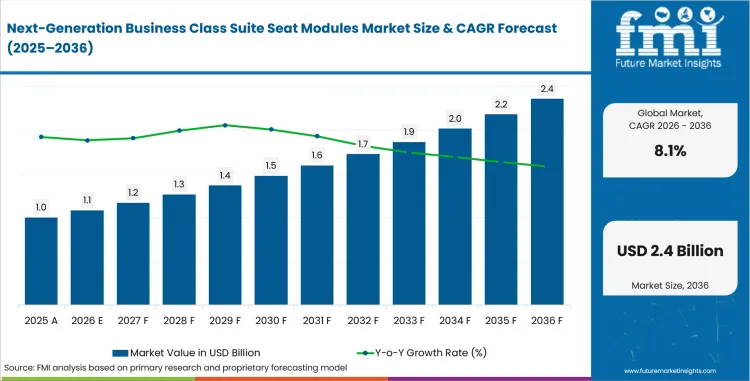
Next-generation business class suite seat modules market surpassed a value of USD 1.0 billion in 2025 and is forecast to reach USD 1.1 billion in 2026. Revenue is expected to reach USD 2.4 billion by 2036 at 8.1% CAGR during the forecast period. Privacy-door suite modules are forecast to lead module type demand with 62.0% share in 2026. Wide-body aircraft are expected to hold 57.0% of aircraft platform demand in 2026.
Key Takeaways, Market Size, and Forecast
- Next-generation business class suite seat modules market stood at USD 1.0 billion in 2025.
- By 2036, industry revenue is forecast to reach USD 2.4 billion.
- Market value is expected to expand at 8.1% CAGR across the forecast period.
- Revenue is predicted to add USD 1.3 billion in incremental opportunity over 2026 to 2036.
- Privacy-door suite modules are expected to lead with 62.0% share in 2026.
- Wide-body aircraft are anticipated to represent 57.0% of aircraft platform demand in 2026.
- India at 9.6% CAGR and China at 9.1% CAGR lead country-level expansion during the forecast period.
Summary of the Next-Generation Business Class Suite Seat Modules Market
- Demand and Growth Drivers
- Airlines are adding enclosed business suites as premium passengers pay for privacy and better sleep quality on long routes.
- Wide-body delivery backlogs support suite programs since business cabins carry higher seat value than standard cabin rows.
- Supplier choice now depends on certification readiness and module repeatability as complex custom suites can delay aircraft acceptance.
- Product and Segment View
- Privacy-door suite modules lead as airline brands use enclosed space to protect premium fares on long-haul networks.
- Reverse herringbone layouts attract airline interest since direct aisle access can be delivered with good bed length and cabin density.
- Powered comfort packages add value through motorized recline and seat memory controls in premium suites.
- Geography and Competitive Outlook
- India and China are expected to expand faster as international network expansion raises demand for wide-body and long-range narrow-body cabins.
- United States and Europe continue as main design approval centers through aircraft OEMs and certified seat suppliers.
- Suppliers with certified suite doors and repeatable module platforms have better access to airline retrofit programs.
- Analyst Opinion
- Nikhil Kaitwade, Principal Consultant at FMI says, “Premium cabin seats are becoming aircraft acceptance items. Comfort products must pass a tougher delivery test. Airlines want suites able to protect fare yield and arrive on time. Suppliers combining certified privacy doors and reliable actuation will secure better access to new wide-body programs and retrofit decisions.”
- Next-Generation Business Class Suite Seat Modules Market Value Analysis
- Suite modules add value as airlines turn limited cabin floor area into higher fare inventory on long-haul routes.
- Privacy doors and aisle-access structures raise module pricing since certification covers latching and passenger movement.
- Wide-body aircraft keep demand active since premium cabin count and route length justify higher module spend per aircraft.
- OEM line fit is the main route since suite monuments must match aircraft layout and safety approval before delivery.
- Suppliers with repeatable platforms lower redesign effort for airlines seeking brand-specific trim without a new seat program.
Business class suite modules are moving from premium seat styling toward safety-approved private cabin products. In August 2024, FAA Exemption No. 22742 covered American Airlines’ request for relief from 14 CFR 25.813(e) and 121.310(f)(5) and (6) to install 70 passenger mini-suites with doors. The filing shows that door-equipped suites need evacuation and crew-procedure clearance before cabin rollout. In June 2025, Safran and ANA unveiled THE Room FX for wide-body aircraft.
The seat has a privacy door for each seat and is planned for long-haul international routes from 2026. In October 2025, RECARO and LATAM prepared the R7 long-haul business class seat for B787-8 and B787-9 retrofit work. RECARO said the 24 shipset retrofit includes increased shell height and suite doors for better privacy. These moves give seat suppliers a clearer route into premium cabin programs as airlines shift from open lie-flat seats toward certified enclosed suites.
Next-Generation Business Class Suite Seat Modules Market Definition
Next-generation business class suite seat modules refer to certified premium aircraft seating systems built for business class cabins. These modules combine lie-flat seating with privacy features and passenger comfort controls. A suite module usually includes the seat structure, privacy shell and integrated console. It may include powered recline, personal storage and digital controls when supplied as part of the approved cabin package. Airlines use these modules to create a more private and comfortable long-haul travel experience.
Next-Generation Business Class Suite Seat Modules Market Inclusions
Market inclusions cover certified business class suite seat modules categorized by module type, including privacy-door suites and open suites. Aircraft platform includes wide-body aircraft and long-range narrow-body aircraft. Fitment route includes OEM line fit and airline retrofit programs. Suite layout includes reverse herringbone and staggered configurations. Feature package includes powered comfort systems and digital display modules.
The inclusions also cover integrated seat shells, privacy panels, storage consoles and approved passenger control systems when supplied as part of a certified suite seat package. Revenue scope covers 2026 to 2036. Key stakeholders include airlines and aircraft OEMs. Certified seat suppliers, cabin interior integrators and MRO providers are included when they support suite design, installation or approved replacement work.
Next-Generation Business Class Suite Seat Modules Market Exclusions
Scope excludes economy seats and standard recliner business seats lacking suite-level enclosure. Premium economy seats are outside scope unless sold with enclosed business suite features. Standalone IFE screens and cabin lighting are excluded unless supplied inside a certified suite seat package. VIP private-jet interiors are excluded unless the product is sold as a repeatable business class module.
Next-Generation Business Class Suite Seat Modules Market Research Methodology
- Primary Research: FMI analysts reviewed certified seat suppliers and airline cabin programs across major aviation countries.
- Desk Research: Public aviation traffic data and official supplier releases supported checks against premium cabin activity.
- Market Sizing and Forecasting: Market size was estimated through wide-body deliveries, retrofit cycles and suite module value per aircraft.
- Data Validation: Forecast checks compared aircraft backlogs, premium traffic signals and supplier capacity across major seat manufacturers.
Why is the Next-Generation Business Class Suite Seat Modules Market Growing?
- Premium fare protection is increasing demand for privacy-door suites as airlines use enclosed business seats to protect long-haul revenue.
- Wide-body and long-range narrow-body programs need certified suites that can pass layout approval without delaying aircraft handover.
- Airline retrofit planning creates opportunity as older business cabins lose appeal against suites with doors and larger displays.
Suite demand is rising as premium cabins become more specific to route and brand. IATA reported 4.8 billion passengers in 2024 in its June 2025 annual review. Higher air travel volume widens the pool of long-haul premium travelers. Airline cabin planners now use privacy and inflight retail and advertising signals to defend fare levels on competitive international routes.
OEM and retrofit programs support high-value modules because suite selection starts early in cabin engineering. Airbus recorded 1,000 gross commercial aircraft orders from 57 customers in 2025. New order flow gives seatmakers a longer planning window for certified interiors. Large backlogs create a long planning window for certified interiors. Seatmakers need platforms able to reduce airline-specific engineering work and protect aircraft acceptance timing.
Market Segmentation Analysis
- In 2026, privacy-door suite modules are expected to lead module type demand with 62.0% share.
- Long-haul cabin economics are expected to support wide-body aircraft with 57.0% share in 2026.
- OEM line fit is forecast to hold 63.0% share in the same year.
- Reverse herringbone layouts are anticipated to account for 44.0% share in 2026.
- Powered comfort packages are likely to represent 48.0% share in 2026.
The market is divided into five primary segment groups based on module type and aircraft platform. Fitment route, suite layout and feature package complete the structure. Module type covers privacy-door suites and open suites. Front-row suite modules and companion suite modules complete the group. Aircraft platform covers wide-body aircraft and long-range narrow-body aircraft. Retrofit wide-body aircraft and business jets complete the aircraft scope.
Fitment route covers OEM line fit and airline retrofit. MRO installation and leased aircraft refurbishment complete the fitment scope. Suite layout covers reverse herringbone and staggered systems. Forward-facing and angled layouts are included for selected cabin plans. Feature package covers powered comfort and digital display systems. Storage console packages and aircraft seat actuation systems complete the premium module control scope.
Insights into Next-Generation Business Class Suite Seat Modules Market by Module Type
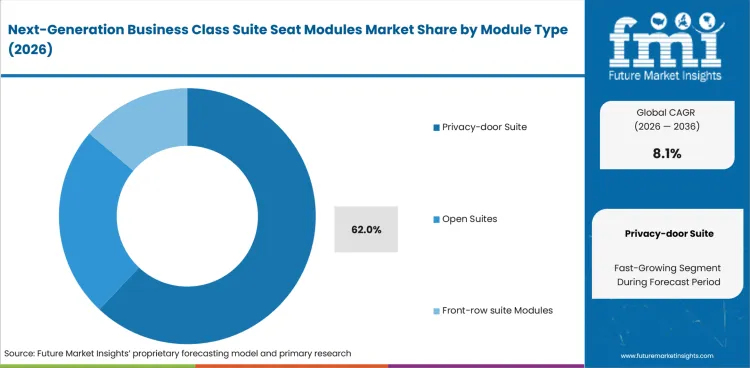
- Privacy-door suite modules are expected to hold 62.0% share in 2026. Airlines prefer them because enclosed seating gives premium passengers more privacy on long flights.
- Open suites work for aircraft programs that need lower weight and easier maintenance access. Front-row suite modules support higher fare seats because larger forward spaces can be sold as a premium option.
Insights into Next-Generation Business Class Suite Seat Modules Market by Aircraft Platform
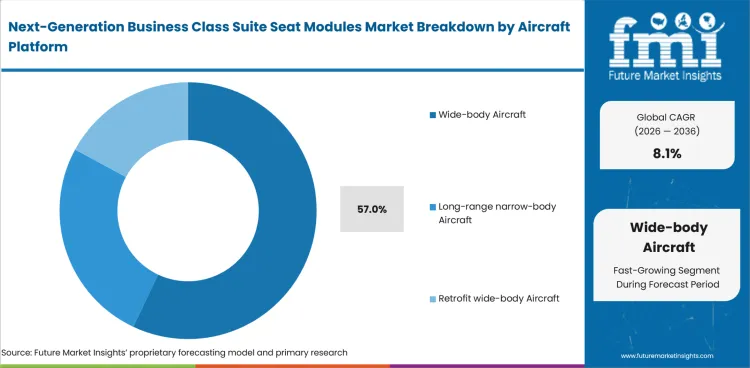
- Wide-body aircraft are likely to account for 57.0% share in 2026. Long-haul aircraft carry more premium passengers, so airlines can justify enclosed modules with higher seat value.
- Long-range narrow-body aircraft support premium cabins on thinner international routes. Retrofit wide-body aircraft create demand for modules that match older aircraft structures and newer cabin standards.
Insights into Next-Generation Business Class Suite Seat Modules Market by Fitment Route
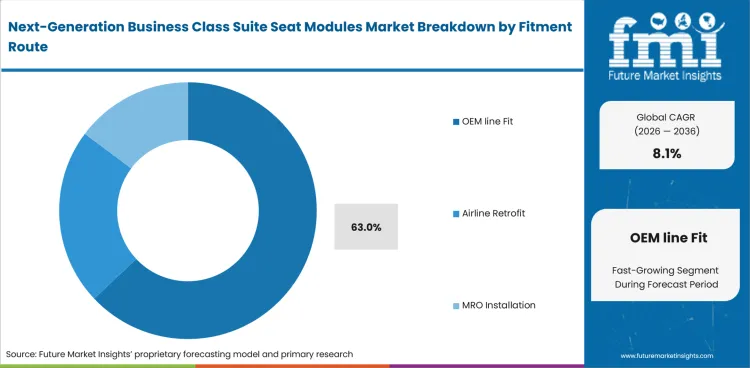
- OEM line fit is expected to hold 63.0% share in 2026. Suite doors and power systems need cabin approval before aircraft delivery, so early fitment is safer for airline schedules.
- Airline retrofit demand is active as carriers update older business cabins. aircraft refurbishing work supports seat replacement when operators combine suite upgrades with cabin trim changes.
Insights into Next-Generation Business Class Suite Seat Modules Market by Suite Layout
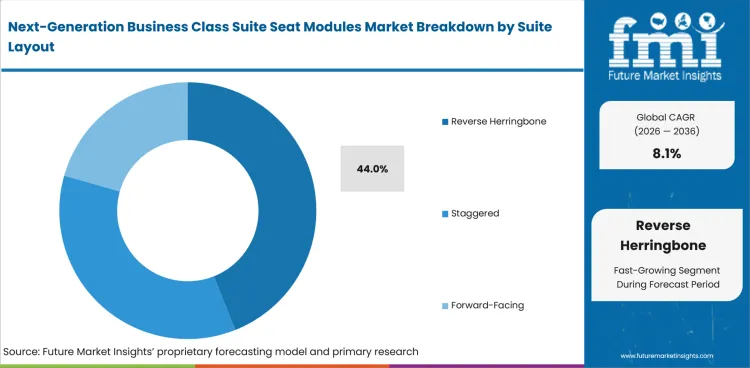
- Reverse herringbone layouts are forecast to account for 44.0% share in 2026. Airlines use them because passengers get direct aisle access without giving up too much cabin space.
- Staggered layouts fit cabins that need a denser business class plan. Forward-facing designs support airlines that want simpler passenger movement and easier module placement.
Insights into Next-Generation Business Class Suite Seat Modules Market by Feature Package
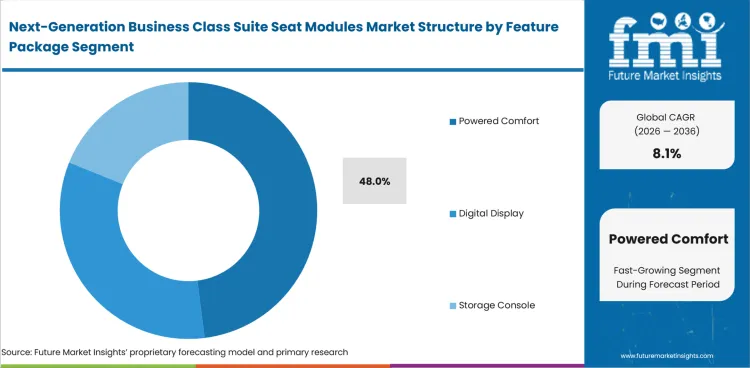
- Powered comfort packages are anticipated to hold 48.0% share in 2026. Motorized recline and seat memory controls make the suite easier to use across sleep and work needs.
- Digital display packages support larger screens and better passenger controls. Storage consoles and seat-level thermal comfort systems add personal comfort around each suite.
Next-Generation Business Class Suite Seat Modules Market Drivers, Restraints, and Opportunities
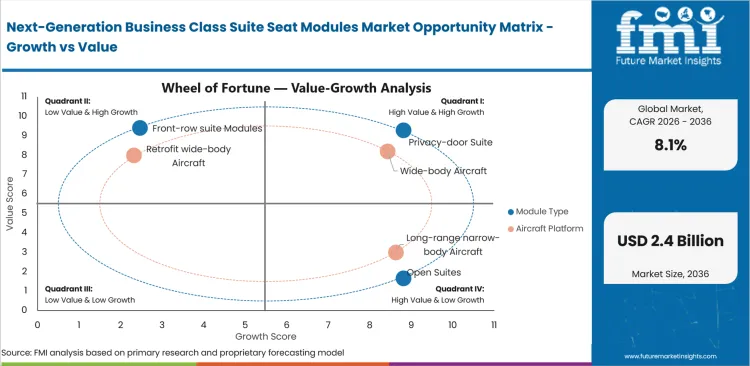
- Premium fare yield is increasing demand for privacy-door suites as airlines use enclosed business seats to protect long-haul revenue.
- Certification and supply limits can slow new suite programs since doors, actuators and shells must pass aircraft-level approval.
- Standardized suite platforms create opportunity as airlines seek brand-specific trim with less custom engineering work.
Privacy Doors Lift Premium Cabin Yield
Business class seat choice is now a revenue decision for long-haul airlines. Enclosed suites help carriers create a clear difference between standard business seating and top-tier business products. Air New Zealand lists Business Premier Luxe on Boeing 787-9 aircraft with enhanced privacy and a sliding door. Such products show how airlines are turning the first business rows into higher-value seat choices. Practical value shifts toward better return per premium row and tighter pressure on suppliers to package privacy, power and maintenance access in one certified module.
Certification Effort Slows Custom Suites
Suite modules face a tougher approval path than standard seats since doors and shells affect evacuation and cabin safety. Aircraft Interiors Expo has become a key venue for airlines and cabin suppliers to compare certified interior options. Planning cycles pull in aviation test equipment because test evidence decides whether a suite can enter service on schedule. Certification effort can slow smaller suppliers if crash testing and flammability proof are not ready early.
Competitive Landscape and Strategic Positioning
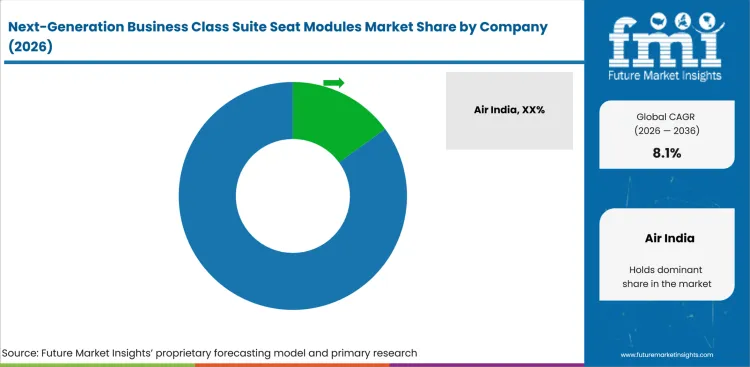
- Competition is focused on certified suite platforms and privacy-door systems that airlines can install without delaying aircraft delivery.
- Suppliers gain stronger program access when they offer a complete module package with the seat shell, actuation system and approval documents already aligned.
- Airline programs prefer vendors that can match brand-specific cabin design while still meeting safety, weight and delivery requirements.
- New entrants face high barriers because suite modules must pass flammability checks and aircraft layout approval before commercial use.
Competitive positioning depends on how well suppliers turn premium seat design into repeatable certified modules. Safran Seats holds depth across Unity and Optima business suite programs. Collins Aerospace adds scale through integrated interiors and business class seating components. Airbus Atlantic supports STELIA Aerospace premium seats through OPERA and RENDEZ-VOUS platforms.
Specialist suppliers follow a focused route. JAMCO supports business class seating through Venture and Quest work. Unum Aircraft Seating targets lighter business class platforms for airlines seeking a credible alternative to larger suppliers. Material control and seat certification decide which vendors can scale from mock-up to fleet fit. Related aircraft maintenance repair and overhaul demand supports retrofit work once cabins enter service.
Key Companies in the Next-Generation Business Class Suite Seat Modules Market
- Premium Suite Platform Leaders: Safran Seats and Collins Aerospace hold strong positions through certified business class platforms and global support reach.
- Business Class Seat Specialists: Thompson Aero Seating and RECARO Aircraft Seating hold focused platform families and certified aircraft program access.
- Emerging and Program-Specific Suppliers: Airbus Atlantic, JAMCO Corporation and Unum Aircraft Seating support premium suite demand through specialized designs and targeted airline programs.
Competitive Benchmarking: Next-Generation Business Class Suite Seat Modules Market
| Company | Suite Platform Depth | Door Certification Readiness | Actuation Integration | Geographic Footprint |
|---|---|---|---|---|
| Safran Seats | High | High | High | Global with French strength |
| Collins Aerospace | High | Medium | High | Global with USA strength |
| Thompson Aero Seating | High | High | Medium | UK centered with global airline reach |
| RECARO Aircraft Seating | Medium | Medium | Medium | Germany centered with global programs |
| Airbus Atlantic | High | High | Medium | Europe centered premium seats |
| JAMCO Corporation | Medium | Medium | Medium | Japan centered with 787 depth |
| Unum Aircraft Seating | Medium | Medium | Medium | UK focused specialist |
Source: Future Market Insights competitive analysis, 2026.
Key Developments in Next-Generation Business Class Suite Seat Modules Market
- In April 2026, Air India unveiled its first retrofitted B787-8 with 20 private business class suites. The aircraft also includes new cabin interiors and upgraded inflight entertainment. This development supports demand for certified private suites in wide-body retrofit programs.
- In April 2026, Thompson Aero Seating announced Delta Air Lines as the launch customer for VantageNOVA. The platform is a premium angled seat for twin-aisle aircraft and extends Thompson’s Vantage seating family.
Key Players in the Next-Generation Business Class Suite Seat Modules Market
Major Global Players
- Safran Seats
- Collins Aerospace
- Thompson Aero Seating
- RECARO Aircraft Seating
- Airbus Atlantic
Specialist and Regional Players
- JAMCO Corporation
- Unum Aircraft Seating
- Adient Aerospace
Analysis of Next-Generation Business Class Suite Seat Modules Market by Key Countries
.webp "Top Country Growth Comparison Next Generation Business Class Suite Seat Modules Market Cagr (2026 2036)")
| Country | CAGR |
|---|---|
| United States | 7.4% |
| China | 9.1% |
| India | 9.6% |
| Germany | 7.8% |
| France | 8.0% |
| Japan | 7.5% |
| United Kingdom | 7.7% |
Source: Future Market Insights, 2026.
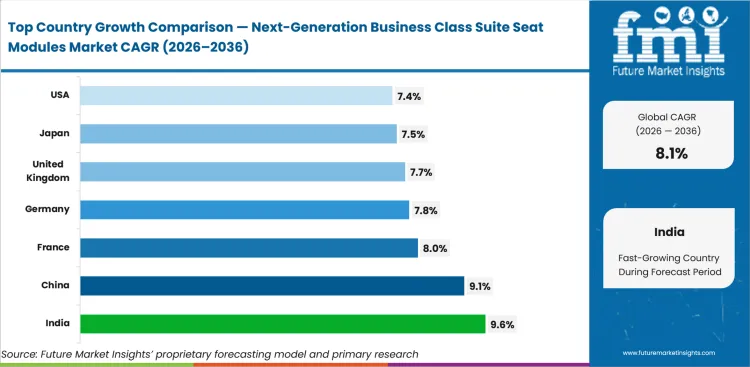
Sales Analysis of Next-Generation Business Class Suite Seat Modules Market in India
Fastest-growing country market | 2026 to 2036
India Market Outlook
India is projected to record 9.6% CAGR from 2026 to 2036, making it the fastest-growing country market in the next-generation business class suite seat modules market. Demand is moving beyond domestic scale as Indian carriers expand long-haul aircraft programs and premium international services.
Airline fleet renewal is opening demand for privacy-door suites and wide-body cabin retrofits. India’s aviation reform path also gives suppliers a clearer route for certified cabin products as airline networks mature.
Key Growth Drivers
- Long-haul fleet renewal is creating demand for premium cabin modules, with Air India stating in April 2026 that its Boeing 787 retrofit program will upgrade onboard products on more than 300 weekly flights after full completion.
- Domestic passenger scale is widening the route base for premium products, with PIB reporting that India crossed 500,000 domestic air passengers in a single day during 2024.
- Aviation reform is improving market structure, with the Bharatiya Vayuyan Adhiniyam 2024 replacing the Aircraft Act of 1934 and modernizing India’s civil aviation legal base.
- Fleet expansion planning is lifting suite module opportunity, with PIB noting that India’s commercial airline fleet is projected to rise from 400 aircraft in 2014 to around 2,359 by March 2040.
Key Restraints
- Certification review can slow cabin retrofit timelines as new suite modules need approval across seat structure and cabin safety rules.
- Premium suite demand is still concentrated among a limited number of long-haul operators, which narrows near-term supplier access outside flagship airline programs.
- Airline cost pressure can delay cabin upgrade work, with Indian domestic traffic estimated at 146.8 lakh passengers in March 2026 and capacity deployment 3.0% lower than March 2025.
What makes India unique
India combines the fastest country CAGR with a shift from domestic aviation scale toward international premium cabin planning. Wide-body retrofits and long-range route additions make India a direct growth market for privacy-door suite modules.
Key Companies
- Air India
- Air India Engineering Services Limited
- Air Works Group
Sales & Marketing Channels
- OEM line-fit programs
- Airline retrofit programs
- MRO cabin upgrade contracts
- Aircraft leasing refurbishment channels
- Certified cabin equipment distributors
Market Taxonomy & Sub-Regions Covered
| Segment | Sub-Segments |
|---|---|
| By Module Type | Privacy-door suites · Open suites · Front-row suite modules · Companion suite modules |
| By Aircraft Platform | Wide-body aircraft · Long-range narrow-body aircraft · Retrofit wide-body aircraft · Business jets |
| By Fitment Route | OEM line fit · Airline retrofit · MRO installation · Leased aircraft refurbishment |
| By Suite Layout | Reverse herringbone · Staggered · Forward-facing · Angled |
| By Feature Package | Powered comfort · Digital display · Storage console · Ambient lighting |
| Key Sub-Regions Covered | Delhi NCR · Maharashtra · Karnataka · Telangana · Tamil Nadu · Gujarat |
Frequently Asked Questions
How fast is India’s next-generation business class suite seat modules market growing?
India is forecast to expand at 9.6% CAGR between 2026 and 2036, placing it first among the listed country markets.
What is driving demand in India?
Demand is led by wide-body retrofit activity and airline plans to improve premium cabin quality.
Which segment leads in India?
Privacy-door suites lead module type demand with 62.0% share in 2026 because enclosed seating gives airlines a clearer premium product tier.
Sales Analysis of Next-Generation Business Class Suite Seat Modules Market in China
Second-fastest country market | 2026 to 2036
China Market Outlook
China is forecast to expand at 9.1% CAGR during the forecast period. Airline traffic scale and international route recovery are lifting premium cabin planning. Suite demand is driven by long-haul service competition and airline efforts to improve passenger comfort on trunk routes.
China also has a large aircraft operating base. Local aviation programs and global wide-body operations create demand for certified seat modules that can meet CAAC approval requirements.
Key Growth Drivers
- Airport passenger throughput is lifting premium cabin planning, with CAAC reporting 1,529.046 million passenger trips through commercial airports in 2025.
- International route recovery is improving suite demand, with CAAC reporting 117.796 million international route passengers in 2025, up 18.7% from the prior year.
- Fleet scale is creating a broad retrofit base, with CAAC reporting 4,574 commercial aircraft by the end of 2025.
- Airline network depth is widening business cabin use, with CAAC reporting 5,488 scheduled routes by the end of 2025.
Key Restraints
- CAAC documentation rules can slow supplier entry because aircraft seating systems need instructions for maintenance and repair across continued airworthiness.
- Imported suite platforms face validation work, as FAA and CAAC airworthiness procedures require authority-level resolution when certification interpretation differs.
- Local aircraft programs are still building premium cabin scale, with domestically manufactured aircraft representing 220 of China’s commercial aircraft fleet by the end of 2025.
What makes China unique
China has a large airport passenger base and fast international route recovery. That combination gives airlines a wider reason to invest in enclosed business class suites for long-haul services.
Key Companies
- AVIC Cabin Systems
- COMAC
- HAECO Xiamen
- China Southern Airlines
Sales & Marketing Channels
- CAAC-approved supplier channels
- Airline fleet planning programs
- Domestic aircraft integration routes
- Wide-body retrofit projects
- MRO cabin installation networks
Market Taxonomy & Sub-Regions Covered
| Segment | Sub-Segments |
|---|---|
| By Module Type | Privacy-door suites · Open suites · Front-row suite modules · Companion suite modules |
| By Aircraft Platform | Wide-body aircraft · Long-range narrow-body aircraft · Retrofit wide-body aircraft · Business jets |
| By Fitment Route | OEM line fit · Airline retrofit · MRO installation · Leased aircraft refurbishment |
| By Suite Layout | Reverse herringbone · Staggered · Forward-facing · Angled |
| By Feature Package | Powered comfort · Digital display · Storage console · Ambient lighting |
| Key Sub-Regions Covered | Beijing · Shanghai · Guangdong · Sichuan · Zhejiang · Jiangsu |
Frequently Asked Questions
How fast is China’s next-generation business class suite seat modules market growing?
China is projected to grow at 9.1% CAGR from 2026 to 2036, ranking second among the listed country markets.
What is driving demand in China?
Demand comes from international route recovery and large airport throughput. Airline fleet depth across major hubs adds another demand route.
Which segment leads in China?
Privacy-door suites lead module type demand with 62.0% share in 2026 because premium international routes need more differentiated business cabins.
Sales Analysis of Next-Generation Business Class Suite Seat Modules Market in France
High-growth European country market | 2026 to 2036
France Market Outlook
France is forecast to expand at 8.0% CAGR by 2036 as local aerospace strength supports premium cabin development. Aircraft seat suppliers in France have direct capability in privacy-door suites and staggered layouts. Front-row premium products give suppliers another way to stand out.
France is also an export-centered aerospace base. Premium seat platforms developed in France are sold into global airline programs, making the country important for both domestic demand and international suite module supply.
Key Growth Drivers
- Aerospace production depth is lifting suite module capability, with GIFAS reporting French aerospace revenue of EUR 85.6 billion in 2025.
- Export scale is improving supplier reach, with GIFAS reporting French aerospace exports of EUR 59.4 billion in 2025.
- Aircraft order flow is keeping cabin suppliers active, with GIFAS reporting order intake of EUR 88.6 billion in 2025.
- Airbus backlog creates long-term line-fit opportunity, with Airbus reporting 8,754 commercial aircraft in backlog at the end of 2025.
Key Restraints
- EASA CS-25 evacuation rules can restrict suite door and partition design because each passenger area must allow rapid evacuation in crash landing conditions.
- Supply pressure can affect cabin delivery timing, as Airbus reported 1,124 wide-body aircraft in backlog at year-end 2025 and suppliers must keep pace with aircraft production plans.
- French traffic weakness can slow airline cabin spending, with government aviation statistics showing April 2026 passenger traffic down 3.2% year over year.
What makes France unique
France is both a premium suite design base and a global aircraft manufacturing center. This gives French suppliers a direct role in certified privacy-door suite programs for wide-body aircraft.
Key Companies
- Safran Seats
- STELIA Aerospace
- Airbus Atlantic
- Air France
Sales & Marketing Channels
- Airbus cabin integration routes
- Airline premium cabin programs
- Export-led seat platform supply
- Aircraft interiors exhibitions
- Retrofit and refurbishment channels
Market Taxonomy & Sub-Regions Covered
| Segment | Sub-Segments |
|---|---|
| By Module Type | Privacy-door suites · Open suites · Front-row suite modules · Companion suite modules |
| By Aircraft Platform | Wide-body aircraft · Long-range narrow-body aircraft · Retrofit wide-body aircraft · Business jets |
| By Fitment Route | OEM line fit · Airline retrofit · MRO installation · Leased aircraft refurbishment |
| By Suite Layout | Reverse herringbone · Staggered · Forward-facing · Angled |
| By Feature Package | Powered comfort · Digital display · Storage console · Ambient lighting |
| Key Sub-Regions Covered | Île-de-France · Occitanie · Nouvelle-Aquitaine · Provence-Alpes-Côte d’Azur · Auvergne-Rhône-Alpes · Pays de la Loire |
Frequently Asked Questions
How fast is France’s next-generation business class suite seat modules market growing?
France is forecast to expand at 8.0% CAGR from 2026 to 2036.
What is driving demand in France?
Demand is led by aerospace manufacturing depth and premium seat design capability. Wide-body aircraft line-fit opportunities add another demand route.
Which segment leads in France?
Privacy-door suites lead module type demand with 62.0% share in 2026 because French suppliers have strong capability in enclosed business class products.
Sales Analysis of Next-Generation Business Class Suite Seat Modules Market in Germany
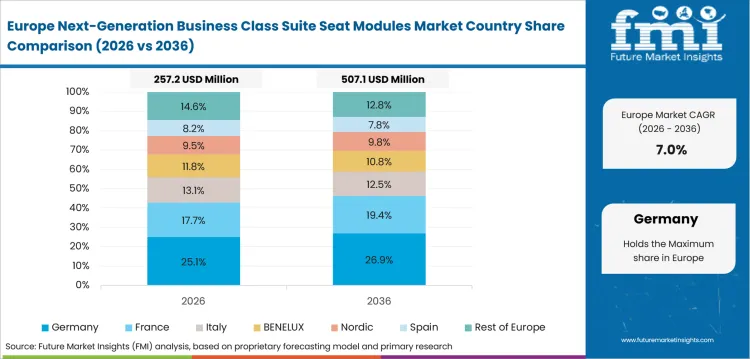
Certified cabin supply country market | 2026 to 2036
Germany Market Outlook
Germany is projected to expand at 7.8% CAGR by 2036. Airline product refresh cycles and aerospace supplier strength create demand for certified business class modules. Local capability in aircraft seating and cabin systems gives Germany a clear premium cabin role. Aircraft maintenance activity adds another route for retrofit and upgrade demand
German demand is also supported by long-haul carrier programs. Premium cabin modules need repeatable platforms and reliable installation paths for airline acceptance.
Key Growth Drivers
- Aerospace supplier scale is lifting cabin equipment capability, with BDLI reporting German aerospace revenue of EUR 62.0 billion in 2025.
- Skilled production depth is improving aircraft interiors capacity, with BDLI reporting 130,000 aerospace employees in 2025.
- Lufthansa premium cabin renewal is creating suite demand, with Allegris Business Class seats made available for booking on flights departing March 29, 2026.
- RECARO Aircraft Seating adds local platform strength, with the company confirming Schwäbisch Hall in Germany as its headquarters.
Key Restraints
- EASA cabin safety rules can slow custom suite designs because passenger areas must allow rapid evacuation under CS-25 requirements.
- Supplier capacity can face pressure during production ramp-up, as BDLI reported revenue growth of 19.0% in 2025 after a prior-year level of EUR 52.0 billion.
- Certification timing can delay premium product monetization, as aircraft seat approvals must align with airline launch dates before seats can be sold.
What makes Germany unique
Germany combines a premium long-haul airline base with specialist seating and MRO capability. This creates a direct route for certified retrofit work and business class platform supply.
Key Companies
- RECARO Aircraft Seating
- Lufthansa Technik
- Diehl Aviation
- Lufthansa
Sales & Marketing Channels
- Airline product renewal programs
- Certified seating platform supply
- MRO retrofit contracts
- OEM cabin coordination
- Aircraft interiors supplier networks
Market Taxonomy & Sub-Regions Covered
| Segment | Sub-Segments |
|---|---|
| By Module Type | Privacy-door suites · Open suites · Front-row suite modules · Companion suite modules |
| By Aircraft Platform | Wide-body aircraft · Long-range narrow-body aircraft · Retrofit wide-body aircraft · Business jets |
| By Fitment Route | OEM line fit · Airline retrofit · MRO installation · Leased aircraft refurbishment |
| By Suite Layout | Reverse herringbone · Staggered · Forward-facing · Angled |
| By Feature Package | Powered comfort · Digital display · Storage console · Ambient lighting |
| Key Sub-Regions Covered | Bavaria · Baden-Württemberg · Hesse · Hamburg · North Rhine-Westphalia · Lower Saxony |
Frequently Asked Questions
How fast is Germany’s next-generation business class suite seat modules market growing?
Germany is expected to expand at 7.8% CAGR by 2036.
What is driving demand in Germany?
Demand is led by aircraft seating expertise and premium airline cabin refresh programs. Aerospace supplier depth adds another route for certified module demand.
Which segment leads in Germany?
Privacy-door suites lead module type demand with 62.0% share in 2026 because long-haul airlines use enclosed modules to improve business cabin value.
Sales Analysis of Next-Generation Business Class Suite Seat Modules Market in the United Kingdom
Specialist premium seat country market | 2026 to 2036
United Kingdom Market Outlook
United Kingdom demand is forecast to rise at 7.7% CAGR through 2036. Airline passenger traffic and specialist seat manufacturing give the country a solid role in premium cabin programs.
The United Kingdom is especially relevant in business class suite supply because local specialists serve global airline programs. Retrofit demand also benefits from long-haul carrier activity and MRO access across major aviation hubs.
Key Growth Drivers
- Passenger scale is strengthening premium cabin investment, with UK CAA reporting 302.0 million passenger journeys through UK airports in 2025.
- UK cabin specialists are widening premium seat options, with Unum Aircraft Seating stating that Unum Two has a 21.5-inch wide seat with a privacy door and direct aisle access.
- UK cabin specialists are widening direct aisle access options, with Unum Aircraft Seating presenting Unum Two as a forward-facing lie-flat business class seat.
Key Restraints
- UK CAA CS 26.50 requires operators of large aeroplanes to ensure flight or cabin crew seats and restraint systems protect occupants and allow rapid egress, raising compliance work for cabin changes.
- Air traffic punctuality can affect airline upgrade planning, with UK CAA-linked reporting showing 73.0% of departures operated on time in 2025.
- Retrofitting premium suites can add aircraft downtime, making airline scheduling more difficult during peak travel periods.
What makes the United Kingdom unique
United Kingdom suppliers hold a strong specialist position in business class seating. Local companies compete through platform engineering and retrofit-ready products for global airlines.
Key Companies
- Thompson Aero Seating
- Unum Aircraft Seating
- British Airways
- Virgin Atlantic
Sales & Marketing Channels
- Airline retrofit contracts
- Premium seat platform exports
- Aircraft Interiors Expo programs
- MRO installation routes
- Leasing refurbishment channels
Market Taxonomy & Sub-Regions Covered
| Segment | Sub-Segments |
|---|---|
| By Module Type | Privacy-door suites · Open suites · Front-row suite modules · Companion suite modules |
| By Aircraft Platform | Wide-body aircraft · Long-range narrow-body aircraft · Retrofit wide-body aircraft · Business jets |
| By Fitment Route | OEM line fit · Airline retrofit · MRO installation · Leased aircraft refurbishment |
| By Suite Layout | Reverse herringbone · Staggered · Forward-facing · Angled |
| By Feature Package | Powered comfort · Digital display · Storage console · Ambient lighting |
| Key Sub-Regions Covered | England · Northern Ireland · Scotland · Wales · Greater London · South East England |
Frequently Asked Questions
How fast is the United Kingdom’s next-generation business class suite seat modules market growing?
United Kingdom demand is forecast to expand at 7.7% CAGR from 2026 to 2036.
What is driving demand in the United Kingdom?
Demand is led by specialist premium seating suppliers and passenger traffic recovery. Airline retrofit activity adds another route for certified module demand.
Which segment leads in the United Kingdom?
Privacy-door suites lead module type demand with 62.0% share in 2026 because long-haul carriers need enclosed cabins to improve premium service quality.
Sales Analysis of Next-Generation Business Class Suite Seat Modules Market in Japan
Premium airline refresh country market | 2026 to 2036
Japan Market Outlook
Japan is forecast to expand at 7.5% CAGR during the forecast period. Airline product refresh cycles and aerospace component depth create demand for next-generation business class suite modules. Long-haul aircraft cabins remain central to Japan’s premium passenger offer.
Japanese demand is led by premium airline programs that value seating comfort and careful cabin integration. Supplier depth helps local firms support certified aircraft interiors and related components.
Key Growth Drivers
- Premium cabin planning is supported by international route use. Long-haul carriers need business class products that protect privacy and keep passenger comfort consistent on international services.
- Premium cabin planning is supported by international route use. Long-haul carriers need business class products that protect privacy and keep passenger comfort consistent on international services.
- Aerospace supplier depth improves cabin component access with SJAC bringing together around 130 companies in aircraft and related technologies.
- Japan’s imported aircraft and parts market remains active with the USA International Trade Administration stating in November 2025 that Japan offers a long-term market for imported aircraft and related technologies.
Key Restraints
- Certification procedures can lengthen cabin changes because MLIT aircraft safety guidance covers certification and inspection rules for aircraft modifications.
- Suite demand is concentrated among a small number of long-haul carriers, which limits broad program volume across domestic airlines.
- Supplier scale is narrower than in major aircraft manufacturing countries. Japan’s suite demand is concentrated around long-haul airline programs, so suppliers need approved products that match route-specific cabin plans.
What makes Japan unique
Japan’s suite demand is linked to premium route quality and careful aircraft product execution. ANA’s privacy-door suite programs make Japan an important reference market for Boeing 787 business class upgrades.
Key Companies
- JAMCO Corporation
- All Nippon Airways
- Japan Aircraft Industrial Enhancement Co., Ltd.
- Mitsubishi Heavy Industries
Sales & Marketing Channels
- Airline product refresh programs
- Boeing 787 cabin upgrade routes
- Certified component supply
- Aircraft interior integration channels
- Long-haul premium cabin programs
Market Taxonomy & Sub-Regions Covered
| Segment | Sub-Segments |
|---|---|
| By Module Type | Privacy-door suites · Open suites · Front-row suite modules · Companion suite modules |
| By Aircraft Platform | Wide-body aircraft · Long-range narrow-body aircraft · Retrofit wide-body aircraft · Business jets |
| By Fitment Route | OEM line fit · Airline retrofit · MRO installation · Leased aircraft refurbishment |
| By Suite Layout | Reverse herringbone · Staggered · Forward-facing · Angled |
| By Feature Package | Powered comfort · Digital display · Storage console · Ambient lighting |
| Key Sub-Regions Covered | Tokyo · Aichi · Osaka · Hyogo · Fukuoka · Hokkaido |
Frequently Asked Questions
How fast is Japan’s next-generation business class suite seat modules market growing?
Japan is forecast to expand at 7.5% CAGR from 2026 to 2036.
What is driving demand in Japan?
Demand is led by airline premium cabin refresh cycles with Boeing 787 route use and privacy-door business suite programs.
Which segment leads in Japan?
Privacy-door suites lead module type demand with 62.0% share in 2026 because Japanese long-haul carriers use enclosed cabins to improve premium comfort.
Sales Analysis of Next-Generation Business Class Suite Seat Modules Market in the United States
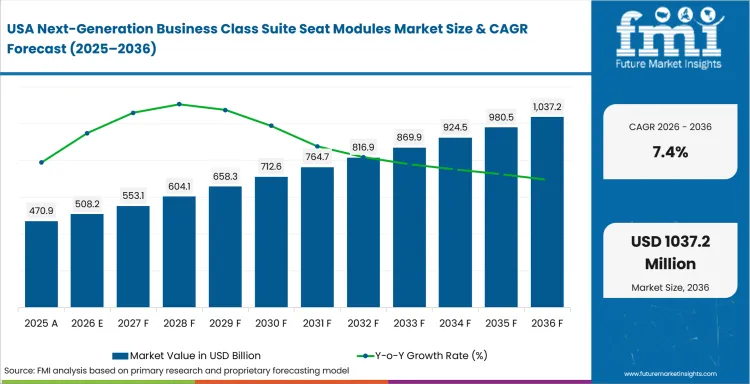
Mature premium cabin replacement market | 2026 to 2036
United States Market Outlook
United States demand is forecast to expand at 7.4% CAGR from 2026 to 2036. The country has a mature premium cabin base, but wide-body replacement and long-haul route competition keep suite module demand active.
United States airlines are moving deeper into enclosed business class products as premium passengers place higher value on privacy and better sleep quality. Seat suppliers also benefit from OEM channels and aircraft certification depth.
Key Growth Drivers
- Airline traffic scale keeps cabin refresh activity active, with BTS reporting 81.2 million systemwide scheduled-service passengers in December 2025.
- Wide-body production planning creates line-fit demand, with Boeing reporting more than 6,100 commercial airplanes in backlog at the end of 2025.
- United’s premium cabin program shows demand for enclosed front-row modules, with Polaris Studio suites stated as 25.0% larger than standard Polaris seats.
- Premium display packages are gaining value, with United reporting 27-inch 4K OLED screens in Polaris Studio suites.
Key Restraints
- FAA approval rules add certification work because 14 CFR 25.785 states that each seat or berth must be approved.
- Traffic softness can delay discretionary cabin spending, with BTS reporting January 2026 systemwide USA airline traffic down 1.8% from the same month in the prior year.
- Complex suite modules raise installation planning needs because doors, restraint systems must meet aircraft safety rules before service entry.
What makes the United States unique
United States demand is supported by premium route competition and a large wide-body operator base. USA carriers are using enclosed suites and front-row products to separate premium cabins from standard business seating.
Key Companies
- Collins Aerospace
- United Airlines
- Adient Aerospace
- Elevate Aircraft Seating
Sales & Marketing Channels
- OEM aircraft delivery programs
- Airline premium cabin refresh cycles
- Retrofit and modification centers
- Aircraft leasing channels
- Certified cabin electronics partners
Market Taxonomy & Sub-Regions Covered
| Segment | Sub-Segments |
|---|---|
| By Module Type | Privacy-door suites · Open suites · Front-row suite modules · Companion suite modules |
| By Aircraft Platform | Wide-body aircraft · Long-range narrow-body aircraft · Retrofit wide-body aircraft · Business jets |
| By Fitment Route | OEM line fit · Airline retrofit · MRO installation · Leased aircraft refurbishment |
| By Suite Layout | Reverse herringbone · Staggered · Forward-facing · Angled |
| By Feature Package | Powered comfort · Digital display · Storage console · Ambient lighting |
| Key Sub-Regions Covered | California · Washington · Texas · Georgia · Illinois · New York |
Frequently Asked Questions
How fast is the United States next-generation business class suite seat modules market growing?
United States demand is projected to expand at 7.4% CAGR from 2026 to 2036.
What is driving demand in the United States?
Demand is led by premium international route competition and airline investment in privacy-door suites.
Which segment leads in the United States?
Privacy-door suites lead module type demand with 62.0% share in 2026 because enclosed seating gives airlines a stronger premium fare product.
Report Scope and Coverage
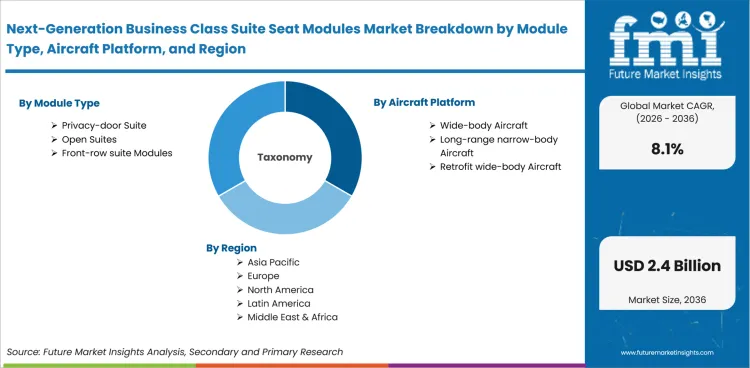
| Parameter | Details |
|---|---|
| Quantitative Units | USD 1.1 billion to USD 2.4 billion at 8.1% CAGR |
| Market Definition | Certified business class suite seat modules with lie-flat seating and privacy features |
| Regions Covered | North America, Latin America, Western Europe, Eastern Europe, East Asia, South Asia and Pacific, Middle East and Africa |
| Countries Covered | United States, China, India, Germany, France, Japan, United Kingdom and other key aviation countries |
| Segments Covered | Module type, aircraft platform, fitment route, suite layout and feature package |
| Key Companies Covered | Safran Seats, Collins Aerospace, Thompson Aero Seating, RECARO Aircraft Seating, Airbus Atlantic, JAMCO Corporation and Unum Aircraft Seating |
| Related Areas | Cabin interiors, premium seats, retrofit services and cabin electronics |
Next-Generation Business Class Suite Seat Modules Market Breakdown by Module Type, Aircraft Platform, Fitment Route, Suite Layout, Feature Package, and Region
Next-Generation Business Class Suite Seat Modules Market Segmented by Module Type
- Privacy-door suites
- Open suites
- Front-row suite modules
- Companion suite modules
Next-Generation Business Class Suite Seat Modules Market Segmented by Aircraft Platform
- Wide-body aircraft
- Long-range narrow-body aircraft
- Retrofit wide-body aircraft
- Business jets
Next-Generation Business Class Suite Seat Modules Market Segmented by Fitment Route
- OEM line fit
- Airline retrofit
- MRO installation
- Leased aircraft refurbishment
Next-Generation Business Class Suite Seat Modules Market Segmented by Suite Layout
- Reverse herringbone
- Staggered
- Forward-facing
- Angled
Next-Generation Business Class Suite Seat Modules Market Segmented by Feature Package
- Powered comfort
- Digital display
- Storage console
- Ambient lighting
Next-Generation Business Class Suite Seat Modules Market by Region
- North America
- Latin America
- Western Europe
- Eastern Europe
- East Asia
- South Asia and Pacific
- Middle East and Africa
Research Sources and Bibliography
- Air India. (2026, April 19). Air India welcomes its first retrofitted B787-8 featuring new cabin interiors and livery. Air India.
- Airbus. (2026, January 12). Airbus reports 793 commercial aircraft deliveries in 2025. Airbus.
- BDLI. (2026, May 27). BDLI industry data 2026: Aerospace industry sets new records for revenue and employment. German Aerospace Industries Association.
- Boeing. (2026, January 27). Boeing reports fourth quarter results. Boeing.
- Bureau of Transportation Statistics. (2026, March 13). December 2025 USA airline traffic data down 2.6% from the same month last year. USA Department of Transportation.
- Bureau of Transportation Statistics. (2026, June 1). January 2026 USA airline traffic data down 1.8% from the same month last year. USA Department of Transportation.
- Civil Aviation Administration of China. (2026, April 3). 2025 national civil transport airport production statistics bulletin. CAAC.
- Civil Aviation Administration of China. (2026, April 22). CAAC releases statistical bulletin of civil aviation industry development in 2025. CAAC.
- Civil Aviation Authority. (2026, February 24). UK aviation officially breaks records with over 300m passenger journeys in 2025. UK Civil Aviation Authority.
- Civil Aviation Authority. (n.d.). CS 26.50 seats, berths, safety belts, and harnesses. UK Civil Aviation Authority.
- Electronic Code of Federal Regulations. (2026, June 2). 14 CFR § 25.785: Seats, berths, safety belts, and harnesses. USA Government Publishing Office.
- Federal Aviation Administration. (2024, August 5). Exemption No. 22742. USA Department of Transportation.
- GIFAS. (2026, May 11). 2025 results: The French aerospace industry remains strongly positioned for the future. GIFAS.
- International Air Transport Association. (2025, June 1). IATA annual review 2025. IATA.
- Lufthansa Group. (2026, February 24). Allegris Business Class seats in the Boeing 787-9 are now available for booking on flights departing from March 29. Lufthansa Group.
- Ministère de la Transition écologique. (2026, May 22). Statistiques du trafic aérien. Government of France.
- Press Information Bureau. (2024, November 18). Aviation sector sees new high as five lakh domestic passengers take to the skies in a single day. Government of India.
- Press Information Bureau. (2025, April 22). India’s aviation revolution. Government of India.
- Press Information Bureau. (2025, October 23). India’s aviation vision 2047. Government of India.
- Safran. (2025, June 17). All Nippon Airways takes business class to new heights with THE Room FX supersized seats. Safran.
- Unum Aircraft Seating. (2023, June 5). Unum delivers maximum comfort at minimum weight with launch of Unum Two. Unum Aircraft Seating.
- United Airlines. (2025, May 13). United unveils the elevated aircraft interior. United Airlines.
This bibliography is provided for reader reference and is not exhaustive. The full report contains the complete reference list and detailed citations.
This Report Answers
- What is the global market demand for next-generation business class suite seat modules in 2026?
- How big will the next-generation business class suite seat modules market be in 2036?
- How much will demand expand during the forecast period?
- Which module type is forecast to lead in 2026?
- Which aircraft platform is forecast to lead demand?
- Which countries are expected to expand faster by 2036?
- How do privacy doors affect business class suite module demand?
- How does FMI estimate the forecast?
Frequently Asked Questions
What is the global demand for next-generation business class suite seat modules in 2026?
In 2026, global next-generation business class suite seat modules demand is estimated at USD 1.1 billion as airline premium cabin programs expand.
How big will the next-generation business class suite seat modules market be in 2036?
By 2036, the market is forecast to reach USD 2.4 billion as privacy-door suites and retrofit programs expand.
How much will demand expand during the forecast period?
Next-generation business class suite seat module demand is expected to expand at 8.1% CAGR from 2026 to 2036.
Which module type is forecast to lead the market in 2026?
Privacy-door suite modules are forecast to lead with 62.0% share in 2026 due to enclosed space and premium fare value.
Which aircraft platform is forecast to lead demand?
Wide-body aircraft are forecast to lead with 57.0% share in 2026 as long-haul cabins justify higher suite value.
Which country will expand fastest in the market?
India is forecast to record 9.6% CAGR through 2036 as fleet expansion and premium international routes lift suite demand.
What does the market include?
Certified business class suite modules include lie-flat seats, privacy doors, consoles and integrated passenger controls.
How does FMI estimate the forecast?
FMI uses aircraft delivery anchors, retrofit activity, supplier developments and premium cabin demand signals to validate the forecast.
Why are privacy doors important in business class suites?
Privacy doors create a clearer premium product tier and support passenger comfort across long-haul sleep and work needs.
Are suite modules used in narrow-body aircraft?
Yes. Long-range narrow-body aircraft use suite modules on thinner international routes needing premium cabins with direct aisle access.
Preview the report firsthand - request a free sample
Get SampleGet the brochure for pricing and purchase details.
Get PDFTable of Content
- Key Takeaways
- Market Size and CAGR
- Top Growth Driver
- Fastest Growing Segment
- Leading Region
- Key Companies
- Emerging Opportunities
- Executive Summary
- Global Market Outlook
- Demand-side Trends
- Supply-side Trends
- Technology Roadmap Analysis
- Analysis and Recommendations
- Analyst Perspective (What is happening? Why now? What should investors know?)
- Key Questions Answered
- How large is the market?
- What is the CAGR?
- What are key trends?
- Which region dominates?
- Who are the leaders?
- Market Overview
- Market Coverage / Taxonomy
- Market Definition / Scope / Limitations
- Research Methodology
- Chapter Orientation
- Analytical Lens and Working Hypotheses
- Market Structure, Signals, and Trend Drivers
- Benchmarking and Cross-market Comparability
- Market Sizing, Forecasting, and Opportunity Mapping
- Research Design and Evidence Framework
- Desk Research Programme (Secondary Evidence)
- Expert Input and Fieldwork (Primary Evidence)
- Tooling, Models, and Reference Databases
- Data Engineering and Model Build
- Quality Assurance and Audit Trail
- Market Background
- Market Dynamics (Drivers, Restraints, Opportunity, Trends)
- Scenario Forecast (Optimistic, Likely, Conservative)
- Impact Analysis
- AI Impact
- Sustainability Impact
- Regulatory Impact
- Technology Impact
- Consumer / Buyer Analysis
- Purchase Drivers
- Adoption Barriers
- Buyer Journey
- Opportunity Map Analysis
- Product Life Cycle Analysis
- Supply Chain Analysis
- Investment Feasibility Matrix
- Value Chain Analysis
- PESTLE and Porter's Analysis
- Regulatory Landscape
- Regional Parent Market Outlook
- Production and Consumption Statistics
- Import and Export Statistics
- Global Market Analysis and Forecast, 2021 to 2036
- Historical Market Size Value (USD Billion) & Volume (Unit) Analysis, 2021 to 2025
- Current and Future Market Size Value (USD Billion) & Volume (Unit) Projections, 2026 to 2036
- Y-o-Y Growth Trend Analysis
- Absolute $ Opportunity Analysis
- Global Market Pricing Analysis, 2021 to 2036
- Global Market Analysis and Forecast, By Module Type, 2021 to 2036
- Introduction / Key Findings
- Historical Market Size Value (USD Billion) & Volume (Unit) Analysis By Module Type, 2021 to 2025
- Current and Future Market Size Value (USD Billion) & Volume (Unit) Analysis and Forecast By Module Type, 2026 to 2036
- Privacy-door suites
- Open suites
- Front-row suite modules
- Companion suite modules
- Privacy-door suites
- Y-o-Y Growth Trend Analysis By Module Type, 2021 to 2025
- Absolute $ Opportunity Analysis By Module Type, 2026 to 2036
- Global Market Analysis and Forecast, By Aircraft Platform, 2021 to 2036
- Introduction / Key Findings
- Historical Market Size Value (USD Billion) & Volume (Unit) Analysis By Aircraft Platform, 2021 to 2025
- Current and Future Market Size Value (USD Billion) & Volume (Unit) Analysis and Forecast By Aircraft Platform, 2026 to 2036
- Wide-body aircraft
- Long-range narrow-body aircraft
- Retrofit wide-body aircraft
- Business jets
- Wide-body aircraft
- Y-o-Y Growth Trend Analysis By Aircraft Platform, 2021 to 2025
- Absolute $ Opportunity Analysis By Aircraft Platform, 2026 to 2036
- Global Market Analysis and Forecast, By Fitment Route, 2021 to 2036
- Introduction / Key Findings
- Historical Market Size Value (USD Billion) & Volume (Unit) Analysis By Fitment Route, 2021 to 2025
- Current and Future Market Size Value (USD Billion) & Volume (Unit) Analysis and Forecast By Fitment Route, 2026 to 2036
- OEM line fit
- Airline retrofit
- MRO installation
- Leased aircraft refurbishment
- OEM line fit
- Y-o-Y Growth Trend Analysis By Fitment Route, 2021 to 2025
- Absolute $ Opportunity Analysis By Fitment Route, 2026 to 2036
- Global Market Analysis and Forecast, By Suite Layout, 2021 to 2036
- Introduction / Key Findings
- Historical Market Size Value (USD Billion) & Volume (Unit) Analysis By Suite Layout, 2021 to 2025
- Current and Future Market Size Value (USD Billion) & Volume (Unit) Analysis and Forecast By Suite Layout, 2026 to 2036
- Reverse herringbone
- Staggered
- Forward-facing
- Angled
- Reverse herringbone
- Y-o-Y Growth Trend Analysis By Suite Layout, 2021 to 2025
- Absolute $ Opportunity Analysis By Suite Layout, 2026 to 2036
- Global Market Analysis and Forecast, By Feature Package, 2021 to 2036
- Introduction / Key Findings
- Historical Market Size Value (USD Billion) & Volume (Unit) Analysis By Feature Package, 2021 to 2025
- Current and Future Market Size Value (USD Billion) & Volume (Unit) Analysis and Forecast By Feature Package, 2026 to 2036
- Powered comfort
- Digital display
- Storage console
- Ambient lighting
- Powered comfort
- Y-o-Y Growth Trend Analysis By Feature Package, 2021 to 2025
- Absolute $ Opportunity Analysis By Feature Package, 2026 to 2036
- Global Market Analysis and Forecast, By Region, 2021 to 2036
- Introduction
- Historical Market Size Value (USD Billion) & Volume (Unit) Analysis By Region, 2021 to 2025
- Current Market Size Value (USD Billion) & Volume (Unit) Analysis and Forecast By Region, 2026 to 2036
- North America
- Latin America
- Western Europe
- Eastern Europe
- East Asia
- South Asia and Pacific
- Middle East & Africa
- Market Attractiveness Analysis By Region
- North America Market Analysis and Forecast, By Country, 2021 to 2036
- Historical Market Size Value (USD Billion) & Volume (Unit) Trend Analysis By Market Taxonomy, 2021 to 2025
- Market Size Value (USD Billion) & Volume (Unit) Forecast By Market Taxonomy, 2026 to 2036
- By Country
- USA
- Canada
- Mexico
- By Module Type
- By Aircraft Platform
- By Fitment Route
- By Suite Layout
- By Feature Package
- By Country
- Market Attractiveness Analysis
- By Country
- By Module Type
- By Aircraft Platform
- By Fitment Route
- By Suite Layout
- By Feature Package
- Key Takeaways
- Latin America Market Analysis and Forecast, By Country
- Historical Market Size Value (USD Billion) & Volume (Unit) Trend Analysis By Market Taxonomy, 2021 to 2025
- Market Size Value (USD Billion) & Volume (Unit) Forecast By Market Taxonomy, 2026 to 2036
- By Country
- Brazil
- Chile
- Rest of Latin America
- By Module Type
- By Aircraft Platform
- By Fitment Route
- By Suite Layout
- By Feature Package
- By Country
- Market Attractiveness Analysis
- By Country
- By Module Type
- By Aircraft Platform
- By Fitment Route
- By Suite Layout
- By Feature Package
- Key Takeaways
- Western Europe Market Analysis and Forecast, By Country
- Historical Market Size Value (USD Billion) & Volume (Unit) Trend Analysis By Market Taxonomy, 2021 to 2025
- Market Size Value (USD Billion) & Volume (Unit) Forecast By Market Taxonomy, 2026 to 2036
- By Country
- Germany
- UK
- Italy
- Spain
- France
- Nordic
- BENELUX
- Rest of Western Europe
- By Module Type
- By Aircraft Platform
- By Fitment Route
- By Suite Layout
- By Feature Package
- By Country
- Market Attractiveness Analysis
- By Country
- By Module Type
- By Aircraft Platform
- By Fitment Route
- By Suite Layout
- By Feature Package
- Key Takeaways
- Eastern Europe Market Analysis and Forecast, By Country
- Historical Market Size Value (USD Billion) & Volume (Unit) Trend Analysis By Market Taxonomy, 2021 to 2025
- Market Size Value (USD Billion) & Volume (Unit) Forecast By Market Taxonomy, 2026 to 2036
- By Country
- Russia
- Poland
- Hungary
- Balkan & Baltic
- Rest of Eastern Europe
- By Module Type
- By Aircraft Platform
- By Fitment Route
- By Suite Layout
- By Feature Package
- By Country
- Market Attractiveness Analysis
- By Country
- By Module Type
- By Aircraft Platform
- By Fitment Route
- By Suite Layout
- By Feature Package
- Key Takeaways
- East Asia Market Analysis and Forecast, By Country
- Historical Market Size Value (USD Billion) & Volume (Unit) Trend Analysis By Market Taxonomy, 2021 to 2025
- Market Size Value (USD Billion) & Volume (Unit) Forecast By Market Taxonomy, 2026 to 2036
- By Country
- China
- Japan
- South Korea
- By Module Type
- By Aircraft Platform
- By Fitment Route
- By Suite Layout
- By Feature Package
- By Country
- Market Attractiveness Analysis
- By Country
- By Module Type
- By Aircraft Platform
- By Fitment Route
- By Suite Layout
- By Feature Package
- Key Takeaways
- South Asia and Pacific Market Analysis and Forecast, By Country
- Historical Market Size Value (USD Billion) & Volume (Unit) Trend Analysis By Market Taxonomy, 2021 to 2025
- Market Size Value (USD Billion) & Volume (Unit) Forecast By Market Taxonomy, 2026 to 2036
- By Country
- India
- ASEAN
- Australia & New Zealand
- Rest of South Asia and Pacific
- By Module Type
- By Aircraft Platform
- By Fitment Route
- By Suite Layout
- By Feature Package
- By Country
- Market Attractiveness Analysis
- By Country
- By Module Type
- By Aircraft Platform
- By Fitment Route
- By Suite Layout
- By Feature Package
- Key Takeaways
- Middle East & Africa Market Analysis and Forecast, By Country
- Historical Market Size Value (USD Billion) & Volume (Unit) Trend Analysis By Market Taxonomy, 2021 to 2025
- Market Size Value (USD Billion) & Volume (Unit) Forecast By Market Taxonomy, 2026 to 2036
- By Country
- Kingdom of Saudi Arabia
- Other GCC Countries
- Türkiye
- South Africa
- Other African Union
- Rest of Middle East & Africa
- By Module Type
- By Aircraft Platform
- By Fitment Route
- By Suite Layout
- By Feature Package
- By Country
- Market Attractiveness Analysis
- By Country
- By Module Type
- By Aircraft Platform
- By Fitment Route
- By Suite Layout
- By Feature Package
- Key Takeaways
- Key Countries Market Analysis
- USA
- Pricing Analysis
- Market Share Analysis, 2025
- By Module Type
- By Aircraft Platform
- By Fitment Route
- By Suite Layout
- By Feature Package
- Canada
- Pricing Analysis
- Market Share Analysis, 2025
- By Module Type
- By Aircraft Platform
- By Fitment Route
- By Suite Layout
- By Feature Package
- Mexico
- Pricing Analysis
- Market Share Analysis, 2025
- By Module Type
- By Aircraft Platform
- By Fitment Route
- By Suite Layout
- By Feature Package
- Brazil
- Pricing Analysis
- Market Share Analysis, 2025
- By Module Type
- By Aircraft Platform
- By Fitment Route
- By Suite Layout
- By Feature Package
- Chile
- Pricing Analysis
- Market Share Analysis, 2025
- By Module Type
- By Aircraft Platform
- By Fitment Route
- By Suite Layout
- By Feature Package
- Germany
- Pricing Analysis
- Market Share Analysis, 2025
- By Module Type
- By Aircraft Platform
- By Fitment Route
- By Suite Layout
- By Feature Package
- UK
- Pricing Analysis
- Market Share Analysis, 2025
- By Module Type
- By Aircraft Platform
- By Fitment Route
- By Suite Layout
- By Feature Package
- Italy
- Pricing Analysis
- Market Share Analysis, 2025
- By Module Type
- By Aircraft Platform
- By Fitment Route
- By Suite Layout
- By Feature Package
- Spain
- Pricing Analysis
- Market Share Analysis, 2025
- By Module Type
- By Aircraft Platform
- By Fitment Route
- By Suite Layout
- By Feature Package
- France
- Pricing Analysis
- Market Share Analysis, 2025
- By Module Type
- By Aircraft Platform
- By Fitment Route
- By Suite Layout
- By Feature Package
- India
- Pricing Analysis
- Market Share Analysis, 2025
- By Module Type
- By Aircraft Platform
- By Fitment Route
- By Suite Layout
- By Feature Package
- ASEAN
- Pricing Analysis
- Market Share Analysis, 2025
- By Module Type
- By Aircraft Platform
- By Fitment Route
- By Suite Layout
- By Feature Package
- Australia & New Zealand
- Pricing Analysis
- Market Share Analysis, 2025
- By Module Type
- By Aircraft Platform
- By Fitment Route
- By Suite Layout
- By Feature Package
- China
- Pricing Analysis
- Market Share Analysis, 2025
- By Module Type
- By Aircraft Platform
- By Fitment Route
- By Suite Layout
- By Feature Package
- Japan
- Pricing Analysis
- Market Share Analysis, 2025
- By Module Type
- By Aircraft Platform
- By Fitment Route
- By Suite Layout
- By Feature Package
- South Korea
- Pricing Analysis
- Market Share Analysis, 2025
- By Module Type
- By Aircraft Platform
- By Fitment Route
- By Suite Layout
- By Feature Package
- Russia
- Pricing Analysis
- Market Share Analysis, 2025
- By Module Type
- By Aircraft Platform
- By Fitment Route
- By Suite Layout
- By Feature Package
- Poland
- Pricing Analysis
- Market Share Analysis, 2025
- By Module Type
- By Aircraft Platform
- By Fitment Route
- By Suite Layout
- By Feature Package
- Hungary
- Pricing Analysis
- Market Share Analysis, 2025
- By Module Type
- By Aircraft Platform
- By Fitment Route
- By Suite Layout
- By Feature Package
- Kingdom of Saudi Arabia
- Pricing Analysis
- Market Share Analysis, 2025
- By Module Type
- By Aircraft Platform
- By Fitment Route
- By Suite Layout
- By Feature Package
- Türkiye
- Pricing Analysis
- Market Share Analysis, 2025
- By Module Type
- By Aircraft Platform
- By Fitment Route
- By Suite Layout
- By Feature Package
- South Africa
- Pricing Analysis
- Market Share Analysis, 2025
- By Module Type
- By Aircraft Platform
- By Fitment Route
- By Suite Layout
- By Feature Package
- USA
- Market Structure Analysis
- Competition Dashboard
- Competition Benchmarking
- Market Share Analysis of Top Players
- By Regional
- By Module Type
- By Aircraft Platform
- By Fitment Route
- By Suite Layout
- By Feature Package
- Emerging Startups
- Innovation Benchmarking
- Competition Analysis
- Competition Deep Dive
- Safran Seats
- Overview
- Product Portfolio
- Profitability by Market Segments (Product/Region/Sales Channel)
- Sales Footprint
- Strategy Overview
- Marketing Strategy
- Product Strategy
- Channel Strategy
- Collins Aerospace
- Thompson Aero Seating
- RECARO Aircraft Seating
- Airbus Atlantic
- JAMCO Corporation
- Unum Aircraft Seating
- Safran Seats
- Case Studies
- Success Stories
- Recent Developments
- Competition Deep Dive
- Assumptions & Acronyms Used


