

- Market Size (2026)
- USD 453.2 Mn
- Forecast (2036)
- USD 960.4 Mn
- CAGR (2026 to 2036)
- 7.8%
Modular Seat Track-Mounted Cabin Seating Concepts Market Outlook for 2026 to 2036
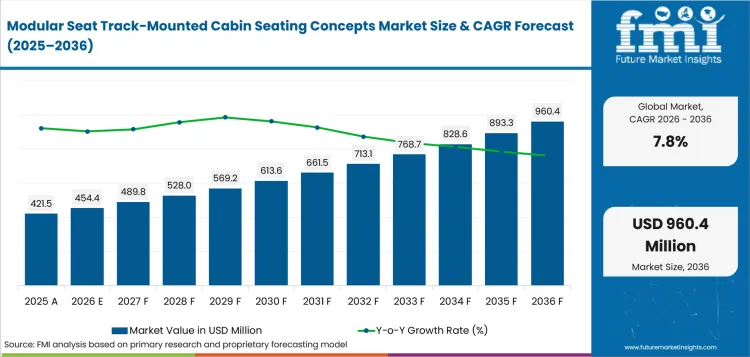
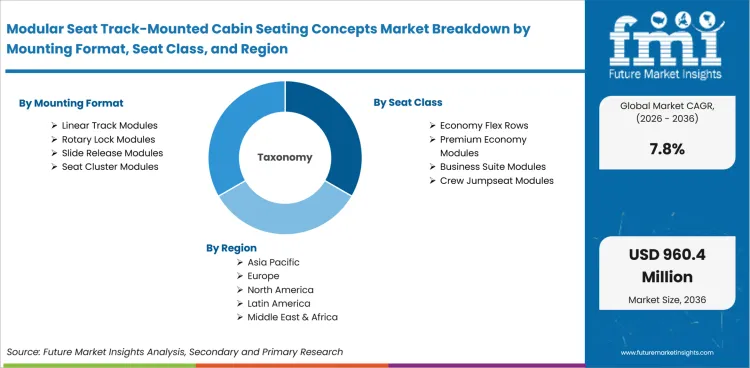
Modular seat track-mounted cabin seating concepts market was valued at USD 421.5 million in 2025 and is expected to reach USD 453.2 million in 2026. Demand is forecast to rise to USD 960.4 million by 2036 at 7.8% CAGR from 2026 to 2036. Linear Track Modules are forecast to account for 43.0% share of mounting format demand in 2026. Economy Flex Rows are expected to hold 46.5% share of seat class demand in 2026 as airlines test pitch changes before full cabin approval.
Key Takeaways, Market Size, and Forecast
- Modular seat track-mounted cabin seating concepts market stood at USD 421.5 million in 2025.
- Industry demand is expected to reach USD 960.4 million by 2036 as airlines test flexible seat maps before major cabin programs.
- Industry value is forecast to rise at 7.8% CAGR from 2026 to 2036 as certified track interfaces see wider commercial use.
- Market demand is expected to add USD 507.2 million in incremental opportunity between 2026 and 2036.
- Linear Track Modules are forecast to lead mounting format demand with 43.0% share in 2026 as existing floor tracks support faster layout checks.
- Retrofit Kits are expected to hold 52.0% share of fitment route demand in 2026 with airlines using scheduled cabin checks for layout trials.
- India is expected to record 9.2% CAGR through 2036 as fleet expansion increases demand for reconfigurable cabin planning.
- Narrow-body Aircraft are forecast to account for 57.0% share in 2026 as A320 and 737 family programs carry frequent seat-map changes.
Summary of the Modular Seat Track-Mounted Cabin Seating Concepts Market
- Demand and Growth Drivers
- Airlines are using modular seat concepts to test cabin layouts before they approve full seating programs. This helps them compare comfort needs with route revenue plans.
- Retrofit work is creating steady demand as older aircraft need cabin changes during planned checks. Track-mounted concepts help airlines test new layouts without changing the whole cabin structure.
- Seat safety approval is shaping supplier selection. Airlines prefer concepts with clear fitting evidence so the layout can move from review to aircraft planning with fewer delays.
- Product and Segment View
- Linear Track Modules lead the product view as they connect with approved aircraft floor tracks. This makes them easier to test across different cabin layouts.
- Economy Flex Rows support airlines that want to adjust seat pitch and paid comfort rows. These modules help carriers study passenger space before final seat selection.
- Retrofit Kits support cabin updates because airlines can test seating plans during maintenance windows. This route reduces planning risk before a full cabin program begins.
- Geography and Competitive Outlook
- India and China offer faster expansion because fleet additions are increasing cabin planning needs. Airlines in both countries need practical seating concepts for dense narrow-body routes.
- France, Germany and the United Kingdom support the market through aircraft seating design and cabin engineering depth. Suppliers in these countries add value through certified products and retrofit support.
- Competition is shaped by seat-track evidence and proven cabin program experience. Suppliers with tested modules can support airlines from early layout review to final seat approval.
- Analyst Opinion
- Nikhil Kaitwade, Principal Analyst at FMI says, “I see this market as a seat-layout decision before it becomes a seat order. Airlines want to test pitch, monument distance and premium row count without reopening the full cabin design cycle. Pressure comes from aircraft delivery delays and tighter approval checks for floor attachments. Suppliers with certified track interfaces and crash-load evidence will secure better access to airline planning.”
- Modular Seat Track-Mounted Cabin Seating Concepts Market Value Analysis
- The modular seat track-mounted cabin seating concepts market is moving from early cabin mock-up use into a more structured aircraft seating planning area.
- Demand is supported by airlines testing row spacing and premium seat layouts before full cabin approval.
- The market is gaining value from retrofit programs that need faster layout checks during planned aircraft maintenance.
- Supplier value is shaped by certified track fittings and clear safety evidence that help airlines reduce approval risk before selecting full seating packages.
Seat-track mounted cabin seating concepts are becoming more important as airlines need cabin layouts that can pass safety checks and still support faster retrofit work. FAA rules require approved passenger seats to pass dynamic testing with a 170-pound test dummy and forward impact conditions of 16g. That makes certified floor attachment and seat-track interface design a key selection point for OEMs and seat suppliers.
Airbus showed the retrofit value in May 2024 when THAI selected Airbus Services to convert A320ceo cabins from all-economy layouts of 168 to 174 seats into a two-class cabin with 12 business seats and 144 economy seats. This gives modular seating suppliers a clearer route into airline cabin upgrade programs. Mirus adds the product angle with Kestrel seating for the A320 family and Boeing 737 NG/MAX family. The seat lists a 28-inch to 38-inch pitch range and 16G compliance from Q3 2025. That supports short-haul operators that need lighter fixed-recline rows with lower maintenance exposure.
Modular Seat Track-Mounted Cabin Seating Concepts Market Definition
Modular seat track-mounted cabin seating concepts refer to aircraft seating designs built to attach to existing floor seat tracks and support cabin layout trials before final seat approval. These concepts help airlines test row spacing and premium seating plans without changing the full cabin structure. They are used during retrofit planning and new aircraft cabin reviews. Suppliers design these modules with track fittings, seat frames and safety evidence so airline teams can judge space use and installation needs before selecting a full seating package.
Modular Seat Track-Mounted Cabin Seating Concepts Market Inclusions
Market scope covers modular seat track-mounted cabin seating concepts classified by mounting format, including Linear Track Modules and Rotary Lock Modules. Seat class includes Economy Flex Rows and Premium Economy Modules. Aircraft platform covers Narrow-body Aircraft and Wide-body Aircraft. Fitment route includes Retrofit Kits and Line-fit Modules used during cabin planning or aircraft refurbishment. Buyer group covers Airlines and Aircraft OEMs. Cabin Integrators and Lessors are included as they support layout review and fleet transition work.
Revenue scope covers 2026 to 2036. Key stakeholders include aircraft seating suppliers and aircraft manufacturers. Airlines, cabin integrators and MRO providers support demand through layout trials and retrofit planning. Aviation regulators influence the market through seat attachment and cabin safety approval requirements.
Modular Seat Track-Mounted Cabin Seating Concepts Market Exclusions
Scope excludes rail seats and automotive seat rails. Aircraft floor panels sold alone are excluded unless supplied with a track-mounted seat concept package. Non-flight mock-up furniture is excluded. Cabin dividers without seating modules are outside the scope. Standard passenger seats sold without modular track-mounted concept content are not counted.
Modular Seat Track-Mounted Cabin Seating Concepts Market Research Methodology
- Primary Research: FMI analysts reviewed aircraft seating suppliers and cabin integration specialists. Airline cabin planning inputs were checked across major aviation markets.
- Desk Research: Public aviation traffic data and seat safety rules were used to define the addressable product pool. Official company seating releases supported supplier checks.
- Market Sizing and Forecasting: Market size was estimated by combining aircraft delivery volumes and retrofit activity. Seat module pricing and adoption across cabin program phases were used for forecast checks.
- Data Validation: Forecast checks compared aircraft production and passenger traffic. Supplier portfolios and seat certification needs were reviewed before finalizing values.
Why is the Modular Seat Track-Mounted Cabin Seating Concepts Market Growing?
- Airlines need physical layout trials as paid comfort rows become a bigger part of narrow-body cabin planning.
- Aircraft production supports concept demand as seat maps need early approval before cabin build work starts.
- Retrofit programs use track-mounted modules to compare seat density with passenger comfort before final approval.
- Seat safety rules make attachment evidence important as track fittings carry crash and emergency landing loads.
Cabin layout planning is becoming a revenue tool for airlines and lessors. IATA reported in January 2026 that total passenger demand rose 3.8% year over year and load factor reached 82.0%. Full aircraft cabins make each row decision more valuable. Track-mounted seating concepts let airlines test seat pitch and premium row count before committing to a full retrofit package. Suppliers with real modules and certification evidence get a clearer route into airline planning cycles.
Aircraft production creates another demand route through new cabin programs. Airbus reported 1,000.0 gross commercial aircraft orders in 2025. Order activity keeps cabin suppliers under pressure to freeze layouts earlier. Modular track-mounted concepts reduce late-stage change risk as airlines compare cabin options before engineering release. Concept suppliers benefit as OEM delivery planning and airline branding needs move together.
Market Segmentation Analysis
- Linear Track Modules are expected to hold 43.0% share of mounting format demand in 2026.
- Economy Flex Rows reflects 46.5% share during the same year.
- Narrow-body Aircraft are expected to account for 57.0% share in 2026.
- Retrofit Kits are forecast to capture 52.0% share in 2026.
- Airlines are expected to represent 61.0% share of buyer group demand in 2026.
The market is divided into five primary segment groups based on mounting format and seat class. Aircraft platform, fitment route and buyer group complete the structure. Mounting format covers Linear Track Modules and Rotary Lock Modules. Slide Release Modules and Seat Cluster Modules complete the group. Seat class covers Economy Flex Rows and Premium Economy Modules. Business Suite Modules and Crew Jumpseat Modules complete the cabin seating scope. Aircraft platform covers Narrow-body Aircraft and Wide-body Aircraft. Regional Jets and Business Jets complete the aircraft scope. Fitment route covers Retrofit Kits and Line-fit Modules. Demonstrator Builds are included for early cabin planning. Buyer group covers Airlines and Aircraft OEMs. Cabin Integrators and Lessors complete the buyer group scope.
Insights into Modular Seat Track-Mounted Cabin Seating Concepts Market by Mounting Format
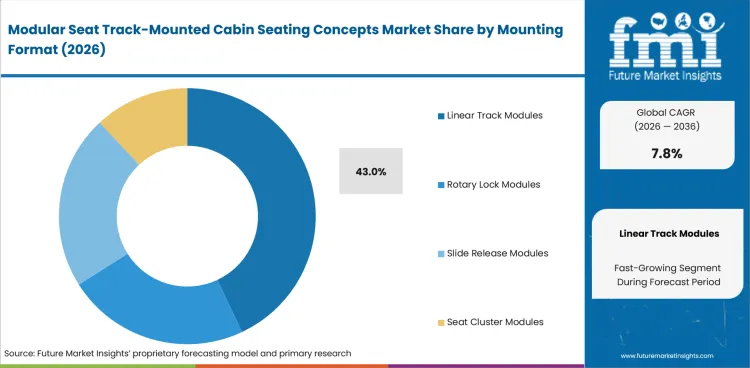
- Linear Track Modules are expected to hold 43.0% share in 2026 as airlines prefer layouts that fit approved aircraft floor tracks.
- Rotary Lock Modules support cabins that need faster seat checks and quick-change cabin class divider systems add value when airlines test flexible zones.
Insights into Modular Seat Track-Mounted Cabin Seating Concepts Market by Seat Class
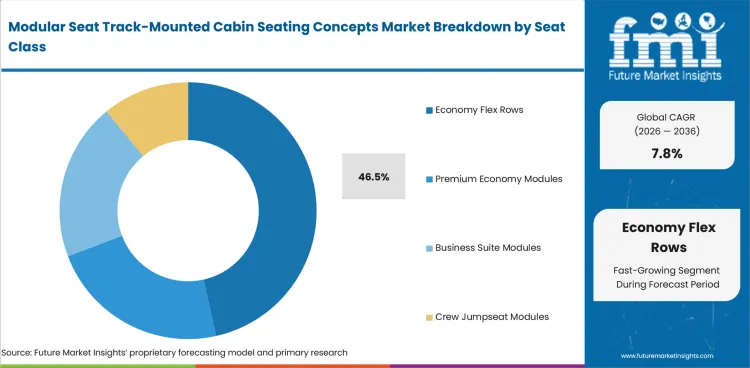
- Economy Flex Rows are expected to account for 46.5% share in 2026 as airlines test paid comfort rows before full cabin approval.
- Business Suite Modules need more planning time because doors and power systems affect seat weight, which makes the demand for aircraft seat actuation systems important for premium layouts.
Insights into Modular Seat Track-Mounted Cabin Seating Concepts Market by Aircraft Platform
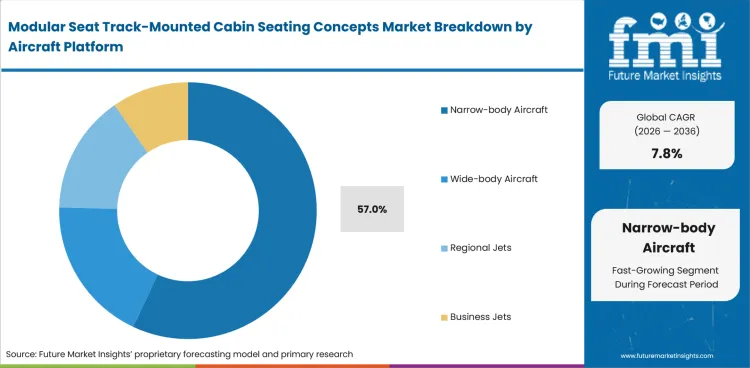
- Narrow-body Aircraft are forecast to hold 57.0% share in 2026 as high-use routes need seat maps that balance comfort and seat count.
- Wide-body Aircraft support premium concept work because airlines need more proof before adding suites, partitions and privacy features.
Insights into Modular Seat Track-Mounted Cabin Seating Concepts Market by Fitment Route
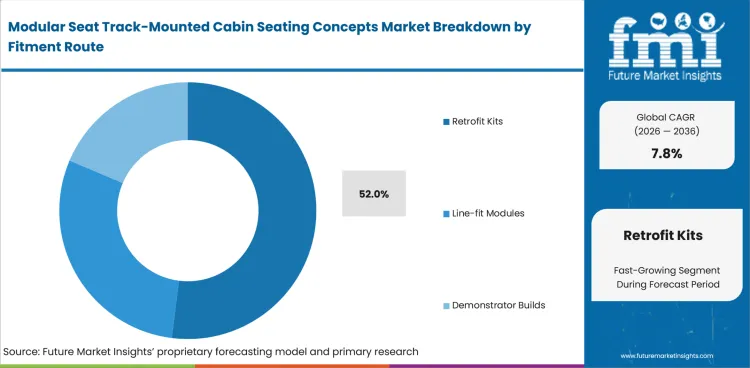
- Retrofit Kits are expected to capture 52.0% share in 2026 as airlines test cabin updates during planned aircraft checks.
- Line-fit Modules support new aircraft programs because seat layouts must be cleared early and demand for aircraft refurbishing activity keeps retrofit planning active.
Insights into Modular Seat Track-Mounted Cabin Seating Concepts Market by Buyer Group
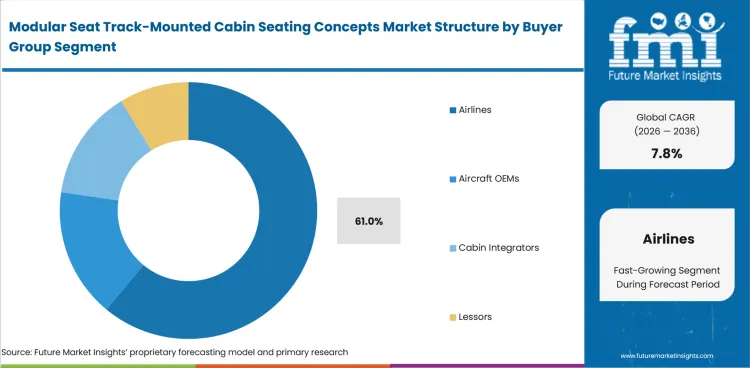
- Airlines are expected to represent 61.0% share in 2026 as seat-map choices affect route revenue and passenger comfort.
- Cabin Integrators need modules with clear drawings and fit proof, while cabin headliner and psu integration modules outlook help connect seating plans with overhead systems.
Modular Seat Track-Mounted Cabin Seating Concepts Market Drivers, Restraints, and Opportunities
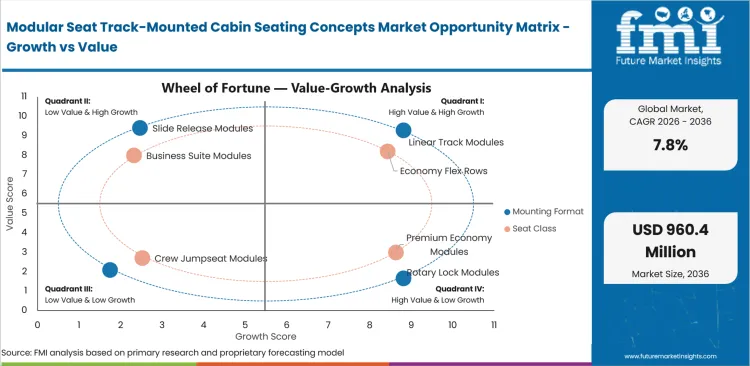
- Cabin yield planning supports concept demand as airlines test premium zones before full seat purchase approval.
- Certification cost can slow smaller suppliers as seat-track loads need proof before airline engineering review.
- Premium narrow-body cabins create scope for track-mounted business modules with faster installation evidence.
- Lessors create demand for reusable concept kits that compare seat layouts across aircraft handovers.
Seat-track load evidence
Seat-track attachment proof is the main technical filter in this market. Federal rules list ultimate inertia forces of 9.0g forward and 6.0g downward for occupants and seat attachments. Load evidence affects more than safety paperwork. It shapes whether an airline can accept a concept as a serious input for cabin planning. Suppliers with early load documentation reduce the time between mock-up review and purchase planning.
Passenger density planning
Passenger volume makes cabin layout choices more valuable for airlines. IATA forecast in December 2025 that passenger traffic would rise 4.9% in 2026. Asia Pacific demand was forecast to rise 7.3% in the same outlook. Higher traffic gives carriers a reason to refine seat maps more often. Track-mounted concepts support this work as airline planners compare comfort zones and standard rows before buying certified shipsets.
Premium module constraint
Premium concept modules create higher revenue scope but carry tougher integration work. Privacy doors and side consoles affect seat weight and aircraft floor loading. Power units add more interface checks before approval. Privacy door-equipped premium cabin seat systems face the same pressure around certification support and cabin density. Smaller suppliers can win concept work if their modules simplify interfaces and reduce expensive late changes.
Analysis of Modular Seat Track-Mounted Cabin Seating Concepts Market By Key Countries
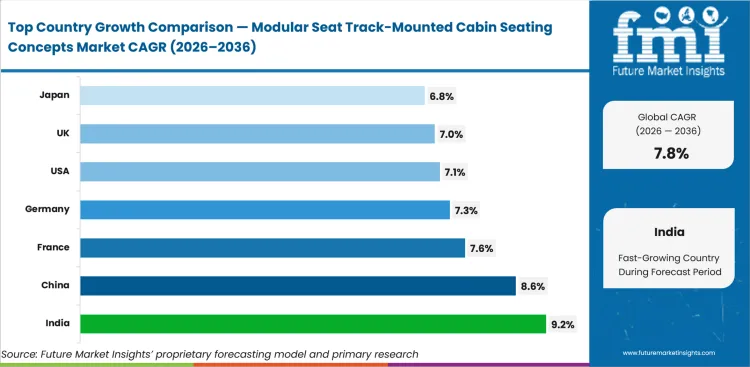
.webp "Top Country Growth Comparison Modular Seat Track Mounted Cabin Seating Concepts Market Cagr (2026 2036)")
| Country | CAGR |
|---|---|
| India | 9.2% |
| China | 8.6% |
| France | 7.6% |
| Germany | 7.3% |
| United States | 7.1% |
| United Kingdom | 7.0% |
| Japan | 6.8% |
Source, FMI analysis based on primary research and proprietary forecasting model.
Sales Analysis of Modular Seat Track-Mounted Cabin Seating Concepts Market in India
Fastest-growing country market 2026-2036
India Market Outlook
- India is expected to record 9.2% CAGR from 2026 to 2036. Market value is estimated at USD 28.6 million in 2026 and is projected to reach USD 69.0 million by 2036. Incremental opportunity is estimated at USD 40.4 million.
- India’s airline sector is adding aircraft and upgrading cabins at the same time. Modular seat track-mounted concepts help airlines test seat pitch and premium row plans before full retrofit approval.
- Air India’s wide-body cabin work makes India important for seating suppliers. A larger domestic network increases the need for quick layout checks on narrow-body aircraft.
Key Growth Drivers
- India’s Ministry of Civil Aviation reported in March 2025 that scheduled domestic airlines carried 122.2 million passengers in FY 2024 to 2025 up to December 2024, supporting cabin layout planning for high-use aircraft.
- India’s Ministry of Civil Aviation reported that scheduled and commuter aircraft fleet count increased from 771 to 834 during 2024, supporting seat concept demand for new aircraft and retrofit work.
- RECARO Aircraft Seating reported in April 2026 that Air India’s B787-8 retrofit covers 26 aircraft and nearly 6,000 seats, supporting demand for premium and economy cabin updates.
- Airline network expansion supports modular track concepts as carriers need to test row spacing before approving full shipsets.
Key Restraints
- India’s Ministry of Civil Aviation reported 8.49 lakh scheduled domestic flights in FY 2024 to 2025 up to December 2024, which limits long aircraft downtime for deeper cabin trials.
- Certification checks can slow supplier approval as seat-track hardware must pass safety and attachment evidence before aircraft use.
- Cost pressure is high in domestic aviation, so airlines may delay concept work that does not support near-term cabin revenue.
What makes India unique
India’s market is shaped by fast fleet expansion and airline retrofit work. Major airline programs are creating a stronger cabin upgrade route for seating suppliers.
Key Companies
- Air India
- AI Engineering Services Ltd.
- Tata Advanced Systems
- GMR Aero Technic
Sales & Marketing Channels
- Airline retrofit programs
- MRO service centers
- Aircraft OEM discussions
- Cabin integrator partnerships
- Aviation trade events
Market Taxonomy & Sub-Regions Covered
| Segment | Sub-Segments |
|---|---|
| By Mounting Format | Linear Track Modules Rotary Lock Modules Slide Release Modules Seat Cluster Modules |
| By Seat Class | Economy Flex Rows Premium Economy Modules Business Suite Modules Crew Jumpseat Modules |
| By Aircraft Platform | Narrow-body Aircraft Wide-body Aircraft Regional Jets Business Jets |
| By Fitment Route | Retrofit Kits Line-fit Modules Demonstrator Builds |
| By Buyer Group | Airlines Aircraft OEMs Cabin Integrators Lessors |
| Key Sub-Regions Covered | Delhi NCR, Bengaluru, Hyderabad, Mumbai, Ahmedabad |
Frequently Asked Questions
How fast is India’s modular seat track-mounted cabin seating concepts market growing?
India is expected to grow at 9.2% CAGR from 2026 to 2036.
What is the market value in India?
India is estimated at USD 28.6 million in 2026 and is projected to reach USD 69.0 million by 2036.
Which segment leads India’s market?
Linear Track Modules lead with 43.0% share in 2026 as approved floor-track fit supports easier cabin trials.
What is driving demand in India?
Demand is led by fleet expansion, Air India retrofit work and the need to test seat layouts before final cabin approval.
Sales Analysis of Modular Seat Track-Mounted Cabin Seating Concepts Market in China
High-growth country market 2026-2036
China Market Outlook
- China is likely to post 8.6% CAGR in the modular seat track-mounted cabin seating concepts market by 2036. Market value is estimated at USD 58.0 million in 2026 and is projected to reach USD 132.4 million by 2036. Incremental opportunity is estimated at USD 74.4 million.
- China’s airline sector has a large passenger base and a growing domestic aircraft program. Modular seating concepts help airlines compare cabin density and comfort before final aircraft layout approval.
- Domestic aircraft activity gives China a different demand profile. Seat concepts must fit large airline fleets and align with Chinese aircraft platform needs.
Key Growth Drivers
- China’s State Council reported in January 2026 that civil aviation passenger traffic reached 770.0 million in 2025, supporting demand for cabin layouts built for dense route use.
- CAAC reported in April 2026 that airport passenger throughput reached 1,529.046 million in 2025, supporting seat-map planning across major airport networks.
- COMAC states that the C919 supports 158 to 192 seats, which creates a direct need for cabin layout testing across different airline configurations.
- Local cabin suppliers support domestic aircraft programs, which improves access to seat concepts tailored for Chinese operators.
Key Restraints
- CAAC reported 12.448 million aircraft movements in 2025, which keeps aircraft use high and can reduce time available for cabin trial work.
- Domestic aircraft programs still require careful supplier qualification, so seat concepts can face long approval steps before airline use.
- Price pressure from local suppliers can limit margin for imported or premium modular seat-track systems.
What makes China unique
China combines large airline demand with domestic aircraft development. Seat concepts must support airline density goals and local aircraft program needs at the same time.
Key Companies
- COMAC
- AVIC Cabin Systems
- Jiatai Aircraft Equipment
- Fesher Aviation Components
Sales & Marketing Channels
- Aircraft OEM programs
- Domestic airline tenders
- Cabin supplier partnerships
- Aircraft interiors exhibitions
- Direct supplier demonstrations
Market Taxonomy & Sub-Regions Covered
| Segment | Sub-Segments |
|---|---|
| By Mounting Format | Linear Track Modules Rotary Lock Modules Slide Release Modules Seat Cluster Modules |
| By Seat Class | Economy Flex Rows Premium Economy Modules Business Suite Modules Crew Jumpseat Modules |
| By Aircraft Platform | Narrow-body Aircraft Wide-body Aircraft Regional Jets Business Jets |
| By Fitment Route | Retrofit Kits Line-fit Modules Demonstrator Builds |
| By Buyer Group | Airlines Aircraft OEMs Cabin Integrators Lessors |
| Key Sub-Regions Covered | Shanghai, Beijing, Guangdong, Hubei, Tianjin |
Frequently Asked Questions
How fast is China’s modular seat track-mounted cabin seating concepts market growing?
China is likely to post 8.6% CAGR in the sector by 2036.
What is the market value in China?
China is estimated at USD 58.0 million in 2026 and is projected to reach USD 132.4 million by 2036.
Which segment leads China’s market?
Linear Track Modules lead with 43.0% share in 2026 as standard floor-track use supports repeat cabin checks.
What is driving demand in China?
Demand is led by high passenger traffic with domestic aircraft programs and airline cabin density planning.
Sales Analysis of Modular Seat Track-Mounted Cabin Seating Concepts Market in France
Premium seating hub 2026-2036
France Market Outlook
- France is forecast at 7.6% CAGR through 2036. Market value is estimated at USD 44.6 million in 2026 and is projected to reach USD 92.8 million by 2036. Incremental opportunity is estimated at USD 48.2 million.
- France is important because it has certified aircraft seating suppliers and premium cabin design depth. Modular seat track-mounted concepts are useful in the country as airlines test premium rows before full cabin work begins.
- France has a strong role in wide-body and premium cabin programs. Suppliers with certification evidence can support airlines that need business suite concepts and economy retrofit options.
Key Growth Drivers
- Groupe ADP reported in January 2026 that Paris Aéroport handled 107.0 million passengers in 2025, supporting cabin refresh planning for airlines serving high-traffic routes.
- STELIA Aerospace launched the next-generation RENDEZ-VOUS business-class seat at Aircraft Interiors Expo 2025, supporting premium cabin concept work.
- Safran Seats was selected in November 2025 to support Emirates fleet upgrades with business and economy class seats, supporting French seating depth in retrofit programs.
- Expliseat reported record 2025 performance with triple-digit year-on-year expansion in January 2026, supporting lightweight seating demand.
Key Restraints
- EASA large aeroplane certification rules require detailed safety compliance, which can slow movement from concept review to airline approval.
- Premium cabin modules often need extra checks around privacy doors and power routing, which raises engineering cost before fleet use.
- High engineering content can limit small supplier access to large airline cabin programs.
What makes France unique
France has a strong premium cabin supplier base. It is suited for modular concepts that need comfort testing and certification planning before airline selection.
Key Companies
- Safran Seats
- STELIA Aerospace
- Expliseat
- Airbus Atlantic
Sales & Marketing Channels
- Aircraft interiors exhibitions
- Airline retrofit programs
- Premium cabin mock-ups
- OEM platform discussions
- Engineering service partners
Market Taxonomy & Sub-Regions Covered
| Segment | Sub-Segments |
|---|---|
| By Mounting Format | Linear Track Modules Rotary Lock Modules Slide Release Modules Seat Cluster Modules |
| By Seat Class | Economy Flex Rows Premium Economy Modules Business Suite Modules Crew Jumpseat Modules |
| By Aircraft Platform | Narrow-body Aircraft Wide-body Aircraft Regional Jets Business Jets |
| By Fitment Route | Retrofit Kits Line-fit Modules Demonstrator Builds |
| By Buyer Group | Airlines Aircraft OEMs Cabin Integrators Lessors |
| Key Sub-Regions Covered | Toulouse, Paris, Île-de-France, Rochefort, Lyon |
Frequently Asked Questions
How fast is France’s modular seat track-mounted cabin seating concepts market growing?
France is forecast at 7.6% CAGR through 2036.
What is the market value in France?
France is estimated at USD 44.6 million in 2026 and is projected to reach USD 92.8 million by 2036.
Which segment leads France’s market?
Linear Track Modules lead with 43.0% share in 2026 as approved track interfaces support repeatable cabin layout checks.
What makes France important for the market?
France has premium seating suppliers and aircraft cabin engineering depth, which supports concept work for business and economy cabins.
Sales Analysis of Modular Seat Track-Mounted Cabin Seating Concepts Market in Germany
Engineering-based seating hub 2026-2036
Germany Market Outlook
- Germany is expected to advance at 7.3% CAGR during the forecast period. Market value is estimated at USD 36.9 million in 2026 and is projected to reach USD 74.6 million by 2036. Incremental opportunity is estimated at USD 37.7 million.
- Germany has a strong cabin engineering base and aircraft seating depth. Airlines and cabin integrators use German suppliers for cabin modification and interior system support.
- Modular track-mounted concepts are useful in Germany because buyers need proven fit, crash-load evidence and repeatable installation planning.
Key Growth Drivers
- DFS reported in January 2026 that 3.071 million flights were controlled in German airspace during 2025, supporting aircraft use and cabin service planning.
- ZIM Aircraft Seating states that it develops and manufactures economy with premium economy and business class seats, supporting Germany’s role in airline seating supply.
- Lufthansa Technik states that its cabin modification service covers consulting, engineering and installation, supporting retrofit projects that may need track-mounted concept validation.
- Aircraft Interiors Expo in Hamburg supports direct buyer access to cabin seating concepts and supplier demonstrations.
Key Restraints
- DFS reported more than 3.0 million controlled flights in 2025, which means airline downtime can stay tight for large cabin trials.
- German suppliers face strict documentation expectations for aircraft interiors, which can raise early project cost.
- Premium economy modules may require longer customer review as airlines balance comfort benefits with seat count.
What makes Germany unique
Germany combines seating production and cabin modification expertise. It is suited for modular concepts that need engineering evidence and retrofit planning support.
Key Companies
- ZIM Aircraft Seating
- RECARO Aircraft Seating
- Diehl Aviation
- Lufthansa Technik
Sales & Marketing Channels
- Aircraft Interiors Expo Hamburg
- Airline cabin modification programs
- MRO-led retrofit work
- OEM seating discussions
- Technical demonstrations
Market Taxonomy & Sub-Regions Covered
| Segment | Sub-Segments |
|---|---|
| By Mounting Format | Linear Track Modules Rotary Lock Modules Slide Release Modules Seat Cluster Modules |
| By Seat Class | Economy Flex Rows Premium Economy Modules Business Suite Modules Crew Jumpseat Modules |
| By Aircraft Platform | Narrow-body Aircraft Wide-body Aircraft Regional Jets Business Jets |
| By Fitment Route | Retrofit Kits Line-fit Modules Demonstrator Builds |
| By Buyer Group | Airlines Aircraft OEMs Cabin Integrators Lessors |
| Key Sub-Regions Covered | Hamburg, Bavaria, Baden-Württemberg, Hesse, Lower Saxony |
Frequently Asked Questions
How fast is Germany’s modular seat track-mounted cabin seating concepts market growing?
Germany is expected to advance at 7.3% CAGR from 2026 to 2036.
What is the market value in Germany?
Germany is estimated at USD 36.9 million in 2026 and is projected to reach USD 74.6 million by 2036.
Which segment leads Germany’s market?
Linear Track Modules lead with 43.0% share in 2026 as airlines prefer tested fit with approved floor tracks.
What is driving demand in Germany?
Demand is supported by seating suppliers, cabin engineering capability and retrofit planning across airline fleets.
Sales Analysis of Modular Seat Track-Mounted Cabin Seating Concepts Market in the United States
Leading value market 2026-2036
United States Market Outlook
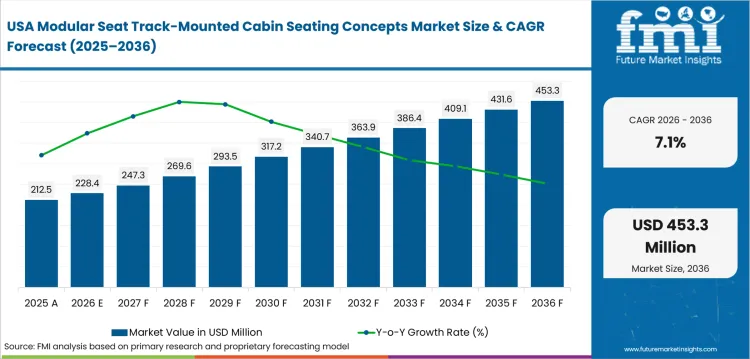
- The United States is projected to expand at 7.1% CAGR through 2036. Market value is estimated at USD 96.5 million in 2026 and is projected to reach USD 191.6 million by 2036. Incremental opportunity is estimated at USD 95.1 million.
- The United States has the largest value pool in the country set. Airlines, aircraft OEMs and seating technology suppliers create a strong base for modular seat-track concept work.
- Cabin concepts in the United States are shaped by safety evidence and airline service needs. Track-mounted modules must support layout review before aircraft installation planning.
Key Growth Drivers
- BTS reported in April 2026 that USA airlines carried 69.5 million scheduled service passengers in January 2026, supporting cabin utilization and seat-map planning.
- RTX reported in April 2026 that Collins Aerospace secured three airline launch customers for Helix seating across nearly 200 aircraft, supporting narrow-body seating programs.
- Boeing reported 600 commercial aircraft deliveries in 2025, supporting cabin planning activity tied to new aircraft programs.
- FAA seat attachment rules support demand for seating concepts with clear load evidence and approval documentation.
Key Restraints
- BTS reported that January 2026 enplanements were down 1.1% from December on a seasonally adjusted basis, which can delay lower-priority cabin spending.
- FAA requirements raise upfront engineering work for new seat-track concepts as suppliers must document occupant and attachment safety.
- Airlines may prioritize proven seat families over new concept modules if retrofit timing is tight.
What makes the United States unique
The United States combines large airline fleets with OEM activity and cabin technology suppliers. It offers the strongest value pool but requires clear safety evidence before concept use.
Key Companies
- Collins Aerospace
- Boeing
- Elevate Aircraft Seating
- Astronics
Sales & Marketing Channels
- OEM program reviews
- Airline procurement teams
- Retrofit approval channels
- MRO engineering partners
- Aircraft interiors events
Market Taxonomy & Sub-Regions Covered
| Segment | Sub-Segments |
|---|---|
| By Mounting Format | Linear Track Modules Rotary Lock Modules Slide Release Modules Seat Cluster Modules |
| By Seat Class | Economy Flex Rows Premium Economy Modules Business Suite Modules Crew Jumpseat Modules |
| By Aircraft Platform | Narrow-body Aircraft Wide-body Aircraft Regional Jets Business Jets |
| By Fitment Route | Retrofit Kits Line-fit Modules Demonstrator Builds |
| By Buyer Group | Airlines Aircraft OEMs Cabin Integrators Lessors |
| Key Sub-Regions Covered | Washington, Texas, Florida, California, North Carolina |
Frequently Asked Questions
How fast is the United States modular seat track-mounted cabin seating concepts market growing?
The United States is projected to expand at 7.1% CAGR through 2036.
What is the market value in the United States?
The United States is estimated at USD 96.5 million in 2026 and is projected to reach USD 191.6 million by 2036.
Which segment leads the United States market?
Linear Track Modules lead with 43.0% share in 2026 because approved floor tracks support faster seat layout trials.
What is driving demand in the United States?
Demand is led by airline passenger volume, narrow-body seating programs and FAA-based safety evidence needs.
Sales Analysis of Modular Seat Track-Mounted Cabin Seating Concepts Market in the United Kingdom
Premium cabin concept base 2026-2036
United Kingdom Market Outlook
- The United Kingdom is forecast to register 7.0% CAGR in this market over the study period. Market value is estimated at USD 31.4 million in 2026 and is projected to reach USD 61.8 million by 2036. Incremental opportunity is estimated at USD 30.4 million.
- The United Kingdom has a strong position in premium seating and aircraft interior design. Its suppliers support business-class suites and cabin furniture for Airbus and Boeing aircraft.
- Modular track-mounted concepts are useful for UK suppliers because airlines need front-row and density concepts before full cabin approval.
Key Growth Drivers
- UK CAA reported in February 2026 that UK airports handled 302.0 million passenger journeys in 2025, supporting airline cabin planning and refresh demand.
- Thompson Aero Seating launched VantageNOVA First in March 2025, supporting premium front-row cabin concept work.
- Mirus Aircraft Seating reported in April 2026 that its Kestrel seat for easyJet is expected to be over 20% lighter than current seats, supporting lighter seating choices for new narrow-body aircraft.
- UK seating suppliers support both short-haul and long-haul aircraft programs, which creates different cabin concept needs.
Key Restraints
- UK CAA reported that 2025 passenger journeys rose 2.0% from 2024, so some airlines may focus on targeted cabin changes instead of full cabin programs.
- Premium modules need extra safety evidence around seat motion, privacy elements and power systems before airline use.
- Smaller UK suppliers may face scale limits when airlines need large shipset volumes across many aircraft.
What makes the United Kingdom unique
The United Kingdom has a strong premium cabin design base. It is especially important for business suite concepts and narrow-body cabin comfort trials.
Key Companies
- Thompson Aero Seating
- Mirus Aircraft Seating
- Acro Aircraft Seating
- AVIC Cabin Systems UK
Sales & Marketing Channels
- Airline cabin design reviews
- Premium seat demonstrations
- MRO retrofit channels
- Aircraft Interiors Expo meetings
- Direct airline engineering reviews
Market Taxonomy & Sub-Regions Covered
| Segment | Sub-Segments |
|---|---|
| By Mounting Format | Linear Track Modules Rotary Lock Modules Slide Release Modules Seat Cluster Modules |
| By Seat Class | Economy Flex Rows Premium Economy Modules Business Suite Modules Crew Jumpseat Modules |
| By Aircraft Platform | Narrow-body Aircraft Wide-body Aircraft Regional Jets Business Jets |
| By Fitment Route | Retrofit Kits Line-fit Modules Demonstrator Builds |
| By Buyer Group | Airlines Aircraft OEMs Cabin Integrators Lessors |
| Key Sub-Regions Covered | Northern Ireland, England, Wales, Scotland, London area |
Frequently Asked Questions
How fast is the United Kingdom modular seat track-mounted cabin seating concepts market growing?
The United Kingdom is forecast to register 7.0% CAGR from 2026 to 2036.
What is the market value in the United Kingdom?
The United Kingdom is estimated at USD 31.4 million in 2026 and is projected to reach USD 61.8 million by 2036.
Which segment leads the United Kingdom market?
Linear Track Modules lead with 43.0% share in 2026 as approved floor-track fit supports cabin layout testing.
What is driving demand in the United Kingdom?
Demand is led by premium seating work, airline traffic and cabin design expertise from local suppliers.
Sales Analysis of Modular Seat Track-Mounted Cabin Seating Concepts Market in Japan
Selective premium cabin market 2026-2036
Japan Market Outlook
- Japan is expected to post 6.8% CAGR through 2036. Market value is estimated at USD 25.7 million in 2026 and is projected to reach USD 49.6 million by 2036. Incremental opportunity is estimated at USD 23.9 million.
- Japan is a selective market for modular cabin seating concepts. Airlines and suppliers focus on fit quality along with maintainability and safety evidence.
- The country has fewer large cabin programs than China or the United States. Demand still exists in premium cabins with long-haul aircraft and carefully managed fleet refresh work.
Key Growth Drivers
- SJAC states that it brings together around 130 companies involved in aircraft and space technologies, supporting Japan’s aerospace supplier base.
- MLIT reported in 2025 that the CARATS target year was extended from 2025 to 2040, supporting long-term air traffic system planning.
- ANA announced in August 2025 that it will introduce new seats for B787-9 long-haul cabins beginning in fiscal year 2026, supporting premium cabin refresh demand.
- Jamco states that its business domains include aircraft interiors, aircraft seats, aircraft components and maintenance, supporting local supplier depth.
Key Restraints
- Japan’s modular seat-track market is smaller by value than the United States and China, which limits high-volume shipset opportunities.
- MLIT airworthiness oversight keeps safety evidence central, so suppliers need clear documentation before new seating concepts move into airline use.
- Premium cabin projects can require longer review cycles due to strict quality and service expectations.
What makes Japan unique
Japan is driven by quality and maintainability. Cabin seating concepts must prove comfort, installation reliability and safety evidence before airline use.
Key Companies
- Jamco Corporation
- Toyota Boshoku
- All Nippon Airways
- Japan Airlines
Sales & Marketing Channels
- Airline cabin refresh programs
- OEM seat approval channels
- Premium cabin demonstrations
- Aircraft interiors supplier networks
- Maintenance planning reviews
Market Taxonomy & Sub-Regions Covered
| Segment | Sub-Segments |
|---|---|
| By Mounting Format | Linear Track Modules Rotary Lock Modules Slide Release Modules Seat Cluster Modules |
| By Seat Class | Economy Flex Rows Premium Economy Modules Business Suite Modules Crew Jumpseat Modules |
| By Aircraft Platform | Narrow-body Aircraft Wide-body Aircraft Regional Jets Business Jets |
| By Fitment Route | Retrofit Kits Line-fit Modules Demonstrator Builds |
| By Buyer Group | Airlines Aircraft OEMs Cabin Integrators Lessors |
| Key Sub-Regions Covered | Tokyo, Aichi, Osaka, Fukuoka, Hokkaido |
Frequently Asked Questions
How fast is Japan’s modular seat track-mounted cabin seating concepts market growing?
Japan is expected to post 6.8% CAGR from 2026 to 2036.
What is the market value in Japan?
Japan is estimated at USD 25.7 million in 2026 and is projected to reach USD 49.6 million by 2036.
Which segment leads Japan’s market?
Linear Track Modules lead with 43.0% share in 2026 as Japanese operators value tested fit and reliable installation.
What is driving demand in Japan?
Demand is supported by premium cabin refresh work, aerospace supplier depth and airline focus on maintainability.
Competitive Landscape and Strategic Positioning
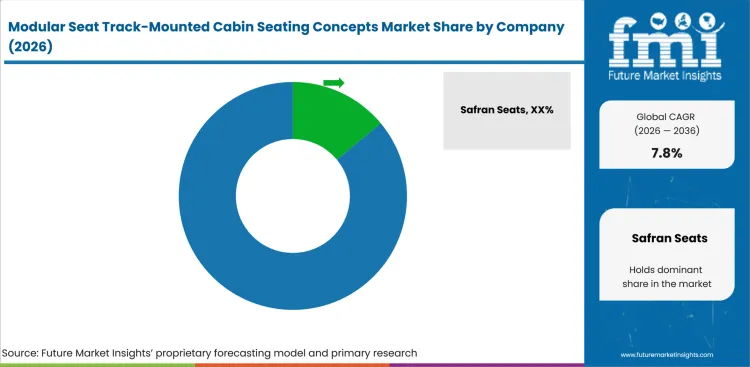
- Competition is shaped by how well suppliers can prove seat-track safety before a cabin concept moves into airline review.
- Larger seating suppliers have an edge because their existing seat platforms already carry design history and airline program experience.
- Specialist suppliers can still win concept work when they offer lighter seat structures and faster prototype support for cabin trials.
- New entrants face a high barrier because aircraft seats must pass crash-load checks before they can move into cabin approval work.
Competition is shaped by the ability to turn a concept into a certifiable cabin option. RECARO Aircraft Seating and All Nippon Airways displayed R3 Economy Class and R4 Premium Class seating comfort at Aircraft Interiors Expo 2025. The seats were designed for ANA’s next-generation international cabins. Such product work supports modular concept demand as airlines test comfort levels before cabin decisions move into program planning. Suppliers with proven seat families can shorten the path from layout review to certified cabin use.
Lightweight seating specialists are becoming more important as airlines try to lower cabin mass without reducing comfort. Expliseat reported record 2025 performance with triple-digit year-on-year expansion across airline programs. The company cited airline focus on weight reduction and total cost of ownership as drivers behind lightweight seat use. Such evidence supports modular track-mounted concepts as lighter modules can improve layout trials and reduce approval friction. Lightweight seat structures also help narrow-body operators test seat density with lower mass penalty.
Geven adds another proof point for high-density narrow-body cabin seating. In April 2026, Geven said Wizz Air selected Eva seats for its Airbus A321neo fleet. The agreement covers nearly 200.0 shipsets and almost 45,000.0 passenger seats. Narrow-body carriers need seating concepts that support density targets and passenger comfort checks before full fleet rollout. Related demand for quick-change cabin class divider systems supports the same need for flexible cabin zoning.
Premium cabin concepts depend on interface planning and passenger-space control. Thompson Aero Seating and STELIA Aerospace focus on business-class suites and front-row cabin ideas. Aircraft seat actuation systems become more important as premium modules add recline motion and power routing. Demand for cabin divider and privacy partition systems support premium seat planning as airlines compare privacy and density before full cabin approval.
Key Companies in the Modular Seat Track-Mounted Cabin Seating Concepts Market
- Certified seating specialists: Safran Seats and RECARO Aircraft Seating hold strong positions through approved seating platforms and airline program history. Collins Aerospace has a similar position through cabin platform depth and certification support.
- Premium cabin concept specialists: STELIA Aerospace and Thompson Aero Seating focus on business-class suites and front-row modules. Geven supports tailored cabin layouts for airlines testing premium density changes.
- Lightweight and regional specialists: Expliseat supports concept work through titanium and composite seat structures. Its lightweight products support regional aircraft and narrow-body cabins needing lower mass and simple service access.
Competitive Benchmarking: Modular Seat Track-Mounted Cabin Seating Concepts Market
| Company | Seat-track Interface Depth | Certification Evidence Support | Cabin Module Flexibility | Geographic Footprint |
|---|---|---|---|---|
| Safran Seats | High | High | High | Global with French depth |
| RECARO Aircraft Seating | High | High | Strong | Global with German depth |
| Collins Aerospace | High | High | Strong | Global with USA depth |
| STELIA Aerospace | Medium | High | High | Europe and premium cabins |
| Thompson Aero Seating | Medium | High | High | United Kingdom and Asia programs |
| Geven | Medium | Medium | Strong | Europe and narrow-body cabins |
| Expliseat | Medium | Medium | Strong | Europe and North America |
| Jamco Corporation | Low | Medium | Medium | Japan and global interiors |
Source, Future Market Insights competitive analysis, 2026. Ratings reflect relative positioning based on seat-track interface depth, certification evidence support, and cabin module flexibility.
Key Developments in Modular Seat Track-Mounted Cabin Seating Concepts Market
- In April 2026, Collins Aerospace secured three airline launch customers for its Helix main cabin seat. Nearly 200 Airbus A320 and Boeing 737 aircraft are planned to receive Helix seats.
- In November 2025, Safran Seats was selected by Emirates to supply new business and economy class seats for Boeing 777-300ER and Airbus A380 cabin refurbishment work.
Key Players in the Modular Seat Track-Mounted Cabin Seating Concepts Market
Certified seating specialists
- Safran Seats
- RECARO Aircraft Seating
- Collins Aerospace
Premium cabin concept specialists
- STELIA Aerospace
- Thompson Aero Seating
- Geven
Lightweight and regional specialists
- Expliseat
- Jamco Corporation
Report Scope and Coverage
| Parameter | Details |
|---|---|
| Quantitative Units | USD 453.2 million to USD 960.4 million at 7.8% CAGR |
| Market Definition | Aircraft cabin seating concepts designed to mount on floor seat tracks for layout testing and cabin program planning |
| Segments Covered | Mounting format, seat class, aircraft platform, fitment route, buyer group, and region |
| Mounting Format | Linear Track Modules, Rotary Lock Modules, Slide Release Modules, and Seat Cluster Modules |
| Seat Class | Economy Flex Rows, Premium Economy Modules, Business Suite Modules, and Crew Jumpseat Modules |
| Aircraft Platform | Narrow-body Aircraft, Wide-body Aircraft, Regional Jets, and Business Jets |
| Fitment Route | Retrofit Kits, Line-fit Modules, and Demonstrator Builds |
| Buyer Group | Airlines, Aircraft OEMs, Cabin Integrators, and Lessors |
| Regions Covered | North America, Latin America, Western Europe, Eastern Europe, East Asia, South Asia and Pacific, Middle East and Africa |
| Countries Covered | United States, China, India, France, Germany, United Kingdom, Japan, and more than 30.0 countries |
| Key Companies Profiled | Safran Seats, RECARO Aircraft Seating, Collins Aerospace, STELIA Aerospace, Thompson Aero Seating, Geven, and Expliseat |
| Forecast Period | 2026 to 2036 |
| Approach | Hybrid bottom-up and top-down method using aircraft delivery data, retrofit activity, seat module pricing, cabin layout needs, and supplier activity |
Modular Seat Track-Mounted Cabin Seating Concepts Market by Segments
Modular Seat Track-Mounted Cabin Seating Concepts Market Segmented by Mounting Format
- Linear Track Modules
- Rotary Lock Modules
- Slide Release Modules
- Seat Cluster Modules
Modular Seat Track-Mounted Cabin Seating Concepts Market Segmented by Seat Class
- Economy Flex Rows
- Premium Economy Modules
- Business Suite Modules
- Crew Jumpseat Modules
Modular Seat Track-Mounted Cabin Seating Concepts Market Segmented by Aircraft Platform
- Narrow-body Aircraft
- Wide-body Aircraft
- Regional Jets
- Business Jets
Modular Seat Track-Mounted Cabin Seating Concepts Market Segmented by Fitment Route
- Retrofit Kits
- Line-fit Modules
- Demonstrator Builds
Modular Seat Track-Mounted Cabin Seating Concepts Market Segmented by Buyer Group
- Airlines
- Aircraft OEMs
- Cabin Integrators
- Lessors
Modular Seat Track-Mounted Cabin Seating Concepts Market by Region
- North America
- Latin America
- Western Europe
- Eastern Europe
- East Asia
- South Asia and Pacific
- Middle East and Africa
Research Sources and Bibliography
- Airbus. (2024, May 28). Airbus secures THAI A320 cabin retrofit deal. Airbus.
- Airbus. (2026, January 12). Airbus reports 793 commercial aircraft deliveries in 2025. Airbus.
- Boeing. (2026, January 13). Boeing announces fourth quarter deliveries. Boeing Investor Relations.
- Bureau of Transportation Statistics. (2026, April 10). January 2026 USA airline traffic data down 1.8% from the same month last year. USADepartment of Transportation.
- Civil Aviation Administration of China. (2026, April 3). 2025 national civil transport airport production statistics bulletin released. Civil Aviation Administration of China.
- Commercial Aircraft Corporation of China, Ltd. (2026, February 5). Several aircraft models of COMAC debut at Singapore Airshow 2026. COMAC.
- DFS Deutsche Flugsicherung GmbH. (2026, January 5). Air traffic in Germany 2025: More flights, good punctuality level. DFS Deutsche Flugsicherung GmbH.
- easyJet. (2026, March 23). easyJet to introduce new ultra-lightweight next generation seats. easyJet.
- Expliseat. (2026, January 20). Expliseat reports record 2025 performance with triple-digit growth. Expliseat.
- Federal Aviation Administration. (2026, May 28). 14 CFR § 25.561: General. Electronic Code of Federal Regulations
- Federal Aviation Administration. (2026, May 28). 14 CFR § 25.562: Emergency landing dynamic conditions. Electronic Code of Federal Regulations.
- Geven. (2026, April 14). Travelling with Wizz Air has never been this light: Wizz Air selects Geven’s Eva for the A321neo fleet. Geven.
- Groupe ADP. (2026, January 15). December & full-year 2025 traffic figures. Groupe ADP.
- International Air Transport Association. (2025, December). Global outlook for air transport: December 2025. International Air Transport Association.
- International Air Transport Association. (2026, March 2). 2026 begins with 3.8% air passenger demand growth. International Air Transport Association.
- Jamco Corporation. (2026). Company profile. Jamco Corporation.
- Ministry of Civil Aviation. (2025, March). Annual report 2024–25. Government of India.
- Ministry of Land, Infrastructure, Transport and Tourism. (2025). Civil Aviation Bureau: The Japan Air Navigation Service. Ministry of Land, Infrastructure, Transport and Tourism.
- Mirus Aircraft Seating. (2026). Kestrel aircraft seat. Mirus Aircraft Seating.
- RECARO Aircraft Seating. (2025, September 4). RECARO Aircraft Seating and All Nippon Airways display R3 and R4 seating comfort at AIX 2025. RECARO Aircraft Seating.
- RECARO Aircraft Seating. (2026, April 20). RECARO Aircraft Seating and Air India launch retrofit program with premium and economy class seating solutions for B787-8. RECARO Aircraft Seating.
- RTX. (2026, April 15). RTX’s Collins Aerospace secures three airline launch customers for its Helix main cabin seat. RTX.
- Safran. (2025, November 18). Safran selected to support upgrade of Emirates’ fleet with new business and economy class seats. Safran.
- Society of Japanese Aerospace Companies. (2026). The Society of Japanese Aerospace Companies. Society of Japanese Aerospace Companies.
- STELIA Aerospace. (2025, April 9). STELIA Aerospace unveils a reinvented RENDEZ-VOUS and showcases the entire OPERA family at Aircraft Interiors Expo 2025. STELIA Aerospace.
- Thompson Aero Seating. (2025, March 10). Thompson Aero Seating launches VantageNOVA First. Thompson Aero Seating.
- UK Civil Aviation Authority. (2026, February 24). UK aviation officially breaks records with over 300m passenger journeys in 2025. UK Civil Aviation Authority.
This Report Answers
- What is the 2026 value of modular seat track-mounted cabin seating concepts and how does it compare with 2036 demand?
- Which mounting format is expected to lead demand and what makes it suitable for cabin layout trials?
- Which seat class creates the main revenue opportunity for airlines testing flexible cabin layouts?
- How do retrofit kits shape demand for track-mounted modular cabin seating concepts?
- Which countries are expected to expand faster in this market from 2026 to 2036?
- Which suppliers hold the strongest role in certified seating concepts and premium cabin modules?
- How do aircraft safety rules affect seat-track concept approval and supplier selection?
- What research method supports the market sizing and CAGR forecast for this product scope?
Frequently Asked Questions
What is the global demand for modular seat track-mounted cabin seating concepts in 2026?
Global demand is expected to reach USD 453.2 million in 2026 as airlines test flexible cabin layouts before full seat orders.
What will the market value reach by 2036?
Market value is forecast to reach USD 960.4 million by 2036 as retrofit programs and premium cabin trials increase.
What CAGR is expected from 2026 to 2036?
Demand is forecast to rise at 7.8% CAGR from 2026 to 2036, supported by cabin reconfiguration and seat-track approval needs.
Which mounting format is expected to lead in 2026?
Linear Track Modules are forecast to lead with 43.0% share in 2026 due to compatibility with existing aircraft floor tracks.
Which fitment route is expected to lead demand?
Retrofit Kits are expected to hold 52.0% share in 2026 as airlines test layouts during planned cabin checks.
Which country is expected to expand the fastest?
India is forecast to record 9.2% CAGR through 2036 as fleet additions increase cabin layout trials for narrow-body aircraft.
What does this market include?
Scope includes modular aircraft seating concepts, adapter structures, track-mounted seat clusters, and quick-release fitting packages used for cabin planning.
How was the forecast developed?
FMI used aircraft delivery data and passenger traffic to estimate market values. Retrofit activity and supplier developments were used for validation.
Which modular seat concept is best for narrow-body cabin trials?
Linear track-mounted economy flex rows suit narrow-body cabin trials as they use existing floor tracks and support pitch checks before full retrofit work.
How does a track-mounted cabin seating concept work?
A concept module attaches to approved aircraft seat tracks using fittings and adapter structures. Airline planners use it to test seat spacing and service zones.
What makes modular seat concepts expensive?
Crash-load evidence and fire-safe materials raise cost. Premium modules cost more as doors and power systems add engineering work.
Are modular seat concepts used in real aircraft?
Some concepts move into certified shipsets after testing. Others are used for mock-ups and airline reviews before a final cabin package is approved.
Which countries use these concepts most?
United States, China, and India create the main demand signals due to fleet size and cabin retrofit needs across dense airline networks.
Preview the report firsthand - request a free sample
Get SampleGet the brochure for pricing and purchase details.
Get PDFTable of Content
- Key Takeaways
- Market Size and CAGR
- Top Growth Driver
- Fastest Growing Segment
- Leading Region
- Key Companies
- Emerging Opportunities
- Executive Summary
- Global Market Outlook
- Demand-side Trends
- Supply-side Trends
- Technology Roadmap Analysis
- Analysis and Recommendations
- Analyst Perspective (What is happening? Why now? What should investors know?)
- Key Questions Answered
- How large is the market?
- What is the CAGR?
- What are key trends?
- Which region dominates?
- Who are the leaders?
- Market Overview
- Market Coverage / Taxonomy
- Market Definition / Scope / Limitations
- Research Methodology
- Chapter Orientation
- Analytical Lens and Working Hypotheses
- Market Structure, Signals, and Trend Drivers
- Benchmarking and Cross-market Comparability
- Market Sizing, Forecasting, and Opportunity Mapping
- Research Design and Evidence Framework
- Desk Research Programme (Secondary Evidence)
- Expert Input and Fieldwork (Primary Evidence)
- Tooling, Models, and Reference Databases
- Data Engineering and Model Build
- Quality Assurance and Audit Trail
- Market Background
- Market Dynamics (Drivers, Restraints, Opportunity, Trends)
- Scenario Forecast (Optimistic, Likely, Conservative)
- Impact Analysis
- AI Impact
- Sustainability Impact
- Regulatory Impact
- Technology Impact
- Consumer / Buyer Analysis
- Purchase Drivers
- Adoption Barriers
- Buyer Journey
- Opportunity Map Analysis
- Product Life Cycle Analysis
- Supply Chain Analysis
- Investment Feasibility Matrix
- Value Chain Analysis
- PESTLE and Porter's Analysis
- Regulatory Landscape
- Regional Parent Market Outlook
- Production and Consumption Statistics
- Import and Export Statistics
- Global Market Analysis and Forecast, 2021 to 2036
- Historical Market Size Value (USD Million) & Volume (Unit) Analysis, 2021 to 2025
- Current and Future Market Size Value (USD Million) & Volume (Unit) Projections, 2026 to 2036
- Y-o-Y Growth Trend Analysis
- Absolute $ Opportunity Analysis
- Global Market Pricing Analysis, 2021 to 2036
- Global Market Analysis and Forecast, By Mounting Format, 2021 to 2036
- Introduction / Key Findings
- Historical Market Size Value (USD Million) & Volume (Unit) Analysis By Mounting Format, 2021 to 2025
- Current and Future Market Size Value (USD Million) & Volume (Unit) Analysis and Forecast By Mounting Format, 2026 to 2036
- Linear Track Modules
- Rotary Lock Modules
- Slide Release Modules
- Seat Cluster Modules
- Linear Track Modules
- Y-o-Y Growth Trend Analysis By Mounting Format, 2021 to 2025
- Absolute $ Opportunity Analysis By Mounting Format, 2026 to 2036
- Global Market Analysis and Forecast, By Seat Class, 2021 to 2036
- Introduction / Key Findings
- Historical Market Size Value (USD Million) & Volume (Unit) Analysis By Seat Class, 2021 to 2025
- Current and Future Market Size Value (USD Million) & Volume (Unit) Analysis and Forecast By Seat Class, 2026 to 2036
- Economy Flex Rows
- Premium Economy Modules
- Business Suite Modules
- Crew Jumpseat Modules
- Economy Flex Rows
- Y-o-Y Growth Trend Analysis By Seat Class, 2021 to 2025
- Absolute $ Opportunity Analysis By Seat Class, 2026 to 2036
- Global Market Analysis and Forecast, By Aircraft Platform, 2021 to 2036
- Introduction / Key Findings
- Historical Market Size Value (USD Million) & Volume (Unit) Analysis By Aircraft Platform, 2021 to 2025
- Current and Future Market Size Value (USD Million) & Volume (Unit) Analysis and Forecast By Aircraft Platform, 2026 to 2036
- Narrow-body Aircraft
- Wide-body Aircraft
- Regional Jets
- Business Jets
- Narrow-body Aircraft
- Y-o-Y Growth Trend Analysis By Aircraft Platform, 2021 to 2025
- Absolute $ Opportunity Analysis By Aircraft Platform, 2026 to 2036
- Global Market Analysis and Forecast, By Fitment Route, 2021 to 2036
- Introduction / Key Findings
- Historical Market Size Value (USD Million) & Volume (Unit) Analysis By Fitment Route, 2021 to 2025
- Current and Future Market Size Value (USD Million) & Volume (Unit) Analysis and Forecast By Fitment Route, 2026 to 2036
- Retrofit Kits
- Line-fit Modules
- Demonstrator Builds
- Retrofit Kits
- Y-o-Y Growth Trend Analysis By Fitment Route, 2021 to 2025
- Absolute $ Opportunity Analysis By Fitment Route, 2026 to 2036
- Global Market Analysis and Forecast, By Buyer Group, 2021 to 2036
- Introduction / Key Findings
- Historical Market Size Value (USD Million) & Volume (Unit) Analysis By Buyer Group, 2021 to 2025
- Current and Future Market Size Value (USD Million) & Volume (Unit) Analysis and Forecast By Buyer Group, 2026 to 2036
- Airlines
- Aircraft OEMs
- Cabin Integrators
- Lessors
- Airlines
- Y-o-Y Growth Trend Analysis By Buyer Group, 2021 to 2025
- Absolute $ Opportunity Analysis By Buyer Group, 2026 to 2036
- Global Market Analysis and Forecast, By Region, 2021 to 2036
- Introduction
- Historical Market Size Value (USD Million) & Volume (Unit) Analysis By Region, 2021 to 2025
- Current Market Size Value (USD Million) & Volume (Unit) Analysis and Forecast By Region, 2026 to 2036
- North America
- Latin America
- Western Europe
- Eastern Europe
- East Asia
- South Asia and Pacific
- Middle East & Africa
- Market Attractiveness Analysis By Region
- North America Market Analysis and Forecast, By Country, 2021 to 2036
- Historical Market Size Value (USD Million) & Volume (Unit) Trend Analysis By Market Taxonomy, 2021 to 2025
- Market Size Value (USD Million) & Volume (Unit) Forecast By Market Taxonomy, 2026 to 2036
- By Country
- USA
- Canada
- Mexico
- By Mounting Format
- By Seat Class
- By Aircraft Platform
- By Fitment Route
- By Buyer Group
- By Country
- Market Attractiveness Analysis
- By Country
- By Mounting Format
- By Seat Class
- By Aircraft Platform
- By Fitment Route
- By Buyer Group
- Key Takeaways
- Latin America Market Analysis and Forecast, By Country
- Historical Market Size Value (USD Million) & Volume (Unit) Trend Analysis By Market Taxonomy, 2021 to 2025
- Market Size Value (USD Million) & Volume (Unit) Forecast By Market Taxonomy, 2026 to 2036
- By Country
- Brazil
- Chile
- Rest of Latin America
- By Mounting Format
- By Seat Class
- By Aircraft Platform
- By Fitment Route
- By Buyer Group
- By Country
- Market Attractiveness Analysis
- By Country
- By Mounting Format
- By Seat Class
- By Aircraft Platform
- By Fitment Route
- By Buyer Group
- Key Takeaways
- Western Europe Market Analysis and Forecast, By Country
- Historical Market Size Value (USD Million) & Volume (Unit) Trend Analysis By Market Taxonomy, 2021 to 2025
- Market Size Value (USD Million) & Volume (Unit) Forecast By Market Taxonomy, 2026 to 2036
- By Country
- Germany
- UK
- Italy
- Spain
- France
- Nordic
- BENELUX
- Rest of Western Europe
- By Mounting Format
- By Seat Class
- By Aircraft Platform
- By Fitment Route
- By Buyer Group
- By Country
- Market Attractiveness Analysis
- By Country
- By Mounting Format
- By Seat Class
- By Aircraft Platform
- By Fitment Route
- By Buyer Group
- Key Takeaways
- Eastern Europe Market Analysis and Forecast, By Country
- Historical Market Size Value (USD Million) & Volume (Unit) Trend Analysis By Market Taxonomy, 2021 to 2025
- Market Size Value (USD Million) & Volume (Unit) Forecast By Market Taxonomy, 2026 to 2036
- By Country
- Russia
- Poland
- Hungary
- Balkan & Baltic
- Rest of Eastern Europe
- By Mounting Format
- By Seat Class
- By Aircraft Platform
- By Fitment Route
- By Buyer Group
- By Country
- Market Attractiveness Analysis
- By Country
- By Mounting Format
- By Seat Class
- By Aircraft Platform
- By Fitment Route
- By Buyer Group
- Key Takeaways
- East Asia Market Analysis and Forecast, By Country
- Historical Market Size Value (USD Million) & Volume (Unit) Trend Analysis By Market Taxonomy, 2021 to 2025
- Market Size Value (USD Million) & Volume (Unit) Forecast By Market Taxonomy, 2026 to 2036
- By Country
- China
- Japan
- South Korea
- By Mounting Format
- By Seat Class
- By Aircraft Platform
- By Fitment Route
- By Buyer Group
- By Country
- Market Attractiveness Analysis
- By Country
- By Mounting Format
- By Seat Class
- By Aircraft Platform
- By Fitment Route
- By Buyer Group
- Key Takeaways
- South Asia and Pacific Market Analysis and Forecast, By Country
- Historical Market Size Value (USD Million) & Volume (Unit) Trend Analysis By Market Taxonomy, 2021 to 2025
- Market Size Value (USD Million) & Volume (Unit) Forecast By Market Taxonomy, 2026 to 2036
- By Country
- India
- ASEAN
- Australia & New Zealand
- Rest of South Asia and Pacific
- By Mounting Format
- By Seat Class
- By Aircraft Platform
- By Fitment Route
- By Buyer Group
- By Country
- Market Attractiveness Analysis
- By Country
- By Mounting Format
- By Seat Class
- By Aircraft Platform
- By Fitment Route
- By Buyer Group
- Key Takeaways
- Middle East & Africa Market Analysis and Forecast, By Country
- Historical Market Size Value (USD Million) & Volume (Unit) Trend Analysis By Market Taxonomy, 2021 to 2025
- Market Size Value (USD Million) & Volume (Unit) Forecast By Market Taxonomy, 2026 to 2036
- By Country
- Kingdom of Saudi Arabia
- Other GCC Countries
- Türkiye
- South Africa
- Other African Union
- Rest of Middle East & Africa
- By Mounting Format
- By Seat Class
- By Aircraft Platform
- By Fitment Route
- By Buyer Group
- By Country
- Market Attractiveness Analysis
- By Country
- By Mounting Format
- By Seat Class
- By Aircraft Platform
- By Fitment Route
- By Buyer Group
- Key Takeaways
- Key Countries Market Analysis
- USA
- Pricing Analysis
- Market Share Analysis, 2025
- By Mounting Format
- By Seat Class
- By Aircraft Platform
- By Fitment Route
- By Buyer Group
- Canada
- Pricing Analysis
- Market Share Analysis, 2025
- By Mounting Format
- By Seat Class
- By Aircraft Platform
- By Fitment Route
- By Buyer Group
- Mexico
- Pricing Analysis
- Market Share Analysis, 2025
- By Mounting Format
- By Seat Class
- By Aircraft Platform
- By Fitment Route
- By Buyer Group
- Brazil
- Pricing Analysis
- Market Share Analysis, 2025
- By Mounting Format
- By Seat Class
- By Aircraft Platform
- By Fitment Route
- By Buyer Group
- Chile
- Pricing Analysis
- Market Share Analysis, 2025
- By Mounting Format
- By Seat Class
- By Aircraft Platform
- By Fitment Route
- By Buyer Group
- Germany
- Pricing Analysis
- Market Share Analysis, 2025
- By Mounting Format
- By Seat Class
- By Aircraft Platform
- By Fitment Route
- By Buyer Group
- UK
- Pricing Analysis
- Market Share Analysis, 2025
- By Mounting Format
- By Seat Class
- By Aircraft Platform
- By Fitment Route
- By Buyer Group
- Italy
- Pricing Analysis
- Market Share Analysis, 2025
- By Mounting Format
- By Seat Class
- By Aircraft Platform
- By Fitment Route
- By Buyer Group
- Spain
- Pricing Analysis
- Market Share Analysis, 2025
- By Mounting Format
- By Seat Class
- By Aircraft Platform
- By Fitment Route
- By Buyer Group
- France
- Pricing Analysis
- Market Share Analysis, 2025
- By Mounting Format
- By Seat Class
- By Aircraft Platform
- By Fitment Route
- By Buyer Group
- India
- Pricing Analysis
- Market Share Analysis, 2025
- By Mounting Format
- By Seat Class
- By Aircraft Platform
- By Fitment Route
- By Buyer Group
- ASEAN
- Pricing Analysis
- Market Share Analysis, 2025
- By Mounting Format
- By Seat Class
- By Aircraft Platform
- By Fitment Route
- By Buyer Group
- Australia & New Zealand
- Pricing Analysis
- Market Share Analysis, 2025
- By Mounting Format
- By Seat Class
- By Aircraft Platform
- By Fitment Route
- By Buyer Group
- China
- Pricing Analysis
- Market Share Analysis, 2025
- By Mounting Format
- By Seat Class
- By Aircraft Platform
- By Fitment Route
- By Buyer Group
- Japan
- Pricing Analysis
- Market Share Analysis, 2025
- By Mounting Format
- By Seat Class
- By Aircraft Platform
- By Fitment Route
- By Buyer Group
- South Korea
- Pricing Analysis
- Market Share Analysis, 2025
- By Mounting Format
- By Seat Class
- By Aircraft Platform
- By Fitment Route
- By Buyer Group
- Russia
- Pricing Analysis
- Market Share Analysis, 2025
- By Mounting Format
- By Seat Class
- By Aircraft Platform
- By Fitment Route
- By Buyer Group
- Poland
- Pricing Analysis
- Market Share Analysis, 2025
- By Mounting Format
- By Seat Class
- By Aircraft Platform
- By Fitment Route
- By Buyer Group
- Hungary
- Pricing Analysis
- Market Share Analysis, 2025
- By Mounting Format
- By Seat Class
- By Aircraft Platform
- By Fitment Route
- By Buyer Group
- Kingdom of Saudi Arabia
- Pricing Analysis
- Market Share Analysis, 2025
- By Mounting Format
- By Seat Class
- By Aircraft Platform
- By Fitment Route
- By Buyer Group
- Türkiye
- Pricing Analysis
- Market Share Analysis, 2025
- By Mounting Format
- By Seat Class
- By Aircraft Platform
- By Fitment Route
- By Buyer Group
- South Africa
- Pricing Analysis
- Market Share Analysis, 2025
- By Mounting Format
- By Seat Class
- By Aircraft Platform
- By Fitment Route
- By Buyer Group
- USA
- Market Structure Analysis
- Competition Dashboard
- Competition Benchmarking
- Market Share Analysis of Top Players
- By Regional
- By Mounting Format
- By Seat Class
- By Aircraft Platform
- By Fitment Route
- By Buyer Group
- Emerging Startups
- Innovation Benchmarking
- Competition Analysis
- Competition Deep Dive
- Safran Seats
- Overview
- Product Portfolio
- Profitability by Market Segments (Product/Region/Sales Channel)
- Sales Footprint
- Strategy Overview
- Marketing Strategy
- Product Strategy
- Channel Strategy
- RECARO Aircraft Seating
- Collins Aerospace
- STELIA Aerospace
- Thompson Aero Seating
- Geven
- Expliseat
- Jamco Corporation
- Safran Seats
- Case Studies
- Success Stories
- Recent Developments
- Competition Deep Dive
- Assumptions & Acronyms Used


