

- Market Size (2026)
- USD 1.5 Bn
- Forecast (2036)
- USD 2.6 Bn
- CAGR (2026 to 2036)
- 5.6%
Low-Drag Axle Seal Systems Market Size, Market Forecast and Outlook By FMI
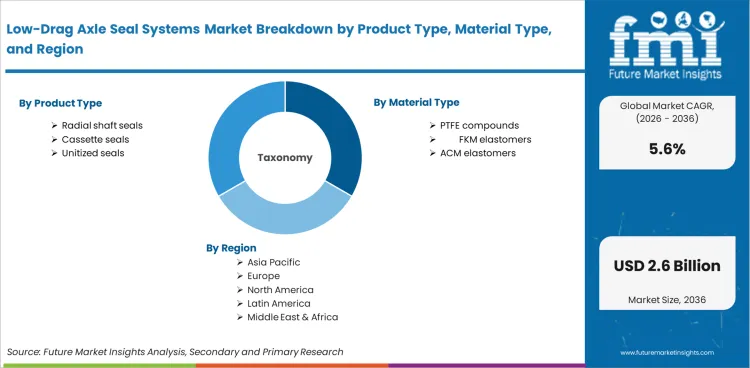
Low-drag axle seal systems market was valued at USD 1.4 billion in 2025 and is estimated at USD 1.5 billion in 2026. Demand is projected to reach USD 2.6 billion by 2036 at 5.6% CAGR during the forecast period. OEM fitment is expected to represent 57.0% of sales channel demand in 2026. Passenger cars are forecast to account for 46.0% of vehicle type demand in 2026.
Summary of the Low-Drag Axle Seal Systems Market
- Demand and Growth Drivers
- Demand is supported by the need to reduce friction inside axle assemblies. Lower drag helps improve vehicle efficiency without changing the main axle design.
- Wheel-end service demand is keeping replacement activity steady. Fleet operators need seals that lower oil seepage and reduce repeat repair work.
- Electric drivetrain repair is creating new aftermarket demand. Workshops need seal kits that match e-axle parts and support safer service work.
- Product and Segment View
- Radial shaft seals continue to serve many axle programs because they offer proven oil retention. Their simple design makes them easier to validate for passenger cars and light trucks.
- PTFE compounds are getting attention in high-speed sealing areas. Low-friction behavior makes them useful in compact e-axle and hybrid driveline designs.
- Drive axle applications form a key demand area. Gear oil protection is important because leakage can damage bearings and reduce axle life.
- Geography and Company Outlook
- China and India support demand through vehicle production scale. Local axle and EV part programs create steady need for approved sealing parts.
- Germany and Japan support higher-value demand through precision drivetrain programs. Seal suppliers must prove friction control and long service life before platform approval.
- Competition depends on testing depth and material control. Suppliers with strong fitment support and oil retention proof are better placed in OEM and aftermarket channels.
- Analyst Opinion
- Nikhil Kaitwade, Principal Consultant for Automotive at FMI, says, “Low-drag axle seals are becoming a drivetrain efficiency decision. OEMs want lower torque without giving up oil retention. Electric axles make the trade-off harder as shaft speed rises. Suppliers with friction data and compound control can win repeat axle programs. Aftermarket demand will favor kits built to reduce leakage complaints and support faster e-axle repair.”
- Low-Drag Axle Seal Systems Market Value Analysis
- The low-drag axle seal systems market is moving from a basic replacement part space into a more defined drivetrain efficiency component market.
- Demand is supported by the need to reduce friction losses in axle assemblies.
- OEM interest is increasing as EV and hybrid axles need seals that can handle higher shaft speeds.
- Aftermarket demand is supported by wheel-end service needs and e-axle repair work.
- Supplier value depends on proven oil retention with lower drag and stable material performance.
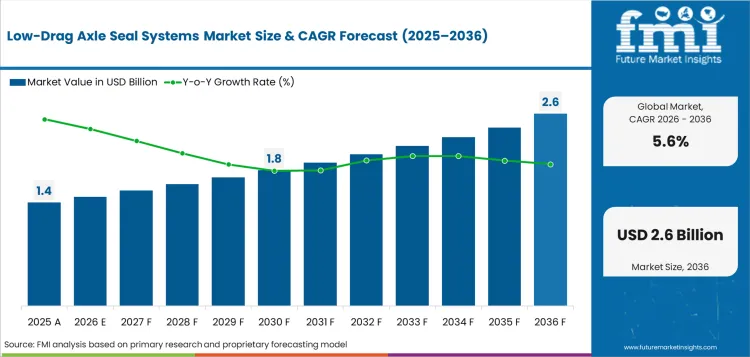
Key Takeaways, Market Size, and Forecast
- Low-drag axle seal systems market was valued at USD 1.4 billion in 2025.
- Demand is estimated at USD 1.5 billion in 2026.
- By 2036, the industry is projected to reach USD 2.6 billion.
- Market value is projected to expand at 5.6% CAGR from 2026 to 2036.
- Market expansion is projected to add USD 1.1 billion in incremental opportunity over the forecast decade.
- OEM fitment is expected to represent 57.0% of sales channel demand in 2026.
- Passenger cars are forecast to account for 46.0% of vehicle type demand in 2026.
- China at 7.1% CAGR and India at 6.8% CAGR are expected to record the faster country pace through 2036.
Axle seal selection is becoming tied to energy loss because fleets need lower drag without leakage risk. In 2024, the European Commission stated that Regulation (EU) 2024/1610 requires new semi-trailers to cut CO₂ emissions by 10% from 2030, with other new trailers set at 7.5%. Axle and trailer suppliers will need seal systems that support certified wheel-end efficiency and reduce resistance during long-distance operation. In October 2024, Schaeffler introduced its FAG Repair Insert Unit with a patented contactless polyamide sealing cap for truck and bus axles. The company said the design cuts energy use by up to 38 watts per wheel hub. This gives distributors a clearer replacement story because workshops can fit a sealed wheel-end unit with a measurable efficiency claim. In September 2024, NSK launched a low-friction hub unit bearing that reduced seal lip count from three to one and cut friction by 40%. Seal suppliers now need proof that lower contact force can still protect hubs from muddy water and road contamination.
Low-Drag Axle Seal Systems Market Definition
The low-drag axle seal systems market covers sealing parts designed to reduce friction around rotating axle shafts. These seals help keep lubricant inside the axle housing and protect the assembly from dust, water, and road debris. The market serves vehicle makers and repair channels that need better oil control with lower energy loss. Demand is closely tied to passenger cars, light trucks, heavy trucks, and electric axle systems. Low-drag axle seals are gaining importance as EV and hybrid drivetrains use faster rotating parts. Seal suppliers must balance low friction with stable sealing performance because oil leakage can damage bearings and shorten axle life.
Low-Drag Axle Seal Systems Market Inclusions
Market scope covers low-drag axle seal systems categorized by product type, including radial shaft seals, cassette seals, unitized seals, and non-contact seals; material type, including PTFE compounds, FKM elastomers, HNBR elastomers, ACM elastomers, and hybrid polymers; vehicle type, including passenger cars, light trucks, heavy trucks, electric axles, and off-highway vehicles; sales channel, including OEM fitment, aftermarket replacement, service kits, and distributor sales; and application, including drive axles, wheel ends, e-axles, transmission outputs, and trailer axles. The scope also includes axle sealing systems used in low-friction drivetrain assemblies where lubricant retention, dust protection, and reduced drag operate as a single sealing function. Revenue scope covers 2026 to 2036. The key stakeholders include axle seal manufacturers, automotive OEMs, e-axle system suppliers, wheel-end component makers, material compound suppliers, aftermarket parts distributors, fleet service providers, repair workshops, testing laboratories, and vehicle safety authorities.
Low-Drag Axle Seal Systems Market Exclusions
Scope excludes engine crankshaft seals and pump seals unless sold for vehicle axle assemblies. General industrial rotary seals are excluded unless the design serves road vehicle axles. Gaskets without rotary shaft contact are excluded except axle cover gaskets supplied as part of a seal kit. Bearing units and gears are excluded unless seal modules are priced as a separate package. Marine rotary seals fall outside scope unless the design is transferred into road vehicle axle programs.
Low-Drag Axle Seal Systems Market Research Methodology
- Primary Research: FMI analysts reviewed seal suppliers and axle component producers across major vehicle regions.
- Desk Research: Public vehicle production data and EV sales data were reviewed for demand checks.
- Market Sizing and Forecasting: Market size was estimated through axle production volume and seal use per vehicle.
- Data Validation: Forecast checks compared vehicle output and e-axle adoption with supplier qualification activity.
Why is the Low-Drag Axle Seal Systems Market Growing?
- EV axle designs are pushing seal suppliers to reduce friction around fast rotating shafts.
- Wheel-end service demand supports replacement seals as fleets need better oil retention.
- New material work is becoming important as suppliers prepare for stricter chemical rules.
- E-axle repair tools are opening a cleaner route for seal replacement during service.
EV drivetrains are changing how axle seals are selected. Seal suppliers now need to control friction and heat near faster shafts. Freudenberg Sealing Technologies introduced a PFAS-alternative sealing material in April 2025 for e-mobility sealing applications. The material is important for axle seal suppliers as automakers review compounds used near electric drivetrains and fluid-contact parts. Low-drag seal demand is likely to expand as OEMs ask for lower torque loss and safer material choices.
Aftermarket demand is becoming more technical as EV repairs move beyond basic service work. Schaeffler received a sustainability award in April 2026 for its E-Axle Repair Tool. The tool matters for this market as e-axle repair often involves careful handling around bearings and rotary seals. Service networks will need matched seal kits that reduce installation damage and lower repeat leakage risk.
Demand for automotive seals and gaskets connects with axle sealing as powertrain parts face tighter friction and fluid-control targets. E-axle designs need seals that work with faster rotation and compact housing space. Axle seal suppliers with material testing and fitment support will have better access to OEM and repair programs.
Market Segmentation Analysis
- Radial shaft seals are expected to lead product type demand with 38.0% share in 2026.
- Passenger cars are forecast to account for 46.0% vehicle type share in 2026.
- Drive axles are expected to hold 42.0% application share in 2026.
- OEM fitment is forecast to represent 57.0% of sales channel demand in 2026.
- PTFE compounds are expected to account for 34.0% material type share in 2026.
The market is divided into five primary segment groups based on product type and material type. Vehicle type, sales channel and application complete the structure. Product type covers radial shaft seals and cassette seals. Unitized seals and non-contact seals complete the group. Material type covers PTFE compounds and FKM elastomers. HNBR elastomers and hybrid polymers are included. Vehicle type covers passenger cars and light trucks. Heavy trucks and off-highway vehicles complete the vehicle scope. Sales channel covers OEM fitment and aftermarket replacement. Service kits and distributor sales complete the channel scope. Application covers drive axles and wheel ends. E-axles and trailer axles complete the application scope.
Insights into Low-Drag Axle Seal Systems Market by Product Type
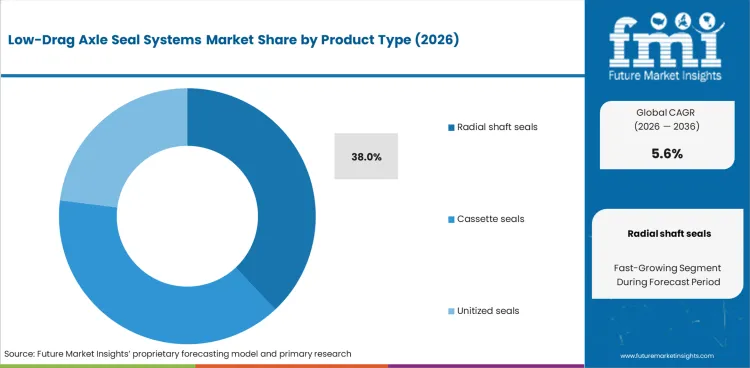
- Radial shaft seals are expected to account for 38.0% share in 2026 as axle shafts need steady oil control under daily rotation. Their use in passenger cars and light trucks keeps approval work simpler for many OEM axle programs.
- Cassette seals support wheel-end applications exposed to road dust and water. Unitized seals can reduce fitting errors as the sealing part and dirt barrier come together in one assembly.
Insights into Low-Drag Axle Seal Systems Market by Material Type
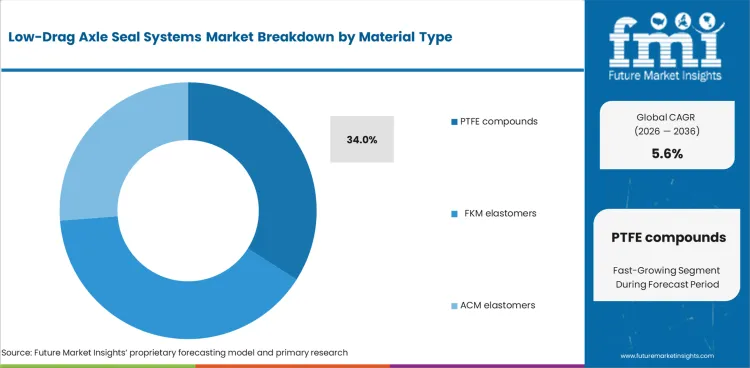
- PTFE compounds are forecast to account for 34.0% material type share in 2026 as fast shafts need lower contact friction. Their use supports e-axle cooling and lubrication system components because oil control and heat handling become harder in compact modules.
- FKM elastomers serve axle areas exposed to heat and aggressive oils. HNBR elastomers support selected programs where abrasion resistance and oil life are more important than very low friction.
Insights into Low-Drag Axle Seal Systems Market by Vehicle Type
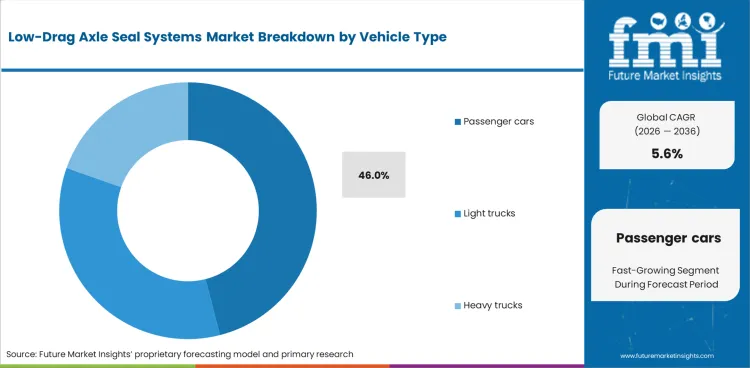
- Passenger cars are expected to account for 46.0% vehicle type share in 2026 as high production volume gives seal suppliers a wider OEM approval route. Steady axle use in everyday vehicles keeps radial shaft seal demand active.
- Light trucks need seals that can handle heavier axle loads and regular road exposure. Heavy trucks use wheel-end seals designed to reduce oil leakage and avoid repeat service work.
Insights into Low-Drag Axle Seal Systems Market by Sales Channel
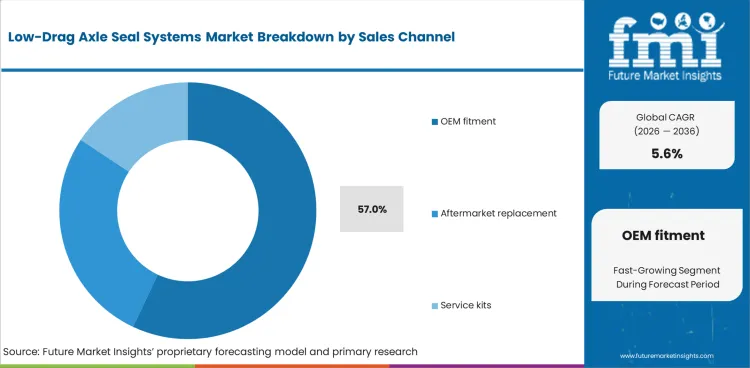
- OEM fitment is expected to represent 57.0% sales channel share in 2026 as axle seals must match shaft finish and housing design before vehicle launch. Early approval gives suppliers a longer supply route across platform cycles.
- Aftermarket replacement demand follows oil seepage and wheel-end service work. Repair kits linked with automotive seals and gaskets can support workshops that need correct fitment and lower repeat repair risk.
Insights into Low-Drag Axle Seal Systems Market by Application
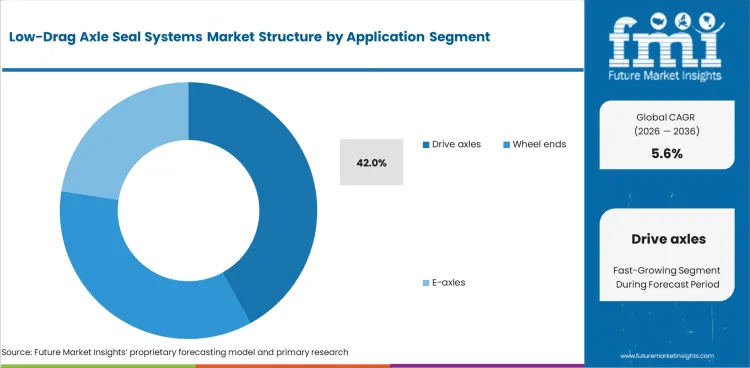
- Drive axles are forecast to hold 42.0% application share in 2026. Seals protect gear oil and bearing surfaces under daily load. Passenger cars and light trucks keep demand steady due to broad axle use.
- E-axles create a higher-value route for low-drag sealing as faster shafts raise heat and friction risk. Demand linked with electric drive axles for heavy-duty trucks will need seals built for oil control under heavier load.
Low-Drag Axle Seal Systems Market Drivers, Restraints, and Opportunities
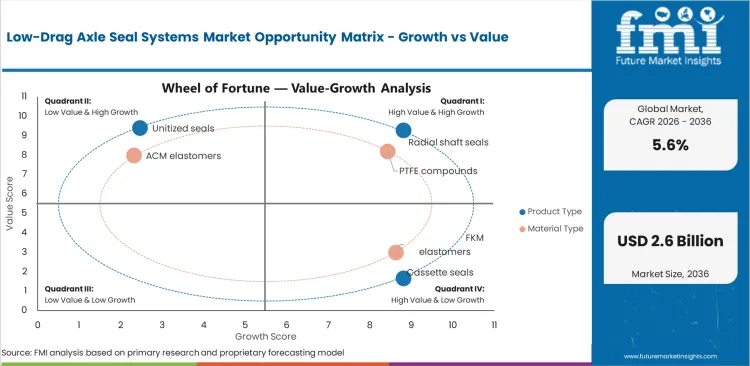
- Faster e-axle rotation is pushing seal suppliers to reduce lip friction and keep gear oil inside compact axle housings.
- Material reformulation can slow approval as OEMs need fresh proof that new compounds can handle axle oil and heat.
- E-axle service tools are creating aftermarket scope as workshops need matched seal kits during bearing and shaft repairs.
E-Axle Speed Raises Seal Requirements
Electric axle systems place seals close to fast shafts and hot lubricant zones. Low-drag designs must reduce contact load without allowing oil seepage. Suppliers serving e-axle cooling and lubrication system components need seal data that matches oil temperature and shaft speed. Seal makers with friction testing can support OEM approval more easily. Axle programs will favor suppliers that can prove low heat build-up and stable oil control.
Material Reformulation Can Slow Qualification
Seal materials are under closer review as automakers prepare for stricter chemical expectations. Freudenberg Sealing Technologies introduced a PFAS-alternative material for e-mobility sealing in April 2025. The company stated that the material is processed by injection molding and targets demanding sealing needs in electric mobility. For low-drag axle seals, this type of material work can help suppliers reduce future approval risk. It can also add testing work before new compounds enter axle programs.
Analysis of Low-Drag Axle Seal Systems Market by Key Countries
.webp "Top Country Growth Comparison Low Drag Axle Seal Systems Market Cagr (2026 2036)")
| Country | CAGR |
|---|---|
| China | 7.1% |
| India | 6.8% |
| South Korea | 6.4% |
| Germany | 5.4% |
| Japan | 5.2% |
| United Kingdom | 5.0% |
| United States | 4.9% |
Source: Future Market Insights, 2026.
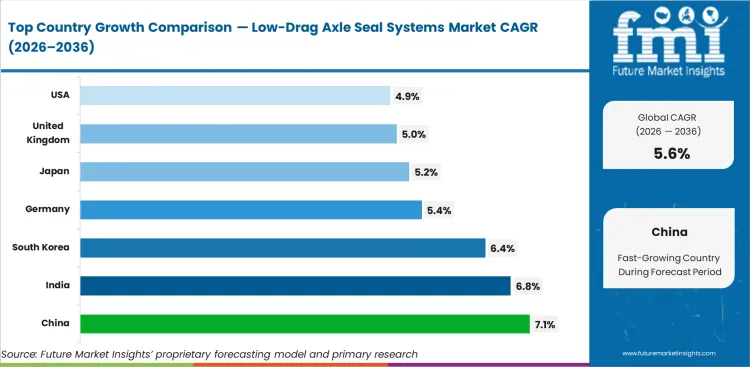
Low-Drag Axle Seal Systems Market CAGR Analysis by Country
- China is projected to record 7.1% CAGR through 2036.
- India is expected to expand at 6.8% CAGR by 2036.
- South Korea is forecast to grow at 6.4% CAGR during the forecast period.
- Germany is expected to advance at 5.4% CAGR by 2036.
- Japan is projected to rise at 5.2% CAGR during the forecast period.
- United Kingdom is forecast at 5.0% CAGR between 2026 and 2036.
- United States is expected to record 4.9% CAGR from 2026 to 2036.
Demand Outlook for Low-Drag Axle Seal Systems Market in China
China produced 34.531 million vehicles in 2025 and sales reached 34.4 million units. The market in China is projected to expand at 7.1% CAGR through 2036 as high vehicle output supports axle seal demand. EV axle programs need low-friction rotary seals that control oil around fast shafts. Local suppliers with tested fitment and stable material supply can serve large axle programs more effectively.
- EV axle programs need seals that reduce heat near fast rotating shafts and keep lubricant inside compact housings.
- High vehicle output supports repeat demand for approved axle sealing parts across passenger cars and light trucks.
- Domestic suppliers can improve OEM access by offering stable fitment and clear oil control proof.
Sales Analysis of Low-Drag Axle Seal Systems Market in India
SIAM reported total vehicle production of 31,034,174 units in April 2024 to March 2025. India is expected to record 6.8% CAGR in the market during the forecast period. Large production volume supports axle seal use across passenger vehicles and commercial fleets. Local EV part sourcing can create demand for seal kits designed around compact e-axle modules.
- Local assembly supports demand for axle seals supplied close to vehicle and axle plants.
- Commercial fleets need wheel-end seals that lower oil seepage risk during heavy use.
- EV repair channels will need matched seal kits as electric drivetrain service becomes more common.
Demand Outlook for Low-Drag Axle Seal Systems Market in South Korea
South Korea produced 407,009 EVs in 2025, equal to 11.0% of total automobile production. EV platforms need compact rotary seals that manage heat and shaft speed. Adoption in South Korea is anticipated to move ahead at 6.4% CAGR through 2036. E-axle programs will support low-drag sealing designs with stronger material proof.
- EV export platforms support demand for seals with tested torque and heat performance.
- Compact drivetrains need rotary seals built for tight housing space and fast shaft rotation.
- Suppliers with material stability data can improve access to e-axle programs.
Opportunity Analysis of Low-Drag Axle Seal Systems Market in Germany
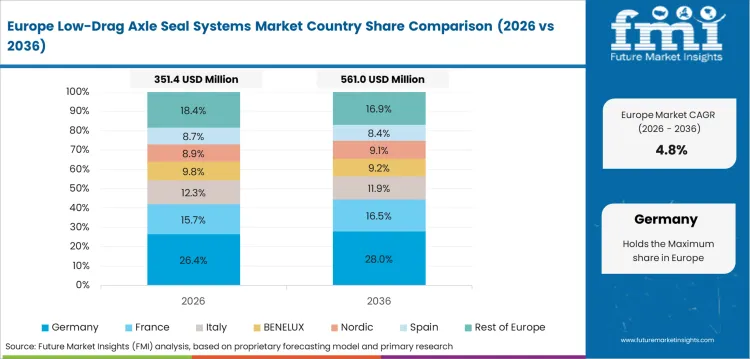
The industry outlook in Germany points to 5.4% CAGR through 2036. Germany produced 864,000 electric cars in the first half of 2025, according to VDA. Premium driveline programs create demand for seals with measured friction performance. Suppliers must meet strict test needs before parts enter axle platforms.
- Premium vehicle programs need seals with low noise and low friction behavior.
- Hybrid and EV driveline work supports demand for heat-resistant seal compounds.
- Local validation needs favor suppliers with torque data and clear material records.
Future Outlook for Low-Drag Axle Seal Systems Market in Japan
Japan recorded 4,421,494 new vehicle sales in 2024, based on the automotive guide published in November 2025. Japan is forecast to register 5.2% CAGR in this market through 2036. Hybrid vehicle sales crossed 2.0 million units in 2024, which supports demand for precision sealing in efficient driveline systems. Seal suppliers must keep dimensions stable across large production runs.
- Hybrid platforms support demand for compact low-friction seals in driveline systems.
- Precision manufacturing favors suppliers with stable geometry and material control.
- Long vehicle life supports replacement demand through regular drivetrain service.
Future Outlook for Low-Drag Axle Seal Systems Market in the United Kingdom
The United Kingdom produced 764,715 cars and commercial vehicles in 2025. Electrified car output reached 298,813 units and represented 41.7% of car production. The United Kingdom is projected to expand at 5.0% CAGR through 2036. Axle seal demand will be tied to repair replacement and selected EV production programs.
- Aftermarket replacement supports demand for seals used in drive axles and wheel ends.
- Fleet service centers need parts that reduce oil seepage and repeat repair work.
- EV repair work can add demand for e-axle seal kits over time.
Demand Outlook for Low-Drag Axle Seal Systems Market in the United States
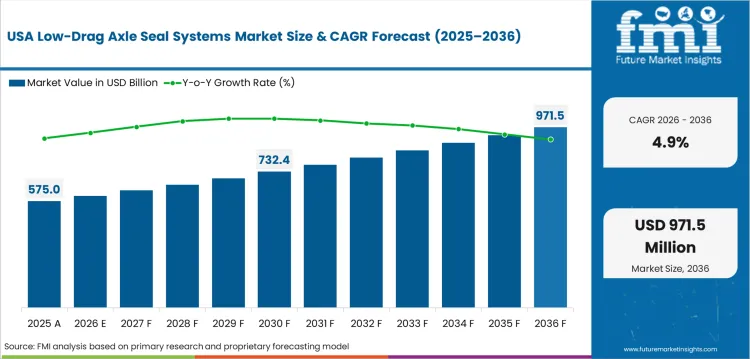
The market in the United States is projected to rise at 4.9% CAGR through 2036. Argonne data cited by the USA Bureau of Transportation Statistics shows about 1.5 million plug-in electric vehicles were sold in 2025. Pickup trucks and commercial fleets support wheel-end replacement demand. EV sales add demand for seals used around compact electric drivetrain parts.
- Pickup and light truck use supports demand for load-ready axle seals.
- Commercial fleets need wheel-end seals that reduce repeat service work.
- Aftermarket suppliers can improve access through reliable kit packaging and fitment coverage.
Company Landscape and Strategic Positioning
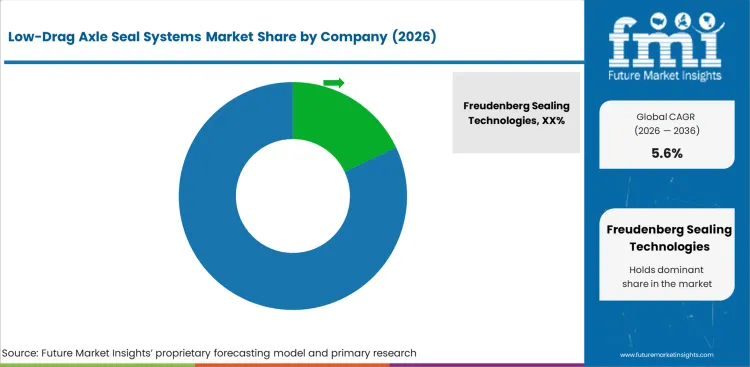
- Seal suppliers are judged on friction data and oil retention proof as axle programs need lower drag without leakage risk.
- Wheel-end specialists have an advantage in service kits as fleets need seals that reduce repeat repair work.
- E-axle programs favor suppliers with material testing and fast validation support for high-speed rotary sealing.
- Entry barriers are shaped by platform approval and compound qualification as axle seals must pass long test cycles before use.
Competitive positioning depends on seal proof, not just part availability. Freudenberg Sealing Technologies has strong automotive sealing depth and recent e-mobility material work. Its April 2025 PFAS-alternative sealing material supports the shift toward safer compounds for electric mobility parts. This adds value for low-drag axle seal systems as OEMs review material safety and fluid-contact performance.
SKF is reshaping its automotive business for a clearer mobility focus. In February 2026, SKF announced SKF Vertevo as the future name of its automotive business as a stand-alone company. The move can support sharper focus on wheel-end and drivetrain components. Low-drag axle seal suppliers will face more pressure to prove performance as automotive component businesses narrow their technical focus.
Schaeffler adds service value through its E-Axle Repair Tool. The April 2026 award confirms that electric axle repair is becoming more structured. This supports the aftermarket side of low-drag axle seals as repair networks need safer tools and matched replacement parts. Suppliers that combine fitment data with clear service guidance can improve access to EV repair channels.
Key Companies in the Low-Drag Axle Seal Systems Market
- Global Sealing Specialists: Freudenberg Sealing Technologies and NOK Corporation hold important positions through rotary seal design and automotive sealing depth.
- Wheel-End Seal Suppliers: SKF and Timken Company serve wheel-end demand through bearing and seal portfolios.
- Material and Application Specialists: Trelleborg Sealing Solutions and Parker Hannifin Corporation support high-performance sealing needs across mobility applications.
- Axle System Participants: Schaeffler Group and Dana Incorporated support the axle ecosystem through e-axle tools and axle system depth.
Company Benchmarking: Low-Drag Axle Seal Systems Market
| Company | Low-Drag Seal Depth | Wheel-End Coverage | E-Axle Readiness | Geographic Footprint |
|---|---|---|---|---|
| Freudenberg Sealing Technologies | High | High | High | Global |
| NOK Corporation | High | Medium | High | Asia and global OEMs |
| SKF | Medium | High | Medium | Global |
| Timken Company | Medium | High | Medium | North America and global fleets |
| Trelleborg Sealing Solutions | High | Medium | High | Global |
| Parker Hannifin Corporation | Medium | Medium | Medium | Global |
| Schaeffler Group | Low | Medium | High | Global drivetrain network |
| Dana Incorporated | Low | Medium | Medium | Global axle systems |
Source: Future Market Insights competitive analysis, 2026.
Key Developments in Low-Drag Axle Seal Systems Market
- In May 2025, NOK Corporation unveiled its High-Speed Bi-Directional Rotary Oil Seal for EV and robotics motor applications.
- In May 2025, Trelleborg Sealing Solutions showcased its Stefa® HiSpin® EV40 radial shaft seal at The Battery Show Europe.
Key Players in the Low-Drag Axle Seal Systems Market
Major Global Players
- Freudenberg Sealing Technologies
- NOK Corporation
- SKF
- Trelleborg Sealing Solutions
- Timken Company
Specialist and Related Players
- Parker Hannifin Corporation
- Schaeffler Group
- Dana Incorporated
- Corteco
- NTN Corporation
Report Scope and Coverage
| Parameter | Details |
|---|---|
| Quantitative Units | USD 1.5 billion to USD 2.6 billion at 5.6% CAGR |
| Market Definition | Low-friction rotary axle sealing systems used to retain lubricant and reduce drag in vehicle axle assemblies |
| Segments Covered | Product type, material type, vehicle type, sales channel, application, and region |
| Product Type | Radial shaft seals, cassette seals, unitized seals, and non-contact seals |
| Material Type | PTFE compounds, FKM elastomers, HNBR elastomers, ACM elastomers, and hybrid polymers |
| Vehicle Type | Passenger cars, light trucks, heavy trucks, electric axles, and off-highway vehicles |
| Sales Channel | OEM fitment, aftermarket replacement, service kits, and distributor sales |
| Application | Drive axles, wheel ends, e-axles, transmission outputs, and trailer axles |
| Regions Covered | North America, Latin America, Western Europe, Eastern Europe, East Asia, South Asia and Pacific, Middle East and Africa |
| Countries Covered | China, India, South Korea, Germany, Japan, United Kingdom, United States, and more than 30.0 countries |
| Key Companies Profiled | Freudenberg Sealing Technologies, NOK Corporation, SKF, Trelleborg Sealing Solutions, Timken Company, Parker Hannifin Corporation, Schaeffler Group, and Dana Incorporated |
| Forecast Period | 2026 to 2036 |
| Approach | Hybrid bottom-up and top-down method using axle production volume, seal use per vehicle, e-axle adoption, channel mix, and supplier activity |
Source: Future Market Insights, 2026.
Low-Drag Axle Seal Systems Market Breakdown by Product Type, Material Type, Vehicle Type, Sales Channel, Application, and Region
Low-Drag Axle Seal Systems Market Segmented by Product Type:
- Radial shaft seals
- Cassette seals
- Unitized seals
- Non-contact seals
Low-Drag Axle Seal Systems Market Segmented by Material Type:
- PTFE compounds
- FKM elastomers
- HNBR elastomers
- ACM elastomers
- Hybrid polymers
Low-Drag Axle Seal Systems Market Segmented by Vehicle Type:
- Passenger cars
- Light trucks
- Heavy trucks
- Electric axles
- Off-highway vehicles
Low-Drag Axle Seal Systems Market Segmented by Sales Channel:
- OEM fitment
- Aftermarket replacement
- Service kits
- Distributor sales
Low-Drag Axle Seal Systems Market Segmented by Application:
- Drive axles
- Wheel ends
- E-axles
- Transmission outputs
- Trailer axles
Low-Drag Axle Seal Systems Market Segmented by Region:
- North America
- Latin America
- Western Europe
- Eastern Europe
- East Asia
- South Asia and Pacific
- Middle East and Africa
Bibliography
- European Commission. (2026). Lorries, buses and coaches. European Commission.
- European Parliament and Council of the European Union. (2024, June 6). Regulation (EU) 2024/1610 of the European Parliament and of the Council of 14 May 2024. EUR-Lex.
- Freudenberg Sealing Technologies. (2025, April 10). New sealing material for safe battery cells. Freudenberg Sealing Technologies.
- German Association of the Automotive Industry. (2025, August 4). Production and market in July 2025. VDA.
- International Trade Administration. (2025, July 21). South Korea electric vehicles EV market. International Trade Administration.
- International Trade Administration. (2025, November 20). Japan - Automotive. International Trade Administration.
- NOK Corporation. (2025, May 7). NOK to exhibit at Automotive Engineering Exposition 2025 in Yokohama. NOK Corporation.
- NSK. (2024, September 18). NSK announces new and improved low-friction hub unit bearing. NSK.
- Schaeffler Group. (2026, April 23). Schaeffler receives Sustainability Award in the Automotive sector with E-Axle Repair Tool. Schaeffler Group.
- Schaeffler India. (2024, October 25). New FAG Repair Insert Unit with patented seal design enables efficient repairs and reduces fuel consumption. Schaeffler India.
- SKF. (2026, February 26). SKF announces the future name of the Automotive business: SKF Vertevo. SKF.
- Society of Indian Automobile Manufacturers. (2025, April 15). Performance of auto industry during 2024-25. SIAM.
- Society of Motor Manufacturers and Traders. (2026, January 29). Tough year for auto but new models and industrial strategy can deliver growth. SMMT.
- The State Council of the People’s Republic of China. (2026, January 14). China’s auto output, sales reach new highs in 2025. The State Council of the People’s Republic of China.
- Trelleborg Sealing Solutions. (2025, May 22). Trelleborg presents advanced e-mobility solutions at The Battery Show Europe. Trelleborg Sealing Solutions.
- USA Department of Transportation, Bureau of Transportation Statistics. (2026, March 25). Hybrid-electric, plug-in hybrid-electric and electric vehicle sales. Bureau of Transportation Statistics.
This Report Answers
- What is the current and future size of the low-drag axle seal systems market?
- How fast will low-drag axle seal systems demand expand from 2026 to 2036?
- Which product type is expected to lead demand in 2026?
- Which material type is expected to hold the main share in axle seal systems?
- Which countries are expected to record faster CAGR through 2036?
- How does EV axle speed change seal material and lip design selection?
- Which suppliers are active and valid for low-drag axle sealing?
- How does FMI validate sizing and country CAGR estimates?
Frequently Asked Questions
What is the size of the low-drag axle seal systems market in 2026?
Low-drag axle seal systems demand is estimated at USD 1.5 billion in 2026.
What is the expected value by 2036?
Market value is projected to reach USD 2.6 billion by 2036.
What CAGR is expected from 2026 to 2036?
Demand is projected to expand at 5.6% CAGR from 2026 to 2036.
Which product type is expected to lead?
Radial shaft seals are expected to lead with 38.0% share in 2026 due to proven axle oil retention performance.
Which material type is expected to hold the main share?
PTFE compounds are expected to account for 34.0% share in 2026 as high-speed shafts need low-friction contact surfaces.
Which country is expected to move fastest?
China is projected to record 7.1% CAGR through 2036 as NEV output expands high-speed axle programs.
Which companies are active in the market?
Freudenberg Sealing Technologies and NOK Corporation are active seal suppliers. SKF and Timken Company are active in wheel-end sealing.
How was the market size built?
FMI used axle production volume and seal use per axle. Low-drag seal pricing and supplier validation checks were used to estimate market size.
Preview the report firsthand - request a free sample
Get SampleGet the brochure for pricing and purchase details.
Get PDFTable of Content
- Executive Summary
- Global Market Outlook
- Demand-side Trends
- Supply-side Trends
- Technology Roadmap Analysis
- Analysis and Recommendations
- Market Overview
- Market Coverage / Taxonomy
- Market Definition / Scope / Limitations
- Research Methodology
- Chapter Orientation
- Analytical Lens and Working Hypotheses
- Market Structure, Signals, and Trend Drivers
- Benchmarking and Cross-market Comparability
- Market Sizing, Forecasting, and Opportunity Mapping
- Research Design and Evidence Framework
- Desk Research Programme (Secondary Evidence)
- Company Annual and Sustainability Reports
- Peer-reviewed Journals and Academic Literature
- Trade Journals, Industry Magazines, and Analyst Briefs
- Conference Proceedings, Webinars, and Seminar Materials
- Government Statistics Portals and Public Data Releases
- Press Releases and Reputable Media Coverage
- Specialist Newsletters and Curated Briefings
- Sector Databases and Reference Repositories
- FMI Internal Proprietary Databases and Historical Market Datasets
- Subscription Datasets and Paid Sources
- Social Channels, Communities, and Digital Listening Inputs
- Additional Desk Sources
- Expert Input and Fieldwork (Primary Evidence)
- Primary Modes
- Qualitative Interviews and Expert Elicitation
- Quantitative Surveys and Structured Data Capture
- Blended Approach
- Why Primary Evidence is Used
- Field Techniques
- Interviews
- Surveys
- Focus Groups
- Observational and In-context Research
- Social and Community Interactions
- Stakeholder Universe Engaged
- C-suite Leaders
- Board Members
- Presidents and Vice Presidents
- R&D and Innovation Heads
- Technical Specialists
- Domain Subject-matter Experts
- Scientists
- Physicians and Other Healthcare Professionals
- Governance, Ethics, and Data Stewardship
- Research Ethics
- Data Integrity and Handling
- Primary Modes
- Opportunity
- Trends
- Desk Research Programme (Secondary Evidence)
- Scenario Forecast
- Demand in Optimistic Scenario
- Demand in Likely Scenario
- Demand in Conservative Scenario
- Opportunity Map Analysis
- Product Life Cycle Analysis
- Supply Chain Analysis
- Investment Feasibility Matrix
- Value Chain Analysis
- PESTLE and Porter’s Analysis
- Regulatory Landscape
- Regional Parent Market Outlook
- Production and Consumption Statistics
- Import and Export Statistics
- Global Market Analysis 2021 to 2025 and Forecast, 2026 to 2036
- Historical Market Size Value (USD Million) Analysis, 2021 to 2025
- Current and Future Market Size Value (USD Million) Projections, 2026 to 2036
- Y-o-Y Growth Trend Analysis
- Absolute $ Opportunity Analysis
- Global Market Pricing Analysis 2021 to 2025 and Forecast 2026 to 2036
- Global Market Analysis 2021 to 2025 and Forecast 2026 to 2036, By Product Type
- Introduction / Key Findings
- Historical Market Size Value (USD Million) Analysis By Product Type , 2021 to 2025
- Current and Future Market Size Value (USD Million) Analysis and Forecast By Product Type , 2026 to 2036
- Radial shaft seals
- Cassette seals
- Value (USD Million)ized seals
- Radial shaft seals
- Y-o-Y Growth Trend Analysis By Product Type , 2021 to 2025
- Absolute $ Opportunity Analysis By Product Type , 2026 to 2036
- Global Market Analysis 2021 to 2025 and Forecast 2026 to 2036, By Material Type
- Introduction / Key Findings
- Historical Market Size Value (USD Million) Analysis By Material Type, 2021 to 2025
- Current and Future Market Size Value (USD Million) Analysis and Forecast By Material Type, 2026 to 2036
- PTFE compounds
- FKM elastomers
- ACM elastomers
- PTFE compounds
- Y-o-Y Growth Trend Analysis By Material Type, 2021 to 2025
- Absolute $ Opportunity Analysis By Material Type, 2026 to 2036
- Global Market Analysis 2021 to 2025 and Forecast 2026 to 2036, By Vehicle Type
- Introduction / Key Findings
- Historical Market Size Value (USD Million) Analysis By Vehicle Type, 2021 to 2025
- Current and Future Market Size Value (USD Million) Analysis and Forecast By Vehicle Type, 2026 to 2036
- Passenger cars
- Light trucks
- Heavy trucks
- Passenger cars
- Y-o-Y Growth Trend Analysis By Vehicle Type, 2021 to 2025
- Absolute $ Opportunity Analysis By Vehicle Type, 2026 to 2036
- Global Market Analysis 2021 to 2025 and Forecast 2026 to 2036, By Sales Channel
- Introduction / Key Findings
- Historical Market Size Value (USD Million) Analysis By Sales Channel, 2021 to 2025
- Current and Future Market Size Value (USD Million) Analysis and Forecast By Sales Channel, 2026 to 2036
- OEM fitment
- Aftermarket replacement
- Service kits
- OEM fitment
- Y-o-Y Growth Trend Analysis By Sales Channel, 2021 to 2025
- Absolute $ Opportunity Analysis By Sales Channel, 2026 to 2036
- Global Market Analysis 2021 to 2025 and Forecast 2026 to 2036, By Application
- Introduction / Key Findings
- Historical Market Size Value (USD Million) Analysis By Application, 2021 to 2025
- Current and Future Market Size Value (USD Million) Analysis and Forecast By Application, 2026 to 2036
- Drive axles
- Wheel ends
- E-axles
- Drive axles
- Y-o-Y Growth Trend Analysis By Application, 2021 to 2025
- Absolute $ Opportunity Analysis By Application, 2026 to 2036
- Global Market Analysis 2021 to 2025 and Forecast 2026 to 2036, By Region
- Introduction
- Historical Market Size Value (USD Million) Analysis By Region, 2021 to 2025
- Current Market Size Value (USD Million) Analysis and Forecast By Region, 2026 to 2036
- North America
- Latin America
- Western Europe
- Eastern Europe
- East Asia
- South Asia and Pacific
- Middle East & Africa
- Market Attractiveness Analysis By Region
- North America Market Analysis 2021 to 2025 and Forecast 2026 to 2036, By Country
- Historical Market Size Value (USD Million) Trend Analysis By Market Taxonomy, 2021 to 2025
- Market Size Value (USD Million) Forecast By Market Taxonomy, 2026 to 2036
- By Country
- USA
- Canada
- Mexico
- By Product Type
- By Material Type
- By Vehicle Type
- By Sales Channel
- By Application
- By Country
- Market Attractiveness Analysis
- By Country
- By Product Type
- By Material Type
- By Vehicle Type
- By Sales Channel
- By Application
- Key Takeaways
- Latin America Market Analysis 2021 to 2025 and Forecast 2026 to 2036, By Country
- Historical Market Size Value (USD Million) Trend Analysis By Market Taxonomy, 2021 to 2025
- Market Size Value (USD Million) Forecast By Market Taxonomy, 2026 to 2036
- By Country
- Brazil
- Chile
- Rest of Latin America
- By Product Type
- By Material Type
- By Vehicle Type
- By Sales Channel
- By Application
- By Country
- Market Attractiveness Analysis
- By Country
- By Product Type
- By Material Type
- By Vehicle Type
- By Sales Channel
- By Application
- Key Takeaways
- Western Europe Market Analysis 2021 to 2025 and Forecast 2026 to 2036, By Country
- Historical Market Size Value (USD Million) Trend Analysis By Market Taxonomy, 2021 to 2025
- Market Size Value (USD Million) Forecast By Market Taxonomy, 2026 to 2036
- By Country
- Germany
- UK
- Italy
- Spain
- France
- Nordic
- BENELUX
- Rest of Western Europe
- By Product Type
- By Material Type
- By Vehicle Type
- By Sales Channel
- By Application
- By Country
- Market Attractiveness Analysis
- By Country
- By Product Type
- By Material Type
- By Vehicle Type
- By Sales Channel
- By Application
- Key Takeaways
- Eastern Europe Market Analysis 2021 to 2025 and Forecast 2026 to 2036, By Country
- Historical Market Size Value (USD Million) Trend Analysis By Market Taxonomy, 2021 to 2025
- Market Size Value (USD Million) Forecast By Market Taxonomy, 2026 to 2036
- By Country
- Russia
- Poland
- Hungary
- Balkan & Baltic
- Rest of Eastern Europe
- By Product Type
- By Material Type
- By Vehicle Type
- By Sales Channel
- By Application
- By Country
- Market Attractiveness Analysis
- By Country
- By Product Type
- By Material Type
- By Vehicle Type
- By Sales Channel
- By Application
- Key Takeaways
- East Asia Market Analysis 2021 to 2025 and Forecast 2026 to 2036, By Country
- Historical Market Size Value (USD Million) Trend Analysis By Market Taxonomy, 2021 to 2025
- Market Size Value (USD Million) Forecast By Market Taxonomy, 2026 to 2036
- By Country
- China
- Japan
- South Korea
- By Product Type
- By Material Type
- By Vehicle Type
- By Sales Channel
- By Application
- By Country
- Market Attractiveness Analysis
- By Country
- By Product Type
- By Material Type
- By Vehicle Type
- By Sales Channel
- By Application
- Key Takeaways
- South Asia and Pacific Market Analysis 2021 to 2025 and Forecast 2026 to 2036, By Country
- Historical Market Size Value (USD Million) Trend Analysis By Market Taxonomy, 2021 to 2025
- Market Size Value (USD Million) Forecast By Market Taxonomy, 2026 to 2036
- By Country
- India
- ASEAN
- Australia & New Zealand
- Rest of South Asia and Pacific
- By Product Type
- By Material Type
- By Vehicle Type
- By Sales Channel
- By Application
- By Country
- Market Attractiveness Analysis
- By Country
- By Product Type
- By Material Type
- By Vehicle Type
- By Sales Channel
- By Application
- Key Takeaways
- Middle East & Africa Market Analysis 2021 to 2025 and Forecast 2026 to 2036, By Country
- Historical Market Size Value (USD Million) Trend Analysis By Market Taxonomy, 2021 to 2025
- Market Size Value (USD Million) Forecast By Market Taxonomy, 2026 to 2036
- By Country
- Kingdom of Saudi Arabia
- Other GCC Countries
- Turkiye
- South Africa
- Other African Union
- Rest of Middle East & Africa
- By Product Type
- By Material Type
- By Vehicle Type
- By Sales Channel
- By Application
- By Country
- Market Attractiveness Analysis
- By Country
- By Product Type
- By Material Type
- By Vehicle Type
- By Sales Channel
- By Application
- Key Takeaways
- Key Countries Market Analysis
- USA
- Pricing Analysis
- Market Share Analysis, 2025
- By Product Type
- By Material Type
- By Vehicle Type
- By Sales Channel
- By Application
- Canada
- Pricing Analysis
- Market Share Analysis, 2025
- By Product Type
- By Material Type
- By Vehicle Type
- By Sales Channel
- By Application
- Mexico
- Pricing Analysis
- Market Share Analysis, 2025
- By Product Type
- By Material Type
- By Vehicle Type
- By Sales Channel
- By Application
- Brazil
- Pricing Analysis
- Market Share Analysis, 2025
- By Product Type
- By Material Type
- By Vehicle Type
- By Sales Channel
- By Application
- Chile
- Pricing Analysis
- Market Share Analysis, 2025
- By Product Type
- By Material Type
- By Vehicle Type
- By Sales Channel
- By Application
- Germany
- Pricing Analysis
- Market Share Analysis, 2025
- By Product Type
- By Material Type
- By Vehicle Type
- By Sales Channel
- By Application
- UK
- Pricing Analysis
- Market Share Analysis, 2025
- By Product Type
- By Material Type
- By Vehicle Type
- By Sales Channel
- By Application
- Italy
- Pricing Analysis
- Market Share Analysis, 2025
- By Product Type
- By Material Type
- By Vehicle Type
- By Sales Channel
- By Application
- Spain
- Pricing Analysis
- Market Share Analysis, 2025
- By Product Type
- By Material Type
- By Vehicle Type
- By Sales Channel
- By Application
- France
- Pricing Analysis
- Market Share Analysis, 2025
- By Product Type
- By Material Type
- By Vehicle Type
- By Sales Channel
- By Application
- India
- Pricing Analysis
- Market Share Analysis, 2025
- By Product Type
- By Material Type
- By Vehicle Type
- By Sales Channel
- By Application
- ASEAN
- Pricing Analysis
- Market Share Analysis, 2025
- By Product Type
- By Material Type
- By Vehicle Type
- By Sales Channel
- By Application
- Australia & New Zealand
- Pricing Analysis
- Market Share Analysis, 2025
- By Product Type
- By Material Type
- By Vehicle Type
- By Sales Channel
- By Application
- China
- Pricing Analysis
- Market Share Analysis, 2025
- By Product Type
- By Material Type
- By Vehicle Type
- By Sales Channel
- By Application
- Japan
- Pricing Analysis
- Market Share Analysis, 2025
- By Product Type
- By Material Type
- By Vehicle Type
- By Sales Channel
- By Application
- South Korea
- Pricing Analysis
- Market Share Analysis, 2025
- By Product Type
- By Material Type
- By Vehicle Type
- By Sales Channel
- By Application
- Russia
- Pricing Analysis
- Market Share Analysis, 2025
- By Product Type
- By Material Type
- By Vehicle Type
- By Sales Channel
- By Application
- Poland
- Pricing Analysis
- Market Share Analysis, 2025
- By Product Type
- By Material Type
- By Vehicle Type
- By Sales Channel
- By Application
- Hungary
- Pricing Analysis
- Market Share Analysis, 2025
- By Product Type
- By Material Type
- By Vehicle Type
- By Sales Channel
- By Application
- Kingdom of Saudi Arabia
- Pricing Analysis
- Market Share Analysis, 2025
- By Product Type
- By Material Type
- By Vehicle Type
- By Sales Channel
- By Application
- Turkiye
- Pricing Analysis
- Market Share Analysis, 2025
- By Product Type
- By Material Type
- By Vehicle Type
- By Sales Channel
- By Application
- South Africa
- Pricing Analysis
- Market Share Analysis, 2025
- By Product Type
- By Material Type
- By Vehicle Type
- By Sales Channel
- By Application
- USA
- Market Structure Analysis
- Competition Dashboard
- Competition Benchmarking
- Market Share Analysis of Top Players
- By Regional
- By Product Type
- By Material Type
- By Vehicle Type
- By Sales Channel
- By Application
- Competition Analysis
- Competition Deep Dive
- Freudenberg Sealing Technologies
- Overview
- Product Portfolio
- Profitability by Market Segments (Product/Age /Sales Channel/Region)
- Sales Footprint
- Strategy Overview
- Marketing Strategy
- Product Strategy
- Channel Strategy
- NOK Corporation
- SKF
- Trelleborg Sealing Solutions
- Timken Company
- Freudenberg Sealing Technologies
- Competition Deep Dive
- Assumptions & Acronyms Used


