

- Industry Size (2026)
- USD 2240.0 Mn
- Forecast (2036)
- USD 3445.5 Mn
- CAGR (2026 to 2036)
- 4.4%
Sealed Wheel Hub Bearings Market Forecast and Outlook 2026 to 2036
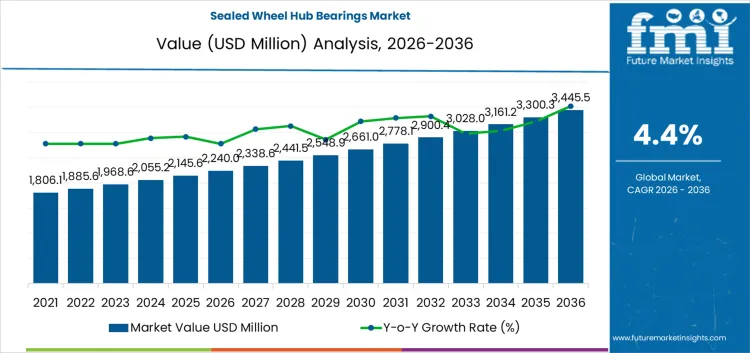
The sealed wheel hub bearings market is projected to grow from USD 2,240.0 million in 2026 to USD 3,445.5 million by 2036, reflecting a CAGR of 4.4%. The demand for sealed wheel hub bearings is rising as vehicle manufacturers focus on enhancing durability and reducing maintenance intervals. These bearings integrate bearings, seals, and lubricants in a factory-calibrated package, providing effective protection against contaminants like water, dust, and road debris that accelerate wear. OEMs specify sealed units for passenger cars, SUVs, and commercial vehicles, particularly in regions with extreme climate conditions.
Electrified powertrains also contribute to the growing demand, as these vehicles benefit from reduced torque draw and improved operational efficiency. Service replacement volumes further drive market growth, with repair facilities stocking sealed bearings matched to specific axle and spindle configurations. Engineers refine sealing technologies and materials to maintain bearing performance under challenging environmental factors, ensuring that low friction is preserved even in harsh conditions. Manufacturers continue to optimize production processes to meet the increasing demand for durable, long-lasting, and maintenance-free components in modern vehicles.
Quick Stats for Sealed Wheel Hub Bearings Market
- Sealed Wheel Hub Bearings Market Value (2026): USD 2,240.0 million
- Sealed Wheel Hub Bearings Market Forecast Value (2036): USD 3,445.5 million
- Sealed Wheel Hub Bearings Market Forecast CAGR 2026 to 2036: 4.4%
- Leading Seal Design by Demand Share: Multi-Lip Seals
- Fastest-Growing Countries: India, China, Vietnam, Mexico, Brazil
- Top Players in Global Demand: SKF, Schaeffler, NSK, NTN, JTEKT (Koyo)
Sealed Wheel Hub Bearings Market Key Takeaways
| Metric | Value |
|---|---|
| Market Value (2026) | USD 2,240.0 million |
| Market Forecast Value (2036) | USD 3,445.5 million |
| Forecast CAGR (2026-2036) | 4.4% |
Why is the Demand for Sealed Wheel Hub Bearings Market Growing?
Demand for sealed wheel hub bearings is rising as vehicle manufacturers extend focus on reducing maintenance intervals and improving durability of wheel end assemblies. Sealed units integrate bearings, seals, and lubrication in a factory calibrated package that limits intrusion of water, dust, and road contaminants that accelerate wear. OEMs specify sealed wheel hub bearings on passenger cars, SUVs, and crossovers targeted for markets with varied climate extremes where traditional open bearing designs struggle to maintain performance. Electrified powertrains place unique torque and thermal profiles on wheel ends that benefit from sealed solutions engineered to retain grease and maintain preload under dynamic load conditions. Engineers adopting advanced polymer and elastomer seal designs create barriers that help bearings maintain performance over extended service miles while meeting stringent noise, vibration, and harshness expectations tied to contemporary ride quality standards.
Demand is supported by expanding light vehicle parc and replacement activity as older vehicles require reliable wheel end components that promise consistent performance without frequent relubrication. Aftermarket channels stock sealed wheel hub bearings matched to specific axle and spindle configurations to support efficient repair workflows at service facilities. Bearing makers refine materials and manufacturing tolerances to balance low friction with robust protection against contaminants encountered in urban and rural driving environments. Fleet maintenance planners specify sealed units to reduce unscheduled downtime and support predictable service scheduling.
How Are the Segments Classified in the Sealed Wheel Hub Bearings Market?
The sealed wheel hub bearings market is driven by the increasing need for reliable, long-lasting, and maintenance-free bearing solutions, particularly for vehicles operating in demanding conditions. These bearings are essential for improving vehicle performance, ensuring smoother operation, and extending the lifespan of wheels and axles. With growing consumer expectations for durability, safety, and noise reduction, manufacturers are focusing on advanced sealing technologies and innovative designs to meet these needs. The market continues to evolve as new materials and seal configurations improve performance in both passenger and commercial vehicles.
Which seal design represents the largest share of demand?
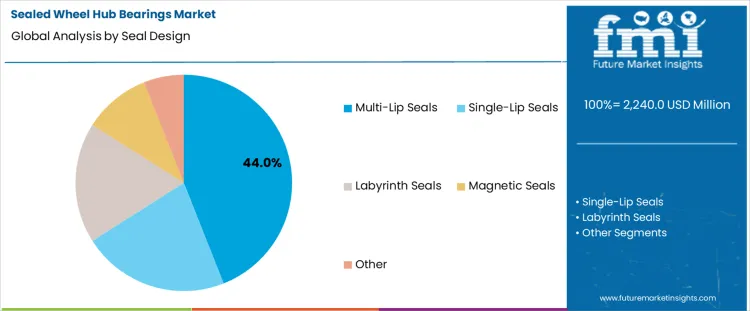
Multi-lip seals dominate the market with a 44.0% share, due to their superior sealing capability, which provides excellent protection against dirt, moisture, and contaminants. Multi-lip seals are designed to create a tighter seal, offering enhanced durability and extended bearing life, which is particularly important in harsh operating environments such as off-road and high-stress conditions. These seals are widely used in passenger cars and SUVs, where long-term reliability and reduced maintenance are essential, particularly in the context of improving vehicle safety and performance.
Key Points
- Provides superior protection against contaminants for extended bearing life
- Commonly used in harsh conditions, such as off-road and commercial applications
- Enhances durability and reduces maintenance needs for vehicle owners
Which vehicle segment holds the largest share of demand?
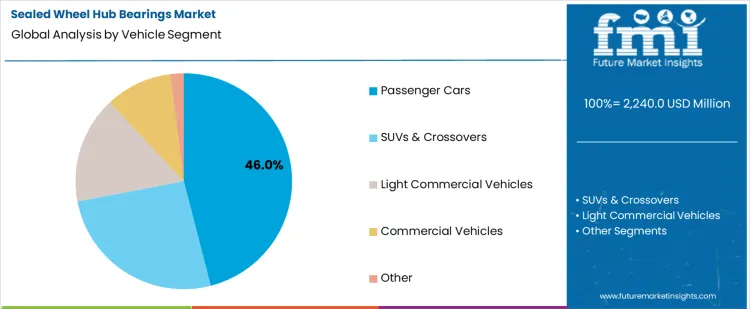
Passenger cars represent the largest share of demand, accounting for 46.0% of the market. The demand for sealed wheel hub bearings in passenger cars is driven by the need for improved vehicle efficiency, safety, and reduced maintenance costs. With consumers increasingly focused on vehicle longevity and low-maintenance solutions, sealed wheel hub bearings with effective sealing systems are essential for ensuring smooth, quiet, and reliable vehicle performance. As passenger car designs evolve, there is an increasing need for bearings that can withstand varying conditions while maintaining performance.
Key Points
- Dominates due to widespread use in consumer vehicles
- Supports the need for low-maintenance and high-durability bearings
- Essential for vehicle efficiency, safety, and performance over time
Which installation type holds the highest share of demand?
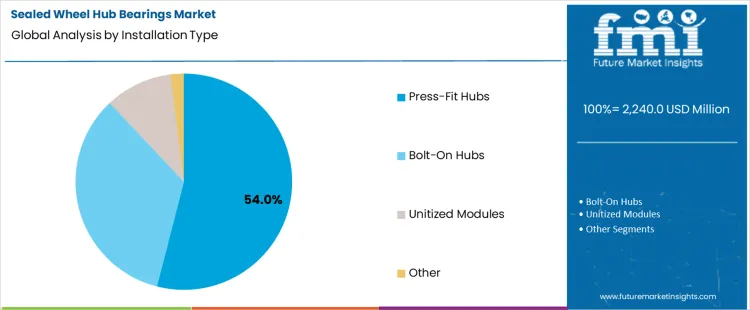
Press-fit hubs capture the largest share, with 54.0% of the demand, primarily due to their simple installation process and secure fit within the wheel hub assembly. This installation type is commonly preferred for high-volume passenger vehicles, as it reduces assembly time and ensures a tight, reliable fit. The press-fit installation offers ease of use and reliability, which are critical for manufacturers aiming to optimize production processes while ensuring the longevity and performance of wheel bearings. The widespread adoption of press-fit hubs in passenger cars and SUVs contributes significantly to its leading position in the market.
Key Points
- Simple and quick installation process, enhancing production efficiency
- Ensures a secure and reliable fit for better long-term performance
- Preferred in high-volume passenger vehicle production for cost-effectiveness
What are the Key Dynamics in the sealed wheel hub bearings market?
Demand dynamics in the sealed wheel hub bearings market stem from the need for maintenance free performance and enhanced reliability in automotive wheel assemblies. Market activity reflects stricter safety standards, higher average mileage per vehicle, and growing preference for long life driveline components. Sealed bearings reduce contamination risk by enclosing internal rolling elements and lubricant, which is critical where road salt, water ingress, and particulate exposure shorten service intervals. Original equipment manufacturers (OEMs) and aftermarket channels prioritize sealed solutions for passenger cars, light trucks, and utility vehicles where durability and predictable performance reduce warranty exposure and service costs.
How do contamination protection and service life expectations shape demand?
Demand increases where vehicle platforms require extended service intervals and resistance to environmental contaminants. Sealed configurations offer intrinsic protection against road debris, moisture, and corrosive agents, maintaining lubricant integrity and reducing frictional wear. This is especially relevant in regions with adverse weather conditions or significant off road usage, where open bearing designs face accelerated degradation.
Automotive OEMs specify sealed bearings to support vehicle warranty strategies and to meet customer expectations for low maintenance operation. In light trucks and crossover segments, which experience variable terrain and load patterns, sealed bearings contribute to stable handling characteristics and reduced noise, vibration, and harshness (NVH). As vehicle lifetimes extend and fleet operators seek lower lifetime cost of ownership, preference for sealed units that sustain performance over prolonged mileage grows.
How do design complexity and manufacturing precision influence market scalability?
Market scalability is influenced by the technical requirements of producing sealed wheel hub bearings with consistent performance across diverse vehicle applications. Sealing elements and lubricant seals must maintain integrity under thermal cycling, high rotational speeds, and external shocks, which increases design complexity and validation effort. Material selection for seals and bearing cages must balance wear resistance with flexibility to maintain contact across service life, particularly where temperature extremes occur.
Tight manufacturing tolerances are critical to ensure uniform preload and minimize internal friction, placing demand on precision machining and quality control. Cost pressures emerge where these advanced features raise unit pricing relative to simpler bearing designs, affecting adoption in entry level vehicle segments. Regional variation in service infrastructure and replacement part availability also affects market penetration, as long life sealed units reduce aftermarket service revenue for some service networks.
How Is Demand for the Sealed Wheel Hub Bearings Market Evolving Globally?
Global demand for sealed wheel hub bearings is increasing as the automotive industry emphasizes enhanced durability, safety, and performance in vehicles. Growth is driven by the need for more efficient and longer-lasting bearings that can withstand harsh operating conditions, improve vehicle stability, and reduce maintenance costs. As vehicle production increases, particularly in emerging markets, demand for high-quality, sealed bearings is expected to rise. India records 6.1% CAGR, China records 5.5% CAGR, Vietnam records 5.0% CAGR, Mexico records 4.8% CAGR, and Brazil records 4.5% CAGR. Adoption is driven by automotive industry standards, the rise of electric vehicles, and the focus on operational efficiency.
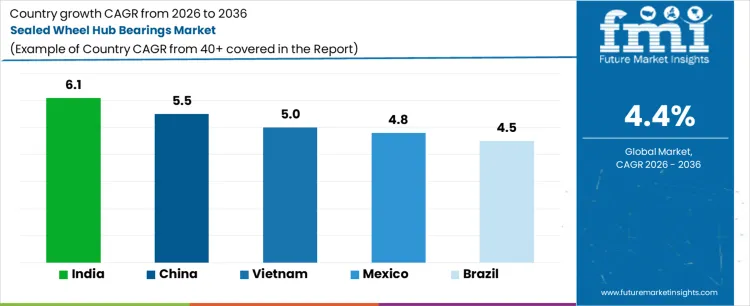
| Country | CAGR (%) |
|---|---|
| India | 6.1% |
| China | 5.5% |
| Vietnam | 5.0% |
| Mexico | 4.8% |
| Brazil | 4.5% |
What is driving demand for sealed wheel hub bearings in India?
Demand for sealed wheel hub bearings in India is increasing as the automotive sector expands and consumer preferences shift towards more durable, high-performance components. With a 6.1% CAGR, India’s automotive market is experiencing growth in both passenger and commercial vehicle segments. The increasing focus on vehicle longevity, reduced maintenance, and fuel efficiency is pushing the adoption of sealed bearings. As the government encourages electric vehicle production, there is a rising demand for bearings designed for higher load capacities and improved performance, further contributing to market growth.
- Growth in passenger and commercial vehicle production
- Focus on reducing vehicle maintenance and enhancing durability
- Government incentives for electric vehicle adoption
- Rising demand for high-performance, long-lasting components
What factors are shaping sealed wheel hub bearings demand in China?
Sealed wheel hub bearings demand in China is growing as the country’s automotive production continues to scale and evolve. Growth at 5.5% CAGR is driven by the increasing demand for reliable, high-performance components across both domestic and export markets. China’s automotive sector is shifting towards more energy-efficient vehicles, particularly electric vehicles, which require specialized sealed bearings to improve performance and longevity. The government’s focus on reducing emissions and increasing fuel efficiency, coupled with rising vehicle production, is contributing to the increasing adoption of sealed wheel hub bearings in the market.
- Rapid growth in automotive production
- Rising demand for electric vehicles and their components
- Focus on improving fuel efficiency and performance
- Government-driven push for reduced emissions and better vehicle longevity
What is driving sales of sealed wheel hub bearings in Vietnam?
Sales of sealed wheel hub bearings in Vietnam are increasing as the automotive industry experiences expansion due to rising demand for both domestic and export vehicles. With a CAGR of 5.0%, the demand is being fueled by a growing middle class, increased vehicle ownership, and government efforts to improve transportation infrastructure. Sealed bearings are increasingly being adopted to enhance vehicle performance, reduce maintenance costs, and extend the life of vehicles. As the demand for more fuel-efficient, low-maintenance vehicles rises, manufacturers are increasingly turning to high-quality, sealed bearings that meet evolving industry standards.
- Expansion of the domestic automotive market
- Growing focus on fuel-efficient, low-maintenance vehicles
- Government efforts to improve transportation infrastructure
- Rising demand for high-quality, durable vehicle components
What factors are shaping sealed wheel hub bearings demand in Mexico?
Sealed wheel hub bearings demand in Mexico is growing due to the country’s role as a key automotive manufacturing hub in North America. With a growth rate of 4.8% CAGR, the increasing demand for durable, high-performance components in heavy-duty trucks and passenger vehicles is pushing the adoption of sealed bearings. As the automotive sector in Mexico focuses on enhancing vehicle safety and performance, the need for sealed wheel hub bearings that offer greater protection and reliability is intensifying. This demand is further supported by Mexico’s growing automotive export market and its increasing focus on environmentally friendly vehicles.
- Mexico’s role as an automotive manufacturing hub
- Growing demand for reliable, high-performance components
- Focus on vehicle safety and performance
- Increasing automotive exports and focus on environmental standards
What is driving sealed wheel hub bearings demand in Brazil?
Sealed wheel hub bearings demand in Brazil is rising as the country’s automotive market expands in response to the growing need for efficient, durable components. With a 4.5% CAGR, the demand is driven by the increasing production of both passenger vehicles and commercial vehicles that require enhanced performance and reliability. Brazil’s emphasis on developing road infrastructure and improving fuel efficiency in vehicles is boosting the adoption of sealed bearings. As the country shifts towards more sustainable automotive technologies, particularly electric vehicles, the demand for specialized sealed bearings to meet these new requirements is expected to continue rising.
- Growth in the domestic automotive market
- Demand for durable, efficient vehicle components
- Focus on fuel efficiency and sustainable transportation
- Expansion of road infrastructure and vehicle performance improvements
What is the competitive landscape of demand for the sealed wheel hub bearings market globally?
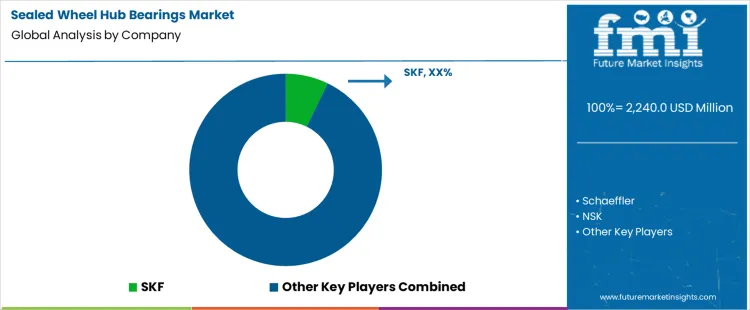
Demand for sealed wheel hub bearings is driven by the need for enhanced durability, reduced maintenance, and improved vehicle performance, especially in harsh operating environments. Buyers evaluate bearing sealing effectiveness, moisture resistance, noise levels, load capacity, and ease of installation. Procurement behavior prioritizes suppliers offering high-quality, sealed bearings that provide long-lasting protection against contaminants, reducing the frequency of repairs and extending service life. Purchasing decisions emphasize suppliers with advanced sealing technologies, ensuring higher reliability in both passenger and commercial vehicles. Trend in the market reflects the growing adoption of sealed bearings in electric vehicles (EVs) and the rising demand for low-maintenance, high-performance components.
SKF leads competitive positioning with its advanced sealed wheel hub bearings, offering robust protection against dirt, moisture, and wear, along with superior sealing technologies. Schaeffler competes by providing high-performance sealed bearings tailored for various automotive applications, ensuring durability and long service intervals. NSK supports demand with sealed wheel hub bearings designed for high-load capacity, resistance to contaminants, and reduced maintenance needs in a wide range of vehicle types. NTN participates by offering sealed bearings with high-performance seals, improving vehicle reliability and longevity, particularly in harsh environmental conditions. Timken delivers sealed wheel hub bearing solutions optimized for longevity, safety, and performance across diverse automotive segments.
Key Players in the Sealed Wheel Hub Bearings Market
- SKF
- Schaeffler
- NSK
- NTN
- JTEKT (Koyo)
- Timken
- ILJIN
- C&U Group
- ZWZ
- Nachi-Fujikoshi
Scope of the Report
| Items | Values |
|---|---|
| Quantitative Units | USD million |
| Seal Design | Multi-Lip Seals; Single-Lip Seals; Labyrinth Seals; Magnetic Seals; Other |
| Vehicle Segment | Passenger Cars; SUVs & Crossovers; Light Commercial Vehicles; Commercial Vehicles; Other |
| Installation Type | Press-Fit Hubs; Bolt-On Hubs; Unitized Modules; Other |
| Sales Channel | OEM or Line-Fit; Aftermarket Replacement; Other |
| Regions Covered | Asia Pacific, Europe, North America, Latin America, Middle East & Africa |
| Countries Covered | India, China, Vietnam, Mexico, Brazil, and 40+ countries |
| Key Companies Profiled | SKF; Schaeffler; NSK; NTN; JTEKT (Koyo); Timken; ILJIN; C&U Group; ZWZ; Nachi-Fujikoshi |
| Additional Attributes | Dollar sales by seal design, vehicle segment, installation type, and sales channel; seal effectiveness in contamination resistance, lubrication retention, and service life across multi-lip, single-lip, labyrinth, and magnetic seal types; integration of press-fit, bolt-on, and unitized modules into vehicle assembly processes; procurement patterns across OEM contracts, aftermarket replacements, and supplier networks. |
Sealed Wheel Hub Bearings Market by Segment
Seal Design:
- Multi-Lip Seals
- Single-Lip Seals
- Labyrinth Seals
- Magnetic Seals
- Other
Vehicle Segment:
- Passenger Cars
- SUVs & Crossovers
- Light Commercial Vehicles
- Commercial Vehicles
- Other
Installation Type:
- Press-Fit Hubs
- Bolt-On Hubs
- Unitized Modules
- Other
Sales Channel:
- OEM or Line-Fit
- Aftermarket Replacement
- Other
Region:
- Asia Pacific
- China
- Japan
- South Korea
- India
- Australia & New Zealand
- ASEAN
- Rest of Asia Pacific
- Europe
- Germany
- United Kingdom
- France
- Italy
- Spain
- Nordic
- BENELUX
- Rest of Europe
- North America
- United States
- Canada
- Mexico
- Latin America
- Brazil
- Chile
- Rest of Latin America
- Middle East & Africa
- Kingdom of Saudi Arabia
- Other GCC Countries
- Turkey
- South Africa
- Other African Union
- Rest of Middle East & Africa
Bibliography
- International Organization for Standardization. (2023). Rolling bearings—Boundary dimensions, general plan (ISO 15:2023). ISO.
- International Organization for Standardization. (2024). Rolling bearings—Dynamic load ratings and rating life (ISO 281:2024). ISO.
- European Commission. (2023). Type-approval requirements for motor vehicles: Mechanical durability, wheel-end safety, and service life provisions. Official Journal of the European Union.
- International Energy Agency. (2024). Electric vehicle powertrain efficiency and component durability considerations. IEA.
- Organisation for Economic Co-operation and Development. (2023). Automotive component durability, lifecycle cost, and maintenance reduction strategies. OECD Publishing.
Frequently Asked Questions
How big is the sealed wheel hub bearings market in 2026?
The global sealed wheel hub bearings market is estimated to be valued at USD 2,240.0 million in 2026.
What will be the size of sealed wheel hub bearings market in 2036?
The market size for the sealed wheel hub bearings market is projected to reach USD 3,445.5 million by 2036.
How much will be the sealed wheel hub bearings market growth between 2026 and 2036?
The sealed wheel hub bearings market is expected to grow at a 4.4% CAGR between 2026 and 2036.
What are the key product types in the sealed wheel hub bearings market?
The key product types in sealed wheel hub bearings market are multi-lip seals, single-lip seals, labyrinth seals, magnetic seals and other.
Which vehicle segment segment to contribute significant share in the sealed wheel hub bearings market in 2026?
In terms of vehicle segment, passenger cars segment to command 46.0% share in the sealed wheel hub bearings market in 2026.
Preview the report firsthand - request a free sample
Get SampleGet the brochure for pricing and purchase details.
Get PDFTable of Content
- Executive Summary
- Global Market Outlook
- Demand-side Trends
- Supply-side Trends
- Technology Roadmap Analysis
- Analysis and Recommendations
- Market Overview
- Market Coverage / Taxonomy
- Market Definition / Scope / Limitations
- Market Background
- Market Dynamics
- Drivers
- Restraints
- Opportunity
- Trends
- Scenario Forecast
- Demand in Optimistic Scenario
- Demand in Likely Scenario
- Demand in Conservative Scenario
- Opportunity Map Analysis
- Product Life Cycle Analysis
- Supply Chain Analysis
- Investment Feasibility Matrix
- Value Chain Analysis
- PESTLE and Porter’s Analysis
- Regulatory Landscape
- Regional Parent Market Outlook
- Production and Consumption Statistics
- Import and Export Statistics
- Market Dynamics
- Global Market Analysis 2021 to 2025 and Forecast, 2026 to 2036
- Historical Market Size Value (USD Million) Analysis, 2021 to 2025
- Current and Future Market Size Value (USD Million) Projections, 2026 to 2036
- Y-o-Y Growth Trend Analysis
- Absolute $ Opportunity Analysis
- Global Market Pricing Analysis 2021 to 2025 and Forecast 2026 to 2036
- Global Market Analysis 2021 to 2025 and Forecast 2026 to 2036, By Seal Design
- Introduction / Key Findings
- Historical Market Size Value (USD Million) Analysis By Seal Design , 2021 to 2025
- Current and Future Market Size Value (USD Million) Analysis and Forecast By Seal Design , 2026 to 2036
- Multi-Lip Seals
- Single-Lip Seals
- Labyrinth Seals
- Magnetic Seals
- Other
- Multi-Lip Seals
- Y-o-Y Growth Trend Analysis By Seal Design , 2021 to 2025
- Absolute $ Opportunity Analysis By Seal Design , 2026 to 2036
- Global Market Analysis 2021 to 2025 and Forecast 2026 to 2036, By Vehicle Segment
- Introduction / Key Findings
- Historical Market Size Value (USD Million) Analysis By Vehicle Segment, 2021 to 2025
- Current and Future Market Size Value (USD Million) Analysis and Forecast By Vehicle Segment, 2026 to 2036
- Passenger Cars
- SUVs & Crossovers
- Light Commercial Vehicles
- Commercial Vehicles
- Other
- Passenger Cars
- Y-o-Y Growth Trend Analysis By Vehicle Segment, 2021 to 2025
- Absolute $ Opportunity Analysis By Vehicle Segment, 2026 to 2036
- Global Market Analysis 2021 to 2025 and Forecast 2026 to 2036, By Installation Type
- Introduction / Key Findings
- Historical Market Size Value (USD Million) Analysis By Installation Type, 2021 to 2025
- Current and Future Market Size Value (USD Million) Analysis and Forecast By Installation Type, 2026 to 2036
- Press-Fit Hubs
- Bolt-On Hubs
- Value (USD Million)ized Modules
- Other
- Press-Fit Hubs
- Y-o-Y Growth Trend Analysis By Installation Type, 2021 to 2025
- Absolute $ Opportunity Analysis By Installation Type, 2026 to 2036
- Global Market Analysis 2021 to 2025 and Forecast 2026 to 2036, By Sales Channel
- Introduction / Key Findings
- Historical Market Size Value (USD Million) Analysis By Sales Channel, 2021 to 2025
- Current and Future Market Size Value (USD Million) Analysis and Forecast By Sales Channel, 2026 to 2036
- OEM or Line-Fit
- Aftermarket Replacement
- Other
- OEM or Line-Fit
- Y-o-Y Growth Trend Analysis By Sales Channel, 2021 to 2025
- Absolute $ Opportunity Analysis By Sales Channel, 2026 to 2036
- Global Market Analysis 2021 to 2025 and Forecast 2026 to 2036, By Region
- Introduction
- Historical Market Size Value (USD Million) Analysis By Region, 2021 to 2025
- Current Market Size Value (USD Million) Analysis and Forecast By Region, 2026 to 2036
- North America
- Latin America
- Western Europe
- Eastern Europe
- East Asia
- South Asia and Pacific
- Middle East & Africa
- Market Attractiveness Analysis By Region
- North America Market Analysis 2021 to 2025 and Forecast 2026 to 2036, By Country
- Historical Market Size Value (USD Million) Trend Analysis By Market Taxonomy, 2021 to 2025
- Market Size Value (USD Million) Forecast By Market Taxonomy, 2026 to 2036
- By Country
- USA
- Canada
- Mexico
- By Seal Design
- By Vehicle Segment
- By Installation Type
- By Sales Channel
- By Country
- Market Attractiveness Analysis
- By Country
- By Seal Design
- By Vehicle Segment
- By Installation Type
- By Sales Channel
- Key Takeaways
- Latin America Market Analysis 2021 to 2025 and Forecast 2026 to 2036, By Country
- Historical Market Size Value (USD Million) Trend Analysis By Market Taxonomy, 2021 to 2025
- Market Size Value (USD Million) Forecast By Market Taxonomy, 2026 to 2036
- By Country
- Brazil
- Chile
- Rest of Latin America
- By Seal Design
- By Vehicle Segment
- By Installation Type
- By Sales Channel
- By Country
- Market Attractiveness Analysis
- By Country
- By Seal Design
- By Vehicle Segment
- By Installation Type
- By Sales Channel
- Key Takeaways
- Western Europe Market Analysis 2021 to 2025 and Forecast 2026 to 2036, By Country
- Historical Market Size Value (USD Million) Trend Analysis By Market Taxonomy, 2021 to 2025
- Market Size Value (USD Million) Forecast By Market Taxonomy, 2026 to 2036
- By Country
- Germany
- UK
- Italy
- Spain
- France
- Nordic
- BENELUX
- Rest of Western Europe
- By Seal Design
- By Vehicle Segment
- By Installation Type
- By Sales Channel
- By Country
- Market Attractiveness Analysis
- By Country
- By Seal Design
- By Vehicle Segment
- By Installation Type
- By Sales Channel
- Key Takeaways
- Eastern Europe Market Analysis 2021 to 2025 and Forecast 2026 to 2036, By Country
- Historical Market Size Value (USD Million) Trend Analysis By Market Taxonomy, 2021 to 2025
- Market Size Value (USD Million) Forecast By Market Taxonomy, 2026 to 2036
- By Country
- Russia
- Poland
- Hungary
- Balkan & Baltic
- Rest of Eastern Europe
- By Seal Design
- By Vehicle Segment
- By Installation Type
- By Sales Channel
- By Country
- Market Attractiveness Analysis
- By Country
- By Seal Design
- By Vehicle Segment
- By Installation Type
- By Sales Channel
- Key Takeaways
- East Asia Market Analysis 2021 to 2025 and Forecast 2026 to 2036, By Country
- Historical Market Size Value (USD Million) Trend Analysis By Market Taxonomy, 2021 to 2025
- Market Size Value (USD Million) Forecast By Market Taxonomy, 2026 to 2036
- By Country
- China
- Japan
- South Korea
- By Seal Design
- By Vehicle Segment
- By Installation Type
- By Sales Channel
- By Country
- Market Attractiveness Analysis
- By Country
- By Seal Design
- By Vehicle Segment
- By Installation Type
- By Sales Channel
- Key Takeaways
- South Asia and Pacific Market Analysis 2021 to 2025 and Forecast 2026 to 2036, By Country
- Historical Market Size Value (USD Million) Trend Analysis By Market Taxonomy, 2021 to 2025
- Market Size Value (USD Million) Forecast By Market Taxonomy, 2026 to 2036
- By Country
- India
- ASEAN
- Australia & New Zealand
- Rest of South Asia and Pacific
- By Seal Design
- By Vehicle Segment
- By Installation Type
- By Sales Channel
- By Country
- Market Attractiveness Analysis
- By Country
- By Seal Design
- By Vehicle Segment
- By Installation Type
- By Sales Channel
- Key Takeaways
- Middle East & Africa Market Analysis 2021 to 2025 and Forecast 2026 to 2036, By Country
- Historical Market Size Value (USD Million) Trend Analysis By Market Taxonomy, 2021 to 2025
- Market Size Value (USD Million) Forecast By Market Taxonomy, 2026 to 2036
- By Country
- Kingdom of Saudi Arabia
- Other GCC Countries
- Turkiye
- South Africa
- Other African Union
- Rest of Middle East & Africa
- By Seal Design
- By Vehicle Segment
- By Installation Type
- By Sales Channel
- By Country
- Market Attractiveness Analysis
- By Country
- By Seal Design
- By Vehicle Segment
- By Installation Type
- By Sales Channel
- Key Takeaways
- Key Countries Market Analysis
- USA
- Pricing Analysis
- Market Share Analysis, 2025
- By Seal Design
- By Vehicle Segment
- By Installation Type
- By Sales Channel
- Canada
- Pricing Analysis
- Market Share Analysis, 2025
- By Seal Design
- By Vehicle Segment
- By Installation Type
- By Sales Channel
- Mexico
- Pricing Analysis
- Market Share Analysis, 2025
- By Seal Design
- By Vehicle Segment
- By Installation Type
- By Sales Channel
- Brazil
- Pricing Analysis
- Market Share Analysis, 2025
- By Seal Design
- By Vehicle Segment
- By Installation Type
- By Sales Channel
- Chile
- Pricing Analysis
- Market Share Analysis, 2025
- By Seal Design
- By Vehicle Segment
- By Installation Type
- By Sales Channel
- Germany
- Pricing Analysis
- Market Share Analysis, 2025
- By Seal Design
- By Vehicle Segment
- By Installation Type
- By Sales Channel
- UK
- Pricing Analysis
- Market Share Analysis, 2025
- By Seal Design
- By Vehicle Segment
- By Installation Type
- By Sales Channel
- Italy
- Pricing Analysis
- Market Share Analysis, 2025
- By Seal Design
- By Vehicle Segment
- By Installation Type
- By Sales Channel
- Spain
- Pricing Analysis
- Market Share Analysis, 2025
- By Seal Design
- By Vehicle Segment
- By Installation Type
- By Sales Channel
- France
- Pricing Analysis
- Market Share Analysis, 2025
- By Seal Design
- By Vehicle Segment
- By Installation Type
- By Sales Channel
- India
- Pricing Analysis
- Market Share Analysis, 2025
- By Seal Design
- By Vehicle Segment
- By Installation Type
- By Sales Channel
- ASEAN
- Pricing Analysis
- Market Share Analysis, 2025
- By Seal Design
- By Vehicle Segment
- By Installation Type
- By Sales Channel
- Australia & New Zealand
- Pricing Analysis
- Market Share Analysis, 2025
- By Seal Design
- By Vehicle Segment
- By Installation Type
- By Sales Channel
- China
- Pricing Analysis
- Market Share Analysis, 2025
- By Seal Design
- By Vehicle Segment
- By Installation Type
- By Sales Channel
- Japan
- Pricing Analysis
- Market Share Analysis, 2025
- By Seal Design
- By Vehicle Segment
- By Installation Type
- By Sales Channel
- South Korea
- Pricing Analysis
- Market Share Analysis, 2025
- By Seal Design
- By Vehicle Segment
- By Installation Type
- By Sales Channel
- Russia
- Pricing Analysis
- Market Share Analysis, 2025
- By Seal Design
- By Vehicle Segment
- By Installation Type
- By Sales Channel
- Poland
- Pricing Analysis
- Market Share Analysis, 2025
- By Seal Design
- By Vehicle Segment
- By Installation Type
- By Sales Channel
- Hungary
- Pricing Analysis
- Market Share Analysis, 2025
- By Seal Design
- By Vehicle Segment
- By Installation Type
- By Sales Channel
- Kingdom of Saudi Arabia
- Pricing Analysis
- Market Share Analysis, 2025
- By Seal Design
- By Vehicle Segment
- By Installation Type
- By Sales Channel
- Turkiye
- Pricing Analysis
- Market Share Analysis, 2025
- By Seal Design
- By Vehicle Segment
- By Installation Type
- By Sales Channel
- South Africa
- Pricing Analysis
- Market Share Analysis, 2025
- By Seal Design
- By Vehicle Segment
- By Installation Type
- By Sales Channel
- USA
- Market Structure Analysis
- Competition Dashboard
- Competition Benchmarking
- Market Share Analysis of Top Players
- By Regional
- By Seal Design
- By Vehicle Segment
- By Installation Type
- By Sales Channel
- Competition Analysis
- Competition Deep Dive
- SKF
- Overview
- Product Portfolio
- Profitability by Market Segments (Product/Age /Sales Channel/Region)
- Sales Footprint
- Strategy Overview
- Marketing Strategy
- Product Strategy
- Channel Strategy
- Schaeffler
- NSK
- NTN
- JTEKT (Koyo)
- Timken
- ILJIN
- C&U Group
- ZWZ
- Nachi-Fujikoshi
- SKF
- Competition Deep Dive
- Assumptions & Acronyms Used
- Research Methodology


