

- Industry Size (2026)
- USD 860.0 Mn
- Forecast (2036)
- USD 1497.1 Mn
- CAGR (2026 to 2036)
- 5.7%
Low-Friction Wheel Hub Bearings Market Forecast and Outlook (2026-2036)
The low-friction wheel hub bearings market is projected to grow from USD 860.0 million in 2026 to USD 1,497.1 million by 2036, reflecting a CAGR of 5.7%. The rising demand for these bearings is driven by the automotive industry's increasing emphasis on fuel efficiency and reduced drivetrain parasitic losses. Vehicle manufacturers are integrating low-friction bearings into designs to meet stringent emissions and fuel economy regulations. These bearings, optimized for minimizing rolling resistance, enhance vehicle range, improve fuel economy, and contribute to smoother driving dynamics, particularly in electric vehicles (EVs) and passenger cars.
Technological advancements in bearing materials, design, and lubrication systems are expanding the market. These innovations improve bearing durability and performance, offering superior resistance to contamination and high operational reliability. The growing adoption of low-friction bearings in passenger cars, light commercial vehicles, and performance cars is contributing to this trend. The ongoing shift toward electric powertrains and advancements in bearing technology are key drivers of market growth, as manufacturers aim to reduce energy consumption and improve the efficiency of both electric and internal combustion engine vehicles.
Quick Stats for Low-Friction Wheel Hub Bearings Market
- Low-Friction Wheel Hub Bearings Market Value (2026): USD 860.0 million
- Low-Friction Wheel Hub Bearings Market Forecast Value (2036): USD 1,497.1 million
- Low-Friction Wheel Hub Bearings Market Forecast CAGR 2026 to 2036: 5.7%
- Leading Technology Package by Demand Share: Optimized Internal Geometry
- Fastest-Growing Countries: China, India, South Korea, Mexico, Poland
- Top Players in Global Demand: SKF, Schaeffler, NSK, NTN, JTEKT (Koyo)
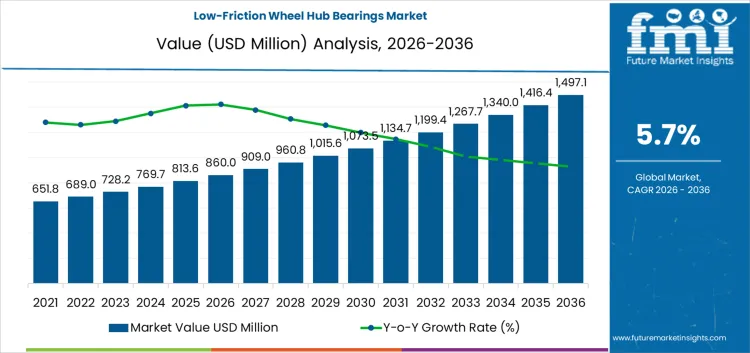
Low-Friction Wheel Hub Bearings Market Key Takeaways
| Metric | Value |
|---|---|
| Market Value (2026) | USD 860.0 million |
| Market Forecast Value (2036) | USD 1,497.1 million |
| Forecast CAGR (2026-2036) | 5.7% |
Why is the Demand for Low-Friction Wheel Hub Bearings Market Growing?
Demand for low-friction wheel hub bearings is rising as vehicle manufacturers prioritize enhancements in fuel efficiency and reduction of drivetrain parasitic losses. These bearings are engineered with optimized internal geometries and advanced lubricant systems that minimize rolling resistance at the wheel end. OEMs specify low-friction bearings on platforms where aerodynamic refinements and powertrain efficiency targets are tightly coupled with corporate average fuel economy and emissions requirements. Electrified vehicles benefit from reduced torque draw in auxiliary systems, extending driving range per charge. Passenger cars equipped with adaptive suspension systems require bearings that maintain consistent preload while reducing frictional heat generation under variable loads. The performance attributes of low-friction wheel hub bearings contribute to smoother wheel rotation, enabling sensor systems that monitor stability control and tire slip without interference from excess drag.
Service replacement volumes influence adoption because repair facilities and parts distributors stock low-friction variants matched to specific wheel end architectures to meet consumer expectations for efficiency improvements after maintenance. Engineers focus on material treatments and sealing effectiveness to sustain low resistance profiles under contamination exposure from water, dust, and road salt. Production planners align capacity with demand from light vehicle segments where buyers emphasize operational cost savings over vehicle lifetime. Calibration of manufacturing processes to support tight tolerances for low-friction designs reinforces market availability for diverse model lineups across regions.
How Are the Segments Classified in the Low-Friction Wheel Hub Bearings Market?
The low-friction wheel hub bearings market is driven by the need for improved energy efficiency, reduced noise, and enhanced vehicle performance. These bearings are crucial in applications where low friction translates to better fuel economy, longer bearing life, and quieter operation. As electric vehicles (EVs) gain market share and performance cars demand higher precision, low-friction bearings are increasingly adopted to meet these specific requirements. The market is evolving with advanced technology packages, such as optimized internal geometry and low-viscosity grease systems, to address the growing demand for energy-efficient and high-performance vehicles.
Which technology package holds the largest share of demand?
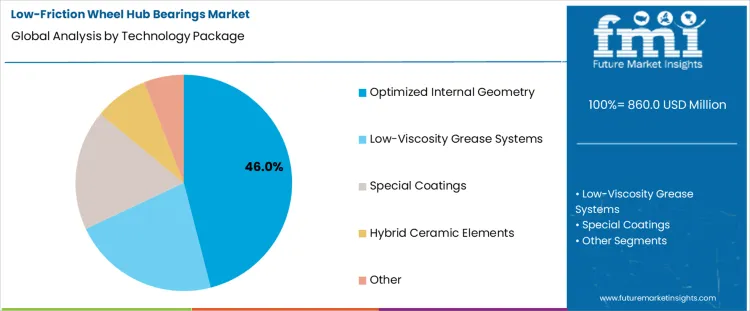
Optimized internal geometry leads with a 46.0% share, driven by its ability to significantly reduce friction within the bearing assembly. This technology improves the efficiency of the bearings by refining the internal design to optimize the load distribution and reduce energy losses. It’s particularly favored in both passenger cars and electric vehicles, where energy efficiency is a key concern. By enhancing the bearing's performance, optimized internal geometry contributes directly to reducing overall vehicle energy consumption and extending the vehicle’s range, making it a preferred choice for modern, efficiency-focused designs.
Key Points
- Reduces friction by optimizing internal bearing geometry
- Improves overall vehicle energy efficiency, especially in EVs
- Essential for extending vehicle range and reducing energy losses
Which vehicle segment represents the largest share of demand?
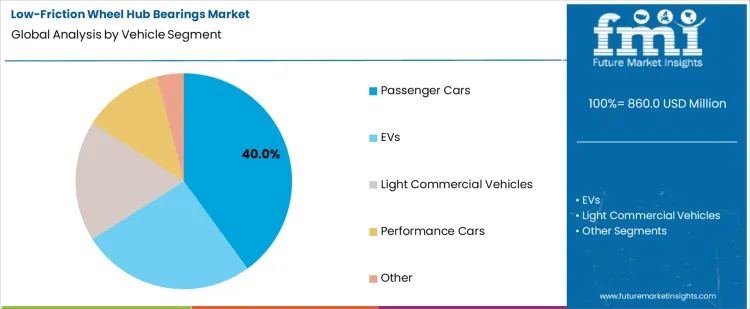
Passenger cars account for the largest share of the market, holding 40.0% of demand. As the most common vehicle type, passenger cars benefit significantly from the reduced friction and improved fuel efficiency provided by low-friction wheel hub bearings. The increasing consumer demand for better fuel economy and lower maintenance costs drives the adoption of these bearings across a wide range of car models. As passenger vehicles become more performance-oriented and efficient, the need for bearings that support these advancements continues to rise.
Key Points
- Dominates the market due to widespread use in everyday vehicles
- Drives demand for bearings that enhance fuel efficiency and reduce maintenance
- A crucial factor in the growing focus on energy efficiency in passenger vehicles
Which primary benefit holds the highest share of demand?
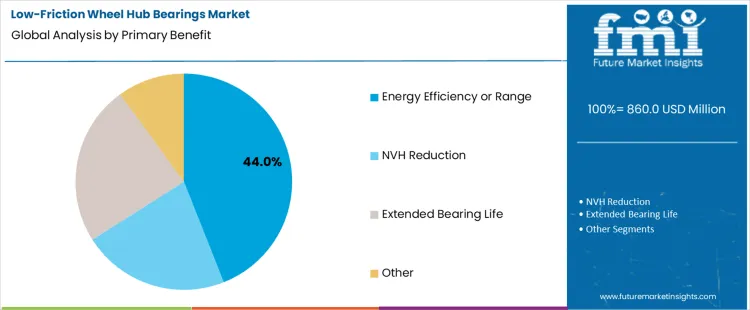
Energy efficiency or range is the primary benefit driving demand, accounting for 44.0% of the market. Low-friction wheel hub bearings are key components in improving overall vehicle efficiency, especially in electric vehicles (EVs), where maximizing range is critical. By reducing friction, these bearings help to lower energy consumption, extending the range of EVs and improving the overall efficiency of internal combustion engine (ICE) vehicles. The increasing push for more sustainable transportation solutions makes energy efficiency the top priority in bearing design.
Key Points
- Directly impacts energy efficiency and vehicle range, especially in EVs
- Reduces overall energy consumption, extending the operational life of vehicles
- Critical for meeting the growing demand for sustainable and cost-effective transport options
What are the Key Dynamics in the low-friction wheel hub bearings market?
Demand dynamics in the low-friction wheel hub bearings market are shaped by vehicle manufacturers’ focus on reducing energy loss and improving powertrain efficiency. Passenger cars, light commercial vehicles, and electrified powertrains increasingly require bearings with lower rotational resistance to enhance fuel economy or extend EV range. Market activity is concentrated where regulatory pressure on vehicle emissions and corporate fleet efficiency targets align with OEM and tier supplier strategies. Purchasing decisions prioritize friction performance, sealing effectiveness, and compatibility with varied wheel sizes and suspension designs across global vehicle platforms.
How do vehicle efficiency targets and electrification trends shape demand?
Demand for low-friction wheel hub bearings grows where vehicle efficiency improvements offer measurable benefit to end users and manufacturers under real-world driving conditions. Internal combustion engine vehicles benefit from reduced parasitic losses, contributing to lower fuel consumption. Battery electric vehicles and hybrid systems place premium emphasis on rolling resistance as a determinant of driving range, pushing OEMs to specify bearings with optimized internal geometry, high-precision rolling elements, and advanced lubricants. Light commercial and delivery fleets, with frequent stop-start cycles, use low-friction bearings to support operational cost control and uptime. Supplier innovation focuses on enhanced material surfaces, tighter dimensional control, and advanced sealing systems to maintain performance under variable speeds and load conditions typical of mixed urban and highway use.
How do material technology challenges and cost considerations influence market adoption?
Market adoption is influenced by the technical demands of developing bearings that deliver measurable friction reduction without sacrificing load capacity or durability. Advanced coatings, precision-ground races, and specialty greases improve friction performance, yet these materials and processes increase manufacturing complexity. Cost sensitivity in mainstream vehicle segments can restrain penetration, as OEMs balance the value of efficiency gains against component price. Longevity expectations under diverse operating conditions, including exposure to water, contaminants, and thermal variation, require robust sealing and lubricant retention, which adds design and validation efforts. Manufacturing throughput and quality control must address tight tolerance requirements to ensure consistent friction performance, placing pressure on supplier capacity planning and production costs in a market with segmented adoption across vehicle classes.
How Is Demand for the Low-Friction Wheel Hub Bearings Market Evolving Globally?
Global demand for low-friction wheel hub bearings is increasing as automakers and manufacturers focus on improving vehicle efficiency, performance, and reducing energy loss. Growth is driven by the adoption of lightweight and energy-efficient components, particularly in electric vehicles (EVs) and fuel-efficient combustion vehicles. Demand remains linked to regulatory requirements for reduced CO2 emissions, performance enhancement, and the growing focus on sustainability in automotive production. China records 6.8% CAGR, India records 6.4% CAGR, South Korea records 5.6% CAGR, Mexico records 5.2% CAGR, and Poland records 4.6% CAGR. Adoption is shaped by the need for smoother operations, reduced friction, and higher vehicle longevity.
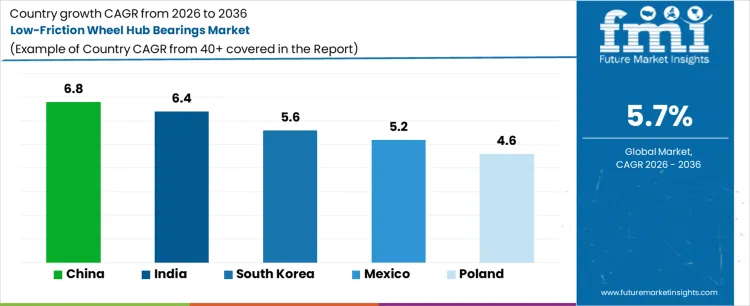
| Country | CAGR (%) |
|---|---|
| China | 6.8% |
| India | 6.4% |
| South Korea | 5.6% |
| Mexico | 5.2% |
| Poland | 4.6% |
What is driving demand for low-friction wheel hub bearings in China?
Demand for low-friction wheel hub bearings in China is rising as the country leads the global automotive industry in vehicle production and the transition to electric vehicles. Growth at 6.8% CAGR reflects the increasing adoption of high-performance, energy-efficient components in the automotive sector. Manufacturers are focused on reducing rolling resistance, enhancing fuel efficiency, and improving the overall driving experience. China’s commitment to environmental sustainability and stricter emission standards further drives demand for low-friction technologies. The expansion of domestic and global electric vehicle production continues to push the need for innovative bearing solutions in the market.
- Growth of electric vehicle production
- Rising adoption of energy-efficient components
- Stricter emissions standards promoting low-friction solutions
- Increasing focus on vehicle performance and efficiency
What factors are shaping low-friction wheel hub bearings demand in India?
Low-friction wheel hub bearings demand in India is increasing as the country’s automotive market expands, with growing interest in fuel-efficient and performance-oriented vehicles. With a 6.4% CAGR, India is seeing increasing adoption of low-friction bearings in both passenger and commercial vehicle segments. The demand is driven by the need for enhanced fuel efficiency, improved driving dynamics, and reduced maintenance costs. The Indian government’s focus on supporting electric vehicle adoption, along with its push for more sustainable transportation, reinforces this trend. Manufacturers are focusing on producing cost-effective solutions that improve overall vehicle performance and efficiency.
- Expanding automotive market driven by fuel efficiency
- Focus on reducing maintenance and energy consumption
- Government support for electric vehicle adoption
- Demand for affordable, high-performance components
What is driving sales of low-friction wheel hub bearings in South Korea?
Sales of low-friction wheel hub bearings in South Korea are rising as the automotive industry continues to emphasize efficiency and advanced technologies. With a growth rate of 5.6% CAGR, the country’s automotive sector is adopting low-friction solutions to meet performance and sustainability requirements. South Korea’s strong focus on electric vehicles and hybrid technologies further drives the demand for components that reduce friction and improve fuel economy. Manufacturers are prioritizing the development of lightweight, energy-efficient solutions for both domestic production and export, with a strong emphasis on vehicle longevity and reduced environmental impact.
- Strong focus on electric vehicle and hybrid technologies
- Adoption of energy-efficient components to meet performance standards
- Growing export demand for high-quality automotive parts
- Emphasis on reducing vehicle environmental impact
What factors are shaping low-friction wheel hub bearings demand in Mexico?
Low-friction wheel hub bearings demand in Mexico is growing as the country strengthens its automotive manufacturing capabilities, particularly for export markets. With a 5.2% CAGR, Mexico is witnessing a rising need for high-performance automotive components, particularly as automakers aim to reduce fuel consumption and CO2 emissions. The expansion of the electric vehicle market, both locally and for export, is a key driver for low-friction technologies. As Mexican manufacturers align with global automotive standards, the demand for advanced bearings that improve vehicle performance and reduce wear and tear is increasing.
- Growth in automotive manufacturing and exports
- Rising focus on reducing vehicle emissions and improving fuel economy
- Increasing demand for components for electric vehicles
- Alignment with global automotive performance standards
What is driving low-friction wheel hub bearings demand in Poland?
Low-friction wheel hub bearings demand in Poland is driven by the country’s increasing role as an automotive manufacturing hub in Europe. With a 4.6% CAGR, Poland’s automotive sector continues to expand, with a growing emphasis on fuel efficiency and reduced environmental impact. Demand for low-friction bearings is supported by the rise of electric vehicle production and the adoption of lightweight, energy-efficient solutions in traditional combustion engine vehicles. As Poland strengthens its position in global supply chains, automakers are increasingly incorporating advanced bearing technologies to meet regulatory standards and improve vehicle performance.
- Growth in Poland’s automotive manufacturing sector
- Emphasis on energy-efficient and lightweight vehicle solutions
- Rising adoption of electric vehicle technologies
- Alignment with European automotive standards for fuel efficiency and emissions reduction
What is the competitive landscape of demand for the low-friction wheel hub bearings market globally?
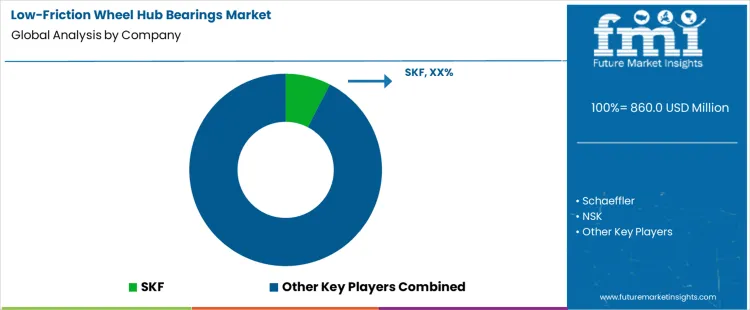
Demand for low-friction wheel hub bearings is driven by the need for improved fuel efficiency, reduced CO2 emissions, and enhanced vehicle performance, especially in the context of electric and hybrid vehicles. Buyers evaluate bearing friction levels, load capacity, noise, vibration, durability, and compatibility with advanced vehicle systems. Procurement behavior prioritizes suppliers that can provide bearings with low rolling resistance, long service life, and minimal maintenance. Purchasing decisions emphasize high-performance solutions that reduce energy consumption while maintaining vehicle safety and handling. Trend in the market reflects growing vehicle electrification, lightweight designs, and the push for reduced environmental impact across global automotive markets.
SKF leads competitive positioning by offering low-friction bearings that prioritize energy savings, performance, and sustainability, particularly in eco-conscious vehicle segments. Schaeffler competes with its innovative bearing solutions that combine low friction and high durability for electric and traditional vehicles. NSK supports demand by providing advanced, low-friction wheel hub bearings designed to enhance fuel efficiency and reduce wear in both passenger and commercial vehicles. NTN participates with high-performance bearings focusing on friction reduction and long service life, optimizing vehicle efficiency. Timken delivers low-friction solutions focused on reducing rolling resistance while maintaining safety and performance, especially in high-load applications.
Key Players in the Low-Friction Wheel Hub Bearings Market
- SKF
- Schaeffler
- NSK
- NTN
- JTEKT (Koyo)
- Timken
- ILJIN
- C&U Group
- ZWZ
- Nachi-Fujikoshi
Scope of the Report
| Items | Values |
|---|---|
| Quantitative Units | USD million |
| Technology Package | Optimized Internal Geometry; Low-Viscosity Grease Systems; Special Coatings; Hybrid Ceramic Elements; Other |
| Vehicle Segment | Passenger Cars; EVs; Light Commercial Vehicles; Performance Cars; Other |
| Primary Benefit | Energy Efficiency or Range; NVH Reduction; Extended Bearing Life; Other |
| Sales Channel | OEM or Line-Fit; Aftermarket Replacement; Other |
| Regions Covered | Asia Pacific, Europe, North America, Latin America, Middle East & Africa |
| Countries Covered | China, India, South Korea, Mexico, Poland, and 40+ countries |
| Key Companies Profiled | SKF; Schaeffler; NSK; NTN; JTEKT (Koyo); Timken; ILJIN; C&U Group; ZWZ; Nachi-Fujikoshi |
| Additional Attributes | Dollar sales by technology package, vehicle segment, primary benefit, and sales channel; bearing performance in energy efficiency, NVH reduction, and lifespan extension across optimized geometries, low-viscosity grease systems, and hybrid ceramic elements; lubrication technology trends influencing bearing lifespan and performance under varying driving conditions; procurement dynamics driven by OEM integration and aftermarket replacement channels. |
Low-Friction Wheel Hub Bearings Market by Segment
Technology Package:
- Optimized Internal Geometry
- Low-Viscosity Grease Systems
- Special Coatings
- Hybrid Ceramic Elements
- Other
Vehicle Segment:
- Passenger Cars
- EVs
- Light Commercial Vehicles
- Performance Cars
- Other
Primary Benefit:
- Energy Efficiency or Range
- NVH Reduction
- Extended Bearing Life
- Other
Sales Channel:
- OEM or Line-Fit
- Aftermarket Replacement
- Other
Region:
- Asia Pacific
- China
- Japan
- South Korea
- India
- Australia & New Zealand
- ASEAN
- Rest of Asia Pacific
- Europe
- Germany
- United Kingdom
- France
- Italy
- Spain
- Nordic
- BENELUX
- Rest of Europe
- North America
- United States
- Canada
- Mexico
- Latin America
- Brazil
- Chile
- Rest of Latin America
- Middle East & Africa
- Kingdom of Saudi Arabia
- Other GCC Countries
- Turkey
- South Africa
- Other African Union
- Rest of Middle East & Africa
Bibliography
- International Organization for Standardization. (2023). Rolling bearings—Lubricating greases—Characteristics and test methods (ISO 2137:2023). ISO.
- European Commission. (2023). Regulation (EU) 2019/631: CO₂ emission performance standards for new passenger cars and light commercial vehicles—Implementation updates. Official Journal of the European Union.
- United Nations Economic Commission for Europe. (2023). Uniform provisions concerning the approval of vehicles with regard to braking, stability control, and wheel-end performance (WP.29 framework). United Nations.
Frequently Asked Questions
How big is the low-friction wheel hub bearings market in 2026?
The global low-friction wheel hub bearings market is estimated to be valued at USD 860.0 million in 2026.
What will be the size of low-friction wheel hub bearings market in 2036?
The market size for the low-friction wheel hub bearings market is projected to reach USD 1,497.1 million by 2036.
How much will be the low-friction wheel hub bearings market growth between 2026 and 2036?
The low-friction wheel hub bearings market is expected to grow at a 5.7% CAGR between 2026 and 2036.
What are the key product types in the low-friction wheel hub bearings market?
The key product types in low-friction wheel hub bearings market are optimized internal geometry, low-viscosity grease systems, special coatings, hybrid ceramic elements and other.
Which vehicle segment segment to contribute significant share in the low-friction wheel hub bearings market in 2026?
In terms of vehicle segment, passenger cars segment to command 40.0% share in the low-friction wheel hub bearings market in 2026.
Preview the report firsthand - request a free sample
Get SampleGet the brochure for pricing and purchase details.
Get PDFTable of Content
- Executive Summary
- Global Market Outlook
- Demand-side Trends
- Supply-side Trends
- Technology Roadmap Analysis
- Analysis and Recommendations
- Market Overview
- Market Coverage / Taxonomy
- Market Definition / Scope / Limitations
- Market Background
- Market Dynamics
- Drivers
- Restraints
- Opportunity
- Trends
- Scenario Forecast
- Demand in Optimistic Scenario
- Demand in Likely Scenario
- Demand in Conservative Scenario
- Opportunity Map Analysis
- Product Life Cycle Analysis
- Supply Chain Analysis
- Investment Feasibility Matrix
- Value Chain Analysis
- PESTLE and Porter’s Analysis
- Regulatory Landscape
- Regional Parent Market Outlook
- Production and Consumption Statistics
- Import and Export Statistics
- Market Dynamics
- Global Market Analysis 2021 to 2025 and Forecast, 2026 to 2036
- Historical Market Size Value (USD Million) Analysis, 2021 to 2025
- Current and Future Market Size Value (USD Million) Projections, 2026 to 2036
- Y-o-Y Growth Trend Analysis
- Absolute $ Opportunity Analysis
- Global Market Pricing Analysis 2021 to 2025 and Forecast 2026 to 2036
- Global Market Analysis 2021 to 2025 and Forecast 2026 to 2036, By Technology Package
- Introduction / Key Findings
- Historical Market Size Value (USD Million) Analysis By Technology Package , 2021 to 2025
- Current and Future Market Size Value (USD Million) Analysis and Forecast By Technology Package , 2026 to 2036
- Optimized Internal Geometry
- Low-Viscosity Grease Systems
- Special Coatings
- Hybrid Ceramic Elements
- Other
- Optimized Internal Geometry
- Y-o-Y Growth Trend Analysis By Technology Package , 2021 to 2025
- Absolute $ Opportunity Analysis By Technology Package , 2026 to 2036
- Global Market Analysis 2021 to 2025 and Forecast 2026 to 2036, By Vehicle Segment
- Introduction / Key Findings
- Historical Market Size Value (USD Million) Analysis By Vehicle Segment, 2021 to 2025
- Current and Future Market Size Value (USD Million) Analysis and Forecast By Vehicle Segment, 2026 to 2036
- Passenger Cars
- EVs
- Light Commercial Vehicles
- Performance Cars
- Other
- Passenger Cars
- Y-o-Y Growth Trend Analysis By Vehicle Segment, 2021 to 2025
- Absolute $ Opportunity Analysis By Vehicle Segment, 2026 to 2036
- Global Market Analysis 2021 to 2025 and Forecast 2026 to 2036, By Primary Benefit
- Introduction / Key Findings
- Historical Market Size Value (USD Million) Analysis By Primary Benefit, 2021 to 2025
- Current and Future Market Size Value (USD Million) Analysis and Forecast By Primary Benefit, 2026 to 2036
- Energy Efficiency or Range
- NVH Reduction
- Extended Bearing Life
- Other
- Energy Efficiency or Range
- Y-o-Y Growth Trend Analysis By Primary Benefit, 2021 to 2025
- Absolute $ Opportunity Analysis By Primary Benefit, 2026 to 2036
- Global Market Analysis 2021 to 2025 and Forecast 2026 to 2036, By Sales Channel
- Introduction / Key Findings
- Historical Market Size Value (USD Million) Analysis By Sales Channel, 2021 to 2025
- Current and Future Market Size Value (USD Million) Analysis and Forecast By Sales Channel, 2026 to 2036
- OEM or Line-Fit
- Aftermarket Replacement
- Other
- OEM or Line-Fit
- Y-o-Y Growth Trend Analysis By Sales Channel, 2021 to 2025
- Absolute $ Opportunity Analysis By Sales Channel, 2026 to 2036
- Global Market Analysis 2021 to 2025 and Forecast 2026 to 2036, By Region
- Introduction
- Historical Market Size Value (USD Million) Analysis By Region, 2021 to 2025
- Current Market Size Value (USD Million) Analysis and Forecast By Region, 2026 to 2036
- North America
- Latin America
- Western Europe
- Eastern Europe
- East Asia
- South Asia and Pacific
- Middle East & Africa
- Market Attractiveness Analysis By Region
- North America Market Analysis 2021 to 2025 and Forecast 2026 to 2036, By Country
- Historical Market Size Value (USD Million) Trend Analysis By Market Taxonomy, 2021 to 2025
- Market Size Value (USD Million) Forecast By Market Taxonomy, 2026 to 2036
- By Country
- USA
- Canada
- Mexico
- By Technology Package
- By Vehicle Segment
- By Primary Benefit
- By Sales Channel
- By Country
- Market Attractiveness Analysis
- By Country
- By Technology Package
- By Vehicle Segment
- By Primary Benefit
- By Sales Channel
- Key Takeaways
- Latin America Market Analysis 2021 to 2025 and Forecast 2026 to 2036, By Country
- Historical Market Size Value (USD Million) Trend Analysis By Market Taxonomy, 2021 to 2025
- Market Size Value (USD Million) Forecast By Market Taxonomy, 2026 to 2036
- By Country
- Brazil
- Chile
- Rest of Latin America
- By Technology Package
- By Vehicle Segment
- By Primary Benefit
- By Sales Channel
- By Country
- Market Attractiveness Analysis
- By Country
- By Technology Package
- By Vehicle Segment
- By Primary Benefit
- By Sales Channel
- Key Takeaways
- Western Europe Market Analysis 2021 to 2025 and Forecast 2026 to 2036, By Country
- Historical Market Size Value (USD Million) Trend Analysis By Market Taxonomy, 2021 to 2025
- Market Size Value (USD Million) Forecast By Market Taxonomy, 2026 to 2036
- By Country
- Germany
- UK
- Italy
- Spain
- France
- Nordic
- BENELUX
- Rest of Western Europe
- By Technology Package
- By Vehicle Segment
- By Primary Benefit
- By Sales Channel
- By Country
- Market Attractiveness Analysis
- By Country
- By Technology Package
- By Vehicle Segment
- By Primary Benefit
- By Sales Channel
- Key Takeaways
- Eastern Europe Market Analysis 2021 to 2025 and Forecast 2026 to 2036, By Country
- Historical Market Size Value (USD Million) Trend Analysis By Market Taxonomy, 2021 to 2025
- Market Size Value (USD Million) Forecast By Market Taxonomy, 2026 to 2036
- By Country
- Russia
- Poland
- Hungary
- Balkan & Baltic
- Rest of Eastern Europe
- By Technology Package
- By Vehicle Segment
- By Primary Benefit
- By Sales Channel
- By Country
- Market Attractiveness Analysis
- By Country
- By Technology Package
- By Vehicle Segment
- By Primary Benefit
- By Sales Channel
- Key Takeaways
- East Asia Market Analysis 2021 to 2025 and Forecast 2026 to 2036, By Country
- Historical Market Size Value (USD Million) Trend Analysis By Market Taxonomy, 2021 to 2025
- Market Size Value (USD Million) Forecast By Market Taxonomy, 2026 to 2036
- By Country
- China
- Japan
- South Korea
- By Technology Package
- By Vehicle Segment
- By Primary Benefit
- By Sales Channel
- By Country
- Market Attractiveness Analysis
- By Country
- By Technology Package
- By Vehicle Segment
- By Primary Benefit
- By Sales Channel
- Key Takeaways
- South Asia and Pacific Market Analysis 2021 to 2025 and Forecast 2026 to 2036, By Country
- Historical Market Size Value (USD Million) Trend Analysis By Market Taxonomy, 2021 to 2025
- Market Size Value (USD Million) Forecast By Market Taxonomy, 2026 to 2036
- By Country
- India
- ASEAN
- Australia & New Zealand
- Rest of South Asia and Pacific
- By Technology Package
- By Vehicle Segment
- By Primary Benefit
- By Sales Channel
- By Country
- Market Attractiveness Analysis
- By Country
- By Technology Package
- By Vehicle Segment
- By Primary Benefit
- By Sales Channel
- Key Takeaways
- Middle East & Africa Market Analysis 2021 to 2025 and Forecast 2026 to 2036, By Country
- Historical Market Size Value (USD Million) Trend Analysis By Market Taxonomy, 2021 to 2025
- Market Size Value (USD Million) Forecast By Market Taxonomy, 2026 to 2036
- By Country
- Kingdom of Saudi Arabia
- Other GCC Countries
- Turkiye
- South Africa
- Other African Union
- Rest of Middle East & Africa
- By Technology Package
- By Vehicle Segment
- By Primary Benefit
- By Sales Channel
- By Country
- Market Attractiveness Analysis
- By Country
- By Technology Package
- By Vehicle Segment
- By Primary Benefit
- By Sales Channel
- Key Takeaways
- Key Countries Market Analysis
- USA
- Pricing Analysis
- Market Share Analysis, 2025
- By Technology Package
- By Vehicle Segment
- By Primary Benefit
- By Sales Channel
- Canada
- Pricing Analysis
- Market Share Analysis, 2025
- By Technology Package
- By Vehicle Segment
- By Primary Benefit
- By Sales Channel
- Mexico
- Pricing Analysis
- Market Share Analysis, 2025
- By Technology Package
- By Vehicle Segment
- By Primary Benefit
- By Sales Channel
- Brazil
- Pricing Analysis
- Market Share Analysis, 2025
- By Technology Package
- By Vehicle Segment
- By Primary Benefit
- By Sales Channel
- Chile
- Pricing Analysis
- Market Share Analysis, 2025
- By Technology Package
- By Vehicle Segment
- By Primary Benefit
- By Sales Channel
- Germany
- Pricing Analysis
- Market Share Analysis, 2025
- By Technology Package
- By Vehicle Segment
- By Primary Benefit
- By Sales Channel
- UK
- Pricing Analysis
- Market Share Analysis, 2025
- By Technology Package
- By Vehicle Segment
- By Primary Benefit
- By Sales Channel
- Italy
- Pricing Analysis
- Market Share Analysis, 2025
- By Technology Package
- By Vehicle Segment
- By Primary Benefit
- By Sales Channel
- Spain
- Pricing Analysis
- Market Share Analysis, 2025
- By Technology Package
- By Vehicle Segment
- By Primary Benefit
- By Sales Channel
- France
- Pricing Analysis
- Market Share Analysis, 2025
- By Technology Package
- By Vehicle Segment
- By Primary Benefit
- By Sales Channel
- India
- Pricing Analysis
- Market Share Analysis, 2025
- By Technology Package
- By Vehicle Segment
- By Primary Benefit
- By Sales Channel
- ASEAN
- Pricing Analysis
- Market Share Analysis, 2025
- By Technology Package
- By Vehicle Segment
- By Primary Benefit
- By Sales Channel
- Australia & New Zealand
- Pricing Analysis
- Market Share Analysis, 2025
- By Technology Package
- By Vehicle Segment
- By Primary Benefit
- By Sales Channel
- China
- Pricing Analysis
- Market Share Analysis, 2025
- By Technology Package
- By Vehicle Segment
- By Primary Benefit
- By Sales Channel
- Japan
- Pricing Analysis
- Market Share Analysis, 2025
- By Technology Package
- By Vehicle Segment
- By Primary Benefit
- By Sales Channel
- South Korea
- Pricing Analysis
- Market Share Analysis, 2025
- By Technology Package
- By Vehicle Segment
- By Primary Benefit
- By Sales Channel
- Russia
- Pricing Analysis
- Market Share Analysis, 2025
- By Technology Package
- By Vehicle Segment
- By Primary Benefit
- By Sales Channel
- Poland
- Pricing Analysis
- Market Share Analysis, 2025
- By Technology Package
- By Vehicle Segment
- By Primary Benefit
- By Sales Channel
- Hungary
- Pricing Analysis
- Market Share Analysis, 2025
- By Technology Package
- By Vehicle Segment
- By Primary Benefit
- By Sales Channel
- Kingdom of Saudi Arabia
- Pricing Analysis
- Market Share Analysis, 2025
- By Technology Package
- By Vehicle Segment
- By Primary Benefit
- By Sales Channel
- Turkiye
- Pricing Analysis
- Market Share Analysis, 2025
- By Technology Package
- By Vehicle Segment
- By Primary Benefit
- By Sales Channel
- South Africa
- Pricing Analysis
- Market Share Analysis, 2025
- By Technology Package
- By Vehicle Segment
- By Primary Benefit
- By Sales Channel
- USA
- Market Structure Analysis
- Competition Dashboard
- Competition Benchmarking
- Market Share Analysis of Top Players
- By Regional
- By Technology Package
- By Vehicle Segment
- By Primary Benefit
- By Sales Channel
- Competition Analysis
- Competition Deep Dive
- SKF
- Overview
- Product Portfolio
- Profitability by Market Segments (Product/Age /Sales Channel/Region)
- Sales Footprint
- Strategy Overview
- Marketing Strategy
- Product Strategy
- Channel Strategy
- Schaeffler
- NSK
- NTN
- JTEKT (Koyo)
- Timken
- ILJIN
- C&U Group
- ZWZ
- Nachi-Fujikoshi
- SKF
- Competition Deep Dive
- Assumptions & Acronyms Used
- Research Methodology


