

- Market Size (2026)
- USD 620.7 Mn
- Forecast (2036)
- USD 1070.3 Mn
- CAGR (2026 to 2036)
- 5.6%
How big is Lift Axle Controls Market in 2026?
USD 620.7 million in 2026 and USD 1070.3 million by 2036 at a 5.6% CAGR.
Sales of lift axle controls are estimated to rise at 5.6% CAGR through 2036, increasing valuation from USD 620.7 million in 2026 to USD 1,070.3 million by 2036. Air suspension systems remain the main hardware base for lift valves operating through established pneumatic circuits in commercial trailers. Eurostat recorded 1,886 billion tonne-kilometres of EU road freight in 2025. Freight intensity at that scale keeps axle-load management relevant on trailers that alternate between empty and loaded running.
Freight patterns impose different auxiliary-axle requirements from one country to another during commercial vehicle specification and service. Mexico links control demand to cross-border truck flows while United States applications also span domestic trailer and vocational fleets using suspension overhaul services. The Bureau of Transportation Statistics reported in May 2026 that trucks carried 73.6% of United States-Mexico trade by value during 2025. High truck exposure increases the commercial value of reliable lift logic without proving identical adoption rates in either country.
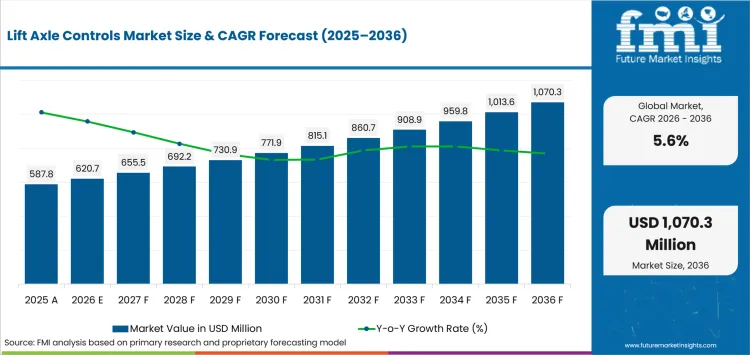
Key Takeaways of Lift Axle Controls Market
- Changing payloads and axle-load rules make lift and deployment logic a specification decision for trailer and vocational vehicle programs.
- Automatic lift axle controls are projected to account for 29.0% of control type demand in 2026 due to defined thresholds that reduce dependence on driver judgement.
- Pneumatic actuation is estimated to hold 43.0% share in 2026, driven by its direct fit with commercial-vehicle air suspension hardware.
- By vehicle type, trailers are forecast to represent 30.0% share in 2026 because variable payloads create repeated lift and deployment cycles.
- Qualification becomes slower when axle-control logic must satisfy local weight rules and interact with electronic braking or suspension software.
- Some of the key players in this market include SAF-HOLLAND SE, BPW Bergische Achsen KG, Haldex AB, ZF Friedrichshafen AG / WABCO, Hendrickson USA, L.L.C., Link Manufacturing, Ltd., JOST Werke SE, and Knorr-Bremse AG.
Analyst Perspective
"Lift axle controls are expected to witness demand as engineers prove valve behavior against axle geometry, load thresholds and the vehicle electronics already specified. Commercial advantage comes from clear calibration records and technician support that restores lift logic without extending trailer or vocational-truck downtime."
- Nikhil Kaitwade,, Principal Consultant, Future Market Insights
How is the Lift Axle Controls Market segmented?
The lift axle controls market is segmented by control type, actuation, vehicle type, sales channel, function and region.
Control type includes automatic controls, electronic control units, manual controls, pressure sensing controls and integrated suspension control kits. Actuation covers pneumatic, electro-pneumatic, electronic valve manifold and hydraulic systems. Vehicle type spans trailers, heavy trucks, vocational trucks, refuse trucks and concrete mixers. Sales channels include suspension OEMs, trailer OEMs, aftermarket retrofit and fleet service channels. Function covers axle lift / lower, load sensing, pressure protection and automatic compliance control.
Why does Pneumatic actuation hold the largest Actuation share?
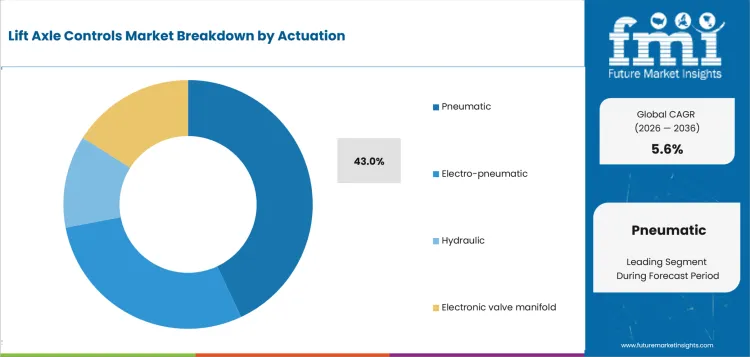
Compressed air already supplies the suspension energy path on many heavy commercial vehicles. JOST disclosed in September 2025 that its DCA AIRMASTER axle beam also functions as a 40-liter reservoir for brake and air suspension functions.
- Pneumatic actuation is expected to lead the actuation category with 43.0% share in 2026 due to direct compatibility with existing commercial-vehicle air suspension hardware.
- Existing air suspension components let technicians change lift behavior through familiar valves and reservoirs without adding a separate hydraulic circuit. Workshop familiarity with compressors and air lines also shortens fault isolation during routine chassis service.
What makes Automatic lift axle controls central to the Control type category?
Automatic controls turn changing suspension pressure or vehicle-state inputs into a defined lift decision that engineers can document during repeatable OEM validation programs. The design also complements automotive pressure sensors used to monitor load-related conditions.
- By control type, automatic lift axle controls are estimated to hold 29.0% in 2026 owing to fewer driver-dependent decisions during repeated vehicle load changes.
- SAF-HOLLAND stated in April 2026 that Haldex would launch ILAS-EP with EBS or TRS integration for automatic lift-axle operation. The release gives OEM engineers an example of automatic logic moving into a compact valve architecture.
How do Trailers shape demand within the Vehicle type category?
Trailer loading changes between collection and delivery points, so lift axle suspension controls reliably carry auxiliary support under heavy loads and raise it during permitted lighter operation.
- By vehicle type, trailers are forecast to represent 30.0% in 2026 because long asset lives expose control valves and wiring to repeated fleet service cycles.
- BPW reported in July 2026 that more than 200,000 two- and three-axle trailers had entered service with ECO Air since 2020. The installed base confirms why heavy-duty air suspension platforms provide a large service pool for compatible control hardware and replacement parts.
What supports Suspension OEMs within the Sales channel category?
Suspension OEMs control air-spring geometry and pressure relationships that determine lift-command behavior during vehicle integration. Link Manufacturing said in September 2025 that International Motors became the fourth major OEM offering SmartValve directly from the factory.
- Suspension OEMs are projected to hold 32.0% of sales channel demand in 2026 attributable to validated plumbing and axle geometry that reduce integration decisions for commercial builders.
- Factory specification lets builders align control calibration with automotive suspension systems before delivery and removes post-production installation work. The same route gives service networks a documented baseline for later valve replacement or software adjustment.
What are the drivers, restraints and opportunities in the Lift Axle Controls Market?
Axle-load enforcement increases control demand, software governance lengthens electronic qualification and active freight fleets support retrofit and replacement revenue.
- Driver: Repeated payload changes make controlled axle deployment a compliance and operating requirement in regulated commercial-vehicle service.
- Restraint: Electronic lift logic can trigger software-governance and documentation work beyond ordinary pneumatic component qualification.
- Opportunity: Retrofit-ready control packages can capture installed vehicles that need new valves, sensors or electronic supervision without full suspension replacement.
Axle-Load Enforcement Keeps Control Logic in the Specification
Payload changes can push individual axles beyond permitted loads during daily operation, increasing the value of automatic lift and deployment logic. Poland's road transport inspectorate reported in February 2025 that an inspected truck exceeded permitted gross mass by more than ten tonnes and also breached axle-load limits. Enforcement makes automotive axle systems and pressure-aware deployment logic relevant before vehicles reach roadside checks.
Software Governance Extends Electronic-Control Qualification
Electronic lift control reduces driver intervention but adds software-governance work once parameter changes affect a trailer's regulated electronic configuration. ZF launched its SUMS Service Suite in May 2025 after earning ISO 24089 certification as a trailer tier-one supplier. Trailer builders therefore need configuration records beside pneumatic validation once lift-axle settings enter governed software updates, especially on platforms sharing EBS or regulated electronic functions.
Installed Freight Activity Supports Retrofit Revenue
Retrofit economics improve on active trailer and vocational fleets with serviceable axle assemblies and scheduled suspension maintenance. BTS's December 2025 Truck-Rail Freight Transportation Services Index reached 135.1 and rose 0.2% year over year, so freight activity sustains air-suspension replacement parts in established workshops. Retrofit programs convert active freight work into replacement revenue without requiring complete suspension replacement during scheduled service.
Which country CAGRs are profiled in the Lift Axle Controls Market?
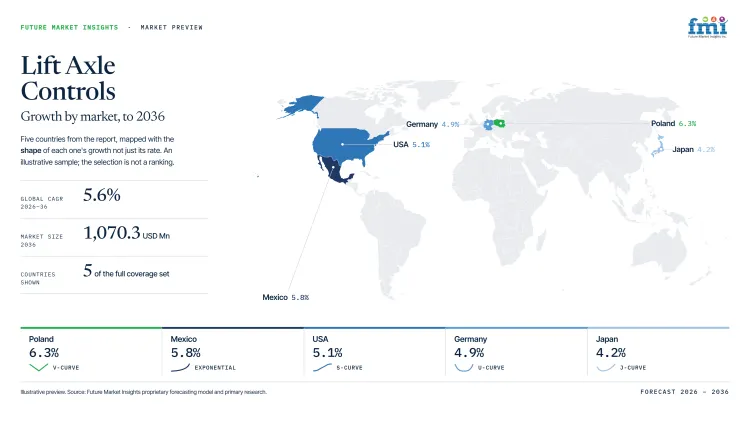
| Country | CAGR |
|---|---|
| Poland | 6.3% |
| Mexico | 5.8% |
| USA | 5.1% |
| Germany | 4.9% |
| Japan | 4.2% |
How do country-level CAGRs compare in the Lift Axle Controls Market?
The forecasts span 2.1 percentage points, from Poland at 6.3% to Japan at 4.2%. Poland and Mexico form the upper growth band, while the USA and Germany occupy the middle range. Japan records the lowest CAGR among the markets, indicating a more moderate growth trajectory. Differences in local market dynamics, fitment economics, and service reach should therefore be considered alongside CAGR when planning regional channel investments.
- Poland's cross-border trailer interchange favors parts stocked through established European service networks.
- Mexico's vehicle-assembly corridors shorten factory fitment decisions for standardized pneumatic control packages.
- United States aftermarket depth supports pneumatic replacement sales near major freight states.
- German vocational fleets favor integrated lift axle controls tailored to municipal, construction applications.
- Japan’s specialized truck market supports demand for compact, reliable lift axle control systems across construction, and regional freight operations.
Comparable CAGRs produce different order economics under different installation and service conditions. The full report provides country-level CAGR analysis across North America, Latin America, Europe, East Asia, South Asia, Oceania and the Middle East and Africa.
Country-wise Analysis
- Polish long-haul fleets in 2026 came with dense trailer-service coverage near major freight corridors and busy depots handling international traffic. Poland is projected to grow at 6.3% CAGR by 2036 tied to repeated axle-load enforcement that preserves demand for automatic lift logic during mixed freight cycles. Statistics Poland's January 2026 release recorded a 13.3% decline in road-freight tonnage during 2025, putting workshop budgets under pressure despite continued vehicle use. Experienced pneumatic technicians support replacement sales and reduce diagnostic delays during scheduled suspension work on high-mileage equipment. Local valve and sensor stocks limit the risk that calibration work extends trailer downtime during routine maintenance at high-volume fleet depots.
- Between industrial centers and the United States border, Mexico's federal freight routes favor pneumatic hardware that regional workshops can service without specialist tools. SICT's August 2026 statistics list more than 1.5 million freight vehicles in the 2025 federal cargo fleet, giving lift axle controls a broad vehicle base without proving uniform adoption. Lift axle control demand in Mexico is forecast to expand at 5.8% CAGR through 2036 owing to cross-border equipment renewal and fleet replacement. Electronic products convert more slowly outside the main assembly corridors as uneven workshop capability raises installation risk beyond standardized pneumatic kits in smaller service markets.
- Broad mix of tractors, vocational bodies and trailers keeps United States service channels exposed to several auxiliary-axle configurations and suspension architectures. USA lift axle control demand is projected to record 5.2% CAGR through 2036 since large bodybuilder networks can absorb automatic controls built for familiar pneumatic architectures. FMCSA's July 2026 registration snapshot lists more than 8.5 million vehicles reported by motor carriers, giving service channels a large operating base without implying lift-axle fitment on every vehicle. State bridge rules complicate one national calibration, so configurable load thresholds and clear technician documentation are more useful than separate diagnostic platforms for each application.
- Germany’s diverse mix of heavy-duty trucks, trailers, construction vehicles, and municipal fleets creates demand for lift axle controls compatible with multiple suspension and body configurations. Germany lift axle control demand is projected to record 4.9% CAGR through 2036, supported by fleet modernization, replacement activity, and demand for automated axle-load management. Strict vehicle-weight requirements and extensive cross-border freight operations favor configurable load thresholds, dependable pneumatic protection, and clear diagnostic documentation that allow workshops to service different vehicle applications efficiently.
- Japan’s lift axle control market is shaped by compact truck configurations, specialized vocational vehicles, and stringent vehicle operating requirements, favoring reliable automatic deployment and precise load management. Japan lift axle control demand is projected to record 4.2% CAGR through 2036, supported by steady replacement needs and adoption of electronically managed pneumatic systems. Dense urban operating conditions and frequent stop-and-go duty increase component wear, making protected air lines, compact control layouts, and straightforward diagnostic procedures valuable for local service technicians.
Who are the notable companies in the Lift Axle Controls Market?
SAF-HOLLAND SE, BPW Bergische Achsen KG, Haldex AB, ZF Friedrichshafen AG / WABCO, Hendrickson USA, L.L.C., Link Manufacturing, Ltd., JOST Werke SE, and Knorr-Bremse AG are the notable companies serving this market.
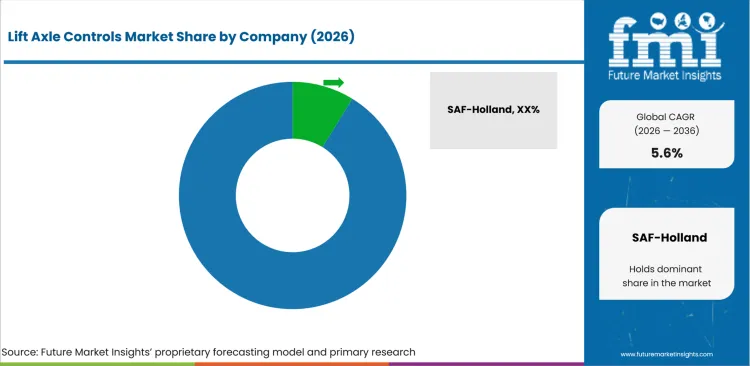
Competition depends on control of ownership inside the trailer or chassis specification. Companies with air-management electronics can influence automatic logic while running-gear manufacturers hold the geometry and service relationships surrounding each installation. Access to air pressure sensors and diagnostic knowledge strengthens programs that need load-aware control without forcing a complete suspension redesign.
- Integrated trailer platforms: SAF-HOLLAND SE, BPW Bergische Achsen KG and JOST Werke SE pair running-gear engineering with broad OEM and service relationships.
- Electronic and pneumatic control groups: Haldex AB, ZF Friedrichshafen AG / WABCO and Knorr-Bremse AG bring braking or suspension electronics into control decisions.
- Vocational suspension specialists: Hendrickson USA, L.L.C. and Link Manufacturing, Ltd. concentrate on heavy-duty suspension fitment plus air-management functions.
Competitive Benchmarking: Lift Axle Controls Market
| Company | Automatic Control Integration | Pneumatic / Load-Control Depth | OEM and Retrofit Coverage | Geographic Reach |
|---|---|---|---|---|
| SAF-HOLLAND SE | High | High | High | Global |
| BPW Bergische Achsen KG | Medium | High | High | Europe and international trailer markets |
| Haldex AB | High | High | High | Europe, North America and SAF-HOLLAND markets |
| ZF Friedrichshafen AG / WABCO | High | High | High | Global |
| Hendrickson USA, L.L.C. | Medium | High | High | North America and international markets |
| Link Manufacturing, Ltd. | Medium | High | High | North America with international distribution |
| JOST Werke SE | Medium | High | High | Global |
| Knorr-Bremse AG | Medium | High | High | Global |
Scoring basis: High automatic-control integration requires documented electronic or automatic suspension logic plus OEM integration, while Medium requires controlled suspension functions without a directly verified lift-axle platform. High pneumatic / load-control depth requires multiple documented air-management or load-control functions, while Medium requires one controlled suspension function. High OEM and retrofit coverage requires factory-fit plus service routes, while Medium requires one verified route. Low identifies one documented narrow capability under the same buyer criterion without evidence of broader coverage.
Key Developments in the Lift Axle Controls Market
- In June 2026, SAF-HOLLAND SE introduced CBXAS25 and CBXAS30 models to complete its CBXA AeroBeam fixed-frame trailer suspension series. The platform can be equipped with the Posi-Lift option, which keeps lift-axle functionality attached to a current trailer suspension program.
- In June 2026, BPW Bergische Achsen KG agreed a fleet partnership with Waberer’s that includes BPW axle technology on 200 new semi-trailers during the carrier’s 2026 renewal. The program reinforces direct OEM-style specification of running gear inside large fleet replacement cycles.
- In April 2026, ZF Friedrichshafen AG signed Tırsan for its SUMS Service Suite to manage UNECE R156 software-update obligations on trailers using ZF electronic systems. The agreement makes documented configuration management more valuable once electronic lift logic enters the same software-governance process.
Key Players in the Lift Axle Controls Market
Integrated Trailer Chassis and Suspension Platforms
- SAF-HOLLAND SE
- BPW Bergische Achsen KG
Electronic and Pneumatic Control Specialists
- Haldex AB
- ZF Friedrichshafen AG / WABCO
Vocational Suspension and Control Specialists
- Hendrickson USA, L.L.C.
- Link Manufacturing, Ltd.
Chassis and Levelling Systems Specialists
- JOST Werke SE
- Knorr-Bremse AG
Lift Axle Controls Market - Report Scope
| Coverage field | Report scope |
|---|---|
| Market breakdown | By control type, actuation, vehicle type, sales channel, function and region. |
| Quantitative Units | USD Million. |
| Market Definition | Commercial lift axle control valves, electronic control units, pressure or load sensing controls, valve manifolds and integrated suspension control kits within the defined vehicle and channel scope. |
| Regions Covered | North America, Latin America, Europe, East Asia, South Asia and Pacific, and Middle East and Africa. |
| Countries Covered | Poland, Mexico, Netherlands, Canada, USA, and 20+ countries included in the full report. |
| Key Companies Profiled | SAF-HOLLAND SE, BPW Bergische Achsen KG, Haldex AB, ZF Friedrichshafen AG / WABCO, Hendrickson USA, L.L.C., Link Manufacturing, Ltd., JOST Werke SE, and Knorr-Bremse AG. |
| Forecast Period | 2026 to 2036. |
| Approach | Primary and secondary research with market triangulation. |
Lift Axle Controls Market - Research Methodology
| Method | Approach |
|---|---|
| Primary Research | FMI analysts gathered input from manufacturers, service providers, technology developers, distributors, end users, procurement teams, and subject-matter experts. Interviews examined purchasing decisions, product or service evaluation, adoption barriers, approval requirements, pricing considerations, and expectations for technical or commercial support. Respondents were also asked what evidence is required before a trial, pilot, or initial order develops into regular purchasing. |
| Desk Research | Desk research covered government statistics, regulatory publications, trade data, industry associations, technical literature, standards, company filings, product information, and official corporate announcements. Sources were reviewed for relevance, publication date, geographic coverage, and consistency with the defined market scope. Claims relating to performance, applications, approvals, capacity, investment, and commercial activity were retained only when supported by credible public evidence. |
| Market Sizing and Forecasting | The market model combined the baseline value with historical performance, segment structure, pricing and volume indicators, adoption levels, company participation, and country-level demand conditions. Forecast assumptions considered economic activity, investment trends, regulatory developments, technology adoption, purchasing cycles, supply availability, and barriers to wider market use. Segment and regional estimates were reconciled before the final market total was calculated. |
| Data Validation | Estimates were checked against multiple independent indicators, including public data, company activity, trade patterns, industry developments, and findings from primary interviews. Validation also tested whether products, services, applications, and company revenues fell within the defined market boundaries. Adjacent categories, unsupported claims, overlapping revenues, and activities without direct market relevance were excluded to reduce double counting and maintain consistency across segments and countries. |
Lift Axle Controls Market by Segments
Lift Axle Controls Market segmented by Control Type:
- Automatic lift axle controls
- Electronic control units
- Manual lift axle controls
- Pressure sensing controls
- Integrated suspension control kits
Lift Axle Controls Market segmented by Actuation:
- Pneumatic
- Electro-pneumatic
- Electronic valve manifold
- Hydraulic
Lift Axle Controls Market segmented by Vehicle Type:
- Trailers
- Heavy trucks
- Vocational trucks
- Refuse trucks
- Concrete mixers
Lift Axle Controls Market segmented by Sales Channel:
- Suspension OEMs
- Trailer OEMs
- Aftermarket retrofit
- Fleet service channel
Lift Axle Controls Market segmented by Function:
- Axle lift / lower
- Load sensing
- Pressure protection
- Automatic compliance control
Lift Axle Controls Market by Region:
- North America
- United States
- Canada
- Latin America
- Brazil
- Mexico
- Chile
- Rest of Latin America
- Western Europe
- Germany
- United Kingdom
- Italy
- Spain
- France
- Nordics
- Benelux
- Rest of Western Europe
- Eastern Europe
- Russia
- Poland
- Hungary
- Balkan and Baltic States
- Rest of Eastern Europe
- East Asia
- China
- Japan
- South Korea
- South Asia and Pacific
- India
- ASEAN
- Australia and New Zealand
- Rest of South Asia and Pacific
- Middle East and Africa
- Kingdom of Saudi Arabia
- Other GCC Countries
- Türkiye
- South Africa
- Other African Union Countries
- Rest of Middle East and Africa
Research Sources and Bibliography
- Eurostat. (2026, July 31). EU road freight transport up by 0.9% in 2025.
- Bureau of Transportation Statistics. (2026, May 15). Transborder Freight Data Annual Report: 2025.
- SAF-HOLLAND / Haldex. (2026, April). New generation of lift-axle valve: ILAS-EP.
- JOST Werke SE. (2025, September 9). NUFAM 2025: JOST and Hyva to Showcase Smart Systems and Sustainable Solutions for the Commercial Vehicle Industry.
- BPW Bergische Achsen KG. (2026, July 22). Six years of ECO Air: 200,000 trailers across Europe demonstrate the success of modular air suspension in large-scale production.
- Link Manufacturing, Ltd. (2025, September 23). SmartValve® Now Available as Factory-Installed Option at International.
- Główny Inspektorat Transportu Drogowego. (2025, February 4). Wielotonowe przekroczenia dopuszczalnego tonażu.
- ZF Friedrichshafen AG. (2025, May 15). ZF Simplifies Software Updates for Trailer OEMs.
- Bureau of Transportation Statistics. (2026, February 2). The December 2025 Truck-Rail Freight Transportation Services Index Rose 0.2% from November 2025 and Rose 0.2% from December 2024.
- Statistics Poland. (2026, January 30). Sytuacja społeczno-gospodarcza kraju - Transport 30.01.2026 r.
- Secretaría de Infraestructura, Comunicaciones y Transportes. (2026, August 17). Principales estadísticas del Sector de Infraestructura, Comunicaciones y Transportes 2025.
- Statistics Netherlands. (2026, July 1). Lower volume of goods transported by road in 2025.
- Transport Canada. (2026, June 24). Transportation in Canada annual report 2025.
- Federal Motor Carrier Safety Administration. (2026, July 31). Motor Carrier Registration Statistics.
- SAF-HOLLAND SE. (2026, June 4). SAF-HOLLAND Completes CBXA AeroBeam™ Fixed Frame Suspension Series with New CBXAS25, CBXAS30 Models.
- BPW Bergische Achsen KG. (2026, June 30). Waberer’s and the BPW Group agree strategic partnership for Europe’s trailer fleets.
- ZF Friedrichshafen AG. (2026, April 22). Tırsan Deploys ZF solution to Meet Rigorous UNECE R156 Software Update.
- ZF Friedrichshafen AG. (2025, June 5). ZF Delivers Electronically Controlled Air Suspension OptiRide to Bus Manufacturer Hyundai.
- Haldex AB. (2026, July 24). Haldex SUMS ensures compliance with new EU regulations or trailer type approval.
- SAF-HOLLAND SE. (2026, March 15). SAF-HOLLAND Announces HOLLAND SmartSTO™, a Safer, Smarter Way to Uncouple, Stow Connection Lines.
- BPW Bergische Achsen KG. (2026, July 15). BPW Gruppe auf der Automechanika: “Always the Right Choice” - für Handel, Werkstatt und Flotte.
- Knorr-Bremse AG. (2025, December 12). Electronic Levelling Control (ELC) for trucks: Leading truck manufacturer extends supply contract with Knorr-Bremse until 2033.
- Hendrickson USA, L.L.C. (2025, November 23). Hendrickson Supports Smarter Trailer Operations.
- Link Manufacturing, Ltd. (2025, March 25). Link® Introduces RespondAir® Heavy-Duty Rear Air Suspension.
- JOST Werke SE. (2025, February 3). JOST closes acquisition of Hyva, a global leader in hydraulic solutions for on- and off-highway commercial vehicles.
This bibliography is provided for reader reference and is not exhaustive. The full report contains the complete reference list and detailed citations.
This Report Answers
- What is the lift axle controls market size in 2026 and 2036?
- Which freight and axle-loading conditions sustain replacement demand for lift axle control hardware?
- Why do automatic lift axle controls hold 29.0% of control type demand in 2026?
- Why does pneumatic actuation account for 43.0% of actuation demand in 2026?
- How do trailer duty cycles support a 30.0% vehicle type share in 2026?
- How do country growth rates differ among Poland, Mexico, Netherlands, Canada and USA?
- Which companies supply integrated chassis, pneumatic controls or vocational suspension systems?
- What software-governance and calibration conditions can delay electronic control qualification?
Frequently Asked Questions
How big is the Lift Axle Controls Market in 2026?
The lift axle controls market is valued at USD 620.7 million in 2026 and is projected to reach USD 1,070.3 million by 2036. Freight activity and replacement cycles sustain control demand in commercial vehicles.
What is the CAGR of the Lift Axle Controls Market from 2026 to 2036?
The lift axle controls market is projected to grow at a CAGR of 5.6% between 2026 and 2036. Automatic axle management and replacement demand in air-suspended commercial vehicles support expansion during the forecast period.
Which control type leads the Lift Axle Controls Market?
The automatic lift axle controls segment is expected to hold 29.0% of the lift axle controls market in 2026, driven by automated load thresholds. OEM engineers document those thresholds during repeatable vehicle validation programs before production release.
Which countries are projected to record the highest growth in the Lift Axle Controls Market?
Poland is projected to grow at 6.6% CAGR, followed by Mexico at 6.2% and Netherlands at 5.9% through 2036. Local axle rules and service networks shape commercial order conversion for regional fleets and distributors.
Which companies are active in the Lift Axle Controls Market?
Key companies in the lift axle controls market include SAF-HOLLAND SE, BPW Bergische Achsen KG, Haldex AB, ZF Friedrichshafen AG / WABCO, Hendrickson USA, L.L.C., Link Manufacturing, Ltd., JOST Werke SE, and Knorr-Bremse AG. Competition centers on integration, pneumatics, electronics and service.
Preview the report firsthand - request a free sample
Get SampleGet the brochure for pricing and purchase details.
Get PDFTable of Content
- Key Takeaways
- Market Size and CAGR
- Top Growth Driver
- Fastest Growing Segment
- Leading Region
- Key Companies
- Emerging Opportunities
- Executive Summary
- Global Market Outlook
- Demand-side Trends
- Supply-side Trends
- Technology Roadmap Analysis
- Analysis and Recommendations
- Analyst Perspective (What is happening? Why now? What should investors know?)
- Key Questions Answered
- How large is the market?
- What is the CAGR?
- What are key trends?
- Which region dominates?
- Who are the leaders?
- Market Overview
- Market Coverage / Taxonomy
- Market Definition / Scope / Limitations
- Research Methodology
- Chapter Orientation
- Analytical Lens and Working Hypotheses
- Market Structure, Signals, and Trend Drivers
- Benchmarking and Cross-market Comparability
- Market Sizing, Forecasting, and Opportunity Mapping
- Research Design and Evidence Framework
- Desk Research Programme (Secondary Evidence)
- Expert Input and Fieldwork (Primary Evidence)
- Tooling, Models, and Reference Databases
- Data Engineering and Model Build
- Quality Assurance and Audit Trail
- Market Background
- Market Dynamics (Drivers, Restraints, Opportunity, Trends)
- Scenario Forecast (Optimistic, Likely, Conservative)
- Impact Analysis
- AI Impact
- Sustainability Impact
- Regulatory Impact
- Technology Impact
- Consumer / Buyer Analysis
- Purchase Drivers
- Adoption Barriers
- Buyer Journey
- Opportunity Map Analysis
- Product Life Cycle Analysis
- Supply Chain Analysis
- Investment Feasibility Matrix
- Value Chain Analysis
- PESTLE and Porter's Analysis
- Regulatory Landscape
- Regional Parent Market Outlook
- Production and Consumption Statistics
- Import and Export Statistics
- Global Market Analysis and Forecast, 2021 to 2036
- Historical Market Size Value (USD Million) Analysis, 2021 to 2025
- Current and Future Market Size Value (USD Million) Projections, 2026 to 2036
- Y-o-Y Growth Trend Analysis
- Absolute $ Opportunity Analysis
- Global Market Pricing Analysis, 2021 to 2036
- Global Market Analysis and Forecast, By Control Type, 2021 to 2036
- Introduction / Key Findings
- Historical Market Size Value (USD Million) Analysis By Control Type, 2021 to 2025
- Current and Future Market Size Value (USD Million) Analysis and Forecast By Control Type, 2026 to 2036
- Manual lift axle controls
- Automatic lift axle controls
- Electronic control units
- Pressure sensing controls
- Integrated suspension control kits
- Manual lift axle controls
- Y-o-Y Growth Trend Analysis By Control Type, 2021 to 2025
- Absolute $ Opportunity Analysis By Control Type, 2026 to 2036
- Global Market Analysis and Forecast, By Actuation, 2021 to 2036
- Introduction / Key Findings
- Historical Market Size Value (USD Million) Analysis By Actuation, 2021 to 2025
- Current and Future Market Size Value (USD Million) Analysis and Forecast By Actuation, 2026 to 2036
- Pneumatic
- Electro-pneumatic
- Hydraulic
- Electronic valve manifold
- Pneumatic
- Y-o-Y Growth Trend Analysis By Actuation, 2021 to 2025
- Absolute $ Opportunity Analysis By Actuation, 2026 to 2036
- Global Market Analysis and Forecast, By Vehicle Type, 2021 to 2036
- Introduction / Key Findings
- Historical Market Size Value (USD Million) Analysis By Vehicle Type, 2021 to 2025
- Current and Future Market Size Value (USD Million) Analysis and Forecast By Vehicle Type, 2026 to 2036
- Heavy trucks
- Trailers
- Vocational trucks
- Refuse trucks
- Concrete mixers
- Heavy trucks
- Y-o-Y Growth Trend Analysis By Vehicle Type, 2021 to 2025
- Absolute $ Opportunity Analysis By Vehicle Type, 2026 to 2036
- Global Market Analysis and Forecast, By Sales Channel, 2021 to 2036
- Introduction / Key Findings
- Historical Market Size Value (USD Million) Analysis By Sales Channel, 2021 to 2025
- Current and Future Market Size Value (USD Million) Analysis and Forecast By Sales Channel, 2026 to 2036
- Suspension OEMs
- Trailer OEMs
- Aftermarket retrofit
- Fleet service channel
- Suspension OEMs
- Y-o-Y Growth Trend Analysis By Sales Channel, 2021 to 2025
- Absolute $ Opportunity Analysis By Sales Channel, 2026 to 2036
- Global Market Analysis and Forecast, By Function, 2021 to 2036
- Introduction / Key Findings
- Historical Market Size Value (USD Million) Analysis By Function, 2021 to 2025
- Current and Future Market Size Value (USD Million) Analysis and Forecast By Function, 2026 to 2036
- Axle lift / lower
- Load sensing
- Pressure protection
- Automatic compliance control
- Axle lift / lower
- Y-o-Y Growth Trend Analysis By Function, 2021 to 2025
- Absolute $ Opportunity Analysis By Function, 2026 to 2036
- Global Market Analysis and Forecast, By Region, 2021 to 2036
- Introduction
- Historical Market Size Value (USD Million) Analysis By Region, 2021 to 2025
- Current Market Size Value (USD Million) Analysis and Forecast By Region, 2026 to 2036
- North America
- Latin America
- Western Europe
- Eastern Europe
- East Asia
- South Asia and Pacific
- Middle East & Africa
- Market Attractiveness Analysis By Region
- North America Market Analysis and Forecast, By Country, 2021 to 2036
- Historical Market Size Value (USD Million) Trend Analysis By Market Taxonomy, 2021 to 2025
- Market Size Value (USD Million) Forecast By Market Taxonomy, 2026 to 2036
- By Country
- USA
- Canada
- By Control Type
- By Actuation
- By Vehicle Type
- By Sales Channel
- By Function
- By Country
- Market Attractiveness Analysis
- By Country
- By Control Type
- By Actuation
- By Vehicle Type
- By Sales Channel
- By Function
- Key Takeaways
- Latin America Market Analysis and Forecast, By Country
- Historical Market Size Value (USD Million) Trend Analysis By Market Taxonomy, 2021 to 2025
- Market Size Value (USD Million) Forecast By Market Taxonomy, 2026 to 2036
- By Country
- Brazil
- Mexico
- Chile
- Rest of Latin America
- By Control Type
- By Actuation
- By Vehicle Type
- By Sales Channel
- By Function
- By Country
- Market Attractiveness Analysis
- By Country
- By Control Type
- By Actuation
- By Vehicle Type
- By Sales Channel
- By Function
- Key Takeaways
- Western Europe Market Analysis and Forecast, By Country
- Historical Market Size Value (USD Million) Trend Analysis By Market Taxonomy, 2021 to 2025
- Market Size Value (USD Million) Forecast By Market Taxonomy, 2026 to 2036
- By Country
- Germany
- UK
- Italy
- Spain
- France
- Nordic
- BENELUX
- Rest of Western Europe
- By Control Type
- By Actuation
- By Vehicle Type
- By Sales Channel
- By Function
- By Country
- Market Attractiveness Analysis
- By Country
- By Control Type
- By Actuation
- By Vehicle Type
- By Sales Channel
- By Function
- Key Takeaways
- Eastern Europe Market Analysis and Forecast, By Country
- Historical Market Size Value (USD Million) Trend Analysis By Market Taxonomy, 2021 to 2025
- Market Size Value (USD Million) Forecast By Market Taxonomy, 2026 to 2036
- By Country
- Russia
- Poland
- Hungary
- Balkan & Baltic
- Rest of Eastern Europe
- By Control Type
- By Actuation
- By Vehicle Type
- By Sales Channel
- By Function
- By Country
- Market Attractiveness Analysis
- By Country
- By Control Type
- By Actuation
- By Vehicle Type
- By Sales Channel
- By Function
- Key Takeaways
- East Asia Market Analysis and Forecast, By Country
- Historical Market Size Value (USD Million) Trend Analysis By Market Taxonomy, 2021 to 2025
- Market Size Value (USD Million) Forecast By Market Taxonomy, 2026 to 2036
- By Country
- China
- Japan
- South Korea
- By Control Type
- By Actuation
- By Vehicle Type
- By Sales Channel
- By Function
- By Country
- Market Attractiveness Analysis
- By Country
- By Control Type
- By Actuation
- By Vehicle Type
- By Sales Channel
- By Function
- Key Takeaways
- South Asia and Pacific Market Analysis and Forecast, By Country
- Historical Market Size Value (USD Million) Trend Analysis By Market Taxonomy, 2021 to 2025
- Market Size Value (USD Million) Forecast By Market Taxonomy, 2026 to 2036
- By Country
- India
- ASEAN
- Australia & New Zealand
- Rest of South Asia and Pacific
- By Control Type
- By Actuation
- By Vehicle Type
- By Sales Channel
- By Function
- By Country
- Market Attractiveness Analysis
- By Country
- By Control Type
- By Actuation
- By Vehicle Type
- By Sales Channel
- By Function
- Key Takeaways
- Middle East & Africa Market Analysis and Forecast, By Country
- Historical Market Size Value (USD Million) Trend Analysis By Market Taxonomy, 2021 to 2025
- Market Size Value (USD Million) Forecast By Market Taxonomy, 2026 to 2036
- By Country
- Kingdom of Saudi Arabia
- Other GCC Countries
- Türkiye
- South Africa
- Other African Union
- Rest of Middle East & Africa
- By Control Type
- By Actuation
- By Vehicle Type
- By Sales Channel
- By Function
- By Country
- Market Attractiveness Analysis
- By Country
- By Control Type
- By Actuation
- By Vehicle Type
- By Sales Channel
- By Function
- Key Takeaways
- Key Countries Market Analysis
- USA
- Pricing Analysis
- Market Share Analysis, 2025
- By Control Type
- By Actuation
- By Vehicle Type
- By Sales Channel
- By Function
- Canada
- Pricing Analysis
- Market Share Analysis, 2025
- By Control Type
- By Actuation
- By Vehicle Type
- By Sales Channel
- By Function
- Mexico
- Pricing Analysis
- Market Share Analysis, 2025
- By Control Type
- By Actuation
- By Vehicle Type
- By Sales Channel
- By Function
- Brazil
- Pricing Analysis
- Market Share Analysis, 2025
- By Control Type
- By Actuation
- By Vehicle Type
- By Sales Channel
- By Function
- Chile
- Pricing Analysis
- Market Share Analysis, 2025
- By Control Type
- By Actuation
- By Vehicle Type
- By Sales Channel
- By Function
- Germany
- Pricing Analysis
- Market Share Analysis, 2025
- By Control Type
- By Actuation
- By Vehicle Type
- By Sales Channel
- By Function
- UK
- Pricing Analysis
- Market Share Analysis, 2025
- By Control Type
- By Actuation
- By Vehicle Type
- By Sales Channel
- By Function
- Italy
- Pricing Analysis
- Market Share Analysis, 2025
- By Control Type
- By Actuation
- By Vehicle Type
- By Sales Channel
- By Function
- Spain
- Pricing Analysis
- Market Share Analysis, 2025
- By Control Type
- By Actuation
- By Vehicle Type
- By Sales Channel
- By Function
- France
- Pricing Analysis
- Market Share Analysis, 2025
- By Control Type
- By Actuation
- By Vehicle Type
- By Sales Channel
- By Function
- India
- Pricing Analysis
- Market Share Analysis, 2025
- By Control Type
- By Actuation
- By Vehicle Type
- By Sales Channel
- By Function
- ASEAN
- Pricing Analysis
- Market Share Analysis, 2025
- By Control Type
- By Actuation
- By Vehicle Type
- By Sales Channel
- By Function
- Australia & New Zealand
- Pricing Analysis
- Market Share Analysis, 2025
- By Control Type
- By Actuation
- By Vehicle Type
- By Sales Channel
- By Function
- China
- Pricing Analysis
- Market Share Analysis, 2025
- By Control Type
- By Actuation
- By Vehicle Type
- By Sales Channel
- By Function
- Japan
- Pricing Analysis
- Market Share Analysis, 2025
- By Control Type
- By Actuation
- By Vehicle Type
- By Sales Channel
- By Function
- South Korea
- Pricing Analysis
- Market Share Analysis, 2025
- By Control Type
- By Actuation
- By Vehicle Type
- By Sales Channel
- By Function
- Russia
- Pricing Analysis
- Market Share Analysis, 2025
- By Control Type
- By Actuation
- By Vehicle Type
- By Sales Channel
- By Function
- Poland
- Pricing Analysis
- Market Share Analysis, 2025
- By Control Type
- By Actuation
- By Vehicle Type
- By Sales Channel
- By Function
- Hungary
- Pricing Analysis
- Market Share Analysis, 2025
- By Control Type
- By Actuation
- By Vehicle Type
- By Sales Channel
- By Function
- Kingdom of Saudi Arabia
- Pricing Analysis
- Market Share Analysis, 2025
- By Control Type
- By Actuation
- By Vehicle Type
- By Sales Channel
- By Function
- Türkiye
- Pricing Analysis
- Market Share Analysis, 2025
- By Control Type
- By Actuation
- By Vehicle Type
- By Sales Channel
- By Function
- South Africa
- Pricing Analysis
- Market Share Analysis, 2025
- By Control Type
- By Actuation
- By Vehicle Type
- By Sales Channel
- By Function
- USA
- Market Structure Analysis
- Competition Dashboard
- Competition Benchmarking
- Market Share Analysis of Top Players
- By Regional
- By Control Type
- By Actuation
- By Vehicle Type
- By Sales Channel
- By Function
- Emerging Startups
- Innovation Benchmarking
- Competition Analysis
- Competition Deep Dive
- SAF-Holland
- Overview
- Product Portfolio
- Profitability by Market Segments
- Sales Footprint
- Strategy Overview
- Marketing Strategy
- Product Strategy
- Channel Strategy
- BPW
- Haldex
- WABCO / ZF
- Watson & Chalin
- Ridewell Suspensions
- Meritor / Cummins
- Link Manufacturing
- Hadley
- SAF-Holland
- Case Studies
- Success Stories
- Recent Developments
- Competition Deep Dive
- Assumptions & Acronyms Used


