

- Market Size (2026)
- USD 1.3 Bn
- Forecast (2036)
- USD 2.2 Bn
- CAGR (2026 to 2036)
- 5.8%
How big is Lift Axle Suspension Market in 2026?
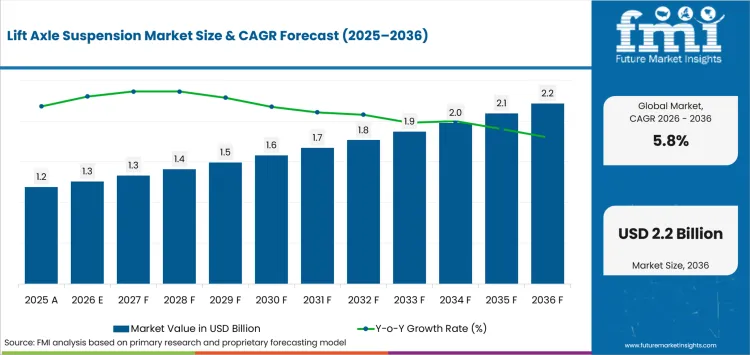
USD 1.3 billion in 2026 and USD 2.2 billion by 2036 at a 5.8% CAGR.
Lift axle suspension demand is expected to push valuation from USD 1.3 billion in 2026 to USD 2.2 billion by 2036 at a 5.8% CAGR driven by freight work that repeatedly pushes loaded trucks toward legal axle and bridge limits. The USA Census Bureau reported in June 2025 that trucks hauled 8.3 billion tons of goods during 2022 and carried 68.1% of total domestic tonnage. Fleets use auxiliary capacity to distribute that weight during loaded operation and lift unused axles during lighter legs. The purchase decision therefore depends on payload economics plus a legal configuration that body builders can install and maintain.
Country demand diverges because freight intensity and route rules change the value of an additional deployable axle. Eurostat reported in July 2026 that Polish-registered road freight generated 381.0 billion tonne-kilometres during 2025 while Germany generated 277.4 billion. High-volume corridors favor repeatable trailer specifications when axle spacing and tire behavior remain compatible across borders. Lower-volume or more specialized duty cycles require stronger savings from tire wear and maneuverability before added suspension cost becomes attractive.
Key Takeaways of Lift Axle Suspension Market
- Demand rises when heavy trucks need temporary axle capacity that preserves legal payload distribution across changing loaded and unloaded duty cycles.
- Steerable lift axles are expected to hold 27.0% share in 2026 because steering reduces scrub during repeated low-speed turns.
- Air-operated systems are estimated to represent 56.0% of actuation demand in 2026 owing to familiar pneumatic architecture across heavy commercial vehicles.
- Heavy trucks are anticipated to account for 31.0% by vehicle-type in 2026 as vocational payload changes increase axle-loading decisions.
- Retrofit economics weaken when frame packaging and approval work require extensive modification before an auxiliary axle becomes legal for the intended route.
- Key players in the lift axle suspension market include Hendrickson, SAF-Holland, BPW, JOST Werke, Haldex, Link Manufacturing, Cummins / Meritor, and Simard Suspensions.
Analyst Perspective
"Lift axle suspension value is earned when the selected configuration fits the legal route and the truck’s actual load pattern. Fleets should compare installation effort and steering behavior alongside tire economics before treating unit price as the primary purchasing measure."
- Nikhil Kaitwade, Principal Consultant, Future Market Insights
How is the Lift Axle Suspension Market segmented?
The lift axle suspension market is segmented by suspension type, actuation, vehicle type, sales channel, end use and region.
Suspension type includes steerable lift axles, non-steerable lift axles, pusher axles, tag axles and self-steering lift systems. Actuation covers air operated, hydraulic, mechanical assist and electronic control. Vehicle types include heavy trucks, trailers, vocational trucks, refuse trucks and concrete mixers. Sales channels cover trailer OEMs, truck body builders, aftermarket retrofit providers and fleet service networks. End uses include freight hauling, construction fleets, waste management and tanker or bulk transport.
Why does air operated lead the actuation category?
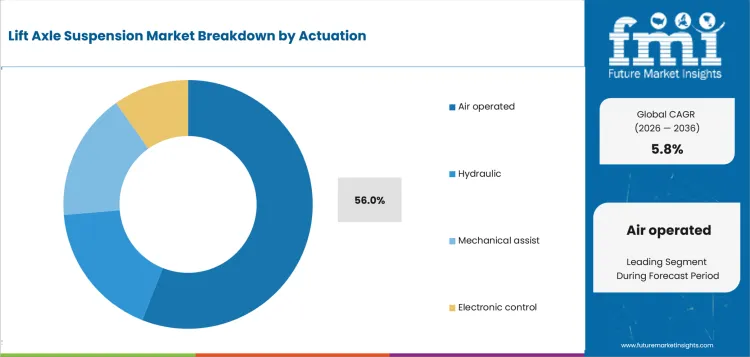
Air-operated lifting fits the pneumatic suspension architecture already present on many heavy trucks and trailers. Body builders can route lift control beside braking systems without introducing a separate hydraulic power pack during routine fleet service.
- Air-operated systems are expected to represent 56.0% of actuation demand in 2026 owing to familiar pneumatic service practices across heavy commercial fleets.
- Link Manufacturing made SmartValve a factory-installed International LT option in September 2025 and retained retrofit coverage across other Class 8 platforms. That OEM pathway shows how suspension air controls increasingly enter standard truck ordering rather than field-only modification.
What makes steerable lift axles central to the suspension type category?
Steerable lift axles reduce the turning penalty created by another load-bearing axle during repeated low-speed maneuvering. Precise steering geometry becomes valuable on vocational routes where vehicles repeatedly enter tight yards and construction access points across dense municipal delivery work.
- Steerable lift axles are estimated to hold 27.0% of suspension-type demand in 2026 because steering reduces tire scrub during low-speed maneuvering.
- BPW expanded its Active Reverse Control auxiliary steering in February 2025 for low loaders using two self-steering axles. That engineering route reinforces demand for steerable auxiliary packages that preserve maneuverability without forcing a rigid axle through every turn.
How do heavy trucks anchor the vehicle type category?
Heavy trucks face the clearest commercial trade-off between payload flexibility and added heavy-truck suspension hardware. Vocational bodies can shift axle loading sharply during loading and unloading across a single operating day in refuse and construction applications.
- By vehicle type, heavy trucks are anticipated to account for 31.0% share in 2026 because changing payload concentration makes auxiliary support economically relevant.
- INEGI reported in May 2026 that Mexico produced 41,071 heavy vehicles during January through April and cargo vehicles represented 97.7% of output. High cargo concentration keeps axle distribution and body-specific packaging visible during heavy-truck specification.
What supports trailer OEMs in the sales channel category?
Trailer OEMs can resolve axle spacing and frame reinforcement inside repeatable trailer configurations before the finished vehicle enters commercial service. Factory engineering reduces rework risk when lift hardware must share space with brakes and air lines across multi-unit fleet programs.
- Trailer OEMs are projected to account for 36.0% of sales-channel demand in 2026 as repeatable factory fitment simplifies multi-unit fleet specifications.
- SAF-Holland presented its factory-preconfigured SAF INTRA Smart Steering axle at NUFAM during September 2025 with integrated VSE steering hardware. Preconfigured steering packages give trailer manufacturers a clearer route to repeatable installation and documented vehicle integration.
What are the drivers, restraints and opportunities in the Lift Axle Suspension Market?
Axle-load compliance and changing payloads support demand while integration work restrains retrofits and smarter steering raises the value of engineered packages.
- Driver: Freight-intensive duty cycles reward auxiliary capacity that carries legal payload without forcing every axle to remain deployed on lighter trips.
- Restraint: Vehicle packaging and jurisdiction-specific weight rules increase engineering work before a lift-axle retrofit can enter regular commercial service.
- Opportunity: Integrated steering and electronic controls reduce maneuvering penalties and support higher-value packages for vocational fleets with demanding route patterns.
Freight Intensity Keeps Axle-Load Compliance Commercially Relevant
Road freight volume keeps axle-loading decisions commercially relevant wherever dense payloads approach legal limits during routine operations. Eurostat reported in July 2026 that EU road freight reached 1,886 billion tonne-kilometres during 2025 and national haulage represented 62.2% of activity. That scale supports recurring demand for auxiliary axle layouts on routes where payload distribution changes between loaded and lighter legs.
Vehicle Integration Raises the Cost of Retrofit Conversion
Retrofit conversion slows when the chassis cannot accept another axle without changes to spacing and related vehicle systems. The Federal Highway Administration reported in July 2025 that states must ensure commercial vehicles comply with federal size and weight standards while FHWA certifies state compliance. Installers therefore need route-specific engineering and documented retrofit suspension work before a modified truck earns fleet approval across multiple jurisdictions.
Integrated Steering Raises the Value of Auxiliary Axle Packages
Higher-value systems are emerging where steering hardware and electronic control reduce the operating penalty of extra axle capacity. JOST expanded its steering axle coverage at Transpotec in April 2026 by presenting the CSA 10T alongside the TRIDEC EF-S electronic steering system, reinforcing trailer manufacturer access to compatible mechanical, hydraulic, and electronic steering configurations across dense urban routes. That broader compatibility gives trailer air controls and steering packages more room to support specialized axle layouts in dense urban routes.
Which country CAGRs are profiled in the Lift Axle Suspension Market?
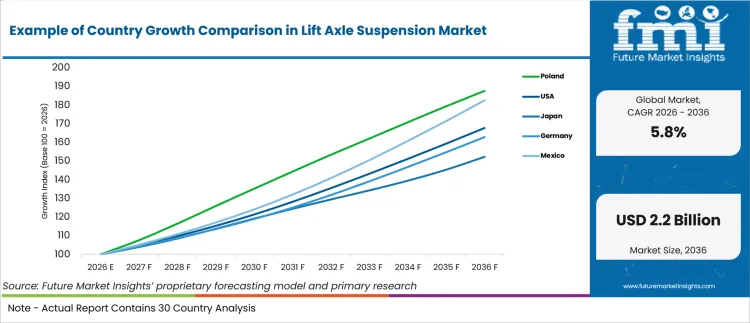
| Country | CAGR |
|---|---|
| Poland | 6.5% |
| Mexico | 6.2% |
| Netherlands | 5.9% |
| Brazil | 5.6% |
| United States | 5.3% |
How do country-level CAGRs compare in the Lift Axle Suspension Market?
The profiled CAGRs span 1.2 percentage points from Poland at 6.5% to the United States at 5.3%. Poland and Mexico form the faster pair while the Netherlands and Brazil occupy a middle band. The narrow range makes local fitment economics more useful than small forecast gaps for channel planning.
- Poland's cross-border freight base rewards EU-compatible axle specifications backed by international service coverage.
- Mexico's heavy-vehicle exports favor body-builder access near border corridors and assembly plants.
- Netherlands truck tolling makes suspension mass visible during trailer replacement and fleet planning.
- Brazil's older traction fleet expands retrofit opportunity but raises installer-support requirements nationwide.
- United States demand varies with vocational bodies and state-specific auxiliary-axle operating rules.
Similar CAGRs can mask different fleet ages and approval routes across markets. The full report provides country-level CAGR analysis across North America, Latin America, Europe, East Asia, South Asia, Oceania and the Middle East and Africa.
Country-wise Analysis
- Polish fleets work across domestic distribution and cross-border corridors where EU axle compatibility affects trailer specifications and replacement-part planning throughout high-frequency freight operations and multi-country duty cycles. Lift axle suspension demand in Poland is forecast to rise at 6.5% CAGR through 2036 as intermodal traffic makes auxiliary axle capacity easier to justify across neighboring markets and regular fleet operations for loaded trailers. Statistics Poland reported in August 2025 that 40 intermodal terminals operated during 2024 and 36 handled rail-road traffic, making cross-border service coverage a practical entry condition for manufacturers whose standardized configurations must remain repairable outside their home networks.
- Mexican heavy-vehicle builders serve export freight and federal road classes that change allowable truck-trailer combinations across manufacturing centers and busy border corridors serving assembly plants and logistics parks. INEGI reported in May 2026 that 33,592 heavy vehicles were exported from January through April and 92.4% went to the United States, reinforcing the need for configurations that body builders can document for cross-border use. Lift axle suspension sales in Mexico are projected to expand at 6.2% CAGR through 2036 as local body-builder access supports fitment, although route-class differences and dispersed replacement support can delay repeat orders outside established freight corridors.
- Dutch fleets operate inside a compact logistics network where high utilization makes suspension mass and empty-running cost visible during trailer replacement decisions on short-haul and international routes across dense freight corridors. Lift axle suspension demand in the Netherlands is estimated to expand at 5.9% CAGR through 2036 as operators compare deployable payload capacity with measured per-kilometer operating costs. The Dutch government started truck tolling in July 2026 and charges cleaner or lighter vehicles less per kilometer, so manufacturers need broader suspension engineering and route-level duty-cycle evidence showing that added axle mass is offset by payload flexibility on intended fleet routes.
- Brazilian freight and vocational operators often keep tractors in service for long periods, giving retrofit workshops a larger role than factory-only specifications across construction and bulk-haul fleets operating beyond major service centers and regional transport depots. ANTT reported in April 2025 that registered traction vehicles averaged 16.4 years of age in March 2025, with autonomous freight carriers averaging 23.8 years. Lift axle suspension demand in Brazil is anticipated to advance at 5.6% CAGR through 2036 as older vehicles widen retrofit opportunity, although uneven workshop coverage and modification documentation favor manufacturers with validated kits and regional installer support near major cities.
- United States auxiliary-axle demand remains highly vocational because dump trucks and refuse vehicles face different payload patterns from line-haul tractors and mixed-duty chassis across state-specific operating environments. United States lift axle suspension demand is forecast to expand at 5.3% CAGR through 2036 as short-haul freight cycles reward load flexibility and keep body-builder fitment support commercially important across regional operations. The USA Census Bureau reported in June 2025 that 56.4% of domestic shipment tonnage traveled less than 50 miles during 2022, while state operating rules can alter acceptable pusher or tag configurations and make axle-load monitoring useful for validation across dispersed fleets.
Who are the notable companies in the Lift Axle Suspension Market?
Hendrickson, SAF-Holland, BPW, JOST Werke, SAF-Holland / Haldex, Link Manufacturing, Cummins / Meritor, and Simard Suspensions are the notable companies profiled in this market.
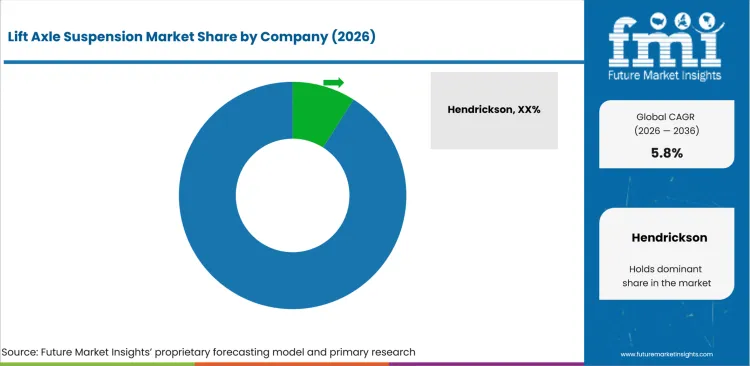
Competition is divided between dedicated auxiliary-axle specialists and broader running-gear groups with established OEM relationships. Entry barriers arise from application engineering because lift systems interact with braking hardware and spring assemblies across each approved vehicle configuration. Manufacturers with documented steering options and installation support can address more vocational applications without forcing body builders to redesign every order.
- Hendrickson, SAF-Holland, BPW and JOST Werke compete with axle, suspension and running-gear platforms that support truck or trailer integration.
- SAF-Holland / Haldex and Link Manufacturing concentrate more heavily on pneumatic controls, suspension electronics and auxiliary-axle integration for OEM or retrofit use.
- Cummins / Meritor participates through wider commercial-vehicle axle systems while Simard Suspensions focuses on vocational truck suspension and steering conversions.
Competitive Benchmarking: Lift Axle Suspension Market
| Company | Lift-Axle Architecture Breadth | Steering & Control Integration | OEM / Retrofit Support | Geographic Reach |
|---|---|---|---|---|
| Hendrickson | High | High | High | Global commercial-vehicle markets |
| SAF-Holland | High | High | High | North America, Europe and international markets |
| BPW | Medium | High | High | Europe with international trailer coverage |
| JOST Werke | Medium | High | High | Europe and international commercial-vehicle markets |
| SAF-Holland / Haldex | Medium | High | High | Europe with global OEM and aftermarket coverage |
| Link Manufacturing | High | High | High | North America with international specialty applications |
| Cummins / Meritor | Medium | Medium | High | North America and global commercial-vehicle markets |
| Simard Suspensions | Medium | High | High | North America with expanding United States coverage |
Key Developments in the Lift Axle Suspension Market
- In May 2026, SAF-Holland redesigned the pendulum lift for SAF MODUL suspensions with a bolt-on axle-lift installation intended to reduce retrofit work.
- In April 2026, Haldex introduced the ILAS-EP lift-axle valve for trailer OEM and aftermarket use with automatic lifting and lowering through connected control systems.
- In April 2026, Simard Suspensions partnered with Truck Zone to extend maintenance and repair coverage for its suspension range across Alberta and British Columbia.
Key Players in the Lift Axle Suspension Market
Auxiliary Axle and Suspension Platforms
- Hendrickson
- SAF-Holland
- BPW
- JOST Werke
Lift Control and Suspension Integration
- SAF-Holland / Haldex
- Link Manufacturing
Broader Axle and Vocational Suspension Platforms
- Cummins / Meritor
- Simard Suspensions
Lift Axle Suspension Market - Report Scope
| Coverage field | Report scope |
|---|---|
| Market breakdown | By suspension type, actuation, vehicle type, sales channel, end use and region. |
| Quantitative Units | Revenue in USD billion and CAGR in %. |
| Market Definition | Commercial liftable auxiliary axle suspension systems and related steering or actuation packages supplied for heavy trucks and trailers. |
| Regions Covered | North America, Latin America, Western Europe, Eastern Europe, East Asia, South Asia and Pacific and Middle East and Africa. |
| Countries Covered | Poland, Mexico, Netherlands, Brazil, United States, and 25+ countries included in the full report. |
| Key Companies Profiled | Hendrickson, SAF-Holland, BPW, JOST Werke, SAF-Holland / Haldex, Link Manufacturing, Cummins / Meritor, and Simard Suspensions. |
| Forecast Period | 2026 to 2036. |
| Approach | Primary and secondary research with market triangulation. |
Lift Axle Suspension Market - Research Methodology
| Method | Approach |
|---|---|
| Primary Research | FMI analysts gathered input from manufacturers, service providers, technology developers, distributors, end users, procurement teams, and subject-matter experts. Interviews examined purchasing decisions, product or service evaluation, adoption barriers, approval requirements, pricing considerations, and expectations for technical or commercial support. Respondents were also asked what evidence is required before a trial, pilot, or initial order develops into regular purchasing. |
| Desk Research | Desk research covered government statistics, regulatory publications, trade data, industry associations, technical literature, standards, company filings, product information, and official corporate announcements. Sources were reviewed for relevance, publication date, geographic coverage, and consistency with the defined market scope. Claims relating to performance, applications, approvals, capacity, investment, and commercial activity were retained only when supported by credible public evidence. |
| Market Sizing and Forecasting | The market model combined the baseline value with historical performance, segment structure, pricing and volume indicators, adoption levels, company participation, and country-level demand conditions. Forecast assumptions considered economic activity, investment trends, regulatory developments, technology adoption, purchasing cycles, supply availability, and barriers to wider market use. Segment and regional estimates were reconciled before the final market total was calculated. |
| Data Validation | Estimates were checked against multiple independent indicators, including public data, company activity, trade patterns, industry developments, and findings from primary interviews. Validation also tested whether products, services, applications, and company revenues fell within the defined market boundaries. Adjacent categories, unsupported claims, overlapping revenues, and activities without direct market relevance were excluded to reduce double counting and maintain consistency across segments and countries. |
Lift Axle Suspension Market by Segments
Lift Axle Suspension Market segmented by Suspension Type:
- Steerable lift axles
- Non-steerable lift axles
- Pusher axles
- Tag axles
- Self-steering lift systems
Lift Axle Suspension Market segmented by Actuation:
- Air operated
- Hydraulic
- Mechanical assist
- Electronic control
Lift Axle Suspension Market segmented by Vehicle Type:
- Heavy trucks
- Trailers
- Vocational trucks
- Refuse trucks
- Concrete mixers
Lift Axle Suspension Market segmented by Sales Channel:
- Trailer OEMs
- Truck body builders
- Aftermarket retrofit
- Fleet service networks
Lift Axle Suspension Market segmented by End Use:
- Freight hauling
- Construction fleets
- Waste management
- Tanker / bulk transport
Lift Axle Suspension Market by Region:
- North America
- United States
- Canada
- Latin America
- Brazil
- Mexico
- Argentina
- Chile
- Western Europe
- Germany
- France
- United Kingdom
- Italy
- Spain
- Benelux
- Nordics
- Eastern Europe
- Poland
- Czech Republic
- Romania
- Hungary
- East Asia
- China
- Japan
- South Korea
- South Asia and Pacific
- India
- ASEAN
- Australia and New Zealand
- Middle East and Africa
- GCC Countries
- South Africa
- Türkiye
- Israel
Research Sources and Bibliography
- USA Census Bureau. (2025, June 26). Census Bureau reports shipment of USA goods reached 12.2 billion tons and $18.0 trillion.
- Eurostat. (2026, July 31). EU road freight transport up by 0.9% in 2025.
- Statistics Poland. (2025, August 27). Intermodal transport in Poland in 2024.
- Instituto Nacional de Estadística y Geografía. (2026, May 13). Reporte del Registro Administrativo de la Industria Automotriz de Vehículos Pesados (RAIAVP).
- Government of the Netherlands. (2026, July 1). Vrachtwagenheffing vandaag van start.
- Agência Nacional de Transportes Terrestres. (2025, April). ANTT em números 2024-2025.
- Federal Highway Administration. (2025, July 1). Truck size and weight.
- BPW Bergische Achsen KG. (2025, February 28). BPW at BAUMA: this is how smart axle and running gear solutions are mastering new challenges in the construction and transport industry.
- Link Manufacturing. (2025, September 23). SmartValve now available as factory-installed option at International.
- SAF-Holland. (2025, September). SAF-Holland combines innovation and performance at NUFAM 2025.
- JOST Werke. (2025, November 4). Solutrans 2025: On the road with tomorrow’s technology.
- SAF-HOLLAND. (2026, May 26). Optimized pendulum lift for faster installation on SAF MODUL suspension systems with steel support brackets.
- SAF-Holland / Haldex. (2026, April 15). ILAS-EP.
- Simard Suspensions. (2026, April 1). Simard Suspensions partners with Truck Zone to expand its service coverage in Western Canada.
- Hendrickson. (2025, July 24). The newest advancements in STEERTEK NXT at PACCAR.
- Link Manufacturing. (2025, March 18). PACCAR recognizes Link as a top performing 2024 supplier.
- Simard Suspensions. (2026, April 10). Simard Suspensions and Braun Companies announce partnership to accelerate USA expansion.
- BPW Bergische Achsen KG. (2025, December 4). New 7t swing axle from BPW makes low-loaders even more efficient.
- JOST Werke. (2026, April 30). JOST at Transpotec 2026: Connecting markets, technologies and people.
- Haldex. (2026, July 24). Haldex SUMS ensures compliance with new EU regulations or trailer type approval.
- SAF-Holland. (2026, March 15). SAF-Holland launches BrakeSight: Real-time brake pad, rotor wear monitoring on Haldex ModulT air disc brakes.
- Hendrickson. (2025, November 23). Hendrickson supports smarter trailer operations.
- Link Manufacturing. (2025, March 25). Link introduces RespondAir heavy-duty rear air suspension.
This bibliography is provided for reader reference and is not exhaustive. The full report contains the complete reference list and detailed citations.
This Report Answers
- What is the Lift Axle Suspension Market size in 2026 and what is the projected value by 2036?
- Which freight and axle-load conditions support demand for lift axle suspension systems?
- Why do steerable lift axles hold the leading position within suspension type?
- How does air-operated actuation influence integration and downstream service requirements?
- Why do heavy trucks account for the largest profiled vehicle-type share?
- How do growth rates differ across Poland, Mexico, Netherlands, Brazil and the United States?
- Which companies compete across auxiliary axles, suspension controls and vocational integration?
- What should fleet and OEM decision-makers evaluate before approving a lift axle suspension configuration?
Frequently Asked Questions
How big is the Lift Axle Suspension Market in 2026?
The lift axle suspension market is valued at USD 1.3 billion in 2026 and is forecast to reach USD 2.2 billion by 2036. Variable payloads and axle-load compliance keep deployable auxiliary capacity relevant across heavy trucks and trailer applications.
What is the CAGR of the Lift Axle Suspension Market from 2026 to 2036?
The lift axle suspension market is forecast to expand at 5.8% CAGR between 2026 and 2036. Recurring payload changes support demand for auxiliary capacity that fleets can deploy during loaded operation and raise during lighter trips.
Which suspension type leads the Lift Axle Suspension Market?
The steerable lift axles segment is expected to hold 27.0% of the lift axle suspension market in 2026, driven by lower tire scrub during repeated low-speed maneuvering. Vocational fleets gain payload flexibility without accepting the turning penalty of a rigid auxiliary axle.
Which sales channel leads the Lift Axle Suspension Market?
The trailer OEM segment is expected to hold 36.0% of the lift axle suspension market in 2026, supported by factory integration of axle spacing and air controls. OEM installation also reduces field rework before a finished trailer enters service.
Which companies are active in the Lift Axle Suspension Market?
Key companies in the lift axle suspension market include Hendrickson, SAF-Holland, BPW, JOST Werke, Haldex, Link Manufacturing, Cummins / Meritor, and Simard Suspensions. Their roles span auxiliary axle hardware and pneumatic control while vocational specialists concentrate on installation and steering conversion support.
Preview the report firsthand - request a free sample
Get SampleGet the brochure for pricing and purchase details.
Get PDFTable of Content
- Key Takeaways
- Market Size and CAGR
- Top Growth Driver
- Fastest Growing Segment
- Leading Region
- Key Companies
- Emerging Opportunities
- Executive Summary
- Global Market Outlook
- Demand-side Trends
- Supply-side Trends
- Technology Roadmap Analysis
- Analysis and Recommendations
- Analyst Perspective (What is happening? Why now? What should investors know?)
- Key Questions Answered
- How large is the market?
- What is the CAGR?
- What are key trends?
- Which region dominates?
- Who are the leaders?
- Market Overview
- Market Coverage / Taxonomy
- Market Definition / Scope / Limitations
- Research Methodology
- Chapter Orientation
- Analytical Lens and Working Hypotheses
- Market Structure, Signals, and Trend Drivers
- Benchmarking and Cross-market Comparability
- Market Sizing, Forecasting, and Opportunity Mapping
- Research Design and Evidence Framework
- Desk Research Programme (Secondary Evidence)
- Expert Input and Fieldwork (Primary Evidence)
- Tooling, Models, and Reference Databases
- Data Engineering and Model Build
- Quality Assurance and Audit Trail
- Market Background
- Market Dynamics (Drivers, Restraints, Opportunity, Trends)
- Scenario Forecast (Optimistic, Likely, Conservative)
- Impact Analysis
- AI Impact
- Sustainability Impact
- Regulatory Impact
- Technology Impact
- Consumer / Buyer Analysis
- Purchase Drivers
- Adoption Barriers
- Buyer Journey
- Opportunity Map Analysis
- Product Life Cycle Analysis
- Supply Chain Analysis
- Investment Feasibility Matrix
- Value Chain Analysis
- PESTLE and Porter's Analysis
- Regulatory Landscape
- Regional Parent Market Outlook
- Production and Consumption Statistics
- Import and Export Statistics
- Global Market Analysis and Forecast, 2021 to 2036
- Historical Market Size Value (USD Billion) Analysis, 2021 to 2025
- Current and Future Market Size Value (USD Billion) Projections, 2026 to 2036
- Y-o-Y Growth Trend Analysis
- Absolute $ Opportunity Analysis
- Global Market Pricing Analysis, 2021 to 2036
- Global Market Analysis and Forecast, By Suspension Type, 2021 to 2036
- Introduction / Key Findings
- Historical Market Size Value (USD Billion) Analysis By Suspension Type, 2021 to 2025
- Current and Future Market Size Value (USD Billion) Analysis and Forecast By Suspension Type, 2026 to 2036
- Steerable lift axles
- Non-steerable lift axles
- Pusher axles
- Tag axles
- Self-steering lift systems
- Steerable lift axles
- Y-o-Y Growth Trend Analysis By Suspension Type, 2021 to 2025
- Absolute $ Opportunity Analysis By Suspension Type, 2026 to 2036
- Global Market Analysis and Forecast, By Actuation, 2021 to 2036
- Introduction / Key Findings
- Historical Market Size Value (USD Billion) Analysis By Actuation, 2021 to 2025
- Current and Future Market Size Value (USD Billion) Analysis and Forecast By Actuation, 2026 to 2036
- Air operated
- Hydraulic
- Mechanical assist
- Electronic control
- Air operated
- Y-o-Y Growth Trend Analysis By Actuation, 2021 to 2025
- Absolute $ Opportunity Analysis By Actuation, 2026 to 2036
- Global Market Analysis and Forecast, By Vehicle Type, 2021 to 2036
- Introduction / Key Findings
- Historical Market Size Value (USD Billion) Analysis By Vehicle Type, 2021 to 2025
- Current and Future Market Size Value (USD Billion) Analysis and Forecast By Vehicle Type, 2026 to 2036
- Heavy trucks
- Trailers
- Vocational trucks
- Refuse trucks
- Concrete mixers
- Heavy trucks
- Y-o-Y Growth Trend Analysis By Vehicle Type, 2021 to 2025
- Absolute $ Opportunity Analysis By Vehicle Type, 2026 to 2036
- Global Market Analysis and Forecast, By Sales Channel, 2021 to 2036
- Introduction / Key Findings
- Historical Market Size Value (USD Billion) Analysis By Sales Channel, 2021 to 2025
- Current and Future Market Size Value (USD Billion) Analysis and Forecast By Sales Channel, 2026 to 2036
- Trailer OEMs
- Truck body builders
- Aftermarket retrofit
- Fleet service networks
- Trailer OEMs
- Y-o-Y Growth Trend Analysis By Sales Channel, 2021 to 2025
- Absolute $ Opportunity Analysis By Sales Channel, 2026 to 2036
- Global Market Analysis and Forecast, By End Use, 2021 to 2036
- Introduction / Key Findings
- Historical Market Size Value (USD Billion) Analysis By End Use, 2021 to 2025
- Current and Future Market Size Value (USD Billion) Analysis and Forecast By End Use, 2026 to 2036
- Freight hauling
- Construction fleets
- Waste management
- Tanker / bulk transport
- Freight hauling
- Y-o-Y Growth Trend Analysis By End Use, 2021 to 2025
- Absolute $ Opportunity Analysis By End Use, 2026 to 2036
- Global Market Analysis and Forecast, By Region, 2021 to 2036
- Introduction
- Historical Market Size Value (USD Billion) Analysis By Region, 2021 to 2025
- Current Market Size Value (USD Billion) Analysis and Forecast By Region, 2026 to 2036
- North America
- Latin America
- Western Europe
- Eastern Europe
- East Asia
- South Asia and Pacific
- Middle East & Africa
- Market Attractiveness Analysis By Region
- North America Market Analysis and Forecast, By Country, 2021 to 2036
- Historical Market Size Value (USD Billion) Trend Analysis By Market Taxonomy, 2021 to 2025
- Market Size Value (USD Billion) Forecast By Market Taxonomy, 2026 to 2036
- By Country
- USA
- Canada
- By Suspension Type
- By Actuation
- By Vehicle Type
- By Sales Channel
- By End Use
- By Country
- Market Attractiveness Analysis
- By Country
- By Suspension Type
- By Actuation
- By Vehicle Type
- By Sales Channel
- By End Use
- Key Takeaways
- Latin America Market Analysis and Forecast, By Country
- Historical Market Size Value (USD Billion) Trend Analysis By Market Taxonomy, 2021 to 2025
- Market Size Value (USD Billion) Forecast By Market Taxonomy, 2026 to 2036
- By Country
- Brazil
- Mexico
- Chile
- Rest of Latin America
- By Suspension Type
- By Actuation
- By Vehicle Type
- By Sales Channel
- By End Use
- By Country
- Market Attractiveness Analysis
- By Country
- By Suspension Type
- By Actuation
- By Vehicle Type
- By Sales Channel
- By End Use
- Key Takeaways
- Western Europe Market Analysis and Forecast, By Country
- Historical Market Size Value (USD Billion) Trend Analysis By Market Taxonomy, 2021 to 2025
- Market Size Value (USD Billion) Forecast By Market Taxonomy, 2026 to 2036
- By Country
- Germany
- UK
- Italy
- Spain
- France
- Nordic
- BENELUX
- Rest of Western Europe
- By Suspension Type
- By Actuation
- By Vehicle Type
- By Sales Channel
- By End Use
- By Country
- Market Attractiveness Analysis
- By Country
- By Suspension Type
- By Actuation
- By Vehicle Type
- By Sales Channel
- By End Use
- Key Takeaways
- Eastern Europe Market Analysis and Forecast, By Country
- Historical Market Size Value (USD Billion) Trend Analysis By Market Taxonomy, 2021 to 2025
- Market Size Value (USD Billion) Forecast By Market Taxonomy, 2026 to 2036
- By Country
- Russia
- Poland
- Hungary
- Balkan & Baltic
- Rest of Eastern Europe
- By Suspension Type
- By Actuation
- By Vehicle Type
- By Sales Channel
- By End Use
- By Country
- Market Attractiveness Analysis
- By Country
- By Suspension Type
- By Actuation
- By Vehicle Type
- By Sales Channel
- By End Use
- Key Takeaways
- East Asia Market Analysis and Forecast, By Country
- Historical Market Size Value (USD Billion) Trend Analysis By Market Taxonomy, 2021 to 2025
- Market Size Value (USD Billion) Forecast By Market Taxonomy, 2026 to 2036
- By Country
- China
- Japan
- South Korea
- By Suspension Type
- By Actuation
- By Vehicle Type
- By Sales Channel
- By End Use
- By Country
- Market Attractiveness Analysis
- By Country
- By Suspension Type
- By Actuation
- By Vehicle Type
- By Sales Channel
- By End Use
- Key Takeaways
- South Asia and Pacific Market Analysis and Forecast, By Country
- Historical Market Size Value (USD Billion) Trend Analysis By Market Taxonomy, 2021 to 2025
- Market Size Value (USD Billion) Forecast By Market Taxonomy, 2026 to 2036
- By Country
- India
- ASEAN
- Australia & New Zealand
- Rest of South Asia and Pacific
- By Suspension Type
- By Actuation
- By Vehicle Type
- By Sales Channel
- By End Use
- By Country
- Market Attractiveness Analysis
- By Country
- By Suspension Type
- By Actuation
- By Vehicle Type
- By Sales Channel
- By End Use
- Key Takeaways
- Middle East & Africa Market Analysis and Forecast, By Country
- Historical Market Size Value (USD Billion) Trend Analysis By Market Taxonomy, 2021 to 2025
- Market Size Value (USD Billion) Forecast By Market Taxonomy, 2026 to 2036
- By Country
- Kingdom of Saudi Arabia
- Other GCC Countries
- Türkiye
- South Africa
- Other African Union
- Rest of Middle East & Africa
- By Suspension Type
- By Actuation
- By Vehicle Type
- By Sales Channel
- By End Use
- By Country
- Market Attractiveness Analysis
- By Country
- By Suspension Type
- By Actuation
- By Vehicle Type
- By Sales Channel
- By End Use
- Key Takeaways
- Key Countries Market Analysis
- USA
- Pricing Analysis
- Market Share Analysis, 2025
- By Suspension Type
- By Actuation
- By Vehicle Type
- By Sales Channel
- By End Use
- Canada
- Pricing Analysis
- Market Share Analysis, 2025
- By Suspension Type
- By Actuation
- By Vehicle Type
- By Sales Channel
- By End Use
- Mexico
- Pricing Analysis
- Market Share Analysis, 2025
- By Suspension Type
- By Actuation
- By Vehicle Type
- By Sales Channel
- By End Use
- Brazil
- Pricing Analysis
- Market Share Analysis, 2025
- By Suspension Type
- By Actuation
- By Vehicle Type
- By Sales Channel
- By End Use
- Chile
- Pricing Analysis
- Market Share Analysis, 2025
- By Suspension Type
- By Actuation
- By Vehicle Type
- By Sales Channel
- By End Use
- Germany
- Pricing Analysis
- Market Share Analysis, 2025
- By Suspension Type
- By Actuation
- By Vehicle Type
- By Sales Channel
- By End Use
- UK
- Pricing Analysis
- Market Share Analysis, 2025
- By Suspension Type
- By Actuation
- By Vehicle Type
- By Sales Channel
- By End Use
- Italy
- Pricing Analysis
- Market Share Analysis, 2025
- By Suspension Type
- By Actuation
- By Vehicle Type
- By Sales Channel
- By End Use
- Spain
- Pricing Analysis
- Market Share Analysis, 2025
- By Suspension Type
- By Actuation
- By Vehicle Type
- By Sales Channel
- By End Use
- France
- Pricing Analysis
- Market Share Analysis, 2025
- By Suspension Type
- By Actuation
- By Vehicle Type
- By Sales Channel
- By End Use
- India
- Pricing Analysis
- Market Share Analysis, 2025
- By Suspension Type
- By Actuation
- By Vehicle Type
- By Sales Channel
- By End Use
- ASEAN
- Pricing Analysis
- Market Share Analysis, 2025
- By Suspension Type
- By Actuation
- By Vehicle Type
- By Sales Channel
- By End Use
- Australia & New Zealand
- Pricing Analysis
- Market Share Analysis, 2025
- By Suspension Type
- By Actuation
- By Vehicle Type
- By Sales Channel
- By End Use
- China
- Pricing Analysis
- Market Share Analysis, 2025
- By Suspension Type
- By Actuation
- By Vehicle Type
- By Sales Channel
- By End Use
- Japan
- Pricing Analysis
- Market Share Analysis, 2025
- By Suspension Type
- By Actuation
- By Vehicle Type
- By Sales Channel
- By End Use
- South Korea
- Pricing Analysis
- Market Share Analysis, 2025
- By Suspension Type
- By Actuation
- By Vehicle Type
- By Sales Channel
- By End Use
- Russia
- Pricing Analysis
- Market Share Analysis, 2025
- By Suspension Type
- By Actuation
- By Vehicle Type
- By Sales Channel
- By End Use
- Poland
- Pricing Analysis
- Market Share Analysis, 2025
- By Suspension Type
- By Actuation
- By Vehicle Type
- By Sales Channel
- By End Use
- Hungary
- Pricing Analysis
- Market Share Analysis, 2025
- By Suspension Type
- By Actuation
- By Vehicle Type
- By Sales Channel
- By End Use
- Kingdom of Saudi Arabia
- Pricing Analysis
- Market Share Analysis, 2025
- By Suspension Type
- By Actuation
- By Vehicle Type
- By Sales Channel
- By End Use
- Türkiye
- Pricing Analysis
- Market Share Analysis, 2025
- By Suspension Type
- By Actuation
- By Vehicle Type
- By Sales Channel
- By End Use
- South Africa
- Pricing Analysis
- Market Share Analysis, 2025
- By Suspension Type
- By Actuation
- By Vehicle Type
- By Sales Channel
- By End Use
- USA
- Market Structure Analysis
- Competition Dashboard
- Competition Benchmarking
- Market Share Analysis of Top Players
- By Regional
- By Suspension Type
- By Actuation
- By Vehicle Type
- By Sales Channel
- By End Use
- Emerging Startups
- Innovation Benchmarking
- Competition Analysis
- Competition Deep Dive
- Hendrickson
- Overview
- Product Portfolio
- Profitability by Market Segments
- Sales Footprint
- Strategy Overview
- Marketing Strategy
- Product Strategy
- Channel Strategy
- SAF-Holland
- BPW
- JOST Werke
- Watson & Chalin
- Ridewell Suspensions
- Meritor / Cummins
- Dexter Axle
- VDL Weweler
- Simard Suspensions
- Hendrickson
- Case Studies
- Success Stories
- Recent Developments
- Competition Deep Dive
- Assumptions & Acronyms Used


