

- Industry Size (2026)
- USD 6094.7 Mn
- Forecast (2036)
- USD 8432.5 Mn
- CAGR (2026 to 2036)
- 3.3%
Heavy-Duty Air Suspension Components Market Forecast and Outlook 2026 to 2036
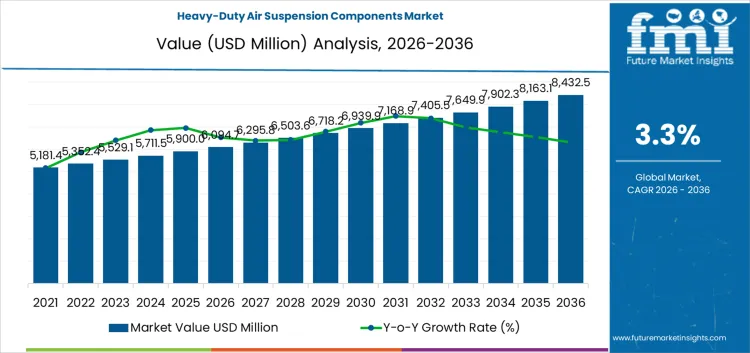
The heavy-duty air suspension components market is valued at USD 6,094.7 million in 2026 and is forecast to reach USD 8,432.5 million by 2036 at a CAGR of 3.3%. Value behavior reflects the structural role of air suspension in managing axle loads, ride height, and vibration under sustained commercial duty cycles. Component demand is embedded within chassis design rather than optional equipment selection, linking volumes to fleet utilization intensity. Load variability, road surface quality, and regulatory axle weight enforcement shape specification rigor. Air springs, valves, and control units are engineered around fatigue limits, pressure retention, and contamination resistance, constraining substitution and redesign frequency. Cost formation remains influenced by rubber compound performance, valve precision, and validation requirements tied to safety compliance.
Operating economics reinforce value accumulation rather than rapid expansion. Maintenance exposure and uptime sensitivity limit tolerance for component failure, supporting conservative replacement practices. System complexity increases where electronic height control interfaces with braking and stability modules, raising qualification thresholds. Packaging constraints and debris exposure influence material selection and protective design features. Aftermarket volumes track mileage accumulation and suspension wear patterns, not discretionary upgrades. Capital allocation by fleets favors reliability improvements that reduce damage to tires and chassis, sustaining replacement demand.
Quick Stats for Heavy-Duty Air Suspension Components Market
- Heavy-Duty Air Suspension Components Market Value (2026): USD 6,094.7 million
- Heavy-Duty Air Suspension Components Market Forecast Value (2036): USD 8,432.5 million
- Heavy-Duty Air Suspension Components Market Forecast CAGR 2026 to 2036: 3.3%
- Leading Component by Demand Share: Air Springs
- Fastest-Growing Countries: China, Brazil, USA, Germany, South Korea
- Top Players in Global Demand: Hendrickson, SAF-Holland, ZF, Firestone Industrial, Continental, Knorr-Bremse, Haldex, Meritor (Cummins), Tenneco
Heavy-Duty Air Suspension Components Market Key Takeaways
| Metric | Value |
|---|---|
| Market Value (2026) | USD 6,094.7 million |
| Market Forecast Value (2036) | USD 8,432.5 million |
| Forecast CAGR 2026 to 2036 | 3.3% |
Why is the Demand for Heavy-Duty Air Suspension Components Growing?
Demand for heavy-duty air suspension components is increasing as commercial transport operations place greater emphasis on load stability, vehicle control, and operating efficiency across long duty cycles. Freight carriers and public transport operators rely on air springs, leveling valves, and control units to maintain consistent ride height under varying payload conditions, which directly affects axle load distribution and braking effectiveness. Regulatory enforcement related to axle weight compliance and road safety encourages adoption of suspension systems that automatically adapt to load changes. Vehicle engineers also account for reduced mechanical stress on chassis structures when specifying air suspension, since controlled damping limits shock transmission from uneven road surfaces.
Procurement decisions increasingly favor components that support predictable performance across extended mileage, particularly in applications involving long haul routes and mixed road quality. Fleet modernization programs further reinforce adoption as operators seek improvements in ride comfort and cargo protection without compromising durability. Air suspension systems reduce vibration exposure for sensitive goods and improve driver working conditions during extended operating hours. Integration with electronic braking and stability systems increases reliance on compatible suspension components that support coordinated vehicle dynamics. Maintenance planning also benefits from modular designs that allow targeted replacement rather than full system overhaul. These operational, regulatory, and engineering factors collectively sustain demand growth for heavy-duty air suspension components.
How Are the Segments Classified in the Heavy-Duty Air Suspension Components Market?
Demand for heavy-duty air suspension components is shaped by load stability requirements, ride quality expectations, and durability needs across commercial transport operations. Adoption increases with freight efficiency goals, axle load optimization, and driver comfort considerations. Component selection prioritizes fatigue resistance, response consistency, and compatibility with varying axle configurations. Regulatory focus on vehicle safety and road impact influences suspension specification. Segment classification reflects differentiation by component role, vehicle application, and suspension architecture. Structure highlights how load management function, vehicle duty cycle, and suspension design influence adoption intensity, service life expectations, and deployment patterns across heavy commercial platforms.
Which Component Represents the Largest Share of Demand?
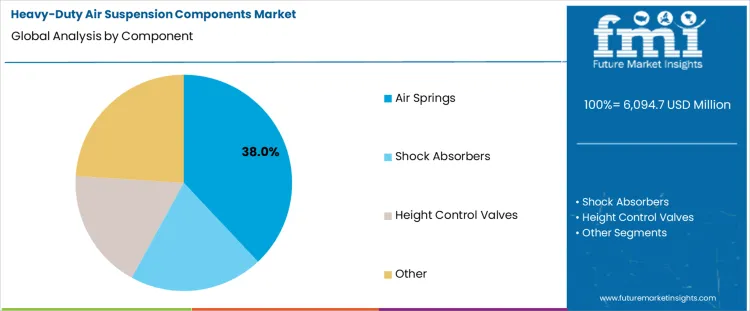
Air springs hold 38.0%, representing the largest share among air suspension components due to primary load-bearing responsibility. These components support vehicle weight distribution and absorb road-induced shocks under variable payload conditions. Performance consistency directly affects ride height control and cargo protection. Design emphasis includes material durability, pressure retention, and resistance to environmental exposure. Shock absorbers manage damping characteristics with lower load responsibility. Height control valves regulate air pressure distribution based on load changes. Other components support auxiliary suspension functions. Component segmentation reflects dominance of elements directly managing vertical load and ride height stability.
Key Points
- Air springs support primary load-bearing and ride height control.
- Payload variability increases performance and durability demands.
- Other components manage damping and pressure regulation functions.
Which Vehicle Category Accounts for the Highest Share of Demand?
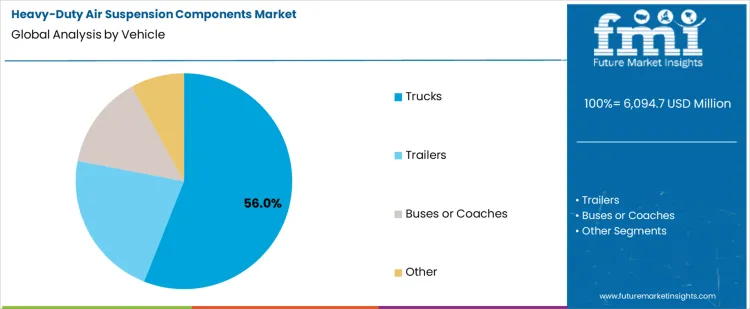
Trucks hold 56.0%, representing the largest share among vehicle categories due to high payload and mileage exposure. Long-haul and regional freight trucks require suspension systems capable of adapting to frequent load variation. Air suspension improves axle load distribution and ride stability under continuous operation. Fleet operators prioritize components reducing tire wear and structural stress. Trailers and buses operate under different load patterns with lower aggregate intensity. Other vehicles contribute limited volume. Vehicle segmentation reflects concentration of air suspension deployment within truck platforms emphasizing payload flexibility and operational efficiency.
Key Points
- Trucks experience frequent load variation and high mileage.
- Air suspension improves stability and axle load distribution.
- Other vehicle categories operate under different duty profiles.
Which Suspension Type Drives the Largest Share of Demand?
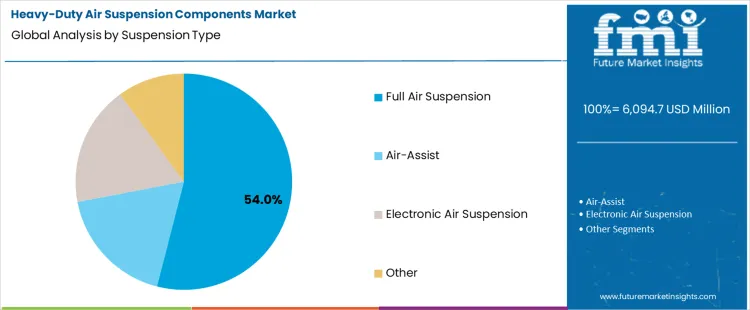
Full air suspension holds 54.0%, representing the largest share among suspension types due to comprehensive ride and load management capability. This configuration replaces conventional steel springs with air-based systems across all axles. Benefits include adjustable ride height, improved comfort, and reduced vibration transmission. Integration supports sensitive cargo transport and driver comfort objectives. Air-assist systems supplement mechanical springs with limited adjustability. Electronic air suspension introduces advanced control with higher complexity. Suspension type segmentation reflects preference for fully pneumatic solutions delivering consistent performance across varied operating and load conditions.
Key Points
- Full air suspension enables complete load and ride control.
- Adjustable height improves comfort and cargo protection.
- Other suspension types address supplemental or advanced control needs.
What are the Key Dynamics in the Heavy-Duty Air Suspension Components Market?
Demand for heavy-duty air suspension components reflects operational necessity to control ride height, axle load distribution, and vibration in commercial vehicles operating under variable payloads. Adoption concentrates in heavy trucks, buses, trailers, and refuse vehicles exposed to continuous load fluctuation. Global scope aligns with freight efficiency requirements, road load compliance, and vehicle durability expectations. Usage centers on air springs, leveling valves, compressors, and electronic height control modules integrated into chassis systems.
How do axle load regulation and vehicle uptime requirements shape adoption?
Heavy-duty vehicles must comply with axle load limits to avoid penalties, accelerated tire wear, and road damage liability. Demand increases as air suspension enables automatic ride height correction under uneven or shifting loads. Fleet operators rely on consistent axle loading to protect driveline, brakes, and tires during long-haul and urban stop-start operation. Refuse trucks and buses adopt air suspension to manage asymmetric loading during collection and passenger movement. Integration with electronic braking systems improves stability during braking and cornering. Reduced vibration transmission lowers structural fatigue on frames and mounted equipment. Adoption reflects operational priority for regulatory compliance, reduced component wear, and predictable vehicle behavior.
How do maintenance exposure and total ownership cost influence market scalability?
Air suspension components operate in harsh environments with continuous exposure to debris, moisture, and temperature variation. Demand sensitivity rises where air spring failure, valve leakage, or compressor wear increases downtime risk. Maintenance complexity exceeds steel spring systems, affecting fleets with limited service infrastructure. Replacement intervals vary significantly based on duty cycle, reducing cost predictability. Electronic height sensors introduce calibration and diagnostic requirements. Initial system cost affects adoption in price-sensitive haulage segments. Supply chain dependence on rubber compounds and precision valves affects availability. Warranty exposure linked to air leaks and system imbalance constrains aggressive cost optimization.
How Is Demand for Heavy-Duty Air Suspension Components Evolving Globally?
Demand for heavy-duty air suspension components is expanding globally due to ride stability requirements, axle load management, and durability expectations across commercial vehicle fleets. Adoption aligns with need to protect cargo, reduce chassis stress, and improve driver comfort under high utilization conditions. Fleet operators prioritize air springs, valves, and control units that support consistent ride height and reduced maintenance downtime. Replacement demand remains significant where mileage accumulation is high. Growth rates in China at 4.9%, Brazil at 4.7%, USA at 2.9%, Germany at 2.7%, and South Korea at 2.6% indicate steady expansion driven by operating intensity, infrastructure usage, and lifecycle servicing requirements.
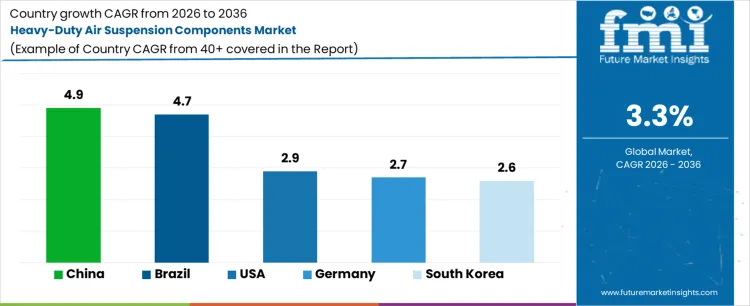
| Country | CAGR (%) |
|---|---|
| China | 4.9% |
| Brazil | 4.7% |
| USA | 2.9% |
| Germany | 2.7% |
| South Korea | 2.6% |
What Is Supporting Heavy-Duty Air Suspension Demand Growth in China?
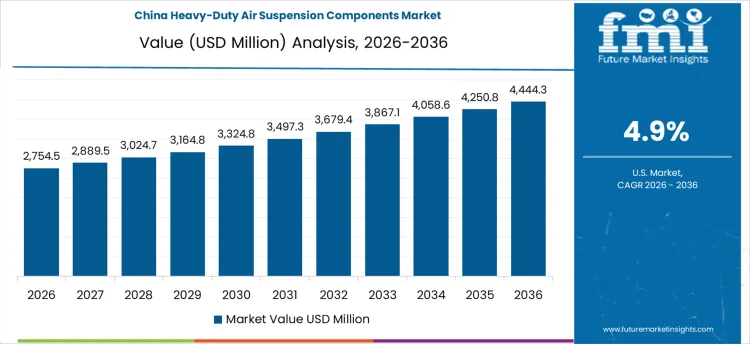
Heavy-duty air suspension component demand in China is growing at a CAGR of 4.9%, supported by intensive freight movement and infrastructure-related transport activity. Long operating hours across logistics and construction fleets increase wear on mechanical suspension systems, encouraging adoption of air-based alternatives. Municipal regulations on axle load distribution influence suspension specification. Fleet operators value air suspension for improved load leveling and reduced chassis fatigue. Domestic truck manufacturing sustains OEM fitment volumes, while inspection regimes encourage replacement of worn components. Demand growth remains maintenance-led, reflecting high utilization and regulatory compliance requirements rather than expansion in vehicle populations.
- High freight and construction vehicle utilization
- Axle load compliance influencing suspension selection
- Preference for load leveling and ride stability
- Stable OEM demand from domestic truck production
Why Is Brazil Experiencing Steady Expansion in Air Suspension Component Demand?
Operating conditions shape heavy-duty air suspension component demand in Brazil, expanding at a CAGR of 4.7%. Long-haul transport across uneven road networks increases stress on traditional suspension systems. Agricultural and mining logistics require improved ride control to protect cargo and vehicle structures. High temperatures and dust exposure influence component durability, increasing replacement needs. Fleet modernization programs adopt air suspension to reduce maintenance costs and improve operational reliability. Demand growth reflects operating environment challenges and lifecycle replacement rather than rapid growth in new truck registrations.
- Uneven road conditions increasing suspension stress
- Agricultural and mining logistics requirements
- Climate exposure affecting component durability
- Fleet modernization supporting air suspension adoption
How Is the USA Sustaining Demand for Heavy-Duty Air Suspension Components?
Heavy-duty air suspension component demand in the USA is expanding at a CAGR of 2.9%, driven by high mileage accumulation and preventive maintenance practices. Long-distance freight transport increases fatigue on suspension systems. Fleet operators adopt air suspension to improve ride consistency and reduce cargo damage. Regulatory focus on vehicle stability and braking performance influences suspension specifications. Aftermarket replacement dominates due to long vehicle service life. Demand growth remains measured, aligned with maintenance cycles and selective fleet upgrades rather than expansion of heavy-duty vehicle counts.
- High mileage long-haul freight operations
- Focus on cargo protection and ride consistency
- Regulatory influence on vehicle stability performance
- Strong aftermarket replacement orientation
What Factors Are Shaping Air Suspension Demand in Germany?
Engineering discipline shapes heavy-duty air suspension component demand in Germany, growing at a CAGR of 2.7%. Strict axle load and vehicle stability standards influence suspension design. Well-maintained road infrastructure moderates extreme suspension stress, extending service life. Fleet operators adopt air suspension to meet comfort and cargo protection requirements. Preventive maintenance schedules create predictable replacement demand. Export-driven logistics sustain steady utilization. Growth reflects structured servicing within mature fleets rather than expansion in commercial vehicle deployment.
- Axle load and stability compliance requirements
- High road quality moderating component wear
- Preventive maintenance-driven replacement cycles
- Stable export-related logistics utilization
Why Is South Korea Showing Controlled Growth in Air Suspension Component Demand?
Heavy-duty air suspension component demand in South Korea is growing at a CAGR of 2.6%, influenced by compact geography and efficient logistics operations. Shorter transport distances reduce cumulative suspension fatigue. High maintenance discipline limits premature component failure. Manufacturing and port logistics sustain consistent truck usage. Fleet operators favor standardized suspension configurations with long service intervals. Growth remains controlled, reflecting efficient fleet utilization and scheduled replacement rather than expansion of heavy-duty truck populations.
- Shorter routes limiting cumulative suspension wear
- Strong preventive maintenance discipline
- Manufacturing and port logistics activity
- Standardized long-life suspension configurations
What is the competitive landscape of demand for the heavy-duty air suspension components market globally?
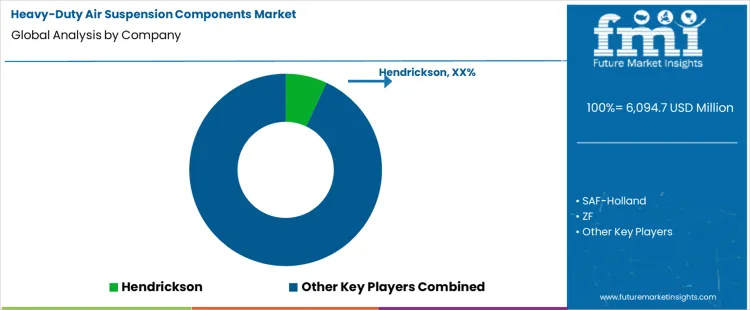
Demand for heavy-duty air suspension components is driven by truck and bus fleet electrification, ride comfort expectations, load leveling requirements, and regulatory mandates for operational safety and durability. Components such as air springs, valves, height sensors, and control modules are critical in enhancing vehicle stability, load distribution, and driver comfort under varying road and load conditions. Buyers evaluate durability under heavy cycles, responsiveness of control systems, corrosion resistance, integration compatibility, and ease of service. Procurement teams prioritize suppliers with validated OEM qualifications, global logistics support, and broad portfolios covering complete suspension ecosystems. Trend in the global market reflects growth in long-haul commercial fleets, increased adoption of electronic suspension controls, and expansion of aftermarket support for fleet operators.
Hendrickson holds leading positioning through a comprehensive portfolio of air suspension components and systems tailored for heavy-duty truck and trailer applications with strong OEM and aftermarket support networks. SAF-Holland supports demand with modular air suspension elements and integration capabilities across commercial vehicle platforms. ZF contributes advanced air spring, valve, and control solutions with engineering support for ride optimization and load management. Firestone Industrial Products participates with air springs and supporting components designed for durability and consistent performance. Continental supplies air suspension components and electronic control modules aligned with heavy-duty vehicle integration and safety standards. Competitive differentiation depends on component durability, integration flexibility, serviceability, and ability to meet demanding performance and safety requirements.
Key Players in the Heavy-Duty Air Suspension Components Market
- Hendrickson
- SAF-Holland
- ZF
- Firestone Industrial
- Continental
- Knorr-Bremse
- Haldex
- Meritor (Cummins)
- Tenneco
Scope of the Report
| Items | Values |
|---|---|
| Quantitative Units | USD million |
| Component | Air Springs; Shock Absorbers; Height Control Valves; Other |
| Vehicle | Trucks; Trailers; Buses or Coaches; Other |
| Suspension Type | Full Air Suspension; Air-Assist; Electronic Air Suspension; Other |
| Sales Channel | OEM Line-Fit; Aftermarket; Dealer or OES; Other |
| Regions Covered | Asia Pacific, Europe, North America, Latin America, Middle East & Africa |
| Countries Covered | China, Brazil, USA, Germany, South Korea, and 40+ countries |
| Key Companies Profiled | Hendrickson; SAF-Holland; ZF; Firestone Industrial; Continental; Knorr-Bremse; Haldex; Meritor; Tenneco |
| Additional Attributes | Dollar sales by component and vehicle category; adoption trends for electronic air suspension to improve ride quality, load leveling, and fuel efficiency; durability under high-load cycles, air retention, and fatigue life performance metrics; integration with braking and stability systems; maintenance intervals, aftermarket replacement rates, and serviceability considerations; compatibility with regional axle and chassis architectures; compliance with OEM durability standards, axle load regulations, and safety requirements influencing heavy-duty air suspension specification. |
Heavy-Duty Air Suspension Components Market by Segment
Component:
- Air Springs
- Shock Absorbers
- Height Control Valves
- Other
Vehicle:
- Trucks
- Trailers
- Buses or Coaches
- Other
Suspension Type:
- Full Air Suspension
- Air-Assist
- Electronic Air Suspension
- Other
Sales Channel:
- OEM Line-Fit
- Aftermarket
- Dealer or OES
- Other
Region:
- Asia Pacific
- China
- Japan
- South Korea
- India
- Australia & New Zealand
- ASEAN
- Rest of Asia Pacific
- Europe
- Germany
- United Kingdom
- France
- Italy
- Spain
- Nordic
- BENELUX
- Rest of Europe
- North America
- United States
- Canada
- Mexico
- Latin America
- Brazil
- Chile
- Rest of Latin America
- Middle East & Africa
- Kingdom of Saudi Arabia
- Other GCC Countries
- Turkey
- South Africa
- Other African Union
- Rest of Middle East & Africa
Bibliography
- European Commission. (2023). Regulation (EU) 2019/2144 on type-approval requirements for motor vehicles and systems, components and separate technical units, including provisions affecting suspension systems and vehicle stability (consolidated version with staged application in force during 2023-2024). Official Journal of the European Union.
- United Nations Economic Commission for Europe. (2023). UNECE Regulation No. 13: Uniform provisions concerning the approval of vehicles with regard to braking systems, including axle load distribution and suspension interaction requirements (consolidated text incorporating amendments effective 2023). United Nations.
- United Nations Economic Commission for Europe. (2024). UNECE Regulation No. 79: Uniform provisions concerning the approval of vehicles with regard to steering equipment, including requirements influencing suspension and vehicle stability systems (amendments in force 2024). United Nations.
- International Organization for Standardization. (2023). ISO 16750-3: Road vehicles - Environmental conditions and testing for electrical and electronic equipment - Mechanical loads (current edition applied in commercial vehicle systems during 2023). International Organization for Standardization.
- International Organization for Standardization. (2024). ISO 7638-2: Road vehicles - Electrical connections between towing and towed vehicles - Requirements applicable to electronically controlled suspension and braking systems (latest edition confirmed in use during 2024). International Organization for Standardization.
- National Highway Traffic Safety Administration. (2024). Federal Motor Vehicle Safety Standards: Air brake systems and suspension-related performance considerations for heavy vehicles (49 CFR Part 571; enforcement interpretations applicable in 2024). U.S. Department of Transportation.
Frequently Asked Questions
How big is the heavy-duty air suspension components market in 2026?
The global heavy-duty air suspension components market is estimated to be valued at USD 6,094.7 million in 2026.
What will be the size of heavy-duty air suspension components market in 2036?
The market size for the heavy-duty air suspension components market is projected to reach USD 8,432.5 million by 2036.
How much will be the heavy-duty air suspension components market growth between 2026 and 2036?
The heavy-duty air suspension components market is expected to grow at a 3.3% CAGR between 2026 and 2036.
What are the key product types in the heavy-duty air suspension components market?
The key product types in heavy-duty air suspension components market are air springs, shock absorbers, height control valves and other.
Which vehicle segment to contribute significant share in the heavy-duty air suspension components market in 2026?
In terms of vehicle, trucks segment to command 56.0% share in the heavy-duty air suspension components market in 2026.
Preview the report firsthand - request a free sample
Get SampleGet the brochure for pricing and purchase details.
Get PDFTable of Content
- Executive Summary
- Global Market Outlook
- Demand-side Trends
- Supply-side Trends
- Technology Roadmap Analysis
- Analysis and Recommendations
- Market Overview
- Market Coverage / Taxonomy
- Market Definition / Scope / Limitations
- Market Background
- Market Dynamics
- Drivers
- Restraints
- Opportunity
- Trends
- Scenario Forecast
- Demand in Optimistic Scenario
- Demand in Likely Scenario
- Demand in Conservative Scenario
- Opportunity Map Analysis
- Product Life Cycle Analysis
- Supply Chain Analysis
- Investment Feasibility Matrix
- Value Chain Analysis
- PESTLE and Porter’s Analysis
- Regulatory Landscape
- Regional Parent Market Outlook
- Production and Consumption Statistics
- Import and Export Statistics
- Market Dynamics
- Global Market Analysis 2021 to 2025 and Forecast, 2026 to 2036
- Historical Market Size Value (USD Million) Analysis, 2021 to 2025
- Current and Future Market Size Value (USD Million) Projections, 2026 to 2036
- Y-o-Y Growth Trend Analysis
- Absolute $ Opportunity Analysis
- Global Market Pricing Analysis 2021 to 2025 and Forecast 2026 to 2036
- Global Market Analysis 2021 to 2025 and Forecast 2026 to 2036, By Component
- Introduction / Key Findings
- Historical Market Size Value (USD Million) Analysis By Component , 2021 to 2025
- Current and Future Market Size Value (USD Million) Analysis and Forecast By Component , 2026 to 2036
- Air Springs
- Shock Absorbers
- Height Control Valves
- Other
- Air Springs
- Y-o-Y Growth Trend Analysis By Component , 2021 to 2025
- Absolute $ Opportunity Analysis By Component , 2026 to 2036
- Global Market Analysis 2021 to 2025 and Forecast 2026 to 2036, By Vehicle
- Introduction / Key Findings
- Historical Market Size Value (USD Million) Analysis By Vehicle, 2021 to 2025
- Current and Future Market Size Value (USD Million) Analysis and Forecast By Vehicle, 2026 to 2036
- Trucks
- Trailers
- Buses or Coaches
- Other
- Trucks
- Y-o-Y Growth Trend Analysis By Vehicle, 2021 to 2025
- Absolute $ Opportunity Analysis By Vehicle, 2026 to 2036
- Global Market Analysis 2021 to 2025 and Forecast 2026 to 2036, By Suspension Type
- Introduction / Key Findings
- Historical Market Size Value (USD Million) Analysis By Suspension Type, 2021 to 2025
- Current and Future Market Size Value (USD Million) Analysis and Forecast By Suspension Type, 2026 to 2036
- Full Air Suspension
- Air-Assist
- Electronic Air Suspension
- Other
- Full Air Suspension
- Y-o-Y Growth Trend Analysis By Suspension Type, 2021 to 2025
- Absolute $ Opportunity Analysis By Suspension Type, 2026 to 2036
- Global Market Analysis 2021 to 2025 and Forecast 2026 to 2036, By Sales Channel
- Introduction / Key Findings
- Historical Market Size Value (USD Million) Analysis By Sales Channel, 2021 to 2025
- Current and Future Market Size Value (USD Million) Analysis and Forecast By Sales Channel, 2026 to 2036
- OEM Line-Fit
- Aftermarket
- Dealer or OES
- Other
- OEM Line-Fit
- Y-o-Y Growth Trend Analysis By Sales Channel, 2021 to 2025
- Absolute $ Opportunity Analysis By Sales Channel, 2026 to 2036
- Global Market Analysis 2021 to 2025 and Forecast 2026 to 2036, By Region
- Introduction
- Historical Market Size Value (USD Million) Analysis By Region, 2021 to 2025
- Current Market Size Value (USD Million) Analysis and Forecast By Region, 2026 to 2036
- North America
- Latin America
- Western Europe
- Eastern Europe
- East Asia
- South Asia and Pacific
- Middle East & Africa
- Market Attractiveness Analysis By Region
- North America Market Analysis 2021 to 2025 and Forecast 2026 to 2036, By Country
- Historical Market Size Value (USD Million) Trend Analysis By Market Taxonomy, 2021 to 2025
- Market Size Value (USD Million) Forecast By Market Taxonomy, 2026 to 2036
- By Country
- USA
- Canada
- Mexico
- By Component
- By Vehicle
- By Suspension Type
- By Sales Channel
- By Country
- Market Attractiveness Analysis
- By Country
- By Component
- By Vehicle
- By Suspension Type
- By Sales Channel
- Key Takeaways
- Latin America Market Analysis 2021 to 2025 and Forecast 2026 to 2036, By Country
- Historical Market Size Value (USD Million) Trend Analysis By Market Taxonomy, 2021 to 2025
- Market Size Value (USD Million) Forecast By Market Taxonomy, 2026 to 2036
- By Country
- Brazil
- Chile
- Rest of Latin America
- By Component
- By Vehicle
- By Suspension Type
- By Sales Channel
- By Country
- Market Attractiveness Analysis
- By Country
- By Component
- By Vehicle
- By Suspension Type
- By Sales Channel
- Key Takeaways
- Western Europe Market Analysis 2021 to 2025 and Forecast 2026 to 2036, By Country
- Historical Market Size Value (USD Million) Trend Analysis By Market Taxonomy, 2021 to 2025
- Market Size Value (USD Million) Forecast By Market Taxonomy, 2026 to 2036
- By Country
- Germany
- UK
- Italy
- Spain
- France
- Nordic
- BENELUX
- Rest of Western Europe
- By Component
- By Vehicle
- By Suspension Type
- By Sales Channel
- By Country
- Market Attractiveness Analysis
- By Country
- By Component
- By Vehicle
- By Suspension Type
- By Sales Channel
- Key Takeaways
- Eastern Europe Market Analysis 2021 to 2025 and Forecast 2026 to 2036, By Country
- Historical Market Size Value (USD Million) Trend Analysis By Market Taxonomy, 2021 to 2025
- Market Size Value (USD Million) Forecast By Market Taxonomy, 2026 to 2036
- By Country
- Russia
- Poland
- Hungary
- Balkan & Baltic
- Rest of Eastern Europe
- By Component
- By Vehicle
- By Suspension Type
- By Sales Channel
- By Country
- Market Attractiveness Analysis
- By Country
- By Component
- By Vehicle
- By Suspension Type
- By Sales Channel
- Key Takeaways
- East Asia Market Analysis 2021 to 2025 and Forecast 2026 to 2036, By Country
- Historical Market Size Value (USD Million) Trend Analysis By Market Taxonomy, 2021 to 2025
- Market Size Value (USD Million) Forecast By Market Taxonomy, 2026 to 2036
- By Country
- China
- Japan
- South Korea
- By Component
- By Vehicle
- By Suspension Type
- By Sales Channel
- By Country
- Market Attractiveness Analysis
- By Country
- By Component
- By Vehicle
- By Suspension Type
- By Sales Channel
- Key Takeaways
- South Asia and Pacific Market Analysis 2021 to 2025 and Forecast 2026 to 2036, By Country
- Historical Market Size Value (USD Million) Trend Analysis By Market Taxonomy, 2021 to 2025
- Market Size Value (USD Million) Forecast By Market Taxonomy, 2026 to 2036
- By Country
- India
- ASEAN
- Australia & New Zealand
- Rest of South Asia and Pacific
- By Component
- By Vehicle
- By Suspension Type
- By Sales Channel
- By Country
- Market Attractiveness Analysis
- By Country
- By Component
- By Vehicle
- By Suspension Type
- By Sales Channel
- Key Takeaways
- Middle East & Africa Market Analysis 2021 to 2025 and Forecast 2026 to 2036, By Country
- Historical Market Size Value (USD Million) Trend Analysis By Market Taxonomy, 2021 to 2025
- Market Size Value (USD Million) Forecast By Market Taxonomy, 2026 to 2036
- By Country
- Kingdom of Saudi Arabia
- Other GCC Countries
- Turkiye
- South Africa
- Other African Union
- Rest of Middle East & Africa
- By Component
- By Vehicle
- By Suspension Type
- By Sales Channel
- By Country
- Market Attractiveness Analysis
- By Country
- By Component
- By Vehicle
- By Suspension Type
- By Sales Channel
- Key Takeaways
- Key Countries Market Analysis
- USA
- Pricing Analysis
- Market Share Analysis, 2025
- By Component
- By Vehicle
- By Suspension Type
- By Sales Channel
- Canada
- Pricing Analysis
- Market Share Analysis, 2025
- By Component
- By Vehicle
- By Suspension Type
- By Sales Channel
- Mexico
- Pricing Analysis
- Market Share Analysis, 2025
- By Component
- By Vehicle
- By Suspension Type
- By Sales Channel
- Brazil
- Pricing Analysis
- Market Share Analysis, 2025
- By Component
- By Vehicle
- By Suspension Type
- By Sales Channel
- Chile
- Pricing Analysis
- Market Share Analysis, 2025
- By Component
- By Vehicle
- By Suspension Type
- By Sales Channel
- Germany
- Pricing Analysis
- Market Share Analysis, 2025
- By Component
- By Vehicle
- By Suspension Type
- By Sales Channel
- UK
- Pricing Analysis
- Market Share Analysis, 2025
- By Component
- By Vehicle
- By Suspension Type
- By Sales Channel
- Italy
- Pricing Analysis
- Market Share Analysis, 2025
- By Component
- By Vehicle
- By Suspension Type
- By Sales Channel
- Spain
- Pricing Analysis
- Market Share Analysis, 2025
- By Component
- By Vehicle
- By Suspension Type
- By Sales Channel
- France
- Pricing Analysis
- Market Share Analysis, 2025
- By Component
- By Vehicle
- By Suspension Type
- By Sales Channel
- India
- Pricing Analysis
- Market Share Analysis, 2025
- By Component
- By Vehicle
- By Suspension Type
- By Sales Channel
- ASEAN
- Pricing Analysis
- Market Share Analysis, 2025
- By Component
- By Vehicle
- By Suspension Type
- By Sales Channel
- Australia & New Zealand
- Pricing Analysis
- Market Share Analysis, 2025
- By Component
- By Vehicle
- By Suspension Type
- By Sales Channel
- China
- Pricing Analysis
- Market Share Analysis, 2025
- By Component
- By Vehicle
- By Suspension Type
- By Sales Channel
- Japan
- Pricing Analysis
- Market Share Analysis, 2025
- By Component
- By Vehicle
- By Suspension Type
- By Sales Channel
- South Korea
- Pricing Analysis
- Market Share Analysis, 2025
- By Component
- By Vehicle
- By Suspension Type
- By Sales Channel
- Russia
- Pricing Analysis
- Market Share Analysis, 2025
- By Component
- By Vehicle
- By Suspension Type
- By Sales Channel
- Poland
- Pricing Analysis
- Market Share Analysis, 2025
- By Component
- By Vehicle
- By Suspension Type
- By Sales Channel
- Hungary
- Pricing Analysis
- Market Share Analysis, 2025
- By Component
- By Vehicle
- By Suspension Type
- By Sales Channel
- Kingdom of Saudi Arabia
- Pricing Analysis
- Market Share Analysis, 2025
- By Component
- By Vehicle
- By Suspension Type
- By Sales Channel
- Turkiye
- Pricing Analysis
- Market Share Analysis, 2025
- By Component
- By Vehicle
- By Suspension Type
- By Sales Channel
- South Africa
- Pricing Analysis
- Market Share Analysis, 2025
- By Component
- By Vehicle
- By Suspension Type
- By Sales Channel
- USA
- Market Structure Analysis
- Competition Dashboard
- Competition Benchmarking
- Market Share Analysis of Top Players
- By Regional
- By Component
- By Vehicle
- By Suspension Type
- By Sales Channel
- Competition Analysis
- Competition Deep Dive
- Hendrickson
- Overview
- Product Portfolio
- Profitability by Market Segments (Product/Age /Sales Channel/Region)
- Sales Footprint
- Strategy Overview
- Marketing Strategy
- Product Strategy
- Channel Strategy
- SAF-Holland
- ZF
- Firestone Industrial
- Continental
- Knorr-Bremse
- Haldex
- Meritor (Cummins)
- Tenneco
- Hendrickson
- Competition Deep Dive
- Assumptions & Acronyms Used
- Research Methodology


