

- Industry Size (2026)
- USD 1.3 Bn
- Forecast (2036)
- USD 4.3 Bn
- CAGR (2026 to 2036)
- 12.2%
Airport Cargo Community Digital Collaboration Platforms Market Size, Market Forecast and Outlook By FMI
The airport cargo community digital collaboration platforms market size was recorded at USD 1.2 billion in 2025. Demand is poised to puss industry to cross USD 1.3 billion in 2026, and reach USD 4.3 billion by 2036, at a 12.2% CAGR over the forecast period. This is driven by the shift from legacy document flows to mandated air cargo ONE Record software standards and ecosystem-wide data exchange protocols.
Summary of Airport Cargo Community Digital Collaboration Platforms Market
- The market is estimated at USD 1.3 billion in 2026.
- The market is projected to reach USD 4.3 billion by 2036.
- The market is expected to grow at a CAGR of 12.2% from 2026 to 2036.
- The forecast period represents an incremental opportunity of USD 2.8 billion.
- Cargo clouds lead the platform type segment with a 34.0% share.
- Cloud deployment dominates with a 68.0% share.
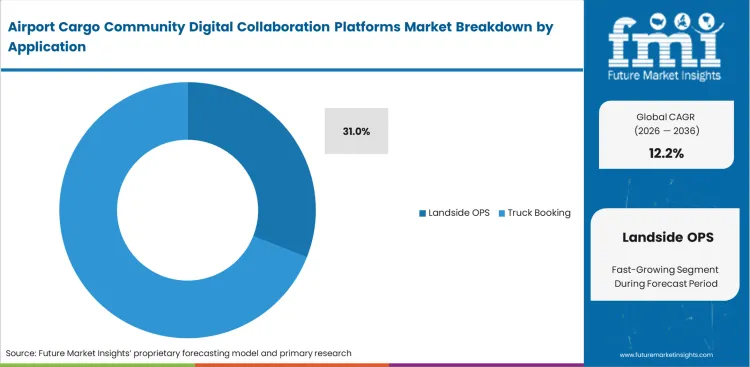
- Landside operations lead the application segment with a 31.0% share.
- Airports dominate the end-user segment with a 29.0% share.
- General cargo leads the cargo type segment with a 46.0% share.
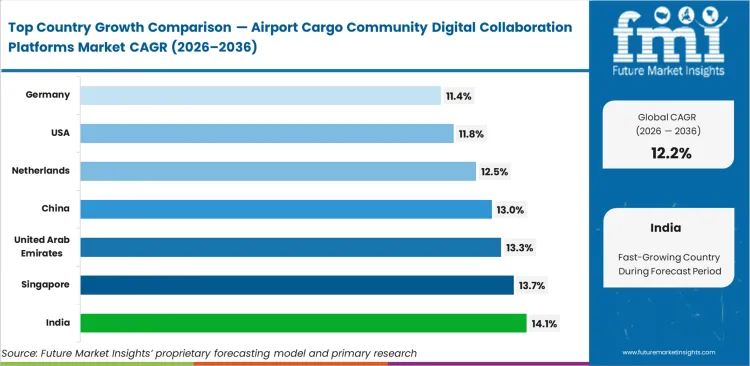
- India (14.1%), Singapore (13.7%), and the UAE (13.3%) are among the fastest-growing markets.
- Key companies in the market include Kale Logistics Solutions, Nallian, CHAMP Cargosystems, Cargonaut, DAKOSY / allivate, CCS-UK, and Descartes.
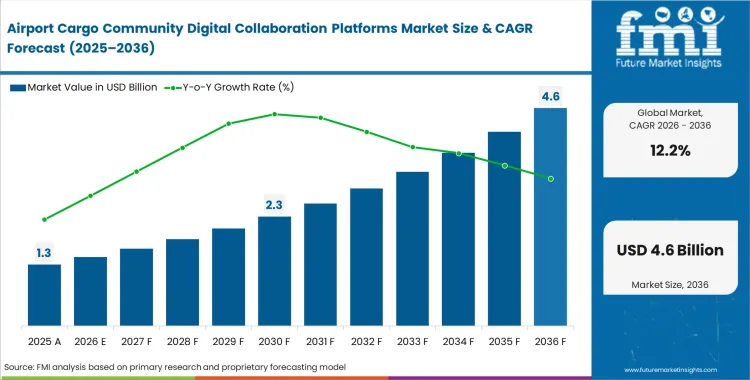
Key Takeaways
| Metric | Details |
| Industry Size (2026) | USD 1.3 Billion |
| Industry Value (2036) | USD 4.3 Billion |
| CAGR (2026-2036) | 12.2% |
Source: Future Market Insights (FMI) analysis, based on proprietary forecasting model and primary research
Severe landside capacity constraints necessitate coordinated scheduling mandates from airport authorities, compelling local logistics operators toward unified digital architectures. Evaluating an airport cargo single window platform becomes an operational imperative; hub administrators begin penalizing forwarders arriving at truck docks without a digital reservation. Delaying integration with advanced airport technologies results in strict detention charges and compromised export throughput for ground handlers. Isolated point solutions prove inadequate under current circumstances because the necessary multi-stakeholder visibility required for simultaneous customs hold clearance and physical dock bottleneck resolution is absent.
The execution of an airport cargo slot booking software Request for Quotation (RFQ) signifies a hub's transition from voluntary Information Technology upgrades to mandatory physical access controls. Ground handlers and trucking firms must abandon fragmented spreadsheets; connection directly to an air cargo community platform is requisite to maintain gate privileges. Crossing this integration threshold transforms a fractured local supply chain into a synchronized operational unit, thereby driving structural airport cargo digitalization.
India is estimated to register a CAGR of 14.1% through 2036, followed by Singapore at 13.7% due to expanding community-wide truck-dock slot systems from export into complex import rollouts. The United Arab Emirates is likely to expand at 13.3%, while China at 13.0%, Netherlands at 12.5%, the United States at 11.8%, Germany at 11.4% CAGR during the forecast period. Since the US and Germany countries are adding airport cargo collaboration software onto highly developed but aging IT stacks. Structural divergence separates emerging hubs adopting cloud-native orchestration from established airports struggling to untangle decades of localized customs interfaces.
Segmental Analysis
Airport Cargo Community Digital Collaboration Platforms Market Analysis by Platform Type
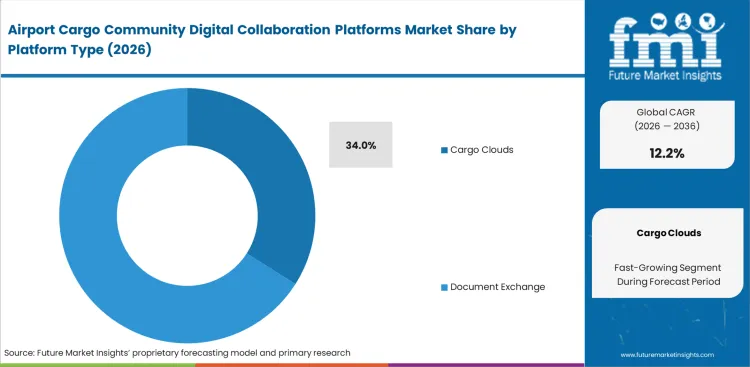
Comparing an airport cargo community system vs freight forwarding software highlights a distinct boundary in the airport cargo community digital collaboration platforms market. Freight software manages a single forwarder’s routing, whereas cargo clouds provide the neutral orchestration layer required across competing entities. The cargo clouds segment is expected to hold 34.0% revenue share in 2026. This dominant market share is driven by immediate operational necessity of establishing verifiable visibility firewalls between fiercely competitive freight forwarders.
Securing this neutral ground eliminates the need to build costly bespoke interfaces between rival air freight forwarding system environments. Based upon FMI's extensive operational analysis, modular flexibility facilitates the natural scaling of comprehensive platforms from simple messaging switches into advanced workflow engines capable of supporting complex multi-hub logistics chains over the next 10 years.
- Visibility firewall configuration: Neutral data governance ensures that while airport authorities see overall capacity, individual operators cannot view competing manifest details. Hub IT directors avoid ecosystem rejection by strictly enforcing these digital boundaries to maintain trust.
- Liability tracking mechanism: Immutable digital handovers log exact timestamps for document submission and physical receipt across the network. Claims managers at ground handling firms use this forensic data to deflect unwarranted demurrage charges effectively and protect operating margins.
- API standardization protocol: Centralized translation layers ingest fragmented proprietary formats and output standardized ONE Record messages efficiently. System architects avoid building costly bespoke connectors for every new airline partner entering local ecosystems, accelerating network expansion.
Airport Cargo Community Digital Collaboration Platforms Market Analysis by Deployment
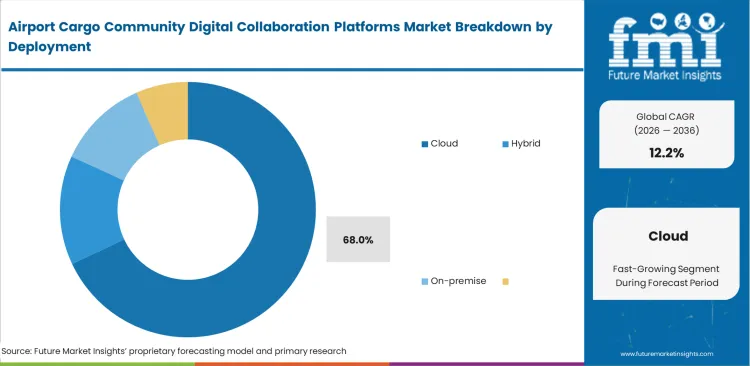
Maintaining legacy hardware drains IT budgets while restricting tarmac mobility, prompting an accelerated shift toward modern infrastructure. Stalling migration to hosted infrastructure inherently restricts a digital freight matching participant's ability to engage in dynamic, multi-hub routing optimization across global networks. The cloud segment is expected to hold 68.0% revenue share in 2026. This is driven by immediate financial incentive of shifting massive capital expenditure into predictable operating costs, critical operational requirement for zero-downtime remote security patching, necessity for highly scalable capacity provisioning during peak seasonal freight surges, and rising demand for real-time mobile access directly on active tarmac zones.
- Zero-downtime update cycle: Hosted architectures push regulatory compliance patches and feature enhancements without requiring local server offline windows. IT operations managers eliminate weekend maintenance disruptions and maintain continuous cargo flows without system blackouts.
- Scalable capacity provisioning: Cloud environments automatically spin up additional processing power during peak seasonal freight surges to manage massive data inflows. Infrastructure leads avoid over-purchasing physical servers that sit idle during off-peak months, optimizing long-term capital allocation.
- Remote access enablement: Mobile applications tied to hosted core systems allow tarmac operators to update milestones directly from physical loading zones. Ramp supervisors accelerate data entry and eliminate paper-based trips back to terminal offices, vastly improving labor productivity.
Airport Cargo Community Digital Collaboration Platforms Market Analysis by Application
Physical dock constraints dictate terminal throughput regardless of internal warehouse efficiency, creating severe operational challenges that require technological intervention. Delaying the rollout of a freight forwarding software dock management module guarantees continued yard gridlock and severely limits total terminal capacity. FMI analysts observe that landside terminal automation digitalization offers the fastest, most quantifiable return on investment for newly formed cargo communities, transforming fractured truck arrivals into smoothly orchestrated supply chain movements capable of handling rapidly surging e-commerce volumes.
The landside OPS segment is expected to hold 31.0% revenue share in 2026, driven by acute commercial pressure to reduce highly visible service level agreement failures, strict mandates imposed by airport authorities to eliminate municipal traffic congestion, rapid adoption of automated pre-arrival document validation procedures, and measurable return on investment generated by optimizing truck turnaround times through dynamic slot allocation.
- Dynamic slot allocation: Algorithms balance incoming truck volumes against available dock doors and warehouse labor capacity to prevent resource scarcity. Dock management personnel smooth out arrival peaks and eliminate hours-long queueing times for local transport providers, improving overall asset utilization.
- Pre-arrival document validation: Drivers submit electronic waybills for automated clearance before receiving confirmed physical approach slots at the terminal. Customs compliance staff prevent incomplete shipments from occupying valuable staging space inside facilities, accelerating total physical throughput.
- Turnaround time optimization: Real-time metrics track exactly a vehicle's occupancy duration in specialized loading bays during active transfer operations. Operations leadership utilizes this granular data to penalize underperforming carriers and reward highly efficient logistics partners, raising community standards.
Airport Cargo Community Digital Collaboration Platforms Market Analysis by End User
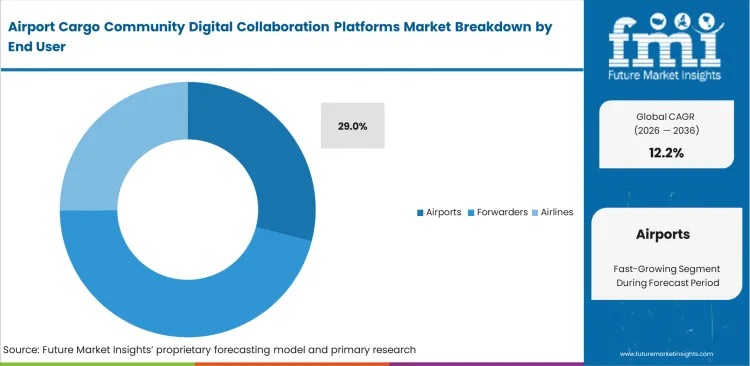
Successful digital ecosystems require a central authority possessing the geopolitical leverage to mandate participation and override local resistance. Hubs failing to provide adequate technical support during this freight management software onboarding phase face fierce resistance and low initial terminal management system utilization rates. Establishing transparent airport cargo community platform pricing structures, where costs are distributed across airlines and forwarders, prevents the hub authority from shouldering the entire software expense. Based on FMI's intensive assessment, successful deployments require airports to act as aggressive conveners rather than passive software providers, actively managing the transition to ensure comprehensive network integration across all competing logistical parties.
The airports segment is expected to hold 29.0% revenue share in 2026. This significant market share is driven by unique capability of hub authorities to tie physical landside access directly to platform compliance, and ability to establish neutral governance committees that prevent stakeholder monopolies. Other factors include capacity to enforce shared financial models that distribute licensing fees equitably, and absolute necessity to maximize existing infrastructure yields without pouring concrete for new facilities. Cargo development directors utilize this leverage to enforce adoption, recognizing that ground handlers bear the brunt of the actual technical integration friction.
- Mandate enforcement authority: Hub leadership links physical access badges and dock privileges directly to platform compliance across the ecosystem. Cargo development personnel ensure rapid ecosystem adoption by removing options to utilize legacy manual processes, forcing technological upgrades.
- Ecosystem cost distribution: Shared financial models spread platform licensing fees across airlines, forwarders, and handlers based on precise transaction volume. Procurement personnel at hub authorities avoid shouldering entire software costs while delivering community-wide value and operational transparency.
- Neutral governance establishment: Independent steering committees featuring representatives from all major stakeholder groups manage system upgrades and baseline data rules. Community managers proactively prevent any single powerful airline or handler from monopolizing digital roadmaps, maintaining a balanced competitive landscape.
Airport Cargo Community Digital Collaboration Platforms Market Analysis by Cargo Type
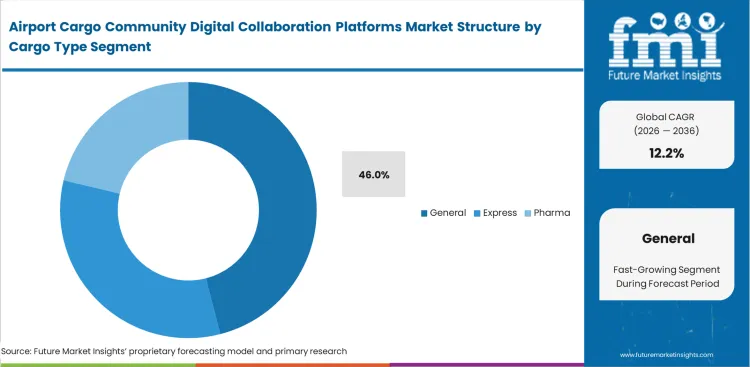
Community-wide digital investments require massive, everyday transaction volumes to justify the initial integration labor and ongoing software maintenance costs. The general cargo segment is expected to hold 46.0% revenue share in 2026, propelled by critical necessity of establishing baseline transaction volumes to stabilize initial software investments, and demand for automated volume processing to clear thousands of routine shipments without manual intervention. Other factors include requirement for comprehensive capacity baseline modeling to optimize future floor layouts, and operational priority of digitizing standard flows before tackling highly complex, specialized handling requirements.
- Volume processing automation: Standardized digital templates rapidly clear thousands of routine shipments without requiring extensive manual human intervention or duplicate data entry. Data entry personnel shift focus from repetitive typing to complex exception management tasks, dramatically elevating overall workforce productivity.
- Baseline milestone tracking: Automated sensors and barcode scans provide essential location updates as standard pallets move progressively through massive hub facilities. Customer service representatives proactively notify shippers about expected release times instead of reacting to blind inquiries, vastly improving client satisfaction metrics.
- Capacity baseline modeling: Historical data from standard shipments feeds predictive algorithms determining long-term warehouse space and labor requirements accurately. Facility planning personnel optimize floor layouts based on quantifiable seasonal flow patterns rather than anecdotal experience, eliminating costly operational bottlenecks before occurrence.
Airport Cargo Community Digital Collaboration Platforms Market Drivers, Restraints, and Opportunities
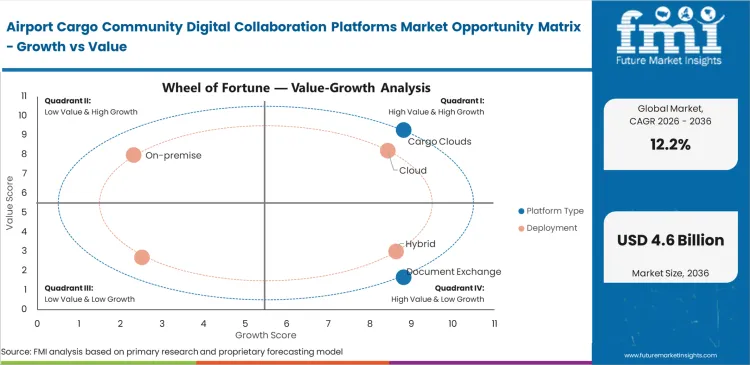
Acute landside truck congestion compels airport authorities to mandate synchronized dock scheduling across the airport cargo community digital collaboration platforms market. Terminal directors at major international hubs recognize that pouring new concrete cannot solve throughput limits; strict digital synchronization processes are required to manage surging volumes within existing footprints. Delaying this transition leaves ground handlers facing severe detention penalties and chronic yard gridlock. This operational pressure forces fragmented local actors to adopt unified freight transport management systems and an airport cargo landside management platform to survive. When physical space runs out, digital coordination becomes the only viable execution path.
Sheer volumes of legacy, proprietary forwarding systems lacking basic API capabilities create substantial operational friction. Independent forwarders utilizing outdated software cannot automatically push data into modern community clouds, forcing reliance on manual double-entry via web portals. This technical gap creates persistent two-tier ecosystems where advanced digital freight management players operate seamlessly while smaller actors introduce severe data latency. Until obsolete platforms undergo replacement or receive wrapper translation layers, true real-time synchronization remains difficult to achieve across the entire airport cargo interoperability software ecosystem.
Opportunities in the Airport Cargo Community Digital Collaboration Platforms Market
- AI-driven predictive routing: Machine learning algorithms analyze historical congestion patterns for the dynamic re-routing of truck approaches before bottlenecks materialize. Terminal management proactively addresses capacity instead of reacting to sudden tarmac gridlock.
- Integrated customs clearance modules: Direct, secure API links into national regulatory databases allow automated, risk-based cargo release. Compliance personnel slash physical inspection delays and accelerate throughput for trusted international freight forwarding partners.
- Air cargo one record software integration: Standardizing data structures allows seamless onboarding of new logistics partners without custom coding. IT architects eliminate expensive middleware requirements and accelerate community-wide platform adoption.
Regional Analysis
Based on regional analysis, the airport cargo community digital collaboration platforms market is segmented into North America, Latin America, Europe, Asia Pacific, and Middle East & Africa across 40 plus countries.
.webp "Top Country Growth Comparison Airport Cargo Community Digital Collaboration Platforms Market Cagr (2026 2036)")
| Country | CAGR (2026 to 2036) |
|---|---|
| India | 14.1% |
| Singapore | 13.7% |
| United Arab Emirates | 13.3% |
| China | 13.0% |
| Netherlands | 12.5% |
| United States | 11.8% |
| Germany | 11.4% |
Source: Future Market Insights (FMI) analysis, based on proprietary forecasting model and primary research
Asia Pacific Airport Cargo Community Digital Collaboration Platforms Market Analysis
Greenfield infrastructure expansion allows entirely new ecosystems to bypass legacy EDI phases. Aviation directors embed centralized data spines directly into terminal blueprints, preventing the fragmented IT environments typical of older Western hubs. As e-commerce volumes surge, relying on anything less than unified digital orchestration guarantees immediate capacity failures across the airport cargo community digital collaboration platforms market.
- India: India is expected to garner at 14.1% CAGR during the forecast period. This rapid adoption rate is driven by massive infrastructure modernization programs at primary greenfield hubs like Hyderabad that bypass outdated bilateral messaging completely, proactive implementation of unified digital mandates by national aviation authorities, acute necessity to handle surging domestic e-commerce transaction volumes without corresponding physical expansion, and aggressive deployment of cloud-native community portals that eliminate days of paper-based customs delays. Regional logistics directors capture distinct operational outcomes, enabling true next-day domestic transit through superior digital integration.
- Singapore: Singapore is expected to advance at a 13.7% CAGR during the forecast period, supported by Changi Airport's aggressive expansion of community-wide truck-dock slot systems from initial export phases directly into highly complex import rollouts. Companies aligning with these strict digital mandates secure immediate commercial advantage by guaranteeing clients highly predictable release windows. Other factors include mandatory integration requirements placed on local freight forwarding operators and widespread adoption of an integrated airport cargo community platform in Singapore.
- China: Digital transformation teams actively outperform regional rivals by leveraging these advanced data spines to coordinate massive logistical networks flawlessly. China is expected to register 13.0% CAGR by 2036, supported by hub-scale cargo competition demanding aggressive platform adoption to manage intense cross-border throughput efficiently, massive scale of domestic manufacturing requiring synchronized export lodgement systems, strong state-level directives pushing rapid digital trade modernization, and vital necessity of discarding localized data silos in favor of unified hub orchestration.
FMI's report includes Japan, South Korea, Australia, and Indonesia. Deeply integrated state-sponsored digital trade initiatives strongly reinforce localized platform adoption across these adjacent markets.
Europe Airport Cargo Community Digital Collaboration Platforms Market Analysis
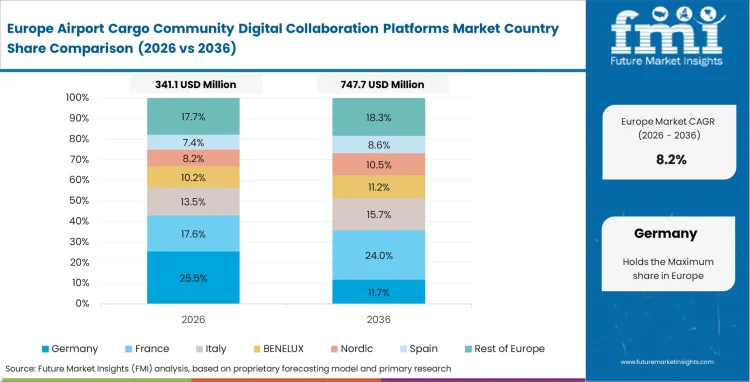
Stringent environmental mandates force legacy hubs to extract maximum throughput from highly restricted physical footprints. Terminal operators deploy digital coordination to reduce truck idling times and lower the carbon intensity of ground handling. As per FMI's projection, the presence of multiple, historically distinct national customs systems requires highly adaptable translation layers ensuring seamless cross-border data flows within the airport cargo community digital collaboration platforms market.
- Netherlands: Netherlands is expected to grow at a rate of 12.5% during the forecast period. This sustained software demand is driven by mature ecosystem by major companies continuously upgrading its real-time inventory in-transit positioning platforms, and critical operational shift from basic localized messaging to highly predictive capacity management. Other factors include stringent European Union environmental targets necessitating reduced landside truck idling, and complex structural trajectory required to transition to an advanced airport cargo community system in the Netherlands. Airport stakeholders continuously reinvent digital architectures to handle complex cross-border data flows efficiently while meeting strict regional sustainability compliance frameworks.
- Germany: Ground handling executives face the practical reality that layering new digital tools over entrenched local frameworks necessitates substantial, often hidden integration labor. Germany is expected to register a 11.4% CAGR during the forecast period. Such technological integration is fueled by major regional centers such as Frankfurt and Munich, implementing advanced smart pick-up modules onto highly developed but aged IT frameworks. Other factors include pressing requirements to resolve specific and intricate necessity of integrating modern workflow automation with decades-old national customs interfaces.
FMI's report includes United Kingdom, France, Italy, and Spain. Expanding continent-wide data privacy frameworks dictate strict localization rules for community clouds operating across these borders.
North America Airport Cargo Community Digital Collaboration Platforms Market Analysis
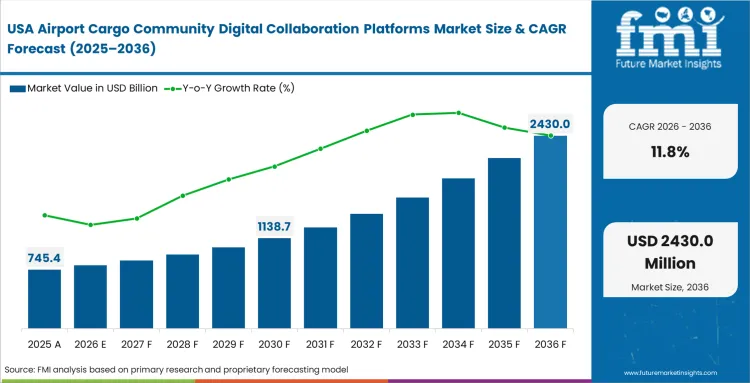
Large installed bases of localized legacy software resist complete replacement, forcing new community platforms to focus on complex API translation layers. Procurement officers at major gateways prioritize systems that ingest highly fragmented data from hundreds of independent, digitally unsophisticated local trucking firms. FMI observes that successful deployments center on providing immediate, tangible value to these smaller actors, overcoming deep-seated skepticism toward centralized airport authority mandates.
- United States: The United States is expected to advance at a 11.8% CAGR during the forecast period. This market progression is driven by regional hubs deploying targeted supply chain visibility software modules to untangle chronic landside congestion immediately, and integration of specialized United States trade management software to streamline complex regulatory clearance protocols. The need to modernize vital choke points without forcing risky rip-and-replace of established local ecosystems, and rigorous evaluation of specialized airport cargo collaboration software in the United States by highly cautious IT directors are driving market growth. Operators achieve critical operational outcomes by strategically modernizing specific workflow bottlenecks while maintaining the functional integrity of their massive established airside operations.
FMI's report includes Canada and Mexico. Tightening cross-border security protocols drive localized interest in platforms offering pre-arrival validation capabilities.
Competitive Aligners for Market Players
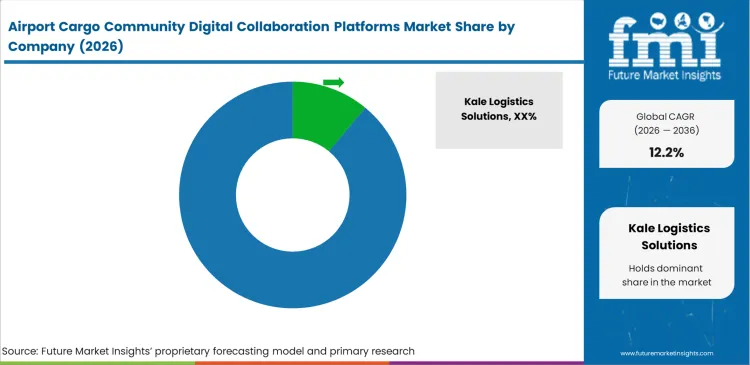
Capturing new hub contracts requires navigating intense local geopolitical friction. Top cargo community system providers recognize that success depends on convincing dozens of fiercely competitive local forwarders to trust a neutral data spine. Airport cargo collaboration software providers secure initial deployments by establishing indisputable visibility firewalls between rival logistics firms, proving technical neutrality. When hub authorities evaluate vendors, the proven ability to manage local stakeholder resistance outweighs pure software capability.
Incumbents hold a distinct operational edge through extensive libraries of pre-built customs API connectors. Cargonaut and DAKOSY leverage decades of embedded relationships with regional regulatory bodies, possessing localized integration knowledge that new airport cargo community system vendors cannot easily replicate. Challengers attempting to penetrate established ecosystems frequently stumble when their logistics visibility software fails to account for undocumented customs workflows. Sustaining a market position requires continuous updates to these compliance layers so shifting national trade policies do not break automated release sequences.
Key Players in Airport Cargo Community Digital Collaboration Platforms Market
- Kale Logistics Solutions
- Nallian
- CHAMP Cargosystems
- Cargonaut
- DAKOSY / allivate
- CCS-UK
- Descartes
Scope of the Report
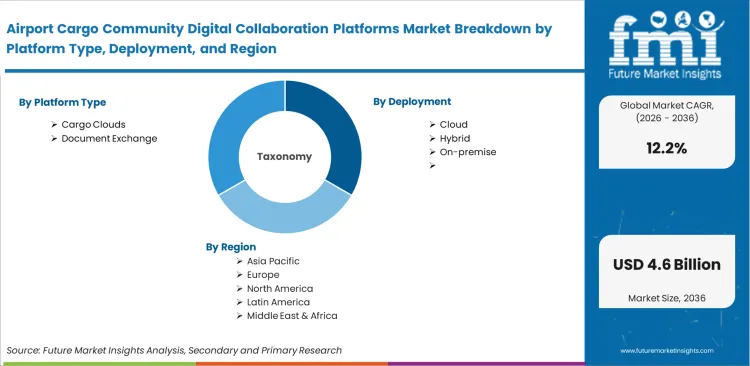
| Metric | Value |
|---|---|
| Quantitative Units | USD 1.3 billion in 2026 to USD 4.3 billion by 2036, at a CAGR of 12.2% |
| Market Definition | Airport cargo community systems operate as shared, neutral digital infrastructures that synchronize operational data across multiple distinct stakeholders within a specific aviation hub, eliminating duplicate data entry. |
| Segmentation | Platform Type, Deployment, Application, End User, Cargo Type, Region |
| Regions Covered | North America, Latin America, Europe, East Asia, South Asia & Pacific, Middle East & Africa |
| Countries Covered | United States, Canada, Germany, United Kingdom, France, Italy, Spain, Russia, China, Japan, South Korea, India, ASEAN, Brazil, Mexico, GCC Countries, South Africa |
| Key Companies Profiled | Kale Logistics Solutions, Nallian, CHAMP Cargosystems, Cargonaut, DAKOSY / allivate, CCS-UK, Descartes |
| Forecast Period | 2026 to 2036 |
| Approach | Baseline established through active community platform rollouts across major international air freight corridors, cross-validated by vendor implementations. |
Source: Future Market Insights (FMI) analysis, based on proprietary forecasting model and primary research
Airport Cargo Community Digital Collaboration Platforms Market Analysis by Segments
Platform Type
- Cargo clouds
- Slot booking
- Document exchange
- Visibility portals
- Customs links
Deployment
- Cloud
- Hybrid
- On-premise
Application
- Landside ops
- Shipment tracking
- Truck booking
- Customs filing
- Release workflows
End User
- Airports
- Ground handlers
- Forwarders
- Airlines
- Customs agencies
Cargo Type
- General cargo
- Express cargo
- Pharma cargo
- Perishables
- Special cargo
Region
- North America
- United States
- Canada
- Europe
- Germany
- United Kingdom
- France
- Italy
- Spain
- Asia Pacific
- China
- Japan
- South Korea
- Taiwan
- Singapore
- Latin America
- Brazil
- Mexico
- Argentina
- Middle East & Africa
- GCC Countries
- South Africa
- Israel
- Rest of Middle East & Africa
Bibliography
- International Civil Aviation Organization. (2025, July). Enhancing air cargo supply chain security through digital transformation (A42-WP/79).
- World Customs Organization. (2025). SAFE framework of standards to secure and facilitate global trade.
- International Civil Aviation Organization. (2024, November). ICAO Strategic Plan, 2026-2050.
- European Commission. (2025, January). Towards paperless freight transport: EU takes a step forward with eFTI Regulation implementation.
- Airports Council International World. (2025). Airport traffic dataset, 2025 edition.
This bibliography is provided for reader reference. The full FMI report contains the complete reference list with primary source documentation.
This Report Addresses
- Core structural pressures forcing ground handlers to abandon legacy manual waybill processing.
- Strategic positioning of neutral cargo clouds in resolving local competitive data-sharing objections.
- Operational impacts of mandatory truck-slot booking on terminal throughput and landside congestion.
- Critical transition paths from legacy on-premise customs EDI gateways to hosted community portals.
- Integration friction points outlined in a standard airport cargo community platform procurement checklist.
- Geopolitical leverage utilized by airport authorities to compel ecosystem-wide platform adoption.
- Distinct commercial advantages secured by hubs bypassing bilateral messaging for cloud-native orchestration.
- Evolving technical requirements for integrating IoT temperature data into centralized community visibility dashboards.
Frequently Asked Questions
What is an airport cargo community system?
These systems function as neutral digital hubs connecting disparate aviation logistics stakeholders. They replace fragmented bilateral EDI links with unified API-driven orchestration, providing an indisputable version of truth for shipment milestones across the entire local hub.
How do airport cargo community platforms work?
They operate as centralized data spines where airlines, forwarders, ground handlers, and customs agencies input shipment data once. The platform then routes relevant visibility and clearance information to authorized parties automatically, eliminating manual double-entry.
How does an airport cargo community system vs freight forwarding software comparison look in practice?
Freight forwarding software manages a single company's internal operations and customer billing. Community platforms are neutral, multi-party environments managed by airport authorities to coordinate physical landside access and terminal handovers between competing forwarders.
Which airports are adopting cargo community platforms in 2025?
Major hubs including Hyderabad, Singapore Changi, Frankfurt, and Heathrow are actively deploying these systems. Expansion focuses heavily on mandating community-wide truck-dock slot booking to eliminate acute landside congestion.
Who are the top cargo community system providers?
Key participants include Kale Logistics Solutions, Nallian, CHAMP Cargosystems, Cargonaut, DAKOSY / allivate, CCS-UK, and Descartes. Deployment decisions remain highly specific to local airport governance rather than globally standardized.
What is driving growth in the airport cargo community digital collaboration platforms market?
Acute landside truck congestion compels airport authorities to mandate synchronized dock scheduling. Escalating paper-based processing costs force ground handlers to demand automated electronic waybill extraction, driving immediate adoption.
Can air cargo one record software replace community portals?
ONE Record provides the standardized data protocol, but it does not replace the physical workflow engine. Community platforms utilize ONE Record standards to ingest data seamlessly while still managing the localized logic for dock scheduling and customs release.
How much does airport cargo community platform pricing usually run?
Pricing models scale based on transaction volume rather than flat licensing fees. Shared financial frameworks spread implementation and maintenance costs across airlines, forwarders, and handlers to avoid placing the entire burden on hub authorities.
Which countries are growing fastest in airport cargo collaboration software?
India leads global adoption at a 14.1% CAGR, followed closely by Singapore at 13.7% and the United Arab Emirates at 13.3%. These regions bypass legacy EDI phases to implement cloud-native infrastructure directly.
Which platform type dominates current adoption?
Cargo clouds dominate the segment, projected to hold 34.0% share in 2026. These architectures provide essential neutral orchestration layers that intensely competitive forwarders require before sharing proprietary capacity data.
Why do cloud deployments capture the highest share?
Cloud architectures lead with anticipated 68.0% share in 2026. Operations managers favor this model because it guarantees continuous security patching and scales processing capacity instantly during peak seasonal freight surges.
What application drives the most immediate value?
Landside ops leads application demand with 31.0% share in 2026. Terminal operators prioritize these modules to force predictability onto chaotic local trucking networks, eliminating hours-long queueing times.
Who is the primary end user procuring these systems?
Airports lead end user categories with 29.0% share in 2026. Hub authorities utilize unique leverage over physical access to compel fragmented private logistics actors into unified digital ecosystems.
Which cargo type establishes the processing baseline?
General cargo forms foundational volumes, estimated at 46.0% share in 2026. Stabilizing these massive, everyday shipment flows remains a prerequisite before facilities accurately digitize highly specialized handling requirements.
Why is India growing faster than established Western markets?
India tracks at a 14.1% CAGR because greenfield hub expansions bypass legacy IT infrastructure entirely. Digital transformation teams deploy cloud-native community portals directly, skipping decades of outdated bilateral messaging protocols.
What limits platform adoption at older European hubs?
Deeply entrenched, highly customized local customs interfaces create severe integration friction. Ground handlers struggle to connect modern visibility modules without breaking fragile legacy links ensuring regulatory compliance.
How do forwarders benefit from community portals?
Forwarding dispatchers gain highly predictable release windows and eliminate manual data double-entry. Connecting directly to community spines ensures avoidance of severe detention penalties caused by unexpected landside delays.
What forces ground handlers to abandon legacy systems?
Airport authorities increasingly tie physical dock access to digital platform compliance. Handlers face severe operational bottlenecks attempting to maintain parallel paper workflows while competitors utilize automated slot booking.
Why do cargo clouds face initial stakeholder resistance?
Logistics operators fear centralizing manifest details exposes critical customer data to direct competitors. Vendor success depends entirely on configuring robust, verifiable visibility firewalls protecting proprietary routing information.
How does digital slot booking improve terminal throughput?
Algorithms balance incoming truck volumes against available warehouse labor capacity in real time. This synchronization eliminates dock starvation and ensures highly efficient utilization of restricted physical infrastructure.
How do platforms handle temperature-sensitive perishables?
Continuous IoT sensor data streams directly into community portals. Claims managers rely on this immutable digital audit trail to prove cold-chain integrity and definitively assign liability for temperature breaches.
What prevents a single software vendor from monopolizing the global market?
Large global freight forwarding consortiums demand open API standards maintaining central control over internal architectures. This specific structural pressure prevents total vendor lock-in and sustains localized competition.
Preview the report firsthand - request a free sample
Get SampleGet the brochure for pricing and purchase details.
Get PDFTable of Content
- Executive Summary
- Global Market Outlook
- Demand-side Trends
- Supply-side Trends
- Technology Roadmap Analysis
- Analysis and Recommendations
- Market Overview
- Market Coverage / Taxonomy
- Market Definition / Scope / Limitations
- Research Methodology
- Chapter Orientation
- Analytical Lens and Working Hypotheses
- Market Structure, Signals, and Trend Drivers
- Benchmarking and Cross-market Comparability
- Market Sizing, Forecasting, and Opportunity Mapping
- Research Design and Evidence Framework
- Desk Research Programme (Secondary Evidence)
- Company Annual and Sustainability Reports
- Peer-reviewed Journals and Academic Literature
- Corporate Websites, Product Literature, and Technical Notes
- Earnings Decks and Investor Briefings
- Statutory Filings and Regulatory Disclosures
- Technical White Papers and Standards Notes
- Trade Journals, Industry Magazines, and Analyst Briefs
- Conference Proceedings, Webinars, and Seminar Materials
- Government Statistics Portals and Public Data Releases
- Press Releases and Reputable Media Coverage
- Specialist Newsletters and Curated Briefings
- Sector Databases and Reference Repositories
- FMI Internal Proprietary Databases and Historical Market Datasets
- Subscription Datasets and Paid Sources
- Social Channels, Communities, and Digital Listening Inputs
- Additional Desk Sources
- Expert Input and Fieldwork (Primary Evidence)
- Primary Modes
- Qualitative Interviews and Expert Elicitation
- Quantitative Surveys and Structured Data Capture
- Blended Approach
- Why Primary Evidence is Used
- Field Techniques
- Interviews
- Surveys
- Focus Groups
- Observational and In-context Research
- Social and Community Interactions
- Stakeholder Universe Engaged
- C-suite Leaders
- Board Members
- Presidents and Vice Presidents
- R&D and Innovation Heads
- Technical Specialists
- Domain Subject-matter Experts
- Scientists
- Physicians and Other Healthcare Professionals
- Governance, Ethics, and Data Stewardship
- Research Ethics
- Data Integrity and Handling
- Primary Modes
- Tooling, Models, and Reference Databases
- Desk Research Programme (Secondary Evidence)
- Data Engineering and Model Build
- Data Acquisition and Ingestion
- Cleaning, Normalisation, and Verification
- Synthesis, Triangulation, and Analysis
- Quality Assurance and Audit Trail
- Market Background
- Market Dynamics
- Drivers
- Restraints
- Opportunity
- Trends
- Scenario Forecast
- Demand in Optimistic Scenario
- Demand in Likely Scenario
- Demand in Conservative Scenario
- Opportunity Map Analysis
- Product Life Cycle Analysis
- Supply Chain Analysis
- Investment Feasibility Matrix
- Value Chain Analysis
- PESTLE and Porter’s Analysis
- Regulatory Landscape
- Regional Parent Market Outlook
- Production and Consumption Statistics
- Import and Export Statistics
- Market Dynamics
- Global Market Analysis 2021 to 2025 and Forecast, 2026 to 2036
- Historical Market Size Value (USD Million) Analysis, 2021 to 2025
- Current and Future Market Size Value (USD Million) Projections, 2026 to 2036
- Y-o-Y Growth Trend Analysis
- Absolute $ Opportunity Analysis
- Global Market Pricing Analysis 2021 to 2025 and Forecast 2026 to 2036
- Global Market Analysis 2021 to 2025 and Forecast 2026 to 2036, By Platform Type
- Introduction / Key Findings
- Historical Market Size Value (USD Million) Analysis By Platform Type , 2021 to 2025
- Current and Future Market Size Value (USD Million) Analysis and Forecast By Platform Type , 2026 to 2036
- Cargo Clouds
- Document Exchange
- Cargo Clouds
- Y-o-Y Growth Trend Analysis By Platform Type , 2021 to 2025
- Absolute $ Opportunity Analysis By Platform Type , 2026 to 2036
- Global Market Analysis 2021 to 2025 and Forecast 2026 to 2036, By Deployment
- Introduction / Key Findings
- Historical Market Size Value (USD Million) Analysis By Deployment, 2021 to 2025
- Current and Future Market Size Value (USD Million) Analysis and Forecast By Deployment, 2026 to 2036
- Cloud
- Hybrid
- On-premise
- Cloud
- Y-o-Y Growth Trend Analysis By Deployment, 2021 to 2025
- Absolute $ Opportunity Analysis By Deployment, 2026 to 2036
- Global Market Analysis 2021 to 2025 and Forecast 2026 to 2036, By Application
- Introduction / Key Findings
- Historical Market Size Value (USD Million) Analysis By Application, 2021 to 2025
- Current and Future Market Size Value (USD Million) Analysis and Forecast By Application, 2026 to 2036
- Landside OPS
- Truck Booking
- Landside OPS
- Y-o-Y Growth Trend Analysis By Application, 2021 to 2025
- Absolute $ Opportunity Analysis By Application, 2026 to 2036
- Global Market Analysis 2021 to 2025 and Forecast 2026 to 2036, By End User
- Introduction / Key Findings
- Historical Market Size Value (USD Million) Analysis By End User, 2021 to 2025
- Current and Future Market Size Value (USD Million) Analysis and Forecast By End User, 2026 to 2036
- Airports
- Forwarders
- Airlines
- Airports
- Y-o-Y Growth Trend Analysis By End User, 2021 to 2025
- Absolute $ Opportunity Analysis By End User, 2026 to 2036
- Global Market Analysis 2021 to 2025 and Forecast 2026 to 2036, By Cargo Type
- Introduction / Key Findings
- Historical Market Size Value (USD Million) Analysis By Cargo Type, 2021 to 2025
- Current and Future Market Size Value (USD Million) Analysis and Forecast By Cargo Type, 2026 to 2036
- General
- Express
- Pharma
- General
- Y-o-Y Growth Trend Analysis By Cargo Type, 2021 to 2025
- Absolute $ Opportunity Analysis By Cargo Type, 2026 to 2036
- Global Market Analysis 2021 to 2025 and Forecast 2026 to 2036, By Region
- Introduction
- Historical Market Size Value (USD Million) Analysis By Region, 2021 to 2025
- Current Market Size Value (USD Million) Analysis and Forecast By Region, 2026 to 2036
- North America
- Latin America
- Western Europe
- Eastern Europe
- East Asia
- South Asia and Pacific
- Middle East & Africa
- Market Attractiveness Analysis By Region
- North America Market Analysis 2021 to 2025 and Forecast 2026 to 2036, By Country
- Historical Market Size Value (USD Million) Trend Analysis By Market Taxonomy, 2021 to 2025
- Market Size Value (USD Million) Forecast By Market Taxonomy, 2026 to 2036
- By Country
- USA
- Canada
- Mexico
- By Platform Type
- By Deployment
- By Application
- By End User
- By Cargo Type
- By Country
- Market Attractiveness Analysis
- By Country
- By Platform Type
- By Deployment
- By Application
- By End User
- By Cargo Type
- Key Takeaways
- Latin America Market Analysis 2021 to 2025 and Forecast 2026 to 2036, By Country
- Historical Market Size Value (USD Million) Trend Analysis By Market Taxonomy, 2021 to 2025
- Market Size Value (USD Million) Forecast By Market Taxonomy, 2026 to 2036
- By Country
- Brazil
- Chile
- Rest of Latin America
- By Platform Type
- By Deployment
- By Application
- By End User
- By Cargo Type
- By Country
- Market Attractiveness Analysis
- By Country
- By Platform Type
- By Deployment
- By Application
- By End User
- By Cargo Type
- Key Takeaways
- Western Europe Market Analysis 2021 to 2025 and Forecast 2026 to 2036, By Country
- Historical Market Size Value (USD Million) Trend Analysis By Market Taxonomy, 2021 to 2025
- Market Size Value (USD Million) Forecast By Market Taxonomy, 2026 to 2036
- By Country
- Germany
- UK
- Italy
- Spain
- France
- Nordic
- BENELUX
- Rest of Western Europe
- By Platform Type
- By Deployment
- By Application
- By End User
- By Cargo Type
- By Country
- Market Attractiveness Analysis
- By Country
- By Platform Type
- By Deployment
- By Application
- By End User
- By Cargo Type
- Key Takeaways
- Eastern Europe Market Analysis 2021 to 2025 and Forecast 2026 to 2036, By Country
- Historical Market Size Value (USD Million) Trend Analysis By Market Taxonomy, 2021 to 2025
- Market Size Value (USD Million) Forecast By Market Taxonomy, 2026 to 2036
- By Country
- Russia
- Poland
- Hungary
- Balkan & Baltic
- Rest of Eastern Europe
- By Platform Type
- By Deployment
- By Application
- By End User
- By Cargo Type
- By Country
- Market Attractiveness Analysis
- By Country
- By Platform Type
- By Deployment
- By Application
- By End User
- By Cargo Type
- Key Takeaways
- East Asia Market Analysis 2021 to 2025 and Forecast 2026 to 2036, By Country
- Historical Market Size Value (USD Million) Trend Analysis By Market Taxonomy, 2021 to 2025
- Market Size Value (USD Million) Forecast By Market Taxonomy, 2026 to 2036
- By Country
- China
- Japan
- South Korea
- By Platform Type
- By Deployment
- By Application
- By End User
- By Cargo Type
- By Country
- Market Attractiveness Analysis
- By Country
- By Platform Type
- By Deployment
- By Application
- By End User
- By Cargo Type
- Key Takeaways
- South Asia and Pacific Market Analysis 2021 to 2025 and Forecast 2026 to 2036, By Country
- Historical Market Size Value (USD Million) Trend Analysis By Market Taxonomy, 2021 to 2025
- Market Size Value (USD Million) Forecast By Market Taxonomy, 2026 to 2036
- By Country
- India
- ASEAN
- Australia & New Zealand
- Rest of South Asia and Pacific
- By Platform Type
- By Deployment
- By Application
- By End User
- By Cargo Type
- By Country
- Market Attractiveness Analysis
- By Country
- By Platform Type
- By Deployment
- By Application
- By End User
- By Cargo Type
- Key Takeaways
- Middle East & Africa Market Analysis 2021 to 2025 and Forecast 2026 to 2036, By Country
- Historical Market Size Value (USD Million) Trend Analysis By Market Taxonomy, 2021 to 2025
- Market Size Value (USD Million) Forecast By Market Taxonomy, 2026 to 2036
- By Country
- Kingdom of Saudi Arabia
- Other GCC Countries
- Turkiye
- South Africa
- Other African Union
- Rest of Middle East & Africa
- By Platform Type
- By Deployment
- By Application
- By End User
- By Cargo Type
- By Country
- Market Attractiveness Analysis
- By Country
- By Platform Type
- By Deployment
- By Application
- By End User
- By Cargo Type
- Key Takeaways
- Key Countries Market Analysis
- USA
- Pricing Analysis
- Market Share Analysis, 2025
- By Platform Type
- By Deployment
- By Application
- By End User
- By Cargo Type
- Canada
- Pricing Analysis
- Market Share Analysis, 2025
- By Platform Type
- By Deployment
- By Application
- By End User
- By Cargo Type
- Mexico
- Pricing Analysis
- Market Share Analysis, 2025
- By Platform Type
- By Deployment
- By Application
- By End User
- By Cargo Type
- Brazil
- Pricing Analysis
- Market Share Analysis, 2025
- By Platform Type
- By Deployment
- By Application
- By End User
- By Cargo Type
- Chile
- Pricing Analysis
- Market Share Analysis, 2025
- By Platform Type
- By Deployment
- By Application
- By End User
- By Cargo Type
- Germany
- Pricing Analysis
- Market Share Analysis, 2025
- By Platform Type
- By Deployment
- By Application
- By End User
- By Cargo Type
- UK
- Pricing Analysis
- Market Share Analysis, 2025
- By Platform Type
- By Deployment
- By Application
- By End User
- By Cargo Type
- Italy
- Pricing Analysis
- Market Share Analysis, 2025
- By Platform Type
- By Deployment
- By Application
- By End User
- By Cargo Type
- Spain
- Pricing Analysis
- Market Share Analysis, 2025
- By Platform Type
- By Deployment
- By Application
- By End User
- By Cargo Type
- France
- Pricing Analysis
- Market Share Analysis, 2025
- By Platform Type
- By Deployment
- By Application
- By End User
- By Cargo Type
- India
- Pricing Analysis
- Market Share Analysis, 2025
- By Platform Type
- By Deployment
- By Application
- By End User
- By Cargo Type
- ASEAN
- Pricing Analysis
- Market Share Analysis, 2025
- By Platform Type
- By Deployment
- By Application
- By End User
- By Cargo Type
- Australia & New Zealand
- Pricing Analysis
- Market Share Analysis, 2025
- By Platform Type
- By Deployment
- By Application
- By End User
- By Cargo Type
- China
- Pricing Analysis
- Market Share Analysis, 2025
- By Platform Type
- By Deployment
- By Application
- By End User
- By Cargo Type
- Japan
- Pricing Analysis
- Market Share Analysis, 2025
- By Platform Type
- By Deployment
- By Application
- By End User
- By Cargo Type
- South Korea
- Pricing Analysis
- Market Share Analysis, 2025
- By Platform Type
- By Deployment
- By Application
- By End User
- By Cargo Type
- Russia
- Pricing Analysis
- Market Share Analysis, 2025
- By Platform Type
- By Deployment
- By Application
- By End User
- By Cargo Type
- Poland
- Pricing Analysis
- Market Share Analysis, 2025
- By Platform Type
- By Deployment
- By Application
- By End User
- By Cargo Type
- Hungary
- Pricing Analysis
- Market Share Analysis, 2025
- By Platform Type
- By Deployment
- By Application
- By End User
- By Cargo Type
- Kingdom of Saudi Arabia
- Pricing Analysis
- Market Share Analysis, 2025
- By Platform Type
- By Deployment
- By Application
- By End User
- By Cargo Type
- Turkiye
- Pricing Analysis
- Market Share Analysis, 2025
- By Platform Type
- By Deployment
- By Application
- By End User
- By Cargo Type
- South Africa
- Pricing Analysis
- Market Share Analysis, 2025
- By Platform Type
- By Deployment
- By Application
- By End User
- By Cargo Type
- USA
- Market Structure Analysis
- Competition Dashboard
- Competition Benchmarking
- Market Share Analysis of Top Players
- By Region
- By Platform Type
- By Deployment
- By Application
- By End User
- By Cargo Type
- Competition Analysis
- Competition Deep Dive
- Kale Logistics Solutions
- Overview
- Product Portfolio
- Profitability by Market Segments (Product/Age /Sales Channel/Region)
- Sales Footprint
- Strategy Overview
- Marketing Strategy
- Product Strategy
- Channel Strategy
- Nallian
- CHAMP Cargosystems
- Cargonaut
- DAKOSY / allivate
- CCS-UK
- Kale Logistics Solutions
- Competition Deep Dive
- Assumptions & Acronyms Used


