

- Industry Size (2026)
- USD 0.5 Bn
- Forecast (2036)
- USD 1.5 Bn
- CAGR (2026 to 2036)
- 12.6%
Real-Time Inventory-in-Transit Positioning Platforms Market Size, Market Forecast and Outlook By FMI
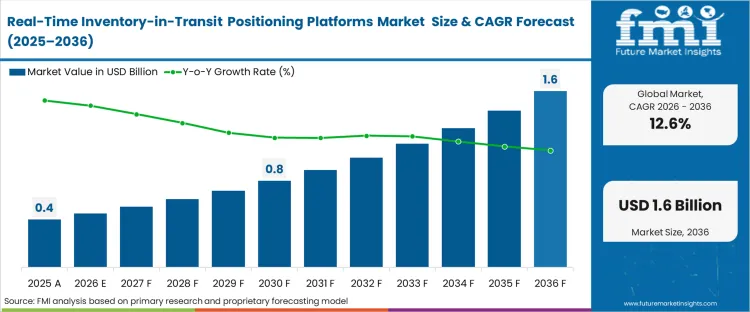
The real-time inventory-in-transit positioning platforms market was valued at USD 0.4 billion in 2025. The industry is expected to reach USD 0.5 billion in 2026 at a CAGR of 12.6% during the forecast period. Demand outlook carries the market valuation to USD 1.5 billion by 2036 as continuous telemetry ingestion replaces static EDI-based milestone tracking across global supply chains.
Summary of Real-Time Inventory-in-Transit Positioning Platforms Market
- Real-Time Inventory-in-Transit Positioning Platforms Market Definition
- Asset tracking architectures aggregate location coordinates from diverse carrier networks to generate predictive arrival algorithms. These systems normalize fragmented telematics data to enable proactive exception management across global supply chains.
- Demand Drivers in the Market
- Retailer compliance mandates require consumer goods shippers to deploy retail in-transit inventory visibility platforms to provide exact delivery windows.
- Port congestion forces forwarders using ocean freight inventory positioning software to recalculate inland transport schedules continuously.
- Carrier capacity volatility pushes operators running a control tower for inventory in transit to reroute critical stock dynamically.
- Key Segments Analyzed in the FMI Report
- Deployment Model: SaaS is projected to capture 62.0% share in 2026, driven by rapid multi-carrier onboarding capabilities.
- Tracking Mode: GPS telematics are anticipated to hold 38.0% share in 2026, benefiting from widespread existing hardware installations.
- Transport Mode: Road freight is set to account for 44.0% share in 2026, supported by high fragmentation in local trucking markets.
- Function Layer: ETA visibility is expected to garner 31.0% share in 2026, serving as the foundational module for exception management.
- End User: Retail is estimated to record 27.0% share in 2026, pushed by strict shelf-availability requirements.
- India: 14.6% compound growth, driven by federal mandates integrating commercial transport registries.
- Analyst Opinion at FMI
- Ronak Shah, Principal Analyst, Consumer Product, at FMI, notes that, "Supply chain leaders assume implementing a visibility platform instantly creates a transparent network. In reality, software deployment is secondary to carrier compliance enforcement. A positioning engine generating predictive models off 40% network coverage produces worse operational outcomes than manual tracking, because dispatchers learn to distrust the algorithm. The actual barrier is convincing fragmented mid-tier trucking fleets to share direct API access without fearing rate negotiations."
- Strategic Implications / Executive Takeaways
- Logistics vice presidents must tie carrier contract awards directly to telematics sharing compliance.
- Integration managers need to prioritize automated onboarding workflows to reduce time-to-value.
- Operations directors face immediate margin loss if they fail to link visibility data to warehouse labor scheduling.
- Methodology
- Primary Research: Carrier integration specialists, logistics procurement directors, and control tower operators
- Desk Research: Telematics protocol documentation, API gateway usage statistics, and carrier onboarding compliance filings
- Market-Sizing and Forecasting: Connected vehicle node counts and enterprise software license deployments
- Data Validation and Update Cycle: Independent cross-validation through telecommunication network traffic analysis
Real-Time Inventory-in-Transit Positioning Platforms Market Key Takeaways
| Metric | Details |
|---|---|
| Industry Size (2026) | USD 0.5 billion |
| Industry Value (2036) | USD 1.5 billion |
| CAGR (2026 to 2036) | 12.60% |
Source: Future Market Insights (FMI) analysis, based on proprietary forecasting model and primary research
Evaluating the inventory in transit category size reveals how procurement directors at multinational manufacturers face severe financial penalties for delivery blind spots. Inventory mapping gaps trigger retailer chargebacks and disrupt downstream assembly sequences. They also force expediting operations that eliminate shipment margins. Integrating logistics visibility software shifts operations toward predictive rerouting. Supply chain leaders often miscalculate how real-time in-transit inventory tracking software value scales non-linearly with carrier network participation.
Once original equipment manufacturers mandate API-level location sharing for all contracted carriers, network effects take hold. Shippers gain sufficient critical mass to train predictive models on a multimodal inventory tracking platform. This allows systems to anticipate delays before trucks miss physical checkpoints.
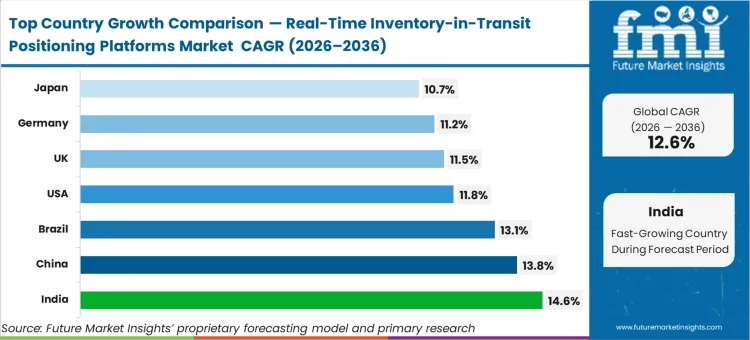
India advances at 14.6% as national logistics policies mandate telematics integration for commercial freight. China expands at 13.8% driven by extensive regional infrastructure upgrades. Brazil tracks at 13.1% due to specialized cargo security requirements. The United States registers 11.8% as legacy routing guides give way to dynamic execution platforms. The United Kingdom grows at 11.5% and Germany reaches 11.2% through cross-border customs synchronization. Japan records 10.7% on the back of labor shortage mitigation strategies. The structural divergence across these geographies centers on API standardization maturity versus localized sensor deployment.
Real-Time Inventory-in-Transit Positioning Platforms Market Definition
Asset tracking architectures capture, normalize, and project location coordinates for moving freight across multi-modal networks. Users frequently ask what is an inventory-in-transit positioning platform to understand its core utility. These platforms ingest structured and unstructured telematics feeds, aggregate carrier data, and apply machine learning to calculate precise arrival algorithms. Procurement departments buy these systems to convert fragmented geographical signals into unified predictive intelligence.
Real-Time Inventory-in-Transit Positioning Platforms Market Inclusions
Core software licenses, API integration modules, predictive arrival algorithms, and cloud hosting infrastructure define the operational scope. Goods-in-transit visibility software must process multi-carrier data streams and normalize disparate formats into a central view. Integrations with overarching transport management systems are standard functional requirements.
Real-Time Inventory-in-Transit Positioning Platforms Market Exclusions
Hardware manufacturing for physical GPS modules, bare-metal server infrastructure, and localized yard management tools fall outside this boundary. Systems limited to single-carrier fleet management lack the necessary multi-tenant aggregation capability. Simple electronic logging devices designed strictly for driver hours compliance do not qualify as predictive positioning engines.
Real-Time Inventory-in-Transit Positioning Platforms Market Research Methodology
- Primary Research: Carrier integration specialists, logistics procurement directors, and control tower operators.
- Desk Research: Telematics protocol documentation, API gateway usage statistics, and carrier onboarding compliance filings.
- Market-Sizing and Forecasting: Connected vehicle node counts and enterprise software license deployments.
- Data Validation and Update Cycle: Independent cross-validation through telecommunication network traffic analysis.
Segmental Analysis
Real-Time Inventory-in-Transit Positioning Platforms Market Analysis by Deployment model
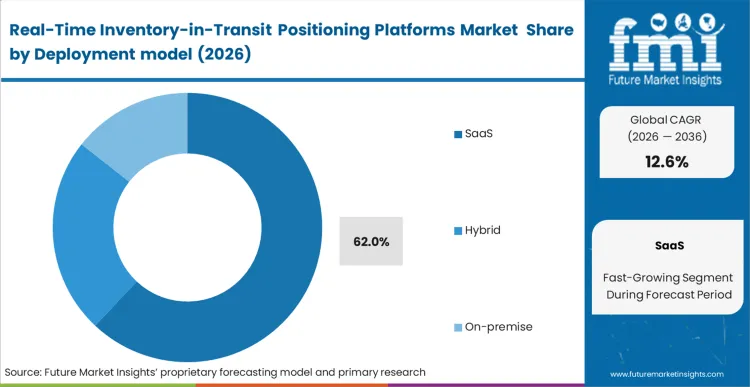
Rapid carrier onboarding drives the 62.0% position SaaS holds in this category. Supply chain IT directors cannot manage individual point-to-point connections with thousands of independent trucking firms. Cloud-native architectures allow platforms to maintain centralized API libraries. Shippers activate new carriers via pre-built connectors. According to FMI's estimates, this centralization reduces technical deployment friction and simplifies enterprise inventory-in-transit tracking platform pricing structures. Operational visibility requires continuous software updates to match changing telematics protocols. On-premise deployments isolate the shipper from the broader network intelligence generated by collective supply chain visibility software deployments. IT leaders mandating hybrid approaches for security reasons delay time-to-value by months while attempting to replicate external gateway infrastructure.
- Initial connection scaling: Cloud gateways aggregate thousands of distinct carrier protocols into unified endpoints. IT directors avoid building bespoke data pipelines for every regional subcontractor.
- Protocol maintenance burden: Maintenance teams bypass the overhead of updating individual integration scripts. Cloud operators manage API versioning centrally to keep data flowing smoothly.
- Network intelligence pooling: Platforms train predictive models on aggregated transit times across all tenants. Shippers who self-host miss the algorithmic accuracy gained from this collective behavioral data.
Real-Time Inventory-in-Transit Positioning Platforms Market Analysis by Tracking mode
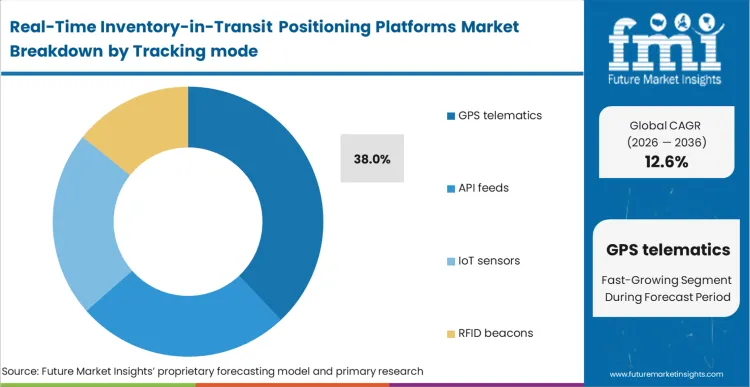
Hardware ubiquity explains why GPS telematics commands 38.0% share. Fleet managers already equip commercial vehicles with location sensors for basic routing and compliance tracking. Positioning platforms ingest this existing data exhaust rather than requiring new capital investments in sensor technology. FMI observes that this approach minimizes hardware friction during carrier onboarding. Dispatchers rely on these streams to generate real-time inventory arrival prediction alerts. Raw GPS pings are notoriously noisy and require intense algorithmic smoothing to differentiate a parked truck from one stuck in unmapped traffic. Operations managers treating all location signals equally face constant false-positive alerts.
- Signal ingestion logic: Platforms capture coordinates directly from established vehicle hardware. Fleet managers avoid procuring specialized tracking tags for standard freight loads.
- Data noise filtering: Algorithmic smoothing cleans erratic ping behavior near dense urban centers. Control tower operators gain reliable position data instead of jumping at false delay warnings.
- Hardware obsolescence risk: Pure telematics reliance creates blind spots when subcontracted drivers use non-compliant vehicles. Shippers must maintain secondary mobile application tracking for overflow capacity.
Real-Time Inventory-in-Transit Positioning Platforms Market Analysis by Transport mode
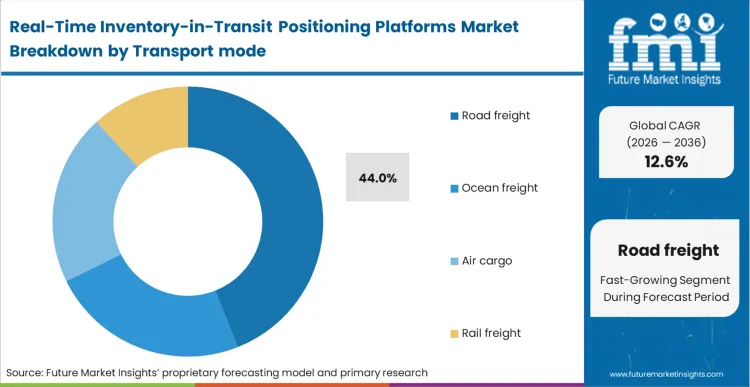
High fragmentation drives the 44.0% share road freight holds in this segment. Over-the-road transport involves millions of independent operators running disparate dispatch systems. Logistics directors deploy digital logistics platforms specifically to bridge this profound technology gap. FMI's analysis indicates that unifying fragmented truck capacity via an inventory on the road visibility platform generates the highest immediate return on investment. Routing flexibility allows dispatchers to redirect trucks mid-transit based on predictive alerts. Road freight visibility depends entirely on driver compliance with mobile apps when hardwired telematics fail. Companies failing to incentivize driver adoption find their expensive tracking platforms degraded to simple manual check-call boards.
- Capacity fragmentation bridging: Normalization engines convert hundreds of distinct dispatch formats into a single visual map. Logistics directors finally view their entire surface network simultaneously.
- Driver compliance friction: Mobile application tracking requires active driver participation. Carrier relations managers must construct strict incentive structures to prevent application uninstalls mid-route.
- Dynamic rerouting execution: Planners use predictive traffic data to alter delivery sequences actively. Warehouses optimize dock door scheduling based on precise arrival telemetry.
Real-Time Inventory-in-Transit Positioning Platforms Market Analysis by Function layer
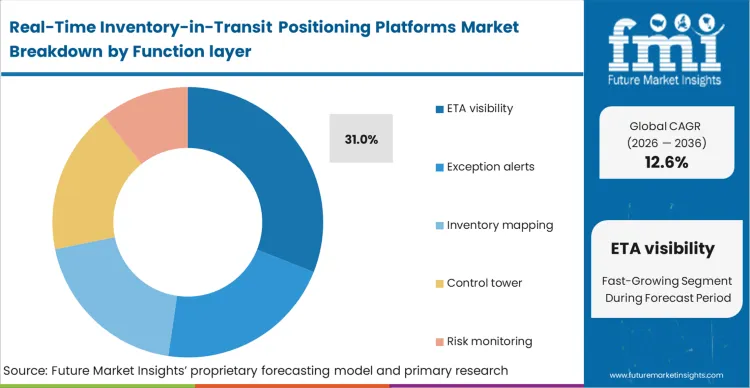
Workflow synchronization depends on ETA visibility, explaining its 31.0% leading position. Warehouse managers cannot schedule unloading labor effectively using broad delivery day estimates. Predictive ETA inventory planning algorithms calculate precise arrival windows. They incorporate driving hours and weather patterns while factoring in historical facility wait times. Based on FMI's assessment, this precision directly reduces overtime labor costs. Planners integrate these timelines into broader supply chain management workflows. Calculating a reliable ETA requires complex regulatory logic to account for mandated driver rest periods. Facilities relying on basic distance-over-speed calculations consistently misallocate receiving staff.
- Labor scheduling alignment: Precise algorithms dictate when dock teams need to be ready. Warehouse managers avoid paying overtime for crews waiting on delayed inbound freight.
- Rest period calculation: Predictive models incorporate legal driving hour limits into arrival estimates. Dispatchers prevent catastrophic scheduling failures caused by mandatory driver layovers.
- Downstream impact mitigation: Exception alerts trigger automated notifications to expectant manufacturing lines. Assembly directors adjust production sequences before parts shortages halt lines.
Real-Time Inventory-in-Transit Positioning Platforms Market Analysis by End user
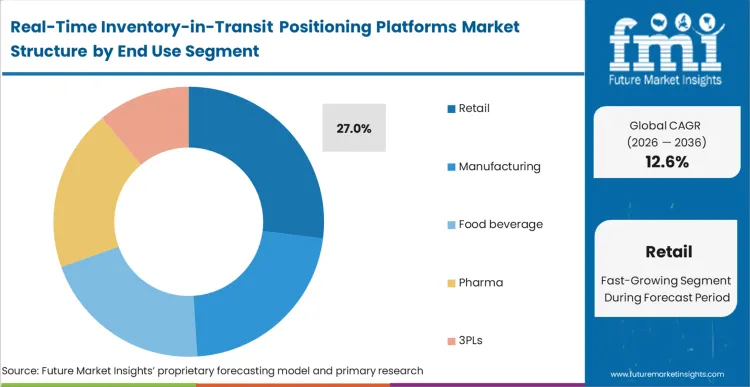
Strict compliance mandates push retail to a 27.0% share. Supermarket chains and big-box stores penalize suppliers heavily for late deliveries that cause out-of-stock events. Fulfillment directors mandate positioning platforms to monitor inbound loads and proactively negotiate delivery window extensions when delays occur. In FMI's view, this defensive strategy preserves supplier margins against aggressive chargeback policies. Logistics teams interface directly with overarching retail warehouse management systems. Store replenishment in-transit inventory software focuses heavily on managing the administrative consequences of delays alongside physical movement. Suppliers ignoring proactive notification protocols face margin erosion even when physical delivery improves.
- Chargeback defense: Documented transit histories prove weather or facility delays outside carrier control. Fulfillment directors successfully dispute unfair late delivery penalties.
- Inventory allocation shifts: Retailers reroute critical stock to high-demand regional distribution centers mid-transit. Inventory planners capture sales that would otherwise be lost to stockouts.
- Promotional sync risk: High-volume product launches require absolute delivery precision. Logistics teams facing blind spots risk catastrophic empty shelves during advertised promotional events.
Real-Time Inventory-in-Transit Positioning Platforms Market Drivers, Restraints, and Opportunities
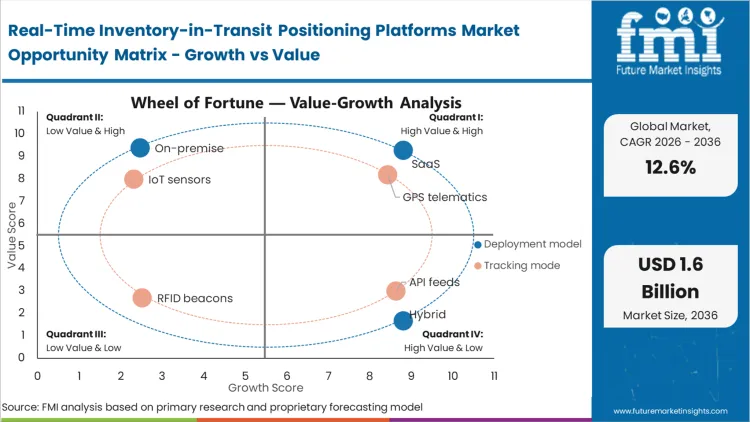
Margin erosion from retailer compliance penalties forces consumer goods manufacturers to overhaul their tracking architectures. Logistics vice presidents cannot absorb six-figure quarterly chargebacks for missed delivery windows. Manufacturing lines idled by delayed components cost thousands of dollars per minute. Implementing predictive tracking converts unexpected delays into manageable schedule adjustments. This allows procurement teams to protect contract margins aggressively and understand exactly how do in-transit inventory visibility platforms work at a financial level.
Carrier fragmentation represents the primary structural friction slowing platform adoption. Shippers want universal visibility, but mid-tier trucking firms resist sharing direct fleet management API access. Fleet owners fear shippers will use transit time data to negotiate lower freight rates. In-transit inventory software vendors must standardize data privacy controls and demonstrate mutual value to both shipper and carrier before network blind spots disappear across outsourced capacity.
Opportunities in the Real-Time Inventory-in-Transit Positioning Platforms Market
- Temperature excursion modeling: Integrating IoT sensors with predictive ETAs. Quality assurance directors prevent pharmaceutical spoilage by routing trucks to nearest cold storage facilities when refrigeration fails.
- Scope 3 emissions calculation: Platforms calculating precise carbon output per shipment. Sustainability officers automate regulatory reporting using verified distance and fuel consumption data.
- Ocean tracking integration: Utilizing inventory on the water tracking software to link vessel arrival telemetry directly to intralogistics automation solutions. Facility managers optimize automated guided vehicle deployment precisely as containers reach port yards.
Regional Analysis
Based on regional analysis, real-time inventory-in-transit positioning platforms market is segmented into North America, Europe, Asia Pacific, and Latin America across 40 plus countries.
.webp "Top Country Growth Comparison Real Time Inventory In Transit Positioning Platforms Market Cagr (2026 2036)")
| Country | CAGR (2026 to 2036) |
|---|---|
| United States | 11.8% |
| Germany | 11.2% |
| United Kingdom | 11.5% |
| China | 13.8% |
| India | 14.6% |
| Japan | 10.7% |
| Brazil | 13.1% |
Source: Future Market Insights (FMI) analysis, based on proprietary forecasting model and primary research
North America Real-Time Inventory-in-Transit Positioning Platforms Market Analysis
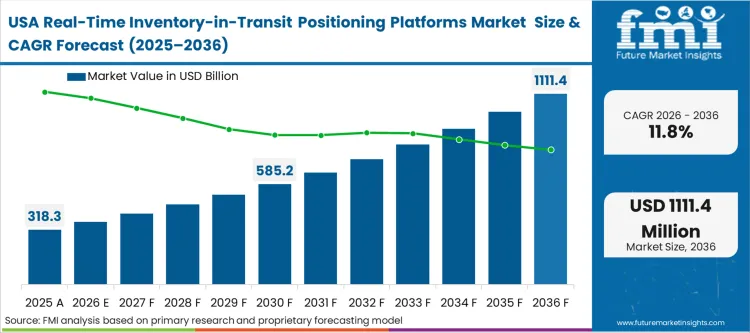
Stringent retailer compliance programs dictate the trajectory of positioning adoption across this geography. Big-box supply chains enforce narrow delivery windows, forcing suppliers to upgrade from manual check-calls to predictive tracking arrays. FMI analysts note that this pressure drives rapid SaaS deployments across mid-market manufacturers. Carrier networks in this region operate with high baseline telematics penetration, simplifying initial API integrations.
- United States: USA’s retail supply chains enforce narrow delivery windows that overwhelm legacy routing guides during periods of capacity volatility. Procurement teams actively deploy dynamic logistics 4.0 platforms to source and track spot-market freight automatically. Supply chain leaders who master algorithmic arrival prediction use this capability to secure preferential dock access at major retail distribution centers. This massive shift toward predictive exception management drives an 11.8% CAGR in the United States through 2036. Shippers seeking a reliable supply chain visibility platform for in-transit inventory quickly abandon systems that rely on manual check-calls instead of automated telemetry.
FMI's report includes Canada and Mexico. Cross-border customs synchronization remains a significant functional requirement for platforms operating across the USMCA corridor.
Europe Real-Time Inventory-in-Transit Positioning Platforms Market Analysis
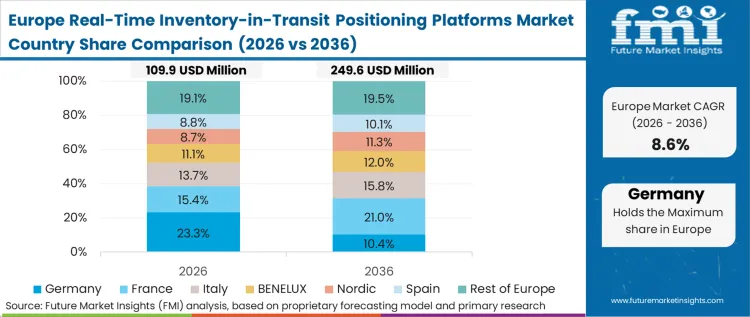
Cross-border complexity shapes how logistics directors evaluate tracking architectures. Moving freight across multiple jurisdictions requires platforms capable of normalizing diverse regional telematics standards. As per FMI's projection, environmental reporting mandates act as a secondary catalyst for adoption. Operations managers rely on these systems to calculate precise Scope 3 emissions using actual transit data. Procurement teams evaluating real-time freight visibility providers 2026 prioritize European footprint density.
- Germany: The high-value automotive manufacturing sector of Germany operates on exact sequencing requirements that demand absolute precision for inbound component deliveries. Production planners integrate live connected logistics feeds directly into their active assembly schedules. This integration allows manufacturers to orchestrate complex multi-tier supplier networks without holding excessive safety stock on the factory floor. The continuous modernization of these industrial supply chains supports an 11.2% CAGR for the German market over the forecast period. Vendors unable to provide granular tracking data across borders struggle to secure contracts with major European automotive brands.
- United Kingdom: Post-Brexit border friction forces British shippers to monitor customs clearance times continuously for imported freight. Logistics directors utilize continuous tracking data to reroute time-sensitive perishable goods dynamically. Platforms that link predictive border delays directly to domestic inventory staging schedules gain significant traction among import-heavy retailers. This intense focus on mitigating administrative bottlenecks rather than physical transit distance fuels an 11.5% CAGR in the United Kingdom. Software providers lacking deep European customs integration face severe competitive disadvantages in this specific market.
FMI's report includes France, Italy, and Spain. Sustainability compliance forces regional operators to map carbon output per individual shipment accurately.
Asia Pacific Real-Time Inventory-in-Transit Positioning Platforms Market Analysis
Rapid infrastructure modernization colliding with highly fragmented carrier networks defines the operational landscape. Multinationals attempting to build uniform visibility face thousands of local sub-contractors operating without formal dispatch software. FMI observes that platforms succeeding here deploy lightweight mobile tracking applications to bypass the lack of hardwired vehicle telematics.
- India: Federal mandates forcing Indian commercial freight onto centralized digital registries act as a massive catalyst for platform adoption. Urban logistics planners leverage freight transport management tools to navigate incredibly dense regional congestion. Operations directors deploying these systems successfully filter chaotic GPS signals into reliable arrival predictions. This aggressive digitization of the domestic transport sector drives a market-leading 14.6% CAGR in India through 2036. Companies continuing to rely on third-party broker check-calls face severe operational delays as digital workflows become the national standard.
- China: Extensive inland infrastructure projects across China require continuous routing recalibration for national distribution networks. Central dispatchers deploy advanced visibility systems capable of mapping newly opened transit corridors instantly. The sheer volume of domestic freight forces seamless integration between these tracking platforms and massive e-commerce fulfillment centers. This rapid expansion of consumer logistics infrastructure sustains a 13.8% CAGR for the Chinese market. Foreign software providers lacking direct integration with regional hardware sensors find it difficult to penetrate this highly localized ecosystem.
- Japan: Severe national labor shortages actively restrict available warehouse receiving hours across the Japanese logistics sector. Facility managers deploy predictive positioning platforms to demand absolute precision regarding inbound freight arrival times. This rigid scheduling environment punishes late deliveries with complete supply chain rejection until the following operational day. The urgent need to align transport arrivals with limited labor availability supports a 10.7% CAGR in Japan. Carriers failing to provide accurate telemetry data quickly lose their preferred vendor status with major domestic distributors.
FMI's report includes South Korea, Australia, and ASEAN countries. Bridging island-based ocean freight with localized road networks remains a distinct architectural challenge.
Latin America Real-Time Inventory-in-Transit Positioning Platforms Market Analysis
Infrastructure limitations and specialized cargo safety requirements define how logistics directors evaluate positioning software in this region. Multinationals operating here prioritize platforms that blend standard location tracking with active security monitoring protocols. Supply chain leaders depend on continuous telemetry to navigate unpredictable inland transit conditions safely.
- Brazil: Specialized cargo security requirements heavily influence how Brazilian logistics networks monitor in-transit inventory. Transport directors deploy integrated visibility platforms to track high-value shipments continuously across remote infrastructure corridors. This real-time positioning capability allows shippers to identify route deviations instantly and trigger rapid security responses. The operational necessity of securing freight against regional theft risks drives a 13.1% CAGR in Brazil through 2036. Visibility platforms that fail to incorporate risk monitoring and exception alerts completely struggle to gain traction among local manufacturers.
FMI's report includes Mexico and the Rest of Latin America. Normalizing tracking data across varying regional cellular networks remains a primary technical hurdle for operators moving goods across South American borders.
Competitive Aligners for Market Players
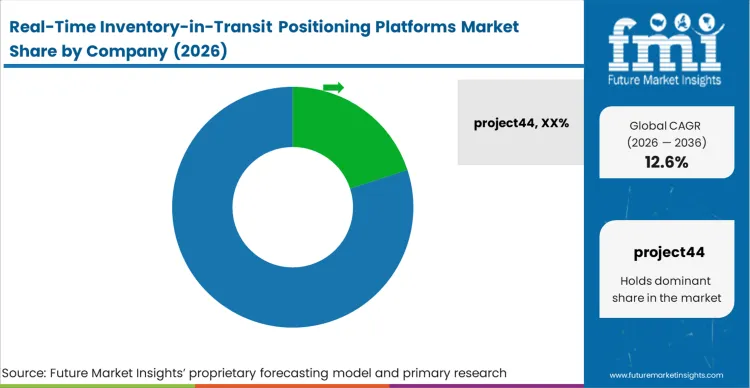
Competitive strength in this market comes more from network depth than from algorithm quality alone. Buyers usually care most about how many carrier connections a platform already has in place when they go live. In comparisons such as project44 and FourKites, the practical advantage often comes from how much of a routing guide can be activated immediately without heavy API setup. That existing integration base makes it harder for new entrants to compete, since they still need to build carrier relationships one by one. Descartes MacroPoint also benefits from long-standing broker connectivity, especially in fragmented spot-market freight.
Established providers have another advantage in the form of historical transit data built over years of shipment activity. That data gives more context to ETA models by adding lane behavior, facility wait times, and recurring delay patterns. A newer platform may have a strong prediction engine, though it is still harder to deliver the same level of accuracy without that historical foundation. Providers such as e2open and Shippeo use this data depth to offer broader visibility into bottlenecks and recurring network issues. Buyers comparing project44, FourKites, Shippeo, and Descartes often pay close attention to that maturity.
Shippers are also pushing the market toward broader coverage across transport modes. Many procurement teams no longer want separate systems for ocean, rail, and road visibility. They want one platform that can support a wider view of freight movement. That pressure is encouraging vendors to expand beyond narrower capabilities. At the same time, players such as Overhaul and Transporeon continue to hold value in specific areas like security monitoring and transport execution. The result is a market that is steadily moving toward more connected and wider orchestration.
Key Players in Real-Time Inventory-in-Transit Positioning Platforms Market
- project44
- FourKites
- Descartes MacroPoint
- e2open
- Shippeo
- Overhaul
- Transporeon (Trimble)
Scope of the Report
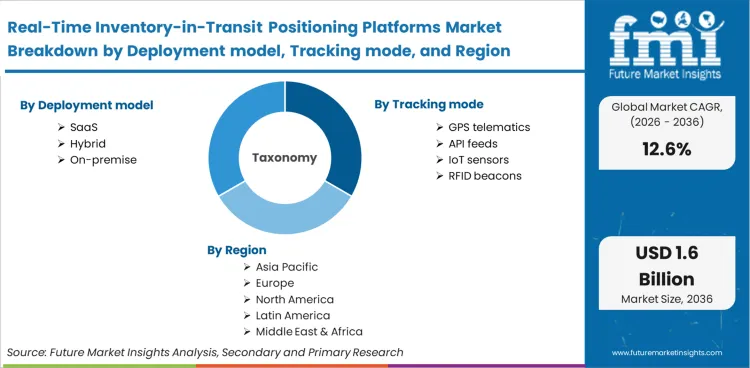
| Metric | Value |
|---|---|
| Quantitative Units | USD 0.5 billion to USD 1.5 billion, at a CAGR of 12.60% |
| Market Definition | Asset tracking architectures capture, normalize, and project location coordinates for moving freight across multi-modal networks. These platforms ingest structured and unstructured telematics feeds, aggregate carrier data, and apply machine learning to calculate precise predictive arrival algorithms. |
| Deployment model Segmentation | SaaS, Hybrid, On-premise |
| Tracking mode Segmentation | GPS telematics, API feeds, IoT sensors, RFID beacons |
| Transport mode Segmentation | Road freight, Ocean freight, Air cargo, Rail freight |
| Function layer Segmentation | ETA visibility, Exception alerts, Inventory mapping, Control tower, Risk monitoring |
| End user Segmentation | Retail, Manufacturing, Food beverage, Pharma, 3PLs |
| Regions Covered | North America, Latin America, Europe, Asia Pacific, Middle East and Africa |
| Countries Covered | United States, Germany, United Kingdom, China, India, Japan, Brazil, and 40 plus countries |
| Key Companies Profiled | project44, FourKites, Descartes MacroPoint, e2open, Shippeo, Overhaul, Transporeon (Trimble) |
| Forecast Period | 2026 to 2036 |
| Approach | The baseline value derives from evaluating connected vehicle node counts alongside enterprise software license deployments across major logistics hubs, applying region-specific telematics integration rates to project future adoption velocity. |
Source: Future Market Insights (FMI) analysis, based on proprietary forecasting model and primary research
Real-Time Inventory-in-Transit Positioning Platforms Market Analysis by Segments
Deployment model:
- SaaS
- Hybrid
- On-premise
Tracking mode:
- GPS telematics
- API feeds
- IoT sensors
- RFID beacons
Transport mode:
- Road freight
- Ocean freight
- Air cargo
- Rail freight
Function layer:
- ETA visibility
- Exception alerts
- Inventory mapping
- Control tower
- Risk monitoring
End user:
- Retail
- Manufacturing
- Food beverage
- Pharma
- 3PLs
Region:
- North America
- United States
- Canada
- Latin America
- Brazil
- Mexico
- Rest of Latin America
- Europe
- Germany
- United Kingdom
- France
- Italy
- Spain
- Rest of Europe
- Asia Pacific
- China
- Japan
- India
- South Korea
- Australia
- Rest of Asia Pacific
- Middle East and Africa
- GCC Countries
- South Africa
- Rest of Middle East and Africa
Bibliography
- National Institute of Standards and Technology. (2024, September). Supply chain traceability: Manufacturing meta-framework (Initial public draft) (NIST IR 8536 ipd).
- Organization for Economic Co-operation and Development. (2024). Promoting resilience and preparedness in supply chains. OECD Publishing.
- Universal Postal Union. (2024, September 2). Postal Transport Guide (2024).
- Wong, W. P., Anwar, M. F., & Soh, K. L. (2024). Transportation 4.0 in supply chain management: State-of-the-art and future directions towards 5.0 in the transportation sector. Operations Management Research, 17, 683-710.
- Modica, T., Tappia, E., Colicchia, C., & Melacini, M. (2024). Integrating arrival time estimation in truck scheduling: An explorative study in grocery retailing. Production & Manufacturing Research, 12(1), 2425678.
This bibliography is provided for reader reference. The full FMI report contains the complete reference list with primary source documentation.
This Report Addresses
- Carrier network fragmentation constraints that limit predictive visibility across outsourced and spot-market freight movements.
- Procurement timelines for SaaS-based positioning platforms among retailers, manufacturers, and third-party logistics operators.
- Software integration challenges when merging GPS telematics, API feeds, IoT sensor data, and RFID beacon signals into unified control tower views.
- Regulatory and policy shifts forcing shippers to connect telematics data with national digital freight registries and customs synchronization workflows.
- Operational gaps between ETA visibility at the shipment level and labor scheduling decisions inside warehouses and distribution centers.
- Facility and network bottlenecks caused by poor carrier onboarding compliance across fragmented road freight ecosystems.
- Data quality risks arising from noisy GPS pings, inconsistent API structures, and incomplete carrier participation in predictive arrival models.
- Recurring commercial losses linked to late-delivery chargebacks, emergency expediting, and margin erosion when in-transit inventory mapping lacks real-time precision.
Frequently Asked Questions
What is an inventory-in-transit positioning platform?
Asset tracking architectures that capture and normalize telematics data to enable predictive exception management across global supply chains.
How do in-transit inventory visibility platforms work?
These systems ingest diverse telematics feeds, aggregate carrier data, and apply machine learning to calculate precise predictive arrival algorithms.
How fast is the inventory-in-transit positioning platforms space growing?
The market expands at a 12.60% CAGR through 2036 as global supply chains mandate continuous geo-spatial tracking protocols.
Inventory visibility platform vs transportation management system?
A TMS handles freight booking and settlement, while visibility platforms aggregate live coordinates to predict exact arrival windows.
RFQ for inventory-in-transit visibility software?
Procurement teams must demand proof of existing carrier network density, rapid onboarding capabilities, and out-of-the-box API integrations.
Inventory-in-transit visibility ROI calculator?
Shippers calculate ROI by measuring reductions in late-delivery chargebacks, warehouse overtime pay, and prevented manufacturing line-down events.
Best multimodal ETA software for global shippers?
Leading platforms seamlessly blend ocean, air, and road telemetry to calculate dynamic ETAs across entire international transit legs.
What calculates the USD 1.5 billion trajectory?
Revenue expands as global supply chains replace static electronic data interchange updates with continuous geo-spatial tracking protocols.
Why does SaaS hold 62.0% share?
Cloud-native architectures maintain centralized API libraries, allowing IT directors to avoid managing individual connections with thousands of carriers.
How does road freight influence adoption?
Logistics directors deploy platforms to bridge technology gaps across fragmented independent operators, making surface visibility a critical margin protector.
What distinguishes growth in India?
Federal digital registry mandates drive 14.6% growth, while planners filter chaotic GPS signals into reliable predictions for congested cities.
Why is ETA visibility crucial?
Predictive algorithms calculate precise arrival windows, allowing warehouse managers to schedule labor effectively and reduce costly overtime expenditures.
What slows universal carrier tracking?
Mid-tier carriers resist sharing API access, fearing shippers will use exact transit data to negotiate lower future freight rates.
How do incumbents protect share?
Established vendors leverage deep historical data lakes to train machine learning models, creating an integration library new entrants cannot replicate.
What changes operational outcomes most?
Mandated API-level location sharing creates network effects, giving shippers sufficient critical mass to anticipate delays before trucks miss checkpoints.
How do retailers impact deployments?
Heavy late-delivery penalties force fulfillment directors to mandate tracking arrays, allowing them to proactively negotiate delivery window extensions.
Why do manual systems fail?
Manual check-calls degrade accuracy, causing constant false-positive alerts that severely limit the capability of predictive routing operations.
How does tracking alter procurement?
Procurement converts geographical signals into predictive intelligence, aggressively protecting contract margins by avoiding unexpected component shortages and line-down events.
Preview the report firsthand - request a free sample
Get SampleGet the brochure for pricing and purchase details.
Get PDFTable of Content
- Executive Summary
- Global Market Outlook
- Demand-side Trends
- Supply-side Trends
- Technology Roadmap Analysis
- Analysis and Recommendations
- Market Overview
- Market Coverage / Taxonomy
- Market Definition / Scope / Limitations
- Research Methodology
- Chapter Orientation
- Analytical Lens and Working Hypotheses
- Market Structure, Signals, and Trend Drivers
- Benchmarking and Cross-market Comparability
- Market Sizing, Forecasting, and Opportunity Mapping
- Research Design and Evidence Framework
- Desk Research Programme (Secondary Evidence)
- Company Annual and Sustainability Reports
- Peer-reviewed Journals and Academic Literature
- Corporate Websites, Product Literature, and Technical Notes
- Earnings Decks and Investor Briefings
- Statutory Filings and Regulatory Disclosures
- Technical White Papers and Standards Notes
- Trade Journals, Industry Magazines, and Analyst Briefs
- Conference Proceedings, Webinars, and Seminar Materials
- Government Statistics Portals and Public Data Releases
- Press Releases and Reputable Media Coverage
- Specialist Newsletters and Curated Briefings
- Sector Databases and Reference Repositories
- FMI Internal Proprietary Databases and Historical Market Datasets
- Subscription Datasets and Paid Sources
- Social Channels, Communities, and Digital Listening Inputs
- Additional Desk Sources
- Expert Input and Fieldwork (Primary Evidence)
- Primary Modes
- Qualitative Interviews and Expert Elicitation
- Quantitative Surveys and Structured Data Capture
- Blended Approach
- Why Primary Evidence is Used
- Field Techniques
- Interviews
- Surveys
- Focus Groups
- Observational and In-context Research
- Social and Community Interactions
- Stakeholder Universe Engaged
- C-suite Leaders
- Board Members
- Presidents and Vice Presidents
- R&D and Innovation Heads
- Technical Specialists
- Domain Subject-matter Experts
- Scientists
- Physicians and Other Healthcare Professionals
- Governance, Ethics, and Data Stewardship
- Research Ethics
- Data Integrity and Handling
- Primary Modes
- Tooling, Models, and Reference Databases
- Desk Research Programme (Secondary Evidence)
- Data Engineering and Model Build
- Data Acquisition and Ingestion
- Cleaning, Normalisation, and Verification
- Synthesis, Triangulation, and Analysis
- Demand in Optimistic Scenario
- Demand in Likely Scenario
- Demand in Conservative Scenario
- Opportunity Map Analysis
- Product Life Cycle Analysis
- Supply Chain Analysis
- Investment Feasibility Matrix
- Value Chain Analysis
- PESTLE and Porter’s Analysis
- Regulatory Landscape
- Regional Parent Market Outlook
- Production and Consumption Statistics
- Import and Export Statistics
- Global Market Analysis 2021 to 2025 and Forecast, 2026 to 2036
- Historical Market Size Value (USD Million) Analysis, 2021 to 2025
- Current and Future Market Size Value (USD Million) Projections, 2026 to 2036
- Y-o-Y Growth Trend Analysis
- Absolute $ Opportunity Analysis
- Global Market Pricing Analysis 2021 to 2025 and Forecast 2026 to 2036
- Global Market Analysis 2021 to 2025 and Forecast 2026 to 2036, By Deployment model
- Introduction / Key Findings
- Historical Market Size Value (USD Million) Analysis By Deployment model , 2021 to 2025
- Current and Future Market Size Value (USD Million) Analysis and Forecast By Deployment model , 2026 to 2036
- SaaS
- Hybrid
- On-premise
- SaaS
- Y-o-Y Growth Trend Analysis By Deployment model , 2021 to 2025
- Absolute $ Opportunity Analysis By Deployment model , 2026 to 2036
- Global Market Analysis 2021 to 2025 and Forecast 2026 to 2036, By Tracking mode
- Introduction / Key Findings
- Historical Market Size Value (USD Million) Analysis By Tracking mode, 2021 to 2025
- Current and Future Market Size Value (USD Million) Analysis and Forecast By Tracking mode, 2026 to 2036
- GPS telematics
- API feeds
- IoT sensors
- RFID beacons
- GPS telematics
- Y-o-Y Growth Trend Analysis By Tracking mode, 2021 to 2025
- Absolute $ Opportunity Analysis By Tracking mode, 2026 to 2036
- Global Market Analysis 2021 to 2025 and Forecast 2026 to 2036, By Transport mode
- Introduction / Key Findings
- Historical Market Size Value (USD Million) Analysis By Transport mode, 2021 to 2025
- Current and Future Market Size Value (USD Million) Analysis and Forecast By Transport mode, 2026 to 2036
- Road freight
- Ocean freight
- Air cargo
- Rail freight
- Road freight
- Y-o-Y Growth Trend Analysis By Transport mode, 2021 to 2025
- Absolute $ Opportunity Analysis By Transport mode, 2026 to 2036
- Global Market Analysis 2021 to 2025 and Forecast 2026 to 2036, By Function layer
- Introduction / Key Findings
- Historical Market Size Value (USD Million) Analysis By Function layer, 2021 to 2025
- Current and Future Market Size Value (USD Million) Analysis and Forecast By Function layer, 2026 to 2036
- ETA visibility
- Exception alerts
- Inventory mapping
- Control tower
- Risk monitoring
- ETA visibility
- Y-o-Y Growth Trend Analysis By Function layer, 2021 to 2025
- Absolute $ Opportunity Analysis By Function layer, 2026 to 2036
- Global Market Analysis 2021 to 2025 and Forecast 2026 to 2036, By End Use
- Introduction / Key Findings
- Historical Market Size Value (USD Million) Analysis By End Use, 2021 to 2025
- Current and Future Market Size Value (USD Million) Analysis and Forecast By End Use, 2026 to 2036
- Retail
- Manufacturing
- Food beverage
- Pharma
- 3PLs
- Retail
- Y-o-Y Growth Trend Analysis By End Use, 2021 to 2025
- Absolute $ Opportunity Analysis By End Use, 2026 to 2036
- Global Market Analysis 2021 to 2025 and Forecast 2026 to 2036, By Region
- Introduction
- Historical Market Size Value (USD Million) Analysis By Region, 2021 to 2025
- Current Market Size Value (USD Million) Analysis and Forecast By Region, 2026 to 2036
- North America
- Latin America
- Western Europe
- Eastern Europe
- East Asia
- South Asia and Pacific
- Middle East & Africa
- Market Attractiveness Analysis By Region
- North America Market Analysis 2021 to 2025 and Forecast 2026 to 2036, By Country
- Historical Market Size Value (USD Million) Trend Analysis By Market Taxonomy, 2021 to 2025
- Market Size Value (USD Million) Forecast By Market Taxonomy, 2026 to 2036
- By Country
- USA
- Canada
- Mexico
- By Deployment model
- By Tracking mode
- By Transport mode
- By Function layer
- By End Use
- By Country
- Market Attractiveness Analysis
- By Country
- By Deployment model
- By Tracking mode
- By Transport mode
- By Function layer
- By End Use
- Key Takeaways
- Latin America Market Analysis 2021 to 2025 and Forecast 2026 to 2036, By Country
- Historical Market Size Value (USD Million) Trend Analysis By Market Taxonomy, 2021 to 2025
- Market Size Value (USD Million) Forecast By Market Taxonomy, 2026 to 2036
- By Country
- Brazil
- Chile
- Rest of Latin America
- By Deployment model
- By Tracking mode
- By Transport mode
- By Function layer
- By End Use
- By Country
- Market Attractiveness Analysis
- By Country
- By Deployment model
- By Tracking mode
- By Transport mode
- By Function layer
- By End Use
- Key Takeaways
- Western Europe Market Analysis 2021 to 2025 and Forecast 2026 to 2036, By Country
- Historical Market Size Value (USD Million) Trend Analysis By Market Taxonomy, 2021 to 2025
- Market Size Value (USD Million) Forecast By Market Taxonomy, 2026 to 2036
- By Country
- Germany
- UK
- Italy
- Spain
- France
- Nordic
- BENELUX
- Rest of Western Europe
- By Deployment model
- By Tracking mode
- By Transport mode
- By Function layer
- By End Use
- By Country
- Market Attractiveness Analysis
- By Country
- By Deployment model
- By Tracking mode
- By Transport mode
- By Function layer
- By End Use
- Key Takeaways
- Eastern Europe Market Analysis 2021 to 2025 and Forecast 2026 to 2036, By Country
- Historical Market Size Value (USD Million) Trend Analysis By Market Taxonomy, 2021 to 2025
- Market Size Value (USD Million) Forecast By Market Taxonomy, 2026 to 2036
- By Country
- Russia
- Poland
- Hungary
- Balkan & Baltic
- Rest of Eastern Europe
- By Deployment model
- By Tracking mode
- By Transport mode
- By Function layer
- By End Use
- By Country
- Market Attractiveness Analysis
- By Country
- By Deployment model
- By Tracking mode
- By Transport mode
- By Function layer
- By End Use
- Key Takeaways
- East Asia Market Analysis 2021 to 2025 and Forecast 2026 to 2036, By Country
- Historical Market Size Value (USD Million) Trend Analysis By Market Taxonomy, 2021 to 2025
- Market Size Value (USD Million) Forecast By Market Taxonomy, 2026 to 2036
- By Country
- China
- Japan
- South Korea
- By Deployment model
- By Tracking mode
- By Transport mode
- By Function layer
- By End Use
- By Country
- Market Attractiveness Analysis
- By Country
- By Deployment model
- By Tracking mode
- By Transport mode
- By Function layer
- By End Use
- Key Takeaways
- South Asia and Pacific Market Analysis 2021 to 2025 and Forecast 2026 to 2036, By Country
- Historical Market Size Value (USD Million) Trend Analysis By Market Taxonomy, 2021 to 2025
- Market Size Value (USD Million) Forecast By Market Taxonomy, 2026 to 2036
- By Country
- India
- ASEAN
- Australia & New Zealand
- Rest of South Asia and Pacific
- By Deployment model
- By Tracking mode
- By Transport mode
- By Function layer
- By End Use
- By Country
- Market Attractiveness Analysis
- By Country
- By Deployment model
- By Tracking mode
- By Transport mode
- By Function layer
- By End Use
- Key Takeaways
- Middle East & Africa Market Analysis 2021 to 2025 and Forecast 2026 to 2036, By Country
- Historical Market Size Value (USD Million) Trend Analysis By Market Taxonomy, 2021 to 2025
- Market Size Value (USD Million) Forecast By Market Taxonomy, 2026 to 2036
- By Country
- Kingdom of Saudi Arabia
- Other GCC Countries
- Turkiye
- South Africa
- Other African Union
- Rest of Middle East & Africa
- By Deployment model
- By Tracking mode
- By Transport mode
- By Function layer
- By End Use
- By Country
- Market Attractiveness Analysis
- By Country
- By Deployment model
- By Tracking mode
- By Transport mode
- By Function layer
- By End Use
- Key Takeaways
- Key Countries Market Analysis
- USA
- Pricing Analysis
- Market Share Analysis, 2025
- By Deployment model
- By Tracking mode
- By Transport mode
- By Function layer
- By End Use
- Canada
- Pricing Analysis
- Market Share Analysis, 2025
- By Deployment model
- By Tracking mode
- By Transport mode
- By Function layer
- By End Use
- Mexico
- Pricing Analysis
- Market Share Analysis, 2025
- By Deployment model
- By Tracking mode
- By Transport mode
- By Function layer
- By End Use
- Brazil
- Pricing Analysis
- Market Share Analysis, 2025
- By Deployment model
- By Tracking mode
- By Transport mode
- By Function layer
- By End Use
- Chile
- Pricing Analysis
- Market Share Analysis, 2025
- By Deployment model
- By Tracking mode
- By Transport mode
- By Function layer
- By End Use
- Germany
- Pricing Analysis
- Market Share Analysis, 2025
- By Deployment model
- By Tracking mode
- By Transport mode
- By Function layer
- By End Use
- UK
- Pricing Analysis
- Market Share Analysis, 2025
- By Deployment model
- By Tracking mode
- By Transport mode
- By Function layer
- By End Use
- Italy
- Pricing Analysis
- Market Share Analysis, 2025
- By Deployment model
- By Tracking mode
- By Transport mode
- By Function layer
- By End Use
- Spain
- Pricing Analysis
- Market Share Analysis, 2025
- By Deployment model
- By Tracking mode
- By Transport mode
- By Function layer
- By End Use
- France
- Pricing Analysis
- Market Share Analysis, 2025
- By Deployment model
- By Tracking mode
- By Transport mode
- By Function layer
- By End Use
- India
- Pricing Analysis
- Market Share Analysis, 2025
- By Deployment model
- By Tracking mode
- By Transport mode
- By Function layer
- By End Use
- ASEAN
- Pricing Analysis
- Market Share Analysis, 2025
- By Deployment model
- By Tracking mode
- By Transport mode
- By Function layer
- By End Use
- Australia & New Zealand
- Pricing Analysis
- Market Share Analysis, 2025
- By Deployment model
- By Tracking mode
- By Transport mode
- By Function layer
- By End Use
- China
- Pricing Analysis
- Market Share Analysis, 2025
- By Deployment model
- By Tracking mode
- By Transport mode
- By Function layer
- By End Use
- Japan
- Pricing Analysis
- Market Share Analysis, 2025
- By Deployment model
- By Tracking mode
- By Transport mode
- By Function layer
- By End Use
- South Korea
- Pricing Analysis
- Market Share Analysis, 2025
- By Deployment model
- By Tracking mode
- By Transport mode
- By Function layer
- By End Use
- Russia
- Pricing Analysis
- Market Share Analysis, 2025
- By Deployment model
- By Tracking mode
- By Transport mode
- By Function layer
- By End Use
- Poland
- Pricing Analysis
- Market Share Analysis, 2025
- By Deployment model
- By Tracking mode
- By Transport mode
- By Function layer
- By End Use
- Hungary
- Pricing Analysis
- Market Share Analysis, 2025
- By Deployment model
- By Tracking mode
- By Transport mode
- By Function layer
- By End Use
- Kingdom of Saudi Arabia
- Pricing Analysis
- Market Share Analysis, 2025
- By Deployment model
- By Tracking mode
- By Transport mode
- By Function layer
- By End Use
- Turkiye
- Pricing Analysis
- Market Share Analysis, 2025
- By Deployment model
- By Tracking mode
- By Transport mode
- By Function layer
- By End Use
- South Africa
- Pricing Analysis
- Market Share Analysis, 2025
- By Deployment model
- By Tracking mode
- By Transport mode
- By Function layer
- By End Use
- USA
- Market Structure Analysis
- Competition Dashboard
- Competition Benchmarking
- Market Share Analysis of Top Players
- By Regional
- By Deployment model
- By Tracking mode
- By Transport mode
- By Function layer
- By End Use
- Competition Analysis
- Competition Deep Dive
- project44
- Overview
- Product Portfolio
- Profitability by Market Segments (Product/Age /Sales Channel/Region)
- Sales Footprint
- Strategy Overview
- Marketing Strategy
- Product Strategy
- Channel Strategy
- FourKites
- Descartes MacroPoint
- e2open
- Shippeo
- Overhaul
- Transporeon (Trimble)
- project44
- Competition Deep Dive
- Assumptions & Acronyms Used


