

- Industry Size (2026)
- USD 2.9 Bn
- Forecast (2036)
- USD 6.0 Bn
- CAGR (2026 to 2036)
- 7.50%
Tension Leg Platforms (TLP) Market Forecast and Outlook 2026 to 2036
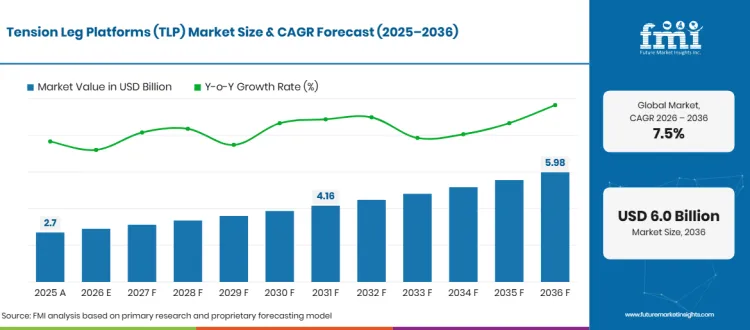
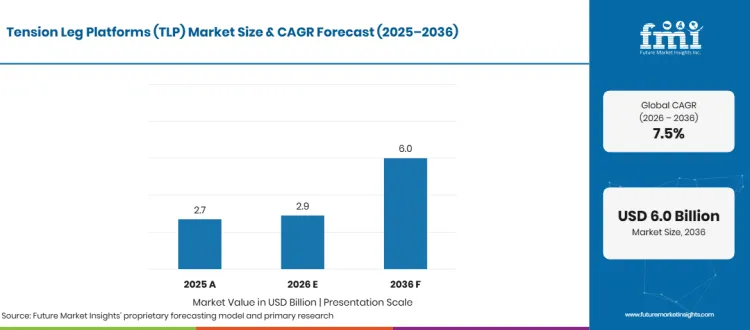
The tension leg platforms (TLP) market is expected to expand from USD 2.9 billion in 2026 to USD 6.0 billion by 2036, growing at a CAGR of 7.50%. While absolute volumes are limited, demand quality is reinforced by the critical role TLPs play in deepwater production strategies. Buyers do not treat TLPs as interchangeable assets, the election reflects confidence in long-term field economics and regulatory certainty. Once commissioned, platforms remain operational for decades, supporting demand for inspection, integrity management, and component replacement.
Purchasing behavior is deliberate and risk-weighted, with operators prioritizing proven designs and execution partners over price-led alternatives. This reduces volatility once projects move beyond sanctioning. Repeat demand materializes through lifecycle extensions, enhanced recovery adaptations, and compliance-driven upgrades. As a result, supplier revenues are closely tied to operational continuity rather than new-build frequency. Demand quality remains resilient, shaped by technical dependency and long-term offshore investment commitments.
Quick Stats for Tension Leg Platforms (TLP) Market
- Tension Leg Platforms (TLP) Market Value (2026): USD 2.9 Billion
- Tension Leg Platforms (TLP) Market Forecast Value (2036): USD 6.0 Billion
- Tension Leg Platforms (TLP) Market Forecast CAGR 2026 to 2036: 7.50%
- Leading Application in Tension Leg Platforms (TLP) Market: Offshore Oil & Gas Production
- Key Growth Regions in Tension Leg Platforms (TLP) Market: North America, Europe, Asia Pacific, Latin America, Middle East & Africa
- Top Key Players in Tension Leg Platforms (TLP) Market: SBM Offshore N.V., MODEC, Inc., Bumi Armada Berhad, BW Offshore Limited, TechnipFMC plc, Heerema Marine Contractors, Aker Solutions ASA, Saipem S.p.A., McDermott International, Keppel Offshore & Marine
Tension Leg Platforms (TLP) Market Key Takeaways
| Metric | Value |
|---|---|
| Tension Leg Platforms (TLP) Market Value (2026) | USD 2.9 Billion |
| Tension Leg Platforms (TLP) Market Forecast Value (2036) | USD 6.0 Billion |
| Tension Leg Platforms (TLP) Market Forecast CAGR 2026 to 2036 | 7.50% |
How Are Deepwater Development Needs and Cost-Efficient Offshore Production Strategies Shaping the Tension Leg Platforms (TLP) Market?
Demand for tension leg platforms is increasingly shaped by offshore operators’ focus on cost control, field productivity, and long-term asset stability in deepwater and ultra-deepwater developments. TLPs are being selected for projects requiring minimal vertical motion, high deck load capacity, and compatibility with dry-tree completions. For EPC contractors and platform fabricators, this preference is translating into fewer but higher-value projects with complex engineering requirements and extended project timelines, emphasizing execution capability over volume.
Supply-side opportunities are emerging across specialized components rather than full-platform construction alone. Demand is rising for high-performance tendons, anchoring systems, corrosion-resistant materials, and fatigue-optimized structural elements. Suppliers that can meet stringent offshore certification standards and offer lifecycle support-including inspection, maintenance, and replacement services-are strengthening their position within TLP project supply chains. Integration with subsea systems and compatibility with enhanced oil recovery operations are also becoming key procurement considerations.
Project sanctioning patterns are further influenced by oil price stability and national offshore development policies. Select deepwater basins in the Gulf of Mexico, Brazil, and West Africa continue to favor TLP-based development concepts for long-life fields with high production intensity. At the same time, operators are scrutinizing capital efficiency, encouraging modular fabrication, standardized designs, and regional fabrication partnerships. For manufacturers and suppliers, competitive advantage in the TLP market increasingly depends on engineering specialization, execution reliability, and the ability to support complex offshore projects across multiple development phases.
What Is The Segment Overview Of The Tension Leg Platforms (TLP) Market?
The tension leg platforms (TLP) market is segmented by component and application, reflecting how structural requirements align with offshore project deployment. By component, deck structure represents the leading segment, as it forms the primary load-bearing and operational interface for offshore facilities. Other components in the tension leg platforms (TLP) market include mooring and tendon systems, risers and connectors, control and safety systems, and auxiliary components that ensure platform stability and functionality. By application, offshore oil and gas production dominates demand, supported by long-term deepwater field development. Offshore wind energy platforms, deepwater drilling support, and other offshore structures contribute to diversified utilization of TLP systems.
Why Does Deck Structure Lead The Tension Leg Platforms (TLP) Market By Component?
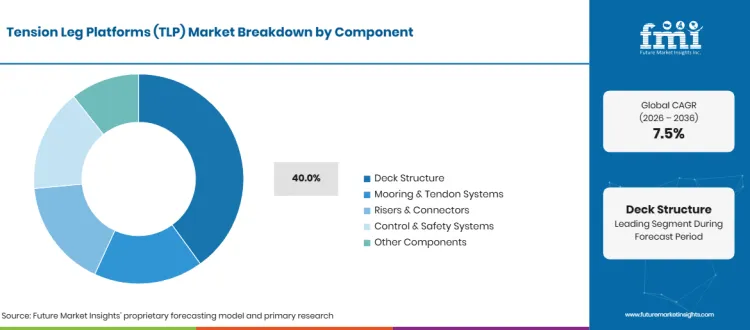
Deck structure accounts for 40% share of the tension leg platforms (TLP) market because it houses critical production, processing, and accommodation facilities. The deck supports drilling equipment, separation units, power systems, and safety infrastructure required for continuous offshore operations. Engineering complexity, material intensity, and customization requirements increase the value contribution of deck structures compared to other components. Operators prioritize deck reliability due to its direct impact on production uptime and personnel safety. Fabrication demand rises with larger field developments and higher payload requirements. These technical and economic factors explain why deck structure remains the most significant component segment in TLP deployments.
Why Does Offshore Oil And Gas Production Dominate The Tension Leg Platforms (TLP) Market By Application?
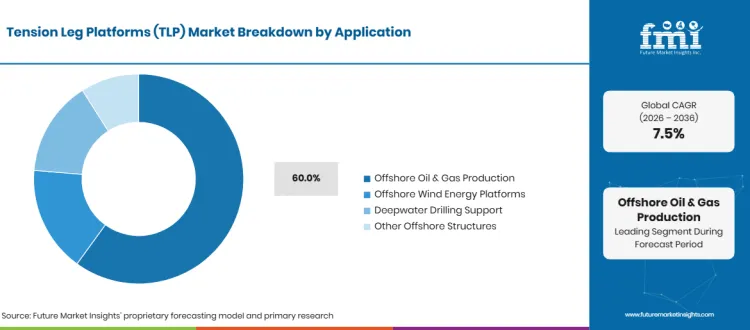
Offshore oil and gas production leads the tension leg platforms (TLP) market by application with 60% share because TLPs are well suited for deepwater and ultra-deepwater hydrocarbon fields. Their vertically tensioned tendons provide stability against wave and current forces, enabling safe drilling and production operations. Oil and gas operators deploy TLPs for long-life reservoirs where fixed platforms are not feasible. Steady investment in deepwater field development supports continued demand. TLP designs allow integration of complex production systems while minimizing seabed footprint. These operational advantages explain why offshore oil and gas production remains the primary application for tension leg platforms.
What Are The Key Dynamics Of The Tension Leg Platforms (TLP) Market?
The tension leg platforms (TLP) market is driven by the ongoing demand for deepwater and ultra-deepwater offshore oil and gas production facilities that provide stability, high payload capacity, and reduced motion for topside equipment. TLPs are preferred for long-term field development due to their tensioned tendon systems, which minimize vertical heave and improve drilling and production efficiency. Rising offshore energy investments, technology advancements in mooring systems, and strategic partnerships between oil majors and engineering firms shape market growth. Cost control, project financing, and risk allocation between owners and contractors are key commercial dynamics affecting TLP deployment decisions.
How Are Technology And Engineering Innovations Shaping The Tension Leg Platforms Market?
Technology and engineering innovations are reshaping the TLP market by improving design flexibility, fabrication efficiency, and safety performance. Advanced finite element modelling, real-time structural health monitoring, and digital twins are enhancing structural reliability and reducing design cycles. Modular fabrication techniques and integrated topside modules are shortening construction timelines and lowering offshore installation risk. Enhanced tendon materials and fatigue-resistant components extend service life in challenging deepwater environments. For EPC contractors and suppliers, offering solutions that integrate automation, predictive maintenance sensors, and compliance with evolving offshore safety standards increases competitiveness in securing TLP projects worldwide.
Why Do Cost, Regulatory, And Supply Chain Challenges Restrain The Tension Leg Platforms Market?
Cost, regulatory, and supply chain constraints restrain TLP market growth. Capital expenditure for TLP fabrication, tendon manufacturing, and offshore installation remains high relative to alternative floating production systems, such as SPAR and semi-submersibles. Complex regulatory requirements for deepwater operations, environmental permits, and safety certifications add to project lead times and cost risk. Supply chain dependencies on heavy-lift fabrication yards, specialized steel suppliers, and offshore installation vessels can cause bottlenecks and scheduling delays. Oil price volatility and investment cycles also influence field development plans, which affect ordering decisions for long-lead TLP infrastructure.
How Is the Global Offshore Development Pipeline Shaping Opportunities in the Tension Leg Platforms (TLP) Market?
Tension leg platforms market is closely linked to deepwater and ultra-deepwater field development economics, reservoir life expectations, and regulatory certainty. TLPs are increasingly favored for fields requiring stable production platforms with reduced motion characteristics and long operating lifespans. Growth is concentrated in regions with mature offshore engineering capability and capital expenditure on deepwater projects. Country-level opportunities vary based on project sanction timelines, local fabrication capacity, and operator preferences for modularization versus integrated builds. Suppliers aligned with tendon systems, hull fabrication, topsides integration, and lifecycle services benefit most from upcoming project pipelines.
-market-cagr-analysis-by-country.webp "Tension Leg Platforms (tlp) Market Cagr Analysis By Country")
| Country | CAGR (%) |
|---|---|
| USA | 8.1% |
| China | 7.9% |
| Norway | 7.6% |
| UK | 7.4% |
| Brazil | 7.2% |
Why Does the United States Remain the Anchor Market for High-Value TLP Projects?
Demand for tension leg platforms in the United States, expanding at a CAGR of 8.1% during 2026 to 2036, is driven by deepwater investment in the Gulf of Mexico. Operators favor TLPs for fields requiring high production uptime, dry tree completions, and long-term reservoir management. The market is characterized by complex project execution models involving international EPC contractors, domestic fabrication yards, and specialized mooring and tendon suppliers. Procurement decisions emphasize proven track records, compliance with stringent safety standards, and lifecycle cost optimization. Modular construction and phased installation strategies are increasingly adopted to control capex and schedule risk. Suppliers benefit from high engineering content, premium specifications, and long-term maintenance contracts. Although project volumes are limited, contract values remain substantial. The United States rewards suppliers with advanced engineering capability, deepwater installation experience, and strong HSE credentials, making it a high-margin but qualification-intensive market.
How Is China Positioning Itself as a Competitive Builder of TLP Infrastructure?
Sales of tension leg platform solutions in China, growing at a CAGR of 7.9% from 2026 to 2036, are supported by expanding offshore development ambitions and growing domestic fabrication capacity. National oil companies increasingly invest in deepwater projects, while Chinese yards strengthen capabilities in hull construction, tendon fabrication, and topside integration. Cost competitiveness and schedule control are key advantages, attracting both domestic and regional projects. Procurement is often centralized, favoring suppliers with local manufacturing presence and government-aligned partnerships. While engineering complexity is rising, operators remain cautious, prioritizing proven designs and incremental capability upgrades. For global suppliers, China offers opportunity through joint ventures, technology licensing, and component supply rather than full EPC leadership. The market is volume- and cost-driven, rewarding suppliers that balance localization with acceptable technical performance.
What Sustains Norway’s Role as a Technology Driven TLP Market?
Demand for tension leg platforms in Norway, expanding at a CAGR of 7.6% during 2026 to 2036, is steady by a highly mature offshore engineering ecosystem and long-standing experience in harsh-environment offshore development. Operators in Norwegian waters prioritize structural integrity, motion minimization, and long-term operational reliability due to severe weather, deepwater conditions, and strict safety expectations. TLP projects increasingly incorporate advanced steel grades, fatigue-resistant tendon systems, digital structural health monitoring, and integrated subsea production architectures. Procurement processes are qualification-intensive, requiring extensive documentation, testing, and environmental compliance. While project volumes are limited, technical complexity is high, resulting in substantial engineering content per platform. Suppliers specializing in tendon design, corrosion protection, digital condition monitoring, and lifecycle engineering services are strongly favored. Cost competitiveness is secondary to technical performance and risk mitigation. Norway rewards vendors with proven offshore track records, innovation capability, and ability to support long-term operations in demanding environments. This market favors depth of expertise, collaborative engineering engagement, and technology leadership rather than scale-driven execution.
How Does the UK Offshore Sector Support Selective TLP Demand?
Sales of tension leg platforms in United Kingdom, growing at a CAGR of 7.4% over the forecast period, are driven by redevelopment of mature North Sea assets and targeted deepwater projects rather than large-scale greenfield developments. Operators deploy TLPs to extend field life, stabilize production, and optimize recovery from technically complex reservoirs. Cost discipline is a defining feature of the UK market, with strong preference for standardized designs, modular construction, and reuse of existing subsea and topside infrastructure. Procurement strategies favor suppliers capable of brownfield integration, retrofit compatibility, and efficient installation planning. Engineering flexibility and schedule certainty influence supplier selection as much as price. Volumes remain moderate, but opportunities for long-term service agreements, life-extension upgrades, and structural modification projects provide recurring revenue streams. The UK market is well suited to suppliers offering cost-optimized engineering, adaptive design solutions, and strong offshore execution capability aligned with late-life asset management strategies.
Why Is Brazil Emerging as a Long-Term Growth Market for TLP Suppliers?
Demand for tension leg platforms in Brazil, expanding at a CAGR of 7.2% during 2026 to 2036, is underpinned by continued development of deepwater and ultra-deepwater pre-salt reserves. Operators prioritize high-capacity, long-life production platforms capable of handling large reservoir volumes and extended project horizons. TLPs are evaluated for applications where stability, dry tree access, and long-term production efficiency are critical. Local content requirements significantly shape procurement strategies, encouraging partnerships with Brazilian fabrication yards, engineering firms, and offshore service providers. Project timelines are extended, but contract values are substantial, favoring suppliers with long-term commitment to the region. Investment in local fabrication capability, workforce training, and regulatory alignment improves competitive positioning. Brazil represents a scale-driven, growth-oriented market where patience, localization strategy, and ability to manage complex project execution determine long-term supplier success.
How Are Key Players Competing in the Tension Leg Platforms (TLP) Market?
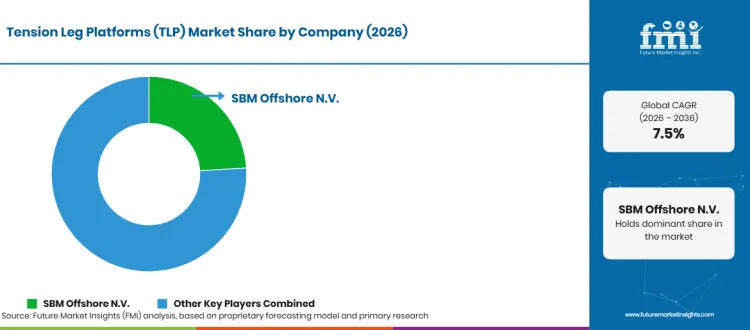
Competition in the Tension Leg Platforms (TLP) market is shaped by engineering breadth, project execution track records, and validated design references documented in official product and project brochures. SBM Offshore N.V. is positioned with TLP solutions highlighted for optimized buoyancy-to-tendon stiffness ratios and modular hull designs validated on deepwater fields. Its project materials emphasize integrated topsides and tendon systems tailored to specific reservoir conditions. MODEC, Inc. competes by offering TLP concepts with standardized module interfaces and digital engineering models that are referenced in technical brochures for enhanced fabrication predictability and lifecycle support. Bumi Armada Berhad differentiates through hybrid TLP configurations with support services highlighted in product literature for vessel integration and hull stability assessments.
Execution capability defines another competitive axis. BW Offshore Limited positions its TLP offerings around integrated project delivery with documented load case analyses and tender design dossiers. TechnipFMC plc emphasizes in official brochures its ability to couple TLP structural systems with subsea and flow assurance packages under unified engineering scopes. Heerema Marine Contractors competes through heavy-lift and installation expertise that is presented alongside TLP design references to de-risk offshore construction sequences.
Engineering depth and regional execution define additional positioning. Aker Solutions ASA and Saipem S.p.A. highlight TLP design and FEED packages in official brochures with emphasis on Norwegian and Mediterranean basin project experience. McDermott International and Keppel Offshore & Marine compete on in-yard integration capacity and proprietary tendon fabrication processes documented in technical materials. ExxonMobil is positioned as an end-user with internal TLP performance criteria that influence supplier selection and platform specifications communicated in joint industry project brochures. Across the market, differentiation is driven by documented design maturity, execution certainty, and tailored TLP system integration rather than price alone.
Key Players in Tension Leg Platforms (TLP) Market
- SBM Offshore N.V.
- MODEC, Inc.
- Bumi Armada Berhad
- BW Offshore Limited
- TechnipFMC plc
- Heerema Marine Contractors
- Aker Solutions ASA
- Saipem S.p.A.
- McDermott International
- Keppel Offshore & Marine
- ExxonMobil
Scope of Report
| Attribute | Description |
|---|---|
| Quantitative Unit | USD Billion |
| Component | Deck Structure, Mooring & Tendon Systems, Risers & Connectors, Control & Safety Systems, Other Components |
| Application | Offshore Oil & Gas Production, Offshore Wind Energy Platforms, Deepwater Drilling Support, Other Offshore Structures |
| Countries Covered | China, Japan, South Korea, India, Australia & New Zealand, ASEAN, Rest of Asia Pacific, Germany, United Kingdom, France, Italy, Spain, Nordic, BENELUX, Rest of Europe, United States, Canada, Mexico, Brazil, Chile, Rest of Latin America, Kingdom of Saudi Arabia, Other GCC Countries, Turkey, South Africa, Other African Union, Rest of Middle East & Africa |
| Regions Covered | Asia Pacific, Europe, North America, Latin America, Middle East & Africa |
| Key Companies Profiled | SBM Offshore N.V., MODEC, Inc., Bumi Armada Berhad, BW Offshore Limited, TechnipFMC plc, Heerema Marine Contractors, Aker Solutions ASA, Saipem S.p.A., McDermott International, Keppel Offshore & Marine, ExxonMobil |
| Additional Attributes | Dollar sales by component and application are assessed across deepwater offshore development projects. The report includes country-level demand analysis, growth projections for 2026 to 2036, evaluation of structural design and tendon system performance, assessment of deployment and installation trends, competitive benchmarking of offshore engineering contractors, and analysis of capital investment patterns across oil, gas, and renewable offshore platforms. |
Tension Leg Platforms (TLP) Market by Key Segments
Component:
- Deck Structure
- Mooring & Tendon Systems
- Risers & Connectors
- Control & Safety Systems
- Other Components
Application:
- Offshore Oil & Gas Production
- Offshore Wind Energy Platforms
- Deepwater Drilling Support
- Other Offshore Structures
Region:
- Asia Pacific
- China
- Japan
- South Korea
- India
- Australia & New Zealand
- ASEAN
- Rest of Asia Pacific
- Europe
- Germany
- United Kingdom
- France
- Italy
- Spain
- Nordic
- BENELUX
- Rest of Europe
- North America
- United States
- Canada
- Mexico
- Latin America
- Brazil
- Chile
- Rest of Latin America
- Middle East & Africa
- Kingdom of Saudi Arabia
- Other GCC Countries
- Turkey
- South Africa
- Other African Union
- Rest of Middle East & Africa
Bibliography
- International Energy Agency. (2025). World Energy Investment 2025. International Energy Agency.
- International Organization for Standardization. (2023). ISO 19901-8: Offshore structures — Marine soil investigations. ISO.
- Norwegian Ocean Industry Authority. (2025, May 12). RNNP 2024 – Trends in risk level in the Norwegian petroleum activity: Summary report.
- Health and Safety Executive. (2025, July 18). Offshore structural integrity: Key topics. UK Health and Safety Executive.
- Office of the Federal Register, National Archives and Records Administration. (2025). Code of Federal Regulations: Title 30, Part 250 – Oil and Gas and Sulphur Operations in the Outer Continental Shelf.
Frequently Asked Questions
How big is the tension leg platforms (tlp) market in 2026?
The global tension leg platforms (tlp) market is estimated to be valued at USD 2.9 million in 2026.
What will be the size of tension leg platforms (tlp) market in 2036?
The market size for the tension leg platforms (tlp) market is projected to reach USD 6.0 million by 2036.
How much will be the tension leg platforms (tlp) market growth between 2026 and 2036?
The tension leg platforms (tlp) market is expected to grow at a 7.5% CAGR between 2026 and 2036.
What are the key product types in the tension leg platforms (tlp) market?
The key product types in tension leg platforms (tlp) market are deck structure, mooring & tendon systems, risers & connectors, control & safety systems and other components.
Which application segment to contribute significant share in the tension leg platforms (tlp) market in 2026?
In terms of application, offshore oil & gas production segment to command 60.0% share in the tension leg platforms (tlp) market in 2026.
Preview the report firsthand - request a free sample
Get SampleGet the brochure for pricing and purchase details.
Get PDFTable of Content
- Executive Summary
- Global Market Outlook
- Demand-side Trends
- Supply-side Trends
- Technology Roadmap Analysis
- Analysis and Recommendations
- Market Overview
- Market Coverage / Taxonomy
- Market Definition / Scope / Limitations
- Market Background
- Market Dynamics
- Drivers
- Restraints
- Opportunity
- Trends
- Scenario Forecast
- Demand in Optimistic Scenario
- Demand in Likely Scenario
- Demand in Conservative Scenario
- Opportunity Map Analysis
- Product Life Cycle Analysis
- Supply Chain Analysis
- Investment Feasibility Matrix
- Value Chain Analysis
- PESTLE and Porter’s Analysis
- Regulatory Landscape
- Regional Parent Market Outlook
- Production and Consumption Statistics
- Import and Export Statistics
- Market Dynamics
- Global Market Analysis 2021 to 2025 and Forecast, 2026 to 2036
- Historical Market Size Value (USD Billion) Analysis, 2021 to 2025
- Current and Future Market Size Value (USD Billion) Projections, 2026 to 2036
- Y-o-Y Growth Trend Analysis
- Absolute $ Opportunity Analysis
- Global Market Pricing Analysis 2021 to 2025 and Forecast 2026 to 2036
- Global Market Analysis 2021 to 2025 and Forecast 2026 to 2036, By Component
- Introduction / Key Findings
- Historical Market Size Value (USD Billion) Analysis By Component , 2021 to 2025
- Current and Future Market Size Value (USD Billion) Analysis and Forecast By Component , 2026 to 2036
- Deck Structure
- Mooring & Tendon Systems
- Risers & Connectors
- Control & Safety Systems
- Other Components
- Deck Structure
- Y-o-Y Growth Trend Analysis By Component , 2021 to 2025
- Absolute $ Opportunity Analysis By Component , 2026 to 2036
- Global Market Analysis 2021 to 2025 and Forecast 2026 to 2036, By Application
- Introduction / Key Findings
- Historical Market Size Value (USD Billion) Analysis By Application, 2021 to 2025
- Current and Future Market Size Value (USD Billion) Analysis and Forecast By Application, 2026 to 2036
- Offshore Oil & Gas Production
- Offshore Wind Energy Platforms
- Deepwater Drilling Support
- Other Offshore Structures
- Offshore Oil & Gas Production
- Y-o-Y Growth Trend Analysis By Application, 2021 to 2025
- Absolute $ Opportunity Analysis By Application, 2026 to 2036
- Global Market Analysis 2021 to 2025 and Forecast 2026 to 2036, By Region
- Introduction
- Historical Market Size Value (USD Billion) Analysis By Region, 2021 to 2025
- Current Market Size Value (USD Billion) Analysis and Forecast By Region, 2026 to 2036
- North America
- Latin America
- Western Europe
- Eastern Europe
- East Asia
- South Asia and Pacific
- Middle East & Africa
- Market Attractiveness Analysis By Region
- North America Market Analysis 2021 to 2025 and Forecast 2026 to 2036, By Country
- Historical Market Size Value (USD Billion) Trend Analysis By Market Taxonomy, 2021 to 2025
- Market Size Value (USD Billion) Forecast By Market Taxonomy, 2026 to 2036
- By Country
- USA
- Canada
- Mexico
- By Component
- By Application
- By Country
- Market Attractiveness Analysis
- By Country
- By Component
- By Application
- Key Takeaways
- Latin America Market Analysis 2021 to 2025 and Forecast 2026 to 2036, By Country
- Historical Market Size Value (USD Billion) Trend Analysis By Market Taxonomy, 2021 to 2025
- Market Size Value (USD Billion) Forecast By Market Taxonomy, 2026 to 2036
- By Country
- Brazil
- Chile
- Rest of Latin America
- By Component
- By Application
- By Country
- Market Attractiveness Analysis
- By Country
- By Component
- By Application
- Key Takeaways
- Western Europe Market Analysis 2021 to 2025 and Forecast 2026 to 2036, By Country
- Historical Market Size Value (USD Billion) Trend Analysis By Market Taxonomy, 2021 to 2025
- Market Size Value (USD Billion) Forecast By Market Taxonomy, 2026 to 2036
- By Country
- Germany
- UK
- Italy
- Spain
- France
- Nordic
- BENELUX
- Rest of Western Europe
- By Component
- By Application
- By Country
- Market Attractiveness Analysis
- By Country
- By Component
- By Application
- Key Takeaways
- Eastern Europe Market Analysis 2021 to 2025 and Forecast 2026 to 2036, By Country
- Historical Market Size Value (USD Billion) Trend Analysis By Market Taxonomy, 2021 to 2025
- Market Size Value (USD Billion) Forecast By Market Taxonomy, 2026 to 2036
- By Country
- Russia
- Poland
- Hungary
- Balkan & Baltic
- Rest of Eastern Europe
- By Component
- By Application
- By Country
- Market Attractiveness Analysis
- By Country
- By Component
- By Application
- Key Takeaways
- East Asia Market Analysis 2021 to 2025 and Forecast 2026 to 2036, By Country
- Historical Market Size Value (USD Billion) Trend Analysis By Market Taxonomy, 2021 to 2025
- Market Size Value (USD Billion) Forecast By Market Taxonomy, 2026 to 2036
- By Country
- China
- Japan
- South Korea
- By Component
- By Application
- By Country
- Market Attractiveness Analysis
- By Country
- By Component
- By Application
- Key Takeaways
- South Asia and Pacific Market Analysis 2021 to 2025 and Forecast 2026 to 2036, By Country
- Historical Market Size Value (USD Billion) Trend Analysis By Market Taxonomy, 2021 to 2025
- Market Size Value (USD Billion) Forecast By Market Taxonomy, 2026 to 2036
- By Country
- India
- ASEAN
- Australia & New Zealand
- Rest of South Asia and Pacific
- By Component
- By Application
- By Country
- Market Attractiveness Analysis
- By Country
- By Component
- By Application
- Key Takeaways
- Middle East & Africa Market Analysis 2021 to 2025 and Forecast 2026 to 2036, By Country
- Historical Market Size Value (USD Billion) Trend Analysis By Market Taxonomy, 2021 to 2025
- Market Size Value (USD Billion) Forecast By Market Taxonomy, 2026 to 2036
- By Country
- Kingdom of Saudi Arabia
- Other GCC Countries
- Turkiye
- South Africa
- Other African Union
- Rest of Middle East & Africa
- By Component
- By Application
- By Country
- Market Attractiveness Analysis
- By Country
- By Component
- By Application
- Key Takeaways
- Key Countries Market Analysis
- USA
- Pricing Analysis
- Market Share Analysis, 2025
- By Component
- By Application
- Canada
- Pricing Analysis
- Market Share Analysis, 2025
- By Component
- By Application
- Mexico
- Pricing Analysis
- Market Share Analysis, 2025
- By Component
- By Application
- Brazil
- Pricing Analysis
- Market Share Analysis, 2025
- By Component
- By Application
- Chile
- Pricing Analysis
- Market Share Analysis, 2025
- By Component
- By Application
- Germany
- Pricing Analysis
- Market Share Analysis, 2025
- By Component
- By Application
- UK
- Pricing Analysis
- Market Share Analysis, 2025
- By Component
- By Application
- Italy
- Pricing Analysis
- Market Share Analysis, 2025
- By Component
- By Application
- Spain
- Pricing Analysis
- Market Share Analysis, 2025
- By Component
- By Application
- France
- Pricing Analysis
- Market Share Analysis, 2025
- By Component
- By Application
- India
- Pricing Analysis
- Market Share Analysis, 2025
- By Component
- By Application
- ASEAN
- Pricing Analysis
- Market Share Analysis, 2025
- By Component
- By Application
- Australia & New Zealand
- Pricing Analysis
- Market Share Analysis, 2025
- By Component
- By Application
- China
- Pricing Analysis
- Market Share Analysis, 2025
- By Component
- By Application
- Japan
- Pricing Analysis
- Market Share Analysis, 2025
- By Component
- By Application
- South Korea
- Pricing Analysis
- Market Share Analysis, 2025
- By Component
- By Application
- Russia
- Pricing Analysis
- Market Share Analysis, 2025
- By Component
- By Application
- Poland
- Pricing Analysis
- Market Share Analysis, 2025
- By Component
- By Application
- Hungary
- Pricing Analysis
- Market Share Analysis, 2025
- By Component
- By Application
- Kingdom of Saudi Arabia
- Pricing Analysis
- Market Share Analysis, 2025
- By Component
- By Application
- Turkiye
- Pricing Analysis
- Market Share Analysis, 2025
- By Component
- By Application
- South Africa
- Pricing Analysis
- Market Share Analysis, 2025
- By Component
- By Application
- USA
- Market Structure Analysis
- Competition Dashboard
- Competition Benchmarking
- Market Share Analysis of Top Players
- By Regional
- By Component
- By Application
- Competition Analysis
- Competition Deep Dive
- SBM Offshore N.V.
- Overview
- Product Portfolio
- Profitability by Market Segments (Product/Age /Sales Channel/Region)
- Sales Footprint
- Strategy Overview
- Marketing Strategy
- Product Strategy
- Channel Strategy
- MODEC, Inc.
- Bumi Armada Berhad
- BW Offshore Limited
- TechnipFMC plc
- Heerema Marine Contractors
- Aker Solutions ASA
- Saipem S.p.A.
- McDermott International
- Keppel Offshore & Marine
- ExxonMobil
- SBM Offshore N.V.
- Competition Deep Dive
- Assumptions & Acronyms Used
- Research Methodology


