

- Industry Size (2026)
- USD 1104 Mn
- Forecast (2036)
- USD 1815.5 Mn
- CAGR (2026 to 2036)
- 5.10%
Subsea Filter Separators Market Forecast and Outlook 2026 to 2036
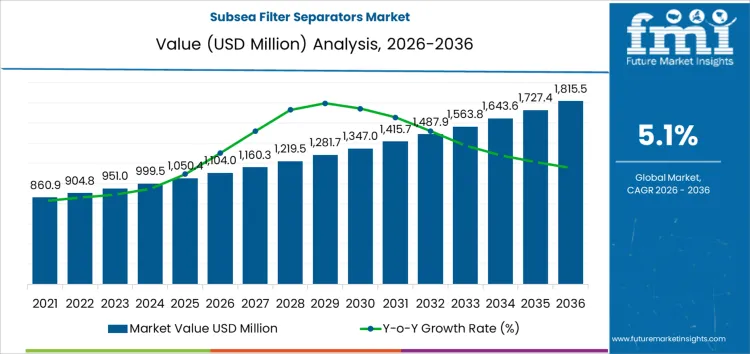
The subsea filter separators market is projected to grow from USD 1,104 million in 2026 to USD 1,815.5 million by 2036, expanding at a CAGR of 5.10%. Demand quality in this market is reinforced by the operational criticality of filtration within subsea production systems. Once installed, subsea filter separators become embedded in long-life assets where replacement or redesign carries high operational risk. This creates strong buyer commitment to qualified suppliers and limits switching behavior.
Consistent demand is generated through brownfield upgrades, tieback extensions, and integrity-driven refurbishment rather than frequent new installations. Operators prioritize reliability, predictable performance, and service continuity over short-term cost advantages. Procurement decisions are conservative, often favoring incumbents with proven field references. Revenue streams are shaped by multi-year service engagement, inspection programs, and component replacement cycles. Demand quality remains high due to technical dependency, long operating horizons, and the strategic role of filtration in safeguarding subsea production uptime.
Quick Stats for Subsea Filter Separators Market
- Subsea Filter Separators Market Value (2026): USD 1,104 Million
- Subsea Filter Separators Market Forecast Value (2036): USD 1,815.5 Million
- Subsea Filter Separators Market Forecast CAGR 2026 to 2036: 5.10%
- Leading Application in Subsea Filter Separators Market: Oil Production (flow assurance and equipment protection driven)
- Key Growth Regions in Subsea Filter Separators Market: Asia Pacific, Latin America, North America, Europe, Middle East & Africa
- Top Key Players in Subsea Filter Separators Market: SLB - OneSubsea, TechnipFMC plc, Baker Hughes Company, Halliburton Company, NOV Inc., Aker Solutions ASA, Subsea 7 S.A., Oceaneering International, Inc., Saipem S.p.A.
Subsea Filter Separators Market Key Takeaways
| Metric | Value |
|---|---|
| Subsea Filter Separators Market Value (2026) | USD 1,104 Million |
| Subsea Filter Separators Market Forecast Value (2036) | USD 1,815.5 Million |
| Subsea Filter Separators Market Forecast CAGR 2026 to 2036 | 5.10% |
How Are Subsea Production Reliability and Flow Assurance Priorities Shaping the Subsea Filter Separators Market?
The subsea filter separators market is being driven by operators’ increasing focus on flow assurance, equipment protection, and uninterrupted production in offshore oil and gas fields. As subsea developments move into deeper waters and more complex reservoirs, managing solids, sand, hydrates, and contaminants before they reach critical subsea equipment has become a priority. Subsea filter separators play a key role in protecting pumps, compressors, and pipelines, making them a strategic component rather than an auxiliary add-on within subsea production systems.
From a supplier perspective, demand is shifting toward highly engineered, application-specific solutions rather than standardized units. Operators and EPC contractors are seeking separators that can handle variable flow rates, high pressures, and challenging multiphase conditions over long operating lifetimes. This is creating opportunities for manufacturers specializing in advanced materials, erosion-resistant internals, compact designs, and low-maintenance architectures. Vendors offering condition monitoring, retrievability options, and integration with subsea control systems are gaining preference during project bidding stages.
Project economics and lifecycle cost considerations are also influencing procurement decisions. With offshore developments under constant pressure to improve capital efficiency, operators are prioritizing subsea filter separators that reduce intervention frequency and support extended tie-back distances. Growth in brownfield upgrades and subsea boosting projects is generating retrofit demand, particularly in mature offshore basins. For manufacturers and suppliers, competitive positioning in this market increasingly depends on engineering credibility, qualification track record, and the ability to support long-term offshore operations across the full project lifecycle.
What Is The Segment Overview Of The Subsea Filter Separators Market?
The subsea filter separators market is segmented by separator design and application, reflecting how separation efficiency and field operating conditions influence equipment selection. By separator design, vertical gas-liquid separators represent the leading category, as they are widely deployed in subsea production systems for compact footprint and stable phase separation. Other designs in the subsea filter separators market include horizontal two-phase separators, coalescing cartridge systems, cyclonic spin-tube designs, and alternative configurations developed for specific flow regimes. By application, oil production forms the primary demand center, while gas processing, water injection, subsea compression, and other subsea operations contribute to broader adoption across offshore developments.
Why Do Vertical Gas-Liquid Separators Lead The Subsea Filter Separators Market By Design?

Vertical gas-liquid separators hold 35% share in the subsea filter separators market because they offer efficient phase separation within a compact vertical layout suited for deepwater installations. These designs manage variable flow rates and pressure conditions while minimizing seabed footprint. Operators prefer vertical configurations for subsea tiebacks where space and structural load constraints are critical. The design supports effective removal of liquids from gas streams, reducing downstream corrosion and equipment wear. Manufacturers benefit from standardized engineering designs that can be adapted across multiple field developments. This balance of operational reliability and installation efficiency explains why vertical gas-liquid separators remain the leading design choice.
Why Does Oil Production Dominate The Subsea Filter Separators Market By Application?
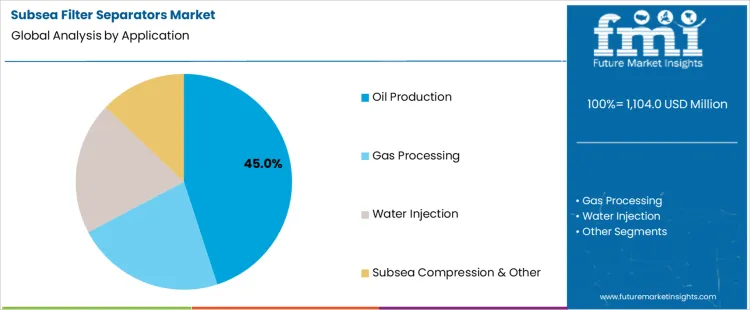
Oil production accounts for 45% share of the subsea filter separators market because crude extraction generates multiphase flows that require continuous separation of gas, oil, water, and solids. Subsea filter separators protect downstream pumps, compressors, and processing units by removing contaminants early in the production stream. Offshore operators deploy these systems to improve flow assurance and extend equipment life in harsh subsea environments. Increasing development of deepwater oil fields steady demand for reliable separation solutions. From a supplier perspective, oil production projects involve high-capacity systems and long-term service contracts. These operational and commercial drivers explain why oil production remains the dominant application segment.
What Are The Key Dynamics Of The Subsea Filter Separators Market?
The subsea filter separators market is shaped by the rising need for reliable multiphase separation solutions that operate under extreme deepwater conditions. Subsea filter separators remove solids and liquid contaminants from wellstream fluids before injection, boosting flow assurance and protecting downstream equipment. Growth in offshore oil and gas development, subsea tie-backs, and offshore drilling supports demand. Key dynamics include robust design for high pressure and temperature environments, low-maintenance reliability, compatibility with chemical injection systems, and integration with subsea processing infrastructure. For OEMs and suppliers, addressing material selection, corrosion resistance, and remote operability are strategic factors influencing customer adoption and long-term field performance.
How Are Technological Innovations Shaping The Subsea Filter Separators Market?
Technological innovations are advancing the subsea filter separators market by enhancing operational efficiency, reliability, and remote monitoring capabilities. Developments in high-performance filter media, smart multi-stage separation designs, and automated backflush systems improve contaminant removal with minimal intervention. Integration with subsea sensor networks and digital monitoring platforms enables real-time diagnostics of filter condition, pressure differentials, and performance trends. For deepwater and ultra-deepwater installations, compact modular designs and tools for easy ROV-based maintenance reduce downtime and intervention costs. Suppliers focusing on digital integration, fatigue-resistant materials, and system-level engineering improve competitiveness in complex subsea environments.
Why Do Cost, Installation, And Operational Constraints Restrain The Subsea Filter Separators Market?
Cost, installation complexity, and operational constraints restrain the subsea filter separators market. High capital expenditure for subsea-rated filter separators, specialized materials, and ruggedized control systems increases upfront investment for operators. Installation in deepwater environments requires heavy-lift vessels, precision positioning, and ROV/AUV support, adding to project costs and scheduling risks. Long-term reliability under corrosive seawater and high-pressure conditions demands premium-grade components, which raises manufacturing expense. Operational challenges such as accessing buried or remotely located units for maintenance, managing filter media replacement, and ensuring compatibility with varying wellstream compositions constrain wider deployment, especially in brownfield retrofits.
How Is Deepwater Flow Assurance Driving Country-Level Demand in the Subsea Filter Separators Market?
Subsea filter separators market is closely linked to deepwater and ultra-deepwater field development, where sand management, hydrate control, and equipment protection are critical to uninterrupted production. Operators increasingly deploy subsea separation and filtration systems to extend tieback distances, protect subsea pumps and compressors, and reduce topside processing loads. Growth opportunities vary by country depending on offshore project sanctioning activity, subsea infrastructure maturity, and operator preference for integrated subsea processing architectures. Suppliers that can deliver compact, high-reliability filtration systems with proven performance under high pressure and corrosive conditions gain competitive advantage. Qualification depth, lifecycle service capability, and compatibility with existing subsea production systems are decisive factors shaping procurement.
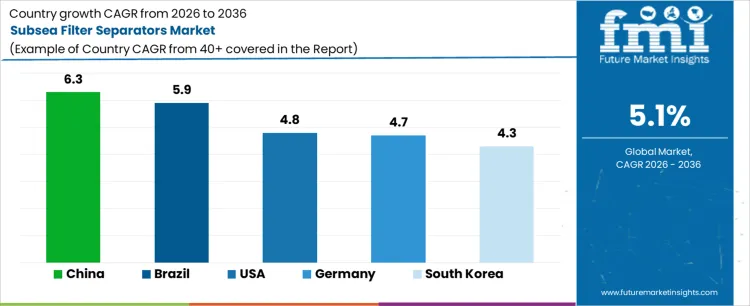
| Country | CAGR (%) |
|---|---|
| China | 6.3% |
| Brazil | 5.9% |
| USA | 4.8% |
| Germany | 4.7% |
| South Korea | 4.3% |
Why Is China Emerging as a High-Potential Market for Subsea Filter Separator Suppliers?
Demand for subsea filter separators in China, expanding at a CAGR of 6.3% during 2026 to 2036, is driven by rising offshore development activity and growing technical ambition in deepwater production. National oil companies are investing in subsea processing to support longer tiebacks and protect critical subsea equipment. Procurement strategies emphasize cost efficiency, localized fabrication, and schedule reliability. Domestic yards are strengthening capabilities in subsea module fabrication, while technology gaps create opportunity for foreign suppliers through joint ventures and licensed solutions. Operators favor compact, modular filter separators that integrate smoothly with subsea trees, manifolds, and boosting systems. Qualification requirements are increasing, but buyers remain pragmatic, preferring proven designs adapted for local manufacturing. China represents a volume-oriented market where suppliers that balance technical robustness with localization and competitive pricing can secure repeat contracts as offshore activity scales.
How Is Brazil Shaping Long-Term Demand for Subsea Filter Separators?
Demand for subsea filter separators in Brazil, growing at a CAGR of 5.9%, is anchored in steady development of deepwater and pre-salt fields. Operators deploy subsea filtration to manage sand production, protect subsea pumps, and improve system uptime in high-flow environments. Local content regulations strongly influence procurement, favoring suppliers with Brazilian manufacturing, assembly, or service presence. Projects are capital-intensive with long timelines, placing emphasis on reliability, maintainability, and lifecycle cost optimization. Qualification processes are rigorous, often requiring extensive testing and field references. While project volumes are limited, contract values are substantial. Brazil rewards suppliers willing to invest locally, build long-term operator relationships, and support complex integration with subsea separation, boosting, and processing architectures.
What Drives Ongoing Demand in the United States Subsea Market?
Demand for subsea filter separators in the United States, expanding at a CAGR of 4.8% during 2026 to 2036, is closely linked to deepwater production activity in the Gulf of Mexico and long-term asset utilization strategies. Operators focus on flow assurance, sand control, and protection of critical subsea equipment such as pumps, compressors, and control valves. Subsea filter separators are deployed to reduce erosion risks, prevent clogging, and minimize costly intervention campaigns. Procurement is highly specification-driven, emphasizing proven offshore performance, materials durability, pressure ratings, and compliance with strict safety and environmental standards. Upgrade and replacement demand is increasing as subsea infrastructure ages and operators extend field life beyond original design assumptions. While project volumes remain moderate, technical requirements are demanding, supporting premium pricing for qualified suppliers. Buyers favor vendors with established deepwater experience, advanced engineering capability, and comprehensive aftersales services, including inspection, refurbishment, and integrity management. The US market rewards reliability, documentation quality, and lifecycle support rather than aggressive cost competition.
How Does Germany Enable Specialized Demand for Subsea Filter Separators?
Demand for subsea filter separators associated with Germany, growing at a CAGR of 4.7%, reflects the country’s role as a global engineering and manufacturing base rather than a major offshore producing region. German companies supply high-precision filtration units, corrosion-resistant materials, and engineered subsea components for offshore projects worldwide. Buyers place strong emphasis on mechanical integrity, materials performance, and adherence to international offshore standards. Demand is driven primarily by export-oriented manufacturing serving operators and EPC contractors in regions such as the Americas, Middle East, and Asia Pacific. Procurement cycles are engineering-led, with detailed technical evaluations, factory testing, and documentation requirements. Volumes are steady but focused on high-value, customized equipment rather than large-scale production. Germany favors suppliers with advanced materials expertise, precision fabrication capabilities, and the ability to deliver bespoke subsea filtration solutions that integrate reliably into complex subsea processing systems.
Why Is South Korea a Manufacturing-Centric Market for Subsea Filter Separators?
Sales of subsea filter separators linked to projects involving South Korea, expanding at a CAGR of 4.3% during 2026 to 2036, are driven by the country’s central role in offshore fabrication and EPC execution. South Korean shipyards and EPC contractors function as global assembly hubs, integrating subsea equipment into large offshore developments destined for Brazil, the Gulf of Mexico, and West Africa. Demand arises from integration requirements rather than domestic offshore production. Procurement is strongly schedule-driven, with emphasis on delivery reliability, interface compatibility, and compliance with EPC technical specifications. Suppliers must coordinate closely with EPC engineering teams and meet rigorous quality assurance standards. Pricing remains important, but execution discipline, documentation accuracy, and consistency carry greater weight. South Korea represents a manufacturing-led opportunity where supplier success depends on seamless EPC collaboration, strong project management capability, and the ability to deliver technically compliant equipment within compressed construction timelines.
How Are Companies Competing in the Subsea Filter Separators Market?
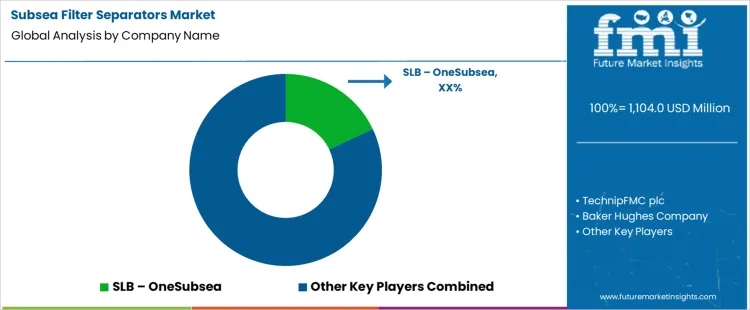
Competition in the subsea filter separators market is driven by validated performance under deepwater conditions, modular design flexibility, and integration with subsea processing systems as documented in official product materials. SLB - OneSubsea positions its subsea filter separators with brochures that highlight compact, high-efficiency particulate removal optimized for integrated subsea processing trains. Technical literature emphasizes materials engineered for corrosion resistance and minimal maintenance intervals. TechnipFMC plc competes with modular separator designs capable of tailored flow rates and solids handling, with product documentation noting scalable configurations tested in deepwater field conditions. Baker Hughes Company differentiates through subsea filter separators engineered for high uptime and fluid compatibility across oil, gas, and water phases, with official materials underscoring automated cleaning features and field-proven reliability.
Service-driven execution is a distinct axis of competition. Halliburton Company integrates its subsea separators with global support infrastructure, backed by brochures detailing end-to-end deployment services and subsea flow assurance optimization. NOV Inc. positions its offerings with official product guides that emphasize rugged mechanical designs and rapid interchangeability for filter elements under high differential pressures. Aker Solutions ASA and Subsea 7 S.A. focus brochures on integrated engineering and installation packages, where filter separators are part of broader subsea production systems with coordinated control and monitoring interfaces.
Complex field environments and execution confidence are key differentiators. Oceaneering International, Inc. markets subsea filter separators with product literature stressing remote inspection capability and subsea service tooling. Saipem S.p.A. competes through engineered systems presented with capability statements for deepwater flow assurance and solids management. Other players in the market add value through specialized filter media, custom housing designs, and regional fabrication support, with datasheets that detail element performance metrics, material certifications, and pressure/temperature ratings. Across suppliers, differentiation is achieved through brochure-verified performance reliability, integration readiness with subsea production systems, and documented service support rather than commodity pricing alone.
Key Players in Subsea Filter Separators Market
- SLB - OneSubsea
- TechnipFMC plc
- Baker Hughes Company
- Halliburton Company
- NOV Inc.
- Aker Solutions ASA
- Subsea 7 S.A.
- Oceaneering International, Inc.
- Saipem S.p.A.
Scope of Report
| Attribute | Description |
|---|---|
| Quantitative Unit | USD Million |
| Separator Design | Vertical Gas-Liquid, Horizontal Two-Phase, Coalescing Cartridge, Cyclonic Spin-Tube, Other Designs |
| Application | Oil Production, Gas Processing, Water Injection, Subsea Compression & Other |
| Countries Covered | China, Japan, South Korea, India, Australia & New Zealand, ASEAN, Rest of Asia Pacific, Germany, United Kingdom, France, Italy, Spain, Nordic, BENELUX, Rest of Europe, United States, Canada, Mexico, Brazil, Chile, Rest of Latin America, Kingdom of Saudi Arabia, Other GCC Countries, Turkey, South Africa, Other African Union, Rest of Middle East & Africa |
| Regions Covered | Asia Pacific, Europe, North America, Latin America, Middle East & Africa |
| Key Companies Profiled | SLB - OneSubsea, TechnipFMC plc, Baker Hughes Company, Halliburton Company, NOV Inc., Aker Solutions ASA, Subsea 7 S.A., Oceaneering International, Inc., Saipem S.p.A. |
| Additional Attributes | Dollar sales by separator design and application are evaluated across subsea oil and gas production systems. The report includes country-level demand assessment, growth projections for 2026 to 2036, evaluation of separation efficiency and flow assurance performance, assessment of deepwater deployment trends, competitive benchmarking of suppliers, and analysis of capital spending patterns across offshore energy developments. |
Subsea Filter Separators Market by Key Segments
Separator Design:
- Vertical Gas-Liquid
- Horizontal Two-Phase
- Coalescing Cartridge
- Cyclonic Spin-Tube
- Other Designs
Application:
- Oil Production
- Gas Processing
- Water Injection
- Subsea Compression & Other
Region:
- Asia Pacific
- China
- Japan
- South Korea
- India
- Australia & New Zealand
- ASEAN
- Rest of Asia Pacific
- Europe
- Germany
- United Kingdom
- France
- Italy
- Spain
- Nordic
- BENELUX
- Rest of Europe
- North America
- United States
- Canada
- Mexico
- Latin America
- Brazil
- Chile
- Rest of Latin America
- Middle East & Africa
- Kingdom of Saudi Arabia
- Other GCC Countries
- Turkey
- South Africa
- Other African Union
- Rest of Middle East & Africa
Bibliography
- International Organization for Standardization. (2025). ISO 13628-1: Design and operation of subsea production systems — General requirements. ISO.
- Office of the Federal Register. (2026). eCFR: Title 30 – Mineral Resources; Part 250. National Archives and Records Administration.
- Bureau of Safety and Environmental Enforcement. (2024). NTL No. 2024-N03: Restricting access to unsafe areas due to corrosion. U.S. Department of the Interior.
- International Organization for Standardization. (2024). ISO 19901-3: Offshore structures — Topsides structure. ISO.
- International Energy Agency. (2024). World Energy Investment 2024. International Energy Agency.
Frequently Asked Questions
How big is the subsea filter separators market in 2026?
The global subsea filter separators market is estimated to be valued at USD 1,104.0 million in 2026.
What will be the size of subsea filter separators market in 2036?
The market size for the subsea filter separators market is projected to reach USD 1,815.5 million by 2036.
How much will be the subsea filter separators market growth between 2026 and 2036?
The subsea filter separators market is expected to grow at a 5.1% CAGR between 2026 and 2036.
What are the key product types in the subsea filter separators market?
The key product types in subsea filter separators market are vertical gas-liquid, horizontal two-phase, coalescing cartridge, cyclonic spin-tube and other designs.
Which application segment to contribute significant share in the subsea filter separators market in 2026?
In terms of application, oil production segment to command 45.0% share in the subsea filter separators market in 2026.
Preview the report firsthand - request a free sample
Get SampleGet the brochure for pricing and purchase details.
Get PDFTable of Content
- Executive Summary
- Global Market Outlook
- Demand-side Trends
- Supply-side Trends
- Technology Roadmap Analysis
- Analysis and Recommendations
- Market Overview
- Market Coverage / Taxonomy
- Market Definition / Scope / Limitations
- Market Background
- Market Dynamics
- Drivers
- Restraints
- Opportunity
- Trends
- Scenario Forecast
- Demand in Optimistic Scenario
- Demand in Likely Scenario
- Demand in Conservative Scenario
- Opportunity Map Analysis
- Product Life Cycle Analysis
- Supply Chain Analysis
- Investment Feasibility Matrix
- Value Chain Analysis
- PESTLE and Porter’s Analysis
- Regulatory Landscape
- Regional Parent Market Outlook
- Production and Consumption Statistics
- Import and Export Statistics
- Market Dynamics
- Global Market Analysis 2021 to 2025 and Forecast, 2026 to 2036
- Historical Market Size Value (USD Million) Analysis, 2021 to 2025
- Current and Future Market Size Value (USD Million) Projections, 2026 to 2036
- Y-o-Y Growth Trend Analysis
- Absolute $ Opportunity Analysis
- Global Market Pricing Analysis 2021 to 2025 and Forecast 2026 to 2036
- Global Market Analysis 2021 to 2025 and Forecast 2026 to 2036, By Separator Design
- Introduction / Key Findings
- Historical Market Size Value (USD Million) Analysis By Separator Design , 2021 to 2025
- Current and Future Market Size Value (USD Million) Analysis and Forecast By Separator Design , 2026 to 2036
- Vertical Gas-Liquid
- Horizontal Two-Phase
- Coalescing Cartridge
- Cyclonic Spin-Tube
- Other Designs
- Vertical Gas-Liquid
- Y-o-Y Growth Trend Analysis By Separator Design , 2021 to 2025
- Absolute $ Opportunity Analysis By Separator Design , 2026 to 2036
- Global Market Analysis 2021 to 2025 and Forecast 2026 to 2036, By Application
- Introduction / Key Findings
- Historical Market Size Value (USD Million) Analysis By Application, 2021 to 2025
- Current and Future Market Size Value (USD Million) Analysis and Forecast By Application, 2026 to 2036
- Oil Production
- Gas Processing
- Water Injection
- Subsea Compression & Other
- Oil Production
- Y-o-Y Growth Trend Analysis By Application, 2021 to 2025
- Absolute $ Opportunity Analysis By Application, 2026 to 2036
- Global Market Analysis 2021 to 2025 and Forecast 2026 to 2036, By Region
- Introduction
- Historical Market Size Value (USD Million) Analysis By Region, 2021 to 2025
- Current Market Size Value (USD Million) Analysis and Forecast By Region, 2026 to 2036
- North America
- Latin America
- Western Europe
- Eastern Europe
- East Asia
- South Asia and Pacific
- Middle East & Africa
- Market Attractiveness Analysis By Region
- North America Market Analysis 2021 to 2025 and Forecast 2026 to 2036, By Country
- Historical Market Size Value (USD Million) Trend Analysis By Market Taxonomy, 2021 to 2025
- Market Size Value (USD Million) Forecast By Market Taxonomy, 2026 to 2036
- By Country
- USA
- Canada
- Mexico
- By Separator Design
- By Application
- By Country
- Market Attractiveness Analysis
- By Country
- By Separator Design
- By Application
- Key Takeaways
- Latin America Market Analysis 2021 to 2025 and Forecast 2026 to 2036, By Country
- Historical Market Size Value (USD Million) Trend Analysis By Market Taxonomy, 2021 to 2025
- Market Size Value (USD Million) Forecast By Market Taxonomy, 2026 to 2036
- By Country
- Brazil
- Chile
- Rest of Latin America
- By Separator Design
- By Application
- By Country
- Market Attractiveness Analysis
- By Country
- By Separator Design
- By Application
- Key Takeaways
- Western Europe Market Analysis 2021 to 2025 and Forecast 2026 to 2036, By Country
- Historical Market Size Value (USD Million) Trend Analysis By Market Taxonomy, 2021 to 2025
- Market Size Value (USD Million) Forecast By Market Taxonomy, 2026 to 2036
- By Country
- Germany
- UK
- Italy
- Spain
- France
- Nordic
- BENELUX
- Rest of Western Europe
- By Separator Design
- By Application
- By Country
- Market Attractiveness Analysis
- By Country
- By Separator Design
- By Application
- Key Takeaways
- Eastern Europe Market Analysis 2021 to 2025 and Forecast 2026 to 2036, By Country
- Historical Market Size Value (USD Million) Trend Analysis By Market Taxonomy, 2021 to 2025
- Market Size Value (USD Million) Forecast By Market Taxonomy, 2026 to 2036
- By Country
- Russia
- Poland
- Hungary
- Balkan & Baltic
- Rest of Eastern Europe
- By Separator Design
- By Application
- By Country
- Market Attractiveness Analysis
- By Country
- By Separator Design
- By Application
- Key Takeaways
- East Asia Market Analysis 2021 to 2025 and Forecast 2026 to 2036, By Country
- Historical Market Size Value (USD Million) Trend Analysis By Market Taxonomy, 2021 to 2025
- Market Size Value (USD Million) Forecast By Market Taxonomy, 2026 to 2036
- By Country
- China
- Japan
- South Korea
- By Separator Design
- By Application
- By Country
- Market Attractiveness Analysis
- By Country
- By Separator Design
- By Application
- Key Takeaways
- South Asia and Pacific Market Analysis 2021 to 2025 and Forecast 2026 to 2036, By Country
- Historical Market Size Value (USD Million) Trend Analysis By Market Taxonomy, 2021 to 2025
- Market Size Value (USD Million) Forecast By Market Taxonomy, 2026 to 2036
- By Country
- India
- ASEAN
- Australia & New Zealand
- Rest of South Asia and Pacific
- By Separator Design
- By Application
- By Country
- Market Attractiveness Analysis
- By Country
- By Separator Design
- By Application
- Key Takeaways
- Middle East & Africa Market Analysis 2021 to 2025 and Forecast 2026 to 2036, By Country
- Historical Market Size Value (USD Million) Trend Analysis By Market Taxonomy, 2021 to 2025
- Market Size Value (USD Million) Forecast By Market Taxonomy, 2026 to 2036
- By Country
- Kingdom of Saudi Arabia
- Other GCC Countries
- Turkiye
- South Africa
- Other African Union
- Rest of Middle East & Africa
- By Separator Design
- By Application
- By Country
- Market Attractiveness Analysis
- By Country
- By Separator Design
- By Application
- Key Takeaways
- Key Countries Market Analysis
- USA
- Pricing Analysis
- Market Share Analysis, 2025
- By Separator Design
- By Application
- Canada
- Pricing Analysis
- Market Share Analysis, 2025
- By Separator Design
- By Application
- Mexico
- Pricing Analysis
- Market Share Analysis, 2025
- By Separator Design
- By Application
- Brazil
- Pricing Analysis
- Market Share Analysis, 2025
- By Separator Design
- By Application
- Chile
- Pricing Analysis
- Market Share Analysis, 2025
- By Separator Design
- By Application
- Germany
- Pricing Analysis
- Market Share Analysis, 2025
- By Separator Design
- By Application
- UK
- Pricing Analysis
- Market Share Analysis, 2025
- By Separator Design
- By Application
- Italy
- Pricing Analysis
- Market Share Analysis, 2025
- By Separator Design
- By Application
- Spain
- Pricing Analysis
- Market Share Analysis, 2025
- By Separator Design
- By Application
- France
- Pricing Analysis
- Market Share Analysis, 2025
- By Separator Design
- By Application
- India
- Pricing Analysis
- Market Share Analysis, 2025
- By Separator Design
- By Application
- ASEAN
- Pricing Analysis
- Market Share Analysis, 2025
- By Separator Design
- By Application
- Australia & New Zealand
- Pricing Analysis
- Market Share Analysis, 2025
- By Separator Design
- By Application
- China
- Pricing Analysis
- Market Share Analysis, 2025
- By Separator Design
- By Application
- Japan
- Pricing Analysis
- Market Share Analysis, 2025
- By Separator Design
- By Application
- South Korea
- Pricing Analysis
- Market Share Analysis, 2025
- By Separator Design
- By Application
- Russia
- Pricing Analysis
- Market Share Analysis, 2025
- By Separator Design
- By Application
- Poland
- Pricing Analysis
- Market Share Analysis, 2025
- By Separator Design
- By Application
- Hungary
- Pricing Analysis
- Market Share Analysis, 2025
- By Separator Design
- By Application
- Kingdom of Saudi Arabia
- Pricing Analysis
- Market Share Analysis, 2025
- By Separator Design
- By Application
- Turkiye
- Pricing Analysis
- Market Share Analysis, 2025
- By Separator Design
- By Application
- South Africa
- Pricing Analysis
- Market Share Analysis, 2025
- By Separator Design
- By Application
- USA
- Market Structure Analysis
- Competition Dashboard
- Competition Benchmarking
- Market Share Analysis of Top Players
- By Regional
- By Separator Design
- By Application
- Competition Analysis
- Competition Deep Dive
- SLB – OneSubsea
- Overview
- Product Portfolio
- Profitability by Market Segments (Product/Age /Sales Channel/Region)
- Sales Footprint
- Strategy Overview
- Marketing Strategy
- Product Strategy
- Channel Strategy
- TechnipFMC plc
- Baker Hughes Company
- Halliburton Company
- NOV Inc.
- Aker Solutions ASA
- Subsea 7 S.A.
- Oceaneering International, Inc.
- Saipem S.p.A.
- Other Players
- SLB – OneSubsea
- Competition Deep Dive
- Assumptions & Acronyms Used
- Research Methodology


