

- Industry Size (2026)
- USD 5.5 Bn
- Forecast (2036)
- USD 10.9 Bn
- CAGR (2026 to 2036)
- 7.10%
High-Pressure GDI Fuel Pumps Market Forecast and Outlook 2026 to 2036
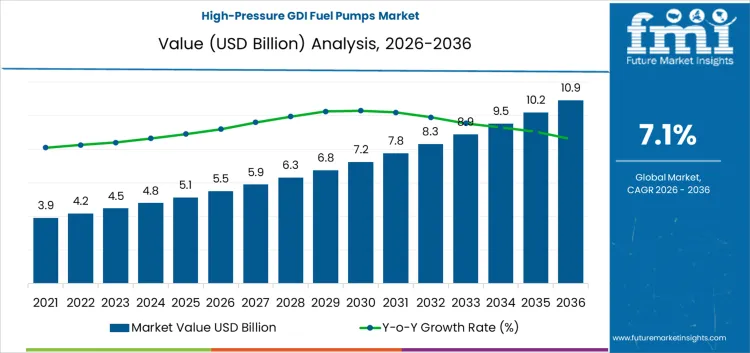
The high-pressure GDI fuel pumps market is valued at USD 5.5 billion in 2026 and is projected to reach USD 10.9 billion by 2036, reflecting a CAGR of 7.10%. Market performance is shaped by concentration in direct injection gasoline engines and the proportion of vehicle fleets equipped with GDI technology. End-use dependency on passenger vehicles and light commercial transport drives procurement priorities. Volume stability is influenced by production schedules, OEM adoption cycles, and engine program launches. Suppliers achieving consistency in pump performance and certification capture more predictable revenue streams, while smaller producers face variability in order flow and limited bargaining leverage.
Revenue quality is determined by the alignment between product reliability and fleet program commitments. Growth outcomes reflect integration with vehicle platforms and regulatory compliance for emissions standards. Concentration among high-volume OEM programs reduces risk exposure and stabilizes cash flow. Operators managing multi-program supply and inventory predictability maintain stronger margin performance. Fragmentation persists in aftermarket and regional segments, whereas leading suppliers leverage platform standardization to capture concentrated value across multiple applications.
Quick Stats of the High-Pressure GDI Fuel Pumps Market
- High-Pressure GDI Fuel Pumps Market Value (2026): USD 5.5 billion
- High-Pressure GDI Fuel Pumps Forecast Value (2036): USD 10.9 billion
- High-Pressure GDI Fuel Pumps Forecast CAGR 2026 to 2036: 7.10%
- High-Pressure GDI Fuel Pumps Leading Vehicle Segment: Passenger Vehicles
- High-Pressure GDI Fuel Pumps Leading Pump Architecture: Cam-Driven Mechanical
- High-Pressure GDI Fuel Pumps Key Growth Regions: Brazil, USA, South Korea, China, UK
- High-Pressure GDI Fuel Pumps Top Players: Bosch, Denso, Continental, Hitachi Astemo, Delphi (BorgWarner), Magna, Weifu High-Technology, Stanadyne, Marelli, Keihin
What is the Growth Forecast for High-Pressure GDI Fuel Pumps Market through 2036?
Between 2026 and 2031, the high-pressure GDI fuel pumps market is projected to grow from USD 5.5 billion to USD 7.2 billion, generating an absolute increase of USD 1.7 billion. The rolling CAGR for this period is approximately 6.1%. Volume contributes around 68% of growth, driven by rising adoption of gasoline direct injection engines in passenger vehicles, regulatory pressure on emissions, and increased fuel efficiency requirements. Price growth accounts for 32%, supported by advanced pump designs, material improvements, and premium performance offerings. Value capture favors suppliers with proven technology, OEM partnerships, and global distribution networks.
From 2031 to 2036, the market is expected to expand from USD 7.2 billion to USD 10.9 billion, adding USD 3.6 billion. The rolling CAGR for this period is approximately 7.9%, reflecting accelerated adoption due to higher penetration of GDI systems in light- and heavy-duty vehicles. Volume remains the dominant driver, contributing roughly 66% of growth due to increased vehicle production and engine upgrades. Price growth represents 34%, influenced by premium designs, durability improvements, and performance differentiation. Competitive advantage favors suppliers with validated technology, strong OEM integration, and scalable manufacturing.
High Pressure GDI Fuel Pumps Market Key Takeaways
| Metric | Value |
|---|---|
| Market Value (2026) | USD 5.5 billion |
| Forecast Value (2036) | USD 10.9 billion |
| Forecast CAGR 2026 to 2036 | 7.10% |
What Is Driving Growth in the High-Pressure GDI Fuel Pumps Market?
High-pressure gasoline direct injection (GDI) fuel pumps are increasingly adopted to support improved engine efficiency, performance, and emission control in modern vehicles. Historically, conventional port fuel injection systems offered lower injection pressures, limiting combustion efficiency and regulatory compliance with emission standards. GDI fuel pumps provide precise high-pressure fuel delivery directly into the combustion chamber, enhancing power output, fuel economy, and reduced particulate emissions. OEMs, aftermarket suppliers, and engine manufacturers prioritize pump reliability, pressure stability, and compatibility with turbocharged and downsized engines. Early adoption focused on premium and high-performance vehicles, while current demand spans mainstream passenger cars, commercial vehicles, and hybrid powertrains driven by stringent fuel efficiency regulations and consumer demand for improved engine performance.
Rising emission standards, fuel efficiency mandates, and adoption of downsized engines are shaping future demand for high-pressure GDI fuel pumps. Compared with earlier designs, modern pumps emphasize precision control, durability under high pressure, and integration with electronic engine management systems. Cost structures depend on material quality, manufacturing precision, and calibration, concentrating margins among suppliers providing reliable, regulatory-compliant solutions. Automakers adopt high-pressure GDI pumps to meet fuel economy targets, enhance combustion efficiency, and reduce exhaust emissions. By 2036, these fuel pumps are expected to be standard components in internal combustion and hybrid vehicles, supporting both performance and regulatory compliance across global automotive markets.
What Factors Are Shaping the Demand for High-Pressure GDI Fuel Pumps in Terms of Vehicle Segment and Pump Architecture?
The demand for high-pressure gasoline direct injection (GDI) fuel pumps is segmented by vehicle segment and pump architecture. Vehicle segments include passenger vehicles, light commercial vehicles (LCVs), performance and premium vehicles, and other categories. Pump architectures include cam-driven mechanical pumps, two-stage high-efficiency pumps, variable displacement pumps, and other specialized systems. Adoption is influenced by engine type, fuel efficiency requirements, and emission standards. Uptake is driven by performance optimization, regulatory compliance, and reliability under high-pressure conditions. Vehicle type and pump design selection depend on engine capacity, operational conditions, and maintenance considerations, ensuring optimal fuel delivery and engine performance.
Why Are Passenger Vehicles Leading the Vehicle Segment in High-Pressure GDI Fuel Pumps?
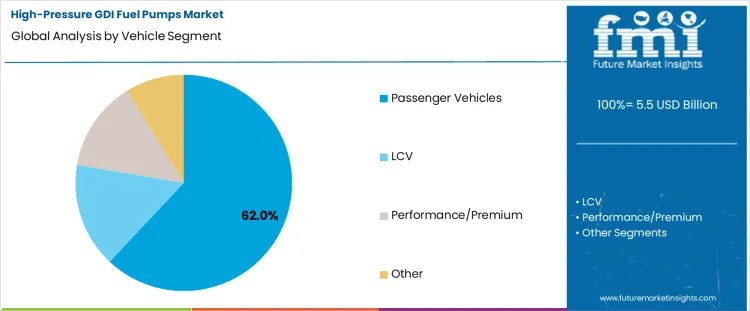
Passenger vehicles account for approximately 62% of total vehicle segment demand, making them the dominant category. Adoption is driven by widespread use of gasoline direct injection engines for fuel efficiency, emission control, and performance. High-pressure GDI pumps provide precise fuel delivery, supporting combustion efficiency and reducing emissions. Manufacturers prioritize reliability under high operating pressures, compatibility with engine management systems, and durability across a range of driving conditions. Maintenance schedules and component accessibility influence adoption, ensuring pumps maintain performance throughout the vehicle lifecycle. The segment leads because passenger vehicles represent the largest global fleet requiring optimized fuel injection systems.
Operational and design factors reinforce adoption. High-pressure pumps must tolerate pressure variations, temperature fluctuations, and continuous operation. Engine designers integrate pumps with cam-driven or two-stage systems to meet fuel delivery requirements. Performance monitoring ensures accurate injection, reduces engine knock, and improves efficiency. The segment leads because passenger vehicles combine fleet volume, operational demands, and regulatory compliance, making them the primary driver of high-pressure GDI fuel pump demand.
Why Is Cam-Driven Mechanical Pump Architecture Leading the Pump Architecture Segment in GDI Fuel Pumps?
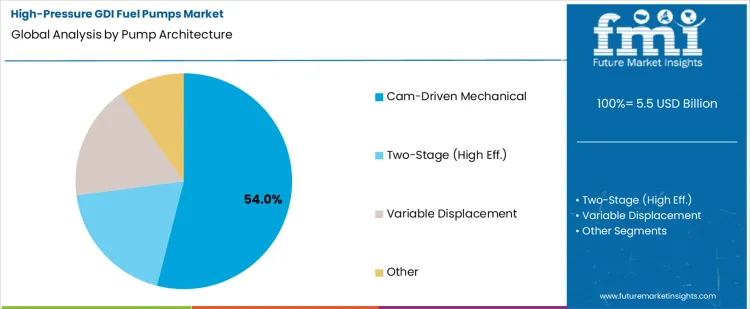
Cam-driven mechanical pumps account for approximately 54% of total pump architecture demand, making them the leading category. These pumps provide consistent, reliable high-pressure fuel delivery in gasoline direct injection engines. Adoption is reinforced by mechanical simplicity, ease of integration with existing engine components, and proven durability. Manufacturers apply cam-driven pumps in passenger and light commercial vehicles where consistent fuel pressure is critical. Maintenance procedures include monitoring pump performance, pressure output, and wear patterns to ensure operational reliability. The segment leads because cam-driven mechanical pumps combine precision, robustness, and cost-effective integration with a variety of engine types.
Operational factors further support adoption. Cam-driven pumps operate efficiently across temperature and pressure ranges while maintaining consistent injection timing. They reduce fuel pulsation, improve combustion efficiency, and support emission compliance. Designers integrate them with engine control systems for optimized performance. The segment leads because cam-driven mechanical pumps deliver measurable operational benefits, high reliability, and long-term durability in high-pressure GDI fuel delivery applications across global vehicle fleets.
How Are High-Pressure GDI Fuel Pumps Enhancing Engine Efficiency?
High-pressure gasoline direct injection (GDI) fuel pumps are increasingly adopted in passenger vehicles and commercial fleets to improve combustion efficiency, power output, and fuel economy. Adoption is strongest in regions with strict emission standards and growing demand for fuel-efficient engines. Pumps are selected for pressure stability, durability, and compatibility with advanced engine management systems. Growth is driven by regulatory mandates on fuel economy, rising vehicle production, and the shift toward downsized engines. Investment focuses on precision manufacturing, quality assurance, and integration with injection systems. OEMs prioritize pumps that deliver reliable performance while reducing emissions and meeting regional efficiency standards.
Why Are Emission Regulations and Fuel Efficiency Standards Driving Demand?
Demand is shaped by stringent regional and national regulations targeting CO2 and NOx reductions. Automotive manufacturers adopt high-pressure GDI pumps to meet fuel efficiency and emission compliance requirements. Pumps capable of maintaining stable high pressure under diverse operating conditions gain preference. Adoption is strongest in regions with aggressive environmental policies and high vehicle production. Regulatory compliance and engine performance reliability drive procurement rather than cost considerations. Suppliers offering validated, durable, and certified pumps achieve market preference among OEMs and tier-one automotive component manufacturers.
What Operational and Technical Factors Limit Broader Adoption?
High manufacturing costs, precision machining requirements, and the need for material durability limit wider deployment. Variability in fuel quality, operating conditions, and contamination risks can affect pump performance. Integration with complex engine control systems requires technical expertise. Certification and testing timelines may delay adoption of new designs. Smaller manufacturers or vehicle programs with limited budgets may face challenges implementing high-pressure GDI pumps. These factors concentrate early adoption among OEMs producing high-efficiency engines and well-funded automotive programs with technical capability and quality infrastructure.
How Are Technological Advances and Collaboration Shaping Market Growth?
Developments include high-strength materials, low-friction components, and precision flow control for enhanced fuel atomization and combustion. Partnerships between pump manufacturers, automotive OEMs, and engine system integrators ensure compatibility, performance validation, and regulatory compliance. Pilot testing under real-world engine conditions supports reliability before full-scale deployment. Quality monitoring and traceability systems maintain consistency and compliance with regional standards. Focus is on operational reliability, emissions reduction, and integration with engine systems rather than cost or volume. Collaborative efforts accelerate adoption, supporting efficient, high-performance gasoline direct injection engines across regional automotive markets.
What is the Demand for High-Pressure GDI Fuel Pumps by Country?
| Country | CAGR (%) |
|---|---|
| USA | 6.3% |
| South Korea | 5.8% |
| China | 5.3% |
| UK | 5.2% |
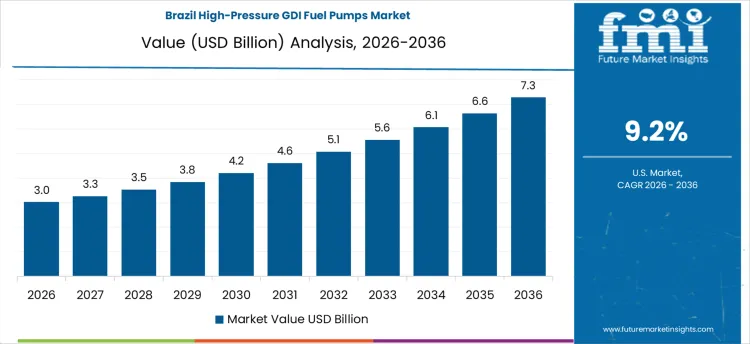
| Brazil | 9.2% |
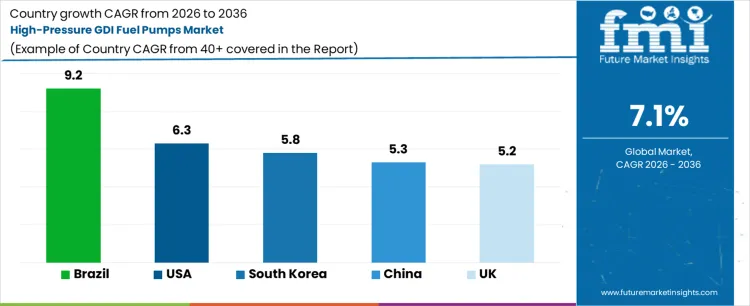
Demand for high-pressure GDI (Gasoline Direct Injection) fuel pumps is rising as automotive manufacturers focus on improving engine efficiency, reducing emissions, and enhancing performance. Brazil leads with a 9.2% CAGR, driven by growing vehicle production, stricter emission standards, and adoption of advanced GDI technology in passenger cars. The USA follows at 6.3%, supported by fleet modernization and integration of high-pressure fuel systems in new vehicles. South Korea records 5.8% growth, shaped by adoption in domestic automotive manufacturing and performance-focused vehicle segments. China grows at 5.3%, driven by gradual implementation of GDI technology in passenger vehicles. The UK shows 5.2% CAGR, reflecting steady adoption and replacement demand in both domestic and imported vehicles.
How Is the United States Experiencing Growth in the High-Pressure GDI Fuel Pumps Market?
United States is experiencing growth at a CAGR of 6.3%, supported by increasing adoption of gasoline direct injection (GDI) systems in light-duty and commercial vehicles to improve fuel efficiency and reduce emissions. Automotive manufacturers and suppliers are producing high-pressure fuel pumps designed to ensure precise fuel delivery, enhanced engine performance, and compliance with emission standards. Demand is concentrated in automotive manufacturing hubs, engine assembly plants, and aftermarket service centers. Investments prioritize pump reliability, precision engineering, and material durability rather than rapid expansion. Growth reflects regulatory pressure to meet fuel efficiency targets, increased vehicle production, and adoption of advanced engine technologies in both passenger and commercial segments.
- GDI system adoption drives demand.
- High-pressure fuel pumps ensure precise fuel delivery.
- Automotive hubs and assembly plants concentrate demand.
- Pump reliability and precision engineering guide investment.
How Is South Korea Witnessing Adoption Through Engine Efficiency Programs?
South Korea is witnessing growth at a CAGR of 5.8%, fueled by increased implementation of GDI engines in passenger and commercial vehicles to enhance fuel economy and reduce emissions. Automakers and suppliers are providing high-pressure fuel pumps to maintain engine performance, precision fuel injection, and compliance with emission regulations. Demand is concentrated in automotive manufacturing clusters, engine assembly plants, and service centers. Investments focus on material quality, pump durability, and performance precision rather than production scale expansion. Growth reflects vehicle manufacturers’ efforts to meet regulatory standards, increase engine efficiency, and adopt advanced fuel injection technologies.
- Fuel efficiency programs drive adoption.
- High-pressure pumps maintain precise fuel injection.
- Automotive clusters and assembly plants concentrate demand.
- Material quality and pump durability guide investment.
How Is China Experiencing Moderate Growth With GDI Engine Adoption?
China is experiencing growth at a CAGR of 5.3%, supported by rising adoption of GDI engines in passenger vehicles and light-duty commercial segments. Automakers and suppliers are producing high-pressure fuel pumps to enable efficient fuel delivery, reduce emissions, and improve engine performance. Demand is concentrated in urban automotive manufacturing hubs and assembly plants. Investments prioritize pump precision, material durability, and operational reliability rather than rapid production expansion. Growth reflects gradual adoption of advanced fuel injection technologies, regulatory compliance for emission standards, and increasing vehicle production in key metropolitan and industrial centers.
- GDI engine adoption drives demand.
- High-pressure fuel pumps improve fuel efficiency.
- Automotive hubs and assembly plants concentrate demand.
- Pump precision and reliability guide investment.
How Is the United Kingdom Growing With Engine Technology Advancements?
United Kingdom is growing at a CAGR of 5.2%, supported by adoption of GDI fuel pumps for light-duty vehicles and commercial fleets to improve fuel efficiency and reduce emissions. Automotive manufacturers and suppliers are deploying high-pressure pumps to ensure precision fuel delivery, consistent engine performance, and regulatory compliance. Demand is concentrated in automotive manufacturing clusters, engine assembly plants, and service centers. Investments focus on material quality, pump durability, and operational precision rather than fleet-scale expansion. Growth reflects gradual adoption of advanced fuel injection technologies, stricter emission regulations, and optimization of engine performance for passenger and commercial vehicles.
- Adoption of advanced engines drives demand.
- High-pressure pumps ensure precise fuel delivery.
- Automotive hubs and assembly plants concentrate demand.
- Pump durability and operational precision guide investment.
How Is Brazil Experiencing Rapid Growth With GDI Vehicle Expansion?
- GDI vehicle adoption drives demand.
- High-pressure pumps optimize fuel delivery and engine efficiency.
- Automotive hubs and assembly plants concentrate demand.
- Pump performance and durability guide investment.
Who Competes in the High-Pressure GDI Fuel Pumps Market and What Defines Their Capabilities?
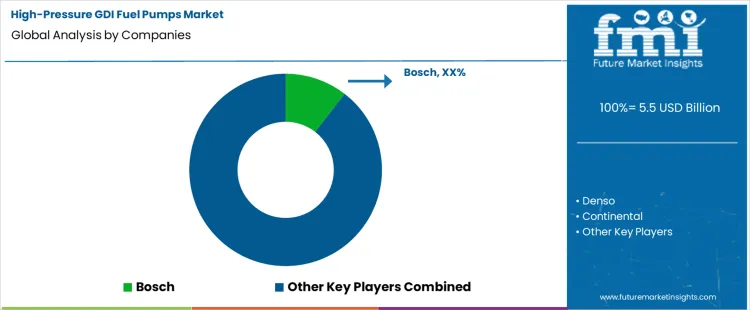
Competition in the high-pressure gasoline direct injection (GDI) fuel pumps market is shaped by differences in precision engineering, system integration, and global automotive OEM relationships. Bosch supplies high-pressure GDI pumps engineered for precise fuel delivery and durability under variable engine conditions. Denso focuses on compact pump designs with thermal stability and compatibility across diverse engine architectures. Continental offers fuel pump systems calibrated for responsiveness and integration with engine management electronics. Hitachi Astemo develops high-pressure GDI solutions with emphasis on vibration resistance and consistent performance.
Delphi (BorgWarner) provides fuel pumps paired with fuel system modules tailored to emission and efficiency targets. Magna competes through engineered pump assemblies designed for manufacturability and OEM integration. Weifu High-Technology focuses on cost-effective high-pressure pump solutions with regional supply strength. Stanadyne delivers fuel pumps engineered for consistent high pressure delivery across operating ranges. Marelli integrates pump technology within broader fuel system components. Keihin supplies precision fuel pump designs optimized for compact engine packages. Competitive differences arise from engineering tolerance, integration with engine control systems, and ability to meet emission and performance standards set by global OEMs.
Key Players in the High-Pressure GDI Fuel Pumps Market
- Bosch
- Denso
- Continental
- Hitachi Astemo
- Delphi (BorgWarner)
- Magna
- Weifu High-Technology
- Stanadyne
- Marelli
- Keihin
Scope of the Report
| Items | Values |
|---|---|
| Quantitative Units (2026) | USD billion |
| Vehicle Segment | Passenger Vehicles, LCV, Performance/Premium, Other |
| Pump Architecture | Cam-Driven Mechanical, Two-Stage (High Efficiency), Variable Displacement, Other |
| Pressure Class | 200-350 bar, 350-500 bar, 500+ bar, Other |
| Sales Channel | OEM Line-Fit, OES Replacement, Independent Aftermarket, Other |
| Region | Asia Pacific, Europe, North America, Latin America, Middle East & Africa |
| Key Countries Covered | China, Japan, South Korea, India, Australia & New Zealand, Germany, United Kingdom, France, Italy, Spain, Nordic, BENELUX, United States, Canada, Mexico, Brazil, Chile, Kingdom of Saudi Arabia, Other GCC Countries, Turkey, South Africa, Other African Union |
| Key Companies Profiled | Bosch, Denso, Continental, Hitachi Astemo, Delphi (BorgWarner), Magna, Weifu High-Technology, Stanadyne, Marelli, Keihin |
| Additional Attributes | Dollar sales by vehicle segment, pump architecture, and pressure class; OEM integration levels; regulatory compliance for emissions; aftermarket adoption rates; material and engineering performance; forecast CAGR and market growth by region and segment |
High-Pressure GDI Fuel Pumps Market Segmentation
Vehicle Segment:
- Passenger Vehicles
- LCV
- Performance/Premium
- Other
Pump Architecture:
- Cam-Driven Mechanical
- Two-Stage (High Eff.)
- Variable Displacement
- Other
Pressure Class:
- 200-350 bar
- 350-500 bar
- 500+ bar
- Other
Sales Channel:
- OEM Line-Fit
- OES Replacement
- Independent Aftermarket
- Other
Region
- Asia Pacific
- China
- Japan
- South Korea
- India
- Australia & New Zealand
- ASEAN
- Rest of Asia Pacific
- Europe
- Germany
- United Kingdom
- France
- Italy
- Spain
- Nordic
- BENELUX
- Rest of Europe
- North America
- United States
- Canada
- Mexico
- Latin America
- Brazil
- Chile
- Rest of Latin America
- Middle East & Africa
- Kingdom of Saudi Arabia
- Other GCC Countries
- Turkey
- South Africa
- Other African Union
- Rest of Middle East & Africa
Bibilography
- International Energy Agency. (2023).
Global vehicle efficiency trends and internal combustion engine technology pathways. IEA Transport Sector Report. - United States Environmental Protection Agency. (2024).
Light-duty vehicle greenhouse gas emissions standards and gasoline direct injection technologies. EPA Office of Transportation and Air Quality. - European Commission. (2023).
EURO 7 proposal: Emission limits and implications for gasoline direct injection systems. Directorate-General for Mobility and Transport. - Society of Automotive Engineers International. (2023).
SAE technical papers on high-pressure gasoline direct injection fuel pump design, durability, and pressure control. SAE Mobility Knowledge. - International Organization for Standardization. (2022).
ISO standards for fuel injection systems and high-pressure fuel delivery components in spark-ignition engines. ISO Technical Committees. - National Renewable Energy Laboratory. (2024).
GDI engine performance, fuel pressure systems, and emission reduction pathways. NREL Vehicle Technologies Research. - Zhao, F., et al. (2022).
High-pressure gasoline direct injection systems: Combustion efficiency, particulate emissions, and fuel pump performance. Applied Energy, Elsevier. - Li, X., et al. (2023).
Durability and wear behavior of high-pressure fuel pumps in gasoline direct injection engines. Tribology International, Elsevier.
Frequently Asked Questions
How big is the high-pressure gdi fuel pumps market in 2026?
The global high-pressure gdi fuel pumps market is estimated to be valued at USD 5.5 billion in 2026.
What will be the size of high-pressure gdi fuel pumps market in 2036?
The market size for the high-pressure gdi fuel pumps market is projected to reach USD 10.9 billion by 2036.
How much will be the high-pressure gdi fuel pumps market growth between 2026 and 2036?
The high-pressure gdi fuel pumps market is expected to grow at a 7.1% CAGR between 2026 and 2036.
What are the key product types in the high-pressure gdi fuel pumps market?
The key product types in high-pressure gdi fuel pumps market are passenger vehicles, lcv, performance/premium and other.
Which pump architecture segment to contribute significant share in the high-pressure gdi fuel pumps market in 2026?
In terms of pump architecture, cam-driven mechanical segment to command 54.0% share in the high-pressure gdi fuel pumps market in 2026.
Preview the report firsthand - request a free sample
Get SampleGet the brochure for pricing and purchase details.
Get PDFTable of Content
- Executive Summary
- Global Market Outlook
- Demand-side Trends
- Supply-side Trends
- Technology Roadmap Analysis
- Analysis and Recommendations
- Market Overview
- Market Coverage / Taxonomy
- Market Definition / Scope / Limitations
- Market Background
- Market Dynamics
- Drivers
- Restraints
- Opportunity
- Trends
- Scenario Forecast
- Demand in Optimistic Scenario
- Demand in Likely Scenario
- Demand in Conservative Scenario
- Opportunity Map Analysis
- Product Life Cycle Analysis
- Supply Chain Analysis
- Investment Feasibility Matrix
- Value Chain Analysis
- PESTLE and Porter’s Analysis
- Regulatory Landscape
- Regional Parent Market Outlook
- Production and Consumption Statistics
- Import and Export Statistics
- Market Dynamics
- Global Market Analysis 2021 to 2025 and Forecast, 2026 to 2036
- Historical Market Size Value (USD Million) Analysis, 2021 to 2025
- Current and Future Market Size Value (USD Million) Projections, 2026 to 2036
- Y-o-Y Growth Trend Analysis
- Absolute $ Opportunity Analysis
- Global Market Pricing Analysis 2021 to 2025 and Forecast 2026 to 2036
- Global Market Analysis 2021 to 2025 and Forecast 2026 to 2036, By Vehicle Segment
- Introduction / Key Findings
- Historical Market Size Value (USD Million) Analysis By Vehicle Segment , 2021 to 2025
- Current and Future Market Size Value (USD Million) Analysis and Forecast By Vehicle Segment , 2026 to 2036
- Passenger Vehicles
- LCV
- Performance/Premium
- Other
- Passenger Vehicles
- Y-o-Y Growth Trend Analysis By Vehicle Segment , 2021 to 2025
- Absolute $ Opportunity Analysis By Vehicle Segment , 2026 to 2036
- Global Market Analysis 2021 to 2025 and Forecast 2026 to 2036, By Pump Architecture
- Introduction / Key Findings
- Historical Market Size Value (USD Million) Analysis By Pump Architecture, 2021 to 2025
- Current and Future Market Size Value (USD Million) Analysis and Forecast By Pump Architecture, 2026 to 2036
- Cam-Driven Mechanical
- Two-Stage (High Eff.)
- Variable Displacement
- Other
- Cam-Driven Mechanical
- Y-o-Y Growth Trend Analysis By Pump Architecture, 2021 to 2025
- Absolute $ Opportunity Analysis By Pump Architecture, 2026 to 2036
- Global Market Analysis 2021 to 2025 and Forecast 2026 to 2036, By Pressure Class
- Introduction / Key Findings
- Historical Market Size Value (USD Million) Analysis By Pressure Class, 2021 to 2025
- Current and Future Market Size Value (USD Million) Analysis and Forecast By Pressure Class, 2026 to 2036
- 200–350 bar
- 350–500 bar
- 500+ bar
- Other
- 200–350 bar
- Y-o-Y Growth Trend Analysis By Pressure Class, 2021 to 2025
- Absolute $ Opportunity Analysis By Pressure Class, 2026 to 2036
- Global Market Analysis 2021 to 2025 and Forecast 2026 to 2036, By Sales Channel
- Introduction / Key Findings
- Historical Market Size Value (USD Million) Analysis By Sales Channel, 2021 to 2025
- Current and Future Market Size Value (USD Million) Analysis and Forecast By Sales Channel, 2026 to 2036
- OEM Line-Fit
- OES Replacement
- Independent Aftermarket
- Other
- OEM Line-Fit
- Y-o-Y Growth Trend Analysis By Sales Channel, 2021 to 2025
- Absolute $ Opportunity Analysis By Sales Channel, 2026 to 2036
- Global Market Analysis 2021 to 2025 and Forecast 2026 to 2036, By Region
- Introduction
- Historical Market Size Value (USD Million) Analysis By Region, 2021 to 2025
- Current Market Size Value (USD Million) Analysis and Forecast By Region, 2026 to 2036
- North America
- Latin America
- Western Europe
- Eastern Europe
- East Asia
- South Asia and Pacific
- Middle East & Africa
- Market Attractiveness Analysis By Region
- North America Market Analysis 2021 to 2025 and Forecast 2026 to 2036, By Country
- Historical Market Size Value (USD Million) Trend Analysis By Market Taxonomy, 2021 to 2025
- Market Size Value (USD Million) Forecast By Market Taxonomy, 2026 to 2036
- By Country
- USA
- Canada
- Mexico
- By Vehicle Segment
- By Pump Architecture
- By Pressure Class
- By Sales Channel
- By Country
- Market Attractiveness Analysis
- By Country
- By Vehicle Segment
- By Pump Architecture
- By Pressure Class
- By Sales Channel
- Key Takeaways
- Latin America Market Analysis 2021 to 2025 and Forecast 2026 to 2036, By Country
- Historical Market Size Value (USD Million) Trend Analysis By Market Taxonomy, 2021 to 2025
- Market Size Value (USD Million) Forecast By Market Taxonomy, 2026 to 2036
- By Country
- Brazil
- Chile
- Rest of Latin America
- By Vehicle Segment
- By Pump Architecture
- By Pressure Class
- By Sales Channel
- By Country
- Market Attractiveness Analysis
- By Country
- By Vehicle Segment
- By Pump Architecture
- By Pressure Class
- By Sales Channel
- Key Takeaways
- Western Europe Market Analysis 2021 to 2025 and Forecast 2026 to 2036, By Country
- Historical Market Size Value (USD Million) Trend Analysis By Market Taxonomy, 2021 to 2025
- Market Size Value (USD Million) Forecast By Market Taxonomy, 2026 to 2036
- By Country
- Germany
- UK
- Italy
- Spain
- France
- Nordic
- BENELUX
- Rest of Western Europe
- By Vehicle Segment
- By Pump Architecture
- By Pressure Class
- By Sales Channel
- By Country
- Market Attractiveness Analysis
- By Country
- By Vehicle Segment
- By Pump Architecture
- By Pressure Class
- By Sales Channel
- Key Takeaways
- Eastern Europe Market Analysis 2021 to 2025 and Forecast 2026 to 2036, By Country
- Historical Market Size Value (USD Million) Trend Analysis By Market Taxonomy, 2021 to 2025
- Market Size Value (USD Million) Forecast By Market Taxonomy, 2026 to 2036
- By Country
- Russia
- Poland
- Hungary
- Balkan & Baltic
- Rest of Eastern Europe
- By Vehicle Segment
- By Pump Architecture
- By Pressure Class
- By Sales Channel
- By Country
- Market Attractiveness Analysis
- By Country
- By Vehicle Segment
- By Pump Architecture
- By Pressure Class
- By Sales Channel
- Key Takeaways
- East Asia Market Analysis 2021 to 2025 and Forecast 2026 to 2036, By Country
- Historical Market Size Value (USD Million) Trend Analysis By Market Taxonomy, 2021 to 2025
- Market Size Value (USD Million) Forecast By Market Taxonomy, 2026 to 2036
- By Country
- China
- Japan
- South Korea
- By Vehicle Segment
- By Pump Architecture
- By Pressure Class
- By Sales Channel
- By Country
- Market Attractiveness Analysis
- By Country
- By Vehicle Segment
- By Pump Architecture
- By Pressure Class
- By Sales Channel
- Key Takeaways
- South Asia and Pacific Market Analysis 2021 to 2025 and Forecast 2026 to 2036, By Country
- Historical Market Size Value (USD Million) Trend Analysis By Market Taxonomy, 2021 to 2025
- Market Size Value (USD Million) Forecast By Market Taxonomy, 2026 to 2036
- By Country
- India
- ASEAN
- Australia & New Zealand
- Rest of South Asia and Pacific
- By Vehicle Segment
- By Pump Architecture
- By Pressure Class
- By Sales Channel
- By Country
- Market Attractiveness Analysis
- By Country
- By Vehicle Segment
- By Pump Architecture
- By Pressure Class
- By Sales Channel
- Key Takeaways
- Middle East & Africa Market Analysis 2021 to 2025 and Forecast 2026 to 2036, By Country
- Historical Market Size Value (USD Million) Trend Analysis By Market Taxonomy, 2021 to 2025
- Market Size Value (USD Million) Forecast By Market Taxonomy, 2026 to 2036
- By Country
- Kingdom of Saudi Arabia
- Other GCC Countries
- Turkiye
- South Africa
- Other African Union
- Rest of Middle East & Africa
- By Vehicle Segment
- By Pump Architecture
- By Pressure Class
- By Sales Channel
- By Country
- Market Attractiveness Analysis
- By Country
- By Vehicle Segment
- By Pump Architecture
- By Pressure Class
- By Sales Channel
- Key Takeaways
- Key Countries Market Analysis
- USA
- Pricing Analysis
- Market Share Analysis, 2025
- By Vehicle Segment
- By Pump Architecture
- By Pressure Class
- By Sales Channel
- Canada
- Pricing Analysis
- Market Share Analysis, 2025
- By Vehicle Segment
- By Pump Architecture
- By Pressure Class
- By Sales Channel
- Mexico
- Pricing Analysis
- Market Share Analysis, 2025
- By Vehicle Segment
- By Pump Architecture
- By Pressure Class
- By Sales Channel
- Brazil
- Pricing Analysis
- Market Share Analysis, 2025
- By Vehicle Segment
- By Pump Architecture
- By Pressure Class
- By Sales Channel
- Chile
- Pricing Analysis
- Market Share Analysis, 2025
- By Vehicle Segment
- By Pump Architecture
- By Pressure Class
- By Sales Channel
- Germany
- Pricing Analysis
- Market Share Analysis, 2025
- By Vehicle Segment
- By Pump Architecture
- By Pressure Class
- By Sales Channel
- UK
- Pricing Analysis
- Market Share Analysis, 2025
- By Vehicle Segment
- By Pump Architecture
- By Pressure Class
- By Sales Channel
- Italy
- Pricing Analysis
- Market Share Analysis, 2025
- By Vehicle Segment
- By Pump Architecture
- By Pressure Class
- By Sales Channel
- Spain
- Pricing Analysis
- Market Share Analysis, 2025
- By Vehicle Segment
- By Pump Architecture
- By Pressure Class
- By Sales Channel
- France
- Pricing Analysis
- Market Share Analysis, 2025
- By Vehicle Segment
- By Pump Architecture
- By Pressure Class
- By Sales Channel
- India
- Pricing Analysis
- Market Share Analysis, 2025
- By Vehicle Segment
- By Pump Architecture
- By Pressure Class
- By Sales Channel
- ASEAN
- Pricing Analysis
- Market Share Analysis, 2025
- By Vehicle Segment
- By Pump Architecture
- By Pressure Class
- By Sales Channel
- Australia & New Zealand
- Pricing Analysis
- Market Share Analysis, 2025
- By Vehicle Segment
- By Pump Architecture
- By Pressure Class
- By Sales Channel
- China
- Pricing Analysis
- Market Share Analysis, 2025
- By Vehicle Segment
- By Pump Architecture
- By Pressure Class
- By Sales Channel
- Japan
- Pricing Analysis
- Market Share Analysis, 2025
- By Vehicle Segment
- By Pump Architecture
- By Pressure Class
- By Sales Channel
- South Korea
- Pricing Analysis
- Market Share Analysis, 2025
- By Vehicle Segment
- By Pump Architecture
- By Pressure Class
- By Sales Channel
- Russia
- Pricing Analysis
- Market Share Analysis, 2025
- By Vehicle Segment
- By Pump Architecture
- By Pressure Class
- By Sales Channel
- Poland
- Pricing Analysis
- Market Share Analysis, 2025
- By Vehicle Segment
- By Pump Architecture
- By Pressure Class
- By Sales Channel
- Hungary
- Pricing Analysis
- Market Share Analysis, 2025
- By Vehicle Segment
- By Pump Architecture
- By Pressure Class
- By Sales Channel
- Kingdom of Saudi Arabia
- Pricing Analysis
- Market Share Analysis, 2025
- By Vehicle Segment
- By Pump Architecture
- By Pressure Class
- By Sales Channel
- Turkiye
- Pricing Analysis
- Market Share Analysis, 2025
- By Vehicle Segment
- By Pump Architecture
- By Pressure Class
- By Sales Channel
- South Africa
- Pricing Analysis
- Market Share Analysis, 2025
- By Vehicle Segment
- By Pump Architecture
- By Pressure Class
- By Sales Channel
- USA
- Market Structure Analysis
- Competition Dashboard
- Competition Benchmarking
- Market Share Analysis of Top Players
- By Regional
- By Vehicle Segment
- By Pump Architecture
- By Pressure Class
- By Sales Channel
- Competition Analysis
- Competition Deep Dive
- Bosch
- Overview
- Product Portfolio
- Profitability by Market Segments (Product/Age /Sales Channel/Region)
- Sales Footprint
- Strategy Overview
- Marketing Strategy
- Product Strategy
- Channel Strategy
- Denso
- Continental
- Hitachi Astemo
- Delphi (BorgWarner)
- Magna
- Weifu High-Technology
- Stanadyne
- Marelli
- Keihin
- Bosch
- Competition Deep Dive
- Assumptions & Acronyms Used
- Research Methodology


