

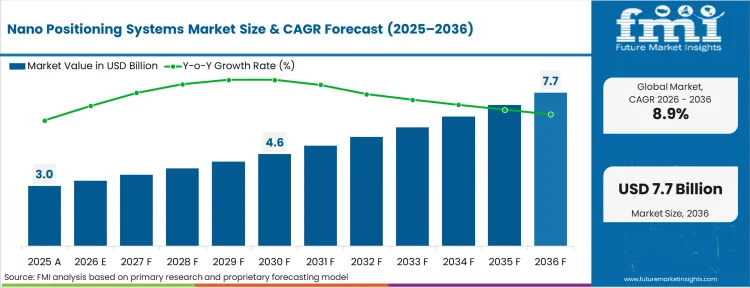
- Industry Size (2026)
- USD 3.3 Bn
- Forecast (2036)
- USD 7.7 Bn
- CAGR (2026 to 2036)
- 8.9%
Nano Positioning Systems Market Size, Market Forecast and Outlook By FMI
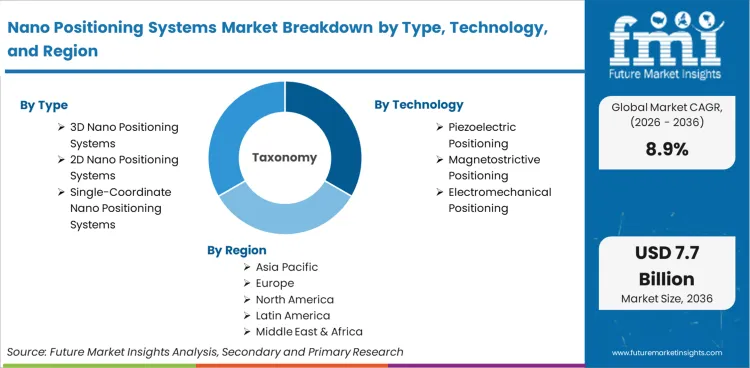
The nano positioning systems market stood at USD 3.0 billion in 2025. The sector is poised to cross USD 3.3 billion in 2026 at a CAGR of 8.9% during the forecast period. Demand outlook propels the valuation to USD 7.7 billion through 2036 as the transition from macro-scale semiconductor lithography to sub-nanometer node fabrication requires active atomic-level alignment that legacy mechanical stages cannot achieve.
Buyers in this space are being forced to choose between upgrading legacy open-loop stages with external sensors or investing in inherently closed-loop, active kinematic architectures. Opting for open-loop retrofits saves initial capital but introduces severe integration latency, directly bottlenecking the throughput of advanced semiconductor metrology and inspection lines. Delaying the transition to fully active stages costs Tier-1 foundries their competitive edge in yield rates. According to FMI's estimates, the focus on bare resolution in specification sheets masks the true operational friction: settling time, which dictates the actual pace of high-throughput wafer scanning.
The integration of AI-driven capacitance estimation directly within the feedback loop, eliminating bulky external hardware, is the structural gate that makes the next unit of precision metrology robots significantly easier to deploy. Once closed-loop algorithms operate entirely on-board without external dimensional displacement sensors, the barrier to scaling multi-axis systems vanishes.
Summary of Nano Positioning Systems Market
- Nano Positioning Systems Market Definition
- The market consists of frictionless, closed-loop motion control mechanisms engineered to manipulate payloads with sub-nanometer resolution. It is defined by the absolute elimination of mechanical hysteresis, utilizing flexure guidance and active sensor feedback to overcome the inherent physical limitations of traditional motorized positioning.
- Demand Drivers in the Market
- The commercialization of angstrom-era semiconductor nodes compels yield engineers to deploy active vibration compensation within vacuum environments.
- High-throughput genome sequencing automation forces laboratory operations directors to mandate millisecond-level settling times for continuous scanning routines.
- Shrinking tolerances in quantum communications hardware pushes photonics integrators to source six-degree-of-freedom parallel kinematic alignment systems.
- Key Segments Analyzed in the FMI Report
- 3D Nano Positioning Systems: 3D Nano Positioning Systems is expected to grab 45.0% share in 2026, driven by the geometric complexity of modern wafer architectures that require simultaneous X-Y-Z manipulation without cascading mechanical error.
- Piezoelectric Positioning: Piezoelectric Positioning is anticipated to hold 55.0% share in 2026, as it provides the only vacuum-compatible, infinite-resolution drive mechanism capable of operating inside extreme ultraviolet environments.
- Semiconductor Manufacturing: Semiconductor Manufacturing accounts for 40.0% of the application landscape, forced by the physical impossibility of relying on passive isolation for angstrom-level feature sizes.
- Electronics: The Electronics end-use sector claims 35.0% share, reflecting the sheer volume of high-precision component testing required in consumer device supply chains.
- India: 13.0% CAGR, driven by aggressive greenfield fab construction that implements sub-nanometer metrology without the burden of legacy equipment replacement.
- Analyst Opinion at FMI
- Rahul Pandita, Principal Analyst, Technology, at FMI, opines, "The generalist assumption that extreme resolution dictates procurement is widely held and partially true, until the equipment hits the production floor. The measurement that actually governs Tier-1 foundry purchasing is settling time. A piezoceramic stage that hits a 0.1-nanometer target but takes 50 milliseconds to stabilize completely ruins the throughput economics of an automated wafer inspection line. The vendors capturing premium contracts are those writing faster proprietary control algorithms, not just building stiffer flexures."
- Strategic Implications / Executive Takeaways
- Foundry procurement directors must prioritize onboard closed-loop control algorithms to eliminate the latency penalties associated with external displacement feedback.
- Photonics equipment integrators should secure long-term piezoceramic supply contracts to avoid impending bottlenecks in high-grade vacuum-compatible actuator production.
- Emerging market calibration laboratories face a critical skills gap in tuning high-bandwidth digital controllers that requires immediate vendor-partnered training initiatives.
- Methodology
- Primary Research: Insights sourced directly from lithography capacity planners and optical systems integration leads.
- Desk Research: Aggregation of technical specifications from advanced photonics roadmaps and metrology standard publications.
- Market-Sizing and Forecasting: Anchored to verifiable capital expenditure deployments in next-generation fab construction.
- Data Validation and Update Cycle: Cross-referenced against independent semiconductor equipment billing reports to eliminate localized spending anomalies.
India is expected to track at 13.0%, followed by China at 12.0%, South Korea at 11.0%, Japan at 10.0%, Germany at 9.0%, the United States at 8.0%, and the United Kingdom at 8.0%. This divergence reflects a fundamental shift where greenfield fabrication investments in emerging hubs completely bypass legacy mechanical architectures, while mature regions must untangle existing, heavily integrated high purity process systems for semiconductor infrastructure before implementing true nanometer-scale upgrades.
Nano Positioning Systems Market Definition
The Nano Positioning Systems Market encompasses electromechanical, magnetostrictive, and piezoceramic architectures designed to generate, measure, and stabilize motion at the sub-nanometer scale. It is functionally distinct from macro-scale motorized staging by its reliance on frictionless flexure guidance and closed-loop position feedback, isolating payloads from external vibrational resonance during atomic-level manufacturing and measurement operations.
Nano Positioning Systems Market Inclusions
This market includes single-axis actuators, multi-coordinate parallel kinematic mechanisms, piezoceramic stacks, capacitive and interferometric position sensors embedded within stages, and the high-bandwidth digital controllers required to drive them. Integrated sub-assemblies utilized as consumable parts for semiconductor equipment within electron microscopy and extreme ultraviolet lithography fall strictly within the scope of this analysis.
Nano Positioning Systems Market Exclusions
The market explicitly excludes traditional stepper-motor linear stages, macro-robotic gantries, and passive pneumatic vibration isolation tables. These systems are excluded because they rely on mechanical bearings that inherently introduce hysteresis and backlash, making them structurally incapable of providing the single-digit nanometer repeatability required by the end-user applications modeled in this forecast.
Nano Positioning Systems Market Research Methodology
- Primary Research: Sourcing directors at major semiconductor fabrication facilities and lead integration engineers at optical metrology tool manufacturers were interviewed to establish true operational upgrade cycles.
- Desk Research: Technical specifications from precision engineering registries, capability matrices from the American Institute of Physics, and patent filings for capacitive feedback control algorithms were analyzed.
- Market-Sizing and Forecasting: The baseline anchors to annual capital expenditure models for extreme ultraviolet lithography capacity expansion and associated metrology infrastructure.
- Data Validation and Update Cycle: Forecasts were triangulated against quarterly capital equipment bookings reported by leading global foundries and photonics research clusters.
Segmental Analysis
Nano Positioning Systems Market Analysis by Type
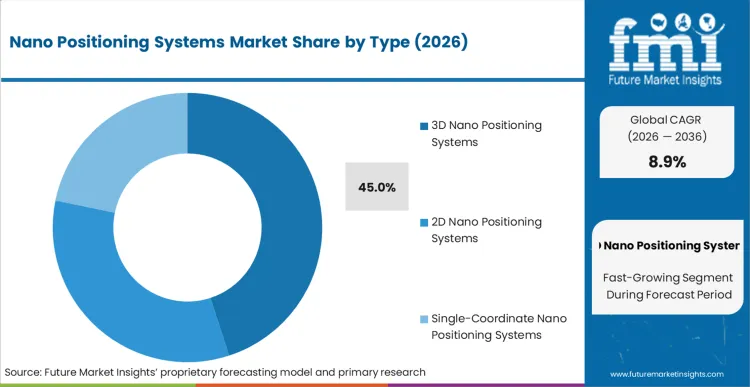
Facilities that rely on legacy stacked stages for volumetric scanning experience severe drift over time, driving up United States ultra short base line (USBL) positioning systems calibration costs and degrading overall throughput. Stacked single-axis stages introduce a cumulative mechanical error that modern optical inspection cannot tolerate, forcing integrators toward true multi-axis kinematics. 3D nano positioning systems holds a commanding 45.0% share because they calculate and execute motion in three dimensions simultaneously, eliminating the orthogonal mismatch inherent in bolted assemblies. As per FMI's projection, the shift from serial to parallel kinematic mechanisms changes how alignment routines are programmed, transferring complexity from the hardware flexures to the digital control algorithms.
- Orthogonal Integrity: Integrated multi-axis flexures eliminate the parasitic friction introduced when bolting discrete stages together. Foundries achieve absolute volumetric accuracy without compounding thermal drift across mechanical interfaces.
- Control Architecture: Centralized processing of all motion vectors allows the controller to preemptively cancel out cross-talk between axes. Alignment engineers compress complex scanning routines into fraction-of-a-second execution windows.
- Payload Penalty: Parallel kinematics provide superior stiffness but restrict the maximum mass the stage can manipulate at high frequencies. Integrators must severely lightweight their optical heads to fully capture the dynamic advantages.
Nano Positioning Systems Market Analysis by Technology
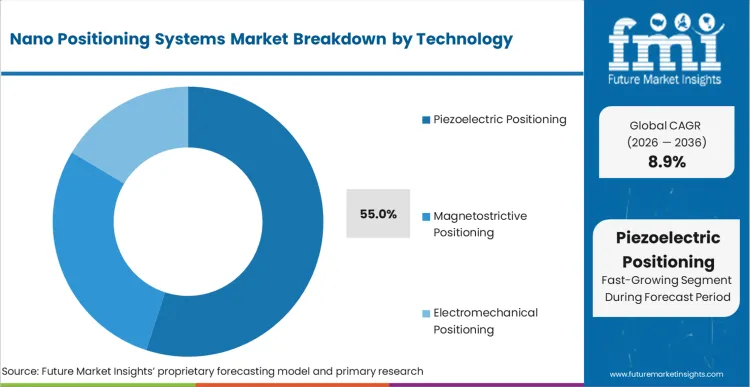
Traditional voice coils outgas in high-vacuum environments and suffer from electromagnetic interference, making them entirely unsuitable for extreme ultraviolet piezoelectric devices applications. The reason Piezoelectric Positioning holds 55.0% of this market comes down to a structural necessity: vacuum compatibility combined with infinite resolution. FMI analysts opine that piezoceramic stacks, which expand through crystalline deformation rather than magnetic induction, provide the only drive mechanism capable of operating deep inside next-generation lithography chambers without contaminating the environment. Yield engineers utilizing this technology operate with zero mechanical backlash, allowing immediate sub-nanometer corrections based on real-time interferometric feedback. Falling behind on piezoceramic integration leaves metrology providers structurally locked out of the angstrom-era supply chain.
- Initial Specification: Buyers specify piezoceramic actuators primarily to eliminate the magnetic fields that distort sensitive electron-beam microscopy paths.
- Qualification Hurdle: The material's inherent hysteresis requires sophisticated mathematical modeling to linearize the output during the qualification phase.
- Lifecycle Reality: Piezoceramics lose stroke length over millions of cycles under high dynamic loads. Maintenance operations must implement software-driven stroke compensation to maintain nanometer accuracy year over year.
Nano Positioning Systems Market Analysis by Application
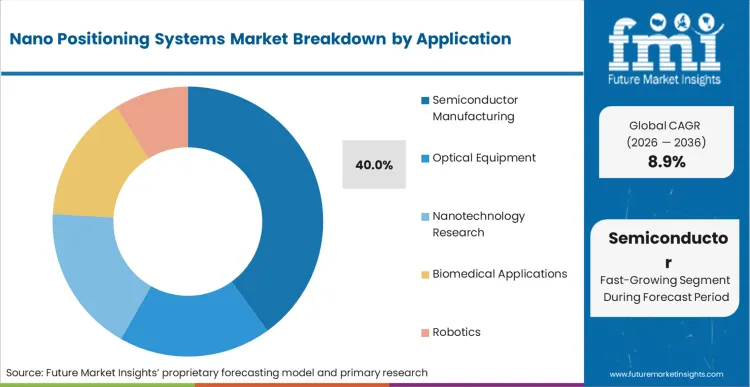
Yield engineers operating angstrom-era nodes face a binary choice: implement active closed-loop stage control or accept crippling false-defect rates during extreme ultraviolet wafer inspection. Semiconductor Manufacturing dominates with 40.0% share because the physical limits of passive vibration isolation have been permanently crossed by current feature sizes. Facilities that attempt to stretch the lifespan of older metrology frames by relying solely on software image-stitching face compounding computational latency that ultimately destroys their unit economics. Based on FMI's assessment, the integration of real-time multi-axis compensation directly underneath the semiconductor bonding equipment head changes the yield calculation from a mechanical constraint to a software constraint.
- Vibration Threshold: Active structural damping prevents facility-level floor resonance from blurring sub-nanometer optical captures. Quality assurance directors reclaim measurement certainty in heavy-industrial fabrication environments.
- Thermal Drift: Continuous closed-loop feedback automatically counteracts the nanometer-scale expansion caused by ambient temperature shifts. Fabrication environments bypass the need for absolute thermal isolation enclosures.
- Execution Bottleneck: Capturing the full benefit of active positioning requires a synchronous real-time operating system to trigger the metrology hardware. Facilities face major IT architecture upgrades to handle the resulting microsecond-level data streams.
Nano Positioning Systems Market Analysis by End Use Industry
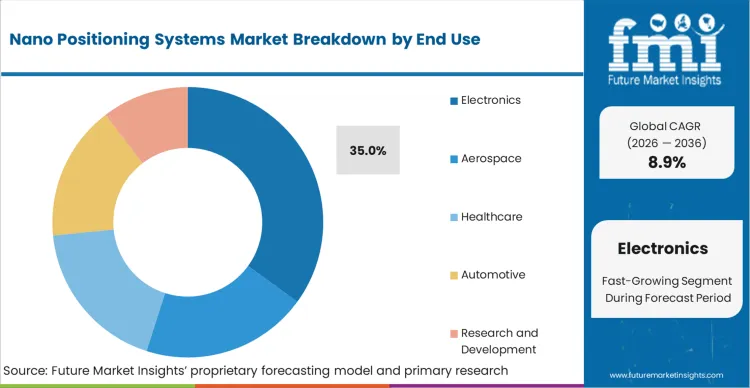
The commercial necessity of achieving zero-defect rates in high-density consumer electronics packaging creates an absolute floor on acceptable alignment tolerance. According to FMI's estimates, as surface-mount technology continues to miniaturize, reliance on global positioning systems and related micro-components demands metrology that can step and settle within milliseconds. The Electronics sector secures 35.0% share, reflecting the sheer volume of components that must undergo high-speed, high-resolution optical validation before final assembly. Failing to integrate active feedback loops at the metrology level forces fabrication facilities to run inspection lines at half-speed, directly eroding the margin on high-volume consumer device contracts.
- High-throughput Producers: Tier-1 electronics assemblers adopt sub-nanometer stages first to clear the inspection bottleneck on advanced communication boards.
- Mid-market Followers: Secondary packaging facilities wait for the capital cost of closed-loop controllers to compress before abandoning legacy stepper-motor lines.
- Legacy Holdouts: Specialized low-volume aerospace electronics manufacturers convert last, transitioning only when their prime contractors rewrite the foundational inspection standards to require active alignment verification.
Nano Positioning Systems Market Drivers, Restraints, and Opportunities
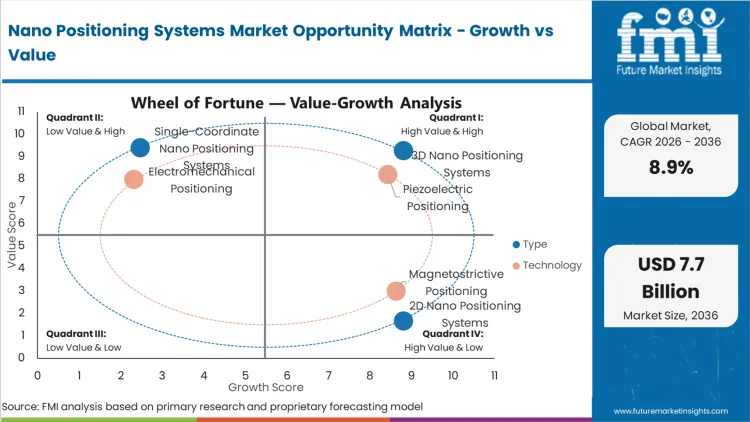
The absolute necessity to protect single-digit nanometer yield rates leaves no room for mechanical error, forcing foundry capacity planners to mandate closed-loop kinematic mounts across all new extreme ultraviolet deployments. This transition is not driven by general technological advancement, but by a hard physical barrier where floor vibrations natively exceed the width of the etched circuitry. Foundries must secure precision high precision confocal sensor architectures to eliminate the blur that invalidates high-speed inspection. Planners who secure these active systems protect their yield rates; those who delay suffer catastrophic false-positive defect flagging that paralyzes the production line.
The sheer complexity of retrofitting active piezoceramics into outdated optical benches acts as the primary organizational friction slowing adoption across legacy research facilities. Integrating a high-bandwidth piezoelectric stage into an existing metrology frame requires rewriting the core synchronization software to handle microsecond feedback loops, a skill set rarely maintained in-house. While vendors offer pre-compiled trimming and forming system middleware, it often clashes with proprietary legacy imaging software, creating a software integration lifecycle that outlasts the hardware installation phase.
Opportunities in the Nano Positioning Systems Market
- AI-driven Capacitance Estimation: The elimination of external sensors through software modeling reduces the footprint of multi-axis stages. Control algorithm developers who perfect this approach capture lucrative contracts in space-constrained vacuum chamber retrofits.
- Automated Photonics Alignment: The explosion of silicon photonics requires six-degree-of-freedom manipulation to align fiber arrays. Integrators building specialized parallel kinematic routines secure a near-monopoly on Tier-1 optical transceiver manufacturing lines, driving demand for innovations such as the wafer batch aligner.
- Embedded Structural Kinematics: Moving from bolted stages to chassis-integrated flexures removes parasitic mass. Specialized machine tool builders who partner with piezoceramic foundries redefine the baseline stability metrics for next-generation microscopy.
Regional Analysis
Global adoption of nano positioning architectures diverges sharply based on localized industrial policies, existing infrastructure maturity, and the specific high-precision applications dominating each territory. This regional variation dictates whether buyers are retrofitting legacy systems or deploying native sub-nanometer capabilities in greenfield developments with the nano positioning systems market being segmented into North America, Europe, and Asia Pacific across 40 plus countries.
.webp "Top Country Growth Comparison Nano Positioning Systems Market Cagr (2026 2036)")
| Country | CAGR (2026 to 2036) |
|---|---|
| India | 13.0% |
| China | 12.0% |
| South Korea | 11.0% |
| Japan | 10.0% |
| Germany | 9.0% |
| United States | 8.0% |
| United Kingdom | 8.0% |
Source: Future Market Insights (FMI) analysis, based on proprietary forecasting model and primary research
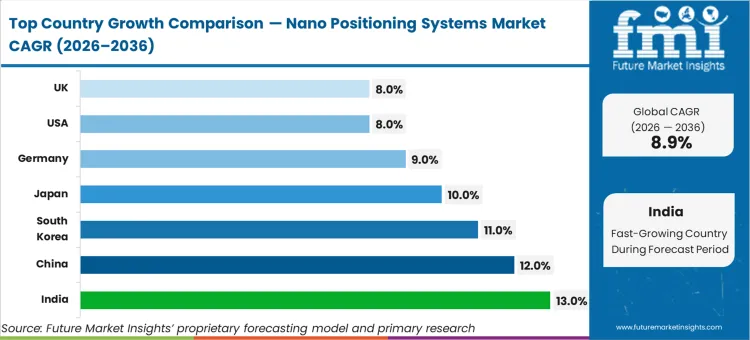
Asia Pacific Nano Positioning Systems Market Analysis
In FMI's view, Asian foundries leveraging this economics-led strategy can standardize on parallel kinematic control architectures immediately, and, when specifying wafer manufacturing equipment, these buyers heavily favor entrenched domestic suppliers who can guarantee rapid, localized calibration turnarounds over imported hardware. State-backed mega-projects and abundant capital are fundamentally rewriting the timeline for metrology modernization throughout the Asia Pacific. Instead of wrestling with the software integration friction that bogs down older Western facilities, massive greenfield fabrication plants are natively embedding angstrom-capable infrastructure from the ground up.
- India: Advancing at a rapid 13.0% CAGR value between 2026 and 2036, the Indian market benefits from an aggressive semiconductor production-linked incentive framework. This structure allows newly constructed facilities to entirely skip decades of legacy mechanical iterations and directly procure closed-loop, sub-nanometer stages. To guarantee compliance with global Tier-1 yield standards from the very start of production, operations directors mandate these active architectures natively. The vendors who establish deep localized support for calibration and control-algorithm tuning, as a result, will lock in preferred status within an ecosystem that severely punishes any equipment downtime.
- China: Procurement directors across the nation are aggressively qualifying localized capacitive sensing technologies to insulate their supply chains from external shocks. This drive is fueled by a broader mandate for absolute technological sovereignty, which compels Chinese foundries to heavily fund domestic precision engineering clusters as alternatives to export-restricted Western interferometric systems. With the nation's demand expanding at a 12.0% CAGR, this trajectory positions domestic integrators to fiercely challenge established European market leaders in the next hardware cycle.
- South Korea: To maintain nanometer stability without relying on massive, latency-inducing environmental isolation chambers, yield engineers in the country are embedding highly complex piezoceramic compensation algorithms directly into their tools. Registering an 11.0% CAGR, this market is fundamentally shaped by the extreme density limits of advanced memory fabrication, which require the absolute elimination of thermal drift during prolonged wafer inspections. Once this embedded capability is fully scaled, factories will eliminate the delays associated with thermal stabilization pauses and drastically accelerate overall throughput.
- Japan: Expected to track at a 10.0% CAGR, Japan faces a unique structural hurdle where massive installed-base inertia initially favored upgrading existing mechanical benches over transitioning to piezoceramic parallel kinematics. However, the unforgiving precision demands of extreme ultraviolet component testing are now forcing a reluctant but necessary shift in foundational hardware design. Because of this entrenched optical equipment legacy, traditional mechanical suppliers are on a collision course where they must either acquire advanced closed-loop intellectual property or risk being forced out of the sub-nanometer tier entirely.
FMI's report includes emerging Southeast Asian electronics manufacturing hubs. The concentration of advanced packaging investments in these secondary markets creates a rapid secondary demand spike for low-cost, high-speed automated alignment stages tailored specifically for photonics assembly rather than lithography.
Europe Nano Positioning Systems Market Analysis
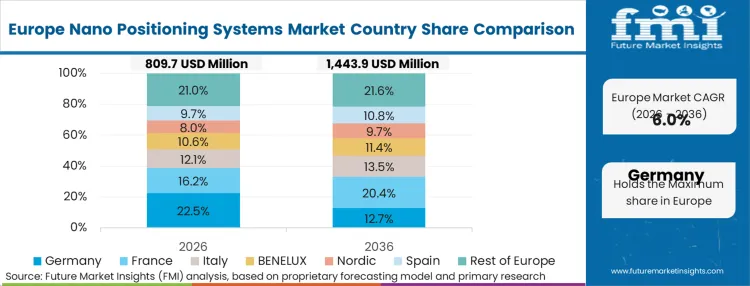
The procurement of active isolation technologies across the continent is heavily dictated by rigorous qualification protocols within top-tier industrial and research sectors. Rather than focusing solely on raw operational speed, European buyers prioritize extreme long-term material stability and ultra-high vacuum compatibility, driven by massive institutional backing for synchrotron and photonics facilities. As per FMI's projection, this infrastructure-led reality forces precision engineering firms in the region to master radiation-hardened control electronics and exotic materials, frequently baking advanced high current ion implanter protocols directly into their material science development loops.
- Germany: Rather than sourcing standard off-the-shelf actuators, systems engineers in this region co-develop highly specialized flexures that are integrated straight into the chassis of flagship microscopes. Germany features a highly concentrated ecosystem of premier metrology and optical manufacturers, creating an environment where stages are routinely engineered to the absolute physical limits of modern material science. Tracking at a 9.0% CAGR, the reality on the German fabrication floor is that these sub-nanometer upgrades are necessitated by the unrelenting physical demands of the photonics industry rather than general macroeconomic expansion.
- United Kingdom: Growing at an 8.0% CAGR, UK is heavily influenced by concentrated national investments in quantum computing hardware that require stages capable of operating near absolute zero. Research directors are confronted with extreme technical hurdles as they attempt to qualify piezoceramic materials that will not lose their displacement characteristics in these deep-freeze, cryogenic environments. Vendors who can successfully navigate this highly specialized technical landscape will secure highly lucrative, recurring revenue streams by acting as the foundational motion control backbone for next-generation quantum arrays.
FMI's report includes advancing research corridors in France and the Netherlands. These markets leverage centralized European Union technology grants to modernize core optical inspection infrastructure, standardizing on interconnected, network-capable multi-axis controllers.
North America Nano Positioning Systems Market Analysis
Hardware specifications in this region are largely dictated by high-throughput scanning requirements stemming from the aggressive commercialization of genome sequencing and biotechnology. The procurement behaviors, as a result, heavily tilt toward fully integrated, turnkey sub-systems that bundle the capacitive sensors, piezoceramic stages, and high-bandwidth metrology software into one aggressively supported package. According to FMI's estimates, this buyer behavior-led approach actively rewards vendors who take complete ownership of the dynamic feedback loop while simultaneously punishing those who attempt to sell isolated mechanical components.
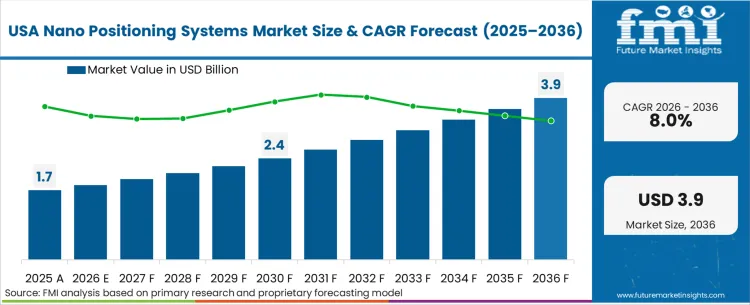
- United States: Operations directors at leading laboratories now mandate stages capable of stepping, settling, and capturing an image in mere milliseconds in order to profitably process massive biological sample arrays. Supporting a market expansion at an 8.0% CAGR over the forecast period, this dynamic shifts the primary qualification metric away from absolute resolution and strictly toward dynamic settling time, driven by the intense geographic concentration of automated biomedical imaging and genomics companies. By embracing this high-speed operational approach, North American research clusters maintain a distinct advantage in volume-heavy life science commercialization
FMI's report includes the expanding Canadian photonics sector. Here, procurement focuses heavily on ruggedized, multi-axis alignment systems capable of maintaining sub-nanometer stability in harsh industrial environments outside the traditional cleanroom.
Competitive Aligners for Market Players
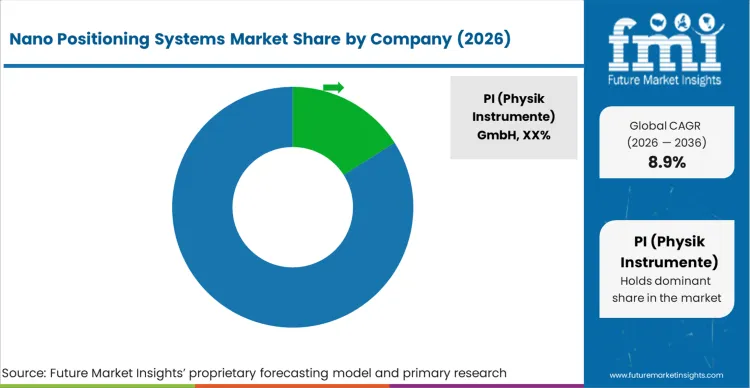
The highly concentrated nature of the sub-nanometer motion control space stems directly from the extreme intellectual property barriers surrounding high-bandwidth closed-loop control algorithms. PI (Physik Instrumente) GmbH, Thorlabs Inc., and Aerotech Inc. dominate because they supply not just the raw piezoceramic flexures, but the tightly integrated digital controllers that preemptively cancel structural resonance. Buyers distinguish qualified Tier-1 vendors from lower-cost mechanical suppliers strictly by examining dynamic settling times under load; a vendor that cannot provide real-time software compensation for inherent mechanical ringing is immediately disqualified from lucrative semiconductor lift-off resists metrology contracts.
Incumbents like SmarAct GmbH and MKS Instruments Inc. leverage deep institutional knowledge of ultra-high vacuum material science and non-magnetic actuator construction, creating a structural advantage in the extreme ultraviolet lithography supply chain. This advantage persists because the cost of failing a vacuum qualification test in an angstrom-era fab is catastrophically high, removing any incentive for foundries to gamble on unproven suppliers. To break this hold, a challenger must build proprietary AI-driven capacitance estimation models that match the accuracy of external X-ray positioning devices without the spatial footprint, effectively offering foundries a path to miniaturize their optical heads.
Large optical equipment integrators actively resist this vendor lock-in by designing modular metrology chassis that theoretically accept stages from multiple suppliers, though physical constraints often make this impractical. The structural tension between integrators demanding open-architecture control interfaces and dominant vendors protecting their proprietary ultra wideband anchor and tags algorithms will intensify through 2036. The market is structurally destined to consolidate further as the mathematical complexity of controlling six degrees of freedom simultaneously at high speeds pushes smaller, hardware-only firms into obsolescence.
Key Players in Nano Positioning Systems Market
- PI (Physik Instrumente) GmbH
- Thorlabs Inc.
- Aerotech Inc.
- SmarAct GmbH
- OptoSigma Corporation
- MKS Instruments Inc.
- Piezosystem Jena GmbH
Scope of the Report
| Metric | Value |
|---|---|
| Quantitative Units | USD 3.3 billion to USD 7.7 billion, at a CAGR of 8.9% |
| Market Definition | The market encompasses frictionless, closed-loop motion mechanisms relying on flexure guidance and active sensor feedback to manipulate payloads with absolute sub-nanometer resolution, excluding traditional motorized mechanical bearings. |
| Type Segmentation | 3D Nano Positioning Systems, 2D Nano Positioning Systems, Single-Coordinate Nano Positioning Systems |
| Technology Segmentation | Piezoelectric Positioning, Magnetostrictive Positioning, Electromechanical Positioning |
| Application Segmentation | Semiconductor Manufacturing, Optical Equipment, Nanotechnology Research, Biomedical Applications, Robotics |
| End Use Industry Segmentation | Electronics, Aerospace, Healthcare, Automotive, Research and Development |
| Regions Covered | North America, Europe, Asia Pacific |
| Countries Covered | India, China, South Korea, Japan, Germany, United States, United Kingdom, and 40 plus countries |
| Key Companies Profiled | PI (Physik Instrumente) GmbH, Thorlabs Inc., Aerotech Inc., SmarAct GmbH, OptoSigma Corporation, MKS Instruments Inc., Piezosystem Jena GmbH |
| Forecast Period | 2026 to 2036 |
| Approach | Sourcing directors and systems engineers within advanced lithography and photonics integration were interviewed to establish true adoption timelines. The baseline capital expenditure targets for next-generation semiconductor metrology infrastructure anchored the volume projections. Forecasts were rigorously cross-validated against independent optical equipment billing data to remove transient market anomalies. |
Source: Future Market Insights (FMI) analysis, based on proprietary forecasting model and primary research
Key Segments
-
Type:
- 3D Nano Positioning Systems
- 2D Nano Positioning Systems
- Single-Coordinate Nano Positioning Systems
-
Technology:
- Piezoelectric Positioning
- Magnetostrictive Positioning
- Electromechanical Positioning
-
Application:
- Semiconductor Manufacturing
- Optical Equipment
- Nanotechnology Research
- Biomedical Applications
- Robotics
-
End Use Industry:
- Electronics
- Aerospace
- Healthcare
- Automotive
- Research and Development
-
Region:
- North America
- Europe
- Asia-Pacific
- Rest of the World
- Latin America
- Middle East, and Africa
Bibliography
- Argonne National Laboratory. (2025, January). Advanced Photon Source Strategic Plan 2025-29. Argonne National Laboratory.
- LEAPS Initiative. (2025, February). LEAPS Technology Roadmap 2025. LEAPS Initiative.
- SmarAct. (2025). SmarAct product catalog: High precision positioning [Catalog].
- Aerotech. (2024). Motion solutions for next generation sequencing (NGS) [Case study].
- Yu, L., et al. (2025, September). High bandwidth control of a piezo-actuated nanopositioning system based on a discrete-time high-order dual-loop framework. Sensors.
- Lubotzky, B., et al. (2024, November). Room-temperature fiber-coupled single-photon sources based on colloidal quantum dots and SiV centers in back-excited nanoantennas. Nano Letters.
This bibliography is provided for reader reference. The full FMI report contains the complete reference list with primary source documentation.
This Report Addresses
- Market intelligence to support strategic decision making across piezoelectric actuators, flexure stages, and high-bandwidth closed-loop controllers
- Market size estimation and 10-year revenue forecasts from 2026 to 2036, supported by extreme ultraviolet lithography capital expenditure models
- Growth opportunity mapping across single-axis and multi-axis kinematic mechanisms with emphasis on the integration of AI-driven capacitance estimation
- Segment and regional revenue forecasts covering angstrom-era semiconductor manufacturing and automated genome sequencing environments
- Competition strategy assessment including proprietary control algorithms, vacuum-compatible material science, and dynamic settling time optimizations
- Technology development tracking including non-magnetic piezoceramics, AI capacitance modeling, and cryogenic quantum arrays
- Market access analysis covering extreme ultra-high vacuum qualification protocols and Tier-1 foundry supplier validation pathways
- Market report delivery in PDF, Excel, PPT, and interactive dashboard formats for executive strategy, lithography capacity planning, and operational benchmarking use
Frequently Asked Questions
How large is the Nano Positioning Systems Market in 2026?
Crossing USD 3.3 billion in 2026, the market reflects the immediate capital deployment required by foundries forced to abandon legacy mechanical stages for active vibration isolation.
What will it be valued at by 2036?
The valuation is set to reach USD 7.7 billion by 2036 as critical metrology infrastructure universally embeds active closed-loop kinematic control.
What CAGR is projected?
An 8.9% CAGR is expected, signaling the high replacement cost and mandatory nature of piezoceramic upgrades for sub-nanometer yield stability.
Which Type segment leads?
3D nano positioning systems holds the dominant position because the geometric complexity of modern wafer scanning requires simultaneous volumetric correction without orthogonal misalignment.
Which Technology segment leads?
Piezoelectric Positioning controls the majority share by providing the essential combination of infinite operational resolution and absolute vacuum compatibility required for lithography tools.
Which Application segment leads?
Semiconductor Manufacturing claims the largest adoption footprint as yield engineers face a hard physical limit where floor vibrations natively exceed angstrom-era feature sizes.
What drives rapid growth?
The absolute necessity to eliminate motion blur during high-speed, sub-nanometer defect inspection for angstrom-level semiconductor nodes forces immediate upgrades across Tier-1 fabrication facilities.
What is the primary restraint?
Rewriting proprietary legacy imaging software to properly ingest and synchronize with microsecond-level feedback loops from piezoceramic controllers creates severe deployment bottlenecks.
Which country grows fastest?
India leads at a 13.0% CAGR because its greenfield fab construction allows facilities to adopt active parallel kinematics natively, completely bypassing the complex retrofitting cycles seen in mature markets.
How do ultra-high vacuum requirements reshape vendor selection?
Tier-1 optical integrators immediately disqualify actuators utilizing magnetic voice coils due to outgassing risks, making qualification entirely dependent on proven piezoceramic longevity under extreme ultraviolet bombardment.
What role does AI-driven capacitance estimation play?
By eliminating the need for bulky external dimensional sensors through algorithmic modeling, multi-axis stages can shrink physically to fit into space-constrained legacy electron microscopes.
Why do buyers heavily scrutinize settling times?
Because stages that suffer from prolonged mechanical ringing destroy the unit economics of automated high-volume inspection, settling time rather than bare resolution dictates financial throughput.
How does South Korea's memory focus impact procurement?
Extreme memory fabrication density forces South Korean engineers to implement aggressive piezoceramic thermal compensation routines to maintain alignment without building massive environmental isolation chambers.
What creates the structural advantage for incumbent stage manufacturers?
The proprietary mathematics governing multi-axis cross-talk cancellation forms an immense intellectual property moat that locks new entrants out of premium OEM metrology contracts.
Why are single-coordinate stages losing ground in premium applications?
Integrators are moving away from stacking multiple single-axis stages, which multiplies mechanical error across bolted interfaces, in favor of centralized parallel kinematic designs.
How do cryogenic requirements in the UK alter the technology stack?
Quantum computing research demands that vendors reformulate their piezoceramic materials and wiring harnesses to maintain predictable expansion characteristics near absolute zero.
What forces the aerospace sector to lag in adoption?
Operating on extended, highly regulated product lifecycles, aerospace electronics manufacturers transition to active sub-nanometer inspection only when prime contractors officially rewrite foundational compliance standards.
How does the shift to parallel kinematics alter maintenance protocols?
Maintenance shifts from traditional mechanical lubrication to software-driven stroke compensation, requiring advanced controller tuning capabilities rather than mechanical repair.
Why do North American life science buyers prefer turnkey systems?
High-throughput genomics labs lacking in-house precision engineering expertise prioritize vendors who bundle the stage, sensor, and control software into a single, millisecond-ready unit.
What dictates the baseline for FMI's forecasting model in this space?
FMI anchors the projection to verifiable capital expenditure outlays for advanced node capacity expansion and synchrotron upgrades.
Why are macro-robotic gantries explicitly excluded from the scope?
Macro gantries rely on traditional mechanical bearings that introduce hysteresis, making them structurally incapable of sustaining the single-digit nanometer repeatability defining this market.
What non-obvious measurement dictates foundry purchasing decisions?
While marketing materials highlight ultimate resolution, foundries actually purchase based on dynamic bandwidth and the ability to execute high-speed scanning routines without inducing structural resonance.
Preview the report firsthand - request a free sample
Get SampleGet the brochure for pricing and purchase details.
Get PDFTable of Content
- Executive Summary
- Global Market Outlook
- Demand-side Trends
- Supply-side Trends
- Technology Roadmap Analysis
- Analysis and Recommendations
- Market Overview
- Market Coverage / Taxonomy
- Market Definition / Scope / Limitations
- Research Methodology
- Chapter Orientation
- Analytical Lens and Working Hypotheses
- Market Structure, Signals, and Trend Drivers
- Benchmarking and Cross-market Comparability
- Market Sizing, Forecasting, and Opportunity Mapping
- Research Design and Evidence Framework
- Desk Research Programme (Secondary Evidence)
- Company Annual and Sustainability Reports
- Peer-reviewed Journals and Academic Literature
- Corporate Websites, Product Literature, and Technical Notes
- Earnings Decks and Investor Briefings
- Statutory Filings and Regulatory Disclosures
- Technical White Papers and Standards Notes
- Trade Journals, Industry Magazines, and Analyst Briefs
- Conference Proceedings, Webinars, and Seminar Materials
- Government Statistics Portals and Public Data Releases
- Press Releases and Reputable Media Coverage
- Specialist Newsletters and Curated Briefings
- Sector Databases and Reference Repositories
- FMI Internal Proprietary Databases and Historical Market Datasets
- Subscription Datasets and Paid Sources
- Social Channels, Communities, and Digital Listening Inputs
- Additional Desk Sources
- Expert Input and Fieldwork (Primary Evidence)
- Primary Modes
- Qualitative Interviews and Expert Elicitation
- Quantitative Surveys and Structured Data Capture
- Blended Approach
- Why Primary Evidence is Used
- Field Techniques
- Interviews
- Surveys
- Focus Groups
- Observational and In-context Research
- Social and Community Interactions
- Stakeholder Universe Engaged
- C-suite Leaders
- Board Members
- Presidents and Vice Presidents
- R&D and Innovation Heads
- Technical Specialists
- Domain Subject-matter Experts
- Scientists
- Physicians and Other Healthcare Professionals
- Governance, Ethics, and Data Stewardship
- Research Ethics
- Data Integrity and Handling
- Primary Modes
- Tooling, Models, and Reference Databases
- Desk Research Programme (Secondary Evidence)
- Data Engineering and Model Build
- Data Acquisition and Ingestion
- Cleaning, Normalisation, and Verification
- Synthesis, Triangulation, and Analysis
- Quality Assurance and Audit Trail
- Market Background
- Market Dynamics
- Drivers
- Restraints
- Opportunity
- Trends
- Scenario Forecast
- Demand in Optimistic Scenario
- Demand in Likely Scenario
- Demand in Conservative Scenario
- Opportunity Map Analysis
- Product Life Cycle Analysis
- Supply Chain Analysis
- Investment Feasibility Matrix
- Value Chain Analysis
- PESTLE and Porter’s Analysis
- Regulatory Landscape
- Regional Parent Market Outlook
- Production and Consumption Statistics
- Import and Export Statistics
- Market Dynamics
- Global Market Analysis 2021 to 2025 and Forecast, 2026 to 2036
- Historical Market Size Value (USD Million) Analysis, 2021 to 2025
- Current and Future Market Size Value (USD Million) Projections, 2026 to 2036
- Y-o-Y Growth Trend Analysis
- Absolute $ Opportunity Analysis
- Global Market Pricing Analysis 2021 to 2025 and Forecast 2026 to 2036
- Global Market Analysis 2021 to 2025 and Forecast 2026 to 2036, By Type
- Introduction / Key Findings
- Historical Market Size Value (USD Million) Analysis By Type , 2021 to 2025
- Current and Future Market Size Value (USD Million) Analysis and Forecast By Type , 2026 to 2036
- 3D Nano Positioning Systems
- 2D Nano Positioning Systems
- Single-Coordinate Nano Positioning Systems
- 3D Nano Positioning Systems
- Y-o-Y Growth Trend Analysis By Type , 2021 to 2025
- Absolute $ Opportunity Analysis By Type , 2026 to 2036
- Global Market Analysis 2021 to 2025 and Forecast 2026 to 2036, By Technology
- Introduction / Key Findings
- Historical Market Size Value (USD Million) Analysis By Technology, 2021 to 2025
- Current and Future Market Size Value (USD Million) Analysis and Forecast By Technology, 2026 to 2036
- Piezoelectric Positioning
- Magnetostrictive Positioning
- Electromechanical Positioning
- Piezoelectric Positioning
- Y-o-Y Growth Trend Analysis By Technology, 2021 to 2025
- Absolute $ Opportunity Analysis By Technology, 2026 to 2036
- Global Market Analysis 2021 to 2025 and Forecast 2026 to 2036, By Application
- Introduction / Key Findings
- Historical Market Size Value (USD Million) Analysis By Application, 2021 to 2025
- Current and Future Market Size Value (USD Million) Analysis and Forecast By Application, 2026 to 2036
- Semiconductor Manufacturing
- Optical Equipment
- Nanotechnology Research
- Biomedical Applications
- Robotics
- Semiconductor Manufacturing
- Y-o-Y Growth Trend Analysis By Application, 2021 to 2025
- Absolute $ Opportunity Analysis By Application, 2026 to 2036
- Global Market Analysis 2021 to 2025 and Forecast 2026 to 2036, By End Use
- Introduction / Key Findings
- Historical Market Size Value (USD Million) Analysis By End Use, 2021 to 2025
- Current and Future Market Size Value (USD Million) Analysis and Forecast By End Use, 2026 to 2036
- Electronics
- Aerospace
- Healthcare
- Automotive
- Research and Development
- Electronics
- Y-o-Y Growth Trend Analysis By End Use, 2021 to 2025
- Absolute $ Opportunity Analysis By End Use, 2026 to 2036
- Global Market Analysis 2021 to 2025 and Forecast 2026 to 2036, By Region
- Introduction
- Historical Market Size Value (USD Million) Analysis By Region, 2021 to 2025
- Current Market Size Value (USD Million) Analysis and Forecast By Region, 2026 to 2036
- North America
- Latin America
- Western Europe
- Eastern Europe
- East Asia
- South Asia and Pacific
- Middle East & Africa
- Market Attractiveness Analysis By Region
- North America Market Analysis 2021 to 2025 and Forecast 2026 to 2036, By Country
- Historical Market Size Value (USD Million) Trend Analysis By Market Taxonomy, 2021 to 2025
- Market Size Value (USD Million) Forecast By Market Taxonomy, 2026 to 2036
- By Country
- USA
- Canada
- Mexico
- By Type
- By Technology
- By Application
- By End Use
- By Country
- Market Attractiveness Analysis
- By Country
- By Type
- By Technology
- By Application
- By End Use
- Key Takeaways
- Latin America Market Analysis 2021 to 2025 and Forecast 2026 to 2036, By Country
- Historical Market Size Value (USD Million) Trend Analysis By Market Taxonomy, 2021 to 2025
- Market Size Value (USD Million) Forecast By Market Taxonomy, 2026 to 2036
- By Country
- Brazil
- Chile
- Rest of Latin America
- By Type
- By Technology
- By Application
- By End Use
- By Country
- Market Attractiveness Analysis
- By Country
- By Type
- By Technology
- By Application
- By End Use
- Key Takeaways
- Western Europe Market Analysis 2021 to 2025 and Forecast 2026 to 2036, By Country
- Historical Market Size Value (USD Million) Trend Analysis By Market Taxonomy, 2021 to 2025
- Market Size Value (USD Million) Forecast By Market Taxonomy, 2026 to 2036
- By Country
- Germany
- UK
- Italy
- Spain
- France
- Nordic
- BENELUX
- Rest of Western Europe
- By Type
- By Technology
- By Application
- By End Use
- By Country
- Market Attractiveness Analysis
- By Country
- By Type
- By Technology
- By Application
- By End Use
- Key Takeaways
- Eastern Europe Market Analysis 2021 to 2025 and Forecast 2026 to 2036, By Country
- Historical Market Size Value (USD Million) Trend Analysis By Market Taxonomy, 2021 to 2025
- Market Size Value (USD Million) Forecast By Market Taxonomy, 2026 to 2036
- By Country
- Russia
- Poland
- Hungary
- Balkan & Baltic
- Rest of Eastern Europe
- By Type
- By Technology
- By Application
- By End Use
- By Country
- Market Attractiveness Analysis
- By Country
- By Type
- By Technology
- By Application
- By End Use
- Key Takeaways
- East Asia Market Analysis 2021 to 2025 and Forecast 2026 to 2036, By Country
- Historical Market Size Value (USD Million) Trend Analysis By Market Taxonomy, 2021 to 2025
- Market Size Value (USD Million) Forecast By Market Taxonomy, 2026 to 2036
- By Country
- China
- Japan
- South Korea
- By Type
- By Technology
- By Application
- By End Use
- By Country
- Market Attractiveness Analysis
- By Country
- By Type
- By Technology
- By Application
- By End Use
- Key Takeaways
- South Asia and Pacific Market Analysis 2021 to 2025 and Forecast 2026 to 2036, By Country
- Historical Market Size Value (USD Million) Trend Analysis By Market Taxonomy, 2021 to 2025
- Market Size Value (USD Million) Forecast By Market Taxonomy, 2026 to 2036
- By Country
- India
- ASEAN
- Australia & New Zealand
- Rest of South Asia and Pacific
- By Type
- By Technology
- By Application
- By End Use
- By Country
- Market Attractiveness Analysis
- By Country
- By Type
- By Technology
- By Application
- By End Use
- Key Takeaways
- Middle East & Africa Market Analysis 2021 to 2025 and Forecast 2026 to 2036, By Country
- Historical Market Size Value (USD Million) Trend Analysis By Market Taxonomy, 2021 to 2025
- Market Size Value (USD Million) Forecast By Market Taxonomy, 2026 to 2036
- By Country
- Kingdom of Saudi Arabia
- Other GCC Countries
- Turkiye
- South Africa
- Other African Union
- Rest of Middle East & Africa
- By Type
- By Technology
- By Application
- By End Use
- By Country
- Market Attractiveness Analysis
- By Country
- By Type
- By Technology
- By Application
- By End Use
- Key Takeaways
- Key Countries Market Analysis
- USA
- Pricing Analysis
- Market Share Analysis, 2025
- By Type
- By Technology
- By Application
- By End Use
- Canada
- Pricing Analysis
- Market Share Analysis, 2025
- By Type
- By Technology
- By Application
- By End Use
- Mexico
- Pricing Analysis
- Market Share Analysis, 2025
- By Type
- By Technology
- By Application
- By End Use
- Brazil
- Pricing Analysis
- Market Share Analysis, 2025
- By Type
- By Technology
- By Application
- By End Use
- Chile
- Pricing Analysis
- Market Share Analysis, 2025
- By Type
- By Technology
- By Application
- By End Use
- Germany
- Pricing Analysis
- Market Share Analysis, 2025
- By Type
- By Technology
- By Application
- By End Use
- UK
- Pricing Analysis
- Market Share Analysis, 2025
- By Type
- By Technology
- By Application
- By End Use
- Italy
- Pricing Analysis
- Market Share Analysis, 2025
- By Type
- By Technology
- By Application
- By End Use
- Spain
- Pricing Analysis
- Market Share Analysis, 2025
- By Type
- By Technology
- By Application
- By End Use
- France
- Pricing Analysis
- Market Share Analysis, 2025
- By Type
- By Technology
- By Application
- By End Use
- India
- Pricing Analysis
- Market Share Analysis, 2025
- By Type
- By Technology
- By Application
- By End Use
- ASEAN
- Pricing Analysis
- Market Share Analysis, 2025
- By Type
- By Technology
- By Application
- By End Use
- Australia & New Zealand
- Pricing Analysis
- Market Share Analysis, 2025
- By Type
- By Technology
- By Application
- By End Use
- China
- Pricing Analysis
- Market Share Analysis, 2025
- By Type
- By Technology
- By Application
- By End Use
- Japan
- Pricing Analysis
- Market Share Analysis, 2025
- By Type
- By Technology
- By Application
- By End Use
- South Korea
- Pricing Analysis
- Market Share Analysis, 2025
- By Type
- By Technology
- By Application
- By End Use
- Russia
- Pricing Analysis
- Market Share Analysis, 2025
- By Type
- By Technology
- By Application
- By End Use
- Poland
- Pricing Analysis
- Market Share Analysis, 2025
- By Type
- By Technology
- By Application
- By End Use
- Hungary
- Pricing Analysis
- Market Share Analysis, 2025
- By Type
- By Technology
- By Application
- By End Use
- Kingdom of Saudi Arabia
- Pricing Analysis
- Market Share Analysis, 2025
- By Type
- By Technology
- By Application
- By End Use
- Turkiye
- Pricing Analysis
- Market Share Analysis, 2025
- By Type
- By Technology
- By Application
- By End Use
- South Africa
- Pricing Analysis
- Market Share Analysis, 2025
- By Type
- By Technology
- By Application
- By End Use
- USA
- Market Structure Analysis
- Competition Dashboard
- Competition Benchmarking
- Market Share Analysis of Top Players
- By Regional
- By Type
- By Technology
- By Application
- By End Use
- Competition Analysis
- Competition Deep Dive
- PI (Physik Instrumente) GmbH
- Overview
- Product Portfolio
- Profitability by Market Segments (Product/Age /Sales Channel/Region)
- Sales Footprint
- Strategy Overview
- Marketing Strategy
- Product Strategy
- Channel Strategy
- Thorlabs Inc.
- Aerotech Inc.
- SmarAct GmbH
- OptoSigma Corporation
- MKS Instruments Inc.
- Piezosystem Jena GmbH
- PI (Physik Instrumente) GmbH
- Competition Deep Dive
- Assumptions & Acronyms Used


