

- Industry Size (2026)
- USD 1480 Mn
- Forecast (2036)
- USD 5344 Mn
- CAGR (2026 to 2036)
- 13.7%
Nano-Enhanced PCR Composite Materials Market Forecast and Outlook 2026 to 2036
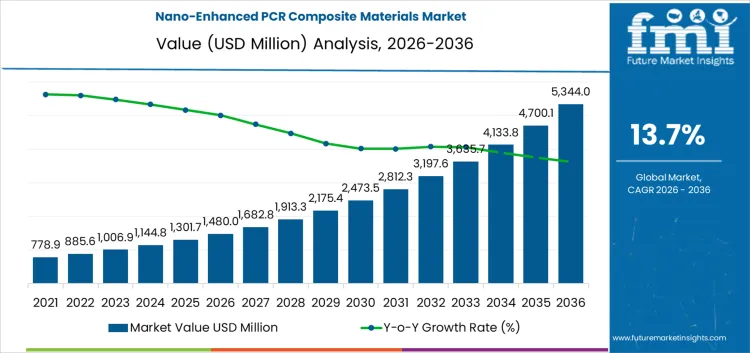
The nano-enhanced PCR composite materials market is expected to grow from USD 1,480 million in 2026 to USD 5,344 million by 2036, expanding at a CAGR of 13.7%. Nano-scale reinforcements enable PCR materials to meet higher mechanical, thermal, and functional requirements, allowing their use in applications traditionally reserved for virgin or engineered plastics. Commercial adoption is concentrated in automotive, packaging, and electronics, where material performance directly affects product durability, weight reduction, and design flexibility.
Buyer decisions are driven by dispersion reliability, processing compatibility, and the ability to achieve performance gains at low additive loadings without disrupting existing manufacturing lines. Cost-benefit evaluation increasingly focuses on downgauging potential, part consolidation, and lifecycle durability rather than material price alone. Between 2026 and 2036, growth quality will depend on suppliers’ capability to manage PCR variability, deliver consistent nano-dispersion at scale, and support qualification across high-volume production environments, positioning nano-enhanced PCR composites as a practical bridge between sustainability targets and advanced material engineering.
Quick Stats for Nano-Enhanced PCR Composite Materials Market
- Nano-Enhanced PCR Composite Materials Market Value (2026): USD 1,480 Million
- Nano-Enhanced PCR Composite Materials Market Forecast Value (2036): USD 5,344 Million
- Nano-Enhanced PCR Composite Materials Market Forecast CAGR 2026 to 2036: 13.7%
- Leading Enhancement Technology in Nano-Enhanced PCR Composite Materials Market: Nano-Dispersion & Compatibilisation (55% share)
- Key Regions in Nano-Enhanced PCR Composite Materials Market: Asia Pacific, Europe, North America, Latin America, Middle East & Africa
- Key Players in Nano-Enhanced PCR Composite Materials Market: BASF SE, Evonik Industries AG, Cabot Corporation, Avient Corporation, Toray Industries, Inc., Mitsubishi Chemical Group Corporation, Kingfa Sci. & Tech. Co., Ltd., Wanhua Chemical Group Co., Ltd.
Nano-Enhanced PCR Composite Materials Market Key Takeaways
| Metric | Value |
|---|---|
| Nano-Enhanced PCR Composite Materials Market Value (2026) | USD 1,480 Million |
| Nano-Enhanced PCR Composite Materials Market Forecast Value (2036) | USD 5,344 Million |
| Nano-Enhanced PCR Composite Materials Market Forecast CAGR 2026 to 2036 | 13.7% |
How are Performance Recovery and Advanced Material Engineering Driving the Nano-Enhanced PCR Composite Materials Market?
The nano-enhanced PCR composite materials market is expanding as manufacturers seek to overcome the inherent performance limitations of recycled polymers. Incorporation of nanomaterials such as nanoclays, carbon nanotubes, graphene derivatives, and nano-silica enables recovery and enhancement of mechanical strength, barrier properties, thermal stability, and electrical performance in PCR-based compounds. For compounders and OEMs, this approach allows higher recycled content while meeting demanding specifications in automotive, electronics, packaging, and industrial applications.
Supplier selection in this market is strongly influenced by formulation expertise and dispersion control. Nanomaterials must be uniformly distributed at low loadings to deliver performance gains without negatively affecting processability or cost. Buyers are prioritizing partners that can demonstrate stable dispersion, predictable rheology, and compatibility with standard extrusion and molding equipment. Offering pre-compounded masterbatches, application-specific grades, and validated performance data is becoming essential to reduce customer qualification timelines.
Scale-up and cost-performance balance are shaping commercial adoption. While nano-enhanced PCR composites command premium pricing, end users are evaluating total value based on downgauging potential, part consolidation, and extended product lifespan. Growth in lightweighting, functional packaging, and electronics housings is accelerating demand for these advanced materials. For suppliers, competitive advantage increasingly depends on aligning nanotechnology selection with PCR variability management, regulatory readiness, and scalable manufacturing positioning nano-enhanced PCR composites as a high-growth bridge between sustainability targets and advanced material performance.
How Is the Nano-Enhanced PCR Composite Materials Market Structured Across Key Segments?
The nano-enhanced PCR composite materials market is segmented by end use and enhancement technology, reflecting how performance targets and processing control influence material selection. By end use, automotive and packaging applications lead adoption, supported by demand for lightweight structures and consistent mechanical properties at scale. Other end uses include electronics and industrial parts, precision engineering, mass-market applications, electronics housings, and industrial components, each requiring different levels of reinforcement and process control. By enhancement technology, nano-dispersion and compatibilisation dominate, while surface-treated nano-fillers, controlled nano-dispersion methods, and cost-optimised nano-compounding address application-specific strength, stability, and manufacturability requirements.
Why Do Automotive and Packaging Applications Lead End-Use Demand In the Nano-Enhanced PCR Composite Materials Market?
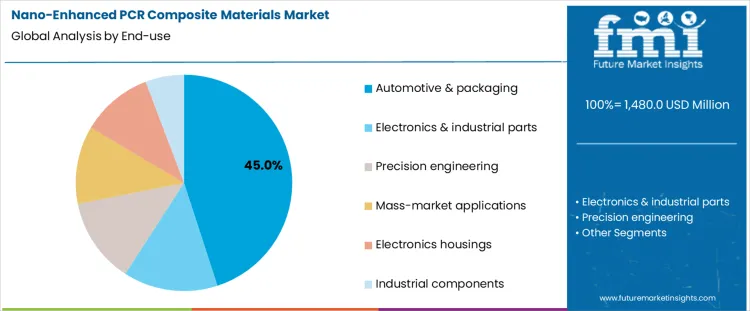
Automotive and packaging account for 45% share of the nano-enhanced PCR composite materials market because these sectors combine high material volumes with strict performance expectations. Automotive components require improved stiffness, impact resistance, and dimensional stability, while packaging applications demand strength consistency and downgauging capability. Nano-enhanced composites allow manufacturers to reinforce recycled polymer matrices without significantly increasing weight. High production throughput supports rapid qualification and repeat usage across multiple product lines. Component standardization across platforms increases material repeatability. For material suppliers, automotive and packaging customers offer scale and long-term supply programs, explaining why these end uses dominate overall demand.
Why Does Nano-Dispersion And Compatibilisation Dominate Enhancement Technology Selection?
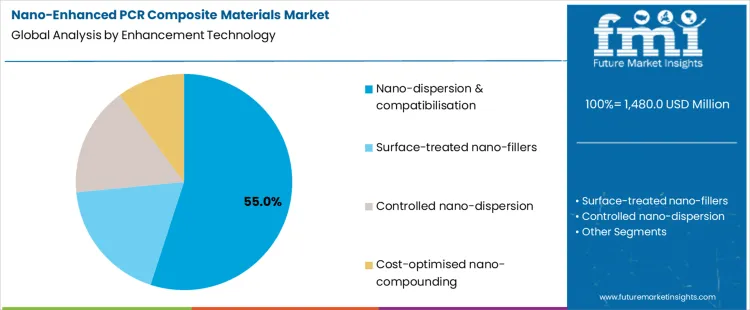
Nano-dispersion and compatibilisation hold 55% share of the nano-enhanced PCR composite materials market because uniform distribution of nano-fillers is critical to achieving consistent mechanical and thermal performance. Compatibilisation improves bonding between recycled polymer matrices and nano-scale additives, reducing agglomeration and property variation. Compounders prefer dispersion-focused approaches because they integrate into existing extrusion and compounding lines with controlled processing parameters. This method supports scalable production and predictable material behavior across batches. For technology providers, nano-dispersion solutions allow standardized formulations adaptable to multiple applications. These processing reliability and performance consistency advantages explain their dominance among enhancement technologies.
What are the Key Dynamics Of The Nano-Enhanced PCR Composite Materials Market?
The nano-enhanced PCR composite materials market is driven by demand for high-performance recycled polymer composites that combine post-consumer recycled (PCR) resins with nanoscale reinforcements such as nanoclays, graphene, carbon nanotubes, metal oxides, and nano-cellulose to deliver enhanced mechanical, thermal, or barrier properties. End-use sectors including automotive, consumer electronics, building products, and specialty packaging seek materials that improve stiffness, impact resistance, conductivity, flame performance, or dimensional stability while maintaining cost competitiveness. For material compounders and additive suppliers, achieving uniform nano-dispersion, consistent PCR quality, and predictable processing behavior are critical factors influencing adoption and product differentiation.
How are Material Innovation and Processing Technologies Shaping This Market?
Material innovation and processing technologies are reshaping the nano-enhanced PCR composite materials market through scalable dispersion methods, tailored surface treatments, and advanced compounding strategies. Techniques such as high-shear extrusion, ultrasonic mixing, and compatibilizer systems enhance nanoscale filler distribution within PCR matrices, overcoming historical aggregation challenges that limit performance. Surface-functionalized nanoparticles improve interfacial bonding and stability, supporting applications with demanding structural or thermal requirements. Digital process controls and in-line monitoring help compounders maintain property consistency across production lots. Suppliers offering engineered masterbatches and application-specific formulations (e.g., automotive interior grades, EMI shielding composites) strengthen competitive positioning in a market where performance predictability is paramount.
Why Do Quality Control, Feedstock Variability, And Technical Barriers Restrain Adoption?
Quality control, feedstock variability, and technical barriers restrain broader adoption of nano-enhanced PCR composite materials. Variability in PCR resin streams-such as inconsistent polymer grades, residual contaminants, and differing thermal histories-complicates nano-additive integration and predictable material behavior. Achieving consistent nano-dispersion at commercial scale remains technically demanding and sensitive to processing conditions, increasing development time and cost. Ensuring performance reliability (e.g., mechanical strength, fatigue resistance) across batches and validating against OEM specifications extend qualification cycles for converters and original equipment manufacturers. These technical challenges elevate total cost of ownership and slow conversion from conventional PCR materials to nano-enhanced composites.
What is the Country-Wise Outlook for Nano-Enhanced PCR Composite Materials Market?
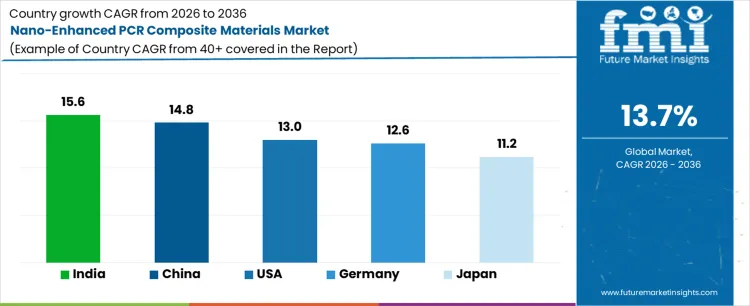
The nano-enhanced PCR composite materials market is advancing as manufacturers combine post-consumer recycled polymers with nano-scale additives to improve mechanical strength, thermal stability, barrier performance, and functional properties. These materials enable wider use of PCR plastics in applications that demand higher performance without reverting to virgin resins. Growth varies by country based on advanced materials R&D capability, manufacturing scale, cost tolerance, and speed of industrial adoption. Mature markets focus on controlled formulation development, dispersion quality, and long qualification cycles, while high-growth regions prioritize rapid scaling, cost-efficient enhancement, and integration into mass-market applications.
| Country | CAGR (%) |
|---|---|
| India | 15.6 |
| China | 14.8 |
| USA | 13.0 |
| Germany | 12.6 |
| Japan | 11.2 |
How is Germany Advancing Precision Adoption of Nano-Enhanced PCR Composite Materials?
Germany’s nano-enhanced PCR composite materials market is expanding at a CAGR of 12.6% during 2026-2036, driven by structured integration into high-performance and engineered applications. Adoption focuses on combining PCR polymers with nano-fillers to improve mechanical strength, thermal stability, and barrier properties while maintaining processing consistency. German manufacturers emphasize controlled formulation development, extensive lab validation, and predictable behavior in extrusion, injection molding, and compounding operations. Use cases are concentrated in automotive components, technical packaging, and industrial products where performance reliability is critical. Buyers prioritize documentation, repeatability, and long-term material stability over aggressive performance claims. Qualification cycles are deliberate, often involving multi-stage testing and pilot production runs. Procurement decisions are led by engineering and materials teams, favoring suppliers with strong R&D capabilities and application-specific formulations. Germany represents a precision-driven market where value creation depends on technical rigor, quality assurance, and sustained performance delivery.
What Is Driving Commercial Uptake of Nano-Enhanced PCR Composites in the United States?
The nano-enhanced PCR composite materials market in the United States is growing at a CAGR of 13.0% during 2026-2036, supported by demand for differentiated, high-value recycled materials across multiple industries. USA manufacturers adopt nano-enhanced composites to improve stiffness, impact resistance, and functional performance while retaining design flexibility. Applications span consumer goods, packaging, electronics housings, and selected automotive parts. Buyers emphasize scalability, formulation versatility, and rapid transition from pilot to full production. Qualification timelines are shorter than in Europe, enabling faster market entry. Procurement favors suppliers capable of customizing nano-additive loading levels, supporting multiple resin systems, and scaling production across geographically distributed plants. Market value is driven by speed of commercialization and the ability to balance performance enhancement with cost control. The USA represents a market where competitive advantage lies in flexibility, innovation speed, and application breadth.
How Does Japan Apply Controlled Engineering to Nano-Enhanced PCR Composite Materials?
Japan’s nano-enhanced PCR composite materials market is expanding at a CAGR of 11.2% during the forecast period, reflecting a disciplined, engineering-centric adoption approach. Japanese manufacturers focus on precise dispersion of nano-materials to achieve incremental performance gains without compromising processing stability or long-term durability. Adoption is gradual, typically beginning with non-critical components before moving into higher-specification applications. Buyers place strong emphasis on material consistency, defect minimization, and detailed technical documentation. Nano-enhanced PCR composites are evaluated extensively for aging behavior, surface quality, and repeatability. Procurement decisions favor suppliers with proven formulation expertise, strong quality systems, and long-term technical support. Volumes are moderate, but performance expectations are extremely high. Japan represents a quality-led market where success depends on predictability, process control, and trusted supplier relationships rather than rapid scale expansion.
Why Is China Scaling Nano-Enhanced PCR Composite Materials Rapidly?
China’s nano-enhanced PCR composite materials market is growing at a CAGR of 14.8% during 2026-2036, driven by high-volume manufacturing demand and rapid material substitution. Chinese producers adopt nano-enhanced composites to improve mechanical performance and functionality of PCR plastics for mass-market applications. Buyers prioritize throughput efficiency, cost competitiveness, and compatibility with existing high-speed processing lines. Nano-additives are often used to achieve acceptable performance improvements rather than premium specifications. Deployment is fast, with formulations rolled out across packaging, consumer goods, and industrial products at scale. Procurement favors suppliers with localized compounding capability, high production capacity, and consistent quality under large batch sizes. Qualification cycles are short, with performance validated in production environments. China represents a scale-led market where operational efficiency, feedstock access, and manufacturing robustness define success.
Why Is India the Fastest-Growing Market for Nano-Enhanced PCR Composite Materials?
India’s nano-enhanced PCR composite materials market is projected to grow at a CAGR of 15.6% during 2026-2036, supported by rapid industrialization and increasing adoption of advanced polymer systems. Manufacturers use nano-enhancement to improve strength, durability, and functionality of PCR plastics while maintaining affordability. Adoption is largely greenfield-driven, with nano-enhanced composites integrated early into new product designs across packaging, automotive components, infrastructure materials, and consumer goods. Buyers emphasize cost-performance balance, processing flexibility, and availability of locally produced formulations. Qualification cycles are relatively short, enabling fast commercialization. Procurement favors suppliers offering scalable formulations, technical guidance, and responsive local support. Market value is created through speed, adaptability, and the ability to convert advanced material concepts into cost-effective products. India represents a high-growth market where scale, flexibility, and applied innovation drive competitiveness.
What Drives Competition in the Nano-Enhanced PCR Composite Materials Market?

Competition in the nano-enhanced PCR composite materials market is shaped by verified improvements in mechanical performance, nano-additive dispersion control, and documented integration with conventional processing technologies that matter to materials engineers, compounders, and OEM designers. BASF SE positions its nano-enhanced PCR composites with technical materials highlighting uniform nano-filler dispersion and reinforced mechanical strength while maintaining high recycled content. Official brochures emphasize reduced brittleness, improved impact resistance, and validated performance through standardized test data, appealing to automotive, consumer electronics, and industrial sectors.
Evonik Industries AG competes by offering tailored nano-additives and surface-engineered reinforcing agents designed to optimize interfacial bonding in PCR polymer matrices. Product literature focuses on enhanced thermal stability and dimensional performance in high-load applications, supported by dispersion profiles and rheological analysis. Cabot Corporation differentiates through conductive and structural nano-carbon reinforcements documented for improved stiffness and fatigue resistance, with official datasheets detailing particle size distribution and percolation threshold results relevant to elevated performance composites.
Compounders and materials system providers extend competitive breadth. Avient Corporation markets PCR composite compounds with nano-enhancement backed by materials that emphasize balanced stiffness, processability, and consistent batch control for injection and extrusion molding. Toray Industries, Inc. and Mitsubishi Chemical Group Corporation leverage proprietary nano-fiber and nano-platelet technologies with brochures detailing improved mechanical moduli and impact performance in high-PCR formulations suitable for automotive interiors and structural components.
Regional and cost-focused suppliers add further differentiation. Kingfa Sci. & Tech. Co., Ltd. and Wanhua Chemical Group Co., Ltd. compete with nano-enhanced PCR grades documented for controlled particle dispersion and consistent processing windows across conventional molding platforms. Official product guides highlight tensile, flexural, and thermal performance metrics that align with industry standards. Across all suppliers, competitive advantage is driven by brochure-verified nano-reinforcement efficacy, dispersion quality, and integration readiness with existing manufacturing systems rather than pricing alone.
Key Players in Nano-Enhanced PCR Composite Materials Market
- BASF SE
- Evonik Industries AG
- Cabot Corporation
- Avient Corporation
- Toray Industries, Inc.
- Mitsubishi Chemical Group Corporation
- Kingfa Sci. & Tech. Co., Ltd.
- Wanhua Chemical Group Co., Ltd.
Scope of Report
| Attribute | Description |
|---|---|
| Quantitative Unit | USD Million |
| End-use | Automotive & Packaging, Electronics & Industrial Parts, Precision Engineering, Mass-Market Applications, Electronics Housings, Industrial Components |
| Enhancement Technology | Nano-Dispersion & Compatibilisation, Surface-Treated Nano-Fillers, Controlled Nano-Dispersion, Cost-Optimised Nano-Compounding |
| Countries Covered | China, Japan, South Korea, India, Australia & New Zealand, ASEAN, Rest of Asia Pacific, Germany, United Kingdom, France, Italy, Spain, Nordic, BENELUX, Rest of Europe, United States, Canada, Mexico, Brazil, Chile, Rest of Latin America, Kingdom of Saudi Arabia, Other GCC Countries, Turkey, South Africa, Other African Union, Rest of Middle East & Africa |
| Regions Covered | Asia Pacific, Europe, North America, Latin America, Middle East & Africa |
| Key Companies Profiled | BASF SE, Evonik Industries AG, Cabot Corporation, Avient Corporation, Toray Industries, Inc., Mitsubishi Chemical Group Corporation, Kingfa Sci. & Tech. Co., Ltd., Wanhua Chemical Group Co., Ltd. |
| Additional Attributes | Dollar sales by end-use and enhancement technology are assessed across performance-driven PCR composite applications. The report includes country-level demand assessment, growth projections for 2026-2036, analysis of mechanical, thermal, and barrier property improvements, evaluation of nano-filler dispersion efficiency, competitive benchmarking of material suppliers, and assessment of adoption trends across automotive, electronics, and industrial manufacturing value chains. |
Nano-Enhanced PCR Composite Materials Market by Key Segments
End-use
- Automotive & packaging
- Electronics & industrial parts
- Precision engineering
- Mass-market applications
- Electronics housings
- Industrial components
Enhancement Technology
- Nano-dispersion & compatibilisation
- Surface-treated nano-fillers
- Controlled nano-dispersion
- Cost-optimised nano-compounding
Region
- Asia Pacific
- China
- Japan
- South Korea
- India
- Australia & New Zealand
- ASEAN
- Rest of Asia Pacific
- Europe
- Germany
- United Kingdom
- France
- Italy
- Spain
- Nordic
- BENELUX
- Rest of Europe
- North America
- United States
- Canada
- Mexico
- Latin America
- Brazil
- Chile
- Rest of Latin America
- Middle East & Africa
- Kingdom of Saudi Arabia
- Other GCC Countries
- Turkey
- South Africa
- Other African Union
- Rest of Middle East & Africa
Bibliography
- Organisation for Economic Co-operation and Development. (2024). Plastics recycled content requirements (OECD Environment Working Paper No. 236). OECD Publishing.
- European Union. (2025). Regulation (EU) 2025/40 of the European Parliament and of the Council of 19 December 2024 on packaging and packaging waste. Publications Office of the European Union.
- United Nations Environment Programme. (2024). Technical guidelines on the environmentally sound management of plastic wastes and composite materials. UN Environment Programme.
Frequently Asked Questions
How big is the nano-enhanced PCR composite materials market in 2026?
The global nano-enhanced PCR composite materials market is estimated to be valued at USD 1,480.0 million in 2026.
What will be the size of nano-enhanced PCR composite materials market in 2036?
The market size for the nano-enhanced PCR composite materials market is projected to reach USD 5,344.0 million by 2036.
How much will be the nano-enhanced PCR composite materials market growth between 2026 and 2036?
The nano-enhanced PCR composite materials market is expected to grow at a 13.7% CAGR between 2026 and 2036.
What are the key end-use segments in the nano-enhanced PCR composite materials market?
Automotive & packaging, electronics & industrial parts, precision engineering, mass-market applications, electronics housings, and industrial components.
Which enhancement technology segment to contribute significant share in the nano-enhanced PCR composite materials market in 2026?
In terms of enhancement technology, nano-dispersion & compatibilisation segment to command 55.0% share in the nano-enhanced PCR composite materials market in 2026.
Preview the report firsthand - request a free sample
Get SampleGet the brochure for pricing and purchase details.
Get PDFTable of Content
- Executive Summary
- Global Market Outlook
- Demand-side Trends
- Supply-side Trends
- Technology Roadmap Analysis
- Analysis and Recommendations
- Market Overview
- Market Coverage / Taxonomy
- Market Definition / Scope / Limitations
- Market Background
- Market Dynamics
- Drivers
- Restraints
- Opportunity
- Trends
- Scenario Forecast
- Demand in Optimistic Scenario
- Demand in Likely Scenario
- Demand in Conservative Scenario
- Opportunity Map Analysis
- Product Life Cycle Analysis
- Supply Chain Analysis
- Investment Feasibility Matrix
- Value Chain Analysis
- PESTLE and Porter’s Analysis
- Regulatory Landscape
- Regional Parent Market Outlook
- Production and Consumption Statistics
- Import and Export Statistics
- Market Dynamics
- Global Market Analysis 2021 to 2025 and Forecast, 2026 to 2036
- Historical Market Size Value (USD Million) Analysis, 2021 to 2025
- Current and Future Market Size Value (USD Million) Projections, 2026 to 2036
- Y-o-Y Growth Trend Analysis
- Absolute $ Opportunity Analysis
- Global Market Pricing Analysis 2021 to 2025 and Forecast 2026 to 2036
- Global Market Analysis 2021 to 2025 and Forecast 2026 to 2036, By End-use
- Introduction / Key Findings
- Historical Market Size Value (USD Million) Analysis By End-use , 2021 to 2025
- Current and Future Market Size Value (USD Million) Analysis and Forecast By End-use , 2026 to 2036
- Automotive & packaging
- Electronics & industrial parts
- Precision engineering
- Mass-market applications
- Electronics housings
- Industrial components
- Automotive & packaging
- Y-o-Y Growth Trend Analysis By End-use , 2021 to 2025
- Absolute $ Opportunity Analysis By End-use , 2026 to 2036
- Global Market Analysis 2021 to 2025 and Forecast 2026 to 2036, By Enhancement Technology
- Introduction / Key Findings
- Historical Market Size Value (USD Million) Analysis By Enhancement Technology, 2021 to 2025
- Current and Future Market Size Value (USD Million) Analysis and Forecast By Enhancement Technology, 2026 to 2036
- Nano-dispersion & compatibilisation
- Surface-treated nano-fillers
- Controlled nano-dispersion
- Cost-optimised nano-compounding
- Nano-dispersion & compatibilisation
- Y-o-Y Growth Trend Analysis By Enhancement Technology, 2021 to 2025
- Absolute $ Opportunity Analysis By Enhancement Technology, 2026 to 2036
- Global Market Analysis 2021 to 2025 and Forecast 2026 to 2036, By Region
- Introduction
- Historical Market Size Value (USD Million) Analysis By Region, 2021 to 2025
- Current Market Size Value (USD Million) Analysis and Forecast By Region, 2026 to 2036
- North America
- Latin America
- Western Europe
- Eastern Europe
- East Asia
- South Asia and Pacific
- Middle East & Africa
- Market Attractiveness Analysis By Region
- North America Market Analysis 2021 to 2025 and Forecast 2026 to 2036, By Country
- Historical Market Size Value (USD Million) Trend Analysis By Market Taxonomy, 2021 to 2025
- Market Size Value (USD Million) Forecast By Market Taxonomy, 2026 to 2036
- By Country
- USA
- Canada
- Mexico
- By End-use
- By Enhancement Technology
- By Country
- Market Attractiveness Analysis
- By Country
- By End-use
- By Enhancement Technology
- Key Takeaways
- Latin America Market Analysis 2021 to 2025 and Forecast 2026 to 2036, By Country
- Historical Market Size Value (USD Million) Trend Analysis By Market Taxonomy, 2021 to 2025
- Market Size Value (USD Million) Forecast By Market Taxonomy, 2026 to 2036
- By Country
- Brazil
- Chile
- Rest of Latin America
- By End-use
- By Enhancement Technology
- By Country
- Market Attractiveness Analysis
- By Country
- By End-use
- By Enhancement Technology
- Key Takeaways
- Western Europe Market Analysis 2021 to 2025 and Forecast 2026 to 2036, By Country
- Historical Market Size Value (USD Million) Trend Analysis By Market Taxonomy, 2021 to 2025
- Market Size Value (USD Million) Forecast By Market Taxonomy, 2026 to 2036
- By Country
- Germany
- UK
- Italy
- Spain
- France
- Nordic
- BENELUX
- Rest of Western Europe
- By End-use
- By Enhancement Technology
- By Country
- Market Attractiveness Analysis
- By Country
- By End-use
- By Enhancement Technology
- Key Takeaways
- Eastern Europe Market Analysis 2021 to 2025 and Forecast 2026 to 2036, By Country
- Historical Market Size Value (USD Million) Trend Analysis By Market Taxonomy, 2021 to 2025
- Market Size Value (USD Million) Forecast By Market Taxonomy, 2026 to 2036
- By Country
- Russia
- Poland
- Hungary
- Balkan & Baltic
- Rest of Eastern Europe
- By End-use
- By Enhancement Technology
- By Country
- Market Attractiveness Analysis
- By Country
- By End-use
- By Enhancement Technology
- Key Takeaways
- East Asia Market Analysis 2021 to 2025 and Forecast 2026 to 2036, By Country
- Historical Market Size Value (USD Million) Trend Analysis By Market Taxonomy, 2021 to 2025
- Market Size Value (USD Million) Forecast By Market Taxonomy, 2026 to 2036
- By Country
- China
- Japan
- South Korea
- By End-use
- By Enhancement Technology
- By Country
- Market Attractiveness Analysis
- By Country
- By End-use
- By Enhancement Technology
- Key Takeaways
- South Asia and Pacific Market Analysis 2021 to 2025 and Forecast 2026 to 2036, By Country
- Historical Market Size Value (USD Million) Trend Analysis By Market Taxonomy, 2021 to 2025
- Market Size Value (USD Million) Forecast By Market Taxonomy, 2026 to 2036
- By Country
- India
- ASEAN
- Australia & New Zealand
- Rest of South Asia and Pacific
- By End-use
- By Enhancement Technology
- By Country
- Market Attractiveness Analysis
- By Country
- By End-use
- By Enhancement Technology
- Key Takeaways
- Middle East & Africa Market Analysis 2021 to 2025 and Forecast 2026 to 2036, By Country
- Historical Market Size Value (USD Million) Trend Analysis By Market Taxonomy, 2021 to 2025
- Market Size Value (USD Million) Forecast By Market Taxonomy, 2026 to 2036
- By Country
- Kingdom of Saudi Arabia
- Other GCC Countries
- Turkiye
- South Africa
- Other African Union
- Rest of Middle East & Africa
- By End-use
- By Enhancement Technology
- By Country
- Market Attractiveness Analysis
- By Country
- By End-use
- By Enhancement Technology
- Key Takeaways
- Key Countries Market Analysis
- USA
- Pricing Analysis
- Market Share Analysis, 2025
- By End-use
- By Enhancement Technology
- Canada
- Pricing Analysis
- Market Share Analysis, 2025
- By End-use
- By Enhancement Technology
- Mexico
- Pricing Analysis
- Market Share Analysis, 2025
- By End-use
- By Enhancement Technology
- Brazil
- Pricing Analysis
- Market Share Analysis, 2025
- By End-use
- By Enhancement Technology
- Chile
- Pricing Analysis
- Market Share Analysis, 2025
- By End-use
- By Enhancement Technology
- Germany
- Pricing Analysis
- Market Share Analysis, 2025
- By End-use
- By Enhancement Technology
- UK
- Pricing Analysis
- Market Share Analysis, 2025
- By End-use
- By Enhancement Technology
- Italy
- Pricing Analysis
- Market Share Analysis, 2025
- By End-use
- By Enhancement Technology
- Spain
- Pricing Analysis
- Market Share Analysis, 2025
- By End-use
- By Enhancement Technology
- France
- Pricing Analysis
- Market Share Analysis, 2025
- By End-use
- By Enhancement Technology
- India
- Pricing Analysis
- Market Share Analysis, 2025
- By End-use
- By Enhancement Technology
- ASEAN
- Pricing Analysis
- Market Share Analysis, 2025
- By End-use
- By Enhancement Technology
- Australia & New Zealand
- Pricing Analysis
- Market Share Analysis, 2025
- By End-use
- By Enhancement Technology
- China
- Pricing Analysis
- Market Share Analysis, 2025
- By End-use
- By Enhancement Technology
- Japan
- Pricing Analysis
- Market Share Analysis, 2025
- By End-use
- By Enhancement Technology
- South Korea
- Pricing Analysis
- Market Share Analysis, 2025
- By End-use
- By Enhancement Technology
- Russia
- Pricing Analysis
- Market Share Analysis, 2025
- By End-use
- By Enhancement Technology
- Poland
- Pricing Analysis
- Market Share Analysis, 2025
- By End-use
- By Enhancement Technology
- Hungary
- Pricing Analysis
- Market Share Analysis, 2025
- By End-use
- By Enhancement Technology
- Kingdom of Saudi Arabia
- Pricing Analysis
- Market Share Analysis, 2025
- By End-use
- By Enhancement Technology
- Turkiye
- Pricing Analysis
- Market Share Analysis, 2025
- By End-use
- By Enhancement Technology
- South Africa
- Pricing Analysis
- Market Share Analysis, 2025
- By End-use
- By Enhancement Technology
- USA
- Market Structure Analysis
- Competition Dashboard
- Competition Benchmarking
- Market Share Analysis of Top Players
- By Regional
- By End-use
- By Enhancement Technology
- Competition Analysis
- Competition Deep Dive
- BASF SE
- Overview
- Product Portfolio
- Profitability by Market Segments (Product/Age /Sales Channel/Region)
- Sales Footprint
- Strategy Overview
- Marketing Strategy
- Product Strategy
- Channel Strategy
- Evonik Industries AG
- Cabot Corporation
- Avient Corporation
- Toray Industries, Inc.
- Mitsubishi Chemical Group Corporation
- Kingfa Sci. & Tech. Co., Ltd.
- Wanhua Chemical Group Co., Ltd.
- BASF SE
- Competition Deep Dive
- Assumptions & Acronyms Used
- Research Methodology


