

- Industry Size (2026)
- USD 1.7 Bn
- Forecast (2036)
- USD 5.0 Bn
- CAGR (2026 to 2036)
- 11.4%
Precision Metrology Robots Market Forecast and Outlook 2026 to 2036
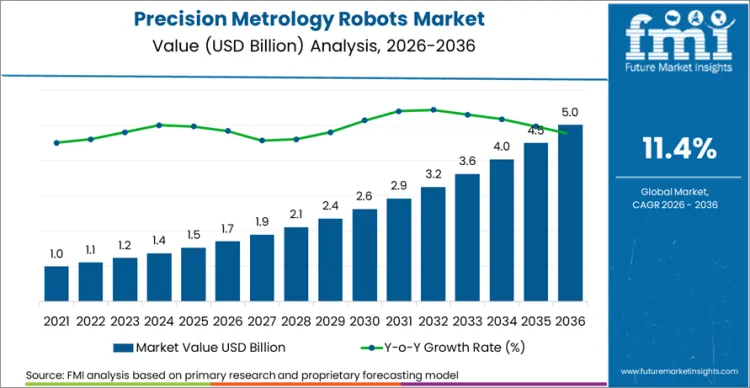
FMI expects precision metrology robots market revenue to total USD 1.7 billion in 2026, expanding to USD 5.0 billion by 2036. A CAGR of 11.4% is forecasted from 2026 to 2036. Precision metrology robots’ technology is moving toward integrated Quality 5.0 ecosystems.
Strategic shifts from 2024 to 2026 include convergence of IT and OT, as evidenced by KUKA’s 2025 launch of KUKA Digital and ZEISS’s introduction of the ZEISS Connected Quality hub. These platforms centralize metrology data, transforming it from reactive defect detection into proactive, closed-loop process control.
Technical innovations involve Physical AI and non-contact inspection. Hexagon’s 2025 launch of AEON, a humanoid robot with spatial intelligence, and its Leica ATS800 hybrid tracker reflect a market-wide pivot toward autonomous, high-speed 3D scanning.
This shift is further validated by Creaform’s 3D MAX series, which increased large-scale part precision by 30% in 2024. The sector’s reliance on the automotive and semiconductor industries remains absolute; the International Energy Agency projected 17 million EV sales for 2024, creating a massive demand for automated verification of high-tolerance components.
Industry leadership confirms this shift, noting that the integration of onboard intelligence is fundamentally redefining the boundary between automated tools and truly autonomous industrial agents:
“We are entering the age of humanoids. Versatile, multi-purpose robots that bring real autonomy into industrial settings. Aeon represents a massive transition from automation to autonomy. Two key technological breakthroughs, both achieved within the last 18 to 24 months, have made humanoids like Aeon viable. First, we've seen extremely high-performing actuators come to market. They allow robots to move smoothly and quickly. And second, bionic hands have become significantly more dexterous.”
Arnaud Robert, President, Hexagon’s Robotics Division
Financial data confirms a shift in delivery models. While Renishaw maintained heavy capital expenditure at £46.3M in FY2025 for physical plant capacity, Teradyne’s Universal Robots reported USD 89 million in quarterly robotics revenue, highlighting the growth of flexible, cobot-led automation.
The International Federation of Robotics noted a record 4.2 million industrial units in 2024, providing the infrastructure for RaaS. This model is lowering the barrier for SMEs to adopt high-precision tools like DCCs, which the BIPM identified as essential for machine-readable, FAIR-compliant data in 2025.
Summary of Precision Metrology Robots Market
What Is the Long-Term Growth Trajectory of the Precision Metrology Robots Market?
Future Market Insights projects the global precision metrology robots market to expand from USD 1.7 billion in 2026 to USD 5.0 billion by 2036, advancing at a strong 11.4% CAGR over the forecast period. This growth reflects a fundamental repositioning of metrology robots—from programmable inspection tools into autonomous mobile quality agents embedded directly within production environments.
Market momentum is being driven by zero-defect manufacturing imperatives across semiconductors, electric vehicles, and aerospace, where tolerance thresholds have reached micrometer and sub-micrometer levels. As manufacturing systems evolve toward closed-loop, self-correcting architectures, precision metrology robots are becoming integral to real-time process control rather than post-production validation.
FMI Research Approach: This outlook is developed using FMI’s integrated demand model, combining industrial robot shipment data, semiconductor and EV production forecasts, capital expenditure disclosures from leading metrology vendors, and policy-led manufacturing investment programs across major economies.
How do FMI Analysts Interpret the Structural Evolution of Precision Metrology Robots?
FMI analysts observe a decisive transition from task-specific robotic inspection toward Quality 5.0 ecosystems, where physical robots, AI-driven perception, and digital quality platforms operate as a unified system. Metrology is rapidly migrating from controlled laboratory environments to in-line and near-line production settings, eliminating latency between defect detection and corrective action.
This evolution is underpinned by the convergence of IT and OT layers. Platforms such as connected quality hubs are centralizing measurement data, enabling predictive analytics and autonomous decision-making. Physical AI, non-contact sensing, and spatial intelligence are redefining how robots perceive, interpret, and react to manufacturing variability.
FMI Research Approach: These insights are derived from technology roadmap analysis, product launches in autonomous robotics and connected quality software, and benchmarking of factory-level deployments across automotive, semiconductor, and aerospace production lines.
Which Regions are Driving Value Concentration in the Precision Metrology Robots Market?
China represents the fastest-growing market, expanding at an estimated 13.4% CAGR, driven by aggressive industrial digitalization mandates and large-scale automation investments. The United States follows with a 12.9% CAGR, supported by semiconductor reshoring, aerospace regulation, and federally backed R&D programs.
Within Europe, UK and Germany remain high-value markets, growing at 11.9% and 11.8% CAGR, respectively. Growth in these regions is shaped by advanced manufacturing strategies, semiconductor sovereignty initiatives, and deep integration of robotics within Industrie 4.0 frameworks.
FMI Research Approach: Country-level analysis integrates national industrial strategies, automation penetration rates, semiconductor fab announcements, aerospace compliance mandates, and primary interviews with system integrators and OEMs.
How large will the Precision Metrology Robots Market Be by 2036?
By 2036, the global precision metrology robots market is expected to reach USD 5.0 billion, supported by sustained demand for in-line inspection, autonomous verification, and digitally traceable measurement systems. The automotive and semiconductor sectors remain the primary volume drivers, while aerospace and additive manufacturing represent high-margin application areas.
As manufacturers shift from statistical sampling to 100% automated inspection, metrology robots are becoming indispensable infrastructure within smart factories, ensuring yield optimization, regulatory compliance, and lifecycle traceability.
FMI Research Approach: Market sizing incorporates robotic density forecasts, industry-specific inspection intensity ratios, adoption curves for non-contact measurement technologies, and long-term assumptions around digital calibration and traceability requirements.
What Constitutes the Precision Metrology Robots Market?
The precision metrology robots market comprises revenues generated from robotic systems specifically engineered for high-accuracy measurement, inspection, and dimensional verification within industrial environments. These systems integrate robotic motion platforms with contact and non-contact sensing technologies, including probing, optical, and laser-based measurement.
The market scope includes articulated, SCARA, collaborative, and cartesian robotic platforms deployed across automotive, aerospace, electronics, and general industrial manufacturing. Solutions are delivered as standalone inspection cells or embedded within automated production workflows, enabling real-time quality assurance.
The market excludes standalone laboratory metrology equipment, manual inspection tools, and general-purpose industrial robots not configured for precision measurement tasks.
What Globally Distinct Trends are Shaping the Precision Metrology Robots Market?
Globally, the market is being shaped by the migration of metrology to the production edge, the rise of Physical AI, and the institutionalization of digital measurement traceability. Non-contact, high-speed inspection technologies are gaining prominence as manufacturers pursue higher throughput without sacrificing accuracy.
The adoption of digital calibration certificates and machine-readable metrology data is strengthening interoperability across multi-vendor robotic cells. At the same time, business models are shifting toward Robotics-as-a-Service (RaaS), lowering adoption barriers for small and mid-sized manufacturers.
FMI Research Approach: Trend analysis is informed by regulatory developments in digital calibration, adoption of FAIR-compliant data architectures, RaaS deployment statistics, and strategic investments in autonomous robotics platforms across leading manufacturing economies.
Precision Metrology Robots Market Key Takeaways
| Metrics | Values |
|---|---|
| Expected Value (2026E) | USD 1.7 billion |
| Projected Value (2036F) | USD 5.0 billion |
| CAGR (2026-2036) | 11.4% |
Source: Future Market Insights (FMI) analysis, based on proprietary forecasting model and primary research
Why is the Precision Metrology Robots Market Growing?
The scope for precision metrology robots is witnessing a structural expansion as the industry transitions from task-specific automation to highly intelligent, self-evolving systems. Semiconductor manufacturing requirements for sub-5nm nodes and advanced 3D packaging are mandating a transition from statistical sampling to 100% automated inspection. ASML reported record net sales of €32.7 billion in 2025, driven by a marked step-up in customer capacity plans for AI-related hardware.
This volume necessitates high-throughput robotic metrology capable of identifying sub-atomic variances in complex architectures. Government initiatives are formalizing this demand; the USA CHIPS and Science Act has designated USD 11 billion for advanced R&D, with specific NIST-led programs focused on establishing new metrology standards for heterogeneous integration and chiplet packaging through 2026.
Corporate restructuring is increasingly favoring pure-play robotics entities to accelerate innovation cycles and optimize capital allocation. ABB has initiated a structural separation of its Robotics division, with a planned independent public listing scheduled for the second quarter of 2026. This independent entity will focus exclusively on high-growth intelligent automation, including AMRs and AI-driven software. By decoupling from broader electrification segments, such organizations aim to increase agility and deepen domain expertise in visual SLAM and adaptive measurement technologies essential for dynamic factory environments.
Operational efficiency is being redefined by the migration of high-precision measurement from controlled laboratories directly onto the production floor. Manufacturers are deploying hardened robotic cells that perform near-line and in-line inspections to eliminate the bottlenecks of manual testing.
Mitutoyo’s Roundform Automation, which synchronizes the Roundtracer Flash with FANUC CRX collaborative robots, exemplifies this trend by delivering 2D image-based measurements twice as fast as traditional linear scanning. Nikon has mirrored this strategy by consolidating its industrial metrology and digital solutions into a single business unit as of April 2024, targeting enhanced profitability by 2026 through specialized automated inspection for aerospace and metal 3D-printed components.
What is the Segment Profile of Precision Metrology Robots Market?
The precision metrology robots market segmentation examines core categories including robotic architecture (articulated, SCARA, collaborative, and cartesian), measurement modalities (contact probing, optical, and laser), and diverse industrial verticals including Automotive, Aerospace, and Electronics.
How is the Dominance of Articulated Arms influencing High-Volume Assembly Lines?
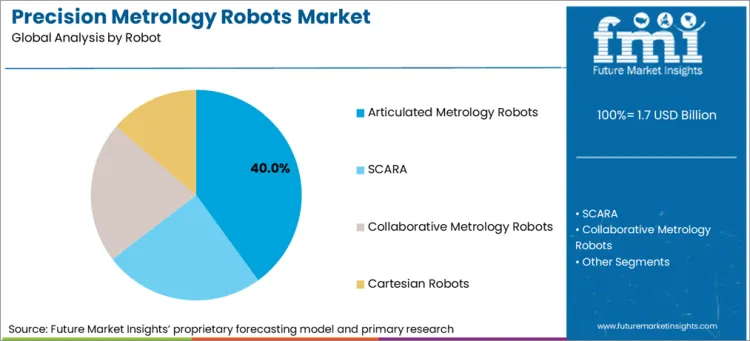
Articulated metrology robots currently command 40% of the total market volume, serving as the primary architecture for complex, multi-axis inspection tasks. Strategic developments in 2025 emphasize the integration of Physical AI within these units to manage high-mix production environments without manual reprogramming. A notable example is Nikon’s 2025 restructuring, which consolidated its Industrial Metrology and Digital Solutions units to prioritize the deployment of autonomous articulated systems for large-scale precision parts in the defense and space segments.
Market momentum is also being driven by ultra-accuracy software enhancements. ABB Robotics introduced a feature for its high-precision arms in late 2024 that achieves 0.03 mm accuracy, specifically targeting the imbalance in precision requirements for automotive and electronics machining. This shift highlights a broader trend where articulated systems are evolving from static inspection tools into adaptive agents capable of real-time spatial orientation adjustments on the shop floor.
Will Contact Probing maintain its Relevance in an Increasingly Optical-driven World?
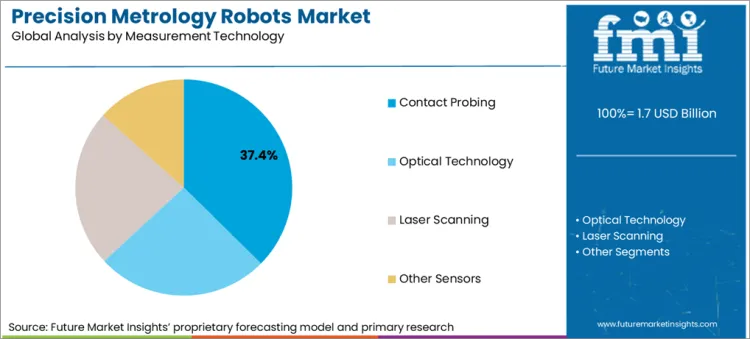
The hardware landscape remains anchored by contact probing, which accounts for a 37.4% revenue share as of the most recent 2025 fiscal reporting. Despite the rise of non-contact methods, tactile sensing is seeing a shop-floor migration through systems like Renishaw’s Equator-X, launched for full scale-up in late 2025. This dual-method gauge reflects a strategic pivot toward using contact data to update offsets for automated process control in real-time, effectively bridging the gap between a standalone lab measurement and an in-line robotic cell.
Contact technology is being retrofitted with digital twin modules to support 2026 compliance deadlines for data traceability. Siemens reported a significant uptick in licenses for twin modules that ingest tactile metrology data, growing from 22% to 38% by late 2025. This trend ensures that contact probing remains essential for verifying critical tolerances in gigafactories where Korean producers have successfully reduced scrap rates from 4.2% to 2.8% by integrating robotic CMM cells directly into battery production lines.
To What Extent is the Automotive Sector dictating the Pace of Metrology Innovation?
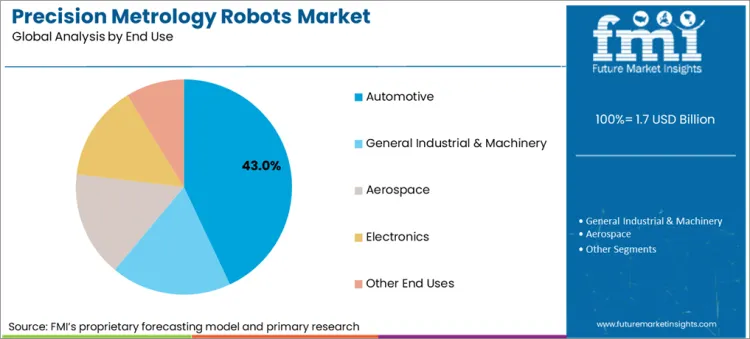
The automotive vertical remains the primary engine of growth, representing 43% of total end-use demand. Manufacturers are rapidly transitioning to 100% inline inspection to accommodate the micrometer tolerances required by EV battery cells and autonomous sensor arrays. Stellantis, during its 2025 Factory Booster Day, demonstrated this by showcasing over 100 innovations, including the Keyence IV4 AI-powered vision system, which performs 50,000 automated inspections per day at its Detroit facility to ensure zero-defect assembly.
Expansion is anchored by convergence of robotics and machine vision for BiW optimization. As automotive players shift toward Level 4 autonomous platforms, the demand for precision-verified chassis and sensor mounts has surged. Hexagon noted in its 2025 year-end report that recurring revenue from automotive service contracts rose significantly, reflecting a strategic shift among OEMs from purchasing hardware to investing in long-term, data-driven quality ecosystems that guarantee regulatory safety compliance.
What Drivers, Restraints, Opportunities, and Trends Prevail in the Precision Metrology Robots Market?
Precision metrology robots are increasingly integrated into aerospace additive manufacturing where extreme tolerances are required for flight-grade hardware. Agnikul Cosmos commissioned a large-format 3D printing facility in September 2025 capable of producing single-piece rocket engines up to one meter in height.
This shift toward manufacturing complex monolithic structures eliminates traditional joints and welds but necessitates robotic inspection systems that can verify internal geometries. The move from rapid prototyping to final production in space-tech creates a direct requirement for metrology robots to ensure structural integrity under strenuous environmental conditions.
The Bureau International des Poids et Mesures (BIPM) and national metrology institutes have prioritized digital calibration certificates as a core pillar for 2025 and 2026. This transition from paper-based reports to machine-actionable XML formats ensures that robotic systems can ingest calibration data without manual entry.
These certificates comply with the FAIR principles of findability and interoperability allowing multi-vendor robotic cells to maintain a digital thread of measurement traceability. Strategic implementation is currently hindered by legacy system incompatibilities with approximately 41% of companies reporting difficulties embedding new robotic assets into existing IT infrastructures.
Trade policy shifts in 2025 have redirected procurement strategies and investment timelines for industrial automation. The United States implemented 50% tariffs on steel and aluminum derivatives including precision parts and machining centers under Section 232 in the third quarter of 2025. These measures have increased landed costs for robotic components by up to 30% forcing manufacturers to reconsider regional sourcing and domestic production.
While 85% of manufacturing technology executives reported raising prices to offset these costs only 9% have shifted suppliers as of late 2025 highlighting a reactive market environment. These macroeconomic pressures are causing small and mid-sized enterprises to delay automation investments due to shrinking profit margins and unpredictable enforcement timelines.
How is the Precision Metrology Robots Market analysed in Key Countries
| Country | CAGR (2026-2036) |
|---|---|
| USA | 12.9% |
| UK | 11.9% |
| China | 13.4% |
| Germany | 11.8% |
Source: Future Market Insights (FMI) analysis, based on proprietary forecasting model and primary research
How is USA accelerating Precision Metrology Robots Demand through 2036?
The precision metrology robots market in the USA is projected to expand at a CAGR of 12.9% from 2026 to 2036. This trajectory is anchored by the reshoring of high-tech manufacturing and stringent regulatory frameworks in the aerospace and defense sectors. The Federal Aviation Administration recently finalized mandates requiring biannual calibration for critical flight components, prompting OEMs to deploy automated robotic cells that ensure repeatable, traceable measurement data without human error.
Technological advancements are heavily supported by government-led initiatives such as the NIST-led National Semiconductor Technology Center. Under the CHIPS and Science Act, specialized programs for 2025 and 2026 are focusing on establishing metrology standards for heterogeneous integration. These initiatives incentivize the adoption of robotic inspection systems capable of managing the sub-atomic variances required for chiplet packaging. This shift from statistical sampling to 100% automated verification is essential for maintaining the yield rates of next-generation domestic semiconductor facilities.
What Role does Industrial Digitalization play in UK’s Precision Metrology Robots Market?
In the UK, the precision metrology robots market is expected to grow at a CAGR of 11.9% during the forecast period. Expansion is significantly influenced by the Modern Industrial Strategy 2025 and the Advanced Manufacturing Sector Plan. The government has committed £2.8 billion for R&D over the next five years, specifically targeting automation and digitization within smart factories. A key component of this strategy is the expansion of the Made Smarter Adoption programme, which facilitates the integration of robotic metrology tools for small and medium enterprises.
Precision timing and sensing are also reaching new frontiers through the National Quantum Strategy. The National Physical Laboratory in Teddington is spearheading the miniaturization of quantum-enabled clocks and sensors for 2026 deployment. These compact devices are being integrated into robotic end-effectors to provide unprecedented accuracy in timing and spatial orientation. This innovation supports the UK’s goal of leading in frontier technologies, particularly where high-fidelity measurement is a prerequisite for autonomous systems in harsh or complex environments.
How is China Transforming its Manufacturing Base with Precision Metrology Robots?
China represents the fastest-growing region with a CAGR of 13.4% for the precision metrology robots market between 2026 and 2036. The Ministry of Industry and Information Technology released an updated Digital Transformation Guide in September 2025, which provides an operational roadmap for upgrading industrial hubs. This plan aims for over 70% of manufacturing enterprises to be digitized by late 2026, creating a massive vacuum for robotic inspection systems that can operate within networked, AI-driven environments.
The 14th Five-Year Plan continues to prioritize basic industrial capacity reengineering to eliminate bottlenecks in high-end equipment. Major industrial players like Huawei and Foxconn have initiated large-scale automation projects that utilize precision metrology robots for the assembly and testing of delicate electronic components. These systems are increasingly equipped with foundational reasoning models that allow robots to autonomously determine the best measurement path for complex 3D-printed parts, aligning with the national objective of becoming a global powerhouse in quality manufacturing.
Why is Germany maintaining Leadership in Europe’s Precision Metrology Robots Market?
The precision metrology robots market in Germany is poised for a CAGR of 11.8% from 2026 to 2036. Growth is sustained by the country’s advanced industrial infrastructure and the ongoing Industrie 4.0 strategic program. The Bavarian government’s Digital Bavaria initiative and the Stuttgart Digital Hub have successfully fostered collaboration between established engineering firms and robotics startups. These hubs are currently focusing on the integration of IoT-enabled sensors within robotic arms to facilitate predictive maintenance and real-time quality analytics on the shop floor.
Semiconductor sovereignty is a major catalyst for regional expansion through 2026. Massive investments under the EU Chips Act, including Infineon’s €5 billion Smart Power Fab in Dresden scheduled for operation in 2026, are creating localized demand for high-throughput metrology. These facilities require specialized robotic systems to perform wafer defect detection and thin-film metrology at high speeds. By focusing on specialized automotive microcontrollers and power management ICs, Germany is ensuring that its robotic metrology fleet remains a critical component of the global electronics supply chain.
How Competitive is the Precision Metrology Robots Market?
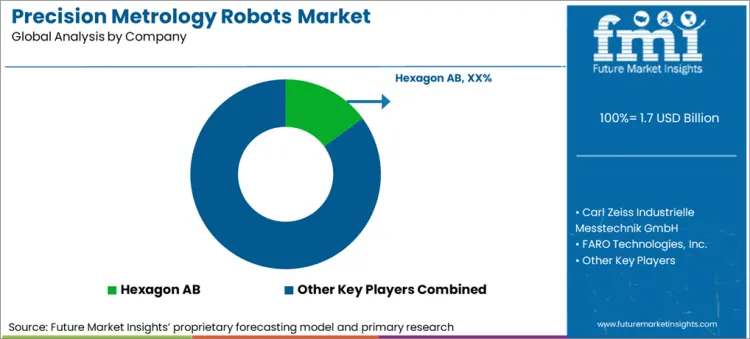
The competitive landscape for precision metrology robots is characterized by a definitive shift from standalone hardware sales toward intelligent autonomy as a service. Market intensity is driven by the race to eliminate the latency of measurement by moving inspection from the laboratory to the production edge. ABB Robotics and FANUC have intensified this rivalry through open-source software plays; FANUC’s late 2025 release of a dedicated ROS 2 driver and Python support allows third-party developers to embed proprietary AI algorithms directly into robot controllers. This democratization of the software layer forces traditional metrology firms to pivot toward integrated digital twins and photorealistic simulation environments to maintain their competitive moats.
Strategic reorganization and pure-play consolidations are further reshaping the leaderboard. The January 2026 merger of FARO’s 3D Measurement segment with Creaform to create FARO CREAFORM marks a significant consolidation of portable metrology powerhouses, aiming to provide a single point of contact for automated and handheld scanning. ZEISS has signaled a shift toward high-growth digital segments by announcing the cessation of analog optics manufacturing in Wetzlar by 2026, realigning its capital toward SMT and smart production. These maneuvers indicate that the next phase of competition will not be won on mechanical precision alone, but on the ability to provide a "Context-Rich" data thread across the entire manufacturing lifecycle.
Key Market Developments (2024-2026)
- In October 2024, Nikon Metrology NV completed the divestment of its laser scanner division to LK Metrology, a strategic move to streamline its portfolio and focus on high-speed X-ray CT and integrated industrial solutions for the 2025-2026 fiscal cycle.
- Renishaw plc unveiled the MODUS™ IM Equator intelligent metrology software and the XK20 next-generation alignment laser system in August 2025, specifically engineered to provide comprehensive build data for high-performance machine tools and robotic stages.
- In February 2026,, Nikon Corporation launched the newest version of NEXIV AutoMeasure software, featuring advanced AI-driven routines that significantly reduce the time required to create complex measurement programs for semiconductor and electronic components.
Key Players Profiled
- Hexagon AB
- Carl Zeiss Industrielle Messtechnik GmbH
- FARO Technologies, Inc.
- ABB Robotics
- KUKA AG
- FANUC Corporation
- Mecmesin Limited
- Mahr GmbH
- Nikon Metrology NV
- Renishaw plc
Market Definition
The precision metrology robots market comprises revenue generated from robotic systems designed to perform high-accuracy measurement, inspection, and verification tasks within industrial environments. These robots integrate mechanical motion platforms with contact and non-contact sensing technologies such as probing, optical, and laser-based systems to enable dimensional inspection, geometric analysis, and quality assurance directly on or near the production line.
The market scope includes articulated, SCARA, collaborative, and cartesian robotic platforms deployed across automotive, aerospace, electronics, and general industrial manufacturing. Revenue is measured from hardware systems and integrated metrology solutions supplied as standalone inspection cells or embedded within automated production workflows.
The market excludes standalone laboratory metrology equipment, manual inspection tools, and general industrial robots not configured or sold specifically for precision measurement and quality control applications.
Scope of Report
| Items | Values |
|---|---|
| Quantitative Units | USD 1.7 billion |
| Type of Robot | Articulated Metrology Robots, SCARA, Collaborative Metrology Robots, Cartesian Robots |
| Measurement Technology | Contact Probing, Optical Technology, Laser Scanning, Other Sensors |
| End Use | Automotive, General Industrial & Machinery, Aerospace, Electronics, Other End Uses |
| Regions Covered | North America, Western Europe, Eastern Europe, East Asia, South Asia & Pacific, Latin America, Middle East & Africa |
| Countries | USA, UK, Germany, China and 40+ countries |
| Key Companies | Hexagon AB, Carl Zeiss Industrielle Messtechnik GmbH, FARO Technologies Inc., ABB Robotics, KUKA AG, FANUC Corporation, Mecmesin Limited, Mahr GmbH, Nikon Metrology NV, Renishaw plc |
Source: Future Market Insights (FMI) analysis, based on proprietary forecasting model and primary research
Precision Metrology Robots Market Key Segments
Type of Robot
- Articulated Metrology Robots
- SCARA
- Collaborative Metrology Robots
- Cartesian Robots
Measurement Technology
- Contact Probing
- Optical Technology
- Laser Scanning
- Other Sensors
End Use
- Automotive
- General Industrial & Machinery
- Aerospace
- Electronics
- Other End Uses
Region
- North America
- Western Europe
- Eastern Europe
- East Asia
- South Asia & Pacific
- Latin America
- Middle East & Africa
Bibliography
- International Society for Pharmaceutical Engineering. (2024). Good packaging practices and outsourcing models in pharmaceutical manufacturing. Tampa, FL: ISPE.
- European Commission. (2024). Packaging and packaging waste regulation (PPWR): Implications for third-party packaging services. Brussels, Belgium.
- Institute of Packaging Professionals. (2023). Trends in co-packing, kitting, and value-added packaging services. Herndon, VA: IoPP.
- World Packaging Organisation. (2024). Global packaging industry report: Outsourced and contract packaging segments. Zurich, Switzerland.
- DHL Group. (2024). Life sciences and healthcare logistics: Packaging, assembly, and compliance services. Bonn, Germany.
Frequently Asked Questions
What is the projected market value for precision metrology robots in 2026?
The market value is expected to reach USD 1.7 billion by 2026.
What will the market value for precision metrology robots be in 2036?
The projected market value in 2036 is USD 5.0 billion.
What is the CAGR for the precision metrology robots market from 2026 to 2036?
The CAGR for the precision metrology robots market from 2026 to 2036 is 11.4%.
What are the key trends driving the market growth?
Key trends include the migration of metrology from laboratories to in-line production environments, adoption of Physical AI, expansion of non-contact inspection technologies, convergence of IT and OT systems, and the rise of closed-loop, autonomous quality control architectures supporting zero-defect manufacturing.
How is the competitive landscape evolving?
The competitive landscape is shifting from standalone hardware competition toward intelligent autonomy and data-driven quality ecosystems, marked by strategic mergers, pure-play robotics spin-offs, open software platforms, and increased emphasis on Robotics-as-a-Service (RaaS) and connected quality hubs rather than fragmented price-based competition.
Preview the report firsthand - request a free sample
Get SampleGet the brochure for pricing and purchase details.
Get PDFTable of Content
- Executive Summary
- Global Market Outlook
- Demand-side Trends
- Supply-side Trends
- Technology Roadmap Analysis
- Analysis and Recommendations
- Market Overview
- Market Coverage / Taxonomy
- Market Definition / Scope / Limitations
- Research Methodology
- Chapter Orientation
- Analytical Lens and Working Hypotheses
- Market Structure, Signals, and Trend Drivers
- Benchmarking and Cross-market Comparability
- Market Sizing, Forecasting, and Opportunity Mapping
- Research Design and Evidence Framework
- Desk Research Programme (Secondary Evidence)
- Company Annual and Sustainability Reports
- Peer-reviewed Journals and Academic Literature
- Corporate Websites, Product Literature, and Technical Notes
- Earnings Decks and Investor Briefings
- Statutory Filings and Regulatory Disclosures
- Technical White Papers and Standards Notes
- Trade Journals, Industry Magazines, and Analyst Briefs
- Conference Proceedings, Webinars, and Seminar Materials
- Government Statistics Portals and Public Data Releases
- Press Releases and Reputable Media Coverage
- Specialist Newsletters and Curated Briefings
- Sector Databases and Reference Repositories
- FMI Internal Proprietary Databases and Historical Market Datasets
- Subscription Datasets and Paid Sources
- Social Channels, Communities, and Digital Listening Inputs
- Additional Desk Sources
- Expert Input and Fieldwork (Primary Evidence)
- Primary Modes
- Qualitative Interviews and Expert Elicitation
- Quantitative Surveys and Structured Data Capture
- Blended Approach
- Why Primary Evidence is Used
- Field Techniques
- Interviews
- Surveys
- Focus Groups
- Observational and In-context Research
- Social and Community Interactions
- Stakeholder Universe Engaged
- C-suite Leaders
- Board Members
- Presidents and Vice Presidents
- R&D and Innovation Heads
- Technical Specialists
- Domain Subject-matter Experts
- Scientists
- Physicians and Other Healthcare Professionals
- Governance, Ethics, and Data Stewardship
- Research Ethics
- Data Integrity and Handling
- Primary Modes
- Tooling, Models, and Reference Databases
- Desk Research Programme (Secondary Evidence)
- Data Engineering and Model Build
- Data Acquisition and Ingestion
- Cleaning, Normalisation, and Verification
- Synthesis, Triangulation, and Analysis
- Quality Assurance and Audit Trail
- Market Background
- Market Dynamics
- Drivers
- Restraints
- Opportunity
- Trends
- Scenario Forecast
- Demand in Optimistic Scenario
- Demand in Likely Scenario
- Demand in Conservative Scenario
- Opportunity Map Analysis
- Product Life Cycle Analysis
- Supply Chain Analysis
- Investment Feasibility Matrix
- Value Chain Analysis
- PESTLE and Porter’s Analysis
- Regulatory Landscape
- Regional Parent Market Outlook
- Production and Consumption Statistics
- Import and Export Statistics
- Market Dynamics
- Global Market Analysis 2021 to 2025 and Forecast, 2026 to 2036
- Historical Market Size Value (USD Million) Analysis, 2021 to 2025
- Current and Future Market Size Value (USD Million) Projections, 2026 to 2036
- Y-o-Y Growth Trend Analysis
- Absolute $ Opportunity Analysis
- Global Market Pricing Analysis 2021 to 2025 and Forecast 2026 to 2036
- Global Market Analysis 2021 to 2025 and Forecast 2026 to 2036, By Robot
- Introduction / Key Findings
- Historical Market Size Value (USD Million) Analysis By Robot , 2021 to 2025
- Current and Future Market Size Value (USD Million) Analysis and Forecast By Robot , 2026 to 2036
- Articulated Metrology Robots
- SCARA
- Collaborative Metrology Robots
- Cartesian Robots
- Articulated Metrology Robots
- Y-o-Y Growth Trend Analysis By Robot , 2021 to 2025
- Absolute $ Opportunity Analysis By Robot , 2026 to 2036
- Global Market Analysis 2021 to 2025 and Forecast 2026 to 2036, By Measurement Technology
- Introduction / Key Findings
- Historical Market Size Value (USD Million) Analysis By Measurement Technology, 2021 to 2025
- Current and Future Market Size Value (USD Million) Analysis and Forecast By Measurement Technology, 2026 to 2036
- Contact Probing
- Optical Technology
- Laser Scanning
- Other Sensors
- Contact Probing
- Y-o-Y Growth Trend Analysis By Measurement Technology, 2021 to 2025
- Absolute $ Opportunity Analysis By Measurement Technology, 2026 to 2036
- Global Market Analysis 2021 to 2025 and Forecast 2026 to 2036, By End Use
- Introduction / Key Findings
- Historical Market Size Value (USD Million) Analysis By End Use, 2021 to 2025
- Current and Future Market Size Value (USD Million) Analysis and Forecast By End Use, 2026 to 2036
- Automotive
- General Industrial & Machinery
- Aerospace
- Electronics
- Other End Uses
- Automotive
- Y-o-Y Growth Trend Analysis By End Use, 2021 to 2025
- Absolute $ Opportunity Analysis By End Use, 2026 to 2036
- Global Market Analysis 2021 to 2025 and Forecast 2026 to 2036, By Region
- Introduction
- Historical Market Size Value (USD Million) Analysis By Region, 2021 to 2025
- Current Market Size Value (USD Million) Analysis and Forecast By Region, 2026 to 2036
- North America
- Latin America
- Western Europe
- Eastern Europe
- East Asia
- South Asia and Pacific
- Middle East & Africa
- Market Attractiveness Analysis By Region
- North America Market Analysis 2021 to 2025 and Forecast 2026 to 2036, By Country
- Historical Market Size Value (USD Million) Trend Analysis By Market Taxonomy, 2021 to 2025
- Market Size Value (USD Million) Forecast By Market Taxonomy, 2026 to 2036
- By Country
- USA
- Canada
- Mexico
- By Robot
- By Measurement Technology
- By End Use
- By Country
- Market Attractiveness Analysis
- By Country
- By Robot
- By Measurement Technology
- By End Use
- Key Takeaways
- Latin America Market Analysis 2021 to 2025 and Forecast 2026 to 2036, By Country
- Historical Market Size Value (USD Million) Trend Analysis By Market Taxonomy, 2021 to 2025
- Market Size Value (USD Million) Forecast By Market Taxonomy, 2026 to 2036
- By Country
- Brazil
- Chile
- Rest of Latin America
- By Robot
- By Measurement Technology
- By End Use
- By Country
- Market Attractiveness Analysis
- By Country
- By Robot
- By Measurement Technology
- By End Use
- Key Takeaways
- Western Europe Market Analysis 2021 to 2025 and Forecast 2026 to 2036, By Country
- Historical Market Size Value (USD Million) Trend Analysis By Market Taxonomy, 2021 to 2025
- Market Size Value (USD Million) Forecast By Market Taxonomy, 2026 to 2036
- By Country
- Germany
- UK
- Italy
- Spain
- France
- Nordic
- BENELUX
- Rest of Western Europe
- By Robot
- By Measurement Technology
- By End Use
- By Country
- Market Attractiveness Analysis
- By Country
- By Robot
- By Measurement Technology
- By End Use
- Key Takeaways
- Eastern Europe Market Analysis 2021 to 2025 and Forecast 2026 to 2036, By Country
- Historical Market Size Value (USD Million) Trend Analysis By Market Taxonomy, 2021 to 2025
- Market Size Value (USD Million) Forecast By Market Taxonomy, 2026 to 2036
- By Country
- Russia
- Poland
- Hungary
- Balkan & Baltic
- Rest of Eastern Europe
- By Robot
- By Measurement Technology
- By End Use
- By Country
- Market Attractiveness Analysis
- By Country
- By Robot
- By Measurement Technology
- By End Use
- Key Takeaways
- East Asia Market Analysis 2021 to 2025 and Forecast 2026 to 2036, By Country
- Historical Market Size Value (USD Million) Trend Analysis By Market Taxonomy, 2021 to 2025
- Market Size Value (USD Million) Forecast By Market Taxonomy, 2026 to 2036
- By Country
- China
- Japan
- South Korea
- By Robot
- By Measurement Technology
- By End Use
- By Country
- Market Attractiveness Analysis
- By Country
- By Robot
- By Measurement Technology
- By End Use
- Key Takeaways
- South Asia and Pacific Market Analysis 2021 to 2025 and Forecast 2026 to 2036, By Country
- Historical Market Size Value (USD Million) Trend Analysis By Market Taxonomy, 2021 to 2025
- Market Size Value (USD Million) Forecast By Market Taxonomy, 2026 to 2036
- By Country
- India
- ASEAN
- Australia & New Zealand
- Rest of South Asia and Pacific
- By Robot
- By Measurement Technology
- By End Use
- By Country
- Market Attractiveness Analysis
- By Country
- By Robot
- By Measurement Technology
- By End Use
- Key Takeaways
- Middle East & Africa Market Analysis 2021 to 2025 and Forecast 2026 to 2036, By Country
- Historical Market Size Value (USD Million) Trend Analysis By Market Taxonomy, 2021 to 2025
- Market Size Value (USD Million) Forecast By Market Taxonomy, 2026 to 2036
- By Country
- Kingdom of Saudi Arabia
- Other GCC Countries
- Turkiye
- South Africa
- Other African Union
- Rest of Middle East & Africa
- By Robot
- By Measurement Technology
- By End Use
- By Country
- Market Attractiveness Analysis
- By Country
- By Robot
- By Measurement Technology
- By End Use
- Key Takeaways
- Key Countries Market Analysis
- USA
- Pricing Analysis
- Market Share Analysis, 2025
- By Robot
- By Measurement Technology
- By End Use
- Canada
- Pricing Analysis
- Market Share Analysis, 2025
- By Robot
- By Measurement Technology
- By End Use
- Mexico
- Pricing Analysis
- Market Share Analysis, 2025
- By Robot
- By Measurement Technology
- By End Use
- Brazil
- Pricing Analysis
- Market Share Analysis, 2025
- By Robot
- By Measurement Technology
- By End Use
- Chile
- Pricing Analysis
- Market Share Analysis, 2025
- By Robot
- By Measurement Technology
- By End Use
- Germany
- Pricing Analysis
- Market Share Analysis, 2025
- By Robot
- By Measurement Technology
- By End Use
- UK
- Pricing Analysis
- Market Share Analysis, 2025
- By Robot
- By Measurement Technology
- By End Use
- Italy
- Pricing Analysis
- Market Share Analysis, 2025
- By Robot
- By Measurement Technology
- By End Use
- Spain
- Pricing Analysis
- Market Share Analysis, 2025
- By Robot
- By Measurement Technology
- By End Use
- France
- Pricing Analysis
- Market Share Analysis, 2025
- By Robot
- By Measurement Technology
- By End Use
- India
- Pricing Analysis
- Market Share Analysis, 2025
- By Robot
- By Measurement Technology
- By End Use
- ASEAN
- Pricing Analysis
- Market Share Analysis, 2025
- By Robot
- By Measurement Technology
- By End Use
- Australia & New Zealand
- Pricing Analysis
- Market Share Analysis, 2025
- By Robot
- By Measurement Technology
- By End Use
- China
- Pricing Analysis
- Market Share Analysis, 2025
- By Robot
- By Measurement Technology
- By End Use
- Japan
- Pricing Analysis
- Market Share Analysis, 2025
- By Robot
- By Measurement Technology
- By End Use
- South Korea
- Pricing Analysis
- Market Share Analysis, 2025
- By Robot
- By Measurement Technology
- By End Use
- Russia
- Pricing Analysis
- Market Share Analysis, 2025
- By Robot
- By Measurement Technology
- By End Use
- Poland
- Pricing Analysis
- Market Share Analysis, 2025
- By Robot
- By Measurement Technology
- By End Use
- Hungary
- Pricing Analysis
- Market Share Analysis, 2025
- By Robot
- By Measurement Technology
- By End Use
- Kingdom of Saudi Arabia
- Pricing Analysis
- Market Share Analysis, 2025
- By Robot
- By Measurement Technology
- By End Use
- Turkiye
- Pricing Analysis
- Market Share Analysis, 2025
- By Robot
- By Measurement Technology
- By End Use
- South Africa
- Pricing Analysis
- Market Share Analysis, 2025
- By Robot
- By Measurement Technology
- By End Use
- USA
- Market Structure Analysis
- Competition Dashboard
- Competition Benchmarking
- Market Share Analysis of Top Players
- By Regional
- By Robot
- By Measurement Technology
- By End Use
- Competition Analysis
- Competition Deep Dive
- Hexagon AB
- Overview
- Product Portfolio
- Profitability by Market Segments (Product/Age /Sales Channel/Region)
- Sales Footprint
- Strategy Overview
- Marketing Strategy
- Product Strategy
- Channel Strategy
- Carl Zeiss Industrielle Messtechnik GmbH
- FARO Technologies, Inc.
- ABB Robotics
- KUKA AG
- FANUC Corporation
- Mecmesin Limited
- Mahr GmbH
- Nikon Metrology NV
- Renishaw plc
- Hexagon AB
- Competition Deep Dive
- Assumptions & Acronyms Used


