

- Industry Size (2026)
- USD 0.8 Bn
- Forecast (2036)
- USD 2.0 Bn
- CAGR (2026 to 2036)
- 9.6%
Precision Fiber Molding Market Size, Market Forecast and Outlook By FMI
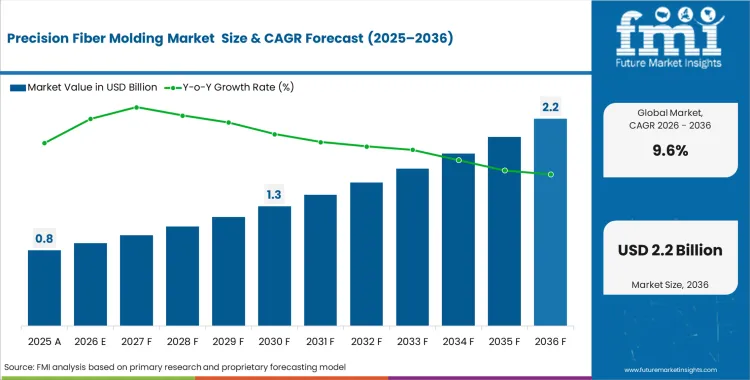
The precision fiber molding market was valued at USD 0.7 billion in 2025. The market is projected to reach USD 0.8 billion in 2026 and USD 2.0 billion by 2036, expanding at a CAGR of 9.6% during the forecast period. Virgin wood pulp are expected to lead fiber source or material demand with a 49.3% share in 2026. Consumer electronics inserts are projected to remain the leading product type with a 29.8% share in 2026. Consumer electronics are expected to lead end-use demand with a 31.6% share in 2026.
Summary of Precision Fiber Molding Market
- Key Drivers
- Geometry precision: Brands are adopting molded fiber where component fit, repeatable tolerances, and premium unboxing quality all matter.
- Premium plastic displacement: High-visibility categories are replacing plastic trays with shaped fiber parts that still look engineered.
- Tooling and automation gains: Advances in tooling, digital development, and controlled forming are making complex fiber parts more commercially viable.
- Key Segments Analyzed in the Report
- Fiber source: virgin wood pulp, recycled pulp, bagasse, bamboo, and others
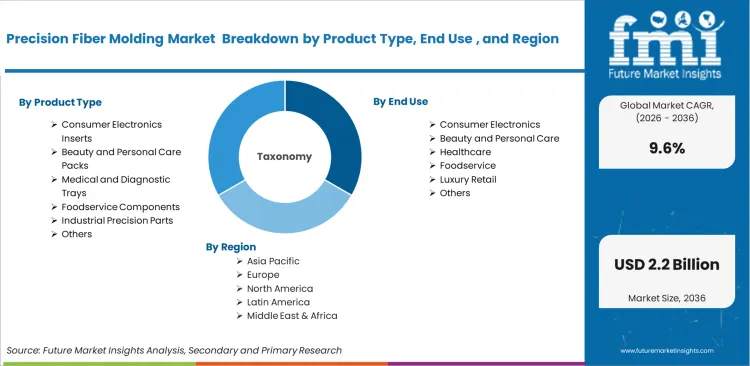
- Product type: consumer electronics inserts, beauty and personal care packs, medical and diagnostic trays, foodservice components, industrial precision parts, and others
- End use industry: consumer electronics, beauty and personal care, healthcare, foodservice, luxury retail, and others
- Region: North America, Latin America, Western Europe, Eastern Europe, East Asia, South Asia and Pacific, and Middle East and Africa
- Analyst Opinion
- Ismail Sutaria, Senior Consultant at FMI says, "Precision fiber molding is where fiber stops competing on conscience alone and starts competing on engineering. The profit pool is forming in applications that demand exact fit, branded surface quality, and reliable automated handling."
Precision Fiber Molding market Definition
The precision fiber molding market covers engineered molded-fiber components manufactured to tighter dimensional tolerances and cleaner surface standards than conventional utility pulp packaging. It includes device inserts, cosmetic trays, diagnostic and medical trays, premium foodservice parts, and custom industrial components produced through advanced forming, tooling, and finishing methods. These parts serve categories where fit accuracy, product presentation, and a renewable material story need to coexist inside an operationally reliable packaging system.
Precision Fiber Molding market Inclusions
- Sales of advanced molded-fiber parts designed for exact-fit protective, presentation, or handling functions in premium and regulated applications.
- Revenue from custom tooling, engineered inserts, high-definition molded-fiber trays, and comparable precision formed parts.
- Commercial demand across all major regions where fiber parts compete with plastic trays, foam inserts, and premium paperboard fittings.
Precision Fiber Molding market Exclusions
- Commodity utility molded-pulp formats sold mainly on volume and rough protective geometry.
- Simple paperboard cartons, sleeves, and folded inserts that do not rely on molded three-dimensional shaping.
- Injection-molded plastic, thermoformed plastic, or foam precision components outside fiber-based production.
Precision Fiber Molding market Research Methodology
This study evaluates precision fiber molding by fiber source, product type, and end use industry with 2025 as the base year and 2026 to 2036 as the forecast period in value terms. Inputs include official packaging regulation, trade association molded-fiber classifications, annual reports and technology disclosures from formed-fiber and packaging companies, and technical literature on advanced molded pulp properties and thermoformed performance. Market estimates are built through triangulation of premium packaging substitution rates, tooling and machine capability improvements, consumer-electronics packaging intensity, and commercialization pathways for exact-fit fiber components.
Key Drivers, Restraints, and Trends in Precision Fiber Molding market
Drivers
Precision fiber molding is advancing because premium brands and device makers are looking for plastic replacement options that do not sacrifice geometry or the unboxing experience. The category benefits from better tooling, improved surface finish, and more stable forming that let fiber move into exact-fit inserts and trays. It is also gaining attention in healthcare and diagnostics, where controlled handling and single-use packaging remain essential. The commercial attraction is clear: brands can retain a strong engineered look while improving the material narrative. As more converters learn to run tighter-tolerance fiber parts, the addressable market keeps widening.
Restraints
The market remains constrained by process complexity and cost. Tight-tolerance molded-fiber parts demand cleaner pulp, better tooling, and narrower process windows than standard utility trays. Qualification cycles are longer because brands and regulated buyers test dimensional repeatability closely. Some applications still reject fiber because barrier or cosmetic requirements remain too strict. Volume scale is also smaller, which means many converters cannot yet offer the same cost curve available in mature packaging categories.
Trends
The category is moving toward applications where engineering and presentation carry similar weight. Consumer electronics, beauty packaging, and medical accessory trays are becoming the most visible battlegrounds. Suppliers are using digital prototyping, advanced tooling, and heat-assisted finishing to tighten tolerances and improve part uniformity. Brand owners increasingly judge these parts on fit accuracy, line compatibility, and premium feel rather than on sustainability claims alone. The market is therefore evolving from molded-pulp substitution into a specialized packaging-engineering segment.
Segmental Analysis
Precision Fiber Molding market Analysis by Product Type
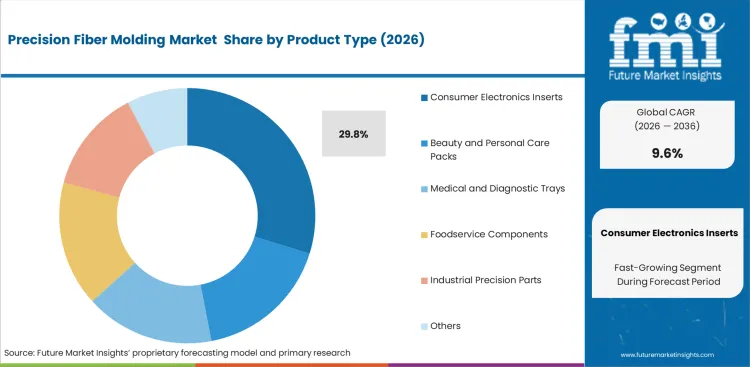
Consumer electronics inserts are projected to hold 29.8% of market value in 2026 because devices, accessories, and wearables need exact-fit support, clean presentation, and efficient pack-out at large unit volumes. These inserts replace plastic trays in applications where every millimeter of fit influences damage risk and perceived quality. The segment also benefits from recurring product refresh cycles. HP demonstrated molded-fiber packaging for its Desktop Mini using advanced molded-fiber tooling, showing that precision molded-fiber parts are already viable in electronics packaging where dimensional control matters.
Precision Fiber Molding market Analysis by End Use Industry
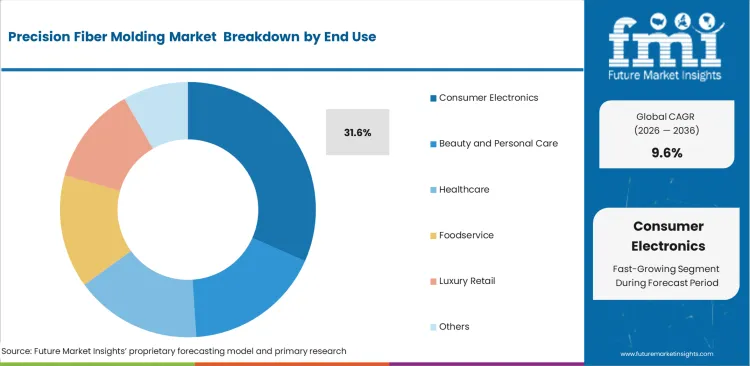
Consumer electronics are expected to account for 31.6% of end-use demand in 2026 because the category combines fragile products, frequent redesign cycles, and strong public pressure to remove plastic from accessory and device packaging. Buyers in this segment are willing to pay for exact fit and cleaner presentation when it supports brand value. PulPac, Footprint, and other advanced fiber innovators continue to position molded fiber as a route to replace short-term use plastics in branded packaging, reinforcing electronics as a natural early adopter market.
Competitive Aligners for Market Players
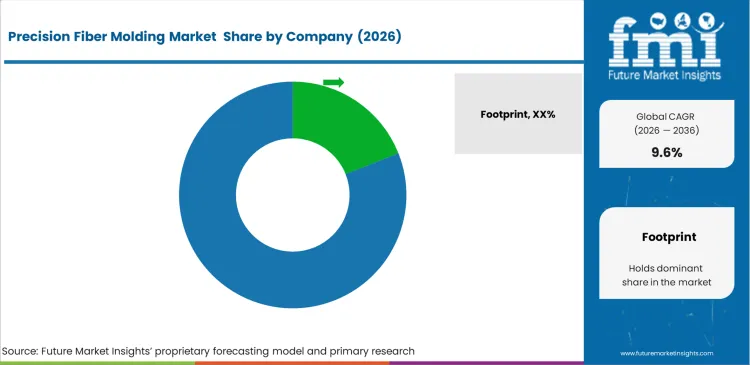
Winning in precision fiber molding requires more than fiber access. Buyers need tool development, repeatable process control, premium surface finish, and packaging engineers who can translate product geometry into scalable molded parts. HP’s work on advanced molded-fiber tooling shows that equipment and tooling sophistication are becoming core market assets. Stora Enso has continued to invest in formed-fiber growth, while Footprint frames its business around replacing short-term use plastic with plant-based material science. Market leadership will form around companies that can merge material science, mold engineering, and customer qualification support into one commercial offer.
Key Players in Precision Fiber Molding market
- Footprint
- PulPac AB
- Stora Enso Oyj
- Huhtamaki Oyj
- Valmet Oyj
- Omni-Pac Group
- CKF Inc.
- MFT-CKF
- PA Consulting
- UFP Technologies, Inc.
Strategic Outlook by FMI on Precision Fiber Molding market
FMI sees precision fiber molding as one of the highest-value niches within fiber packaging. Growth will be determined by how quickly suppliers can industrialize exact-fit parts without losing yield, finish quality, or pack-line compatibility. The most successful companies will be those that make fiber behave like engineered packaging, not merely sustainable packaging.
Scope of the Report
| Metric | Value |
|---|---|
| Market Value | USD 0.7 billion in 2025 to USD 2.0 billion by 2036 |
| CAGR | 9.6% from 2026 to 2036 |
| Base Year | 2025 |
| Forecast Period | 2026 to 2036 |
| Fiber Source Segmentation | Virgin Wood Pulp, Recycled Pulp, Bagasse, Bamboo, Others |
| Product Type Segmentation | Consumer Electronics Inserts, Beauty and Personal Care Packs, Medical and Diagnostic Trays, Foodservice Components, Industrial Precision Parts, Others |
| End Use Industry Segmentation | Consumer Electronics, Beauty and Personal Care, Healthcare, Foodservice, Luxury Retail, Others |
| Regions Covered | North America, Latin America, Western Europe, Eastern Europe, East Asia, South Asia and Pacific, Middle East and Africa |
Bibliography
- European Commission. 2025. Packaging and Packaging Waste Regulation.
- International Molded Fiber Association. 2025. Molded Fiber Masterclass.
- HP Inc. 2021. HP and Innofibre Showcase Significant Performance and Reliability Results in Molded Fiber Packaging.
- PulPac AB. 2024. Dry Molded Fiber.
- Footprint. 2025. Plant-based Fiber Technology and Material Science.
- Stora Enso Oyj. 2025. Annual Report 2025.
- Semple, K. E. et al. 2022. Moulded Pulp Fibers for Disposable Food Packaging.
Frequently Asked Questions
What is precision fiber molding and how is it different from regular molded pulp?
It refers to fiber components manufactured to tighter dimensional tolerances and cleaner surface finishes than standard utility pulp packaging, designed to compete with plastic trays on engineering terms.
Which end-use industry is driving the most demand right now?
Consumer electronics leads with a projected 31.6% share in 2026, driven by device packaging redesigns and brand pressure to remove plastic from accessories.
Why is the market still constrained despite strong sustainability tailwinds?
Process complexity, longer qualification cycles, and smaller production volumes make cost and yield control harder than in mature packaging categories.
Which fiber source dominates supply and why?
Virgin wood pulp is expected to hold a 49.3% share in 2026 because it delivers the consistent fiber quality needed to hold tighter tolerances in precision parts.
What does it take to win in this market as a converter or supplier?
Companies need a combination of tooling sophistication, process repeatability, and the ability to support customers through dimensional qualification, not just fiber supply.
Preview the report firsthand - request a free sample
Get SampleGet the brochure for pricing and purchase details.
Get PDFTable of Content
- Executive Summary
- Global Market Outlook
- Demand-side Trends
- Supply-side Trends
- Technology Roadmap Analysis
- Analysis and Recommendations
- Market Overview
- Market Coverage / Taxonomy
- Market Definition / Scope / Limitations
- Research Methodology
- Chapter Orientation
- Analytical Lens and Working Hypotheses
- Market Structure, Signals, and Trend Drivers
- Benchmarking and Cross-market Comparability
- Market Sizing, Forecasting, and Opportunity Mapping
- Research Design and Evidence Framework
- Desk Research Programme (Secondary Evidence)
- Company Annual and Sustainability Reports
- Peer-reviewed Journals and Academic Literature
- Corporate Websites, Product Literature, and Technical Notes
- Earnings Decks and Investor Briefings
- Statutory Filings and Regulatory Disclosures
- Technical White Papers and Standards Notes
- Trade Journals, Industry Magazines, and Analyst Briefs
- Conference Proceedings, Webinars, and Seminar Materials
- Government Statistics Portals and Public Data Releases
- Press Releases and Reputable Media Coverage
- Specialist Newsletters and Curated Briefings
- Sector Databases and Reference Repositories
- FMI Internal Proprietary Databases and Historical Market Datasets
- Subscription Datasets and Paid Sources
- Social Channels, Communities, and Digital Listening Inputs
- Additional Desk Sources
- Expert Input and Fieldwork (Primary Evidence)
- Primary Modes
- Qualitative Interviews and Expert Elicitation
- Quantitative Surveys and Structured Data Capture
- Blended Approach
- Why Primary Evidence is Used
- Field Techniques
- Interviews
- Surveys
- Focus Groups
- Observational and In-context Research
- Social and Community Interactions
- Stakeholder Universe Engaged
- C-suite Leaders
- Board Members
- Presidents and Vice Presidents
- R&D and Innovation Heads
- Technical Specialists
- Domain Subject-matter Experts
- Scientists
- Physicians and Other Healthcare Professionals
- Governance, Ethics, and Data Stewardship
- Research Ethics
- Data Integrity and Handling
- Primary Modes
- Tooling, Models, and Reference Databases
- Desk Research Programme (Secondary Evidence)
- Data Engineering and Model Build
- Data Acquisition and Ingestion
- Cleaning, Normalisation, and Verification
- Synthesis, Triangulation, and Analysis
- Quality Assurance and Audit Trail
- Market Background
- Market Dynamics
- Drivers
- Restraints
- Opportunity
- Trends
- Scenario Forecast
- Demand in Optimistic Scenario
- Demand in Likely Scenario
- Demand in Conservative Scenario
- Opportunity Map Analysis
- Product Life Cycle Analysis
- Supply Chain Analysis
- Investment Feasibility Matrix
- Value Chain Analysis
- PESTLE and Porter’s Analysis
- Regulatory Landscape
- Regional Parent Market Outlook
- Production and Consumption Statistics
- Import and Export Statistics
- Market Dynamics
- Global Market Analysis 2021 to 2025 and Forecast, 2026 to 2036
- Historical Market Size Value (USD Million) Analysis, 2021 to 2025
- Current and Future Market Size Value (USD Million) Projections, 2026 to 2036
- Y-o-Y Growth Trend Analysis
- Absolute $ Opportunity Analysis
- Global Market Pricing Analysis 2021 to 2025 and Forecast 2026 to 2036
- Global Market Analysis 2021 to 2025 and Forecast 2026 to 2036, By Product Type
- Introduction / Key Findings
- Historical Market Size Value (USD Million) Analysis By Product Type , 2021 to 2025
- Current and Future Market Size Value (USD Million) Analysis and Forecast By Product Type , 2026 to 2036
- Consumer Electronics Inserts
- Beauty and Personal Care Packs
- Medical and Diagnostic Trays
- Foodservice Components
- Industrial Precision Parts
- Others
- Consumer Electronics Inserts
- Y-o-Y Growth Trend Analysis By Product Type , 2021 to 2025
- Absolute $ Opportunity Analysis By Product Type , 2026 to 2036
- Global Market Analysis 2021 to 2025 and Forecast 2026 to 2036, By End Use
- Introduction / Key Findings
- Historical Market Size Value (USD Million) Analysis By End Use, 2021 to 2025
- Current and Future Market Size Value (USD Million) Analysis and Forecast By End Use, 2026 to 2036
- Consumer Electronics
- Beauty and Personal Care
- Healthcare
- Foodservice
- Luxury Retail
- Others
- Consumer Electronics
- Y-o-Y Growth Trend Analysis By End Use, 2021 to 2025
- Absolute $ Opportunity Analysis By End Use, 2026 to 2036
- Global Market Analysis 2021 to 2025 and Forecast 2026 to 2036, By Region
- Introduction
- Historical Market Size Value (USD Million) Analysis By Region, 2021 to 2025
- Current Market Size Value (USD Million) Analysis and Forecast By Region, 2026 to 2036
- North America
- Latin America
- Western Europe
- Eastern Europe
- East Asia
- South Asia and Pacific
- Middle East & Africa
- Market Attractiveness Analysis By Region
- North America Market Analysis 2021 to 2025 and Forecast 2026 to 2036, By Country
- Historical Market Size Value (USD Million) Trend Analysis By Market Taxonomy, 2021 to 2025
- Market Size Value (USD Million) Forecast By Market Taxonomy, 2026 to 2036
- By Country
- USA
- Canada
- Mexico
- By Product Type
- By End Use
- By Country
- Market Attractiveness Analysis
- By Country
- By Product Type
- By End Use
- Key Takeaways
- Latin America Market Analysis 2021 to 2025 and Forecast 2026 to 2036, By Country
- Historical Market Size Value (USD Million) Trend Analysis By Market Taxonomy, 2021 to 2025
- Market Size Value (USD Million) Forecast By Market Taxonomy, 2026 to 2036
- By Country
- Brazil
- Chile
- Rest of Latin America
- By Product Type
- By End Use
- By Country
- Market Attractiveness Analysis
- By Country
- By Product Type
- By End Use
- Key Takeaways
- Western Europe Market Analysis 2021 to 2025 and Forecast 2026 to 2036, By Country
- Historical Market Size Value (USD Million) Trend Analysis By Market Taxonomy, 2021 to 2025
- Market Size Value (USD Million) Forecast By Market Taxonomy, 2026 to 2036
- By Country
- Germany
- UK
- Italy
- Spain
- France
- Nordic
- BENELUX
- Rest of Western Europe
- By Product Type
- By End Use
- By Country
- Market Attractiveness Analysis
- By Country
- By Product Type
- By End Use
- Key Takeaways
- Eastern Europe Market Analysis 2021 to 2025 and Forecast 2026 to 2036, By Country
- Historical Market Size Value (USD Million) Trend Analysis By Market Taxonomy, 2021 to 2025
- Market Size Value (USD Million) Forecast By Market Taxonomy, 2026 to 2036
- By Country
- Russia
- Poland
- Hungary
- Balkan & Baltic
- Rest of Eastern Europe
- By Product Type
- By End Use
- By Country
- Market Attractiveness Analysis
- By Country
- By Product Type
- By End Use
- Key Takeaways
- East Asia Market Analysis 2021 to 2025 and Forecast 2026 to 2036, By Country
- Historical Market Size Value (USD Million) Trend Analysis By Market Taxonomy, 2021 to 2025
- Market Size Value (USD Million) Forecast By Market Taxonomy, 2026 to 2036
- By Country
- China
- Japan
- South Korea
- By Product Type
- By End Use
- By Country
- Market Attractiveness Analysis
- By Country
- By Product Type
- By End Use
- Key Takeaways
- South Asia and Pacific Market Analysis 2021 to 2025 and Forecast 2026 to 2036, By Country
- Historical Market Size Value (USD Million) Trend Analysis By Market Taxonomy, 2021 to 2025
- Market Size Value (USD Million) Forecast By Market Taxonomy, 2026 to 2036
- By Country
- India
- ASEAN
- Australia & New Zealand
- Rest of South Asia and Pacific
- By Product Type
- By End Use
- By Country
- Market Attractiveness Analysis
- By Country
- By Product Type
- By End Use
- Key Takeaways
- Middle East & Africa Market Analysis 2021 to 2025 and Forecast 2026 to 2036, By Country
- Historical Market Size Value (USD Million) Trend Analysis By Market Taxonomy, 2021 to 2025
- Market Size Value (USD Million) Forecast By Market Taxonomy, 2026 to 2036
- By Country
- Kingdom of Saudi Arabia
- Other GCC Countries
- Turkiye
- South Africa
- Other African Union
- Rest of Middle East & Africa
- By Product Type
- By End Use
- By Country
- Market Attractiveness Analysis
- By Country
- By Product Type
- By End Use
- Key Takeaways
- Key Countries Market Analysis
- USA
- Pricing Analysis
- Market Share Analysis, 2025
- By Product Type
- By End Use
- Canada
- Pricing Analysis
- Market Share Analysis, 2025
- By Product Type
- By End Use
- Mexico
- Pricing Analysis
- Market Share Analysis, 2025
- By Product Type
- By End Use
- Brazil
- Pricing Analysis
- Market Share Analysis, 2025
- By Product Type
- By End Use
- Chile
- Pricing Analysis
- Market Share Analysis, 2025
- By Product Type
- By End Use
- Germany
- Pricing Analysis
- Market Share Analysis, 2025
- By Product Type
- By End Use
- UK
- Pricing Analysis
- Market Share Analysis, 2025
- By Product Type
- By End Use
- Italy
- Pricing Analysis
- Market Share Analysis, 2025
- By Product Type
- By End Use
- Spain
- Pricing Analysis
- Market Share Analysis, 2025
- By Product Type
- By End Use
- France
- Pricing Analysis
- Market Share Analysis, 2025
- By Product Type
- By End Use
- India
- Pricing Analysis
- Market Share Analysis, 2025
- By Product Type
- By End Use
- ASEAN
- Pricing Analysis
- Market Share Analysis, 2025
- By Product Type
- By End Use
- Australia & New Zealand
- Pricing Analysis
- Market Share Analysis, 2025
- By Product Type
- By End Use
- China
- Pricing Analysis
- Market Share Analysis, 2025
- By Product Type
- By End Use
- Japan
- Pricing Analysis
- Market Share Analysis, 2025
- By Product Type
- By End Use
- South Korea
- Pricing Analysis
- Market Share Analysis, 2025
- By Product Type
- By End Use
- Russia
- Pricing Analysis
- Market Share Analysis, 2025
- By Product Type
- By End Use
- Poland
- Pricing Analysis
- Market Share Analysis, 2025
- By Product Type
- By End Use
- Hungary
- Pricing Analysis
- Market Share Analysis, 2025
- By Product Type
- By End Use
- Kingdom of Saudi Arabia
- Pricing Analysis
- Market Share Analysis, 2025
- By Product Type
- By End Use
- Turkiye
- Pricing Analysis
- Market Share Analysis, 2025
- By Product Type
- By End Use
- South Africa
- Pricing Analysis
- Market Share Analysis, 2025
- By Product Type
- By End Use
- USA
- Market Structure Analysis
- Competition Dashboard
- Competition Benchmarking
- Market Share Analysis of Top Players
- By Regional
- By Product Type
- By End Use
- Competition Analysis
- Competition Deep Dive
- Footprint
- Overview
- Product Portfolio
- Profitability by Market Segments (Product/Age /Sales Channel/Region)
- Sales Footprint
- Strategy Overview
- Marketing Strategy
- Product Strategy
- Channel Strategy
- PulPac AB
- Stora Enso Oyj
- Huhtamaki Oyj
- Valmet Oyj
- Omni-Pac Group
- CKF Inc.
- MFT-CKF
- PA Consulting
- UFP Technologies, Inc.
- Footprint
- Competition Deep Dive
- Assumptions & Acronyms Used


