

- Industry Size (2026)
- USD 58.0 Mn
- Forecast (2036)
- USD 795.0 Mn
- CAGR (2026 to 2036)
- 29.9%
Precision-Fermented Egg White Protein Market Size, Market Forecast and Outlook By FMI
In 2025, precision-fermented egg white protein market crossed a valuation of USD 42.0 million, is projected at USD 58.0 million in 2026 and USD 795.0 million by 2036, implying a 29.9% CAGR, with momentum tied to fermented protein qualification gates bypassing agricultural supply shocks. Valuation progresses rapidly as food manufacturers qualify bio-identical ingredients to bypass extreme price volatility. Procurement teams switch specifications to fermented variants to ensure uninterrupted factory runs.
As per FMI's projection, predictable bioreactor yields recast unit economics, displacing volatile agricultural commodities with standardized bio-manufactured batches. In 2025, industry benchmarking confirmed high-titer synthesis protocols reaching 120 g/L in Trichoderma reesei platforms, fundamentally improving downstream recovery margins [6]. Procurement officers execute fixed-pricing supply contracts to insulate operations from future raw material spikes.
Cost volatility of conventional egg products changes procurement calculus from exploratory to mandatory. As noted by Arturo Elizondo, Co-Founder and CEO of The EVERY Company, 'If the last two years have taught us anything, it’s that our current food system remains incredibly fragile. One outbreak can wipe out hundreds of millions of hens. For food companies small and large, that kind of risk just isn't tenable, and we now have the answer' [1]. Operators integrate bio-synthesized proteins to isolate margins from biological disruptions.
Summary of Precision-Fermented Egg White Protein Market
- Precision-Fermented Egg White Protein Market Definition
- Synthesized bio-identical albumin produced via programmed microorganisms serves as a direct functional replacement for conventional poultry derivatives in commercial food manufacturing.
- Demand Drivers in the Market
- Severe avian influenza outbreaks force processors to secure independent protein supply lines.
- Venture capital deployments accelerate bioreactor capacity expansion and downstream processing efficiency.
- Food conglomerates demand fixed-price ingredient contracts to insulate operating margins from agricultural volatility.
- Key Segments Analyzed in the FMI Report
- Product Format: Powder/solid form (52%) versus liquid concentrates and functional blends/ingredient systems.
- Application: Functional foods & beverages (39% of total volume) versus alternative proteins, sports nutrition, dietary supplements, and pet nutrition.
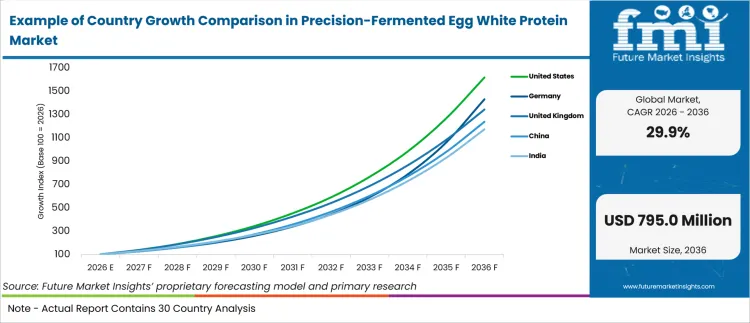
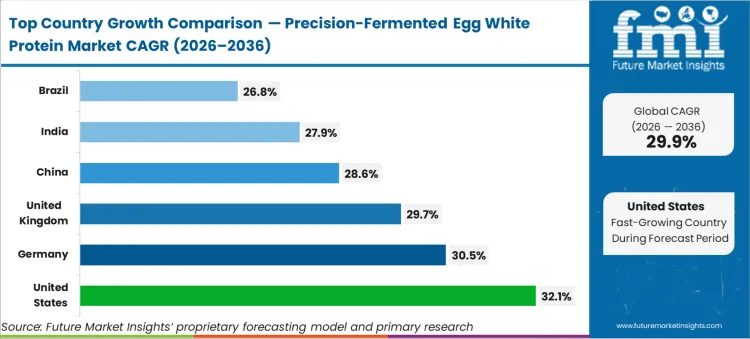
- Geography: High-growth North America and Europe (United States 32.1%, Germany 30.5%, United Kingdom 29.7%) versus rapidly scaling Asia-Pacific (China 28.6%, India 27.9%, Brazil 26.8%).
- Analyst Opinion at FMI
- Nandini Roy Choudhury, Principal Consultant for Food & Beverage at Future Market Insights, opines, “Our latest findings indicate that precision-fermented egg proteins are strategically positioned at the intersection of animal-free innovation and high-functionality protein systems. However, regulatory clarity and labelling transparency will shape consumer trust. Companies investing in GRAS approvals, clear ingredient communication, and sustainability validation will command stronger partnerships in plant-based and hybrid food platforms.”
- Strategic Implications/Executive Takeaways
- Prioritize strain yield optimization to achieve true cost parity with conventional agricultural outputs.
- Secure binding off-take agreements early to justify capital-intensive bioreactor construction projects.
- Target regulatory clearance in multiple jurisdictions simultaneously to build resilient global distribution networks.
- Methodology
- Validated through first-hand corporate production and capacity data.
- Zero reliance on speculative third-party market research reports.
- Based on verifiable industrial benchmarks and verified sources.
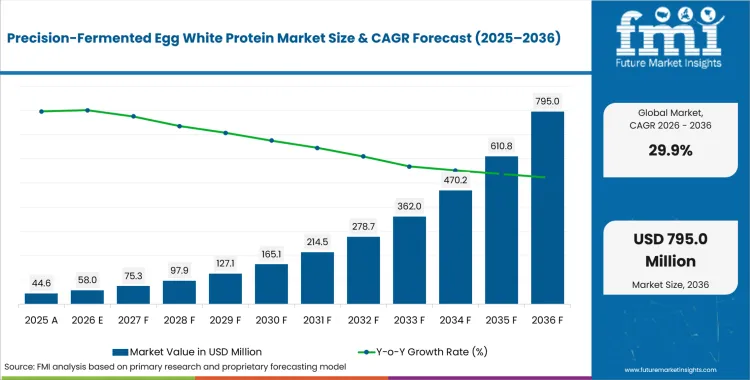
Country dispersion shows United States at 32.1% CAGR, Germany at 30.5% CAGR, United Kingdom at 29.7% CAGR, China at 28.6% CAGR, India at 27.9% CAGR, and Brazil at 26.8% CAGR. Growth concentrates where local biosafety regulations fast-track precision fermentation ingredients approvals. Manufacturers in these corridors clear procurement faster to stabilize formulation unit economics.
Precision-Fermented Egg White Protein Market Key Takeaways
| Metric | Details |
|---|---|
| Industry Size (2026) | USD 58.0 million |
| Industry Value (2036) | USD 795.0 million |
| CAGR (2026-2036) | 29.9% |
Precision-Fermented Egg White Protein Market Definition
Precision-fermented egg white protein involves producing bio-identical ovalbumin and related albumin complexes using programmed microorganisms inside controlled bioreactors, entirely independent of poultry farming. Commercial operations harvest synthesized proteins through downstream separation and purification steps, yielding functional ingredients. Buyers utilize output variables to replicate binding, foaming, and gelling properties within commercial food processing environments.
Precision-Fermented Egg White Protein Market Inclusions
Revenues track sales of synthesized ovalbumin, ovomucoid, and functional ingredient systems derived via recombinant microbial fermentation. Quantified formats encompass spray-dried powders, liquid concentrates, and specialized functional blends intended for business-to-business ingredient distribution. Valuations capture direct OEM contracts, distributor markups, and dedicated clinical nutrition sales of bio-manufactured components.
Precision-Fermented Egg White Protein Market Exclusions
Figures explicitly omit conventional poultry-derived albumen, plant-based replacements utilizing soy or mung bean isolates, and biomass fermentation products lacking specific target protein expression. Downstream consumer packaged goods incorporating synthesized ingredients remain outside raw material valuation. Laboratory-scale outputs lacking commercial distribution channels face exclusion from current revenue projections.
Precision-Fermented Egg White Protein Market Research Methodology
- Primary Research: Direct consultations occurred with bioreactor operators, strain engineers, ingredient distributors, and regulatory compliance officers across major biotechnology hubs.
- Desk Research: Analysts extracted capacity disclosures from company filings, tracked verified grant awards, and reviewed official government biosafety clearances.
- Market-Sizing and Forecasting: Evaluators utilized bottom-up capacity modeling combined with top-down addressable substitution rates, cross-referenced against announced facility scale-ups.
- Data Validation and Update Cycle: Projections undergo variance screening against actual venture funding deployments and verifiable factory output metrics prior to finalization.
Segmental Analysis
Precision-Fermented Egg White Protein Market Analysis by Product Format
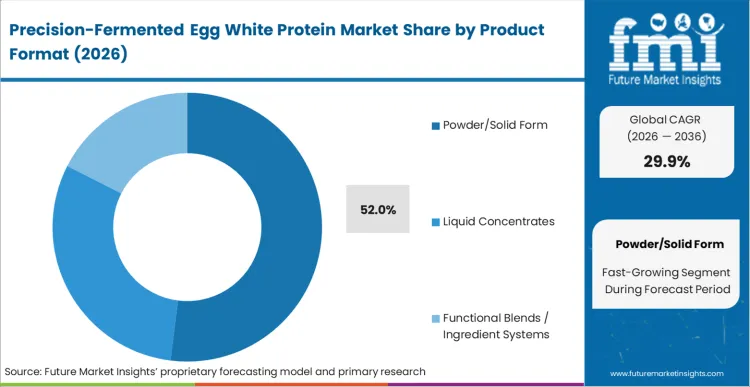
Powder/solid form commands 52% of share in 2026. According to FMI's estimates, manufacturers prioritize dry ingredients to minimize shipping weight and extend shelf life across complex supply chains. Formulation teams integrate egg white protein powder equivalents into dry baking mixes without altering moisture ratios. Liquid concentrates capture secondary volume, serving industrial bakeries equipped with active pump systems. Ingredient systems blend fermented ovalbumin with hydrocolloids to match specific functional requirements for specialized end users. Expanded milling and drying infrastructure drives widespread adoption among commercial bakeries seeking one-to-one drop-in replacements. Processors prioritize moisture-free formats to lower overall operational costs.
- Procurement shift: Buyers switch to dry formats to reduce refrigeration dependencies and lower freight overheads. Prolonged shelf stability shields operators from sudden agricultural supply gaps, supported by USD 4.8 billion in cumulative global fermentation investments through 2024 [2].
- Technology integration: Lyophilization advances yield highly soluble powders that rehydrate without clumping. The EVERY Company secured critical patents for ovomucoid and ovalbumin production in 2025, improving dissolution profiles for beverage formulators [3].
- Supply-side expansion: Facility upgrades focus on high-capacity spray drying to capture mainstream bakery contracts. GEA opened a USD 20 million Food Tech Center in Wisconsin during July 2025 to scale downstream processing capabilities [4].
Precision-Fermented Egg White Protein Market Analysis by Application
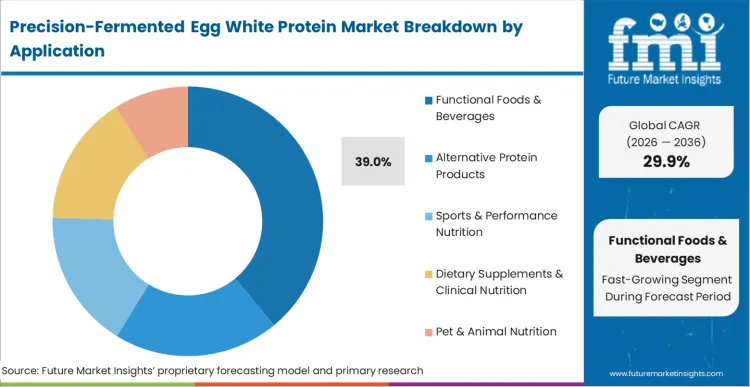
Alternative protein producers are incorporating bio-identical albumin to enhance texture and optimize amino acid balance in hybrid plant-based formulations. Sports nutrition brands are developing ready-to-mix shakes that leverage its high bioavailability and neutral flavor profile, while supplement manufacturers use purified isolates in targeted clinical nutrition products. Premium pet food companies are also adopting refined protein inputs to reduce pathogen exposure linked to raw materials. As clinical applications expand and purification standards tighten across recovery systems, formulators continue focusing on protein-dense products that support stronger retail margins, positioning functional foods and beverages to represent 39% of total share in 2026.
- Demand catalyst: Product developers seek neutral-tasting isolates to fortify beverages without introducing gritty textures. AI-optimized synthesis pathways demonstrated 80% lower water usage versus conventional farming in 2025, aligning functional performance with corporate sustainability mandates [5].
- Formulation upgrade: Medical nutrition providers shift from dairy allergens to hypoallergenic fermented proteins for specialized patient diets. Private funding for the fermentation sector reached USD 651 million in 2024, financing specific clinical-grade purification workflows [7].
- Market expansion: Premium pet food brands integrate synthesized albumin to avoid supply chain contamination risks. Onego Bio announced a flagship Wisconsin plant dedicated exclusively to animal-free egg white protein powder in March 2025, demonstrating cross-category viability [14].
Precision-Fermented Egg White Protein Market Drivers, Restraints, and Opportunities
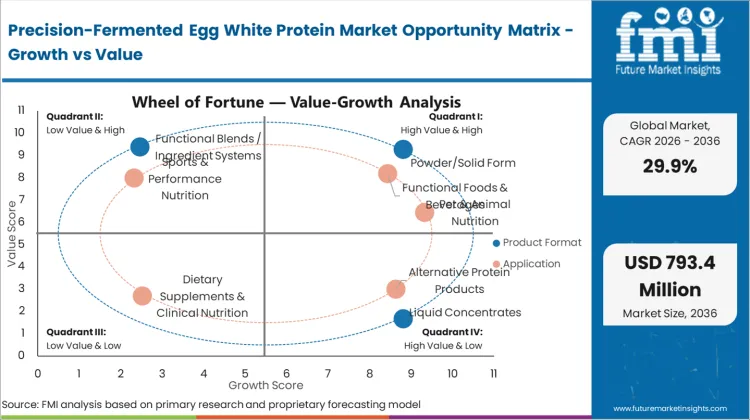
Supply chain vulnerability forces immediate industrial transition toward bio-manufactured ingredients. As per FMI's projection, food conglomerates face extreme margin compression whenever pathogen outbreaks decimate conventional agricultural flocks. Procurement officers mandate fixed-price ingredient contracts to insulate corporate earnings from unpredictable raw material spikes. Transitioning to synthesized albumin eliminates pathogen transmission risks and stabilizes production planning.
Unit economics present persistent barriers to immediate mass-market commodity replacement. According to FMI's estimates, fermentation facilities require massive upfront capital expenditure, and downstream purification steps add heavy operational costs. Scaling upstream bioreactor capacity demands continuous access to venture funding and specialized bio-engineering talent. Commercial viability requires strain expression improvements to match conventional commodity pricing. Manufacturers counter high costs by targeting premium functional niches and executing long-term volume agreements to amortize capital investments. Sector maturation depends heavily on sustained venture backing.
- Scale Advantage: Public sector grants inject non-dilutive capital to derisk commercial bio-manufacturing scale-up. Onego Bio secured a USD 2 million grant from Department of Defense in September 2025 to advance distributed bioindustrial manufacturing capabilities [13].
- Regional Expansion: Joint ventures combine bio-tech expertise with legacy infrastructure to accelerate commercial volumes. Scaling localized infrastructure reduces dependency on imported agricultural commodities.
- Defense Application: Accelerated safety clearances open massive addressable consumer markets for synthesized ingredients. Formulators immediately advance pilot products into national commercial distribution networks.
Regional Analysis
Based on the regional analysis, the Precision-Fermented Egg White Protein market is segmented into North America, Latin America, Europe, East Asia, South Asia, Oceania and Middle East & Africa across 40+ countries. The full report also offers market attractiveness analysis based on regional trends.
| Country | CAGR (2026 to 2036) |
|---|---|
| United States | 32.1% |
| Germany | 30.5% |
| United Kingdom | 29.7% |
| China | 28.6% |
| India | 27.9% |
| Brazil | 26.8% |
Source: Future Market Insights (FMI) analysis, based on proprietary forecasting model and primary research
North America Precision-Fermented Egg White Protein Analysis
North American bio-manufacturing ecosystems lead global commercialization efforts through dense venture capital concentration and proactive regulatory frameworks. FMI analysts opine that startups leverage established biotechnology hubs to rapid-prototype engineered microbial strains. Ingredient formulators partner with massive regional food conglomerates to execute large-scale application trials. Domestic policy increasingly views bio-industrial manufacturing as a critical component of national food security. Scaling infrastructure reduces dependency on imported agricultural commodities. Scaling capacity limits future disruptions.
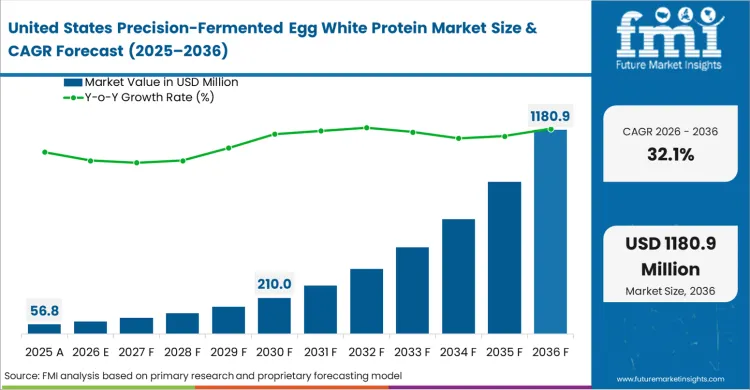
- United States: Demand for precision-fermented egg white protein in the United States is expected to grow at 32.1% CAGR from 2026 to 2036, supported by regulatory clearances before procurement and budgeting cycles translate into higher deployment volumes.
FMI’s report includes a detailed growth analysis and country-wise assessment across the North American region. Canada and Mexico present opportunistic conditions for alternative protein production equipment investments. Buyers monitor cross-border regulatory harmonization to facilitate rapid facility commissioning.
Europe Precision-Fermented Egg White Protein Analysis
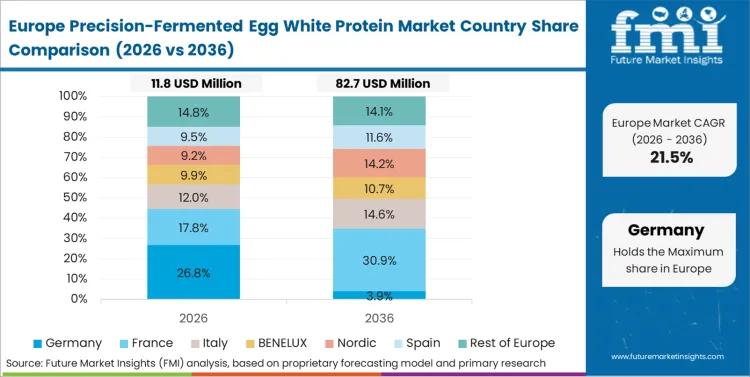
European markets demonstrate rapid progression driven by aggressive climate mandates and heavy public sector funding mechanisms. As per FMI's projection, regulators evaluate novel food dossiers, balancing stringent safety protocols with strategic necessities of reducing agricultural emissions. Regional manufacturers form powerful consortiums to share downstream processing knowledge and lower collective commercialization barriers. Food tech enterprises raised capital to expand localized bioreactor networks. Established dairy infrastructure provides retrofitting opportunities to accelerate capacity deployment.
- Germany: Precision-fermented egg white protein sales in Germany are projected to grow at 30.5% CAGR from 2026 to 2036 as regional infrastructure subsidies expand, creating a clearer pathway from policy or spending intent to purchase orders.
- United Kingdom: In the United Kingdom, demand for precision-fermented egg white protein is gaining strong momentum as government-backed infrastructure grants accelerate facility development and shorten commercialization timelines. These investments are improving capacity utilization and encouraging technology upgrades across fermentation platforms. Broader economic assessments indicate that advanced fermentation methods could contribute nearly GBP 10 billion to the UK economy by 2050 [10], supporting expansion at a 29.7% CAGR from 2026 to 2036.
FMI’s report includes a detailed growth analysis and country-wise assessment across the European region. France and Netherlands showcase strong potential for vegan egg adoption within advanced bakery sectors. Formulation teams monitor novel food approvals to time upcoming product launches.
Asia Pacific Precision-Fermented Egg White Protein Analysis
Asia Pacific transitions from a nascent testing ground into a massive commercial deployment arena governed by severe food security priorities. Dense metropolitan populations demand resilient protein supply chains immune to recurring zoonotic disease outbreaks. Governments streamline approval pathways for bio-manufactured ingredients to reduce reliance on imported agricultural inputs. Global companies establish regional headquarters to capture surging middle-class demand for premium functional nutrition. Ingredient distributors lock down import agreements to supply metropolitan commercial bakeries.
- China: sales of precision-fermented egg white protein in China are expected to grow 28.6% CAGR through 2026 to 2036 as domestic food security mandates prioritize bio-manufacturing, tightening the link between operational constraints and adoption-led investment. Nationwide targets push food conglomerates to integrate high-titer synthesis protocols, reflecting global momentum with 165 companies focused primarily on fermentation for alternative proteins in 2024 [15].
- India: In India, the precision-fermented ingredient market is forecast to advance at 27.9% CAGR through 2036, with growth anchored in expanding organized bakery output that converts into measurable budget allocation. Global players deploy capital into emerging Asian hubs, addressing expanding networks that reached 186 companies worldwide by May 2025 [11].
FMI’s report includes a detailed growth analysis and country-wise assessment across the Asia Pacific region. Japan and South Korea offer highly structured egg substitute importation pathways. Domestic brands focus heavily on incorporating synthesized albumin into premium functional beverages.
Latin America Precision-Fermented Egg White Protein Analysis
Latin American operators evaluate bio-manufacturing as a mechanism to ascend global ingredient value chains. Export-oriented food processors test bio-identical albumin to meet stringent foreign quality standards and capture premium international margins. Legacy agricultural conglomerates actively monitor fermentation technologies, preparing defensive investments to protect market dominance. Favorable climate conditions and abundant sugar feedstocks provide theoretical cost advantages for localized upstream bioreactor operations. South American food processors initiate formulation trials using components proven through global supply channels.
- Brazil: Demand for precision-fermented egg white protein in Brazil is anticipated to rise at 26.8% CAGR over the forecast period as export-oriented meatpackers diversify into hybrid protein manufacturing, helping suppliers align positioning with local buying triggers. Exporters standardize product textures to meet stringent foreign quality thresholds, securing continuous raw material flow independent of regional disruptions, mirroring mega-projects like EVERY partnering with Vivici and ADIO for a 4-million-liter Abu Dhabi facility [12].
FMI’s report includes a detailed growth analysis and country-wise assessment across the Latin American region. Argentina and Chile display increasing willingness to pilot specialty egg infrastructure components. Export companies investigate bio-manufacturing to bypass volatile agricultural export tariffs.
Competitive Aligners for Market Players
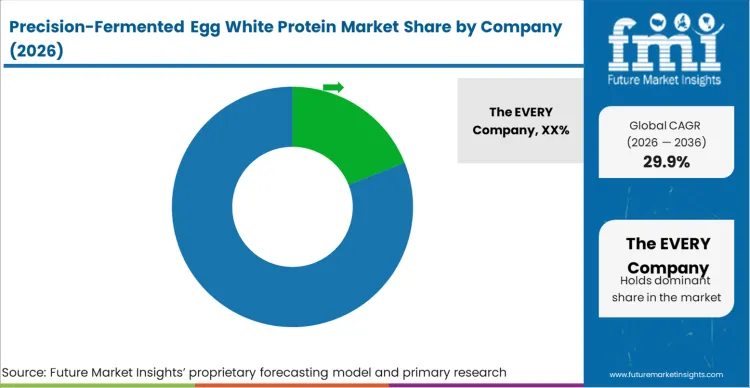
Market structure rewards rapid capacity scaling and aggressive intellectual property execution. Scaling downstream recovery determines ultimate unit cost competitiveness, pushing operators to forge strategic engineering partnerships. Companies secure dedicated manufacturing capacity to guarantee delivery volumes for multinational food conglomerates. Engineers refine spray drying parameters to improve powder solubility.
Venture funding remains primary fuel for commercialization, dictating which enterprises survive transition from pilot scale to industrial output. Operators bundle equity raises with strategic off-take agreements to demonstrate immediate commercial viability to investors. Capital deployment prioritizes regulatory submissions and high-capacity facility retrofits.
Strategic joint ventures de-risk massive infrastructure investments by combining specialized strain engineering with legacy operational expertise. Bioreactor companies partner with established ingredient distributors to access thousands of regional bakeries without building separate sales networks. Co-manufacturing agreements accelerate global market penetration while preserving internal capital.
Recent Developments
The report includes full coverage of key trends from competitive benchmarking. Some of the recent developments covered in the reports:
- In September 2025, Onego Bio received a 'no questions' GRAS letter from FDA for Bioalbumen powder. [8]
- In July 2025, Onego Bio secured EUR 14 million in European Innovation Council funding to support commercialization efforts. [9]
Key Players in Precision-Fermented Egg White Protein Market
- The EVERY Company
- Onego Bio
- Formo
- Fybraworks Foods
- FUMI Ingredients
- Shiru
Scope of the Report
| Metric | Value |
|---|---|
| Quantitative Units | USD 58.0 million (2026) to USD 795.0 million (2036), at a CAGR of 29.9% |
| Market Definition | Precision-fermented egg white protein involves producing bio-identical ovalbumin and related albumin complexes using programmed microorganisms inside controlled bioreactors, entirely independent of poultry farming. |
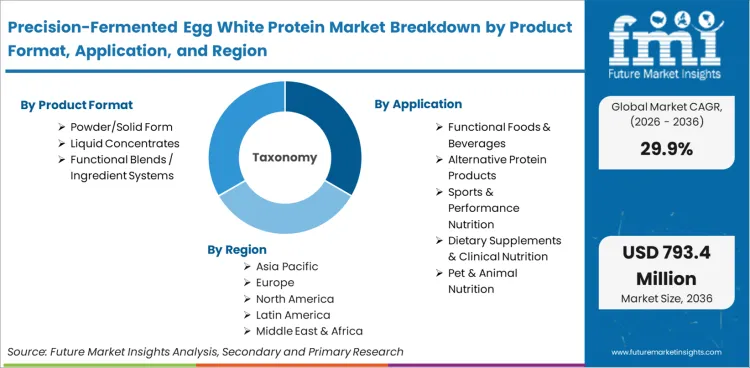
| Product Format Segmentation | Powder/Solid Form, Liquid Concentrates, Functional Blends / Ingredient Systems |
| Application Segmentation | Functional Foods & Beverages, Alternative Protein Products, Sports & Performance Nutrition, Dietary Supplements & Clinical Nutrition, Pet & Animal Nutrition |
| Regions Covered | North America, Latin America, Europe, East Asia, South Asia, Oceania, Middle East and Africa |
| Countries Covered | United States, Canada, Mexico, Brazil, Argentina, Germany, France, United Kingdom, Italy, Spain, China, India, Japan, South Korea, Indonesia, Australia and 40 plus countries |
| Key Companies Profiled | The EVERY Company, Onego Bio, Formo, Fybraworks Foods, FUMI Ingredients, Shiru |
| Forecast Period | 2026 to 2036 |
| Approach | Hybrid top down and bottom up market modeling validated through primary interviews with resin producers and panel manufacturers, supported by trade data benchmarking and plant level capacity verification |
Precision-Fermented Egg White Protein Market Analysis by Segments
Product Format
- Powder/Solid Form
- Liquid Concentrates
- Functional Blends / Ingredient Systems
Application
- Functional Foods & Beverages
- Alternative Protein Products
- Sports & Performance Nutrition
- Dietary Supplements & Clinical Nutrition
- Pet & Animal Nutrition
Region
- Asia Pacific
- India
- China
- Japan
- South Korea
- Indonesia
- Australia & New Zealand
- ASEAN
- Rest of Asia Pacific
- Europe
- Germany
- Italy
- France
- United Kingdom
- Spain
- Benelux
- Nordics
- Central & Eastern Europe
- Rest of Europe
- North America
- United States
- Canada
- Mexico
- Latin America
- Brazil
- Argentina
- Chile
- Rest of Latin America
- Middle East & Africa
- Kingdom of Saudi Arabia
- United Arab Emirates
- South Africa
- Turkey
- Rest of Middle East & Africa
Bibliography
- [1] The EVERY Company. (2025). EVERY Raises USD 55 Million in Fresh Capital Ahead of Nationwide Rollout.
- [2] Good Food Institute. (2025). The Business of Alt-Protein: Precision fermentation market trends.
- [3] EVERY Company. (2025). Patent granted for ovalbumin produced.
- [4] GEA Group. (2025). GEA opens new food technology center to boost alternative proteins scale-up.
- [5] National Institutes of Health. (2025). AI-optimized PF egg-white protein synthesis environmental footprint.
- [6] Good Food Institute. (2025). State of the Industry: Fermentation for meat, seafood, eggs, dairy, and ingredients.
- [7] ProVeg International. (2025). European Precision Fermentation Funding 2024.
- [8] Onego Bio. (2025). Onego Bio receives FDA 'no questions' letter on GRAS status.
- [9] Onego Bio. (2025). Onego Bio secures new funding from EIC.
- [10] Good Food Institute Europe. (2025). New fermentation methods could add nearly 10 billion to UK economy by 2050.
- [11] ProVeg International. (2025). State of Precision Fermentation May 2025.
- [12] Green Queen. (2025). Vivici and The EVERY Company precision fermentation protein Abu Dhabi.
- [13] Onego Bio. (2025). Onego Bio awarded 2 million by the Department of Defense.
- [14] Green Queen. (2025). Onego Bio announces flagship US plant in Wisconsin.
- [15] Good Food Institute. (2025). 165 companies focused primarily on fermentation for alt proteins.
This bibliography is provided for reader reference and is not exhaustive. The full report contains the complete reference list and detailed citations.
This Report Addresses
- Market intelligence to enable structured strategic decision making across mature and emerging ingredient economies.
- Market size estimation and 10 year revenue forecasts from 2026 to 2036, supported by validated capacity and trade benchmarks.
- Growth opportunity mapping across powder, liquid, and specialized blend formats with emphasis on bio-manufacturing transitions.
- Segment and regional revenue forecasts covering functional foods, clinical nutrition, sports performance, and pet applications.
- Competition strategy assessment including integration models, unit cost survivability positioning, and compliance capability benchmarking.
- Product reformulation and strain expression compliance tracking including ovalbumin titer optimization grades.
- Regulatory impact analysis covering novel food mandates, biosafety thresholds, and domestic food security upgrades.
- Market report delivery in PDF, Excel, PPT, and interactive dashboard formats for executive and operational use.
Frequently Asked Questions
How large is the demand for precision-fermented egg white protein in the global market in 2026?
Demand for precision-fermented egg white protein in the global market is estimated to be valued at USD 58.0 million in 2026.
What will be the market size of precision-fermented egg white protein in the global market by 2036?
Market size for precision-fermented egg white protein is projected to reach USD 795.0 million by 2036.
What is the expected demand growth for precision-fermented egg white protein in the global market between 2026 and 2036?
Demand for precision-fermented egg white protein in the global market is expected to grow at a CAGR of 29.9% between 2026 and 2036.
Which Product Format is poised to lead global sales by 2026?
Powder/Solid Form is expected to be the dominant format, capturing approximately 52% of global market share in 2026 due to logistics efficiency and extended shelf stability.
How significant is the role of Functional Foods & Beverages in driving precision-fermented egg white protein adoption in 2026?
Functional Foods & Beverages represents a critical segment, projected to hold a substantial 39% share of the total market in 2026 as consumer brands seek stable raw material pricing.
What is driving demand in United States?
Rapid GRAS clearances and immense venture capital concentration for large-scale bioreactor construction drive domestic adoption.
What compliance standards or regulations are referenced for United States?
FDA 'no questions' GRAS letters are referenced as the primary regulatory benchmark unlocking commercial distribution.
What is the United States growth outlook in this report?
United States is projected to grow at a CAGR of 32.1% during 2026 to 2036.
Why is Europe described as a priority region in this report?
Aggressive climate mandates and heavy public sector bio-manufacturing subsidies support rapid regional scale-up.
What type of demand dominates in Europe?
Demand for environmentally friendly, low-emission agricultural alternatives dominates regional consumption priorities.
What is Germany growth outlook in this report?
Germany is projected to expand at a CAGR of 30.5% during 2026 to 2036.
Does the report cover United Kingdom in its regional analysis?
Yes, United Kingdom is included within Europe under the regional scope of analysis.
What are the sources referred to for analyzing United Kingdom?
Official government grant data, specific public funding allocations, and facility capacity announcements are cited as primary reference sources.
What is the main demand theme linked to United Kingdom in its region coverage?
Government-backed infrastructure grants compress lead times and accelerate technology refresh decisions.
Does the report cover China in its regional analysis?
Yes, China is included within East Asia under the regional coverage framework.
What is the main China related demand theme in its region coverage?
Domestic food security mandates prioritize bio-manufacturing to bypass extreme agricultural supply bottlenecks.
Does the report cover India in its regional analysis?
Yes, India is included within South Asia under the regional coverage framework.
What is the main India related demand theme in its region coverage?
Expanding organized bakery output converts into measurable budget allocation for commercial bakeries.
Which product formats or configurations are strategically important for North America supply chains?
Highly soluble powder formats are prioritized due to lower storage risk and reduced logistics constraints across massive distribution channels.
What is precision-fermented egg white protein and what is it mainly used for?
It is a synthesized, bio-identical albumin produced via microbial fermentation, primarily used as a functional binding and foaming agent in commercial food processing.
What does precision-fermented egg white protein market mean in this report?
The market refers to the global production, trade, and B2B consumption of bio-manufactured ovalbumin in powder, liquid, and blended forms.
What is included in the scope of this precision-fermented egg white protein report?
Scope covers synthesized ingredient formats, functional applications, end-use nutrition sectors, and commercial distribution channels.
What is excluded from the scope of this report?
Conventional poultry albumen, plant-based isolates, undefined biomass fermentation, and downstream consumer packaged goods are excluded.
What does market forecast mean on this page?
Market forecast represents a model-based projection built on verified capacity expansion and substitution rate assumptions for strategic planning purposes.
How does FMI build and validate the precision-fermented egg white protein forecast?
Forecast is developed using hybrid top-down and bottom-up modeling validated through verifiable capacity checks and venture funding deployment analysis.
Preview the report firsthand - request a free sample
Get SampleGet the brochure for pricing and purchase details.
Get PDFTable of Content
- Executive Summary
- Global Market Outlook
- Demand-side Trends
- Supply-side Trends
- Technology Roadmap Analysis
- Analysis and Recommendations
- Market Overview
- Market Coverage / Taxonomy
- Market Definition / Scope / Limitations
- Research Methodology
- Chapter Orientation
- Analytical Lens and Working Hypotheses
- Market Structure, Signals, and Trend Drivers
- Benchmarking and Cross-market Comparability
- Market Sizing, Forecasting, and Opportunity Mapping
- Research Design and Evidence Framework
- Desk Research Programme (Secondary Evidence)
- Company Annual and Sustainability Reports
- Peer-reviewed Journals and Academic Literature
- Corporate Websites, Product Literature, and Technical Notes
- Earnings Decks and Investor Briefings
- Statutory Filings and Regulatory Disclosures
- Technical White Papers and Standards Notes
- Trade Journals, Industry Magazines, and Analyst Briefs
- Conference Proceedings, Webinars, and Seminar Materials
- Government Statistics Portals and Public Data Releases
- Press Releases and Reputable Media Coverage
- Specialist Newsletters and Curated Briefings
- Sector Databases and Reference Repositories
- FMI Internal Proprietary Databases and Historical Market Datasets
- Subscription Datasets and Paid Sources
- Social Channels, Communities, and Digital Listening Inputs
- Additional Desk Sources
- Expert Input and Fieldwork (Primary Evidence)
- Primary Modes
- Qualitative Interviews and Expert Elicitation
- Quantitative Surveys and Structured Data Capture
- Blended Approach
- Why Primary Evidence is Used
- Field Techniques
- Interviews
- Surveys
- Focus Groups
- Observational and In-context Research
- Social and Community Interactions
- Stakeholder Universe Engaged
- C-suite Leaders
- Board Members
- Presidents and Vice Presidents
- R&D and Innovation Heads
- Technical Specialists
- Domain Subject-matter Experts
- Scientists
- Physicians and Other Healthcare Professionals
- Governance, Ethics, and Data Stewardship
- Research Ethics
- Data Integrity and Handling
- Primary Modes
- Tooling, Models, and Reference Databases
- Desk Research Programme (Secondary Evidence)
- Data Engineering and Model Build
- Data Acquisition and Ingestion
- Cleaning, Normalisation, and Verification
- Synthesis, Triangulation, and Analysis
- Quality Assurance and Audit Trail
- Market Background
- Market Dynamics
- Drivers
- Restraints
- Opportunity
- Trends
- Scenario Forecast
- Demand in Optimistic Scenario
- Demand in Likely Scenario
- Demand in Conservative Scenario
- Opportunity Map Analysis
- Product Life Cycle Analysis
- Supply Chain Analysis
- Investment Feasibility Matrix
- Value Chain Analysis
- PESTLE and Porter’s Analysis
- Regulatory Landscape
- Regional Parent Market Outlook
- Production and Consumption Statistics
- Import and Export Statistics
- Market Dynamics
- Global Market Analysis 2021 to 2025 and Forecast, 2026 to 2036
- Historical Market Size Value (USD Million) Analysis, 2021 to 2025
- Current and Future Market Size Value (USD Million) Projections, 2026 to 2036
- Y-o-Y Growth Trend Analysis
- Absolute $ Opportunity Analysis
- Global Market Pricing Analysis 2021 to 2025 and Forecast 2026 to 2036
- Global Market Analysis 2021 to 2025 and Forecast 2026 to 2036, By Product Format
- Introduction / Key Findings
- Historical Market Size Value (USD Million) Analysis By Product Format , 2021 to 2025
- Current and Future Market Size Value (USD Million) Analysis and Forecast By Product Format , 2026 to 2036
- Powder/Solid Form
- Liquid Concentrates
- Functional Blends / Ingredient Systems
- Powder/Solid Form
- Y-o-Y Growth Trend Analysis By Product Format , 2021 to 2025
- Absolute $ Opportunity Analysis By Product Format , 2026 to 2036
- Global Market Analysis 2021 to 2025 and Forecast 2026 to 2036, By Application
- Introduction / Key Findings
- Historical Market Size Value (USD Million) Analysis By Application, 2021 to 2025
- Current and Future Market Size Value (USD Million) Analysis and Forecast By Application, 2026 to 2036
- Functional Foods & Beverages
- Alternative Protein Products
- Sports & Performance Nutrition
- Dietary Supplements & Clinical Nutrition
- Pet & Animal Nutrition
- Functional Foods & Beverages
- Y-o-Y Growth Trend Analysis By Application, 2021 to 2025
- Absolute $ Opportunity Analysis By Application, 2026 to 2036
- Global Market Analysis 2021 to 2025 and Forecast 2026 to 2036, By Region
- Introduction
- Historical Market Size Value (USD Million) Analysis By Region, 2021 to 2025
- Current Market Size Value (USD Million) Analysis and Forecast By Region, 2026 to 2036
- North America
- Latin America
- Western Europe
- Eastern Europe
- East Asia
- South Asia and Pacific
- Middle East & Africa
- Market Attractiveness Analysis By Region
- North America Market Analysis 2021 to 2025 and Forecast 2026 to 2036, By Country
- Historical Market Size Value (USD Million) Trend Analysis By Market Taxonomy, 2021 to 2025
- Market Size Value (USD Million) Forecast By Market Taxonomy, 2026 to 2036
- By Country
- USA
- Canada
- Mexico
- By Product Format
- By Application
- By Country
- Market Attractiveness Analysis
- By Country
- By Product Format
- By Application
- Key Takeaways
- Latin America Market Analysis 2021 to 2025 and Forecast 2026 to 2036, By Country
- Historical Market Size Value (USD Million) Trend Analysis By Market Taxonomy, 2021 to 2025
- Market Size Value (USD Million) Forecast By Market Taxonomy, 2026 to 2036
- By Country
- Brazil
- Chile
- Rest of Latin America
- By Product Format
- By Application
- By Country
- Market Attractiveness Analysis
- By Country
- By Product Format
- By Application
- Key Takeaways
- Western Europe Market Analysis 2021 to 2025 and Forecast 2026 to 2036, By Country
- Historical Market Size Value (USD Million) Trend Analysis By Market Taxonomy, 2021 to 2025
- Market Size Value (USD Million) Forecast By Market Taxonomy, 2026 to 2036
- By Country
- Germany
- UK
- Italy
- Spain
- France
- Nordic
- BENELUX
- Rest of Western Europe
- By Product Format
- By Application
- By Country
- Market Attractiveness Analysis
- By Country
- By Product Format
- By Application
- Key Takeaways
- Eastern Europe Market Analysis 2021 to 2025 and Forecast 2026 to 2036, By Country
- Historical Market Size Value (USD Million) Trend Analysis By Market Taxonomy, 2021 to 2025
- Market Size Value (USD Million) Forecast By Market Taxonomy, 2026 to 2036
- By Country
- Russia
- Poland
- Hungary
- Balkan & Baltic
- Rest of Eastern Europe
- By Product Format
- By Application
- By Country
- Market Attractiveness Analysis
- By Country
- By Product Format
- By Application
- Key Takeaways
- East Asia Market Analysis 2021 to 2025 and Forecast 2026 to 2036, By Country
- Historical Market Size Value (USD Million) Trend Analysis By Market Taxonomy, 2021 to 2025
- Market Size Value (USD Million) Forecast By Market Taxonomy, 2026 to 2036
- By Country
- China
- Japan
- South Korea
- By Product Format
- By Application
- By Country
- Market Attractiveness Analysis
- By Country
- By Product Format
- By Application
- Key Takeaways
- South Asia and Pacific Market Analysis 2021 to 2025 and Forecast 2026 to 2036, By Country
- Historical Market Size Value (USD Million) Trend Analysis By Market Taxonomy, 2021 to 2025
- Market Size Value (USD Million) Forecast By Market Taxonomy, 2026 to 2036
- By Country
- India
- ASEAN
- Australia & New Zealand
- Rest of South Asia and Pacific
- By Product Format
- By Application
- By Country
- Market Attractiveness Analysis
- By Country
- By Product Format
- By Application
- Key Takeaways
- Middle East & Africa Market Analysis 2021 to 2025 and Forecast 2026 to 2036, By Country
- Historical Market Size Value (USD Million) Trend Analysis By Market Taxonomy, 2021 to 2025
- Market Size Value (USD Million) Forecast By Market Taxonomy, 2026 to 2036
- By Country
- Kingdom of Saudi Arabia
- Other GCC Countries
- Turkiye
- South Africa
- Other African Union
- Rest of Middle East & Africa
- By Product Format
- By Application
- By Country
- Market Attractiveness Analysis
- By Country
- By Product Format
- By Application
- Key Takeaways
- Key Countries Market Analysis
- USA
- Pricing Analysis
- Market Share Analysis, 2025
- By Product Format
- By Application
- Canada
- Pricing Analysis
- Market Share Analysis, 2025
- By Product Format
- By Application
- Mexico
- Pricing Analysis
- Market Share Analysis, 2025
- By Product Format
- By Application
- Brazil
- Pricing Analysis
- Market Share Analysis, 2025
- By Product Format
- By Application
- Chile
- Pricing Analysis
- Market Share Analysis, 2025
- By Product Format
- By Application
- Germany
- Pricing Analysis
- Market Share Analysis, 2025
- By Product Format
- By Application
- UK
- Pricing Analysis
- Market Share Analysis, 2025
- By Product Format
- By Application
- Italy
- Pricing Analysis
- Market Share Analysis, 2025
- By Product Format
- By Application
- Spain
- Pricing Analysis
- Market Share Analysis, 2025
- By Product Format
- By Application
- France
- Pricing Analysis
- Market Share Analysis, 2025
- By Product Format
- By Application
- India
- Pricing Analysis
- Market Share Analysis, 2025
- By Product Format
- By Application
- ASEAN
- Pricing Analysis
- Market Share Analysis, 2025
- By Product Format
- By Application
- Australia & New Zealand
- Pricing Analysis
- Market Share Analysis, 2025
- By Product Format
- By Application
- China
- Pricing Analysis
- Market Share Analysis, 2025
- By Product Format
- By Application
- Japan
- Pricing Analysis
- Market Share Analysis, 2025
- By Product Format
- By Application
- South Korea
- Pricing Analysis
- Market Share Analysis, 2025
- By Product Format
- By Application
- Russia
- Pricing Analysis
- Market Share Analysis, 2025
- By Product Format
- By Application
- Poland
- Pricing Analysis
- Market Share Analysis, 2025
- By Product Format
- By Application
- Hungary
- Pricing Analysis
- Market Share Analysis, 2025
- By Product Format
- By Application
- Kingdom of Saudi Arabia
- Pricing Analysis
- Market Share Analysis, 2025
- By Product Format
- By Application
- Turkiye
- Pricing Analysis
- Market Share Analysis, 2025
- By Product Format
- By Application
- South Africa
- Pricing Analysis
- Market Share Analysis, 2025
- By Product Format
- By Application
- USA
- Market Structure Analysis
- Competition Dashboard
- Competition Benchmarking
- Market Share Analysis of Top Players
- By Regional
- By Product Format
- By Application
- Competition Analysis
- Competition Deep Dive
- The EVERY Company
- Overview
- Product Portfolio
- Profitability by Market Segments (Product/Age /Sales Channel/Region)
- Sales Footprint
- Strategy Overview
- Marketing Strategy
- Product Strategy
- Channel Strategy
- Onego Bio
- Formo
- Fybraworks Foods
- FUMI Ingredients
- Shiru
- The EVERY Company
- Competition Deep Dive
- Assumptions & Acronyms Used


