

- Industry Size (2026)
- USD 405.0 Mn
- Forecast (2036)
- USD 1040.0 Mn
- CAGR (2026 to 2036)
- 9.8%
Lentil Protein Concentrate Market Size, Market Forecast and Outlook By FMI
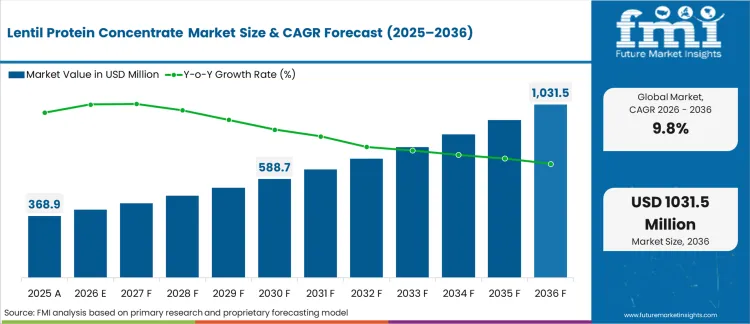
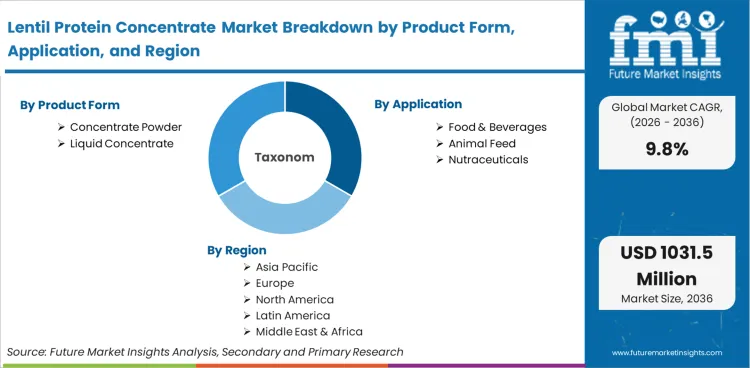
In 2025, the lentil protein concentrate market surpassed a value of USD 375.0 million. Based on Future Market Insights’ analysis, demand is estimated to grow to USD 405.0 million in 2026 and USD 1,031.5 million by 2036. FMI projects a CAGR of 9.8% during the forecast period.
Recommendations from the 2024 Dietary Guidelines Advisory Committee to increase population-wide pulse consumption to 2.5 cups weekly establish a clear policy baseline for food manufacturers [2]. Regulatory guidelines act as a massive demand catalyst, forcing brands to incorporate pulse ingredients into core product lines. Suppliers with validated, neutral-tasting concentrates secure long-term procurement contracts over legacy soy providers.
“The successful startup of our Galesburg facility marks a key operational milestone in Burcon’s commercial scale-up,” said Kip Underwood, Burcon’s chief executive officer. “In less than 90 days since commissioning, our team has brought next-generation protein production online, enabling us to meet accelerating customer demand and unlock scalable revenue opportunities.” [1]
Summary of Lentil Protein Concentrate Market
- Lentil Protein Concentrate Market Definition
- Industry covers extracted protein fractions utilized as functional binding ingredients.
- Demand Drivers in the Market
- Formulators require clean-label alternatives to soy and dairy proteins.
- Regulatory push for higher pulse consumption accelerates inclusion rates.
- Extraction technology improvements reduce undesirable flavor profiles.
- Key Segments Analyzed in the FMI Report
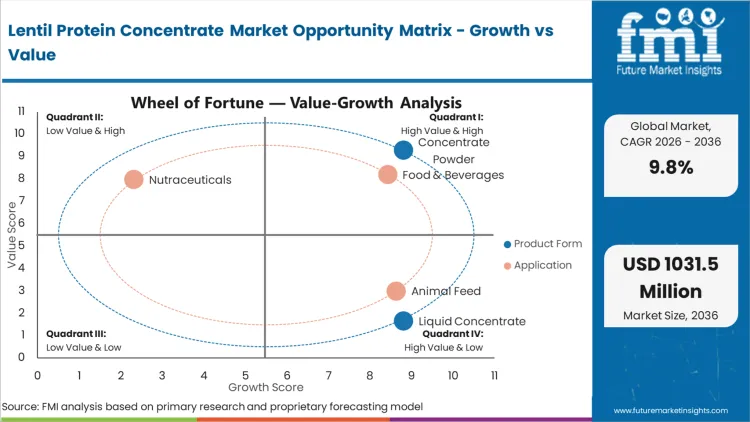
- Form: Dominant concentrate powder formats (65%) versus liquid concentrates.
- Application: Food & Beverages (46% of total volume) versus animal feed and nutraceuticals.
- Geography: High-growth Asia-Pacific (India 11.5%, China 10.8%) versus regulatory-heavy mature North America and Europe.
- Analyst Opinion at FMI
- Nandini Roy Choudhury, Principal Consultant for Food & Beverage at Future Market Insights, opines, “In our latest strategic review of the Lentil Protein Concentrate Market, my team and I have identified lentil as one of the most commercially scalable pulse proteins within the mid-cost formulation tier. Unlike highly refined isolates, concentrates preserve functional fiber while delivering meaningful protein density, aligning with clean-label and whole-food positioning. As food manufacturers seek balanced nutrition claims without aggressive price escalation, lentil protein concentrate is emerging as a pragmatic solution for mainstream plant-based innovation. Companies optimizing dehulling precision and minimizing off-notes will accelerate its transition into mass-market product pipelines.”
- Strategic Implications/Executive Takeaways
- Shift focus toward neutral-tasting extraction methodologies.
- Secure local agricultural partnerships to stabilize feedstock pricing.
- Prioritize organic certifications to capture premium segment margins.
- Methodology
- Validated through first-hand corporate production and capacity data.
- Zero reliance on speculative third-party market research reports.
- Based on verifiable industrial benchmarks and verified sources.
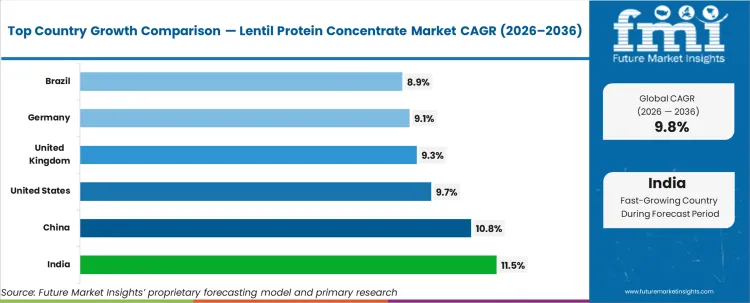
Country adoption skews toward regions possessing established domestic processing infrastructure, with India (11.5% CAGR), China (10.8% CAGR), United States (9.7% CAGR), United Kingdom (9.3% CAGR), Germany (9.1% CAGR), and Brazil (8.9% CAGR) dictating growth. Localized extraction capacity reduces volatile import lead times and shields buyers from international freight fluctuations.
Lentil Protein Concentrate Market Key Takeaways
| Metric | Details |
|---|---|
| Industry Size (2026) | USD 405.0 million |
| Industry Value (2036) | USD 1,031.5 million |
| CAGR (2026-2036) | 9.8% |
Lentil Protein Concentrate Market Definition
Lentil protein concentrate represents high-protein fractions extracted from dry lentils, utilized primarily as functional ingredients across various manufacturing sectors. Producers extract starches and fibers to yield a fine powder with strong binding and emulsifying properties. Demand centers on meat alternatives, baked goods, and sports nutrition products requiring hypoallergenic protein sources.
Lentil Protein Concentrate Market Inclusions
Scope encompasses all dry and liquid concentrates derived from red, green, and brown lentils explicitly sold for industrial formulation. Formats include standard concentrates, modified functional powders, and organic-certified variants used by food manufacturers. Coverage extends to bulk sales traversing B2B distribution networks.
Lentil Protein Concentrate Market Exclusions
Analysis omits whole lentils, split peas, lentil flour with lower protein content, and isolated proteins exceeding 85 percent purity. Fully packaged consumer goods utilizing lentil proteins fall outside assessment boundaries. Byproducts such as starches and hull fibers remain excluded from valuation models.
Lentil Protein Concentrate Market Research Methodology
- Primary Research: Analysts conducted interviews with ingredient processors, food brand formulators, and supply chain directors.
- Desk Research: Production volumes triangulated against agricultural output datasets, corporate sustainability reports, and customs trade statistics.
- Market-Sizing and Forecasting: Demand reconstructed via top-down analysis of plant-protein inclusion rates and validated against bottom-up capacity expansions.
- Data Validation and Update Cycle: Findings undergo variance checks against historical agricultural yields before final clearance.
Segmental Analysis
Lentil Protein Concentrate Market Analysis by Product Form
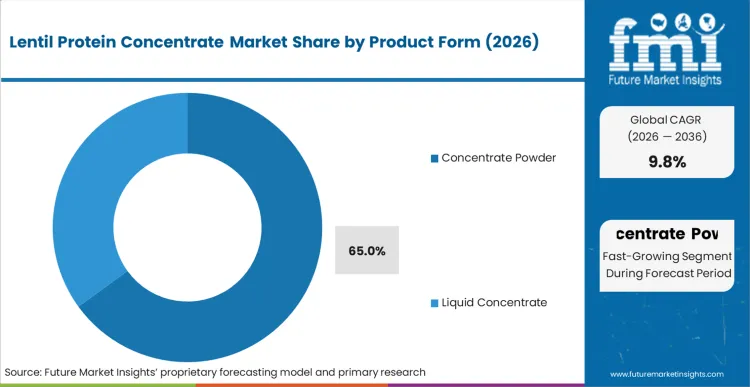
Concentrate powder commands 65% share in 2026 due to superior shelf life and transport efficiency. Manufacturers favor dry formats as moisture removal reduces microbial risk during global shipping. As per FMI's projection, formulation science gravitates toward powder variants to optimize bakery and meat-alternative production lines. Liquid formats serve niche beverage applications requiring immediate solubility without agglomeration.
- Procurement shift: Dry powders reduce logistics costs by eliminating water weight during transit. Procurement teams centralize buying around stable bulk shipments to minimize expenditure.
- Technology upgrade: Advanced milling techniques improve particle size distribution for better mouthfeel. Formulators achieve smoother textures in finished goods without gritty residues.
- Supply-side move: Processors expand spray-drying capacity to meet volume demands. Scaled production lowers unit costs for major food brands seeking reliable bulk inventory.
Lentil Protein Concentrate Market Analysis by Application
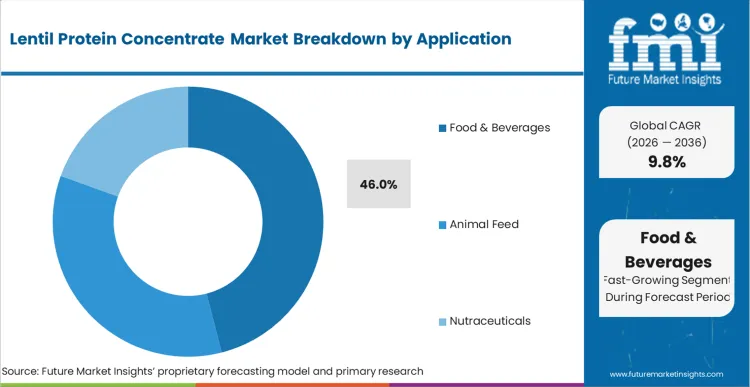
Expanding demand for meat substitutes and functional snacks is accelerating ingredient use across mainstream food applications. Formulators combine pulse flour with protein concentrates to deliver the texture required in extruded products. With U.S. plant-based meat and seafood sales reaching USD 1.2 billion in 2024 [14], the need for clean-label binding agents remains strong, while pet food and nutraceutical segments add incremental volume. As a result, food and beverages account for 46% of total share in 2026.
- Formulation trigger: Brands replace soy isolates with pulse concentrates to satisfy allergen-free consumer preferences. Sales velocity improves for certified clean-label items on crowded grocery shelves.
- Regulatory signal: Health authorities promote diverse plant protein consumption. Food manufacturers adjust recipes to secure favorable nutritional scoring and avoid penalty taxes.
- Capacity expansion: Ingredient suppliers build dedicated pulse lines to serve human nutrition markets. Increased regional processing lowers dependency on imported binding agents.
Lentil Protein Concentrate Market Drivers, Restraints, and Opportunities
National dietary mandates accelerate widespread ingredientization of pulses. Government agencies urge populations to diversify protein intake, directly prompting food manufacturers to reformulate core product lines. As per FMI's projection, Statistics Canada reporting lentil production hit a record 3.4 million tonnes in February 2026 ensures processors possess adequate raw material volumes for ambitious scale-up plans [3]. Procurement directors shift budgets toward lentil fractions to meet new nutritional scoring requirements, guaranteeing continuous demand for high-quality concentrates. Stable feedstock supplies lower financial risk for large-scale extraction facility investments.
Sensory limitations and formulation complexities present persistent barriers to immediate mass adoption. Extracted fractions often retain native bitter notes, requiring expensive masking agents or advanced processing to achieve neutral flavor profiles. Preliminary per-capita availability of dry peas and lentils falling to 3.6 pounds in 2023 highlights consumption volatility that complicates long-term processing forecasts [4]. Formulators struggle with solubility issues in liquid applications, forcing prolonged research phases before product commercialization. Procurement teams face higher final recipe costs when complex masking technologies become necessary.
- Clean-label positioning: Brands reformulate existing snacks to remove synthetic binders, capturing health-conscious demographics. Clean-label mandates force procurement shifts away from heavily processed texturizers toward native lentil fractions.
- Agronomic expansion: Farmers increase planted acreage, ensuring stable raw material pricing for downstream extraction facilities. Consistent crop yields allow ingredient manufacturers to offer fixed-price contracts to massive food conglomerates.
- Technological partnership: Ingredient processors collaborate with biotechnology firms to improve extraction yields. Improved enzymatic processes reduce bitter off-notes, unlocking broader inclusion in delicate beverage profiles.
Regional Analysis
Based on the regional analysis, the Lentil Protein Concentrate market is segmented into North America, Latin America, Europe, East Asia, South Asia, Oceania and Middle East & Africa across 40+ countries. The full report also offers market attractiveness analysis based on regional trends.
.webp "Top Country Growth Comparison Lentil Protein Concentrate Market Cagr (2026 2036)")
| Country | CAGR (2026 to 2036) |
|---|---|
| India | 11.5% |
| China | 10.8% |
| United States | 9.7% |
| United Kingdom | 9.3% |
| Germany | 9.1% |
| Brazil | 8.9% |
Source: Future Market Insights (FMI) analysis, based on proprietary forecasting model and primary research
Asia Pacific Lentil Protein Concentrate Analysis
Asia Pacific demonstrates rapid processing expansion, fueled by massive demographic shifts toward protein-fortified diets. Governments implement structural policies supporting domestic plant-based manufacturing ecosystems. According to FMI's estimates, regional food brands bypass traditional dairy inputs, favoring native pulses for cost-effective nutritional upgrades. Scaling local processing capacity insulates markets from volatile international freight costs.
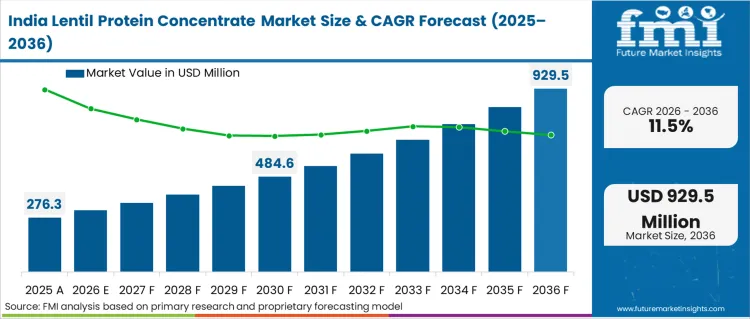
- India: Rising value-added pulse exports are strengthening India’s position in downstream ingredient processing, with shipments reaching 793,291.51 MT in FY 2024-25 [5]. This expanding agricultural base supports local extraction initiatives and structured procurement growth, positioning concentrate demand to expand at an 11.5% CAGR through 2036.
- China: Concentrate sales in China are projected to rise at 10.8% CAGR from 2026 to 2036 as consumption broadens nationally, creating a clearer pathway from policy intent to purchase orders. Chinese lentil imports totaling 13.2 thousand tons in MY 2024/25 confirms sustained raw material inflow necessary for domestic processor scale-up [6].
FMI’s report includes deep dive into expanding processing hubs across Asia Pacific. Thailand, Indonesia, and Vietnam exhibit strong growth potential as local brands adopt chickpea protein and lentil blends to lower production costs. Ministry of Food Processing Industries expecting the global plant-based protein market to grow to USD 64.38 billion by 2025 creates massive regional momentum for specialized extractors [18].
North America Lentil Protein Concentrate Analysis
North America’s growth is supported by well-established agricultural infrastructure and strong venture capital investment fueling food innovation. Shifting consumer preferences toward clean-label products are pushing established brands to incorporate more pulse-based ingredients across retail shelves. FMI analysts opine that, in response, ingredient processors are expanding domestic extraction capacity to strengthen supply chain resilience and reduce dependence on imports.
- United States: In the United States, evolving dietary guidance increasingly positions pulses within the protein foods category, encouraging wider use in mainstream formulations. With lentil planted area reaching 936,000 acres in 2024 [7], domestic feedstock availability remains strong. Supported by these trends, the concentrate sector is projected to grow at a 9.7% CAGR between 2026 and 2036, as higher utilization rates justify ongoing technology upgrades across specialized extraction networks.
FMI’s report includes granular tracking of North American extraction capacity. Canada and Mexico present critical processing nodes supporting regional pea protein and lentil networks. Suppliers should track cross-border agricultural agreements ensuring seamless raw material transfer for texturizer production.
Europe Lentil Protein Concentrate Analysis
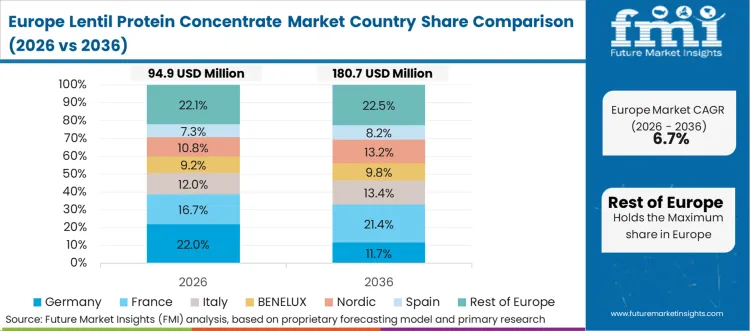
Europe leads rigorous regulatory environments, mandating high purity and sustainability standards for food ingredients. Processors invest heavily in local extraction sites to minimize carbon footprints and appeal to eco-conscious brands. Stricter labeling laws compel manufacturers to abandon artificial additives.
- United Kingdom: United Kingdom is expected to record 9.3% CAGR in concentrate demand over 2026 to 2036 as plant-based purchasing shifts alter retail shelves, tightening link between operational constraints and adoption-led investment. United Kingdom Food Security Report data emphasizing a distinct shift away from traditional meat purchasing anchors sustained demand for advanced vegetable binders [8].
- Germany: In Germany, stronger domestic processing investment is reshaping supply security for plant proteins. The concentrate segment is projected to expand at a 9.1% CAGR through 2036, as capital deployment increasingly converts into structured procurement budgets. BENEO’s opening of its first pulse-processing facility in April 2025 significantly reduces import dependence and strengthens local sourcing options for regional food manufacturers [9].
FMI’s report includes compliance mapping for European ingredient standards. France, Italy, and Spain offer expanding consumer bases seeking clean vegan protein foods and fortified bakery items. Procurement teams must navigate strict organic certification requirements prevalent across European borders.
Latin America Lentil Protein Concentrate Analysis
Latin America emerges as a vital agricultural source gradually moving up the value chain into ingredient processing. Regional brands launch protein-enriched snacks catering to rising middle-class health consciousness. Domestic processing lowers costs compared to importing finished European concentrates.
- Brazil: Concentrate uptake in Brazil is anticipated to rise at 8.9% CAGR over forecast period as mainstream fortification drives demand, helping suppliers align positioning with local buying triggers. Above Food announcing the acquisition of Redwood Group specialty crop division in August 2024 illustrates growing cross-border investments expanding local pulse infrastructure [10].
FMI’s report includes trade flow analysis across Latin American corridors. Argentina, Chile, and Colombia display promising adoption curves for fava bean protein and lentil applications in regional snacks. Manufacturers should secure consistent raw pulse supplies to avoid production disruption.
Competitive Aligners for Market Players
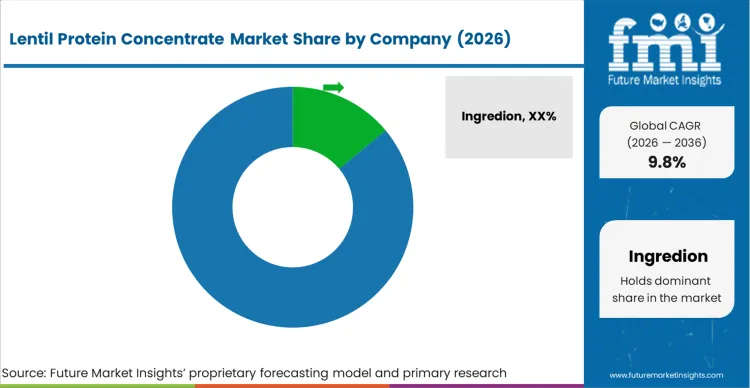
Market participants focus on securing reliable agricultural feedstocks to buffer against climate-induced yield volatility. Companies forming direct partnerships with pulse farming cooperatives achieve superior pricing predictability and ensure traceable supply chains. FMI analysts opine that Roquette launching NUTRALYS Pea 850F in February 2026 demonstrates capital commitment to superior ingredient functionality across multiple pulse types, forcing competitors to upgrade sensory profiles [15]. Better sensory parameters directly correlate with faster customer acquisition in beverage sectors.
Technological mastery over flavor masking and extraction efficiency separates tier-one suppliers from generic processors. Firms investing in advanced fractionation isolate higher-purity proteins while eliminating bitter native compounds. Avena Foods launching Regen Ag protocol verified pulse ingredients in September 2024 sets new standards for transparent sourcing [16]. Traceability metrics dominate vendor qualification processes for premium food brands.
Mergers and acquisitions accelerate as major agricultural conglomerates seek rapid entry into value-added ingredient spaces. Buying established processing facilities circumvents multi-year construction delays and instantly secures existing customer networks. Louis Dreyfus Company announcing the construction of a pea and pulse protein production plant in North America during February 2024 drastically increases regional commercial availability [17]. Consolidation pressure pushes smaller players into niche organic operational models.
Recent Developments
The report includes full coverage of key trends from competitive benchmarking. Some of the recent developments covered in the reports:
- In July 2025, Danone completed acquisition of a majority stake in Kate Farms to expand plant-based clinical nutrition portfolios. [11]
- In March 2025, Burcon alliance partner completed acquisition of an Illinois protein production facility to scale commercial plant protein output. [12]
- In March 2025, Shiru and GreenLab partnered to commercialize novel food proteins through sustainable expression systems. [13]
Key Players in Lentil Protein Concentrate
- Ingredion
- Roquette Frères
- Louis Dreyfus Company
- Above Food
- Burcon
- BENEO
- Avena Foods
- Beyond Meat
- Danone
Scope of the Report
| Metric | Value |
|---|---|
| Quantitative Units | USD 405.0 million (2026) to USD 1,040.0 million (2036), at a CAGR of 9.8% |
| Market Definition | Lentil protein concentrate represents high-protein fractions extracted from dry lentils, utilized primarily as functional ingredients across various manufacturing sectors. |
| Product Form Segmentation | Concentrate Powder, Liquid Concentrate |
| Application Segmentation | Food & Beverages, Animal Feed, Nutraceuticals |
| Distribution Channel Segmentation | Food & Grocery Retail, Online Sales, B2B |
| End-User Group Segmentation | Adults, Children, Seniors |
| Regions Covered | North America, Latin America, Europe, East Asia, South Asia, Oceania, Middle East and Africa |
| Countries Covered | United States, Canada, Mexico, Brazil, Argentina, Germany, France, United Kingdom, Italy, Spain, China, India, Japan, South Korea, Indonesia, Australia and 40 plus countries |
| Key Companies Profiled | Ingredion, Roquette Frères, Louis Dreyfus Company, Above Food, Burcon, BENEO, Avena Foods, Beyond Meat, Danone |
| Forecast Period | 2026 to 2036 |
|
Approach |
Hybrid top down and bottom up market modeling validated through primary interviews with ingredient processors and food brand formulators, supported by trade data benchmarking and plant level capacity verification |
Lentil Protein Concentrate Market Analysis by Segments
Product Form
- Concentrate Powder
- Liquid Concentrate
Application
- Food & Beverages
- Animal Feed
- Nutraceuticals
Distribution Channel
- Food & Grocery Retail
- Online Sales
- B2B
End-User Group
- Adults
- Children
- Seniors
Region
- Asia Pacific
- India
- China
- Japan
- South Korea
- Indonesia
- Australia & New Zealand
- ASEAN
- Rest of Asia Pacific
- Europe
- Germany
- Italy
- France
- United Kingdom
- Spain
- Benelux
- Nordics
- Central & Eastern Europe
- Rest of Europe
- North America
- United States
- Canada
- Mexico
- Latin America
- Brazil
- Argentina
- Chile
- Rest of Latin America
- Middle East & Africa
- Kingdom of Saudi Arabia
- United Arab Emirates
- South Africa
- Turkey
- Rest of Middle East & Africa
Bibliography
- [1] Burcon NutraScience Corporation. (2025). Burcon achieves first commercial production of pea protein.
- [2] Dietary Guidelines Advisory Committee, Scientific Report of 2025 Dietary Guidelines Advisory Committee, December 2024.
- [3] Statistics Canada, Lentil Production Record Output, February 2026.
- [4] USDA ERS, Vegetable and Pulses Outlook, July 2024.
- [5] APEDA, Pulses Export Data, FY 2024-25.
- [6] USDA FAS, China Pulses Report, February 2025.
- [7] USDA NASS, Crop Production News Release, September 2024.
- [8] UK Government, Food Security Report, 2024.
- [9] Nutritional Outlook, BENEO Pulse Processing Plant Opening, April 2025.
- [10] Above Food, Redwood Group Acquisition Announcement, August 2024.
- [11] Danone, Kate Farms Acquisition Press Release, July 2025.
- [12] Burcon, Illinois Facility Acquisition Press Release, March 2025.
- [13] PR Newswire, Shiru and GreenLab Partnership, March 2025.
- [14] The Good Food Institute, State of Industry Plant-Based Meat, 2025.
- [15] Roquette Frères, NUTRALYS Pea 850F Launch Announcement, February 2026.
- [16] Avena Foods, Regen Ag Protocol Verification, September 2024.
- [17] Louis Dreyfus Company, Pea Protein Production Plant Construction, February 2024.
- [18] Ministry of Food Processing Industries, Plant-Based Protein Sector Profile, 2025.
This bibliography is provided for reader reference and is not exhaustive. The full report contains the complete reference list and detailed citations.
This Report Addresses
- Clean-label ingredient substitution trends driving food manufacturers toward native pulse derivatives.
- Production capacity expansion updates across major North American and European agricultural processing hubs.
- Traced sourcing strategies utilized by global food brands to secure reliable raw material supplies.
- Extraction technology advancements mitigating traditional bitter flavor profiles in specialized pulse proteins.
- Direct regulatory impacts stemming from updated national dietary guidelines recommending higher pulse consumption.
- Comparative ingredient utilization rates across sports nutrition, clinical formulas, and mainstream food applications.
- Regional integration models highlighting downstream acquisitions by established global food conglomerates.
- Cross-border trade flow analysis detailing agricultural dependencies in emerging plant-based manufacturing economies.
Frequently Asked Questions
How large is the demand for Lentil Protein Concentrate in the global market in 2026?
Demand for Lentil Protein Concentrate in global markets is estimated to be valued at USD 405.0 million in 2026.
What will be the market size of Lentil Protein Concentrate in the global market by 2036?
Market size for Lentil Protein Concentrate is projected to reach USD 1,040.0 million by 2036.
What is the expected demand growth for Lentil Protein Concentrate in the global market between 2026 and 2036?
Demand for Lentil Protein Concentrate globally is expected to grow at a CAGR of 9.8% between 2026 and 2036.
Which Product Form is poised to lead global sales by 2026?
Concentrate powder is expected to command 65% share in 2026 as dry formats drastically reduce shipping logistics costs.
How significant is the role of Food & Beverages in driving Lentil Protein Concentrate adoption in 2026?
Food and beverages represent 46% share in 2026 due to extensive utilization within plant-based meat substitute applications.
What is driving demand in India?
Demand stems from rapid value-added export expansion and aggressive local ingredient processing investments.
What compliance standards or regulations are referenced for India?
Ministry of Food Processing Industries provides critical guidance mapping plant-based sector growth.
What is the India growth outlook in this report?
India is projected to grow at a CAGR of 11.5% during 2026 to 2036.
Why is North America described as a priority region in this report?
Aggressive venture funding and established processing infrastructure drive rapid commercialization of clean-label ingredients.
What type of demand dominates in North America?
Clean-label reformulation demand from established grocery brands dominates regional consumption trends.
What is China growth outlook in this report?
China is projected to expand at a CAGR of 10.8% during 2026 to 2036.
Does the report cover United States in its regional analysis?
Yes, United States is included within North America under regional analysis.
What are the sources referred to for analyzing United States?
Dietary Guidelines Advisory Committee recommendations and NASS planted area statistics inform regional projections.
What is the main demand theme linked to United States in its region coverage?
Main theme involves dietary guidance shifts pulling pulse derivatives into mainstream protein food categories.
Does the report cover United Kingdom in its regional analysis?
Yes, United Kingdom is included within Europe under regional analysis.
What is the main United Kingdom related demand theme in its region coverage?
Shifting purchasing habits toward non-dairy and meat substitutes anchor sustained demand.
Which product formats or configurations are strategically important for Europe supply chains?
Neutral-tasting extracted powders hold strategic importance for premium clean-label food applications.
What is Lentil Protein Concentrate and what is it mainly used for?
Lentil protein concentrate comprises functional protein fractions extracted from dry lentils used for binding and nutrition.
What does Lentil Protein Concentrate mean in this report?
Scope encompasses dry and liquid lentil concentrates explicitly sold for industrial formulation and B2B transfer.
What is included in the scope of this Lentil Protein Concentrate report?
Included items cover standard and modified functional lentil powders utilized by commercial food manufacturers.
What is excluded from the scope of this report?
Whole lentils, split peas, low-protein lentil flour, and finished packaged consumer goods remain excluded.
What does market forecast mean on this page?
Market forecast represents a model-based projection built on defined capacity and demand assumptions.
How does FMI build and validate the Lentil Protein Concentrate forecast?
Forecast relies on hybrid top-down and bottom-up modeling validated through processing capacity verification.
What does zero reliance on speculative third party market research mean here?
Analysts utilize primary interviews and verifiable public customs datasets instead of unverified syndicated estimates.
Preview the report firsthand - request a free sample
Get SampleGet the brochure for pricing and purchase details.
Get PDFTable of Content
- Executive Summary
- Global Market Outlook
- Demand-side Trends
- Supply-side Trends
- Technology Roadmap Analysis
- Analysis and Recommendations
- Market Overview
- Market Coverage / Taxonomy
- Market Definition / Scope / Limitations
- Research Methodology
- Chapter Orientation
- Analytical Lens and Working Hypotheses
- Market Structure, Signals, and Trend Drivers
- Benchmarking and Cross-market Comparability
- Market Sizing, Forecasting, and Opportunity Mapping
- Research Design and Evidence Framework
- Desk Research Programme (Secondary Evidence)
- Company Annual and Sustainability Reports
- Peer-reviewed Journals and Academic Literature
- Corporate Websites, Product Literature, and Technical Notes
- Earnings Decks and Investor Briefings
- Statutory Filings and Regulatory Disclosures
- Technical White Papers and Standards Notes
- Trade Journals, Industry Magazines, and Analyst Briefs
- Conference Proceedings, Webinars, and Seminar Materials
- Government Statistics Portals and Public Data Releases
- Press Releases and Reputable Media Coverage
- Specialist Newsletters and Curated Briefings
- Sector Databases and Reference Repositories
- FMI Internal Proprietary Databases and Historical Market Datasets
- Subscription Datasets and Paid Sources
- Social Channels, Communities, and Digital Listening Inputs
- Additional Desk Sources
- Expert Input and Fieldwork (Primary Evidence)
- Primary Modes
- Qualitative Interviews and Expert Elicitation
- Quantitative Surveys and Structured Data Capture
- Blended Approach
- Why Primary Evidence is Used
- Field Techniques
- Interviews
- Surveys
- Focus Groups
- Observational and In-context Research
- Social and Community Interactions
- Stakeholder Universe Engaged
- C-suite Leaders
- Board Members
- Presidents and Vice Presidents
- R&D and Innovation Heads
- Technical Specialists
- Domain Subject-matter Experts
- Scientists
- Physicians and Other Healthcare Professionals
- Governance, Ethics, and Data Stewardship
- Research Ethics
- Data Integrity and Handling
- Primary Modes
- Tooling, Models, and Reference Databases
- Desk Research Programme (Secondary Evidence)
- Data Engineering and Model Build
- Data Acquisition and Ingestion
- Cleaning, Normalisation, and Verification
- Synthesis, Triangulation, and Analysis
- Quality Assurance and Audit Trail
- Market Background
- Market Dynamics
- Drivers
- Restraints
- Opportunity
- Trends
- Scenario Forecast
- Demand in Optimistic Scenario
- Demand in Likely Scenario
- Demand in Conservative Scenario
- Opportunity Map Analysis
- Product Life Cycle Analysis
- Supply Chain Analysis
- Investment Feasibility Matrix
- Value Chain Analysis
- PESTLE and Porter’s Analysis
- Regulatory Landscape
- Regional Parent Market Outlook
- Production and Consumption Statistics
- Import and Export Statistics
- Market Dynamics
- Global Market Analysis 2021 to 2025 and Forecast, 2026 to 2036
- Historical Market Size Value (USD Million) Analysis, 2021 to 2025
- Current and Future Market Size Value (USD Million) Projections, 2026 to 2036
- Y-o-Y Growth Trend Analysis
- Absolute $ Opportunity Analysis
- Global Market Pricing Analysis 2021 to 2025 and Forecast 2026 to 2036
- Global Market Analysis 2021 to 2025 and Forecast 2026 to 2036, By Product Form
- Introduction / Key Findings
- Historical Market Size Value (USD Million) Analysis By Product Form , 2021 to 2025
- Current and Future Market Size Value (USD Million) Analysis and Forecast By Product Form , 2026 to 2036
- Concentrate Powder
- Liquid Concentrate
- Concentrate Powder
- Y-o-Y Growth Trend Analysis By Product Form , 2021 to 2025
- Absolute $ Opportunity Analysis By Product Form , 2026 to 2036
- Global Market Analysis 2021 to 2025 and Forecast 2026 to 2036, By Application
- Introduction / Key Findings
- Historical Market Size Value (USD Million) Analysis By Application, 2021 to 2025
- Current and Future Market Size Value (USD Million) Analysis and Forecast By Application, 2026 to 2036
- Food & Beverages
- Animal Feed
- Nutraceuticals
- Food & Beverages
- Y-o-Y Growth Trend Analysis By Application, 2021 to 2025
- Absolute $ Opportunity Analysis By Application, 2026 to 2036
- Global Market Analysis 2021 to 2025 and Forecast 2026 to 2036, By Region
- Introduction
- Historical Market Size Value (USD Million) Analysis By Region, 2021 to 2025
- Current Market Size Value (USD Million) Analysis and Forecast By Region, 2026 to 2036
- North America
- Latin America
- Western Europe
- Eastern Europe
- East Asia
- South Asia and Pacific
- Middle East & Africa
- Market Attractiveness Analysis By Region
- North America Market Analysis 2021 to 2025 and Forecast 2026 to 2036, By Country
- Historical Market Size Value (USD Million) Trend Analysis By Market Taxonomy, 2021 to 2025
- Market Size Value (USD Million) Forecast By Market Taxonomy, 2026 to 2036
- By Country
- USA
- Canada
- Mexico
- By Product Form
- By Application
- By Country
- Market Attractiveness Analysis
- By Country
- By Product Form
- By Application
- Key Takeaways
- Latin America Market Analysis 2021 to 2025 and Forecast 2026 to 2036, By Country
- Historical Market Size Value (USD Million) Trend Analysis By Market Taxonomy, 2021 to 2025
- Market Size Value (USD Million) Forecast By Market Taxonomy, 2026 to 2036
- By Country
- Brazil
- Chile
- Rest of Latin America
- By Product Form
- By Application
- By Country
- Market Attractiveness Analysis
- By Country
- By Product Form
- By Application
- Key Takeaways
- Western Europe Market Analysis 2021 to 2025 and Forecast 2026 to 2036, By Country
- Historical Market Size Value (USD Million) Trend Analysis By Market Taxonomy, 2021 to 2025
- Market Size Value (USD Million) Forecast By Market Taxonomy, 2026 to 2036
- By Country
- Germany
- UK
- Italy
- Spain
- France
- Nordic
- BENELUX
- Rest of Western Europe
- By Product Form
- By Application
- By Country
- Market Attractiveness Analysis
- By Country
- By Product Form
- By Application
- Key Takeaways
- Eastern Europe Market Analysis 2021 to 2025 and Forecast 2026 to 2036, By Country
- Historical Market Size Value (USD Million) Trend Analysis By Market Taxonomy, 2021 to 2025
- Market Size Value (USD Million) Forecast By Market Taxonomy, 2026 to 2036
- By Country
- Russia
- Poland
- Hungary
- Balkan & Baltic
- Rest of Eastern Europe
- By Product Form
- By Application
- By Country
- Market Attractiveness Analysis
- By Country
- By Product Form
- By Application
- Key Takeaways
- East Asia Market Analysis 2021 to 2025 and Forecast 2026 to 2036, By Country
- Historical Market Size Value (USD Million) Trend Analysis By Market Taxonomy, 2021 to 2025
- Market Size Value (USD Million) Forecast By Market Taxonomy, 2026 to 2036
- By Country
- China
- Japan
- South Korea
- By Product Form
- By Application
- By Country
- Market Attractiveness Analysis
- By Country
- By Product Form
- By Application
- Key Takeaways
- South Asia and Pacific Market Analysis 2021 to 2025 and Forecast 2026 to 2036, By Country
- Historical Market Size Value (USD Million) Trend Analysis By Market Taxonomy, 2021 to 2025
- Market Size Value (USD Million) Forecast By Market Taxonomy, 2026 to 2036
- By Country
- India
- ASEAN
- Australia & New Zealand
- Rest of South Asia and Pacific
- By Product Form
- By Application
- By Country
- Market Attractiveness Analysis
- By Country
- By Product Form
- By Application
- Key Takeaways
- Middle East & Africa Market Analysis 2021 to 2025 and Forecast 2026 to 2036, By Country
- Historical Market Size Value (USD Million) Trend Analysis By Market Taxonomy, 2021 to 2025
- Market Size Value (USD Million) Forecast By Market Taxonomy, 2026 to 2036
- By Country
- Kingdom of Saudi Arabia
- Other GCC Countries
- Turkiye
- South Africa
- Other African Union
- Rest of Middle East & Africa
- By Product Form
- By Application
- By Country
- Market Attractiveness Analysis
- By Country
- By Product Form
- By Application
- Key Takeaways
- Key Countries Market Analysis
- USA
- Pricing Analysis
- Market Share Analysis, 2025
- By Product Form
- By Application
- Canada
- Pricing Analysis
- Market Share Analysis, 2025
- By Product Form
- By Application
- Mexico
- Pricing Analysis
- Market Share Analysis, 2025
- By Product Form
- By Application
- Brazil
- Pricing Analysis
- Market Share Analysis, 2025
- By Product Form
- By Application
- Chile
- Pricing Analysis
- Market Share Analysis, 2025
- By Product Form
- By Application
- Germany
- Pricing Analysis
- Market Share Analysis, 2025
- By Product Form
- By Application
- UK
- Pricing Analysis
- Market Share Analysis, 2025
- By Product Form
- By Application
- Italy
- Pricing Analysis
- Market Share Analysis, 2025
- By Product Form
- By Application
- Spain
- Pricing Analysis
- Market Share Analysis, 2025
- By Product Form
- By Application
- France
- Pricing Analysis
- Market Share Analysis, 2025
- By Product Form
- By Application
- India
- Pricing Analysis
- Market Share Analysis, 2025
- By Product Form
- By Application
- ASEAN
- Pricing Analysis
- Market Share Analysis, 2025
- By Product Form
- By Application
- Australia & New Zealand
- Pricing Analysis
- Market Share Analysis, 2025
- By Product Form
- By Application
- China
- Pricing Analysis
- Market Share Analysis, 2025
- By Product Form
- By Application
- Japan
- Pricing Analysis
- Market Share Analysis, 2025
- By Product Form
- By Application
- South Korea
- Pricing Analysis
- Market Share Analysis, 2025
- By Product Form
- By Application
- Russia
- Pricing Analysis
- Market Share Analysis, 2025
- By Product Form
- By Application
- Poland
- Pricing Analysis
- Market Share Analysis, 2025
- By Product Form
- By Application
- Hungary
- Pricing Analysis
- Market Share Analysis, 2025
- By Product Form
- By Application
- Kingdom of Saudi Arabia
- Pricing Analysis
- Market Share Analysis, 2025
- By Product Form
- By Application
- Turkiye
- Pricing Analysis
- Market Share Analysis, 2025
- By Product Form
- By Application
- South Africa
- Pricing Analysis
- Market Share Analysis, 2025
- By Product Form
- By Application
- USA
- Market Structure Analysis
- Competition Dashboard
- Competition Benchmarking
- Market Share Analysis of Top Players
- By Regional
- By Product Form
- By Application
- Competition Analysis
- Competition Deep Dive
- Ingredion
- Overview
- Product Portfolio
- Profitability by Market Segments (Product/Age /Sales Channel/Region)
- Sales Footprint
- Strategy Overview
- Marketing Strategy
- Product Strategy
- Channel Strategy
- Roquette Frères
- Louis Dreyfus Company
- Above Food
- Burcon
- BENEO
- Avena Foods
- Beyond Meat
- Danone
- Ingredion
- Competition Deep Dive
- Assumptions & Acronyms Used


