

- Industry Size (2026)
- USD 794.9 Mn
- Forecast (2036)
- USD 1872.0 Mn
- CAGR (2026 to 2036)
- 8.9%
Sunflower Protein Concentrate Market Size, Market Forecast and Outlook By FMI
In 2025, the sunflower protein concentrate market surpassed a value of USD 737.5 Million, is projected at USD 794.9 Million in 2026 and USD 1,872.0 Million by 2036, implying an 8.9% CAGR, with momentum tied to clean-label reformulation mandates. Procurement teams bypass lengthy qualification phases, moving directly to commercial runs to secure allergen-free inputs for plant-based protein product lines.
Crush operators maximize meal recovery as global sunflowerseed production reaches 56.3 million tons in the 2025/26 cycle, expanding feedstock pools for downstream concentration [1]. Extraction facilities translate higher meal volumes into isolated formats, absorbing pricing shocks to supply plant-based ingredients networks efficiently.
Summary of Sunflower Protein Concentrate Market
- Sunflower Protein Concentrate Market Definition
- A refined agricultural derivative extracted from defatted sunflower meal, utilizing mechanical and aqueous extraction techniques to isolate functional proteins for industrial food formulation.
- Demand Drivers in the Market
- Stringent allergen labeling mandates push manufacturers away from soy and wheat additives.
- Recovery in global sunflowerseed harvests expands available raw material feedstock.
- Advancements in extraction technology improve solubility and taste neutrality.
- Key Segments Analyzed in the FMI Report
- Form: Powder dominates (81%) over liquid formats due to shelf stability and global trade logistics advantages.
- Application: Food & Beverages lead (46% of total volume) driven by allergen-free reformulation mandates.
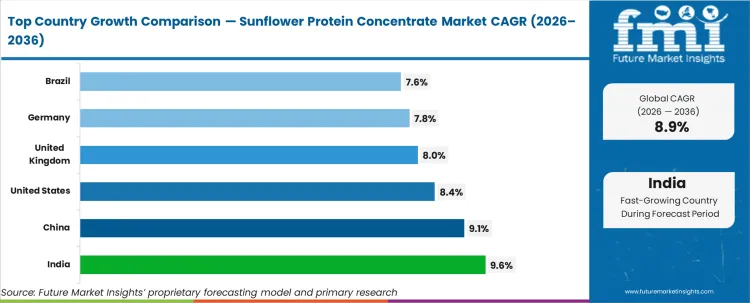
- Geography: High-growth Asia-Pacific (India 9.6%, China 9.1%) outpaces mature but regulation-intensive North America and Europe.
- Analyst Opinion at FMI
- Nandini Roy Choudhury, Principal Consultant for Food & Beverage at Future Market Insights, opines, "Through our recent evaluation, we observed that sunflower protein concentrate is gaining traction in plant-based meat applications due to its emulsification and water-binding properties. While sensory optimization remains ongoing, improvements in filtration and purification are steadily enhancing taste neutrality. Suppliers investing in application-specific extrusion trials will secure stronger positioning in alternative protein innovation pipelines."
- Strategic Implications/Executive Takeaways
- Secure long-term meal supply contracts to insulate against raw material price shocks.
- Prioritize solubility improvements to capture high-value beverage applications.
- Build extraction plants near existing oilseed crush hubs to minimize freight costs.
- Methodology
- Validated through first-hand corporate production and capacity data.
- Zero reliance on speculative third-party market research reports.
- Based on verifiable industrial benchmarks and verified sources.
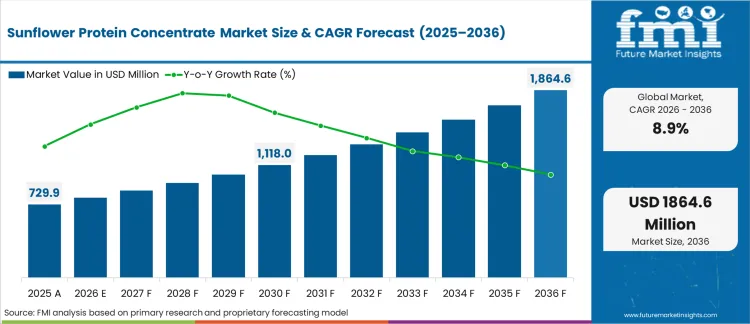
Sunflower Protein Concentrate Market Key Takeaways
| Metric | Details |
|---|---|
| Industry Size (2026) | USD 794.9 Million |
| Industry Value (2036) | USD 1,872.0 Million |
| CAGR (2026-2036) | 8.9% |
Sasha Ilyukhin, Senior Vice President Global Processing Services and Services Solutions at Tetra Pak, stated: zSunflower protein is a renewable and flexible ingredient that opens the door to new product opportunities without requiring major changes to existing lines and product formulations. With its adaptable flavour and nutritional benefits, it’s a great way for producers to expand product portfolios using current infrastructure, attract health-conscious consumers, and stay ahead of market trends." [2]
Emerging markets and localized processing hubs present significant untapped potential for supply chain resilience. Across India, China, the United States, the United Kingdom, Germany, and Brazil, growth concentrates where localization aligns with lead-time reduction, prompting buyers to secure reliable shipments for vegan protein portfolios.
Sunflower Protein Concentrate Market Definition
Sunflower protein concentrate represents a refined agricultural derivative extracted from defatted sunflower meal, possessing elevated protein content suitable for industrial formulation. Processors utilize mechanical and aqueous extraction techniques to isolate functional proteins from raw press cake, yielding an ingredient used primarily in nutritional and commercial food applications. Global trade relies on standardized powder formats to ensure stable shelf life and consistent mixing properties for end users.
Sunflower Protein Concentrate Market Inclusions
The Sunflower Protein Concentrate category includes dry powder concentrates containing 50% to 70% protein by weight, along with liquid protein suspensions developed for beverage formulation systems. It covers ingredients intended for human consumption and premium animal nutrition, including defatted sunflower meal fractions specifically processed to enable functional protein recovery and standardized concentration.
Sunflower Protein Concentrate Market Exclusions
The scope excludes unprocessed raw sunflower seeds and whole kernels. It does not include standard crude sunflower meal used solely for bulk livestock feed without protein concentration processing. Refined sunflower oil and associated lipid byproducts are excluded, as are fully formulated consumer end products where ingredient-level protein quantification is not separately defined.
Sunflower Protein Concentrate Market Research Methodology
- Primary Research: Direct interviews with protein extraction facility managers, agricultural commodity traders, and food formulation scientists provided baseline pricing and capacity utilization metrics.
- Desk Research: Custom import/export datasets from national agricultural ministries, corporate capacity announcements, and patent filings substantiated regional supply flow models.
- Market-Sizing and Forecasting: Analysts developed a bottom-up adoption model starting from regional sunflower crush volumes, applying historical extraction yield ratios to project available concentrate tonnage.
- Data Validation and Update Cycle: Findings underwent cross-verification against official regulatory import logs and peer-reviewed plant science journals before final forecast integration.
Segmental Analysis
Sunflower Protein Concentrate Market Analysis by Application
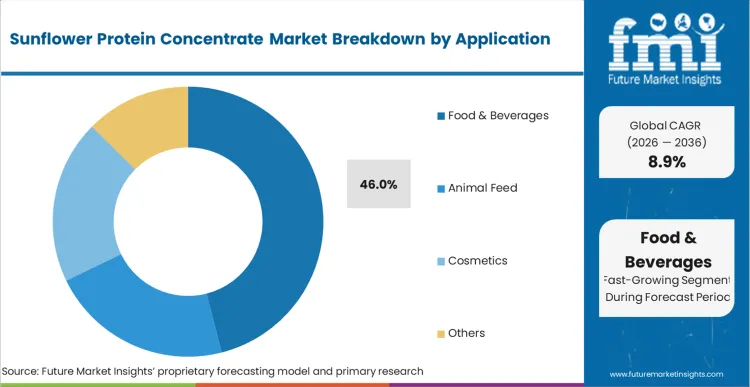
Consumer packaged goods manufacturers are actively reformulating product portfolios, driving stronger adoption of plant-based seed derivatives that help remove common allergens while improving nutritional positioning. Technical functionality remains central to commercial success, as ingredients such as extracted sunflower protein flour with 53.4% solubility enable smooth incorporation into premium liquid applications [4]. FMI estimates that processing facilities increasingly prioritize high hydration performance to secure competitive contracts within the functional beverage segment. As reformulation momentum accelerates, food and beverages account for 46% of total segment share in 2026.
- Technical validation: High-performance extraction protocols yield concentrates that dissolve efficiently in fluid environments. Beverage producers specify these grades to avoid gritty textures in finished plant-based snacks and drinks.
- Dietary compliance: Clean-label mandates force a transition away from synthetic and allergenic additives. Procurement departments source seed-based components to align with retail partner guidelines governing plant-based meals.
- Product innovation: Joint ventures linking extraction technology with food science accelerate commercialization timelines. Consortium investments validate new recipes, pushing specialized ingredients from lab-scale prototypes to supermarket shelves.
Sunflower Protein Concentrate Market Analysis by Form
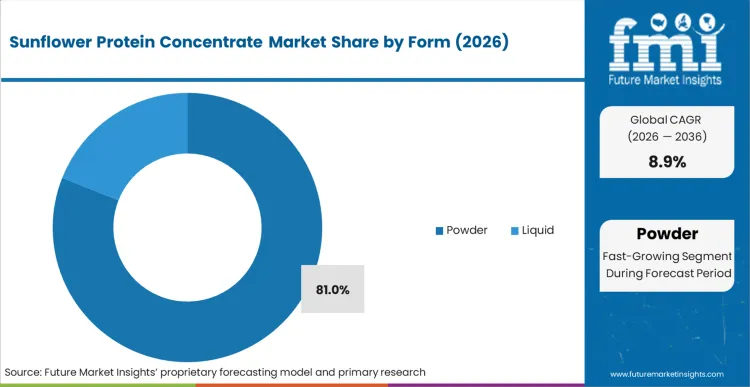
Powder grades capture an 81% share in 2026, reflecting the logistical necessities of global ingredient trade. Dry formats eliminate moisture-related spoilage risks, extending shelf life and reducing complex temperature-controlled freight requirements. The structural push toward bulk powder handling aligns with trade forecasts indicating global sunflower meal exports will grow by 700,000 tons in the 2025/26 cycle [5]. FMI analysts opine that hydration rates and particle size distributions remain critical quality parameters for industrial buyers seeking drop-in replacements for demand for alternative protein meat extenders with shelf life.
- Logistics advantage: Dehydrated formats minimize shipping weights and prevent bacterial degradation during long transit routes. Distributors stockpile dry concentrates, insulating local markets from temporary agricultural shortfalls.
- Process compatibility: Factory setups designed for flour and milk powders readily accept dry sunflower derivatives. Plant managers avoid capital expenditure on specialized liquid dosing systems by sticking to powdered inputs.
- Shelf stability: Extended expiration dates allow procurement teams to execute bulk purchasing strategies when commodity prices dip. Ingredient buyers hold larger inventories without risking product loss over quarterly cycles.
Sunflower Protein Concentrate Market Drivers, Restraints, and Opportunities
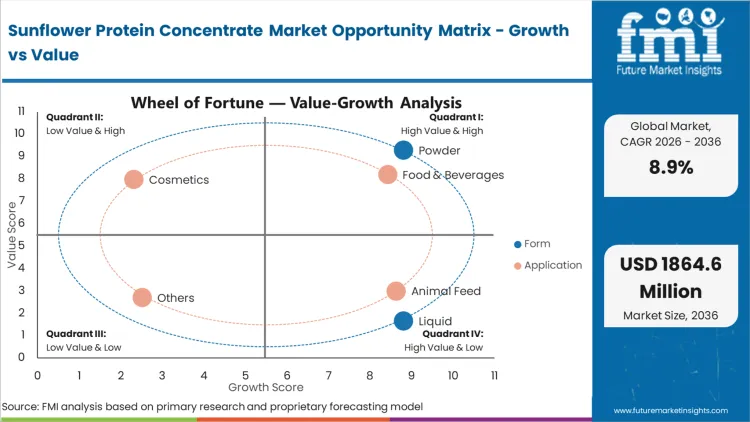
Allergen-free dietary trends force widespread recipe reformulations across the fast-moving consumer goods sector. Food scientists replace legacy additives with sunflower derivatives to capture expanding clean-label consumer segments. Improved agricultural stability directly accelerates this transition, providing the requisite volume for mass industrial adoption. A 3.9-million-ton recovery from the previous year's sunflower seed shortfalls actively supports continuous capacity utilization for concentration plants [7]. According to FMI's estimates, production lines adapt to these novel ingredients without facing sudden feedstock shortages, encouraging long-term procurement commitments.
Processing costs and yield inefficiencies restrict rapid capacity scaling for high-purity protein fractions. Extraction protocols demand significant energy and water inputs, compressing margins for emerging manufacturers competing against entrenched soy supply chains. The margin pressure intensifies when competing baseline commodities flood the zone; last year’s EU decade-high soybean meal imports hit 20.6 million tons, suppressing alternative protein pricing [8]. Producers refine separation methods to lower unit costs and differentiate their demand for pea protein in plant-based meat applications to justify slight premiums.
- Scale-up funding: Consortiums inject capital into refined manufacturing techniques to bypass early commercialization bottlenecks. A total project investment of USD 6.9 million by Protein Industries Canada explicitly targets the scaling of sunflower and hemp protein ingredients [9].
- Application diversification: Dairy alternatives and sports nutrition brands represent a massive growth vector for specialized concentrates. Processors holding patents for specific isolate extraction methods capture early market share in high-value beverage applications.
- Localized processing: Building concentration plants near major agricultural hubs reduces freight expenses and secures direct feedstock access. Facility acquisitions streamline the path from harvest to refined ingredient, shielding buyers from international supply disruptions.
Regional Analysis
Based on the regional analysis, the Sunflower Protein Concentrate market is segmented into North America, Latin America, Europe, East Asia, South Asia, Oceania and Middle East & Africa across 40+ countries. The full report also offers market attractiveness analysis based on regional trends.
.webp "Top Country Growth Comparison Sunflower Protein Concentrate Market Cagr (2026 2036)")
| Country | CAGR (2026 to 2036) |
|---|---|
| India | 9.6% |
| China | 9.1% |
| United States | 8.4% |
| United Kingdom | 8.0% |
| Germany | 7.8% |
| Brazil | 7.6% |
Source: Future Market Insights (FMI) analysis, based on proprietary forecasting model and primary research
Asia Pacific Sunflower Protein Concentrate Market Analysis
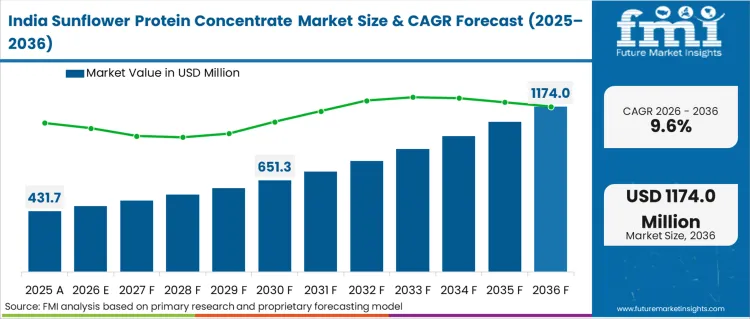
Asia Pacific’s commercialization pace is increasingly defined by how quickly regional processors convert raw sunflower harvests into higher-value functional ingredients. Instead of exporting untreated seeds, domestic crush operators are upgrading extraction systems to capture better margins from side streams and protein fractions. This structural shift reflects a broader opportunity: replacing volatile imported soy inputs with regionally available plant proteins. As one regional trade body noted in 2024, "local processing depth determines long-term agricultural profitability," underscoring why modernization is accelerating.
- China: As industrial formulation capabilities scale and beverage producers formalize long-term procurement contracts, sunflower protein sales in China are projected to grow at a 9.1% CAGR between 2026 and 2036. Russia’s estimated 17.2 million tonnes of production strengthens inbound trade stability, allowing Chinese buyers to reduce exposure to volatile soy channels [10]. Procurement teams increasingly prioritize diversified protein sourcing to protect margin structures.
- India: Demand for sunflower protein concentrate in India is projected to expand at a 9.6% CAGR through 2036, supported by value-focused protein fortification strategies ahead of broader mass-market penetration. Domestic brands are diversifying sourcing lines, including Bulgaria’s 1.66 million metric tons of production, to mitigate Black Sea geopolitical risk exposure [11]. In rural and semi-urban retail channels, cost efficiency consistently outweighs specialized functional claims, shaping ingredient selection behavior.
FMI analysts opine that supply chain localization shields processors from freight volatility and currency swings, improving cost predictability for beverage and packaged food manufacturers. The International Grains Council projected 2024/25 global sunflower output at 57.1 million tonnes, ensuring feedstock continuity for Asian extraction plants targeting consistent throughput [12]. Japan and South Korea remain strategic demand pockets, where aging populations and clinical nutrition preferences elevate interest in digestible plant-based proteins.
North America Sunflower Protein Concentrate Market Analysis
North America’s protein landscape is undergoing recalibration as domestic agricultural recovery aligns with downstream investment. Rebounding seed output reduces dependence on imported meal, while public-private consortiums channel funding into commercial-scale extraction. A 2025 industry executive noted, "bridging pilot success to industrial throughput is the real unlock for sunflower protein," reflecting how capital inflows are translating into infrastructure expansion.
- United States: The United States sunflower protein segment is expected to grow at an 8.4% CAGR from 2026 to 2036. MY 2025/26 sunflowerseed crush volumes were raised to 992 million pounds, providing critical raw material depth for extraction facilities [13]. Functionality-led substitution away from soy continues to influence formulation, as brands seek cleaner labels without compromising texture performance.
Food manufacturers increasingly reformulate flagship SKUs to emphasize domestic ingredient sourcing, capitalizing on consumer preference for traceable supply chains. The MY 2024/25 USA sunflowerseed crush baseline revision to 796 million pounds confirms steady upstream strengthening [14]. Canada and Mexico operate as integrated supply nodes, enabling cross-border seed movement and processing optimization.
Europe Sunflower Protein Concentrate Market Analysis
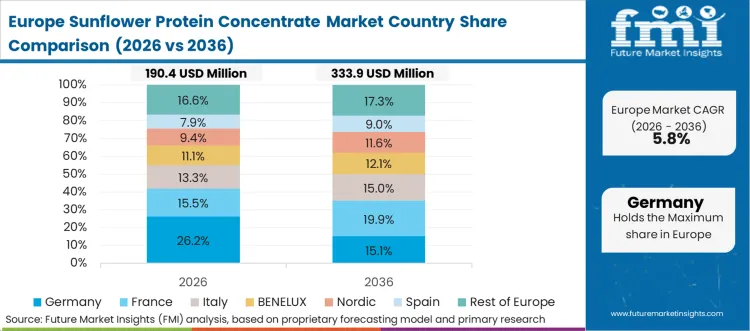
Europe functions as a technical proving ground for advanced isolation methods under strict sustainability and labeling rules. Regulatory scrutiny compels manufacturers to source efficient, low-impact ingredients while minimizing exposure to volatile import streams. The European Union reported 3.9 million tons of soybean meal imports within the first two months of the current cycle, highlighting persistent reliance on external protein channels [15]. This dynamic reinforces strategic pivoting toward domestically cultivated sunflower crops.
- United Kingdom: Rising private-label penetration reshapes procurement economics in the United Kingdom. Against this backdrop, sunflower protein demand is projected to rise at an 8.0% CAGR between 2026 and 2036. Clean-label positioning allows retailers to differentiate from low-cost commodity imports, particularly amid large-scale soy inflows.
- Germany: In Germany, sunflower protein demand is forecast to expand at a 7.8% CAGR through 2036, supported by a maturing technical ecosystem and defined sustainability budgets. Projects such as Sunflopro, targeting 550 tons of upcycled side streams by 2031, demonstrate measurable commercialization pathways [16]. German processors compete on solubility performance and taste neutrality to secure high-value contracts.
FMI estimates that EU import unit values falling below USD 400 per ton intensify competitive pressure, compelling domestic processors to differentiate through superior functional attributes rather than price alone [17]. France and Italy benefit from strong agricultural bases that support bakery and functional nutrition innovation. Collaborative research initiatives between universities and processors accelerate side-stream upcycling innovation. As one EU policy brief emphasized in 2024, "resilient protein autonomy requires value-added crop utilization," encapsulating the continent’s direction.
Latin America Sunflower Protein Concentrate Market Analysis
Cost physics and local agricultural output determine Latin American adoption curves. Processors evaluate ingredient switching strictly on a cost-per-gram of protein basis, favoring inputs that seamlessly integrate into existing mass-market food lines. Regional agricultural strength ensures a steady, low-cost supply of raw seeds, insulating local manufacturers from global commodity spikes. Extraction facilities prioritize high-volume, conventional processing over niche organic production to maintain competitive pricing.
- Brazil: As domestic food conglomerates expand functional SKUs and focus on protecting margins, sunflower protein uptake in Brazil is projected to grow at a 7.6% CAGR over the forecast period. Consistent meal supply helps stabilize retail pricing despite global export headwinds linked to Turkey’s forecasted 900,000 metric tons of sunflowerseed oil exports [18]. In this environment, affordability consistently outweighs specialized performance differentiation.
FMI’s report includes comprehensive tracking of the Latin American processing landscape, connecting agricultural output to finished ingredient capacity. Argentina and Chile serve as vital production zones, leveraging vast farming networks to supply regional extraction plants. Trade baselines defining commodity movement, such as Turkiye's MY 2024/25 sunflowerseed oil export estimate of 950,000 metric tons, influence the global pricing structures that dictate Latin American lecithin procurement strategies [19].
Competitive Aligners for Market Players
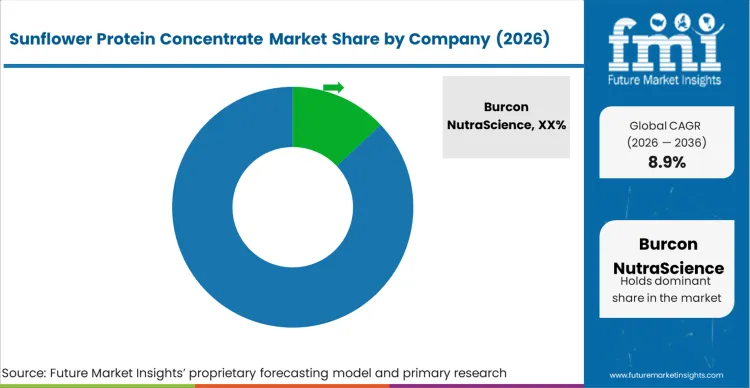
Market structure relies heavily on access to consistent, low-cost raw material feedstocks. Facilities positioned near major agricultural crush zones maintain a structural advantage over competitors reliant on imported meal. Reduced freight expenses and guaranteed supply continuity allow integrated processors to weather temporary commodity price fluctuations. Players secure multi-year procurement contracts to stabilize operations.
Strategic consortiums and public funding accelerate commercialization timelines for emerging players. Co-investment programs offset the massive capital requirements associated with building new extraction facilities. The industry shift toward operational maturity is evident as companies like Burcon sign manufacturing agreements and acquire dedicated protein production facilities [20]. Collaborative networks effectively de-risk capacity expansion.
Technological capability differentiates premium suppliers from bulk commodity processors. Companies holding intellectual property for specific isolation techniques command higher margins by delivering proteins with superior solubility and color profiles. Technical validation remains the primary barrier to entry for new market participants seeking access to high-value fractionated lecithin portfolios.
Recent Developments
The report includes full coverage of key trends from competitive benchmarking. Some of the recent developments covered in the reports:
- In November 2025, Tetra Pak launched sunflower protein as an ingredient specifically designed for food and beverage producers looking to expand clean-label product portfolios. [3]
- In January 2026, the Time-travelling Milkman collaborated with VTT Research on the Sunflopro project to convert complex agricultural side streams into high-value functional protein powder. [6]
Key Players in Sunflower Protein Concentrate Market
- Burcon NutraScience
- Tetra Pak
- Cereal Docks
- Time-travelling Milkman
- Sunbloom Proteins
- Protein Industries Canada Partners
- Austrade Inc.
- Bio Springer
- Bioriginal Food & Science Corp.
Scope of the Report
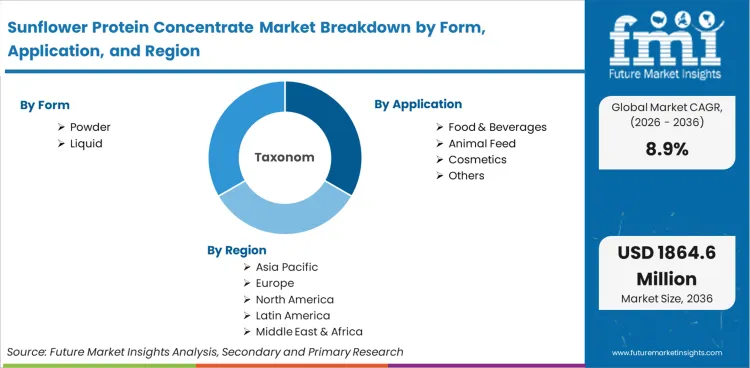
| Metric | Value |
|---|---|
| Quantitative Units | USD 794.9 Million (2026) to USD 1,872.0 Million (2036), at a CAGR of 8.9% |
| Market Definition | A refined agricultural derivative extracted from defatted sunflower meal, utilizing mechanical and aqueous extraction techniques to isolate functional proteins for industrial food formulation. |
| Product Type Segmentation | Conventional, Organic |
| Application Segmentation | Food & Beverages, Animal Feed, Cosmetics, Others |
| Form Segmentation | Powder, Liquid |
| Distribution Channel Segmentation | Supermarkets / Hypermarkets, Online Retail, Specialty Stores, Direct Sales |
| Regions Covered | North America, Latin America, Europe, East Asia, South Asia, Oceania, Middle East and Africa |
| Countries Covered | United States, Canada, Mexico, Brazil, Argentina, Germany, France, United Kingdom, Italy, Spain, China, India, Japan, South Korea, Indonesia, Australia and 40 plus countries |
| Key Companies Profiled | Burcon NutraScience, Tetra Pak, Cereal Docks, Time-travelling Milkman, Sunbloom Proteins, Austrade Inc. |
| Forecast Period | 2026 to 2036 |
| Approach | Hybrid top-down and bottom-up market modeling validated through primary interviews with extraction managers and commodity traders, supported by trade data benchmarking |
Sunflower Protein Concentrate Market Analysis by Segments
Product Type:
- Conventional
- Organic
Application:
- Food & Beverages
- Animal Feed
- Cosmetics
- Others
Form:
- Powder
- Liquid
Distribution Channel:
- Supermarkets / Hypermarkets
- Online Retail
- Specialty Stores
- Direct Sales
Region:
- Asia Pacific
- India
- China
- Japan
- South Korea
- Indonesia
- Australia & New Zealand
- ASEAN
- Rest of Asia Pacific
- Europe
- Germany
- Italy
- France
- United Kingdom
- Spain
- Benelux
- Nordics
- Central & Eastern Europe
- Rest of Europe
- North America
- United States
- Canada
- Mexico
- Latin America
- Brazil
- Argentina
- Chile
- Rest of Latin America
- Middle East & Africa
- Kingdom of Saudi Arabia
- United Arab Emirates
- South Africa
- Turkey
- Rest of Middle East & Africa
Bibliography
- [1] USDA. (2025). Oilseeds: World Markets and Trade.
- [2] Tetra Pak. (2024). Tetra Pak empowers food and beverage producers to meet consumer demands with launch of sunflower protein.
- [3] Tetra Pak. (2024). Tetra Pak empowers food and beverage producers to meet consumer demands with launch of sunflower protein.
- [4] PMC. (2025). Sunflower Protein Extents.
- [5] USDA. (2025). Global Oilseed Projections.
- [6] VTT Technical Research Centre of Finland. (2024). SunflOPro project valorizes sunflower side-streams into high-value functional plant-based ingredients.
- [7] USDA. (2025). Seed Recovery Outlook.
- [8] USDA FAS. (2026). EU Oilseeds Update.
- [9] Protein Industries Canada. (2024). Co-investment Announcement.
- [10] International Sunflower Association. (2024). Newsletter N17.
- [11] USDA FAS. (2025). Bulgaria Market Update.
- [12] International Grains Council. (2024). Supply Outlook.
- [13] USDA Economic Research Service. (2026). Oil Crops Outlook.
- [14] USDA Economic Research Service. (2026). Seed Crush Revisions.
- [15] USDA FAS. (2026). EU Meal Imports.
- [16] VTT Research. (2026). Sunflopro Project.
- [17] USDA FAS. (2026). Import Value Benchmarks.
- [18] USDA FAS. (2025). Turkiye Export Update.
- [19] USDA FAS. (2025). Turkiye Trade Estimates.
- [20] Burcon NutraScience. (2025). Q3 Results.
This bibliography is provided for reader reference and is not exhaustive. The full report contains the complete reference list and detailed citations.
This Report Addresses
- Market size estimation and revenue forecasts from 2026 to 2036, supported by validated capacity and trade benchmarks across major processing hubs.
- Growth opportunity mapping across conventional and organic formats with emphasis on clean-label supply chain transitions.
- Segment and regional revenue forecasts covering critical applications like food formulation, beverage processing, and animal nutrition.
- Competition strategy assessment including integration models, cost survivability positioning, and process capability benchmarking.
- Product reformulation tracking covering key metrics such as powder solubility, hydration rates, and neutral taste profiling.
- Regulatory impact analysis evaluating strict allergen mandates, indoor food safety protocols, and plant-based ingredient guidelines.
- Market report delivery in PDF, Excel, PPT, and interactive dashboard formats for executive and operational use.
- Supply chain vulnerability assessment linking upstream agricultural crush capacity directly to final functional ingredient availability.
Frequently Asked Questions
How large is the demand for Sunflower Protein Concentrate in the global market in 2026?
Demand for Sunflower Protein Concentrate in the global market is estimated to be valued at USD 794.9 Million in 2026.
What will be the market size of Sunflower Protein Concentrate in the global market by 2036?
Market size for Sunflower Protein Concentrate is projected to reach USD 1,872.0 Million by 2036.
What is the expected demand growth for Sunflower Protein Concentrate in the global market between 2026 and 2036?
Demand for Sunflower Protein Concentrate in the global market is expected to grow at a CAGR of 8.9% between 2026 and 2036.
Which Product Type is poised to lead global sales by 2026?
Conventional product types command 67% of the volume in 2026 as manufacturers prioritize bulk availability and cost parity.
How significant is the role of Food & Beverages in driving Sunflower Protein Concentrate adoption in 2026?
Food and beverages represent 46% of segment share as brands replace allergenic soy and wheat additives.
What is driving demand in India?
Value-driven protein fortification and localization of domestic meal streams drive functional ingredient adoption in India.
What compliance standards or regulations are referenced for India?
Allergen-free dietary guidelines and clean-label retail mandates directly influence domestic procurement behavior.
What is the India growth outlook in this report?
India is projected to grow at a CAGR of 9.6% during 2026 to 2036.
Why is North America described as a priority region in this report?
Rebounding domestic seed production and strong government-backed consortium funding accelerate commercial extraction capacity.
What type of demand dominates in North America?
Clean-label switching and functionality-led substitution dominate regional formulation demand.
What is China growth outlook in this report?
China is projected to expand at a CAGR of 9.1% during 2026 to 2036.
Does the report cover United States in its regional analysis?
Yes, the United States is included within North America under the regional scope of analysis.
What are the sources referred to for analyzing United States?
Official crop crush data from the USDA Economic Research Service and corporate capacity announcements form the analytical basis.
What is the main demand theme linked to United States in its region coverage?
Functionality-led formulation switching to replace legacy soy and wheat additives shapes continuous procurement demand.
Does the report cover United Kingdom in its regional analysis?
Yes, the United Kingdom is included within Europe under the regional coverage framework.
What is the main United Kingdom related demand theme in its region coverage?
Private-label penetration and the strategic management of imported protein costs dominate regional buyer behavior.
Which product formats or configurations are strategically important for Europe supply chains?
High-solubility powders generated from upcycled regional agricultural side streams hold immense strategic importance.
What is Sunflower Protein Concentrate and what is it mainly used for?
It is a refined agricultural derivative extracted from defatted sunflower meal, utilized primarily in commercial food formulation and beverages.
What does Sunflower Protein Concentrate mean in this report?
The market refers to the global production, trade, and industrial consumption of functional proteins isolated from sunflower press cake.
What is included in the scope of this Sunflower Protein Concentrate report?
Scope includes dry powders, liquid suspensions, and defatted meal fractions designated for human food or premium animal nutrition.
What is excluded from the scope of this report?
Raw sunflower seeds, crude livestock meal, refined oils, and fully formulated consumer end products are strictly excluded.
What does market forecast mean on this page?
The market forecast represents a model-based projection built on defined agricultural and industrial assumptions for strategic planning purposes.
How does FMI build and validate the Sunflower Protein Concentrate forecast?
Forecasts combine top-down agricultural crush data with bottom-up extraction yields, validated by primary facility manager interviews.
What does zero reliance on speculative third party market research mean here?
Primary interviews, verified patent filings, and official agricultural datasets are used exclusively instead of unverified syndicated estimates.
Preview the report firsthand - request a free sample
Get SampleGet the brochure for pricing and purchase details.
Get PDFTable of Content
- Executive Summary
- Global Market Outlook
- Demand-side Trends
- Supply-side Trends
- Technology Roadmap Analysis
- Analysis and Recommendations
- Market Overview
- Market Coverage / Taxonomy
- Market Definition / Scope / Limitations
- Research Methodology
- Chapter Orientation
- Analytical Lens and Working Hypotheses
- Market Structure, Signals, and Trend Drivers
- Benchmarking and Cross-market Comparability
- Market Sizing, Forecasting, and Opportunity Mapping
- Research Design and Evidence Framework
- Desk Research Programme (Secondary Evidence)
- Company Annual and Sustainability Reports
- Peer-reviewed Journals and Academic Literature
- Corporate Websites, Product Literature, and Technical Notes
- Earnings Decks and Investor Briefings
- Statutory Filings and Regulatory Disclosures
- Technical White Papers and Standards Notes
- Trade Journals, Industry Magazines, and Analyst Briefs
- Conference Proceedings, Webinars, and Seminar Materials
- Government Statistics Portals and Public Data Releases
- Press Releases and Reputable Media Coverage
- Specialist Newsletters and Curated Briefings
- Sector Databases and Reference Repositories
- FMI Internal Proprietary Databases and Historical Market Datasets
- Subscription Datasets and Paid Sources
- Social Channels, Communities, and Digital Listening Inputs
- Additional Desk Sources
- Expert Input and Fieldwork (Primary Evidence)
- Primary Modes
- Qualitative Interviews and Expert Elicitation
- Quantitative Surveys and Structured Data Capture
- Blended Approach
- Why Primary Evidence is Used
- Field Techniques
- Interviews
- Surveys
- Focus Groups
- Observational and In-context Research
- Social and Community Interactions
- Stakeholder Universe Engaged
- C-suite Leaders
- Board Members
- Presidents and Vice Presidents
- R&D and Innovation Heads
- Technical Specialists
- Domain Subject-matter Experts
- Scientists
- Physicians and Other Healthcare Professionals
- Governance, Ethics, and Data Stewardship
- Research Ethics
- Data Integrity and Handling
- Primary Modes
- Tooling, Models, and Reference Databases
- Desk Research Programme (Secondary Evidence)
- Data Engineering and Model Build
- Data Acquisition and Ingestion
- Cleaning, Normalisation, and Verification
- Synthesis, Triangulation, and Analysis
- Quality Assurance and Audit Trail
- Market Background
- Market Dynamics
- Drivers
- Restraints
- Opportunity
- Trends
- Scenario Forecast
- Demand in Optimistic Scenario
- Demand in Likely Scenario
- Demand in Conservative Scenario
- Opportunity Map Analysis
- Product Life Cycle Analysis
- Supply Chain Analysis
- Investment Feasibility Matrix
- Value Chain Analysis
- PESTLE and Porter’s Analysis
- Regulatory Landscape
- Regional Parent Market Outlook
- Production and Consumption Statistics
- Import and Export Statistics
- Market Dynamics
- Global Market Analysis 2021 to 2025 and Forecast, 2026 to 2036
- Historical Market Size Value (USD Million) Analysis, 2021 to 2025
- Current and Future Market Size Value (USD Million) Projections, 2026 to 2036
- Y-o-Y Growth Trend Analysis
- Absolute $ Opportunity Analysis
- Global Market Pricing Analysis 2021 to 2025 and Forecast 2026 to 2036
- Global Market Analysis 2021 to 2025 and Forecast 2026 to 2036, By Form
- Introduction / Key Findings
- Historical Market Size Value (USD Million) Analysis By Form , 2021 to 2025
- Current and Future Market Size Value (USD Million) Analysis and Forecast By Form , 2026 to 2036
- Powder
- Liquid
- Powder
- Y-o-Y Growth Trend Analysis By Form , 2021 to 2025
- Absolute $ Opportunity Analysis By Form , 2026 to 2036
- Global Market Analysis 2021 to 2025 and Forecast 2026 to 2036, By Application
- Introduction / Key Findings
- Historical Market Size Value (USD Million) Analysis By Application, 2021 to 2025
- Current and Future Market Size Value (USD Million) Analysis and Forecast By Application, 2026 to 2036
- Food & Beverages
- Animal Feed
- Cosmetics
- Others
- Food & Beverages
- Y-o-Y Growth Trend Analysis By Application, 2021 to 2025
- Absolute $ Opportunity Analysis By Application, 2026 to 2036
- Global Market Analysis 2021 to 2025 and Forecast 2026 to 2036, By Region
- Introduction
- Historical Market Size Value (USD Million) Analysis By Region, 2021 to 2025
- Current Market Size Value (USD Million) Analysis and Forecast By Region, 2026 to 2036
- North America
- Latin America
- Western Europe
- Eastern Europe
- East Asia
- South Asia and Pacific
- Middle East & Africa
- Market Attractiveness Analysis By Region
- North America Market Analysis 2021 to 2025 and Forecast 2026 to 2036, By Country
- Historical Market Size Value (USD Million) Trend Analysis By Market Taxonomy, 2021 to 2025
- Market Size Value (USD Million) Forecast By Market Taxonomy, 2026 to 2036
- By Country
- USA
- Canada
- Mexico
- By Form
- By Application
- By Country
- Market Attractiveness Analysis
- By Country
- By Form
- By Application
- Key Takeaways
- Latin America Market Analysis 2021 to 2025 and Forecast 2026 to 2036, By Country
- Historical Market Size Value (USD Million) Trend Analysis By Market Taxonomy, 2021 to 2025
- Market Size Value (USD Million) Forecast By Market Taxonomy, 2026 to 2036
- By Country
- Brazil
- Chile
- Rest of Latin America
- By Form
- By Application
- By Country
- Market Attractiveness Analysis
- By Country
- By Form
- By Application
- Key Takeaways
- Western Europe Market Analysis 2021 to 2025 and Forecast 2026 to 2036, By Country
- Historical Market Size Value (USD Million) Trend Analysis By Market Taxonomy, 2021 to 2025
- Market Size Value (USD Million) Forecast By Market Taxonomy, 2026 to 2036
- By Country
- Germany
- UK
- Italy
- Spain
- France
- Nordic
- BENELUX
- Rest of Western Europe
- By Form
- By Application
- By Country
- Market Attractiveness Analysis
- By Country
- By Form
- By Application
- Key Takeaways
- Eastern Europe Market Analysis 2021 to 2025 and Forecast 2026 to 2036, By Country
- Historical Market Size Value (USD Million) Trend Analysis By Market Taxonomy, 2021 to 2025
- Market Size Value (USD Million) Forecast By Market Taxonomy, 2026 to 2036
- By Country
- Russia
- Poland
- Hungary
- Balkan & Baltic
- Rest of Eastern Europe
- By Form
- By Application
- By Country
- Market Attractiveness Analysis
- By Country
- By Form
- By Application
- Key Takeaways
- East Asia Market Analysis 2021 to 2025 and Forecast 2026 to 2036, By Country
- Historical Market Size Value (USD Million) Trend Analysis By Market Taxonomy, 2021 to 2025
- Market Size Value (USD Million) Forecast By Market Taxonomy, 2026 to 2036
- By Country
- China
- Japan
- South Korea
- By Form
- By Application
- By Country
- Market Attractiveness Analysis
- By Country
- By Form
- By Application
- Key Takeaways
- South Asia and Pacific Market Analysis 2021 to 2025 and Forecast 2026 to 2036, By Country
- Historical Market Size Value (USD Million) Trend Analysis By Market Taxonomy, 2021 to 2025
- Market Size Value (USD Million) Forecast By Market Taxonomy, 2026 to 2036
- By Country
- India
- ASEAN
- Australia & New Zealand
- Rest of South Asia and Pacific
- By Form
- By Application
- By Country
- Market Attractiveness Analysis
- By Country
- By Form
- By Application
- Key Takeaways
- Middle East & Africa Market Analysis 2021 to 2025 and Forecast 2026 to 2036, By Country
- Historical Market Size Value (USD Million) Trend Analysis By Market Taxonomy, 2021 to 2025
- Market Size Value (USD Million) Forecast By Market Taxonomy, 2026 to 2036
- By Country
- Kingdom of Saudi Arabia
- Other GCC Countries
- Turkiye
- South Africa
- Other African Union
- Rest of Middle East & Africa
- By Form
- By Application
- By Country
- Market Attractiveness Analysis
- By Country
- By Form
- By Application
- Key Takeaways
- Key Countries Market Analysis
- USA
- Pricing Analysis
- Market Share Analysis, 2025
- By Form
- By Application
- Canada
- Pricing Analysis
- Market Share Analysis, 2025
- By Form
- By Application
- Mexico
- Pricing Analysis
- Market Share Analysis, 2025
- By Form
- By Application
- Brazil
- Pricing Analysis
- Market Share Analysis, 2025
- By Form
- By Application
- Chile
- Pricing Analysis
- Market Share Analysis, 2025
- By Form
- By Application
- Germany
- Pricing Analysis
- Market Share Analysis, 2025
- By Form
- By Application
- UK
- Pricing Analysis
- Market Share Analysis, 2025
- By Form
- By Application
- Italy
- Pricing Analysis
- Market Share Analysis, 2025
- By Form
- By Application
- Spain
- Pricing Analysis
- Market Share Analysis, 2025
- By Form
- By Application
- France
- Pricing Analysis
- Market Share Analysis, 2025
- By Form
- By Application
- India
- Pricing Analysis
- Market Share Analysis, 2025
- By Form
- By Application
- ASEAN
- Pricing Analysis
- Market Share Analysis, 2025
- By Form
- By Application
- Australia & New Zealand
- Pricing Analysis
- Market Share Analysis, 2025
- By Form
- By Application
- China
- Pricing Analysis
- Market Share Analysis, 2025
- By Form
- By Application
- Japan
- Pricing Analysis
- Market Share Analysis, 2025
- By Form
- By Application
- South Korea
- Pricing Analysis
- Market Share Analysis, 2025
- By Form
- By Application
- Russia
- Pricing Analysis
- Market Share Analysis, 2025
- By Form
- By Application
- Poland
- Pricing Analysis
- Market Share Analysis, 2025
- By Form
- By Application
- Hungary
- Pricing Analysis
- Market Share Analysis, 2025
- By Form
- By Application
- Kingdom of Saudi Arabia
- Pricing Analysis
- Market Share Analysis, 2025
- By Form
- By Application
- Turkiye
- Pricing Analysis
- Market Share Analysis, 2025
- By Form
- By Application
- South Africa
- Pricing Analysis
- Market Share Analysis, 2025
- By Form
- By Application
- USA
- Market Structure Analysis
- Competition Dashboard
- Competition Benchmarking
- Market Share Analysis of Top Players
- By Regional
- By Form
- By Application
- Competition Analysis
- Competition Deep Dive
- Burcon NutraScience
- Overview
- Product Portfolio
- Profitability by Market Segments (Product/Age /Sales Channel/Region)
- Sales Footprint
- Strategy Overview
- Marketing Strategy
- Product Strategy
- Channel Strategy
- Tetra Pak
- Cereal Docks
- Time-travelling Milkman
- Sunbloom Proteins
- Protein Industries Canada Partners
- Burcon NutraScience
- Competition Deep Dive
- Assumptions & Acronyms Used


