

- Industry Size (2026)
- USD 9.6 Bn
- Forecast (2036)
- USD 18.4 Bn
- CAGR (2026 to 2036)
- 6.7%
Concentrated Scalp Pastes Market Forecast and Outlook 2026 to 2036
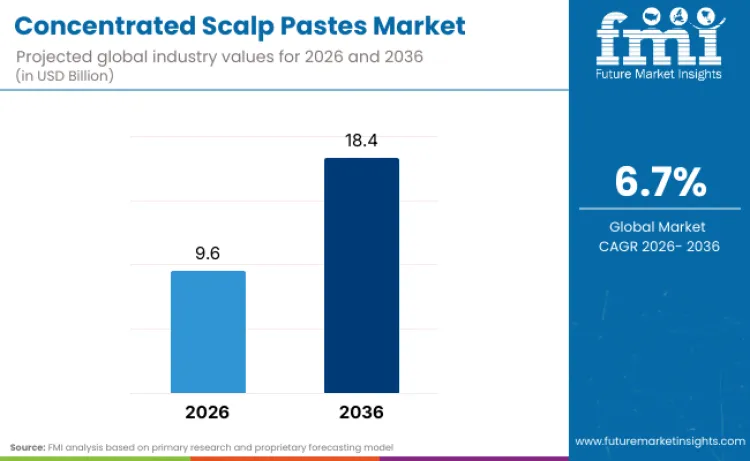
The global concentrated scalp pastes market is projected to reach USD 9.6 billion in 2026 and expand to USD 18.4 billion by 2036, reflecting a CAGR of 6.7% over the forecast period. As per FMI opinion, this growth signals a structural shift in scalp care from cosmetic cleansing toward dermatology inspired, treatment led routines. Consumers and professionals increasingly view scalp health as a foundation for hair quality, driving demand for dense, high activity paste formats that deliver therapeutic outcomes rather than short term refreshment. Concentrated scalp pastes address chronic concerns such as inflammation, excess sebum, follicular stress, and microbiome imbalance through prolonged scalp contact and controlled active delivery.
Product development centers on concentrated architectures built around anti inflammatory agents, microbiome balancing compounds, exfoliating acids, and follicle support actives. Encapsulation techniques and pH controlled release systems extend active residency time and improve tolerance for frequent use. These features position scalp pastes closer to dermocosmetic treatments than traditional hair care products.
Scalp health is a hot topic in the beauty world right now-something I love to see because healthy hair is rooted in scalp care! The ‘skin-ification’ of hair movement is definitely here to stay, and lots of scalp and hair care treatments are brimming with ingredients similar to your favorite skin care products." - Nancy Twine, Founder & CEO of Briogeo
Concentrated scalp pastes increasingly function as primary intervention formats rather than supplemental care. Fewer applications deliver measurable improvements in comfort, inflammation control, and long term follicular health. As scalp care converges with skincare science, concentrated pastes are becoming core components of premium, professional, and clinical hair maintenance routines.
Summary of the Concentrated Scalp Pastes Market
What Is Growth Outlook for Concentrated Scalp Pastes Market as per Future Market Insights Projection?
Future Market Insights projects the concentrated scalp pastes industry to expand at a CAGR of 6.7% from 2026 to 2036, increasing from USD 9.6 Billion in 2026 to USD 18.4 Billion by 2036.
FMI Research Approach: FMI proprietary forecasting model based on trichological condition prevalence, dermocosmetic adoption patterns, and concentrated format efficacy scaling.
How Do FMI Analysts Perceive Concentrated Scalp Pastes Market to Evolve?
FMI analysts perceive the market evolving toward protocol-based scalp therapy, where concentrated pastes transition from problem-specific cosmetic remedies to core treatment tools embedded in daily and professional scalp care regimens.
FMI Research Approach: Clinical trial data (e.g., NCT03830177, NCT06985121) mapped against consumer shift toward dermatology-led product usage and professionalised scalp intervention systems.
Which Country Holds Largest Share in Global Concentrated Scalp Pastes Market?
China holds a significant share of the global concentrated scalp pastes market by value which is supported by national regulatory standardization such as the Technical Guidelines for Anti Hair Loss Products released by the NIFDC in December 2025.
FMI Research Approach: FMI country-level CAGR modeling by regulatory adoption curves, professional-led distribution expansion, and biomarker-aligned scalp therapy segmentation.
How Large Will Concentrated Scalp Pastes Market by 2036?
The global concentrated scalp pastes market is projected to reach USD 18.4 Billion by 2036.
FMI Research Approach: FMI long-term revenue forecast derived from therapeutic use case analysis, subscription platform performance, and professional adoption of high-potency scalp treatments.
What Is Definition of Concentrated Scalp Pastes Market?
The concentrated scalp pastes market comprises high-concentration, semi-solid topical formulations engineered for scalp-specific therapeutic use, including inflammation control, microbiome restoration, barrier repair, and follicular nutrition, distinct from traditional shampoos and liquid-based cleansers.
FMI Research Approach: FMI market taxonomy and inclusion-exclusion framework covering paste-format scalp interventions with dermatological or clinical positioning.
What Are Globally Unique Trends Shaping Concentrated Scalp Pastes Market?
Globally unique trends include the dermatological pivot toward microbiome-targeted pastes, integration of AI-powered scalp diagnostics, and regulatory elevation of concentrated formats under MoCRA (USA), AYUSH (India), and NIFDC (China), transforming these products into compliance-grade interventions.
FMI Research Approach: Global harmonization signals from FDA cosmetic modernization, China’s safety monitoring lifecycle rules, and digital compliance protocols in EU INCI reformulation timelines.
Concentrated Scalp Pastes Market Key Takeaways
| Metric | Value |
|---|---|
| Market Value (2026) | USD 9.6 billion |
| Market Forecast Value (2036) | USD 18.4 billion |
| Forecast CAGR (2026-2036) | 6.7% |
Source: FMI’s proprietary forecasting model and primary research
Which Factors Drive High-Potency Scalp Intervention Adoption?
The traditional hair care model is currently undergoing a “dermatological pivot,” where consumers are moving away from superficial hair-length treatments toward concentrated scalp-barrier repair. This shift is driven by a critical need for high-efficacy, low-frequency interventions that address the “root cause” of hair health, the scalp microbiome and epidermal integrity.
Unilever signaled this transition in April 2025 with the launch of its ScalpCeuticals Pro collection. Developed via a proprietary Scalp Derma Research platform involving over 1,100 dermatologists, the range utilizes high-potency ingredients like Selenium Disulfide PRO. Clinical trials proved that these concentrated formulas could achieve up to 99% visible flake reduction after a single use, with efficacy lasting up to seven weeks. This “one-and-done” potency is a primary driver for concentrated pastes, which offer a therapeutic alternative to daily, dilute shampoos and align with consumer demand for fewer, more effective treatment steps.
Furthermore, L’Oréal Groupe and CeraVe redefined the category in September 2025 through their award-winning study on scalp biology. Their research identified specific bacterial drivers (Staphylococcus aureus) and ceramide deficiencies as the true culprits behind scalp dysfunction. This discovery has forced a fundamental shift from generic “anti-dandruff” products to concentrated biochemical pastes that prioritize barrier restoration and microbiome diversity over simple cleansing, establishing scalp care as a dermatology-led discipline rather than a cosmetic routine.
Dyson further validated the “early intervention” maxim in early 2026 by integrating AI-powered sensors in their Clean Haircare ecosystem to track scalp moisture and inflammation. Their internal data showed that users employing concentrated pre-wash treatments like serums and pastes saw a 31% increase in microbiome diversity within 8 weeks, effectively “tripling” the health-retention rate of the hair follicle compared to traditional routines.
What are the Various Segments of the Concentrated Scalp Pastes Market?
The concentrated scalp pastes market is segmented by product type into scalp serums & concentrates, exfoliators & scrubs, pre-wash pastes & concentrates, scalp masks, other treatments, and others; by distribution channel into online retail, specialty stores, hypermarkets & supermarkets, salon & professional channels, and others; by end use into hair loss & thinning, dry/sensitive/irritated scalp, oil control/dandruff, microbiome-balanced treatments, general scalp wellness, and others; by ingredient type into natural/botanical/herbal, dermatological/clinical formulations, microbiome-focused technologies, high potency/concentrated actives, and others; and by region into Asia Pacific (China, Japan, South Korea, India, Australia & New Zealand, ASEAN, rest of Asia Pacific), Europe (Germany, United Kingdom, France, Italy, Spain, Nordic, BENELUX, rest of Europe), North America (USA, Canada, Mexico), Latin America (Brazil, Chile, rest of Latin America), and Middle East & Africa (Kingdom of Saudi Arabia, other GCC countries, Turkey, South Africa, other African Union, rest of Middle East & Africa).
FMI analysis suggests that while innovative formulations are gaining visibility, the market structure remains strongly influenced by dermatology-led care principles. This segmentation highlights a dual-track market where traditional scalp remedies provide familiarity while concentrated biochemical treatments provide measurable efficacy and performance.
Which Concentrated Scalp Paste Formats Function as the Primary Treatment Core?
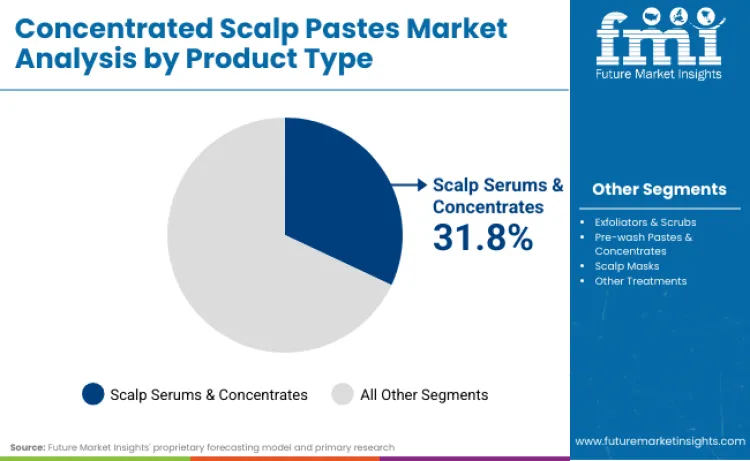
Scalp serums and concentrated treatment pastes dominate the category with a 31.8% share, supported by their ability to address the broadest range of scalp conditions through high active density and targeted delivery. These formats treat hair loss risk, inflammation, compromised barrier function, and poor microcirculation, making them relevant across age groups and hair types. Leave on or semi occlusive systems deliver visible comfort improvement and measurable scalp balance, which supports repeat use. Market behavior reinforces this structure. L'Oréal scales clinically tested scalp serums across Kérastase and Vichy Dercos. Amorepacific integrates ginseng based concentrates. Henkel advances scalp serums under Schwarzkopf Professional. Together, these players define serums and dense pastes as the treatment core of modern scalp care.
How Do Therapeutic Use Cases Shape Concentrated Scalp Paste Demand?
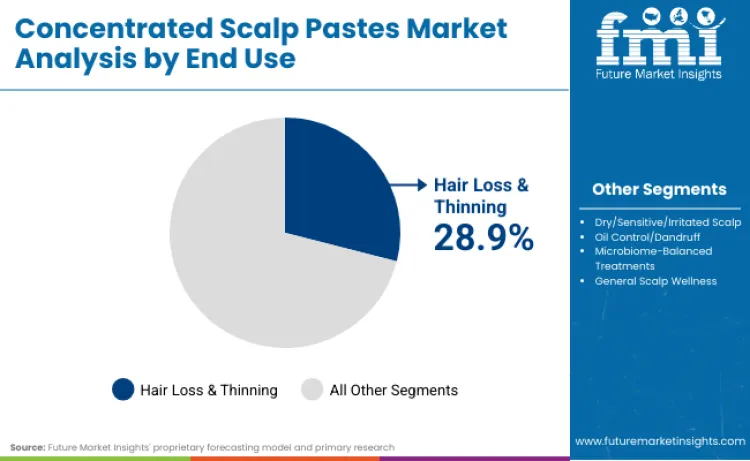
Hair loss and thinning applications account for 28.9% of demand, reflecting a shift toward correcting the scalp environment rather than masking fiber damage. Use case defines success metrics such as reduced shedding, improved follicle anchoring, calmer scalp sensation, and visible density improvement over time. Concentrated pastes perform well in this context because they support circulation, reduce inflammatory signaling, and improve nutrient delivery to follicles. Brand strategy mirrors this logic. Briogeo positions Scalp Revival as a follicle support intervention. The Ordinary extends evidence led positioning into scalp treatments. Kérastase embeds dense treatments within prescriptive salon regimens. Comfort driven segments prioritize gentleness, while oil control and dandruff emphasize microbiome balance, reinforcing use case driven formulation design.
Why Do Digital Channels Dominate Concentrated Scalp Paste Distribution?
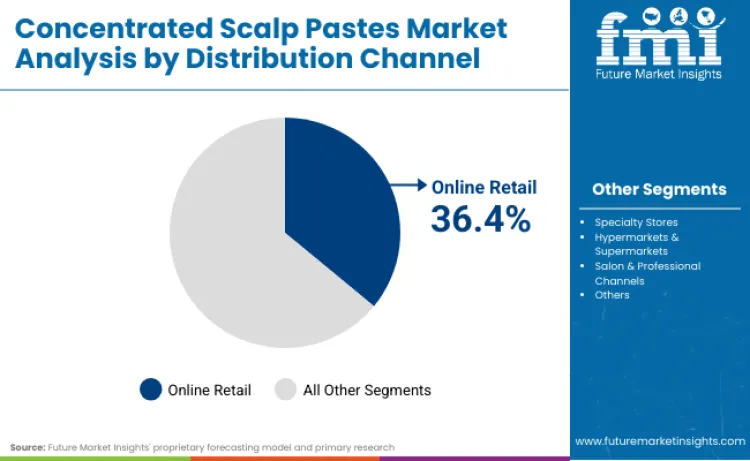
Online channels lead concentrated scalp paste distribution with a 36.4% share, reflecting the education intensive nature of scalp therapy. These products require condition identification, ingredient understanding, and correct application technique. Digital platforms support this through long form education, before and after validation, and guided routines that reduce misuse risk. Brand execution aligns with this structure. Dr. Groot does indeed use AI/diagnostic quizzes as their primary lead magnet. Nutrafol’s business model is built entirely on the "compliance" (regularity) of their subscription. Aveda launched a major "Virtual Consultation" tool recently to mirror their in-salon experience.
Why Is Microbiome Targeted Concentration Reshaping Scalp Therapy?
Dermatological science is shifting from generic liquid cleansers toward highly concentrated anhydrous pastes that prioritize the scalp microbiome over simple debris removal. Traditional shampoos contain 70 to 90 percent water which dilutes active ingredients and requires preservatives. Emerging concentrated pastes using Lactobacillus species, honey, and turmeric are tested for their ability to recalibrate the scalp bacterial composition rather than cleanse the surface.
A pivotal 2025 clinical trial NCT03830177 demonstrated that these concentrated formulas alleviated symptoms of seborrheic and atopic dermatitis by addressing microbial imbalance instead of masking flakes. This shift enables precision scalp care where high density delivery systems provide a therapeutic burst of anti inflammatory agents that remain stable without liquid surfactants.
How Is Regenerative Biomarker Integration Changing Scalp Outcomes?
The scalp care sector is moving from cosmetic claims to regenerative medical integration using concentrated pastes as delivery vehicles for biological growth factors. Innovation has progressed beyond minoxidil toward extracellular vesicles and concentrated growth factors.
Trials concluding in July 2025 NCT06985121 at Hungkuang University deployed concentrated essences containing Centella asiatica extracellular vesicles and growth factors such as IGF 1 and FGF 7 to improve scalp texture and hair density. This approach allows clinicians to target the follicular environment with precision and deliver measurable improvements in sebum control and hair length within 56 days.
What Role Does Regulatory Modernization Play in Formulation Innovation?
The Modernization of Cosmetics Regulation Act granted the FDA expanded authority over cosmetic safety and product listing during 2024 and 2025. This clarity encouraged investment in products that function as both cosmetics and therapeutic treatments.
The January 1 2026 expansion of Medicare coverage for mechanical scalp cooling systems reflects regulatory recognition of scalp health as a medical consideration. This acceptance lowers the barrier for laboratories to patent and market anhydrous concentrated hair care pastes such as Patent US20230338257A1 and allows high potency formulations to reach consumers without immediate pharmaceutical classification.
What is the Concentrated Scalp Pastes Market Regional Outlook?
Demand across emerging markets is rising faster than the global average as scalp health awareness shifts from cosmetic concern to health necessity. While global adoption grows steadily, high population countries are accelerating uptake through education led by dermatologists, trichologists, and salon professionals who introduce concentrated pastes within guided treatment routines. China leads this expansion with a 7.8% CAGR, followed by India at 7.5%, where consumers increasingly seek solutions for microbiome imbalance, sensitivity, and early thinning rather than general cleansing.
In contrast, mature markets such as Germany at 6.9%, the United States at 6.2%, and the United Kingdom at 5.7% show growth driven by clinical validation, dermatological testing, and professional grade formulation credibility rather than rapid volume expansion. Here, adoption is linked to structured treatment plans that clarify usage, improve compliance, and emphasize measurable improvements in barrier integrity and long term scalp balance. FMI analysis indicates that future growth will be shaped by condition specific positioning and professional channel education across both emerging and developed regions.
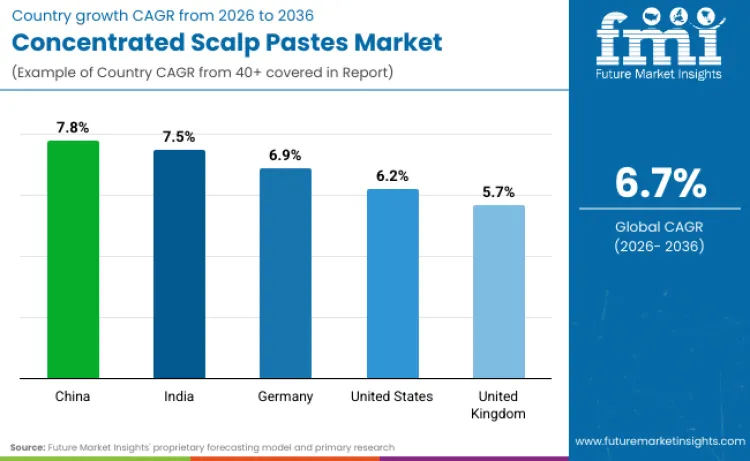
| Country | CAGR (2026-2036) |
|---|---|
| China | 7.8% |
| India | 7.5% |
| Germany | 6.9% |
| United States | 6.2% |
| United Kingdom | 5.7% |
Source: Future Market Insights' proprietary forecasting model and primary research
Why is China focusing on Anti Hair Loss Technical Standards?
China is growing at a rapid 7.8% CAGR, driven primarily by regulatory standardization that is forcing the formalization of the special use cosmetics sector. The National Medical Products Administration supported this shift when the NIFDC released the Technical Guidelines for Anti Hair Loss Products on December 16, 2025, creating a uniform pathway for ingredient classification into anti hair loss agents and auxiliaries. This policy requires documented proof for any efficacy claim, preventing informal positioning of scalp pastes without verified testing.
FMI predicts that compliance driven reformulation will accelerate as manufacturers adjust to the Cosmetic Safety Risk Monitoring Measures effective July 1, 2025, which mandate lifecycle monitoring of products using new technologies or attracting concentrated consumer complaints. This monitoring system effectively raises the barrier for entry for unverified concentrated scalp formulations. The integration of testing discipline into product approval indicates that China is positioning concentrated scalp pastes within a documented technical framework rather than a cosmetic trend.
How is India Formalizing the Ayurvedic Scalp Sector?
India is growing at a steady 7.5% CAGR, driven by the Ministry of Ayush’s effort to formalize traditional topical preparations into regulated dosage systems. The January 10, 2025 Gazette Notification G.S.R. 28(E) amended the Drugs and Cosmetics Rules to include new dosage forms under standardized quality control. This policy creates a uniform manufacturing and testing pathway for Ayurvedic scalp pastes that were previously produced under informal practices.
FMI predicts that licensing requirements will increase as state authorities adopt these rules for issuing new and renewal licenses. The regulatory push ensures that Ayurvedic scalp formulations must meet defined standards for safety, stability, and efficacy before reaching consumers. This shift positions concentrated herbal scalp pastes within a documented pharmaceutical style compliance system rather than a traditional remedy category.
Why is Germany Leading the Anhydrous Waterless Transition?
Germany is expanding at a 6.9% CAGR, responding to high consumer concern regarding chemical safety and environmental exposure. The BfR Consumer Monitor 05 2025 reports that undesirable substances remain a leading health concern for a large share of the population. This awareness is influencing manufacturers to reduce preservative dependency by adopting anhydrous scalp paste formats.
FMI predicts that the July 2026 EU labeling deadline will accelerate this transition as brands align with transparency requirements in the INCI glossary. Anhydrous formulations require fewer stabilizers and preservatives which fits consumer demand for ingredient clarity. This transition positions concentrated scalp pastes as a compliance driven response to chemical safety concerns rather than a cosmetic innovation.
How is the USA Market Maturing via Clinical Accountability?
The USA market is growing at a 6.2% CAGR, characterized by increasing focus on medical grade safety and removal of toxic legacy ingredients. The FDA confirmation in January 2026 that formaldehyde regulation remains a priority is forcing brands to reformulate into safer concentrated paste formats ahead of enforcement. This regulatory pressure encourages preventive compliance rather than reactive change.
FMI predicts that updates to the CMS Physician Fee Schedule for CY 2026 will create reimbursement pathways for clinical scalp treatments delivered within dermatology settings. This integration supports the positioning of concentrated scalp pastes as part of professional care rather than consumer haircare. The market is shifting toward documented safety, clinical oversight, and professional accountability.
Why is the UK Focusing on Preventative Scalp Health?
The United Kingdom is rising at a 5.7% CAGR under the NHS Public Health Functions Agreement for 2025 to 2026, which mandates movement from hospital to community care. This policy encourages early screening and preventative approaches across health conditions.
FMI predicts that this approach will increase the role of at home diagnostic tools that recommend corrective scalp pastes before conditions progress into clinical disorders. Community led health monitoring reduces reliance on secondary medical intervention. This environment supports the adoption of concentrated scalp pastes as preventative care tools guided by early detection and routine monitoring rather than reactive treatment.
Which Brands are Gaining Share in Concentrated Scalp Pastes Market?
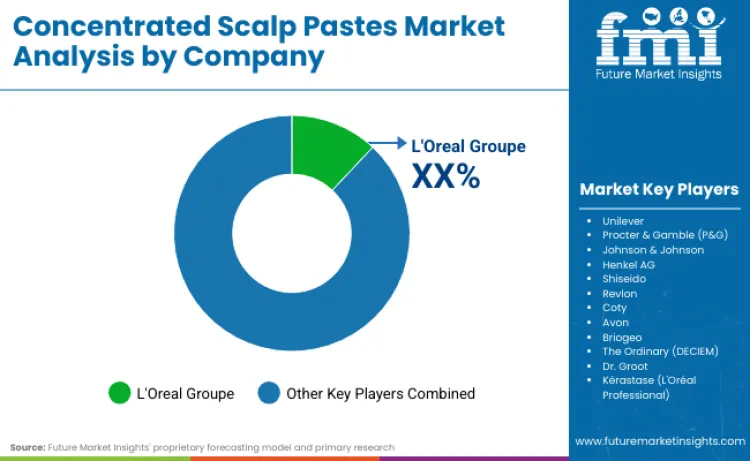
The concentrated scalp pastes market is being shaped by the skinification of hair, where the scalp is treated as a skin surface with barrier, microbiome, and inflammation dynamics. This shift pulls the category away from simple cleansing and toward targeted therapy, which rewards formats that signal active density, contact time, and step based use.
Leadership is consolidating around scale players that already own repeat purchase haircare relationships. L’Oréal is gaining share through Kérastase, where Symbiose and Fusio-Scrub act as premium paste like treatments positioned around exfoliation and microbiome support, using actives such as salicylic acid and bifidus style complexes to anchor the therapy narrative. Procter & Gamble is defending its franchise through Head & Shoulders, extending the Clinical line into more sophisticated scrub and treatment adjacencies to retain users who are trading up toward derm backed routines.
Challengers are winning by owning the ritual and the proof point. Briogeo helped mainstream the concentrated paste concept with Scalp Revival Charcoal plus Coconut Oil Micro-Exfoliating Shampoo, making exfoliation feel like a legitimate scalp maintenance step.
Recent Developments:
- In December 2025, Unilever highlighted scalp “skinification” through Dove and Clear, launching premium formulas with niacinamide and ceramide technologies. Backed by decades of research, dermatologist-endorsed ranges address dandruff and irritation while driving strong consumer demand globally.
- In September 2025, CeraVe and L’Oréal Groupe won the IFSCC Applied Research Award for a breakthrough dandruff study. The research identified ceramide deficiency, microbiome roles, and ethnic variations, advancing scalp barrier science and personalized care innovation.
Key Players in the Concentrated Scalp Pastes Market
- L'Oréal Group
- Unilever
- Procter & Gamble (P&G)
- Johnson & Johnson
- Henkel AG
- Shiseido
- Revlon
- Coty
- Avon
- Briogeo
- The Ordinary (DECIEM)
- Dr. Groot
- Kérastase (L'Oréal Professional)
- Redken (L'Oréal Professional)
- Ouai Haircare
Market Definition
The concentrated scalp pastes market represents revenues generated from high-concentration, paste-format topical treatments engineered specifically for scalp health intervention, including condition management, preventive therapy, and clinically oriented maintenance. These products deliver elevated active loadings through dense, semi-solid matrices designed for localized scalp application, extended contact time, and protocol-driven use. Market sizing reflects therapeutic intensity, formulation concentration, and repeat-use treatment economics, measured in USD billions for the 2026 to 2036 period.
This market includes scalp treatments positioned for identified scalp conditions, preventative scalp therapy, or professionally guided care, rather than routine cleansing. Products are classified by concentration level, therapeutic intent, and delivery mechanism, spanning clinical-strength formulations, professional salon treatments, and consumer-accessible concentrated pastes addressing inflammation, microbiome imbalance, barrier disruption, dandruff, sensitivity, or early thinning. The analysis treats concentrated scalp pastes as a specialized treatment subcategory of hair care, distinct from shampoos, conditioners, and cosmetic leave-ins. Revenue attribution applies only to paste-format products with explicit concentration advantages and scalp-specific therapeutic positioning.
Market Inclusion
Included in scope are commercially sold, ready-to-use concentrated scalp paste formulations distributed through professional salons, specialty beauty retail, direct-to-consumer platforms, pharmacy recommendation, and healthcare-adjacent channels. Eligible products include exfoliating scalp pastes, pre-wash concentrates, intensive treatment masks, clinical scalp serums in paste form, and therapeutic compounds designed for protocol-based application.
The market includes products formulated with high-dose botanical extracts, dermatologically validated actives, microbiome-supporting technologies, keratolytic agents, anti-inflammatory compounds, and follicle-support systems when delivered through paste matrices. Revenues from professional treatments, retail SKUs, and treatment regimens are included when paste concentration and scalp intervention represent the primary functional value, independent of packaging or brand tier. Geographic scope covers regions where scalp health literacy, professional validation, and education driven adoption support regular use of concentrated treatment formats.
Market Exclusion
Excluded are liquid scalp treatments, shampoos, conditioners, tonics, sprays, oils, and cosmetic leave-ins, regardless of active concentration or claim intensity. Styling products and general hair preparations are excluded unless explicitly formulated as concentrated paste-format scalp therapies with defined treatment protocols.
Oral supplements, ingestible treatments, and systemic scalp interventions fall outside scope. Diagnostic tools, scalp imaging devices, monitoring equipment, and software are excluded. Professional services, spa rituals, and treatment programs are excluded when the concentrated paste product is not the primary therapeutic mechanism sold.
Also excluded are application tools, accessories, brushes, packaging components, and refill systems. Wellness programs, general beauty treatments, and spa services with incidental scalp benefits are not counted unless concentrated paste application constitutes the core therapeutic intervention and revenue driver.
Scope of the Report
| Items | Values |
|---|---|
| Quantitative Units | USD billion |
| Product Type | Scalp Serums & Concentrates; Exfoliators & Scrubs; Pre-wash Pastes & Concentrates; Scalp Masks; Other Treatments |
| Distribution Channel | Online Retail; Specialty Stores; Hypermarkets & Supermarkets; Salon & Professional Channels; Others |
| End Use | Hair Loss & Thinning; Dry/Sensitive/Irritated Scalp; Oil Control/Dandruff; Microbiome-Balanced Treatments; General Scalp Wellness |
| Ingredient Type | Natural/Botanical/Herbal; Dermatological/Clinical Formulations; Microbiome-focused Technologies; High Potency/Concentrated Actives; Others |
| Regions Covered | Asia Pacific, Europe, North America, Latin America, Middle East & Africa |
| Countries Covered | China, India, Germany, United States, United Kingdom, Brazil, and 40+ countries |
| Key Companies Profiled | L'Oréal Group; Unilever; Procter & Gamble; Johnson & Johnson; Henkel AG; Others |
| Additional Attributes | Dollar sales by product type, distribution channel, end use, and ingredient type; therapeutic efficacy benchmarking across scalp barrier restoration, circulation improvement, microbiome balance, and long-term scalp health; adoption drivers linked to professional validation, consumer education, and clinical evidence; impact on scalp health outcomes, treatment compliance, and professional service integration; formulation development under dermatological standards; compatibility with professional protocols, consumer routines, and scalp health monitoring across global beauty and healthcare markets |
Concentrated Scalp Pastes Market by Segment
Product Type:
- Scalp Serums & Concentrates
- Exfoliators & Scrubs
- Pre-wash Pastes & Concentrates
- Scalp Masks
- Other Treatments
Distribution Channel:
- Online Retail
- Specialty Stores
- Hypermarkets & Supermarkets
- Salon & Professional Channels
- Others
End Use:
- Hair Loss & Thinning
- Dry/Sensitive/Irritated Scalp
- Oil Control/Dandruff
- Microbiome-Balanced Treatments
- General Scalp Wellness
Ingredient Type:
- Natural/Botanical/Herbal
- Dermatological/Clinical Formulations
- Microbiome-focused Technologies
- High Potency/Concentrated Actives
- Others
Region:
- Asia Pacific
- China
- Japan
- South Korea
- India
- Australia & New Zealand
- ASEAN
- Rest of Asia Pacific
- Europe
- Germany
- United Kingdom
- France
- Italy
- Spain
- Nordic
- BENELUX
- Rest of Europe
- North America
- USA
- Canada
- Mexico
- Latin America
- Brazil
- Chile
- Rest of Latin America
- Middle East & Africa
- Kingdom of Saudi Arabia
- Other GCC Countries
- Turkey
- South Africa
- Other African Union
- Rest of Middle East & Africa
Bibliography
- International Association of Trichologists (IAT). (2024). Professional guidelines for scalp health assessment, trichological treatment protocols, and topical therapy application. IAT Standards.
- American Academy of Dermatology (AAD). (2024). Clinical recommendations for management of scalp dermatitis, seborrheic conditions, and hair loss disorders. AAD Treatment Guidelines.
- USA Food and Drug Administration (FDA). (2024). Cosmetics and topical products: Safety, labeling, and regulatory requirements for scalp and hair care treatments. USA Department of Health and Human Services.
Frequently Asked Questions
How big is the global concentrated scalp pastes market?
The global concentrated scalp pastes market is valued at USD 9.6 billion in 2026 and is forecast to reach USD 18.4 billion by 2036.
What is the growth outlook for the concentrated scalp pastes market over the next 10 years?
The category is projected to expand at a 6.7% CAGR from 2026 to 2036, reflecting increasing scalp health awareness and adoption of targeted, high-concentration treatments.
Which product types or applications drive demand in this market?
Scalp serums and concentrates lead demand with a 31.8% share, supported by their versatility and ability to deliver high concentrations of active ingredients for multiple scalp concerns.
How does market development differ by region?
Growth is strongest where traditional scalp care practices combine with modern formulation technology, with China (7.8% CAGR), India (7.5%), Germany (6.9%), United States (6.2%), and United Kingdom (5.7%) leading global development during 2026-2036.
What are the main challenges and constraints affecting this market?
Growth is constrained where application complexity creates user barriers, price sensitivity limits adoption, or limited professional guidance affects proper product selection and usage techniques.
Preview the report firsthand - request a free sample
Get SampleGet the brochure for pricing and purchase details.
Get PDFTable of Content
- Executive Summary
- Global Market Outlook
- Demand Side Trends
- Supply Side Trends
- Technology Roadmap Analysis
- Analysis and Recommendations
- Market Overview
- Market Coverage / Taxonomy
- Market Definition / Scope / Limitations
- Research Methodology
- Chapter Orientation
- Analytical Lens and Working Hypotheses
- Market Structure, Signals, and Trend Drivers
- Benchmarking and Cross-market Comparability
- Market Sizing, Forecasting, and Opportunity Mapping
- Research Design and Evidence Framework
- Desk Research Programme (Secondary Evidence)
- Company Annual and Sustainability Reports
- Peer-reviewed Journals and Academic Literature
- Corporate Websites, Product Literature, and Technical Notes
- Earnings Decks and Investor Briefings
- Statutory Filings and Regulatory Disclosures
- Technical White Papers and Standards Notes
- Trade Journals, Industry Magazines, and Analyst Briefs
- Conference Proceedings, Webinars, and Seminar Materials
- Government Statistics Portals and Public Data Releases
- Press Releases and Reputable Media Coverage
- Specialist Newsletters and Curated Briefings
- Sector Databases and Reference Repositories
- FMI Internal Knowledge Base and Historical Datasets
- Subscription Datasets and Paid Sources
- Social Channels, Communities, and Digital Listening Inputs
- Additional Desk Sources
- Expert Input and Fieldwork (Primary Evidence)
- Primary Modes
- Qualitative Interviews and Expert Elicitation
- Quantitative Surveys and Structured Data Capture
- Blended Approach
- Why Primary Evidence is Used
- Field Techniques
- Interviews
- Surveys
- Focus Groups
- Observational and In-context Research
- Social and Community Interactions
- Stakeholder Universe Engaged
- C-suite Leaders
- Board Members
- Presidents and Vice Presidents
- R&D and Innovation Heads
- Technical Specialists
- Domain Subject-matter Experts
- Scientists
- Physicians and Other Healthcare Professionals
- Governance, Ethics, and Data Stewardship
- Research Ethics
- Data Integrity and Handling
- Primary Modes
- Tooling, Models, and Reference Databases
- Desk Research Programme (Secondary Evidence)
- Data Engineering and Model Build
- Data Acquisition and Ingestion
- Cleaning, Normalisation, and Verification
- Synthesis, Triangulation, and Analysis
- Quality Assurance and Audit Trail
- Market Background
- Market Dynamics
- Drivers
- Restraints
- Opportunity
- Trends
- Scenario Forecast
- Demand in Optimistic Scenario
- Demand in Likely Scenario
- Demand in Conservative Scenario
- Opportunity Map Analysis
- Product Life Cycle Analysis
- Supply Chain Analysis
- Investment Feasibility Matrix
- Value Chain Analysis
- PESTLE and Porter's Analysis
- Regulatory Landscape
- Regional Parent Market Outlook
- Production and Consumption Statistics
- Import and Export Statistics
- Market Dynamics
- Global Market Analysis 2021 to 2025 and Forecast, 2026 to 2036
- Historical Market Size Value (USD Billion) Analysis, 2021 to 2025
- Current and Future Market Size Value (USD Billion) Projections, 2026 to 2036
- Y-o-Y Growth Trend Analysis
- Absolute $ Opportunity Analysis
- Global Market Pricing Analysis 2021 to 2025 and Forecast 2026 to 2036
- Y-o-Y Growth Trend Analysis 2021 to 2025
- Absolute $ Opportunity Analysis 2026 to 2036
- Global Market Analysis 2021 to 2025 and Forecast 2026 to 2036, By Product Type
- Introduction / Key Findings
- Historical Market Size Value (USD Billion) Analysis By Product Type, 2021 to 2025
- Current and Future Market Size Value (USD Billion) Analysis and Forecast By Product Type, 2026 to 2036
- Scalp Serums & Concentrates
- Exfoliators & Scrubs
- Pre-wash Pastes & Concentrates
- Scalp Masks
- Other Treatments
- Y-o-Y Growth Trend Analysis By Product Type, 2021 to 2025
- Absolute $ Opportunity Analysis By Product Type, 2026 to 2036
- Global Market Analysis 2021 to 2025 and Forecast 2026 to 2036, By Distribution Channel
- Introduction / Key Findings
- Historical Market Size Value (USD Billion) Analysis By Distribution Channel, 2021 to 2025
- Current and Future Market Size Value (USD Billion) Analysis and Forecast By Distribution Channel, 2026 to 2036
- Online Retail
- Specialty Stores
- Hypermarkets & Supermarkets
- Salon & Professional Channels
- Others
- Y-o-Y Growth Trend Analysis By Distribution Channel, 2021 to 2025
- Absolute $ Opportunity Analysis By Distribution Channel, 2026 to 2036
- Global Market Analysis 2021 to 2025 and Forecast 2026 to 2036, By End Use
- Introduction / Key Findings
- Historical Market Size Value (USD Billion) Analysis By End Use, 2021 to 2025
- Current and Future Market Size Value (USD Billion) Analysis and Forecast By End Use, 2026 to 2036
- Hair Loss & Thinning
- Dry/Sensitive/Irritated Scalp
- Oil Control/Dandruff
- Microbiome-Balanced Treatments
- General Scalp Wellness
- Y-o-Y Growth Trend Analysis By End Use, 2021 to 2025
- Absolute $ Opportunity Analysis By End Use, 2026 to 2036
- Global Market Analysis 2021 to 2025 and Forecast 2026 to 2036, By Ingredient Type
- Introduction / Key Findings
- Historical Market Size Value (USD Billion) Analysis By Ingredient Type, 2021 to 2025
- Current and Future Market Size Value (USD Billion) Analysis and Forecast By Ingredient Type, 2026 to 2036
- Natural/Botanical/Herbal
- Dermatological/Clinical Formulations
- Microbiome-focused Technologies
- High Potency/Concentrated Actives
- Others
- Y-o-Y Growth Trend Analysis By Ingredient Type, 2021 to 2025
- Absolute $ Opportunity Analysis By Ingredient Type, 2026 to 2036
- Global Market Analysis 2021 to 2025 and Forecast 2026 to 2036, By Region
- Introduction
- Historical Market Size Value (USD Billion) Analysis By Region, 2021 to 2025
- Current Market Size Value (USD Billion) Analysis and Forecast By Region, 2026 to 2036
- North America
- Latin America
- Western Europe
- Eastern Europe
- East Asia
- South Asia and Pacific
- Middle East & Africa
- Market Attractiveness Analysis By Region
- North America Market Analysis 2021 to 2025 and Forecast 2026 to 2036, By Country
- Historical Market Size Value (USD Billion) Trend Analysis By Market Taxonomy, 2021 to 2025
- Market Size Value (USD Billion) Forecast By Market Taxonomy, 2026 to 2036
- By Country
- USA
- Canada
- Mexico
- By Product Type
- By Distribution Channel
- By End Use
- By Ingredient Type
- By Country
- Market Attractiveness Analysis
- By Country
- By Product Type
- By Distribution Channel
- By End Use
- By Ingredient Type
- Key Takeaways
- Latin America Market Analysis 2021 to 2025 and Forecast 2026 to 2036, By Country
- Historical Market Size Value (USD Billion) Trend Analysis By Market Taxonomy, 2021 to 2025
- Market Size Value (USD Billion) Forecast By Market Taxonomy, 2026 to 2036
- By Country
- Brazil
- Chile
- Rest of Latin America
- By Product Type
- By Distribution Channel
- By End Use
- By Ingredient Type
- By Country
- Market Attractiveness Analysis
- By Country
- By Product Type
- By Distribution Channel
- By End Use
- By Ingredient Type
- Key Takeaways
- Western Europe Market Analysis 2021 to 2025 and Forecast 2026 to 2036, By Country
- Historical Market Size Value (USD Billion) Trend Analysis By Market Taxonomy, 2021 to 2025
- Market Size Value (USD Billion) Forecast By Market Taxonomy, 2026 to 2036
- By Country
- Germany
- UK
- Italy
- Spain
- France
- Nordic
- BENELUX
- Rest of Western Europe
- By Product Type
- By Distribution Channel
- By End Use
- By Ingredient Type
- By Country
- Market Attractiveness Analysis
- By Country
- By Product Type
- By Distribution Channel
- By End Use
- By Ingredient Type
- Key Takeaways
- Eastern Europe Market Analysis 2021 to 2025 and Forecast 2026 to 2036, By Country
- Historical Market Size Value (USD Billion) Trend Analysis By Market Taxonomy, 2021 to 2025
- Market Size Value (USD Billion) Forecast By Market Taxonomy, 2026 to 2036
- By Country
- Russia
- Poland
- Hungary
- Balkan & Baltic
- Rest of Eastern Europe
- By Product Type
- By Distribution Channel
- By End Use
- By Ingredient Type
- By Country
- Market Attractiveness Analysis
- By Country
- By Product Type
- By Distribution Channel
- By End Use
- By Ingredient Type
- Key Takeaways
- East Asia Market Analysis 2021 to 2025 and Forecast 2026 to 2036, By Country
- Historical Market Size Value (USD Billion) Trend Analysis By Market Taxonomy, 2021 to 2025
- Market Size Value (USD Billion) Forecast By Market Taxonomy, 2026 to 2036
- By Country
- China
- Japan
- South Korea
- By Product Type
- By Distribution Channel
- By End Use
- By Ingredient Type
- By Country
- Market Attractiveness Analysis
- By Country
- By Product Type
- By Distribution Channel
- By End Use
- By Ingredient Type
- Key Takeaways
- South Asia and Pacific Market Analysis 2021 to 2025 and Forecast 2026 to 2036, By Country
- Historical Market Size Value (USD Billion) Trend Analysis By Market Taxonomy, 2021 to 2025
- Market Size Value (USD Billion) Forecast By Market Taxonomy, 2026 to 2036
- By Country
- India
- ASEAN
- Australia & New Zealand
- Rest of South Asia and Pacific
- By Product Type
- By Distribution Channel
- By End Use
- By Ingredient Type
- By Country
- Market Attractiveness Analysis
- By Country
- By Product Type
- By Distribution Channel
- By End Use
- By Ingredient Type
- Key Takeaways
- Middle East & Africa Market Analysis 2021 to 2025 and Forecast 2026 to 2036, By Country
- Historical Market Size Value (USD Billion) Trend Analysis By Market Taxonomy, 2021 to 2025
- Market Size Value (USD Billion) Forecast By Market Taxonomy, 2026 to 2036
- By Country
- Kingdom of Saudi Arabia
- Other GCC Countries
- Turkiye
- South Africa
- Other African Union
- Rest of Middle East & Africa
- By Product Type
- By Distribution Channel
- By End Use
- By Ingredient Type
- By Country
- Market Attractiveness Analysis
- By Country
- By Product Type
- By Distribution Channel
- By End Use
- By Ingredient Type
- Key Takeaways
- Key Countries Market Analysis
- USA
- Pricing Analysis
- Market Share Analysis, 2025
- By Product Type
- By Distribution Channel
- By End Use
- By Ingredient Type
- Canada
- Pricing Analysis
- Market Share Analysis, 2025
- By Product Type
- By Distribution Channel
- By End Use
- By Ingredient Type
- Mexico
- Pricing Analysis
- Market Share Analysis, 2025
- By Product Type
- By Distribution Channel
- By End Use
- By Ingredient Type
- Brazil
- Pricing Analysis
- Market Share Analysis, 2025
- By Product Type
- By Distribution Channel
- By End Use
- By Ingredient Type
- Chile
- Pricing Analysis
- Market Share Analysis, 2025
- By Product Type
- By Distribution Channel
- By End Use
- By Ingredient Type
- Germany
- Pricing Analysis
- Market Share Analysis, 2025
- By Product Type
- By Distribution Channel
- By End Use
- By Ingredient Type
- UK
- Pricing Analysis
- Market Share Analysis, 2025
- By Product Type
- By Distribution Channel
- By End Use
- By Ingredient Type
- Italy
- Pricing Analysis
- Market Share Analysis, 2025
- By Product Type
- By Distribution Channel
- By End Use
- By Ingredient Type
- Spain
- Pricing Analysis
- Market Share Analysis, 2025
- By Product Type
- By Distribution Channel
- By End Use
- By Ingredient Type
- France
- Pricing Analysis
- Market Share Analysis, 2025
- By Product Type
- By Distribution Channel
- By End Use
- By Ingredient Type
- India
- Pricing Analysis
- Market Share Analysis, 2025
- By Product Type
- By Distribution Channel
- By End Use
- By Ingredient Type
- ASEAN
- Pricing Analysis
- Market Share Analysis, 2025
- By Product Type
- By Distribution Channel
- By End Use
- By Ingredient Type
- Australia & New Zealand
- Pricing Analysis
- Market Share Analysis, 2025
- By Product Type
- By Distribution Channel
- By End Use
- By Ingredient Type
- China
- Pricing Analysis
- Market Share Analysis, 2025
- By Product Type
- By Distribution Channel
- By End Use
- By Ingredient Type
- Japan
- Pricing Analysis
- Market Share Analysis, 2025
- By Product Type
- By Distribution Channel
- By End Use
- By Ingredient Type
- South Korea
- Pricing Analysis
- Market Share Analysis, 2025
- By Product Type
- By Distribution Channel
- By End Use
- By Ingredient Type
- Russia
- Pricing Analysis
- Market Share Analysis, 2025
- By Product Type
- By Distribution Channel
- By End Use
- By Ingredient Type
- Poland
- Pricing Analysis
- Market Share Analysis, 2025
- By Product Type
- By Distribution Channel
- By End Use
- By Ingredient Type
- Hungary
- Pricing Analysis
- Market Share Analysis, 2025
- By Product Type
- By Distribution Channel
- By End Use
- By Ingredient Type
- Kingdom of Saudi Arabia
- Pricing Analysis
- Market Share Analysis, 2025
- By Product Type
- By Distribution Channel
- By End Use
- By Ingredient Type
- Turkiye
- Pricing Analysis
- Market Share Analysis, 2025
- By Product Type
- By Distribution Channel
- By End Use
- By Ingredient Type
- South Africa
- Pricing Analysis
- Market Share Analysis, 2025
- By Product Type
- By Distribution Channel
- By End Use
- By Ingredient Type
- USA
- Market Structure Analysis
- Competition Dashboard
- Competition Benchmarking
- Market Share Analysis of Top Players
- By Regional
- By Product Type
- By Distribution Channel
- By End Use
- By Ingredient Type
- Competition Analysis
- Competition Deep Dive
- L'Oréal Group
- Unilever
- Procter & Gamble
- Johnson & Johnson
- Henkel AG
- Shiseido
- Revlon
- Coty
- Avon
- Briogeo
- Competition Deep Dive
- Assumptions & Acronyms Used


