

- Industry Size (2026)
- USD 5.6 Bn
- Forecast (2036)
- USD 13.5 Bn
- CAGR (2026 to 2036)
- 9.20%
Concentrated Cleaning Refills Market Size, Market Forecast and Outlook By FMI
The concentrated cleaning refills market surpassed a value of USD 5.1 billion in 2025. The industry is expected to reach USD 5.6 billion in 2026 at a CAGR of 9.20% during the forecast period. Demand outlook carries the market valuation to USD 13.5 billion by 2036 as supply chain optimization and standardized dilution-at-home models become the universal retail baseline.
The decisive shift from shipping water to shipping active chemical chemistry marks a structural transition that renders traditional ready-to-use (RTU) formats operationally inefficient. Retailers facing rising logistics costs and stringent packaging waste regulations now prioritize refillable cleaning products to maximize shelf-space density and reduce carbon footprints. This architectural pivot forces incumbent consumer packaged goods (CPG) giants to reformulate entire product lines into high-potency concentrates. Brands that delay the transition to native refill architectures face a de-listing window as major supermarkets mandate measurable plastic reduction targets in their 2027 supplier agreements.
Summary of Concentrated Cleaning Refills Market
- Concentrated Cleaning Refills Market Definition
- Concentrated cleaning refills encompass potent chemical formulations delivered in compact formats such as tablets, liquids, or pods that require on-site dilution. This structural dependency on end-user mixing defines the market boundary, separating it from the traditional pre-diluted liquid cleaner industry.
- Demand Drivers in the Market
- Global plastic reduction mandates compel major retailers to replace high-volume single-use bottles with concentrated refill pouches to meet legislative waste targets.
- E-commerce fulfillment centers prioritize lightweight concentrated tablets and pods to reduce shipping costs and secondary packaging requirements in the last-mile delivery chain.
- Hospitality facility managers adopt high-potency concentrates to minimize storage footprints in urban hotels while ensuring consistent chemical efficacy across large-scale sanitation routines.
- Key Segments Analyzed in the FMI Report
- Multi-surface Cleaners: 36.0% share in 2026, reflecting the segment's role as the primary entry point for consumers adopting refillable household systems.
- Liquid Concentrates: 45.0% share in 2026, as established brands leverage familiar pouch-based delivery models to transition loyal customers toward concentrated formats.
- China: 11.5% compound growth, driven by rapid urban adoption of eco-friendly home care products and a robust domestic manufacturing base for sustainable packaging.
- Analyst Opinion at FMI
- Ronak Shah, Principal Consultant for Consumer Product, suggests, "In my analysis, I have observed that the primary obstacle to concentrated refill adoption is not the chemistry, but the psychological friction of the dilution process. Consumers accustomed to the immediate convenience of ready-to-use sprays must be incentivized through 'starter kit' models that simplify the initial transition. Based on FMI's research, brands that incorporate auto-dosing technology or color-coded tablet systems successfully bypass this hesitation. I expect that as the cost-per-wash for concentrates drops below traditional liquids, the economic crossover will trigger a massive migration of mass-market shoppers away from plastic-heavy legacy products."
- Strategic Implications / Executive Takeaways
- CPG brand owners must redesign primary packaging to support multiple reuse cycles and secure third-party durability certifications to justify premium starter kit pricing.
- Logistics directors should phase out water-heavy shipping routes and mandate the use of high-density concentrated formats to achieve corporate carbon neutrality goals.
- Packaging engineering leads must develop moisture-resistant, plastic-free outer casings for soluble tablets to align with the market's core sustainability value proposition.
- Methodology
- Primary Research: FMI conducted detailed technical interviews with packaging engineers, retail category leads, and sustainability consultants across 40 countries to validate refill adoption timelines.
- Desk Research: Analysts aggregated public ESG documentation, international plastic treaty draft texts, and corporate hardware launch sheets for durable dispensing systems.
- Market-Sizing and Forecasting: The model applies a bottom-up methodology starting with global installed base metrics for household cleaners and projecting the conversion rate to concentrated standards.
- Data Validation and Update Cycle: Segment forecasts undergo cross-validation against regional retail scan data and plastic-to-chemical volume ratios.
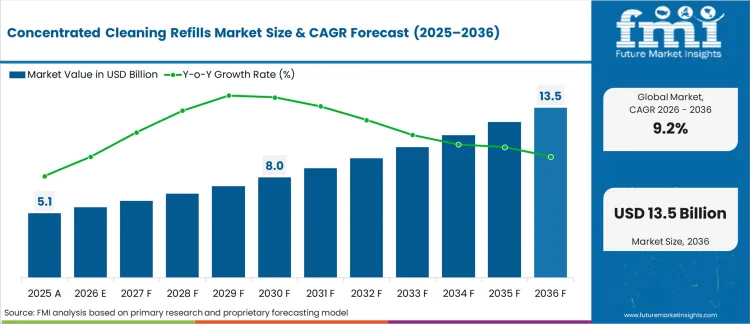
Concentrated Cleaning Refills Market Key Takeaways
| Metric | Details |
|---|---|
| Industry Size (2026) | USD 5.6 billion |
| Industry Value (2036) | USD 13.5 billion |
| CAGR (2026-2036) | 9.20% |
Source: Future Market Insights (FMI) analysis, based on proprietary forecasting model and primary research
The primary inflection point for market acceleration is the normalization of the "forever bottle" concept, where the purchase of a high-quality durable dispenser precedes a multi-year refill relationship. Household managers must commit to a specific brand's ecosystem within the next three years to realize the full economic and space-saving benefits of concentrated systems. Once this consumer lock-in is established, the market transitions from a trial-based niche into a stable, subscription-driven replenishment economy.
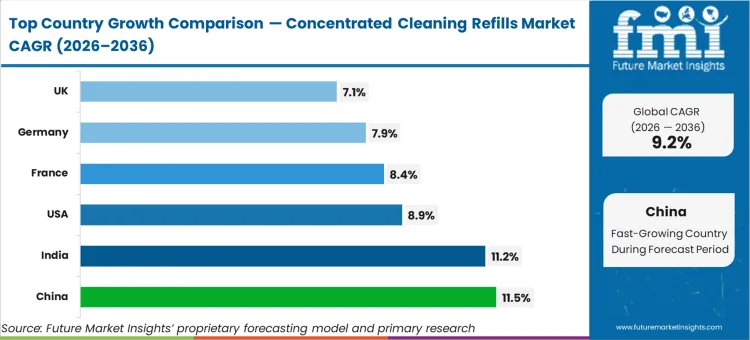
Industrial and residential demand patterns across major economies reveal distinct adoption velocities tied to waste management legislation. China leads the global expansion with an 11.5% CAGR as the nation implements strict circular economy frameworks. India records an 11.2% growth rate driven by the rapid expansion of in-store refill stations in urban retail hubs. The United States advances at an 8.9% pace, while France posts an 8.4% expansion as regulatory bans on certain single-use plastics take effect. Germany reaches a 7.9% trajectory, followed by the United Kingdom at 7.1% as environmental awareness becomes a core driver of purchasing behavior.
Concentrated Cleaning Refills Market Definition
Concentrated Cleaning Refills represent high-potency chemical formulations designed to be diluted with water by the end user at the point of use. This category includes liquid concentrates, dissolvable tablets, and encapsulated pods that contain the active cleaning agents required for effective sanitation without the water weight of traditional ready-to-use products. The market encompasses the specific delivery systems and chemistry designed for repeated use in professional cleaning products and residential environments.
Concentrated Cleaning Refills Market Inclusions
Market scope includes concentrated liquid refills in pouches, water-soluble tablets, and pre-measured pods or capsules for various surfaces. It incorporates high-durability trigger spray bottles sold as part of starter kits and automated dilution-control systems used in commercial facilities. Products utilizing specialized floor cleaner concentrates and multi-surface agents are fully incorporated within the valuation.
Concentrated Cleaning Refills Market Exclusions
Standard ready-to-use (RTU) liquid cleaning products that do not require dilution are explicitly excluded. The valuation omits industrial-grade bulk chemicals sold in drums for manufacturing processes that lack a consumer-facing or institutional refill format. Standalone traditional cleaning tools such as mops, brushes, and sponges without an integrated concentrate delivery mechanism fall outside the defined parameters.
Concentrated Cleaning Refills Market Research Methodology
- Primary Research: Analysts engaged with sustainability directors, CPG procurement leads, and retail category managers to map the specific decision gates triggering the shift from RTU to refill formats.
- Desk Research: The data collection phase aggregated corporate ESG reports, plastic reduction policy timelines from the Ellen MacArthur Foundation, and cleaning chemicals for retail demand trends.
- Market-Sizing and Forecasting: The baseline value derives from a bottom-up aggregation of concentrate unit sales, applying region-specific adoption curves to project the conversion rate of traditional household cleaners.
- Data Validation and Update Cycle: Projections are rigorously tested against quarterly financial disclosures from major chemical manufacturers and packaging sustainability indices.
Segmental Analysis
Concentrated Cleaning Refills Market Analysis by Product Type
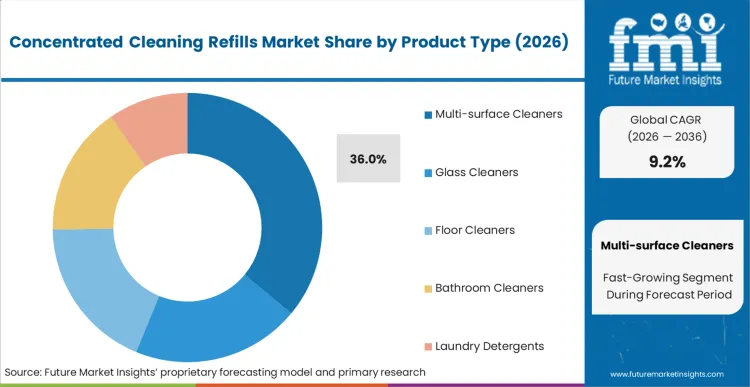
With legacy single-use packaging facing increasing regulatory scrutiny, household procurement leads are executing full-scale transitions to concentrated architectures. Multi-surface Cleaners command a dominant 36.0% share in 2026, reflecting the absolute requirement for versatile sanitation agents that can be easily diluted in standardized durable bottles. According to FMI's estimates, consumers deploying concentrated liquids as their primary kitchen and living area agents establish the behavioral foundation for wider category adoption. This high-frequency usage ensures that once a consumer invests in a starter kit, they remain locked into the brand's replenishment cycle for various surfaces. Households utilizing these refills realize measurable reductions in cabinet clutter and overall plastic waste generation. Brand owners unable to supply high-efficacy multi-surface concentrates risk immediate exclusion from the next wave of "green-aisle" retail shelf allocations.
- Interoperability validation: Refill systems demand rigorous trigger-pump testing to guarantee that concentrated chemistries do not clog or corrode the dispensing mechanism over hundreds of usage cycles.
- Storage efficiency: Concentrated pouches and tablets occupy significantly less physical space, allowing urban residents to maintain a full suite of cleaning agents in constrained apartment environments.
- Subscription longevity: Integrating concentrates into automatic delivery models secures predictable revenue streams for vendors while ensuring consumers never face a "stock-out" of essential sanitation supplies.
Concentrated Cleaning Refills Market Analysis by Form
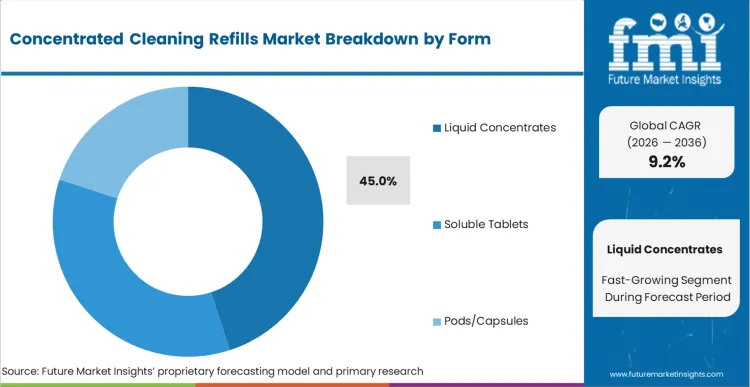
Liquid Concentrates emerge as the leading form, expected to represent 45.0% of total market share in 2026. Established household brands are increasingly building their refill strategies around high-viscosity liquids that offer a familiar mixing experience for consumers transitioning from RTU formats. FMI analysts opine that the use of high-strength pouches and sachets for liquid delivery significantly lowers the barrier to entry for mass-market shoppers. Plant managers at CPG facilities must validate the stability of ultra-concentrated formulas to ensure no separation or degradation occurs during extended shelf lives. The integration of precision-pour spouts on refill pouches forces packaging engineers to rethink traditional pouch geometries to prevent accidental spills during the dilution process.
- Dosing accuracy: Pre-marked durable bottles paired with precision-pour liquid concentrates help end users achieve the intended chemical concentration for effective cleaning performance.
- Formula stability: High-potency liquid refills need to maintain chemical integrity under varying temperature conditions to avoid the precipitation of active surfactants in concentrated form.
- Packaging reduction: Replacing rigid HDPE jugs with flexible film pouches lowers plastic use per unit of product and supports broader corporate sustainability objectives.
Concentrated Cleaning Refills Market Analysis by End Use
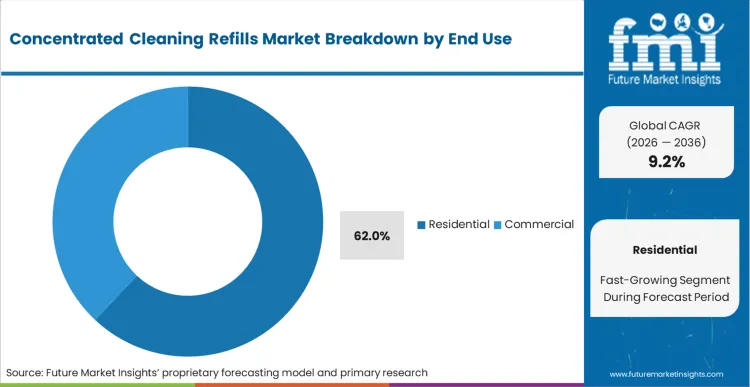
Every facility manager bidding on institutional maintenance contracts now faces strict adherence criteria for waste reduction and chemical safety. Residential end use accounts for a leading 62.0% segment share in 2026. Private homeowners operating within urban sustainability frameworks reject product designs that require the frequent disposal of high-volume plastic containers. Incorporating certified eco-friendly concentrate pods guarantees that high-traffic domestic areas remain sanitized without the introduction of excessive packaging waste. As per FMI's projection, the convergence of smart home sensors with concentrated refill systems amplifies the demand for reliable, lightweight chemical supplies. Suppliers failing to demonstrate seamless integration with standard retail "forever bottles" lose priority status in major supermarket loyalty programs.
- Waste mitigation: Fixed-volume concentrate pods ensure that residential users bypass the waste associated with half-empty bottles, as refills are only purchased when the durable dispenser is empty.
- Fragrance preservation: Dedicated bandwidth within the formulation allows for high-concentration essential oils, ensuring that diluted refills maintain a premium scent profile throughout the usage cycle.
- Consumer agnosticism: Open-system durable bottles empower homeowners to source specialized concentrates from multiple niche brands without being constrained by proprietary bottle threads.
Concentrated Cleaning Refills Market Drivers, Restraints, and Opportunities
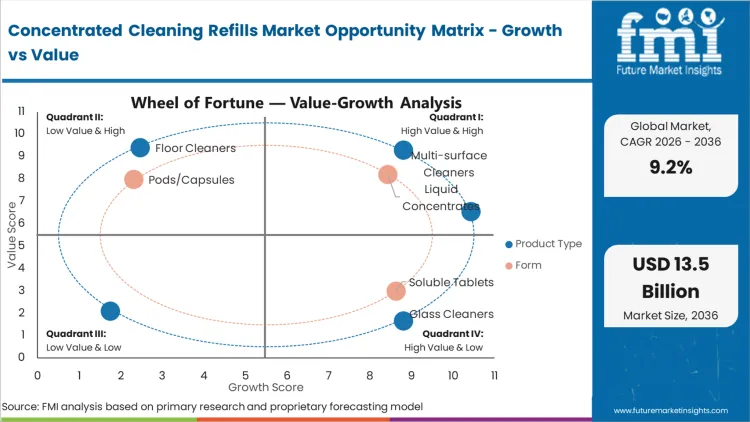
The convergence of e-commerce logistics and corporate ESG reporting forces CPG procurement leads to extract operational efficiency from the cleaning category. This architectural requirement renders bulky, water-heavy RTU products commercially obsolete in the digital retail chain. Asset owners upgrading their product portfolios face a strict choice between maintaining legacy shipping volumes or overhauling their chemistry for concentration. Transitioning to a unified refill backbone simplifies the logistics chain and enables direct-to-consumer (DTC) connectivity for advanced subscription models. Brands that fail to modernize their delivery layers risk losing digital shelf space and face increased shipping surcharges from third-party logistics providers.
The intricate chemistry required to maintain surfactant stability in an ultra-concentrated state creates steep research and development hurdles for traditional manufacturers. Designing "instant-dissolve" tablets that perform consistently across variable water hardness levels demands specialized chemical engineering expertise that many mid-tier companies lack internally. To mitigate this skill gap, capital projects directors increasingly rely on advanced contract manufacturing partners that automate the tablet-pressing process and validate dissolution rates before market launch.
Opportunities in the Concentrated Cleaning Refills Market
- DTC Subscription Models: Next-generation concentrated brands enable marketing directors to build high-margin subscription services that bypass traditional retail markups. This model eliminates the need for bulky storage and drastically simplifies the consumer replenishment journey.
- Cross-Category Refill Systems: Upgraded durable dispensing platforms permit consumers to use the same high-quality bottle for multiple cleaning product families by simply swapping the concentrate cartridge. This capability prevents the proliferation of multiple disparate dispensing systems in the home.
- Carbon-Neutral Logistics: Supply chain planners integrating concentrated refills can achieve measurable carbon reductions by shipping only the active ingredients. This transition provides the precision necessary to reach Net Zero targets across the global distribution network.
Regional Analysis
Based on the regional analysis, the concentrated cleaning refills market is segmented into North America, Latin America, Europe, East Asia, South Asia, Oceania, and Middle East & Africa across 40+ countries.
.webp "Top Country Growth Comparison Concentrated Cleaning Refills Market Cagr (2026 2036)")
| Country | CAGR (2026 to 2036) |
|---|---|
| China | 11.5% |
| India | 11.2% |
| USA | 8.9% |
| France | 8.4% |
| Germany | 7.9% |
| UK | 7.1% |
Asia Pacific Concentrated Cleaning Refills Market Analysis
Greenfield retail infrastructure development across the Asia Pacific region accelerates the bypass of legacy distribution constraints. Capital projects directors constructing new eco-retail hubs and automated fulfillment centers specify in-store refill stations in their initial site blueprints. FMI analysts opine that this clean-slate approach entirely eliminates the costly and time-consuming shelf-space reorganization that affects older retail centers. By building native concentrate delivery capabilities into the foundation, regional asset owners establish highly flexible retail environments capable of rapid inventory retooling. This aggressive greenfield expansion strategy directly fuels the demand for high-performance refill chemistry. The integration of refill systems forms a key prerequisite for deploying compact, logistics-efficient cleaning formats at scale. The specific retail and packaging requirements of individual nations define the exact implementation pathway for these concentrate systems.
- China: China’s urban home care sector deploys highly automated, digital-first shopping environments requiring seamless integration between e-commerce platforms and household refill systems. Greenfield retail architects bypass traditional large-format liquid aisles entirely, specifying super-concentrate cleaning chemicals for all new private-label procurement contracts. The sheer volume of new residential high-rise construction establishes a massive installed base of space-conscious consumers across the eastern industrial corridor. This aggressive modernization strategy drives an 11.5% CAGR for concentrated cleaning refills in China through 2036. Vendors unable to demonstrate verified high-potency liquid stability lose access to the most lucrative greenfield retail projects in the region.
- India: India’s organized retail sector operates under stringent waste management frameworks requiring measurable reductions in secondary packaging for household goods. Process engineers must deploy refill networks capable of guaranteeing product integrity from bulk concentrate pods to consumer-owned bottles. The national push toward a circular economy triggers a wave of brand launches prioritizing unified, secure refillable packaging backbones. This regulatory compliance pressure anchors India’s 11.2% compound expansion of concentrated cleaning refills demand to 2036. Suppliers failing to provide hardware with built-in anti-counterfeit refill mechanisms face disqualification from major multi-brand retail tenders.
FMI's report includes extensive coverage of the Asia Pacific concentrated cleaning refills landscape. It incorporates detailed analysis of Japan, South Korea, Indonesia, Australia, and the broader ASEAN region. A primary trend shaping these nations is the rapid localization of refill infrastructure and sustainable packaging formats, forcing retail operators and brand owners to deploy unified concentrate systems that satisfy rising consumer and regulatory expectations.
North America Concentrated Cleaning Refills Market Analysis
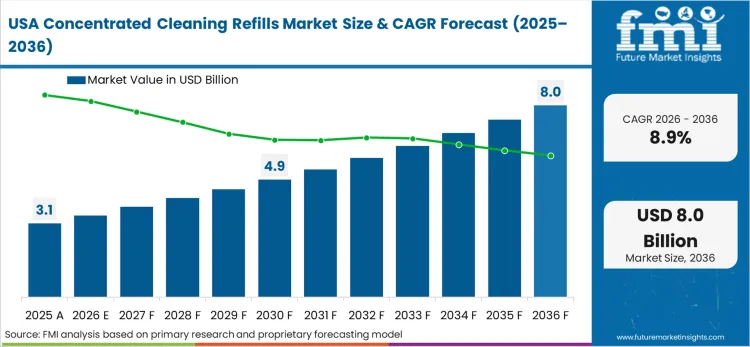
Industrial modernization mandates across North America target the systematic eradication of high-waste operational cycles in the cleaning sector. Control systems engineers leading critical facility overhauls face strict directives to unify disparate sanitation domains under a single manageable architecture. According to FMI's estimates, the hospitality and healthcare sectors actively drive this consolidation to secure their supply chains against logistics disruptions and packaging inefficiencies. Implementing standardized concentrate systems enables facilities to reduce storage burdens and improve replenishment economics without compromising cleaning efficacy. This strategic shift requires significant capital allocation toward dispensing hardware capable of supporting repeatable dilution and refill operations. The success of these modernization initiatives depends heavily on the availability of standardized concentrate protocols and durable dispenser systems. National sustainability frameworks and retail modernization programs shape the exact requirements for these regional deployments.
- USA: The United States household care sector enforces strict environmental and plastic reduction mandates across its entire multi-tier retail ecosystem. Network specification leads replacing aging ready-to-use product lines must deploy refillable cleaning products capable of supporting both real-time cost savings and secure sustainability reporting. Federal infrastructure modernization initiatives actively fund the replacement of high-waste legacy systems with standardized, resilient concentrate backbones. The United States advances at an 8.9% compound rate across the forecast decade as households and institutional users unify their procurement systems around refillable formats. Hardware vendors lacking documented compliance with rigorous sustainability standards face immediate exclusion from national retail modernization contracts.
FMI's report includes comprehensive evaluation of the North American concentrated cleaning refills sector. It features specific analysis of the Canadian and Mexican markets. A defining dynamic in these countries involves the integration of cross-border supply chains, which requires standardized concentrate protocols to coordinate just-in-time delivery and maintain synchronized replenishment flows across multiple retail and commercial channels.
Europe Concentrated Cleaning Refills Market Analysis
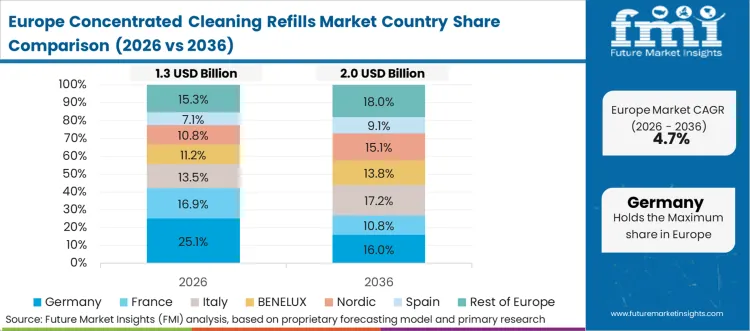
European environmental policy actively penalizes the continued use of waste-intensive and packaging-heavy cleaning formats. Retail and packaging architects redesigning legacy product lines must integrate refill systems and concentrate delivery models alongside broader waste-reduction targets. This dual-purpose requirement forces the rapid adoption of refillable packaging systems that can support both consumer convenience and regulatory compliance. The transition requires a structural overhaul of existing retail cleaning formats, shifting from bulky ready-to-use liquids to compact concentrate-based systems. Upgrading the core packaging and dispensing infrastructure provides the necessary flexibility to support sustainable cleaning product strategies at scale. Facility directors and retail buyers recognize that maintaining outdated ready-to-use product mixes severely limits their ability to compete in highly regulated European markets. Regional packaging laws and circular economy frameworks heavily influence the implementation pathway for these concentrate refill systems.
- France: France’s national restrictions on non-recyclable and single-use packaging force a rapid shift toward dissolvable tablets and ultra-concentrate sachets. Facility directors in the hospitality sector mandate the use of high-durability dispensing systems to comply with circular economy requirements. This structural transition anchors France’s 8.4% compound trajectory to 2036 as households and institutions move toward zero-waste replenishment models. Vendors failing to provide refill systems aligned with strong packaging reduction expectations forfeit access to key urban distribution channels.
- Germany: Germany’s market is shaped by strict waste reduction priorities and high-performance cleaning requirements across industrial and institutional settings. Process engineers must demonstrate consistent chemical purity and reliable dilution performance before authorizing large-scale deployment of concentrate systems. The national focus on packaging efficiency and circularity creates a recurring compliance cycle that accelerates the use of compact refill formats. This systemic qualification pressure drives a 7.9% annual expansion rate for concentrated cleaning refills as the format standardizes across major applications. Suppliers targeting domestic retail and institutional contracts must guarantee repeatable dosing performance before the finalization of procurement budgets.
- UK: The United Kingdom’s extended producer responsibility frameworks require closer tracking of packaging life cycles and stronger waste accountability across consumer goods sectors. Retail and utility planners deploying advanced sustainable packaging systems mandate architectures capable of supporting durable refill models and lower packaging intensity. The shift toward circular retail formats forces operators to abandon legacy cleaning products in favor of compact concentrate systems. This transition anchors the UK’s 7.1% compound trajectory to 2036 as retailers and households systematically upgrade their replenishment models. Systems integrators unable to demonstrate reliable refill compatibility under real-world usage conditions forfeit qualification for major retail sustainability programs.
FMI's report includes thorough investigation of the European concentrated cleaning refills framework. The analysis encompasses Italy, Spain, the Nordics, and the Benelux region. A prevailing structural condition across these nations is the mandatory compliance with strict packaging reduction targets and circular economy rules, forcing brand owners and retailers to specify concentrated refill systems that can reliably reduce plastic intensity alongside standard cleaning performance.
Competitive Aligners for Market Players
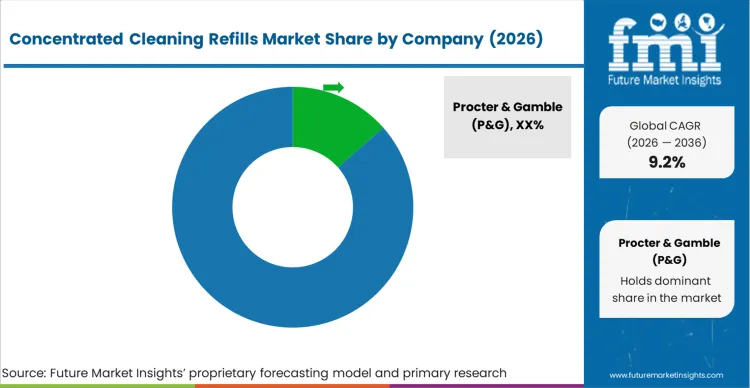
The introduction of standardized testing profiles for concentrate dissolution is reshaping how industrial buyers evaluate professional cleaning products. Instead of accepting variable dilution ratios, procurement teams now demand certified, interoperable concentrate formats in all new tenders. This shift has raised the performance bar across the industry, meaning vendors that continue to rely on proprietary, single-bottle ecosystems risk being excluded from major institutional modernization programs. Industry leaders have already begun adapting by aligning portions of their portfolios with open, deterministic refill standards, setting a new competitive baseline for others to follow.
Vendors embedding precision dosing and anti-clogging protocols directly into their durable dispensers gain a significant architectural advantage. Companies that incorporate refillable pump bottles at the device level help reduce engineering overhead during the site commissioning phase and shrink the physical storage footprint in commercial facilities. This silicon-first approach to dispenser design accelerates brownfield migration projects, allowing facility leads to prioritize platforms that avoid the complexity associated with manual dilution measurements. In contrast, component manufacturers slow to adopt native concentrate designs risk losing position during early-stage vendor shortlisting.
Growth of cross-vendor interoperability ecosystems is disrupting long-established market strongholds in the home care sector. With more refillable layers becoming standardized, system integrators designing converged hospitality cleaning architectures can now choose concentrates from multiple suppliers without worrying about timing drift or synchronization failures in automated dispensers. This expanded flexibility empowers facility owners to optimize networks for performance and reliability instead of being constrained by vendor lock-in.
Key Players in Concentrated Cleaning Refills Market
- Procter & Gamble (P&G)
- Unilever
- Reckitt Benckiser Group
- Henkel AG & Co. KGaA
- SC Johnson & Son, Inc.
- The Clorox Company
- Church & Dwight Co., Inc.
- Colgate-Palmolive
- Seventh Generation
- Method Products
- Blueland
- Grove Collaborative
- Ecolab Inc.
Scope of the Report
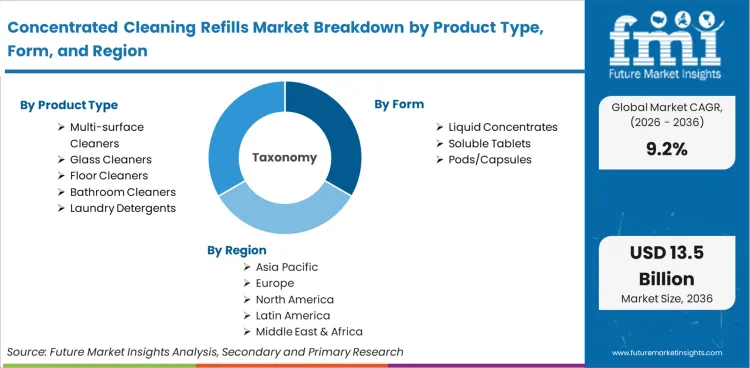
| Metric | Value |
|---|---|
| Quantitative Units | USD 5.6 billion to USD 13.5 billion, at a CAGR of 9.20% |
| Market Definition | Concentrated cleaning refills encompass potent chemical formulations delivered in compact formats such as tablets, liquids, or pods that require on-site dilution. |
| Product Type Segmentation | Multi-surface Cleaners, Glass Cleaners, Floor Cleaners, Bathroom Cleaners, Laundry Detergents |
| Form Segmentation | Liquid Concentrates, Soluble Tablets, Pods/Capsules |
| Distribution Channel Segmentation | Supermarkets/Hypermarkets, Convenience Stores, Online Retail, Specialty Stores |
| End Use Segmentation | Residential, Commercial |
| Regions Covered | North America, Latin America, Europe, East Asia, South Asia, Oceania, Middle East & Africa |
| Countries Covered | China, India, USA, France, Germany, UK, Brazil, and 40 plus countries |
| Key Companies Profiled | Procter & Gamble, Unilever, Reckitt Benckiser, Henkel, SC Johnson, Clorox, Church & Dwight |
| Forecast Period | 2026 to 2036 |
| Approach | FMI conducted detailed technical interviews with packaging engineers and category leads across 40 countries, cross-referencing regional retail scan data with corporate sustainability disclosures. |
Concentrated Cleaning Refills Market Analysis by Segments
Product Type:
- Multi-surface Cleaners
- Glass Cleaners
- Floor Cleaners
- Bathroom Cleaners
- Laundry Detergents
Form:
- Liquid Concentrates
- Soluble Tablets
- Pods/Capsules
Distribution Channel:
- Supermarkets/Hypermarkets
- Convenience Stores
- Online Retail
- Specialty Stores
End Use:
- Residential
- Commercial
Region:
- Asia Pacific
- India
- China
- Japan
- South Korea
- Indonesia
- Australia & New Zealand
- ASEAN
- Rest of Asia Pacific
- Europe
- Germany
- Italy
- France
- United Kingdom
- Spain
- Benelux
- Nordics
- Central & Eastern Europe
- Rest of Europe
- North America
- United States
- Canada
- Mexico
- Latin America
- Brazil
- Argentina
- Chile
- Rest of Latin America
- Middle East & Africa
- Kingdom of Saudi Arabia
- United Arab Emirates
- South Africa
- Turkey
- Rest of Middle East & Africa
Bibliography
- European Commission, Directorate-General for Environment. (2024, February). EU Ecolabel user manual: Detergents and cleaning products (Version 1.5).
- European Parliament. (2024, February 27). European Parliament legislative resolution of 27 February 2024 on the proposal for a regulation of the European Parliament and of the Council on detergents and surfactants, amending Regulation (EU) 2019/1020 and repealing Regulation (EC) No 648/2004 (COM(2023)0217 - C9-0154/2023 - 2023/0124(COD)).
- Organization for Economic Co-operation and Development. (2024). Plastics recycled content requirements. OECD Publishing.
- USA Environmental Protection Agency. (2024, November). National Strategy to Prevent Plastic Pollution.
- Ellen MacArthur Foundation. (2024). The Global Commitment 2024 Progress Report.
- WRAP. (2024, July 22). Mainstreaming reusable and refillable packaging in the UK.
This Report Addresses
- Market sizing for the organized concentrated cleaning refill layer from 2026 to 2036.
- Forecast demand for high-potency sanitation chemistry across residential and commercial sectors.
- Product Type analysis across multi-surface, glass, floor, and laundry segments.
- Form demand patterns across liquid concentrates, soluble tablets, and pods.
- Regional growth comparisons shaped by national plastic reduction mandates and retail infrastructure.
- Competitive positioning factors for CPG incumbents and sustainable startup challengers.
- Revenue opportunities tied to DTC subscription models and circular economy retail systems.
- Strategic implications for packaging engineers and sustainability directors in the home care industry.
Frequently Asked Questions
How large is the demand for Concentrated Cleaning Refills in the global market in 2026?
Demand for Concentrated Cleaning Refills in the global market is estimated to be valued at USD 5.6 billion in 2026.
What will be the market size of Concentrated Cleaning Refills in the global market by 2036?
Market size for Concentrated Cleaning Refills is projected to reach USD 13.5 billion by 2036.
What is the expected demand growth for Concentrated Cleaning Refills in the global market between 2026 and 2036?
Demand for Concentrated Cleaning Refills is expected to grow at a CAGR of 9.20% between 2026 and 2036.
Which Product Type is poised to lead global sales by 2026?
Multi-surface Cleaners accounts for 36.0% in 2026 as households adopt versatile refill systems that support repeated use across kitchen and living-area cleaning routines.
How significant is the role of Liquid Concentrates in driving Concentrated Cleaning Refills adoption in 2026?
Liquid Concentrates represents 45.0% of segment share as pouch-based refill formats offer a familiar dilution experience for consumers shifting away from ready-to-use cleaners.
What is driving demand in China?
China's urban home care sector is adopting digital-first refill systems and space-saving concentrated cleaning formats, pushing brands toward high-potency solutions linked to circular economy goals.
What compliance standards or regulations are referenced for Germany?
Germany's market is shaped by packaging reduction priorities and broader circular economy rules that encourage refill adoption and discourage waste-heavy cleaning product formats.
What is the China growth outlook in this report?
China is projected to grow at a CAGR of 11.5% during 2026 to 2036.
Why is North America described as a priority region in this report?
North America is positioned as a priority region because retailers, sustainability teams, and facility operators are accelerating the replacement of bulky ready-to-use cleaning products with concentrated refill systems.
What type of demand dominates in North America?
Demand heavily focuses on lightweight, refillable, and logistics-efficient cleaning formats that reduce packaging waste and improve shipping economics across retail and institutional channels.
What is India's growth outlook in this report?
India is projected to expand at a CAGR of 11.2% during 2026 to 2036.
Does the report cover USA in its regional analysis?
Yes, USA is included within North America under the regional scope of analysis.
What are the sources referred to for analyzing USA?
Federal sustainability initiatives, plastic reduction programs, and retail modernization trends form the analytical basis.
What is the main demand theme linked to USA in its region coverage?
Environmental compliance pressure and retailer-led packaging reduction targets are forcing the shift from water-heavy ready-to-use products toward concentrated refill systems.
Does the report cover Germany in its regional analysis?
Yes, Germany is included within Europe under the regional coverage framework.
What is the main Germany related demand theme in its region coverage?
Germany's demand is tied to packaging waste reduction, refill adoption, and stronger preference for compact cleaning formats aligned with circular economy behavior.
Which product formats or configurations are strategically important for Asia Pacific supply chains?
High-potency liquid pouches, soluble tablets, and refill-compatible durable bottles are strategically important for Asia Pacific supply chains.
What is Concentrated Cleaning Refills and what is it mainly used for?
Concentrated Cleaning Refills are high-potency cleaning formulations that require dilution at the point of use. They are mainly used for residential and commercial cleaning applications where packaging reduction and storage efficiency are important.
What does Concentrated Cleaning Refills mean in this report?
The scope encompasses concentrated liquids, soluble tablets, and pods designed for repeated use through refill systems rather than one-time ready-to-use formats.
What is included in the scope of this Concentrated Cleaning Refills report?
The market covers liquid concentrate pouches, water-soluble tablets, pods or capsules, starter kits with durable bottles, and automated dilution-control systems used in residential and commercial cleaning.
What is excluded from the scope of this report?
Standard ready-to-use liquid cleaners, bulk industrial chemicals without refill formats, and standalone cleaning tools without integrated concentrate delivery mechanisms are explicitly excluded.
What does market forecast mean on this page?
The market forecast represents a model-based projection built on defined adoption and conversion assumptions for strategic planning purposes.
How does FMI build and validate the Concentrated Cleaning Refills forecast?
The model applies a bottom-up methodology starting with concentrate unit sales and cross-validates projections against retail scan data, sustainability disclosures, and financial filings.
What does zero reliance on speculative third-party market research mean here?
Primary interviews, verified corporate reports, and official policy and sustainability documentation are used exclusively instead of unverified syndicated estimates.
Preview the report firsthand - request a free sample
Get SampleGet the brochure for pricing and purchase details.
Get PDFTable of Content
- Key Takeaways
- Market Size and CAGR
- Top Growth Driver
- Fastest Growing Segment
- Leading Region
- Key Companies
- Emerging Opportunities
- Executive Summary
- Global Market Outlook
- Demand-side Trends
- Supply-side Trends
- Technology Roadmap Analysis
- Analysis and Recommendations
- Analyst Perspective (What is happening? Why now? What should investors know?)
- Key Questions Answered
- How large is the market?
- What is the CAGR?
- What are key trends?
- Which region dominates?
- Who are the leaders?
- Market Overview
- Market Coverage / Taxonomy
- Market Definition / Scope / Limitations
- Research Methodology
- Chapter Orientation
- Analytical Lens and Working Hypotheses
- Market Structure, Signals, and Trend Drivers
- Benchmarking and Cross-market Comparability
- Market Sizing, Forecasting, and Opportunity Mapping
- Research Design and Evidence Framework
- Desk Research Programme (Secondary Evidence)
- Expert Input and Fieldwork (Primary Evidence)
- Tooling, Models, and Reference Databases
- Data Engineering and Model Build
- Quality Assurance and Audit Trail
- Market Background
- Market Dynamics (Drivers, Restraints, Opportunity, Trends)
- Scenario Forecast (Optimistic, Likely, Conservative)
- Impact Analysis
- AI Impact
- Sustainability Impact
- Regulatory Impact
- Technology Impact
- Consumer / Buyer Analysis
- Purchase Drivers
- Adoption Barriers
- Buyer Journey
- Opportunity Map Analysis
- Product Life Cycle Analysis
- Supply Chain Analysis
- Investment Feasibility Matrix
- Value Chain Analysis
- PESTLE and Porter's Analysis
- Regulatory Landscape
- Regional Parent Market Outlook
- Production and Consumption Statistics
- Import and Export Statistics
- Global Market Analysis and Forecast, 2021 to 2036
- Historical Market Size Value (USD Billion) & Volume (Unit) Analysis, 2021 to 2025
- Current and Future Market Size Value (USD Billion) & Volume (Unit) Projections, 2026 to 2036
- Y-o-Y Growth Trend Analysis
- Absolute $ Opportunity Analysis
- Global Market Pricing Analysis, 2021 to 2036
- Global Market Analysis and Forecast, By Product Type, 2021 to 2036
- Introduction / Key Findings
- Historical Market Size Value (USD Billion) & Volume (Unit) Analysis By Product Type, 2021 to 2025
- Current and Future Market Size Value (USD Billion) & Volume (Unit) Analysis and Forecast By Product Type, 2026 to 2036
- Multi-surface Cleaners
- Glass Cleaners
- Floor Cleaners
- Bathroom Cleaners
- Laundry Detergents
- Multi-surface Cleaners
- Y-o-Y Growth Trend Analysis By Product Type, 2021 to 2025
- Absolute $ Opportunity Analysis By Product Type, 2026 to 2036
- Global Market Analysis and Forecast, By Form, 2021 to 2036
- Introduction / Key Findings
- Historical Market Size Value (USD Billion) & Volume (Unit) Analysis By Form, 2021 to 2025
- Current and Future Market Size Value (USD Billion) & Volume (Unit) Analysis and Forecast By Form, 2026 to 2036
- Liquid Concentrates
- Soluble Tablets
- Pods/Capsules
- Liquid Concentrates
- Y-o-Y Growth Trend Analysis By Form, 2021 to 2025
- Absolute $ Opportunity Analysis By Form, 2026 to 2036
- Global Market Analysis and Forecast, By Distribution Channel, 2021 to 2036
- Introduction / Key Findings
- Historical Market Size Value (USD Billion) & Volume (Unit) Analysis By Distribution Channel, 2021 to 2025
- Current and Future Market Size Value (USD Billion) & Volume (Unit) Analysis and Forecast By Distribution Channel, 2026 to 2036
- Supermarkets/Hypermarkets
- Convenience Stores
- Online Retail
- Specialty Stores
- Supermarkets/Hypermarkets
- Y-o-Y Growth Trend Analysis By Distribution Channel, 2021 to 2025
- Absolute $ Opportunity Analysis By Distribution Channel, 2026 to 2036
- Global Market Analysis and Forecast, By End Use, 2021 to 2036
- Introduction / Key Findings
- Historical Market Size Value (USD Billion) & Volume (Unit) Analysis By End Use, 2021 to 2025
- Current and Future Market Size Value (USD Billion) & Volume (Unit) Analysis and Forecast By End Use, 2026 to 2036
- Residential
- Commercial
- Residential
- Y-o-Y Growth Trend Analysis By End Use, 2021 to 2025
- Absolute $ Opportunity Analysis By End Use, 2026 to 2036
- Global Market Analysis and Forecast, By Region, 2021 to 2036
- Introduction
- Historical Market Size Value (USD Billion) & Volume (Unit) Analysis By Region, 2021 to 2025
- Current Market Size Value (USD Billion) & Volume (Unit) Analysis and Forecast By Region, 2026 to 2036
- North America
- Latin America
- Western Europe
- Eastern Europe
- East Asia
- South Asia and Pacific
- Middle East & Africa
- Market Attractiveness Analysis By Region
- North America Market Analysis and Forecast, By Country, 2021 to 2036
- Historical Market Size Value (USD Billion) & Volume (Unit) Trend Analysis By Market Taxonomy, 2021 to 2025
- Market Size Value (USD Billion) & Volume (Unit) Forecast By Market Taxonomy, 2026 to 2036
- By Country
- USA
- Canada
- Mexico
- By Product Type
- By Form
- By Distribution Channel
- By End Use
- By Country
- Market Attractiveness Analysis
- By Country
- By Product Type
- By Form
- By Distribution Channel
- By End Use
- Key Takeaways
- Latin America Market Analysis and Forecast, By Country
- Historical Market Size Value (USD Billion) & Volume (Unit) Trend Analysis By Market Taxonomy, 2021 to 2025
- Market Size Value (USD Billion) & Volume (Unit) Forecast By Market Taxonomy, 2026 to 2036
- By Country
- Brazil
- Chile
- Rest of Latin America
- By Product Type
- By Form
- By Distribution Channel
- By End Use
- By Country
- Market Attractiveness Analysis
- By Country
- By Product Type
- By Form
- By Distribution Channel
- By End Use
- Key Takeaways
- Western Europe Market Analysis and Forecast, By Country
- Historical Market Size Value (USD Billion) & Volume (Unit) Trend Analysis By Market Taxonomy, 2021 to 2025
- Market Size Value (USD Billion) & Volume (Unit) Forecast By Market Taxonomy, 2026 to 2036
- By Country
- Germany
- UK
- Italy
- Spain
- France
- Nordic
- BENELUX
- Rest of Western Europe
- By Product Type
- By Form
- By Distribution Channel
- By End Use
- By Country
- Market Attractiveness Analysis
- By Country
- By Product Type
- By Form
- By Distribution Channel
- By End Use
- Key Takeaways
- Eastern Europe Market Analysis and Forecast, By Country
- Historical Market Size Value (USD Billion) & Volume (Unit) Trend Analysis By Market Taxonomy, 2021 to 2025
- Market Size Value (USD Billion) & Volume (Unit) Forecast By Market Taxonomy, 2026 to 2036
- By Country
- Russia
- Poland
- Hungary
- Balkan & Baltic
- Rest of Eastern Europe
- By Product Type
- By Form
- By Distribution Channel
- By End Use
- By Country
- Market Attractiveness Analysis
- By Country
- By Product Type
- By Form
- By Distribution Channel
- By End Use
- Key Takeaways
- East Asia Market Analysis and Forecast, By Country
- Historical Market Size Value (USD Billion) & Volume (Unit) Trend Analysis By Market Taxonomy, 2021 to 2025
- Market Size Value (USD Billion) & Volume (Unit) Forecast By Market Taxonomy, 2026 to 2036
- By Country
- China
- Japan
- South Korea
- By Product Type
- By Form
- By Distribution Channel
- By End Use
- By Country
- Market Attractiveness Analysis
- By Country
- By Product Type
- By Form
- By Distribution Channel
- By End Use
- Key Takeaways
- South Asia and Pacific Market Analysis and Forecast, By Country
- Historical Market Size Value (USD Billion) & Volume (Unit) Trend Analysis By Market Taxonomy, 2021 to 2025
- Market Size Value (USD Billion) & Volume (Unit) Forecast By Market Taxonomy, 2026 to 2036
- By Country
- India
- ASEAN
- Australia & New Zealand
- Rest of South Asia and Pacific
- By Product Type
- By Form
- By Distribution Channel
- By End Use
- By Country
- Market Attractiveness Analysis
- By Country
- By Product Type
- By Form
- By Distribution Channel
- By End Use
- Key Takeaways
- Middle East & Africa Market Analysis and Forecast, By Country
- Historical Market Size Value (USD Billion) & Volume (Unit) Trend Analysis By Market Taxonomy, 2021 to 2025
- Market Size Value (USD Billion) & Volume (Unit) Forecast By Market Taxonomy, 2026 to 2036
- By Country
- Kingdom of Saudi Arabia
- Other GCC Countries
- Türkiye
- South Africa
- Other African Union
- Rest of Middle East & Africa
- By Product Type
- By Form
- By Distribution Channel
- By End Use
- By Country
- Market Attractiveness Analysis
- By Country
- By Product Type
- By Form
- By Distribution Channel
- By End Use
- Key Takeaways
- Key Countries Market Analysis
- USA
- Pricing Analysis
- Market Share Analysis, 2025
- By Product Type
- By Form
- By Distribution Channel
- By End Use
- Canada
- Pricing Analysis
- Market Share Analysis, 2025
- By Product Type
- By Form
- By Distribution Channel
- By End Use
- Mexico
- Pricing Analysis
- Market Share Analysis, 2025
- By Product Type
- By Form
- By Distribution Channel
- By End Use
- Brazil
- Pricing Analysis
- Market Share Analysis, 2025
- By Product Type
- By Form
- By Distribution Channel
- By End Use
- Chile
- Pricing Analysis
- Market Share Analysis, 2025
- By Product Type
- By Form
- By Distribution Channel
- By End Use
- Germany
- Pricing Analysis
- Market Share Analysis, 2025
- By Product Type
- By Form
- By Distribution Channel
- By End Use
- UK
- Pricing Analysis
- Market Share Analysis, 2025
- By Product Type
- By Form
- By Distribution Channel
- By End Use
- Italy
- Pricing Analysis
- Market Share Analysis, 2025
- By Product Type
- By Form
- By Distribution Channel
- By End Use
- Spain
- Pricing Analysis
- Market Share Analysis, 2025
- By Product Type
- By Form
- By Distribution Channel
- By End Use
- France
- Pricing Analysis
- Market Share Analysis, 2025
- By Product Type
- By Form
- By Distribution Channel
- By End Use
- India
- Pricing Analysis
- Market Share Analysis, 2025
- By Product Type
- By Form
- By Distribution Channel
- By End Use
- ASEAN
- Pricing Analysis
- Market Share Analysis, 2025
- By Product Type
- By Form
- By Distribution Channel
- By End Use
- Australia & New Zealand
- Pricing Analysis
- Market Share Analysis, 2025
- By Product Type
- By Form
- By Distribution Channel
- By End Use
- China
- Pricing Analysis
- Market Share Analysis, 2025
- By Product Type
- By Form
- By Distribution Channel
- By End Use
- Japan
- Pricing Analysis
- Market Share Analysis, 2025
- By Product Type
- By Form
- By Distribution Channel
- By End Use
- South Korea
- Pricing Analysis
- Market Share Analysis, 2025
- By Product Type
- By Form
- By Distribution Channel
- By End Use
- Russia
- Pricing Analysis
- Market Share Analysis, 2025
- By Product Type
- By Form
- By Distribution Channel
- By End Use
- Poland
- Pricing Analysis
- Market Share Analysis, 2025
- By Product Type
- By Form
- By Distribution Channel
- By End Use
- Hungary
- Pricing Analysis
- Market Share Analysis, 2025
- By Product Type
- By Form
- By Distribution Channel
- By End Use
- Kingdom of Saudi Arabia
- Pricing Analysis
- Market Share Analysis, 2025
- By Product Type
- By Form
- By Distribution Channel
- By End Use
- Türkiye
- Pricing Analysis
- Market Share Analysis, 2025
- By Product Type
- By Form
- By Distribution Channel
- By End Use
- South Africa
- Pricing Analysis
- Market Share Analysis, 2025
- By Product Type
- By Form
- By Distribution Channel
- By End Use
- USA
- Market Structure Analysis
- Competition Dashboard
- Competition Benchmarking
- Market Share Analysis of Top Players
- By Regional
- By Product Type
- By Form
- By Distribution Channel
- By End Use
- Emerging Startups
- Innovation Benchmarking
- Competition Analysis
- Competition Deep Dive
- Procter & Gamble (P&G)
- Overview
- Product Portfolio
- Profitability by Market Segments (Product/Region/Sales Channel)
- Sales Footprint
- Strategy Overview
- Marketing Strategy
- Product Strategy
- Channel Strategy
- Unilever
- Reckitt Benckiser Group
- Henkel AG & Co. KGaA
- SC Johnson & Son, Inc.
- The Clorox Company
- Church & Dwight Co., Inc.
- Colgate-Palmolive
- Seventh Generation
- Method Products
- Blueland
- Grove Collaborative
- Ecolab Inc.
- Procter & Gamble (P&G)
- Case Studies
- Success Stories
- Recent Developments
- Competition Deep Dive
- Assumptions & Acronyms Used


