

- Industry Size (2026)
- USD 2.3 Bn
- Forecast (2036)
- USD 6.2 Bn
- CAGR (2026 to 2036)
- 10.4%
In-store refill stations Market Forecast and Outlook 2026 to 2036
In store refill stations are valued at USD 2.3 billion in 2026, and growth is being pulled by retailers that want measurable packaging reduction without disrupting store throughput, shopper convenience, or hygiene control. The category is expected to expand at a 10.4% CAGR through 2036 to reach USD 6.2 billion, as refill moves from pilot programs into standardized formats for water, household liquids, and personal care where repeat purchase behavior is easiest to build. Investment is shifting toward modular dispensing hardware that integrates with POS, supports precise metering by weight or volume, and uses tighter sanitation design, spill control, and container compatibility so stores can run refills with predictable labor and shrink outcomes.
Government regulation is a direct accelerator because it raises the cost of single use packaging and pushes producers and retailers toward reuse and refill models. In the EU, the Packaging and Packaging Waste Regulation (PPWR) 2025/40 strengthens packaging prevention and reuse expectations across member states, increasing pressure to scale compliant reuse systems in retail. In the UK, the Plastic Packaging Tax adds cost for plastic packaging that does not meet recycled content rules, reinforcing retailer interest in formats that reduce packaged volume altogether. In California, SB 54 shifts responsibility to producers and targets major reductions in single use packaging while supporting pathways that include reuse and refill systems, which strengthens the business case for store based refill infrastructure. As these policies tighten, the commercial advantage moves to operators that can prove compliance readiness through documentation, cleaning protocols, and consistent dispensing accuracy, making refill stations a core piece of circular retail execution rather than a sustainability add on.
Quick Stats for In-store refill stations Market
- In-store refill stations Industry Value (2026): USD 2.3 Billion
- In-store refill stations Industry Forecast Value (2036): USD 6.2 Billion
- In-store refill stations Industry Forecast CAGR: 10.4%
- In-store refill stations Industry Leading Product Type: Water Refill Stations (34.8%)
- In-store refill stations Industry Key Growth Regions: North America, Europe, Asia-Pacific
- In-store refill stations Industry Key Players: Algramo, Replenish, Loop (TerraCycle), Unilever, The Body Shop
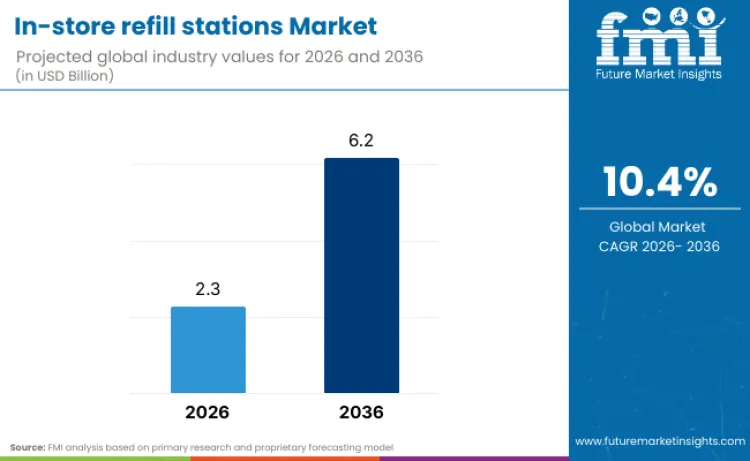
In-store refill stations Market Key Takeaways
| Metric | Value |
|---|---|
| Industry Size (2026) | USD 2.3 Billion |
| Industry Value (2036) | USD 6.2 Billion |
| CAGR (2026-2036) | 10.4% |
Source: FMI analysis based on primary research and proprietary forecasting model
What drivers are accelerating water refill station deployment?
Water refill station deployment is being pushed by retailers and commercial site operators who want a measurable reduction in single use bottled water while keeping convenience and hygiene consistent at high footfall locations. Adoption is rising as automated dispensers integrate stronger water treatment stacks such as sediment pre filtration, activated carbon for taste control, and optional UV or membrane purification, paired with filter life tracking and basic quality monitoring that supports consistent output and simpler maintenance planning. These improvements make rollout viable across supermarkets, convenience chains, campuses, and transit linked retail where uptime and fast dispense cycles are key purchase criteria.
Brand led partnerships are also speeding expansion, with beverage and water players co branding refill points to protect premium positioning and drive repeat traffic without adding packaged SKU volume. Loyalty and membership integration is becoming a commercial trigger, because app linked refill credits and subscription style refills make usage trackable, improve retention, and support store level margin management. Environmental communication in store and local campaigns around plastic bottle waste further strengthens internal approvals by giving refill stations a clear role in sustainability delivery and customer experience.
How Is the In-store refill stations Market Segmented Across Key Categories?
Global landscape is comprehensively segmented to address varied requirements of the zero-waste retail industry, categorizing sector by product type, application, distribution channel, and end-user. This structural division enables stakeholders to identify specific retail targets, such as growing demand for beverage refill systems in grocery chains or preference for personal care dispensers in specialty health stores. Through analyzing these segments, retailers can customize installation strategies to meet distinct requirements of high-traffic locations versus boutique establishments. Segmentation also reveals transition from basic water dispensing to comprehensive household product refill ecosystems. As technology advances, detailed segmentation becomes critical for understanding consumer adoption patterns and regulatory requirements, ensuring equipment deployment aligns with evolving retail standards.
Why Do Water Refill Stations Maintain Leadership?
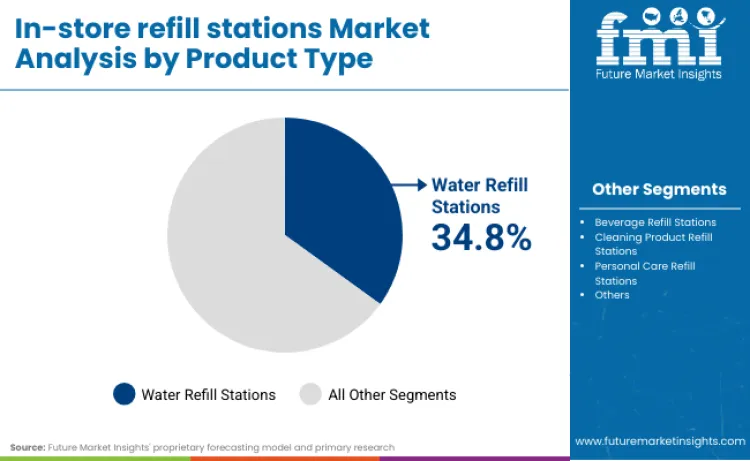
Water refill stations secure 34.8% of product type share in 2026, driven by widespread consumer acceptance and proven operational reliability. Market leadership stems from established filtration technologies and straightforward maintenance protocols that retail operators can manage effectively. Segment benefits from continuous purification advancements, including UV sterilization and advanced membrane filtration removing contaminants. Research focused on water quality monitoring is revitalizing interest among franchise operators. Essential role in reducing plastic bottle waste further strengthens market position, as these systems directly address environmental concerns. As retail sustainability guidelines prioritize water refill options, demand for commercial-grade dispensing equipment is projected to remain strong.
Why Do Commercial Applications Dominate End-User Adoption?
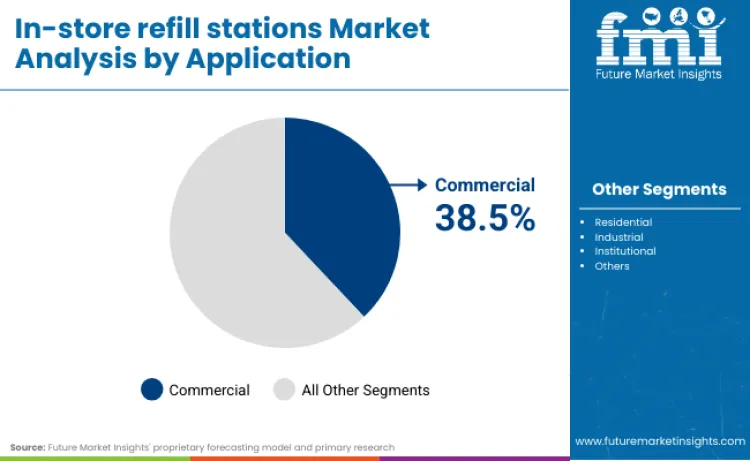
Commercial applications capture 38.5% of end-user share in 2026, reflecting institutional commitment to waste reduction and operational cost savings. Leadership position is connected to corporate sustainability mandates requiring measurable environmental impact reductions. Retailers depend on proven refill station technology to achieve zero-waste objectives while maintaining customer satisfaction levels. These applications are vital for delivering bulk household products and personal care items, establishing priority status among environmentally conscious retail chains. Continuous pursuit of automation ensures systems designed for high-volume operations remain the preferred choice. Strong commercial acceptance drives substantial equipment demand, supporting sustained revenue growth for technology suppliers.
Why Do Supermarkets Lead Distribution Channel Adoption?
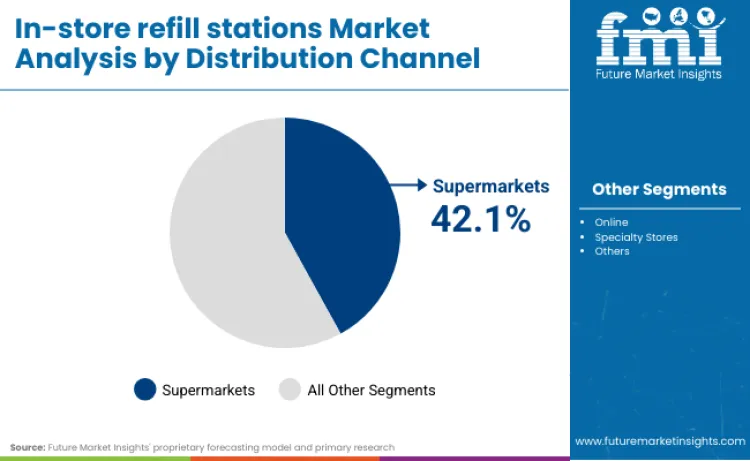
Supermarket deployment commands 42.1% of distribution channel share in 2026, owing to high customer traffic and established bulk purchasing infrastructure. Dominance originates from store layout flexibility that accommodates refill stations alongside traditional product displays. Consumers appreciate these installations for their convenience and immediate access to household essentials. Implementation in large format stores drives continuous adoption growth among national grocery chains. Compatibility with existing checkout systems allows for seamless integration across different payment methods. Supermarket operators focusing on comprehensive refill offerings for cleaning products and personal care items secure substantial customer loyalty among environmentally conscious shoppers.
Market Dynamics
How Will Environmental Regulations Impact Station Deployment?
Refill station rollout is increasingly being driven by policy, not just sustainability branding. In the EU, the Packaging and Packaging Waste Regulation, Regulation (EU) 2025/40, explicitly targets prevention of unnecessary packaging and promotes reuse and refill across the packaging life cycle, which strengthens the business case for retailer-operated dispensing infrastructure and brand-supported refill formats as compliance-ready routes to market. Extended producer responsibility is also tightening the economics of single-use packaging by shifting end-of-life cost and performance obligations onto producers, creating a direct incentive to redesign delivery models toward refill and reuse. In France, the consumer-code framework around bulk selling and container acceptance, with public-health-based exclusions, is shaping how retailers design hygiene controls and category eligibility for in-store dispensing.
How Will Digital Integration Transform Customer Experience?
Digital layers are turning refill stations into “managed services” that can compete with packaged convenience. The refill models being promoted by reuse frameworks increasingly include subscription and replenishment logic, where consumers keep a primary pack and refill via store visits or delivery, and digital touchpoints reduce friction by linking identity, payment, and repeat purchase triggers. Retail pilots are also extending refill beyond physical aisles into e-commerce by combining delivery with container take-back, cleaning, and refill, which helps normalize reuse behavior without requiring a special trip. Smart dispensers and connected systems improve usability through real-time product information, usage tracking, and automated stock signals, which is why “smart systems” are repeatedly highlighted as a scaling enabler for reuse and refill programs.
How Will Supply Chain Evolution Affect Market Growth?
Supply chain design is becoming the main determinant of whether refill stations scale profitably. The strongest momentum is around concentrated or compact refill formats because they cut logistics burden by shipping less packaging and less water, and reuse frameworks note that packaging and transportation costs can be reduced when refills are supplied in concentrates or solids. At the same time, refill growth depends on reverse logistics that can reliably collect, clean, inspect, and redeploy containers at scale, which is why leading reuse guidance emphasizes system-wide operational design rather than isolated pilots. As quality requirements tighten, operators are building stronger controls around segregation, sanitation, batch traceability, and verification testing, since bulk handling shifts risk from “package integrity” to “process integrity” across storage, dispensing, and refilling.
How Will the In-store refill stations Industry Evolve in Major Nations?
Global landscape for refill station technology is characterized by diverse regulatory environments, influenced by waste management policies and retail infrastructure development. Established markets prioritize automated dispensing systems and comprehensive product portfolios, whereas developing economies focus on basic refill functionality and accessible pricing structures. Europe is emerging as a regulatory leader due to stringent plastic packaging restrictions and advanced circular economy policies. Conversely, North American markets emphasize technological innovation and franchise-based deployment models. FMI is of the opinion that government initiatives in developed nations supporting waste reduction targets ensure sustained demand for refill infrastructure across all retail categories.
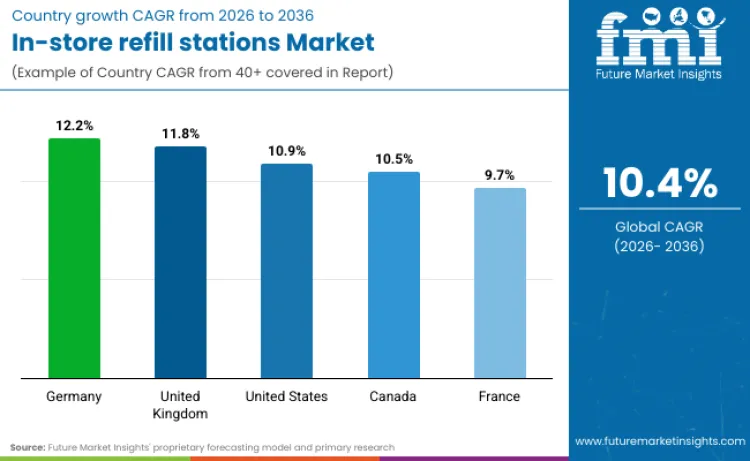
| Country | CAGR (2026 to 2036) |
|---|---|
| Germany | 12.2% |
| United Kingdom | 11.8% |
| United States | 10.9% |
| Canada | 10.5% |
| France | 9.7% |
Source: Future Market Insights - analysis driven by proprietary forecasting models and primary research
Why is the In store refill stations Industry in Germany Growing?
Deployment of in store refill systems in Germany is positioned to grow at 12.2% CAGR through 2036 because retail and foodservice operators are operating under a clear reuse obligation that directly expands the addressable installed base for refill and reusable dispensing formats. Germany’s Federal Environment Ministry explains that, under section 33 of the Packaging Act, takeaway food and beverages that were previously offered only in single use cups or certain single use plastic food packaging must also be offered in reusable packaging, and the reusable option cannot be offered on worse terms than single use. The Federal Environment Agency also references implementation guidance for enforcement of this reusable offer obligation, which strengthens real world rollout across outlets and increases demand for dispensing systems and operational processes that make reuse workable at point of sale.
Why is the In store refill stations Sector in United Kingdom Expanding?
Demand for refill infrastructure in the UK is projected to advance at 11.8% CAGR through 2036 because packaging cost and compliance signals are strengthening for businesses that place packaging on the market, pushing retailers toward packaging avoidance and reuse models. UK government guidance on extended producer responsibility for packaging sets out new obligations to report packaging data and pay fees based on that data, which increases the commercial incentive to reduce packaging placed on the market, including through refill and reuse formats. In parallel, the UK Plastic Packaging Tax applies when plastic packaging does not meet recycled content thresholds, which further reinforces packaging redesign and reduction strategies that can include refill station deployment as a packaging avoidance route for suitable categories.
Why is the In store refill stations Industry in United States Showing Potential?
In store refill stations in the United States are set to expand at 10.9% CAGR through 2036 because state level packaging responsibility and source reduction policies are starting to explicitly promote reuse and refill systems, creating compliance linked reasons for retailers and brands to invest in refill infrastructure. California’s SB 54 program establishes an extended producer responsibility framework for packaging and single use plastic food service ware, which is one of the strongest policy signals in the country for shifting packaging systems toward circular models. Draft regulatory text linked to implementation also defines what it means for packaging to be reused or refilled through systematic recovery and return into supply chains, which aligns with refill station operating models and supports more standardized approaches to reuse measurement and verification.
Why is the In store refill stations Industry in Canada Growing?
Sales of refill station technology in Canada are set to grow at 10.5% CAGR through 2036 because federal direction is explicitly oriented toward preventing waste and increasing reuse, which supports retail adoption of refill as a practical waste prevention lever. Environment and Climate Change Canada describes a Canada wide action plan on zero plastic waste with actions to prevent, reduce, reuse, recover, and clean up plastic waste and pollution, reinforcing an enabling policy context for retail refill models. Canada’s single use plastics framework also drives substitution and system change in foodservice and retail facing items, and federal guidance supports businesses in choosing alternatives that prevent pollution and reduce waste, which supports the business case for reuse and refill formats where feasible.
Why is the In store refill stations Sector in France Expanding?
Revenue from refill systems in France is positioned to grow at 9.7% CAGR through 2036 because national circular economy law formalizes bulk and reusable container models and the extended producer responsibility architecture is being used to support reuse. France’s anti waste and circular economy law defines bulk sale as selling products without packaging in reusable or reusable use containers, which directly supports retail concepts built around refill and container reuse. France’s EPR system has also been expanded under the same law and ADEME describes mechanisms such as reuse funding requirements within EPR, which supports financing and scaling of reuse operations and related infrastructure across value chains.
What is the Competitive Outlook for the In-store Refill Stations Market?
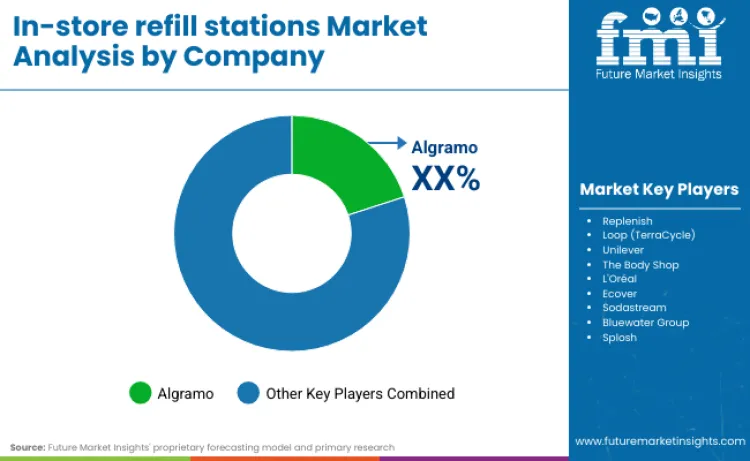
Competition is being decided by who can make refill operationally “retail-proof”, accurate dispensing, low mess, traceability, and simple store workflows, more than by sustainability messaging alone. Algramo is leaning into smart, IoT-linked dispensing and retailer pilots, including a Lidl UK in-store trial and packaged-goods pilots with Nestlé-linked programs in Indonesia, showing a playbook built around vending/dispensing hardware plus brand partnerships. MIWA is scaling a different model: modular in-store systems using reusable, returnable containers for dry goods, expanded through retail rollouts such as REWE in Germany and a broader dm rollout, which highlights that store-layout flexibility and standardized modules are key buying criteria for chains. Loop’s momentum is strongest where retailers commit to reuse infrastructure; TerraCycle’s updates point to meaningful expansion in France and Japan, underlining that logistics and return convenience drive viability.
Key Players in In-store refill stations Market
- Algramo
- Replenish
- Loop (TerraCycle)
- Unilever
- The Body Shop
- L'Oréal
- Ecover
- Sodastream
- Bluewater Group
- Splosh
Scope of Report
| Items | Values |
|---|---|
| Quantitative Units | USD Billion |
| Product Type Segments | Water Refill Stations; Beverage Refill Stations; Cleaning Product Refill Stations; Personal Care Refill Stations; Others |
| Application Categories | Commercial; Residential; Industrial; Institutional; Others |
| Distribution Channel Types | Supermarkets/Hypermarkets; Online; Specialty Stores; Others |
| End-User Categories | Households; Businesses; Public Spaces; Others |
| Regions Covered | North America, Europe, Asia-Pacific, Latin America, Middle East & Africa |
| Key Countries | Germany, United Kingdom, United States, Canada, France |
| Key Companies Profiled | Algramo; Replenish; Loop (TerraCycle); Unilever; The Body Shop; L'Oréal; Ecover; Sodastream; Bluewater Group; Splosh |
| Additional Attributes | Dollar sales measured for in-store refill stations used in retail environments and zero-waste applications, specified by dispensing technology type (automated, manual, smart-enabled), product category focus, installation complexity, application target (household products, personal care, beverages), retail model (franchise vs. corporate), and compliance alignment with evolving waste reduction standards and food safety regulations. |
In-store refill stations Market by Segments
Product Type:
- Water Refill Stations
- Beverage Refill Stations
- Cleaning Product Refill Stations
- Personal Care Refill Stations
- Others
Application:
- Commercial
- Residential
- Industrial
- Institutional
- Others
Distribution Channel:
- Supermarkets/Hypermarkets
- Online
- Specialty Stores
- Others
End-User:
- Households
- Businesses
- Public Spaces
- Others
Bibliography
- European Union. (2025). Regulation (EU) 2025/40 on packaging and packaging waste (PPWR). Official Journal of the European Union.
- USA Environmental Protection Agency. (2024). Reuse, refill, and packaging reduction strategies for retail and commercial environments. EPA Office of Resource Conservation and Recovery.
- United Nations Environment Programme. (2024). Turning off the tap: Reuse and refill as solutions to plastic pollution. UNEP.
Frequently Asked Questions
How big is the global in-store refill stations market?
The global in-store refill stations market is valued at USD 2.3 billion in 2026.
What is the growth outlook for the in-store refill stations market over the next 10 years?
The market is projected to expand at a 10.4% CAGR from 2026 to 2036, reaching USD 6.2 billion.
Which industries or use cases drive adoption?
Adoption is driven primarily by retail grocery, commercial facilities, personal care brands, and household liquid refilling use cases, led by water refill applications.
How does adoption differ by region or maturity level?
Europe leads adoption through regulation-driven circular economy mandates, North America advances via technology-enabled retail pilots, while Asia-Pacific adoption remains early-stage and urban-focused.
What are the main barriers to adoption or scaling?
Key barriers include hygiene assurance requirements, operational integration complexity, upfront installation costs, and the need for standardized cleaning and dispensing protocols.
Preview the report firsthand - request a free sample
Get SampleGet the brochure for pricing and purchase details.
Get PDFTable of Content
- Executive Summary
- Global Market Outlook
- Demand Side Trends
- Supply Side Trends
- Technology Roadmap Analysis
- Analysis and Recommendations
- Market Overview
- Market Coverage / Taxonomy
- Market Definition / Scope / Limitations
- Research Methodology
- Chapter Orientation
- Analytical Lens and Working Hypotheses
- Market Structure, Signals, and Trend Drivers
- Benchmarking and Cross-market Comparability
- Market Sizing, Forecasting, and Opportunity Mapping
- Research Design and Evidence Framework
- Desk Research Programme (Secondary Evidence)
- Company Annual and Sustainability Reports
- Peer-reviewed Journals and Academic Literature
- Corporate Websites, Product Literature, and Technical Notes
- Earnings Decks and Investor Briefings
- Statutory Filings and Regulatory Disclosures
- Technical White Papers and Standards Notes
- Trade Journals, Industry Magazines, and Analyst Briefs
- Conference Proceedings, Webinars, and Seminar Materials
- Government Statistics Portals and Public Data Releases
- Press Releases and Reputable Media Coverage
- Specialist Newsletters and Curated Briefings
- Sector Databases and Reference Repositories
- FMI Internal Knowledge Base and Historical Datasets
- Subscription Datasets and Paid Sources
- Social Channels, Communities, and Digital Listening Inputs
- Additional Desk Sources
- Expert Input and Fieldwork (Primary Evidence)
- Primary Modes
- Qualitative Interviews and Expert Elicitation
- Quantitative Surveys and Structured Data Capture
- Blended Approach
- Why Primary Evidence is Used
- Field Techniques
- Interviews
- Surveys
- Focus Groups
- Observational and In-context Research
- Social and Community Interactions
- Stakeholder Universe Engaged
- C-suite Leaders
- Board Members
- Presidents and Vice Presidents
- R&D and Innovation Heads
- Technical Specialists
- Domain Subject-matter Experts
- Scientists
- Physicians and Other Healthcare Professionals
- Governance, Ethics, and Data Stewardship
- Research Ethics
- Data Integrity and Handling
- Primary Modes
- Tooling, Models, and Reference Databases
- Desk Research Programme (Secondary Evidence)
- Data Engineering and Model Build
- Data Acquisition and Ingestion
- Cleaning, Normalisation, and Verification
- Synthesis, Triangulation, and Analysis
- Quality Assurance and Audit Trail
- Market Background
- Market Dynamics
- Drivers
- Restraints
- Opportunity
- Trends
- Scenario Forecast
- Demand in Optimistic Scenario
- Demand in Likely Scenario
- Demand in Conservative Scenario
- Opportunity Map Analysis
- Product Life Cycle Analysis
- Supply Chain Analysis
- Investment Feasibility Matrix
- Value Chain Analysis
- PESTLE and Porter's Analysis
- Regulatory Landscape
- Regional Parent Market Outlook
- Production and Consumption Statistics
- Import and Export Statistics
- Market Dynamics
- Global Market Analysis 2021 to 2025 and Forecast, 2026 to 2036
- Historical Market Size Value (USD Billion) Analysis, 2021 to 2025
- Current and Future Market Size Value (USD Billion) Projections, 2026 to 2036
- Y-o-Y Growth Trend Analysis
- Absolute $ Opportunity Analysis
- Global Market Pricing Analysis 2021 to 2025 and Forecast 2026 to 2036
- Y-o-Y Growth Trend Analysis 2021 to 2025
- Absolute $ Opportunity Analysis 2026 to 2036
- Global Market Analysis 2021 to 2025 and Forecast 2026 to 2036, By Product Type
- Introduction / Key Findings
- Historical Market Size Value (USD Billion) Analysis By Product Type, 2021 to 2025
- Current and Future Market Size Value (USD Billion) Analysis and Forecast By Product Type, 2026 to 2036
- Water Refill Stations
- Beverage Refill Stations
- Cleaning Product Refill Stations
- Personal Care Refill Stations
- Others
- Y-o-Y Growth Trend Analysis By Product Type, 2021 to 2025
- Absolute $ Opportunity Analysis By Product Type, 2026 to 2036
- Global Market Analysis 2021 to 2025 and Forecast 2026 to 2036, By Application
- Introduction / Key Findings
- Historical Market Size Value (USD Billion) Analysis By Application, 2021 to 2025
- Current and Future Market Size Value (USD Billion) Analysis and Forecast By Application, 2026 to 2036
- Commercial
- Residential
- Industrial
- Institutional
- Others
- Y-o-Y Growth Trend Analysis By Application, 2021 to 2025
- Absolute $ Opportunity Analysis By Application, 2026 to 2036
- Global Market Analysis 2021 to 2025 and Forecast 2026 to 2036, By Distribution Channel
- Introduction / Key Findings
- Historical Market Size Value (USD Billion) Analysis By Distribution Channel, 2021 to 2025
- Current and Future Market Size Value (USD Billion) Analysis and Forecast By Distribution Channel, 2026 to 2036
- Supermarkets/Hypermarkets
- Online
- Specialty Stores
- Others
- Y-o-Y Growth Trend Analysis By Distribution Channel, 2021 to 2025
- Absolute $ Opportunity Analysis By Distribution Channel, 2026 to 2036
- Global Market Analysis 2021 to 2025 and Forecast 2026 to 2036, By End-User
- Introduction / Key Findings
- Historical Market Size Value (USD Billion) Analysis By End-User, 2021 to 2025
- Current and Future Market Size Value (USD Billion) Analysis and Forecast By End-User, 2026 to 2036
- Households
- Businesses
- Public Spaces
- Others
- Y-o-Y Growth Trend Analysis By End-User, 2021 to 2025
- Absolute $ Opportunity Analysis By End-User, 2026 to 2036
- Global Market Analysis 2021 to 2025 and Forecast 2026 to 2036, By Region
- Introduction
- Historical Market Size Value (USD Billion) Analysis By Region, 2021 to 2025
- Current Market Size Value (USD Billion) Analysis and Forecast By Region, 2026 to 2036
- North America
- Latin America
- Western Europe
- Eastern Europe
- East Asia
- South Asia and Pacific
- Middle East & Africa
- Market Attractiveness Analysis By Region
- North America Market Analysis 2021 to 2025 and Forecast 2026 to 2036, By Country
- Historical Market Size Value (USD Billion) Trend Analysis By Market Taxonomy, 2021 to 2025
- Market Size Value (USD Billion) Forecast By Market Taxonomy, 2026 to 2036
- By Country
- USA
- Canada
- Mexico
- By Product Type
- By Application
- By Distribution Channel
- By End-User
- By Country
- Market Attractiveness Analysis
- By Country
- By Product Type
- By Application
- By Distribution Channel
- By End-User
- Key Takeaways
- Latin America Market Analysis 2021 to 2025 and Forecast 2026 to 2036, By Country
- Historical Market Size Value (USD Billion) Trend Analysis By Market Taxonomy, 2021 to 2025
- Market Size Value (USD Billion) Forecast By Market Taxonomy, 2026 to 2036
- By Country
- Brazil
- Chile
- Rest of Latin America
- By Product Type
- By Application
- By Distribution Channel
- By End-User
- By Country
- Market Attractiveness Analysis
- By Country
- By Product Type
- By Application
- By Distribution Channel
- By End-User
- Key Takeaways
- Western Europe Market Analysis 2021 to 2025 and Forecast 2026 to 2036, By Country
- Historical Market Size Value (USD Billion) Trend Analysis By Market Taxonomy, 2021 to 2025
- Market Size Value (USD Billion) Forecast By Market Taxonomy, 2026 to 2036
- By Country
- Germany
- UK
- Italy
- Spain
- France
- Nordic
- BENELUX
- Rest of Western Europe
- By Product Type
- By Application
- By Distribution Channel
- By End-User
- By Country
- Market Attractiveness Analysis
- By Country
- By Product Type
- By Application
- By Distribution Channel
- By End-User
- Key Takeaways
- Eastern Europe Market Analysis 2021 to 2025 and Forecast 2026 to 2036, By Country
- Historical Market Size Value (USD Billion) Trend Analysis By Market Taxonomy, 2021 to 2025
- Market Size Value (USD Billion) Forecast By Market Taxonomy, 2026 to 2036
- By Country
- Russia
- Poland
- Hungary
- Balkan & Baltic
- Rest of Eastern Europe
- By Product Type
- By Application
- By Distribution Channel
- By End-User
- By Country
- Market Attractiveness Analysis
- By Country
- By Product Type
- By Application
- By Distribution Channel
- By End-User
- Key Takeaways
- East Asia Market Analysis 2021 to 2025 and Forecast 2026 to 2036, By Country
- Historical Market Size Value (USD Billion) Trend Analysis By Market Taxonomy, 2021 to 2025
- Market Size Value (USD Billion) Forecast By Market Taxonomy, 2026 to 2036
- By Country
- China
- Japan
- South Korea
- By Product Type
- By Application
- By Distribution Channel
- By End-User
- By Country
- Market Attractiveness Analysis
- By Country
- By Product Type
- By Application
- By Distribution Channel
- By End-User
- Key Takeaways
- South Asia and Pacific Market Analysis 2021 to 2025 and Forecast 2026 to 2036, By Country
- Historical Market Size Value (USD Billion) Trend Analysis By Market Taxonomy, 2021 to 2025
- Market Size Value (USD Billion) Forecast By Market Taxonomy, 2026 to 2036
- By Country
- India
- ASEAN
- Australia & New Zealand
- Rest of South Asia and Pacific
- By Product Type
- By Application
- By Distribution Channel
- By End-User
- By Country
- Market Attractiveness Analysis
- By Country
- By Product Type
- By Application
- By Distribution Channel
- By End-User
- Key Takeaways
- Middle East & Africa Market Analysis 2021 to 2025 and Forecast 2026 to 2036, By Country
- Historical Market Size Value (USD Billion) Trend Analysis By Market Taxonomy, 2021 to 2025
- Market Size Value (USD Billion) Forecast By Market Taxonomy, 2026 to 2036
- By Country
- Kingdom of Saudi Arabia
- Other GCC Countries
- Turkiye
- South Africa
- Other African Union
- Rest of Middle East & Africa
- By Product Type
- By Application
- By Distribution Channel
- By End-User
- By Country
- Market Attractiveness Analysis
- By Country
- By Product Type
- By Application
- By Distribution Channel
- By End-User
- Key Takeaways
- Key Countries Market Analysis
- USA
- Pricing Analysis
- Market Share Analysis, 2025
- By Product Type
- By Application
- By Distribution Channel
- By End-User
- Canada
- Pricing Analysis
- Market Share Analysis, 2025
- By Product Type
- By Application
- By Distribution Channel
- By End-User
- Mexico
- Pricing Analysis
- Market Share Analysis, 2025
- By Product Type
- By Application
- By Distribution Channel
- By End-User
- Brazil
- Pricing Analysis
- Market Share Analysis, 2025
- By Product Type
- By Application
- By Distribution Channel
- By End-User
- Chile
- Pricing Analysis
- Market Share Analysis, 2025
- By Product Type
- By Application
- By Distribution Channel
- By End-User
- Germany
- Pricing Analysis
- Market Share Analysis, 2025
- By Product Type
- By Application
- By Distribution Channel
- By End-User
- UK
- Pricing Analysis
- Market Share Analysis, 2025
- By Product Type
- By Application
- By Distribution Channel
- By End-User
- Italy
- Pricing Analysis
- Market Share Analysis, 2025
- By Product Type
- By Application
- By Distribution Channel
- By End-User
- Spain
- Pricing Analysis
- Market Share Analysis, 2025
- By Product Type
- By Application
- By Distribution Channel
- By End-User
- France
- Pricing Analysis
- Market Share Analysis, 2025
- By Product Type
- By Application
- By Distribution Channel
- By End-User
- India
- Pricing Analysis
- Market Share Analysis, 2025
- By Product Type
- By Application
- By Distribution Channel
- By End-User
- ASEAN
- Pricing Analysis
- Market Share Analysis, 2025
- By Product Type
- By Application
- By Distribution Channel
- By End-User
- Australia & New Zealand
- Pricing Analysis
- Market Share Analysis, 2025
- By Product Type
- By Application
- By Distribution Channel
- By End-User
- China
- Pricing Analysis
- Market Share Analysis, 2025
- By Product Type
- By Application
- By Distribution Channel
- By End-User
- Japan
- Pricing Analysis
- Market Share Analysis, 2025
- By Product Type
- By Application
- By Distribution Channel
- By End-User
- South Korea
- Pricing Analysis
- Market Share Analysis, 2025
- By Product Type
- By Application
- By Distribution Channel
- By End-User
- Russia
- Pricing Analysis
- Market Share Analysis, 2025
- By Product Type
- By Application
- By Distribution Channel
- By End-User
- Poland
- Pricing Analysis
- Market Share Analysis, 2025
- By Product Type
- By Application
- By Distribution Channel
- By End-User
- Hungary
- Pricing Analysis
- Market Share Analysis, 2025
- By Product Type
- By Application
- By Distribution Channel
- By End-User
- Kingdom of Saudi Arabia
- Pricing Analysis
- Market Share Analysis, 2025
- By Product Type
- By Application
- By Distribution Channel
- By End-User
- Turkiye
- Pricing Analysis
- Market Share Analysis, 2025
- By Product Type
- By Application
- By Distribution Channel
- By End-User
- South Africa
- Pricing Analysis
- Market Share Analysis, 2025
- By Product Type
- By Application
- By Distribution Channel
- By End-User
- USA
- Market Structure Analysis
- Competition Dashboard
- Competition Benchmarking
- Market Share Analysis of Top Players
- By Regional
- By Product Type
- By Application
- By Distribution Channel
- By End-User
- Competition Analysis
- Competition Deep Dive
- Algramo
- Replenish
- Loop (TerraCycle)
- Unilever
- The Body Shop
- L'Oréal
- Ecover
- Sodastream
- Bluewater Group
- Splosh
- Competition Deep Dive
- Assumptions & Acronyms Used


