

- Industry Size (2026)
- USD 104 Mn
- Forecast (2036)
- USD 244 Mn
- CAGR (2026 to 2036)
- 8.9%
Refillable and Concentrated Pigment Paste Systems for Low-Packaging Formats Market Forecast and Outlook 2026 to 2036
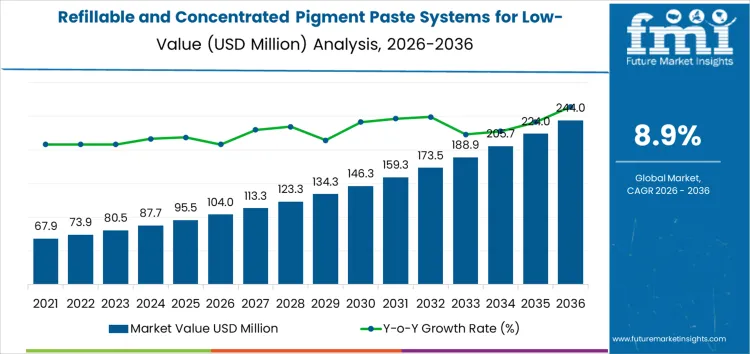
The refillable and concentrated pigment paste systems for low-packaging formats market is valued at USD 104 million in 2026 and is projected to reach USD 244 million by 2036, reflecting a CAGR of 8.90%. Growth across this period is shaped by packaging reduction targets, handling efficiency, and dosing accuracy rather than pigment consumption volumes. Cost structures are influenced by paste concentration levels, dispersion stability, and compatibility with refillable cartridges, sachets, and bulk delivery formats. Higher solids content raises formulation and processing demands while reducing downstream packaging requirements. Suppliers delivering stable rheology and predictable color strength gain preference. Procurement decisions emphasize operational reliability and dosing consistency across decentralized refill systems.
Between 2026 and 2036, market outcomes are guided by buyer risk management and workflow integration priorities. End users favor systems that minimize handling errors and support repeatable color performance across refill cycles. Once qualified, paste systems remain specified due to equipment calibration and process validation requirements. Switching costs increase where dispensing hardware and formulation parameters are tightly linked. Entry barriers persist through application testing and customer specific format adaptation. Strategic trade offs arise between maximizing concentration and maintaining ease of use. Competitive positioning depends on alignment with low packaging operational models rather than short term pricing competition.
Quick Stats for Refillable and Concentrated Pigment Paste Systems for Low Packaging Formats Market
- Refillable and Concentrated Pigment Paste Systems for Low Packaging Formats Market Value (2026): USD 104 million
- Refillable and Concentrated Pigment Paste Systems for Low Packaging Formats Market Forecast Value (2036): USD 244 million
- Refillable and Concentrated Pigment Paste Systems for Low Packaging Formats Market Forecast CAGR (2026 to 2036): 8.9%
- Leading Form Factor in Refillable and Concentrated Pigment Paste Systems for Low Packaging Formats Market: Refillable cartridges
- Key Growth Regions in Refillable and Concentrated Pigment Paste Systems for Low Packaging Formats Market: Asia Pacific, North America, Europe
- Top Players in Refillable and Concentrated Pigment Paste Systems for Low Packaging Formats Market: BASF SE, DIC Corporation (including Sun Chemical), Clariant AG, Merck KGaA, Sensient Technologies Corporation
What Is the Growth Forecast for Refillable and Concentrated Pigment Paste Systems for Low Packaging Formats Market through 2036?
Packaging efficiency targets and formulation concentration requirements shape the early growth phase of the refillable and concentrated pigment paste systems for low packaging formats market between 2026 and 2031. During this period, the market expands from USD 104 million to USD 150 million, adding USD 46 million in value. Annual progression from USD 62 million to USD 104 million reflects growing adoption of high strength pigment pastes designed for dilution at the point of use. Historical growth was constrained by handling complexity and limited compatibility with existing dosing systems. Forward expansion in this phase is supported by improved paste stability, accurate metering solutions, and wider uptake by coatings, inks, and cosmetics manufacturers seeking to reduce packaging intensity and logistics volume.
Operational efficiency gains and portfolio level integration drive growth from 2031 to 2036. Over this period, the market increases from USD 150 million to USD 244 million, adding USD 108 million and representing the stronger expansion window. Annual values rise from USD 164 million to USD 244 million, indicating accelerating year over year momentum. Earlier demand focused on niche applications and pilot programs, while future growth reflects broader adoption across standardized production lines. Higher concentrate ratios, repeat refill cycles, and improved supply chain coordination support sustained expansion as refillable and concentrated pigment paste systems become established inputs for low packaging format manufacturing strategies.
Refillable and Concentrated Pigment Paste Systems for Low Packaging Formats Market Key Takeaways
| Metric | Value |
|---|---|
| Market Value (2026) | USD 104 million |
| Forecast Value (2036) | USD 244 million |
| Forecast CAGR (2026 to 2036) | 8.9% |
What Is Driving Demand in the Refillable and Concentrated Pigment Paste Systems for Low-Packaging Formats Market?
Demand for refillable and concentrated pigment paste systems in low-packaging formats arises from evolving formulation, supply chain, and sustainability requirements that traditional ready-to-use products did not fully address. Conventional makeup and colorant products often ship with redundant packaging to house diluted pigment dispersions, increasing material use and transport weight. This created inefficiencies in inventory, higher logistics cost per unit of active pigment, and consumer dissatisfaction with packaging waste. Early adopters in colour cosmetics and professional makeup sectors responded with concentrated pigment pastes that dilute at point of use, reducing container volume and enabling smaller, refillable delivery systems. Historical uptake followed measured reductions in packaging cost and waste in specific product lines rather than broad reformulation across categories.
Future growth will be shaped by structured sustainability standards, retailer and brand environmental commitments, and documented material efficiency criteria rather than packaging preference alone. Regulatory focus on packaging waste reduction, extended producer responsibility, and recyclability targets is prompting suppliers to redesign distribution systems. Refillable pigment paste systems align with low-packaging goals by transferring dilution and packaging functions closer to point of consumption, decreasing overall material throughput. Advances in paste stability, dispersion uniformity, and dosing accuracy support consistent performance after on-site dilution without compromising colour fidelity or wear characteristics. Demand will align with formalised environmental reporting expectations, retail sustainability scoring, and documented reduction in packaging footprint rather than incremental packaging redesign, embedding these systems into product portfolios that require compliance with corporate and regulatory waste minimisation targets.
What Factors Are Affecting the Demand for Refillable and Concentrated Pigment Paste Systems for Low Packaging Formats Market in Terms of Form Factor and End Use Application?
The refillable and concentrated pigment paste systems market is driven by packaging reduction targets, logistics efficiency goals, and demand for precise colour dosing. Adoption focuses on delivery formats that minimize packaging waste while maintaining colour consistency and handling safety. Market leadership reflects refill compatibility, dosing accuracy, and suitability across professional and industrial use cases rather than aesthetic presentation.
What Is Driving Leadership by Form Factor in the Refillable and Concentrated Pigment Paste Systems Market?
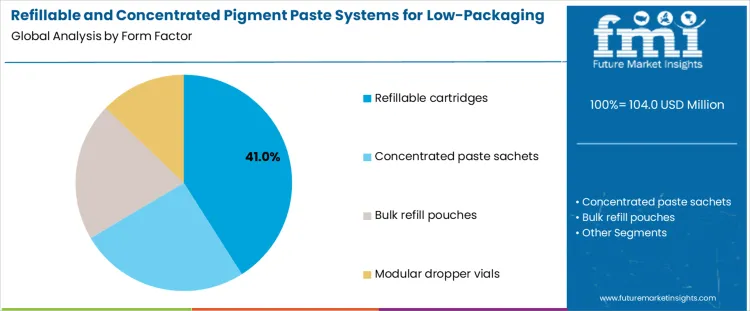
Refillable cartridges account for about 41% of demand because they balance material reduction with controlled dispensing and contamination prevention. These cartridges are designed for repeated use within closed or semi closed systems, supporting consistent colour delivery without exposure to air or moisture. Manufacturers favor cartridges because they integrate with automated or semi-automated dispensing equipment used in beauty, coatings, and ink preparation environments. Their rigid structure protects paste rheology and pigment dispersion during transport and storage.
Refillable cartridges also support standardized volumes, simplifying inventory planning and refill logistics across multiple locations. In professional settings, cartridges reduce handling errors and spillage risk, improving workplace safety and cleanliness. As brands and industrial users adopt circular packaging strategies, cartridges enable measurable packaging reduction without altering formulation chemistry. Concentrated paste sachets and bulk refill pouches reduce packaging weight but offer less dosing precision and higher handling variability. Modular dropper vials provide flexibility for small batch use but operate at lower volumes. Form factor leadership therefore reflects operational control, refill durability, and compatibility with repeat use systems rather than lowest packaging weight per unit alone.
What Is Driving Leadership by End Use Application in the Refillable and Concentrated Pigment Paste Systems Market?
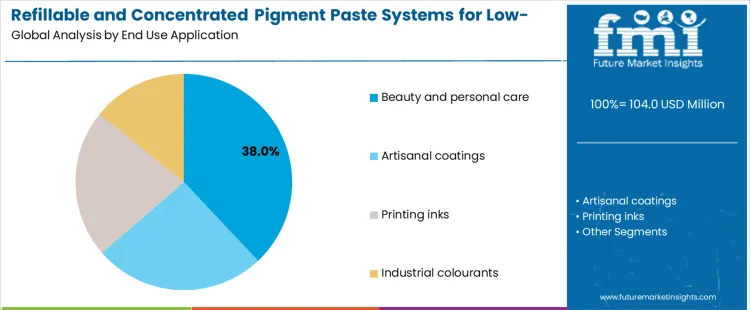
Beauty and personal care applications represent about 38% of demand because colour accuracy, hygiene, and refill convenience are critical in this sector. Pigment pastes used in cosmetics require precise dosing to maintain shade consistency across batches and refills. Refillable systems support brand sustainability claims while preserving product performance and user experience. High product turnover and frequent shade replenishment drive steady consumption of concentrated pigment pastes in this segment.
Professional salons and manufacturing facilities benefit from reduced packaging disposal and simplified storage. Artisanal coatings, printing inks, and industrial colourants contribute secondary demand. Artisanal users value flexibility but operate at smaller scale. Printing inks require bulk handling but prioritize speed over refill aesthetics. Industrial colourants focus on cost efficiency and robustness. These segments adopt refillable systems selectively based on workflow integration. End use leadership therefore reflects frequency of colour replenishment, sensitivity to dosing accuracy, and alignment with consumer facing sustainability expectations rather than total pigment volume consumed.
How Are Refillable and Concentrated Pigment Paste Systems Being Applied Across Low-Packaging Formats?
Use appears in cosmetics, personal care, and industrial coatings where small-format packaging and sustainable solutions are prioritized. Manufacturers adopt concentrated pigment pastes to reduce packaging volume, shipping weight, and waste while enabling refillable or modular systems. Brands integrate these pastes into foundations, lipsticks, eyeshadows, or coatings, allowing end-users or converters to dilute or mix pigments as needed. These applications reflect operational and environmental priorities rather than purely aesthetic objectives, with adoption driven by sustainability, cost efficiency, and flexibility in low-packaging product formats.
What Operational and Material Conditions Support Adoption of Refillable and Concentrated Pigment Pastes?
Selection aligns with substrates and formulations requiring high pigment load, consistent dispersion, and stability during storage and handling. Pastes are optimized for viscosity, particle size, and compatibility with oils, waxes, or binders to maintain color intensity and application properties. Manufacturing workflows monitor mixing, packaging, and sealing processes to prevent contamination and ensure uniformity. Quality control evaluates pigment concentration, stability, and performance upon dilution or blending. These conditions emerge from operational reliability, material performance, and sustainability priorities in structured low-packaging production workflows.
Which Practical Considerations Limit Wider Use of Refillable and Concentrated Pigment Pastes?
Higher formulation and handling requirements can limit adoption in small-scale or low-margin operations. Compatibility with multiple diluents, bases, or substrates must be validated to maintain performance. Precise dispensing, storage conditions, and contamination control are necessary to ensure quality. Regulatory approvals for food-contact or cosmetic applications differ by region. These factors lead to selective deployment where sustainability, pigment efficiency, and product flexibility justify incremental cost and process oversight in refillable or concentrated low-packaging systems.
What is the Demand for Refillable and Concentrated Pigment Paste Systems for Low Packaging Formats by Country?
| Country | CAGR (%) |
|---|---|
| USA | 8.1% |
| UK | 7.6% |
| China | 9.6% |
| India | 11.3% |
| Brazil | 9.1% |
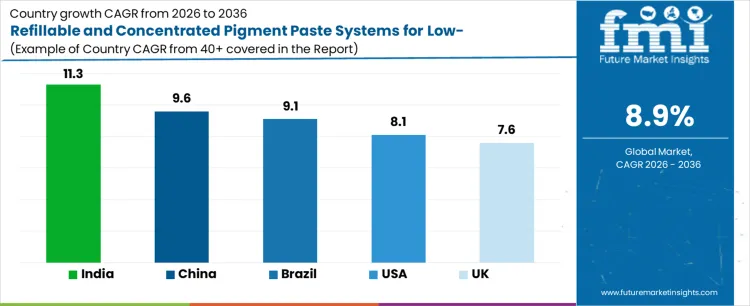
The demand for refillable and concentrated pigment paste systems for low packaging formats is rising across major cosmetic and personal care markets, driven by packaging reduction targets, supply chain efficiency, and formulation flexibility. India leads with an 11.3% CAGR, supported by rapid growth in cosmetics manufacturing, increasing adoption of refill based formats, and cost efficiency advantages in high volume production. China follows at 9.6%, reflecting large scale cosmetics output and brand focus on concentrated color systems to reduce logistics and packaging intensity. Brazil records 9.1%, shaped by strong beauty consumption and growing interest in refill compatible product designs. The USA grows at 8.1%, driven by brand initiatives to reduce packaging use and improve formulation efficiency. The UK posts 7.6%, supported by mature cosmetic markets and gradual adoption of concentrated pigment delivery systems.
How are refillable and concentrated pigment paste systems expanding low-packaging format applications in the United States?
In the United States, the refillable and concentrated pigment paste systems for low-packaging formats market is growing at a CAGR of 8.1% through 2036, driven by increasing demand for sustainable packaging, growth of compact cosmetics, and adoption of refillable product concepts. Manufacturers are using concentrated pastes to reduce packaging volume, improve color consistency, and maintain formulation stability. Demand is concentrated in industrial cosmetic hubs, formulation laboratories, and packaging facilities. Compared to China, adoption emphasizes regulatory compliance and premium brand positioning rather than high-volume deployment. Domestic suppliers provide high-performance, chemically stable pastes suitable for recurring formulation and packaging operations.
- Industrial cosmetic hubs, formulation laboratories, and packaging facilities drive adoption
- Pastes reduce packaging volume, maintain color consistency, and improve formulation stability
- Domestic suppliers provide high-performance, chemically stable solutions
- Recurring formulation and packaging operations sustain adoption
How are sustainability and product innovation driving growth in the United Kingdom?
In the United Kingdom, revenue is growing at a CAGR of 7.6% through 2036, supported by growing consumer awareness of refillable packaging, compact cosmetic formats, and sustainability initiatives. Manufacturers are integrating concentrated pigment pastes to reduce waste, maintain high-quality color performance, and enhance product convenience. Demand is concentrated in industrial formulation labs, cosmetic production centers, and packaging facilities. Compared to India, adoption emphasizes compliance with EU regulations and premium product quality over large-scale volume. Domestic suppliers provide chemically stable, high-quality pastes suitable for recurring formulation and packaging cycles.
- Industrial formulation labs, cosmetic production centers, and packaging facilities drive adoption
- Pastes reduce waste and maintain color performance
- Domestic suppliers provide chemically stable, high-quality solutions
- Recurring formulation and packaging cycles sustain adoption
How are large-scale cosmetic manufacturing and environmental standards driving adoption in China?
In China, the market is expanding at a CAGR of 9.6% through 2036, fueled by rapid growth in compact cosmetic products, urban retail expansion, and government sustainability initiatives. Manufacturers are adopting refillable and concentrated pigment pastes to ensure consistent color, reduce packaging materials, and comply with environmental regulations. Demand is concentrated in industrial cosmetic hubs, formulation laboratories, and packaging facilities. Compared to the UK, adoption emphasizes high-volume industrial integration and large-scale production. Domestic suppliers provide cost-effective, high-performance pastes suitable for recurring formulation, packaging, and quality inspection operations.
- Industrial cosmetic hubs, formulation laboratories, and packaging facilities drive adoption
- Pastes ensure consistent color, reduce packaging materials, and comply with regulations
- Domestic suppliers provide cost-effective, high-performance solutions
- Recurring formulation, packaging, and quality inspection operations sustain adoption
How are refillable packaging trends and industrial expansion driving growth in India?
In India, the market is growing at a CAGR of 11.3% through 2036, supported by increasing demand for compact and sustainable cosmetics, growing FMCG penetration, and consumer preference for refillable products. Manufacturers are integrating concentrated pigment pastes to enhance color consistency, reduce packaging footprint, and improve operational efficiency. Demand is concentrated in industrial cosmetic hubs, formulation labs, and packaging facilities. Compared to China, adoption emphasizes rapid high-volume deployment for domestic and export markets. Domestic suppliers provide high-performance, safe pastes suitable for recurring formulation, packaging, and inspection cycles.
- Industrial cosmetic hubs, formulation labs, and packaging facilities drive adoption
- Pastes enhance color consistency and reduce packaging footprint
- Domestic suppliers provide high-performance, safe solutions
- Recurring formulation, packaging, and inspection cycles sustain adoption
How are sustainable packaging initiatives and local brand growth supporting adoption in Brazil?
In Brazil, the market is expanding at a CAGR of 9.1% through 2036, fueled by rising demand for refillable cosmetics, urban retail expansion, and adoption of concentrated pigment technologies. Manufacturers are using pastes to reduce packaging material usage, maintain color quality, and enhance product convenience for low-packaging formats. Demand is concentrated in industrial cosmetic hubs, formulation laboratories, and packaging facilities. Compared to India, adoption emphasizes medium-scale production with strong integration for local and regional brands. Domestic suppliers provide cost-effective, high-performance pastes suitable for recurring formulation, production, and packaging operations.
- Industrial cosmetic hubs, formulation laboratories, and packaging facilities drive adoption
- Pastes reduce packaging materials and maintain color quality
- Domestic suppliers provide cost-effective, high-performance solutions
- Recurring formulation, production, and packaging operations sustain adoption
Which Strategic Approaches Define Competition in the Refillable and Concentrated Pigment Paste Systems for Low Packaging Formats Market?
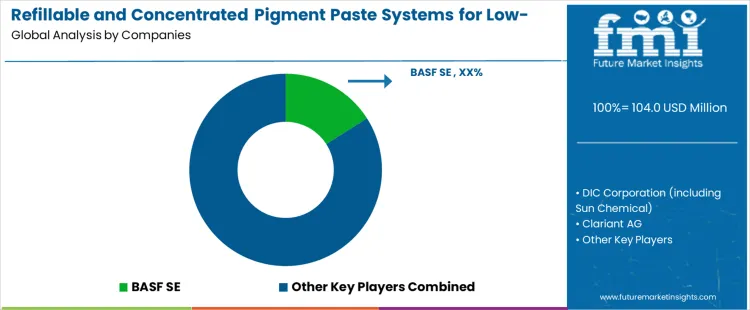
Competition in refillable and concentrated pigment paste systems is shaped by how effectively suppliers reduce packaging intensity without increasing formulation risk for cosmetic and personal care brands. BASF SE and Clariant AG approach this market through high strength pigment pastes engineered for dilution accuracy, allowing brands to transport and store concentrates while maintaining shade fidelity at point of use. Their strategies emphasize rheology control, shelf stability, and predictable redispersion, which are critical when pigments are reformulated or replenished in decentralized manufacturing or refill hubs. Merck KGaA applies its materials expertise to concentrated systems that preserve optical performance and texture after dilution, supporting premium refillable formats where visual consistency is closely scrutinized.
A different competitive emphasis is evident among suppliers closely aligned with brand scale and operational rollout. DIC Corporation, including Sun Chemical, positions concentrated pigment pastes around manufacturing robustness and global color reproducibility, enabling brands to deploy refill and concentrate models across regions without batch drift. Sensient Technologies Corporation competes through application specific paste systems tailored for low packaging concepts in foundations, lip products, and eye makeup, focusing on ease of handling and formulation flexibility. Across the market, strategies prioritize logistics efficiency, waste reduction, and formulation resilience. Competitive advantage is built through dilution reliability, color stability over multiple refill cycles, and the ability to support brands transitioning to low packaging formats without disrupting product performance or production speed.
Key Players in the Refillable and Concentrated Pigment Paste Systems for Low Packaging Formats Market
- BASF SE
- DIC Corporation (including Sun Chemical)
- Clariant AG
- Merck KGaA
- Sensient Technologies Corporation
Scope of the Report
| Items | Values |
|---|---|
| Quantitative Units | USD million |
| Type | Refillable cartridges, concentrated paste sachets, bulk refill pouches, modular dropper vials |
| Application | Low-packaging pigment delivery for refillable and concentrated color systems |
| End User | Cosmetic and personal care manufacturers, artisanal coatings producers, printing ink formulators, industrial colourant manufacturers |
| Regions Covered | Asia Pacific, Europe, North America, Latin America, Middle East & Africa |
| Countries Covered | India, China, USA, United Kingdom, Brazil, and other major cosmetic and colourant production markets |
| Key Companies Profiled | BASF SE, DIC Corporation (including Sun Chemical), Clariant AG, Merck KGaA, Sensient Technologies Corporation |
| Additional Attributes | Dollar sales by form factor and end-use application, regional adoption trends linked to refillable and low-packaging formats, competitive landscape based on paste concentration, rheology stability, and dosing accuracy, dispensing hardware compatibility and workflow integration requirements, formulation validation and refill-cycle performance considerations |
Refillable and Concentrated Pigment Paste Systems for Low Packaging Formats Market Segmentation
Form Factor:
- Refillable cartridges
- Concentrated paste sachets
- Bulk refill pouches
- Modular dropper vials
End Use Application:
- Beauty and personal care
- Artisanal coatings
- Printing inks
- Industrial colourants
Region
- Asia Pacific
- China
- Japan
- South Korea
- India
- Australia & New Zealand
- ASEAN
- Rest of Asia Pacific
- Europe
- Germany
- United Kingdom
- France
- Italy
- Spain
- Nordic
- BENELUX
- Rest of Europe
- North America
- United States
- Canada
- Mexico
- Latin America
- Brazil
- Chile
- Rest of Latin America
- Middle East & Africa
- Kingdom of Saudi Arabia
- Other GCC Countries
- Turkey
- South Africa
- Other African Union
- Rest of Middle East & Africa
Frequently Asked Questions
How big is the refillable and concentrated pigment paste systems for low-packaging formats market in 2026?
The global refillable and concentrated pigment paste systems for low-packaging formats market is estimated to be valued at USD 104.0 million in 2026.
What will be the size of refillable and concentrated pigment paste systems for low-packaging formats market in 2036?
The market size for the refillable and concentrated pigment paste systems for low-packaging formats market is projected to reach USD 244.0 million by 2036.
How much will be the refillable and concentrated pigment paste systems for low-packaging formats market growth between 2026 and 2036?
The refillable and concentrated pigment paste systems for low-packaging formats market is expected to grow at a 8.9% CAGR between 2026 and 2036.
What are the key product types in the refillable and concentrated pigment paste systems for low-packaging formats market?
The key product types in refillable and concentrated pigment paste systems for low-packaging formats market are refillable cartridges , concentrated paste sachets, bulk refill pouches and modular dropper vials.
Which end use application segment to contribute significant share in the refillable and concentrated pigment paste systems for low-packaging formats market in 2026?
In terms of end use application, beauty and personal care segment to command 38.0% share in the refillable and concentrated pigment paste systems for low-packaging formats market in 2026.
Preview the report firsthand - request a free sample
Get SampleGet the brochure for pricing and purchase details.
Get PDFTable of Content
- Executive Summary
- Global Market Outlook
- Demand-side Trends
- Supply-side Trends
- Technology Roadmap Analysis
- Analysis and Recommendations
- Market Overview
- Market Coverage / Taxonomy
- Market Definition / Scope / Limitations
- Market Background
- Market Dynamics
- Drivers
- Restraints
- Opportunity
- Trends
- Scenario Forecast
- Demand in Optimistic Scenario
- Demand in Likely Scenario
- Demand in Conservative Scenario
- Opportunity Map Analysis
- Product Life Cycle Analysis
- Supply Chain Analysis
- Investment Feasibility Matrix
- Value Chain Analysis
- PESTLE and Porter’s Analysis
- Regulatory Landscape
- Regional Parent Market Outlook
- Production and Consumption Statistics
- Import and Export Statistics
- Market Dynamics
- Global Market Analysis 2021 to 2025 and Forecast, 2026 to 2036
- Historical Market Size Value (USD Million) Analysis, 2021 to 2025
- Current and Future Market Size Value (USD Million) Projections, 2026 to 2036
- Y-o-Y Growth Trend Analysis
- Absolute $ Opportunity Analysis
- Global Market Pricing Analysis 2021 to 2025 and Forecast 2026 to 2036
- Global Market Analysis 2021 to 2025 and Forecast 2026 to 2036, By Form Factor
- Introduction / Key Findings
- Historical Market Size Value (USD Million) Analysis By Form Factor , 2021 to 2025
- Current and Future Market Size Value (USD Million) Analysis and Forecast By Form Factor , 2026 to 2036
- Refillable cartridges
- Concentrated paste sachets
- Bulk refill pouches
- Modular dropper vials
- Refillable cartridges
- Y-o-Y Growth Trend Analysis By Form Factor , 2021 to 2025
- Absolute $ Opportunity Analysis By Form Factor , 2026 to 2036
- Global Market Analysis 2021 to 2025 and Forecast 2026 to 2036, By End Use Application
- Introduction / Key Findings
- Historical Market Size Value (USD Million) Analysis By End Use Application, 2021 to 2025
- Current and Future Market Size Value (USD Million) Analysis and Forecast By End Use Application, 2026 to 2036
- Beauty and personal care
- Artisanal coatings
- Printing inks
- Industrial colourants
- Beauty and personal care
- Y-o-Y Growth Trend Analysis By End Use Application, 2021 to 2025
- Absolute $ Opportunity Analysis By End Use Application, 2026 to 2036
- Global Market Analysis 2021 to 2025 and Forecast 2026 to 2036, By Region
- Introduction
- Historical Market Size Value (USD Million) Analysis By Region, 2021 to 2025
- Current Market Size Value (USD Million) Analysis and Forecast By Region, 2026 to 2036
- North America
- Latin America
- Western Europe
- Eastern Europe
- East Asia
- South Asia and Pacific
- Middle East & Africa
- Market Attractiveness Analysis By Region
- North America Market Analysis 2021 to 2025 and Forecast 2026 to 2036, By Country
- Historical Market Size Value (USD Million) Trend Analysis By Market Taxonomy, 2021 to 2025
- Market Size Value (USD Million) Forecast By Market Taxonomy, 2026 to 2036
- By Country
- USA
- Canada
- Mexico
- By Form Factor
- By End Use Application
- By Country
- Market Attractiveness Analysis
- By Country
- By Form Factor
- By End Use Application
- Key Takeaways
- Latin America Market Analysis 2021 to 2025 and Forecast 2026 to 2036, By Country
- Historical Market Size Value (USD Million) Trend Analysis By Market Taxonomy, 2021 to 2025
- Market Size Value (USD Million) Forecast By Market Taxonomy, 2026 to 2036
- By Country
- Brazil
- Chile
- Rest of Latin America
- By Form Factor
- By End Use Application
- By Country
- Market Attractiveness Analysis
- By Country
- By Form Factor
- By End Use Application
- Key Takeaways
- Western Europe Market Analysis 2021 to 2025 and Forecast 2026 to 2036, By Country
- Historical Market Size Value (USD Million) Trend Analysis By Market Taxonomy, 2021 to 2025
- Market Size Value (USD Million) Forecast By Market Taxonomy, 2026 to 2036
- By Country
- Germany
- UK
- Italy
- Spain
- France
- Nordic
- BENELUX
- Rest of Western Europe
- By Form Factor
- By End Use Application
- By Country
- Market Attractiveness Analysis
- By Country
- By Form Factor
- By End Use Application
- Key Takeaways
- Eastern Europe Market Analysis 2021 to 2025 and Forecast 2026 to 2036, By Country
- Historical Market Size Value (USD Million) Trend Analysis By Market Taxonomy, 2021 to 2025
- Market Size Value (USD Million) Forecast By Market Taxonomy, 2026 to 2036
- By Country
- Russia
- Poland
- Hungary
- Balkan & Baltic
- Rest of Eastern Europe
- By Form Factor
- By End Use Application
- By Country
- Market Attractiveness Analysis
- By Country
- By Form Factor
- By End Use Application
- Key Takeaways
- East Asia Market Analysis 2021 to 2025 and Forecast 2026 to 2036, By Country
- Historical Market Size Value (USD Million) Trend Analysis By Market Taxonomy, 2021 to 2025
- Market Size Value (USD Million) Forecast By Market Taxonomy, 2026 to 2036
- By Country
- China
- Japan
- South Korea
- By Form Factor
- By End Use Application
- By Country
- Market Attractiveness Analysis
- By Country
- By Form Factor
- By End Use Application
- Key Takeaways
- South Asia and Pacific Market Analysis 2021 to 2025 and Forecast 2026 to 2036, By Country
- Historical Market Size Value (USD Million) Trend Analysis By Market Taxonomy, 2021 to 2025
- Market Size Value (USD Million) Forecast By Market Taxonomy, 2026 to 2036
- By Country
- India
- ASEAN
- Australia & New Zealand
- Rest of South Asia and Pacific
- By Form Factor
- By End Use Application
- By Country
- Market Attractiveness Analysis
- By Country
- By Form Factor
- By End Use Application
- Key Takeaways
- Middle East & Africa Market Analysis 2021 to 2025 and Forecast 2026 to 2036, By Country
- Historical Market Size Value (USD Million) Trend Analysis By Market Taxonomy, 2021 to 2025
- Market Size Value (USD Million) Forecast By Market Taxonomy, 2026 to 2036
- By Country
- Kingdom of Saudi Arabia
- Other GCC Countries
- Turkiye
- South Africa
- Other African Union
- Rest of Middle East & Africa
- By Form Factor
- By End Use Application
- By Country
- Market Attractiveness Analysis
- By Country
- By Form Factor
- By End Use Application
- Key Takeaways
- Key Countries Market Analysis
- USA
- Pricing Analysis
- Market Share Analysis, 2025
- By Form Factor
- By End Use Application
- Canada
- Pricing Analysis
- Market Share Analysis, 2025
- By Form Factor
- By End Use Application
- Mexico
- Pricing Analysis
- Market Share Analysis, 2025
- By Form Factor
- By End Use Application
- Brazil
- Pricing Analysis
- Market Share Analysis, 2025
- By Form Factor
- By End Use Application
- Chile
- Pricing Analysis
- Market Share Analysis, 2025
- By Form Factor
- By End Use Application
- Germany
- Pricing Analysis
- Market Share Analysis, 2025
- By Form Factor
- By End Use Application
- UK
- Pricing Analysis
- Market Share Analysis, 2025
- By Form Factor
- By End Use Application
- Italy
- Pricing Analysis
- Market Share Analysis, 2025
- By Form Factor
- By End Use Application
- Spain
- Pricing Analysis
- Market Share Analysis, 2025
- By Form Factor
- By End Use Application
- France
- Pricing Analysis
- Market Share Analysis, 2025
- By Form Factor
- By End Use Application
- India
- Pricing Analysis
- Market Share Analysis, 2025
- By Form Factor
- By End Use Application
- ASEAN
- Pricing Analysis
- Market Share Analysis, 2025
- By Form Factor
- By End Use Application
- Australia & New Zealand
- Pricing Analysis
- Market Share Analysis, 2025
- By Form Factor
- By End Use Application
- China
- Pricing Analysis
- Market Share Analysis, 2025
- By Form Factor
- By End Use Application
- Japan
- Pricing Analysis
- Market Share Analysis, 2025
- By Form Factor
- By End Use Application
- South Korea
- Pricing Analysis
- Market Share Analysis, 2025
- By Form Factor
- By End Use Application
- Russia
- Pricing Analysis
- Market Share Analysis, 2025
- By Form Factor
- By End Use Application
- Poland
- Pricing Analysis
- Market Share Analysis, 2025
- By Form Factor
- By End Use Application
- Hungary
- Pricing Analysis
- Market Share Analysis, 2025
- By Form Factor
- By End Use Application
- Kingdom of Saudi Arabia
- Pricing Analysis
- Market Share Analysis, 2025
- By Form Factor
- By End Use Application
- Turkiye
- Pricing Analysis
- Market Share Analysis, 2025
- By Form Factor
- By End Use Application
- South Africa
- Pricing Analysis
- Market Share Analysis, 2025
- By Form Factor
- By End Use Application
- USA
- Market Structure Analysis
- Competition Dashboard
- Competition Benchmarking
- Market Share Analysis of Top Players
- By Regional
- By Form Factor
- By End Use Application
- Competition Analysis
- Competition Deep Dive
- BASF SE
- Overview
- Product Portfolio
- Profitability by Market Segments (Product/Age /Sales Channel/Region)
- Sales Footprint
- Strategy Overview
- Marketing Strategy
- Product Strategy
- Channel Strategy
- DIC Corporation (including Sun Chemical)
- Clariant AG
- Merck KGaA
- Sensient Technologies Corporation
- BASF SE
- Competition Deep Dive
- Assumptions & Acronyms Used
- Research Methodology


