

- Industry Size (2026)
- USD 255.0 Mn
- Forecast (2036)
- USD 692.1 Mn
- CAGR (2026 to 2036)
- 10.5%
Ocean-Safe Pigment Systems for Reef-Safe Tinted Suncare Market Forecast and Outlook 2026 to 2036
The ocean-safe pigment systems for reef-safe tinted suncare market is valued at USD 255.0 million in 2026 and is forecasted to reach USD 692.1 million by 2036, reflecting a CAGR of 10.5%. Market behavior across this period is shaped by regulatory exposure and formulation substitution rather than expansion in overall sunscreen usage. Tinted suncare products face higher scrutiny because pigments interact directly with UV filters and remain on skin during marine exposure. Demand concentrates in facial sunscreens and daily UV moisturizers, where pigment selection influences both reef-safe compliance and cosmetic acceptability. Value accrues to pigment systems specified early in development cycles, reducing reformulation risk linked to evolving coastal and tourism-driven regulations.
Adoption patterns remain closely tied to application criticality and geographic enforcement intensity. Facial products dominate usage because shade correction, photostability, and visible-light protection must align with mineral-only UV systems. Water-resistant formulations follow, driven by outdoor recreation and beach use, where pigment wash-off and environmental dispersion remain under observation. Baby and sensitive-skin suncare integrates ocean-safe pigments selectively, prioritizing purity and low reactivity over shade breadth. Demand stability remains strongest in regions with active reef protection policies and high sunscreen usage frequency. Growth quality remains anchored in daily-use tinted suncare platforms embedded into long-term regulatory strategies, rather than seasonal launches or short-cycle sun care trends.
Quick Stats for Ocean-Safe Pigment Systems for Reef-Safe Tinted Suncare Market
- Ocean-Safe Pigment Systems for Reef-Safe Tinted Suncare Market Value (2026): USD 255.0 million
- Ocean-Safe Pigment Systems for Reef-Safe Tinted Suncare Market Forecast Value (2036): USD 692.1 million
- Forecast CAGR (2026–2036): 10.5%
- Leading Pigment System Type in Global Demand: Non-Nano Mineral Pigments (ZnO, TiO₂)
- Fastest-Growing Countries: India, China, Australia, USA, Brazil
- Key Players in Global Demand: Sensient Technologies, Clariant AG, BASF SE, DSM-Firmenich, Sun Chemical
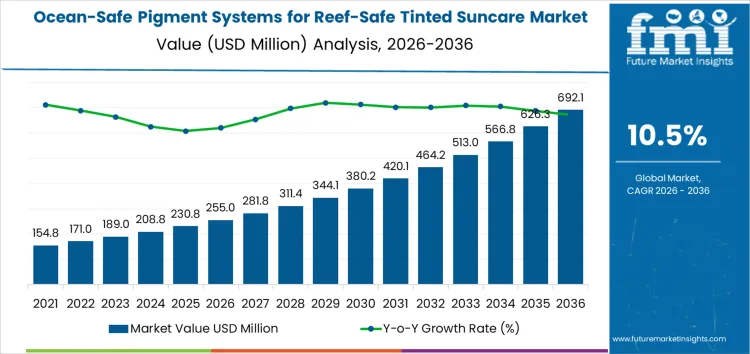
Ocean-Safe Pigment Systems for Reef-Safe Tinted Suncare Market Key Takeaways
| Metric | Value |
|---|---|
| Market Value (2026) | USD 255.0 million |
| Market Forecast Value (2036) | USD 692.1 million |
| Forecast CAGR (2026-2036) | 10.5% |
Why is the Demand for Ocean-Safe Pigment Systems for Reef-Safe Tinted Suncare Market Growing?
Demand for ocean-safe pigment systems for reef-safe tinted suncare products is growing globally due to rising environmental awareness, regulatory restrictions on harmful UV filters and colorants, and consumer preference for formulations that protect marine ecosystems. Reef-safe criteria discourage or prohibit ingredients associated with coral bleaching, toxicity to aquatic life, or persistence in marine environments, which motivates sunscreen and tinted suncare manufacturers to adopt pigment systems that meet defined eco-friendly standards. Ocean-safe pigment systems typically rely on mineral and bio-based colorants with minimal environmental impact, high dispersion uniformity, and compatibility with broad spectrum UV protection formulations.
Regulatory frameworks in multiple regions restrict use of specific chemical UV filters and related additives, reinforcing use of compliant pigment technologies across global cosmetic portfolios. Beach and water sports culture increases demand for tinted suncare products that deliver aesthetic and protective performance while avoiding ingredients linked to ecological harm. Research and formulation innovation improve light scattering, skin tone matching, and photostability of pigments without compromising reef-safe criteria. Brand strategies that emphasize sustainability, ingredient transparency, and responsible sourcing further support adoption. Retail expansion through specialty skincare, travel retail, and digital channels increases accessibility for consumers seeking high performance reef-safe tinted suncare solutions.
How Is the Ocean-Safe Pigment Systems for Reef-Safe Tinted Suncare Market Structured?
Demand for ocean-safe pigment systems in reef-safe tinted suncare is driven by global restrictions on coral-harming UV filters, heightened environmental scrutiny of sunscreen runoff, and growing consumer preference for mineral-based sun protection. Cosmetic and suncare brands prioritize pigments that ensure UV stability, visible-light protection, and skin-tone compatibility while minimizing ecological impact. Segment structure reflects how mineral chemistry, formulation compatibility, and end-use applications determine performance, regulatory acceptance, and environmental compliance across global suncare portfolios.
Which Pigment System Type Represents the Largest Share of Global Demand?
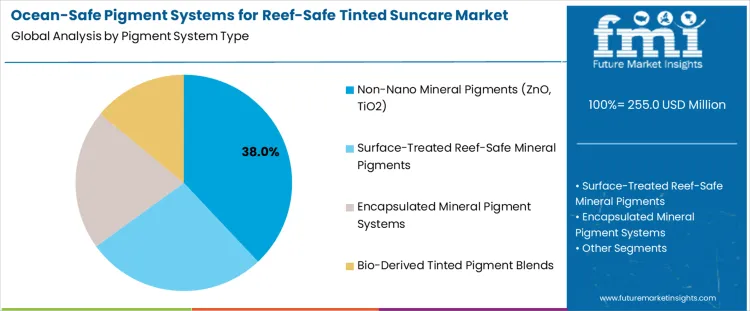
Non-nano mineral pigments based on zinc oxide and titanium dioxide account for 38.0%, representing the largest share of global demand. These pigments comply with reef-safe positioning by avoiding nano-sized particles and providing broad-spectrum UV protection with low aquatic toxicity. Surface-treated reef-safe mineral pigments follow at 27.0%, supported by improved dispersion, reduced whitening, and enhanced cosmetic elegance. Encapsulated mineral pigment systems hold 21.0%, enabling controlled release, photostability, and reduced interaction with sensitive skin. Bio-derived tinted pigment blends represent 14.0%, reflecting early-stage adoption of naturally sourced colorants for eco-positioned formulations.
Segment Insights
- Non-nano minerals lead due to regulatory clarity and reef-safe acceptance
- Surface treatments improve aesthetics without compromising safety
- Encapsulation supports stability and skin compatibility
Which Formulation Compatibility Segment Drives the Most Demand Globally?
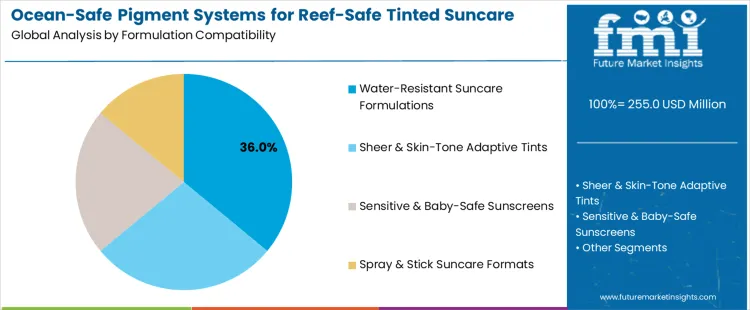
Water-resistant suncare formulations account for 36.0%, making them the leading compatibility segment globally. These formulations require pigments that remain stable during prolonged water exposure while limiting environmental dispersion. Sheer and skin-tone adaptive tints follow at 28.0%, driven by demand for inclusive shade ranges and reduced white cast. Sensitive and baby-safe sunscreen formulations represent 22.0%, emphasizing low irritation and minimal ingredient interaction. Spray and stick suncare formats hold 14.0%, constrained by formulation complexity and delivery limitations.
Segment Insights
- Water resistance dominates due to outdoor and marine exposure use cases
- Adaptive tints support cosmetic acceptance across skin tones
- Baby-safe formats prioritize purity and low reactivity
Which Application Segment Accounts for the Highest Global Demand?
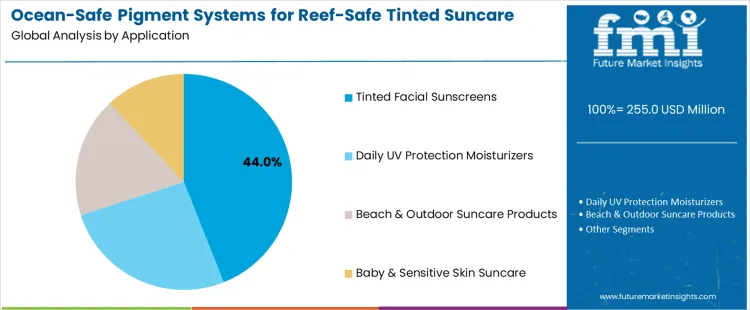
Tinted facial sunscreens hold 44.0%, making them the largest application segment globally. Daily-use facial products require reef-safe pigments that combine UV protection with cosmetic coverage and skin comfort. Daily UV protection moisturizers follow at 26.0%, integrating tinted pigments into multifunctional skincare formats. Beach and outdoor suncare products account for 18.0%, driven by recreational and travel usage. Baby and sensitive skin suncare represents 12.0%, reflecting cautious adoption tied to stringent safety requirements.
Segment Insights
- Facial sunscreens lead due to daily wear and cosmetic integration
- Moisturizer hybrids support multifunctional product strategies
- Baby applications emphasize safety over aesthetic performance
What are the Key Dynamics in the Ocean-Safe Pigment Systems for Reef-Safe Tinted Suncare Market?
Global demand rises as manufacturers of tinted suncare and sunscreen products adopt pigment systems formulated to avoid ingredients linked to coral reef harm and marine ecosystem impact. Ocean-safe pigments are selected to comply with environmental standards, support broad-spectrum UV protection, and maintain aesthetic performance in formulations. Adoption aligns with tightening regulations on reef impact, growing consumer preference for environmentally responsible personal care, and industry initiatives to reduce chemical stressors on aquatic habitats. Usage spans daily-use tinted sunscreens, sport-focused sun protection, and multifunctional skincare with color benefits.
How do environmental regulations and marine conservation priorities shape adoption?
Regulatory actions in North America, Europe, Asia-Pacific, and island nations restrict or evaluate use of UV filters and pigment components associated with coral bleaching and marine toxicity. Brands respond by specifying pigment systems that avoid ecotoxicological concern and meet criteria for biodegradable or low-impact performance in marine environments. Cosmetic formulators balance aesthetic attributes such as tint shade, dispersion quality, and skin feel with ingredient safety profiles. Retailers and sustainability certification schemes emphasize transparency and compliance with reef-safe criteria in product labeling. Public awareness campaigns highlighting sunscreen impact on coral reefs reinforce consumer demand for ocean-safe alternatives that align with conservation objectives and responsible recreation.
How do performance expectations, cost factors, and regulatory variation influence market scalability?
Ocean-safe pigment systems must deliver color payoff, stability, and compatibility with UV filters without compromising SPF efficacy or formulation integrity. Performance trade-offs may arise when replacing legacy pigments with compliant alternatives, requiring targeted formulation development and testing. Cost differentials relative to conventional pigments affect sourcing decisions, especially in value-oriented product segments. Raw material availability for compliant pigment chemistries varies by region, influencing pricing and supply stability. Regulatory definitions of reef-safe and allowable ingredients differ across jurisdictions, creating complexity in global product rollout and labeling consistency. Long-term market growth depends on continued innovation that balances ocean safety with cosmetic performance and harmonized standards that support broad adoption of reef-conscious pigment systems in tinted suncare worldwide.
How Is Demand for Ocean-Safe Pigment Systems for Reef-Safe Tinted Suncare Evolving?
Demand for ocean-safe pigment systems for reef-safe tinted suncare is increasing globally due to coastal ecosystem protection rules, tourism-linked sunscreen regulation, and consumer avoidance of harmful UV filter interactions. India leads with an 11.1% CAGR, supported by expanding suncare consumption and export-oriented formulation upgrades. China follows at 10.8%, driven by scale manufacturing and compliance with international reef-safe standards.
Australia records 10.6%, reflecting strict marine protection policies and coastal tourism exposure. USA posts a 10.2% CAGR, shaped by state-level reef-safe legislation and dermatologist-backed product positioning. Brazil records 9.9%, supported by beach culture intensity and growing awareness of marine-safe personal care. Growth reflects integration of mineral-safe pigments aligned with ecological risk reduction.
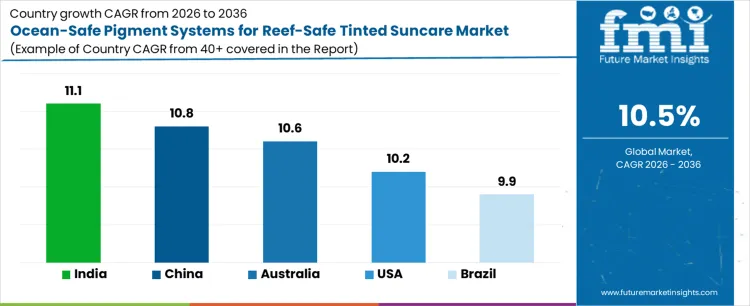
| Country | CAGR (%) |
|---|---|
| India | 11.1% |
| China | 10.8% |
| Australia | 10.6% |
| USA | 10.2% |
| Brazil | 9.9% |
What factors are driving strong adoption of ocean-safe pigment systems in India?
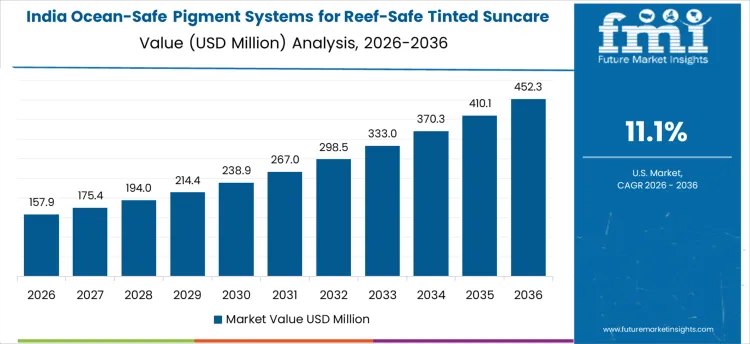
India demand is driven by growth in tinted sunscreen usage, rising UV exposure awareness, and export requirements for reef-safe formulations. CAGR of 11.1% reflects substitution of conventional coated pigments with ocean-safe mineral pigments that avoid coral toxicity risks. Manufacturers prioritize iron oxides and titanium dioxide grades with controlled surface treatments and low aquatic impact. Export-oriented brands align formulations with international reef-safe definitions to access global retail channels. Regulatory scrutiny on sunscreen ingredients increases documentation requirements. Growth remains consumption-led and compliance-aligned, supported by expanding personal care manufacturing and climate-driven sun protection needs.
- Expansion of tinted sunscreen and hybrid makeup products
- Export compliance with reef-safe formulation standards
- Use of mineral pigments with controlled surface treatment
- Rising UV exposure awareness across consumer segments
How is China sustaining high growth in reef-safe pigment system adoption?
China demand reflects large-scale suncare manufacturing and alignment with international cosmetic compliance. CAGR of 10.8% is supported by reformulation of tinted sunscreens using ocean-safe pigment systems compatible with mineral UV filters. Export manufacturing for global brands accelerates adoption of compliant pigments. Domestic suppliers invest in pigment purification and dispersion stability to meet reef-safe performance requirements. E-commerce platforms increase consumer scrutiny of environmental claims. Growth remains scale-driven and compliance-focused, supported by manufacturing depth and export dependency.
- Large-scale suncare and tinted sunscreen manufacturing
- Export-driven compliance with reef-safe standards
- Investment in pigment purity and dispersion stability
- Rising scrutiny of environmental safety claims
What supports Australia’s strong growth in ocean-safe pigment demand?
Australia demand is shaped by stringent marine conservation policies and high sunscreen usage intensity. CAGR of 10.6% reflects mandatory reformulation away from reef-harming substances in coastal regions. Tinted suncare products adopt ocean-safe pigments to ensure compatibility with mineral-only UV systems. Dermatologist and regulatory endorsement influence product development. Tourism-linked sunscreen regulation accelerates compliance timelines. Growth remains regulation-led and safety-driven, aligned with reef protection priorities and high public awareness.
- Strict coastal and reef protection regulations
- High sunscreen usage due to UV intensity
- Preference for mineral-only reef-safe systems
- Strong regulatory and medical endorsement influence
What factors shape demand growth in the USA for reef-safe tinted suncare pigments?
USA demand is driven by state-level reef-safe sunscreen laws, consumer advocacy, and dermatological guidance. CAGR of 10.2% reflects adoption of ocean-safe pigment systems in tinted sunscreens and daily wear SPF products. Brands reformulate to avoid pigments and coatings associated with aquatic toxicity. Retailers require substantiated reef-safe claims. Product performance must balance shade coverage, UV protection, and environmental safety. Growth remains brand-led and compliance-focused, aligned with regulatory fragmentation and consumer trust requirements.
- State-level reef-safe sunscreen legislation
- Retail enforcement of substantiated environmental claims
- Integration with daily wear tinted SPF products
- Balance of cosmetic coverage and ecological safety
Why is Brazil showing steady growth in ocean-safe pigment systems?
Brazil demand reflects strong beach culture, high sun exposure, and rising environmental awareness. CAGR of 9.9% is supported by expansion of tinted suncare usage in daily routines. Consumers value products combining complexion correction with reef-safe positioning. Regulatory alignment with international cosmetic safety standards influences formulation choices. Domestic brands introduce ocean-safe pigment systems to differentiate in competitive markets. Growth remains usage-driven and product-focused, supported by climate conditions and increasing sustainability awareness.
- High frequency of sunscreen usage in coastal regions
- Growth of tinted daily-use suncare products
- Alignment with international reef-safe standards
- Differentiation through environmental safety positioning
What is the competitive landscape of demand for ocean-safe pigment systems for reef-safe tinted suncare?
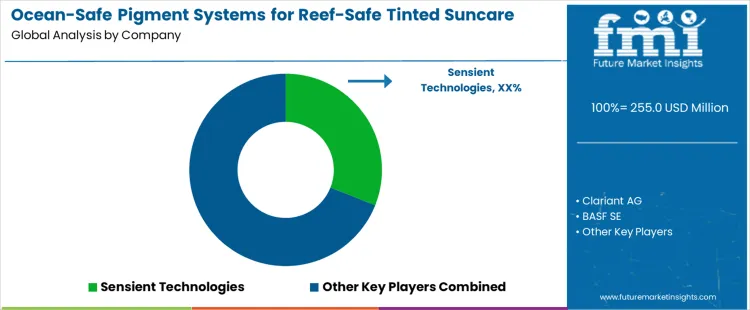
Demand for ocean-safe pigment systems for reef-safe tinted suncare is driven by sunscreen ingredient regulations, marine ecosystem protection policies, and brand commitments to reef-safe claims. Tinted suncare formulations require mineral and hybrid pigments that deliver uniform skin tone correction while avoiding ingredients linked to coral toxicity or bioaccumulation. Buyers evaluate pigment purity, photostability, UV interaction behavior, dispersion quality, and compatibility with zinc oxide and titanium dioxide systems. Procurement teams prioritize suppliers with verified reef-safe declarations, low aquatic toxicity data, and compliance with evolving regional sunscreen regulations. Trend in the global market reflects increased scrutiny of rinse-off and leave-on sun products and expansion of mineral-based tinted sunscreen portfolios.
Sensient Technologies maintains leading positioning through high-purity inorganic and treated pigment systems designed for reef-safe and mineral suncare formulations. Clariant AG supplies cosmetic-grade pigments and surface-treated systems optimized for stability and skin feel in tinted sunscreens. BASF SE contributes pigment technologies and formulation support aligned with reef-safe mineral UV systems and global regulatory frameworks. DSM-Firmenich supports demand through color and formulation science capabilities linked to sun care performance and safety validation. Sun Chemical, part of DIC Group, provides large-scale pigment dispersions suitable for reef-safe tinted suncare products distributed globally. Competitive differentiation depends on pigment purity, aquatic safety documentation, formulation compatibility with UV filters, and ability to support global brand compliance requirements.
Key Players in the Ocean-Safe Pigment Systems for Reef-Safe Tinted Suncare Market
- Sensient Technologies
- Clariant AG
- BASF SE
- DSM-Firmenich
- Sun Chemical (DIC Group)
Scope of the Report
| Items | Values |
|---|---|
| Quantitative Units | USD million |
| Pigment System Type | Non-Nano Mineral Pigments (ZnO, TiO₂); Surface-Treated Reef-Safe Mineral Pigments; Encapsulated Mineral Pigment Systems; Bio-Derived Tinted Pigment Blends |
| Formulation Compatibility | Water-Resistant Suncare Formulations; Sheer & Skin-Tone Adaptive Tints; Sensitive & Baby-Safe Sunscreens; Spray & Stick Suncare Formats |
| Application | Tinted Facial Sunscreens; Daily UV Protection Moisturizers; Beach & Outdoor Suncare Products; Baby & Sensitive Skin Suncare |
| Regions Covered | Asia Pacific, Europe, North America, Latin America, Middle East & Africa |
| Countries Covered | India, China, Australia, USA, Brazil, and 40+ countries |
| Key Companies Profiled | Sensient Technologies; Clariant AG; BASF SE; DSM-Firmenich; Sun Chemical |
| Additional Attributes | Dollar sales by pigment system type and formulation compatibility; adoption trends for reef-safe and non-nano mineral pigment technologies in tinted suncare; UV attenuation, visible light protection, and shade uniformity performance metrics; compatibility with water-resistant and sensitive-skin suncare bases; particle size control, coating durability, and dispersion stability considerations; compliance with reef-safe claims, regional sunscreen regulations, and cosmetic safety standards influencing ocean-safe pigment selection. |
Ocean-Safe Pigment Systems for Reef-Safe Tinted Suncare Market by Segment
Pigment System Type:
- Non-Nano Mineral Pigments (ZnO, TiO₂)
- Surface-Treated Reef-Safe Mineral Pigments
- Encapsulated Mineral Pigment Systems
- Bio-Derived Tinted Pigment Blends
Formulation Compatibility:
- Water-Resistant Suncare Formulations
- Sheer & Skin-Tone Adaptive Tints
- Sensitive & Baby-Safe Sunscreens
- Spray & Stick Suncare Formats
Application:
- Tinted Facial Sunscreens
- Daily UV Protection Moisturizers
- Beach & Outdoor Suncare Products
- Baby & Sensitive Skin Suncare
Region:
- Asia Pacific
- China
- Japan
- South Korea
- India
- Australia & New Zealand
- ASEAN
- Rest of Asia Pacific
- Europe
- Germany
- United Kingdom
- France
- Italy
- Spain
- Nordic
- BENELUX
- Rest of Europe
- North America
- United States
- Canada
- Mexico
- Latin America
- Brazil
- Chile
- Rest of Latin America
- Middle East & Africa
- Kingdom of Saudi Arabia
- Other GCC Countries
- Turkey
- South Africa
- Other African Union
- Rest of Middle East & Africa
Frequently Asked Questions
How big is the ocean-safe pigment systems for reef-safe tinted suncare market in 2026?
The global ocean-safe pigment systems for reef-safe tinted suncare market is estimated to be valued at USD 255.0 million in 2026.
What will be the size of ocean-safe pigment systems for reef-safe tinted suncare market in 2036?
The market size for the ocean-safe pigment systems for reef-safe tinted suncare market is projected to reach USD 692.1 million by 2036.
How much will be the ocean-safe pigment systems for reef-safe tinted suncare market growth between 2026 and 2036?
The ocean-safe pigment systems for reef-safe tinted suncare market is expected to grow at a 10.5% CAGR between 2026 and 2036.
What are the key product types in the ocean-safe pigment systems for reef-safe tinted suncare market?
The key product types in ocean-safe pigment systems for reef-safe tinted suncare market are non-nano mineral pigments (zno, tio2), surface-treated reef-safe mineral pigments, encapsulated mineral pigment systems and bio-derived tinted pigment blends.
Which formulation compatibility segment to contribute significant share in the ocean-safe pigment systems for reef-safe tinted suncare market in 2026?
In terms of formulation compatibility, water-resistant suncare formulations segment to command 36.0% share in the ocean-safe pigment systems for reef-safe tinted suncare market in 2026.
Preview the report firsthand - request a free sample
Get SampleGet the brochure for pricing and purchase details.
Get PDFTable of Content
- Executive Summary
- Global Market Outlook
- Demand-side Trends
- Supply-side Trends
- Technology Roadmap Analysis
- Analysis and Recommendations
- Market Overview
- Market Coverage / Taxonomy
- Market Definition / Scope / Limitations
- Market Background
- Market Dynamics
- Drivers
- Restraints
- Opportunity
- Trends
- Scenario Forecast
- Demand in Optimistic Scenario
- Demand in Likely Scenario
- Demand in Conservative Scenario
- Opportunity Map Analysis
- Product Life Cycle Analysis
- Supply Chain Analysis
- Investment Feasibility Matrix
- Value Chain Analysis
- PESTLE and Porter’s Analysis
- Regulatory Landscape
- Regional Parent Market Outlook
- Production and Consumption Statistics
- Import and Export Statistics
- Market Dynamics
- Global Market Analysis 2021 to 2025 and Forecast, 2026 to 2036
- Historical Market Size Value (USD Million) Analysis, 2021 to 2025
- Current and Future Market Size Value (USD Million) Projections, 2026 to 2036
- Y-o-Y Growth Trend Analysis
- Absolute $ Opportunity Analysis
- Global Market Pricing Analysis 2021 to 2025 and Forecast 2026 to 2036
- Global Market Analysis 2021 to 2025 and Forecast 2026 to 2036, By Pigment System Type
- Introduction / Key Findings
- Historical Market Size Value (USD Million) Analysis By Pigment System Type , 2021 to 2025
- Current and Future Market Size Value (USD Million) Analysis and Forecast By Pigment System Type , 2026 to 2036
- Non-Nano Mineral Pigments (ZnO, TiO2)
- Surface-Treated Reef-Safe Mineral Pigments
- Encapsulated Mineral Pigment Systems
- Bio-Derived Tinted Pigment Blends
- Non-Nano Mineral Pigments (ZnO, TiO2)
- Y-o-Y Growth Trend Analysis By Pigment System Type , 2021 to 2025
- Absolute $ Opportunity Analysis By Pigment System Type , 2026 to 2036
- Global Market Analysis 2021 to 2025 and Forecast 2026 to 2036, By Formulation Compatibility
- Introduction / Key Findings
- Historical Market Size Value (USD Million) Analysis By Formulation Compatibility, 2021 to 2025
- Current and Future Market Size Value (USD Million) Analysis and Forecast By Formulation Compatibility, 2026 to 2036
- Water-Resistant Suncare Formulations
- Sheer & Skin-Tone Adaptive Tints
- Sensitive & Baby-Safe Sunscreens
- Spray & Stick Suncare Formats
- Water-Resistant Suncare Formulations
- Y-o-Y Growth Trend Analysis By Formulation Compatibility, 2021 to 2025
- Absolute $ Opportunity Analysis By Formulation Compatibility, 2026 to 2036
- Global Market Analysis 2021 to 2025 and Forecast 2026 to 2036, By Application
- Introduction / Key Findings
- Historical Market Size Value (USD Million) Analysis By Application, 2021 to 2025
- Current and Future Market Size Value (USD Million) Analysis and Forecast By Application, 2026 to 2036
- Tinted Facial Sunscreens
- Daily UV Protection Moisturizers
- Beach & Outdoor Suncare Products
- Baby & Sensitive Skin Suncare
- Tinted Facial Sunscreens
- Y-o-Y Growth Trend Analysis By Application, 2021 to 2025
- Absolute $ Opportunity Analysis By Application, 2026 to 2036
- Global Market Analysis 2021 to 2025 and Forecast 2026 to 2036, By Region
- Introduction
- Historical Market Size Value (USD Million) Analysis By Region, 2021 to 2025
- Current Market Size Value (USD Million) Analysis and Forecast By Region, 2026 to 2036
- North America
- Latin America
- Western Europe
- Eastern Europe
- East Asia
- South Asia and Pacific
- Middle East & Africa
- Market Attractiveness Analysis By Region
- North America Market Analysis 2021 to 2025 and Forecast 2026 to 2036, By Country
- Historical Market Size Value (USD Million) Trend Analysis By Market Taxonomy, 2021 to 2025
- Market Size Value (USD Million) Forecast By Market Taxonomy, 2026 to 2036
- By Country
- USA
- Canada
- Mexico
- By Pigment System Type
- By Formulation Compatibility
- By Application
- By Country
- Market Attractiveness Analysis
- By Country
- By Pigment System Type
- By Formulation Compatibility
- By Application
- Key Takeaways
- Latin America Market Analysis 2021 to 2025 and Forecast 2026 to 2036, By Country
- Historical Market Size Value (USD Million) Trend Analysis By Market Taxonomy, 2021 to 2025
- Market Size Value (USD Million) Forecast By Market Taxonomy, 2026 to 2036
- By Country
- Brazil
- Chile
- Rest of Latin America
- By Pigment System Type
- By Formulation Compatibility
- By Application
- By Country
- Market Attractiveness Analysis
- By Country
- By Pigment System Type
- By Formulation Compatibility
- By Application
- Key Takeaways
- Western Europe Market Analysis 2021 to 2025 and Forecast 2026 to 2036, By Country
- Historical Market Size Value (USD Million) Trend Analysis By Market Taxonomy, 2021 to 2025
- Market Size Value (USD Million) Forecast By Market Taxonomy, 2026 to 2036
- By Country
- Germany
- UK
- Italy
- Spain
- France
- Nordic
- BENELUX
- Rest of Western Europe
- By Pigment System Type
- By Formulation Compatibility
- By Application
- By Country
- Market Attractiveness Analysis
- By Country
- By Pigment System Type
- By Formulation Compatibility
- By Application
- Key Takeaways
- Eastern Europe Market Analysis 2021 to 2025 and Forecast 2026 to 2036, By Country
- Historical Market Size Value (USD Million) Trend Analysis By Market Taxonomy, 2021 to 2025
- Market Size Value (USD Million) Forecast By Market Taxonomy, 2026 to 2036
- By Country
- Russia
- Poland
- Hungary
- Balkan & Baltic
- Rest of Eastern Europe
- By Pigment System Type
- By Formulation Compatibility
- By Application
- By Country
- Market Attractiveness Analysis
- By Country
- By Pigment System Type
- By Formulation Compatibility
- By Application
- Key Takeaways
- East Asia Market Analysis 2021 to 2025 and Forecast 2026 to 2036, By Country
- Historical Market Size Value (USD Million) Trend Analysis By Market Taxonomy, 2021 to 2025
- Market Size Value (USD Million) Forecast By Market Taxonomy, 2026 to 2036
- By Country
- China
- Japan
- South Korea
- By Pigment System Type
- By Formulation Compatibility
- By Application
- By Country
- Market Attractiveness Analysis
- By Country
- By Pigment System Type
- By Formulation Compatibility
- By Application
- Key Takeaways
- South Asia and Pacific Market Analysis 2021 to 2025 and Forecast 2026 to 2036, By Country
- Historical Market Size Value (USD Million) Trend Analysis By Market Taxonomy, 2021 to 2025
- Market Size Value (USD Million) Forecast By Market Taxonomy, 2026 to 2036
- By Country
- India
- ASEAN
- Australia & New Zealand
- Rest of South Asia and Pacific
- By Pigment System Type
- By Formulation Compatibility
- By Application
- By Country
- Market Attractiveness Analysis
- By Country
- By Pigment System Type
- By Formulation Compatibility
- By Application
- Key Takeaways
- Middle East & Africa Market Analysis 2021 to 2025 and Forecast 2026 to 2036, By Country
- Historical Market Size Value (USD Million) Trend Analysis By Market Taxonomy, 2021 to 2025
- Market Size Value (USD Million) Forecast By Market Taxonomy, 2026 to 2036
- By Country
- Kingdom of Saudi Arabia
- Other GCC Countries
- Turkiye
- South Africa
- Other African Union
- Rest of Middle East & Africa
- By Pigment System Type
- By Formulation Compatibility
- By Application
- By Country
- Market Attractiveness Analysis
- By Country
- By Pigment System Type
- By Formulation Compatibility
- By Application
- Key Takeaways
- Key Countries Market Analysis
- USA
- Pricing Analysis
- Market Share Analysis, 2025
- By Pigment System Type
- By Formulation Compatibility
- By Application
- Canada
- Pricing Analysis
- Market Share Analysis, 2025
- By Pigment System Type
- By Formulation Compatibility
- By Application
- Mexico
- Pricing Analysis
- Market Share Analysis, 2025
- By Pigment System Type
- By Formulation Compatibility
- By Application
- Brazil
- Pricing Analysis
- Market Share Analysis, 2025
- By Pigment System Type
- By Formulation Compatibility
- By Application
- Chile
- Pricing Analysis
- Market Share Analysis, 2025
- By Pigment System Type
- By Formulation Compatibility
- By Application
- Germany
- Pricing Analysis
- Market Share Analysis, 2025
- By Pigment System Type
- By Formulation Compatibility
- By Application
- UK
- Pricing Analysis
- Market Share Analysis, 2025
- By Pigment System Type
- By Formulation Compatibility
- By Application
- Italy
- Pricing Analysis
- Market Share Analysis, 2025
- By Pigment System Type
- By Formulation Compatibility
- By Application
- Spain
- Pricing Analysis
- Market Share Analysis, 2025
- By Pigment System Type
- By Formulation Compatibility
- By Application
- France
- Pricing Analysis
- Market Share Analysis, 2025
- By Pigment System Type
- By Formulation Compatibility
- By Application
- India
- Pricing Analysis
- Market Share Analysis, 2025
- By Pigment System Type
- By Formulation Compatibility
- By Application
- ASEAN
- Pricing Analysis
- Market Share Analysis, 2025
- By Pigment System Type
- By Formulation Compatibility
- By Application
- Australia & New Zealand
- Pricing Analysis
- Market Share Analysis, 2025
- By Pigment System Type
- By Formulation Compatibility
- By Application
- China
- Pricing Analysis
- Market Share Analysis, 2025
- By Pigment System Type
- By Formulation Compatibility
- By Application
- Japan
- Pricing Analysis
- Market Share Analysis, 2025
- By Pigment System Type
- By Formulation Compatibility
- By Application
- South Korea
- Pricing Analysis
- Market Share Analysis, 2025
- By Pigment System Type
- By Formulation Compatibility
- By Application
- Russia
- Pricing Analysis
- Market Share Analysis, 2025
- By Pigment System Type
- By Formulation Compatibility
- By Application
- Poland
- Pricing Analysis
- Market Share Analysis, 2025
- By Pigment System Type
- By Formulation Compatibility
- By Application
- Hungary
- Pricing Analysis
- Market Share Analysis, 2025
- By Pigment System Type
- By Formulation Compatibility
- By Application
- Kingdom of Saudi Arabia
- Pricing Analysis
- Market Share Analysis, 2025
- By Pigment System Type
- By Formulation Compatibility
- By Application
- Turkiye
- Pricing Analysis
- Market Share Analysis, 2025
- By Pigment System Type
- By Formulation Compatibility
- By Application
- South Africa
- Pricing Analysis
- Market Share Analysis, 2025
- By Pigment System Type
- By Formulation Compatibility
- By Application
- USA
- Market Structure Analysis
- Competition Dashboard
- Competition Benchmarking
- Market Share Analysis of Top Players
- By Regional
- By Pigment System Type
- By Formulation Compatibility
- By Application
- Competition Analysis
- Competition Deep Dive
- Sensient Technologies
- Overview
- Product Portfolio
- Profitability by Market Segments (Product/Age /Sales Channel/Region)
- Sales Footprint
- Strategy Overview
- Marketing Strategy
- Product Strategy
- Channel Strategy
- Clariant AG
- BASF SE
- DSM-Firmenich
- Sun Chemical (DIC Group)
- Sensient Technologies
- Competition Deep Dive
- Assumptions & Acronyms Used
- Research Methodology


