

- Industry Size (2026)
- USD 730 Mn
- Forecast (2036)
- USD 1580 Mn
- CAGR (2026 to 2036)
- 8.1%
Melanin-Mimicking Adaptive Pigment Systems for Skin Tone Matching Market Forecast and Outlook 2026 to 2036
The melanin-mimicking adaptive pigment systems for skin tone matching market is valued at USD 730 million in 2026 and is expected to reach USD 1,580 million by 2036, growing at a compound annual growth rate (CAGR) of 8.1%. Procurement priorities will be influenced by the increasing demand for inclusive beauty products, with buyers focused on securing pigments that can match a wide range of skin tones. Buyer risk aversion will drive decisions, favoring suppliers with a track record of proven effectiveness and consistent quality.
Vendor lock-in is anticipated as long-term relationships are established with trusted suppliers who can meet rigorous standards. Switching costs will add complexity to purchasing decisions, as changing suppliers often requires revalidation of product formulations and potential delays in product launches. These factors will create a stable but competitive landscape where value is captured by vendors who offer reliable, high-performance solutions, balancing cost efficiency with technological innovation in skin tone matching.
Quick Stats of the Melanin-Mimicking Adaptive Pigment Systems for Skin Tone Matching Market
- Melanin-Mimicking Adaptive Pigment Systems for Skin Tone Matching Market Value (2026): USD 730 million
- Melanin-Mimicking Adaptive Pigment Systems for Skin Tone Matching Market Forecast Value (2036): USD 1,580 million
- Melanin-Mimicking Adaptive Pigment Systems for Skin Tone Matching Market Global Forecast CAGR (2026 to 2036): 8.1%
- Melanin-Mimicking Adaptive Pigment Systems for Skin Tone Matching Market Leading Segment: Application Type (Foundation & Concealer Products) 46%
- Key Growth Regions in Melanin-Mimicking Adaptive Pigment Systems for Skin Tone Matching Market: USA
- Top Players in Melanin-Mimicking Adaptive Pigment Systems for Skin Tone Matching Market: Chromagenics Limited, Adaptive Cosmetics Inc., ToneFlex Technologies, Pigment Dynamics Corporation, Melanin Systems International
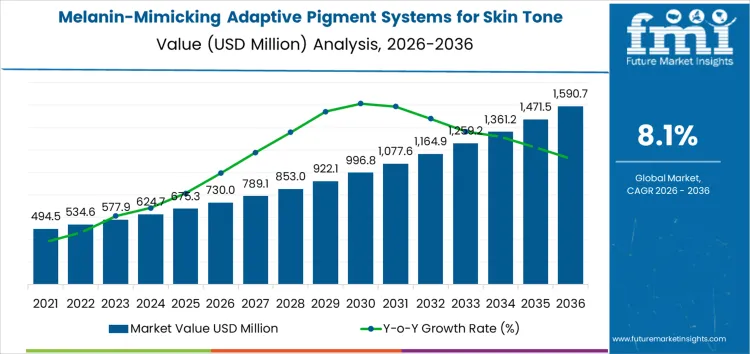
What is the Growth Forecast for the Melanin-Mimicking Adaptive Pigment Systems for Skin Tone Matching Market through 2036?
The acceleration and deceleration pattern for the melanin-mimicking adaptive pigment systems for skin tone matching market shows clear phases of rapid growth followed by stabilization as the technology becomes widely adopted. The market will experience a significant acceleration in growth in the first half of the forecast period, driven by the increasing demand for inclusive and diverse cosmetic products. The market value will rise from USD 730 million in 2026 to USD 1,079 million in 2031, reflecting a substantial increase of USD 349 million over the first five years. This rapid growth will be fueled by consumer demand for products that better match their skin tones, as well as advancements in adaptive pigment formulations that offer a more personalized and natural finish. The accelerated growth is also likely to be driven by industry efforts to create a broader range of shades and products for different skin tones.
As the market matures and the technology becomes widely adopted, the growth rate will decelerate, although the market will continue to expand steadily. From USD 1,079 million in 2031, the market will increase to USD 1,580 million by 2036. While the market will still grow by approximately USD 500 million over the next five years, the rate of acceleration will slow as adoption stabilizes and most consumers have access to adaptive pigment products. The deceleration phase is typical of a maturing market, where the product becomes mainstream and competition among brands increases, leading to a more stable but still positive growth trajectory.
Melanin-Mimicking Adaptive Pigment Systems for Skin Tone Matching Market Key Takeaways
| Metric | Value |
|---|---|
| Industry Sales Value (2026) | USD 730 million |
| Industry Forecast Value (2036) | USD 1,580 million |
| Industry Forecast CAGR (2026 to 2036) | 8.1% |
What Is Driving the Demand for Melanin-Mimicking Adaptive Pigment Systems for Skin Tone Matching?
Historical demand for melanin-mimicking adaptive pigment systems was shaped by the broader growth of cosmetic pigments and inclusive beauty product formulation. Cosmetic pigments have been used to provide color and texture in makeup products, with market expansion linked to rising use of foundations, concealers, and color cosmetics worldwide. Global cosmetic pigment markets showed growth through the early 2020s, driven by demand in personal care and grooming segments as consumers sought broader shade ranges and consistent performance across skin tones.
Research into melanin and bio-inspired pigmentation supported technical understanding of skin-matching systems focused on melanin analogs, enabling closer optical adaptation to diverse skin colors. These adaptive pigments found initial use in inclusive beauty lines and specialty makeup formulations where conventional pigments did not adequately match varied skin tones. Historically, industry focus on formulation precision and optical properties guided early adoption of adaptive pigment technologies in niche segments.
Future demand for melanin-mimicking adaptive pigment systems is expected to be driven by continued interest in personalized cosmetic products and expanding inclusive beauty standards. The global market for these adaptive systems is projected to grow from about USD 0.7 billion in 2026 to around USD 1.6 billion by 2036, at an estimated compound annual growth rate of 8.1 percent.
Growth factors include increased use of synthetic melanin analogs for precise color adaptation and the need for formulation integration that supports a wider range of skin tones in foundations, concealers, and color-correcting products. Manufacturers and beauty brands are likely to adopt adaptive pigment technologies to improve color matching accuracy and optical response across diverse consumer groups. Challenges may arise from formulation complexity and material performance, but ongoing innovation is expected to support broader use in personal care and therapeutic applications.
What are the Leading Segments in the Global Melanin-Mimicking Adaptive Pigment Systems for Skin Tone Matching Market?
The global melanin-mimicking adaptive pigment systems for skin tone matching market is segmented by material type and application type. Among material types, synthetic melanin analogs lead the market, capturing 42% of the share, followed by bio-engineered melanin compounds, photochromic pigment systems, and thermochromic adaptive materials. Synthetic melanin analogs are highly effective in mimicking natural melanin’s ability to adapt to different skin tones, making them a popular choice in skin tone matching products. On the application side, foundation & concealer products dominate the market, holding 46% of the share, followed by color-correcting formulations, BB & CC creams, and powder makeup products. Foundation & concealer products are the largest segment due to their widespread use and the need for products that can match a wide range of skin tones.
What Drives the Growth of Synthetic Melanin Analogs in the Melanin-Mimicking Adaptive Pigment Systems for Skin Tone Matching Market?
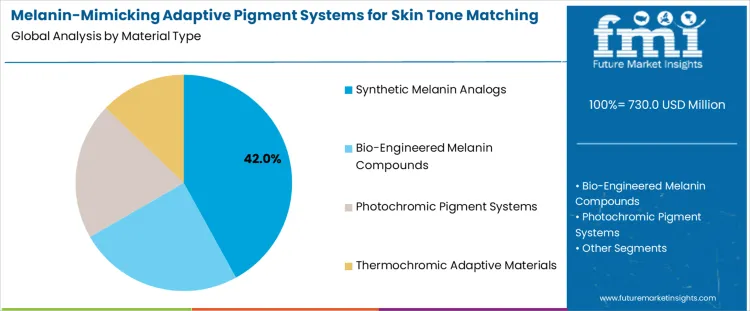
Synthetic melanin analogs are the leading material type in the melanin-mimicking adaptive pigment systems for skin tone matching market, holding 42% of the share. These analogs are designed to mimic the natural melanin in human skin, enabling the pigments to adjust to different skin tones, providing a more personalized and seamless match. Synthetic melanin analogs offer several advantages, including the ability to blend with various skin tones, enhance coverage, and provide a natural finish. They are particularly valued in foundation and concealer products, which are essential for achieving even skin tone and flawless coverage.
The growing demand for inclusive beauty products, where a broad range of skin tones must be matched, is driving the adoption of synthetic melanin analogs. As the market moves toward more personalized and adaptive cosmetic solutions, these synthetic pigments are expected to continue dominating the market due to their versatility and effectiveness in mimicking natural skin tones.
What is Driving the Demand for Foundation & Concealer Products in the Melanin-Mimicking Adaptive Pigment Systems for Skin Tone Matching Market?
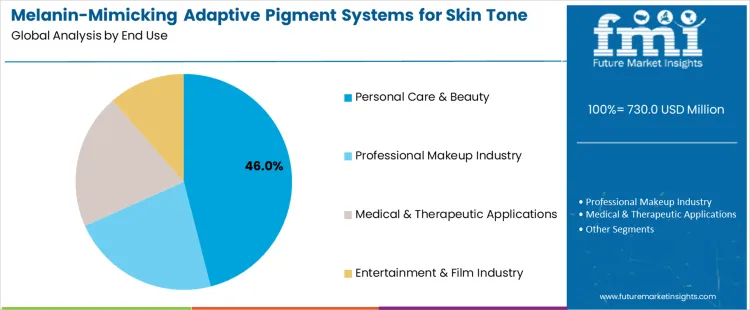
Foundation & concealer products are the leading application type in the melanin-mimicking adaptive pigment systems for skin tone matching market, capturing 46% of the share. This demand is primarily driven by the increasing consumer demand for personalized and inclusive beauty solutions, particularly in the area of complexion products. Foundation and concealer are key makeup products that need to match a wide range of skin tones. The ability to achieve an exact skin tone match, regardless of the undertones or depth of complexion, is critical for these products.
Melanin-mimicking adaptive pigment systems, particularly those based on synthetic melanin analogs, are ideal for foundation and concealer formulations because they adjust to individual skin tones, providing a more natural and seamless finish. The growing focus on diversity and inclusivity in the beauty industry, alongside the increasing demand for products that offer both functionality and personalization, is driving the adoption of adaptive pigment systems in foundation and concealer products. As consumer expectations for skin tone matching increase, these products will continue to be the dominant segment in the market.
What are the Key Dynamics in the Global Melanin Mimicking Adaptive Pigment Systems for Skin Tone Matching Market?
The global melanin-mimicking adaptive pigment systems for skin tone matching market is expanding as beauty and cosmetic brands develop formulations that adjust to varied skin tones with a natural appearance. These adaptive pigments respond to light and skin undertone cues to provide seamless blending in foundations, concealers and bronzers. Growth is supported by demand for personalized makeup, digital shade matching tools and expanding product portfolios that reflect diversity. Technology that delivers color stability across lighting conditions, extended wear and inclusive shade ranges is driving adoption in both mass and prestige cosmetic lines worldwide.
What are the Key Drivers for the Global Melanin-Mimicking Adaptive Pigment Systems for Skin Tone Matching Market?
Consumer demand for makeup that accurately reflects diverse skin tones is a major driver. Expansion of global beauty audiences and visibility of inclusivity in media increases pressure on brands to offer formulations that match a range of complexions. Advances in pigment technology that mimic melanin behavior improve color fidelity and comfort on skin. Integration of adaptive pigments with virtual shade matching and personalized beauty platforms enhances consumer confidence and reduces return rates. Growth in online sales and digital try on tools pushes innovation in adaptive systems that cater to individual preferences and natural appearance standards.
What are the Restraints for the Global Melanin-Mimicking Adaptive Pigment Systems for Skin Tone Matching Market?
A constraint arises from the technical demand of developing pigments that adjust reliably across a wide variety of undertones without compromising texture or finish. Formulating adaptive systems with consistent performance, longevity and skin compatibility requires rigorous testing and quality control. Higher formulation and production costs for advanced pigment systems can affect pricing positioning in competitive segments. Some consumers may remain cautious about claims related to adaptive behavior without visible proof. Regulatory variability in colorant approval and labeling across regions adds planning complexity for global product launches and marketing.
What are the Key Trends in the Global Melanin-Mimicking Adaptive Pigment Systems for Skin Tone Matching Market?
An emerging trend is formulation of adaptive pigment systems that work with artificial intelligence driven shade matching, enabling precise customization based on selfies or scanning technology. Ingredient innovation focuses on particle engineering that delivers smooth transition between undertones and minimizes patchiness under varied lighting. Collaboration between pigment developers and digital beauty platforms accelerates integration of adaptive systems into augmented reality beauty experiences. There is increasing attention on clean and skin friendly pigment carriers that support long wear and comfort. Brands are also expanding inclusive shade ranges powered by adaptive technologies to build loyalty and meet evolving consumer expectations.
What is the Country-Wise Analysis of the Melanin-Mimicking Adaptive Pigment Systems for Skin Tone Matching Market?
The melanin-mimicking adaptive pigment systems for skin tone matching market is experiencing significant growth, driven by the increasing demand for personalized and inclusive beauty products that cater to a wide range of skin tones. These adaptive pigment systems are designed to mimic natural melanin, offering a customized, natural-looking match for different skin tones. With consumers seeking products that provide more precise and individualized color matching, melanin-mimicking pigments are gaining popularity in foundations, concealers, and other complexion products.
Developed markets like the USA, Germany, and the UK are seeing strong demand for these innovative products due to the growing emphasis on diversity and inclusivity in the beauty industry. In markets like Japan and Australia, there is also steady growth driven by rising consumer awareness of the need for more inclusive beauty solutions. As consumers continue to demand products that cater to all skin tones, the market for melanin-mimicking adaptive pigments is expected to continue expanding globally.
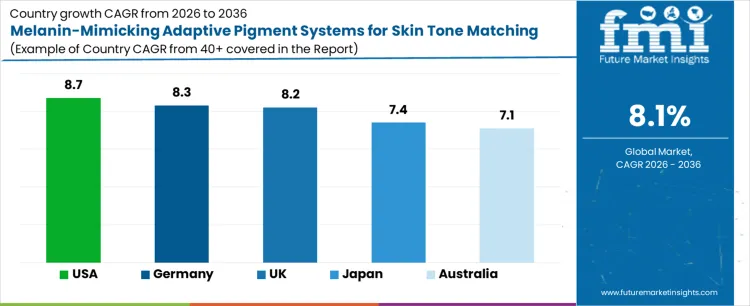
| Country | CAGR (2026 to 2036) |
|---|---|
| USA | 8.7% |
| Germany | 8.3% |
| UK | 8.2% |
| Japan | 7.4% |
| Australia | 7.1% |
What is the Growth Outlook for the Melanin-Mimicking Adaptive Pigment Systems for Skin Tone Matching Market in the USA?
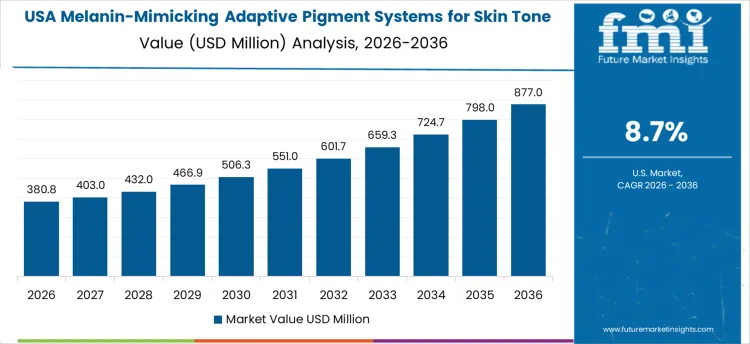
The melanin-mimicking adaptive pigment systems for skin tone matching market in the USA is expected to grow steadily, with a projected CAGR of 8.7% from 2026 to 2036. The USA has been at the forefront of the inclusivity movement in the beauty industry, with a growing focus on providing products that cater to a wide variety of skin tones. As consumers demand more personalized beauty solutions, especially for complexion products like foundations, there is a rising need for adaptive pigments that can mimic natural melanin and offer a customized skin tone match. The success of inclusive beauty brands such as Fenty Beauty has paved the way for increased awareness and demand for products that provide more precise and personalized color matching. The growing trend toward clean beauty, combined with heightened consumer awareness about skin health and diversity, is expected to continue driving the demand for melanin-mimicking pigments in the USA market. As beauty brands increasingly focus on offering tailored, inclusive products, the USA market is expected to lead the growth of this segment.
What is the Market Outlook for the Melanin-Mimicking Adaptive Pigment Systems for Skin Tone Matching Market in Germany?
Germany is projected to see steady growth in the melanin-mimicking adaptive pigment systems for skin tone matching market, with a projected CAGR of 8.3% from 2026 to 2036. As one of the largest beauty markets in Europe, Germany is increasingly embracing the trend toward more inclusive beauty products. Consumers in Germany are becoming more aware of the importance of diversity in beauty standards, and there is a growing demand for products that cater to a broader range of skin tones. The German beauty market, which is heavily focused on sustainability and quality, is adopting more innovative products that use adaptive pigments to provide customized skin tone matching. Additionally, Germany’s regulatory environment is pushing for cleaner, safer beauty products, which aligns with the increasing consumer preference for adaptive, melanin-mimicking pigments in complexion products. As the market for inclusive and natural beauty solutions continues to grow, Germany is expected to see continued growth in the demand for these pigments, driven by both consumer demand and industry innovation.
What is the Growth Forecast for the Melanin-Mimicking Adaptive Pigment Systems for Skin Tone Matching Market in the UK?
The melanin-mimicking adaptive pigment systems for skin tone matching market in the UK is projected to grow steadily, with a projected CAGR of 8.2% from 2026 to 2036. The UK market is rapidly evolving as consumers increasingly seek beauty products that reflect diverse skin tones. The demand for personalized and inclusive beauty solutions is driving the adoption of melanin-mimicking adaptive pigments in complexion products such as foundations and concealers. With the UK’s growing focus on diversity and inclusivity in beauty, brands are shifting towards offering a wider range of shades and formulations that cater to various skin tones. This trend is further supported by regulatory initiatives and consumer demand for safe, natural, and effective beauty products. The success of inclusive beauty campaigns, combined with the UK’s established clean beauty movement, is expected to fuel the market for melanin-mimicking pigments. As brands in the UK continue to innovate to meet the needs of a diverse consumer base, the demand for these adaptive pigment systems is likely to see steady growth.
What is the Market Outlook for the Melanin-Mimicking Adaptive Pigment Systems for Skin Tone Matching Market in Japan?
Japan is expected to experience steady growth in the melanin-mimicking adaptive pigment systems for skin tone matching market, with a projected CAGR of 7.4% from 2026 to 2036. Japan has a well-established beauty industry, and the growing demand for personalized beauty solutions is shaping the market for adaptive pigment systems. Japanese consumers, known for their appreciation of high-quality beauty products, are becoming increasingly aware of the need for inclusive and diverse beauty products. The demand for complexion products that match a variety of skin tones is rising, and adaptive pigments that mimic melanin offer a safe and effective solution for creating products with a natural skin tone match. As Japan’s beauty industry increasingly embraces diversity and personalized beauty, the market for melanin-mimicking adaptive pigment systems is expected to grow steadily. The increasing focus on both beauty and skincare, combined with Japan’s openness to global beauty trends, will contribute to the expansion of this market.
What are the Growth Prospects for the Melanin-Mimicking Adaptive Pigment Systems for Skin Tone Matching Market in Australia?
Australia is projected to see steady growth in the melanin-mimicking adaptive pigment systems for skin tone matching market, with a projected CAGR of 7.1% from 2026 to 2036. Australia’s beauty market has been increasingly shifting toward inclusivity, with consumers demanding products that cater to a wide variety of skin tones. As awareness of the importance of skin tone diversity in beauty products rises, Australian consumers are seeking products that provide natural and personalized color matching. The growing clean beauty trend in Australia, along with the increasing focus on ethical and sustainable products, is driving the demand for melanin-mimicking pigments. Australian beauty brands are increasingly adopting these pigments in their formulations to provide consumers with more inclusive products. As demand for products that reflect a broader spectrum of skin tones continues to rise, the market for adaptive pigment systems in Australia is expected to grow steadily, supported by both consumer preference and industry innovation.
What is the Competitive Landscape for the Melanin-Mimicking Adaptive Pigment Systems for Skin Tone Matching Market?

The melanin-mimicking adaptive pigment systems for skin tone matching market is growing rapidly as consumers and the cosmetics industry increasingly demand personalized, inclusive solutions for foundation and skincare products that perfectly match diverse skin tones. Chromagenics Limited leads the market with its innovative melanin-mimicking pigment systems, offering adaptive pigment solutions that blend seamlessly with a wide range of skin tones.
Their focus on product innovation, skin tone versatility, and enhancing natural appearance has positioned them as a dominant player. Adaptive Cosmetics Inc., ToneFlex Technologies, and Pigment Dynamics Corporation are significant competitors, each offering specialized adaptive pigments designed to adjust to individual skin tones for a flawless match. Adaptive Cosmetics Inc. focuses on high-performance, skin-tone-mimicking pigments that offer precise and customizable solutions, while ToneFlex Technologies and Pigment Dynamics Corporation provide advanced systems that adjust to various skin shades and undertones for more accurate complexion matching.
Melanin Systems International further contributes to the competitive landscape by offering melanin-based adaptive pigment solutions designed to mimic the natural skin tones of diverse populations. Melanin Systems International emphasizes inclusivity and provides pigments that help create more natural and personalized skin tone products. These companies compete by focusing on innovation, inclusivity, and the growing consumer demand for personalized skincare and makeup products. As the emand for adaptive, skin tone-matching cosmetics continues to rise, the market for melanin-mimicking adaptive pigment systems is expected to expand, driving further innovation and competition in the sector.
Key Players of the Melanin-Mimicking Adaptive Pigment Systems for Skin Tone Matching Market
- Chromagenics Limited
- Adaptive Cosmetics Inc.
- ToneFlex Technologies
- Pigment Dynamics Corporation
- Melanin Systems International
Scope of the Report
| Items | Values |
|---|---|
| Quantitative Units (2026) | USD Million |
| Material Type | Synthetic Melanin Analogs, Bio Engineered Melanin Compounds, Photochromic Pigment Systems, Thermochromic Adaptive Materials |
| Application Type | Foundation & Concealer Products, Color Correcting Formulations, BB & CC Creams, Powder Makeup Products |
| End Use | Personal Care & Beauty, Professional Makeup Industry, Medical & Therapeutic Applications, Entertainment & Film Industry |
| Companies | Chromagenics Limited, Adaptive Cosmetics Inc., ToneFlex Technologies, Pigment Dynamics Corporation, Melanin Systems International |
| Regions Covered | North America, Latin America, Western Europe, Eastern Europe, South Asia and Pacific, East Asia, Middle East & Africa |
| Countries Covered | United States, Canada, Mexico, Brazil, Argentina, Germany, France, United Kingdom, Italy, Spain, Netherlands, China, India, Japan, South Korea, ANZ, GCC Countries, South Africa |
| Additional Attributes | Dollar by sales by material type, application type, end use, and region. Includes analysis of market trends in melanin mimicking adaptive pigment systems adoption for skin tone matching, performance in cosmetic and therapeutic formulations, formulation cost considerations, regulatory and safety frameworks affecting adaptive pigments, consumer acceptance and demand for personalized skin tone products, market share and competitive positioning of key companies, innovations in adaptive pigment technologies, and assessment of impact on product effectiveness, adaptability, and user experience. |
Melanin-Mimicking Adaptive Pigment Systems for Skin Tone Matching Market Segmentation
By Material Type:
- Synthetic Melanin Analogs
- Bio-Engineered Melanin Compounds
- Photochromic Pigment Systems
- Thermochromic Adaptive Materials
By Application Type:
- Foundation & Concealer Products
- Color-Correcting Formulations
- BB & CC Creams
- Powder Makeup Products
By End Use:
- Personal Care & Beauty
- Professional Makeup Industry
- Medical & Therapeutic Applications
- Entertainment & Film Industry
By Region:
- Asia Pacific
- China
- Japan
- South Korea
- India
- Australia & New Zealand
- ASEAN
- Rest of Asia Pacific
- Europe
- Germany
- United Kingdom
- France
- Italy
- Spain
- Nordic
- BENELUX
- Rest of Europe
- North America
- United States
- Canada
- Mexico
- Latin America
- Brazil
- Chile
- Rest of Latin America
- Middle East & Africa
- Kingdom of Saudi Arabia
- Other GCC Countries
- Turkey
- South Africa
- Other African Union
- Rest of Middle East & Africa
Frequently Asked Questions
How big is the melanin-mimicking adaptive pigment systems for skin tone matching market in 2026?
The global melanin-mimicking adaptive pigment systems for skin tone matching market is estimated to be valued at USD 730.0 million in 2026.
What will be the size of melanin-mimicking adaptive pigment systems for skin tone matching market in 2036?
The market size for the melanin-mimicking adaptive pigment systems for skin tone matching market is projected to reach USD 1,590.7 million by 2036.
How much will be the melanin-mimicking adaptive pigment systems for skin tone matching market growth between 2026 and 2036?
The melanin-mimicking adaptive pigment systems for skin tone matching market is expected to grow at a 8.1% CAGR between 2026 and 2036.
What are the key product types in the melanin-mimicking adaptive pigment systems for skin tone matching market?
The key product types in melanin-mimicking adaptive pigment systems for skin tone matching market are synthetic melanin analogs, bio‑engineered melanin compounds, photochromic pigment systems and thermochromic adaptive materials.
Which application type segment to contribute significant share in the melanin-mimicking adaptive pigment systems for skin tone matching market in 2026?
In terms of application type, foundation & concealer products segment to command 46.0% share in the melanin-mimicking adaptive pigment systems for skin tone matching market in 2026.
Preview the report firsthand - request a free sample
Get SampleGet the brochure for pricing and purchase details.
Get PDFTable of Content
- Executive Summary
- Global Market Outlook
- Demand-side Trends
- Supply-side Trends
- Technology Roadmap Analysis
- Analysis and Recommendations
- Market Overview
- Market Coverage / Taxonomy
- Market Definition / Scope / Limitations
- Market Background
- Market Dynamics
- Drivers
- Restraints
- Opportunity
- Trends
- Scenario Forecast
- Demand in Optimistic Scenario
- Demand in Likely Scenario
- Demand in Conservative Scenario
- Opportunity Map Analysis
- Product Life Cycle Analysis
- Supply Chain Analysis
- Investment Feasibility Matrix
- Value Chain Analysis
- PESTLE and Porter’s Analysis
- Regulatory Landscape
- Regional Parent Market Outlook
- Production and Consumption Statistics
- Import and Export Statistics
- Market Dynamics
- Global Market Analysis 2021 to 2025 and Forecast, 2026 to 2036
- Historical Market Size Value (USD Million) Analysis, 2021 to 2025
- Current and Future Market Size Value (USD Million) Projections, 2026 to 2036
- Y-o-Y Growth Trend Analysis
- Absolute $ Opportunity Analysis
- Global Market Pricing Analysis 2021 to 2025 and Forecast 2026 to 2036
- Global Market Analysis 2021 to 2025 and Forecast 2026 to 2036, By Material Type
- Introduction / Key Findings
- Historical Market Size Value (USD Million) Analysis By Material Type , 2021 to 2025
- Current and Future Market Size Value (USD Million) Analysis and Forecast By Material Type , 2026 to 2036
- Synthetic Melanin Analogs
- Bio‑Engineered Melanin Compounds
- Photochromic Pigment Systems
- Thermochromic Adaptive Materials
- Synthetic Melanin Analogs
- Y-o-Y Growth Trend Analysis By Material Type , 2021 to 2025
- Absolute $ Opportunity Analysis By Material Type , 2026 to 2036
- Global Market Analysis 2021 to 2025 and Forecast 2026 to 2036, By Application Type
- Introduction / Key Findings
- Historical Market Size Value (USD Million) Analysis By Application Type, 2021 to 2025
- Current and Future Market Size Value (USD Million) Analysis and Forecast By Application Type, 2026 to 2036
- Foundation & Concealer Products
- Color‑Correcting Formulations
- BB & CC Creams
- Powder Makeup Products
- Foundation & Concealer Products
- Y-o-Y Growth Trend Analysis By Application Type, 2021 to 2025
- Absolute $ Opportunity Analysis By Application Type, 2026 to 2036
- Global Market Analysis 2021 to 2025 and Forecast 2026 to 2036, By End Use
- Introduction / Key Findings
- Historical Market Size Value (USD Million) Analysis By End Use, 2021 to 2025
- Current and Future Market Size Value (USD Million) Analysis and Forecast By End Use, 2026 to 2036
- Personal Care & Beauty
- Professional Makeup Industry
- Medical & Therapeutic Applications
- Entertainment & Film Industry
- Personal Care & Beauty
- Y-o-Y Growth Trend Analysis By End Use, 2021 to 2025
- Absolute $ Opportunity Analysis By End Use, 2026 to 2036
- Global Market Analysis 2021 to 2025 and Forecast 2026 to 2036, By Region
- Introduction
- Historical Market Size Value (USD Million) Analysis By Region, 2021 to 2025
- Current Market Size Value (USD Million) Analysis and Forecast By Region, 2026 to 2036
- North America
- Latin America
- Western Europe
- Eastern Europe
- East Asia
- South Asia and Pacific
- Middle East & Africa
- Market Attractiveness Analysis By Region
- North America Market Analysis 2021 to 2025 and Forecast 2026 to 2036, By Country
- Historical Market Size Value (USD Million) Trend Analysis By Market Taxonomy, 2021 to 2025
- Market Size Value (USD Million) Forecast By Market Taxonomy, 2026 to 2036
- By Country
- USA
- Canada
- Mexico
- By Material Type
- By Application Type
- By End Use
- By Country
- Market Attractiveness Analysis
- By Country
- By Material Type
- By Application Type
- By End Use
- Key Takeaways
- Latin America Market Analysis 2021 to 2025 and Forecast 2026 to 2036, By Country
- Historical Market Size Value (USD Million) Trend Analysis By Market Taxonomy, 2021 to 2025
- Market Size Value (USD Million) Forecast By Market Taxonomy, 2026 to 2036
- By Country
- Brazil
- Chile
- Rest of Latin America
- By Material Type
- By Application Type
- By End Use
- By Country
- Market Attractiveness Analysis
- By Country
- By Material Type
- By Application Type
- By End Use
- Key Takeaways
- Western Europe Market Analysis 2021 to 2025 and Forecast 2026 to 2036, By Country
- Historical Market Size Value (USD Million) Trend Analysis By Market Taxonomy, 2021 to 2025
- Market Size Value (USD Million) Forecast By Market Taxonomy, 2026 to 2036
- By Country
- Germany
- UK
- Italy
- Spain
- France
- Nordic
- BENELUX
- Rest of Western Europe
- By Material Type
- By Application Type
- By End Use
- By Country
- Market Attractiveness Analysis
- By Country
- By Material Type
- By Application Type
- By End Use
- Key Takeaways
- Eastern Europe Market Analysis 2021 to 2025 and Forecast 2026 to 2036, By Country
- Historical Market Size Value (USD Million) Trend Analysis By Market Taxonomy, 2021 to 2025
- Market Size Value (USD Million) Forecast By Market Taxonomy, 2026 to 2036
- By Country
- Russia
- Poland
- Hungary
- Balkan & Baltic
- Rest of Eastern Europe
- By Material Type
- By Application Type
- By End Use
- By Country
- Market Attractiveness Analysis
- By Country
- By Material Type
- By Application Type
- By End Use
- Key Takeaways
- East Asia Market Analysis 2021 to 2025 and Forecast 2026 to 2036, By Country
- Historical Market Size Value (USD Million) Trend Analysis By Market Taxonomy, 2021 to 2025
- Market Size Value (USD Million) Forecast By Market Taxonomy, 2026 to 2036
- By Country
- China
- Japan
- South Korea
- By Material Type
- By Application Type
- By End Use
- By Country
- Market Attractiveness Analysis
- By Country
- By Material Type
- By Application Type
- By End Use
- Key Takeaways
- South Asia and Pacific Market Analysis 2021 to 2025 and Forecast 2026 to 2036, By Country
- Historical Market Size Value (USD Million) Trend Analysis By Market Taxonomy, 2021 to 2025
- Market Size Value (USD Million) Forecast By Market Taxonomy, 2026 to 2036
- By Country
- India
- ASEAN
- Australia & New Zealand
- Rest of South Asia and Pacific
- By Material Type
- By Application Type
- By End Use
- By Country
- Market Attractiveness Analysis
- By Country
- By Material Type
- By Application Type
- By End Use
- Key Takeaways
- Middle East & Africa Market Analysis 2021 to 2025 and Forecast 2026 to 2036, By Country
- Historical Market Size Value (USD Million) Trend Analysis By Market Taxonomy, 2021 to 2025
- Market Size Value (USD Million) Forecast By Market Taxonomy, 2026 to 2036
- By Country
- Kingdom of Saudi Arabia
- Other GCC Countries
- Turkiye
- South Africa
- Other African Union
- Rest of Middle East & Africa
- By Material Type
- By Application Type
- By End Use
- By Country
- Market Attractiveness Analysis
- By Country
- By Material Type
- By Application Type
- By End Use
- Key Takeaways
- Key Countries Market Analysis
- USA
- Pricing Analysis
- Market Share Analysis, 2025
- By Material Type
- By Application Type
- By End Use
- Canada
- Pricing Analysis
- Market Share Analysis, 2025
- By Material Type
- By Application Type
- By End Use
- Mexico
- Pricing Analysis
- Market Share Analysis, 2025
- By Material Type
- By Application Type
- By End Use
- Brazil
- Pricing Analysis
- Market Share Analysis, 2025
- By Material Type
- By Application Type
- By End Use
- Chile
- Pricing Analysis
- Market Share Analysis, 2025
- By Material Type
- By Application Type
- By End Use
- Germany
- Pricing Analysis
- Market Share Analysis, 2025
- By Material Type
- By Application Type
- By End Use
- UK
- Pricing Analysis
- Market Share Analysis, 2025
- By Material Type
- By Application Type
- By End Use
- Italy
- Pricing Analysis
- Market Share Analysis, 2025
- By Material Type
- By Application Type
- By End Use
- Spain
- Pricing Analysis
- Market Share Analysis, 2025
- By Material Type
- By Application Type
- By End Use
- France
- Pricing Analysis
- Market Share Analysis, 2025
- By Material Type
- By Application Type
- By End Use
- India
- Pricing Analysis
- Market Share Analysis, 2025
- By Material Type
- By Application Type
- By End Use
- ASEAN
- Pricing Analysis
- Market Share Analysis, 2025
- By Material Type
- By Application Type
- By End Use
- Australia & New Zealand
- Pricing Analysis
- Market Share Analysis, 2025
- By Material Type
- By Application Type
- By End Use
- China
- Pricing Analysis
- Market Share Analysis, 2025
- By Material Type
- By Application Type
- By End Use
- Japan
- Pricing Analysis
- Market Share Analysis, 2025
- By Material Type
- By Application Type
- By End Use
- South Korea
- Pricing Analysis
- Market Share Analysis, 2025
- By Material Type
- By Application Type
- By End Use
- Russia
- Pricing Analysis
- Market Share Analysis, 2025
- By Material Type
- By Application Type
- By End Use
- Poland
- Pricing Analysis
- Market Share Analysis, 2025
- By Material Type
- By Application Type
- By End Use
- Hungary
- Pricing Analysis
- Market Share Analysis, 2025
- By Material Type
- By Application Type
- By End Use
- Kingdom of Saudi Arabia
- Pricing Analysis
- Market Share Analysis, 2025
- By Material Type
- By Application Type
- By End Use
- Turkiye
- Pricing Analysis
- Market Share Analysis, 2025
- By Material Type
- By Application Type
- By End Use
- South Africa
- Pricing Analysis
- Market Share Analysis, 2025
- By Material Type
- By Application Type
- By End Use
- USA
- Market Structure Analysis
- Competition Dashboard
- Competition Benchmarking
- Market Share Analysis of Top Players
- By Regional
- By Material Type
- By Application Type
- By End Use
- Competition Analysis
- Competition Deep Dive
- Chromagenics Limited
- Overview
- Product Portfolio
- Profitability by Market Segments (Product/Age /Sales Channel/Region)
- Sales Footprint
- Strategy Overview
- Marketing Strategy
- Product Strategy
- Channel Strategy
- Adaptive Cosmetics Inc.
- ToneFlex Technologies
- Pigment Dynamics Corporation
- Melanin Systems International
- Chromagenics Limited
- Competition Deep Dive
- Assumptions & Acronyms Used
- Research Methodology


