

- Industry Size (2026)
- USD 290.0 Mn
- Forecast (2036)
- USD 794.2 Mn
- CAGR (2026 to 2036)
- 10.6%
Photo-Stable Natural Pigment Systems for High-SPF Tinted Sunscreens Market Forecast and Outlook 2026 to 2036
The photo-stable natural pigment systems for high-SPF tinted sunscreens market is valued at USD 290.0 million in 2026 and is forecasted to reach USD 794.2 million by 2036, with a CAGR of 10.6%. Growth during this period is driven by structural changes in sun care formulation priorities rather than expansion in overall sunscreen consumption.
High-SPF tinted sunscreens require pigment systems that retain shade integrity, optical balance, and dispersion stability under prolonged ultraviolet exposure. Natural mineral and botanical-derived pigments gain preference where formulation credibility depends on both photostability and clean-label positioning. Demand concentrates in products positioned for daily facial use, where consistent tone correction and SPF reliability influence repeat purchase behavior. Adoption strengthens in portfolios that replace separate foundation and sunscreen steps with a single protective complexion product.
Quick Stats for Photo-Stable Natural Pigment Systems for High-SPF Tinted Sunscreens Market
- Photo-Stable Natural Pigment Systems for High-SPF Tinted Sunscreens Market Value (2026): USD 290.0 million
- Photo-Stable Natural Pigment Systems for High-SPF Tinted Sunscreens Market Forecast Value (2036): USD 794.2 million
- Forecast CAGR (2026 to 2036): 10.6%
- Leading Pigment System Type in Global Demand: Photo-Stable Mineral Pigments (ZnO, TiO₂)
- Fastest-Growing Countries: India, China, Australia, USA, Brazil
- Key Players in Global Demand: Sensient Technologies, Clariant AG, BASF SE, DSM-Firmenich, Sun Chemical
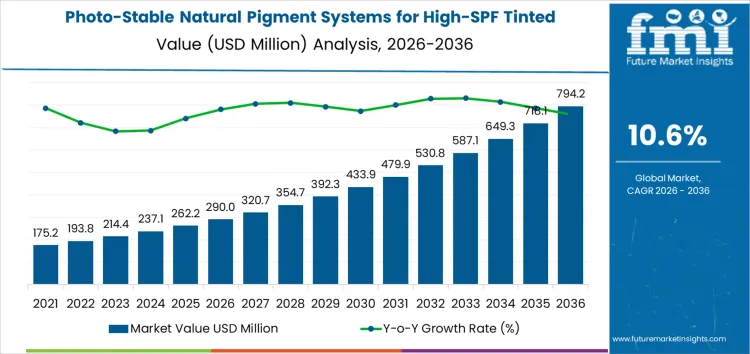
Application requirements shape demand quality across segments. High-SPF tinted facial sunscreens account for the largest value share due to frequent application, extended wear expectations, and direct sun exposure. Daily UV protection moisturizers follow, relying on lighter pigmentation with strict photodegradation control. Outdoor and sport suncare products adopt these systems selectively, prioritizing stability under sweat, heat, and friction.
Sensitive and baby suncare formulations emphasize inert behavior, low reactivity, and predictable color performance. Pigment selection favors zinc oxide, titanium dioxide, and stabilized iron oxides with surface treatments that limit photocatalytic activity. Long-term expansion remains anchored in formulation trust, regulatory alignment, and consistent performance under high irradiation, rather than novelty-driven shade expansion or decorative color innovation.
Photo-Stable Natural Pigment Systems for High-SPF Tinted Sunscreens Market Key Takeaways
| Metric | Value |
|---|---|
| Market Value (2026) | USD 290.0 million |
| Market Forecast Value (2036) | USD 794.2 million |
| Forecast CAGR (2026-2036) | 10.6% |
Why is the Demand for Photo-Stable Natural Pigment Systems for High-SPF Tinted Sunscreens Market Growing?
Demand for photo-stable natural pigment systems for high-SPF tinted sunscreens is growing globally due to increasing consumer and regulatory emphasis on sun protection efficacy, safety, and clean ingredient profiles. High-SPF tinted sunscreens combine UV defense with cosmetic coverage, which requires pigments that remain stable under prolonged UV exposure and maintain consistent shade and performance without degradation. Natural pigment systems sourced from mineral and botanical derivatives align with clean beauty trends and address concerns about synthetic colorants and potential irritants, which supports formulation of sun care products suited for sensitive skin.
Regulatory frameworks in multiple regions, including North America, Europe, and parts of Asia, emphasize accurate labeling, broad spectrum protection, and ingredient safety, which reinforces specification of photo-stable pigments that support both coverage and SPF integrity. Technological advances in pigment surface treatment, particle engineering, and dispersion improve compatibility with SPF boosters and UV filters while minimizing whitening, flashback, and texture issues. Consumer demand for multifunctional skincare-makeup hybrids that deliver environmental defense, antioxidant support, and aesthetic enhancement strengthens adoption of advanced pigment systems. Global retail expansion through mass, prestige, and digital channels increases access to high-performance tinted sunscreens formulated with photo-stable natural pigments.
How Are the Photo-Stable Natural Pigment Systems for High-SPF Tinted Sunscreens Market Structured?
Demand for photo-stable natural pigment systems in high-SPF tinted sunscreens is shaped by requirements for UV stability, shade consistency, and regulatory compliance in sun-care formulations. Formulators evaluate mineral integrity, surface treatment effectiveness, and interaction with UV filters under prolonged exposure. Global demand reflects growth in tinted sun protection products where color durability, safety perception, and performance under high irradiation conditions determine formulation acceptance.
Which Pigment System Type Holds the Largest Share of Global Demand?
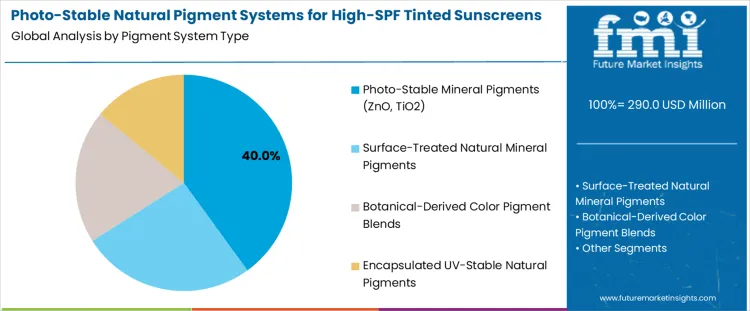
Photo-stable mineral pigments based on zinc oxide and titanium dioxide hold 40.0%, representing the largest share of global demand. These pigments provide inherent UV resistance and color stability under high-SPF conditions. Surface-treated natural mineral pigments follow at 26.0%, improving dispersion and reducing photocatalytic activity. Botanical-derived color pigment blends account for 20.0%, supporting natural positioning while requiring stability optimization. Encapsulated UV-stable natural pigments represent 14.0%, applied where enhanced protection against photodegradation is required.
Key Points
- Mineral pigments lead due to inherent UV and color stability
- Surface treatments improve dispersion and photostability
- Encapsulation supports extended exposure performance
Which Photostability Enhancement Method Drives the Highest Global Demand?
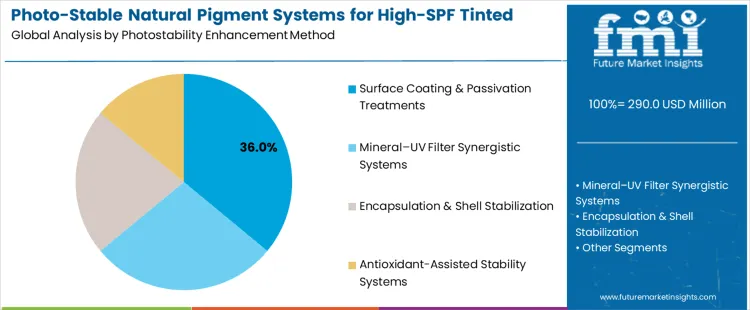
Surface coating and passivation treatments account for 36.0%, making them the leading photostability enhancement method globally. These treatments reduce reactive surface activity and limit pigment degradation under UV exposure. Mineral–UV filter synergistic systems follow at 28.0%, enabling balanced protection through coordinated absorption and scattering. Encapsulation and shell stabilization represent 22.0%, providing physical barriers against light-induced degradation. Antioxidant-assisted stability systems hold 14.0%, supporting secondary protection against oxidative stress.
Key Points
- Surface passivation remains primary for stability control
- Synergistic systems balance pigment and UV filter performance
- Encapsulation enhances durability under prolonged exposure
Which Application Segment Represents the Largest Share of Global Demand?
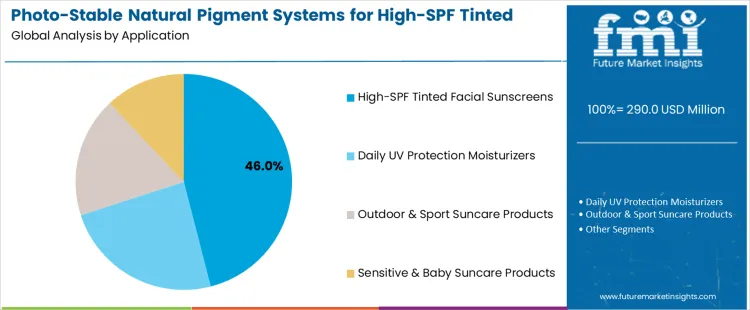
High-SPF tinted facial sunscreens account for 46.0%, making them the largest application segment globally. These products require pigments that maintain shade fidelity and protection during extended sun exposure. Daily UV protection moisturizers follow at 24.0%, integrating lighter pigmentation with photostable performance. Outdoor and sport suncare products represent 18.0%, emphasizing durability under sweat and friction. Sensitive and baby suncare products hold 12.0%, prioritizing safety and low-reactivity pigments.
Key Points
- Facial sunscreens dominate due to daily high-SPF usage
- Moisturizers balance light tint with stability
- Sensitive applications emphasize safety and inert behavior
What are the Key Dynamics in the Photo-Stable Natural Pigment Systems for High-SPF Tinted Sunscreens Market?
Global demand rises as sunscreen manufacturers and personal care brands adopt natural pigment systems that maintain color performance while enhancing photo-stability and UV protection in high-SPF tinted formulations. Photo-stable natural pigments support broad consumer interest in products that balance sun defense, aesthetic appeal, and clean ingredient positioning. Adoption aligns with tightening regulatory scrutiny of UV filters, rising awareness of sun damage, and preference for plant-derived or mineral-based colorants. Usage spans tinted sunscreens, daily defense primers, and multifunctional skincare with integrated SPF across diverse global markets including North America, Europe, Asia-Pacific, and Latin America.
How do sun protection performance expectations and consumer safety preferences shape adoption?
Consumers increasingly seek tinted sunscreens that provide reliable high-SPF performance and a natural finish without synthetic or controversial colorants. Cosmetic formulators integrate photo-stable natural pigments with mineral UV filters such as zinc oxide and titanium dioxide to achieve consistent tint, broad-spectrum coverage, and reduced need for frequent reapplication. Retailers emphasize products that meet dermatological standards and appeal to health-conscious users who prefer clean, plant-derived ingredients. Emerging regulatory frameworks encourage transparent labeling and restrict certain synthetic colorants deemed unsafe or persistent, reinforcing interest in natural pigment systems engineered for photo-stability under prolonged sun exposure. Market segmentation includes daily wear formulas and sport or outdoor variants requiring robust photochemical performance.
How does formulation complexity, cost considerations, and regulatory compliance influence market scalability?
Developing photo-stable natural pigment systems involves precise selection of pigment sources, particle size control, and surface treatment technologies that maintain color integrity without degrading under UV stress. Sourcing high-quality, natural pigments can involve premium pricing relative to conventional colorants, affecting pricing strategies for finished products. Compatibility with SPF actives and other functional ingredients influences texture, spreadability, and wear, requiring extensive testing to optimize final formulations. Regulatory frameworks vary by region in definitions of natural ingredients and allowable concentrations, affecting global rollout plans. Supply chain variability in natural feedstocks influences consistency and cost stability. Long-term growth depends on innovation in high-performance, photo-stable natural pigments, harmonized safety standards, and formulation support that delivers both effective sun protection and cosmetic appeal in tinted sunscreen products worldwide.
How Is Demand for Photo-Stable Natural Pigment Systems for High-SPF Tinted Sunscreens Evolving?
Demand for photo-stable natural pigment systems for high-SPF tinted sunscreens is increasing globally due to higher UV exposure awareness, reef-safe reformulation, and need for color stability under intense sunlight. India leads with an 11.2% CAGR, supported by rising daily sunscreen usage and growth of tinted SPF hybrids. China follows at 10.9%, driven by large-scale manufacturing and export compliance with global photostability requirements. Australia records 10.6%, reflecting extreme UV conditions and strict sunscreen performance standards. USA posts a 10.1% CAGR, shaped by dermatologist guidance and regulatory scrutiny of SPF claims. Brazil records 9.8%, supported by beach culture intensity and demand for durable sun protection products.
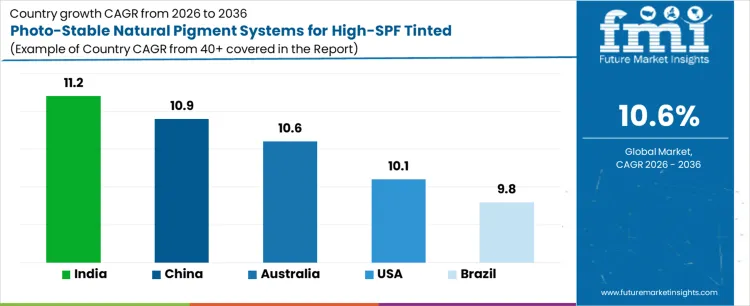
| Country | CAGR (%) |
|---|---|
| India | 11.2% |
| China | 10.9% |
| Australia | 10.6% |
| USA | 10.1% |
| Brazil | 9.8% |
What factors are driving strong adoption of photo-stable natural pigments in India?
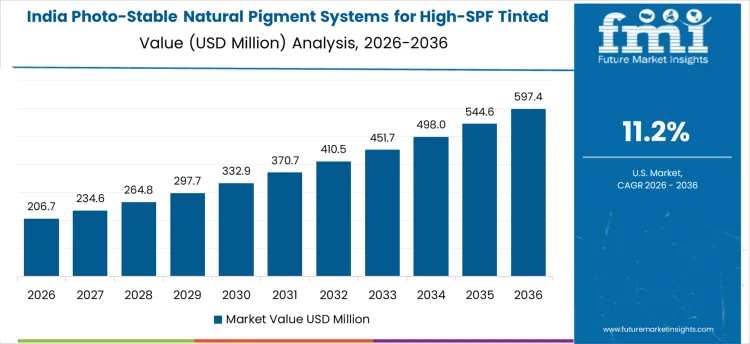
India demand is driven by increased awareness of sun damage, urban pollution exposure, and preference for multifunctional tinted sunscreens. CAGR of 11.2% reflects adoption of natural mineral pigments engineered for photostability under high UV conditions. Consumers favor products that maintain shade integrity during prolonged outdoor exposure. Domestic manufacturers integrate stabilized iron oxides and mineral blends compatible with high-SPF systems. Export-oriented brands align formulations with international photostability testing protocols. Growth remains consumption-led and formulation-driven, aligned with climate conditions and rising preventive skincare adoption.
- Growth of daily-use tinted SPF products
- Preference for natural pigments with UV stability
- Climate-driven need for shade retention
- Alignment with international photostability testing
How is China sustaining high growth in photo-stable pigment usage for tinted sunscreens?
China demand reflects scale of suncare manufacturing and export-oriented compliance requirements. CAGR of 10.9% is supported by reformulation of tinted sunscreens using natural pigments with enhanced lightfastness. Brands emphasize long-lasting shade accuracy and uniform coverage. E-commerce platforms amplify scrutiny of SPF and color durability claims. Domestic pigment suppliers invest in surface treatment and dispersion stability to improve photostability. Growth remains scale-driven and compliance-aligned, supported by manufacturing capacity and global retail requirements.
- Large-scale tinted sunscreen production
- Export compliance with global SPF standards
- Focus on long-term shade stability
- Investment in pigment surface treatment
What supports Australia’s strong growth in photo-stable natural pigment systems?
Australia demand is shaped by extreme UV exposure, strict sunscreen regulations, and high public awareness of skin cancer prevention. CAGR of 10.6% reflects mandatory performance requirements for high-SPF products. Tinted sunscreens adopt photo-stable natural pigments to maintain color accuracy during prolonged sun exposure. Regulatory testing emphasizes photodegradation resistance. Dermatologist and public health endorsement influences formulation standards. Growth remains regulation-led and safety-driven, aligned with national sun protection priorities.
- Extreme UV exposure conditions
- Strict regulatory testing for sunscreen performance
- Emphasis on long-duration color stability
- Strong public health and dermatology influence
What factors shape demand growth in the USA for photo-stable tinted sunscreen pigments?
USA demand is shaped by dermatologist recommendations, consumer scrutiny of SPF claims, and preference for tinted daily sunscreens. CAGR of 10.1% reflects reformulation toward natural pigments that resist photodegradation and color shift. Brands emphasize consistent tone, non-oxidizing wear, and compatibility with mineral UV filters. Retailers require substantiated performance data. Professional and mass-market brands adopt photo-stable pigments across daily SPF products. Growth remains brand-led and compliance-focused, aligned with wellness-oriented sun care consumption.
- Dermatologist-influenced sunscreen usage
- Reformulation for color stability under UV exposure
- Retail enforcement of SPF performance claims
- Adoption across daily-use tinted SPF products
Why is Brazil showing steady growth in photo-stable pigment systems for suncare?
Brazil demand reflects high sun exposure, beach-centric lifestyles, and frequent sunscreen reapplication. CAGR of 9.8% is supported by adoption of tinted sunscreens requiring pigments that maintain shade integrity under heat and sunlight. Consumers value products combining sun protection with complexion enhancement. Domestic brands expand photo-stable pigment usage to meet performance expectations. Regulatory alignment with international cosmetic safety standards influences pigment sourcing. Growth remains usage-driven and product-focused, supported by climate conditions and strong suncare culture.
- High frequency of sunscreen usage
- Demand for shade stability in hot climates
- Growth of tinted sunscreen formats
- Alignment with international safety standards
What is the competitive landscape of demand for photo-stable natural pigment systems for high-SPF tinted sunscreens?
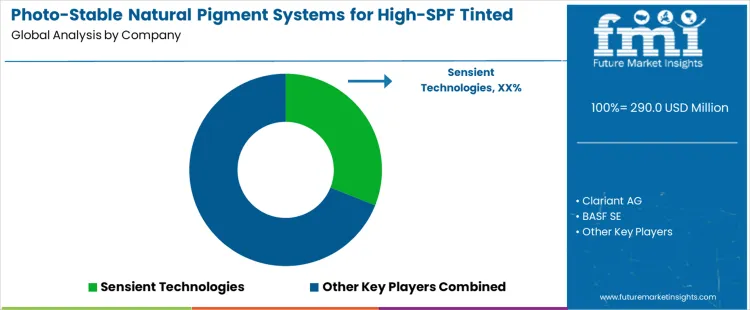
Demand for photo-stable natural pigment systems for high-SPF tinted sunscreens is driven by regulatory scrutiny of UV stability, consumer preference for mineral-based sun care, and expansion of tinted SPF daily-wear products. These formulations require pigments that maintain color integrity and optical correction under prolonged UV exposure while remaining compatible with zinc oxide and titanium dioxide systems. Buyers evaluate photostability performance, color shift resistance, dispersion behavior, interaction with UV filters, and impact on SPF efficacy. Procurement teams prioritize suppliers with validated UV-exposure testing data, low impurity natural sources, and global regulatory compliance for sun care applications. Trend in the global market reflects growth of reef-safe, mineral-first sunscreen products and increased demand for tinted SPF formats offering complexion enhancement.
Sensient Technologies holds leading positioning through photo-stable natural and mineral pigment systems engineered for high-SPF tinted sunscreen formulations. Clariant AG supplies cosmetic-grade natural and treated mineral pigments optimized for UV stability and dispersion in sun care matrices. BASF SE contributes pigment technologies and formulation support aligned with mineral UV systems and global sunscreen regulations. DSM-Firmenich supports demand through color science, photostability testing expertise, and ingredient platforms tailored to sun care performance requirements. Sun Chemical, part of DIC Group, provides scalable natural pigment dispersions with consistent batch quality for global sunscreen brand launches. Competitive differentiation depends on proven photostability, compatibility with high-SPF systems, regulatory readiness, and ability to support large-scale sun care formulations.
Key Players in the Photo-Stable Natural Pigment Systems for High-SPF Tinted Sunscreens Market
- Sensient Technologies
- Clariant AG
- BASF SE
- DSM-Firmenich
- Sun Chemical (DIC Group)
Scope of the Report
| Items | Values |
|---|---|
| Quantitative Units | USD million |
| Pigment System Type | Photo-Stable Mineral Pigments (ZnO, TiO₂); Surface-Treated Natural Mineral Pigments; Botanical-Derived Color Pigment Blends; Encapsulated UV-Stable Natural Pigments |
| Photostability Enhancement Method | Surface Coating & Passivation Treatments; Mineral–UV Filter Synergistic Systems; Encapsulation & Shell Stabilization; Antioxidant-Assisted Stability Systems |
| Application | High-SPF Tinted Facial Sunscreens; Daily UV Protection Moisturizers; Outdoor & Sport Suncare Products; Sensitive & Baby Suncare Products |
| Regions Covered | Asia Pacific, Europe, North America, Latin America, Middle East & Africa |
| Countries Covered | India, China, Australia, USA, Brazil, and 40+ countries |
| Key Companies Profiled | Sensient Technologies; Clariant AG; BASF SE; DSM-Firmenich; Sun Chemical (DIC Group) |
| Additional Attributes | Dollar sales by pigment system type and photostability enhancement method; adoption trends for photo-stable natural pigments in high-SPF tinted sunscreen formulations; UV exposure durability, color shift resistance, and photodegradation performance metrics; compatibility with inorganic UV filters and water-resistant suncare bases; dispersion stability, coating integrity, and skin tone uniformity considerations; regulatory compliance with sunscreen photostability requirements and cosmetic safety standards influencing natural pigment selection. |
Photo-Stable Natural Pigment Systems for High-SPF Tinted Sunscreens Market by Segment
Pigment System Type:
- Photo-Stable Mineral Pigments (ZnO, TiO₂)
- Surface-Treated Natural Mineral Pigments
- Botanical-Derived Color Pigment Blends
- Encapsulated UV-Stable Natural Pigments
Photostability Enhancement Method:
- Surface Coating & Passivation Treatments
- Mineral–UV Filter Synergistic Systems
- Encapsulation & Shell Stabilization
- Antioxidant-Assisted Stability Systems
Application:
- High-SPF Tinted Facial Sunscreens
- Daily UV Protection Moisturizers
- Outdoor & Sport Suncare Products
- Sensitive & Baby Suncare Products
Region:
- Asia Pacific
- China
- Japan
- South Korea
- India
- Australia & New Zealand
- ASEAN
- Rest of Asia Pacific
- Europe
- Germany
- United Kingdom
- France
- Italy
- Spain
- Nordic
- BENELUX
- Rest of Europe
- North America
- United States
- Canada
- Mexico
- Latin America
- Brazil
- Chile
- Rest of Latin America
- Middle East & Africa
- Kingdom of Saudi Arabia
- Other GCC Countries
- Turkey
- South Africa
- Other African Union
- Rest of Middle East & Africa
Frequently Asked Questions
How big is the photo-stable natural pigment systems for high-spf tinted sunscreens market in 2026?
The global photo-stable natural pigment systems for high-spf tinted sunscreens market is estimated to be valued at USD 290.0 million in 2026.
What will be the size of photo-stable natural pigment systems for high-spf tinted sunscreens market in 2036?
The market size for the photo-stable natural pigment systems for high-spf tinted sunscreens market is projected to reach USD 794.2 million by 2036.
How much will be the photo-stable natural pigment systems for high-spf tinted sunscreens market growth between 2026 and 2036?
The photo-stable natural pigment systems for high-spf tinted sunscreens market is expected to grow at a 10.6% CAGR between 2026 and 2036.
What are the key pigment system types in the photo-stable natural pigment systems for high-spf tinted sunscreens market?
The key pigment system types in photo-stable natural pigment systems for the high-SPF tinted sunscreens market are photo-stable mineral pigments (ZnO, TiO₂), surface-treated natural mineral pigments, botanical-derived color pigment blends and encapsulated uv-stable natural pigments.
Which photostability enhancement method segment will contribute significant share in the photo-stable natural pigment systems for high-spf tinted sunscreens market in 2026?
In terms of photostability enhancement method, surface coating & passivation treatments segment to command 36.0% share in the photo-stable natural pigment systems for high-spf tinted sunscreens market in 2026.
Preview the report firsthand - request a free sample
Get SampleGet the brochure for pricing and purchase details.
Get PDFTable of Content
- Executive Summary
- Global Market Outlook
- Demand-side Trends
- Supply-side Trends
- Technology Roadmap Analysis
- Analysis and Recommendations
- Market Overview
- Market Coverage / Taxonomy
- Market Definition / Scope / Limitations
- Market Background
- Market Dynamics
- Drivers
- Restraints
- Opportunity
- Trends
- Scenario Forecast
- Demand in Optimistic Scenario
- Demand in Likely Scenario
- Demand in Conservative Scenario
- Opportunity Map Analysis
- Product Life Cycle Analysis
- Supply Chain Analysis
- Investment Feasibility Matrix
- Value Chain Analysis
- PESTLE and Porter’s Analysis
- Regulatory Landscape
- Regional Parent Market Outlook
- Production and Consumption Statistics
- Import and Export Statistics
- Market Dynamics
- Global Market Analysis 2021 to 2025 and Forecast, 2026 to 2036
- Historical Market Size Value (USD Million) Analysis, 2021 to 2025
- Current and Future Market Size Value (USD Million) Projections, 2026 to 2036
- Y-o-Y Growth Trend Analysis
- Absolute $ Opportunity Analysis
- Global Market Pricing Analysis 2021 to 2025 and Forecast 2026 to 2036
- Global Market Analysis 2021 to 2025 and Forecast 2026 to 2036, By Pigment System Type
- Introduction / Key Findings
- Historical Market Size Value (USD Million) Analysis By Pigment System Type , 2021 to 2025
- Current and Future Market Size Value (USD Million) Analysis and Forecast By Pigment System Type , 2026 to 2036
- Photo-Stable Mineral Pigments (ZnO, TiO2)
- Surface-Treated Natural Mineral Pigments
- Botanical-Derived Color Pigment Blends
- Encapsulated UV-Stable Natural Pigments
- Photo-Stable Mineral Pigments (ZnO, TiO2)
- Y-o-Y Growth Trend Analysis By Pigment System Type , 2021 to 2025
- Absolute $ Opportunity Analysis By Pigment System Type , 2026 to 2036
- Global Market Analysis 2021 to 2025 and Forecast 2026 to 2036, By Photostability Enhancement Method
- Introduction / Key Findings
- Historical Market Size Value (USD Million) Analysis By Photostability Enhancement Method, 2021 to 2025
- Current and Future Market Size Value (USD Million) Analysis and Forecast By Photostability Enhancement Method, 2026 to 2036
- Surface Coating & Passivation Treatments
- Mineral–UV Filter Synergistic Systems
- Encapsulation & Shell Stabilization
- Antioxidant-Assisted Stability Systems
- Surface Coating & Passivation Treatments
- Y-o-Y Growth Trend Analysis By Photostability Enhancement Method, 2021 to 2025
- Absolute $ Opportunity Analysis By Photostability Enhancement Method, 2026 to 2036
- Global Market Analysis 2021 to 2025 and Forecast 2026 to 2036, By Application
- Introduction / Key Findings
- Historical Market Size Value (USD Million) Analysis By Application, 2021 to 2025
- Current and Future Market Size Value (USD Million) Analysis and Forecast By Application, 2026 to 2036
- High-SPF Tinted Facial Sunscreens
- Daily UV Protection Moisturizers
- Outdoor & Sport Suncare Products
- Sensitive & Baby Suncare Products
- High-SPF Tinted Facial Sunscreens
- Y-o-Y Growth Trend Analysis By Application, 2021 to 2025
- Absolute $ Opportunity Analysis By Application, 2026 to 2036
- Global Market Analysis 2021 to 2025 and Forecast 2026 to 2036, By Region
- Introduction
- Historical Market Size Value (USD Million) Analysis By Region, 2021 to 2025
- Current Market Size Value (USD Million) Analysis and Forecast By Region, 2026 to 2036
- North America
- Latin America
- Western Europe
- Eastern Europe
- East Asia
- South Asia and Pacific
- Middle East & Africa
- Market Attractiveness Analysis By Region
- North America Market Analysis 2021 to 2025 and Forecast 2026 to 2036, By Country
- Historical Market Size Value (USD Million) Trend Analysis By Market Taxonomy, 2021 to 2025
- Market Size Value (USD Million) Forecast By Market Taxonomy, 2026 to 2036
- By Country
- USA
- Canada
- Mexico
- By Pigment System Type
- By Photostability Enhancement Method
- By Application
- By Country
- Market Attractiveness Analysis
- By Country
- By Pigment System Type
- By Photostability Enhancement Method
- By Application
- Key Takeaways
- Latin America Market Analysis 2021 to 2025 and Forecast 2026 to 2036, By Country
- Historical Market Size Value (USD Million) Trend Analysis By Market Taxonomy, 2021 to 2025
- Market Size Value (USD Million) Forecast By Market Taxonomy, 2026 to 2036
- By Country
- Brazil
- Chile
- Rest of Latin America
- By Pigment System Type
- By Photostability Enhancement Method
- By Application
- By Country
- Market Attractiveness Analysis
- By Country
- By Pigment System Type
- By Photostability Enhancement Method
- By Application
- Key Takeaways
- Western Europe Market Analysis 2021 to 2025 and Forecast 2026 to 2036, By Country
- Historical Market Size Value (USD Million) Trend Analysis By Market Taxonomy, 2021 to 2025
- Market Size Value (USD Million) Forecast By Market Taxonomy, 2026 to 2036
- By Country
- Germany
- UK
- Italy
- Spain
- France
- Nordic
- BENELUX
- Rest of Western Europe
- By Pigment System Type
- By Photostability Enhancement Method
- By Application
- By Country
- Market Attractiveness Analysis
- By Country
- By Pigment System Type
- By Photostability Enhancement Method
- By Application
- Key Takeaways
- Eastern Europe Market Analysis 2021 to 2025 and Forecast 2026 to 2036, By Country
- Historical Market Size Value (USD Million) Trend Analysis By Market Taxonomy, 2021 to 2025
- Market Size Value (USD Million) Forecast By Market Taxonomy, 2026 to 2036
- By Country
- Russia
- Poland
- Hungary
- Balkan & Baltic
- Rest of Eastern Europe
- By Pigment System Type
- By Photostability Enhancement Method
- By Application
- By Country
- Market Attractiveness Analysis
- By Country
- By Pigment System Type
- By Photostability Enhancement Method
- By Application
- Key Takeaways
- East Asia Market Analysis 2021 to 2025 and Forecast 2026 to 2036, By Country
- Historical Market Size Value (USD Million) Trend Analysis By Market Taxonomy, 2021 to 2025
- Market Size Value (USD Million) Forecast By Market Taxonomy, 2026 to 2036
- By Country
- China
- Japan
- South Korea
- By Pigment System Type
- By Photostability Enhancement Method
- By Application
- By Country
- Market Attractiveness Analysis
- By Country
- By Pigment System Type
- By Photostability Enhancement Method
- By Application
- Key Takeaways
- South Asia and Pacific Market Analysis 2021 to 2025 and Forecast 2026 to 2036, By Country
- Historical Market Size Value (USD Million) Trend Analysis By Market Taxonomy, 2021 to 2025
- Market Size Value (USD Million) Forecast By Market Taxonomy, 2026 to 2036
- By Country
- India
- ASEAN
- Australia & New Zealand
- Rest of South Asia and Pacific
- By Pigment System Type
- By Photostability Enhancement Method
- By Application
- By Country
- Market Attractiveness Analysis
- By Country
- By Pigment System Type
- By Photostability Enhancement Method
- By Application
- Key Takeaways
- Middle East & Africa Market Analysis 2021 to 2025 and Forecast 2026 to 2036, By Country
- Historical Market Size Value (USD Million) Trend Analysis By Market Taxonomy, 2021 to 2025
- Market Size Value (USD Million) Forecast By Market Taxonomy, 2026 to 2036
- By Country
- Kingdom of Saudi Arabia
- Other GCC Countries
- Turkiye
- South Africa
- Other African Union
- Rest of Middle East & Africa
- By Pigment System Type
- By Photostability Enhancement Method
- By Application
- By Country
- Market Attractiveness Analysis
- By Country
- By Pigment System Type
- By Photostability Enhancement Method
- By Application
- Key Takeaways
- Key Countries Market Analysis
- USA
- Pricing Analysis
- Market Share Analysis, 2025
- By Pigment System Type
- By Photostability Enhancement Method
- By Application
- Canada
- Pricing Analysis
- Market Share Analysis, 2025
- By Pigment System Type
- By Photostability Enhancement Method
- By Application
- Mexico
- Pricing Analysis
- Market Share Analysis, 2025
- By Pigment System Type
- By Photostability Enhancement Method
- By Application
- Brazil
- Pricing Analysis
- Market Share Analysis, 2025
- By Pigment System Type
- By Photostability Enhancement Method
- By Application
- Chile
- Pricing Analysis
- Market Share Analysis, 2025
- By Pigment System Type
- By Photostability Enhancement Method
- By Application
- Germany
- Pricing Analysis
- Market Share Analysis, 2025
- By Pigment System Type
- By Photostability Enhancement Method
- By Application
- UK
- Pricing Analysis
- Market Share Analysis, 2025
- By Pigment System Type
- By Photostability Enhancement Method
- By Application
- Italy
- Pricing Analysis
- Market Share Analysis, 2025
- By Pigment System Type
- By Photostability Enhancement Method
- By Application
- Spain
- Pricing Analysis
- Market Share Analysis, 2025
- By Pigment System Type
- By Photostability Enhancement Method
- By Application
- France
- Pricing Analysis
- Market Share Analysis, 2025
- By Pigment System Type
- By Photostability Enhancement Method
- By Application
- India
- Pricing Analysis
- Market Share Analysis, 2025
- By Pigment System Type
- By Photostability Enhancement Method
- By Application
- ASEAN
- Pricing Analysis
- Market Share Analysis, 2025
- By Pigment System Type
- By Photostability Enhancement Method
- By Application
- Australia & New Zealand
- Pricing Analysis
- Market Share Analysis, 2025
- By Pigment System Type
- By Photostability Enhancement Method
- By Application
- China
- Pricing Analysis
- Market Share Analysis, 2025
- By Pigment System Type
- By Photostability Enhancement Method
- By Application
- Japan
- Pricing Analysis
- Market Share Analysis, 2025
- By Pigment System Type
- By Photostability Enhancement Method
- By Application
- South Korea
- Pricing Analysis
- Market Share Analysis, 2025
- By Pigment System Type
- By Photostability Enhancement Method
- By Application
- Russia
- Pricing Analysis
- Market Share Analysis, 2025
- By Pigment System Type
- By Photostability Enhancement Method
- By Application
- Poland
- Pricing Analysis
- Market Share Analysis, 2025
- By Pigment System Type
- By Photostability Enhancement Method
- By Application
- Hungary
- Pricing Analysis
- Market Share Analysis, 2025
- By Pigment System Type
- By Photostability Enhancement Method
- By Application
- Kingdom of Saudi Arabia
- Pricing Analysis
- Market Share Analysis, 2025
- By Pigment System Type
- By Photostability Enhancement Method
- By Application
- Turkiye
- Pricing Analysis
- Market Share Analysis, 2025
- By Pigment System Type
- By Photostability Enhancement Method
- By Application
- South Africa
- Pricing Analysis
- Market Share Analysis, 2025
- By Pigment System Type
- By Photostability Enhancement Method
- By Application
- USA
- Market Structure Analysis
- Competition Dashboard
- Competition Benchmarking
- Market Share Analysis of Top Players
- By Regional
- By Pigment System Type
- By Photostability Enhancement Method
- By Application
- Competition Analysis
- Competition Deep Dive
- Sensient Technologies
- Overview
- Product Portfolio
- Profitability by Market Segments (Product/Age /Sales Channel/Region)
- Sales Footprint
- Strategy Overview
- Marketing Strategy
- Product Strategy
- Channel Strategy
- Clariant AG
- BASF SE
- DSM-Firmenich
- Sun Chemical (DIC Group)
- Sensient Technologies
- Competition Deep Dive
- Assumptions & Acronyms Used
- Research Methodology


