

- Industry Size (2026)
- USD 310.0 Mn
- Forecast (2036)
- USD 818.8 Mn
- CAGR (2026 to 2036)
- 10.2%
Low-Residue Wash-Off Pigment Systems for Rinse-Off Makeup Products Market Forecast and Outlook 2026 to 2036
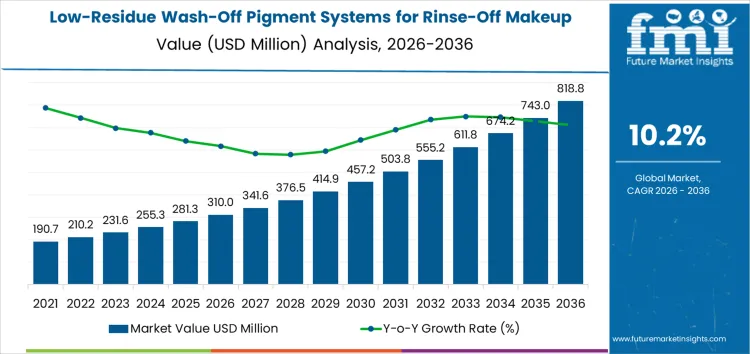
The low-residue wash-off pigment systems for rinse-off makeup products market is valued at USD 310.0 million in 2026 and is projected to reach USD 818.8 million by 2036, registering a CAGR of 10.2%. Expansion during this period is linked to functional reformulation priorities rather than increased decorative makeup usage. Rinse-off formats place structural importance on pigments that provide visible color during short wear while allowing complete removal during cleansing. Product categories such as wash-off mascaras, temporary face makeup, children’s cosmetics, and cleansing-integrated color products rely on pigments engineered for controlled adhesion and rapid dispersion in water. Performance evaluation centers on residue behavior, skin cleanliness after rinse, and compatibility with frequent cleansing routines.
Quick Stats for Low-Residue Wash-Off Pigment Systems for Rinse-Off Makeup Products Market
- Low-Residue Wash-Off Pigment Systems for Rinse-Off Makeup Products Market Value (2026): USD 310.0 million
- Low-Residue Wash-Off Pigment Systems for Rinse-Off Makeup Products Market Forecast Value (2036): USD 818.8 million
- Forecast CAGR (2026-2036): 10.2%
- Leading Pigment System Type in Global Demand: Water-Dispersible Wash-Off Pigments
- Fastest-Growing Countries: India, China, South Korea, USA, Brazil
- Key Players in Global Demand: Sensient Technologies, Clariant AG, BASF SE, DSM-Firmenich, Sun Chemical
Application-specific requirements determine value concentration across the category. Wash-off face makeup represents the largest share due to daily cleansing cycles and repeated skin contact. Children’s and play makeup follows, governed by safety, residue avoidance, and simplified removal standards. Temporary event and festival products prioritize high visual impact combined with fast post-use cleanup. Pigment selection increasingly favors water-dispersible systems and weak-adhesion surface treatments to limit staining and buildup. Regulatory scrutiny on rinse-off ingredients, wastewater compatibility, and child-use safety reinforces demand for pigments with predictable wash-off kinetics. Long-term growth remains anchored in formulation reliability, regulatory alignment, and consumer trust in clean removal performance rather than shade complexity or extended wear capabilities.
Low-Residue Wash-Off Pigment Systems for Rinse-Off Makeup Products Market Key Takeaways
| Metric | Value |
|---|---|
| Market Value (2026) | USD 310.0 million |
| Market Forecast Value (2036) | USD 818.8 million |
| Forecast CAGR (2026-2036) | 10.2% |
Why is the Demand for Low-Residue Wash-Off Pigment Systems for Rinse-Off Makeup Products Market Growing?
Demand for low-residue wash-off pigment systems for rinse-off makeup products is growing globally due to rising consumer expectations for cleansing ease, skin comfort, and reduced environmental impact. Rinse-off makeup formats such as mascaras, eyeliners, and theatrical face paints require pigments that deliver vibrant color and performance yet rinse cleanly with water or mild cleansers without leaving persistent residues. Cosmetic formulators integrate pigment systems engineered for low adhesion and high dispersibility, which supports efficient removal from skin and reduces the need for aggressive cleansing agents that can disrupt skin barrier function.
Regulatory frameworks in multiple regions emphasize safety, biodegradability, and minimized environmental persistence for rinse-off product ingredients, which reinforces specification of pigments that meet eco-toxicity criteria and wastewater treatment compatibility. Growth in daily makeup routines and increased focus on skin health encourages preference for products that simplify cleansing while maintaining aesthetic performance. Advances in pigment engineering improve wash-off kinetics, dispersion uniformity, and cosmetic stability under dynamic use conditions. Retail expansion across mass market, specialty cosmetics, and e-commerce channels increases availability for diverse consumer segments. Consumer awareness of sustainable product attributes further reinforces adoption of low-residue wash-off pigment systems in global makeup portfolios.
How Is the Low-Residue Wash-Off Pigment Systems for Rinse-Off Makeup Products Market Structured?
Demand for low-residue wash-off pigment systems in rinse-off makeup products is shaped by expectations for easy removal, minimal skin residue, and compatibility with frequent cleansing. Formulators evaluate pigment solubility, surface adhesion behavior, and rinse efficiency to ensure complete removal without mechanical stress. Global demand reflects growth in temporary makeup formats, child-safe products, and cleansing-integrated cosmetics where residue control and skin comfort define functional acceptance.
Which Pigment System Type Accounts for the Largest Share of Global Demand?
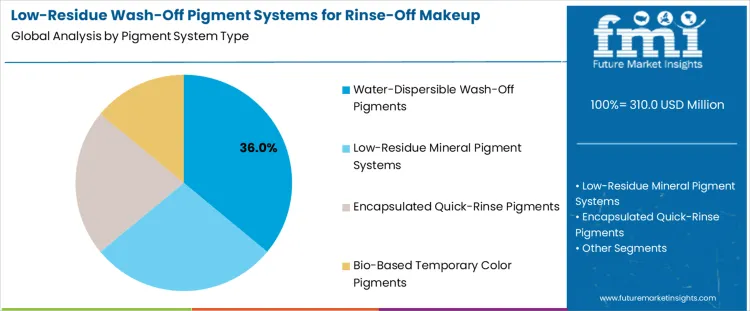
Water-dispersible wash-off pigments account for 36.0%, representing the largest share of global demand. These pigments dissolve or disperse rapidly in water, enabling effective removal during rinsing. Low-residue mineral pigment systems follow at 28.0%, offering improved wash-off behavior while maintaining color stability during short wear periods. Encapsulated quick-rinse pigments hold 22.0%, supporting controlled release and reduced skin adherence. Bio-based temporary color pigments represent 14.0%, reflecting selective adoption in naturally positioned and child-focused formulations.
Key Points
- Water-dispersible pigments lead due to rapid rinse efficiency
- Mineral systems balance short-wear stability with low residue
- Encapsulation limits pigment adhesion during cleansing
Which Residue Control Mechanism Drives the Highest Global Demand?
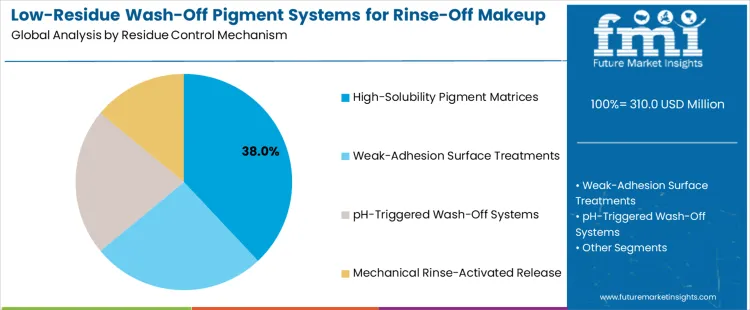
High-solubility pigment matrices account for 38.0%, making them the leading residue control mechanism globally. These matrices allow pigments to disengage quickly upon water contact. Weak-adhesion surface treatments follow at 26.0%, reducing pigment bonding to skin or hair surfaces. pH-triggered wash-off systems represent 22.0%, enabling color release under cleansing conditions. Mechanical rinse-activated release holds 14.0%, relying on water flow rather than chemical triggers.
Key Points
- High solubility ensures efficient pigment removal
- Weak adhesion reduces residual staining risk
- pH-responsive systems support controlled wash-off
Which Application Segment Represents the Largest Share of Global Demand?
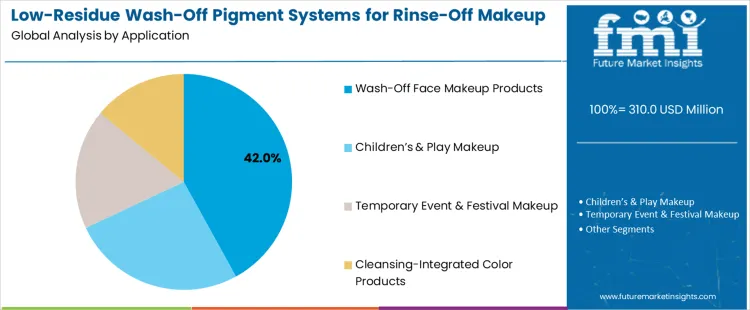
Wash-off face makeup products account for 42.0%, making them the largest application segment globally. These products require pigments that maintain appearance during wear while ensuring complete removal during cleansing. Children’s and play makeup follows at 26.0%, driven by safety and residue-free removal requirements. Temporary event and festival makeup represents 18.0%, supporting short-duration wear with easy cleanup. Cleansing-integrated color products hold 14.0%, combining visual effect with wash-off functionality.
Key Points
- Face wash-off makeup dominates due to daily cleansing routines
- Children’s products emphasize safety and residue control
- Temporary makeup prioritizes easy post-use removal
What are the Key Dynamics in the Low-Residue Wash-Off Pigment Systems for Rinse-Off Makeup Products Market?
Global demand rises as cosmetic brands and formulators adopt low-residue wash-off pigment systems that deliver vibrant color while minimizing product buildup and residue after cleansing. These specialized pigment systems support formulations for rinse-off makeup products such as mascaras, eyeliner washes, wash-off lip stains, and face paints. Adoption aligns with consumer preference for easy removal, reduced pore occlusion risk, and gentle cleansing routines. Usage spans mass market, prestige, and kids’ makeup segments across Europe, North America, Asia-Pacific, and Latin America with growing interest in wash-off performance and skin health.
How do ease-of-use preferences and skin health concerns shape adoption?
Consumers increasingly value makeup products that provide reliable color payoff during wear and clean removal without strenuous scrubbing or lingering residue. Low-residue pigments enable formulators to create rinse-off products that reduce potential irritation, buildup, and transfer to pillowcases or clothing. Beauty routines that emphasize gentle cleansing and minimal water usage benefit from pigment systems that disperse easily in wash-off formats. Retailers highlight these attributes in product descriptions and merchandising to appeal to makeup wearers with sensitive skin, active lifestyles, or daily cleansing expectations. Social media trends reinforce demand for makeup that integrates smoothly with skincare and hygiene routines while delivering expressive color effects.
How do formulation challenges, cost considerations, and regulatory compliance influence market scalability?
Low-residue wash-off pigment systems require careful selection of particle size, surface chemistry, and dispersion technology to balance wash-off ease with color intensity and stability during wear. Specialized pigment formulations often carry higher raw material costs relative to conventional colorants, influencing pricing of finished products and margin planning. Formulators must optimize interactions with surfactants, cleansers, and emulsifiers to ensure efficient removal without compromising the texture or appearance of the makeup. Regulatory frameworks in key markets enforce limits on preservatives, heavy metals, and allergenic impurities for rinse-off products, influencing pigment choice and documentation processes. Variability in supply chain availability for compliant pigment sources affects planning and cost stability. Long-term growth depends on continued innovation that delivers strong performance with minimal residue and harmonized safety standards that facilitate broad product deployment worldwide.
How Is Demand for Low-Residue Wash-Off Pigment Systems for Rinse-Off Makeup Products Evolving?
Demand for low-residue wash-off pigment systems for rinse-off makeup products is increasing globally due to skin barrier concerns, cleansing efficiency expectations, and regulatory focus on rinse-off residue. India leads with an 11.0% CAGR, supported by growth in rinse-off makeup and hybrid cleansing formats. China follows at 10.7%, driven by scale manufacturing and rapid adoption of gentle removal claims. South Korea records 10.4%, reflecting leadership in wash-off texture engineering. USA posts a 9.9% CAGR, shaped by dermatologist guidance and clean beauty governance. Brazil records 9.6%, supported by frequent product use and climate-driven cleansing needs. Growth reflects preference for pigments that deliver color performance while minimizing post-rinse residue.
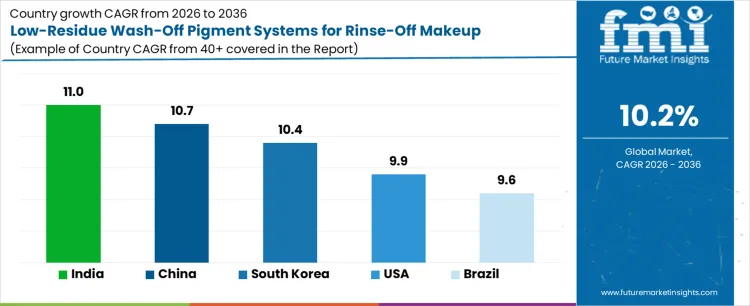
| Country | CAGR (%) |
|---|---|
| India | 11.0% |
| China | 10.7% |
| South Korea | 10.4% |
| USA | 9.9% |
| Brazil | 9.6% |
What factors are driving strong adoption of low-residue wash-off pigments in India?
India demand is driven by rising preference for makeup products that remove cleanly without leaving stains or film on skin. CAGR of 11.0% reflects adoption of pigment systems optimized for easy rinse-off and minimal pore residue. Consumers favor products compatible with frequent cleansing under warm and humid conditions. Domestic brands expand rinse-off color products across mass and premium segments. Export-oriented manufacturers align pigment performance with international residue and safety benchmarks. Growth remains consumption-led and formulation-driven, aligned with skin comfort priorities and evolving hygiene routines.
- Preference for easy removal and clean rinse performance
- Climate-driven need for residue minimization
- Expansion of rinse-off makeup formats
- Alignment with international residue standards
How is China sustaining high growth in low-residue pigment usage?
China demand reflects scale of cosmetic manufacturing and strong consumer interest in gentle cleansing performance. CAGR of 10.7% is supported by integration of low-residue pigments into wash-off masks, temporary makeup, and color-cleansing hybrids. Brands emphasize clarity of removal and reduced skin buildup. E-commerce accelerates adoption of rinse-clean claims. Domestic pigment suppliers invest in dispersion control and surface chemistry to enhance washability. Growth remains scale-driven and innovation-aligned, supported by rapid product iteration and consumer feedback loops.
- Large-scale production of rinse-off color products
- Emphasis on clean removal and washability
- E-commerce-driven consumer education
- Investment in dispersion and surface chemistry
What supports South Korea’s leadership in wash-off pigment innovation?
South Korea demand reflects leadership in cleansing-focused beauty routines and texture refinement. CAGR of 10.4% is supported by development of pigments delivering visible color that releases efficiently during rinsing. Brands integrate low-residue pigments into wash-off tints, masks, and temporary color cosmetics. Export-oriented formulations adopt these systems to meet global gentle-cleansing expectations. Continuous innovation in texture and rinse behavior sustains demand. Growth remains technology-led and trend-driven, aligned with South Korea’s influence on cleansing-centric beauty formats.
- Advanced expertise in cleansing and texture design
- Integration into wash-off and temporary makeup
- Export-driven adoption of gentle removal systems
- Continuous innovation in rinse performance
What factors shape demand growth in the USA for low-residue wash-off pigments?
USA demand is shaped by dermatologist advice, skin sensitivity concerns, and clean beauty standards. CAGR of 9.9% reflects reformulation of rinse-off makeup to reduce residual staining and irritation risk. Brands emphasize compatibility with sensitive skin and barrier-support routines. Retailers require substantiated claims related to residue and removability. Professional and mass-market brands adopt low-residue pigments across cleansing makeup formats. Growth remains brand-led and compliance-focused, aligned with wellness-oriented personal care consumption.
- Dermatologist influence on cleansing performance
- Reformulation to reduce residue and irritation
- Retail scrutiny of removal claims
- Adoption across professional and mass-market products
Why is Brazil showing steady growth in low-residue wash-off pigment systems?
Brazil demand reflects frequent makeup use and high importance of effective cleansing under warm climate conditions. CAGR of 9.6% is supported by adoption of wash-off pigments that minimize staining after removal. Consumers value products that cleanse quickly without leaving color traces. Domestic brands expand rinse-off color formats to meet lifestyle needs. Regulatory alignment with international cosmetic safety standards influences pigment sourcing. Growth remains usage-driven and product-focused, supported by climate conditions and strong cleansing culture.
- High frequency of makeup use and cleansing
- Demand for minimal staining after rinse-off
- Expansion of wash-off color product formats
- Alignment with international cosmetic safety standards
What is the competitive landscape of demand for low-residue wash-off pigment systems for rinse-off makeup products?
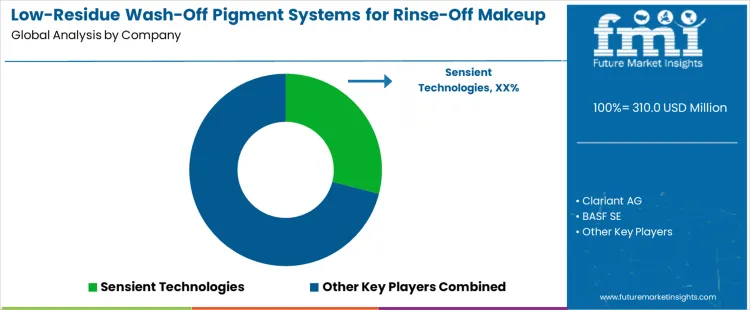
Demand for low-residue wash-off pigment systems for rinse-off makeup products is driven by growth of cleansing balms, wash-off masks, and temporary color cosmetics. These products require pigments that deliver visible color during application while enabling complete removal without staining skin or leaving residue in pores. Buyers evaluate pigment solubility or dispersibility, rinse-off efficiency, low affinity to keratin, and compatibility with surfactant-rich and oil-based cleansing systems. Procurement teams prioritize suppliers with validated rinse-off testing data, low migration risk, and compliance with global cosmetic safety regulations. Trend in the global market reflects increased consumer focus on gentle cleansing, barrier protection, and avoidance of post-use residue associated with traditional pigments.
Sensient Technologies holds leading positioning through engineered low-residue pigment dispersions designed for controlled adhesion and rapid wash-off performance. Clariant AG supplies cosmetic pigments optimized for temporary color payoff and efficient removal in rinse-off formulations. BASF SE contributes pigment technologies and auxiliaries supporting clean rinse profiles and formulation stability in cleansing products. DSM-Firmenich supports demand through color science expertise and ingredient platforms aligned with mild surfactant systems and sensitive-skin positioning. Sun Chemical, part of DIC Group, provides scalable pigment systems with consistent batch behavior for global rinse-off makeup launches. Competitive differentiation depends on wash-off efficiency, residue control, formulation flexibility, and ability to support large-scale brand requirements.
Key Players in the Low-Residue Wash-Off Pigment Systems for Rinse-Off Makeup Products Market
- Sensient Technologies
- Clariant AG
- BASF SE
- DSM-Firmenich
- Sun Chemical (DIC Group)
Scope of the Report
| Items | Values |
|---|---|
| Quantitative Units | USD million |
| Pigment System Type | Water-Dispersible Wash-Off Pigments; Low-Residue Mineral Pigment Systems; Encapsulated Quick-Rinse Pigments; Bio-Based Temporary Color Pigments |
| Residue Control Mechanism | High-Solubility Pigment Matrices; Weak-Adhesion Surface Treatments; pH-Triggered Wash-Off Systems; Mechanical Rinse-Activated Release |
| Application | Wash-Off Face Makeup Products; Children’s & Play Makeup; Temporary Event & Festival Makeup; Cleansing-Integrated Color Products |
| Regions Covered | Asia Pacific, Europe, North America, Latin America, Middle East & Africa |
| Countries Covered | India, China, South Korea, USA, Brazil, and 40+ countries |
| Key Companies Profiled | Sensient Technologies; Clariant AG; BASF SE; DSM-Firmenich; Sun Chemical (DIC Group) |
| Additional Attributes | Dollar sales by pigment system type and residue control mechanism; adoption trends for quick-rinse and low-residue pigments in rinse-off makeup formats; wash-off efficiency, residual staining, and skin cleanliness performance metrics; compatibility with surfactant-based cleansing systems and water-activated products; particle dispersion, rinse kinetics, and color release uniformity considerations; cosmetic safety, child-use compliance, and temporary color claim standards influencing wash-off pigment system selection. |
Low-Residue Wash-Off Pigment Systems for Rinse-Off Makeup Products Market by Segment
Pigment System Type:
- Water-Dispersible Wash-Off Pigments
- Low-Residue Mineral Pigment Systems
- Encapsulated Quick-Rinse Pigments
- Bio-Based Temporary Color Pigments
Residue Control Mechanism:
- High-Solubility Pigment Matrices
- Weak-Adhesion Surface Treatments
- pH-Triggered Wash-Off Systems
- Mechanical Rinse-Activated Release
Application:
- Wash-Off Face Makeup Products
- Children’s & Play Makeup
- Temporary Event & Festival Makeup
- Cleansing-Integrated Color Products
Region:
- Asia Pacific
- China
- Japan
- South Korea
- India
- Australia & New Zealand
- ASEAN
- Rest of Asia Pacific
- Europe
- Germany
- United Kingdom
- France
- Italy
- Spain
- Nordic
- BENELUX
- Rest of Europe
- North America
- United States
- Canada
- Mexico
- Latin America
- Brazil
- Chile
- Rest of Latin America
- Middle East & Africa
- Kingdom of Saudi Arabia
- Other GCC Countries
- Turkey
- South Africa
- Other African Union
- Rest of Middle East & Africa
Frequently Asked Questions
How big is the low-residue wash-off pigment systems for rinse-off makeup products market in 2026?
The global low-residue wash-off pigment systems for rinse-off makeup products market is estimated to be valued at USD 310.0 million in 2026.
What will be the size of low-residue wash-off pigment systems for rinse-off makeup products market in 2036?
The market size for the low-residue wash-off pigment systems for rinse-off makeup products market is projected to reach USD 818.8 million by 2036.
How much will be the low-residue wash-off pigment systems for rinse-off makeup products market growth between 2026 and 2036?
The low-residue wash-off pigment systems for rinse-off makeup products market is expected to grow at a CAGR of 10.2% between 2026 and 2036.
What are the key pigment system types in the low-residue wash-off pigment systems for rinse-off makeup products market?
The key pigment system types in the low-residue wash-off pigment systems for rinse-off makeup products market are water-dispersible wash-off pigments, low-residue mineral pigment systems, encapsulated quick-rinse pigments, and bio-based temporary color pigments.
Which residue control mechanism segment will contribute significant share in the low-residue wash-off pigment systems for rinse-off makeup products market in 2026?
In terms of residue control mechanism, high-solubility pigment matrices segment to command 38.0% share in the low-residue wash-off pigment systems for rinse-off makeup products market in 2026.
Preview the report firsthand - request a free sample
Get SampleGet the brochure for pricing and purchase details.
Get PDFTable of Content
- Executive Summary
- Global Market Outlook
- Demand-side Trends
- Supply-side Trends
- Technology Roadmap Analysis
- Analysis and Recommendations
- Market Overview
- Market Coverage / Taxonomy
- Market Definition / Scope / Limitations
- Market Background
- Market Dynamics
- Drivers
- Restraints
- Opportunity
- Trends
- Scenario Forecast
- Demand in Optimistic Scenario
- Demand in Likely Scenario
- Demand in Conservative Scenario
- Opportunity Map Analysis
- Product Life Cycle Analysis
- Supply Chain Analysis
- Investment Feasibility Matrix
- Value Chain Analysis
- PESTLE and Porter’s Analysis
- Regulatory Landscape
- Regional Parent Market Outlook
- Production and Consumption Statistics
- Import and Export Statistics
- Market Dynamics
- Global Market Analysis 2021 to 2025 and Forecast, 2026 to 2036
- Historical Market Size Value (USD Million) Analysis, 2021 to 2025
- Current and Future Market Size Value (USD Million) Projections, 2026 to 2036
- Y-o-Y Growth Trend Analysis
- Absolute $ Opportunity Analysis
- Global Market Pricing Analysis 2021 to 2025 and Forecast 2026 to 2036
- Global Market Analysis 2021 to 2025 and Forecast 2026 to 2036, By Pigment System Type
- Introduction / Key Findings
- Historical Market Size Value (USD Million) Analysis By Pigment System Type , 2021 to 2025
- Current and Future Market Size Value (USD Million) Analysis and Forecast By Pigment System Type , 2026 to 2036
- Water-Dispersible Wash-Off Pigments
- Low-Residue Mineral Pigment Systems
- Encapsulated Quick-Rinse Pigments
- Bio-Based Temporary Color Pigments
- Water-Dispersible Wash-Off Pigments
- Y-o-Y Growth Trend Analysis By Pigment System Type , 2021 to 2025
- Absolute $ Opportunity Analysis By Pigment System Type , 2026 to 2036
- Global Market Analysis 2021 to 2025 and Forecast 2026 to 2036, By Residue Control Mechanism
- Introduction / Key Findings
- Historical Market Size Value (USD Million) Analysis By Residue Control Mechanism, 2021 to 2025
- Current and Future Market Size Value (USD Million) Analysis and Forecast By Residue Control Mechanism, 2026 to 2036
- High-Solubility Pigment Matrices
- Weak-Adhesion Surface Treatments
- pH-Triggered Wash-Off Systems
- Mechanical Rinse-Activated Release
- High-Solubility Pigment Matrices
- Y-o-Y Growth Trend Analysis By Residue Control Mechanism, 2021 to 2025
- Absolute $ Opportunity Analysis By Residue Control Mechanism, 2026 to 2036
- Global Market Analysis 2021 to 2025 and Forecast 2026 to 2036, By Application
- Introduction / Key Findings
- Historical Market Size Value (USD Million) Analysis By Application, 2021 to 2025
- Current and Future Market Size Value (USD Million) Analysis and Forecast By Application, 2026 to 2036
- Wash-Off Face Makeup Products
- Children’s & Play Makeup
- Temporary Event & Festival Makeup
- Cleansing-Integrated Color Products
- Wash-Off Face Makeup Products
- Y-o-Y Growth Trend Analysis By Application, 2021 to 2025
- Absolute $ Opportunity Analysis By Application, 2026 to 2036
- Global Market Analysis 2021 to 2025 and Forecast 2026 to 2036, By Region
- Introduction
- Historical Market Size Value (USD Million) Analysis By Region, 2021 to 2025
- Current Market Size Value (USD Million) Analysis and Forecast By Region, 2026 to 2036
- North America
- Latin America
- Western Europe
- Eastern Europe
- East Asia
- South Asia and Pacific
- Middle East & Africa
- Market Attractiveness Analysis By Region
- North America Market Analysis 2021 to 2025 and Forecast 2026 to 2036, By Country
- Historical Market Size Value (USD Million) Trend Analysis By Market Taxonomy, 2021 to 2025
- Market Size Value (USD Million) Forecast By Market Taxonomy, 2026 to 2036
- By Country
- USA
- Canada
- Mexico
- By Pigment System Type
- By Residue Control Mechanism
- By Application
- By Country
- Market Attractiveness Analysis
- By Country
- By Pigment System Type
- By Residue Control Mechanism
- By Application
- Key Takeaways
- Latin America Market Analysis 2021 to 2025 and Forecast 2026 to 2036, By Country
- Historical Market Size Value (USD Million) Trend Analysis By Market Taxonomy, 2021 to 2025
- Market Size Value (USD Million) Forecast By Market Taxonomy, 2026 to 2036
- By Country
- Brazil
- Chile
- Rest of Latin America
- By Pigment System Type
- By Residue Control Mechanism
- By Application
- By Country
- Market Attractiveness Analysis
- By Country
- By Pigment System Type
- By Residue Control Mechanism
- By Application
- Key Takeaways
- Western Europe Market Analysis 2021 to 2025 and Forecast 2026 to 2036, By Country
- Historical Market Size Value (USD Million) Trend Analysis By Market Taxonomy, 2021 to 2025
- Market Size Value (USD Million) Forecast By Market Taxonomy, 2026 to 2036
- By Country
- Germany
- UK
- Italy
- Spain
- France
- Nordic
- BENELUX
- Rest of Western Europe
- By Pigment System Type
- By Residue Control Mechanism
- By Application
- By Country
- Market Attractiveness Analysis
- By Country
- By Pigment System Type
- By Residue Control Mechanism
- By Application
- Key Takeaways
- Eastern Europe Market Analysis 2021 to 2025 and Forecast 2026 to 2036, By Country
- Historical Market Size Value (USD Million) Trend Analysis By Market Taxonomy, 2021 to 2025
- Market Size Value (USD Million) Forecast By Market Taxonomy, 2026 to 2036
- By Country
- Russia
- Poland
- Hungary
- Balkan & Baltic
- Rest of Eastern Europe
- By Pigment System Type
- By Residue Control Mechanism
- By Application
- By Country
- Market Attractiveness Analysis
- By Country
- By Pigment System Type
- By Residue Control Mechanism
- By Application
- Key Takeaways
- East Asia Market Analysis 2021 to 2025 and Forecast 2026 to 2036, By Country
- Historical Market Size Value (USD Million) Trend Analysis By Market Taxonomy, 2021 to 2025
- Market Size Value (USD Million) Forecast By Market Taxonomy, 2026 to 2036
- By Country
- China
- Japan
- South Korea
- By Pigment System Type
- By Residue Control Mechanism
- By Application
- By Country
- Market Attractiveness Analysis
- By Country
- By Pigment System Type
- By Residue Control Mechanism
- By Application
- Key Takeaways
- South Asia and Pacific Market Analysis 2021 to 2025 and Forecast 2026 to 2036, By Country
- Historical Market Size Value (USD Million) Trend Analysis By Market Taxonomy, 2021 to 2025
- Market Size Value (USD Million) Forecast By Market Taxonomy, 2026 to 2036
- By Country
- India
- ASEAN
- Australia & New Zealand
- Rest of South Asia and Pacific
- By Pigment System Type
- By Residue Control Mechanism
- By Application
- By Country
- Market Attractiveness Analysis
- By Country
- By Pigment System Type
- By Residue Control Mechanism
- By Application
- Key Takeaways
- Middle East & Africa Market Analysis 2021 to 2025 and Forecast 2026 to 2036, By Country
- Historical Market Size Value (USD Million) Trend Analysis By Market Taxonomy, 2021 to 2025
- Market Size Value (USD Million) Forecast By Market Taxonomy, 2026 to 2036
- By Country
- Kingdom of Saudi Arabia
- Other GCC Countries
- Turkiye
- South Africa
- Other African Union
- Rest of Middle East & Africa
- By Pigment System Type
- By Residue Control Mechanism
- By Application
- By Country
- Market Attractiveness Analysis
- By Country
- By Pigment System Type
- By Residue Control Mechanism
- By Application
- Key Takeaways
- Key Countries Market Analysis
- USA
- Pricing Analysis
- Market Share Analysis, 2025
- By Pigment System Type
- By Residue Control Mechanism
- By Application
- Canada
- Pricing Analysis
- Market Share Analysis, 2025
- By Pigment System Type
- By Residue Control Mechanism
- By Application
- Mexico
- Pricing Analysis
- Market Share Analysis, 2025
- By Pigment System Type
- By Residue Control Mechanism
- By Application
- Brazil
- Pricing Analysis
- Market Share Analysis, 2025
- By Pigment System Type
- By Residue Control Mechanism
- By Application
- Chile
- Pricing Analysis
- Market Share Analysis, 2025
- By Pigment System Type
- By Residue Control Mechanism
- By Application
- Germany
- Pricing Analysis
- Market Share Analysis, 2025
- By Pigment System Type
- By Residue Control Mechanism
- By Application
- UK
- Pricing Analysis
- Market Share Analysis, 2025
- By Pigment System Type
- By Residue Control Mechanism
- By Application
- Italy
- Pricing Analysis
- Market Share Analysis, 2025
- By Pigment System Type
- By Residue Control Mechanism
- By Application
- Spain
- Pricing Analysis
- Market Share Analysis, 2025
- By Pigment System Type
- By Residue Control Mechanism
- By Application
- France
- Pricing Analysis
- Market Share Analysis, 2025
- By Pigment System Type
- By Residue Control Mechanism
- By Application
- India
- Pricing Analysis
- Market Share Analysis, 2025
- By Pigment System Type
- By Residue Control Mechanism
- By Application
- ASEAN
- Pricing Analysis
- Market Share Analysis, 2025
- By Pigment System Type
- By Residue Control Mechanism
- By Application
- Australia & New Zealand
- Pricing Analysis
- Market Share Analysis, 2025
- By Pigment System Type
- By Residue Control Mechanism
- By Application
- China
- Pricing Analysis
- Market Share Analysis, 2025
- By Pigment System Type
- By Residue Control Mechanism
- By Application
- Japan
- Pricing Analysis
- Market Share Analysis, 2025
- By Pigment System Type
- By Residue Control Mechanism
- By Application
- South Korea
- Pricing Analysis
- Market Share Analysis, 2025
- By Pigment System Type
- By Residue Control Mechanism
- By Application
- Russia
- Pricing Analysis
- Market Share Analysis, 2025
- By Pigment System Type
- By Residue Control Mechanism
- By Application
- Poland
- Pricing Analysis
- Market Share Analysis, 2025
- By Pigment System Type
- By Residue Control Mechanism
- By Application
- Hungary
- Pricing Analysis
- Market Share Analysis, 2025
- By Pigment System Type
- By Residue Control Mechanism
- By Application
- Kingdom of Saudi Arabia
- Pricing Analysis
- Market Share Analysis, 2025
- By Pigment System Type
- By Residue Control Mechanism
- By Application
- Turkiye
- Pricing Analysis
- Market Share Analysis, 2025
- By Pigment System Type
- By Residue Control Mechanism
- By Application
- South Africa
- Pricing Analysis
- Market Share Analysis, 2025
- By Pigment System Type
- By Residue Control Mechanism
- By Application
- USA
- Market Structure Analysis
- Competition Dashboard
- Competition Benchmarking
- Market Share Analysis of Top Players
- By Regional
- By Pigment System Type
- By Residue Control Mechanism
- By Application
- Competition Analysis
- Competition Deep Dive
- Sensient Technologies
- Overview
- Product Portfolio
- Profitability by Market Segments (Product/Age /Sales Channel/Region)
- Sales Footprint
- Strategy Overview
- Marketing Strategy
- Product Strategy
- Channel Strategy
- Clariant AG
- BASF SE
- DSM-Firmenich
- Sun Chemical (DIC Group)
- Sensient Technologies
- Competition Deep Dive
- Assumptions & Acronyms Used
- Research Methodology


