

- Industry Size (2026)
- USD 540.0 Mn
- Forecast (2036)
- USD 1375.4 Mn
- CAGR (2026 to 2036)
- 9.8%
High-Purity Cosmetic Pigment Systems for Sensitive Skin and Baby Care Market Forecast and Outlook 2026 to 2036
The high-purity cosmetic pigment systems for sensitive skin and baby care market is valued at USD 540.0 million in 2026 and is projected to reach USD 1,375.4 million by 2036, reflecting a CAGR of 9.8%. Market expansion during this period is anchored in formulation risk management rather than decorative cosmetics growth cycles. Pigment selection is driven by impurity thresholds, toxicological acceptability, and reproducibility under gentle use conditions.
Baby care cosmetics and sensitive skin products require pigments that meet ultra-low heavy metal limits and predictable particle behavior, placing emphasis on mineral and highly refined pigment systems. Value concentration remains strongest where pigments are specified early in product design to meet pediatric and dermatological safety expectations, reducing downstream reformulation and compliance risk.
Adoption patterns are shaped by application criticality and regulatory exposure. Baby care products account for the highest value share due to non-negotiable safety margins and frequent regulatory review. Sensitive skin face makeup follows, supported by rising diagnosis of intolerance and increased reliance on dermatologist-recommended products. Dermocosmetic and medically positioned color products adopt high-purity pigments selectively, prioritizing compatibility with active ingredients and compromised skin barriers.
Cost sensitivity remains secondary to safety assurance in these segments, supporting stable demand even during pricing pressure. Growth quality is strongest where pigments are embedded in long-term product platforms with repeat usage and pharmacy or pediatric channel credibility, rather than trend-driven color launches or seasonal shade rotations.
Quick Stats for High-Purity Cosmetic Pigment Systems for Sensitive Skin and Baby Care Market
- High-Purity Cosmetic Pigment Systems for Sensitive Skin and Baby Care Market Value (2026): USD 540.0 million
- High-Purity Cosmetic Pigment Systems for Sensitive Skin and Baby Care Market Forecast Value (2036): USD 1,375.4 million
- Forecast CAGR (2026 to 2036): 9.8%
- Leading Pigment System Type in Global Demand: High-Purity Mineral Pigments
- Fastest-Growing Countries: India, China, USA, Germany, France
- Key Players in Global Demand: Sensient Technologies, Clariant AG, BASF SE, DSM-Firmenich, Sun Chemical
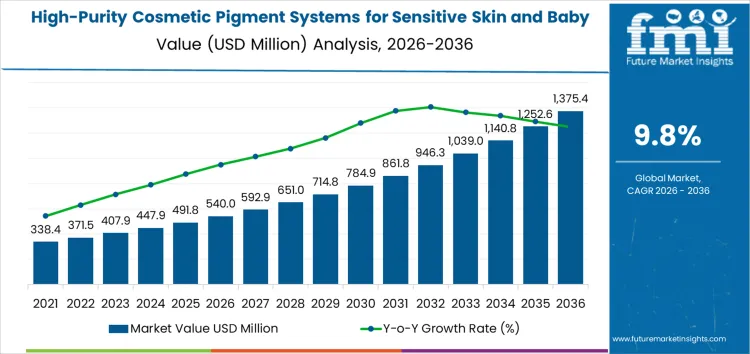
High-Purity Cosmetic Pigment Systems for Sensitive Skin and Baby Care Market Key Takeaways
| Metric | Value |
|---|---|
| Market Value (2026) | USD 540.0 million |
| Market Forecast Value (2036) | USD 1,375.4 million |
| Forecast CAGR (2026 to 2036) | 9.8% |
Why is the Demand for High-Purity Cosmetic Pigment Systems for Sensitive Skin and Baby Care Market Growing?
Demand for high-purity cosmetic pigment systems for sensitive skin and baby care products is growing globally due to heightened consumer awareness of formulation safety, skin tolerance, and long-term health implications. Sensitive skin and infant dermal applications require colorants with minimal impurities, low irritancy potential, and predictable performance under gentle use conditions. Cosmetic manufacturers and pediatric personal care brands integrate high-purity pigments into lip balms, baby safe tinted moisturizers, cream blushes, and powder formulations to minimize risk of redness, itching, or allergic response.
Regulatory frameworks in multiple regions set stringent limits on heavy metals, PAHs, and residual synthesis byproducts in cosmetic colorants, which reinforces selection of pigments that meet defined purity thresholds and testing criteria. Expansion of market segments focused on hypoallergenic and dermatologist-tested offerings supports use of certified high-purity systems that deliver consistent hue and stability without harsh co-ingredients.
Retail growth through specialty baby care, pharmacy, and e-commerce channels increases access to formulations tailored for delicate skin. Advances in pigment purification techniques improve performance characteristics, including lightfastness, dispersion uniformity, and compatibility with sensitive skin bases. Brand positioning that emphasizes safety, transparency, and trusted quality encourages continued adoption of high-purity pigment systems across global sensitive and baby care markets.
How Is the High-Purity Cosmetic Pigment Systems for Sensitive Skin and Baby Care Market Structured?
Demand for high-purity cosmetic pigment systems for sensitive skin and baby care is driven by heightened safety expectations, regulatory scrutiny on trace impurities, and growing clinical validation requirements in pediatric and dermatology-focused formulations. Global cosmetic manufacturers prioritize pigments with ultra-low heavy metal content, controlled particle morphology, and documented biocompatibility. Segment structure reflects how pigment chemistry, purity grading, and end-use sensitivity influence formulation decisions across baby care, dermocosmetics, and medically positioned color products.
Which Pigment System Type Represents the Largest Share in Global Demand?
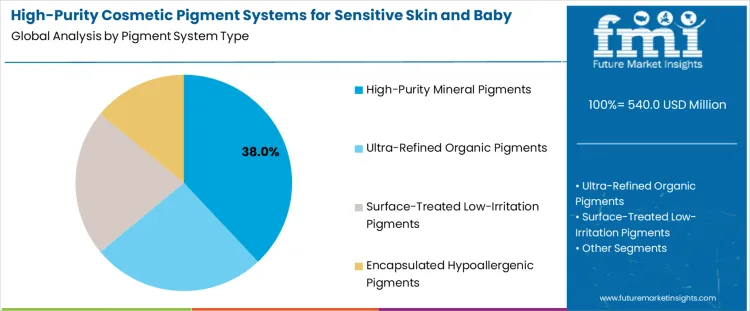
High-purity mineral pigments account for 38.0%, representing the largest share of global demand. These pigments are preferred due to inherent inertness, low allergenic potential, and stability under varied formulation conditions. Ultra-refined organic pigments follow at 26.0%, supported by advanced purification processes that reduce residual solvents and by-products. Surface-treated low-irritation pigments hold 22.0%, reflecting demand for enhanced skin compatibility and reduced reactivity in leave-on products. Encapsulated hypoallergenic pigments account for 14.0%, used in formulations requiring controlled pigment-skin interaction and minimized direct contact.
- Mineral pigments lead due to inherent safety and chemical stability
- Ultra-refined organics balance color performance with purity control
- Encapsulation supports irritation mitigation in high-sensitivity use cases
Which Purity and Safety Grade Is Most Widely Adopted Globally?
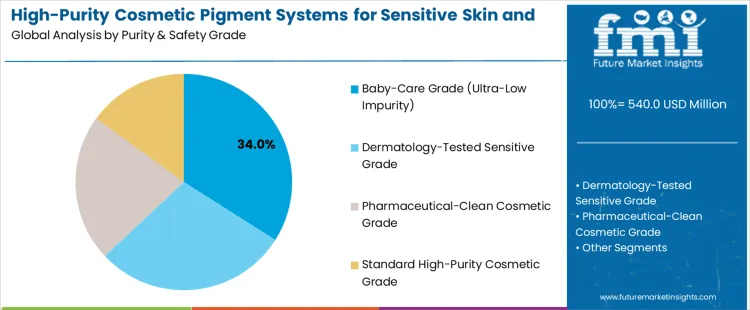
Baby-care grade pigments with ultra-low impurity thresholds dominate with a 34.0% share, making this category the most widely adopted globally. This grade is required for infant and toddler products where tolerance margins are minimal. Dermatology-tested sensitive grade follows at 29.0%, driven by adult sensitive-skin and allergy-tested cosmetic lines. Pharmaceutical-clean cosmetic grade represents 22.0%, reflecting crossover use in medicated and clinically positioned products. Standard high-purity cosmetic grade accounts for 15.0%, serving formulations that require elevated purity without pediatric-level constraints.
- Baby-care grade leads due to strict impurity and safety limits
- Dermatology-tested grades support sensitive adult skin positioning
- Pharmaceutical-clean grades align with therapeutic-adjacent cosmetics
Which Application Segment Drives Global Utilization the Most?
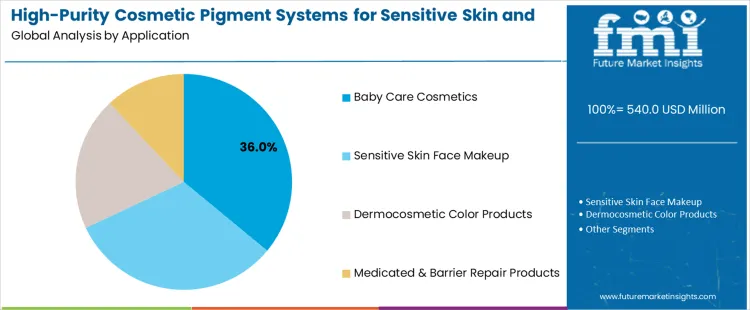
Baby care cosmetics account for 36.0%, making them the leading application segment globally. These products demand the highest safety margins and drive adoption of ultra-pure pigment systems. Sensitive skin face makeup follows at 32.0%, reflecting increasing consumer diagnosis of skin sensitivity and intolerance. Dermocosmetic color products hold 20.0%, integrating cosmetic aesthetics with dermatological performance claims. Medicated and barrier repair products represent 12.0%, where pigments must coexist with active ingredients and compromised skin barriers.
- Baby care drives highest purity requirements globally
- Sensitive skin makeup reflects rising intolerance awareness
- Dermocosmetics bridge clinical validation and aesthetic performance
What are the Key Dynamics in the High-Purity Cosmetic Pigment Systems for Sensitive Skin and Baby Care Market?
Global demand rises as cosmetic manufacturers and personal care brands adopt high-purity pigment systems formulated for sensitive skin and baby care products. High-purity pigments minimize risk of irritation, allergic response, and contamination with heavy metals or residual impurities. Adoption aligns with rising consumer awareness of skin sensitivity, stronger regulatory requirements for product safety, and growth in premium and mild cosmetic segments. Usage spans foundations, tinted moisturizers, baby-safe makeup, and formulation bases designed for delicate skin across global retail and specialist channels.
How do sensitive skin trends and safety expectations drive adoption?
Consumers with sensitive skin and caregivers of infants prioritize products with minimal irritants, well-characterized ingredient profiles, and proven dermatological compatibility. Cosmetic formulators select high-purity pigment systems manufactured under stringent material quality standards to reduce trace contaminants and particle variability that can trigger irritation. Brands marketing baby-safe and sensitive skin lines emphasize pigment systems that conform to rigorous purity criteria and support hypoallergenic claims. Regulatory frameworks in major markets enforce limits on heavy metals, banned substances, and allergenic impurities, influencing pigment specification. Test methods such as patch testing and clinical safety evaluation further validate suitability for sensitive applications. Retailers and online platforms highlight transparency and safe formulation credentials to meet informed consumer expectations globally.
How do performance demands, production costs, and regulatory compliance influence market scalability?
High-purity cosmetic pigments require controlled synthesis, purification, and analytical verification, increasing manufacturing complexity and material cost compared with conventional colorants. Achieving desired color strength, stability, and dispersibility while preserving mild action demands formulation expertise. Regulatory compliance for global product distribution involves adherence to varying purity limits, labeling requirements, and safety testing protocols, which influence development timelines and cost. Supply chain variability in high-quality feedstock affects pigment availability and price stability. Brands must balance performance attributes such as opacity and wear with sensitive skin suitability and regulatory acceptance in diverse regions. Long-term growth depends on continued innovation in robust, skin-friendly pigment systems, harmonized safety standards, and formulation support that minimizes irritation risk while delivering market-acceptable aesthetics worldwide.
How Is Demand for High-Purity Cosmetic Pigment Systems for Sensitive Skin and Baby Care Evolving?
Demand for high-purity cosmetic pigment systems for sensitive skin and baby care is increasing globally due to dermatological safety expectations, allergen risk reduction, and stricter formulation standards. India leads with a 10.5% CAGR, supported by expansion of baby care consumption and dermatology-led product development. China follows at 10.2%, driven by large-scale personal care manufacturing and rising safety scrutiny. USA records a 9.7% CAGR, reflecting pediatric safety standards and ingredient transparency. Germany posts 9.4%, shaped by precautionary regulation and clinical validation norms. France records 9.2%, supported by dermocosmetic leadership and pharmacy-led product adoption. Growth reflects structural shift toward ultra-pure, low-irritation pigment systems in global personal care.
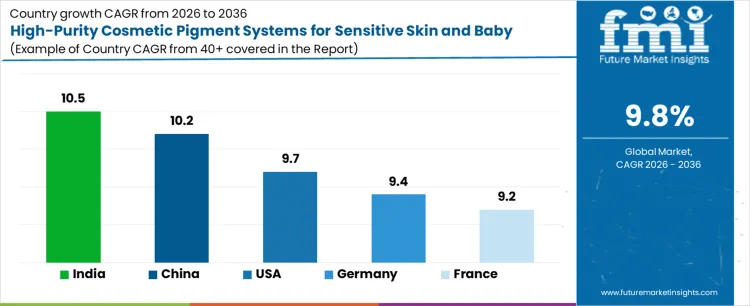
| Country | CAGR (%) |
|---|---|
| India | 10.5% |
| China | 10.2% |
| USA | 9.7% |
| Germany | 9.4% |
| France | 9.2% |
What factors are driving strong adoption of high-purity pigment systems in India?
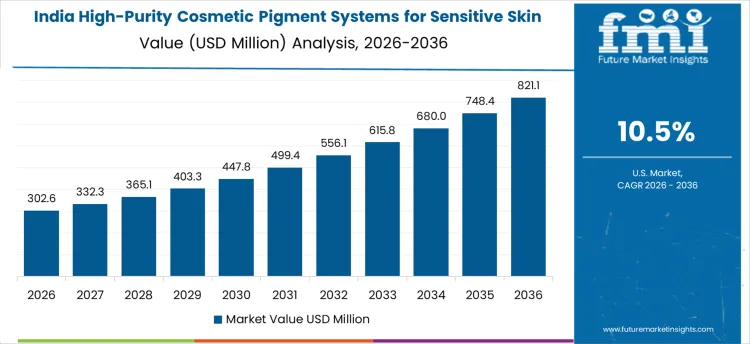
India demand is driven by rapid growth in baby care, sensitive skin cosmetics, and dermatologist-recommended product lines. CAGR of 10.5% reflects increased use of highly refined inorganic and synthetic pigments with controlled heavy metal limits. Parents and caregivers prioritize safety certifications and hypoallergenic claims. Domestic manufacturers align formulations with international pediatric safety benchmarks to support exports. Regulatory focus on contaminant thresholds influences pigment sourcing. Growth remains demand-led and compliance-aligned, supported by rising disposable incomes and expansion of premium baby care categories.
- Expansion of baby care and sensitive skin segments
- Preference for hypoallergenic and low-contaminant pigments
- Alignment with international pediatric safety benchmarks
- Regulatory focus on impurity and heavy metal limits
How is China sustaining high growth in high-purity cosmetic pigment usage?
China demand reflects scale of personal care manufacturing and heightened regulatory attention to product safety. CAGR of 10.2% is supported by adoption of purified pigment systems in baby wipes, creams, and sensitive skin cosmetics. Brands emphasize safety testing and documentation to maintain consumer trust. E-commerce platforms amplify scrutiny of ingredient quality. Domestic pigment suppliers invest in purification technologies to meet low-irritation requirements. Growth remains scale-driven and safety-aligned, supported by manufacturing capacity and evolving consumer expectations.
- Large-scale personal care and baby product manufacturing
- Increased consumer and regulatory safety scrutiny
- Investment in pigment purification technologies
- Emphasis on documentation and testing
What factors shape demand growth for high-purity pigment systems in the USA?
USA demand is shaped by pediatric safety standards, dermatologist recommendations, and ingredient disclosure requirements. CAGR of 9.7% reflects reformulation of baby care and sensitive skin products using pigments with minimal impurity profiles. Brands emphasize non-irritation and suitability for compromised skin barriers. Retailers require extensive safety documentation and testing data. Regulatory oversight reinforces conservative ingredient selection. Growth remains brand-led and compliance-focused, aligned with healthcare-influenced personal care consumption.
- Pediatric and dermatological safety standards
- Reformulation for low-irritation performance
- Retailer-driven documentation requirements
- Conservative ingredient selection practices
Why does Germany show steady growth in high-purity pigment adoption?
Germany demand reflects precautionary consumer protection policy and emphasis on clinical validation. CAGR of 9.4% is supported by use of high-purity pigments in pharmacy-distributed baby and sensitive skin products. Manufacturers prioritize traceability, impurity control, and reproducibility. Certification and toxicological assessment guide pigment selection. Integration occurs within controlled production environments. Growth remains efficiency-led and compliance-focused, aligned with stringent safety and quality assurance frameworks.
- Precautionary consumer and chemical regulation
- Emphasis on clinical and toxicological validation
- Strong traceability and impurity control
- Controlled production and quality assurance systems
What supports continued demand growth in France for high-purity pigment systems?
France demand is driven by leadership in dermocosmetics and pharmacy-led skincare distribution. CAGR of 9.2% reflects adoption of ultra-pure pigments in products positioned for sensitive, infant, and post-procedure skin. Brands emphasize tolerability, minimal formulation complexity, and medical endorsement. Regulatory alignment with EU cosmetic safety standards influences sourcing. Export of dermocosmetic brands sustains demand for consistent pigment quality. Growth remains formulation-driven and trust-focused, supported by strong dermatological heritage and global brand presence.
- Leadership in dermocosmetic and pharmacy channels
- Focus on tolerability and minimal formulation complexity
- Medical and dermatological endorsement influence
- Export-driven demand for consistent pigment quality
What is the competitive landscape of demand for high-purity cosmetic pigment systems for sensitive skin and baby care globally?
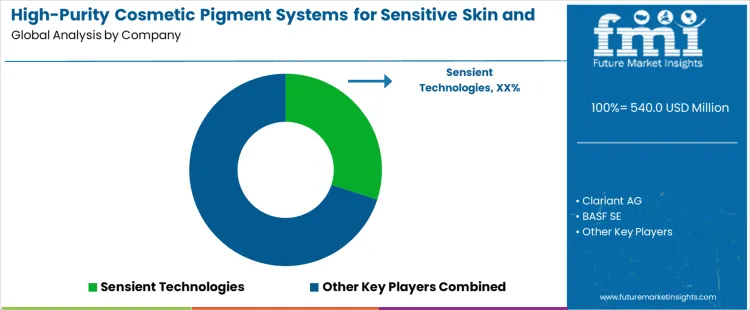
Demand for high-purity cosmetic pigment systems for sensitive skin and baby care is driven by heightened safety expectations, pediatric dermatology guidance, and stricter impurity thresholds. Formulations for baby lotions, creams, wipes, and sensitive-skin cosmetics require pigments with extremely low heavy metal content, absence of PAHs, controlled particle size, and high microbiological purity. Buyers evaluate toxicological dossiers, batch consistency, color stability, and compatibility with minimalist formulations containing fewer stabilizers.
Procurement teams prioritize suppliers with GMP-controlled manufacturing, validated analytical testing, and full traceability across raw materials and processing steps. Trend in the global market reflects growth in hypoallergenic claims, dermatologist-tested positioning, and increased regulatory scrutiny of infant and sensitive-skin products.
Sensient Technologies maintains leading positioning through high-purity botanical and synthetic pigment systems supported by extensive safety documentation and global application laboratories. Clariant AG supplies cosmetic pigments engineered for sensitive applications with strong impurity control and regulatory support across regions. BASF SE contributes pigment technologies and formulation expertise aligned with stringent safety and quality requirements for baby care products. DSM-Firmenich supports demand through science-based ingredient platforms and safety assessment capabilities relevant to sensitive-skin formulations.
Sun Chemical, part of DIC Group, provides high-purity pigment dispersions and global manufacturing scale serving multinational cosmetic brands. Competitive differentiation depends on impurity control, toxicological validation, documentation depth, and ability to support global brand launches with consistent quality.
Key Players in the High-Purity Cosmetic Pigment Systems for Sensitive Skin and Baby Care Market
- Sensient Technologies
- Clariant AG
- BASF SE
- DSM-Firmenich
- Sun Chemical (DIC Group)
Scope of the Report
| Items | Values |
|---|---|
| Quantitative Units | USD million |
| Pigment System Type | High-Purity Mineral Pigments; Ultra-Refined Organic Pigments; Surface-Treated Low-Irritation Pigments; Encapsulated Hypoallergenic Pigments |
| Purity & Safety Grade | Baby-Care Grade (Ultra-Low Impurity); Dermatology-Tested Sensitive Grade; Pharmaceutical-Clean Cosmetic Grade; Standard High-Purity Cosmetic Grade |
| Application | Baby Care Cosmetics; Sensitive Skin Face Makeup; Dermocosmetic Color Products; Medicated & Barrier Repair Products |
| Regions Covered | Asia Pacific, Europe, North America, Latin America, Middle East & Africa |
| Countries Covered | India, China, USA, Germany, France, and 40+ countries |
| Key Companies Profiled | Sensient Technologies; Clariant AG; BASF SE; DSM-Firmenich; Sun Chemical (DIC Group) |
| Additional Attributes | Dollar sales by pigment system type and purity grade; adoption trends for ultra-low impurity and hypoallergenic cosmetic pigments; irritation potential, heavy metal residue, and microbiological purity benchmarks; compatibility with baby-care, dermocosmetic, and medicated formulations; surface treatment and encapsulation impacts on skin tolerance and color stability; regulatory compliance with baby-care, sensitive-skin, and dermatological safety standards influencing pigment selection. |
High-Purity Cosmetic Pigment Systems for Sensitive Skin and Baby Care Market by Segment
By Pigment System Type:
- High-Purity Mineral Pigments
- Ultra-Refined Organic Pigments
- Surface-Treated Low-Irritation Pigments
- Encapsulated Hypoallergenic Pigments
By Purity & Safety Grade:
- Baby-Care Grade (Ultra-Low Impurity)
- Dermatology-Tested Sensitive Grade
- Pharmaceutical-Clean Cosmetic Grade
- Standard High-Purity Cosmetic Grade
By Application:
- Baby Care Cosmetics
- Sensitive Skin Face Makeup
- Dermocosmetic Color Products
- Medicated & Barrier Repair Products
By Region:
- Asia Pacific
- China
- Japan
- South Korea
- India
- Australia & New Zealand
- ASEAN
- Rest of Asia Pacific
- Europe
- Germany
- United Kingdom
- France
- Italy
- Spain
- Nordic
- BENELUX
- Rest of Europe
- North America
- United States
- Canada
- Mexico
- Latin America
- Brazil
- Chile
- Rest of Latin America
- Middle East & Africa
- Kingdom of Saudi Arabia
- Other GCC Countries
- Turkey
- South Africa
- Other African Union
- Rest of Middle East & Africa
Frequently Asked Questions
How big is the high-purity cosmetic pigment systems for sensitive skin and baby care market in 2026?
The global high-purity cosmetic pigment systems for sensitive skin and baby care market is estimated to be valued at USD 540.0 million in 2026.
What will be the size of high-purity cosmetic pigment systems for sensitive skin and baby care market in 2036?
The market size for the high-purity cosmetic pigment systems for sensitive skin and baby care market is projected to reach USD 1,375.4 million by 2036.
How much will be the high-purity cosmetic pigment systems for sensitive skin and baby care market growth between 2026 and 2036?
The high-purity cosmetic pigment systems for sensitive skin and baby care market is expected to grow at a 9.8% CAGR between 2026 and 2036.
What are the key product types in the high-purity cosmetic pigment systems for sensitive skin and baby care market?
The key product types in high-purity cosmetic pigment systems for sensitive skin and baby care market are high-purity mineral pigments, ultra-refined organic pigments, surface-treated low-irritation pigments and encapsulated hypoallergenic pigments.
Which purity & safety grade segment to contribute significant share in the high-purity cosmetic pigment systems for sensitive skin and baby care market in 2026?
In terms of purity & safety grade, baby-care grade (ultra-low impurity) segment to command 34.0% share in the high-purity cosmetic pigment systems for sensitive skin and baby care market in 2026.
Preview the report firsthand - request a free sample
Get SampleGet the brochure for pricing and purchase details.
Get PDFTable of Content
- Executive Summary
- Global Market Outlook
- Demand-side Trends
- Supply-side Trends
- Technology Roadmap Analysis
- Analysis and Recommendations
- Market Overview
- Market Coverage / Taxonomy
- Market Definition / Scope / Limitations
- Market Background
- Market Dynamics
- Drivers
- Restraints
- Opportunity
- Trends
- Scenario Forecast
- Demand in Optimistic Scenario
- Demand in Likely Scenario
- Demand in Conservative Scenario
- Opportunity Map Analysis
- Product Life Cycle Analysis
- Supply Chain Analysis
- Investment Feasibility Matrix
- Value Chain Analysis
- PESTLE and Porter’s Analysis
- Regulatory Landscape
- Regional Parent Market Outlook
- Production and Consumption Statistics
- Import and Export Statistics
- Market Dynamics
- Global Market Analysis 2021 to 2025 and Forecast, 2026 to 2036
- Historical Market Size Value (USD Million) Analysis, 2021 to 2025
- Current and Future Market Size Value (USD Million) Projections, 2026 to 2036
- Y-o-Y Growth Trend Analysis
- Absolute $ Opportunity Analysis
- Global Market Pricing Analysis 2021 to 2025 and Forecast 2026 to 2036
- Global Market Analysis 2021 to 2025 and Forecast 2026 to 2036, By Pigment System Type
- Introduction / Key Findings
- Historical Market Size Value (USD Million) Analysis By Pigment System Type , 2021 to 2025
- Current and Future Market Size Value (USD Million) Analysis and Forecast By Pigment System Type , 2026 to 2036
- High-Purity Mineral Pigments
- Ultra-Refined Organic Pigments
- Surface-Treated Low-Irritation Pigments
- Encapsulated Hypoallergenic Pigments
- High-Purity Mineral Pigments
- Y-o-Y Growth Trend Analysis By Pigment System Type , 2021 to 2025
- Absolute $ Opportunity Analysis By Pigment System Type , 2026 to 2036
- Global Market Analysis 2021 to 2025 and Forecast 2026 to 2036, By Purity & Safety Grade
- Introduction / Key Findings
- Historical Market Size Value (USD Million) Analysis By Purity & Safety Grade, 2021 to 2025
- Current and Future Market Size Value (USD Million) Analysis and Forecast By Purity & Safety Grade, 2026 to 2036
- Baby-Care Grade (Ultra-Low Impurity)
- Dermatology-Tested Sensitive Grade
- Pharmaceutical-Clean Cosmetic Grade
- Standard High-Purity Cosmetic Grade
- Baby-Care Grade (Ultra-Low Impurity)
- Y-o-Y Growth Trend Analysis By Purity & Safety Grade, 2021 to 2025
- Absolute $ Opportunity Analysis By Purity & Safety Grade, 2026 to 2036
- Global Market Analysis 2021 to 2025 and Forecast 2026 to 2036, By Application
- Introduction / Key Findings
- Historical Market Size Value (USD Million) Analysis By Application, 2021 to 2025
- Current and Future Market Size Value (USD Million) Analysis and Forecast By Application, 2026 to 2036
- Baby Care Cosmetics
- Sensitive Skin Face Makeup
- Dermocosmetic Color Products
- Medicated & Barrier Repair Products
- Baby Care Cosmetics
- Y-o-Y Growth Trend Analysis By Application, 2021 to 2025
- Absolute $ Opportunity Analysis By Application, 2026 to 2036
- Global Market Analysis 2021 to 2025 and Forecast 2026 to 2036, By Region
- Introduction
- Historical Market Size Value (USD Million) Analysis By Region, 2021 to 2025
- Current Market Size Value (USD Million) Analysis and Forecast By Region, 2026 to 2036
- North America
- Latin America
- Western Europe
- Eastern Europe
- East Asia
- South Asia and Pacific
- Middle East & Africa
- Market Attractiveness Analysis By Region
- North America Market Analysis 2021 to 2025 and Forecast 2026 to 2036, By Country
- Historical Market Size Value (USD Million) Trend Analysis By Market Taxonomy, 2021 to 2025
- Market Size Value (USD Million) Forecast By Market Taxonomy, 2026 to 2036
- By Country
- USA
- Canada
- Mexico
- By Pigment System Type
- By Purity & Safety Grade
- By Application
- By Country
- Market Attractiveness Analysis
- By Country
- By Pigment System Type
- By Purity & Safety Grade
- By Application
- Key Takeaways
- Latin America Market Analysis 2021 to 2025 and Forecast 2026 to 2036, By Country
- Historical Market Size Value (USD Million) Trend Analysis By Market Taxonomy, 2021 to 2025
- Market Size Value (USD Million) Forecast By Market Taxonomy, 2026 to 2036
- By Country
- Brazil
- Chile
- Rest of Latin America
- By Pigment System Type
- By Purity & Safety Grade
- By Application
- By Country
- Market Attractiveness Analysis
- By Country
- By Pigment System Type
- By Purity & Safety Grade
- By Application
- Key Takeaways
- Western Europe Market Analysis 2021 to 2025 and Forecast 2026 to 2036, By Country
- Historical Market Size Value (USD Million) Trend Analysis By Market Taxonomy, 2021 to 2025
- Market Size Value (USD Million) Forecast By Market Taxonomy, 2026 to 2036
- By Country
- Germany
- UK
- Italy
- Spain
- France
- Nordic
- BENELUX
- Rest of Western Europe
- By Pigment System Type
- By Purity & Safety Grade
- By Application
- By Country
- Market Attractiveness Analysis
- By Country
- By Pigment System Type
- By Purity & Safety Grade
- By Application
- Key Takeaways
- Eastern Europe Market Analysis 2021 to 2025 and Forecast 2026 to 2036, By Country
- Historical Market Size Value (USD Million) Trend Analysis By Market Taxonomy, 2021 to 2025
- Market Size Value (USD Million) Forecast By Market Taxonomy, 2026 to 2036
- By Country
- Russia
- Poland
- Hungary
- Balkan & Baltic
- Rest of Eastern Europe
- By Pigment System Type
- By Purity & Safety Grade
- By Application
- By Country
- Market Attractiveness Analysis
- By Country
- By Pigment System Type
- By Purity & Safety Grade
- By Application
- Key Takeaways
- East Asia Market Analysis 2021 to 2025 and Forecast 2026 to 2036, By Country
- Historical Market Size Value (USD Million) Trend Analysis By Market Taxonomy, 2021 to 2025
- Market Size Value (USD Million) Forecast By Market Taxonomy, 2026 to 2036
- By Country
- China
- Japan
- South Korea
- By Pigment System Type
- By Purity & Safety Grade
- By Application
- By Country
- Market Attractiveness Analysis
- By Country
- By Pigment System Type
- By Purity & Safety Grade
- By Application
- Key Takeaways
- South Asia and Pacific Market Analysis 2021 to 2025 and Forecast 2026 to 2036, By Country
- Historical Market Size Value (USD Million) Trend Analysis By Market Taxonomy, 2021 to 2025
- Market Size Value (USD Million) Forecast By Market Taxonomy, 2026 to 2036
- By Country
- India
- ASEAN
- Australia & New Zealand
- Rest of South Asia and Pacific
- By Pigment System Type
- By Purity & Safety Grade
- By Application
- By Country
- Market Attractiveness Analysis
- By Country
- By Pigment System Type
- By Purity & Safety Grade
- By Application
- Key Takeaways
- Middle East & Africa Market Analysis 2021 to 2025 and Forecast 2026 to 2036, By Country
- Historical Market Size Value (USD Million) Trend Analysis By Market Taxonomy, 2021 to 2025
- Market Size Value (USD Million) Forecast By Market Taxonomy, 2026 to 2036
- By Country
- Kingdom of Saudi Arabia
- Other GCC Countries
- Turkiye
- South Africa
- Other African Union
- Rest of Middle East & Africa
- By Pigment System Type
- By Purity & Safety Grade
- By Application
- By Country
- Market Attractiveness Analysis
- By Country
- By Pigment System Type
- By Purity & Safety Grade
- By Application
- Key Takeaways
- Key Countries Market Analysis
- USA
- Pricing Analysis
- Market Share Analysis, 2025
- By Pigment System Type
- By Purity & Safety Grade
- By Application
- Canada
- Pricing Analysis
- Market Share Analysis, 2025
- By Pigment System Type
- By Purity & Safety Grade
- By Application
- Mexico
- Pricing Analysis
- Market Share Analysis, 2025
- By Pigment System Type
- By Purity & Safety Grade
- By Application
- Brazil
- Pricing Analysis
- Market Share Analysis, 2025
- By Pigment System Type
- By Purity & Safety Grade
- By Application
- Chile
- Pricing Analysis
- Market Share Analysis, 2025
- By Pigment System Type
- By Purity & Safety Grade
- By Application
- Germany
- Pricing Analysis
- Market Share Analysis, 2025
- By Pigment System Type
- By Purity & Safety Grade
- By Application
- UK
- Pricing Analysis
- Market Share Analysis, 2025
- By Pigment System Type
- By Purity & Safety Grade
- By Application
- Italy
- Pricing Analysis
- Market Share Analysis, 2025
- By Pigment System Type
- By Purity & Safety Grade
- By Application
- Spain
- Pricing Analysis
- Market Share Analysis, 2025
- By Pigment System Type
- By Purity & Safety Grade
- By Application
- France
- Pricing Analysis
- Market Share Analysis, 2025
- By Pigment System Type
- By Purity & Safety Grade
- By Application
- India
- Pricing Analysis
- Market Share Analysis, 2025
- By Pigment System Type
- By Purity & Safety Grade
- By Application
- ASEAN
- Pricing Analysis
- Market Share Analysis, 2025
- By Pigment System Type
- By Purity & Safety Grade
- By Application
- Australia & New Zealand
- Pricing Analysis
- Market Share Analysis, 2025
- By Pigment System Type
- By Purity & Safety Grade
- By Application
- China
- Pricing Analysis
- Market Share Analysis, 2025
- By Pigment System Type
- By Purity & Safety Grade
- By Application
- Japan
- Pricing Analysis
- Market Share Analysis, 2025
- By Pigment System Type
- By Purity & Safety Grade
- By Application
- South Korea
- Pricing Analysis
- Market Share Analysis, 2025
- By Pigment System Type
- By Purity & Safety Grade
- By Application
- Russia
- Pricing Analysis
- Market Share Analysis, 2025
- By Pigment System Type
- By Purity & Safety Grade
- By Application
- Poland
- Pricing Analysis
- Market Share Analysis, 2025
- By Pigment System Type
- By Purity & Safety Grade
- By Application
- Hungary
- Pricing Analysis
- Market Share Analysis, 2025
- By Pigment System Type
- By Purity & Safety Grade
- By Application
- Kingdom of Saudi Arabia
- Pricing Analysis
- Market Share Analysis, 2025
- By Pigment System Type
- By Purity & Safety Grade
- By Application
- Turkiye
- Pricing Analysis
- Market Share Analysis, 2025
- By Pigment System Type
- By Purity & Safety Grade
- By Application
- South Africa
- Pricing Analysis
- Market Share Analysis, 2025
- By Pigment System Type
- By Purity & Safety Grade
- By Application
- USA
- Market Structure Analysis
- Competition Dashboard
- Competition Benchmarking
- Market Share Analysis of Top Players
- By Regional
- By Pigment System Type
- By Purity & Safety Grade
- By Application
- Competition Analysis
- Competition Deep Dive
- Sensient Technologies
- Overview
- Product Portfolio
- Profitability by Market Segments (Product/Age /Sales Channel/Region)
- Sales Footprint
- Strategy Overview
- Marketing Strategy
- Product Strategy
- Channel Strategy
- Clariant AG
- BASF SE
- DSM-Firmenich
- Sun Chemical (DIC Group)
- Sensient Technologies
- Competition Deep Dive
- Assumptions & Acronyms Used
- Research Methodology


