

- Industry Size (2026)
- USD 163 Mn
- Forecast (2036)
- USD 378.9 Mn
- CAGR (2026 to 2036)
- 8.8%
Inclusive Shade Pigment Systems for Deep Skin Tones in Global Brands Market Forecast and Outlook 2026 to 2036
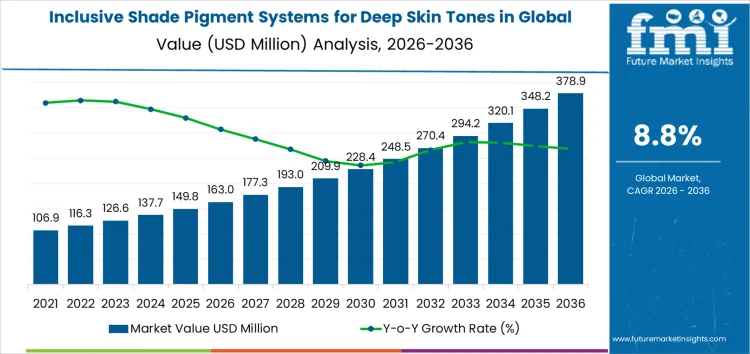
The inclusive shade pigment systems for deep skin tones in global brands market is valued at USD 163 million in 2026 and is projected to reach USD 378.9 million by 2036, reflecting a CAGR of 8.80%. Growth during this period is driven by formulation performance requirements rather than range expansion alone. Cost structures are shaped by pigment dispersion stability, undertone accuracy, and batch to batch consistency across darker shades. Development effort increases where higher pigment loads must maintain skin feel and wear. Suppliers capable of delivering repeatable chroma and undertone control secure specification preference. Procurement decisions emphasize reliability in scale production and predictable shade matching across regional manufacturing sites.
Between 2026 and 2036, outcomes are influenced by brand risk management and portfolio alignment across global product lines. Brands prioritize pigment systems that reduce reformulation cycles and minimize shade drift over time. Once approved, systems remain embedded due to relaunch risk and regulatory documentation alignment. Switching costs rise where global shade architecture depends on shared pigment bases. Entry barriers persist through extended testing across lighting conditions and skin tone panels. Strategic tradeoffs emerge between expanding shade depth and maintaining manufacturing efficiency. Competitive positioning favors suppliers integrated into long term brand roadmaps rather than short cycle trend launches.
Quick Stats for Inclusive Shade Pigment Systems for Deep Skin Tones in Global Brands Market
- Inclusive Shade Pigment Systems for Deep Skin Tones in Global Brands Market Value (2026): USD 163 million
- Inclusive Shade Pigment Systems for Deep Skin Tones in Global Brands Market Forecast Value (2036): USD 378.9 million
- Inclusive Shade Pigment Systems for Deep Skin Tones in Global Brands Market Forecast CAGR (2026 to 2036): 8.8%
- Leading Product Type in Inclusive Shade Pigment Systems for Deep Skin Tones in Global Brands Market: High-melanin iron oxides
- Key Growth Regions in Inclusive Shade Pigment Systems for Deep Skin Tones in Global Brands Market: Asia Pacific, North America, Europe
- Top Players in Inclusive Shade Pigment Systems for Deep Skin Tones in Global Brands Market: BASF SE, Merck KGaA, Sun Chemical Corporation (DIC Corporation), Clariant AG, Sensient Technologies Corporation
What Is the Growth Forecast for Inclusive Shade Pigment Systems for Deep Skin Tones in Global Brands Market through 2036?
Shade range expansion priorities and formulation accuracy define the early growth phase of the inclusive shade pigment systems for deep skin tones in global brands market between 2026 and 2031. During this period, the market expands from USD 163 million to USD 224 million, adding USD 61 million in value. Annual progression from USD 98 million to USD 163 million reflects increasing investment by global cosmetic brands in deeper shade development across foundations, concealers, and complexion products. Historical growth was constrained by limited pigment availability and undertone instability. Forward expansion in this phase is supported by improved chromatic precision, better dispersion stability, and structured shade mapping approaches adopted across global product portfolios.
Portfolio normalization and global rollout strategies drive growth from 2031 to 2036. Over this period, the market increases from USD 224 million to USD 378.9 million, adding USD 176 million and representing the stronger expansion window. Annual values rise from USD 242 million to USD 400 million, indicating accelerating year over year momentum. Earlier demand focused on selective launches and regional pilots, while future growth reflects full line integration across mass, premium, and professional cosmetic ranges. Higher shade count per SKU, consistent cross region shade matching, and longer product lifecycle planning support sustained expansion as inclusive pigment systems become standard inputs in global beauty brand development.
Inclusive Shade Pigment Systems for Deep Skin Tones in Global Brands Market Key Takeaways
| Metric | Value |
|---|---|
| Market Value (2026) | USD 163 million |
| Forecast Value (2036) | USD 378.9 million |
| Forecast CAGR (2026 to 2036) | 8.8% |
What Is Driving Demand in the Inclusive Shade Pigment Systems for Deep Skin Tones in Global Brands Market?
Demand for inclusive shade pigment systems for deep skin tones is driven by market gaps revealed through product performance and consumer response rather than general cosmetic colour expansion alone. Traditional pigment formulations often prioritized mid-range and lighter skin tones, leaving deep tones underserved in foundation, concealer, and complexion products. Users with deeper skin tones frequently encountered mismatch, ashy casts, and tonal imbalance, which became evident through wear testing and consumer feedback.
Global brands responded by developing pigment systems with broader chromatic range, increased tinting strength, and tailored undertones to achieve visual fidelity across diverse complexions. Initial adoption was concentrated in premium and multicultural product lines where performance deficits were most visible rather than across entire colour portfolios.
Future demand for inclusive shade pigment systems will be shaped by structural shifts in product development, diversity expectations, and documented performance outcomes rather than trend-driven aesthetic choice alone. Consumer demographics are diversifying globally, and brands are embedding inclusive pigment specifications early in formulation pipelines to avoid repeat reformulations and reputation risk. Regulatory and advertising standards increasingly emphasise truthful representation of shade range and performance consistency in marketing and labelling.
Advances in pigment blending technology, undertone calibration, and dispersion methods are improving colour accuracy and stability in complex formulations. Demand will align with documented coverage precision, undertone matching metrics, and consumer acceptance data rather than incremental shade additions, positioning inclusive pigment systems as core components of global brand strategies for complexion and makeup categories.
What Factors Are Affecting the Demand for Inclusive Shade Pigment Systems for Deep Skin Tones in Global Brands Market in Terms of Product Type and Application?
The inclusive shade pigment systems market for deep skin tones is driven by global brand commitments to expanded shade ranges, higher consumer scrutiny of undertone accuracy, and the need for consistency across regions and formulations. Demand focuses on pigment systems that deliver depth, opacity, and stability without ashiness or oxidation. Adoption depends on dispersion behavior, regulatory acceptance, and scalability across product portfolios. Market leadership reflects formulation reliability and global reproducibility rather than decorative or trend driven effects.
What Is Driving Leadership by Product Type in the Inclusive Shade Pigment Systems Market?
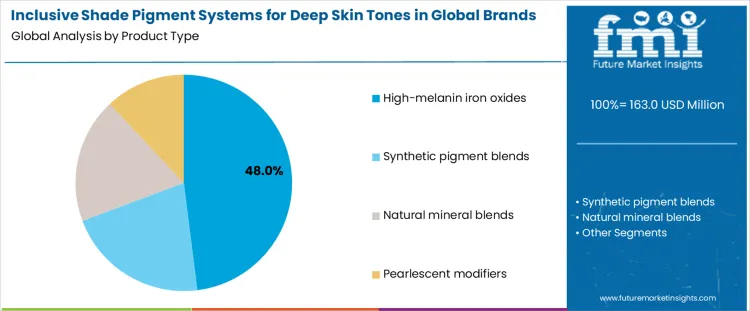
High melanin iron oxides account for about 48% of demand because they enable precise control of depth, warmth, and undertone required for deep skin tone formulations. These pigments allow formulators to achieve rich brown to deep neutral shades without excessive pigment loading, which can negatively affect texture, spread, and wear. Their controlled particle size distribution supports smooth dispersion in liquid, cream, and stick formulations, reducing streaking and patchiness on application. High melanin iron oxides also exhibit strong stability against oxidation and color shift over time, which is critical for consumer trust in complexion products.
Global cosmetic brands favor these pigments because their performance is reproducible across manufacturing sites and climate conditions. Regulatory approval across major markets supports global launches without repeated reformulation. As shade ranges expand from limited offerings to full spectrum portfolios, brands require pigment systems that scale efficiently across dozens of deep shades while maintaining batch consistency. Synthetic blends, natural mineral blends, and pearlescent modifiers support fine tuning and visual balance, but they cannot replace the foundational depth control provided by high melanin iron oxides. Product type leadership therefore reflects precision, stability, and scalability rather than visual novelty or cost advantage.
What Is Driving Leadership by Application in the Inclusive Shade Pigment Systems Market?
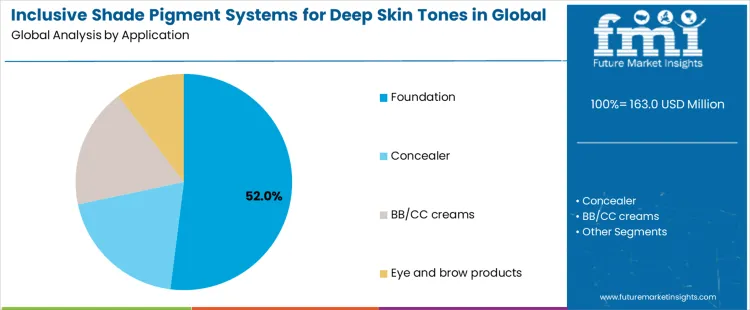
Foundation represents about 52% of demand because it is the primary complexion product where shade inclusivity is most visible and performance expectations are highest. Deep skin tone foundations must deliver uniform coverage, correct undertones, and maintain color stability throughout wear without turning grey, red, or dull. Foundations also involve the broadest shade ranges within brand portfolios, driving high pigment usage during formulation, testing, and ongoing production. Global brands often launch twenty to forty foundation shades, with a growing proportion dedicated to deeper tones, reinforcing demand concentration in this application.
Foundation products are used daily and applied across large facial areas, amplifying the importance of smooth pigment dispersion and consistent opacity. Consumer feedback on foundation shade accuracy directly influences brand credibility, increasing reliance on proven pigment systems. Concealers and BB or CC creams also require inclusive pigments but involve smaller shade counts and lower volume usage. Eye and brow products focus on contrast and definition rather than skin matching. Application leadership therefore reflects volume intensity, shade breadth, and performance sensitivity rather than the number of cosmetic categories addressing deeper skin tones.
How Are Inclusive Shade Pigment Systems Being Applied Across Global Cosmetics Brands?
Use appears in foundations, concealers, powders, and lip products designed for deep skin tones where accurate color matching and uniform coverage are critical. Manufacturers adopt inclusive shade pigment systems to expand shade ranges, improve blendability, and maintain formulation stability across diverse skin types. Global cosmetic brands integrate these pigments into liquid, cream, and powder products to ensure consistent appearance, opacity, and long-lasting wear. These applications reflect operational and consumer inclusivity priorities rather than purely aesthetic objectives, with adoption driven by shade accuracy, formulation performance, and brand diversity initiatives.
What Operational and Material Conditions Support Adoption of Inclusive Shade Pigment Systems?
Selection aligns with formulations requiring precise dispersion, compatibility with oils, waxes, and polymers, and minimal sedimentation. Pigments are optimized for particle size, refractive index, and light absorption to maintain color integrity on darker skin tones. Manufacturing workflows monitor mixing, milling, and homogenization to ensure uniform shade and texture across batches. Quality control evaluates color accuracy, opacity, stability, and regulatory compliance with international cosmetic safety standards. These conditions emerge from operational consistency, product performance, and inclusivity priorities in structured global makeup production workflows.
Which Practical Considerations Limit Wider Use of Inclusive Shade Pigment Systems?
High raw material costs and formulation complexity may restrict adoption in entry-level product lines. Compatibility with other cosmetic ingredients, such as emollients, UV filters, or preservatives, must be verified. Shade uniformity under varying lighting conditions and long-term stability require extensive testing. Regulatory approvals for pigments differ across regions, adding operational oversight. These factors lead to selective deployment where shade inclusivity, formulation reliability, and product performance justify incremental cost, process control, and careful workflow management in global cosmetics production.
What is the Demand for Inclusive Shade Pigment Systems for Deep Skin Tones in Global Brands by Country?
| Country | CAGR (%) |
|---|---|
| USA | 8.2% |
| UK | 7.8% |
| China | 9.5% |
| India | 11.0% |
| Brazil | 9.2% |
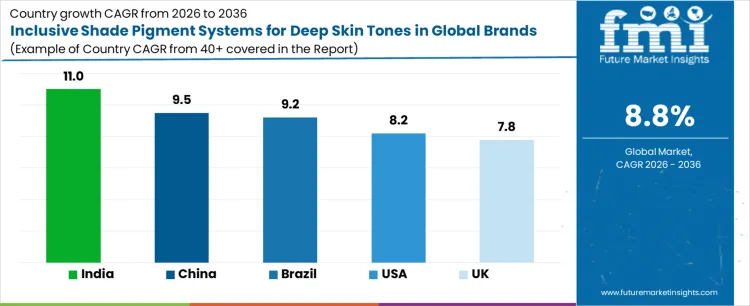
The demand for inclusive shade pigment systems for deep skin tones is expanding across key cosmetic markets, driven by portfolio diversification by global beauty brands, broader shade inclusivity mandates, and rising consumer expectations for accurate tone matching. India leads with an 11.0% CAGR, supported by a large consumer base with diverse skin tones, rapid growth in domestic and international cosmetic brands, and strong retail expansion. China follows at 9.5%, driven by premium makeup growth and global brand localization strategies. Brazil records 9.2%, reflecting high cosmetics penetration and demand for complexion products tailored to diverse skin profiles. The USA grows at 8.2%, shaped by brand commitments to inclusive product ranges. The UK posts 7.8%, supported by mature cosmetic markets and steady innovation in pigment systems.
How are inclusive shade pigment systems expanding applications for deep skin tones in global brands in the United States?
In the United States, the inclusive shade pigment systems for deep skin tones market is growing at a CAGR of 8.2% through 2036, driven by increasing consumer demand for diverse cosmetic options, multicultural representation in beauty, and growth of premium and mass-market makeup brands. Manufacturers are integrating inclusive pigments to improve color matching, opacity, and skin-safe formulation for deeper skin tones. Demand is concentrated in cosmetic formulation labs, industrial production hubs, and packaging facilities. Compared to China, adoption emphasizes regulatory compliance, brand positioning, and quality over large-scale industrial deployment. Domestic suppliers provide high-performance pigments suitable for recurring formulation and packaging operations.
- Cosmetic formulation labs, industrial production hubs, and packaging facilities drive adoption
- Pigments improve color matching, opacity, and skin-safe performance
- Domestic suppliers provide high-performance, reliable solutions
- Recurring formulation and packaging operations sustain adoption
How are multicultural consumer trends and brand inclusivity driving growth in the United Kingdom?
In the United Kingdom, revenue is growing at a CAGR of 7.8% through 2036, supported by growing demand for inclusive makeup, multicultural representation, and premium brand adoption. Manufacturers are adopting inclusive shade pigments to improve coverage, skin tone matching, and product versatility for deeper skin tones. Demand is concentrated in formulation laboratories, cosmetic production facilities, and urban packaging hubs. Compared to India, adoption emphasizes compliance with EU cosmetic regulations and brand differentiation rather than high-volume production. Domestic suppliers provide safe, high-quality pigments suitable for recurring formulation and manufacturing cycles.
- Formulation laboratories, cosmetic production facilities, and packaging hubs drive adoption
- Pigments improve coverage, skin tone matching, and versatility
- Domestic suppliers provide safe, high-quality solutions
- Recurring formulation and manufacturing cycles sustain adoption
How are industrial expansion and multicultural consumer demand driving adoption in China?
In China, the market is expanding at a CAGR of 9.5% through 2036, fueled by growing consumer awareness of diversity, increasing urban beauty retail, and expansion of international cosmetic brands. Manufacturers are integrating inclusive shade pigment systems to provide deeper skin tone coverage, improve product consistency, and maintain skin safety compliance. Demand is concentrated in industrial cosmetic hubs, formulation labs, and packaging facilities. Compared to the USA, adoption emphasizes large-scale integration, high-volume production, and rapid industrial deployment. Domestic suppliers provide cost-effective, high-performance pigments suitable for recurring formulation, packaging, and quality inspection cycles.
- Industrial cosmetic hubs, formulation labs, and packaging facilities drive adoption
- Pigments provide deeper skin tone coverage and consistency
- Domestic suppliers provide cost-effective, high-performance solutions
- Recurring formulation, packaging, and quality inspection cycles sustain adoption
How are inclusive beauty trends and high-volume production driving growth in India?
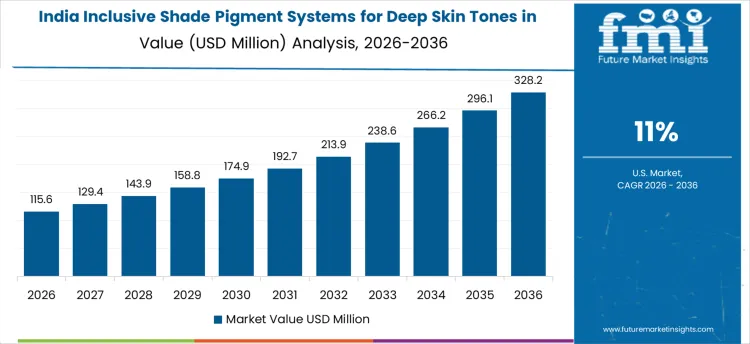
In India, the market is growing at a CAGR of 11% through 2036, supported by increasing demand for diverse makeup options, multicultural representation, and rapid FMCG cosmetics expansion. Manufacturers are adopting inclusive pigments to enhance shade matching, opacity, and durability for deeper skin tones. Demand is concentrated in industrial cosmetic hubs, formulation labs, and packaging facilities. Compared to the UK, adoption emphasizes large-scale production and high-volume deployment for domestic and export markets. Domestic suppliers provide high-performance, skin-safe pigments suitable for recurring formulation, packaging, and quality control cycles.
- Industrial cosmetic hubs, formulation labs, and packaging facilities drive adoption
- Pigments enhance shade matching, opacity, and durability
- Domestic suppliers provide high-performance, skin-safe solutions
- Recurring formulation, packaging, and quality control cycles sustain adoption
How are consumer diversity and product innovation supporting growth in Brazil?
In Brazil, the market is expanding at a CAGR of 9.2% through 2036, fueled by high demand for inclusive beauty, urban cosmetic retail expansion, and adoption of international makeup standards. Manufacturers are integrating inclusive shade pigment systems to improve coverage, color intensity, and formulation safety for deeper skin tones. Demand is concentrated in industrial cosmetic hubs, formulation laboratories, and packaging facilities. Compared to China, adoption emphasizes medium-scale production with local brand integration. Domestic suppliers provide cost-effective, high-performance pigments suitable for recurring formulation, production, and packaging operations.
- Industrial cosmetic hubs, formulation laboratories, and packaging facilities drive adoption
- Pigments improve coverage, color intensity, and formulation safety
- Domestic suppliers provide cost-effective, high-performance solutions
- Recurring formulation, production, and packaging operations sustain adoption
Which Strategic Approaches Define Competition in the Inclusive Shade Pigment Systems for Deep Skin Tones Market for Global Beauty Brands?
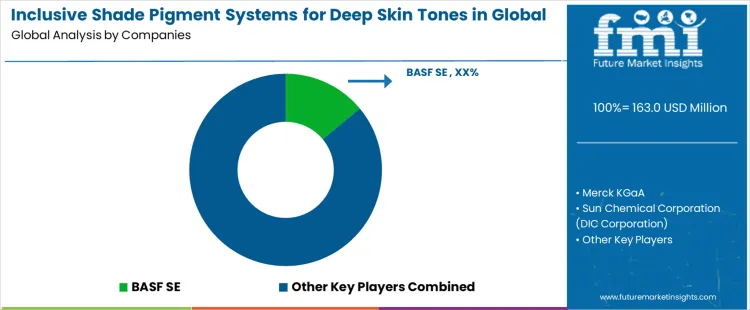
Competition in inclusive shade pigment systems for deep skin tones is shaped by how accurately pigments deliver depth, undertone balance, and color stability across a wide range of complexions. BASF SE and Clariant AG approach this market through advanced pigment surface treatments and dispersion control that prevent ashy appearance and color distortion at higher chroma levels. Their strategies focus on managing red, blue, and olive undertones while maintaining coverage and blendability in liquid and cream formulations. Merck KGaA differentiates through hybrid and effect pigment technologies that add dimensionality without compromising shade accuracy, supporting premium foundations and eye products designed for deeper skin tones. Brand selection is driven by undertone fidelity, oxidation resistance, and consistency across global production batches.
A different competitive emphasis is evident among suppliers closely aligned with large color cosmetics portfolios. Sun Chemical Corporation, part of DIC Corporation, positions inclusive pigment systems around manufacturing scalability and shade reproducibility, supporting global launches that require tight color matching across regions. Sensient Technologies Corporation competes through application specific pigment platforms developed explicitly for deep shade ranges, emphasizing dispersion ease, sensory performance, and stability under varied climate conditions. Across the market, strategies prioritize collaboration with brand shade development teams, extensive wearer testing, and regulatory alignment across geographies. Competitive advantage is built through undertone precision, formulation reliability, and the ability to support inclusive shade expansion without sacrificing performance or speed to market.
Key Players in the Inclusive Shade Pigment Systems for Deep Skin Tones Market
- BASF SE
- Merck KGaA
- Sun Chemical Corporation (DIC Corporation)
- Clariant AG
- Sensient Technologies Corporation
Scope of the Report
| Items | Values |
|---|---|
| Quantitative Units | USD million |
| Type | Iron oxides, titanium dioxide, ultramarines, chromium oxides |
| Application | Face makeup including foundations and powders, eye shadows, concealers, correctors |
| End User | Cosmetic brand owners, contract cosmetic manufacturers, formulation laboratories, professional and mass-market makeup producers |
| Regions Covered | Asia Pacific, Europe, North America, Latin America, Middle East & Africa |
| Countries Covered | India, China, USA, United Kingdom, Brazil, and other major cosmetic manufacturing and consumption markets |
| Key Companies Profiled | BASF SE, Clariant AG, Merck KGaA, DIC Corporation (including Sun Chemical), Sensient Technologies Corporation |
| Additional Attributes | Dollar sales by pigment type and application area, regional adoption trends linked to premium and inclusive makeup demand, competitive landscape based on opacity performance and dispersion stability, pigment surface treatment and particle size control requirements, formulation qualification and regulatory compliance considerations across global cosmetic markets |
Inclusive Shade Pigment Systems for Deep Skin Tones Market Segmentation
By Product Type:
- High-melanin iron oxides
- Synthetic pigment blends
- Natural mineral blends
- Pearlescent modifiers
By Application:
- Foundation
- Concealer
- BB/CC creams
- Eye and brow products
By Region
- Asia Pacific
- China
- Japan
- South Korea
- India
- Australia & New Zealand
- ASEAN
- Rest of Asia Pacific
- Europe
- Germany
- United Kingdom
- France
- Italy
- Spain
- Nordic
- BENELUX
- Rest of Europe
- North America
- United States
- Canada
- Mexico
- Latin America
- Brazil
- Chile
- Rest of Latin America
- Middle East & Africa
- Kingdom of Saudi Arabia
- Other GCC Countries
- Turkey
- South Africa
- Other African Union
- Rest of Middle East & Africa
Frequently Asked Questions
How big is the inclusive shade pigment systems for deep skin tones in global brands market in 2026?
The global inclusive shade pigment systems for deep skin tones in global brands market is estimated to be valued at USD 163.0 million in 2026.
What will be the size of inclusive shade pigment systems for deep skin tones in global brands market in 2036?
The market size for the inclusive shade pigment systems for deep skin tones in global brands market is projected to reach USD 378.9 million by 2036.
How much will be the inclusive shade pigment systems for deep skin tones in global brands market growth between 2026 and 2036?
The inclusive shade pigment systems for deep skin tones in global brands market is expected to grow at a 8.8% CAGR between 2026 and 2036.
What are the key product types in the inclusive shade pigment systems for deep skin tones in global brands market?
The key product types in inclusive shade pigment systems for deep skin tones in global brands market are high-melanin iron oxides , synthetic pigment blends, natural mineral blends and pearlescent modifiers.
Which application segment to contribute significant share in the inclusive shade pigment systems for deep skin tones in global brands market in 2026?
In terms of application, foundation segment to command 52.0% share in the inclusive shade pigment systems for deep skin tones in global brands market in 2026.
Preview the report firsthand - request a free sample
Get SampleGet the brochure for pricing and purchase details.
Get PDFTable of Content
- Executive Summary
- Global Market Outlook
- Demand-side Trends
- Supply-side Trends
- Technology Roadmap Analysis
- Analysis and Recommendations
- Market Overview
- Market Coverage / Taxonomy
- Market Definition / Scope / Limitations
- Market Background
- Market Dynamics
- Drivers
- Restraints
- Opportunity
- Trends
- Scenario Forecast
- Demand in Optimistic Scenario
- Demand in Likely Scenario
- Demand in Conservative Scenario
- Opportunity Map Analysis
- Product Life Cycle Analysis
- Supply Chain Analysis
- Investment Feasibility Matrix
- Value Chain Analysis
- PESTLE and Porter’s Analysis
- Regulatory Landscape
- Regional Parent Market Outlook
- Production and Consumption Statistics
- Import and Export Statistics
- Market Dynamics
- Global Market Analysis 2021 to 2025 and Forecast, 2026 to 2036
- Historical Market Size Value (USD Million) Analysis, 2021 to 2025
- Current and Future Market Size Value (USD Million) Projections, 2026 to 2036
- Y-o-Y Growth Trend Analysis
- Absolute $ Opportunity Analysis
- Global Market Pricing Analysis 2021 to 2025 and Forecast 2026 to 2036
- Global Market Analysis 2021 to 2025 and Forecast 2026 to 2036, By Product Type
- Introduction / Key Findings
- Historical Market Size Value (USD Million) Analysis By Product Type , 2021 to 2025
- Current and Future Market Size Value (USD Million) Analysis and Forecast By Product Type , 2026 to 2036
- High-melanin iron oxides
- Synthetic pigment blends
- Natural mineral blends
- Pearlescent modifiers
- High-melanin iron oxides
- Y-o-Y Growth Trend Analysis By Product Type , 2021 to 2025
- Absolute $ Opportunity Analysis By Product Type , 2026 to 2036
- Global Market Analysis 2021 to 2025 and Forecast 2026 to 2036, By Application
- Introduction / Key Findings
- Historical Market Size Value (USD Million) Analysis By Application, 2021 to 2025
- Current and Future Market Size Value (USD Million) Analysis and Forecast By Application, 2026 to 2036
- Foundation
- Concealer
- BB/CC creams
- Eye and brow products
- Foundation
- Y-o-Y Growth Trend Analysis By Application, 2021 to 2025
- Absolute $ Opportunity Analysis By Application, 2026 to 2036
- Global Market Analysis 2021 to 2025 and Forecast 2026 to 2036, By Region
- Introduction
- Historical Market Size Value (USD Million) Analysis By Region, 2021 to 2025
- Current Market Size Value (USD Million) Analysis and Forecast By Region, 2026 to 2036
- North America
- Latin America
- Western Europe
- Eastern Europe
- East Asia
- South Asia and Pacific
- Middle East & Africa
- Market Attractiveness Analysis By Region
- North America Market Analysis 2021 to 2025 and Forecast 2026 to 2036, By Country
- Historical Market Size Value (USD Million) Trend Analysis By Market Taxonomy, 2021 to 2025
- Market Size Value (USD Million) Forecast By Market Taxonomy, 2026 to 2036
- By Country
- USA
- Canada
- Mexico
- By Product Type
- By Application
- By Country
- Market Attractiveness Analysis
- By Country
- By Product Type
- By Application
- Key Takeaways
- Latin America Market Analysis 2021 to 2025 and Forecast 2026 to 2036, By Country
- Historical Market Size Value (USD Million) Trend Analysis By Market Taxonomy, 2021 to 2025
- Market Size Value (USD Million) Forecast By Market Taxonomy, 2026 to 2036
- By Country
- Brazil
- Chile
- Rest of Latin America
- By Product Type
- By Application
- By Country
- Market Attractiveness Analysis
- By Country
- By Product Type
- By Application
- Key Takeaways
- Western Europe Market Analysis 2021 to 2025 and Forecast 2026 to 2036, By Country
- Historical Market Size Value (USD Million) Trend Analysis By Market Taxonomy, 2021 to 2025
- Market Size Value (USD Million) Forecast By Market Taxonomy, 2026 to 2036
- By Country
- Germany
- UK
- Italy
- Spain
- France
- Nordic
- BENELUX
- Rest of Western Europe
- By Product Type
- By Application
- By Country
- Market Attractiveness Analysis
- By Country
- By Product Type
- By Application
- Key Takeaways
- Eastern Europe Market Analysis 2021 to 2025 and Forecast 2026 to 2036, By Country
- Historical Market Size Value (USD Million) Trend Analysis By Market Taxonomy, 2021 to 2025
- Market Size Value (USD Million) Forecast By Market Taxonomy, 2026 to 2036
- By Country
- Russia
- Poland
- Hungary
- Balkan & Baltic
- Rest of Eastern Europe
- By Product Type
- By Application
- By Country
- Market Attractiveness Analysis
- By Country
- By Product Type
- By Application
- Key Takeaways
- East Asia Market Analysis 2021 to 2025 and Forecast 2026 to 2036, By Country
- Historical Market Size Value (USD Million) Trend Analysis By Market Taxonomy, 2021 to 2025
- Market Size Value (USD Million) Forecast By Market Taxonomy, 2026 to 2036
- By Country
- China
- Japan
- South Korea
- By Product Type
- By Application
- By Country
- Market Attractiveness Analysis
- By Country
- By Product Type
- By Application
- Key Takeaways
- South Asia and Pacific Market Analysis 2021 to 2025 and Forecast 2026 to 2036, By Country
- Historical Market Size Value (USD Million) Trend Analysis By Market Taxonomy, 2021 to 2025
- Market Size Value (USD Million) Forecast By Market Taxonomy, 2026 to 2036
- By Country
- India
- ASEAN
- Australia & New Zealand
- Rest of South Asia and Pacific
- By Product Type
- By Application
- By Country
- Market Attractiveness Analysis
- By Country
- By Product Type
- By Application
- Key Takeaways
- Middle East & Africa Market Analysis 2021 to 2025 and Forecast 2026 to 2036, By Country
- Historical Market Size Value (USD Million) Trend Analysis By Market Taxonomy, 2021 to 2025
- Market Size Value (USD Million) Forecast By Market Taxonomy, 2026 to 2036
- By Country
- Kingdom of Saudi Arabia
- Other GCC Countries
- Turkiye
- South Africa
- Other African Union
- Rest of Middle East & Africa
- By Product Type
- By Application
- By Country
- Market Attractiveness Analysis
- By Country
- By Product Type
- By Application
- Key Takeaways
- Key Countries Market Analysis
- USA
- Pricing Analysis
- Market Share Analysis, 2025
- By Product Type
- By Application
- Canada
- Pricing Analysis
- Market Share Analysis, 2025
- By Product Type
- By Application
- Mexico
- Pricing Analysis
- Market Share Analysis, 2025
- By Product Type
- By Application
- Brazil
- Pricing Analysis
- Market Share Analysis, 2025
- By Product Type
- By Application
- Chile
- Pricing Analysis
- Market Share Analysis, 2025
- By Product Type
- By Application
- Germany
- Pricing Analysis
- Market Share Analysis, 2025
- By Product Type
- By Application
- UK
- Pricing Analysis
- Market Share Analysis, 2025
- By Product Type
- By Application
- Italy
- Pricing Analysis
- Market Share Analysis, 2025
- By Product Type
- By Application
- Spain
- Pricing Analysis
- Market Share Analysis, 2025
- By Product Type
- By Application
- France
- Pricing Analysis
- Market Share Analysis, 2025
- By Product Type
- By Application
- India
- Pricing Analysis
- Market Share Analysis, 2025
- By Product Type
- By Application
- ASEAN
- Pricing Analysis
- Market Share Analysis, 2025
- By Product Type
- By Application
- Australia & New Zealand
- Pricing Analysis
- Market Share Analysis, 2025
- By Product Type
- By Application
- China
- Pricing Analysis
- Market Share Analysis, 2025
- By Product Type
- By Application
- Japan
- Pricing Analysis
- Market Share Analysis, 2025
- By Product Type
- By Application
- South Korea
- Pricing Analysis
- Market Share Analysis, 2025
- By Product Type
- By Application
- Russia
- Pricing Analysis
- Market Share Analysis, 2025
- By Product Type
- By Application
- Poland
- Pricing Analysis
- Market Share Analysis, 2025
- By Product Type
- By Application
- Hungary
- Pricing Analysis
- Market Share Analysis, 2025
- By Product Type
- By Application
- Kingdom of Saudi Arabia
- Pricing Analysis
- Market Share Analysis, 2025
- By Product Type
- By Application
- Turkiye
- Pricing Analysis
- Market Share Analysis, 2025
- By Product Type
- By Application
- South Africa
- Pricing Analysis
- Market Share Analysis, 2025
- By Product Type
- By Application
- USA
- Market Structure Analysis
- Competition Dashboard
- Competition Benchmarking
- Market Share Analysis of Top Players
- By Regional
- By Product Type
- By Application
- Competition Analysis
- Competition Deep Dive
- BASF SE
- Overview
- Product Portfolio
- Profitability by Market Segments (Product/Age /Sales Channel/Region)
- Sales Footprint
- Strategy Overview
- Marketing Strategy
- Product Strategy
- Channel Strategy
- Merck KGaA
- Sun Chemical Corporation (DIC Corporation)
- Clariant AG
- Sensient Technologies Corporation
- BASF SE
- Competition Deep Dive
- Assumptions & Acronyms Used
- Research Methodology


