

- Industry Size (2026)
- USD 72.0 Mn
- Forecast (2036)
- USD 170.5 Mn
- CAGR (2026 to 2036)
- 9.0%
Grape Skin–Carob Synergy Antioxidant Systems Market Size, Market Forecast and Outlook By FMI
Grape skin–carob synergy antioxidant systems market was valued at USD 66.1 million in 2025. Valuation is expected to reach USD 72.0 million in 2026 and ascend to USD 170.5 million by 2036, reflecting a 9.0% CAGR over the forecast period. Growth remains linked to wider use of polyphenolic combinations that help manage both lipid oxidation and color fading in fat-sensitive food applications.
Clean-label reformulation has created a direct preservation challenge in baked goods, where rancidity control still needs to be maintained without relying on synthetic BHT. Delayed transition raises the risk of delisting pressure as large grocery channels tighten ingredient standards. In this setting, blends that combine pomace derivatives with carob pulp extracts offer a more workable route because they deliver dual-action preservation that standard grape skin extract usage does not achieve as effectively. Shelf life improves, and the astringency often associated with high-tannin additives becomes easier to manage within the final formulation.
Summary of Grape Skin–Carob Synergy Antioxidant Systems Market
- Grape Skin–Carob Synergy Antioxidant Systems Market Snapshot
- The grape skin–carob synergy antioxidant systems market is valued at USD 66.1 million in 2025 and is projected to reach USD 170.5 million by 2036.
- The industry is expected to expand at a 9.0% CAGR from 2026 to 2036, creating an incremental opportunity of USD 98.5 million.
- This market covers formulated antioxidant systems that combine grape-skin phenolics and carob polyphenols for shelf-life support, oxidative stability, and in some cases dual color-antioxidant functionality.
- The category remains specification-driven because food manufacturers usually need blends that balance stability, label acceptance, sensory performance, and cost more effectively than single botanical extracts.
- Grape Skin–Carob Synergy Antioxidant Systems Market Demand and Growth Drivers
- Demand is rising as clean-label reformulation pushes processors toward natural preservation systems that can deliver broader functional value in commercial use.
- Grape-skin inputs remain commercially attractive because the wine sector continues to generate a substantial by-product stream.
- Carob supports category expansion because it contributes polyphenols, fiber, and a familiar food ingredient profile, while formulation work shows measurable antioxidant improvement when carob extract is used in bakery applications.
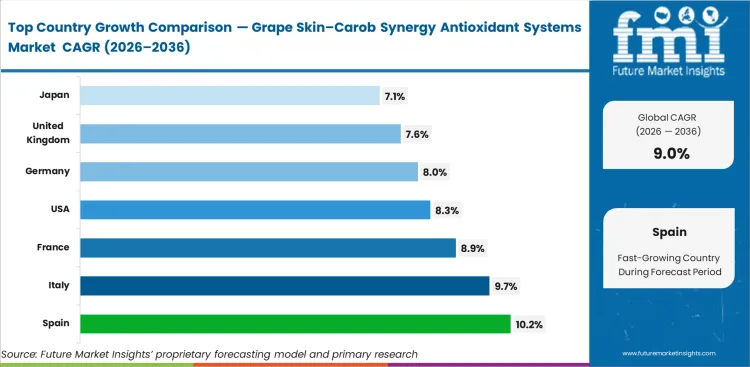
- Spain is estimated to lead at 10.2% CAGR by 2036, followed by Italy at 9.7%, France at 8.9%, the United States at 8.3%, Germany at 8.0%, the United Kingdom at 7.6%, and Japan at 7.1%.
- Growth is moderated by variable Mediterranean carob supply and by the fact that natural preservative systems do not always replace synthetic options on a like-for-like cost basis in industrial formulations.
- Grape Skin–Carob Synergy Antioxidant Systems Market Product and Segment View
- The market includes powdered blends, liquid dispersions, and encapsulated systems supplied mainly to bakery, snacks, oils, beverages, and supplements.
- Powdered blends are expected to account for 42.0% share of the Form segment in 2026 because they fit established premix workflows, store well, and are easier to dose in industrial production.
- As carob works naturally in bakery flavor systems and grape-skin polyphenols can be incorporated without limiting use to oil-based formats., Bakery is projected to represent 28.0% share of the End use segment in 2026
- Buyers are expected to see oxidation control contribute 39.0% share of the Function segment in 2026 because shelf-life protection remains the first commercial reason for adoption ahead of secondary health or color-related claims.
- Supported by better raw-material scalability and a more standardized antioxidant base for formulators, Grape-led blends are likely to represent 46.0% share of the Source balance segment in 2026.
- Direct B2B is forecast to account for 63.0% share of the Sales channel segment in 2026 because stability targets, documentation needs, and sensory adjustment usually require direct technical engagement.
- The scope includes food-grade grape-skin extracts, carob polyphenol ingredients, carrier-supported premixes, and customized antioxidant blends, but excludes single-source grape seed extracts, carob gum thickener categories, and generic natural color systems sold without antioxidant positioning.
- Grape Skin–Carob Synergy Antioxidant Systems Market Geography and Competitive Outlook
- Spain, Italy, and France are the fastest-rising production-linked markets, while the United States and Germany remain dependable high-value demand bases where premium clean-label reformulation is more established.
- Competitive positioning remains open because buyers still rely on custom blends, regional sourcing options, and application-specific validation. Supplier strength depends on standardization, sensory balancing, and the ability to support formulation work across end uses.
- Commercial advantage sits with companies that can combine botanical sourcing, extraction, standardization, and application testing rather than supplying commodity raw extracts alone.
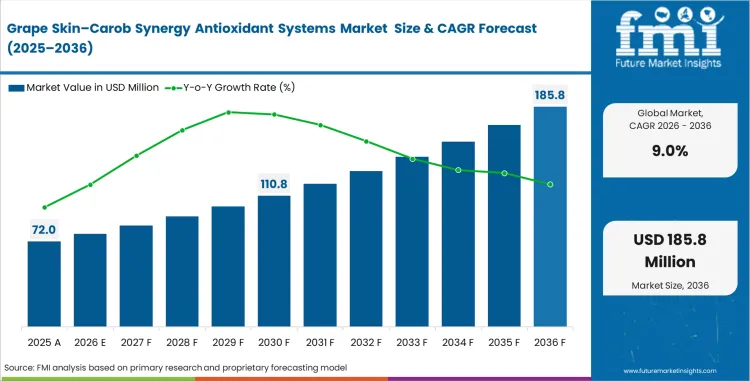
Grape Skin–Carob Synergy Antioxidant Systems Market Key Takeaways
| Metric | Details |
|---|---|
| Industry Size (2026) | USD 72.0 million |
| Industry Value (2036) | USD 170.5 million |
| CAGR (2026–2036) | 9.0% |
Source: Future Market Insights analysis, based on proprietary forecasting model and primary research
Adoption could rise further if synthetic antioxidants face tighter use conditions in toddler snack formulations across Europe. Ingredient supply chains would then need to reformulate before compliance timelines begin to affect commercial continuity. Natural antioxidant systems would then become more relevant in oxidative stability work for affected product lines.
Spain, where regional extractors continue to optimize local pomace availability, is projected to rise at a 10.2% CAGR through 2036. Advanced extraction capability is expected to keep Italy on an inclining path, with the sector forecast to expand at 9.7% over the assessment period. France is set to register an 8.9% CAGR, supported by reformulation activity across premium bakery lines. In the United States, the industry outlook points to 8.3% CAGR through 2036 as label transparency continues to shape product development priorities. Germany is forecast to move ahead at 8.0%, with food compliance requirements continuing to influence formulation choices. Retailer-based clean-label programs keep the United Kingdom on a positive trend, where the sector is anticipated to post 7.6% CAGR over the forecast period. Japan is expected to record 7.1% CAGR through specialized functional food development. Approval conditions still vary across these markets because solvent rules differ by geography, which affects which formulations can move forward locally.
Segmental Analysis
Grape Skin–Carob Synergy Antioxidant Systems Market Analysis by Form
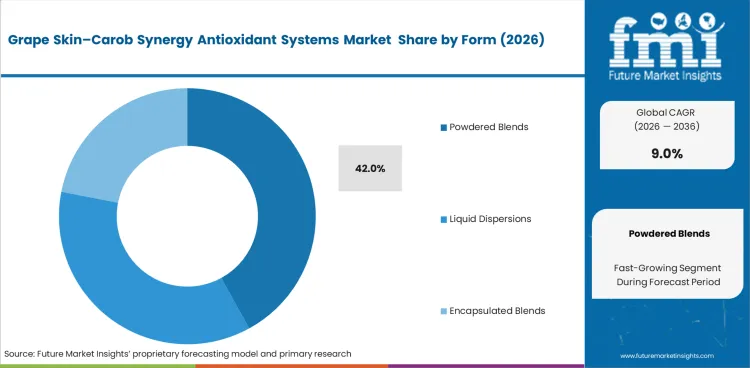
Moisture management failures in liquid systems explain why Powdered blends are expected to account for 42.0% share in 2026. Formulation officers at enterprise snack companies select dry powders specifically because they integrate smoothly into existing dry-mix hoppers without requiring retrofitted dosing equipment. This physical format eliminates microbial risks associated with water-based dispersions sitting in production lines. Ingredient buyers rarely factor spray-drying flavor loss into unit-cost comparisons, meaning highly stable antioxidant formats remain organoleptically neutral. Purchasing teams selecting liquid variants to save on initial material costs face higher long-term expenses through accelerated equipment sanitation cycles.
- Dosing integration: Dry formats flow effortlessly through standard volumetric feeders. Plant managers avoid capital expenditure on specialized liquid injection systems.
- Handling complications: Fine powders generate combustible dust during rapid transfer sequences. Safety officers must mandate upgraded ventilation protocols to prevent facility hazards.
- Lifecycle efficiency: Powdered polyphenols retain active efficacy for up to twenty-four months under ambient conditions. Inventory planners eliminate refrigerated storage costs entirely.
Grape Skin–Carob Synergy Antioxidant Systems Market Analysis by End use
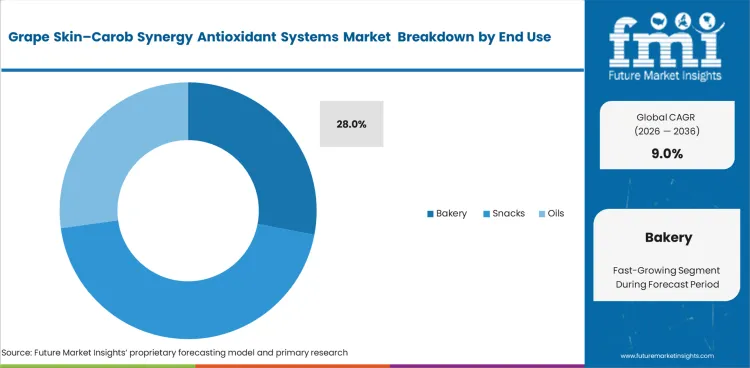
Commercial baking programs continue to favor this combination because it remains functional under high-temperature processing while still supporting antioxidant performance. Carob flavonoids also help protect grape anthocyanins during baking, which improves formulation stability in finished products. Technical evaluation cannot stop at oxidation resistance alone, since this blend can also influence dough handling and structure. An imbalanced ratio in laminated pastry applications can weaken gluten development and leave the final product flatter and denser than intended. Hence, rancidity control in high-fat baked products keeps Bakery in the lead, with the segment expected to account for 28.0% of the market in 2026.
- Thermal validation: Bread formulators rely on carob matrices to shield grape phenols during baking steps. Food scientists guarantee twelve-week shelf stability for packaged goods.
- Flavor interference: Overdosing extracts introduces distinct astringency to delicate vanilla profiles. Sensory panels must rigorously calibrate inclusion rates to remain undetectable.
- Regulatory clearance: Clean-label declarations depend entirely on natural extraction methods. Compliance officers secure retailer approvals by demonstrating zero synthetic solvent residue.
Grape Skin–Carob Synergy Antioxidant Systems Market Analysis by Function
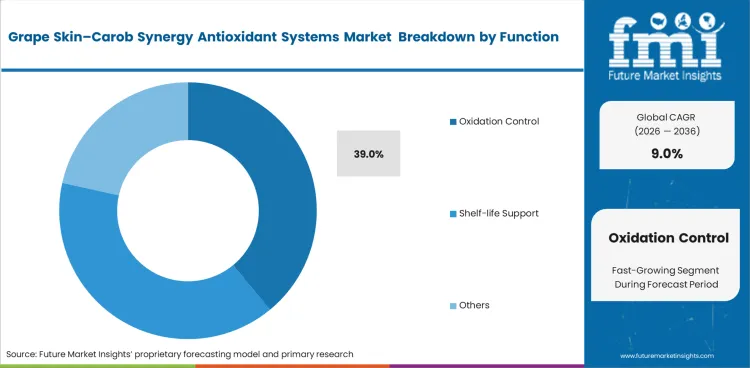
Shelf-life requirements remain the main factor shaping functional selection, with oxidation control expected to account for 39.0% of the market in 2026. Products containing sensitive polyunsaturated fats keep this requirement central because lipid peroxidation directly affects formulation stability. Combined phenolic profiles can interrupt free-radical chain reactions more effectively than an isolated botanical extracts, which sustains the commercial relevance of this function across antioxidant system design. Uniform dispersion through thick lipid matrices still requires careful process adjustment, as these systems usually take longer to mix than synthetic alternatives. Batch consistency often weakens when standard mixing protocols are used without modification.
- Peroxide suppression: Active compounds neutralize free radicals before they degrade delicate oils. Shelf-life technicians double acceptable retail windows for fried snacks.
- Viscosity shifts: High inclusion rates alter flow characteristics of liquid shortenings. Process engineers must recalibrate pumping pressures to maintain line speeds.
- Complete coverage: Achieving full protection requires precise homogenization into fat phases. Operations directors who rush mixing cycles risk localized rancidity in final products.
Grape Skin–Carob Synergy Antioxidant Systems Market Analysis by Source balance
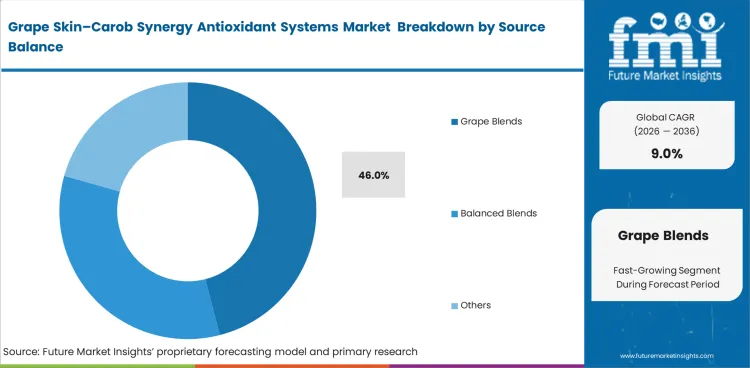
Supply chain maturity heavily favors grape-based blends because wine industry byproducts provide a much larger and more reliable raw-material stream than carob harvests. High concentrations of proanthocyanidins in grape skins carry most of the oxidation-control load, while carob usually plays a supporting stabilizing role in the formulation. Reliance on wine harvest cycles also means unseasonal frosts in Mediterranean regions can influence pricing for these food botanicals in later supply cycles. Grape blends are anticipated to emerge with 46.0% market share in 2026. Poor harvest years leave manufacturers with less room to protect margins when forward coverage is not secured early.
- Material sourcing: European extractors convert millions of tons of winemaking waste into standardized phenolic powders. Sourcing directors secure predictable volume commitments.
- Yield variability: Drought conditions concentrate polyphenols but reduce overall pomace tonnage. Supply chain planners must adjust purchasing models annually based on climate data.
- Cost stabilization: Diversifying blend ratios mitigates price spikes in either raw material. Category managers buffer operational budgets against agricultural volatility.
Grape Skin–Carob Synergy Antioxidant Systems Market Analysis by Sales channel
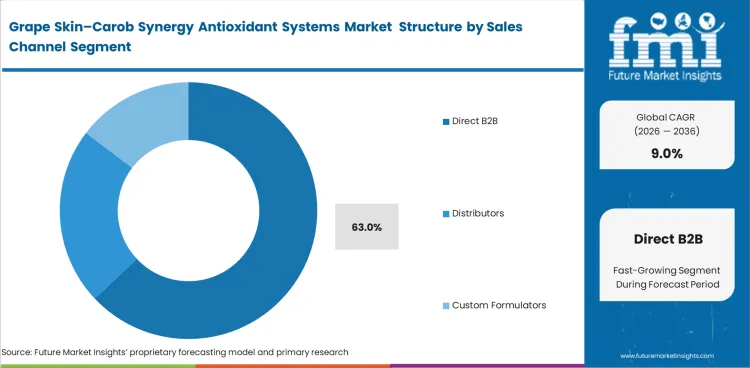
Technical integration complexity keeps Direct B2B central to commercial supply in this market because food formulation often depends on precise calibration across difficult matrix conditions. Direct B2B is forecast to represent 63.0% share in 2026, as direct engagement with primary extractors remains more practical than working through third-party catalogs. That route allows phenolic ratios to be adjusted more precisely for highly acidic or highly alkaline food systems. Dependence on a single extractor’s formulation platform can also become difficult to unwind once validation work is complete. A supplier change often forces a full restart of long stability testing cycles, which raises switching costs and slows reformulation timelines.
- Application engineering: Extractor scientists design custom solubility profiles for specific beverage matrices. Formulation directors bypass standard troubleshooting phases during product development.
- Minimum thresholds: Direct purchasing requires massive minimum order quantities. Mid-tier snack manufacturers struggle to meet volume requirements and must pool orders.
- Partnership lock-in: Tailored phenolic ratios make replacing primary vendors exceptionally difficult. Sourcing executives surrender pricing leverage to avoid costly recipe reformulations.
Grape Skin–Carob Synergy Antioxidant Systems Market Drivers, Restraints, and Opportunities
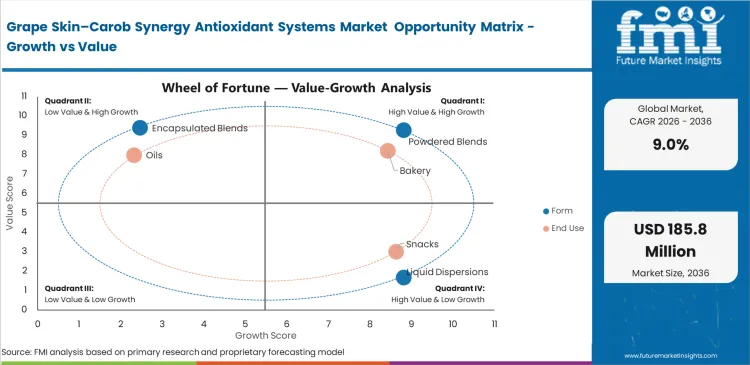
Retailer ingredient blacklists are accelerating the shift away from synthetic preservatives across major grocery chains in Europe and North America. Delayed reformulation puts established shelf presence at risk, which makes replacement of BHT and TBHQ a basic commercial requirement rather than a long-term option. Supply conditions are also tightening because early entrants have already secured much of the stronger Mediterranean extraction capacity for these synergistic blends. Late reformulation leaves less room to protect product quality, raising the risk of using weaker botanical extracts that can undermine finished-product performance and brand positioning.
Adoption still faces a clear technical limit at the formulation stage. Natural polyphenols do not integrate into recipes as easily as synthetic antioxidants, and their interaction with proteins, fats, and other food components can reduce efficacy or alter texture. Stability work therefore has to be carried out at SKU level instead of being applied uniformly across a full portfolio. A carob and grape blend that performs well in one dough system may need a different dosing profile in another. Microencapsulation is helping address some of these compatibility issues, but current formats add a meaningful cost burden to the raw material base.
Opportunities in the Grape Skin–Carob Synergy Antioxidant Systems Market
- Clean-label cosmetics: Cosmetic chemists substitute synthetic stabilizers with food-grade phenolic blends to capture premium natural beauty demographics.
- Pet food preservation: Formulation officers apply anthocyanin food colors and antioxidant properties to extend shelf life for premium extruded kibble.
- Active packaging films: Material engineers embed these polyphenols directly into bio-plastics to create packaging that actively scavenges oxygen from product environments.
Regional Analysis
.webp "Top Country Growth Comparison Grape Skin Carob Synergy Antioxidant Systems Market Cagr (2026 2036)")
Based on regional analysis, Grape Skin–Carob Synergy Antioxidant Systems Market is segmented into North America, Latin America, Europe, Asia Pacific, and Middle East & Africa across 40 plus countries.
| Country | CAGR (2026 to 2036) |
|---|---|
| Spain | 10.2% |
| Italy | 9.7% |
| France | 8.9% |
| United States | 8.3% |
| Germany | 8.0% |
| United Kingdom | 7.6% |
| Japan | 7.1% |
Source: Future Market Insights analysis, based on proprietary forecasting model and primary research
Europe Grape Skin–Carob Synergy Antioxidant Systems Market Analysis
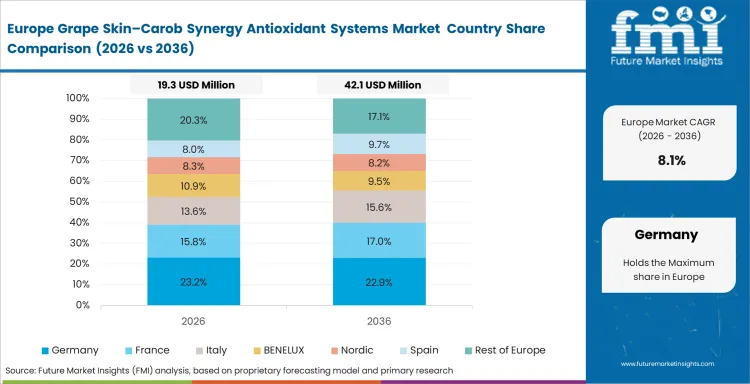
Europe remains the core production and formulation base for this sector because regulatory pressure against synthetic food additives is tighter here than in most other regions. Food manufacturers are under steady pressure to replace conventional preservative systems with botanical alternatives that can still support shelf life and label acceptance. Local access to wine by-products and carob cultivation gives regional extractors a practical cost and supply advantage. Facilities located close to vineyard and orchard belts avoid a large part of the freight burden on raw materials, which supports better processing economics and stronger investment in solvent-free extraction methods. That operating advantage keeps Europe central to both regional supply and export-oriented formulation activity.
- Spain: Spain benefits from direct access to vineyards and carob orchards, which gives processors a favorable raw-material position and supports lower conversion costs. The market in Spain is projected to expand at a CAGR of 10.2% through 2036. Strong local supply also helps Spanish producers maintain an important role in shipments to nearby European markets.
- Italy: Italy combines raw pomace availability with specialized extraction capability that helps producers isolate targeted polyphenols at higher purity levels. In the sector, Italy is likely to post 9.7% CAGR by 2036. That technical position supports its role in premium formulations linked to natural food colours and plant based food colors application.
- France: Adoption in France is anticipated to move ahead at a CAGR of 8.9% during the assessment period. Complex recipe systems also give formulators more room to manage the sensory profile of tannin-rich antioxidant blends. France is supported by premium bakery and packaged food categories where clean-label preservation has become part of brand positioning.
- Germany: Germany is shaped by strict food compliance standards that continue to push legacy synthetic additives out of commercial formulations. The industry outlook in Germany points to 8.0% CAGR through 2036, with botanical blends becoming a more practical route for compliance-led reformulation. Local specification discipline also influences wider European requirements for resveratrol and related phenolic systems.
- United Kingdom: The sector in the United Kingdom is on a positive trend at 7.6% CAGR through 2036 as private-label programs continue to favor botanical preservation systems. That environment keeps commercial adoption tied closely to shelf-level ingredient scrutiny. United Kingdom remains retailer-based, with supermarket clean-label standards often setting the pace for reformulation.
FMI’s detailed analysis also covers wider European adoption beyond the main Mediterranean production centers. Northern European processors rely more heavily on imported dried pomace, which leaves their cost- base less favorable than that of southern facilities.
North America Grape Skin–Carob Synergy Antioxidant Systems Market Analysis
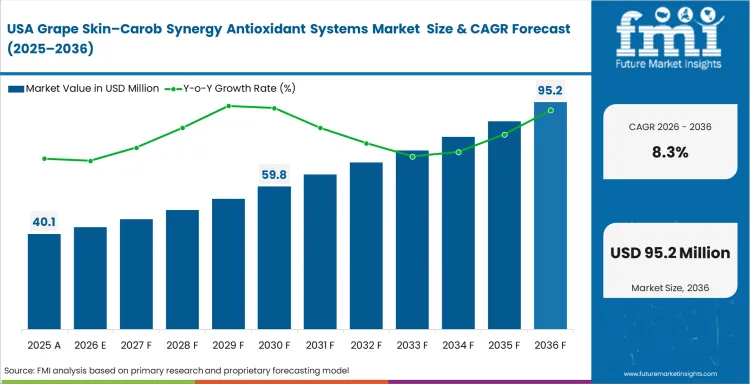
North America is a lucrative market where ingredient transparency has become a commercial requirement across premium packaged food categories. Large retail chains continue to tighten ingredient review standards, and mid-sized manufacturers are under pressure to keep pace with clean-label claims already established by smaller challenger brands. Reformulation is advancing even where natural synergistic blends still carry a higher unit cost than conventional synthetic options. Product teams remain cautious on flavor impact, especially in established snack and bakery lines where even a small sensory shift can disrupt repeat purchases.
- United States: United States remains the main regional demand base because large packaged food manufacturers continue to rework legacy formulations around simpler ingredient decks. The market in the United States is projected to expand at a CAGR of 8.3% through 2036 as stabilization needs in high-fat snacks and shelf-stable foods keep this category relevant. Formulation work still depends on controlling flavor interference in lightly seasoned products, which remains one of the main technical limits in wider use.
FMI’s detailed analysis also covers Canada and Mexica facilities are adapting to cross-border ingredient expectations as regional labeling requirements become more closely aligned. Continental distribution networks favor preservation systems that can move across markets without repeated formulation changes.
Asia Pacific Grape Skin–Carob Synergy Antioxidant Systems Market Analysis
Asia Pacific is shaped less by raw-material access and more by downstream formulation capability. Functional food development remains a major pull factor because manufacturers want ingredients that support both preservation and a stronger health-oriented product position. Shelf-life control also matters for exported premium foods that face longer and less predictable shipping cycles. Since grape and carob inputs are largely imported, processors in this region focus more on efficient downstream handling, yield management, and microencapsulation to extract better value from imported materials.
- Japan: Japan is expected to record 7.1% CAGR in the market during the forecast period. Technical work in this country often draws on grape seed extracts alongside carob-based systems, and that keeps Japan relevant in adjacent Resveratrol-oriented formulation development. The country stands out for formulation precision in premium functional foods, where antioxidant systems are expected to support both product stability and added health positioning.
FMI’s detailed evaluation also covers emerging processing hubs across Southeast Asia and related Resveratrol industry activity in Korea, where supply-chain management remains a key operating issue. Regional manufacturers are adapting imported preservation technologies to local flavor profiles and more demanding ambient storage conditions.
Competitive Aligners for Market Players
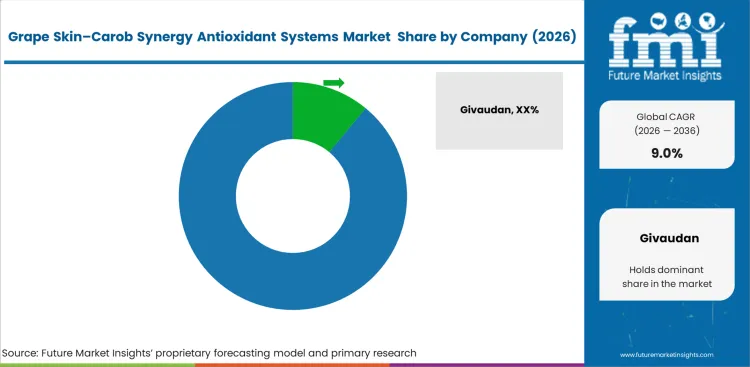
Primary extractors compete on consistency because phenolic ratios have to remain stable even when agricultural harvest quality shifts from season to season. Long-term access to premium pomace and carob depends on close financial alignment with agricultural cooperatives and a sourcing base that is not concentrated in one growing zone. Nexira and Indena reduce this volatility through geographically diversified supply networks, which helps protect contract continuity when one micro-climate underperforms. Commercial evaluation in this category is tied less to first-sample performance and more to the ability to deliver the same specification over a multi-year supply agreement.
Scale players also benefit from broader libraries of matrix-specific stability data that smaller competitors often cannot match. Givaudan and ADM support formulation work with dosing guidance across a wide range of food systems, which shortens internal validation cycles and lowers reformulation friction. Broader portfolios strengthen that position further because adjacent polyphenol systems such as green tea polyphenols or olive mill wastewater polyphenol compounds can be integrated into wider preservation programs. Pricing focused challengers face a harder path because established food science teams tend to stay with validated supplier data where formulation risk is high.
Large food groups are also trying to avoid dependence on single-source proprietary blends by requiring suppliers to work to open specification standards. Standardized analytical methods make dual sourcing more practical and reduce supply risk around critical antioxidant premixes. Competitive positioning toward 2036 is likely to favor companies that can deliver highly soluble, low-impact formats without forcing changes to existing production equipment. Ease of adoption will matter as much as ingredient performance in determining which suppliers move ahead.
Key Players in Grape Skin–Carob Synergy Antioxidant Systems Market
- Givaudan
- Nexira
- Indena
- ADM
- Symrise
- Kalsec
- Döhler
Scope of the Report
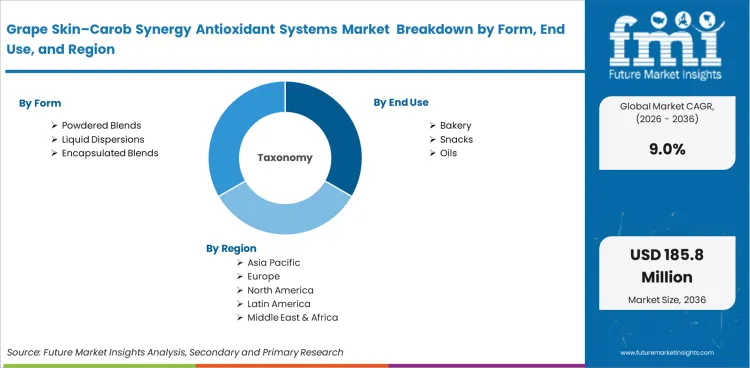
| Metric | Value |
|---|---|
| Quantitative Units | USD 72.0 million to USD 170.5 million, at a CAGR of 9.0% |
| Market Definition | These blends consist of polyphenolic extracts derived from grape pomace combined with carob pulp active compounds. They inhibit lipid oxidation and provide natural preservation in high-fat food formulations. |
| Segmentation | Form, End use, Function, Source balance, Sales channel, and Region |
| Regions Covered | North America, Latin America, Europe, Asia Pacific, Middle East & Africa |
| Countries Covered | Spain, Italy, France, United States, Germany, United Kingdom, Japan |
| Key Companies Profiled | Givaudan, Nexira, Indena, ADM, Symrise, Kalsec, Döhler |
| Forecast Period | 2026 to 2036 |
| Approach | Installed capacity of food-grade phenolic extraction facilities provides primary baselines. |
Source: Future Market Insights analysis, based on proprietary forecasting model and primary research
Grape Skin–Carob Synergy Antioxidant Systems Market Analysis by Segments
- Form
- Powdered blends
- Liquid dispersions
- Encapsulated blends
- End use
- Bakery
- Snacks
- Oils
- Beverages
- Supplements
- Function
- Oxidation control
- Shelf-life support
- Color-antioxidant dual use
- Source balance
- Grape-led
- Balanced blends
- Carob-led
- Sales channel
- Direct B2B
- Distributors
- Custom formulators
- Region
- North America
- Latin America
- Europe
- Asia Pacific
- Middle East & Africa
Bibliography
- Chauhan, K., Shandilya, P., Singh, H., & Sharma, S. (2024, October 30). Clean-label alternatives for food preservation: An emerging trend. Heliyon.
- Covaliov, E., Postolache, O., Izbash, E., Lupascu, L., Blaj, V. A., & Vdovii, N. (2024, October 13). Exploring the biological value of red grape skin. Foods.
- Garau, C., Simal, J., Rosselló, C., & López, A. (2025, June 24). Potential of carob pulp powder: Influence of cultivar on composition and technological functionality. Molecules.
- Lopes, J. C., Silva, A. M. S., & Nunes, F. M. (2025, January 17). Grape pomace: A review of its bioactive phenolic composition and applications. Molecules.
- Martins-Loução, M. A., et al. (2024, April 25). Carob: A Mediterranean resource for the future. Plants.
This bibliography is provided for reader reference. The full FMI report contains the complete reference list with primary source documentation.
Addresses
- Extraction volume capabilities across Mediterranean supply chains, focusing on how local processors secure raw material access.
- Formulation challenges encountered when bridging lipid oxidation control with sensory neutrality in delicate bakery flavor profiles.
- Strategic sourcing shifts away from synthetic BHT preservatives as retail clean-label mandates force immediate ingredient reformulation.
- Thermal stability metrics detailing how carob flavonoids shield grape anthocyanins during high-heat commercial baking applications.
- Regional regulatory approvals governing the use of dual-action botanical extracts across stringent European and North American markets.
- Pricing volatility linked directly to seasonal Mediterranean wine and carob harvests, affecting long-term supply chain budgets.
- Custom blending requirements necessary to achieve uniform dispersion and complete peroxide suppression in complex high-fat snacks.
- Vendor lock-in risks associated with proprietary liquid dispersions that force buyers into costly stability testing restarts.
Frequently Asked Questions
What is the baseline valuation for these antioxidant systems?
Sales reached USD 66.1 million in 2025 as enterprise food brands actively transition toward premium botanical stabilizers.
Why do powdered blends command the highest format share?
Dry formats bypass microbial risks and integrate directly into existing volumetric feeders, avoiding costly liquid injection upgrades.
How does carob influence the performance of grape extracts?
Carob flavonoids physically shield delicate grape anthocyanins, surviving industrial baking temperatures that normally destroy standalone grape derivatives.
What execution issues slow immediate adoption?
Natural polyphenols interact unpredictably with dough proteins, forcing formulation officers to spend months recalibrating existing product textures.
Why does Spain record the fastest regional expansion?
Spanish extractors operate adjacent to massive agricultural outputs, eliminating shipping costs and funding advanced solvent-free processing technologies.
How do large brands mitigate raw material price spikes?
Category managers enforce dual-sourcing requirements and specify balanced blend ratios, buffering budgets against single poor agricultural harvests.
What risk exists in direct B2B purchasing?
Relying on primary suppliers for custom solubility engineering creates vendor lock-in, making subsequent supplier transitions exceptionally expensive.
Where do encapsulated blends find commercial viability?
Engineers specify this costly format solely when active polyphenols require physical separation from reactive ingredients until consumption.
How do clean-label mandates alter formulation strategies?
Purchasing directors accept higher unit costs for natural synergy blends strictly to secure premium grocery shelf placement.
What limits the use of liquid dispersions in industrial settings?
Liquid formats introduce unwanted moisture into dry-mix operations, forcing safety officers to implement rigorous, costly sanitation protocols.
Why do extractors struggle to replace tocopherols entirely?
Matching the uniform dispersion of synthetic tocopherols with complex polyphenols demands significantly longer, energy-intensive lipid mixing cycles.
What dictates the success of a new supplier entering this category?
Enterprise buyers ignore challengers lacking comprehensive, validated stability metrics for specific real-world food matrices and thermal conditions.
Why are cosmetics companies exploring these food-grade extracts?
Premium skincare chemists cross-apply these food-grade synergies to replace synthetic preservatives and capture clean-beauty market share rapidly.
What function does dual-use color and antioxidant application serve?
Sourcing managers reduce supply chain complexity by procuring a single ingredient delivering both rancidity inhibition and natural coloring.
How do storage requirements differ from synthetic alternatives?
Natural polyphenolic powders demand strict ambient humidity control to prevent clumping and maintain active efficacy over twenty-four months.
Why do mid-tier brands struggle with adoption?
Smaller brands lack throughput for massive minimum volume commitments, forcing reliance on regional distributors without custom engineering support.
What drives specific demand in the Japanese market?
Product developers utilize these exact extracts to stabilize products while simultaneously supporting secondary, premium health-focused marketing initiatives.
How will extraction technologies evolve toward 2036?
Facilities will transition entirely to pressurized water or supercritical fluid extraction, satisfying ultimate requirements for absolute ingredient purity.
Preview the report firsthand - request a free sample
Get SampleGet the brochure for pricing and purchase details.
Get PDFTable of Content
- Executive Summary
- Global Market Outlook
- Demand-side Trends
- Supply-side Trends
- Technology Roadmap Analysis
- Analysis and Recommendations
- Market Overview
- Market Coverage / Taxonomy
- Market Definition / Scope / Limitations
- Research Methodology
- Chapter Orientation
- Analytical Lens and Working Hypotheses
- Market Structure, Signals, and Trend Drivers
- Benchmarking and Cross-market Comparability
- Market Sizing, Forecasting, and Opportunity Mapping
- Research Design and Evidence Framework
- Desk Research Programme (Secondary Evidence)
- Company Annual and Sustainability Reports
- Peer-reviewed Journals and Academic Literature
- Corporate Websites, Product Literature, and Technical Notes
- Earnings Decks and Investor Briefings
- Statutory Filings and Regulatory Disclosures
- Technical White Papers and Standards Notes
- Trade Journals, Industry Magazines, and Analyst Briefs
- Conference Proceedings, Webinars, and Seminar Materials
- Government Statistics Portals and Public Data Releases
- Press Releases and Reputable Media Coverage
- Specialist Newsletters and Curated Briefings
- Sector Databases and Reference Repositories
- FMI Internal Proprietary Databases and Historical Market Datasets
- Subscription Datasets and Paid Sources
- Social Channels, Communities, and Digital Listening Inputs
- Additional Desk Sources
- Expert Input and Fieldwork (Primary Evidence)
- Primary Modes
- Qualitative Interviews and Expert Elicitation
- Quantitative Surveys and Structured Data Capture
- Blended Approach
- Why Primary Evidence is Used
- Field Techniques
- Interviews
- Surveys
- Focus Groups
- Observational and In-context Research
- Social and Community Interactions
- Stakeholder Universe Engaged
- C-suite Leaders
- Board Members
- Presidents and Vice Presidents
- R&D and Innovation Heads
- Technical Specialists
- Domain Subject-matter Experts
- Scientists
- Physicians and Other Healthcare Professionals
- Governance, Ethics, and Data Stewardship
- Research Ethics
- Data Integrity and Handling
- Primary Modes
- Tooling, Models, and Reference Databases
- Desk Research Programme (Secondary Evidence)
- Data Engineering and Model Build
- Data Acquisition and Ingestion
- Cleaning, Normalisation, and Verification
- Synthesis, Triangulation, and Analysis
- Quality Assurance and Audit Trail
- Market Background
- Market Dynamics
- Drivers
- Restraints
- Opportunity
- Trends
- Scenario Forecast
- Demand in Optimistic Scenario
- Demand in Likely Scenario
- Demand in Conservative Scenario
- Opportunity Map Analysis
- Product Life Cycle Analysis
- Supply Chain Analysis
- Investment Feasibility Matrix
- Value Chain Analysis
- PESTLE and Porter’s Analysis
- Regulatory Landscape
- Regional Parent Market Outlook
- Production and Consumption Statistics
- Import and Export Statistics
- Market Dynamics
- Global Market Analysis 2021 to 2025 and Forecast, 2026 to 2036
- Historical Market Size Value (USD Million) Analysis, 2021 to 2025
- Current and Future Market Size Value (USD Million) Projections, 2026 to 2036
- Y-o-Y Growth Trend Analysis
- Absolute $ Opportunity Analysis
- Global Market Pricing Analysis 2021 to 2025 and Forecast 2026 to 2036
- Global Market Analysis 2021 to 2025 and Forecast 2026 to 2036, By Form
- Introduction / Key Findings
- Historical Market Size Value (USD Million) Analysis By Form , 2021 to 2025
- Current and Future Market Size Value (USD Million) Analysis and Forecast By Form , 2026 to 2036
- Powdered Blends
- Liquid Dispersions
- Encapsulated Blends
- Powdered Blends
- Y-o-Y Growth Trend Analysis By Form , 2021 to 2025
- Absolute $ Opportunity Analysis By Form , 2026 to 2036
- Global Market Analysis 2021 to 2025 and Forecast 2026 to 2036, By End Use
- Introduction / Key Findings
- Historical Market Size Value (USD Million) Analysis By End Use, 2021 to 2025
- Current and Future Market Size Value (USD Million) Analysis and Forecast By End Use, 2026 to 2036
- Bakery
- Snacks
- Oils
- Bakery
- Y-o-Y Growth Trend Analysis By End Use, 2021 to 2025
- Absolute $ Opportunity Analysis By End Use, 2026 to 2036
- Global Market Analysis 2021 to 2025 and Forecast 2026 to 2036, By Function
- Introduction / Key Findings
- Historical Market Size Value (USD Million) Analysis By Function, 2021 to 2025
- Current and Future Market Size Value (USD Million) Analysis and Forecast By Function, 2026 to 2036
- Oxidation Control
- Shelf-life Support
- Others
- Oxidation Control
- Y-o-Y Growth Trend Analysis By Function, 2021 to 2025
- Absolute $ Opportunity Analysis By Function, 2026 to 2036
- Global Market Analysis 2021 to 2025 and Forecast 2026 to 2036, By Source Balance
- Introduction / Key Findings
- Historical Market Size Value (USD Million) Analysis By Source Balance, 2021 to 2025
- Current and Future Market Size Value (USD Million) Analysis and Forecast By Source Balance, 2026 to 2036
- Grape Blends
- Balanced Blends
- Others
- Grape Blends
- Y-o-Y Growth Trend Analysis By Source Balance, 2021 to 2025
- Absolute $ Opportunity Analysis By Source Balance, 2026 to 2036
- Global Market Analysis 2021 to 2025 and Forecast 2026 to 2036, By Sales Channel
- Introduction / Key Findings
- Historical Market Size Value (USD Million) Analysis By Sales Channel, 2021 to 2025
- Current and Future Market Size Value (USD Million) Analysis and Forecast By Sales Channel, 2026 to 2036
- Direct B2B
- Distributors
- Custom Formulators
- Direct B2B
- Y-o-Y Growth Trend Analysis By Sales Channel, 2021 to 2025
- Absolute $ Opportunity Analysis By Sales Channel, 2026 to 2036
- Global Market Analysis 2021 to 2025 and Forecast 2026 to 2036, By Region
- Introduction
- Historical Market Size Value (USD Million) Analysis By Region, 2021 to 2025
- Current Market Size Value (USD Million) Analysis and Forecast By Region, 2026 to 2036
- North America
- Latin America
- Western Europe
- Eastern Europe
- East Asia
- South Asia and Pacific
- Middle East & Africa
- Market Attractiveness Analysis By Region
- North America Market Analysis 2021 to 2025 and Forecast 2026 to 2036, By Country
- Historical Market Size Value (USD Million) Trend Analysis By Market Taxonomy, 2021 to 2025
- Market Size Value (USD Million) Forecast By Market Taxonomy, 2026 to 2036
- By Country
- USA
- Canada
- Mexico
- By Form
- By End Use
- By Function
- By Source Balance
- By Sales Channel
- By Country
- Market Attractiveness Analysis
- By Country
- By Form
- By End Use
- By Function
- By Source Balance
- By Sales Channel
- Key Takeaways
- Latin America Market Analysis 2021 to 2025 and Forecast 2026 to 2036, By Country
- Historical Market Size Value (USD Million) Trend Analysis By Market Taxonomy, 2021 to 2025
- Market Size Value (USD Million) Forecast By Market Taxonomy, 2026 to 2036
- By Country
- Brazil
- Chile
- Rest of Latin America
- By Form
- By End Use
- By Function
- By Source Balance
- By Sales Channel
- By Country
- Market Attractiveness Analysis
- By Country
- By Form
- By End Use
- By Function
- By Source Balance
- By Sales Channel
- Key Takeaways
- Western Europe Market Analysis 2021 to 2025 and Forecast 2026 to 2036, By Country
- Historical Market Size Value (USD Million) Trend Analysis By Market Taxonomy, 2021 to 2025
- Market Size Value (USD Million) Forecast By Market Taxonomy, 2026 to 2036
- By Country
- Germany
- UK
- Italy
- Spain
- France
- Nordic
- BENELUX
- Rest of Western Europe
- By Form
- By End Use
- By Function
- By Source Balance
- By Sales Channel
- By Country
- Market Attractiveness Analysis
- By Country
- By Form
- By End Use
- By Function
- By Source Balance
- By Sales Channel
- Key Takeaways
- Eastern Europe Market Analysis 2021 to 2025 and Forecast 2026 to 2036, By Country
- Historical Market Size Value (USD Million) Trend Analysis By Market Taxonomy, 2021 to 2025
- Market Size Value (USD Million) Forecast By Market Taxonomy, 2026 to 2036
- By Country
- Russia
- Poland
- Hungary
- Balkan & Baltic
- Rest of Eastern Europe
- By Form
- By End Use
- By Function
- By Source Balance
- By Sales Channel
- By Country
- Market Attractiveness Analysis
- By Country
- By Form
- By End Use
- By Function
- By Source Balance
- By Sales Channel
- Key Takeaways
- East Asia Market Analysis 2021 to 2025 and Forecast 2026 to 2036, By Country
- Historical Market Size Value (USD Million) Trend Analysis By Market Taxonomy, 2021 to 2025
- Market Size Value (USD Million) Forecast By Market Taxonomy, 2026 to 2036
- By Country
- China
- Japan
- South Korea
- By Form
- By End Use
- By Function
- By Source Balance
- By Sales Channel
- By Country
- Market Attractiveness Analysis
- By Country
- By Form
- By End Use
- By Function
- By Source Balance
- By Sales Channel
- Key Takeaways
- South Asia and Pacific Market Analysis 2021 to 2025 and Forecast 2026 to 2036, By Country
- Historical Market Size Value (USD Million) Trend Analysis By Market Taxonomy, 2021 to 2025
- Market Size Value (USD Million) Forecast By Market Taxonomy, 2026 to 2036
- By Country
- India
- ASEAN
- Australia & New Zealand
- Rest of South Asia and Pacific
- By Form
- By End Use
- By Function
- By Source Balance
- By Sales Channel
- By Country
- Market Attractiveness Analysis
- By Country
- By Form
- By End Use
- By Function
- By Source Balance
- By Sales Channel
- Key Takeaways
- Middle East & Africa Market Analysis 2021 to 2025 and Forecast 2026 to 2036, By Country
- Historical Market Size Value (USD Million) Trend Analysis By Market Taxonomy, 2021 to 2025
- Market Size Value (USD Million) Forecast By Market Taxonomy, 2026 to 2036
- By Country
- Kingdom of Saudi Arabia
- Other GCC Countries
- Turkiye
- South Africa
- Other African Union
- Rest of Middle East & Africa
- By Form
- By End Use
- By Function
- By Source Balance
- By Sales Channel
- By Country
- Market Attractiveness Analysis
- By Country
- By Form
- By End Use
- By Function
- By Source Balance
- By Sales Channel
- Key Takeaways
- Key Countries Market Analysis
- USA
- Pricing Analysis
- Market Share Analysis, 2025
- By Form
- By End Use
- By Function
- By Source Balance
- By Sales Channel
- Canada
- Pricing Analysis
- Market Share Analysis, 2025
- By Form
- By End Use
- By Function
- By Source Balance
- By Sales Channel
- Mexico
- Pricing Analysis
- Market Share Analysis, 2025
- By Form
- By End Use
- By Function
- By Source Balance
- By Sales Channel
- Brazil
- Pricing Analysis
- Market Share Analysis, 2025
- By Form
- By End Use
- By Function
- By Source Balance
- By Sales Channel
- Chile
- Pricing Analysis
- Market Share Analysis, 2025
- By Form
- By End Use
- By Function
- By Source Balance
- By Sales Channel
- Germany
- Pricing Analysis
- Market Share Analysis, 2025
- By Form
- By End Use
- By Function
- By Source Balance
- By Sales Channel
- UK
- Pricing Analysis
- Market Share Analysis, 2025
- By Form
- By End Use
- By Function
- By Source Balance
- By Sales Channel
- Italy
- Pricing Analysis
- Market Share Analysis, 2025
- By Form
- By End Use
- By Function
- By Source Balance
- By Sales Channel
- Spain
- Pricing Analysis
- Market Share Analysis, 2025
- By Form
- By End Use
- By Function
- By Source Balance
- By Sales Channel
- France
- Pricing Analysis
- Market Share Analysis, 2025
- By Form
- By End Use
- By Function
- By Source Balance
- By Sales Channel
- India
- Pricing Analysis
- Market Share Analysis, 2025
- By Form
- By End Use
- By Function
- By Source Balance
- By Sales Channel
- ASEAN
- Pricing Analysis
- Market Share Analysis, 2025
- By Form
- By End Use
- By Function
- By Source Balance
- By Sales Channel
- Australia & New Zealand
- Pricing Analysis
- Market Share Analysis, 2025
- By Form
- By End Use
- By Function
- By Source Balance
- By Sales Channel
- China
- Pricing Analysis
- Market Share Analysis, 2025
- By Form
- By End Use
- By Function
- By Source Balance
- By Sales Channel
- Japan
- Pricing Analysis
- Market Share Analysis, 2025
- By Form
- By End Use
- By Function
- By Source Balance
- By Sales Channel
- South Korea
- Pricing Analysis
- Market Share Analysis, 2025
- By Form
- By End Use
- By Function
- By Source Balance
- By Sales Channel
- Russia
- Pricing Analysis
- Market Share Analysis, 2025
- By Form
- By End Use
- By Function
- By Source Balance
- By Sales Channel
- Poland
- Pricing Analysis
- Market Share Analysis, 2025
- By Form
- By End Use
- By Function
- By Source Balance
- By Sales Channel
- Hungary
- Pricing Analysis
- Market Share Analysis, 2025
- By Form
- By End Use
- By Function
- By Source Balance
- By Sales Channel
- Kingdom of Saudi Arabia
- Pricing Analysis
- Market Share Analysis, 2025
- By Form
- By End Use
- By Function
- By Source Balance
- By Sales Channel
- Turkiye
- Pricing Analysis
- Market Share Analysis, 2025
- By Form
- By End Use
- By Function
- By Source Balance
- By Sales Channel
- South Africa
- Pricing Analysis
- Market Share Analysis, 2025
- By Form
- By End Use
- By Function
- By Source Balance
- By Sales Channel
- USA
- Market Structure Analysis
- Competition Dashboard
- Competition Benchmarking
- Market Share Analysis of Top Players
- By Regional
- By Form
- By End Use
- By Function
- By Source Balance
- By Sales Channel
- Competition Analysis
- Competition Deep Dive
- Givaudan
- Overview
- Product Portfolio
- Profitability by Market Segments (Product/Age /Sales Channel/Region)
- Sales Footprint
- Strategy Overview
- Marketing Strategy
- Product Strategy
- Channel Strategy
- Nexira
- Indena
- ADM
- Symrise
- Kalsec
- Döhler
- Givaudan
- Competition Deep Dive
- Assumptions & Acronyms Used


