

- Industry Size (2026)
- USD 177.35 Mn
- Forecast (2036)
- USD 323 Mn
- CAGR (2026 to 2036)
- 67.0%
Grape Seed Extracts Market Size, Market Forecast and Outlook By FMI
The grape seed extracts market was valued at USD 167.00 million in 2025, projected to reach USD 177.35 million in 2026, and is forecast to expand to USD 323.66 million by 2036 at a 6.2% CAGR. Antioxidant ingredient demand across dietary supplement, food fortification, and cosmetic formulation applications is driving procurement of grape seed extract as a concentrated source of oligomeric proanthocyanidins (OPCs) and polyphenol compounds. Grape seed extract benefits from wine industry by-product availability that provides a sustainable, large-scale raw material base for extraction operations co-located with grape processing facilities.
As per FMI, powder form holds 67.0% share because spray-dried grape seed extract powder offers standardized OPC concentration, extended shelf stability, and versatile formulation compatibility across capsule, tablet, beverage, and topical application formats. Food & Beverage commands 54.0% of application share as food manufacturers specify grape seed extract as a natural antioxidant and polyphenol fortification ingredient in functional beverages, bakery products, and confectionery. The extract's dual positioning as both an antioxidant food additive and a dietary supplement active ingredient creates demand across multiple parallel procurement channels.
Summary of Grape Seed Extracts Market
- Grape Seed Extracts Market Definition
- Grape seed extract is a concentrated botanical ingredient derived from the seeds of Vitis vinifera (grape) through solvent extraction and purification processes. The extract is standardized for oligomeric proanthocyanidin (OPC) content and total polyphenol concentration, serving as an antioxidant ingredient in dietary supplements, food fortification, personal care formulations, and functional beverage applications.
- Demand Drivers in the Market
- Antioxidant food ingredient specification: Food manufacturers are sourcing natural antioxidant ingredients for product fortification and shelf-life extension. FMI analysts note that grape seed extract delivers both functional antioxidant activity and consumer-recognized polyphenol health positioning, serving as a dual-purpose ingredient that replaces synthetic antioxidants while adding marketing value.
- Wine industry by-product raw material base: Based on FMI's report, global wine production generates millions of tonnes of grape pomace annually, providing a cost-effective raw material base for seed extraction operations. Co-location of extraction facilities with wine production clusters in France, Italy, Spain, and California reduces raw material logistics costs.
- Cosmetic anti-ageing ingredient demand: As per FMI, personal care formulators specify grape seed extract for its documented antioxidant and anti-inflammatory properties in topical applications. OPC-rich grape seed extract supports anti-ageing skin care product claims, creating a premium cosmetic ingredient demand channel parallel to the dietary supplement market.
- Key Segments Analyzed in the FMI Report
- Powder format standardization: Powder holds 67.0% share in 2026. Spray-dried grape seed extract powder provides standardized OPC concentration labelling, extended shelf stability, and compatibility with capsule, tablet, and dry-blend formulation processes across supplement, food, and cosmetic applications.
- Food and beverage antioxidant fortification: Food & Beverage commands 54.0% share in 2026. Functional beverage producers, bakery formulators, and confectionery manufacturers specify grape seed extract as a natural polyphenol fortification ingredient that delivers both antioxidant function and health-conscious consumer appeal.
- Personal care anti-ageing application: Personal Care represents a premium application channel as cosmetic formulators specify OPC-rich grape seed extract for topical anti-ageing and skin protection products, commanding higher per-kilogram pricing than food-grade extract.
- Analyst Opinion at FMI
- Nandini Roy Choudhury, Principal Consultant for Food & Beverage that the grape seed extracts market benefits from converging demand across supplement, food, and cosmetic applications that collectively absorb production from wine industry by-product sourcing. The market is supply-advantaged because grape seed availability tracks wine production volumes, providing a predictable, large-scale raw material base. Extract producers who achieve pharmaceutical-grade OPC standardization and multi-application quality certification capture the broadest range of procurement contracts across the three parallel demand channels.
- Strategic Implications / Executive Takeaways
- Extract manufacturers should develop multi-grade product lines serving pharmaceutical, food, and cosmetic specification tiers from the same grape seed raw material to maximize revenue per tonne of input material.
- Wine industry operators should evaluate grape seed extraction as a pomace valorization strategy that generates higher returns than composting or distillery by-product disposal pathways.
- Supplement brands should specify grape seed extract with documented OPC standardization and third-party certificate of analysis to differentiate from undifferentiated polyphenol products in the competitive antioxidant supplement category.
- Methodology
- Primary Research: FMI conducted technical interviews with procurement specialists and operations directors across 40 countries to validate adoption timelines.
- Desk Research: Analysts aggregated public regulatory documentation, industry standards, and corporate disclosure filings.
- Market-Sizing and Forecasting: Forecasting models apply hybrid methodology starting with global production metrics and projecting adoption conversion rates.
- Data Validation and Update Cycle: Segment forecasts undergo cross-validation against quarterly and annual industry production volumes.
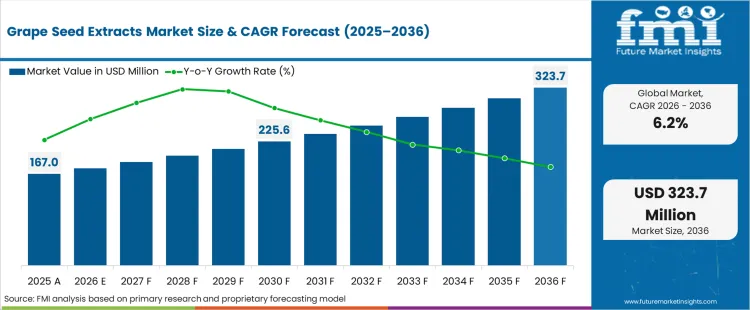
Grape Seed Extracts Market Key Takeaways
| Metric | Details |
|---|---|
| Industry Size (2026) | USD Million 177.35 |
| Industry Value (2036) | USD Million 323.66 |
| CAGR (2026-2036) | 6.2% |
Source: Future Market Insights, 2026
India leads with a 15.4% CAGR, driven by the expanding nutraceutical manufacturing sector and the growing consumer supplement market. China follows at 13.4% as the domestic wine industry expansion increases grape processing by-product availability for extraction. Japan registers an 11.8% pace anchored by the functional food (FOSHU) market and consumer demand for antioxidant health products. USA tracks at 10.5% driven by the dietary supplement sector and natural food ingredient reformulation trends. Canada registers a 9.4% pace reflecting the health supplement market growth. UK tracks at 8.2% supported by the natural cosmetics ingredient sector. Germany registers a 7.3% pace anchored by the European botanical extract industry. France tracks at 6.5% reflecting the wine industry by-product valorization and the cosmetics ingredient sector.
Grape Seed Extracts Market Definition
Grape seed extract is a concentrated botanical ingredient derived from the seeds of Vitis vinifera (grape) through solvent extraction and purification processes. The extract is standardized for oligomeric proanthocyanidin (OPC) content and total polyphenol concentration, serving as an antioxidant ingredient in dietary supplements, food fortification, personal care formulations, and functional beverage applications.
Grape Seed Extracts Market Inclusions
Market scope includes grape seed extract in liquid and powder formats for personal care, dietary supplement, food and beverage, and other applications. The report covers global and regional market sizes from 2026 to 2036, segmented by product, application, and geography.
Grape Seed Extracts Market Exclusions
Grape seed oil sold as a cooking or cosmetic carrier oil without polyphenol concentration is excluded. Whole grape products and grape juice are outside scope. Resveratrol supplements derived from grape skin rather than grape seed fall outside the valuation.
Grape Seed Extracts Market Research Methodology
Primary Research: Analysts engaged with procurement specialists, production managers, and supply chain directors to map purchasing cycles and supplier qualification requirements.
Desk Research: Data collection aggregated regulatory filings, industry standards, trade association publications, and public company disclosures.
Market-Sizing and Forecasting: Baseline values derive from hybrid top-down and bottom-up methodology, applying region-specific adoption curves through 2036.
Data Validation and Update Cycle: Projections tested against publicly reported production volumes, trade data, and industry benchmarks with annual recalibration.
Key Drivers Supporting Growth in the Grape Seed Extracts Market
Rising Demand for Natural Ingredients to Surge Product Demand
The trend in consumers' food, supplement, and skincare practices is toward increased consumption of natural and organic products. Grape seed extract fits the trend by being viewed as a pure, chemical-free substitute for synthetic additives that, in comparison, are considered impure. As the clean-label market continues to expand, grape seed extract is well-positioned to meet the demand for plant-based, organic ingredients in any form pertaining to beauty or health.
Surging Health Consciousness to Bolster Product Uptake
Grape seed extract contains huge amounts of proanthocyanidins, which are aimed at combating oxidative stress and thus supporting cardiovascular health while improving skin elasticity. Increasing consumer awareness about the health benefits has been a driving force that led to the ingredient's incorporation in the context of dietary supplements, functional food, and beverages. Increased health consciousness among consumers who opt for preventive healthcare also increases the demand for grape seed extract.
Top Trends Reshaping the Grape Seed Extracts Industry
Growing Product Use in the Winemaking Sector
Sustainability is becoming an increasingly important factor in the sourcing and production of ingredients. In the case of grape seed extract, the use of byproducts from the wine and grape industry helps reduce waste and promotes eco-friendly practices. As consumers prioritize sustainability and environmental responsibility, the market for grape seed extract benefits from its status as a byproduct of the winemaking industry, appealing to eco-conscious buyers looking for sustainable and responsibly sourced ingredients.
Evolving Consumer Preferences in Grape Seed Extract Supplementation
Mounting Demand for Clean Label Products
A significant mega trend in the grape seed extract market is the increasing demand for clean-label products. Consumers are becoming more conscious of what goes into the products they consume, seeking transparency in ingredient sourcing and manufacturing processes.
Grape seed extract, known for its natural and minimally processed attributes, fits perfectly into this trend, as it is often perceived as a pure, chemical-free alternative to synthetic ingredients. This demand for transparency, along with the desire for simple, wholesome ingredients, is driving the popularity of grape seed extract in dietary supplements, functional foods, and skincare products.
Top Segments Studied in the Grape Seed Extracts Market Report
By Product
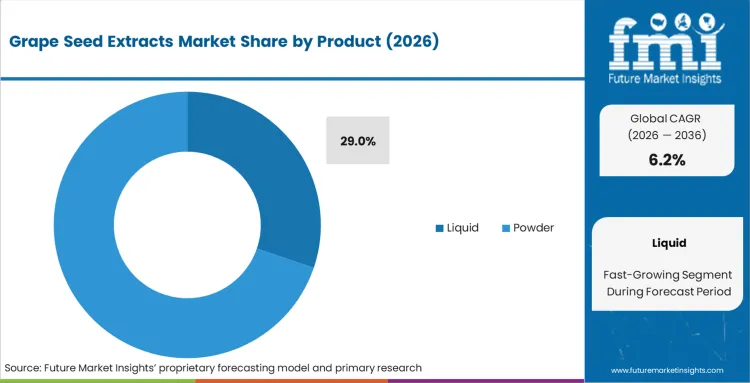
| Attributes | Details |
|---|---|
| Top Product | Powder |
| Market Share in 2026 | 29% |
In terms of product, the market is classified into liquid and powder. The powder segment is poised to witness a 67% share in 2025. The powdered grape seed extract is more versatile and easier to incorporate into various products compared to its liquid counterpart.
It can be easily mixed into capsules, tablets, powders, and other forms of dietary supplements. Its powdered form also allows for precise dosages, which is important for consumers who want to control their intake. Moreover, it is easier to store and has a longer shelf life without the need for refrigeration or special handling, making it a more convenient choice for both manufacturers and consumers.
By Application
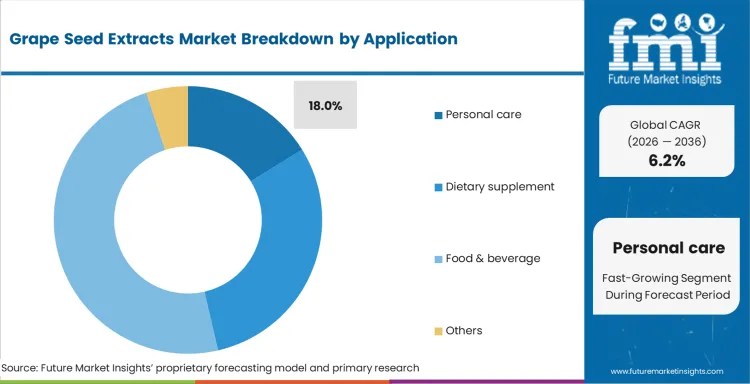
| Attributes | Details |
|---|---|
| Top Application | Food & Beverage |
| Market Share in 2026 | 18% |
With respect to application, the market is divided into personal care, dietary supplement, food & beverage, and others. The food & beverage segment is anticipated to register a 54% share in 2025. Grape seed extracts are rich in antioxidants, especially proanthocyanidins, which are known to reduce oxidative stress and improve health.
As consumers are becoming increasingly interested in functional foods that promote health, grape seed extract is increasingly being utilized as an ingredient in food and beverages to enhance their health benefits. Its support for heart health, improvement of circulation, and anti-inflammatory effects make it an attractive addition to juices, smoothies, and health-focused beverages.
Country-wise Insights into Grape Seed Extract Production and Consumption
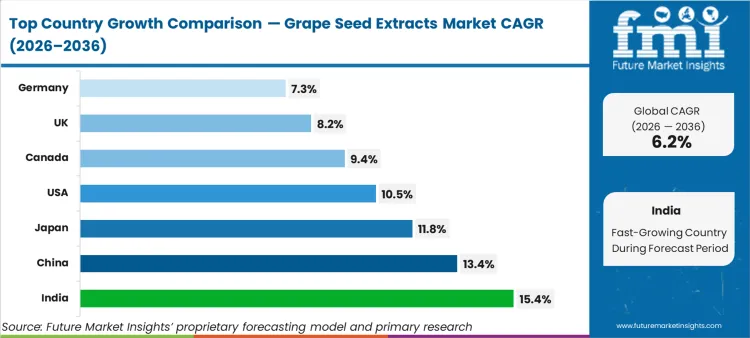
India
The Indian market is set to observe a 15.4% CAGR during the study period. India’s expanding middle class and rapid urbanization have contributed to a higher demand for premium health and wellness products, including grape seed extract.
As disposable incomes rise, consumers are more willing to spend on supplements and functional foods that promise health benefits. This demographic shift is fueling the growth of the grape seed extract market, as urban consumers seek healthier, more innovative products in both food and wellness sectors.
China
The market in China is expected to witness a 13.4% CAGR during the forecast period. There is a surging preference for natural and plant-based ingredients in China, driven by a long-standing tradition of using herbal and natural remedies in Chinese medicine.
Grape seed extract, as a natural and plant-derived product, fits seamlessly into this cultural inclination toward traditional and natural health solutions. Consumers in China are increasingly looking for natural alternatives to synthetic ingredients in both their food and personal care routines, further driving the market for grape seed extract.
Japan
Japanese consumers are increasingly becoming more aware of functional foods and beverages that contribute to health benefits other than the minimum nutritional value for sustenance. Functional food and beverage products ranging from teas, snacks, and beverages now come packed with grape seed extract that can contribute to heart health and antioxidant support. This increased consumer awareness and acceptance of functional ingredients have, in turn, led to growth in grape seed extract markets in Japan.
USA
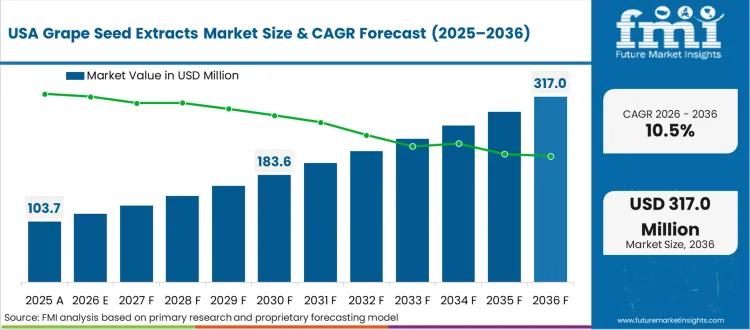
With the rising popularity of plant-based diets and vegan lifestyles in the USA, there is a higher demand for plant-derived supplements and functional food ingredients. Grape seed extract, which is vegan and plant-based, fits seamlessly into this movement. As more consumers opt for plant-based alternatives in their health and beauty products, grape seed extract is gaining popularity as a major ingredient in dietary supplements, beauty products, and functional beverages.
Canada
Functional foods account for a continually growing market share in Canada as the food industry evolves. Consumers are now increasingly seeking multi-nutritional supplements beyond nutrition alone. With antioxidant, anti-inflammatory, and cardiovascular benefits, grape seed extracts find their way into functional foods such as energy bars, snacks, and beverages.
Canadian consumers are becoming more health conscious and seek healthier foods that make them feel fit and well for life, driving the inclusion of grape seed extract into a broad number of food items.
UK
The UK beauty and skincare market has seen significant growth, particularly with consumers opting for natural and effective skincare solutions. Grape seed extract, owing to its antioxidant and anti-aging properties, finds huge applications in skincare products aimed at preventing skin damage, reducing signs of aging, and enhancing skin health. As UK consumers demand more natural and plant-based skincare products, grape seed extract is increasingly featured in serums, creams, and lotions, fueling its market growth.
Germany
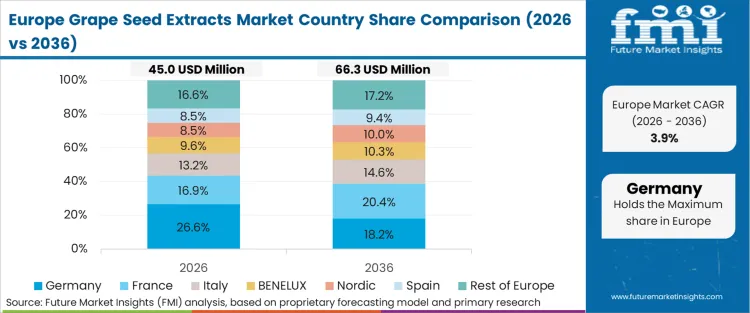
In the country, there is a robust emphasis on health-conscious living and preventive healthcare. German consumers are increasingly seeking natural and functional ingredients to improve their overall well-being, and grape seed extract, known for its high levels of antioxidants and potential cardiovascular benefits, is well-aligned with these health trends.
Grape seed extract is becoming increasingly popular in dietary supplements, health foods, and wellness products, supporting heart health, reducing inflammation, and enhancing skin health, which are all high priorities for the health-conscious German consumer.
France
Long-standing wine production in France ensures an ample and stable supply of grape seeds, which are a byproduct of wine production. These factors further make the production of grape seed extract relatively easier and less expensive. The use of byproducts from the wine industry also aligns with local French consumers' preference for sustainable practices. Such availability and support for sustainable sourcing have been critical in France, driving growth in the market.
Competitive Landscape of the Grape Seed Extracts Market
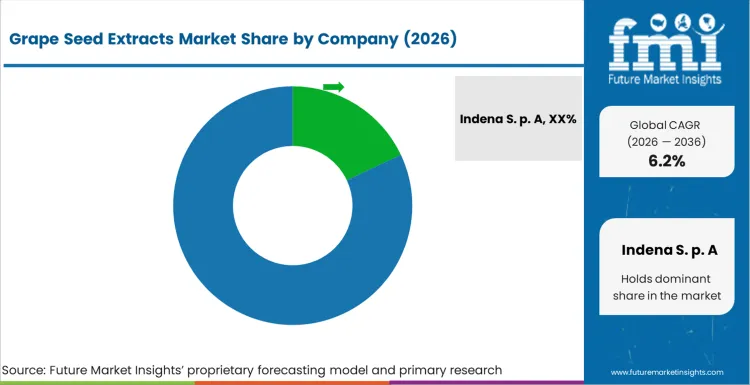
The grape seed extract market has a highly competitive landscape, with many top players focusing on increasing their market share by making use of strategies such as product innovation, strategic partnerships, and geographical expansion.
Prominent companies in the market include Naturex, Euromed, and BASF, who are renowned for their high-quality extracts and global reach. To achieve strength in market positioning, some of these companies conduct merger, acquisition, or collaboration activities with manufacturers within their related markets.
In addition to innovation, sustainability plays a significant role in the strategies of key players in the grape seed extract market. Companies such as Indena and Gevity emphasize eco-friendly sourcing and environmentally sustainable practices, appealing to consumers who prioritize ethical and sustainable products.
These players are also expanding their presence in emerging markets by establishing production units and distribution networks to meet the growing demand for grape seed extract. Through this combination of sustainability and innovation, companies in the grape seed extract market aim to maintain a competitive edge while tapping into new consumer segments globally.
Innovative Startups Entering the Grape Seed Extracts Sector
Several start-ups are emerging in the grape seed extract market and taking advantage of this increasing interest of consumers in this natural health booster ingredient. One prominent among the many is Grapex, which specializes in offering highly quality grape seed extracts that are sustainably sourced for dietary supplements and functional food purposes.
What makes this company stand out is its commitment to environmentally friendly procedures while sourcing grape seeds from winery byproducts, which reduces waste. The startup has been able to find its niche in this competitive market because of its sustainability focus coupled with innovative extraction methods.
Another player is Resveratrol Partners, a premium-grade grape seed extract startup with a strong health and wellness focus. It targets the skincare and anti-aging sectors and offers grape seed extracts that it incorporates into its skincare formulations. The startup's growth strategy includes building strong brand awareness through digital marketing, influencer partnerships, and a focus on the clean beauty movement.
Key Players in the Global Grape Seed Extracts Market
- Indena S. p. A
- Botanic Innovations LLC
- Polyphenolics
- Naturex
- Nexira
- Augusto Bellinvia srl
- NetQem LLC
- Hunan NutraMax Inc.
- Shijiazhuang Jianhe Biotech Co., Ltd.
- Piping Rock Health Products, LLC
Scope of the Report
| Metric | Value |
|---|---|
| Quantitative Units | USD Million 177.35 to USD Million 323.66, at a CAGR of 6.2% |
| Market Definition | Grape seed extract is a concentrated botanical ingredient derived from the seeds of Vitis vinifera (grape) through solvent extraction and purification processes. The extract is standardized for oligomeric proanthocyanidin (OPC) content and total polyphenol concentration, serving as an antioxidant ingredient in dietary supplements, food fortification, personal care formulations, and functional beverage applications. |
| Product Segmentation | Liquid, Powder |
| Application Segmentation | Personal Care, Dietary Supplement, Food & Beverage, Others |
| Regions Covered | North America, Latin America, Europe, East Asia, South Asia, Oceania, Middle East & Africa |
| Countries Covered | India, China, Japan, USA, Canada, UK, Germany, France, and 40 plus countries |
| Key Companies Profiled | Indena S.p.A, Botanic Innovations LLC, Polyphenolics, Naturex, Nexira, Augusto Bellinvia srl, NetQem LLC |
| Forecast Period | 2026 to 2036 |
| Approach | Hybrid top-down and bottom-up modelling anchored by primary interviews and public data benchmarking |
Segmentation Overview of the Grape Seed Extracts Market Report
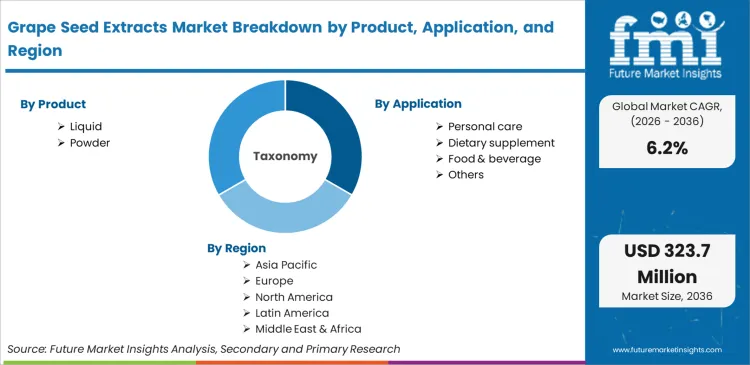
The market has been studied based on segments, including product, application, and region.
By Product:
In terms of product, the market is classified into liquid and powder.
By Application:
With respect to application, the market is divided into personal care, dietary supplement, food & beverage, and others.
By Region:
From the regional standpoint, the market is segregated into Latin America, Asia Pacific, the Middle East & Africa, North America, and Europe.
Bibliography
- European Food Safety Authority. (2024). Scientific Opinions on Health Claims Related to Grape Seed Extract Polyphenols. EFSA Journal.
- International Organisation of Vine and Wine. (2024). State of the World Vine and Wine Sector: By-Product Utilization. OIV.
- United States Pharmacopeia. (2024). Dietary Supplements Compendium: Grape Seed Extract Monograph. USP.
- Codex Alimentarius Commission. (2024). Guidelines on Nutrition and Health Claims: Antioxidant Claims. FAO/WHO.
- European Commission. (2024). Regulation (EC) No 1223/2009 on cosmetic products: Botanical Extract Ingredients. EUR-Lex.
This bibliography is provided for reader reference. The full FMI report contains the complete reference list with primary research documentation.
Frequently Asked Questions
How large is the demand for Grape Seed Extracts in the global market in 2026?
Demand for Grape Seed Extracts in the global market is estimated to be valued at USD Million 177.35 in 2026.
What will be the market size of Grape Seed Extracts in the global market by 2036?
Market size for Grape Seed Extracts is projected to reach USD Million 323.66 by 2036.
What is the expected demand growth for Grape Seed Extracts in the global market between 2026 and 2036?
Demand for Grape Seed Extracts is expected to grow at a CAGR of 6.2% between 2026 and 2036.
Which Product is poised to lead global sales by 2026?
Powder accounts for 67.0% share in 2026.
How significant is the role of Food & Beverage in Application?
Food & Beverage commands 54.0% of the application segment in 2026.
What is the growth outlook for India?
India is projected to grow at a CAGR of 15.4% during 2026 to 2036.
What is the growth rate for China in this market?
China is projected to expand at a CAGR of 13.4% during 2026 to 2036.
What is Grape Seed Extracts and what is it mainly used for?
Grape seed extract is a concentrated botanical ingredient derived from the seeds of Vitis vinifera (grape) through solvent extraction and purification processes. The extract is standardized for oligomeric proanthocyanidin (OPC) content and total polyphenol concentration, serving as an antioxidant ingredient in dietary supplements, food fortification, personal care formulations, and functional beverage applications.
What is included in the scope of this Grape Seed Extracts report?
Market scope includes grape seed extract in liquid and powder formats for personal care, dietary supplement, food and beverage, and other applications. The report covers global and regional market sizes from 2026 to 2036, segmented by product, application, and geography.
What is excluded from the scope of this report?
Grape seed oil sold as a cooking or cosmetic carrier oil without polyphenol concentration is excluded. Whole grape products and grape juice are outside scope.
What does market forecast mean on this page?
The market forecast represents a model-based projection built on defined industry and supply chain assumptions for strategic planning purposes.
How does FMI build and validate the Grape Seed Extracts forecast?
Forecasting models apply a hybrid top-down and bottom-up methodology and cross-validate projections against publicly available industry data and primary research inputs.
What does zero reliance on speculative third-party market research mean here?
Primary interviews, verified public regulatory documentation, and official industry standards registries are used instead of unverified syndicated estimates.
Preview the report firsthand - request a free sample
Get SampleGet the brochure for pricing and purchase details.
Get PDFTable of Content
- Executive Summary
- Global Market Outlook
- Demand-side Trends
- Supply-side Trends
- Technology Roadmap Analysis
- Analysis and Recommendations
- Market Overview
- Market Coverage / Taxonomy
- Market Definition / Scope / Limitations
- Research Methodology
- Chapter Orientation
- Analytical Lens and Working Hypotheses
- Market Structure, Signals, and Trend Drivers
- Benchmarking and Cross-market Comparability
- Market Sizing, Forecasting, and Opportunity Mapping
- Research Design and Evidence Framework
- Desk Research Programme (Secondary Evidence)
- Company Annual and Sustainability Reports
- Peer-reviewed Journals and Academic Literature
- Corporate Websites, Product Literature, and Technical Notes
- Earnings Decks and Investor Briefings
- Statutory Filings and Regulatory Disclosures
- Technical White Papers and Standards Notes
- Trade Journals, Industry Magazines, and Analyst Briefs
- Conference Proceedings, Webinars, and Seminar Materials
- Government Statistics Portals and Public Data Releases
- Press Releases and Reputable Media Coverage
- Specialist Newsletters and Curated Briefings
- Sector Databases and Reference Repositories
- FMI Internal Proprietary Databases and Historical Market Datasets
- Subscription Datasets and Paid Sources
- Social Channels, Communities, and Digital Listening Inputs
- Additional Desk Sources
- Expert Input and Fieldwork (Primary Evidence)
- Primary Modes
- Qualitative Interviews and Expert Elicitation
- Quantitative Surveys and Structured Data Capture
- Blended Approach
- Why Primary Evidence is Used
- Field Techniques
- Interviews
- Surveys
- Focus Groups
- Observational and In-context Research
- Social and Community Interactions
- Stakeholder Universe Engaged
- C-suite Leaders
- Board Members
- Presidents and Vice Presidents
- R&D and Innovation Heads
- Technical Specialists
- Domain Subject-matter Experts
- Scientists
- Physicians and Other Healthcare Professionals
- Governance, Ethics, and Data Stewardship
- Research Ethics
- Data Integrity and Handling
- Primary Modes
- Tooling, Models, and Reference Databases
- Desk Research Programme (Secondary Evidence)
- Data Engineering and Model Build
- Data Acquisition and Ingestion
- Cleaning, Normalisation, and Verification
- Synthesis, Triangulation, and Analysis
- Quality Assurance and Audit Trail
- Market Background
- Market Dynamics
- Drivers
- Restraints
- Opportunity
- Trends
- Scenario Forecast
- Demand in Optimistic Scenario
- Demand in Likely Scenario
- Demand in Conservative Scenario
- Opportunity Map Analysis
- Product Life Cycle Analysis
- Supply Chain Analysis
- Investment Feasibility Matrix
- Value Chain Analysis
- PESTLE and Porter’s Analysis
- Regulatory Landscape
- Regional Parent Market Outlook
- Production and Consumption Statistics
- Import and Export Statistics
- Market Dynamics
- Global Market Analysis 2021 to 2025 and Forecast, 2026 to 2036
- Historical Market Size Value (USD Million) Analysis, 2021 to 2025
- Current and Future Market Size Value (USD Million) Projections, 2026 to 2036
- Y-o-Y Growth Trend Analysis
- Absolute $ Opportunity Analysis
- Global Market Pricing Analysis 2021 to 2025 and Forecast 2026 to 2036
- Global Market Analysis 2021 to 2025 and Forecast 2026 to 2036, By Product
- Introduction / Key Findings
- Historical Market Size Value (USD Million) Analysis By Product , 2021 to 2025
- Current and Future Market Size Value (USD Million) Analysis and Forecast By Product , 2026 to 2036
- Liquid
- Powder
- Liquid
- Y-o-Y Growth Trend Analysis By Product , 2021 to 2025
- Absolute $ Opportunity Analysis By Product , 2026 to 2036
- Global Market Analysis 2021 to 2025 and Forecast 2026 to 2036, By Application
- Introduction / Key Findings
- Historical Market Size Value (USD Million) Analysis By Application, 2021 to 2025
- Current and Future Market Size Value (USD Million) Analysis and Forecast By Application, 2026 to 2036
- Personal care
- Dietary supplement
- Food & beverage
- Others
- Personal care
- Y-o-Y Growth Trend Analysis By Application, 2021 to 2025
- Absolute $ Opportunity Analysis By Application, 2026 to 2036
- Global Market Analysis 2021 to 2025 and Forecast 2026 to 2036, By Region
- Introduction
- Historical Market Size Value (USD Million) Analysis By Region, 2021 to 2025
- Current Market Size Value (USD Million) Analysis and Forecast By Region, 2026 to 2036
- North America
- Latin America
- Western Europe
- Eastern Europe
- East Asia
- South Asia and Pacific
- Middle East & Africa
- Market Attractiveness Analysis By Region
- North America Market Analysis 2021 to 2025 and Forecast 2026 to 2036, By Country
- Historical Market Size Value (USD Million) Trend Analysis By Market Taxonomy, 2021 to 2025
- Market Size Value (USD Million) Forecast By Market Taxonomy, 2026 to 2036
- By Country
- USA
- Canada
- Mexico
- By Product
- By Application
- By Country
- Market Attractiveness Analysis
- By Country
- By Product
- By Application
- Key Takeaways
- Latin America Market Analysis 2021 to 2025 and Forecast 2026 to 2036, By Country
- Historical Market Size Value (USD Million) Trend Analysis By Market Taxonomy, 2021 to 2025
- Market Size Value (USD Million) Forecast By Market Taxonomy, 2026 to 2036
- By Country
- Brazil
- Chile
- Rest of Latin America
- By Product
- By Application
- By Country
- Market Attractiveness Analysis
- By Country
- By Product
- By Application
- Key Takeaways
- Western Europe Market Analysis 2021 to 2025 and Forecast 2026 to 2036, By Country
- Historical Market Size Value (USD Million) Trend Analysis By Market Taxonomy, 2021 to 2025
- Market Size Value (USD Million) Forecast By Market Taxonomy, 2026 to 2036
- By Country
- Germany
- UK
- Italy
- Spain
- France
- Nordic
- BENELUX
- Rest of Western Europe
- By Product
- By Application
- By Country
- Market Attractiveness Analysis
- By Country
- By Product
- By Application
- Key Takeaways
- Eastern Europe Market Analysis 2021 to 2025 and Forecast 2026 to 2036, By Country
- Historical Market Size Value (USD Million) Trend Analysis By Market Taxonomy, 2021 to 2025
- Market Size Value (USD Million) Forecast By Market Taxonomy, 2026 to 2036
- By Country
- Russia
- Poland
- Hungary
- Balkan & Baltic
- Rest of Eastern Europe
- By Product
- By Application
- By Country
- Market Attractiveness Analysis
- By Country
- By Product
- By Application
- Key Takeaways
- East Asia Market Analysis 2021 to 2025 and Forecast 2026 to 2036, By Country
- Historical Market Size Value (USD Million) Trend Analysis By Market Taxonomy, 2021 to 2025
- Market Size Value (USD Million) Forecast By Market Taxonomy, 2026 to 2036
- By Country
- China
- Japan
- South Korea
- By Product
- By Application
- By Country
- Market Attractiveness Analysis
- By Country
- By Product
- By Application
- Key Takeaways
- South Asia and Pacific Market Analysis 2021 to 2025 and Forecast 2026 to 2036, By Country
- Historical Market Size Value (USD Million) Trend Analysis By Market Taxonomy, 2021 to 2025
- Market Size Value (USD Million) Forecast By Market Taxonomy, 2026 to 2036
- By Country
- India
- ASEAN
- Australia & New Zealand
- Rest of South Asia and Pacific
- By Product
- By Application
- By Country
- Market Attractiveness Analysis
- By Country
- By Product
- By Application
- Key Takeaways
- Middle East & Africa Market Analysis 2021 to 2025 and Forecast 2026 to 2036, By Country
- Historical Market Size Value (USD Million) Trend Analysis By Market Taxonomy, 2021 to 2025
- Market Size Value (USD Million) Forecast By Market Taxonomy, 2026 to 2036
- By Country
- Kingdom of Saudi Arabia
- Other GCC Countries
- Turkiye
- South Africa
- Other African Union
- Rest of Middle East & Africa
- By Product
- By Application
- By Country
- Market Attractiveness Analysis
- By Country
- By Product
- By Application
- Key Takeaways
- Key Countries Market Analysis
- USA
- Pricing Analysis
- Market Share Analysis, 2025
- By Product
- By Application
- Canada
- Pricing Analysis
- Market Share Analysis, 2025
- By Product
- By Application
- Mexico
- Pricing Analysis
- Market Share Analysis, 2025
- By Product
- By Application
- Brazil
- Pricing Analysis
- Market Share Analysis, 2025
- By Product
- By Application
- Chile
- Pricing Analysis
- Market Share Analysis, 2025
- By Product
- By Application
- Germany
- Pricing Analysis
- Market Share Analysis, 2025
- By Product
- By Application
- UK
- Pricing Analysis
- Market Share Analysis, 2025
- By Product
- By Application
- Italy
- Pricing Analysis
- Market Share Analysis, 2025
- By Product
- By Application
- Spain
- Pricing Analysis
- Market Share Analysis, 2025
- By Product
- By Application
- France
- Pricing Analysis
- Market Share Analysis, 2025
- By Product
- By Application
- India
- Pricing Analysis
- Market Share Analysis, 2025
- By Product
- By Application
- ASEAN
- Pricing Analysis
- Market Share Analysis, 2025
- By Product
- By Application
- Australia & New Zealand
- Pricing Analysis
- Market Share Analysis, 2025
- By Product
- By Application
- China
- Pricing Analysis
- Market Share Analysis, 2025
- By Product
- By Application
- Japan
- Pricing Analysis
- Market Share Analysis, 2025
- By Product
- By Application
- South Korea
- Pricing Analysis
- Market Share Analysis, 2025
- By Product
- By Application
- Russia
- Pricing Analysis
- Market Share Analysis, 2025
- By Product
- By Application
- Poland
- Pricing Analysis
- Market Share Analysis, 2025
- By Product
- By Application
- Hungary
- Pricing Analysis
- Market Share Analysis, 2025
- By Product
- By Application
- Kingdom of Saudi Arabia
- Pricing Analysis
- Market Share Analysis, 2025
- By Product
- By Application
- Turkiye
- Pricing Analysis
- Market Share Analysis, 2025
- By Product
- By Application
- South Africa
- Pricing Analysis
- Market Share Analysis, 2025
- By Product
- By Application
- USA
- Market Structure Analysis
- Competition Dashboard
- Competition Benchmarking
- Market Share Analysis of Top Players
- By Regional
- By Product
- By Application
- Competition Analysis
- Competition Deep Dive
- Indena S. p. A
- Overview
- Product Portfolio
- Profitability by Market Segments (Product/Age /Sales Channel/Region)
- Sales Footprint
- Strategy Overview
- Marketing Strategy
- Product Strategy
- Channel Strategy
- Botanic Innovations LLC
- Polyphenolics
- Naturex
- Nexira
- Augusto Bellinvia srl
- NetQem LLC
- Indena S. p. A
- Competition Deep Dive
- Assumptions & Acronyms Used


