

- Industry Size (2026)
- USD 365.0 Mn
- Forecast (2036)
- USD 946.7 Mn
- CAGR (2026 to 2036)
- 10.0%
Kosher-Certified Cosmetic Colorant Systems for Global Brands Market Forecast and Outlook 2026 to 2036
The kosher-certified cosmetic colorant systems for global brands market is valued at USD 365.0 million in 2026 and is forecasted to reach USD 946.7 million by 2036, registering a CAGR of 10.0%. Market behavior across this period reflects structural compliance needs within global brand portfolios rather than incremental color cosmetics expansion.
Kosher-certified colorants are selected early in formulation pipelines because they influence ingredient eligibility, cross-border approvals, and internal governance standards. Demand concentrates around global brands seeking uniform specifications across regions, where certified inputs reduce reformulation cycles and audit exposure. Synthetic organic pigments capture a large share because they combine certification feasibility with scalability, shade consistency, and supply reliability suited to multinational production environments.
Certification scope and end-use concentration shape adoption quality between 2026 and 2036. Ingredient-level certification dominates since it allows brands to manage compliance without fully redesigning manufacturing footprints, supporting flexibility across contract manufacturers. Facility-level certification gains relevance in tightly controlled supply chains serving regulated retailers. Global multinational brands absorb most value due to portfolio breadth, export exposure, and standardized sourcing models.
Mass-premium segments follow where certification supports risk management without excessive cost escalation. Clean and ethical beauty lines integrate kosher colorants selectively as part of broader transparency positioning. Demand stability remains highest where certification functions as a governance tool embedded in long-term sourcing strategies, rather than as a consumer-facing differentiator tied to short product cycles or pricing pressure.
Quick Stats for Kosher-Certified Cosmetic Colorant Systems for Global Brands Market
- Kosher-Certified Cosmetic Colorant Systems for Global Brands Market Value (2026): USD 365.0 million
- Kosher-Certified Cosmetic Colorant Systems for Global Brands Market Forecast Value (2036): USD 946.7 million
- Forecast CAGR (2026 to 2036): 10.0%
- Leading Pigment System Type in Global Demand: Kosher-Certified Synthetic Organic Pigments
- Fastest-Growing Countries: India, China, USA, Germany, Brazil
- Key Players in Global Demand: Sensient Technologies, Clariant AG, Sun Chemical, BASF SE, DSM-Firmenich

Kosher-Certified Cosmetic Colorant Systems for Global Brands Market Key Takeaways
| Metric | Value |
|---|---|
| Market Value (2026) | USD 365.0 million |
| Market Forecast Value (2036) | USD 946.7 million |
| Forecast CAGR (2026 to 2036) | 10.0% |
Why is the Demand for Kosher-Certified Cosmetic Colorant Systems for Global Brands Market Growing?
Demand for kosher-certified cosmetic colorant systems is growing globally due to increasing emphasis on inclusive product portfolios and clear ingredient credentials across beauty and personal care categories. Kosher certification verifies that colorants and formulation components comply with dietary and processing standards recognized by diverse consumer groups, which supports use in lipsticks, foundations, eyeshadows, and multi-use makeup. Global brands adopt kosher-certified colorants to expand market access in regions with significant Jewish populations and to appeal to ethically minded consumers who value transparency and certified ingredient sourcing. Retail expansion through mass market, specialty beauty, and e-commerce channels increases visibility and accessibility of certified products across multiple demographics.
Regulatory frameworks in various regions emphasize accurate labeling and restricted substance compliance, which reinforces procurement of certified colorant systems that support quality assurance and traceability. Ingredient sourcing transparency influences purchasing behavior among consumers with dietary sensitivities or preference for third-party validation. Advances in pigment and dye technology improve stability, color strength, and compatibility with diverse formulation bases while maintaining certification requirements. Brand positioning strategies that prioritize inclusivity, cultural respect, and broad regulatory acceptance support continued adoption of kosher-certified colorant systems in global cosmetic portfolios.
How Is the Kosher-Certified Cosmetic Colorant Systems for Global Brands Market Structured?
Demand for kosher-certified cosmetic colorant systems is shaped by global brand compliance strategies, export-driven formulation requirements, and increasing overlap between religious certification, ethical sourcing, and ingredient transparency. Global brands prioritize ingredient traceability, segregation of certified and non-certified materials, and consistent documentation across multinational supply chains. Segment structure reflects how pigment technology, certification depth, and brand positioning influence adoption across large-scale cosmetic portfolios.
Which Pigment System Type Holds the Largest Share in Global Demand?

Kosher-certified synthetic organic pigments account for 34.0%, representing the largest share of global demand. These pigments provide strong color strength, batch-to-batch consistency, and formulation flexibility while meeting kosher compliance requirements. Kosher-compliant mineral pigments follow at 28.0%, supported by inherent inorganic stability and relatively straightforward certification pathways. Lake and treated pigment systems represent 22.0%, reflecting demand in premium formulations requiring enhanced dispersion and shade uniformity. Encapsulated and functional colorants account for 16.0%, used in advanced performance cosmetics where controlled release, stability, or skin interaction is required.
- Synthetic organic pigments lead due to scalability and performance reliability
- Mineral pigments support stable compliance across global supply chains
- Encapsulated systems address high-performance formulation needs
Which Certification Scope Is Most Widely Adopted Globally?
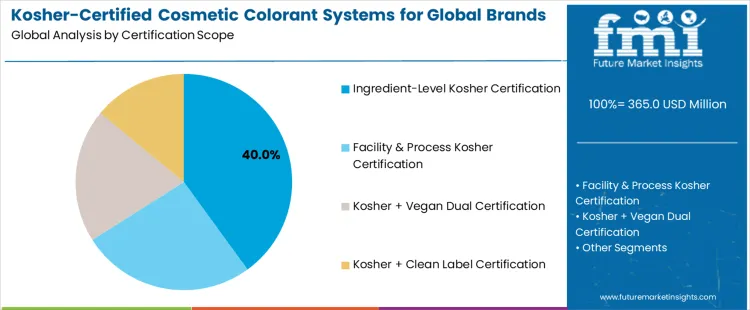
Ingredient-level kosher certification dominates with a 40.0% share, making it the most widely adopted certification scope. This approach allows global brands to certify individual raw materials while maintaining operational flexibility across manufacturing sites. Facility and process kosher certification accounts for 26.0%, reflecting stricter controls on production environments and cross-contamination prevention. Kosher and vegan dual certification represents 20.0%, driven by convergence of religious compliance and cruelty-free positioning. Kosher and clean-label certification holds 14.0%, addressing demand for simplified formulations alongside certified sourcing.
- Ingredient-level certification offers operational flexibility
- Facility certification supports risk mitigation in complex supply chains
- Dual certification strengthens ethical and regulatory alignment
Which End-Use Segment Drives Global Adoption the Most?
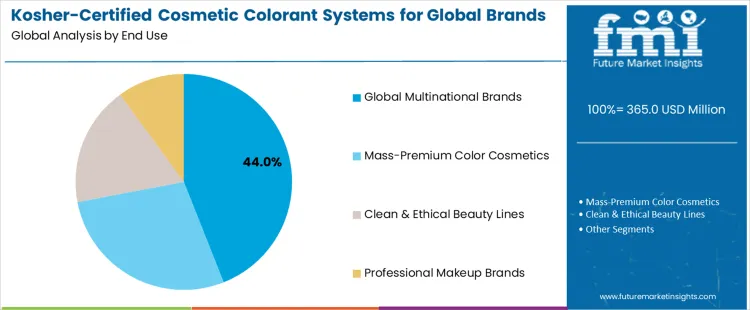
Global multinational brands account for 44.0%, making them the leading end-use segment. These brands require kosher-certified colorants to support cross-border distribution, regional labeling compliance, and portfolio standardization. Mass-premium color cosmetics represent 28.0%, reflecting balanced demand for performance, certification, and cost control. Clean and ethical beauty lines hold 18.0%, driven by transparency and ethical sourcing priorities. Professional makeup brands account for 10.0%, where performance considerations often outweigh certification breadth.
- Multinational brands lead due to global compliance requirements
- Mass-premium brands balance certification with scalability
- Ethical beauty lines integrate kosher within broader transparency goals
What are the Key Dynamics in the Kosher-Certified Cosmetic Colorant Systems for Global Brands Market?
Global demand rises as cosmetic brands and formulators adopt kosher-certified colorant systems to meet dietary law adherence, cultural preferences, and ethical purchasing trends among diverse consumer populations. Kosher-certified cosmetic colorants comply with standards that exclude prohibited substances and maintain certified handling and processing practices. Adoption aligns with expansion of inclusive product portfolios, growth of multicultural markets, and retailer demand for certified offerings. Usage spans lipsticks, mascaras, blushes, eye shadows, and multifunctional color cosmetics positioned for broad, global appeal.
How do cultural demand patterns and certification requirements shape adoption?
Consumers in regions with significant Jewish populations and multicultural segments value kosher certification as assurance of ingredient eligibility and manufacturing integrity. Beauty manufacturers integrate kosher-certified pigment and dye systems to support claims backed by recognized certification bodies that audit ingredient sources, processing facilities, and quality controls. Retailers and brands leverage kosher certification to signal adherence to rigorous standards and broaden accessibility across global markets where certification influences purchase decisions. Cosmetic developers balance certification needs with performance expectations for color intensity, stability, and safety in finished products. Transparent certification labeling supports consumer trust in markets with high demand for inclusive credentialing.
How do supply chain certification complexity, performance expectations, and cost factors influence market scalability?
Kosher certification requires documented ingredient traceability, segregated handling, and compliance with standards set by authoritative kosher organizations, adding administrative and operational effort. Colorant systems must deliver comparable chromatic range, durability, and formulation compatibility to noncertified alternatives to meet brand performance criteria. Certification processes incur costs for audits, documentation, and periodic verification, affecting finished product pricing strategies for global brands. Variation in accepted kosher standards across regions and certifying bodies influences global product rollout planning and messaging. Integration of certified colorants into global manufacturing lines may require quality assurance adjustments and supplier qualification efforts. Long-term growth depends on continued development of high-performance kosher-certified colorant options, streamlined certification pathways, and formulation support that reduces compliance complexity for global cosmetic brand portfolios.
How Is Demand for Kosher-Certified Cosmetic Colorant Systems for Global Brands Evolving?
Demand for kosher-certified cosmetic colorant systems for global brands is increasing globally due to ingredient traceability requirements, cross-border compliance needs, and expansion of inclusive beauty positioning. India leads with a 10.7% CAGR, supported by export-oriented cosmetic manufacturing and certification-led sourcing. China follows at 10.5%, driven by large-scale production for international brands requiring kosher documentation. USA records a 10.1% CAGR, reflecting brand governance standards and retailer audit requirements. Germany posts 9.8%, shaped by regulatory rigor and formulation transparency expectations. Brazil records 9.6%, supported by growing participation in global cosmetic supply chains. Growth reflects rising use of kosher certification as a quality and compliance benchmark in global color cosmetics.
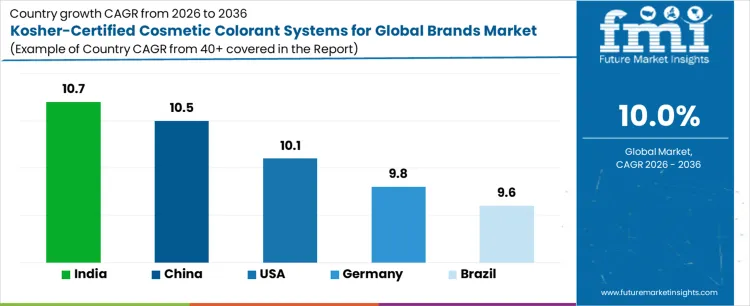
| Country | CAGR (%) |
|---|---|
| India | 10.7% |
| China | 10.5% |
| USA | 10.1% |
| Germany | 9.8% |
| Brazil | 9.6% |
What factors are driving strong adoption of kosher-certified colorant systems in India?
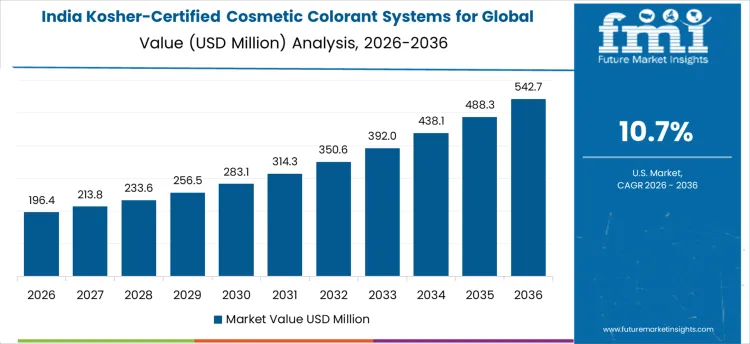
India demand is driven by its role as a manufacturing base for global cosmetic brands serving regulated export destinations. CAGR of 10.7% reflects increasing use of synthetic and mineral colorants verified under kosher certification protocols. Export contracts require documented compliance covering raw material origin, processing aids, and contamination controls. Manufacturers integrate kosher-certified inputs to streamline multi-market approvals. Certification bodies influence supplier qualification and formulation decisions. Growth remains export-led and compliance-focused, aligned with India’s expanding role in international cosmetic supply chains.
- Export-oriented cosmetic manufacturing growth
- Requirement for multi-market compliance documentation
- Preference for synthetic and mineral colorants
- Certification-led supplier qualification
How is China sustaining high growth in kosher-certified colorant usage?
China demand reflects scale of cosmetic manufacturing for multinational brands and private labels. CAGR of 10.5% is supported by adoption of kosher-certified colorants to meet international brand governance standards. Manufacturers favor certified systems to reduce reformulation risk across markets. Centralized production for global distribution increases reliance on universally accepted certifications. Domestic suppliers expand certified portfolios to meet buyer requirements. Growth remains scale-driven and compliance-aligned, supported by China’s position in global cosmetic production.
- Large-scale production for global cosmetic brands
- Use of certification to reduce reformulation risk
- Centralized manufacturing for international distribution
- Expansion of certified domestic colorant supply
What factors shape demand growth for kosher-certified colorants in the USA?
USA demand is shaped by retailer audit standards, brand transparency commitments, and risk management practices. CAGR of 10.1% reflects use of kosher-certified colorants as part of broader ingredient governance frameworks. Brands adopt certification to support claims related to purity, process control, and inclusivity. Retailers and distributors require verifiable documentation for ingredient sourcing. Professional and mass-market brands align on standardized certified inputs. Growth remains brand-led and governance-focused, aligned with supply chain assurance and compliance consistency.
- Retailer-driven audit and documentation requirements
- Brand governance and ingredient transparency policies
- Standardization across product portfolios
- Alignment with inclusive formulation strategies
Why does Germany show steady growth in kosher-certified cosmetic colorants?
Germany demand reflects stringent regulatory oversight and emphasis on formulation transparency. CAGR of 9.8% is supported by adoption of kosher-certified colorants to meet documentation and traceability expectations. Manufacturers prioritize certifications that simplify compliance across EU and export markets. Certified inputs support audit readiness and risk reduction. Integration occurs within controlled production systems. Growth remains compliance-driven and process-focused, aligned with Germany’s regulatory culture and quality assurance standards.
- Strong emphasis on traceability and documentation
- Simplification of multi-market regulatory compliance
- Integration within controlled production systems
- Focus on audit readiness and risk management
What supports continued demand growth for kosher-certified colorant systems in Brazil?
Brazil demand is driven by participation in global cosmetic supply chains and increasing export activity. CAGR of 9.6% reflects adoption of kosher-certified colorants to meet international buyer requirements. Domestic brands supplying multinational partners align formulations with certified ingredient standards. Certification supports access to regulated retail channels abroad. Ingredient governance gains importance alongside product performance. Growth remains trade-driven and compliance-aligned, supported by Brazil’s expanding cosmetic manufacturing and export integration.
- Integration into global cosmetic supply chains
- Compliance with international buyer requirements
- Certification supporting export market access
- Growing emphasis on ingredient governance
What is the competitive landscape of demand for kosher-certified cosmetic colorant systems globally?
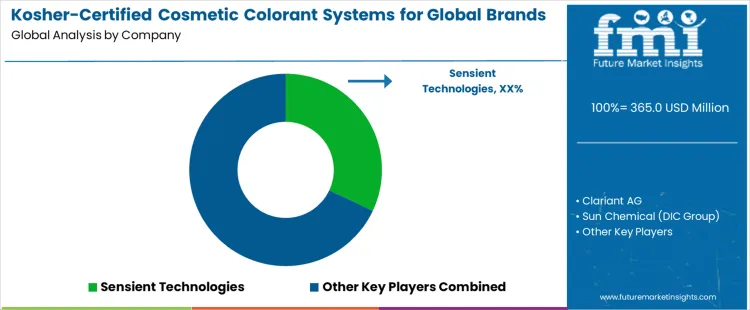
Demand for kosher-certified cosmetic colorant systems is driven by multinational brand compliance and growing consumer demand for certified ingredients. Formulators require pigments with documented kosher certification, traceable supply chains, and robust allergen control across manufacturing and packaging lines. Buyers evaluate colorfastness, light stability, migration resistance, and compatibility with diverse matrices including wax, oil, and emulsion systems. Procurement teams prioritize suppliers with audited kosher certification, GMP documentation, and capacity to segregate production for certified batches. Regulatory alignment and reliable documentation reduce brand risk during entry into markets with stringent dietary and ethical standards.
Sensient Technologies leverages global production and application laboratories to deliver kosher-certified pigments and customized dispersion systems supporting major cosmetic launches. Clariant supplies cosmetic-grade pigments with certification pathways and technical support for shade matching across powder, cream, and liquid formats. Sun Chemical, part of DIC Group, provides global dispersion capabilities and certification traceability for large-scale color production and formulation. BASF supports demand through pigment technologies and regulatory services enabling kosher certification across supply chains and multinational rollouts. DSM-Firmenich advances biotech-derived and natural color platforms with compliance documentation and supply reliability for premium and mass-market cosmetic brands. Market growth reflects increased halal, kosher, and clean-label consumer demand across global beauty retail channels.
Key Players in the Kosher-Certified Cosmetic Colorant Systems for Global Brands Market
- Sensient Technologies
- Clariant AG
- Sun Chemical (DIC Group)
- BASF SE
- DSM-Firmenich
Scope of the Report
| Items | Values |
|---|---|
| Quantitative Units | USD million |
| Pigment System Type | Kosher-Certified Synthetic Organic Pigments; Kosher-Compliant Mineral Pigments; Lake & Treated Pigment Systems; Encapsulated & Functional Colorants |
| Certification Scope | Ingredient-Level Kosher Certification; Facility & Process Kosher Certification; Kosher + Vegan Dual Certification; Kosher + Clean Label Certification |
| End Use | Global Multinational Brands; Mass-Premium Color Cosmetics; Clean & Ethical Beauty Lines; Professional Makeup Brands |
| Regions Covered | Asia Pacific, Europe, North America, Latin America, Middle East & Africa |
| Countries Covered | India, China, USA, Germany, Brazil, and 40+ countries |
| Key Companies Profiled | Sensient Technologies; Clariant AG; Sun Chemical (DIC Group); BASF SE; DSM-Firmenich |
| Additional Attributes | Dollar sales by pigment system type and end use; adoption trends for kosher-certified and dual-certified cosmetic colorants; certification audit scope, traceability, and documentation requirements; color strength, dispersion, and stability performance metrics; compatibility with oil, wax, powder, and emulsion cosmetic bases; regional kosher standards alignment and regulatory compliance influencing kosher-certified colorant selection. |
Kosher-Certified Cosmetic Colorant Systems for Global Brands Market by Segment
By Pigment System Type:
- Kosher-Certified Synthetic Organic Pigments
- Kosher-Compliant Mineral Pigments
- Lake & Treated Pigment Systems
- Encapsulated & Functional Colorants
By Certification Scope:
- Ingredient-Level Kosher Certification
- Facility & Process Kosher Certification
- Kosher + Vegan Dual Certification
- Kosher + Clean Label Certification
By End Use:
- Global Multinational Brands
- Mass-Premium Color Cosmetics
- Clean & Ethical Beauty Lines
- Professional Makeup Brands
By Region:
- Asia Pacific
- China
- Japan
- South Korea
- India
- Australia & New Zealand
- ASEAN
- Rest of Asia Pacific
- Europe
- Germany
- United Kingdom
- France
- Italy
- Spain
- Nordic
- BENELUX
- Rest of Europe
- North America
- United States
- Canada
- Mexico
- Latin America
- Brazil
- Chile
- Rest of Latin America
- Middle East & Africa
- Kingdom of Saudi Arabia
- Other GCC Countries
- Turkey
- South Africa
- Other African Union
- Rest of Middle East & Africa
Frequently Asked Questions
How big is the kosher-certified cosmetic colorant systems for global brands market in 2026?
The global kosher-certified cosmetic colorant systems for global brands market is estimated to be valued at USD 365.0 million in 2026.
What will be the size of kosher-certified cosmetic colorant systems for global brands market in 2036?
The market size for the kosher-certified cosmetic colorant systems for global brands market is projected to reach USD 946.7 million by 2036.
How much will be the kosher-certified cosmetic colorant systems for global brands market growth between 2026 and 2036?
The kosher-certified cosmetic colorant systems for global brands market is expected to grow at a 10.0% CAGR between 2026 and 2036.
What are the key product types in the kosher-certified cosmetic colorant systems for global brands market?
The key product types in kosher-certified cosmetic colorant systems for global brands market are kosher-certified synthetic organic pigments, kosher-compliant mineral pigments, lake & treated pigment systems and encapsulated & functional colorants.
Which certification scope segment to contribute significant share in the kosher-certified cosmetic colorant systems for global brands market in 2026?
In terms of certification scope, ingredient-level kosher certification segment to command 40.0% share in the kosher-certified cosmetic colorant systems for global brands market in 2026.
Preview the report firsthand - request a free sample
Get SampleGet the brochure for pricing and purchase details.
Get PDFTable of Content
- Executive Summary
- Global Market Outlook
- Demand-side Trends
- Supply-side Trends
- Technology Roadmap Analysis
- Analysis and Recommendations
- Market Overview
- Market Coverage / Taxonomy
- Market Definition / Scope / Limitations
- Market Background
- Market Dynamics
- Drivers
- Restraints
- Opportunity
- Trends
- Scenario Forecast
- Demand in Optimistic Scenario
- Demand in Likely Scenario
- Demand in Conservative Scenario
- Opportunity Map Analysis
- Product Life Cycle Analysis
- Supply Chain Analysis
- Investment Feasibility Matrix
- Value Chain Analysis
- PESTLE and Porter’s Analysis
- Regulatory Landscape
- Regional Parent Market Outlook
- Production and Consumption Statistics
- Import and Export Statistics
- Market Dynamics
- Global Market Analysis 2021 to 2025 and Forecast, 2026 to 2036
- Historical Market Size Value (USD Million) Analysis, 2021 to 2025
- Current and Future Market Size Value (USD Million) Projections, 2026 to 2036
- Y-o-Y Growth Trend Analysis
- Absolute $ Opportunity Analysis
- Global Market Pricing Analysis 2021 to 2025 and Forecast 2026 to 2036
- Global Market Analysis 2021 to 2025 and Forecast 2026 to 2036, By Pigment System Type
- Introduction / Key Findings
- Historical Market Size Value (USD Million) Analysis By Pigment System Type , 2021 to 2025
- Current and Future Market Size Value (USD Million) Analysis and Forecast By Pigment System Type , 2026 to 2036
- Kosher-Certified Synthetic Organic Pigments
- Kosher-Compliant Mineral Pigments
- Lake & Treated Pigment Systems
- Encapsulated & Functional Colorants
- Kosher-Certified Synthetic Organic Pigments
- Y-o-Y Growth Trend Analysis By Pigment System Type , 2021 to 2025
- Absolute $ Opportunity Analysis By Pigment System Type , 2026 to 2036
- Global Market Analysis 2021 to 2025 and Forecast 2026 to 2036, By Certification Scope
- Introduction / Key Findings
- Historical Market Size Value (USD Million) Analysis By Certification Scope, 2021 to 2025
- Current and Future Market Size Value (USD Million) Analysis and Forecast By Certification Scope, 2026 to 2036
- Ingredient-Level Kosher Certification
- Facility & Process Kosher Certification
- Kosher + Vegan Dual Certification
- Kosher + Clean Label Certification
- Ingredient-Level Kosher Certification
- Y-o-Y Growth Trend Analysis By Certification Scope, 2021 to 2025
- Absolute $ Opportunity Analysis By Certification Scope, 2026 to 2036
- Global Market Analysis 2021 to 2025 and Forecast 2026 to 2036, By End Use
- Introduction / Key Findings
- Historical Market Size Value (USD Million) Analysis By End Use, 2021 to 2025
- Current and Future Market Size Value (USD Million) Analysis and Forecast By End Use, 2026 to 2036
- Global Multinational Brands
- Mass-Premium Color Cosmetics
- Clean & Ethical Beauty Lines
- Professional Makeup Brands
- Global Multinational Brands
- Y-o-Y Growth Trend Analysis By End Use, 2021 to 2025
- Absolute $ Opportunity Analysis By End Use, 2026 to 2036
- Global Market Analysis 2021 to 2025 and Forecast 2026 to 2036, By Region
- Introduction
- Historical Market Size Value (USD Million) Analysis By Region, 2021 to 2025
- Current Market Size Value (USD Million) Analysis and Forecast By Region, 2026 to 2036
- North America
- Latin America
- Western Europe
- Eastern Europe
- East Asia
- South Asia and Pacific
- Middle East & Africa
- Market Attractiveness Analysis By Region
- North America Market Analysis 2021 to 2025 and Forecast 2026 to 2036, By Country
- Historical Market Size Value (USD Million) Trend Analysis By Market Taxonomy, 2021 to 2025
- Market Size Value (USD Million) Forecast By Market Taxonomy, 2026 to 2036
- By Country
- USA
- Canada
- Mexico
- By Pigment System Type
- By Certification Scope
- By End Use
- By Country
- Market Attractiveness Analysis
- By Country
- By Pigment System Type
- By Certification Scope
- By End Use
- Key Takeaways
- Latin America Market Analysis 2021 to 2025 and Forecast 2026 to 2036, By Country
- Historical Market Size Value (USD Million) Trend Analysis By Market Taxonomy, 2021 to 2025
- Market Size Value (USD Million) Forecast By Market Taxonomy, 2026 to 2036
- By Country
- Brazil
- Chile
- Rest of Latin America
- By Pigment System Type
- By Certification Scope
- By End Use
- By Country
- Market Attractiveness Analysis
- By Country
- By Pigment System Type
- By Certification Scope
- By End Use
- Key Takeaways
- Western Europe Market Analysis 2021 to 2025 and Forecast 2026 to 2036, By Country
- Historical Market Size Value (USD Million) Trend Analysis By Market Taxonomy, 2021 to 2025
- Market Size Value (USD Million) Forecast By Market Taxonomy, 2026 to 2036
- By Country
- Germany
- UK
- Italy
- Spain
- France
- Nordic
- BENELUX
- Rest of Western Europe
- By Pigment System Type
- By Certification Scope
- By End Use
- By Country
- Market Attractiveness Analysis
- By Country
- By Pigment System Type
- By Certification Scope
- By End Use
- Key Takeaways
- Eastern Europe Market Analysis 2021 to 2025 and Forecast 2026 to 2036, By Country
- Historical Market Size Value (USD Million) Trend Analysis By Market Taxonomy, 2021 to 2025
- Market Size Value (USD Million) Forecast By Market Taxonomy, 2026 to 2036
- By Country
- Russia
- Poland
- Hungary
- Balkan & Baltic
- Rest of Eastern Europe
- By Pigment System Type
- By Certification Scope
- By End Use
- By Country
- Market Attractiveness Analysis
- By Country
- By Pigment System Type
- By Certification Scope
- By End Use
- Key Takeaways
- East Asia Market Analysis 2021 to 2025 and Forecast 2026 to 2036, By Country
- Historical Market Size Value (USD Million) Trend Analysis By Market Taxonomy, 2021 to 2025
- Market Size Value (USD Million) Forecast By Market Taxonomy, 2026 to 2036
- By Country
- China
- Japan
- South Korea
- By Pigment System Type
- By Certification Scope
- By End Use
- By Country
- Market Attractiveness Analysis
- By Country
- By Pigment System Type
- By Certification Scope
- By End Use
- Key Takeaways
- South Asia and Pacific Market Analysis 2021 to 2025 and Forecast 2026 to 2036, By Country
- Historical Market Size Value (USD Million) Trend Analysis By Market Taxonomy, 2021 to 2025
- Market Size Value (USD Million) Forecast By Market Taxonomy, 2026 to 2036
- By Country
- India
- ASEAN
- Australia & New Zealand
- Rest of South Asia and Pacific
- By Pigment System Type
- By Certification Scope
- By End Use
- By Country
- Market Attractiveness Analysis
- By Country
- By Pigment System Type
- By Certification Scope
- By End Use
- Key Takeaways
- Middle East & Africa Market Analysis 2021 to 2025 and Forecast 2026 to 2036, By Country
- Historical Market Size Value (USD Million) Trend Analysis By Market Taxonomy, 2021 to 2025
- Market Size Value (USD Million) Forecast By Market Taxonomy, 2026 to 2036
- By Country
- Kingdom of Saudi Arabia
- Other GCC Countries
- Turkiye
- South Africa
- Other African Union
- Rest of Middle East & Africa
- By Pigment System Type
- By Certification Scope
- By End Use
- By Country
- Market Attractiveness Analysis
- By Country
- By Pigment System Type
- By Certification Scope
- By End Use
- Key Takeaways
- Key Countries Market Analysis
- USA
- Pricing Analysis
- Market Share Analysis, 2025
- By Pigment System Type
- By Certification Scope
- By End Use
- Canada
- Pricing Analysis
- Market Share Analysis, 2025
- By Pigment System Type
- By Certification Scope
- By End Use
- Mexico
- Pricing Analysis
- Market Share Analysis, 2025
- By Pigment System Type
- By Certification Scope
- By End Use
- Brazil
- Pricing Analysis
- Market Share Analysis, 2025
- By Pigment System Type
- By Certification Scope
- By End Use
- Chile
- Pricing Analysis
- Market Share Analysis, 2025
- By Pigment System Type
- By Certification Scope
- By End Use
- Germany
- Pricing Analysis
- Market Share Analysis, 2025
- By Pigment System Type
- By Certification Scope
- By End Use
- UK
- Pricing Analysis
- Market Share Analysis, 2025
- By Pigment System Type
- By Certification Scope
- By End Use
- Italy
- Pricing Analysis
- Market Share Analysis, 2025
- By Pigment System Type
- By Certification Scope
- By End Use
- Spain
- Pricing Analysis
- Market Share Analysis, 2025
- By Pigment System Type
- By Certification Scope
- By End Use
- France
- Pricing Analysis
- Market Share Analysis, 2025
- By Pigment System Type
- By Certification Scope
- By End Use
- India
- Pricing Analysis
- Market Share Analysis, 2025
- By Pigment System Type
- By Certification Scope
- By End Use
- ASEAN
- Pricing Analysis
- Market Share Analysis, 2025
- By Pigment System Type
- By Certification Scope
- By End Use
- Australia & New Zealand
- Pricing Analysis
- Market Share Analysis, 2025
- By Pigment System Type
- By Certification Scope
- By End Use
- China
- Pricing Analysis
- Market Share Analysis, 2025
- By Pigment System Type
- By Certification Scope
- By End Use
- Japan
- Pricing Analysis
- Market Share Analysis, 2025
- By Pigment System Type
- By Certification Scope
- By End Use
- South Korea
- Pricing Analysis
- Market Share Analysis, 2025
- By Pigment System Type
- By Certification Scope
- By End Use
- Russia
- Pricing Analysis
- Market Share Analysis, 2025
- By Pigment System Type
- By Certification Scope
- By End Use
- Poland
- Pricing Analysis
- Market Share Analysis, 2025
- By Pigment System Type
- By Certification Scope
- By End Use
- Hungary
- Pricing Analysis
- Market Share Analysis, 2025
- By Pigment System Type
- By Certification Scope
- By End Use
- Kingdom of Saudi Arabia
- Pricing Analysis
- Market Share Analysis, 2025
- By Pigment System Type
- By Certification Scope
- By End Use
- Turkiye
- Pricing Analysis
- Market Share Analysis, 2025
- By Pigment System Type
- By Certification Scope
- By End Use
- South Africa
- Pricing Analysis
- Market Share Analysis, 2025
- By Pigment System Type
- By Certification Scope
- By End Use
- USA
- Market Structure Analysis
- Competition Dashboard
- Competition Benchmarking
- Market Share Analysis of Top Players
- By Regional
- By Pigment System Type
- By Certification Scope
- By End Use
- Competition Analysis
- Competition Deep Dive
- Sensient Technologies
- Overview
- Product Portfolio
- Profitability by Market Segments (Product/Age /Sales Channel/Region)
- Sales Footprint
- Strategy Overview
- Marketing Strategy
- Product Strategy
- Channel Strategy
- Clariant AG
- Sun Chemical (DIC Group)
- BASF SE
- DSM-Firmenich
- Sensient Technologies
- Competition Deep Dive
- Assumptions & Acronyms Used
- Research Methodology


