

- Industry Size (2026)
- USD 120 Mn
- Forecast (2036)
- USD 303 Mn
- CAGR (2026 to 2036)
- 9.0%
Solid and Waterless Format Cosmetic Pigment Systems for Sticks and Bars Market Forecast and Outlook 2026 to 2036
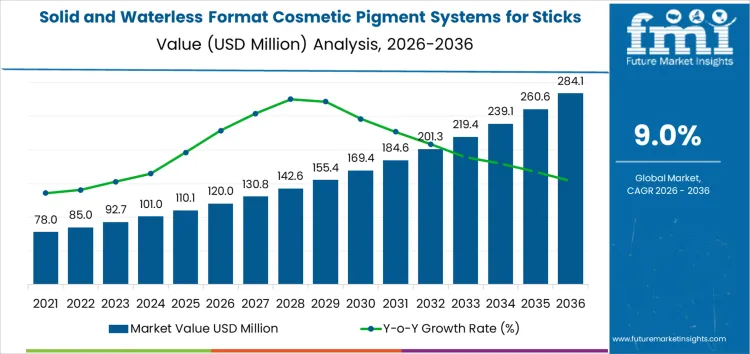
The solid and waterless format cosmetic pigment systems for sticks and bars market is valued at USD 120 million in 2026 and is projected to reach USD 303 million by 2036, reflecting a CAGR of 9%. Growth during this period is shaped by formulation stability requirements, pay off consistency, and compatibility with anhydrous bases. Cost structures are influenced by pigment surface treatment, dispersion behavior in waxes, and resistance to sweating or crumbling under temperature variation. Performance is assessed on color intensity, glide, and uniform deposition. Suppliers delivering predictable processing across stick and bar formats retain stronger specification positions. Purchasing decisions emphasize formulation reliability over pigment loading efficiency.
Between 2026 and 2036, market outcomes are driven by brand risk management and manufacturing repeatability. Cosmetic producers favor pigment systems that reduce batch adjustment and minimize production downtime. Once qualified, systems remain embedded due to reformulation cost and product line continuity considerations. Switching costs increase where shade libraries depend on shared pigment platforms. Entry barriers persist through stability testing and consumer performance validation. Strategic tradeoffs arise between maximizing color payoff and maintaining structural integrity. Competitive positioning depends on integration within long term product architectures rather than short cycle trend responsiveness.
Quick Stats for Solid and Waterless Format Cosmetic Pigment Systems for Sticks and Bars Market
- Solid and Waterless Format Cosmetic Pigment Systems for Sticks and Bars Market Value (2026): USD 120 million
- Solid and Waterless Format Cosmetic Pigment Systems for Sticks and Bars Market Forecast Value (2036): USD 303 million
- Solid and Waterless Format Cosmetic Pigment Systems for Sticks and Bars Market Forecast CAGR (2026 to 2036): 9.0%
- Leading Format Type in Solid and Waterless Format Cosmetic Pigment Systems for Sticks and Bars Market: Stick pigments
- Key Growth Regions in Solid and Waterless Format Cosmetic Pigment Systems for Sticks and Bars Market: Asia Pacific, North America, Europe
- Top Players in Solid and Waterless Format Cosmetic Pigment Systems for Sticks and Bars Market: BASF SE, Clariant AG, Merck KGaA, DIC Corporation (including Sun Chemical), Sensient Technologies Corporation
What Is the Growth Forecast for Solid and Waterless Format Cosmetic Pigment Systems for Sticks and Bars Market through 2036?
Format stability requirements and payoff consistency define the early growth phase of the solid and waterless format cosmetic pigment systems for sticks and bars market between 2026 and 2031. During this period, the market expands from USD 120 million to USD 170 million, adding USD 50 million in value. Annual progression from USD 72 million to USD 120 million reflects rising adoption of stick and bar formats across lip color, blush, foundation, and eye products where structural integrity and uniform color release are critical. Historical growth was constrained by brittleness, poor glide, and shade variability. Forward expansion in this phase is supported by improved binder compatibility, optimized particle morphology, and better dispersion within wax and oil matrices.
Portfolio diversification and manufacturing scale up drive growth from 2031 to 2036. Over this period, the market increases from USD 170 million to USD 303 million, adding USD 133 million and representing the stronger expansion window. Annual values rise from USD 185 million to USD 303 million, indicating accelerating year over year momentum. Earlier demand focused on niche launches, while future growth reflects broader rollout across complexion, contour, and multi stick products. Higher SKU density, improved mold filling efficiency, and consistent shade performance across climates support sustained expansion as solid and waterless pigment systems become core components of stick and bar cosmetic formulations.
Solid and Waterless Format Cosmetic Pigment Systems for Sticks and Bars Market Key Takeaways
| Metric | Value |
|---|---|
| Market Value (2026) | USD 120 million |
| Forecast Value (2036) | USD 303 million |
| Forecast CAGR (2026 to 2036) | 9.0% |
What Is Driving Demand in the Solid and Waterless Format Cosmetic Pigment Systems for Sticks and Bars Market?
Demand for solid and waterless pigment systems used in cosmetic sticks and bars has emerged from performance and formulation imperatives that traditional liquid or emulsion-based systems struggled to address. Conventional pigment dispersions rely on water or solvent carriers, which require stabilisers, preservatives, and emulsifiers. In formulations for lipsticks, eye shadows, and cream sticks, these carriers can lead to phase separation, microbial risk, or compromised colour payoff under variable temperature conditions. Early product developers observed that consumers experienced poor wear, uneven colour saturation, or texture instability in warm environments. Solid and waterless pigment systems offer concentrated colour that maintains structural integrity without relying on liquid carriers, improving formulation stability and product robustness. Initial adoption occurred in premium and performance-oriented lines where these issues were measurable rather than across all cosmetic categories.
Future growth will be shaped by broader formulation trends that prioritise sustainability, storage stability, and consumer sensory expectations rather than incremental shade range expansion alone. The elimination of water reduces product weight, extends shelf life without preservatives, and aligns with consumer demand for concentrated, long-lasting cosmetics. Regulatory and safety frameworks are tightening around preservative systems and microbial control in multi-use products, increasing formulation complexity for water-based systems. Advances in pigment chemistry and binder technologies are improving dispersion quality, adhesion, and tactile feel in solid matrices, enabling vibrant, uniform colour in sticks and bars that meet performance criteria. Demand will align with documented performance benchmarks for wear, transfer resistance, and product integrity under temperature cycling rather than cosmetic trend cycles alone, embedding solid and waterless pigment systems into core formulation strategies for makeup sticks and bars.
What Factors Are Affecting the Demand for Solid and Waterless Format Cosmetic Pigment Systems for Sticks and Bars Market in Terms of Format Type and Application Category?
The solid and waterless cosmetic pigment systems market is driven by packaging reduction goals, portability requirements, and rising demand for concentrated, mess free makeup formats. Demand centers on pigment systems that deliver consistent color payoff, structural stability, and smooth application without liquid carriers. Adoption depends on compatibility with stick molding processes, sensory performance, and shelf stability. Market leadership reflects formulation robustness, ease of manufacturing, and alignment with low water cosmetic strategies rather than novelty of format.
What Is Driving Leadership by Format Type in the Solid and Waterless Cosmetic Pigment Systems Market?
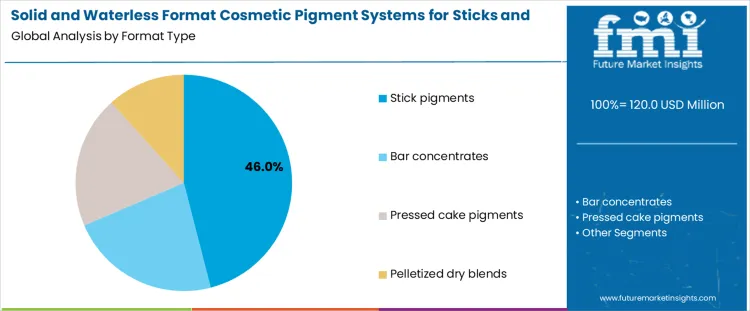
Stick pigments account for about 46% of demand because they offer the most reliable balance between color intensity, structural integrity, and ease of application. These pigments are engineered to disperse uniformly in wax and oil matrices, enabling smooth glide and consistent color transfer during use. Cosmetic manufacturers favor stick pigment systems because they integrate efficiently into existing extrusion and molding lines used for lipsticks, contour sticks, and multi-use formats. Their controlled particle size and surface treatment help prevent sweating, crumbling, or color separation over time. Stick pigments also support precise shade control across large production runs, which is critical for global brand consistency. Stability under temperature variation during transport and storage further reinforces adoption. As brands shift toward waterless formulations to reduce preservatives and packaging weight, stick pigments provide a scalable solution without requiring major changes in consumer behavior.
Bar concentrates, pressed cake pigments, and pelletized dry blends serve important but smaller roles. Bar concentrates enable ultra-compact formats but require careful handling. Pressed cakes suit crayons but limit flexibility. Pelletized blends support batching efficiency but add processing steps. Format leadership therefore reflects manufacturing familiarity, performance predictability, and versatility across multiple stick based cosmetic products rather than maximum concentration alone.
What Is Driving Leadership by Application Category in the Solid and Waterless Cosmetic Pigment Systems Market?
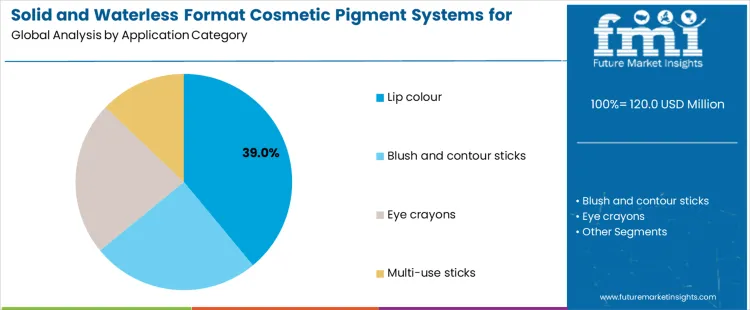
Lip color represents about 39% of demand because lip products were the earliest and most established stick based cosmetic category. Lipsticks and lip balms require high pigment loading, smooth application, and strong color fidelity, making pigment system performance highly visible to consumers. High product turnover, frequent shade launches, and daily use drive continuous demand for stable pigment systems. Lip color also benefits from consumer acceptance of solid formats, reducing adoption barriers for waterless formulations. Brands prioritize pigments that maintain shade accuracy, resist blooming, and deliver even payoff across diverse skin tones, reinforcing reliance on proven systems.
Blush and contour sticks, eye crayons, and multi-use sticks contribute secondary demand. These products emphasize blendability and versatility but involve smaller unit volumes. Eye crayons require higher precision but limited surface coverage. Multi use sticks prioritize flexibility over maximum pigmentation. These applications adopt similar pigment technologies but consume less material overall. Application leadership therefore reflects usage frequency, volume scale, and consumer sensitivity to color performance rather than the diversity of stick based cosmetic formats available.
How Are Solid and Waterless Format Cosmetic Pigment Systems Being Applied Across Sticks and Bars?
Use appears in lipsticks, eyeshadow sticks, blush bars, and solid deodorants where waterless formulations improve stability, portability, and shelf life. Manufacturers adopt solid pigment systems to achieve high color payoff, blendability, and structural integrity without relying on water-based carriers. Cosmetic brands integrate these pigments into bars and sticks to enhance product performance, reduce microbial growth risk, and enable compact, travel-friendly formats. These applications reflect operational and consumer convenience priorities rather than purely aesthetic objectives, with adoption driven by formulation stability, pigment intensity, and user experience.
What Operational and Material Conditions Support Adoption of Solid and Waterless Pigment Systems?
Selection aligns with waxes, oils, and solid matrices that require uniform dispersion, adhesion, and thermal stability. Pigments are optimized for particle size, opacity, and compatibility with oils, waxes, and polymers to maintain color consistency and structural integrity. Manufacturing workflows monitor melting, mixing, molding, and cooling processes to ensure consistent texture and pigment distribution. Quality control evaluates color intensity, stability under temperature fluctuations, and compliance with cosmetic safety regulations. These conditions emerge from operational reliability, product performance, and formulation stability priorities in structured solid cosmetic production workflows.
Which Practical Considerations Limit Wider Use of Solid and Waterless Pigment Systems?
Higher material and process costs can restrict adoption in entry-level or mass-market products. Compatibility with various waxes, oils, and binders must be validated to prevent settling or phase separation. Thermal sensitivity during processing requires precise temperature control. Regulatory compliance and safety testing vary by region and product type. These factors lead to selective deployment where pigment intensity, formulation integrity, and user convenience justify incremental cost and careful process management in solid and waterless cosmetic formats.
What is the Demand for Solid and Waterless Format Cosmetic Pigment Systems for Sticks and Bars by Country?
| Country | CAGR (%) |
|---|---|
| USA | 8.3% |
| UK | 7.7% |
| China | 10.2% |
| India | 11.8% |
| Brazil | 9.4% |
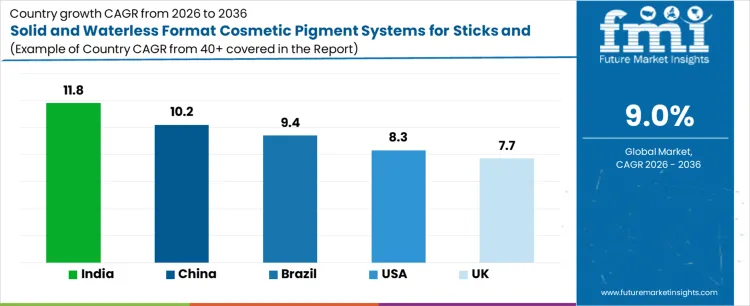
The demand for solid and waterless format cosmetic pigment systems for sticks and bars is increasing across global beauty markets, driven by shifts toward compact formulations, reduced water usage, and growth of stick based makeup and personal care formats. India leads with an 11.8% CAGR, supported by rapid expansion of color cosmetics manufacturing, strong uptake of solid formulations in mass and premium segments, and rising adoption of low water products. China follows at 10.2%, reflecting scale driven cosmetics production and innovation in solid makeup formats. Brazil records 9.4%, shaped by strong consumer acceptance of stick cosmetics and climate suited formulations. The USA grows at 8.3%, driven by brand innovation in waterless beauty products. The UK posts 7.7%, supported by mature markets and gradual adoption of solid cosmetic systems.
How are solid and waterless format cosmetic pigment systems expanding applications in sticks and bars in the United States?
In the United States, the solid and waterless format cosmetic pigment systems for sticks and bars market is growing at a CAGR of 8.3% through 2036, driven by increasing demand for compact, portable makeup, sustainable formulations, and premium product innovation. Manufacturers are integrating solid pigments to improve color intensity, formulation stability, and shelf life while reducing water content in cosmetic sticks and bars. Demand is concentrated in cosmetic production hubs, formulation laboratories, and packaging facilities. Compared to China, adoption emphasizes regulatory compliance and brand differentiation rather than high-volume deployment. Domestic suppliers provide high-performance pigments suitable for recurring formulation and finishing operations.
- Cosmetic production hubs, formulation laboratories, and packaging facilities drive adoption
- Pigments improve color intensity, formulation stability, and shelf life
- Domestic suppliers provide high-performance, waterless-compatible solutions
- Recurring formulation and finishing operations sustain adoption
How are sustainable beauty trends and product innovation driving growth in the United Kingdom?
In the United Kingdom, revenue is growing at a CAGR of 7.7% through 2036, supported by consumer demand for portable, waterless makeup products, sustainability initiatives, and premium cosmetics. Manufacturers are adopting solid pigment systems to enhance opacity, maintain formulation stability, and reduce water usage in sticks and bars. Demand is concentrated in industrial formulation labs, cosmetic production centers, and urban packaging hubs. Compared to India, adoption emphasizes EU regulatory compliance and product quality over volume. Domestic suppliers provide chemically stable, high-performance pigments suitable for recurring formulation and packaging operations.
- Industrial formulation labs, cosmetic production centers, and packaging hubs drive adoption
- Pigments maintain opacity, formulation stability, and reduce water usage
- Domestic suppliers provide chemically stable, high-performance solutions
- Recurring formulation and packaging operations sustain adoption
How are industrial manufacturing and consumer demand driving adoption in China?
In China, the market is expanding at a CAGR of 10.2% through 2036, fueled by rapid growth of compact and portable cosmetic products, urban retail expansion, and domestic brand proliferation. Manufacturers are integrating solid, waterless pigments to improve color coverage, maintain product stability, and ensure formulation safety in sticks and bars. Demand is concentrated in industrial cosmetic hubs, formulation laboratories, and packaging facilities. Compared to the UK, adoption emphasizes high-volume production and large-scale industrial integration. Domestic suppliers provide cost-effective, high-performance pigments suitable for recurring formulation, packaging, and inspection operations.
- Industrial cosmetic hubs, formulation laboratories, and packaging facilities drive adoption
- Pigments improve color coverage, stability, and formulation safety
- Domestic suppliers provide cost-effective, high-performance solutions
- Recurring formulation, packaging, and inspection operations sustain adoption
How are refillable and compact makeup trends driving growth in India?
In India, the market is growing at a CAGR of 11.8% through 2036, supported by increasing demand for sticks and bars in portable and waterless cosmetic formats, premium makeup launches, and sustainability initiatives. Manufacturers are adopting solid pigment systems to enhance color payoff, improve formulation longevity, and reduce water content in cosmetic products. Demand is concentrated in industrial cosmetic hubs, formulation labs, and packaging facilities. Compared to China, adoption emphasizes rapid high-volume deployment for domestic and export markets. Domestic suppliers provide high-performance, safe pigments suitable for recurring formulation, packaging, and quality inspection cycles.
- Industrial cosmetic hubs, formulation labs, and packaging facilities drive adoption
- Pigments enhance color payoff, formulation longevity, and reduce water content
- Domestic suppliers provide high-performance, safe solutions
- Recurring formulation, packaging, and quality inspection cycles sustain adoption
How are sustainable packaging and regional brand growth supporting market expansion in Brazil?
In Brazil, the market is expanding at a CAGR of 9.4% through 2036, driven by urban cosmetic retail expansion, consumer demand for portable makeup, and adoption of sustainable, waterless formulations. Manufacturers are integrating solid pigment systems to improve opacity, product durability, and ease of application for sticks and bars. Demand is concentrated in industrial cosmetic hubs, formulation laboratories, and packaging facilities. Compared to India, adoption emphasizes medium-scale production and local brand integration. Domestic suppliers provide cost-effective, high-performance pigments suitable for recurring formulation, production, and packaging operations.
- Industrial cosmetic hubs, formulation laboratories, and packaging facilities drive adoption
- Pigments improve opacity, durability, and ease of application
- Domestic suppliers provide cost-effective, high-performance solutions
- Recurring formulation, production, and packaging operations sustain adoption
Which Strategic Approaches Define Competition in the Solid and Waterless Format Cosmetic Pigment Systems for Sticks and Bars Market?
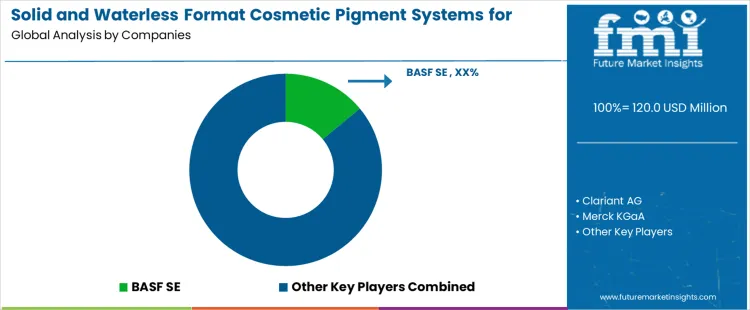
Competition in solid and waterless cosmetic pigment systems is shaped by how pigments perform under high wax loading, low moisture conditions, and mechanical stress during application. BASF SE and Clariant AG approach this market through surface treated pigments and dispersions engineered to maintain color intensity and uniform payoff in sticks and bars. Their strategies focus on preventing pigment aggregation, sweating, and breakage in anhydrous systems used for lipsticks, foundation sticks, and eye products. Merck KGaA differentiates through pigment technologies that combine coverage with controlled light interaction, supporting premium solid formats where glide and visual depth are critical. Brand selection is driven by color consistency, resistance to bloom, and stability across temperature variation rather than pigment concentration alone.
A different competitive emphasis is evident among suppliers closely aligned with formulation and manufacturing realities. DIC Corporation, including Sun Chemical, positions pigment systems around process reliability, ensuring consistent extrusion, molding, and cutting behavior in high volume stick production. Sensient Technologies Corporation competes through format specific pigment platforms tailored to waterless systems, emphasizing dispersion ease, sensory performance, and shade stability during repeated use. Across the market, strategies prioritize formulation robustness, compatibility with plant based waxes and oils, and support for sustainability driven format shifts. Competitive advantage is built through predictable performance in solid matrices, close collaboration with brand formulators, and the ability to support rapid development cycles without compromising product integrity.
Key Players in the Solid and Waterless Format Cosmetic Pigment Systems for Sticks and Bars Market
- BASF SE
- Clariant AG
- Merck KGaA
- DIC Corporation (including Sun Chemical)
- Sensient Technologies Corporation
Scope of the Report
| Items | Values |
|---|---|
| Quantitative Units | USD million |
| Type | Stick pigments, bar concentrates, pressed cake pigments, pelletized dry blends |
| Application | Lip colour, blush and contour sticks, eye crayons, multi-use sticks |
| End User | Cosmetic brand owners, contract cosmetic manufacturers, formulation laboratories, stick and bar cosmetic producers |
| Regions Covered | Asia Pacific, Europe, North America, Latin America, Middle East & Africa |
| Countries Covered | India, China, USA, United Kingdom, Brazil, and other major stick and bar cosmetics manufacturing markets |
| Key Companies Profiled | BASF SE, Clariant AG, Merck KGaA, DIC Corporation (including Sun Chemical), Sensient Technologies Corporation |
| Additional Attributes | Dollar sales by format type and application category, regional adoption trends linked to waterless and solid cosmetic formats, competitive landscape based on payoff consistency and structural stability, pigment surface treatment and dispersion requirements in wax and oil matrices, formulation qualification and stability testing considerations across climates |
Solid and Waterless Format Cosmetic Pigment Systems for Sticks and Bars Market Segmentation
Format Type:
- Stick pigments
- Bar concentrates
- Pressed cake pigments
- Pelletized dry blends
Application Category:
- Lip colour
- Blush and contour sticks
- Eye crayons
- Multi-use sticks
Region
- Asia Pacific
- China
- Japan
- South Korea
- India
- Australia & New Zealand
- ASEAN
- Rest of Asia Pacific
- Europe
- Germany
- United Kingdom
- France
- Italy
- Spain
- Nordic
- BENELUX
- Rest of Europe
- North America
- United States
- Canada
- Mexico
- Latin America
- Brazil
- Chile
- Rest of Latin America
- Middle East & Africa
- Kingdom of Saudi Arabia
- Other GCC Countries
- Turkey
- South Africa
- Other African Union
- Rest of Middle East & Africa
Frequently Asked Questions
How big is the solid and waterless format cosmetic pigment systems for sticks and bars market in 2026?
The global solid and waterless format cosmetic pigment systems for sticks and bars market is estimated to be valued at USD 120.0 million in 2026.
What will be the size of solid and waterless format cosmetic pigment systems for sticks and bars market in 2036?
The market size for the solid and waterless format cosmetic pigment systems for sticks and bars market is projected to reach USD 284.1 million by 2036.
How much will be the solid and waterless format cosmetic pigment systems for sticks and bars market growth between 2026 and 2036?
The solid and waterless format cosmetic pigment systems for sticks and bars market is expected to grow at a 9.0% CAGR between 2026 and 2036.
What are the key product types in the solid and waterless format cosmetic pigment systems for sticks and bars market?
The key product types in solid and waterless format cosmetic pigment systems for sticks and bars market are stick pigments , bar concentrates, pressed cake pigments and pelletized dry blends.
Which application category segment to contribute significant share in the solid and waterless format cosmetic pigment systems for sticks and bars market in 2026?
In terms of application category, lip colour segment to command 39.0% share in the solid and waterless format cosmetic pigment systems for sticks and bars market in 2026.
Preview the report firsthand - request a free sample
Get SampleGet the brochure for pricing and purchase details.
Get PDFTable of Content
- Executive Summary
- Global Market Outlook
- Demand-side Trends
- Supply-side Trends
- Technology Roadmap Analysis
- Analysis and Recommendations
- Market Overview
- Market Coverage / Taxonomy
- Market Definition / Scope / Limitations
- Market Background
- Market Dynamics
- Drivers
- Restraints
- Opportunity
- Trends
- Scenario Forecast
- Demand in Optimistic Scenario
- Demand in Likely Scenario
- Demand in Conservative Scenario
- Opportunity Map Analysis
- Product Life Cycle Analysis
- Supply Chain Analysis
- Investment Feasibility Matrix
- Value Chain Analysis
- PESTLE and Porter’s Analysis
- Regulatory Landscape
- Regional Parent Market Outlook
- Production and Consumption Statistics
- Import and Export Statistics
- Market Dynamics
- Global Market Analysis 2021 to 2025 and Forecast, 2026 to 2036
- Historical Market Size Value (USD Million) Analysis, 2021 to 2025
- Current and Future Market Size Value (USD Million) Projections, 2026 to 2036
- Y-o-Y Growth Trend Analysis
- Absolute $ Opportunity Analysis
- Global Market Pricing Analysis 2021 to 2025 and Forecast 2026 to 2036
- Global Market Analysis 2021 to 2025 and Forecast 2026 to 2036, By Format Type
- Introduction / Key Findings
- Historical Market Size Value (USD Million) Analysis By Format Type , 2021 to 2025
- Current and Future Market Size Value (USD Million) Analysis and Forecast By Format Type , 2026 to 2036
- Stick pigments
- Bar concentrates
- Pressed cake pigments
- Pelletized dry blends
- Stick pigments
- Y-o-Y Growth Trend Analysis By Format Type , 2021 to 2025
- Absolute $ Opportunity Analysis By Format Type , 2026 to 2036
- Global Market Analysis 2021 to 2025 and Forecast 2026 to 2036, By Application Category
- Introduction / Key Findings
- Historical Market Size Value (USD Million) Analysis By Application Category, 2021 to 2025
- Current and Future Market Size Value (USD Million) Analysis and Forecast By Application Category, 2026 to 2036
- Lip colour
- Blush and contour sticks
- Eye crayons
- Multi-use sticks
- Lip colour
- Y-o-Y Growth Trend Analysis By Application Category, 2021 to 2025
- Absolute $ Opportunity Analysis By Application Category, 2026 to 2036
- Global Market Analysis 2021 to 2025 and Forecast 2026 to 2036, By Region
- Introduction
- Historical Market Size Value (USD Million) Analysis By Region, 2021 to 2025
- Current Market Size Value (USD Million) Analysis and Forecast By Region, 2026 to 2036
- North America
- Latin America
- Western Europe
- Eastern Europe
- East Asia
- South Asia and Pacific
- Middle East & Africa
- Market Attractiveness Analysis By Region
- North America Market Analysis 2021 to 2025 and Forecast 2026 to 2036, By Country
- Historical Market Size Value (USD Million) Trend Analysis By Market Taxonomy, 2021 to 2025
- Market Size Value (USD Million) Forecast By Market Taxonomy, 2026 to 2036
- By Country
- USA
- Canada
- Mexico
- By Format Type
- By Application Category
- By Country
- Market Attractiveness Analysis
- By Country
- By Format Type
- By Application Category
- Key Takeaways
- Latin America Market Analysis 2021 to 2025 and Forecast 2026 to 2036, By Country
- Historical Market Size Value (USD Million) Trend Analysis By Market Taxonomy, 2021 to 2025
- Market Size Value (USD Million) Forecast By Market Taxonomy, 2026 to 2036
- By Country
- Brazil
- Chile
- Rest of Latin America
- By Format Type
- By Application Category
- By Country
- Market Attractiveness Analysis
- By Country
- By Format Type
- By Application Category
- Key Takeaways
- Western Europe Market Analysis 2021 to 2025 and Forecast 2026 to 2036, By Country
- Historical Market Size Value (USD Million) Trend Analysis By Market Taxonomy, 2021 to 2025
- Market Size Value (USD Million) Forecast By Market Taxonomy, 2026 to 2036
- By Country
- Germany
- UK
- Italy
- Spain
- France
- Nordic
- BENELUX
- Rest of Western Europe
- By Format Type
- By Application Category
- By Country
- Market Attractiveness Analysis
- By Country
- By Format Type
- By Application Category
- Key Takeaways
- Eastern Europe Market Analysis 2021 to 2025 and Forecast 2026 to 2036, By Country
- Historical Market Size Value (USD Million) Trend Analysis By Market Taxonomy, 2021 to 2025
- Market Size Value (USD Million) Forecast By Market Taxonomy, 2026 to 2036
- By Country
- Russia
- Poland
- Hungary
- Balkan & Baltic
- Rest of Eastern Europe
- By Format Type
- By Application Category
- By Country
- Market Attractiveness Analysis
- By Country
- By Format Type
- By Application Category
- Key Takeaways
- East Asia Market Analysis 2021 to 2025 and Forecast 2026 to 2036, By Country
- Historical Market Size Value (USD Million) Trend Analysis By Market Taxonomy, 2021 to 2025
- Market Size Value (USD Million) Forecast By Market Taxonomy, 2026 to 2036
- By Country
- China
- Japan
- South Korea
- By Format Type
- By Application Category
- By Country
- Market Attractiveness Analysis
- By Country
- By Format Type
- By Application Category
- Key Takeaways
- South Asia and Pacific Market Analysis 2021 to 2025 and Forecast 2026 to 2036, By Country
- Historical Market Size Value (USD Million) Trend Analysis By Market Taxonomy, 2021 to 2025
- Market Size Value (USD Million) Forecast By Market Taxonomy, 2026 to 2036
- By Country
- India
- ASEAN
- Australia & New Zealand
- Rest of South Asia and Pacific
- By Format Type
- By Application Category
- By Country
- Market Attractiveness Analysis
- By Country
- By Format Type
- By Application Category
- Key Takeaways
- Middle East & Africa Market Analysis 2021 to 2025 and Forecast 2026 to 2036, By Country
- Historical Market Size Value (USD Million) Trend Analysis By Market Taxonomy, 2021 to 2025
- Market Size Value (USD Million) Forecast By Market Taxonomy, 2026 to 2036
- By Country
- Kingdom of Saudi Arabia
- Other GCC Countries
- Turkiye
- South Africa
- Other African Union
- Rest of Middle East & Africa
- By Format Type
- By Application Category
- By Country
- Market Attractiveness Analysis
- By Country
- By Format Type
- By Application Category
- Key Takeaways
- Key Countries Market Analysis
- USA
- Pricing Analysis
- Market Share Analysis, 2025
- By Format Type
- By Application Category
- Canada
- Pricing Analysis
- Market Share Analysis, 2025
- By Format Type
- By Application Category
- Mexico
- Pricing Analysis
- Market Share Analysis, 2025
- By Format Type
- By Application Category
- Brazil
- Pricing Analysis
- Market Share Analysis, 2025
- By Format Type
- By Application Category
- Chile
- Pricing Analysis
- Market Share Analysis, 2025
- By Format Type
- By Application Category
- Germany
- Pricing Analysis
- Market Share Analysis, 2025
- By Format Type
- By Application Category
- UK
- Pricing Analysis
- Market Share Analysis, 2025
- By Format Type
- By Application Category
- Italy
- Pricing Analysis
- Market Share Analysis, 2025
- By Format Type
- By Application Category
- Spain
- Pricing Analysis
- Market Share Analysis, 2025
- By Format Type
- By Application Category
- France
- Pricing Analysis
- Market Share Analysis, 2025
- By Format Type
- By Application Category
- India
- Pricing Analysis
- Market Share Analysis, 2025
- By Format Type
- By Application Category
- ASEAN
- Pricing Analysis
- Market Share Analysis, 2025
- By Format Type
- By Application Category
- Australia & New Zealand
- Pricing Analysis
- Market Share Analysis, 2025
- By Format Type
- By Application Category
- China
- Pricing Analysis
- Market Share Analysis, 2025
- By Format Type
- By Application Category
- Japan
- Pricing Analysis
- Market Share Analysis, 2025
- By Format Type
- By Application Category
- South Korea
- Pricing Analysis
- Market Share Analysis, 2025
- By Format Type
- By Application Category
- Russia
- Pricing Analysis
- Market Share Analysis, 2025
- By Format Type
- By Application Category
- Poland
- Pricing Analysis
- Market Share Analysis, 2025
- By Format Type
- By Application Category
- Hungary
- Pricing Analysis
- Market Share Analysis, 2025
- By Format Type
- By Application Category
- Kingdom of Saudi Arabia
- Pricing Analysis
- Market Share Analysis, 2025
- By Format Type
- By Application Category
- Turkiye
- Pricing Analysis
- Market Share Analysis, 2025
- By Format Type
- By Application Category
- South Africa
- Pricing Analysis
- Market Share Analysis, 2025
- By Format Type
- By Application Category
- USA
- Market Structure Analysis
- Competition Dashboard
- Competition Benchmarking
- Market Share Analysis of Top Players
- By Regional
- By Format Type
- By Application Category
- Competition Analysis
- Competition Deep Dive
- BASF SE
- Overview
- Product Portfolio
- Profitability by Market Segments (Product/Age /Sales Channel/Region)
- Sales Footprint
- Strategy Overview
- Marketing Strategy
- Product Strategy
- Channel Strategy
- Clariant AG
- Merck KGaA
- DIC Corporation (including Sun Chemical)
- Sensient Technologies Corporation
- BASF SE
- Competition Deep Dive
- Assumptions & Acronyms Used
- Research Methodology


