

- Industry Size (2026)
- USD 0.6 Bn
- Forecast (2036)
- USD 1.6 Bn
- CAGR (2026 to 2036)
- 11%
Solid Face Toner Bars Market Forecast and Outlook 2026 to 2036
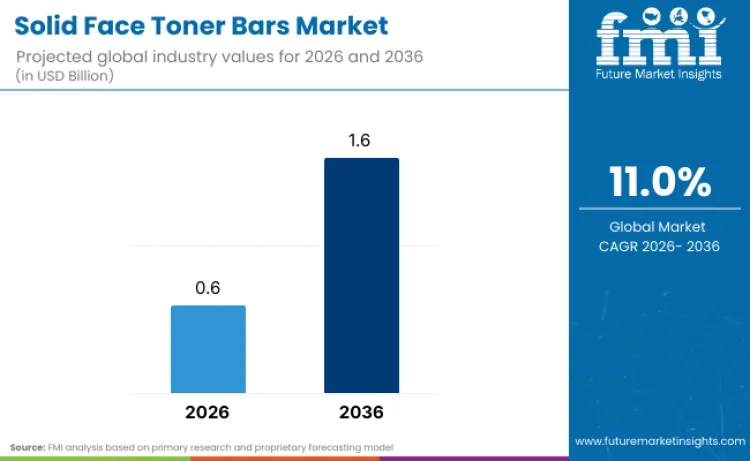
The global solid face toner bars market is projected to reach a valuation of USD 0.6 billion in 2026 and accelerate to USD 1.6 billion by 2036, expanding at a robust 11.0% CAGR. Demand for solid face toner bars, as per Future Market Insights, is being driven by rising consumer awareness around beauty industry waste, waterless formulation benefits, and the shift toward concentrated, plastic-free skincare formats, trends reinforced by sustainability frameworks promoted by the World Health Organization and aligned environmental bodies.
Founder-led experimentation and grassroots formulation innovation continue to shape category momentum. One early-stage brand founder captured this shift by stating: “While studying, I really researched how much waste the beauty industry is responsible for, and wanted to find a solution to this. I taught myself cosmetic chemistry, bought some ingredients from a store online, and started experimenting!” This mindset reflects how environmental concern is translating directly into product architecture and entrepreneurial entry.
Regulatory pressure, refill adoption, and dermatologist-backed minimal routines are further accelerating acceptance. Enhanced consumer education and digital-first discovery channels are amplifying trial rates, a pattern consistent with broader personal care surveillance and behavior change trends documented by the Centers for Disease Control and Prevention in relation to preventive health and hygiene awareness.
Summary of Solid Face Toner Bars Market
What Is Growth Outlook for Solid Face Toner Bars Market as per Future Market Insights Projection?
Future Market Insights projects the solid face toner bars market to expand at a CAGR of 11.0% from 2026 to 2036, increasing from USD 0.6 Billion in 2026 to USD 1.6 Billion by 2036.
FMI Research Approach: FMI proprietary forecasting model based on waterless skincare adoption, plastic-free format penetration, and concentrated facial care demand.
How Do FMI Analysts Perceive Solid Face Toner Bars Market to Evolve?
FMI analysts perceive the market evolving toward waterless, concentrated skincare routines where solid toner formats replace diluted liquid toners to improve efficacy and sustainability.
FMI Research Approach: Analysis of waterless formulation economics, minimalist skincare adoption, and plastic reduction mandates.
Which Country Holds Largest Share in Global Solid Face Toner Bars Market?
China holds a significant share of the global solid face toner bars market, supported by rapid digital adoption of clean beauty and strong preference for concentrated, plastic-free skincare formats.
FMI Research Approach: FMI country-level revenue modeling based on e-commerce penetration, clean beauty awareness, and solid skincare uptake.
How Large Will Solid Face Toner Bars Market Be by 2036?
The global solid face toner bars market is projected to reach USD 1.6 Billion by 2036.
FMI Research Approach: FMI long-term revenue forecast derived from substitution of liquid toners, repeat daily-use adoption, and premium solid skincare scaling.
What Is Definition of Solid Face Toner Bars Market?
The solid face toner bars market comprises waterless, solid facial toner products designed to deliver toning, hydration, and treatment benefits without liquid carriers or plastic bottles.
FMI Research Approach: FMI market taxonomy and inclusion-exclusion framework aligned with solid skincare and waterless beauty classifications.
What Are Globally Unique Trends Shaping Solid Face Toner Bars Market?
Globally unique trends include waterless skincare chemistry, plastic-free facial care, and concentrated active delivery in solid formats.
FMI Research Approach: Regulatory clean beauty tracking, lifecycle impact assessment, and solid formulation innovation analysis.
Solid Face Toner Bars Market Key Takeaways
| Metric | Details |
|---|---|
| Industry Size (2026) | USD 0.6 Billion |
| Industry Value (2036) | USD 1.6 Billion |
| CAGR (2026 to 2036) | 11% |
Source: Future Market Insights (FMI) analysis, based on proprietary forecasting model and primary research
Which Factors Drive Solid Face Toner Bars Adoption?
Traditional liquid toners are increasingly viewed as operationally inefficient, as they are composed of up to 95% water and require rigid plastic bottles, chemical preservatives, and carbon-intensive logistics to remain shelf-stable. This inefficiency is creating an urgent environmental and supply-chain rationale for solid face toner bars, which eliminate “shipping water” and dramatically reduce plastic dependency. By removing water at the formulation stage, brands can cut packaging weight, lower freight emissions, and extend product stability without preservative overload.
Founder and executive leadership within the waterless beauty movement have crystallized this logic. Brianne West, Founder of Ethique, articulated this shift clearly: “I reached the logical conclusion that with so much water found in our bathrooms there's no need to add it to the likes of shampoo, conditioners, moisturisers, household cleaners and cosmetics, which are usually 60-95% water. By making these products solid and simply sending the active ingredients to our customers, there's no need for plastic containers.”
This efficiency-driven thinking is reinforced by logistics reality. West further noted that shipping products where 75-95% of the formula is water imposes unnecessary packaging and transport burdens, especially when end-use occurs in water-abundant environments. As a result, solid toner bars are emerging as a structurally superior format, aligning sustainability mandates with cost efficiency and modern minimalist skincare routines.
How is the Solid Face Toner Bars Market Segmented?
The solid face toner bars market is segmented by product type, skin type, distribution channel, and region to reflect formulation purpose, usage intensity, and consumer access points. By product type, the market includes hydrating, exfoliating, brightening, soothing or sensitive skin, and anti-aging solid toner bars and sticks, with hydrating variants representing the primary daily-use interface. By skin type, demand spans normal, oily, dry, combination, and sensitive skin categories, mirroring the full spectrum of facial care routines rather than treatment-only usage. By distribution channel, adoption is led by online retail and direct-to-consumer platforms, while supermarkets, specialty beauty stores, pharmacies, and other offline channels continue to support scale and mainstream visibility.
FMI analysis suggests that while innovation in solid formulation chemistry is accelerating, the market structure remains anchored in everyday skincare logic rather than niche sustainability alone. This segmentation highlights a dual-track market where hydration-led mass adoption provides volume, while concern-specific variants drive premiumization and regimen depth.
Why do Hydrating Toner Bars and Sticks Hold a Dominant Share?
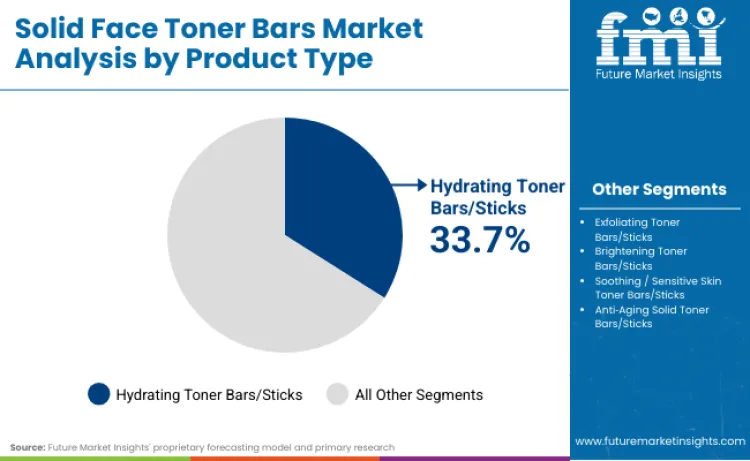
Hydrating toner bars and sticks command a dominant 33.7% share because they deliver the clearest performance advantage of solid formats: higher active concentration without dilution. Unlike liquid toners that are largely composed of water, hydrating solid toners allow consumers to pay almost entirely for functional ingredients, improving both perceived value and visible skin results. This concentration-first logic aligns with modern skincare expectations, where efficacy increasingly outweighs sensorial aesthetics or packaging familiarity.
Brand leaders have reinforced this performance narrative through formulation strategy. Ben Grace, Founder of SBTRCT, emphasized this positioning by stating: “We innovate and evolve to bring first-to-market formulations using proven ingredients in a truly sustainable solid state. 100% plastic-free, palm oil-free and nominal water content, our products address the three biggest environmental challenges facing the beauty industry: plastic pollution, water waste and over-reliance on palm oil.”
This logic is echoed across the category. Allison Teasdale, COO of Unwrapped Life, noted that removing water from formulations reduces packaging complexity while delivering a smaller, lighter, and more carbon-efficient product. Together, these dynamics protect hydrating toner bars from rapid substitution, anchoring them as the daily-use entry point for solid facial toners.
Why does the Normal Skin Segment Dominate Market?
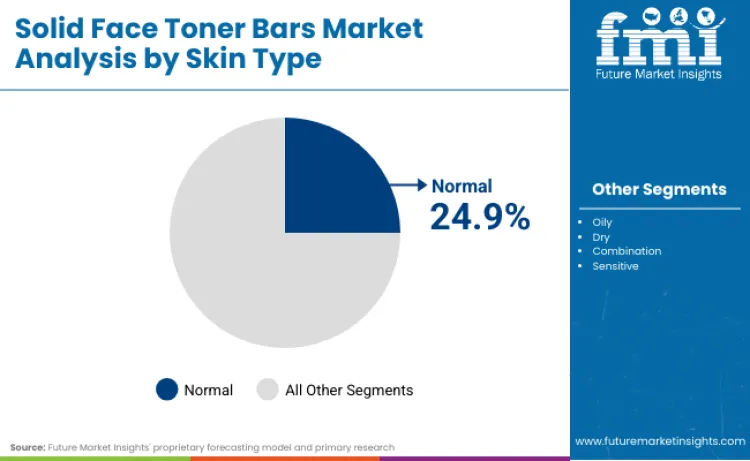
The normal skin segment leads the solid face toner bars market with a 29.4% share, supported by the rapid shift toward bottle-free retail environments and simplified in-store education. Solid toner bars targeted at normal skin are the easiest for first-time users to understand and adopt, making them the preferred entry point as retailers expand dedicated shelf space for solid beauty formats. Their compact form, clear sustainability messaging, and minimal regimen complexity allow products to “sell themselves,” accelerating impulse purchase and trial.
Retail momentum is being actively reinforced by brand leadership. Cassandra Thurswell, CEO of Kitsch, highlighted this shift, stating: “Sustainability - I’m hearing a lot of brands are testing solid (bottle free) versions of their products and that makes me very excited. If we can influence more people to go bottle-free then I can’t help but be excited.” She further emphasized retail clarity as a growth lever, noting: “The product should really be able to sell itself. And it should be very, very easy for anybody to understand what it is that they’re buying.”
Why Is Waterless Formulation Reshaping Skincare Efficacy?
Waterless formulation is fundamentally reshaping skincare efficacy by replacing diluted liquid toners with ultra-concentrated solid formats that deliver actives directly to the skin. By eliminating water, which can account for 80% or more of conventional toner formulations, solid face toner bars improve the stability and potency of sensitive ingredients such as Vitamin C, botanical extracts, and exfoliating acids. This shift ensures consumers are paying for functional treatment rather than fillers, enabling smaller application amounts to achieve treatment-level results and naturally extending shelf life without reliance on aggressive synthetic preservatives. Ben Grace, Founder of SBTRCT, captured this efficiency-driven logic, stating that condensed, waterless solid formulations prioritize active ingredients rather than bulk, reinforcing performance-led adoption across daily skincare routines.
How Is Plastic-Free Logistics Changing Industry Economics?
The solid face toner bars market is rapidly pivoting away from liquid shipping models toward lightweight, plastic-free logistics that materially reduce distribution emissions and packaging costs. By removing water from formulations, brands eliminate the need for rigid plastic bottles and significantly cut freight weight, addressing what industry leaders increasingly describe as the systemic failure of “shipping water.” Brianne West, Founder of Ethique, emphasized that solid bars not only save water and plastic but also reduce fossil fuel emissions, with an average carbon footprint that is a fraction of bottled products. This logistics transformation allows brands to redirect capital toward ingredient quality and sourcing rather than plastic manufacturing and heavy transport infrastructure.
What Role Does Regulatory Maturation Play in Solid Beauty Innovation?
Regulatory maturation is stabilizing the innovation landscape for solid beauty by favoring anhydrous products with simpler, more transparent ingredient profiles. The implementation of the Modernization of Cosmetics Regulation Act in 2024 and 2025 has intensified scrutiny around preservative safety, microplastics, and documentation requirements for liquid cosmetics. Solid toner bars often bypass many of these hurdles due to their naturally water-free composition and shorter INCI lists, making safety substantiation more straightforward. This evolving regulatory environment reduces compliance risk for smaller laboratories and independent formulators, enabling focused innovation in botanical and performance-led toner panels while curbing greenwashing and rewarding genuine clean beauty design.
What Is Solid Face Toner Bars Market Regional Outlook?
Growth in the solid face toner bars market is being led by Asia and select emerging economies, where sustainability awareness, digital-first beauty adoption, and waterless product education are accelerating faster than the global average CAGR of 11.0%. China anchors this expansion with a 14.9% CAGR, supported by strong penetration of solid skincare formats across urban Gen Z consumers and rapid scale-up through online marketplaces. India follows closely at 13.8%, driven by rising demand for minimalist, preservative-light skincare and strong direct-to-consumer brand activity.
Latin America is also emerging as a high-growth corridor, with Brazil recording an 11.6% CAGR as specialty beauty retail and sustainability-led premiumization gain traction. In contrast, mature markets such as the United States (10.5%) and Germany (12.7%) are expanding through format substitution rather than volume-led growth, with consumers replacing liquid toners with solid alternatives for environmental and travel convenience reasons. The United Kingdom shows comparatively slower momentum at 4.0%, reflecting cautious mass-market adoption despite high awareness. FMI analysis indicates that future growth will be structurally anchored in Asia-led digital adoption, while Western markets focus on efficiency, refillability, and plastic reduction.
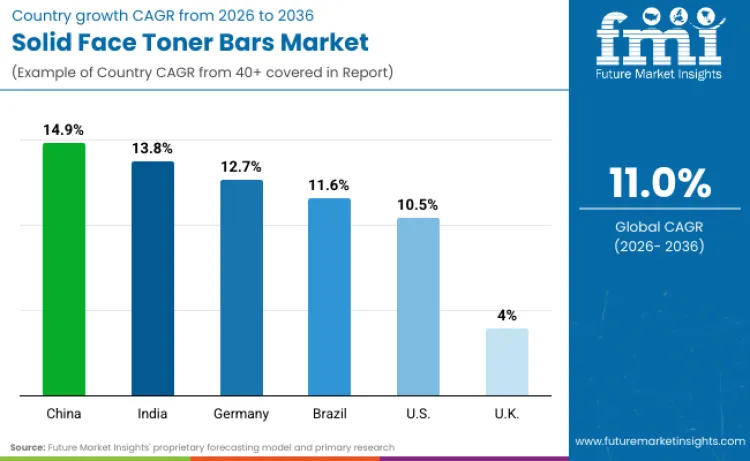
| Country | CAGR (2026 to 2036) |
|---|---|
| China | 14.9% |
| India | 13.8% |
| Germany | 12.7% |
| Brazil | 11.6% |
| United States | 10.5% |
| United Kingdom | 4.0% |
Source: FMI historical analysis and forecast data.
Why Is China Leading in Clean Beauty and Digital Adoption?
China is expanding at a robust 14.9% CAGR, positioning it as the global demand anchor for solid face toner bars through the convergence of clean beauty regulation, digital education, and ingredient scrutiny. Urban consumers are increasingly prioritizing evidence-backed efficacy over aspirational aesthetics, with more than 70% actively checking ingredient labels and following dermatologist-led content across platforms such as Red (小红书) and Douyin. This behavior structurally favors solid, waterless toner formats that clearly communicate concentration, stability, and sustainability benefits. National “Green Beauty” objectives and zero-waste policy narratives have further legitimized solid-state skincare as a compliant and future-ready format. The market is evolving from influencer-driven novelty toward research-led standards, where formulation transparency and lifecycle impact are key purchase criteria. FMI analysis indicates that China’s combination of policy alignment, digital literacy, and performance-driven consumption will continue to accelerate adoption of solid toner bars, making the country the primary innovation and scaling engine for clean, waterless facial care globally.
How Is India Formalizing Sustainable Beauty Adoption?
India is growing at a rapid 13.8% CAGR, driven by a structural shift toward formalized, sustainability-aligned beauty consumption under the broader “Viksit Bharat” vision. Government emphasis on domestic manufacturing, circular value chains, and eco-conscious consumerism is creating a supportive environment for waterless and solid cosmetic formats. Direct-to-consumer brands are playing a pivotal role, using digital platforms to educate consumers on ingredient concentration, reduced waste, and long-term cost efficiency of solid toner bars. Events such as Bharat Tex are reinforcing collaboration across raw materials, formulation, packaging, and retail, indirectly legitimizing sustainable personal care as an industrial priority rather than a niche lifestyle choice. Rising middle-class awareness and affordability-focused innovation are also expanding the addressable market beyond premium urban consumers. FMI analysis suggests that India’s growth trajectory will be anchored in scalable DTC distribution and regulatory signaling, transforming solid face toner bars into a mass-aspirational clean beauty category over the forecast period.
Why Is Germany Advancing Through Heritage Brand Modernization?
Germany is expanding at a 12.7% CAGR, led by the modernization of heritage skincare portfolios in response to stringent EU climate and transparency mandates. Rather than relying on disruptive new brands, the German market is driven by trusted incumbents re-engineering iconic formulations into anhydrous and low-waste formats that align with Net Zero 2045 objectives. Consumers exhibit high regulatory trust and product loyalty, enabling a smooth substitution from liquid toners to solid alternatives when endorsed by established brands. This dynamic reduces adoption friction and accelerates scale within pharmacies, supermarkets, and specialty beauty retail. The focus is less on experimentation and more on responsible continuity, where sustainability upgrades preserve emotional brand connections while meeting evolving compliance requirements. FMI analysis indicates that Germany’s leadership lies in disciplined execution, making it the European benchmark for compliant, large-scale adoption of solid face toner bars driven by brand credibility and regulatory certainty.
How Is Brazil Reshaping the Sustainability Narrative in Beauty?
Brazil is recording an 11.6% CAGR, fueled by a strong cultural linkage between beauty, wellbeing, and social responsibility. Brazilian consumers increasingly expect beauty brands to demonstrate tangible environmental and social impact, not just performance claims. Solid face toner bars resonate strongly within this context, as their waterless and plastic-free attributes provide visible proof of sustainability action. Large multinational players are reinforcing this shift by embedding sustainability into personalized beauty and wellbeing strategies, while specialty beauty retailers are amplifying education around low-waste routines. The market benefits from high emotional engagement, where sustainable choices are framed as part of holistic self-care rather than sacrifice. FMI analysis suggests that Brazil’s growth will continue to be driven by values-led consumption and brand storytelling, positioning the country as the Latin American hub for adoption of solid, environmentally responsible facial care formats.
Why Does the UK Remain the Ideological Hub Despite Slower Growth?
United Kingdom, despite a slower 4.0% CAGR, remains the global philosophical and R&D nucleus of solid and “naked” cosmetics. The market is defined by a principled rejection of unnecessary packaging, synthetic preservatives, and diluted formulations, giving rise to early innovation in solid-state chemistry. While mass-market adoption is gradual, the UK continues to influence global formulation standards and sustainability narratives through pioneering brands and research-led product development. Solid face toner bars in the UK are positioned less as convenience products and more as ethical statements, which limits short-term volume growth but reinforces long-term innovation leadership. FMI analysis views the UK as an exporter of ideas, formulations, and sustainability frameworks rather than a volume-driven growth market, with its impact felt disproportionately across global clean beauty portfolios.
How Is the USA Market Scaling Through Water Stewardship Metrics?
United States is expanding at a steady 10.5% CAGR, characterized by a shift from broad clean beauty messaging toward measurable water, plastic, and carbon reduction targets. Growth is increasingly driven by enterprise-scale beauty groups embedding sustainability KPIs into product development, sourcing, and reporting frameworks. Solid face toner bars benefit from this metrics-driven environment, as their waterless composition and plastic-free packaging deliver quantifiable improvements in lifecycle assessments. Adoption is less about ideological positioning and more about operational efficiency and ESG accountability. Retailers and investors alike favor formats that can demonstrate measurable impact at scale. FMI analysis indicates that future USA growth will be anchored in portfolio-wide integration of solid formats, where toner bars become standardized tools for achieving water stewardship and waste reduction commitments across large beauty ecosystems.
How Is the Competition in the Solid Face Toner Bars Market?
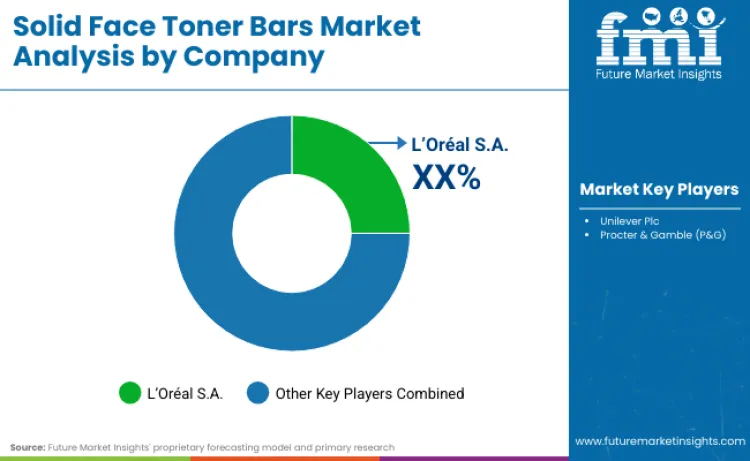
Competition in the solid face toner bars market is increasingly defined by leadership in waterless formulation, circular packaging, and scalable sustainability innovation rather than by conventional price or brand positioning. Early pioneers such as Ethique continue to protect their competitive advantage through first-mover credibility and sustained consumer education around the inefficiency of water-heavy cosmetics. Founder-led advocacy has anchored this positioning, with Brianne West articulating the core market logic: “I knew that up to 75% of shampoo and even 95% of conditioner is usually water, which just seemed crazy. Why on earth do we make a product out of 95% water, package it in plastic, ship that around the world, then use that product in a bathroom full of water?!” This framing has become a de facto competitive benchmark across solid skincare.
At the same time, global incumbents are institutionalizing sustainability-led competition. In January 2026, L’Oréal Groupe announced the first 13 change makers selected for its €100 million “L’AcceleratOR” sustainable innovation program, run in partnership with the University of Cambridge Institute for Sustainability Leadership. The inclusion of startups such as Blue Ocean Closures signals a strategic push toward scalable circular and plastic-free solutions that directly support solid and waterless formats. This convergence of founder-led disruption and enterprise-backed acceleration is shifting competition toward ecosystem control, long-term innovation pipelines, and verifiable climate impact rather than short-term product differentiation alone.
Recent Developments:
- December 2025: Lifebuoy is reinventing itself from a germ-protection soap into a science-backed skin health brand. With new patented, barrier-strengthening formulas and social-first campaigns, the 130-year-old brand is targeting higher value growth under Unilever’s Desire at Scale model.
- August 2025: Unilever highlighted the growth of its €13.2 billion Beauty & Wellbeing business, home to brands like Dove and Vaseline. Driven by science and consumer insight, the division is aligning beauty with wellbeing as demand shifts toward health-led, purpose-driven products.
Key Players in Solid Face Toner Bars Market
- L’Oréal S.A.
- Unilever Plc
- Procter & Gamble (P&G)
Market Definition
The solid face toner bars market comprises waterless, anhydrous facial toner products formulated in solid bar or stick form and designed to deliver toning, hydrating, exfoliating, brightening, soothing, or anti-aging benefits without liquid carriers. These products are activated with water at the point of use and are positioned as concentrated, preservative-light alternatives to traditional liquid toners. The market is driven by clean beauty principles, plastic-free packaging, ingredient efficiency, and reduced environmental footprint across manufacturing, logistics, and disposal. Solid face toner bars are typically aligned with minimalist skincare routines and are marketed across mass, premium, and indie beauty segments through online, specialty, pharmacy, and select grocery channels.
Market Inclusion
The market includes solid and semi-solid facial toner bars or sticks intended for leave-on or rinse-off toning functions within daily skincare routines. Included products address hydration, pH balancing, exfoliation, brightening, calming, or age-defense benefits and are formulated for normal, oily, dry, combination, or sensitive skin types. Products sold under clean beauty, waterless beauty, zero-waste, or plastic-free positioning are included, regardless of price tier. Both branded and private-label offerings distributed via online retail, direct-to-consumer platforms, specialty beauty stores, pharmacies, and supermarkets are covered. Products formulated with botanical actives, acids, vitamins, or dermatology-aligned ingredients are included when marketed explicitly as facial toners.
Market Exclusion
The market excludes liquid, gel, mist, or essence-based facial toners, even if sold in refillable or reduced-plastic packaging. Cleansing bars, facial soaps, exfoliating scrubs, micellar bars, and cleansing balms are excluded unless explicitly positioned and functionally marketed as toners. Solid skincare products focused solely on cleansing, moisturizing, serum delivery, or mask applications are not included. Professional-use-only products, bulk institutional skincare, and DIY or home-compounded formulations are excluded. Products primarily positioned as makeup removers, facial wipes, or treatment sticks without toning claims fall outside the market scope, as do oral supplements or ingestible beauty products.
| Items | Values |
|---|---|
| Quantitative Units | USD billion |
| Product Categories | Hydrating Toner Bars & Sticks; Exfoliating Toner Bars & Sticks; Brightening Toner Bars & Sticks; Soothing/Sensitive Skin Toner Bars & Sticks; Anti-Aging Solid Toner Bars |
| Skin Type Coverage | Normal; Oily; Dry; Combination; Sensitive |
| Core Functional Benefits | Hydration & moisture retention; skin barrier support; exfoliation & cell renewal; tone brightening; irritation calming; anti-aging actives delivery |
| Formulation Architecture | Waterless solid bars; concentrated botanical & active complexes; preservative-light anhydrous systems; plastic-free packaging formats |
| Distribution Channels | Online Retail & Direct-to-Consumer; Supermarkets & Hypermarkets; Specialty Beauty Stores; Pharmacies & Drugstores; Other offline formats |
| Consumer Use Logic | Daily toner replacement; minimalist skincare routines; travel-friendly skincare; sustainability-driven product substitution |
| Regions Covered | North America; Europe; Asia Pacific; Latin America; Middle East & Africa |
| Countries Covered | China; India; Germany; Brazil; United States; United Kingdom; Japan; South Korea; France; and 35+ additional countries |
| Key Companies Profiled | L’Oréal S.A.; Unilever Plc; Procter & Gamble (P&G); Ethique; SBTRCT; Unwrapped Life; Kitsch and other solid beauty innovators |
| Innovation & Trend Platforms | Waterless skincare chemistry; solid formulation technology; plastic-free logistics; concentrated active delivery; clean beauty & circular packaging systems |
Solid Face Toner Bars Market by Segments
By Product Type:
- Hydrating Toner Bars & Sticks
- Exfoliating Toner Bars & Sticks
- Brightening Toner Bars & Sticks
- Soothing / Sensitive Skin Toner Bars & Sticks
- Anti-Aging Solid Toner Bars & Sticks
By Skin Type:
- Normal Skin
- Oily Skin
- Dry Skin
- Combination Skin
- Sensitive Skin
By Distribution Channel:
- Online Retail & Direct-to-Consumer Platforms
- Supermarkets & Hypermarkets
- Specialty Beauty Stores
- Pharmacies & Drugstores
- Other Offline Channels
By Region:
- North America
- Europe
- Asia Pacific
- Latin America
- Middle East & Africa
Bibliography
- Unilever PLC. (2025) Unilever sees early signs of progress on sustainability goals: Strategic imperatives for climate, nature, and plastics.
- Press Information Bureau. (2026). Viksit Bharat-Guarantee for Rozgar and Ajeevika Mission (Gramin) Act, 2025: A significant milestone in the transformation of Rural Bharat. Ministry of Education.
- Honasa Consumer Limited. (2025). Appointment of Chief Business Officer to lead the next chapter of beauty and personal care in India. The Economic Times.
Frequently Asked Questions
What is the current global market size for Solid Face Toner Bars?
The global market is valued at USD 0.6 billion in 2026, driven by rapid adoption of waterless, plastic-free skincare formats focused on concentrated efficacy and sustainability.
What is the projected CAGR for the Solid Face Toner Bars market?
The market is projected to grow at an 11.0% CAGR from 2026 to 2036, reflecting accelerating substitution of liquid toners with solid, low-waste alternatives.
Which segment currently dominates the industry?
Hydrating toner bars and sticks lead with a 33.7% share, while normal skin products dominate usage with 29.4% of total demand.
What are the primary drivers for adoption in emerging markets?
Rising clean beauty awareness, digital-first product education, sustainability mandates, and preference for concentrated skincare in China and India are the main growth drivers.
Who are the leading players in the Solid Face Toner Bars space?
Key players include L’Oréal S.A., Unilever Plc, and Procter & Gamble (P&G).
Preview the report firsthand - request a free sample
Get SampleGet the brochure for pricing and purchase details.
Get PDFTable of Content
- Executive Summary
- Global Market Outlook
- Demand Side Trends
- Supply Side Trends
- Technology Roadmap Analysis
- Analysis and Recommendations
- Market Overview
- Market Coverage / Taxonomy
- Market Definition / Scope / Limitations
- Research Methodology
- Chapter Orientation
- Analytical Lens and Working Hypotheses
- Market Structure, Signals, and Trend Drivers
- Benchmarking and Cross-market Comparability
- Market Sizing, Forecasting, and Opportunity Mapping
- Research Design and Evidence Framework
- Desk Research Programme (Secondary Evidence)
- Company Annual and Sustainability Reports
- Peer-reviewed Journals and Academic Literature
- Corporate Websites, Product Literature, and Technical Notes
- Earnings Decks and Investor Briefings
- Statutory Filings and Regulatory Disclosures
- Technical White Papers and Standards Notes
- Trade Journals, Industry Magazines, and Analyst Briefs
- Conference Proceedings, Webinars, and Seminar Materials
- Government Statistics Portals and Public Data Releases
- Press Releases and Reputable Media Coverage
- Specialist Newsletters and Curated Briefings
- Sector Databases and Reference Repositories
- FMI Internal Knowledge Base and Historical Datasets
- Subscription Datasets and Paid Sources
- Social Channels, Communities, and Digital Listening Inputs
- Additional Desk Sources
- Expert Input and Fieldwork (Primary Evidence)
- Primary Modes
- Qualitative Interviews and Expert Elicitation
- Quantitative Surveys and Structured Data Capture
- Blended Approach
- Why Primary Evidence is Used
- Field Techniques
- Interviews
- Surveys
- Focus Groups
- Observational and In-context Research
- Social and Community Interactions
- Stakeholder Universe Engaged
- C-suite Leaders
- Board Members
- Presidents and Vice Presidents
- R&D and Innovation Heads
- Technical Specialists
- Domain Subject-matter Experts
- Scientists
- Physicians and Other Healthcare Professionals
- Governance, Ethics, and Data Stewardship
- Research Ethics
- Data Integrity and Handling
- Primary Modes
- Tooling, Models, and Reference Databases
- Desk Research Programme (Secondary Evidence)
- Data Engineering and Model Build
- Data Acquisition and Ingestion
- Cleaning, Normalisation, and Verification
- Synthesis, Triangulation, and Analysis
- Quality Assurance and Audit Trail
- Market Background
- Market Dynamics
- Drivers
- Restraints
- Opportunity
- Trends
- Scenario Forecast
- Demand in Optimistic Scenario
- Demand in Likely Scenario
- Demand in Conservative Scenario
- Opportunity Map Analysis
- Product Life Cycle Analysis
- Supply Chain Analysis
- Investment Feasibility Matrix
- Value Chain Analysis
- PESTLE and Porter's Analysis
- Regulatory Landscape
- Regional Parent Market Outlook
- Production and Consumption Statistics
- Import and Export Statistics
- Market Dynamics
- Global Market Analysis 2021 to 2025 and Forecast, 2026 to 2036
- Historical Market Size Value (USD Billion) Analysis, 2021 to 2025
- Current and Future Market Size Value (USD Billion) Projections, 2026 to 2036
- Y-o-Y Growth Trend Analysis
- Absolute $ Opportunity Analysis
- Global Market Pricing Analysis 2021 to 2025 and Forecast 2026 to 2036
- Y-o-Y Growth Trend Analysis 2021 to 2025
- Absolute $ Opportunity Analysis 2026 to 2036
- Global Market Analysis 2021 to 2025 and Forecast 2026 to 2036, By Product Type
- Introduction / Key Findings
- Historical Market Size Value (USD Billion) Analysis By Product Type, 2021 to 2025
- Current and Future Market Size Value (USD Billion) Analysis and Forecast By Product Type, 2026 to 2036
- Hydrating Toner Bars & Sticks
- Exfoliating Toner Bars & Sticks
- Brightening Toner Bars & Sticks
- Soothing / Sensitive Skin Toner Bars & Sticks
- Anti-Aging Solid Toner Bars & Sticks
- Y-o-Y Growth Trend Analysis By Product Type, 2021 to 2025
- Absolute $ Opportunity Analysis By Product Type, 2026 to 2036
- Global Market Analysis 2021 to 2025 and Forecast 2026 to 2036, By Skin Type
- Introduction / Key Findings
- Historical Market Size Value (USD Billion) Analysis By Skin Type, 2021 to 2025
- Current and Future Market Size Value (USD Billion) Analysis and Forecast By Skin Type, 2026 to 2036
- Normal Skin
- Oily Skin
- Dry Skin
- Combination Skin
- Sensitive Skin
- Y-o-Y Growth Trend Analysis By Skin Type, 2021 to 2025
- Absolute $ Opportunity Analysis By Skin Type, 2026 to 2036
- Global Market Analysis 2021 to 2025 and Forecast 2026 to 2036, By Distribution Channel
- Introduction / Key Findings
- Historical Market Size Value (USD Billion) Analysis By Distribution Channel, 2021 to 2025
- Current and Future Market Size Value (USD Billion) Analysis and Forecast By Distribution Channel, 2026 to 2036
- Online Retail & Direct-to-Consumer Platforms
- Supermarkets & Hypermarkets
- Specialty Beauty Stores
- Pharmacies & Drugstores
- Other Offline Channels
- Y-o-Y Growth Trend Analysis By Distribution Channel, 2021 to 2025
- Absolute $ Opportunity Analysis By Distribution Channel, 2026 to 2036
- Global Market Analysis 2021 to 2025 and Forecast 2026 to 2036, By Region
- Introduction
- Historical Market Size Value (USD Billion) Analysis By Region, 2021 to 2025
- Current Market Size Value (USD Billion) Analysis and Forecast By Region, 2026 to 2036
- North America
- Europe
- Asia Pacific
- Latin America
- Middle East & Africa
- Market Attractiveness Analysis By Region
- North America Market Analysis 2021 to 2025 and Forecast 2026 to 2036, By Country
- Historical Market Size Value (USD Billion) Trend Analysis By Market Taxonomy, 2021 to 2025
- Market Size Value (USD Billion) Forecast By Market Taxonomy, 2026 to 2036
- By Country
- USA
- Canada
- By Product Type
- By Skin Type
- By Distribution Channel
- By Country
- Market Attractiveness Analysis
- By Country
- By Product Type
- By Skin Type
- By Distribution Channel
- Key Takeaways
- Europe Market Analysis 2021 to 2025 and Forecast 2026 to 2036, By Country
- Historical Market Size Value (USD Billion) Trend Analysis By Market Taxonomy, 2021 to 2025
- Market Size Value (USD Billion) Forecast By Market Taxonomy, 2026 to 2036
- By Country
- Germany
- UK
- France
- Rest of Europe
- By Product Type
- By Skin Type
- By Distribution Channel
- By Country
- Market Attractiveness Analysis
- By Country
- By Product Type
- By Skin Type
- By Distribution Channel
- Key Takeaways
- Asia Pacific Market Analysis 2021 to 2025 and Forecast 2026 to 2036, By Country
- Historical Market Size Value (USD Billion) Trend Analysis By Market Taxonomy, 2021 to 2025
- Market Size Value (USD Billion) Forecast By Market Taxonomy, 2026 to 2036
- By Country
- China
- India
- Japan
- South Korea
- Rest of Asia Pacific
- By Product Type
- By Skin Type
- By Distribution Channel
- By Country
- Market Attractiveness Analysis
- By Country
- By Product Type
- By Skin Type
- By Distribution Channel
- Key Takeaways
- Latin America Market Analysis 2021 to 2025 and Forecast 2026 to 2036, By Country
- Historical Market Size Value (USD Billion) Trend Analysis By Market Taxonomy, 2021 to 2025
- Market Size Value (USD Billion) Forecast By Market Taxonomy, 2026 to 2036
- By Country
- Brazil
- Rest of Latin America
- By Product Type
- By Skin Type
- By Distribution Channel
- By Country
- Market Attractiveness Analysis
- By Country
- By Product Type
- By Skin Type
- By Distribution Channel
- Key Takeaways
- Middle East & Africa Market Analysis 2021 to 2025 and Forecast 2026 to 2036, By Country
- Historical Market Size Value (USD Billion) Trend Analysis By Market Taxonomy, 2021 to 2025
- Market Size Value (USD Billion) Forecast By Market Taxonomy, 2026 to 2036
- By Country
- Kingdom of Saudi Arabia
- South Africa
- Rest of Middle East & Africa
- By Product Type
- By Skin Type
- By Distribution Channel
- By Country
- Market Attractiveness Analysis
- By Country
- By Product Type
- By Skin Type
- By Distribution Channel
- Key Takeaways
- Key Countries Market Analysis
- USA
- Pricing Analysis
- Market Share Analysis, 2025
- By Product Type
- By Skin Type
- By Distribution Channel
- China
- Pricing Analysis
- Market Share Analysis, 2025
- By Product Type
- By Skin Type
- By Distribution Channel
- India
- Pricing Analysis
- Market Share Analysis, 2025
- By Product Type
- By Skin Type
- By Distribution Channel
- Germany
- Pricing Analysis
- Market Share Analysis, 2025
- By Product Type
- By Skin Type
- By Distribution Channel
- Brazil
- Pricing Analysis
- Market Share Analysis, 2025
- By Product Type
- By Skin Type
- By Distribution Channel
- UK
- Pricing Analysis
- Market Share Analysis, 2025
- By Product Type
- By Skin Type
- By Distribution Channel
- USA
- Market Structure Analysis
- Competition Dashboard
- Competition Benchmarking
- Market Share Analysis of Top Players
- By Regional
- By Product Type
- By Skin Type
- By Distribution Channel
- Competition Analysis
- Competition Deep Dive
- L’Oréal S.A.
- Unilever Plc
- Procter & Gamble (P&G)
- Ethique
- SBTRCT
- Unwrapped Life
- Kitsch
- Competition Deep Dive
- Assumptions & Acronyms Used


