

- Industry Size (2026)
- USD 9.83 Bn
- Forecast (2036)
- USD 12.46 Bn
- CAGR (2026 to 2036)
- 2.4%
Solid Board Market Size and Share Forecast Outlook By FMI
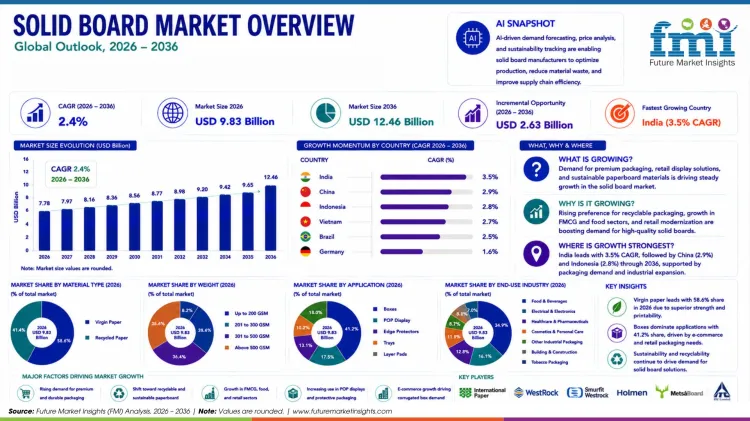
The solid board market is valued at USD 9.83 billion in 2026 and is forecast to be valued at USD 12.46 billion by 2036. The market is anticipated to register 2.4% CAGR during the forecast period. Virgin paper is likely to lead material demand with 58.6% share, while boxes are expected to account for 41.2% of application demand in 2026.
Key Takeaways, Market Size, and Forecast
- The solid board market is valued at USD 9.83 billion in 2026.
- By 2036, the market is forecast to be valued at USD 12.46 billion.
- Demand is likely to expand at 2.4% CAGR during 2026 to 2036.
- Virgin paper is expected to account for 58.6% of material demand in 2026.
- The 301 to 500 GSM range is likely to hold 36.4% share by weight.
- Boxes are forecast to lead applications with 41.2% share in 2026.
- Food and beverages are expected to account for 34.9% of end-use demand.
Summary of the Solid Board Market
- Demand and Growth Drivers
- Premium packaging needs are lifting demand for stronger paperboard grades.
- Retail display formats require better stiffness and cleaner print surfaces.
- Brand owners are shifting toward recyclable fiber-based packaging substrates.
- Shelf-ready formats are creating steady demand across modern retail channels.
- Product and Segment View
- Virgin paper leads due to better brightness and surface uniformity.
- Mid-weight boards suit cartons that need strength without excess material use.
- Boxes remain the main application because they serve retail and transit needs.
- POP displays are gaining relevance as stores prioritize visual merchandising.
- Geography and Competitive Outlook
- India is likely to lead growth through FMCG packaging and retail modernization.
- China remains important due to consumer goods manufacturing scale.
- Europe is advancing through recyclable packaging rules and retail-ready formats.
- Leading suppliers are strengthening coated board grades and fiber sourcing systems.
- Analyst Opinion
- Ismail Sutaria, Principal Consultant for Packaging at FMI, suggests, “Solid board is gaining relevance as brands look for packaging that combines shelf impact with reliable protection. Suppliers with better coating control, stiffness-to-weight performance, and recyclable board platforms are likely to gain preference as retail packaging becomes more performance-focused.”
- Solid Board Market Value Analysis
- The solid board market is moving from basic paperboard supply toward premium packaging use.
- Value creation depends on print quality and reliable board stiffness.
- Food and personal care packaging continue to anchor recurring demand.
- Retail-ready formats are improving the role of solid board in merchandising.
- Lightweighting helps converters reduce fiber use without losing pack strength.
- Competitive advantage will depend on surface quality and circular packaging alignment.
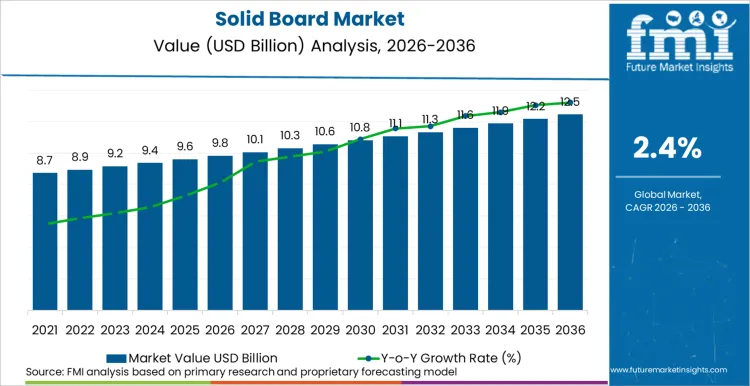
Solid Board Market Key Takeaways
| Metric | Details |
|---|---|
| Industry Size (2026) | USD 9.83 Billion |
| Industry Value (2036) | USD 12.46 Billion |
| CAGR (2026-2036) | 2.4% |
Source: Future Market Insights (FMI) analysis, based on proprietary forecasting model and primary research.
What Is Driving Rising Demand for Solid Board in Packaging Applications?
Expectations around packaging performance are shifting as solid board moves beyond basic folding carton use into broader applications that prioritize rigidity, print quality, and sustainability. According to Future Market Insights, brand owners and packaging converters are placing greater emphasis on materials that combine structural integrity with premium shelf presentation and recyclability. Solid board was earlier viewed mainly as a cost-efficient substrate for standard cartons, which limited its positioning in higher-value packaging formats. That perception is changing as coated and high-brightness solid board grades gain visibility across premium food, beverage, and personal care packaging, where shelf appeal and brand differentiation directly influence consumer choice.
Material innovation and portfolio strategies illustrate this transition. Producers are increasingly promoting lightweight, high-stiffness solid board grades that enable downgauging without compromising pack strength or runnability on high-speed filling lines. This supports both cost optimization and sustainability goals by reducing fiber usage per pack. Advanced coating technologies improve print fidelity and surface smoothness, making solid board more competitive for premium packaging that demands visual impact. FMI notes that these technical refinements are repositioning solid board from a commodity input toward a performance-oriented packaging material suited for brand-led applications.
Strategic investments by leading board producers reinforce this shift. Metsä Board has expanded its portfolio of lightweight cartonboard grades positioned for premium food and consumer goods packaging, emphasizing stiffness-to-weight performance and recyclability credentials. Such offerings are increasingly specified by brand owners seeking materials that support sustainability commitments while maintaining shelf presence. FMI observes that converters and brand owners embedding advanced solid board grades into core packaging programs, with consistent performance across production and distribution environments, are more likely to sustain repeat adoption as packaging strategies evolve toward premium, recyclable formats.
How Is the Solid Board Market Segmented?
The solid board market is segmented by material type, weight (GSM), application, and end-use industry, reflecting how board specifications are selected based on strength, print quality, and protection requirements across packaging formats. By material type, adoption spans recycled paper and virgin paper grades used across folding cartons and protective inserts. By weight, demand ranges from up to 200 GSM through above 500 GSM, aligned with lightweight retail packs and heavy-duty protective uses. By application, solid board is used for boxes, POP displays, edge protectors, trays, and layer pads across primary and secondary packaging workflows. By end-use industry, demand spans electrical and electronics, healthcare and pharmaceuticals, cosmetics and personal care, food and beverages including confectionery, fresh produce, dairy, frozen food, and meat, along with other industrial packaging, building and construction, and tobacco packaging.
Why Does Virgin Paper Lead Material Adoption?
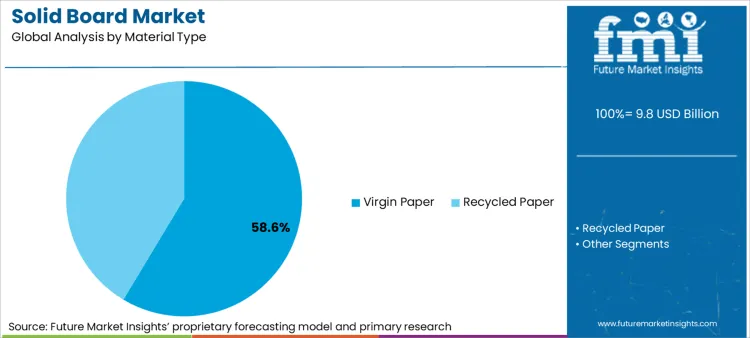
Virgin paper accounts for 58.6% of solid board demand, driven by superior stiffness, brightness, and surface uniformity required for premium printed packaging. Brand owners in food, cosmetics, and pharmaceuticals prioritize visual consistency and print fidelity, which favors virgin fiber boards for cartons and retail-facing packs. FMI notes that virgin grades deliver more predictable performance on high-speed converting lines, supporting yield stability and lower rejection rates. While recycled grades gain traction for sustainability-driven programs, performance requirements in premium packaging sustain virgin paper leadership. The premium cartonboard lines supplied by Metsä Board to branded food and personal care packaging illustrate how virgin fiber boards remain preferred for applications demanding high visual quality and structural integrity.
What Makes 301-500 GSM the Preferred Weight Range?
.webp "Solid Board Market Analysis By By Weight (gsm)")
Boards in the 301-500 GSM range represent 36.4% of demand, reflecting the balance between stiffness and material efficiency needed for folding cartons and protective trays. This weight band supports structural integrity for stacked retail packs while remaining compatible with die-cutting and high-speed filling equipment. FMI observes that converters standardize tooling around this GSM range to serve multiple end-use segments, improving operational efficiency. Lighter grades suit small packs, while heavier boards serve industrial protection, yet the mid-range remains the volume anchor across food, pharmaceuticals, and cosmetics packaging. The broad adoption of mid-GSM cartonboard in Smurfit Westrock’s consumer packaging portfolio reflects how converters favor this range for versatility across mass-market and premium retail formats.
Why Do Boxes Dominate Solid Board Applications?
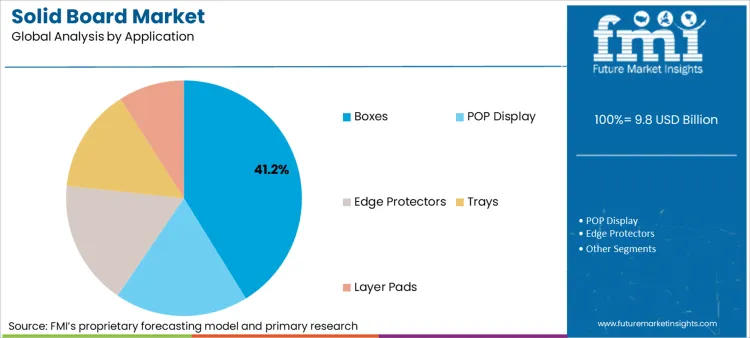
Boxes account for 41.2% of solid board usage, driven by their role in primary and secondary packaging for retail and transit protection. Solid board boxes provide stacking strength, surface quality for branding, and compatibility with automated packing lines. FMI highlights that boxes integrate easily with inserts and trays, enabling product protection without compromising shelf presentation. POP displays and trays support merchandising, while edge protectors and layer pads serve logistics needs, yet boxes remain the dominant application due to their versatility across industries. The widespread use of solid board folding cartons by International Paper for branded consumer goods packaging underscores the continued centrality of boxes within the solid board application mix.
Why Does Food and Beverages Lead End-Use Demand?
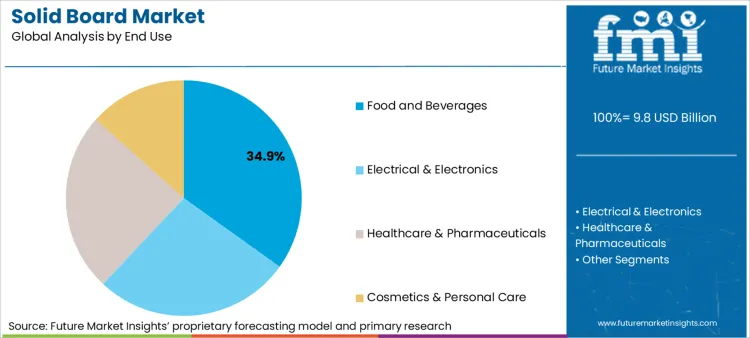
Food and beverages account for 34.9% of solid board consumption, reflecting high volumes of folding cartons and trays used across confectionery, dairy, frozen food, and fresh produce packaging. Brand owners prioritize print quality, food-contact compliance, and structural protection to maintain shelf appeal and product integrity. FMI notes that growth in packaged foods and private-label expansion sustain steady demand for solid board formats across retail channels. Confectionery and dairy drive premium cartonboard usage, while frozen and meat products rely on heavier grades for cold-chain durability. The extensive use of solid board cartons in Nestlé’s packaged food portfolio highlights how food brands depend on solid board for scalable, retail-ready packaging across diverse product categories.
What Forces Are Steering the Evolution of Solid Board Applications?
Solid board is gaining stronger traction as brand owners and retailers seek packaging and display substrates that balance structural strength, visual quality, and recyclability. Compared with lighter paperboard grades, solid board offers higher stiffness and surface integrity, supporting premium cartons, shelf-ready packaging, and point-of-purchase displays that must retain shape across handling cycles. These attributes support better shelf presentation, improved stackability, and reduced product damage during in-store merchandising. As per Future Market Insights, solid board is increasingly positioned as a performance-grade packaging material rather than a basic paperboard input, particularly within food, personal care, and consumer electronics packaging. Improvements in caliper control and surface treatments are enabling wider use of solid board in applications that require high print quality alongside load-bearing performance. This shift is contributing to broader acceptance of solid board as a reliable substrate for premium and retail-facing packaging formats.
How Is Portfolio Expansion Strengthening Packaging and Display Platforms?
Portfolio expansion is strengthening competitive positioning as packaging producers integrate solid board into broader packaging and display material portfolios alongside folding cartons, corrugated formats, and specialty coated boards. This enables converters and brand owners to source multiple packaging components from unified supply platforms, improving consistency in material performance and visual standards across packaging programs. Graphic Packaging Holding Company has expanded its fiber-based packaging portfolio across carton board and solid board substrates to support premium consumer goods packaging and retail display applications, aligning material performance with circular packaging objectives. According to FMI, embedding solid board within broader packaging portfolios accelerates adoption by aligning premium paperboard formats with established procurement relationships and converting capabilities. This integration supports scalability across mass and premium packaging programs while reducing supplier fragmentation across retail packaging ecosystems.
Why Is Material and Surface Engineering Driving Solid Board Innovation?
Rising performance expectations and sustainability requirements are pushing manufacturers to refine solid board compositions, coatings, and surface finishes while maintaining stiffness and print fidelity. Solid board substrates require careful balance of fiber density, caliper consistency, and coating performance to deliver predictable strength, clean die-cutting, and high-quality graphics. Minor variations in fiber composition or coating thickness can affect fold performance, compression strength, and print outcomes across high-volume packaging runs. FMI notes that increasing competitive pressure is elevating the importance of material engineering discipline, with producers emphasizing lightweighting strategies, recyclable coatings, and surface treatments that improve printability without compromising recyclability. This focus on material optimization supports wider deployment of solid board across premium packaging and display formats, positioning it as a dependable, scalable substrate for retail-ready and merchandising applications rather than a niche paperboard solution.
What Is the Country-wise Outlook for the Solid Board Market?
Country-level growth for solid board varies based on packaging demand intensity, retail modernization, manufacturing output, and sustainability policy adoption. India leads with a 4.60% CAGR, supported by expanding FMCG packaging needs, organized retail growth, and rising use of shelf-ready and display packaging across food, beverages, and personal care. China follows at 4.20%, driven by high-volume consumer goods manufacturing and steady demand for premium retail packaging substrates. Thailand records 3.20% growth, reflecting rising packaged food exports and retail display requirements across modern trade formats. Spain posts 3.0%, supported by gradual upgrades in retail-ready packaging and merchandising displays. The United States trails at 1.50%, reflecting replacement-driven demand in a mature packaging market where solid board adoption is steady but incremental.
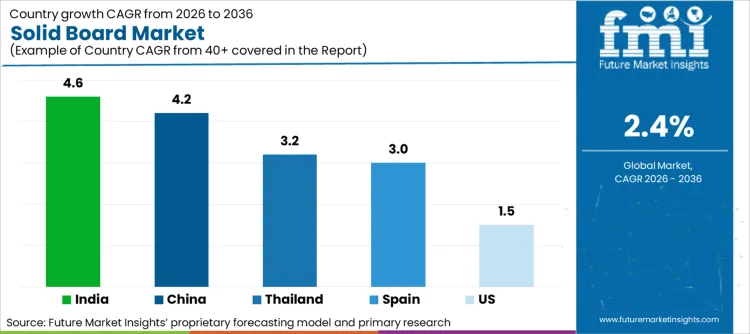
| Country | CAGR (2026 to 2036) |
|---|---|
| India | 4.6% |
| China | 4.2% |
| Thailand | 3.2% |
| Spain | 3.0% |
| USA | 1.5% |
Source: FMI historical analysis and forecast data.
Why Is India Recording the Fastest Growth in Solid Board Demand?
India’s 4.60% CAGR is supported by rapid growth in organized retail, expansion of branded FMCG packaging, and increasing use of shelf-ready and display packaging formats across urban and semi-urban markets. Solid board is gaining traction in premium food packaging, personal care cartons, and retail display units that require higher stiffness, surface smoothness, and print quality. Retail chains are standardizing packaging formats that improve shelf presentation and handling efficiency, reinforcing demand for stronger paperboard substrates. Growth is reinforced by investments in domestic paperboard capacity and conversion infrastructure aligned with branded packaging requirements. For instance, ITC Limited has expanded its premium paperboard packaging offerings to support high-graphics consumer goods packaging, illustrating how domestic packaging ecosystems are aligning with stronger board grades. Adoption is driven by retail modernization and brand differentiation needs rather than volume-driven commodity packaging expansion.
What Is Sustaining Solid Board Growth in China’s Packaging Market?
China’s 4.20% CAGR reflects steady upgrades in retail packaging and branded display formats across consumer electronics, cosmetics, and packaged foods. Solid board supports higher print fidelity and structural reliability for shelf-facing cartons and promotional displays used in modern retail environments. Export packaging requirements also reinforce demand for higher-grade paperboard that withstands multi-stage logistics and handling across international supply chains. Growth is anchored in substitution toward premium board grades rather than net-new packaging formats, as converters upgrade substrates to meet evolving brand presentation and durability standards. E-commerce fulfillment and retail display convergence is encouraging packaging designs that balance visual appeal with structural performance, favoring solid board over lighter grades for specific use cases. Adoption remains concentrated in premium and display-led applications rather than mass-market transport packaging, supporting consistent but measured growth across major manufacturing hubs.
Why Is Thailand Seeing Moderate Expansion in Solid Board Usage?
Thailand’s 3.20% CAGR is shaped by rising packaged food exports, growth in modern trade retail formats, and demand for visually appealing retail displays. Solid board is increasingly used for export cartons, confectionery packaging, and premium food boxes that require better stiffness and surface finish than conventional paperboard. Tourism-linked consumer goods and gift packaging also support demand for presentation-grade substrates used in retail merchandising. Growth remains moderate as corrugated packaging continues to dominate bulk transport and logistics use cases, limiting broader substitution toward solid board. Adoption is concentrated in shelf-facing and promotional display applications rather than high-volume shipping cartons. Packaging converters are gradually expanding solid board usage to meet brand requirements for shelf impact and structural reliability, supporting steady but incremental growth aligned with retail packaging upgrades rather than rapid material transitions.
What Is Driving Solid Board Adoption in Spain’s Packaging Sector?
Spain’s 3.0% CAGR reflects gradual modernization of retail-ready packaging and merchandising formats across grocery, personal care, and specialty retail channels. Solid board is used for display units, premium cartons, and branded outer packaging that enhance shelf presentation and handling stability. Demand is reinforced by EU-aligned sustainability frameworks encouraging recyclable, fiber-based packaging materials, supporting substitution from plastic-heavy secondary packaging formats. Retailers increasingly prefer standardized shelf-ready packaging designs that improve in-store efficiency and visual consistency, which benefits higher-stiffness board grades. Growth is measured rather than rapid, as packaging upgrades are driven by merchandising optimization and regulatory alignment instead of capacity-driven expansion. Adoption remains concentrated in premium and display-oriented packaging segments, supporting stable demand growth across food, beverages, and consumer goods retail ecosystems.
Why Is Growth More Limited in the United States Solid Board Market?
The United States’ 1.50% CAGR reflects a mature packaging landscape with established use of folding cartons and corrugated board across retail and logistics applications. Solid board demand is largely replacement-driven, concentrated in premium packaging, retail display units, and select point-of-purchase applications. Brands emphasize cost efficiency, lightweighting, and logistics optimization, which limits rapid expansion of heavier board grades across mainstream packaging workflows. Growth is anchored in niche upgrades toward stronger substrates for shelf-ready packaging and merchandising displays rather than broad-based material shifts. Adoption continues through targeted improvements in print quality, stiffness, and sustainability alignment, supporting incremental value growth without major changes to dominant packaging material structures.
What Is the Competitive Outlook for the Solid Board Market?
The competitive landscape for solid board is led by integrated paper and packaging producers that extend beyond commodity paperboard supply into value-added cartonboard, retail-ready packaging, and protective packaging solutions. Players such as International Paper Company, Smurfit Westrock, Mondi Group, DS Smith Packaging Limited, Mayr-Melnhof Karton AG, Stora Enso, Billerud, Rengo Co., Ltd., and Georgia-Pacific LLC benefit from vertically integrated fiber sourcing, large-scale converting networks, and long-standing relationships with brand owners and retailers. Competitive positioning in this market is shaped less by short-term tonnage leadership and more by the ability to offer consistent board quality, coating performance, and conversion compatibility across diverse packaging formats used in food, beverages, personal care, and consumer goods.
Future Market Insights highlights that competitive differentiation is moving toward material engineering depth, circular design integration, and packaging system compatibility rather than capacity scale alone. Producers are placing greater emphasis on downgauged board grades, improved stiffness-to-weight performance, and surface treatments that support high-quality printing while reducing fiber intensity per pack. Alongside this, lifecycle performance, recyclability alignment, and fiber traceability are becoming decisive factors in supplier selection by multinational brand owners. Companies including Stora Enso, Billerud, and Mayr-Melnhof Karton AG are advancing premium cartonboard platforms optimized for lightweighting and visual quality, while Smurfit Westrock, Mondi Group, DS Smith Packaging Limited, and Rengo Co., Ltd. are aligning solid board development with circular packaging strategies and retail execution requirements. FMI notes that long-term advantage will depend on how effectively suppliers embed solid board into integrated packaging solutions that meet performance, sustainability, and retail display demands in parallel.
Recent Developments:
- In November 2025, Mondi finalized a $686 million acquisition of Schumacher Packaging’s assets. This strategic move significantly expanded Mondi’s solid board production footprint across Europe. By integrating these facilities, Mondi has enhanced its regional supply reliability and added advanced digital printing capabilities to its solid board portfolio, specifically targeting the high-growth food and e-commerce sectors.
- In September 2025, Mondi showcased an extended solid board portfolio at Fachpack. The new range focuses on "TwinBox" shelf-ready solutions that combine the rigidity of solid board with smart gluing techniques for easy retail placement. This innovation targets "retail-ready" packaging trends, helping brands reduce stocking time while improving shelf impact.
Key Players in Solid Board Market
- International Paper Company
- Mayr-Melnhof Karton AG
- Smurfit WestRock
- Mondi Group
- DS Smith Packaging Limited
- Georgia Pacific LLC
- Rengo Co.Ltd
- Stora Enso
Market Definition
The solid board market captures revenue from rigid paperboard materials used in folding cartons, retail-ready packaging, POP displays, trays, and protective packaging applications. In this assessment, the market covers commercially produced solid board grades supplied to packaging converters and brand owners for primary and secondary packaging across consumer and industrial end uses. Market sizing reflects the value of finished solid board sold into packaging applications through direct supply contracts and distribution channels, analyzed by material type, weight (GSM), application format, end-use industry, and region, and reported in USD billion.
The scope includes solid bleached sulfate (SBS), solid unbleached sulfate (SUS), coated unbleached kraft (CUK), and other coated solid board grades used for food and beverage cartons, pharmaceuticals packaging, cosmetics and personal care boxes, electrical and electronics packaging, POP displays, trays, layer pads, and edge protectors. Boards supplied for retail packaging, shelf-ready formats, and transit protection are included. Geographic coverage spans North America, Europe, Asia Pacific, Latin America, and the Middle East & Africa.
The market excludes corrugated board, molded fiber packaging, paper bags, flexible paper packaging, and non-board rigid plastics. Revenues from pulp production, recovered paper trading, coating chemicals, adhesives, inks, packaging machinery, contract converting services, logistics services, and waste management are excluded. Paperboard used solely for construction panels or non-packaging industrial applications is outside the defined market scope.
Scope of Report
| Items | Values |
|---|---|
| Quantitative Units (2026) | USD 9.83 Billion |
| Material Type | Recycled Paper; Virgin Paper |
| Weight (GSM) | Up to 200 GSM; 201 to 300 GSM; 301 to 500 GSM; Above 500 GSM |
| Application | Boxes; POP Display; Edge Protectors; Trays; Layer Pads |
| End-Use Industry | Electrical & Electronics; Healthcare & Pharmaceuticals; Cosmetics & Personal Care; Food & Beverages (Confectionery; Fresh Produce; Milk & Dairy; Frozen Food; Meat & Poultry); Other Industrial Packaging; Building & Construction; Tobacco Packaging |
| Regions Covered | North America, Europe, Asia Pacific, Latin America, Middle East & Africa |
| Countries Covered | United States, Spain, India, China, Thailand, and 40+ countries |
| Key Companies Profiled | International Paper Company; Mayr-Melnhof Karton AG; Smurfit WestRock; Mondi Group; DS Smith Packaging Limited; Georgia-Pacific LLC; Rengo Co., Ltd.; Stora Enso; Billerud |
| Additional Attributes | Dollar sales by material type, weight, application, and end-use industry; country-wise growth analysis; adoption trends for retail-ready and shelf-ready packaging; demand patterns for premium cartonboard in food, personal care, and consumer goods; competitive positioning across integrated paper and packaging producers |
Source: FMI historical analysis and forecast data
Solid Board Market by Segments
By Material Type:
- Recycled Paper
- Virgin Paper
By Weight (GSM):
- Up to 200 GSM
- 201 to 300 GSM
- 301 to 500 GSM
- Above 500 GSM
By Application:
- Boxes
- POP Display
- Edge Protectors
- Trays
- Layer Pads
By End-Use Industry:
- Electrical & Electronics
- Healthcare & Pharmaceuticals
- Cosmetics & Personal Care
- Food & Beverages
- Confectionery
- Fresh Produce
- Milk & Dairy
- Frozen Food
- Meat & Poultry
- Other Industrial Packaging
- Building & Construction
- Tobacco Packaging
By Region:
- North America
- Europe
- Asia Pacific
- Latin America
- Middle East & Africa
Bibliography
- Billerud. (2026). Premium cartonboard platforms: Optimized for lightweighting and visual quality in global packaging.
- ITC Limited. (2026). Premium paperboard expansion: Supporting high-graphics consumer packaging in the Indian market.
- Mayr-Melnhof Karton AG. (2026). Advanced solid board grades and sustainable barrier technologies for food and personal care.
- Metsä Board. (2026). Lightweight cartonboard and stiffness-to-weight performance in premium retail-ready packaging.
Frequently Asked Questions
What is the current global market size for Solid Board?
The global solid board market is valued at USD 9.83 billion in 2026, supported by steady demand from folding cartons, retail-ready packaging, POP displays, and protective packaging applications across food, personal care, and consumer goods.
What is the projected growth outlook for the Solid Board market?
Market revenues are projected to expand steadily through 2036, reaching USD 12.46 billion by the end of the forecast period, reflecting moderate growth driven by premium packaging upgrades and retail display demand.
Which segment currently dominates the industry?
Boxes represent the leading application segment, driven by widespread use of solid board in folding cartons and secondary packaging for food, beverages, pharmaceuticals, and consumer goods.
What are the primary risks or barriers to adoption?
Key barriers include cost sensitivity among mass-market brand owners, competition from corrugated board and flexible packaging formats, and limited substitution of solid board in high-volume transport packaging.
Who are the leading players in the Solid Board market?
Leading companies include International Paper Company, Mayr-Melnhof Karton AG, Smurfit WestRock, Mondi Group, DS Smith Packaging Limited, Georgia-Pacific LLC, Rengo Co., Ltd., Stora Enso, and Billerud.
Preview the report firsthand - request a free sample
Get SampleGet the brochure for pricing and purchase details.
Get PDFTable of Content
- Executive Summary
- Global Market Outlook
- Demand-side Trends
- Supply-side Trends
- Technology Roadmap Analysis
- Analysis and Recommendations
- Market Overview
- Market Coverage / Taxonomy
- Market Definition / Scope / Limitations
- Research Methodology
- Chapter Orientation
- Analytical Lens and Working Hypotheses
- Market Structure, Signals, and Trend Drivers
- Benchmarking and Cross-market Comparability
- Market Sizing, Forecasting, and Opportunity Mapping
- Research Design and Evidence Framework
- Desk Research Programme (Secondary Evidence)
- Company Annual and Sustainability Reports
- Peer-reviewed Journals and Academic Literature
- Corporate Websites, Product Literature, and Technical Notes
- Earnings Decks and Investor Briefings
- Statutory Filings and Regulatory Disclosures
- Technical White Papers and Standards Notes
- Trade Journals, Industry Magazines, and Analyst Briefs
- Conference Proceedings, Webinars, and Seminar Materials
- Government Statistics Portals and Public Data Releases
- Press Releases and Reputable Media Coverage
- Specialist Newsletters and Curated Briefings
- Sector Databases and Reference Repositories
- FMI Internal Proprietary Databases and Historical Market Datasets
- Subscription Datasets and Paid Sources
- Social Channels, Communities, and Digital Listening Inputs
- Additional Desk Sources
- Expert Input and Fieldwork (Primary Evidence)
- Primary Modes
- Qualitative Interviews and Expert Elicitation
- Quantitative Surveys and Structured Data Capture
- Blended Approach
- Why Primary Evidence is Used
- Field Techniques
- Interviews
- Surveys
- Focus Groups
- Observational and In-context Research
- Social and Community Interactions
- Stakeholder Universe Engaged
- C-suite Leaders
- Board Members
- Presidents and Vice Presidents
- R&D and Innovation Heads
- Technical Specialists
- Domain Subject-matter Experts
- Scientists
- Physicians and Other Healthcare Professionals
- Governance, Ethics, and Data Stewardship
- Research Ethics
- Data Integrity and Handling
- Primary Modes
- Tooling, Models, and Reference Databases
- Desk Research Programme (Secondary Evidence)
- Data Engineering and Model Build
- Data Acquisition and Ingestion
- Cleaning, Normalisation, and Verification
- Synthesis, Triangulation, and Analysis
- Quality Assurance and Audit Trail
- Market Background
- Market Dynamics
- Drivers
- Restraints
- Opportunity
- Trends
- Scenario Forecast
- Demand in Optimistic Scenario
- Demand in Likely Scenario
- Demand in Conservative Scenario
- Opportunity Map Analysis
- Product Life Cycle Analysis
- Supply Chain Analysis
- Investment Feasibility Matrix
- Value Chain Analysis
- PESTLE and Porter’s Analysis
- Regulatory Landscape
- Regional Parent Market Outlook
- Production and Consumption Statistics
- Import and Export Statistics
- Market Dynamics
- Global Market Analysis 2021 to 2025 and Forecast, 2026 to 2036
- Historical Market Size Value (USD Billion) Analysis, 2021 to 2025
- Current and Future Market Size Value (USD Billion) Projections, 2026 to 2036
- Y-o-Y Growth Trend Analysis
- Absolute $ Opportunity Analysis
- Global Market Pricing Analysis 2021 to 2025 and Forecast 2026 to 2036
- Global Market Analysis 2021 to 2025 and Forecast 2026 to 2036, By Material Type
- Introduction / Key Findings
- Historical Market Size Value (USD Billion) Analysis By Material Type , 2021 to 2025
- Current and Future Market Size Value (USD Billion) Analysis and Forecast By Material Type , 2026 to 2036
- Virgin Paper
- Recycled Paper
- Virgin Paper
- Y-o-Y Growth Trend Analysis By Material Type , 2021 to 2025
- Absolute $ Opportunity Analysis By Material Type , 2026 to 2036
- Global Market Analysis 2021 to 2025 and Forecast 2026 to 2036, By By Weight (GSM)
- Introduction / Key Findings
- Historical Market Size Value (USD Billion) Analysis By By Weight (GSM), 2021 to 2025
- Current and Future Market Size Value (USD Billion) Analysis and Forecast By By Weight (GSM), 2026 to 2036
- 301-500 GSM
- Up to 200 GSM
- 201 to 300 GSM
- Above 500 GSM
- 301-500 GSM
- Y-o-Y Growth Trend Analysis By By Weight (GSM), 2021 to 2025
- Absolute $ Opportunity Analysis By By Weight (GSM), 2026 to 2036
- Global Market Analysis 2021 to 2025 and Forecast 2026 to 2036, By Application
- Introduction / Key Findings
- Historical Market Size Value (USD Billion) Analysis By Application, 2021 to 2025
- Current and Future Market Size Value (USD Billion) Analysis and Forecast By Application, 2026 to 2036
- Boxes
- POP Display
- Edge Protectors
- Trays
- Layer Pads
- Boxes
- Y-o-Y Growth Trend Analysis By Application, 2021 to 2025
- Absolute $ Opportunity Analysis By Application, 2026 to 2036
- Global Market Analysis 2021 to 2025 and Forecast 2026 to 2036, By End Use
- Introduction / Key Findings
- Historical Market Size Value (USD Billion) Analysis By End Use, 2021 to 2025
- Current and Future Market Size Value (USD Billion) Analysis and Forecast By End Use, 2026 to 2036
- Food and Beverages
- Electrical & Electronics
- Healthcare & Pharmaceuticals
- Cosmetics & Personal Care
- Food and Beverages
- Y-o-Y Growth Trend Analysis By End Use, 2021 to 2025
- Absolute $ Opportunity Analysis By End Use, 2026 to 2036
- Global Market Analysis 2021 to 2025 and Forecast 2026 to 2036, By Region
- Introduction
- Historical Market Size Value (USD Billion) Analysis By Region, 2021 to 2025
- Current Market Size Value (USD Billion) Analysis and Forecast By Region, 2026 to 2036
- North America
- Latin America
- Western Europe
- Eastern Europe
- East Asia
- South Asia and Pacific
- Middle East & Africa
- Market Attractiveness Analysis By Region
- North America Market Analysis 2021 to 2025 and Forecast 2026 to 2036, By Country
- Historical Market Size Value (USD Billion) Trend Analysis By Market Taxonomy, 2021 to 2025
- Market Size Value (USD Billion) Forecast By Market Taxonomy, 2026 to 2036
- By Country
- USA
- Canada
- Mexico
- By Material Type
- By By Weight (GSM)
- By Application
- By End Use
- By Country
- Market Attractiveness Analysis
- By Country
- By Material Type
- By By Weight (GSM)
- By Application
- By End Use
- Key Takeaways
- Latin America Market Analysis 2021 to 2025 and Forecast 2026 to 2036, By Country
- Historical Market Size Value (USD Billion) Trend Analysis By Market Taxonomy, 2021 to 2025
- Market Size Value (USD Billion) Forecast By Market Taxonomy, 2026 to 2036
- By Country
- Brazil
- Chile
- Rest of Latin America
- By Material Type
- By By Weight (GSM)
- By Application
- By End Use
- By Country
- Market Attractiveness Analysis
- By Country
- By Material Type
- By By Weight (GSM)
- By Application
- By End Use
- Key Takeaways
- Western Europe Market Analysis 2021 to 2025 and Forecast 2026 to 2036, By Country
- Historical Market Size Value (USD Billion) Trend Analysis By Market Taxonomy, 2021 to 2025
- Market Size Value (USD Billion) Forecast By Market Taxonomy, 2026 to 2036
- By Country
- Germany
- UK
- Italy
- Spain
- France
- Nordic
- BENELUX
- Rest of Western Europe
- By Material Type
- By By Weight (GSM)
- By Application
- By End Use
- By Country
- Market Attractiveness Analysis
- By Country
- By Material Type
- By By Weight (GSM)
- By Application
- By End Use
- Key Takeaways
- Eastern Europe Market Analysis 2021 to 2025 and Forecast 2026 to 2036, By Country
- Historical Market Size Value (USD Billion) Trend Analysis By Market Taxonomy, 2021 to 2025
- Market Size Value (USD Billion) Forecast By Market Taxonomy, 2026 to 2036
- By Country
- Russia
- Poland
- Hungary
- Balkan & Baltic
- Rest of Eastern Europe
- By Material Type
- By By Weight (GSM)
- By Application
- By End Use
- By Country
- Market Attractiveness Analysis
- By Country
- By Material Type
- By By Weight (GSM)
- By Application
- By End Use
- Key Takeaways
- East Asia Market Analysis 2021 to 2025 and Forecast 2026 to 2036, By Country
- Historical Market Size Value (USD Billion) Trend Analysis By Market Taxonomy, 2021 to 2025
- Market Size Value (USD Billion) Forecast By Market Taxonomy, 2026 to 2036
- By Country
- China
- Japan
- South Korea
- By Material Type
- By By Weight (GSM)
- By Application
- By End Use
- By Country
- Market Attractiveness Analysis
- By Country
- By Material Type
- By By Weight (GSM)
- By Application
- By End Use
- Key Takeaways
- South Asia and Pacific Market Analysis 2021 to 2025 and Forecast 2026 to 2036, By Country
- Historical Market Size Value (USD Billion) Trend Analysis By Market Taxonomy, 2021 to 2025
- Market Size Value (USD Billion) Forecast By Market Taxonomy, 2026 to 2036
- By Country
- India
- ASEAN
- Australia & New Zealand
- Rest of South Asia and Pacific
- By Material Type
- By By Weight (GSM)
- By Application
- By End Use
- By Country
- Market Attractiveness Analysis
- By Country
- By Material Type
- By By Weight (GSM)
- By Application
- By End Use
- Key Takeaways
- Middle East & Africa Market Analysis 2021 to 2025 and Forecast 2026 to 2036, By Country
- Historical Market Size Value (USD Billion) Trend Analysis By Market Taxonomy, 2021 to 2025
- Market Size Value (USD Billion) Forecast By Market Taxonomy, 2026 to 2036
- By Country
- Kingdom of Saudi Arabia
- Other GCC Countries
- Turkiye
- South Africa
- Other African Union
- Rest of Middle East & Africa
- By Material Type
- By By Weight (GSM)
- By Application
- By End Use
- By Country
- Market Attractiveness Analysis
- By Country
- By Material Type
- By By Weight (GSM)
- By Application
- By End Use
- Key Takeaways
- Key Countries Market Analysis
- USA
- Pricing Analysis
- Market Share Analysis, 2025
- By Material Type
- By By Weight (GSM)
- By Application
- By End Use
- Canada
- Pricing Analysis
- Market Share Analysis, 2025
- By Material Type
- By By Weight (GSM)
- By Application
- By End Use
- Mexico
- Pricing Analysis
- Market Share Analysis, 2025
- By Material Type
- By By Weight (GSM)
- By Application
- By End Use
- Brazil
- Pricing Analysis
- Market Share Analysis, 2025
- By Material Type
- By By Weight (GSM)
- By Application
- By End Use
- Chile
- Pricing Analysis
- Market Share Analysis, 2025
- By Material Type
- By By Weight (GSM)
- By Application
- By End Use
- Germany
- Pricing Analysis
- Market Share Analysis, 2025
- By Material Type
- By By Weight (GSM)
- By Application
- By End Use
- UK
- Pricing Analysis
- Market Share Analysis, 2025
- By Material Type
- By By Weight (GSM)
- By Application
- By End Use
- Italy
- Pricing Analysis
- Market Share Analysis, 2025
- By Material Type
- By By Weight (GSM)
- By Application
- By End Use
- Spain
- Pricing Analysis
- Market Share Analysis, 2025
- By Material Type
- By By Weight (GSM)
- By Application
- By End Use
- France
- Pricing Analysis
- Market Share Analysis, 2025
- By Material Type
- By By Weight (GSM)
- By Application
- By End Use
- India
- Pricing Analysis
- Market Share Analysis, 2025
- By Material Type
- By By Weight (GSM)
- By Application
- By End Use
- ASEAN
- Pricing Analysis
- Market Share Analysis, 2025
- By Material Type
- By By Weight (GSM)
- By Application
- By End Use
- Australia & New Zealand
- Pricing Analysis
- Market Share Analysis, 2025
- By Material Type
- By By Weight (GSM)
- By Application
- By End Use
- China
- Pricing Analysis
- Market Share Analysis, 2025
- By Material Type
- By By Weight (GSM)
- By Application
- By End Use
- Japan
- Pricing Analysis
- Market Share Analysis, 2025
- By Material Type
- By By Weight (GSM)
- By Application
- By End Use
- South Korea
- Pricing Analysis
- Market Share Analysis, 2025
- By Material Type
- By By Weight (GSM)
- By Application
- By End Use
- Russia
- Pricing Analysis
- Market Share Analysis, 2025
- By Material Type
- By By Weight (GSM)
- By Application
- By End Use
- Poland
- Pricing Analysis
- Market Share Analysis, 2025
- By Material Type
- By By Weight (GSM)
- By Application
- By End Use
- Hungary
- Pricing Analysis
- Market Share Analysis, 2025
- By Material Type
- By By Weight (GSM)
- By Application
- By End Use
- Kingdom of Saudi Arabia
- Pricing Analysis
- Market Share Analysis, 2025
- By Material Type
- By By Weight (GSM)
- By Application
- By End Use
- Turkiye
- Pricing Analysis
- Market Share Analysis, 2025
- By Material Type
- By By Weight (GSM)
- By Application
- By End Use
- South Africa
- Pricing Analysis
- Market Share Analysis, 2025
- By Material Type
- By By Weight (GSM)
- By Application
- By End Use
- USA
- Market Structure Analysis
- Competition Dashboard
- Competition Benchmarking
- Market Share Analysis of Top Players
- By Regional
- By Material Type
- By By Weight (GSM)
- By Application
- By End Use
- Competition Analysis
- Competition Deep Dive
- International Paper Company
- Overview
- Product Portfolio
- Profitability by Market Segments (Product/Age /Sales Channel/Region)
- Sales Footprint
- Strategy Overview
- Marketing Strategy
- Product Strategy
- Channel Strategy
- Mayr-Melnhof Karton AG
- Smurfit WestRock
- Mondi Group
- DS Smith Packaging Limited
- Georgia Pacific LLC
- Rengo Co.Ltd
- Stora Enso
- International Paper Company
- Competition Deep Dive
- Assumptions & Acronyms Used


