

- Industry Size (2026)
- USD 25.4 Bn
- Forecast (2036)
- USD 44.6 Bn
- CAGR (2026 to 2036)
- 5.8%
Solid Hair Styling Formats Market Forecast and Outlook 2026 to 2036
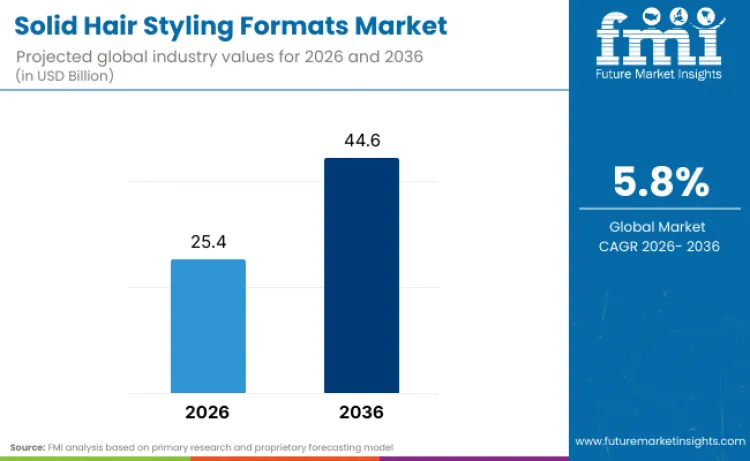
The solid hair styling formats market is valued at USD 25.4 billion in 2026 and is projected to reach USD 44.6 billion by 2036, advancing at a 5.8% CAGR. As noted by Future Market Insights, demand is rising as consumers increasingly prefer waterless, compact styling products that align with sustainability goals while offering better value per use. Solid formats reduce dependence on excess packaging, lower transport weight, and deliver longer usage cycles than traditional liquid alternatives.
Discussion among formulators and product developers reflects the same direction. Kelly Dobos, a Cincinnati-based cosmetic chemist, notes that “the interest in waterless hair care is driven by a combination of sustainability concerns and innovative formats,” highlighting how environmental priorities and practical performance are becoming closely linked in product design. Product activity between 2024 and 2026 reflects this trend, with brands focusing on concentrated solid gels, waxes, and sticks that provide consistent hold and texture using smaller product volumes.
Established hair care companies are expanding into solid formats to maintain relevance, while emerging brands continue to build awareness through simplified formulations and low-waste packaging. Digital and specialty retail channels are supporting wider adoption as solid products are easier to ship, store, and replenish. As solid styling products become part of everyday grooming routines, repeat usage and broader brand participation are expected to support steady market growth through 2036.
Summary of Solid Hair Styling Formats Market
What is the Growth Outlook for the Solid Hair Styling Formats Market as per Future Market Insights Projection?
Future Market Insights projects the solid hair styling formats market to grow at a CAGR of 5.8% from 2026 to 2036, expanding from USD 25.4 billion in 2026 to USD 44.6 billion by 2036.
How Do FMI Analysts Perceive the Solid Hair Styling Formats Market to Evolve?
FMI analysts perceive the market evolving from niche, eco-positioned alternatives toward mainstream, performance-driven styling solutions integrated into daily grooming routines.
Which Country Holds the Largest Share in the Global Solid Hair Styling Formats Market?
China holds the largest share of the global solid hair styling formats market by value.
How Large Will the Solid Hair Styling Formats Market Be by 2036?
The global solid hair styling formats market is estimated to reach USD 44.6 billion by 2036.
What Is the Definition of the Solid Hair Styling Formats Market?
The solid hair styling formats market comprises commercially sold, non-liquid hair styling products, including solid gels, waxes, sticks, and pomades, formulated to provide hold, texture, and shape without water-based carriers.
What Are Globally Unique Trends Shaping the Solid Hair Styling Formats Market?
Globally unique trends include concentration-led product design, broader adoption of waterless grooming formats, and normalization of solid styling products in everyday routines.
Solid Hair Styling Formats Market Key Takeaways
| Metric | Details |
|---|---|
| Industry Size (2026) | USD 25.4 billion |
| Industry Value (2036) | USD 44.6 billion |
| CAGR (2026 to 2036) | 5.8% |
Source: Future Market Insights (FMI) analysis, based on proprietary forecasting model and primary research
What is Driving the Demand for Solid Hair Styling Formats Market?
Shifting grooming habits and space-constrained lifestyles are fundamentally reshaping the hair styling formats landscape by driving demand for compact, waterless products suited for regular use. Solid gels, waxes, and sticks are gaining preference as they offer longer product life, improved portability, and lower packaging intensity than liquid alternatives. This transition is significant because it is pushing manufacturers to reassess liquid-centric portfolios and prioritize concentrated, anhydrous styling systems that deliver consistent hold with smaller quantities.
The rise of e-commerce and specialty beauty retail is further amplifying demand; as solid styling products align well with digital-first distribution models. Platforms such as Amazon, Ulta Beauty, and Sephora have expanded shelf space for solid personal care formats due to their lower leakage risk, simplified logistics, and higher repeat purchase rates. This retail visibility is accelerating normalization of solid styling products as everyday grooming essentials rather than niche or travel-only options, reinforcing sustained demand growth through 2036.
How is the Solid Hair Styling Formats Market Segmented?
The solid hair styling formats market is segmented by product type, ingredient type, sales channel, and end user, reflecting how these products are integrated into everyday grooming routines. By product type, the market includes solid hair gels, sprays, mousses, waxes, pomades, creams, and other compact formats designed to deliver hold, texture, and styling control. By ingredient type, offerings are grouped into chemical-based, organic or natural, and hybrid formulations, shaped by performance expectations and formulation stability. By sales channel, demand spans supermarkets and hypermarkets, specialty beauty stores, pharmacies and drug stores, online platforms, and other retail outlets. By end user, the market is segmented into men, women, and unisex consumers, capturing differences in styling frequency and routine complexity. According to Future Market Insights, segmentation is shifting from novelty-led adoption toward routine-driven, performance-oriented grooming solutions suited for regular daily use.
Why does Hair Gels hold a leading share by product type?
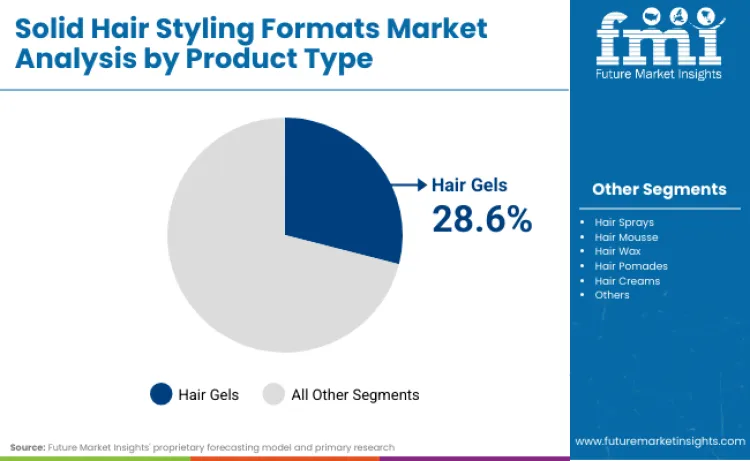
Hair gels account for 28.6% share of the solid hair styling formats market due to their broad functional versatility and strong alignment with everyday grooming routines. Solid hair gels deliver consistent hold, shape retention, and styling control across multiple hair types, making them suitable for frequent daily use. This dominance is reinforced by high adoption among men, where quick application, predictable results, and compact formats support regular grooming habits. Compared with waxes or pomades that emphasize texture or shine, hair gels function as a universal styling solution for structured, casual, and controlled looks. Manufacturers continue refining solid gel formulations to improve spreadability, minimize residue, and maintain long-lasting hold, addressing performance expectations tied to repeat use. Their compact form and longer shelf life also support wide distribution across mass retail and online channels, reinforcing volume-driven demand within the solid styling formats category.
Why does the Chemical-Based Segment Dominate Market?
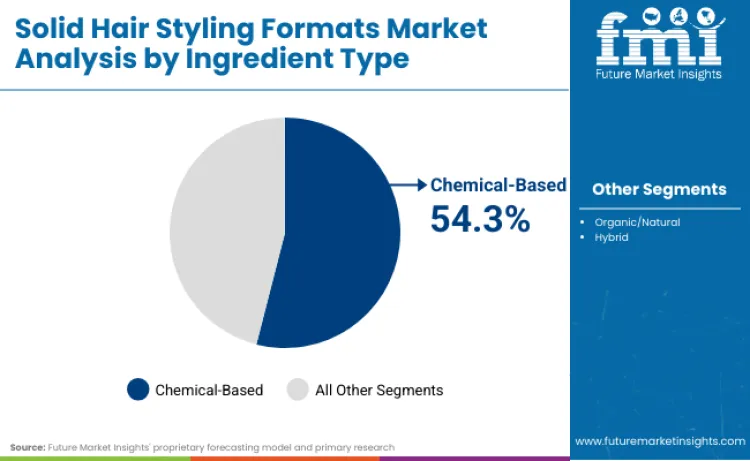
Chemical-based formulations dominate the solid hair styling formats market with a 54.3% share, supported by their ability to deliver consistent hold, texture control, and styling durability across diverse hair types and usage conditions. Factors supporting this dominance include superior formulation stability, predictable performance across humidity and temperature variations, and long shelf life suited for mass distribution. Chemical-based systems also enable precise tuning of hold strength and finish, which remains critical for daily grooming routines requiring repeatable results. Industry formulation trends during 2024-2026 indicate continued reliance on synthetic polymers and fixatives to meet performance benchmarks that hybrid or natural alternatives struggle to match at scale. Their compatibility with high-volume manufacturing and broad retail channels further reinforces adoption. These dynamics position chemical-based formulations as the performance backbone of solid hair styling formats, sustaining their leadership as the market expands toward routine-driven, everyday grooming use.
Why do Supermarkets/Hypermarkets lead adoption?
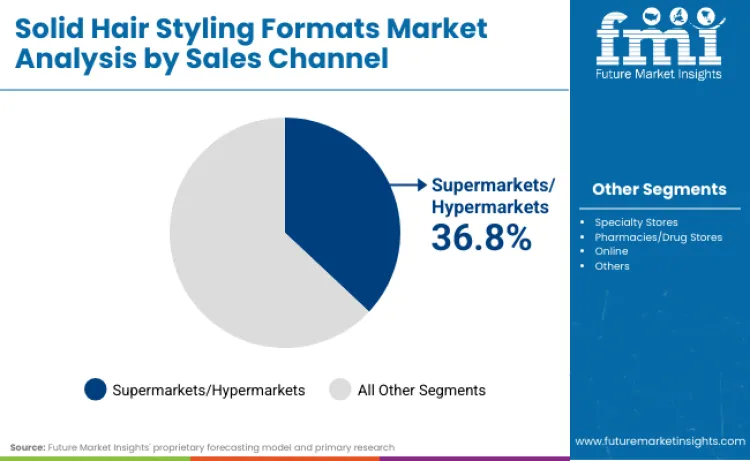
Supermarkets and hypermarkets lead adoption in the solid hair styling formats market, holding a 36.8% share, as they remain the primary channel for routine personal care replenishment. These outlets capture high footfall from consumers purchasing grooming products alongside daily essentials, creating frequent, repeat exposure to solid styling formats. This channel dominance is significant because solid hair gels, waxes, and sticks are increasingly treated as habitual, low-involvement purchases rather than specialty items. Large-format retailers favor solid products due to their compact size, lower leakage risk, and longer shelf stability, which simplify inventory handling and reduce in-store losses. Promotional visibility through aisle placement and bundled personal care offerings further accelerates uptake. The economics of this channel matter, as supermarkets and hypermarkets prioritize fast-moving SKUs with predictable turnover, encouraging brands to scale solid formats for mass distribution. As grooming routines normalize solid styling products, this channel continues to anchor volume-led growth through consistent, high-frequency consumer purchasing.
Why Are Concentrated Solid Formats Reshaping Hair Styling Demand?
Concentrated solid hair styling formats are reshaping demand by addressing inefficiencies long associated with liquid-based products, including short usage cycles, bulky packaging, and transport losses. Solid gels, waxes, and sticks eliminate water as a carrier, allowing higher functional concentration and longer product life per unit. This shift is important because hair styling products are used frequently, making durability and consistency critical for repeat purchase. According to Future Market Insights, water-free formulations also improve structural stability, reducing separation and leakage during storage and transit. Large consumer goods companies such as The Procter & Gamble Company and Unilever PLC have expanded solid and semi-solid personal care portfolios, reflecting broader confidence in concentrated formats as scalable, mainstream solutions rather than niche alternatives.
How Is Performance Engineering Replacing Novelty-Led Adoption?
The evolution of solid hair styling formats is increasingly driven by performance engineering rather than novelty appeal. Early adoption was supported by portability and sustainability positioning, but sustained growth now depends on formulation reliability. Manufacturers are refining polymer systems, wax matrices, and binding agents to improve spreadability, hold duration, and texture control across different hair types and climates. This transition matters because consumers expect solid formats to match the predictability of liquids in daily grooming routines. Companies such as L’Oréal S.A. and Kao Corporation have invested in advanced formulation science to standardize styling outcomes across solid formats. As performance parity improves, solid styling products are increasingly treated as primary grooming tools rather than experimental substitutes.
What Role Do Retail Economics and Brand Scaling Play in Market Expansion?
Retail and distribution economics play a decisive role in accelerating adoption of solid hair styling formats. Compared with liquids, solid products are easier to store, ship, and merchandise due to compact size, lower leakage risk, and longer shelf stability. These advantages align well with high-turnover retail models that prioritize inventory efficiency and predictable replenishment. Specialty beauty retailers and mass outlets increasingly favor solid formats that reduce operational complexity while maintaining consistent margins. Brands under groups such as Shiseido Company, Limited and Henkel AG & Co. KGaA have scaled solid styling SKUs across multiple channels, reinforcing visibility and repeat purchase. As retail normalization continues, solid formats are becoming embedded within routine grooming assortments, supporting sustained value growth through 2036.
What is Solid Hair Styling Formats Market Regional Outlook?
Growth patterns for solid hair styling formats show clear regional variation when compared with the global expansion rate of 5.8%, reflecting differences in grooming frequency, retail access, and openness to compact styling solutions. China shows the fastest momentum with a 7.83% CAGR, supported by strong uptake of men’s styling products and widespread availability across mass retail and online platforms. India follows at 7.25%, driven by urban lifestyle shifts and rising preference for travel-friendly, long-lasting grooming products.
In Germany, growth reaches 6.67%, shaped by sustainability-aware consumers and strong specialty and pharmacy retail penetration. Brazil records a 6.09% CAGR, broadly tracking global trends as solid formats gain mainstream visibility. The United States grows at 5.51%, reflecting a mature but steadily transitioning market. Growth in the United Kingdom stands at 4.93%, while Japan, at 4.35%, remains more restrained due to strong loyalty toward conventional liquid styling products.
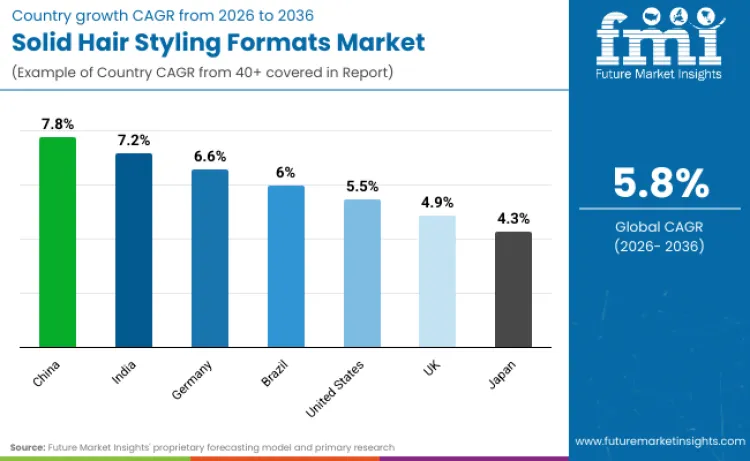
| Country | CAGR (2026 to 2036) |
|---|---|
| China | 7.8% |
| India | 7.2% |
| Germany | 6.6% |
| Brazil | 6% |
| United States | 5.5% |
| UK | 4.9% |
| Japan | 4.3% |
Source: FMI historical analysis and forecast data.
Why is China Emerging as the Fastest-Growing Market for Solid Hair Styling Formats?
China’s 7.83% CAGR is being driven by rapid normalization of compact, waterless grooming products and strong acceptance of performance-focused personal care solutions. Urban consumers are highly receptive to styling formats that suit mobile lifestyles, limited storage space, and frequent on-the-go use. Solid hair gels, waxes, and sticks align well with China’s e-commerce-led purchasing behavior, where lightweight, non-leak formats perform better in repeat orders and bundled grooming kits. Both domestic and multinational brands are expanding solid styling assortments, improving availability and format awareness across mass and digital channels. Growth is shaped less by population factors and more by increased styling frequency and active substitution of liquid products with longer-lasting solid alternatives that fit daily grooming routines.
What is Supporting Strong Growth in India?
India’s solid hair styling formats market is expanding at a 7.25% pace, supported by evolving grooming habits among younger, urban consumers and a broader personal care spending uptick. Daily styling is becoming more routine-oriented, increasing demand for compact products that are easy to store and carry as lifestyles grow busier and travel-heavy. Solid gels and related formats align well with India’s growing hair styling products market, which includes popular offerings such as Set Wet and other styling gels available widely online and in stores, indicating strong product penetration across segments. Retailers like Nykaa are expanding access to grooming and styling solutions across physical and digital channels, helping consumers discover and repeat purchase new formats. Domestic manufacturers including Marico (with Set Wet and Livon hair care) and personal care incumbents are also broadening portfolios to capture rising interest in efficient, value-oriented styling solutions amid rising disposable incomes and urban grooming trends.
Why is Germany Showing Stronger Growth in Solid Hair Styling Formats?
Germany’s 6.67% growth reflects structured grooming behavior and strong alignment with sustainability-led consumption. Consumers show readiness to adopt solid styling products that reduce packaging while maintaining high standards for quality and performance. Specialty beauty retailers and pharmacy channels reinforce trust, especially for formats positioned for everyday styling rather than occasional use. Purchasing decisions are typically deliberate, driven by durability, ingredient clarity, and efficiency. Solid formats appeal to consumers seeking reduced waste without compromising reliability. This measured but consistent transition toward compact styling solutions keeps Germany’s growth rate above the global average.
Why is Brazil Showing Steady Growth in Solid Hair Styling Formats?
Brazil’s market is growing steadily at 6.09%, supported by climate-driven grooming needs and rising middle-income consumption. Warm temperatures and humidity increase the need for frequent styling and reliable hold, making solid formats practical for daily use. Portability and storage ease add to their appeal for work and travel routines. Expanding access through supermarkets, specialty stores, and online platforms is improving trial and repeat usage. Solid styling products are increasingly viewed as dependable everyday tools rather than niche options, supporting consistent adoption across major urban population centers.
Why is Growth in the United States More Gradual?
The United States shows a 5.51% growth rate, reflecting cautious but steady adoption of solid hair styling formats. Demand is primarily driven by convenience-oriented consumers, frequent travelers, and digital-first shoppers seeking compact products. However, strong household loyalty to liquid styling products limits rapid switching. Solid formats are often added as complementary options rather than full replacements within grooming routines. Adoption progresses through e-commerce, subscription models, and specialty retail, supporting stable demand expansion without abrupt displacement of established liquid-based styling products.
How is the Competition in the Solid Hair Styling Formats Market?
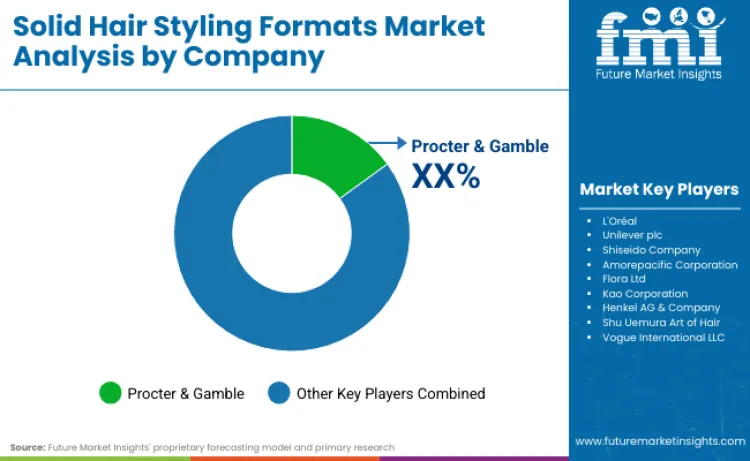
Competition in the solid hair styling formats market is shaped by the dominance of large, diversified personal care companies that leverage scale, brand equity, and global distribution to maintain leadership. Players such as The Procter & Gamble Company, L’Oréal S.A., and Unilever PLC anchor the market through extensive grooming portfolios that span styling, cleansing, and treatment products. Procter & Gamble holds a leading position with an estimated 17.9% share, supported by strong penetration across mass-market and men’s grooming segments. Their ability to bundle solid styling formats with adjacent hair care products strengthens retailer relationships and raises switching barriers for smaller entrants.
Japanese and Korean beauty leaders such as Shiseido Company, Limited, Kao Corporation, and Amorepacific Corporation compete through formulation precision, premium branding, and strong specialty retail presence. Henkel AG & Co. KGaA benefits from its dual presence in consumer and professional hair care channels, enabling cross-channel adoption. Brand-focused players such as Shu Uemura Art of Hair and Vogue International LLC intensify competition in premium and textured-hair niches. Competition is shifting from rapid SKU expansion toward formulation optimization, channel efficiency, and brand-led differentiation as solid formats become mainstream grooming staples.
Recent Developments:
- In October 2024, Unilever PLC expanded its low-water and compact personal care portfolio across select Asia Pacific markets, incorporating solid and concentrated styling formats within its hair care range. This move supports Unilever’s broader packaging-reduction and formulation-efficiency strategy, while improving accessibility of travel-friendly and long-lasting styling products through mass retail and e-commerce channels.
- In February 2025, L’Oréal S.A. accelerated investment in solid and anhydrous hair product innovation through its Research & Innovation division, focusing on improving polymer performance, texture control, and consumer sensory experience in non-liquid formats. The initiative strengthens L’Oréal’s ability to scale solid styling products across both professional and consumer portfolios as part of its sustainability-linked product roadmap.
- In January 2026, The Procter & Gamble Company announced capacity upgrades across selected grooming manufacturing sites to support higher output of compact and concentrated personal care products, including solid and semi-solid hair styling formats. This expansion improves supply reliability for mass-market distribution and aligns with P&G’s focus on efficiency, reduced material usage, and repeat-use grooming solutions.
Key Players in Solid Hair Styling Formats Market
- Procter & Gamble
- L'Oréal
- Unilever plc
- Shiseido Company
- Amorepacific Corporation
- Flora Ltd
- Kao Corporation
- Henkel AG & Company
- Shu Uemura Art of Hair
- Vogue International LLC
Market Definition
The solid hair styling formats market represents revenue generated from the sale of non-liquid hair styling products designed to provide hold, texture, shape, and finish without the use of water-based carriers. As operationally defined in the report, the market measures the commercial value of finished solid and semi-solid styling products sold through retail and professional channels to end consumers.
The market includes solid hair gels, waxes, pomades, sticks, creams, and related compact styling formats formulated using chemical-based, organic or natural, and hybrid ingredient systems. It covers products used by men, women, and unisex consumers across supermarkets and hypermarkets, specialty beauty stores, pharmacies and drug stores, online platforms, and other retail outlets. Revenue generated from branded consumer sales across mass, premium, and professional segments is included.
The market excludes liquid sprays, mousses, foams, aerosols, and water-based creams, as well as salon services, styling tools, and appliances. Raw material sales, contract manufacturing services, and non-styling hair care products such as shampoos, conditioners, and treatments are not counted as part of the solid hair styling formats market.
Scope of Report
| Items | Values |
|---|---|
| Quantitative Units (2026) | USD 25.4 Billion |
| Product Type Segments | Hair Gels; Hair Sprays; Hair Mousse; Hair Wax; Hair Pomades; Hair Creams; Others |
| Ingredient Type Segments | Chemical-Based; Organic/Natural; Hybrid |
| Sales Channel Segments | Supermarkets/Hypermarkets; Specialty Stores; Pharmacies/Drug Stores; Online; Others |
| End-User Segments | Men; Women; Unisex |
| Regions Covered | North America, Latin America, Europe, East Asia, South Asia, Middle East & Africa |
| Countries Covered | United States, China, India, Brazil, Germany, United Kingdom, Japan + 40+ countries |
| Key Companies Profiled | Procter & Gamble; L’Oréal; Unilever plc; Shiseido Company; Amorepacific Corporation; Flora Ltd; Kao Corporation; Henkel AG & Company; Shu Uemura Art of Hair; Vogue International LLC |
| Additional Attributes | Packaging reduction impact, anhydrous formulation efficiency, cost-per-use optimization, retail loss and leakage mitigation, e-commerce logistics suitability, repeat purchase cycle normalization, formulation stability across climates, mass-retail inventory efficiency, supply chain resilience analysis |
Source: FMI historical analysis and forecast data.
Key Segments
By Product Type:
- Hair Gels
- Hair Sprays
- Hair Mousse
- Hair Wax
- Hair Pomades
- Hair Creams
- Others
By Ingredient Type:
- Chemical-Based
- Organic/Natural
- Hybrid
By Sales Channel:
- Supermarkets/Hypermarkets
- Specialty Stores
- Pharmacies/Drug Stores
- Online
- Others
By End User:
- Men
- Women
- Unisex
By Region:
- North America
- Europe
- Asia Pacific
- Latin America
- Middle East & Africa
Bibliography
- International Journal of Cosmetic Science. (2023). Film-forming polymers and fixation systems in modern hair styling products. International Journal of Cosmetic Science, 45(4), 356-369.
- Journal of Cosmetic Science. (2024). Stability and performance of anhydrous cosmetic formulations under varied climatic conditions. Journal of Cosmetic Science, 75(2), 91-108.
- Organisation for Economic Co-operation and Development. (2023). Product concentration, packaging reduction, and logistics efficiency in consumer goods. OECD Industry Policy Papers.
- United Nations Environment Programme. (2024). Packaging reduction and material efficiency in personal care products. UNEP Technical Report.
Frequently Asked Questions
What is the current global market size for Solid Hair Styling Formats?
The global solid hair styling formats market is valued at USD 25.4 billion in 2026, supported by rising adoption of waterless, compact grooming products designed for regular daily use.
What is the projected CAGR for the Solid Hair Styling Formats market?
Sales are projected to grow at a 5.8% CAGR from 2026 to 2036, driven by normalization of solid formats within everyday hair styling routines.
Which segment currently dominates the Solid Hair Styling Formats market?
Hair gels lead product demand with a 28.6% share, while chemical-based formulations dominate ingredient usage, accounting for 54.3% of total market value.
What are the primary drivers supporting market growth globally?
Key drivers include demand for waterless and low-waste products, longer usage cycles, improved portability, and strong alignment with e-commerce and mass-retail logistics requirements.
Who are the leading players in the Solid Hair Styling Formats market?
The market is led by large personal care groups such as Procter & Gamble, L’Oréal, and Unilever plc, alongside strong competition from Shiseido Company, Kao Corporation, and Henkel AG & Co. KGaA across mass, premium, and professional channels.
Preview the report firsthand - request a free sample
Get SampleGet the brochure for pricing and purchase details.
Get PDFTable of Content
- Executive Summary
- Global Market Outlook
- Demand Side Trends
- Supply Side Trends
- Technology Roadmap Analysis
- Analysis and Recommendations
- Market Overview
- Market Coverage / Taxonomy
- Market Definition / Scope / Limitations
- Research Methodology
- Chapter Orientation
- Analytical Lens and Working Hypotheses
- Market Structure, Signals, and Trend Drivers
- Benchmarking and Cross-market Comparability
- Market Sizing, Forecasting, and Opportunity Mapping
- Research Design and Evidence Framework
- Desk Research Programme (Secondary Evidence)
- Expert Input and Fieldwork (Primary Evidence)
- Governance, Ethics, and Data Stewardship
- Tooling, Models, and Reference Databases
- Data Engineering and Model Build
- Data Acquisition and Ingestion
- Cleaning, Normalisation, and Verification
- Synthesis, Triangulation, and Analysis
- Quality Assurance and Audit Trail
- Market Background
- Market Dynamics
- Drivers
- Restraints
- Opportunities
- Trends
- Scenario Forecast
- Demand in Optimistic Scenario
- Demand in Likely Scenario
- Demand in Conservative Scenario
- Opportunity Map Analysis
- Product Life Cycle Analysis
- Supply Chain Analysis
- Investment Feasibility Matrix
- Value Chain Analysis
- PESTLE and Porter's Analysis
- Regulatory Landscape
- Regional Parent Market Outlook
- Production and Consumption Statistics
- Import and Export Statistics
- Market Dynamics
- Global Market Analysis 2021 to 2025 and Forecast, 2026 to 2036
- Historical Market Size Value (USD Billion) Analysis, 2021 to 2025
- Current and Future Market Size Value (USD Billion) Projections, 2026 to 2036
- Y-o-Y Growth Trend Analysis
- Absolute $ Opportunity Analysis
- Global Market Pricing Analysis 2021 to 2025 and Forecast 2026 to 2036
- Y-o-Y Growth Trend Analysis 2021 to 2025
- Absolute $ Opportunity Analysis 2026 to 2036
- Global Market Analysis 2021 to 2025 and Forecast 2026 to 2036, By Product Type
- Introduction / Key Findings
- Historical Market Size Value (USD Billion), 2021 to 2025
- Current and Future Market Size Value (USD Billion), 2026 to 2036
- Hair Gels
- Hair Sprays
- Hair Mousse
- Hair Wax
- Hair Pomades
- Hair Creams
- Others
- Y-o-Y Growth Trend Analysis
- Absolute $ Opportunity Analysis
- Global Market Analysis 2021 to 2025 and Forecast 2026 to 2036, By Ingredient Type
- Introduction / Key Findings
- Historical Market Size Value (USD Billion), 2021 to 2025
- Current and Future Market Size Value (USD Billion), 2026 to 2036
- Chemical-Based
- Organic / Natural
- Hybrid
- Y-o-Y Growth Trend Analysis
- Absolute $ Opportunity Analysis
- Global Market Analysis 2021 to 2025 and Forecast 2026 to 2036, By Sales Channel
- Introduction / Key Findings
- Historical Market Size Value (USD Billion), 2021 to 2025
- Current and Future Market Size Value (USD Billion), 2026 to 2036
- Supermarkets / Hypermarkets
- Specialty Stores
- Pharmacies / Drug Stores
- Online
- Others
- Y-o-Y Growth Trend Analysis
- Absolute $ Opportunity Analysis
- Global Market Analysis 2021 to 2025 and Forecast 2026 to 2036, By End User
- Introduction / Key Findings
- Historical Market Size Value (USD Billion), 2021 to 2025
- Current and Future Market Size Value (USD Billion), 2026 to 2036
- Men
- Women
- Unisex
- Y-o-Y Growth Trend Analysis
- Absolute $ Opportunity Analysis
- Global Market Analysis 2021 to 2025 and Forecast 2026 to 2036, By Region
- Introduction
- Historical Market Size Value (USD Billion), 2021 to 2025
- Current and Future Market Size Value (USD Billion), 2026 to 2036
- North America
- Latin America
- Europe
- East Asia
- South Asia
- Middle East & Africa
- Market Attractiveness Analysis By Region
- Country-wise Market Analysis and Forecast, 2026 to 2036
- China
- India
- Germany
- Brazil
- United States
- United Kingdom
- Japan
- Market Structure Analysis
- Competition Dashboard
- Competition Benchmarking
- Market Share Analysis of Top Players
- By Product Type
- By Region
- Competition Analysis
- Competition Deep Dive
- Procter & Gamble
- L’Oréal
- Unilever plc
- Shiseido Company
- Amorepacific Corporation
- Flora Ltd
- Kao Corporation
- Henkel AG & Company
- Shu Uemura Art of Hair
- Vogue International LLC
- Competition Deep Dive
- Assumptions & Acronyms Used


