

- Industry Size (2026)
- USD 0.8 Bn
- Forecast (2036)
- USD 1.7 Bn
- CAGR (2026 to 2036)
- 7.5%
Solid Under-Eye Masks Market Forecast and Outlook 2026 to 2036
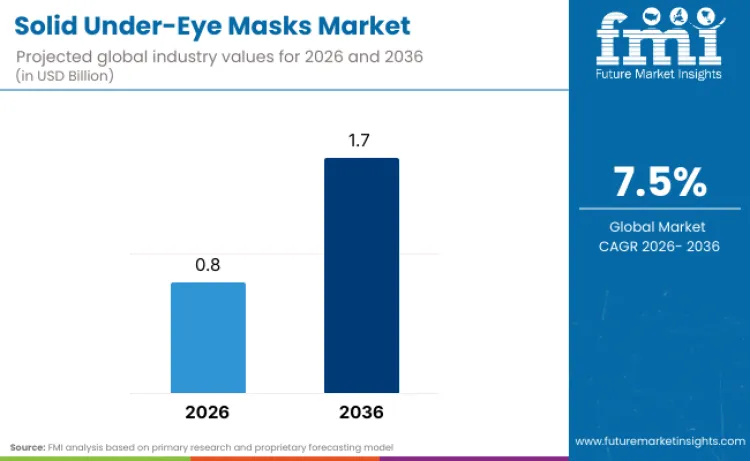
The global solid under-eye masks market is projected to reach a valuation of USD 0.8 billion in 2026 and accelerate to USD 1.7 billion by 2036, expanding at a steady 7.5% CAGR. Demand for solid under-eye masks, as per Future Market Insights, is being driven by the convergence of skinification trends, rising consumer focus on targeted eye-area treatments, and the rapid shift toward waterless, travel-friendly skincare formats. Brands are increasingly positioning solid under-eye masks as high-efficacy solutions for hydration, depuffing, and barrier repair, aligning with minimalist routines and sustainability-led purchasing behavior.
Digital-first beauty platforms are playing a decisive role in shaping category discovery and adoption. Virginie Duigou, Head of Beauty Buying at Zalando, captured this shift by stating: “2025 is proving an exciting year for beauty as we see more products and innovative ingredients enter the market to support much deeper needs. By blending inspiration, entertainment and commerce on Zalando, our ambition is to transform how customers engage with beauty online.” This perspective underscores how immersive commerce models are accelerating trial of niche formats such as solid under-eye masks.
Manufacturers are responding by investing in sensorial textures, concentrated actives, and dermatologist-aligned claims to elevate solid under-eye masks from novelty items to regimen-critical skincare tools. Enhanced digital storytelling, influencer-led education, and platform-driven engagement are reinforcing repeat usage and premium positioning, supporting sustained category expansion through 2036.
Summary of Solid Under-Eye Masks Market
What Is Growth Outlook for Solid Under-Eye Masks Market as per Future Market Insights Projection?
Future Market Insights projects the solid under-eye masks market to expand at a CAGR of 7.5% from 2026 to 2036, increasing from USD 0.8 Billion in 2026 to USD 1.7 Billion by 2036.
FMI Research Approach: FMI proprietary forecasting model based on skincare-led self-care adoption, reusable eye-care tool penetration, and premium under-eye treatment demand.
How Do FMI Analysts Perceive Solid Under-Eye Masks Market to Evolve?
FMI analysts perceive the market evolving toward reusable, performance-led eye-care tools integrated into daily skincare rituals to enhance serum efficacy and reduce single-use waste.
FMI Research Approach: Analysis of skinification trends, occlusive therapy science, and sustainability-driven product substitution.
Which Country Holds Largest Share in Global Solid Under-Eye Masks Market?
China holds a significant share of the global solid under-eye masks market, supported by premium skincare rebound, strong e-commerce penetration, and rising demand for targeted eye-area treatments.
FMI Research Approach: FMI country-level revenue modeling based on digital beauty retail growth, fatigue-care demand, and adoption of reusable skincare tools.
How Large Will Solid Under-Eye Masks Market Be by 2036?
The global solid under-eye masks market is projected to reach USD 1.7 Billion by 2036.
FMI Research Approach: FMI long-term revenue forecast derived from repeat-use adoption, premiumization of eye-care routines, and circular beauty scaling.
What Is Definition of Solid Under-Eye Masks Market?
The solid under-eye masks market comprises reusable and solid-format eye-area treatment tools designed to deliver hydration, depuffing, and anti-aging benefits through occlusion and concentrated actives.
FMI Research Approach: FMI market taxonomy and inclusion-exclusion framework aligned with reusable skincare tools and targeted eye-care formats.
What Are Globally Unique Trends Shaping Solid Under-Eye Masks Market?
Globally unique trends include reusable under-eye masks, occlusive skin-tech tools, and integration of eye-care into longevity-focused skincare routines.
FMI Research Approach: Circular beauty assessment, dermatology-aligned innovation tracking, and digital skincare ritual analysis.
Solid Under-Eye Masks Market Key Takeaways
| Metric | Details |
|---|---|
| Industry Size (2026) | USD 0.8 Billion |
| Industry Value (2036) | USD 1.7 Billion |
| CAGR (2026-2036) | 7.5% |
Source: Future Market Insights (FMI) analysis, based on proprietary forecasting model and primary research
Why is the Demand for Solid Under-Eye Masks Accelerating Within Skincare Portfolios?
Future Market Insights analysts perceive the solid under-eye masks market gaining momentum as consumer spending continues to structurally shift toward skincare-led self-care routines. Eye-area treatments sit squarely within the skincare segment, which is increasingly capturing wallet share from traditional color cosmetics as consumers prioritize preventative skin health, fatigue management, and long-term appearance outcomes. This reallocation of spend reflects a durable post-pandemic behavioral change rather than a short-term trend, reinforcing consistent demand for targeted formats such as under-eye masks.
Category-level performance data from mass-premium retailers validates this transition. Kecia Steelman, CEO of Ulta Beauty, emphasized this shift by stating: "Skincare and Wellness grew its share to 25% from 24% of total sales. This suggests a durable, post-pandemic consumer focus on self-care and skin health is continuing to gain traction over traditional color cosmetics." This expansion of skincare’s share directly benefits sub-categories such as under-eye masks, which are positioned as high-frequency, problem-solution products addressing puffiness, dark circles, and early signs of aging.
How is the Solid Under-Eye Masks Market Segmented?
The market for solid under-eye masks is segmented into Product Type (hydrogel under-eye masks and patches, collagen or bio-cellulose masks, and serum-infused or hybrid solid masks), Application (dark circles treatment, puffiness or under-eye bags reduction, fine lines and wrinkles or anti-aging, and hydration and brightening), and Distribution Channel (online retail and offline retail). This segmentation reflects how demand is structured around immediate fatigue-related concerns, preventive eye-area skincare routines, and digitally driven discovery and repurchase behavior, with product formats and channels evolving to support concentrated, high-frequency use within modern skincare regimens.
How Does Reusable Material Innovation Secure Market Leadership?
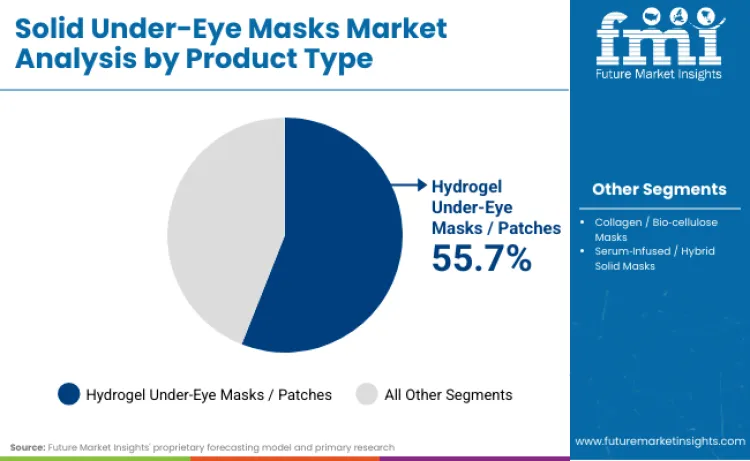
According to Future Market Insights, reusable material innovation is emerging as a decisive leadership driver within the solid under-eye masks market as brands transition the category from single-use accessories to durable, performance-oriented skin-tech tools. With hydrogel under-eye masks and patches accounting for 55.7% of total product-type share, manufacturers are increasingly layering reusable and medical-grade solid formats on top of this dominant base to elevate efficacy, sustainability, and repeat-use economics. Platinum-grade silicone and advanced hydrogel composites are being positioned for their superior occlusive properties, enabling enhanced active penetration when paired with high-performance serums already embedded in consumer routines.
This leadership position is reinforced by broader category dynamics, as skincare now commands approximately 25% of total beauty retail revenue at major platforms, creating favorable conditions for science-driven eye-care formats to scale. Reusable solid under-eye masks align with circular beauty mandates by eliminating recurring waste while maintaining professional-grade results, a value proposition that resonates strongly with efficacy-first consumers. Charlotte Palermino, Cofounder and CEO of Dieux Skin, articulated this shift by stating: "For that product, we just didn't understand why sheet masks had to exist. The serums on your counter tend to be of better quality and the mechanism that made sheet masks work was that occlusive layer to help plump the skin. We wanted to rethink the ritual."
How Does Environmental Sustainability Drive Demand for Solid Under-Eye Masks?
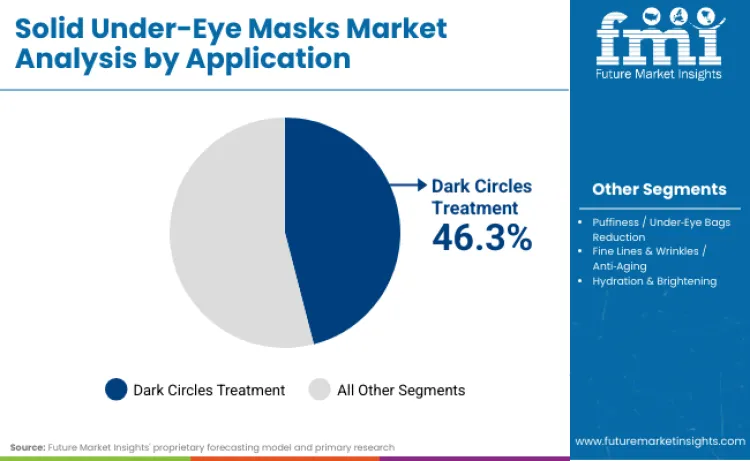
Future Market Insights identifies environmental sustainability as a primary demand catalyst reshaping the solid under-eye masks market, particularly as reusable formats transition from niche tools to core skincare essentials. Within this landscape, dark circles treatment represents the largest application segment, accounting for 46.3% of total market demand, reflecting consumer prioritization of fatigue-linked eye concerns that benefit from repeated, occlusive treatment rather than disposable use. Reusable solid under-eye masks align directly with this need by enabling daily or routine application without generating single-use waste, reinforcing both clinical consistency and circular beauty objectives.
This demand shift is occurring alongside a broader structural expansion of skincare, which now captures approximately 23-25% of total beauty revenue at major retailers, creating favorable conditions for tool-based, efficacy-led categories to scale. Senior leadership across global beauty groups increasingly frame reusable eye masks as "skin-tech essentials" that enhance serum performance while reducing environmental impact. Barbara Lavernos, Deputy CEO in charge of Research, Innovation and Technology at L’Oréal Groupe, underscored this direction by stating: "This 2025 edition is L’Oréal’s boldest VivaTech yet, with future-ready, high-impact innovations for longevity, sustainability, consumer care, and creative services that together, represent a new era of tech-powered beauty."
How Are Skincare Ritual Guidelines Influencing Integrated Tool Adoption?
Industry evolution within the solid under-eye masks market is being shaped by a shift away from sequential, product-by-product routines toward integrated skincare rituals designed to deliver superior biological outcomes. Senior executives at global beauty groups increasingly frame reusable solid under-eye masks as "Grade A" tools within clinically backed routines, where mechanical occlusion is used to amplify serum penetration, improve ingredient bioavailability, and standardize results across repeated use. This transition reflects the broader repositioning of skincare from cosmetic enhancement to skin health optimization, with reusable masks functioning as delivery systems rather than disposable accessories. Stéphane de La Faverie, President and CEO of Estée Lauder, reinforced this strategic direction by stating: "We are realigning our innovation portfolio to deliver gross margin accretive product quicker and better capture faster growing industry trends in skincare with Ignite, Longevity and Derms." This realignment is accelerating adoption of integrated tool based rituals across premium and masstige skincare portfolios.
Why Is Digital Health and Sustainability Infrastructure Reshaping Delivery Models?
The expansion of beauty tech platforms and sustainable materials infrastructure is fundamentally altering how consumers access and use under-eye treatments. Fragmented single-use patches are being replaced by unified, reusable systems that combine high performance materials with digital education and community-led adoption. Reusable solid under-eye masks fit seamlessly into digital-first routines where consumers are guided on pairing tools with existing serums, tracking results, and minimizing waste. Charlotte Palermino, Cofounder and CEO of Dieux Skin, articulated this sustainability-first logic by stating: "We like to say we make good trash - almost everything in the United States ends up in a landfill, so it's important to remember the only truly sustainable thing to do is buy less, and reuse. We always have more work to do, but the eye mask was the first step towards rethinking an entire category and asking; can we make this so you only have to buy it once?" This infrastructure shift is enabling scale without proportional environmental cost, reinforcing repeat use and long-term adoption.
How Are Preventive Skin Longevity Models Creating New Market Segments?
Emerging longevity science and evidence around occlusive therapy are creating new preventive skincare segments focused on delaying early aging and barrier degradation. Solid under-eye masks are increasingly positioned as upstream intervention tools that seal actives against transepidermal water loss, supporting long-term skin resilience rather than episodic correction. This approach is expanding addressable demand among younger, prevention-oriented consumers who view under-eye care as a daily health ritual rather than a reactive treatment. Vincent Warnery, CEO of Beiersdorf, highlighted this shift by stating: "Longevity is top of mind for consumers, and our goal is to lead the way in longevity science by cutting-edge research based on real consumer insights." As preventive skin longevity frameworks gain traction, reusable solid under-eye masks are increasingly embedded into early-stage routines, opening structurally larger and more durable market segments.
How Will the Solid Under-Eye Masks Market Expand Across Key Global Regions?
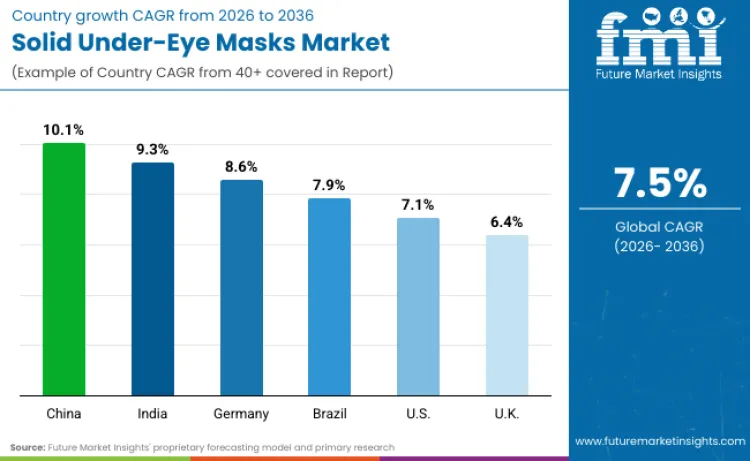
Future Market Insights identifies China (CAGR 10.1%), India (9.3%), Germany (8.6%), Brazil (7.9%), United States (7.1%), and United Kingdom (6.4%) as the six core regional growth engines for the solid under-eye masks market between 2026 and 2036. China leads global expansion due to rapid premium skincare adoption, strong e-commerce penetration, and rising consumer focus on fatigue-related eye concerns linked to urban lifestyles. India’s growth is driven by accelerating skincare digitization, influencer-led education, and increasing uptake of targeted eye-care routines among younger consumers.
Germany’s expansion reflects demand for dermatologically positioned, ingredient-conscious under-eye treatments, supported by pharmacy and specialty retail credibility. Brazil’s growth is anchored in high engagement with beauty rituals, climate-driven demand for hydration and depuffing solutions, and strong social commerce dynamics. The United States benefits from mature skincare routines, high awareness of dark circle correction, and rapid adoption of reusable and premium formats through online channels. The United Kingdom shows comparatively moderate growth, constrained by cost sensitivity, yet supported by sustained interest in sustainable, reusable skincare tools and digital-first brand discovery. FMI emphasizes that across all regions, demand is reinforced by the convergence of skincare-led self-care, sustainability preferences, and digitally enabled distribution infrastructure, creating resilient category expansion through 2036.
| Country | CAGR (2026-2036) |
|---|---|
| China | 10.1% |
| India | 9.3% |
| Germany | 8.6% |
| Brazil | 7.9% |
| United States | 7.1% |
| United Kingdom | 6.4% |
Source: Future Market Insights (FMI) analysis, based on proprietary forecasting model and primary research
Is Premium Skincare Rebound Driving Solid Under-Eye Mask Demand in China?
China is the fastest-expanding regional market for solid under-eye masks, recording a projected 10.1% CAGR from 2026 to 2036. Growth is being driven by a rebound in selective and prestige beauty, where consumers are increasingly prioritizing performance-led and science-backed skincare over mass experimentation. Urban work intensity, prolonged screen exposure, and lifestyle fatigue are amplifying demand for targeted eye-area treatments addressing dark circles, puffiness, and early aging.
High engagement with premium skincare innovations through e-commerce and omnichannel retail is accelerating category adoption, particularly for reusable under-eye formats positioned as long-term regimen tools. As noted by Future Market Insights, China’s advanced digital retail ecosystem and strong acceptance of dermatologist-positioned products are expanding access beyond Tier 1 cities. Ingredient transparency, clinical claims, and livestream education are further reinforcing consumer confidence. Together, premium recovery, digital penetration, and performance credibility are structurally reinforcing China’s leadership through 2036.
How Is Skincare Digitization Accelerating Market Growth in India?
India’s solid under-eye masks market is forecast to expand at a 9.3% CAGR, supported by rapid skincare digitization and rising consumer literacy around ingredients and efficacy. Younger consumers are shifting away from trend-driven beauty toward barrier care, fatigue management, and preventive skin health, embedding eye-area treatments into regular routines.
Social commerce, creator-led education, and mobile-first beauty platforms are central to adoption, lowering entry barriers and normalizing targeted eye-care usage across urban and semi-urban populations. According to Future Market Insights, India’s ongoing premiumization cycle is translating increased awareness into repeat purchases, particularly for products positioned around hydration, depuffing, and long-term skin maintenance. Rising disposable incomes and exposure to global dermatological standards are reinforcing demand for formats that deliver visible results with consistent use. Solid under-eye masks align closely with this shift, making India one of the most structurally resilient growth engines in the global market.
Why Is Dermatological Credibility Supporting Market Expansion in Germany?
Germany’s solid under-eye masks market is projected to grow at an 8.6% CAGR, shaped by strong consumer preference for dermatologically validated and ingredient-conscious skincare. High trust in pharmacy distribution, clinical endorsements, and science-backed claims favors under-eye treatments positioned around intrinsic skin health rather than short-term cosmetic effects.
An aging population, combined with a preventive skincare mindset, is driving consistent demand for eye-area products targeting fine lines, fatigue, and barrier integrity. As highlighted by Future Market Insights, German consumers place significant emphasis on formulation quality and measurable outcomes, supporting adoption of reusable and premium under-eye formats. Specialty retail and derma-focused brands continue to strengthen category credibility, while rigorous regulatory standards reinforce consumer confidence. This convergence of clinical trust, prevention-oriented routines, and performance validation is enabling stable and sustained market expansion across Germany through 2036.
How Do Beauty Ritual Intensity and Social Commerce Drive Growth in Brazil?
Brazil is emerging as a high-engagement growth market for solid under-eye masks, expanding at a 7.9% CAGR during the forecast period. Beauty rituals are deeply embedded in daily lifestyles, creating strong receptivity to performance-driven products that deliver visible hydration, depuffing, and brightening benefits. Climate conditions further intensify demand for eye-area solutions addressing dehydration and swelling.
Social commerce plays a decisive role in category expansion, with influencers and peer-led education accelerating trial and repeat usage. Future Market Insights notes that Brazilian consumers demonstrate a high willingness to adopt innovative skincare tools when efficacy is clearly communicated. Solid under-eye masks benefit from this environment by aligning repeat use with enhanced serum performance and long-term value. As eye-care routines become more structured and prevention-focused, Brazil’s combination of cultural engagement and digital amplification continues to support above-average growth momentum.
Why Is the United States a Stable Growth Engine for Solid Under-Eye Masks?
The United States solid under-eye masks market is expected to grow at a 7.1% CAGR, supported by mature skincare routines and high awareness of targeted eye-area correction. Prestige skincare continues to outperform broader beauty categories, reinforcing demand for high-efficacy formats positioned as skin-tech tools rather than occasional indulgences.
Consumers increasingly view under-eye masks as functional extensions of serum-based routines, particularly for dark circle correction and fatigue management. Online retail and specialty beauty chains accelerate adoption through education-led merchandising, subscription models, and dermatologist influence. As observed by Future Market Insights, rapid uptake of reusable and premium formats is strengthening category resilience. Ingredient literacy, clinical validation, and consistent repurchase behavior collectively underpin stable growth, positioning the United States as a dependable contributor to global market expansion through 2036.
How Is Value Optimization Shaping Moderate but Resilient Growth in the United Kingdom?
The United Kingdom’s solid under-eye masks market is projected to expand at a 6.4% CAGR, reflecting moderate yet resilient growth dynamics. While broader retail conditions remain challenging, consumer demand persists for multifunctional, performance-led skincare tools that justify long-term value. Cost sensitivity is reshaping purchasing behavior toward products that deliver consistent results and integrate seamlessly into daily routines.
Digital-first brand discovery and education-driven commerce continue to support category visibility, even as discretionary spending is more closely scrutinized. According to Future Market Insights, reusable under-eye formats are gaining traction as consumers prioritize durability and repeat usability over disposable alternatives. As skincare routines become leaner and more outcome-focused, solid under-eye masks are increasingly positioned as essential regimen components, supporting steady demand growth across the UK through the forecast horizon.
What Strategic Moves Are Defining Competitive Landscape?
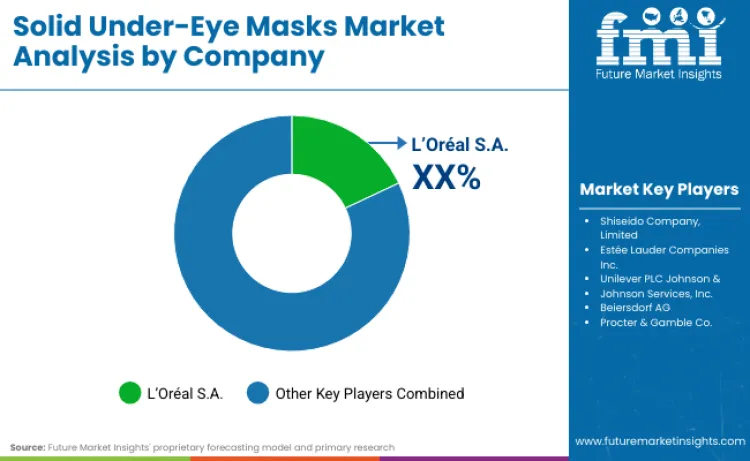
Future Market Insights analysts observe that competition in the solid under-eye masks market is increasingly defined by biotechnological proof points, clinical-grade technology integration, and dermatologist-aligned credibility rather than traditional mass-marketing scale. Leading beauty-tech innovators are investing in proprietary material science and device-led enhancements, including contractile film systems and light-based technologies, to demonstrate visible eye-area remodeling outcomes required for premium positioning. Recognition at global technology forums such as Consumer Electronics Show 2026 has elevated precision skincare tools from accessory status to clinically inspired skin-tech solutions, raising competitive entry barriers and shifting expectations toward measurable performance.
Another defining move is the acceleration of strategic dermo-cosmetic partnerships and equity investments that link consumer skincare with pharmaceutical and medical-grade expertise. Global beauty leaders are actively reinforcing credibility in skin longevity and eye-area science by aligning with dermatology-focused companies, enabling access to advanced research platforms, clinical validation frameworks, and prescription-adjacent innovation pipelines. Nicolas Hieronimus, CEO of L’Oréal Groupe, highlighted this direction in September 2025 by announcing increased strategic investment in Galderma, reinforcing L’Oréal’s position at the intersection of consumer beauty and clinical dermatology.
FMI further highlights that competitive advantage is increasingly secured through integrated portfolios that combine topical formulations, reusable under-eye tools, and clinically informed usage protocols rather than standalone products. Companies pursuing dermatologist partnerships, proprietary material technologies, and medically adjacent acquisitions are creating durable differentiation and higher switching costs, reshaping competition toward evidence-led, clinically integrated eye-care ecosystems through 2036.
Recent Developments:
- In December 2025, Shiseido developed a new "Second Skin" base agent that visibly reduces under-eye bags within two weeks by forming a flexible contractile film that gently compresses skin, stimulates collagen production, and restructures internal skin layers beyond traditional cosmetic action.
- In October 2025, Estée Lauder Companies reported a strong start to fiscal 2026, reaffirming its outlook to restore organic sales growth and improve profitability. CEO Stéphane de La Faverie highlighted progress under the Beauty Reimagined strategy, prestige beauty share gains, and operational agility.
Key Players in Solid Under-Eye Masks Market
- L’Oréal S.A.
- Shiseido Company, Limited
- Estée Lauder Companies Inc.
- Unilever PLC
- Johnson & Johnson Services, Inc.
- Beiersdorf AG
- Procter & Gamble Co.
Market Definition
The solid under-eye masks market comprises reusable and single-format eye-area treatment tools designed to deliver targeted skincare benefits through occlusion, material contact, or integrated active delivery. These products are formulated or engineered to address concerns such as dark circles, puffiness, fine lines, dehydration, and early signs of aging around the periocular region. Solid under-eye masks are positioned as performance-led skincare tools rather than disposable cosmetic accessories and are typically used in combination with serums, essences, or creams to enhance absorption and treatment efficacy. The market spans mass, masstige, and premium price tiers and is distributed through online retail, specialty beauty stores, dermatology clinics, and selected pharmacy channels. Growth is driven by increasing integration of eye-care into daily skincare routines and rising demand for clinically informed, repeat-use solutions.
Market Inclusion
The market includes reusable solid under-eye masks made from materials such as hydrogel composites, silicone-based polymers, collagen matrices, or bio-cellulose structures, whether sold as standalone tools or paired with compatible skincare formulations. It covers products positioned for dark circle correction, puffiness reduction, hydration, brightening, and anti-aging applications. Both consumer-facing and dermatology-aligned brands are included, across online and offline distribution channels. The scope also encompasses hybrid solid formats that combine physical occlusion with embedded or compatible active delivery systems. Products marketed as part of structured skincare routines, skin-tech systems, or eye-area treatment regimens fall within market inclusion, regardless of whether they are positioned for daily, weekly, or intensive-use protocols.
Market Exclusion
The market excludes single-use sheet masks, disposable eye patches, and fabric-based under-eye products intended for one-time application. Traditional topical eye creams, gels, serums, and roll-on applicators without a solid or occlusive mask component are not included. Medical devices intended solely for ophthalmic treatment, post-surgical recovery, or prescription-only therapeutic use are excluded. General facial masks that incidentally cover the eye area but are not designed specifically for under-eye application are outside scope. Makeup products such as concealers or color-correcting patches without a skincare treatment function are also excluded. Additionally, spa-only professional tools not commercially available to consumers are not considered part of the defined market.
Scope of Report
| Items | Values |
|---|---|
| Quantitative Units | USD billion |
| Product Categories | Hydrogel Under-Eye Masks & Patches; Collagen & Bio-cellulose Masks; Serum-Infused & Hybrid Solid Masks; Reusable Silicone & Occlusive Eye Masks |
| Core Application Areas | Dark circles correction; puffiness & under-eye bag reduction; fine lines & wrinkle smoothing; hydration & brightening; barrier repair |
| Formulation & Material Systems | Solid hydrogel composites; collagen & bio-cellulose structures; reusable medical-grade silicone; concentrated serum-infused matrices |
| Functional Positioning | High-efficacy targeted treatment; occlusive delivery enhancement; reusable skin-tech tools; preventive eye-area care |
| Distribution Channels | Online Retail & Direct-to-Consumer; Specialty Beauty Retail; Department Stores; Pharmacies & Drugstores; Other offline formats |
| Consumer Usage Logic | Daily fatigue management; preventive anti-aging routines; serum performance amplification; sustainable reusable skincare tools |
| Regions Covered | North America; Europe; Asia Pacific; Latin America; Middle East & Africa |
| Countries Covered | China; India; Germany; Brazil; United States; United Kingdom; Japan; South Korea; France; and 35+ additional countries |
| Key Companies Profiled | L’Oréal S.A.; Shiseido Company Limited; Estée Lauder Companies; Unilever PLC; Johnson & Johnson; Beiersdorf AG; Procter & Gamble |
| Innovation & Trend Platforms | Reusable skincare tools; occlusive therapy systems; skin-tech ritual integration; sustainable beauty materials; longevity-focused eye care |
Solid Under-Eye Masks Market by Segments
By Product Type:
- Hydrogel Under-Eye Masks & Patches
- Collagen / Bio-Cellulose Masks
- Serum-Infused / Hybrid Solid Masks
By Application:
- Dark Circles Treatment
- Puffiness & Under-Eye Bags Reduction
- Fine Lines & Wrinkles / Anti-Aging
- Hydration & Brightening
By Distribution Channel:
- Online Retail Platforms
- Offline Retail (Specialty Beauty Stores, Pharmacies, Department Stores)
By Region:
- North America
- Europe
- Asia Pacific
- Latin America
- Middle East & Africa
Bibliography
- China National Medical Products Administration (NMPA). (2025). Opinions on deepening the reform of cosmetics regulation and promoting high-quality industry development.
- European Medicines Agency (EMA). (2026). Expert panel support for breakthrough medical devices and CE marking conformity assessment. EMA Regulatory Overview.
- USA Patent and Trademark Office (USPTO) via Google Patents. (2026). Wireless silicone patches for targeted eye rejuvenation and light therapy delivery.
Frequently Asked Questions
What is the current global market size for Solid Under-Eye Masks?
The global solid under-eye masks market is valued at USD 0.8 billion in 2026, driven by rising demand for targeted hydration, depuffing, and reusable skincare formats.
What is the projected CAGR for the Solid Under-Eye Masks market?
The market is projected to expand at a 7.5% CAGR from 2026 to 2036, supported by skincare-led self-care routines and sustainability-focused product adoption.
Which segment currently dominates the market?
Hydrogel under-eye masks and patches dominate with a 55.7% share, while dark circles treatment leads applications at 46.3%.
What are the main factors driving market growth?
Growth is primarily driven by premium skincare rebound, digital beauty commerce, increased focus on eye-area fatigue care, and rising adoption of reusable formats.
Who are the leading companies in the Solid Under-Eye Masks market?
Major players include L’Oréal S.A., Shiseido Company Limited, Estée Lauder Companies Inc., Unilever PLC, Procter & Gamble Co., and Beiersdorf AG.
Preview the report firsthand - request a free sample
Get SampleGet the brochure for pricing and purchase details.
Get PDFTable of Content
- Executive Summary
- Global Market Outlook
- Demand Side Trends
- Supply Side Trends
- Technology Roadmap Analysis
- Analysis and Recommendations
- Market Overview
- Market Coverage / Taxonomy
- Market Definition / Scope / Limitations
- Research Methodology
- Chapter Orientation
- Analytical Lens and Working Hypotheses
- Market Structure, Signals, and Trend Drivers
- Benchmarking and Cross-market Comparability
- Market Sizing, Forecasting, and Opportunity Mapping
- Research Design and Evidence Framework
- Desk Research Programme (Secondary Evidence)
- Company Annual and Sustainability Reports
- Peer-reviewed Journals and Academic Literature
- Corporate Websites, Product Literature, and Technical Notes
- Earnings Decks and Investor Briefings
- Statutory Filings and Regulatory Disclosures
- Technical White Papers and Standards Notes
- Trade Journals, Industry Magazines, and Analyst Briefs
- Conference Proceedings, Webinars, and Seminar Materials
- Government Statistics Portals and Public Data Releases
- Press Releases and Reputable Media Coverage
- Specialist Newsletters and Curated Briefings
- Sector Databases and Reference Repositories
- FMI Internal Knowledge Base and Historical Datasets
- Subscription Datasets and Paid Sources
- Social Channels, Communities, and Digital Listening Inputs
- Additional Desk Sources
- Expert Input and Fieldwork (Primary Evidence)
- Primary Modes
- Qualitative Interviews and Expert Elicitation
- Quantitative Surveys and Structured Data Capture
- Blended Approach
- Why Primary Evidence is Used
- Field Techniques
- Interviews
- Surveys
- Focus Groups
- Observational and In-context Research
- Social and Community Interactions
- Stakeholder Universe Engaged
- C-suite Leaders
- Board Members
- Presidents and Vice Presidents
- R&D and Innovation Heads
- Technical Specialists
- Domain Subject-matter Experts
- Scientists
- Physicians and Other Healthcare Professionals
- Governance, Ethics, and Data Stewardship
- Research Ethics
- Data Integrity and Handling
- Primary Modes
- Tooling, Models, and Reference Databases
- Desk Research Programme (Secondary Evidence)
- Data Engineering and Model Build
- Data Acquisition and Ingestion
- Cleaning, Normalisation, and Verification
- Synthesis, Triangulation, and Analysis
- Quality Assurance and Audit Trail
- Market Background
- Market Dynamics
- Drivers
- Restraints
- Opportunity
- Trends
- Scenario Forecast
- Demand in Optimistic Scenario
- Demand in Likely Scenario
- Demand in Conservative Scenario
- Opportunity Map Analysis
- Product Life Cycle Analysis
- Supply Chain Analysis
- Investment Feasibility Matrix
- Value Chain Analysis
- PESTLE and Porter's Analysis
- Regulatory Landscape
- Regional Parent Market Outlook
- Production and Consumption Statistics
- Import and Export Statistics
- Market Dynamics
- Global Market Analysis 2021 to 2025 and Forecast, 2026 to 2036
- Historical Market Size Value (USD Billion) Analysis, 2021 to 2025
- Current and Future Market Size Value (USD Billion) Projections, 2026 to 2036
- Y-o-Y Growth Trend Analysis
- Absolute $ Opportunity Analysis
- Global Market Pricing Analysis 2021 to 2025 and Forecast 2026 to 2036
- Y-o-Y Growth Trend Analysis 2021 to 2025
- Absolute $ Opportunity Analysis 2026 to 2036
- Global Market Analysis 2021 to 2025 and Forecast 2026 to 2036, By Product Type
- Introduction / Key Findings
- Historical Market Size Value (USD Billion) Analysis By Product Type, 2021 to 2025
- Current and Future Market Size Value (USD Billion) Analysis and Forecast By Product Type, 2026 to 2036
- Hydrogel Under-Eye Masks & Patches
- Collagen / Bio-Cellulose Masks
- Serum-Infused / Hybrid Solid Masks
- Y-o-Y Growth Trend Analysis By Product Type, 2021 to 2025
- Absolute $ Opportunity Analysis By Product Type, 2026 to 2036
- Global Market Analysis 2021 to 2025 and Forecast 2026 to 2036, By Application
- Introduction / Key Findings
- Historical Market Size Value (USD Billion) Analysis By Application, 2021 to 2025
- Current and Future Market Size Value (USD Billion) Analysis and Forecast By Application, 2026 to 2036
- Dark Circles Treatment
- Puffiness & Under-Eye Bags Reduction
- Fine Lines & Wrinkles / Anti-Aging
- Hydration & Brightening
- Y-o-Y Growth Trend Analysis By Application, 2021 to 2025
- Absolute $ Opportunity Analysis By Application, 2026 to 2036
- Global Market Analysis 2021 to 2025 and Forecast 2026 to 2036, By Distribution Channel
- Introduction / Key Findings
- Historical Market Size Value (USD Billion) Analysis By Distribution Channel, 2021 to 2025
- Current and Future Market Size Value (USD Billion) Analysis and Forecast By Distribution Channel, 2026 to 2036
- Online Retail Platforms
- Offline Retail (Specialty Beauty Stores, Pharmacies, Department Stores)
- Y-o-Y Growth Trend Analysis By Distribution Channel, 2021 to 2025
- Absolute $ Opportunity Analysis By Distribution Channel, 2026 to 2036
- Global Market Analysis 2021 to 2025 and Forecast 2026 to 2036, By Region
- Introduction
- Historical Market Size Value (USD Billion) Analysis By Region, 2021 to 2025
- Current Market Size Value (USD Billion) Analysis and Forecast By Region, 2026 to 2036
- North America
- Europe
- Asia Pacific
- Latin America
- Middle East & Africa
- Market Attractiveness Analysis By Region
- North America Market Analysis 2021 to 2025 and Forecast 2026 to 2036, By Country
- Historical Market Size Value (USD Billion) Trend Analysis By Market Taxonomy, 2021 to 2025
- Market Size Value (USD Billion) Forecast By Market Taxonomy, 2026 to 2036
- By Country
- USA
- Canada
- By Product Type
- By Application
- By Distribution Channel
- By Country
- Market Attractiveness Analysis
- By Country
- By Product Type
- By Application
- By Distribution Channel
- Key Takeaways
- Europe Market Analysis 2021 to 2025 and Forecast 2026 to 2036, By Country
- Historical Market Size Value (USD Billion) Trend Analysis By Market Taxonomy, 2021 to 2025
- Market Size Value (USD Billion) Forecast By Market Taxonomy, 2026 to 2036
- By Country
- Germany
- UK
- France
- Rest of Europe
- By Product Type
- By Application
- By Distribution Channel
- By Country
- Market Attractiveness Analysis
- By Country
- By Product Type
- By Application
- By Distribution Channel
- Key Takeaways
- Asia Pacific Market Analysis 2021 to 2025 and Forecast 2026 to 2036, By Country
- Historical Market Size Value (USD Billion) Trend Analysis By Market Taxonomy, 2021 to 2025
- Market Size Value (USD Billion) Forecast By Market Taxonomy, 2026 to 2036
- By Country
- China
- India
- Japan
- South Korea
- Rest of Asia Pacific
- By Product Type
- By Application
- By Distribution Channel
- By Country
- Market Attractiveness Analysis
- By Country
- By Product Type
- By Application
- By Distribution Channel
- Key Takeaways
- Latin America Market Analysis 2021 to 2025 and Forecast 2026 to 2036, By Country
- Historical Market Size Value (USD Billion) Trend Analysis By Market Taxonomy, 2021 to 2025
- Market Size Value (USD Billion) Forecast By Market Taxonomy, 2026 to 2036
- By Country
- Brazil
- Rest of Latin America
- By Product Type
- By Application
- By Distribution Channel
- By Country
- Market Attractiveness Analysis
- By Country
- By Product Type
- By Application
- By Distribution Channel
- Key Takeaways
- Middle East & Africa Market Analysis 2021 to 2025 and Forecast 2026 to 2036, By Country
- Historical Market Size Value (USD Billion) Trend Analysis By Market Taxonomy, 2021 to 2025
- Market Size Value (USD Billion) Forecast By Market Taxonomy, 2026 to 2036
- By Country
- Kingdom of Saudi Arabia
- South Africa
- Rest of Middle East & Africa
- By Product Type
- By Application
- By Distribution Channel
- By Country
- Market Attractiveness Analysis
- By Country
- By Product Type
- By Application
- By Distribution Channel
- Key Takeaways
- Key Countries Market Analysis
- USA
- Pricing Analysis
- Market Share Analysis, 2025
- By Product Type
- By Application
- By Distribution Channel
- China
- Pricing Analysis
- Market Share Analysis, 2025
- By Product Type
- By Application
- By Distribution Channel
- India
- Pricing Analysis
- Market Share Analysis, 2025
- By Product Type
- By Application
- By Distribution Channel
- Germany
- Pricing Analysis
- Market Share Analysis, 2025
- By Product Type
- By Application
- By Distribution Channel
- Brazil
- Pricing Analysis
- Market Share Analysis, 2025
- By Product Type
- By Application
- By Distribution Channel
- UK
- Pricing Analysis
- Market Share Analysis, 2025
- By Product Type
- By Application
- By Distribution Channel
- USA
- Market Structure Analysis
- Competition Dashboard
- Competition Benchmarking
- Market Share Analysis of Top Players
- By Regional
- By Product Type
- By Application
- By Distribution Channel
- Competition Analysis
- Competition Deep Dive
- L’Oréal S.A.
- Shiseido Company, Limited
- Estée Lauder Companies Inc.
- Unilever PLC
- Johnson & Johnson Services, Inc.
- Beiersdorf AG
- Procter & Gamble Co.
- Competition Deep Dive
- Assumptions & Acronyms Used


