

- Industry Size (2026)
- USD 1.5 Bn
- Forecast (2036)
- USD 3.2 Bn
- CAGR (2026 to 2036)
- 7.8%
Solid Conditioner Bars Market Forecast and Outlook 2026 to 2036
The global solid conditioner bars market is forecasted to reach USD 1.5 billion in 2026 and expand to USD 3.2 billion by 2036, advancing at a 7.8% CAGR. As per FMI, this growth reflects a clear shift in hair care science: brands are increasingly using anhydrous, high-concentration formats as credible alternatives to water-heavy liquid conditioners. The change is sticking because the category has moved past one-size-fits-all “eco bars” and toward purpose-built performance bars such as moisturising, volumising, and color-protecting options that are designed to feel and work like premium liquids. Many newer bars also lean on modern conditioning systems, including plant-derived silicone alternatives and cationic conditioners such as BTMS, to deliver the slip, detangling, and nourishment consumers expect.
“When we develop a product, it has to be as good as, if not better than, the leading liquid alternative because people aren't going to give something up just because it's good for the environment."
- Brianne West, Founder & CEO, Ethique
Ethique’s 2025 entry into Ulta Beauty, along with growing visibility at Boots and Woolworths, signals that solid formats are no longer limited to zero-waste stores and are increasingly positioned in mass-premium settings. The underlying rule driving uptake in 2026 is simple: efficacy without compromise. With packaging reduction pressure and waterless beauty innovation moving in the same direction, solid conditioner bars are increasingly set up to become a standard choice for concentrated hair treatment over the next decade.
Quick Stats for Solid Conditioner Bars Market
- Solid Conditioner Bars Industry Value (2026): USD 1.5 Billion
- Solid Conditioner Bars Industry Forecast Value (2036): USD 3.2 Billion
- Solid Conditioner Bars Industry Forecast CAGR: 7.8%
- Solid Conditioner Bars Industry Leading Product: Moisturizing Bars (42.8%)
- Solid Conditioner Bars Industry Key Growth Regions: New Zealand, United Kingdom, Canada, Germany
- Solid Conditioner Bars Industry Key Players: Ethique, Lush, HiBAR, Lamazuna, Foamie
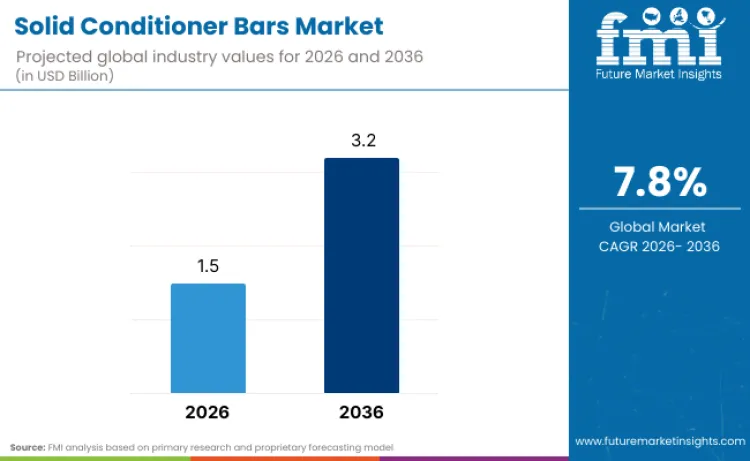
Solid Conditioner Bars Market Key Takeaways
| Metric | Value |
|---|---|
| Market Value (2026) | USD 1.5 billion |
| Market Forecast Value (2036) | USD 3.2 billion |
| Forecast CAGR (2026-2036) | 7.8% |
Source: Future Market Insights - analysis driven by proprietary forecasting models and primary research
Key Shift in the Solid Conditioner Bars Market During 2026 to 2036
Prior to 2026, solid conditioner bars sat on the margins of hair care, often criticised for poor glide, weak detangling, and inconsistent results. Consumer confidence was fragile because performance claims rarely matched lived experience, and few products carried the formulation rigour associated with salon grade conditioning.
By 2026, the segment shifts into what FMI terms the “Anhydrous Efficacy Phase.” Advances in syndet based conditioning systems, precision surfactant pairing, and stabilisation platforms allow bar formats to compete with and in some routines surpass liquids on core KPIs, including comb through, moisture retention, frizz management, and root lift.
The positioning also changes. Conditioner bars are increasingly framed as high concentration “active delivery blocks” within dermaceutical haircare regimens. Brands such as Pantene, leveraging P&G’s “magnet molecule” approach, and Dove Serum Bars under Hindustan Unilever are introducing patented conditioning actives in compact solids, signalling a pivot from virtue messaging toward measurable bioavailability and outcomes.
At the same time, the industrial base is being rebuilt. Manual extrusion and hand shaping are giving way to modular, higher throughput production and more distributed fulfilment. Ethique has adjusted U.S. distribution to localise fulfilment and reduce Scope 3 exposure, while Lush’s “Jigsaw” programme targets shorter manufacturing cycles and lower carbon intensity per SKU amid energy and input cost volatility.
What are the Various Segments of the Solid Conditioner Bars Market?
The solid conditioner bars market is segmented by product type into moisturizing, volumizing, color-protecting, anti-dandruff, and others; by application into household, salons & spas, hotels, and others; by distribution channel into online stores, supermarkets/hypermarkets, specialty stores, and others; by ingredient type into natural, organic, synthetic, and others; and by region into Asia Pacific (China, Japan, South Korea, India, Australia & New Zealand, ASEAN, rest of Asia Pacific), Europe (Germany, United Kingdom, France, Italy, Spain, Nordic, BENELUX, rest of Europe), North America (USA, Canada, Mexico), Latin America (Brazil, Chile, rest of Latin America), and Middle East & Africa (Kingdom of Saudi Arabia, other GCC countries, Turkey, South Africa, other African Union, rest of Middle East & Africa).
Which Product Type Holds the Largest Share in Solid Conditioner Bars?
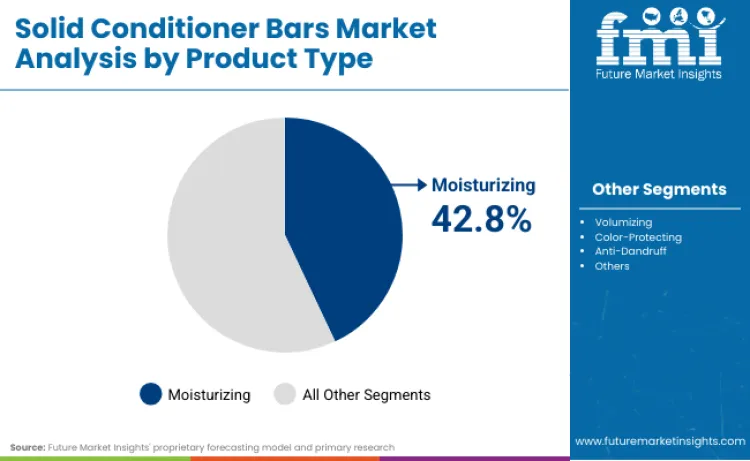
Moisturizing solid conditioners dominate the market with a 42.8% share, supported by their wide applicability across dry, frizzy, and chemically treated hair. They fix the widest, most frequent hair problem: dryness and frizz, amplified by heat styling, coloring, and hard water. Hydration formulas also deliver an immediate, tactile payoff, better slip, easier detangling, less breakage, which drives repeat purchase. Real market behavior reflects this advantage: Ethique’s solid haircare best sellers prominently include its HYDRATING Conditioner Bar, with strong consumer ratings and heavy review volume, signalling where demand concentrates at scale. HiBAR likewise centers its flagship conditioner offer on a “Moisturize” bar for dry, frizzy hair. Lush sells pressed conditioner bars like American Cream positioned as softening
How Do End Use Applications Influence Solid Conditioner Bar Preferences?
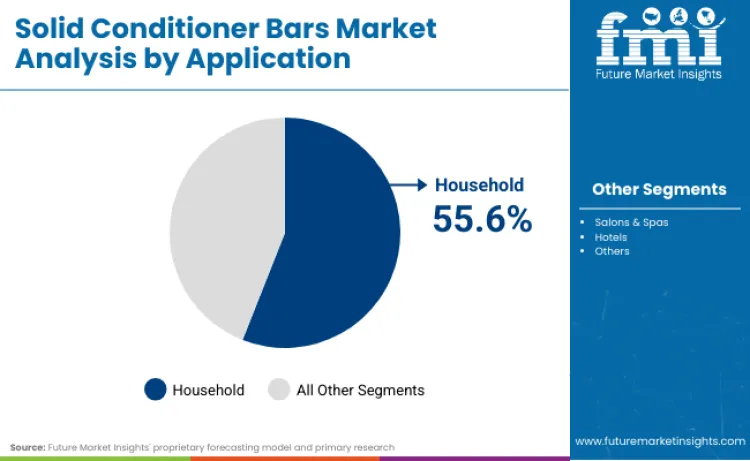
Household use constitutes 55.6% of the market, where eco-conscious buyers seek convenient, sustainable alternatives to liquid conditioners. End use shapes preference because it decides what “good” looks like in real life. Household buyers dominate because solid conditioner bars solve daily friction: no leaks, longer use per unit, easy storage, and a clear plastic reduction story that feels actionable at the bathroom shelf level. This is visible in how mass-loved consumer brands position the format: Lush explicitly sells “zero-waste conditioner bars” alongside liquids, making the bar a mainstream at-home option rather than a niche experiment. Salons and spas care less about the bottle and more about performance, sensoriality, and ingredient clarity, so brands win by claiming professional-grade results with clean formulation logic; HiBAR markets its shampoo and conditioner bars as “salon-quality,” pH-balanced and color-safe, which maps directly to salon expectations around repeatable outcomes and client trust. Hotels optimize for housekeeping efficiency and guest convenience, so compact, spill-proof formats matter, and the category is already showing up in branded offers: a Fairfield by Marriott package in Busan includes a solid amenities kit with a shampoo bar and a conditioner bar, validating real hospitality deployment beyond marketing talk.
Which Distribution Channel is Most Preferred for Solid Conditioner Bars?
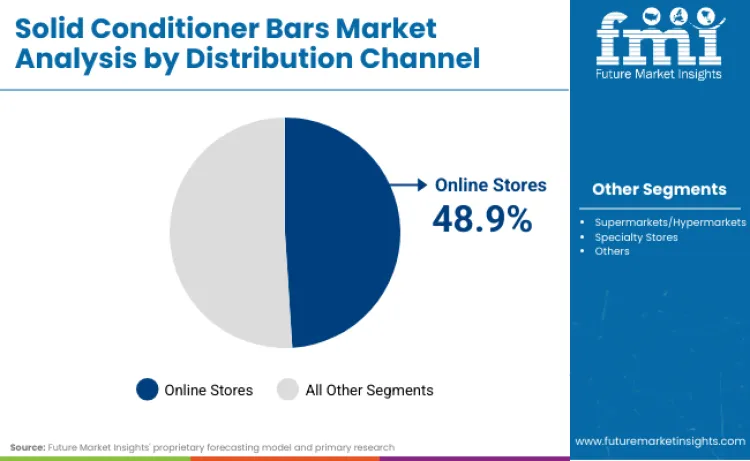
Online channels lead this segment as solid conditioner bars require pre-purchase validation that is hard to deliver in a physical aisle. Adoption depends on fit to hair type, clarity on ingredient function, and correct usage to avoid a poor first experience. Digital storefronts solve this by carrying long-form product education, comparison across variants, reviews at scale, and routine-building guidance that reduces perceived switching risk. The channel also improves unit economics through direct-to-consumer mechanics: bundled sets increase basket size, while subscription and autoship programs smooth replenishment and lift repeat rates for a compact, easy-to-ship format. Brand behavior aligns with this logic.
Kitsch and Viori both operationalize retention through Subscribe and Save structures and multi-product bundles that tie conditioner bars to adjacent shampoo bars and travel kits, reinforcing frequency and cross-sell. This dominance reflects a recent structural shift rather than a long-standing constant. Solid bars have existed for years, but channel power has migrated online as beauty purchasing moved toward e-commerce, with acceleration during the COVID period. Large beauty players now report meaningful e-commerce penetration, reinforcing that discovery and conversion are increasingly captured in digital pathways rather than offline walk-in traffic.
What Structural Drivers Make Solid Conditioner Bars Win Share?
Solid conditioner bars gain traction when the adoption barrier shifts from product novelty to operational logic. The strongest driver is reduced discovery and purchase friction, where mainstream retail access moves bars out of niche zero waste contexts and into mass visibility, a dynamic reflected by broad listings for bar-based haircare in large USA retailers. A second driver is packaging economics created by regulation. When packaging fees and compliance rules make packaging-heavy formats structurally more expensive or administratively burdensome, packaging-light formats become easier to justify, especially under EPR frameworks and formal producer registration systems seen across parts of Western Europe. A third driver comes from institutional demand in hospitality, where plastic reduction policy targeting accommodation supply chains increases the relevance of compact, low-waste toiletry formats.
These drivers do not operate as vague sustainability sentiment. They show up as tangible system-level incentives: retail distribution expands the addressable audience; EPR base fees and packaging registration formalities reward simpler packaging architectures; accommodation-focused plastic rules create a direct use-case pull. Adoption is therefore shaped less by preference and more by channel access, compliance design, and institutional procurement logic.
Which Constraints Slow Adoption Even When Interest Exists?
Constraints emerge when user experience risk or compliance complexity increases the cost of switching. Performance variance is a primary brake in hard water conditions, where mineral content can leave residue and alter conditioning feel, making early trials less reliable and reducing repeat purchase. A second constraint is affordability pressure driven by policy costs. Packaging fees and compliance obligations can raise shelf prices through pass-through dynamics, which matters for premium solid formats that consumers can postpone without functional loss. A third constraint is administrative friction for smaller and cross-border brands, where registration and system participation requirements can slow assortment breadth and experimentation.
Regulatory scope can also limit direct pull. Some plastic reduction regimes focus on specific single-use items and amenity categories rather than shampoo and conditioner formats, making the policy effect indirect rather than mandatory. Additional formulation and compliance diligence is required in environments with microbead restrictions for rinse-off cosmetics, raising the burden on ingredient choices and claims discipline. Finally, uneven enforcement across jurisdictions can create patchwork signals that slow consistent retail rollout, even when national rules exist.
What Recent Shifts Explain Why Momentum Has Increased Lately?
Recent momentum is best explained by a shift in systems, not a sudden change in consumer psychology. Packaging governance has tightened through EPR programs and active recyclability standards maintenance, creating ongoing incentives to reduce packaging complexity and improve packaging outcomes. This shift appears in both state-level packaging frameworks and formal minimum-standard updates that keep packaging optimization on a continuous improvement path. Channel structure is also changing. High-street normalization through listings at major health and beauty retailers expands reach beyond early-adopter online audiences, turning bars into a routine purchase option rather than a specialty hunt.
A parallel shift is visible in product development and distribution pathways. Domestic innovation in parts of Asia positions solid conditioner as a waterless format rather than only an imported niche, while mature recycling and EPR reporting environments favour packaging-light products that are simpler to classify and manage. Marketplace and D2C expansion in India reinforces this shift by placing solid hair formats inside mainstream digital commerce rather than limiting them to boutique channels. Overall, the trend is structural: policy design, retail availability, and compliance mechanics increasingly align with the bar format.
How Is the Solid Conditioner Bars Market Evolving Globally?
Global demand for solid conditioner bars is rising as the category shifts from niche trial to routine replenishment, supported by formulation advances that make anhydrous, high concentration bars competitive on detangling, slip, moisture retention, frizz management, and bar longevity. Growth is increasingly anchored in performance led conversion rather than eco positioning, with brands scaling syndet based systems, smarter surfactant blending, and stabilisation platforms to deliver consistent results across hair types. Expansion is also being reinforced by retail mainstreaming and format normalisation, as consumers encounter conditioner bars in mass premium doors and structured planograms, reducing discovery friction and increasing repeat purchase.
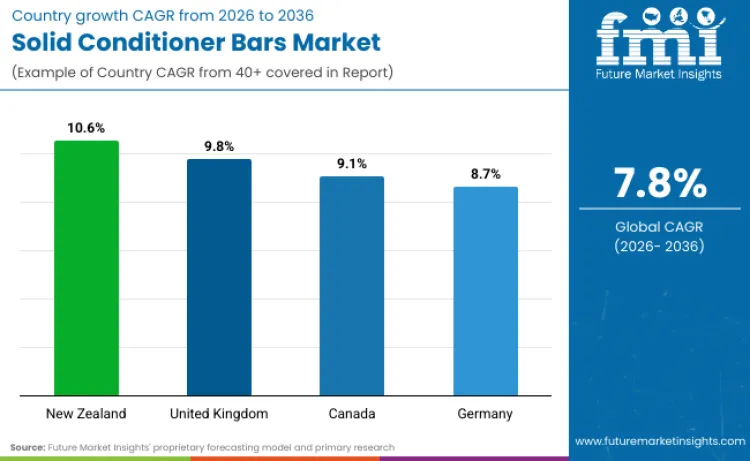
| Country | CAGR (2026 to 2036) |
|---|---|
| New Zealand | 10.6% |
| United Kingdom | 9.8% |
| Canada | 9.1% |
| Germany | 8.7% |
Source: Future Market Insights’ proprietary forecasting model and primary research
United Kingdom Solid Conditioner Bars Market Gaining Ground
The UK market is expanding because the policy stack makes packaging a measurable cost centre, not a background externality. Plastic Packaging Tax applies to plastic packaging manufactured in or imported into the UK that contains under 30% recycled plastic, creating a direct tax exposure for packaging-heavy personal care formats. In parallel, the UK has published base fees for year one of packaging Extended Producer Responsibility for 2025 to 2026, with obligations on organisations that import or supply packaging to report data and pay fees administered by PackUK. Together, these instruments reward formats that structurally reduce packaging use, supporting solid bars as a compliance-efficient architecture rather than a lifestyle choice.
Distribution dynamics reinforce this shift. High-street health and beauty retailers have begun listing conditioner bars, which converts an online discovery product into a walk-in purchase and increases trial velocity through routine retail exposure. Boots lists FRUU conditioner bars, while Superdrug lists multiple conditioner bar SKUs through its assortment and marketplace model.
Canada: Is North America’s “Mass-Premium Shelf Access” Turning Conditioner Bars Into a Standardized Routine Purchase?
Canada’s solid conditioner bar market is expanding through two Canada-specific reasons: winter dryness management and pharmacy-led retail normalization. Health Canada’s indoor air guidance notes that when relative humidity drops below 30%, complaints of dry skin increase, and the National Research Council has documented that Canadian heating seasons commonly produce low indoor relative humidity. This creates everyday need around dryness and frizz control that aligns with moisturizing bar formats, especially during long cold-season indoor heating.
Growth is helped by how Canadians actually buy personal care: large drug retail platforms are carrying conditioner bars within regular haircare aisle trips and tying purchases into loyalty economics. Shoppers Drug Mart lists a conditioner bar SKU and links it to PC Optimum earning and redemption, making it easier to try versus niche-only channels. Domestic product expansion adds another proof point. Montréal-based ATTITUDE launched its Leaves Bars line as a full bar collection, explicitly including conditioner bars, and the product appears in Canadian consumer award listings, signalling mainstream visibility beyond early adopters.
German Solid Conditioner Bar Sales Influenced by High-Trust Product Testing Behavior
Germany is projected to grow at an 8.7% CAGR from 2026 to 2036 as the format is increasingly aligned with Europe’s compliance-driven packaging environment and large-player rollout discipline. Germany’s solid conditioner bar momentum is being pulled by a distinctly German consumer mechanism: high-trust product testing that converts a niche format into a low-risk purchase. Öko-Test ran a dedicated solid conditioner test in October 2025 covering 13 products across a wide price band and reported that many products achieved top recommendations, while also flagging specific ingredients that drew criticism, such as talc, cashmeran, and synthetic polymers. This kind of third-party grading has an outsized impact in Germany because it gives shoppers a simple decision shortcut and forces brands into visible formulation discipline rather than vague claims.
Retail behavior supports the same consumer logic. The bar format is being normalized inside Germany’s dominant drugstore ecosystem, where consumers routinely buy haircare. dm runs an always-on hub for solid shampoo and solid conditioner and publishes usage guidance, reducing trial friction at the shelf and in repeat purchase. Rossmann likewise categorizes solid conditioners within its mainstream conditioner assortment, making the format a standard option rather than a specialty detour.
USA Solid Conditioner Bar Sales Driven by Ingredient Transparency and Consumer Trust
The United States solid conditioner bar market is projected to grow at an 8.1% CAGR from 2026 to 2036, propelled by consumer expectations for safety assurance and ingredient clarity. Unlike Germany’s institutional testing model, the USA market is led by consumer advocacy groups. The Environmental Working Group (EWG) has become central, with its EWG Verified® seal now appearing on numerous bars, signaling compliance with strict safety standards and exclusion of nearly 2,000 harmful substances.
This demand for proof has prompted reformulation, eliminating synthetic fragrances, silicones like Dimethicone, and PFAS. Brands now publish in-home use test results (IHUT), showcasing measurable improvements in shine and detangling to reassure skeptical liquid users.
Major retailers, Target, Ulta, and Walmart, integrate bars within mainstream haircare aisles under “clean” or “sustainable” merchandising hubs, helping normalize the format. Professional salon branding and texture-specific formulations further position conditioner bars as science-backed solutions, not just sustainability accessories. This dual focus on efficacy and transparency is shaping mass adoption.
Which Brands are Gaining Share in Solid Conditioner Bars Market?
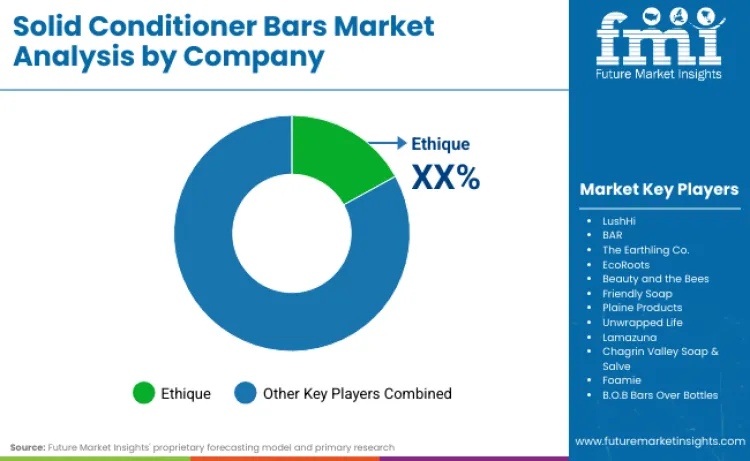
The global solid conditioner bar market is led by brands that already own a repeat purchase haircare relationship and can educate consumers at the shelf without relying on a niche sustainability narrative. Solid conditioner bars are a formulation and usage shift, not a packaging tweak. Winning players control trial, demonstrate performance on hair texture outcomes, and keep consumers inside a simple routine that pairs shampoo bars with matching conditioner bars.
Lush is one of the largest solid conditioner bar player globally. Its leadership is built on vertical control of product creation and a global owned retail footprint that normalizes bar-based routines as mainstream haircare rather than a novelty. Lush has advantage in physical distribution for this format, and it explicitly positions shampoo bars as a core invention story while selling solid conditioners as the companion step in the routine.
Asia is where the gap between global and regional leadership becomes most visible, and Japan is the anchor market for bar based haircare adoption in the region. In Japan, the mass haircare incumbents compete ferociously in liquids, but solid bars gain customer preference based on specialist proposition strength and routine building. Large beauty conglomerates are present in solid bars, but they are not the leaders in solid conditioner bars because their disclosed bar activity has been framed primarily through shampoo, packaging, and water use rather than conditioner performance. L Oréal has documented strong momentum in solid shampoos under Garnier, including statements that the brand doubled sales of solid shampoos, reinforcing that the mass channel push has been shampoo led. This matters competitively because shampoo bars are easier to trial and validate than conditioner bars, so mass players can scale the front door of the routine without necessarily owning the conditioner step that drives loyalty and perceived transformation.
The competitive landscape therefore splits into two power positions. One is the system owner that controls education and routine adoption, which is Lush at global scale. The other is the mass scale follower that can flood retail with bar formats once consumer familiarity exists, which is where groups like L Oréal have built credibility through disclosed solid shampoo traction. Until mass players treat solid conditioner bars as a performance category with repeat purchase economics rather than a packaging adjacent extension, global leadership remains concentrated with the specialist that already owns the bar habit.
Key Players in the Solid Conditioner Bars Market
- Ethique
- Lush
- HiBAR
- The Earthling Co.
- EcoRoots
- Beauty and the Bees
- Friendly Soap
- Plaine Products
- Unwrapped Life
- Lamazuna
- Chagrin Valley Soap & Salve
- Foamie
- B.O.B Bars Over Bottles
- The Solid Bar Company
- Kind2
- Bar None
- Biovène Barcelona
- Bali Secrets
- Nourish Natural Soap
- Viori
Market Definition
The solid conditioner bars market refers to revenues generated from solid, waterless hair conditioning products formulated in bar or pressed solid form and sold for post-cleansing hair treatment. These products are designed to deliver conditioning functions such as detangling, moisture retention, frizz control, cuticle smoothing, and manageability without requiring dilution or liquid carriers. Market size is measured in USD billion and analyzed over the 2026 to 2036 period.
The market includes conditioner bars positioned as primary haircare conditioning solutions for household, professional, and hospitality use. Products are classified based on formulation intent rather than sustainability claims and include syndet-based, plant-based, and hybrid conditioning systems that replicate or exceed the performance of liquid conditioners. The analysis treats solid conditioner bars as a standalone haircare category, distinct from shampoo bars, soap bars, and multipurpose cleansing bars, and attributes revenues only to products explicitly marketed and used as conditioners.
Market Inclusion
Included in the solid conditioner bars market scope are finished, ready-to-use solid conditioning products sold through online and offline retail, professional salon channels, hospitality supply chains, and direct-to-consumer platforms. The scope covers moisturizing, volumizing, color-protecting, anti-dandruff, and function-specific conditioner bars intended for repeated consumer or professional use.
The market includes products formulated with cationic conditioning agents, syndet bases, silicone alternatives, botanical actives, protein complexes, and performance-driven blends designed to condition hair after cleansing. Revenues from conditioner bars sold as part of bundled haircare routines, travel kits, or subscription programs are included where the conditioner component is distinctly priced or identifiable.
Geographically, the scope includes North America, Europe, Asia Pacific, Latin America, and the Middle East & Africa, with country-level analysis for key markets where retail normalization, regulatory alignment, or brand anchoring materially influences adoption.
Market Exclusion
Excluded from the scope are liquid, cream, gel, lotion, or paste-based conditioners regardless of packaging type. Shampoo bars, cleansing bars, soap bars, co-wash bars, and 2-in-1 shampoo-conditioner bars are not included unless the product is explicitly positioned and functionally used as a standalone conditioner.
The market excludes DIY conditioner formulations, bulk salon conditioning treatments not sold in solid bar form, and experimental or prototype products without commercial distribution. Amenities such as single-use hotel conditioner tablets or dissolvable sheets are excluded unless marketed as reusable solid conditioner bars.
Also excluded are revenues from sustainability accessories, packaging substitutes, refill containers, and claims-only eco formats where conditioning performance is not the primary functional proposition. Hair masks, leave-in conditioners, styling bars, and treatment bars with non-rinse applications are outside the defined market boundary.
Scope of the Report
| Items | Values |
|---|---|
| Quantitative Units | USD billion |
| Product Type | Moisturizing Conditioner Bars; Volumizing Conditioner Bars; Color-Protecting Conditioner Bars; Anti-Dandruff Conditioner Bars; Others |
| End-Use Application | Household; Salons & Spas; Hotels & Hospitality; Others |
| Distribution Channel | Online Stores (DTC & Marketplaces); Supermarkets & Hypermarkets; Specialty Beauty Stores; Others |
| Ingredient Type | Syndet-Based Formulations; Plant-Based Conditioning Actives; Essential Oil Infusions; Protein & Botanical Blends; Others |
| Regions Covered | North America, Europe, Asia Pacific, Latin America, Middle East & Africa |
| Countries Covered | New Zealand, United Kingdom, Canada, Germany, United States, France, Japan, Australia, and 40+ countries |
| Key Companies Profiled | Ethique; Lush; HiBAR; Lamazuna; Foamie; The Earthling Co.; Viori; EcoRoots; Friendly Soap; Others |
| Additional Attributes | Dollar sales by product type, application, ingredient type, and distribution channel; performance benchmarking across detangling efficacy, moisture retention, frizz control, and bar longevity; consumer adoption drivers linked to sustainability compliance and performance parity with liquid conditioners; impact on packaging reduction, replenishment frequency, and repeat purchase behavior; supply chain efficiency under waterless beauty manufacturing models; compatibility with salon standards, retail planograms, and regulatory sustainability targets across personal care ecosystems |
Solid Conditioner Bars Market by Segment
Product Type:
- Moisturizing
- Volumizing
- Color-Protecting
- Anti-Dandruff
- Others
Application:
- Household
- Salons & Spas
- Hotels
- Others
Distribution Channel:
- Online Stores
- Supermarkets/Hypermarkets
- Specialty Stores
- Others
Ingredient Type:
- Natural
- Organic
- Synthetic
- Others
Region:
- Asia Pacific
- China
- Japan
- South Korea
- India
- Australia & New Zealand
- ASEAN
- Rest of Asia Pacific
- Europe
- Germany
- United Kingdom
- France
- Italy
- Spain
- Nordic
- BENELUX
- Rest of Europe
- North America
- USA
- Canada
- Mexico
- Latin America
- Brazil
- Chile
- Rest of Latin America
- Middle East & Africa
- Kingdom of Saudi Arabia
- Other GCC Countries
- Turkey
- South Africa
- Other African Union
- Rest of Middle East & Africa
Bibliography
- United States Food and Drug Administration. (2024). Cosmetics - Laws and regulations. USA Department of Health and Human Services, FDA.
- UK Government, Office for Product Safety and Standards. (2024). Guidance on cosmetic product regulation and safety. GOV.UK.
- Cosmetics Europe. (2024). Guidance on cosmetic ingredient safety and product claims. Cosmetics Europe - The Personal Care Association.
Frequently Asked Questions
How big is the global solid conditioner bars market?
The global solid conditioner bars market is valued at USD 1.5 billion in 2026 and is forecast to reach USD 3.2 billion by 2036.
What is the growth outlook for the solid conditioner bars market over the next 10 years?
The category is projected to expand at a 7.8% CAGR from 2026 to 2036, reflecting accelerating conversion from liquid conditioners to concentrated solid formats.
Which product segments or formats drive demand in this market?
Moisturizing conditioner bars lead demand with a 42.8% share, supported by broad suitability across dry, frizzy, and chemically treated hair routines.
How does consumer behavior differ by region?
Adoption is strongest where performance-led bars are retail-normalized fastest, with New Zealand (10.6% CAGR), the United Kingdom (9.8%), Canada (9.1%), and Germany (8.7%) outpacing the global baseline during 2026 to 2036.
What are the main risks and constraints affecting this market?
Growth is constrained where consumers perceive weaker detangling “slip,” inconsistent results across hair types, or higher price-per-use versus liquid alternatives, reducing repeat purchase.
Preview the report firsthand - request a free sample
Get SampleGet the brochure for pricing and purchase details.
Get PDFTable of Content
- Executive Summary
- Global Market Outlook
- Demand Side Trends
- Supply Side Trends
- Technology Roadmap Analysis
- Analysis and Recommendations
- Market Overview
- Market Coverage / Taxonomy
- Market Definition / Scope / Limitations
- Research Methodology
- Chapter Orientation
- Analytical Lens and Working Hypotheses
- Market Structure, Signals, and Trend Drivers
- Benchmarking and Cross-market Comparability
- Market Sizing, Forecasting, and Opportunity Mapping
- Research Design and Evidence Framework
- Desk Research Programme (Secondary Evidence)
- Company Annual and Sustainability Reports
- Peer-reviewed Journals and Academic Literature
- Corporate Websites, Product Literature, and Technical Notes
- Earnings Decks and Investor Briefings
- Statutory Filings and Regulatory Disclosures
- Technical White Papers and Standards Notes
- Trade Journals, Industry Magazines, and Analyst Briefs
- Conference Proceedings, Webinars, and Seminar Materials
- Government Statistics Portals and Public Data Releases
- Press Releases and Reputable Media Coverage
- Specialist Newsletters and Curated Briefings
- Sector Databases and Reference Repositories
- FMI Internal Knowledge Base and Historical Datasets
- Subscription Datasets and Paid Sources
- Social Channels, Communities, and Digital Listening Inputs
- Additional Desk Sources
- Expert Input and Fieldwork (Primary Evidence)
- Primary Modes
- Qualitative Interviews and Expert Elicitation
- Quantitative Surveys and Structured Data Capture
- Blended Approach
- Why Primary Evidence is Used
- Field Techniques
- Interviews
- Surveys
- Focus Groups
- Observational and In-context Research
- Social and Community Interactions
- Stakeholder Universe Engaged
- C-suite Leaders
- Board Members
- Presidents and Vice Presidents
- R&D and Innovation Heads
- Technical Specialists
- Domain Subject-matter Experts
- Scientists
- Physicians and Other Healthcare Professionals
- Governance, Ethics, and Data Stewardship
- Research Ethics
- Data Integrity and Handling
- Primary Modes
- Tooling, Models, and Reference Databases
- Desk Research Programme (Secondary Evidence)
- Data Engineering and Model Build
- Data Acquisition and Ingestion
- Cleaning, Normalisation, and Verification
- Synthesis, Triangulation, and Analysis
- Quality Assurance and Audit Trail
- Market Background
- Market Dynamics
- Drivers
- Restraints
- Opportunity
- Trends
- Scenario Forecast
- Demand in Optimistic Scenario
- Demand in Likely Scenario
- Demand in Conservative Scenario
- Opportunity Map Analysis
- Product Life Cycle Analysis
- Supply Chain Analysis
- Investment Feasibility Matrix
- Value Chain Analysis
- PESTLE and Porter's Analysis
- Regulatory Landscape
- Regional Parent Market Outlook
- Production and Consumption Statistics
- Import and Export Statistics
- Market Dynamics
- Global Market Analysis 2021 to 2026 and Forecast, 2026 to 2036
- Historical Market Size Value (USD Billion) Analysis, 2021 to 2026
- Current and Future Market Size Value (USD Billion) Projections, 2026 to 2036
- Y-o-Y Growth Trend Analysis
- Absolute $ Opportunity Analysis
- Global Market Pricing Analysis 2021 to 2026 and Forecast 2026 to 2036
- Y-o-Y Growth Trend Analysis 2021 to 2026
- Absolute $ Opportunity Analysis 2026 to 2036
- Global Market Analysis 2021 to 2026 and Forecast 2026 to 2036, By Product Type
- Introduction / Key Findings
- Historical Market Size Value (USD Billion) Analysis By Product Type, 2021 to 2026
- Current and Future Market Size Value (USD Billion) Analysis and Forecast By Product Type, 2026 to 2036
- Moisturizing
- Volumizing
- Color-Protecting
- Anti-Dandruff
- Others
- Y-o-Y Growth Trend Analysis By Product Type, 2021 to 2026
- Absolute $ Opportunity Analysis By Product Type, 2026 to 2036
- Global Market Analysis 2021 to 2026 and Forecast 2026 to 2036, By Application
- Introduction / Key Findings
- Historical Market Size Value (USD Billion) Analysis By Application, 2021 to 2026
- Current and Future Market Size Value (USD Billion) Analysis and Forecast By Application, 2026 to 2036
- Household
- Salons & Spas
- Hotels
- Others
- Y-o-Y Growth Trend Analysis By Application, 2021 to 2026
- Absolute $ Opportunity Analysis By Application, 2026 to 2036
- Global Market Analysis 2021 to 2026 and Forecast 2026 to 2036, By Distribution Channel
- Introduction / Key Findings
- Historical Market Size Value (USD Billion) Analysis By Distribution Channel, 2021 to 2026
- Current and Future Market Size Value (USD Billion) Analysis and Forecast By Distribution Channel, 2026 to 2036
- Online Stores
- Supermarkets/Hypermarkets
- Specialty Stores
- Others
- Y-o-Y Growth Trend Analysis By Distribution Channel, 2021 to 2026
- Absolute $ Opportunity Analysis By Distribution Channel, 2026 to 2036
- Global Market Analysis 2021 to 2026 and Forecast 2026 to 2036, By Region
- Introduction
- Historical Market Size Value (USD Billion) Analysis By Region, 2021 to 2026
- Current Market Size Value (USD Billion) Analysis and Forecast By Region, 2026 to 2036
- North America
- Latin America
- Western Europe
- Eastern Europe
- East Asia
- South Asia and Pacific
- Middle East & Africa
- Market Attractiveness Analysis By Region
- North America Market Analysis 2021 to 2026 and Forecast 2026 to 2036, By Country
- Historical Market Size Value (USD Billion) Trend Analysis By Market Taxonomy, 2021 to 2026
- Market Size Value (USD Billion) Forecast By Market Taxonomy, 2026 to 2036
- By Country
- USA
- Canada
- Mexico
- By Product Type
- By Application
- By Distribution Channel
- By Country
- Market Attractiveness Analysis
- By Country
- By Product Type
- By Application
- By Distribution Channel
- Key Takeaways
- Latin America Market Analysis 2021 to 2026 and Forecast 2026 to 2036, By Country
- Historical Market Size Value (USD Billion) Trend Analysis By Market Taxonomy, 2021 to 2026
- Market Size Value (USD Billion) Forecast By Market Taxonomy, 2026 to 2036
- By Country
- Brazil
- Chile
- Rest of Latin America
- By Product Type
- By Application
- By Distribution Channel
- By Country
- Market Attractiveness Analysis
- By Country
- By Product Type
- By Application
- By Distribution Channel
- Key Takeaways
- Western Europe Market Analysis 2021 to 2026 and Forecast 2026 to 2036, By Country
- Historical Market Size Value (USD Billion) Trend Analysis By Market Taxonomy, 2021 to 2026
- Market Size Value (USD Billion) Forecast By Market Taxonomy, 2026 to 2036
- By Country
- Germany
- UK
- Italy
- Spain
- France
- Nordic
- BENELUX
- Rest of Western Europe
- By Product Type
- By Application
- By Distribution Channel
- By Country
- Market Attractiveness Analysis
- By Country
- By Product Type
- By Application
- By Distribution Channel
- Key Takeaways
- Eastern Europe Market Analysis 2021 to 2026 and Forecast 2026 to 2036, By Country
- Historical Market Size Value (USD Billion) Trend Analysis By Market Taxonomy, 2021 to 2026
- Market Size Value (USD Billion) Forecast By Market Taxonomy, 2026 to 2036
- By Country
- Russia
- Poland
- Hungary
- Balkan & Baltic
- Rest of Eastern Europe
- By Product Type
- By Application
- By Distribution Channel
- By Country
- Market Attractiveness Analysis
- By Country
- By Product Type
- By Application
- By Distribution Channel
- Key Takeaways
- East Asia Market Analysis 2021 to 2026 and Forecast 2026 to 2036, By Country
- Historical Market Size Value (USD Billion) Trend Analysis By Market Taxonomy, 2021 to 2026
- Market Size Value (USD Billion) Forecast By Market Taxonomy, 2026 to 2036
- By Country
- China
- Japan
- South Korea
- By Product Type
- By Application
- By Distribution Channel
- By Country
- Market Attractiveness Analysis
- By Country
- By Product Type
- By Application
- By Distribution Channel
- Key Takeaways
- South Asia and Pacific Market Analysis 2021 to 2026 and Forecast 2026 to 2036, By Country
- Historical Market Size Value (USD Billion) Trend Analysis By Market Taxonomy, 2021 to 2026
- Market Size Value (USD Billion) Forecast By Market Taxonomy, 2026 to 2036
- By Country
- India
- ASEAN
- Australia & New Zealand
- Rest of South Asia and Pacific
- By Product Type
- By Application
- By Distribution Channel
- By Country
- Market Attractiveness Analysis
- By Country
- By Product Type
- By Application
- By Distribution Channel
- Key Takeaways
- Middle East & Africa Market Analysis 2021 to 2026 and Forecast 2026 to 2036, By Country
- Historical Market Size Value (USD Billion) Trend Analysis By Market Taxonomy, 2021 to 2026
- Market Size Value (USD Billion) Forecast By Market Taxonomy, 2026 to 2036
- By Country
- Kingdom of Saudi Arabia
- Other GCC Countries
- Turkiye
- South Africa
- Other African Union
- Rest of Middle East & Africa
- By Product Type
- By Application
- By Distribution Channel
- By Country
- Market Attractiveness Analysis
- By Country
- By Product Type
- By Application
- By Distribution Channel
- Key Takeaways
- Key Countries Market Analysis
- USA
- Pricing Analysis
- Market Share Analysis, 2026
- By Product Type
- By Application
- By Distribution Channel
- Canada
- Pricing Analysis
- Market Share Analysis, 2026
- By Product Type
- By Application
- By Distribution Channel
- Mexico
- Pricing Analysis
- Market Share Analysis, 2026
- By Product Type
- By Application
- By Distribution Channel
- Brazil
- Pricing Analysis
- Market Share Analysis, 2026
- By Product Type
- By Application
- By Distribution Channel
- Chile
- Pricing Analysis
- Market Share Analysis, 2026
- By Product Type
- By Application
- By Distribution Channel
- Germany
- Pricing Analysis
- Market Share Analysis, 2026
- By Product Type
- By Application
- By Distribution Channel
- UK
- Pricing Analysis
- Market Share Analysis, 2026
- By Product Type
- By Application
- By Distribution Channel
- Italy
- Pricing Analysis
- Market Share Analysis, 2026
- By Product Type
- By Application
- By Distribution Channel
- Spain
- Pricing Analysis
- Market Share Analysis, 2026
- By Product Type
- By Application
- By Distribution Channel
- France
- Pricing Analysis
- Market Share Analysis, 2026
- By Product Type
- By Application
- By Distribution Channel
- India
- Pricing Analysis
- Market Share Analysis, 2026
- By Product Type
- By Application
- By Distribution Channel
- ASEAN
- Pricing Analysis
- Market Share Analysis, 2026
- By Product Type
- By Application
- By Distribution Channel
- Australia & New Zealand
- Pricing Analysis
- Market Share Analysis, 2026
- By Product Type
- By Application
- By Distribution Channel
- China
- Pricing Analysis
- Market Share Analysis, 2026
- By Product Type
- By Application
- By Distribution Channel
- Japan
- Pricing Analysis
- Market Share Analysis, 2026
- By Product Type
- By Application
- By Distribution Channel
- South Korea
- Pricing Analysis
- Market Share Analysis, 2026
- By Product Type
- By Application
- By Distribution Channel
- Russia
- Pricing Analysis
- Market Share Analysis, 2026
- By Product Type
- By Application
- By Distribution Channel
- Poland
- Pricing Analysis
- Market Share Analysis, 2026
- By Product Type
- By Application
- By Distribution Channel
- Hungary
- Pricing Analysis
- Market Share Analysis, 2026
- By Product Type
- By Application
- By Distribution Channel
- Kingdom of Saudi Arabia
- Pricing Analysis
- Market Share Analysis, 2026
- By Product Type
- By Application
- By Distribution Channel
- Turkiye
- Pricing Analysis
- Market Share Analysis, 2026
- By Product Type
- By Application
- By Distribution Channel
- South Africa
- Pricing Analysis
- Market Share Analysis, 2026
- By Product Type
- By Application
- By Distribution Channel
- USA
- Market Structure Analysis
- Competition Dashboard
- Competition Benchmarking
- Market Share Analysis of Top Players
- By Regional
- By Product Type
- By Application
- By Distribution Channel
- Competition Analysis
- Competition Deep Dive
- Ethique
- Lush
- HiBAR
- Lamazuna
- Foamie
- The Earthling Co.
- EcoRoots
- Beauty and the Bees
- Friendly Soap
- Plaine Products
- Competition Deep Dive
- Assumptions & Acronyms Used


