

- Industry Size (2026)
- USD 170 Mn
- Forecast (2036)
- USD 3.49 Bn
- CAGR (2026 to 2036)
- 35.40%
Solid Oral Dosage PROTAC Degrader Formulations Market Size, Market Forecast and Outlook By FMI
The solid oral dosage PROTAC degrader formulations market was valued at USD 130 million in 2025. Sales are expected to reach USD 170 million in 2026 at a CAGR of 35.40% during the forecast period. Consistent investment propels the valuation to USD 3.49 billion through 2036 as massive molecular weight and poor solubility of these targeted degraders force innovators to adopt advanced solid dispersion technologies to achieve systemic exposure, removing reliance from intravenous routes.
Biopharmaceutical developers are no longer evaluating whether target protein degradation works, but whether it can be delivered outside an infusion clinic. This pivot forces early-stage innovators to integrate oral solid dosage pharmaceutical formulation design during lead optimization rather than pre-clinical scale-up. Relying on traditional crystalline approaches for these complex molecules guarantees clinical failure due to negligible bioavailability. Companies delaying complex formulation integration risk losing their primary competitive advantage to fast-followers who master the solid-state architecture first.
Summary of Solid Oral Dosage PROTAC Degrader Formulations Market
- Solid Oral Dosage PROTAC Degrader Formulations Market Definition:
- The market represents the specialized technologies and outsourced services required to convert high-molecular-weight proteolysis-targeting chimeras into viable pills. It exists strictly to solve the extreme solubility and permeability barriers that otherwise trap these degraders in intravenous delivery formats.
- Demand Drivers in the Market:
- Clinical trial design pressure compels biopharmaceutical sponsors to transition to oral formats to enable chronic outpatient administration.
- Oncology lifecycle management strategies require clinical development directors to match the convenience of established targeted therapies to ensure patient enrollment.
- Extreme lipophilicity of degrader molecules drives formulation scientists to contract specialized solid dispersion facilities earlier in the development timeline.
- Key Segments Analyzed in the FMI Report:
- Tablets: Tablets are poised to hold 44.0% share in 2026, leading because high drug loading required for PROTACs demands compression techniques that can accommodate large excipient-to-API ratios.
- Amorphous Solid Dispersion: Amorphous Solid Dispersion is expected to hold 38.0% share in 2026, dominating as it reliably stabilizes the high-energy non-crystalline state required for gastrointestinal absorption.
- Oncology: Oncology is estimated to hold 64.0% share in 2026, driven by the intense unmet need to degrade undruggable transcription factors in treatment-resistant solid tumors.
- Biopharmaceutical Innovators: Biopharmaceutical Innovators are projected to hold 68.0% share in 2026, reflecting the concentration of novel degrader intellectual property within venture-backed biotechnology pure-plays.
- India: 40.2% compound growth, propelled by the high concentration of specialized contract manufacturers equipped with containment infrastructure for potent compounds.
- Analyst Opinion at FMI:
- Sabyasachi Ghosh, Principal Analyst, Healthcare, at FMI, opines, "Formulators initially expect these massive degraders to follow the standard timeline of amorphous solid dispersion development. However, dynamics here operate on a very different timeline: the flexible nature of the PROTAC linker accelerates recrystallization, effectively cutting the usable shelf-life of early formulations in half. Because of this thermodynamic challenge, developers are compelled to secure commercial-scale hot-melt extrusion facilities far earlier than would ever be required for a conventional small‑molecule program. "
- Strategic Implications / Executive Takeaways:
- Biopharmaceutical executives must secure commercial-scale solid dispersion manufacturing capacity before initiating Phase 2 trials to avoid critical path delays.
- Procurement directors should audit contract manufacturers specifically for their handling of highly potent, high-molecular-weight amorphous intermediates.
- Formulation service providers face a requirement to integrate containment suites with hot-melt extrusion lines to qualify for this distinct project pipeline.
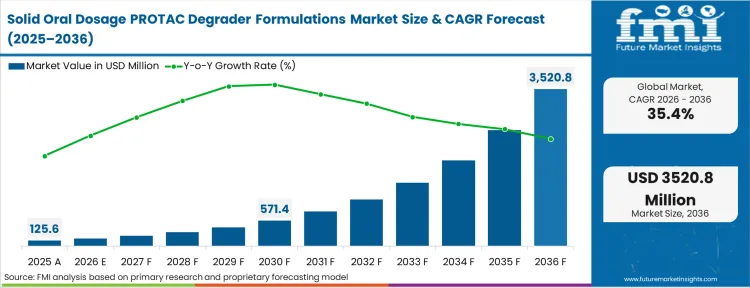
The gate unlocking this progression is the consistent achievement of human oral bioavailability above the ten per cent threshold. Once a specific polymer matrix demonstrates reproducible pharmacokinetic profiles across a patient cohort, scaling drug formulation from clinical to commercial batches becomes an engineering exercise rather than a biological gamble. Contract manufacturers successfully crossing this threshold establish immediate lock-in with asset owners, fundamentally altering the outsourcing landscape.
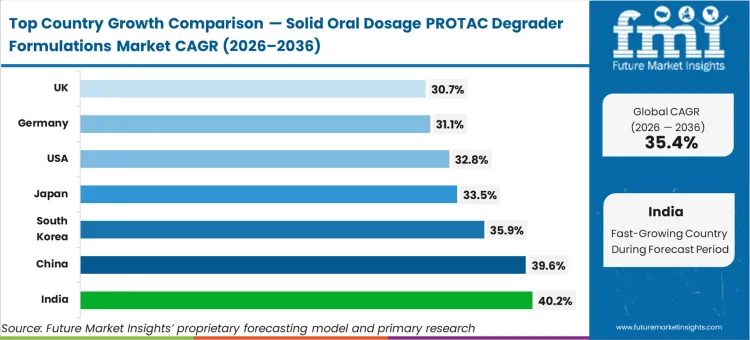
India is expected to advance at 40.2%, driven by its dense concentration of specialized contract manufacturers capable of scaling complex molecules. China follows closely at 39.6%, while South Korea is estimated to register 35.9%. Japan tracks at 33.5% as its established pharmaceutical sector pivots toward advanced degradation mechanisms. The United States is poised to expand at 32.8%, anchored by primary discovery investments. Germany and the United Kingdom are likely to garner 31.1% and 30.7% respectively. The stark divergence across these regions reflects a transition from Western-led basic research to Asian-dominated complex formulation scale-up.
Solid Oral Dosage PROTAC Degrader Formulations Market Key Takeaways
| Metric | Details |
|---|---|
| Industry Size (2026) | USD 170 Million |
| Industry Value (2036) | USD 3.49 Billion |
| CAGR (2026-2036) | 35.40% |
Source: Future Market Insights (FMI) analysis, based on proprietary forecasting model and primary research
Solid Oral Dosage PROTAC Degrader Formulations Market Definition
The solid oral dosage PROTAC degrader formulations space encompasses specialized matrices, excipient systems, and processing technologies engineered specifically to deliver proteolysis-targeting chimeras through the gastrointestinal tract. Functionally, it is defined by the absolute requirement to overcome the "beyond rule of five" physicochemical properties of bifunctional degraders, converting highly lipophilic and high-molecular-weight active pharmaceutical ingredients into systemically available solid oral formats.
Solid Oral Dosage PROTAC Degrader Formulations Market Inclusions
Scope includes amorphous solid dispersions, lipid-based solidified formulations, hot-melt extruded matrices, and spray-dried intermediate powders specifically applied to targeted protein degraders. It covers the formulation services, enabling excipients, specialized coating systems, and complete final dosage forms formatted as tablets, capsules, or multiparticulates. The market specifically tracks revenue generated by high potent oral solid dosage contract manufacturing networks dedicated to these unique bifunctional molecules.
Solid Oral Dosage PROTAC Degrader Formulations Market Exclusions
Intravenous, subcutaneous, and other parenteral formulations of PROTACs are strictly excluded, as they bypass the gastrointestinal permeability challenges that define this market. Traditional small-molecule kinase inhibitor formulations are excluded because their lower molecular weights allow conventional crystalline blending. Early-stage unmodified PROTAC APIs without an enabling drug delivery system applied are excluded, as the boundary isolates the formulation phase rather than basic discovery.
Solid Oral Dosage PROTAC Degrader Formulations Market Research Methodology
- Primary Research: Sourcing directors at biopharmaceutical innovators, formulation scientists specializing in amorphous solid dispersions, and commercial heads at specialized CDMOs.
- Desk Research: Clinical trial registries detailing oral degrader pharmacokinetic data, patent filings for lipid-based solid architectures, and investor presentations from leading targeted protein degradation biotechs.
- Market-Sizing and Forecasting: Baseline anchored to the progression rate of oral PROTACs transitioning from Phase 1 to Phase 2 trials, combined with standard outsourcing contract values for complex highly potent APIs.
- Data Validation and Update Cycle: Forecasts triangulated against reported R&D expenditures of the top tier targeted protein degradation pure-plays and specialized excipient supply volume growth.
Segmental Analysis
Solid Oral Dosage PROTAC Degrader Formulations Market Analysis by Dosage Form
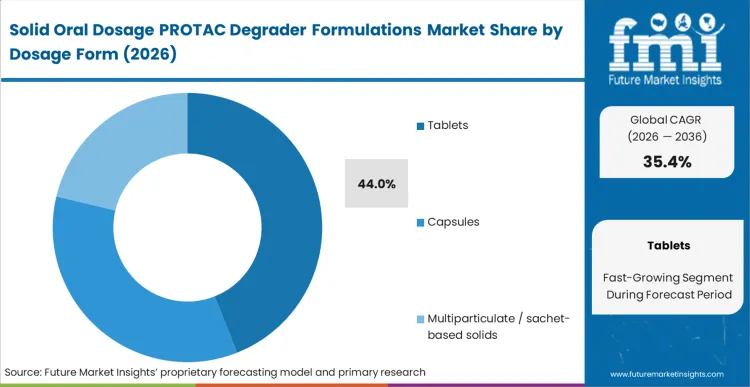
Standard liquid-filled capsule approaches fail to deliver the massive drug loading required for PROTAC efficacy, forcing a total displacement of early-stage formulation strategies.
Based on FMI's assessment, tablets command 44.0% of the market because they effectively handle the bulky stabilizing polymers required to keep PROTACs in an amorphous state without requiring patients to swallow an unmanageable number of pills. Innovators leveraging drug delivery technology platforms optimized for tableting avoid critical adherence drop-offs in chronic outpatient settings. Sponsors who resist this transition routinely face costly bridging studies when forced to switch formats for commercial viability, as stabilizer excipients behave differently under high-pressure compression than in loose powder fills.
- Purchase Trigger: High therapeutic loading requirements force clinical directors to select tableting early to ensure the final product meets patient adherence criteria.
- Qualification Validation: Stability protocols during Phase 2 confirm that compression forces do not induce sudden crystallization of the amorphous degrader intermediate.
- Renewal Driver: Commercial supply chain teams mandate tablet formats to ensure seamless integration into automated hospital dispensing systems and global distribution networks.
Solid Oral Dosage PROTAC Degrader Formulations Market Analysis by Formulation Technology
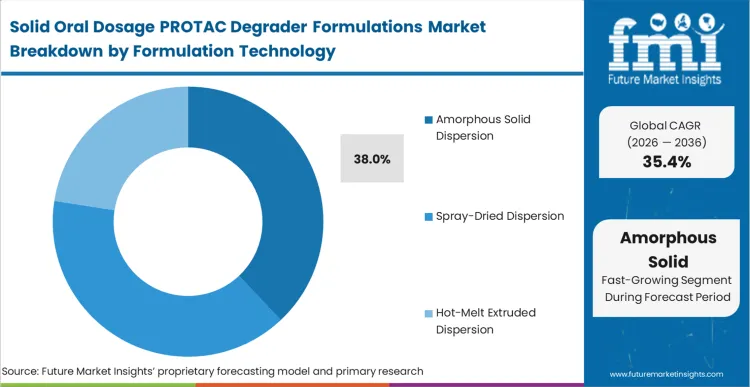
The reason amorphous solid dispersion holds 38.0% of the market is that PROTACs exist in a chemical space where traditional salt formation simply cannot generate the necessary free energy for absorption.
According to FMI's estimates, this technology isolates individual degrader molecules within a polymer matrix, bypassing the catastrophic lattice energy barriers that prevent crystalline uptake. Formulators rely heavily on advanced pharmaceuticals excipients to maintain this high-energy state throughout the product shelf life. The financial penalty for poor physical stability is extreme, requiring total batch destruction if recrystallization occurs during transit. Relying on basic lipid vehicles without advancing to true solid dispersions limits clinical exploration, restricting the asset's total addressable patient population. The integration of permeation enhancers like pharmaceutical excipient snac further amplifies this architectural advantage.
- Cost Origin: Early investment in spray-dried amorphous solid dispersion prevents repetitive Phase 1 trial failures linked to variable human food effects.
- Hidden Operations: Stringent moisture control requirements throughout the packaging lifecycle add complex monitoring costs that standard formulations avoid entirely.
- Lifecycle Comparison: Total cost of ownership analysis proves that advanced polymer matrix integration is cheaper than running larger, longer trials to overcome erratic pharmacokinetic data.
Solid Oral Dosage PROTAC Degrader Formulations Market Analysis by Therapeutic Area
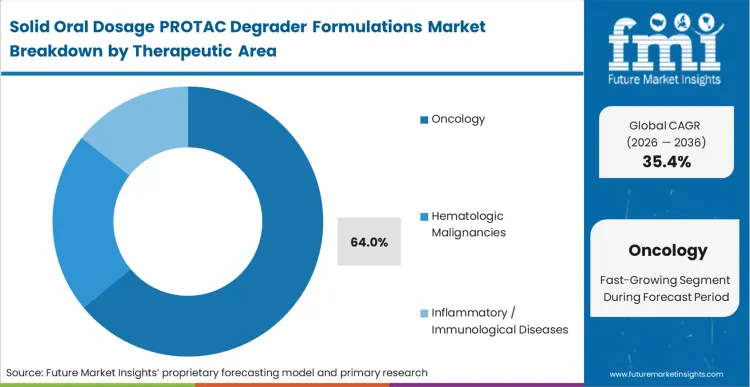
Patient enrollment stalls completely when advanced therapies require daily intravenous infusions for chronic maintenance.
In FMI's view, this commercial consequence forces oncology, which holds 64.0% share, to aggressively pursue solid oral formats. Medical directors treating advanced solid tumors recognize that outpatient oral administration transforms the health economics of degradation therapies by removing infusion clinic bottlenecks. The transition from clinical supervision to home dispensing allows treatment protocols to span months rather than weeks, opening access to vast new patient pools. Asset managers who fail to secure viable pharmaceutical drug delivery solutions for their oncology pipelines face steep valuation discounts during licensing negotiations, as large pharma partners refuse to absorb the commercial limitations of needle-based regimens.
- Failure Prevention: Oral solid formats prevent the severe peak-to-trough plasma fluctuations that routinely cause dose-limiting toxicity in targeted cancer treatments.
- Residual Risk: Fasting state variability remains a persistent threat even with advanced solid tumor oral protocols, requiring strict patient guidance and monitoring.
- Operational Requirement: Clinical operations teams must completely rebuild adherence tracking mechanisms when moving trial participants from supervised infusions to home-based pill regimens.
Solid Oral Dosage PROTAC Degrader Formulations Market Analysis by End User / Customer Type
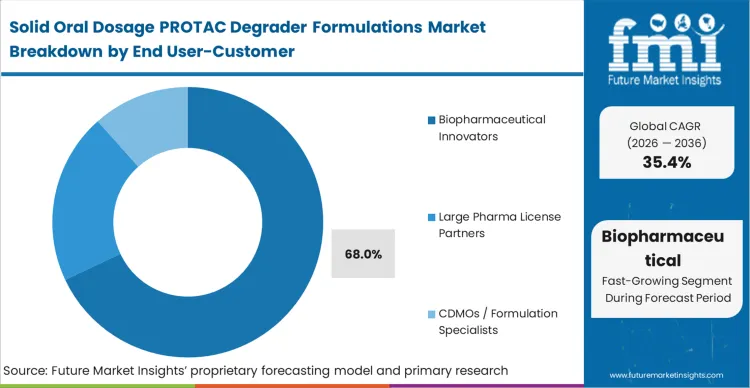
Venture-backed biotechnology firms possess the proprietary degrader chemistry but fundamentally lack the capital-intensive infrastructure to manufacture complex solid dispersions in-house.
As per FMI's projection, biopharmaceutical innovators capture 68.0% share by aggressively outsourcing this tension. These agile firms contract biopharmaceutical contract manufacturing networks the moment a lead molecule is selected, prioritizing speed to the clinic over internal capacity building. The friction lies in securing dedicated spray-drying suites from top-tier partners who typically reserve capacity for established commercial products rather than novel assets moving into early clinical trials. Innovators who hesitate to lock down outsourcing agreements find their clinical timelines entirely gated by external manufacturing waitlists.
- Initial Adopters: Well-capitalized pure-play degrader biotech firms initiate specialized formulation outsourcing immediately following lead optimization.
- Secondary Followers: Traditional mid-cap pharmaceutical companies adapt by licensing these formulated assets only after Phase 1 bioavailability is rigorously verified.
- Final Converts: Academic translational centers reluctantly move to specialized contract manufacturing only when grant requirements mandate clinical-grade physical stability data.
Solid Oral Dosage PROTAC Degrader Formulations Market Drivers, Restraints, and Opportunities
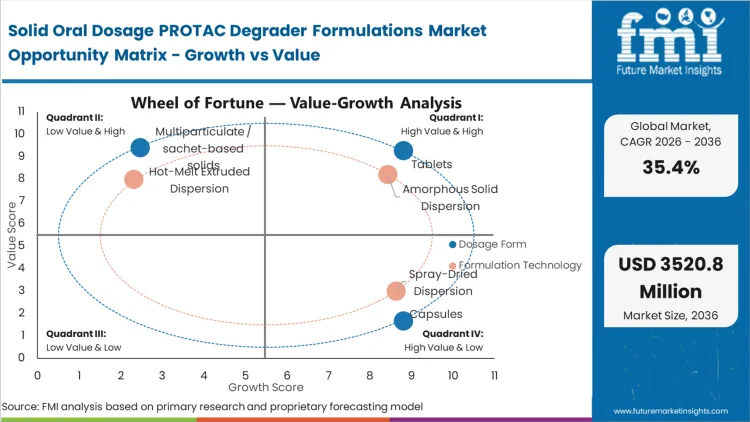
The absolute requirement to move targeted degradation from acute inpatient settings to chronic outpatient management compels clinical development directors to qualify solid oral forms. The commercial viability of degrading established targets relies entirely on matching the convenience of existing kinase inhibitors, forcing a rapid evolution in the procurement of complex small molecule api processing capacity. Delaying this transition limits an asset to niche hematology indications, cutting off access to the vastly larger solid tumor market, where outpatient adherence dictates commercial success.
Formulators face a severe operational bottleneck in maintaining the physical stability of amorphous PROTACs under commercial storage conditions. Unlike standard active pharmaceutical ingredients, degraders possess high molecular flexibility that actively promotes recrystallization over time, destroying bioavailability. This instability requires intense environmental controls and highly specialized pharmaceutical solvents during processing. While advanced polymeric wrapping offers a partial solution, the fundamental thermodynamics of these massive molecules restrict the shelf life of early iterations, elevating supply chain risk.
Opportunities in the Solid Oral Dosage PROTAC Degrader Formulations Market
- Platform Consolidation: Specialized facilities offering end-to-end containment scale-up capture outsized value. CDMOs integrating high-potency API synthesis with dedicated solid dispersion lines secure multi-year crdmo partnerships from biotechs demanding single-source accountability.
- Excipient Innovation: The unique polarity of bifunctional degraders demands novel stabilization matrices. Excipient suppliers developing polymer blends matched specifically to PROTAC physical chemistry capture premium pricing over standard pharmaceutical grades.
- Capability Expansion: Traditional manufacturers migrating into complex specialty active pharmaceutical ingredients handling capture immediate market share by relieving the severe spray-drying capacity constraints plaguing the current clinical pipeline.
Regional Analysis
From a regional perspective, the market stretches across North America, Asia Pacific, and Europe, representing more than 40 countries.
.webp "Top Country Growth Comparison Solid Oral Dosage Protac Degrader Formulations Market Cagr (2026 2036)")
| Country | CAGR (2026 to 2036) |
|---|---|
| India | 40.2% |
| China | 39.6% |
| South Korea | 35.9% |
| Japan | 33.5% |
| United States | 32.8% |
| Germany | 31.1% |
| United Kingdom | 30.7% |
Source: Future Market Insights (FMI) analysis, based on proprietary forecasting model and primary research
North America Solid Oral Dosage PROTAC Degrader Formulations Market Analysis
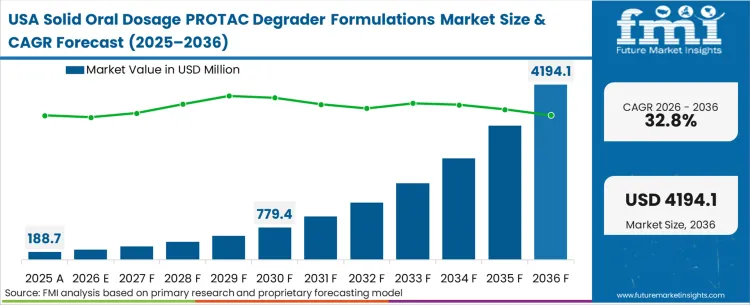
Early-stage discovery capital shapes the adoption pattern across North America, driving the deepest pipeline of novel degrader targets globally. FMI analysts opine that procurement behavior here favors proximity and speed during the initial technology transfer phase, heavily utilizing domestic early phase clinical trial outsourcing hubs. The ecosystem is distinctly weighted toward venture-backed innovators requiring high-touch formulation design rather than pure high-volume commercial production.
- United States: The United States is poised to expand at 32.8% through 2036. The massive concentration of targeted protein degradation pure-plays in biotech clusters forces a high volume of complex formulation contracts locally. Clinical supply managers prioritize partners capable of rapid iterative prototyping, recognizing that speed to Phase 1 data outweighs raw cost efficiency. Specialized formulation labs that demonstrate mastery over PROTAC spray-drying capture preferred supplier status in procurement frameworks that rarely reopen once initial clinical batches succeed, locking in long-term commercial upside.
Asia Pacific Solid Oral Dosage PROTAC Degrader Formulations Market Analysis
The regional dynamic is driven by aggressive investments in high-potency containment infrastructure and complex chemical synthesis capabilities. According to FMI's estimates, local contract manufacturers leverage their established cmo cdmo networks to absorb the scale-up phases that Western innovators cannot afford to run domestically, shifting the center of gravity for commercial volumes.
- India: India's deep expertise in complex synthetic chemistry and rapid scale-up of novel APIs creates a distinct cost advantage against Western incumbents. FMI estimates the solid oral dosage PROTAC degrader formulations market in India to expand at an annual growth rate of 40.2%. Manufacturing directors at global biopharma firms increasingly route their mid-to-late stage clinical material production here to optimise cash burn. This creates a path where the region aggressively transitions from basic intermediate synthesis to full finished-dosage amorphous manufacturing for global trials.
- China: China is expected to see its sector grow at a compound annual rate of 39.6%. Massive state-backed and private investments in cutting-edge hot-melt extrusion suites clear a primary scale-up bottleneck for degrader pipelines. Operations heads in China manage rapid technology transfers by co-locating API synthesis and formulation under single roofs, eliminating the need to ship highly unstable amorphous powders across borders. Facilities integrating these steps achieve profound operational outcomes, slashing months off the critical path for Phase 2 readiness.
- South Korea: South Korea's advanced biologics manufacturing framework is rapidly adapting its sophisticated quality systems to handle highly potent small molecules. The nuance is that these sites prioritize speed and strict regulatory compliance over raw cost competition, attracting risk-averse Western sponsors. A CAGR of 35.9% is expected for South Korea over the forecast period. This positions the country's CDMO sector directly against established European hubs, capturing premium manufacturing contracts that require zero-defect tolerance.
- Japan: Japan is forecast to register a CAGR of 33.5%. Stringent domestic regulatory frameworks regarding novel excipients force a highly deliberate approach to solid dispersion adoption. Formulators in Japan rely on established local partnerships to navigate unique stability testing requirements before advancing to human trials. The practitioner reality is that Japanese pharmaceutical companies are quietly building massive internal formulation libraries, preparing to launch highly optimised, second-generation oral degraders that bypass the physical stability flaws of early Western attempts.
Europe Solid Oral Dosage PROTAC Degrader Formulations Market Analysis
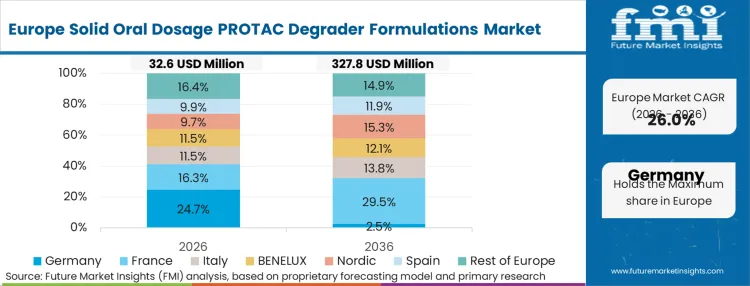
Complex procurement practices and highly fragmented national clinical trial regulations drive the European landscape. In FMI's view, biopharmaceutical sponsors operating here must build formulation strategies capable of passing stringent, diverse stability audits across multiple jurisdictions before initiating multi-center studies.
- Germany: Germany's dense concentration of precision engineering firms provides the advanced equipment required for complex hot-melt extrusion. Sourcing directors utilize these domestic hubs to ensure tight control over the delicate processing parameters of amorphous dispersions. The market for solid oral dosage PROTAC degrader formulations in Germany is forecast to register a CAGR of 31.1%. Sponsors delaying engagement with these specialized German equipment integrators face severe capacity constraints, often waiting over a year for dedicated GMP extrusion suite time.
- United Kingdom: The UK market is anticipated to increase by a CAGR of 30.7%. The robust academic and translational research ecosystem rapidly spins out novel degrader biotech firms requiring immediate formulation support. Clinical operations teams must tightly manage the transition from bench-scale lipid formulations to robust solid architectures to satisfy stringent domestic clinical trial applications. Successful navigation of this phase yields a clear path, allowing UK-based biotechs to rapidly license their derisked, orally bioavailable assets to global pharma partners.
FMI's report includes extensive coverage of adjacent markets executing similar high-potency solid dispersion strategies. The capacity to securely manage and distribute highly sensitive clinical drug supply chain services fundamentally separates the specialized service providers from generalized pharmaceutical contractors across these advanced regulatory environments.
Competitive Aligners for Market Players
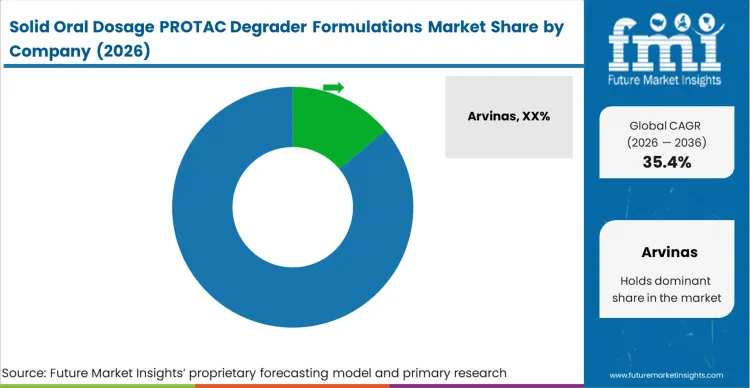
The competitive landscape is heavily concentrated among a small tier of specialized formulation houses capable of managing extreme potency alongside complex amorphous solid dispersions. Large pharmaceutical companies evaluating degraders do not utilize basic contract manufacturers; they rigorously screen partners for proven experience handling "beyond rule of five" molecules under high containment. The primary variable separating qualified vendors from the broader market is the verifiable demonstration of high-containment spray drying and hot-melt extrusion operating simultaneously under strict current Good Manufacturing Practices.
Incumbents like Pfizer and specialized developers such as Arvinas and C4 Therapeutics possess a deep advantage through their proprietary understanding of PROTAC physical chemistry behavior. They have established robust internal predictive models that map how specific polymer matrices stabilize massive molecular weights. To compete, emerging investigational new drug cdmo partners must build end-to-end analytical suites capable of tracking trace crystallization events in real-time. The ability to integrate advanced clinical trial packaging solutions that protect these moisture-sensitive dispersions is no longer optional but a baseline requirement for entry.
Through 2036, the tension exists between biopharmaceutical innovators demanding dedicated, flexible manufacturing suites and contract organizations requiring guaranteed volumes to justify capital expenditures. Large buyers resist lock-in by validating secondary suppliers early in Phase 2, forcing primary vendors to compete strictly on scale-up yield and advanced drug delivery solutions rather than resting on basic formulation capability. The market is programmed to remain concentrated, as the extreme technical barriers to handling potent solid dispersions prevent generalist manufacturers from participating in commercial-stage production.
Key Players in Solid Oral Dosage PROTAC Degrader Formulations Market
- Arvinas
- Pfizer
- Nurix Therapeutics
- C4 Therapeutics
- Kymera Therapeutics
- Monte Rosa Therapeutics
- BeOne Medicines
Scope of the Report
| Metric | Value |
|---|---|
| Quantitative Units | USD 170 Million to USD 3.49 Billion, at a CAGR of 35.40% |
| Market Definition | The space encompasses specialized matrices, excipient systems, and processing technologies engineered specifically to convert highly lipophilic, high-molecular-weight proteolysis-targeting chimeras into systemically available solid oral dosage forms. |
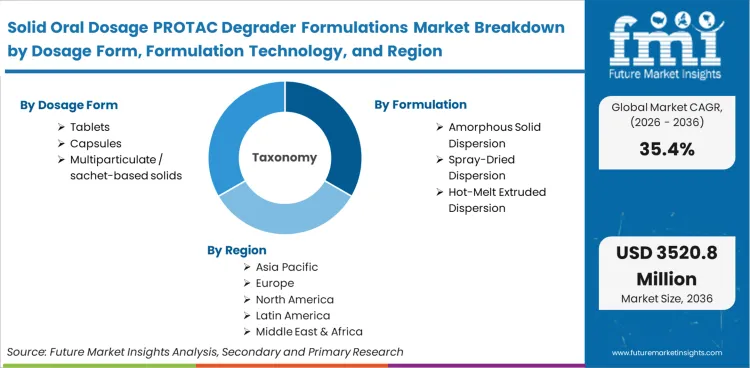
| Dosage Form Segmentation | Tablets, Capsules, Multiparticulate / sachet-based solids |
| Formulation Technology Segmentation | Amorphous Solid Dispersion, Spray-Dried Dispersion, Hot-Melt Extruded Dispersion, Lipid-Based Solidified Formulations |
| Therapeutic Area Segmentation | Oncology, Hematologic Malignancies, Inflammatory / Immunological Diseases, Other Indications |
| End User / Customer Type Segmentation | Biopharmaceutical Innovators, Large Pharma License Partners, CDMOs / Formulation Specialists, Academic / Translational Centers |
| Regions Covered | North America, Asia Pacific, Europe |
| Countries Covered | United States, China, India, Germany, United Kingdom, Japan, South Korea, and 40 plus countries |
| Key Companies Profiled | Arvinas, Pfizer, Nurix Therapeutics, C4 Therapeutics, Kymera Therapeutics, Monte Rosa Therapeutics, BeOne Medicines |
| Forecast Period | 2026 to 2036 |
| Approach | Primary interviews targeted bioprocessing engineers and clinical supply chain managers handling complex molecular scale-ups. Baseline valuation anchored to the progression rate of oral degraders from Phase 1 to Phase 2, validated against R&D expenditures of pure-play targeted protein degradation firms. |
Source: Future Market Insights (FMI) analysis, based on proprietary forecasting model and primary research
Solid Oral Dosage PROTAC Degrader Formulations Market Analysis by Segments
Dosage Form:
- Tablets
- Capsules
- Multiparticulate / sachet-based solids
Formulation Technology:
- Amorphous Solid Dispersion
- Spray-Dried Dispersion
- Hot-Melt Extruded Dispersion
- Lipid-Based Solidified Formulations
Therapeutic Area:
- Oncology
- Hematologic Malignancies
- Inflammatory / Immunological Diseases
- Other Indications
End User / Customer Type:
- Biopharmaceutical Innovators
- Large Pharma License Partners
- CDMOs / Formulation Specialists
- Academic / Translational Centers
Region:
- North America
- United States
- Asia Pacific
- China
- India
- Japan
- South Korea
- Europe
- Germany
- United Kingdom
Bibliography
- Zhong, G., Chang, X., Xie, W., & Zhou, X. (2024). Targeted protein degradation: advances in drug discovery and clinical practice. Signal Transduction and Targeted Therapy, 9, 308.
- Yang, W., Saboo, S., Zhou, L., Askin, S., & Bak, A. (2024). Early evaluation of opportunities in oral delivery of PROTACs to overcome their molecular challenges. Drug Discovery Today, 29(2), 103865.
- Hofmann, N., Johann, F., Krollik, K., Marx, A., Duevel, H. M., Lecomte, M., Harms, M., & Mäder, K. (2025). PROTAC Enabling Formulation In Vivo: Implications of the Polymeric Carrier Eudragit E PO. Molecular Pharmaceutics, 22(10), 5845-5859.
- Syahputra, E. W., Lee, Y., et al. (2025). PROTAC Delivery Strategies for Overcoming Physicochemical Properties and Physiological Barriers in Targeted Protein Degradation.
- Pan, M., Yang, C., Fu, Z., et al. (2025). Remodeling the Physicochemical and Pharmacokinetic Properties of PROTAC via Lipid Nanodisks for Cancer Therapy. Advanced Science, 12(36), e01384.
- Fan, G., et al. (2025). Proteolysis-Targeting Chimera (PROTAC): Current Applications and Future Directions. MedComm, 6(11), e70491.
- Campone, M., et al. (2025). Vepdegestrant, a PROTAC Estrogen Receptor Degrader, in Advanced Breast Cancer. New England Journal of Medicine.
- ClinicalTrials.gov. (2026). NCT05654623: A Study to Learn About a New Medicine Called PF-07850327 in People Who Have Advanced Metastatic Breast Cancer (VERITAC-2).
This bibliography is provided for reader reference. The full FMI report contains the complete reference list with primary source documentation.
This Report Addresses
- Market intelligence to support strategic decision making across Amorphous Solid Dispersion and Spray-Dried Dispersion services
- Market size estimation and 10-year revenue forecasts from 2026 to 2036, supported by clinical trial transition rate mapping
- Growth opportunity mapping across Formulation Technology dimensions with emphasis on consistent human oral bioavailability above the ten percent threshold
- Segment and regional revenue forecasts covering Oncology and Hematologic Malignancies across stringent European stability audit environments
- Competition strategy assessment including high-containment spray drying and predictive analytical tracking capabilities
- Technology development tracking including hot-melt extruded matrices and lipid-based solidified architectures
- Market access analysis covering novel excipient qualification pathways and specialized clinical trial packaging guidelines
- Market report delivery in PDF, Excel, PPT, and interactive dashboard formats for executive strategy, contract manufacturing capacity planning, and operational benchmarking use
Frequently Asked Questions
How large is the Solid Oral Dosage PROTAC Degrader Formulations in 2026?What is the primary restraint?
The market is valued at USD 170 million in 2026. This figure reflects the immediate outsourcing capital deployed by biopharmaceutical innovators moving their leading degradation candidates into Phase 2 trials.
What will it be valued at by 2036?
The market will reach USD 3.49 billion by 2036. This massive expansion signals a change where complex solid dispersions become the industry baseline, entirely replacing early-stage liquid-filled capsule bridges.
What CAGR is projected?
A compound annual growth rate of 35.40% is expected. This aggressive rate maps directly to the anticipated commercial approvals of the first wave of oral degraders, triggering heavy commercial-scale manufacturing contracts.
Which Dosage Form segment leads?
Tablets hold 44.0% share because they provide the necessary compression density. Formulators cannot fit the required high ratio of stabilizing polymer to active ingredient into standard capsules without demanding unmanageable patient pill burdens.
Which Formulation Technology segment leads?
Amorphous Solid Dispersion leads by functionally trapping the massive PROTAC molecules in a high-energy state. Without this specific technology, the molecules crystallize, rendering them completely incapable of crossing the gastrointestinal boundary.
Which Therapeutic Area segment leads?
Oncology dominates with 64.0% share due to the intense pressure to transition targeted cancer therapies to outpatient settings. Intravenous administration severely limits patient enrollment and degrades the commercial value of solid tumor treatments.
What drives rapid growth?
Clinical development directors recognize that advanced degrader therapies cannot compete commercially if they require hospital infusion. The requirement for chronic, at-home administration forces immediate investment in complex formulation services.
What is the primary restraint?
The inherent physical instability of these massive molecules constantly risks recrystallization. This forces manufacturers to maintain intense environmental controls and utilize highly specialized solvent systems, severely limiting available global capacity.
Which country grows fastest?
India expands at 40.2%, outpacing China's 39.6%. The difference stems from India's established dense networks of contract manufacturers actively repurposing high-potency API synthesis suites to handle Western clinical scale-up demands, rather than relying solely on state-backed mega-facilities.
How does the clinical scale-up environment dictate technology choice?
Innovators are forced to select spray drying early because bridging studies from lipid solutions are too costly. Choosing the final commercial architecture during lead optimization prevents catastrophic delays during Phase 3 scale-up.
What specific capability separates qualified formulation vendors?
The ability to seamlessly integrate high-containment API handling with hot-melt extrusion lines. Vendors lacking dedicated suites for highly potent amorphous intermediates are immediately disqualified from commercial requests for proposals.
How do large biopharma companies avoid outsourcing lock-in?
They actively qualify secondary spray-drying facilities the moment an asset clears Phase 2. This creates intense tension, forcing primary vendors to compete fiercely on overall yield rather than resting on initial process development success.
Why are biopharmaceutical innovators dominating the end-user segment?
Venture-backed pure-plays hold the core degrader intellectual property but lack internal manufacturing capacity. They are required to outsource the entirety of their solid dispersion requirements.
How does Amorphous Solid Dispersion compare to lipid formulations?
Lipid-based systems serve as quick bridges for early toxicology studies, but they fail to accommodate high commercial dosing requirements. Amorphous dispersions provide the long-term stability essential for global distribution chains.
What is the hidden cost of handling PROTAC formulations?
The extreme moisture sensitivity of the amorphous state requires specialized packaging and cold-chain-like tracking. These stringent controls add a permanent operational premium to the final drug product lifecycle.
Why is the United States market heavily weighted toward formulation design?
The massive concentration of early discovery capital in US biotech hubs funds iterative prototyping. Clinical supply managers prioritize speed to Phase 1 over bulk commercial production, contracting local boutique formulation labs.
What role do stabilizers play in the final tablet form?
They prevent the "spring and parachute" dissolution profile from crashing. Without perfectly matched polymeric stabilizers, the degrader precipitates out of solution before it can be absorbed in the intestinal tract.
How do European stability requirements alter formulation timelines?
Highly fragmented national regulations force formulators to over-engineer physical stability protocols. A solid dispersion matrix must prove viable across a wider range of climatic testing zones before securing multi-center trial approval.
Why is South Korea's growth trajectory unique?
South Korea is actively transitioning its massive biologics quality systems to handle potent small molecules. The market advances as innovators leverage these hubs for rapid, strictly compliant execution rather than pure cost savings.
What defines a failure in the solid dispersion scale-up phase?
Even minor variations in spray dryer inlet temperatures can induce trace crystallinity. A failure is absolute, requiring the total destruction of the batch, as the clinical bioavailability drops to near zero.
Why are traditional kinase inhibitor formulators struggling with PROTACs?
Kinase inhibitors are small enough to utilize conventional salt forms or simple blending. PROTACs represent a distinct class of "beyond rule of five" chemistry that destroys standard tableting equipment assumptions.
How does the shift to outpatient administration impact procurement?
It forces a total overhaul of the vendor qualification process. Sourcing directors must now evaluate CDMOs based entirely on their proprietary understanding of amorphous state thermodynamics rather than simple tablet pressing capacity.
Preview the report firsthand - request a free sample
Get SampleGet the brochure for pricing and purchase details.
Get PDFTable of Content
- Executive Summary
- Global Market Outlook
- Demand-side Trends
- Supply-side Trends
- Technology Roadmap Analysis
- Analysis and Recommendations
- Market Overview
- Market Coverage / Taxonomy
- Market Definition / Scope / Limitations
- Research Methodology
- Chapter Orientation
- Analytical Lens and Working Hypotheses
- Market Structure, Signals, and Trend Drivers
- Benchmarking and Cross-market Comparability
- Market Sizing, Forecasting, and Opportunity Mapping
- Research Design and Evidence Framework
- Desk Research Programme (Secondary Evidence)
- Company Annual and Sustainability Reports
- Peer-reviewed Journals and Academic Literature
- Corporate Websites, Product Literature, and Technical Notes
- Earnings Decks and Investor Briefings
- Statutory Filings and Regulatory Disclosures
- Technical White Papers and Standards Notes
- Trade Journals, Industry Magazines, and Analyst Briefs
- Conference Proceedings, Webinars, and Seminar Materials
- Government Statistics Portals and Public Data Releases
- Press Releases and Reputable Media Coverage
- Specialist Newsletters and Curated Briefings
- Sector Databases and Reference Repositories
- FMI Internal Proprietary Databases and Historical Market Datasets
- Subscription Datasets and Paid Sources
- Social Channels, Communities, and Digital Listening Inputs
- Additional Desk Sources
- Expert Input and Fieldwork (Primary Evidence)
- Primary Modes
- Qualitative Interviews and Expert Elicitation
- Quantitative Surveys and Structured Data Capture
- Blended Approach
- Why Primary Evidence is Used
- Field Techniques
- Interviews
- Surveys
- Focus Groups
- Observational and In-context Research
- Social and Community Interactions
- Stakeholder Universe Engaged
- C-suite Leaders
- Board Members
- Presidents and Vice Presidents
- R&D and Innovation Heads
- Technical Specialists
- Domain Subject-matter Experts
- Scientists
- Physicians and Other Healthcare Professionals
- Governance, Ethics, and Data Stewardship
- Research Ethics
- Data Integrity and Handling
- Primary Modes
- Tooling, Models, and Reference Databases
- Desk Research Programme (Secondary Evidence)
- Data Engineering and Model Build
- Data Acquisition and Ingestion
- Cleaning, Normalisation, and Verification
- Synthesis, Triangulation, and Analysis
- Quality Assurance and Audit Trail
- Market Background
- Market Dynamics
- Drivers
- Restraints
- Opportunity
- Trends
- Scenario Forecast
- Demand in Optimistic Scenario
- Demand in Likely Scenario
- Demand in Conservative Scenario
- Opportunity Map Analysis
- Product Life Cycle Analysis
- Supply Chain Analysis
- Investment Feasibility Matrix
- Value Chain Analysis
- PESTLE and Porter’s Analysis
- Regulatory Landscape
- Regional Parent Market Outlook
- Production and Consumption Statistics
- Import and Export Statistics
- Market Dynamics
- Global Market Analysis 2021 to 2025 and Forecast, 2026 to 2036
- Historical Market Size Value (USD Million) Analysis, 2021 to 2025
- Current and Future Market Size Value (USD Million) Projections, 2026 to 2036
- Y-o-Y Growth Trend Analysis
- Absolute $ Opportunity Analysis
- Global Market Pricing Analysis 2021 to 2025 and Forecast 2026 to 2036
- Global Market Analysis 2021 to 2025 and Forecast 2026 to 2036, By Dosage Form
- Introduction / Key Findings
- Historical Market Size Value (USD Million) Analysis By Dosage Form , 2021 to 2025
- Current and Future Market Size Value (USD Million) Analysis and Forecast By Dosage Form , 2026 to 2036
- Tablets
- Capsules
- Multiparticulate / sachet-based solids
- Tablets
- Y-o-Y Growth Trend Analysis By Dosage Form , 2021 to 2025
- Absolute $ Opportunity Analysis By Dosage Form , 2026 to 2036
- Global Market Analysis 2021 to 2025 and Forecast 2026 to 2036, By Formulation Technology
- Introduction / Key Findings
- Historical Market Size Value (USD Million) Analysis By Formulation Technology, 2021 to 2025
- Current and Future Market Size Value (USD Million) Analysis and Forecast By Formulation Technology, 2026 to 2036
- Amorphous Solid Dispersion
- Spray-Dried Dispersion
- Hot-Melt Extruded Dispersion
- Amorphous Solid Dispersion
- Y-o-Y Growth Trend Analysis By Formulation Technology, 2021 to 2025
- Absolute $ Opportunity Analysis By Formulation Technology, 2026 to 2036
- Global Market Analysis 2021 to 2025 and Forecast 2026 to 2036, By Therapeutic Area
- Introduction / Key Findings
- Historical Market Size Value (USD Million) Analysis By Therapeutic Area, 2021 to 2025
- Current and Future Market Size Value (USD Million) Analysis and Forecast By Therapeutic Area, 2026 to 2036
- Oncology
- Hematologic Malignancies
- Inflammatory / Immunological Diseases
- Oncology
- Y-o-Y Growth Trend Analysis By Therapeutic Area, 2021 to 2025
- Absolute $ Opportunity Analysis By Therapeutic Area, 2026 to 2036
- Global Market Analysis 2021 to 2025 and Forecast 2026 to 2036, By End User / Customer
- Introduction / Key Findings
- Historical Market Size Value (USD Million) Analysis By End User / Customer, 2021 to 2025
- Current and Future Market Size Value (USD Million) Analysis and Forecast By End User / Customer, 2026 to 2036
- Biopharmaceutical Innovators
- Large Pharma License Partners
- CDMOs / Formulation Specialists
- Biopharmaceutical Innovators
- Y-o-Y Growth Trend Analysis By End User / Customer, 2021 to 2025
- Absolute $ Opportunity Analysis By End User / Customer, 2026 to 2036
- Global Market Analysis 2021 to 2025 and Forecast 2026 to 2036, By Region
- Introduction
- Historical Market Size Value (USD Million) Analysis By Region, 2021 to 2025
- Current Market Size Value (USD Million) Analysis and Forecast By Region, 2026 to 2036
- North America
- Latin America
- Western Europe
- Eastern Europe
- East Asia
- South Asia and Pacific
- Middle East & Africa
- Market Attractiveness Analysis By Region
- North America Market Analysis 2021 to 2025 and Forecast 2026 to 2036, By Country
- Historical Market Size Value (USD Million) Trend Analysis By Market Taxonomy, 2021 to 2025
- Market Size Value (USD Million) Forecast By Market Taxonomy, 2026 to 2036
- By Country
- USA
- Canada
- Mexico
- By Dosage Form
- By Formulation Technology
- By Therapeutic Area
- By End User / Customer
- By Country
- Market Attractiveness Analysis
- By Country
- By Dosage Form
- By Formulation Technology
- By Therapeutic Area
- By End User / Customer
- Key Takeaways
- Latin America Market Analysis 2021 to 2025 and Forecast 2026 to 2036, By Country
- Historical Market Size Value (USD Million) Trend Analysis By Market Taxonomy, 2021 to 2025
- Market Size Value (USD Million) Forecast By Market Taxonomy, 2026 to 2036
- By Country
- Brazil
- Chile
- Rest of Latin America
- By Dosage Form
- By Formulation Technology
- By Therapeutic Area
- By End User / Customer
- By Country
- Market Attractiveness Analysis
- By Country
- By Dosage Form
- By Formulation Technology
- By Therapeutic Area
- By End User / Customer
- Key Takeaways
- Western Europe Market Analysis 2021 to 2025 and Forecast 2026 to 2036, By Country
- Historical Market Size Value (USD Million) Trend Analysis By Market Taxonomy, 2021 to 2025
- Market Size Value (USD Million) Forecast By Market Taxonomy, 2026 to 2036
- By Country
- Germany
- UK
- Italy
- Spain
- France
- Nordic
- BENELUX
- Rest of Western Europe
- By Dosage Form
- By Formulation Technology
- By Therapeutic Area
- By End User / Customer
- By Country
- Market Attractiveness Analysis
- By Country
- By Dosage Form
- By Formulation Technology
- By Therapeutic Area
- By End User / Customer
- Key Takeaways
- Eastern Europe Market Analysis 2021 to 2025 and Forecast 2026 to 2036, By Country
- Historical Market Size Value (USD Million) Trend Analysis By Market Taxonomy, 2021 to 2025
- Market Size Value (USD Million) Forecast By Market Taxonomy, 2026 to 2036
- By Country
- Russia
- Poland
- Hungary
- Balkan & Baltic
- Rest of Eastern Europe
- By Dosage Form
- By Formulation Technology
- By Therapeutic Area
- By End User / Customer
- By Country
- Market Attractiveness Analysis
- By Country
- By Dosage Form
- By Formulation Technology
- By Therapeutic Area
- By End User / Customer
- Key Takeaways
- East Asia Market Analysis 2021 to 2025 and Forecast 2026 to 2036, By Country
- Historical Market Size Value (USD Million) Trend Analysis By Market Taxonomy, 2021 to 2025
- Market Size Value (USD Million) Forecast By Market Taxonomy, 2026 to 2036
- By Country
- China
- Japan
- South Korea
- By Dosage Form
- By Formulation Technology
- By Therapeutic Area
- By End User / Customer
- By Country
- Market Attractiveness Analysis
- By Country
- By Dosage Form
- By Formulation Technology
- By Therapeutic Area
- By End User / Customer
- Key Takeaways
- South Asia and Pacific Market Analysis 2021 to 2025 and Forecast 2026 to 2036, By Country
- Historical Market Size Value (USD Million) Trend Analysis By Market Taxonomy, 2021 to 2025
- Market Size Value (USD Million) Forecast By Market Taxonomy, 2026 to 2036
- By Country
- India
- ASEAN
- Australia & New Zealand
- Rest of South Asia and Pacific
- By Dosage Form
- By Formulation Technology
- By Therapeutic Area
- By End User / Customer
- By Country
- Market Attractiveness Analysis
- By Country
- By Dosage Form
- By Formulation Technology
- By Therapeutic Area
- By End User / Customer
- Key Takeaways
- Middle East & Africa Market Analysis 2021 to 2025 and Forecast 2026 to 2036, By Country
- Historical Market Size Value (USD Million) Trend Analysis By Market Taxonomy, 2021 to 2025
- Market Size Value (USD Million) Forecast By Market Taxonomy, 2026 to 2036
- By Country
- Kingdom of Saudi Arabia
- Other GCC Countries
- Turkiye
- South Africa
- Other African Union
- Rest of Middle East & Africa
- By Dosage Form
- By Formulation Technology
- By Therapeutic Area
- By End User / Customer
- By Country
- Market Attractiveness Analysis
- By Country
- By Dosage Form
- By Formulation Technology
- By Therapeutic Area
- By End User / Customer
- Key Takeaways
- Key Countries Market Analysis
- USA
- Pricing Analysis
- Market Share Analysis, 2025
- By Dosage Form
- By Formulation Technology
- By Therapeutic Area
- By End User / Customer
- Canada
- Pricing Analysis
- Market Share Analysis, 2025
- By Dosage Form
- By Formulation Technology
- By Therapeutic Area
- By End User / Customer
- Mexico
- Pricing Analysis
- Market Share Analysis, 2025
- By Dosage Form
- By Formulation Technology
- By Therapeutic Area
- By End User / Customer
- Brazil
- Pricing Analysis
- Market Share Analysis, 2025
- By Dosage Form
- By Formulation Technology
- By Therapeutic Area
- By End User / Customer
- Chile
- Pricing Analysis
- Market Share Analysis, 2025
- By Dosage Form
- By Formulation Technology
- By Therapeutic Area
- By End User / Customer
- Germany
- Pricing Analysis
- Market Share Analysis, 2025
- By Dosage Form
- By Formulation Technology
- By Therapeutic Area
- By End User / Customer
- UK
- Pricing Analysis
- Market Share Analysis, 2025
- By Dosage Form
- By Formulation Technology
- By Therapeutic Area
- By End User / Customer
- Italy
- Pricing Analysis
- Market Share Analysis, 2025
- By Dosage Form
- By Formulation Technology
- By Therapeutic Area
- By End User / Customer
- Spain
- Pricing Analysis
- Market Share Analysis, 2025
- By Dosage Form
- By Formulation Technology
- By Therapeutic Area
- By End User / Customer
- France
- Pricing Analysis
- Market Share Analysis, 2025
- By Dosage Form
- By Formulation Technology
- By Therapeutic Area
- By End User / Customer
- India
- Pricing Analysis
- Market Share Analysis, 2025
- By Dosage Form
- By Formulation Technology
- By Therapeutic Area
- By End User / Customer
- ASEAN
- Pricing Analysis
- Market Share Analysis, 2025
- By Dosage Form
- By Formulation Technology
- By Therapeutic Area
- By End User / Customer
- Australia & New Zealand
- Pricing Analysis
- Market Share Analysis, 2025
- By Dosage Form
- By Formulation Technology
- By Therapeutic Area
- By End User / Customer
- China
- Pricing Analysis
- Market Share Analysis, 2025
- By Dosage Form
- By Formulation Technology
- By Therapeutic Area
- By End User / Customer
- Japan
- Pricing Analysis
- Market Share Analysis, 2025
- By Dosage Form
- By Formulation Technology
- By Therapeutic Area
- By End User / Customer
- South Korea
- Pricing Analysis
- Market Share Analysis, 2025
- By Dosage Form
- By Formulation Technology
- By Therapeutic Area
- By End User / Customer
- Russia
- Pricing Analysis
- Market Share Analysis, 2025
- By Dosage Form
- By Formulation Technology
- By Therapeutic Area
- By End User / Customer
- Poland
- Pricing Analysis
- Market Share Analysis, 2025
- By Dosage Form
- By Formulation Technology
- By Therapeutic Area
- By End User / Customer
- Hungary
- Pricing Analysis
- Market Share Analysis, 2025
- By Dosage Form
- By Formulation Technology
- By Therapeutic Area
- By End User / Customer
- Kingdom of Saudi Arabia
- Pricing Analysis
- Market Share Analysis, 2025
- By Dosage Form
- By Formulation Technology
- By Therapeutic Area
- By End User / Customer
- Turkiye
- Pricing Analysis
- Market Share Analysis, 2025
- By Dosage Form
- By Formulation Technology
- By Therapeutic Area
- By End User / Customer
- South Africa
- Pricing Analysis
- Market Share Analysis, 2025
- By Dosage Form
- By Formulation Technology
- By Therapeutic Area
- By End User / Customer
- USA
- Market Structure Analysis
- Competition Dashboard
- Competition Benchmarking
- Market Share Analysis of Top Players
- By Regional
- By Dosage Form
- By Formulation Technology
- By Therapeutic Area
- By End User / Customer
- Competition Analysis
- Competition Deep Dive
- Arvinas
- Overview
- Product Portfolio
- Profitability by Market Segments (Product/Age /Sales Channel/Region)
- Sales Footprint
- Strategy Overview
- Marketing Strategy
- Product Strategy
- Channel Strategy
- Pfizer
- Nurix Therapeutics
- C4 Therapeutics
- Kymera Therapeutics
- Monte Rosa Therapeutics
- Arvinas
- Competition Deep Dive
- Assumptions & Acronyms Used


