

- Industry Size (2026)
- USD 0.61 Bn
- Forecast (2036)
- USD 1.25 Bn
- CAGR (2026 to 2036)
- 7.42%
Desiccant-Extruded Oral Solid Packaging Market Size, Market Forecast and Outlook By FMI
The desiccant-extruded oral solid packaging market was valued at USD 0.57 billion in 2025. The industry is poised to reach USD 0.61 billion in 2026 at a CAGR of 7.42% during the forecast period. Demand outlook lifts the total opportunity to USD 1.25 billion through 2036 as pharmaceutical manufacturers transition from secondary desiccant sachets to integrated moisture scavenging systems to eliminate the risk of accidental ingestion and improve high-speed filling efficiency.
The fundamental shift facing procurement directors today involves moving from passive barrier protection to active moisture management environments. Traditional foil-based blisters offer high barriers but fail to protect the tablet once the primary seal is breached; co-extruded desiccant packaging addresses this "dead time" humidity during patient use. Decision-makers are increasingly forced to choose between the unit-cost efficiency of legacy pouches and the long-term stability performance of integrated scavenging systems. Practitioners in the stability-testing phase understand that integrated desiccants are not just a shelf-life extension tool but a structural necessity for the next generation of moisture-sensitive biologics. Delaying this transition risks significant batch loss during global distribution through high-humidity corridors where traditional secondary desiccants often reach saturation before the product reaches the end user.
Summary of Desiccant-Extruded Oral Solid Packaging Market
- Desiccant-Extruded Oral Solid Packaging Market Definition:
- The market centers on the integration of moisture-scavenging agents directly into primary packaging structures through co-extrusion. This active packaging provides a controlled internal micro-environment for sensitive pharmaceuticals, eliminating the mechanical and safety risks associated with loose desiccant inserts while maintaining tablet integrity in humid environments.
- Demand Drivers in the Market:
- Stricter stability requirements for moisture-sensitive biologics force pharmaceutical packaging engineers to adopt active scavenging systems.
- The shift toward automated high-speed filling lines requires the elimination of secondary sachet insertion steps to reduce line stoppages.
- Increasing consumer demand for user-friendly packaging compels nutraceutical brands to move away from loose desiccants that pose an ingestion risk.
- Key Segments Analyzed in the FMI Report:
- Tubes: Tubes are expected to hold 42.0% share in 2026, as they offer the most efficient form factor for integrated desiccant lining in effervescent tablet segments.
- Desiccant Integrated Polymers: Desiccant Integrated Polymers are poised to lead the material segment with 55.0% share, driven by superior moisture vapor transmission rate (MVTR) performance.
- Pharmaceuticals: The pharmaceutical sector is estimated to account for 60.0% of the end-use demand, owing to rigorous shelf-life regulations for oral solids.
- India: A 9.8% compound growth is expected as the region scales its role as a global provider of generic medicines requiring high-performance packaging.
- Analyst Opinion at FMI:
- Ismail Sutaria, Principal Analyst, Packaging, at FMI, opines, "The industry often views desiccant integration purely through the lens of shelf-life extension, but the actual value proposition for the practitioner is the management of the 'in-use' stability period. Once a bulk container is opened by a patient in a high-humidity region, the internal environment is compromised; co-extruded desiccants provide the only structural defense that continues to scavenge moisture after the initial seal is broken. This moves packaging from a static container to an active component of the drug delivery system."
- Strategic Implications / Executive Takeaways:
- Stability Managers must initiate 12-month qualification cycles for integrated polymers now to meet the 2026 regulatory shift toward active packaging.
- Generic manufacturers should transition to extruded tubes for high-value effervescents to avoid the recurring operational cost of sachet insertion failures.
- Packaging vendors face a high technical barrier in co-extrusion which requires long-term capital investment in masterbatch blending technology to maintain share.
- Methodology:
- The research utilizes a bottom-up approach anchoring to OSD production volumes across 40 plus countries.
- Data is triangulated via interviews with polymer scientists and secondary analysis of pharmaceutical logistics audit trails.
- Sizing reflects the total value of primary packaging components specifically featuring extruded or integrated desiccant functionality.
- Forecasts account for the capital expenditure cycles of pharmaceutical machinery, which dictate the pace of packaging format transitions.
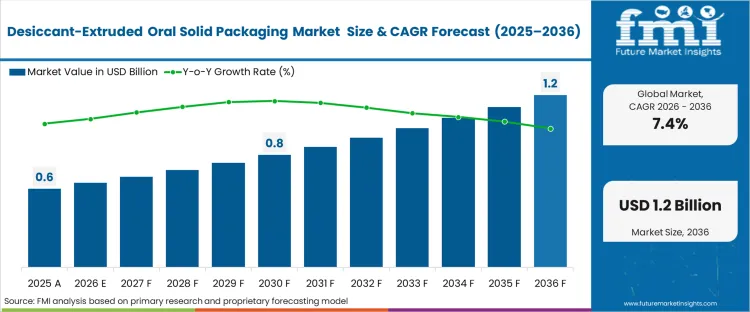
Before this market enters a phase of self-reinforcing growth, the structural gate of cross-industry validation standards for co-extruded polymers must be fully established. Stability testing cycles, which currently act as a two-year barrier for drug-packaging changes, trigger a bottleneck in adoption even when technical advantages are clear. Once these qualification cycles for integrated desiccant tubes are streamlined within major regulatory filings, the volume of adoption will move from niche specialty drugs to mass-market moisture-sensitive generics.
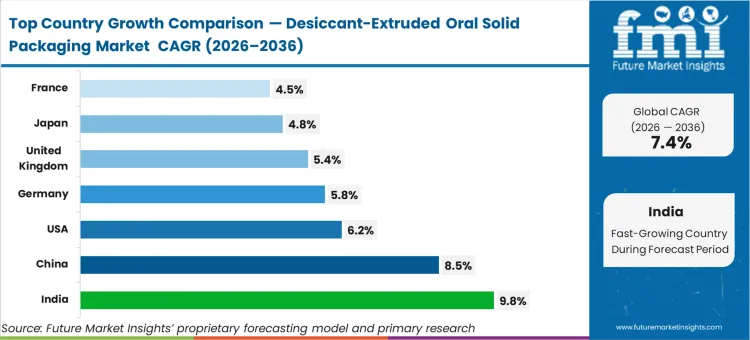
India’s market is expected to expand at a 9.8% compound rate, reflecting the rapid modernization of export-oriented generic manufacturing hubs. China follows with a projected 8.5% CAGR as domestic diagnostic kit production scales significantly. The United States tracks at 6.2% while Germany is likely to garner 5.8% growth through 2036. United Kingdom sales are set to increase at 5.4%, Japan is estimated to follow at 4.8%, and France records a CAGR of 4.5%. This geographic range highlights a structural divergence between high-growth manufacturing hubs in Asia and the steady-state replacement cycles characterizing mature Western pharmaceutical markets.
Desiccant-Extruded Oral Solid Packaging Market Key Takeaways
| Metric | Details |
|---|---|
| Industry Size (2026) | USD 0.61 billion |
| Industry Value (2036) | USD 1.25 billion |
| CAGR (2026-2036) | 7.42% |
Source: Future Market Insights (FMI) analysis, based on proprietary forecasting model and primary research
Desiccant-Extruded Oral Solid Packaging Market Definition
The Desiccant-Extruded Oral Solid Packaging Market comprises primary packaging solutions where moisture-scavenging agents are co-extruded or embedded directly into the polymer matrix of the container walls. This technology creates an active internal environment for oral solid dosage forms, such as tablets and capsules, maintaining low relative humidity without the need for loose sachets or canisters. It is distinguished from traditional packaging by its ability to provide localized moisture control throughout the product’s lifecycle, specifically during repeated openings.
Desiccant-Extruded Oral Solid Packaging Market Inclusions
Included within the scope are desiccant-lined tubes, co-extruded moisture-scavenging blisters, and protective bottles utilizing integrated desiccant technology. The market covers various scavenging chemistries including molecular sieves and silica gel when co-processed with polymers like PP or PE. It also includes the specialized closures and seals specifically engineered for use with extruded desiccant containers to ensure a hermetic environment for oral solid medicines and nutraceuticals.
Desiccant-Extruded Oral Solid Packaging Market Exclusions
Explicitly excluded from this analysis are secondary desiccant components such as loose sachets packaging, packets, or drop-in canisters that are not integrated into the container wall structure. Also excluded are bulk desiccant materials used for industrial warehouse drying and moisture-barrier packaging that relies solely on passive foil or film barriers without active scavenging properties. Functional packaging for liquid pharmaceuticals or medical devices that does not utilize co-extrusion technology for oral solid protection is outside this scope.
Desiccant-Extruded Oral Solid Packaging Market Research Methodology
- Primary Research: FMI conducted interviews with Packaging Engineering Leads, Pharmaceutical Stability Managers, and Procurement Directors at tier-1 generic drug manufacturers.
- Desk Research: Data was aggregated from regulatory filing databases, pharmaceutical equipment specification archives, and technical whitepapers from polymer co-extrusion specialists.
- Market-Sizing and Forecasting: The baseline anchors to the global production volume of moisture-sensitive oral solid dosages (OSD) and the replacement rate of traditional foil blisters.
- Data Validation and Update Cycle: Forecasts were cross-validated using independent data streams from high-speed filling line machinery shipments and desiccant masterbatch consumption figures.
Segmental Analysis
Desiccant-Extruded Oral Solid Packaging Market Analysis by Product Type
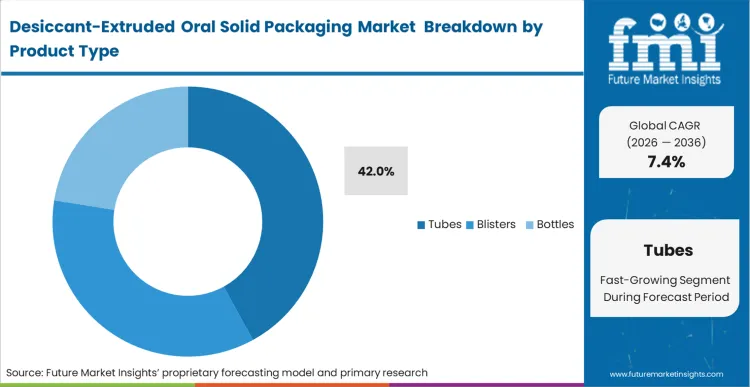
The displacement of traditional sachet-based bottles by co-extruded tubes is currently driven by the operational failures of secondary insertions in high-speed automated environments. Packaging engineers are recognizing that the marginal cost increase of a desiccant-lined tube is frequently offset by the reduction in line downtime caused by misaligned sachet feeders. According to FMI's assessment, scavenging tubes provide a structural advantage in protecting effervescent dosages where even a minor moisture ingress can trigger premature degradation. This shift is particularly pronounced in the nutraceutical sector, where brand owners are moving to premiumize their delivery formats while simultaneously addressing consumer safety concerns regarding loose desiccant canisters. Procurement teams that delay the move to integrated tubes face increasing audit pressure from retail chains concerned with the "accidental ingestion" risk of loose desiccant inserts.
- Dose triggers: Manufacturers initiate the transition to integrated tubes when the drug's moisture sensitivity threshold requires sub-10% relative humidity throughout the 30-day usage cycle. Operations managers capture improved filling speeds of up to 15% by removing the desiccant insertion station.
- Qualification validation: Stability leads validate the choice of co-extruded tubes during the ICH accelerated aging phase to ensure performance parity with traditional glass-and-sachet formats. Failure to meet these thresholds during qualification necessitates a restart of the 12-month stability cycle.
- Expansion renewal: Brand managers drive renewal by integrating "color-change" desiccant indicators into the tube closure, providing visual confirmation of product freshness to the patient. This visual mechanism increases the likelihood of long-term contract renewal for the packaging vendor.
Desiccant-Extruded Oral Solid Packaging Market Analysis by Material Type
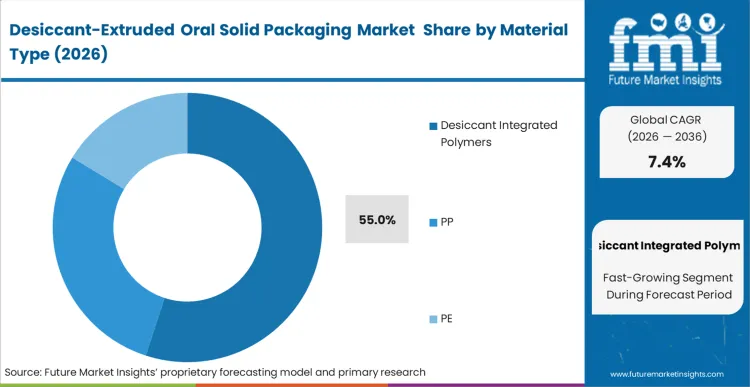
Desiccant integrated polymers hold their dominant 55.0% share because they provide the only commercially viable path to "active" moisture scavenging without increasing the physical footprint of the container. This material class is not chosen for simple barrier properties; it is selected for its ability to pull moisture away from the oral solid dosage after the package has been opened. FMI analysts opine that the technical barrier for co-extruding molecular sieves into a polymer matrix without compromising the structural integrity of the container wall is the primary variable separating tier-1 vendors from lower-cost alternatives. Buyers are increasingly standardizing on integrated polymers to allow for thinner secondary packaging, potentially reducing the overall plastic weight of the total shipping unit. Manufacturers who fail to master this co-extrusion process are excluded from high-margin pharmaceutical contracts where moisture-vapor transmission rates are strictly audited.
- Superior absorption: The polymer matrix achieves moisture absorption rates that exceed standard silica gel sachets by 25% within the first 24 hours of exposure. This prevents the initial moisture spike that often compromises the coating of sensitive tablets.
- Structural gaps: Gaps in performance appear under extreme tropical storage conditions if the desiccant loading levels in the polymer are not precisely calibrated for the container volume. Buyers must specify higher loading for products destined for Southeast Asian distribution.
- Standard acceptability: Qualification standards for pharmaceutical grade desiccant integrated polymers determine the acceptability of the packaging in North American and European markets. Vendors must provide verifiable traceability for the desiccant masterbatch to pass these audits.
Desiccant-Extruded Oral Solid Packaging Market Analysis by End Use
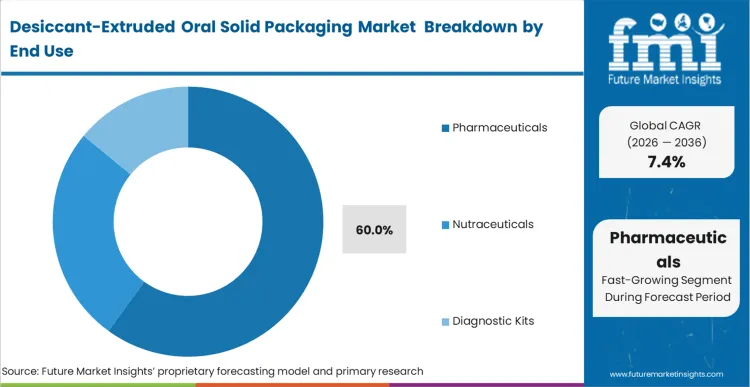
The commercial consequence of failing to provide adequate moisture protection for Class III oral solids is often an entire batch recall, which can cost pharmaceutical companies millions in lost revenue and brand equity. This risk environment creates a forced adoption cycle for desiccant-extruded packaging within the chronic care segment, where patients rely on daily doses from a single container over a 90-day period. Based on FMI's projection, the pharmaceutical sector will continue to lead as regulatory bodies like the FDA increase scrutiny on the stability data of moisture-sensitive generics. In diagnostic kits, the adoption is driven by the need to protect reagents from the minute humidity ingress that can cause false readings. Organizations that cling to legacy desiccant sachets in these sensitive applications face increasing litigation risks and regulatory warnings as superior integrated alternatives become the industry benchmark.
- Early adopters: High-value effervescent drug manufacturers adopt first because the product's functional viability is entirely dependent on a zero-moisture environment. These players absorb the initial technology premium to secure early market dominance in specialty categories.
- Follower transitions: Generic manufacturers follow once the price of desiccant-integrated tubes reaches a 1.2x parity with traditional bottle-and-sachet systems. This transition is supported by the operational savings found in higher packaging line speeds.
- Late conversion: Bulk nutraceutical providers reach this sub-segment last, only converting when retail procurement mandates the removal of loose desiccants to prevent consumer misuse. This final wave of adoption stabilizes the long-term volume of the integrated polymer market.
Desiccant-Extruded Oral Solid Packaging Market Drivers, Restraints, and Opportunities
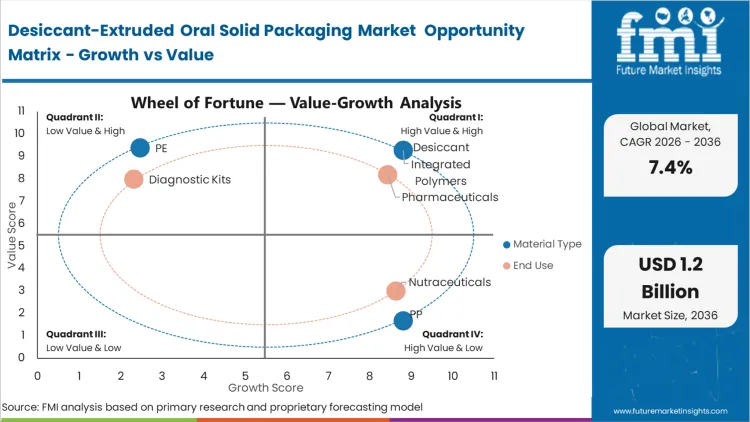
The structural forcing condition driving this market is the "stability gap" created by the move toward more complex, moisture-sensitive pharmaceutical formulations. Stability managers at tier-1 pharmaceutical firms are finding that traditional passive barriers are no longer sufficient to maintain potency through the entire distribution chain, especially as supply lines lengthen into emerging markets with high ambient humidity. This requires a shift to active scavenging that can recover the internal environment after patient access. FMI's assessment suggests that this is no longer an optional upgrade but a commercial necessity for any oral solid dosage requiring a shelf life of over 24 months.
The primary restraint in this market is the "qualification inertia" inherent in pharmaceutical manufacturing, where changing a primary packaging material requires a full requalification of the drug product. Stability testing cycles lasting 6 to 12 months act as a significant operational bottleneck, preventing rapid switching even when the technical benefits of integrated desiccants are obvious. This friction is structural, as it is tied to regulatory safety protocols rather than temporary cost barriers. While some vendors are attempting to provide pre-qualified "drug-master-file" (DMF) supported packaging components, the final responsibility for stability still rests with the drug manufacturer, slowing the overall growth rate.
Opportunities in the Desiccant-Extruded Oral Solid Packaging Market
- Nutraceutical premiumization: The rise of high-end probiotic and enzyme-based supplements creates an opportunity for brand owners to use desiccant tubes to justify a premium price point. These buyers capture market share by positioning the packaging as a guarantee of high-potency delivery to the consumer.
- Diagnostic integration: Rapid expansion of point-of-care diagnostic kits enables kit manufacturers to integrate desiccant strips directly into the test cartridge housing. This captures the diagnostic market by extending the functional life of reagents in non-clinical environments.
- Sustainable thinning: The use of active scavenging allows for a reduction in the thickness of external high-barrier polymer walls without compromising protection. Procurement directors at global brands capture this opportunity to meet corporate plastic-reduction targets while maintaining product safety.
Regional Analysis
Based on the regional analysis, the Desiccant-Extruded Oral Solid Packaging market is segmented into North America, Latin America, Europe, East Asia, South Asia & Pacific, and Middle East & Africa across 40 plus countries.
.webp "Top Country Growth Comparison Desiccant Extruded Oral Solid Packaging Market Cagr (2026 2036)")
| Country | CAGR (2026 to 2036) |
|---|---|
| India | 9.8% |
| China | 8.5% |
| USA | 6.2% |
| Germany | 5.8% |
| United Kingdom | 5.4% |
| Japan | 4.8% |
| France | 4.5% |
Source: Future Market Insights (FMI) analysis, based on proprietary forecasting model and primary research
South Asia & Pacific Desiccant-Extruded Oral Solid Packaging Market Analysis
The structural trajectory of the South Asia market is defined by its role as the global "pharmacy of the world," where the concentration of generic manufacturing requires rapid alignment with international packaging standards. Regulatory bodies in this region are increasingly mandating that export-grade oral solids utilize packaging that can withstand the extreme humidity of maritime transit. FMI analysts opine that the adoption of active packaging in South Asia is not a luxury but a prerequisite for maintaining tier-1 supplier status for Western pharmaceutical contracts.
- India: India's rapid expansion of generic export hubs drives a massive requirement for high-performance desiccant tubes to ensure the stability of medicines destined for global markets. Pharmaceutical logistics operators running these routes have begun large-scale qualification of integrated scavenging systems to meet 2026 compliance targets. Demand for Desiccant-Extruded Oral Solid Packaging in India is set to grow at 9.8% CAGR. Companies that move first capture preferred supplier status in procurement frameworks that are unlikely to reopen once initial vendors are qualified.
East Asia Desiccant-Extruded Oral Solid Packaging Market Analysis
Infrastructure-led adoption in East Asia is centered on the region's dominance in diagnostic kit manufacturing and high-speed pharmaceutical automation. The physical infrastructure of Chinese and Japanese plants is optimized for "Pharma 4.0" standards, where the elimination of manual sachet insertion is a primary goal for robotic filling lines. Based on FMI's assessment, the integration of desiccant functionality into the primary container wall is seen as a vital step in reducing mechanical complexity on the factory floor.
- China: China's position as a global leader in rapid c creates a sustained demand for desiccant-integrated strips and housings to protect sensitive chemical reagents. Kit manufacturers in this region are prioritizing co-extruded solutions to streamline their assembly processes and reduce product failure rates. The market for Desiccant-Extruded Oral Solid Packaging in China is forecast to register a CAGR of 8.5%. This growth trajectory positions Chinese manufacturers to dominate the global supply of "active" diagnostic kit components over the next decade.
- Japan: Japan's aging population and the resulting high consumption of chronic care medications drive a steady-state requirement for user-friendly, moisture-scavenging tubes. The Japanese market for Desiccant-Extruded Oral Solid Packaging is likely to post a CAGR of 4.8%. This adoption simplifies the medication management process for elderly patients, clearing the bottleneck of handling loose desiccants in daily dose containers.
North America Desiccant-Extruded Oral Solid Packaging Market Analysis
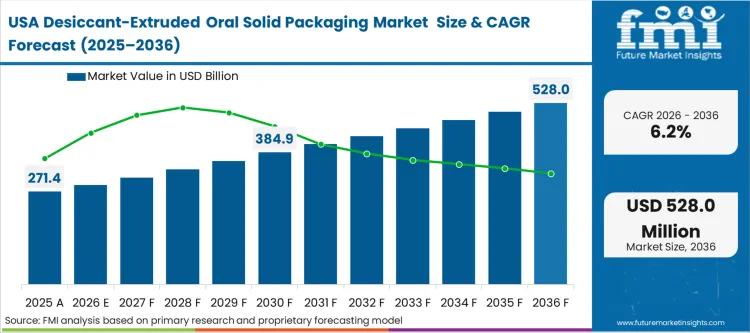
The North American market trajectory is dictated by the rigorous evolution of FDA stability mandates, which increasingly favor active primary packaging over secondary desiccant inserts. Procurement directors at major U.S.-based pharmaceutical firms are prioritizing integrated systems to meet the "Revision 2" stability testing standards recently updated for moisture-sensitive oral solids. According to FMI's estimates, this shift is centered on reducing the chemical degradation risks associated with the high-speed distribution of biologics and high-value generics.
- USA: The United States market is structurally defined by the high concentration of advanced pharmaceutical R&D and a robust regulatory environment that penalizes batch inconsistency. Manufacturers are rapidly transitioning to co-extruded desiccant tubes to align with the FDA’s guidance on container closure systems, which emphasizes active moisture management for Class III medications. The market for Desiccant-Extruded Oral Solid Packaging in the USA is set to grow at a CAGR of 6.2%. This transition to integrated scavenging ensures that domestic pharmaceutical operators achieve a standardized micro-environment across all climate zones, effectively eliminating the operational cost and time delays associated with secondary desiccant failures during the stability testing phase.
Europe Desiccant-Extruded Oral Solid Packaging Market Analysis
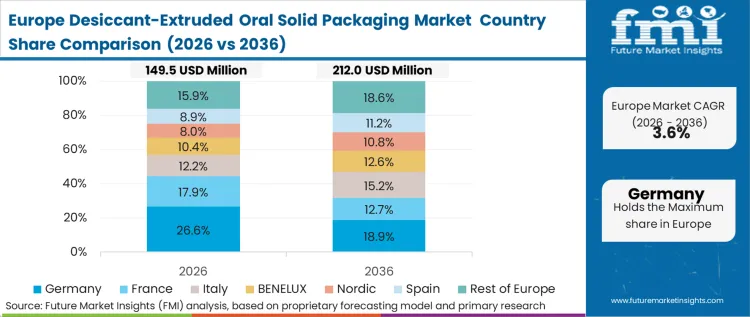
Economics-led dynamics in Europe focus on the total cost of ownership (TCO) comparisons between traditional barrier packaging and integrated desiccant systems. While the unit cost of extruded tubes is higher, European procurement directors are calculating the savings from reduced batch wastage and the elimination of sachet-related line downtime. FMI's report indicates that the European market is shifting toward integrated solutions as a hedge against the rising cost of pharmaceutical recalls and quality audits.
- Germany: Germany's high concentration of specialty pharmaceutical firms necessitates packaging that can maintain ultra-low humidity for orphan drugs and biologics. The German market for Desiccant-Extruded Oral Solid Packaging is projected to witness growth at a CAGR of 5.8%. This structural shift toward active protection is heading toward a state where integrated desiccants are the default for all moisture-sensitive drug categories by 2030.
- United Kingdom: Procurement practices in the UK pharmaceutical sector emphasize long-term stability data, making co-extruded polymers a favored choice for chronic care medications. A CAGR of 5.4% is expected for Desiccant-Extruded Oral Solid Packaging in the UK over the forecast period. On-the-ground reality shows that the CAGR reflects a cycle of capital refresh where aging sachet-insertion machines are being replaced by high-speed lines designed for pre-desiccated tubes.
- France: The French pharmaceutical sector's focus on innovative drug delivery formats drives the adoption of moisture-scavenging blisters for premium oral solids. France is expected to see its Desiccant-Extruded Oral Solid Packaging sector grow at a compound annual rate of 4.5%. This trajectory creates a competitive advantage for French brands exporting high-value nutraceuticals to high-humidity global markets.
FMI's report includes additional coverage for North America and Latin America. These regions exhibit a structural pattern where the consolidation of retail pharmacy chains is forcing manufacturers toward unified packaging formats that minimize in-store storage risks.
Competitive Aligners for Market Players
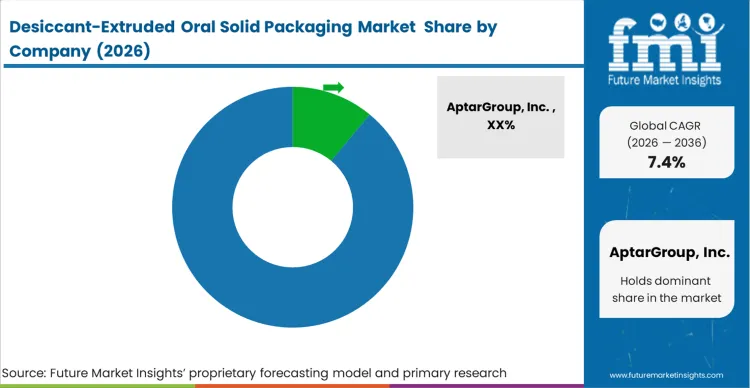
The competitive structure of the Desiccant-Extruded Oral Solid Packaging market is highly concentrated, driven by the significant capital requirement for advanced co-extrusion and masterbatch blending technology. Buyers in this space do not select vendors based on general manufacturing capacity; they choose based on the verifiable moisture-vapor transmission rate (MVTR) and absorption capacity data provided for the integrated polymer matrix. Leading firms like AptarGroup and Sanner GmbH have secured their positions by maintaining proprietary formulations for their desiccant-loaded polymers, creating a high barrier for new entrants. The primary variable used to distinguish qualified vendors is the ability to provide a Drug Master File (DMF) that supports the regulatory submission of the pharmaceutical client, effectively locking in long-term supply contracts.
Incumbents in the market hold a structural advantage through their deep integration with high-speed filling line manufacturers. A company like Airnov or Mitsubishi Gas Chemical does not just sell a container; they sell a validated system that is optimized for specific robotic sachet-less environments. To replicate this, a challenger must build not only the polymer science capability but also a global stability-testing infrastructure that can mirror the ICH protocols required by pharmaceutical clients. The competitive landscape is defined by these technical-service moats, where the packaging provider acts as an extension of the drug manufacturer's quality control department.
Large pharmaceutical buyers resist vendor lock-in by mandating that their packaging suppliers use standardized mold formats, yet they are often constrained by the specific scavenging performance of the integrated polymer. There is a structural tension between the buyer's desire for commodity-level pricing and the vendor's incentive to provide a high-performance, proprietary scavenging environment. Through 2036, the market is expected to remain concentrated among a few tier-1 players who can sustain the R&D investment required for the next generation of "smart" desiccants. The trajectory suggests that the market will move toward more customized scavenging profiles tailored to the specific degradation curve of individual molecules, further strengthening the bond between the drug developer and the specialty packaging provider.
Key Players in Desiccant-Extruded Oral Solid Packaging Market
- AptarGroup, Inc.
- Sanner GmbH
- Mitsubishi Gas Chemical Company, Inc.
- Hoffmann Neopac AG
- Airnov (Colorcon)
- CSP Technologies (Aptar)
- Multisorb (Filtration Group)
- Origin Pharma Packaging
- IMPAK Corporation
Scope of the Report
| Metric | Value |
|---|---|
| Quantitative Units | USD 0.61 billion to USD 1.25 billion, at a CAGR of 7.42% |
| Market Definition | Primary packaging utilizing co-extruded moisture-scavenging polymers to protect oral solid dosage forms from humidity ingress throughout the product lifecycle. |
| Product Type Segmentation | Tubes, Blisters, Bottles, Pouches |
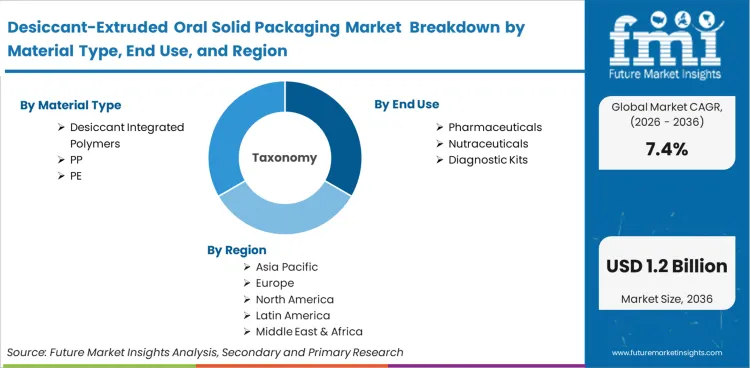
| Material Type Segmentation | Desiccant Integrated Polymers, PP, PE |
| End Use Segmentation | Pharmaceuticals, Nutraceuticals, Diagnostic Kits |
| Regions Covered | North America, Latin America, Europe, East Asia, South Asia & Pacific, Middle East & Africa |
| Countries Covered | India, China, USA, Germany, United Kingdom, Japan, France, and 40 plus countries |
| Key Companies Profiled | AptarGroup, Inc., Airnov Healthcare Packaging, Sanner GmbH, Mitsubishi Gas Chemical, Hoffmann Neopac AG, etc. |
| Forecast Period | 2026 to 2036 |
| Approach | Interviews with pharmaceutical stability leads, analysis of high-speed filling line deployments, and tracking of desiccant masterbatch consumption in co-extrusion plants. |
Source: Future Market Insights (FMI) analysis, based on proprietary forecasting model and primary research
Desiccant-Extruded Oral Solid Packaging Market Analysis by Segments
Product Type:
- Tubes
- Blisters
- Bottles
- Pouches
Material Type:
- Desiccant Integrated Polymers
- PP
- PE
End Use:
- Pharmaceuticals
- Nutraceuticals
- Diagnostic Kits
Region:
- North America
- USA
- Canada
- Europe
- Germany
- United Kingdom
- France
- East Asia
- China
- Japan
- South Asia & Pacific
- India
Bibliography
- FDA. (2025, February). Guidance for Industry: Stability Testing of Drug Substances and Products (Revision 2). U.S. Food and Drug Administration.
- Aptar CSP Technologies. (2024, May). Active Integrated Packaging for Moisture-Sensitive Oral Solid Dosages. White Paper Series.
- Airnov Healthcare Packaging. (2024, March). Advancements in Co-Extruded Polymer Scavenging Systems. Technical Documentation.
- Sanner GmbH. (2024, June). Effervescent Packaging: The Move to Sachet-Free Automated Lines. Industry Report.
- ISO. (2026, January). ISO 15378:2024 Primary Packaging Materials for Medicinal Products (Updated Standard). International Organization for Standardization.
- Mitsubishi Gas Chemical. (2024, February). Age-Gate Scavenging Performance in Extruded Containers. Technical Review.
- Pharmaceutical Engineering Journal. (2024, August). Stability Challenges in High-Humidity Distribution Corridors. ISPE Publications.
- NIST. (2024, July). Polymer Matrix Performance Standards for Desiccant Integration. National Institute of Standards and Technology.
- European Medicines Agency. (2024, September). Guidelines on Quality of Medicinal Products: Plastic Primary Packaging.
- Hoffmann Neopac. (2024, October). Sustainability in Pharmaceutical Tubes: Active Scavenging and Material Reduction.
This bibliography is provided for reader reference. The full FMI report contains the complete reference list with primary source documentation.
This Report Addresses
- Market intelligence to support strategic decision making across co-extruded desiccant tubes and active scavenging integrated polymers
- Market size estimation and 10-year revenue forecasts from 2026 to 2036, supported by tracking of high-speed pharmaceutical filling line deployments
- Growth opportunity mapping across pharmaceutical and nutraceutical sectors with emphasis on the structural gate of stability-testing validation
- Segment and regional revenue forecasts covering moisture-sensitive effervescents across global generic manufacturing procurement contexts
- Competition strategy assessment including technical-service moats and Drug Master File (DMF) regulatory support variables
- Product development tracking including ICH stability standards and molecular sieve co-extrusion compliance frameworks
- Market access analysis covering FDA guidance on container closure systems and European primary packaging quality mandates
- Market report delivery in PDF, Excel, PPT, and interactive dashboard formats for executive strategy, pharmaceutical stability planning, and operational benchmarking use
Frequently Asked Questions
How large is the Desiccant-Extruded Oral Solid Packaging Market in 2026?
The market is projected to reach USD 0.61 billion in 2026. This figure signals that the technology has moved from a niche specialty application into a scalable solution for high-volume generic drug manufacturing.
What will the market be valued at by 2036?
The total opportunity is expected to hit USD 1.25 billion by 2036. This growth reflects the long-term replacement of secondary desiccant sachets as active packaging becomes the industry standard for oral solid dosages.
What CAGR is projected for the Desiccant-Extruded Oral Solid Packaging Market?
FMI forecasts a CAGR of 7.42% between 2026 and 2036. This rate is determined by the capital expenditure cycles of pharmaceutical manufacturers as they upgrade legacy filling lines to sachet-less automated environments.
Which product type segment leads the market?
The Tubes segment leads with 42.0% share in 2026. This leadership is sustained by the tube’s superior functional integration for effervescent tablets, where co-extruded lining provides the most efficient moisture protection.
Which material type is most dominant?
Desiccant Integrated Polymers lead with 55.0% share. This dominance is driven by the material’s ability to actively scavenge moisture after the package is opened, a performance mechanism that standard passive barriers cannot match.
Which end use drives the most demand?
The Pharmaceuticals segment accounts for 60.0% of the market. This is because pharmaceutical manufacturers face the strictest regulatory stability requirements and the highest financial risks associated with batch degradation.
What is the primary driver for rapid growth?
The move toward high-speed, automated sachet-less filling lines is the non-obvious driver. Manufacturers are adopting integrated desiccant packaging to eliminate the mechanical bottlenecks and downtime caused by secondary desiccant insertion stations.
What is the biggest restraint facing the market?
The primary restraint is the 12-month stability-testing requirement for primary packaging changes. This regulatory gate creates a structural delay in adoption, as pharmaceutical companies cannot switch formats without extensive and time-consuming validation data.
Which country is growing the fastest?
India’s 9.8% CAGR reflects a rapid infrastructure pivot toward export-oriented generic biologics, whereas China’s 8.5% is anchored to domestic diagnostic reagent scaling. India's growth is driven by compliance-led capital refresh cycles required for USFDA/EMA market access, creating a steeper adoption curve than China's internal standardization.
How does the ICH stability protocol impact packaging decisions?
The ICH protocols mandate that oral solids maintain potency under accelerated aging conditions (40°C/75% RH). Integrated desiccant packaging is often the only way to meet these thresholds for moisture-sensitive molecules without using expensive cold-chain logistics.
What is the technical challenge of co-extruded polymers?
The challenge lies in loading high percentages of molecular sieves into a polymer matrix without making the container wall brittle. Only tier-1 vendors with proprietary masterbatch blending technology can achieve the necessary balance of absorption and structural integrity.
How does active scavenging differ from passive barrier protection?
Passive barriers like foil blisters only slow the ingress of moisture. Active scavenging, found in co-extruded packaging, removes moisture already present in the headspace or moisture that enters during the patient’s repeated use of the product.
Why is sachet insertion considered a bottleneck for Pharma 4.0?
In fully automated environments, loose sachets can tear, jam feeding mechanisms, or be missed by sensors, leading to expensive line stops. Integrated desiccant packaging eliminates this station entirely, allowing for seamless high-speed production.
What role does the Drug Master File (DMF) play in vendor selection?
Pharmaceutical companies only select vendors who have a pre-filed DMF with regulatory agencies. This allows the client to reference the vendor’s manufacturing data in their own drug application, significantly shortening the packaging approval process.
How does the nutraceutical market use desiccant-extruded packaging?
Nutraceutical brands use desiccant-lined tubes to protect high-potency probiotics and enzymes that are highly moisture-sensitive. This active protection allows them to guarantee product efficacy to the consumer through the entire use-cycle.
Is there a sustainability benefit to integrated desiccants?
Yes, by integrating active scavenging, manufacturers can often use thinner external polymer walls or eliminate the need for secondary foil over-wrapping. This reduces the total plastic footprint of the pharmaceutical shipment while maintaining safety.
How do point-of-care diagnostic kits use this technology?
Diagnostic kits utilize co-extruded desiccant strips inside the test device housing to prevent moisture from degrading the chemical reagents. This ensures that the test remains accurate even when stored in non-controlled environments.
What is the 'in-use stability period' and why does it matter?
In-use stability refers to the time after a patient first opens a multi-dose container. Integrated desiccants are unique in their ability to protect the remaining tablets from the moisture introduced every time the cap is removed.
How concentrated is the competitive landscape?
The market is highly concentrated among five to seven global leaders due to the specialized polymer science required. These incumbents maintain their share through proprietary formulations and deep partnerships with machinery providers.
What changes are expected in regional adoption by 2036?
By 2036, Southeast Asia and India will transition from low-cost sachet systems to integrated desiccants as their domestic quality regulations align with Western export standards. This will make the Asia-Pacific region the primary volume driver for the market.
Can integrated desiccants be used with biologics?
Yes, as oral biologics become more common, the need for precise micro-environment control increases. Integrated scavenging provides a more stable humidity profile than sachets, which is critical for maintaining the three-dimensional structure of sensitive proteins.
How does FMI validate its market sizing for this sector?
FMI triangulates its data by analyzing desiccant masterbatch production volumes and comparing them against the growth of high-speed filling line shipments that do not feature sachet-insertion stations.
Preview the report firsthand - request a free sample
Get SampleGet the brochure for pricing and purchase details.
Get PDFTable of Content
- Executive Summary
- Global Market Outlook
- Demand-side Trends
- Supply-side Trends
- Technology Roadmap Analysis
- Analysis and Recommendations
- Market Overview
- Market Coverage / Taxonomy
- Market Definition / Scope / Limitations
- Research Methodology
- Chapter Orientation
- Analytical Lens and Working Hypotheses
- Market Structure, Signals, and Trend Drivers
- Benchmarking and Cross-market Comparability
- Market Sizing, Forecasting, and Opportunity Mapping
- Research Design and Evidence Framework
- Desk Research Programme (Secondary Evidence)
- Company Annual and Sustainability Reports
- Peer-reviewed Journals and Academic Literature
- Corporate Websites, Product Literature, and Technical Notes
- Earnings Decks and Investor Briefings
- Statutory Filings and Regulatory Disclosures
- Technical White Papers and Standards Notes
- Trade Journals, Industry Magazines, and Analyst Briefs
- Conference Proceedings, Webinars, and Seminar Materials
- Government Statistics Portals and Public Data Releases
- Press Releases and Reputable Media Coverage
- Specialist Newsletters and Curated Briefings
- Sector Databases and Reference Repositories
- FMI Internal Proprietary Databases and Historical Market Datasets
- Subscription Datasets and Paid Sources
- Social Channels, Communities, and Digital Listening Inputs
- Additional Desk Sources
- Expert Input and Fieldwork (Primary Evidence)
- Primary Modes
- Qualitative Interviews and Expert Elicitation
- Quantitative Surveys and Structured Data Capture
- Blended Approach
- Why Primary Evidence is Used
- Field Techniques
- Interviews
- Surveys
- Focus Groups
- Observational and In-context Research
- Social and Community Interactions
- Stakeholder Universe Engaged
- C-suite Leaders
- Board Members
- Presidents and Vice Presidents
- R&D and Innovation Heads
- Technical Specialists
- Domain Subject-matter Experts
- Scientists
- Physicians and Other Healthcare Professionals
- Governance, Ethics, and Data Stewardship
- Research Ethics
- Data Integrity and Handling
- Primary Modes
- Tooling, Models, and Reference Databases
- Desk Research Programme (Secondary Evidence)
- Data Engineering and Model Build
- Data Acquisition and Ingestion
- Cleaning, Normalisation, and Verification
- Synthesis, Triangulation, and Analysis
- Quality Assurance and Audit Trail
- Market Background
- Market Dynamics
- Drivers
- Restraints
- Opportunity
- Trends
- Scenario Forecast
- Demand in Optimistic Scenario
- Demand in Likely Scenario
- Demand in Conservative Scenario
- Opportunity Map Analysis
- Product Life Cycle Analysis
- Supply Chain Analysis
- Investment Feasibility Matrix
- Value Chain Analysis
- PESTLE and Porter’s Analysis
- Regulatory Landscape
- Regional Parent Market Outlook
- Production and Consumption Statistics
- Import and Export Statistics
- Market Dynamics
- Global Market Analysis 2021 to 2025 and Forecast, 2026 to 2036
- Historical Market Size Value (USD Million) Analysis, 2021 to 2025
- Current and Future Market Size Value (USD Million) Projections, 2026 to 2036
- Y-o-Y Growth Trend Analysis
- Absolute $ Opportunity Analysis
- Global Market Pricing Analysis 2021 to 2025 and Forecast 2026 to 2036
- Global Market Analysis 2021 to 2025 and Forecast 2026 to 2036, By Material Type
- Introduction / Key Findings
- Historical Market Size Value (USD Million) Analysis By Material Type , 2021 to 2025
- Current and Future Market Size Value (USD Million) Analysis and Forecast By Material Type , 2026 to 2036
- Desiccant Integrated Polymers
- PP
- PE
- Desiccant Integrated Polymers
- Y-o-Y Growth Trend Analysis By Material Type , 2021 to 2025
- Absolute $ Opportunity Analysis By Material Type , 2026 to 2036
- Global Market Analysis 2021 to 2025 and Forecast 2026 to 2036, By End Use
- Introduction / Key Findings
- Historical Market Size Value (USD Million) Analysis By End Use, 2021 to 2025
- Current and Future Market Size Value (USD Million) Analysis and Forecast By End Use, 2026 to 2036
- Pharmaceuticals
- Nutraceuticals
- Diagnostic Kits
- Pharmaceuticals
- Y-o-Y Growth Trend Analysis By End Use, 2021 to 2025
- Absolute $ Opportunity Analysis By End Use, 2026 to 2036
- Global Market Analysis 2021 to 2025 and Forecast 2026 to 2036, By Product Type
- Introduction / Key Findings
- Historical Market Size Value (USD Million) Analysis By Product Type, 2021 to 2025
- Current and Future Market Size Value (USD Million) Analysis and Forecast By Product Type, 2026 to 2036
- Tubes
- Blisters
- Bottles
- Tubes
- Y-o-Y Growth Trend Analysis By Product Type, 2021 to 2025
- Absolute $ Opportunity Analysis By Product Type, 2026 to 2036
- Global Market Analysis 2021 to 2025 and Forecast 2026 to 2036, By Region
- Introduction
- Historical Market Size Value (USD Million) Analysis By Region, 2021 to 2025
- Current Market Size Value (USD Million) Analysis and Forecast By Region, 2026 to 2036
- North America
- Latin America
- Western Europe
- Eastern Europe
- East Asia
- South Asia and Pacific
- Middle East & Africa
- Market Attractiveness Analysis By Region
- North America Market Analysis 2021 to 2025 and Forecast 2026 to 2036, By Country
- Historical Market Size Value (USD Million) Trend Analysis By Market Taxonomy, 2021 to 2025
- Market Size Value (USD Million) Forecast By Market Taxonomy, 2026 to 2036
- By Country
- USA
- Canada
- Mexico
- By Material Type
- By End Use
- By Product Type
- By Country
- Market Attractiveness Analysis
- By Country
- By Material Type
- By End Use
- By Product Type
- Key Takeaways
- Latin America Market Analysis 2021 to 2025 and Forecast 2026 to 2036, By Country
- Historical Market Size Value (USD Million) Trend Analysis By Market Taxonomy, 2021 to 2025
- Market Size Value (USD Million) Forecast By Market Taxonomy, 2026 to 2036
- By Country
- Brazil
- Chile
- Rest of Latin America
- By Material Type
- By End Use
- By Product Type
- By Country
- Market Attractiveness Analysis
- By Country
- By Material Type
- By End Use
- By Product Type
- Key Takeaways
- Western Europe Market Analysis 2021 to 2025 and Forecast 2026 to 2036, By Country
- Historical Market Size Value (USD Million) Trend Analysis By Market Taxonomy, 2021 to 2025
- Market Size Value (USD Million) Forecast By Market Taxonomy, 2026 to 2036
- By Country
- Germany
- UK
- Italy
- Spain
- France
- Nordic
- BENELUX
- Rest of Western Europe
- By Material Type
- By End Use
- By Product Type
- By Country
- Market Attractiveness Analysis
- By Country
- By Material Type
- By End Use
- By Product Type
- Key Takeaways
- Eastern Europe Market Analysis 2021 to 2025 and Forecast 2026 to 2036, By Country
- Historical Market Size Value (USD Million) Trend Analysis By Market Taxonomy, 2021 to 2025
- Market Size Value (USD Million) Forecast By Market Taxonomy, 2026 to 2036
- By Country
- Russia
- Poland
- Hungary
- Balkan & Baltic
- Rest of Eastern Europe
- By Material Type
- By End Use
- By Product Type
- By Country
- Market Attractiveness Analysis
- By Country
- By Material Type
- By End Use
- By Product Type
- Key Takeaways
- East Asia Market Analysis 2021 to 2025 and Forecast 2026 to 2036, By Country
- Historical Market Size Value (USD Million) Trend Analysis By Market Taxonomy, 2021 to 2025
- Market Size Value (USD Million) Forecast By Market Taxonomy, 2026 to 2036
- By Country
- China
- Japan
- South Korea
- By Material Type
- By End Use
- By Product Type
- By Country
- Market Attractiveness Analysis
- By Country
- By Material Type
- By End Use
- By Product Type
- Key Takeaways
- South Asia and Pacific Market Analysis 2021 to 2025 and Forecast 2026 to 2036, By Country
- Historical Market Size Value (USD Million) Trend Analysis By Market Taxonomy, 2021 to 2025
- Market Size Value (USD Million) Forecast By Market Taxonomy, 2026 to 2036
- By Country
- India
- ASEAN
- Australia & New Zealand
- Rest of South Asia and Pacific
- By Material Type
- By End Use
- By Product Type
- By Country
- Market Attractiveness Analysis
- By Country
- By Material Type
- By End Use
- By Product Type
- Key Takeaways
- Middle East & Africa Market Analysis 2021 to 2025 and Forecast 2026 to 2036, By Country
- Historical Market Size Value (USD Million) Trend Analysis By Market Taxonomy, 2021 to 2025
- Market Size Value (USD Million) Forecast By Market Taxonomy, 2026 to 2036
- By Country
- Kingdom of Saudi Arabia
- Other GCC Countries
- Turkiye
- South Africa
- Other African Union
- Rest of Middle East & Africa
- By Material Type
- By End Use
- By Product Type
- By Country
- Market Attractiveness Analysis
- By Country
- By Material Type
- By End Use
- By Product Type
- Key Takeaways
- Key Countries Market Analysis
- USA
- Pricing Analysis
- Market Share Analysis, 2025
- By Material Type
- By End Use
- By Product Type
- Canada
- Pricing Analysis
- Market Share Analysis, 2025
- By Material Type
- By End Use
- By Product Type
- Mexico
- Pricing Analysis
- Market Share Analysis, 2025
- By Material Type
- By End Use
- By Product Type
- Brazil
- Pricing Analysis
- Market Share Analysis, 2025
- By Material Type
- By End Use
- By Product Type
- Chile
- Pricing Analysis
- Market Share Analysis, 2025
- By Material Type
- By End Use
- By Product Type
- Germany
- Pricing Analysis
- Market Share Analysis, 2025
- By Material Type
- By End Use
- By Product Type
- UK
- Pricing Analysis
- Market Share Analysis, 2025
- By Material Type
- By End Use
- By Product Type
- Italy
- Pricing Analysis
- Market Share Analysis, 2025
- By Material Type
- By End Use
- By Product Type
- Spain
- Pricing Analysis
- Market Share Analysis, 2025
- By Material Type
- By End Use
- By Product Type
- France
- Pricing Analysis
- Market Share Analysis, 2025
- By Material Type
- By End Use
- By Product Type
- India
- Pricing Analysis
- Market Share Analysis, 2025
- By Material Type
- By End Use
- By Product Type
- ASEAN
- Pricing Analysis
- Market Share Analysis, 2025
- By Material Type
- By End Use
- By Product Type
- Australia & New Zealand
- Pricing Analysis
- Market Share Analysis, 2025
- By Material Type
- By End Use
- By Product Type
- China
- Pricing Analysis
- Market Share Analysis, 2025
- By Material Type
- By End Use
- By Product Type
- Japan
- Pricing Analysis
- Market Share Analysis, 2025
- By Material Type
- By End Use
- By Product Type
- South Korea
- Pricing Analysis
- Market Share Analysis, 2025
- By Material Type
- By End Use
- By Product Type
- Russia
- Pricing Analysis
- Market Share Analysis, 2025
- By Material Type
- By End Use
- By Product Type
- Poland
- Pricing Analysis
- Market Share Analysis, 2025
- By Material Type
- By End Use
- By Product Type
- Hungary
- Pricing Analysis
- Market Share Analysis, 2025
- By Material Type
- By End Use
- By Product Type
- Kingdom of Saudi Arabia
- Pricing Analysis
- Market Share Analysis, 2025
- By Material Type
- By End Use
- By Product Type
- Turkiye
- Pricing Analysis
- Market Share Analysis, 2025
- By Material Type
- By End Use
- By Product Type
- South Africa
- Pricing Analysis
- Market Share Analysis, 2025
- By Material Type
- By End Use
- By Product Type
- USA
- Market Structure Analysis
- Competition Dashboard
- Competition Benchmarking
- Market Share Analysis of Top Players
- By Regional
- By Material Type
- By End Use
- By Product Type
- Competition Analysis
- Competition Deep Dive
- AptarGroup, Inc.
- Overview
- Product Portfolio
- Profitability by Market Segments (Product/Age /Sales Channel/Region)
- Sales Footprint
- Strategy Overview
- Marketing Strategy
- Product Strategy
- Channel Strategy
- Sanner GmbH
- Mitsubishi Gas Chemical Company, Inc.
- Hoffmann Neopac AG
- Airnov (Colorcon)
- CSP Technologies (Aptar)
- Multisorb (Filtration Group)
- AptarGroup, Inc.
- Competition Deep Dive
- Assumptions & Acronyms Used


