

- Industry Size (2026)
- USD 920 Mn
- Forecast (2036)
- USD 1880 Mn
- CAGR (2026 to 2036)
- 7.4%
Solid-State Relay and Fuse Box Component Platforms Market Size, Market Forecast and Outlook By FMI
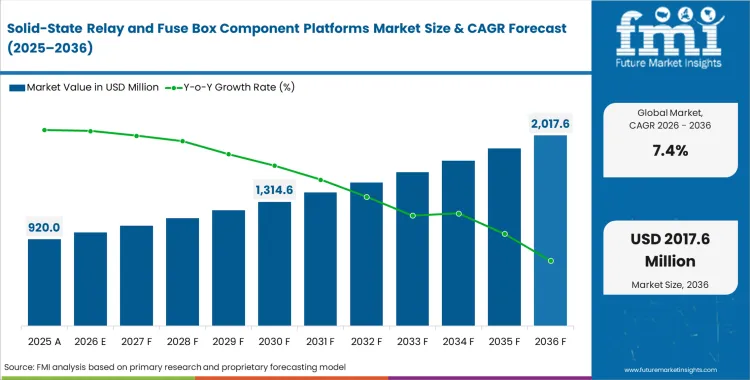
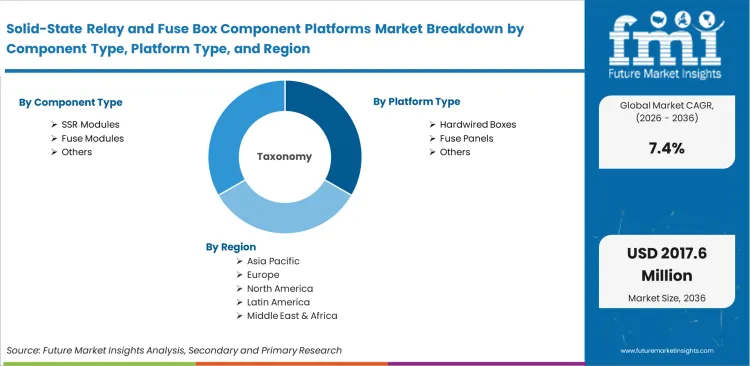
The solid-state relay and fuse box component platforms market crossed a valuation of USD 860 million in 2025 and is expected to reach USD 920 million in 2026, growing at a CAGR of 7.4% through 2036. The market is expected to reach USD 1,880 million by 2036, as high-voltage battery architectures are pushing OEMs to replace mechanical switches with arc-free isolation components.
Summary of Solid-State Relay and Fuse Box Component Platforms Market
- Solid-State Relay and Fuse Box Component Platforms Market Definition
- Solid-State Relay and Fuse Box Component Platforms isolates faults and manages power distribution across complex high-voltage architectures using semiconductor switching combined with circuit protection nodes.
- Demand Drivers in the Market
- Transitioning 800-volt battery architectures forces Tier-1 hardware engineers to specify arc-free isolation components.
- Grid-scale energy storage deployments push facility managers to upgrade thermal management enclosures preventing cascading hardware failures.
- Miniaturization targets compel packaging designers to integrate switching logic directly alongside automotive relays and fuses inside unified module footprints.
- Key Segments Analyzed in the FMI Report
- SSR Modules: 34.0% share in 2026, benefiting from superior vibration resistance compared to electromechanical alternatives.
- Hardwired Boxes: 38.0% share based on proven reliability across extreme vibration environments.
- Low Voltage: 46.0% share anchored by vast installed base across traditional combustion engine platforms.
- Passenger Vehicles: 41.0% share propelled by exponentially increasing internal electronics density per vehicle.
- Panel Mount: 37.0% share because modular replacement requires easily accessible mounting interfaces.
- India: 9.1% CAGR, reflecting aggressive localization initiatives pushing domestic electronics manufacturing.
- Analyst Opinion at FMI
- Rahul Pandita, Principal Analyst, Technology, at FMI, observes that, "Hardware engineers often assume that switching to solid-state designs will eliminate most wear-related issues. It is true that contact wear is no longer the main concern, but that does not mean the problem disappears. In many cases, heat becomes the bigger issue. Buying teams do not always account for the added cooling needs early enough, and that can create avoidable failures. As a result, expensive semiconductor relays may end up failing sooner than lower-cost mechanical fuses, simply because the heat sink requirements were carried over from older designs that were built around different operating conditions."
- Strategic Implications / Executive Takeaways
- Sourcing teams must prioritize thermal management validation data over base component cost when evaluating overseas supplier bids.
- Engineering directors risking reliance on single-source semiconductor foundries face critical production stoppages during wafer shortages.
- Packaging specialists who integrate diagnostic reporting directly into fuse enclosures capture premium contracts from premium vehicle manufacturers.
- Methodology
- Base models anchor against verified automotive and industrial equipment production volumes.
- Secondary validation integrates independent semiconductor wafer shipment data.
- Primary inputs feature blind interviews with hardware procurement directors.
Automotive Tier-1 suppliers need to specify component architectures that handle sudden thermal spikes without degrading physical contacts. Replacing traditional electromechanical switches with solid state relay configurations eliminates arc flash risks inherent to 800-volt battery systems. Suppliers that delay this transition may be passed over for upcoming EV platform contracts. Hardware engineers rarely discuss how thermal management requirements quietly shift diagnostic logic away from central processors toward localized node controllers. Distributed switching creates isolated heat zones requiring independent monitoring systems.
Once thermal dissipation node controllers successfully integrate diagnostic fault reporting, widespread adoption becomes self-reinforcing. System architects realize they can eliminate heavy diagnostic cabling layers entirely. Localized fault management dramatically reduces total harness weight while improving trigger response times.
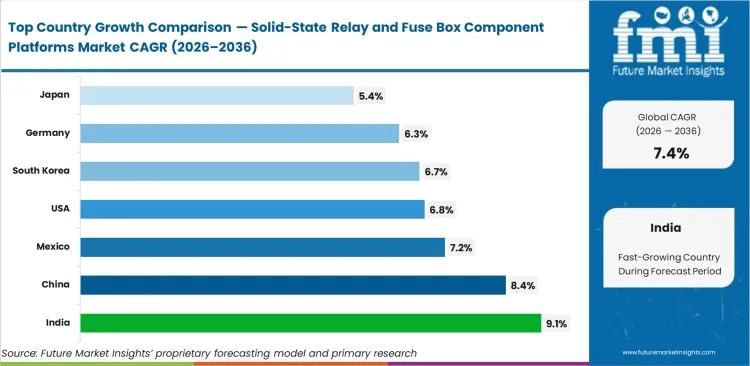
India tracks at 9.1% as domestic EV startups aggressively localize assembly protocols, while China expands at 8.4% driven by aggressive export mandates. Mexico grows at 7.2% due to nearshoring assembly lines serving North American heavy vehicle platforms. United States advances at 6.8% based on grid modernization incentives prioritizing local energy storage. South Korea registers 6.7% on back of premium passenger vehicle electronics density. Germany achieves 6.3% as heritage automakers transition legacy platforms with the United Kingdom advancing at a 6.1% pace. Japan trails at 5.4% prioritizing conservative hybrid power architectures over pure battery configurations. Diverging regulatory timelines across these territories force module suppliers to maintain completely separate hardware validation tracks.
Solid-State Relay and Fuse Box Component Platforms Market Definition
Solid-State Relay and Fuse Box Component Platforms are assemblies that isolate electrical faults and manage power distribution across high-amperage circuits. Modules utilize semiconductor-based switching mechanisms alongside sacrificial circuit breakers to protect sensitive loads from voltage spikes. Intelligent node architectures monitor current flow continuously, providing immediate interruption capabilities without relying on physical contact separation.
Solid-State Relay and Fuse Box Component Platforms Market Inclusions
Scope incorporates surface-mounted switching devices, printed circuit board control centers, plug-in automotive junction box assemblies, and hybrid enclosures combining traditional melting fuses with semiconductor relays. Software algorithms embedded directly within hardware controllers for fault prediction fall within parameters. Thermal dissipation heat sinks attached directly to relay modules are considered integrated structural components.
Solid-State Relay and Fuse Box Component Platforms Market Exclusions
Standalone wiring harnesses connecting separate hardware enclosures sit outside scope because they function strictly as transmission lines rather than active control elements. Central vehicle processing units handling infotainment remain excluded as they lack direct power interruption capabilities. External testing equipment utilized during manufacturing validations falls outside defined boundaries.
Solid-State Relay and Fuse Box Component Platforms Market Research Methodology
- Primary Research: Sourcing directors at major automotive Tier-1 suppliers and electrical engineering leads at industrial automation firms.
- Desk Research: Safety certification registries, component homologation filings, and patent databases covering semiconductor switching topologies.
- Market-Sizing and Forecasting: Module shipment volumes mapped against heavy vehicle production schedules and grid storage deployment targets.
- Data Validation and Update Cycle: Independent semiconductor foundry output figures cross-validated against automotive assembly plant run rates.
Segmental Analysis
Solid-State Relay and Fuse Box Component Platforms Market Analysis by Component Type
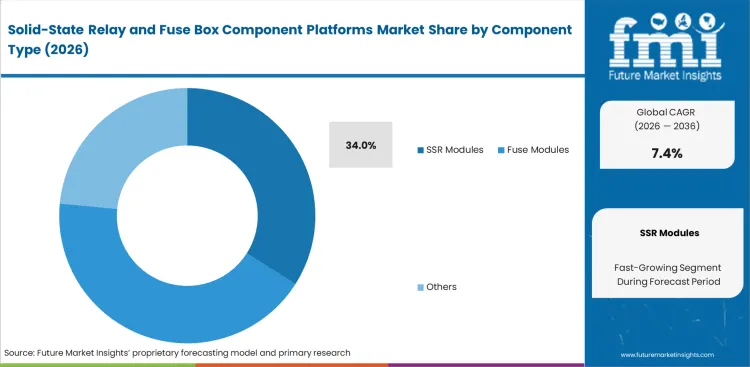
Electromechanical alternatives fail rapidly when tasked with high-frequency switching across 800-volt circuits. SSR modules hold 34.0% share because semiconductor topologies eliminate physical contact wear entirely. Procurement directors specifying electric vehicle relays recognize that continuous switching generates immense concentrated heat. Adopting these solid-state units forces hardware teams to redesign adjacent cooling channels. What supplier specification sheets rarely highlight is how ambient temperature fluctuations severely degrade promised lifespan metrics.
- Vibration Resilience Mechanism: Solid potting compounds encasing switching logic prevent microscopic component separation during extreme chassis impacts. Quality assurance leads eliminate secondary mechanical fastening requirements entirely.
- Thermal Runaway Prevention: Embedded diagnostic chips detect abnormal resistance spikes before semiconductor layers melt. System architects avoid costly total-vehicle recalls by localizing failure containment.
- Diagnostic Feedback Loops: Integrated sensors report precise resistance degradation profiles directly to central maintenance computers. Fleet managers schedule preemptive module replacements rather than reacting to sudden operational halts.
Solid-State Relay and Fuse Box Component Platforms Market Analysis by Platform Type
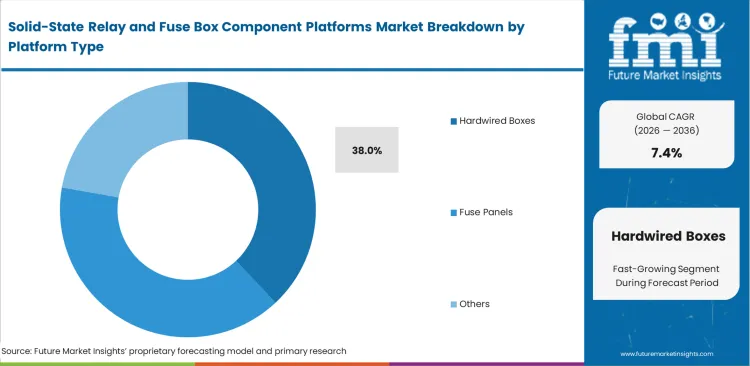
Harsh industrial environments guarantee excessive dust intrusion and continuous high-amplitude shaking. Facility operations managers in high-cost downtime environments favor hardwired enclosures over modular designs because permanent connections reduce the risk of intermittent failures. Utilizing rigid internal copper traces removes entire categories of failure modes linked to plug-in connectors. Generalist engineers assume modular systems always lower lifetime costs due to faster swap times. Factory floor technicians know that permanent connections prevent initial failures from happening at all. Sourcing departments that choose modular designs for high-vibration environments often spend more on resolving intermittent connectivity failures than they saved on initial procurement. Hardwired boxes control 38.0% share because permanent soldered connections prevent microscopic arcing caused by terminal fretting.
- Fretting Corrosion Block: Soldering incoming power lines directly to internal busbars eliminates microscopic friction zones. Electrical engineers completely remove contact oxidation from their reliability failure models.
- Thermal Mass Distribution: Thick copper traces embedded within heavy fiberglass substrates dissipate sudden voltage spikes efficiently. Plant managers run machinery closer to maximum load limits safely.
- Moisture Ingress Denial: Removing modular access panels allows manufacturers to implement permanent epoxy sealing processes. Maintenance directors deploy these units across washdown zones without secondary protective cabinets.
Solid-State Relay and Fuse Box Component Platforms Market Analysis by Voltage Class
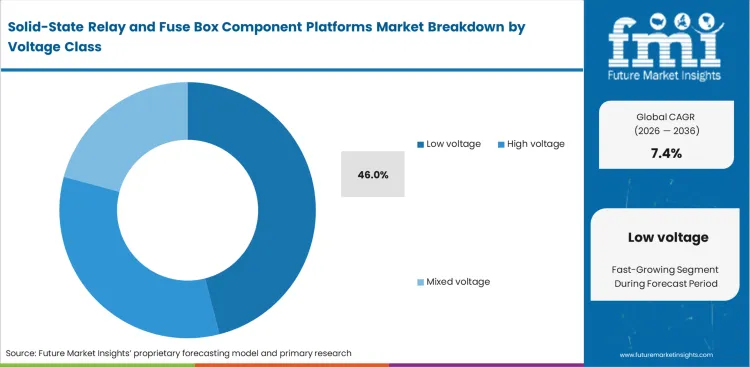
Legacy combustion vehicle platforms and standard industrial control systems utilize 12-volt to 48-volt architectures extensively. The segment secures a 46.0% share for the demand of low voltage category as it is driven by massive installed bases across millions of active machines. Fleet procurement officers sourcing replacement electrical fuses maintain vast inventories of standardized components. Upgrading existing control cabinets requires components perfectly matching previous physical dimensions while offering modernized semiconductor logic inside. Component datasheets imply seamless drop-in replacements for all legacy hardware. Experienced integration specialists understand modern solid-state units often require separate grounding paths incompatible with vintage chassis designs. Operators who overlook grounding differences may experience phantom voltage readings that affect adjacent digital sensors.
- Drop-In Dimension Matching: Engineers design solid-state internals fitting perfectly inside legacy mechanical relay plastic housing profiles. Maintenance teams upgrade factory floor capabilities without modifying expensive metal mounting rails.
- Phantom Voltage Suppression: Built-in bleed resistors neutralize floating voltages generated by sensitive modern sensing equipment. Instrumentation technicians capture accurate digital readings despite proximity to heavy switching loads.
- Inventory Consolidation: Programmable trip curves allow one intelligent module to replace multiple distinct mechanical fuse ratings. Warehouse managers shrink spare part holding costs significantly while improving response times.
Solid-State Relay and Fuse Box Component Platforms Market Analysis By End Use
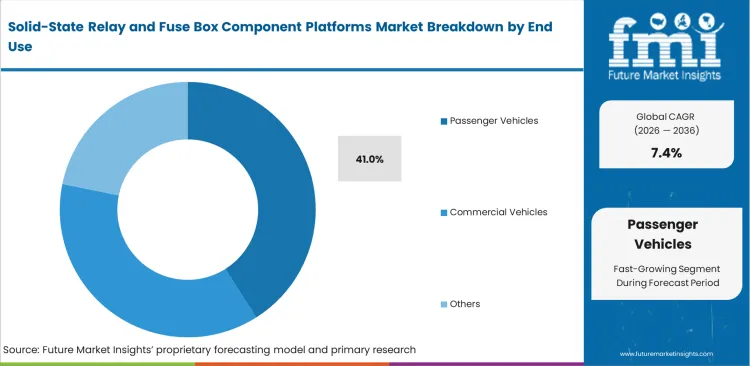
Internal cabin electronics density multiplies exponentially with every new vehicle generation released. Passenger vehicles account for 41.0% share as seat heaters, infotainment screens, and advanced driver assistance cameras demand independent power routing. Automotive packaging engineers work within very tight space constraints behind dashboard panels. Combining solid-state switching with a fuse combination unit shrinks overall spatial footprint drastically. Industry presentations celebrate how these micro-modules reduce total vehicle weight. Placing high-density heat-generating components behind insulated interior trim creates localized hotspots that may require active cooling. Design teams failing to map thermal airflow adequately face delayed production launches and redesign penalties.
- Acoustic Noise Elimination: Semiconductor switching removes annoying clicking sounds associated with mechanical relays cycling during operation. Cabin acoustic engineers achieve strict interior silence targets effortlessly.
- Weight Reduction Topology: Centralizing power distribution logic into fewer printed circuit boards slashes heavy copper wire usage. Chassis designers reallocate saved weight toward larger battery capacity modules.
- Parasitic Draw Minimization: Sleep mode algorithms cut micro-ampere leakage when vehicles sit parked for extended durations. Warranty directors drastically reduce battery replacement claims related to long-term storage drain.
Solid-State Relay and Fuse Box Component Platforms Market Analysis by Mounting Format
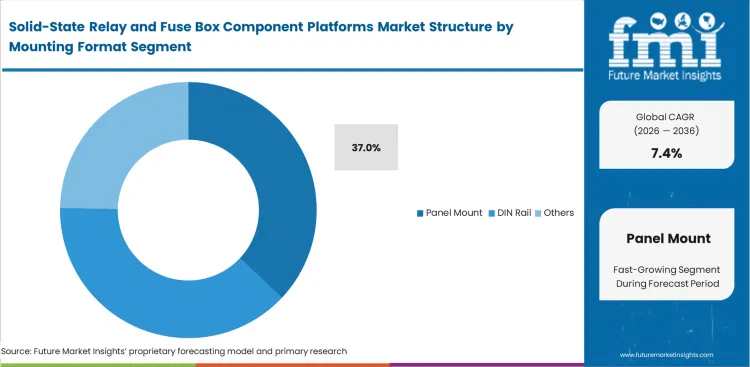
Service technicians need to access individual components quickly when troubleshooting electrical cabinets. Panel mount commands 37.0% share because external bolting mechanisms allow module replacement without dismantling internal busbar architectures. Field service engineers swapping an automotive battery disconnect unit require robust fastening points surviving high-torque wrench applications. Employing thick metal flanges disperses physical stress away from delicate internal circuit boards. Marketing brochures heavily emphasize tool-free DIN rail convenience for new installations. Veteran installers recognize that plastic DIN clips become brittle and snap under severe thermal cycling, whereas bolted panel mounts remain structurally pristine over decades. Operations that use clip-based mounting in high-temperature zones often face unplanned repair costs when clips fail. Rigid wire harness connections require extreme structural stability.
- Torque Stress Deflection: Thick aluminum base plates absorb rotational forces applied during heavy gauge cable installation. Assembly line workers secure massive cables without fracturing delicate internal solder joints.
- Heat Sink Integration: Mounting modules directly onto external metal cabinet walls transforms entire enclosures into massive passive coolers. Hardware designers achieve higher continuous current ratings without adding expensive internal fans.
- Vibration Isolation: Adding rubber dampening washers between mounting flanges and cabinet walls protects sensitive logic chips. Field technicians deploy fragile diagnostic units near heavy stamping presses successfully.
Solid-State Relay and Fuse Box Component Platforms Market Drivers, Restraints, and Opportunities
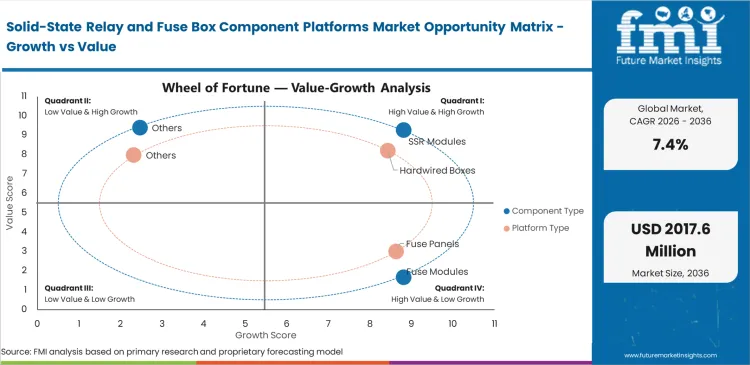
Current automotive architectures have difficulty handling the fault currents generated by 800-volt fast-charging cycles. Hardware procurement managers are working to secure fuse block designs that combine pyrotechnic disconnects with solid-state logic before program deadlines. Suppliers that cannot secure these modules in time may not be able to meet safety homologation requirements for upcoming vehicle programs. The challenge is not just selecting the right components. Engineering teams also need to address thermal runaway risk before it causes failures in the field. Engineering teams realize traditional melting fuses simply react too slowly to protect expensive silicon carbide inverters. Tier-1 suppliers that do not adopt intelligent relay platforms risk losing qualification for next-generation vehicle programs.
Internal disagreements between purchasing and quality assurance teams slow down the approval of new components. Purchasing teams want to buy advanced power distribution component modules, but quality assurance departments refuse to approve components lacking twenty years of field data. This disagreement delays the hardware approval process and forces engineering teams to plan around uncertain component specifications. Engineering teams need confirmed hardware specifications before they can finalize software-defined vehicle architectures, but safety approval committees often require testing timelines that are longer than program schedules allow. Until standardization bodies publish accelerated aging guidelines for automotive semiconductor relays, some automakers will continue using mechanical switching hardware alongside newer software systems.
- Localized Diagnostic Software: Firmware engineers embedding predictive failure algorithms directly into standalone nodes eliminate costly central processor overhead. Software leads capture recurring revenue through diagnostic licensing agreements.
- Thermal Material Innovation: Materials scientists utilizing advanced ceramic heat sinks drastically shrink overall module footprints. Packaging designers fit high-amperage distribution board setups into tighter spaces.
- Recyclable Enclosure Plastics: Chemical engineers formulating flame-retardant bioplastics help automakers hit aggressive sustainability targets. Sourcing directors secure premium pricing from eco-conscious electric vehicle startups.
Regional Analysis
Based on regional analysis, Solid-State Relay and Fuse Box Component Platforms is segmented into North America, Europe, Asia Pacific, and Latin America across 40 plus countries. The structural transition toward solid-state power distribution accelerates unevenly across the globe, heavily dictated by regional supply chain constraints and localized grid modernization policies. Analyzing these geographic shifts reveals stark contrasts in how automotive and industrial procurement directors balance component availability against cutting-edge technical integration.
.webp "Top Country Growth Comparison Solid State Relay And Fuse Box Component Platforms Market Cagr (2026 2036)")
| Country | CAGR (2026 to 2036) |
|---|---|
| India | 9.1% |
| China | 8.4% |
| Mexico | 7.2% |
| United States | 6.8% |
| South Korea | 6.7% |
| Germany | 6.3% |
| Japan | 5.4% |
| United Kingdom | 6.1% |
Source: Future Market Insights (FMI) analysis, based on proprietary forecasting model and primary research
Asia Pacific Solid-State Relay and Fuse Box Component Platforms Market Analysis
To reduce import tariff costs, sourcing directors across Asia Pacific are forming joint ventures with local module manufacturers. Integrating a switchgears system with solid-state logic has become essential for stabilizing massive solar installations on outdated grids, while operators increasingly rely on fiberglass electrical enclosure setups to shield sensitive electronics from intense monsoon moisture. Our analysis indicates that scaling production capacity right now easily trumps the desire for bespoke engineering.
- India: Government incentives for two-wheeler electrification are pushing domestic startups to source compact switching modules, which is one reason India is expected to grow at a 9.1% CAGR. Battery packaging specialists are actively shrinking comprehensive power management systems into cavities that used to house small fuel tanks. Suppliers that secure early high-volume contracts are likely to hold a procurement advantage for several years as buyers prefer to maintain stable supply relationships.
- China: Chinese commercial vehicle builders targeting export markets are meeting European safety standards by installing high-grade solid-state relays. China is expected to grow at an 8.4% CAGR. As Chinese Tier-1 suppliers improve their component quality standards, they are raising the baseline that buyers in other markets expect. Adjacent market competitors are watching nervously as Chinese Tier-1 suppliers rapidly commoditize capabilities that were previously considered premium features.
- South Korea: Quality directors overseeing premium passenger vehicle assembly lines have almost entirely eliminated costly warranty claims linked to parasitic battery drain by integrating predictive maintenance algorithms into power distribution nodes. These organizations are fundamentally pivoting from hardware-centric designs toward software-first integrations which leads to a solid 6.7% of CAGR, reflecting that the territory clearly prioritizes software-defined hardware capabilities over sheer component volume.
- Japan: Tracking at a cautious 5.4% CAGR, adoption timelines stretch significantly longer here than in neighboring automotive hubs as reliability chiefs embedded in conservative engineering cultures insist on exhaustive parallel testing before they approve any semiconductor swap for a proven mechanical system. By deliberately sacrificing early-adopter advantages, local suppliers gain the necessary runway to perfect their thermal dissipation designs before committing to mass deployment.
FMI's comprehensive research framework actively tracks additional evolving markets across the broader Asia Pacific theater, including emerging manufacturing hubs in Southeast Asia. Large automotive purchasing departments in the region are using their buying power to require more detailed local testing from suppliers. Asia Pacific is expected to contribute the largest share of global volume growth for solid-state components over the forecast period.
North America Solid-State Relay and Fuse Box Component Platforms Market Analysis
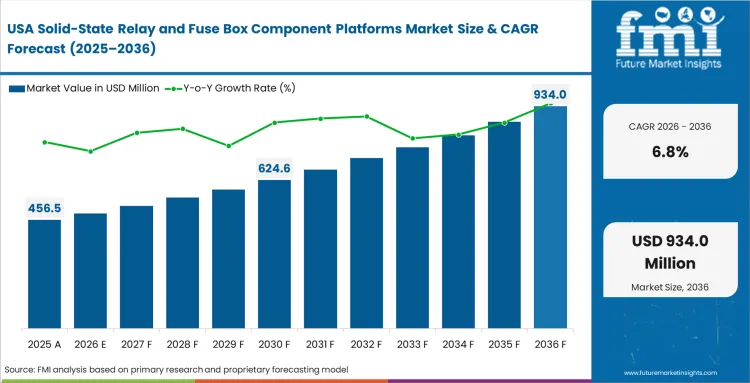
Significant public and private investment in grid modernization is driving a broad expansion of decentralized energy storage across North America. Utility procurement teams are demanding heavily ruggedized distribution panel configurations that can withstand severe weather events without requiring manual intervention. The pivot away from centralized power generation toward localized microgrids changes exactly how hardware engineers calculate fault isolation requirements, with buyers consistently prioritizing domestic sourcing over minor technical upgrades.
- Mexico: To sidestep complex cross-border tariffs, sourcing managers are rapidly rebuilding regional supply chains and relocating heavy commercial vehicle assembly operations southward. These newly established facilities require immediate proximity to high-voltage component validation laboratories that creates an impact of 7.2% CAGR, leading Tier-1 integrators that quickly build local testing centers to capture dominant market positions by prioritizing logistics velocity over raw unit costs.
- United States: Utility operators managing massive lithium battery storage parks have learned that traditional mechanical breakers react far too slowly to prevent cascading thermal events. Safety engineers now require solid-state interruption speeds to isolate failing battery cells within microseconds. The United States is expected to grow at a 6.8% CAGR, as this safety requirement is pushing rapid architecture upgrades and favoring suppliers that meet domestic content requirements.
Detailed modeling within the FMI report extends beyond these borders to capture the nuanced regulatory shifts happening across Canada and related trade zones. North American buyers consistently exhibit a high willingness to fund premium engineering when it directly mitigates physical hardware risks in extreme environments. Federal infrastructure grants and local assembly requirements will shape which suppliers are best positioned to win contracts in North America over the forecast period.
Europe Solid-State Relay and Fuse Box Component Platforms Market Analysis
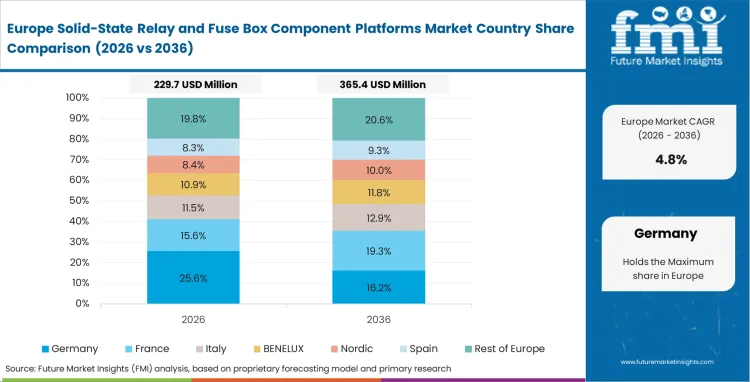
Automotive compliance officers now heavily scrutinize every commercial distribution panel material sheet, driven by strict recycling mandates that ban toxic potting compounds and unrecyclable plastic resins. Upgrading heritage combustion platforms to support electrified drivetrains demands highly creative modularity just to fit new distribution hardware into legacy chassis cavities. Buyers across the region accept noticeably higher upfront component pricing if the modules help them avoid severe end-of-life disposal penalties.
- Germany: German automakers are transitioning through hybrid fuse boxes that combine traditional fuse elements with basic semiconductor logic. This cautious approach is reflected in the expected 6.3% CAGR. Established manufacturers are moving carefully as they adapt long-standing engineering practices to meet the requirements of software-defined vehicle platforms. While this transitional compromise satisfies immediate safety benchmarks, it forces component suppliers to navigate agonizingly slow qualification cycles as their global competitors accelerate.
- United Kingdom: Grid operators managing offshore wind connections across the region fight a relentless battle against equipment degradation. Salt destroys mechanical breakers. Maintenance crews face dangerous and costly repair missions when these physical units fail during winter storms. Engineering teams bypass this problem by installing solid-state alternatives that eliminate moving parts entirely as it advances at a 6.1% CAGR, this hardware swap solves the immediate weather issue. Safety inspectors now demand semiconductor-based isolation for all new coastal energy storage sites. Facility managers that delay this upgrade may face financial penalties during power surges. Sourcing teams that secure weather-sealed module allocations early are likely to hold a supply and compliance advantage for several years.
FMI's report includes detailed analysis for the United Kingdom, France, Italy, Spain, Canada, and Brazil. European buyers are increasingly including supply chain transparency and carbon footprint criteria in their procurement reviews, alongside technical performance requirements. Suppliers with clear lifecycle sustainability documentation are better positioned to win contracts from European buyers that prioritize environmental compliance.
Competitive Aligners for Market Players
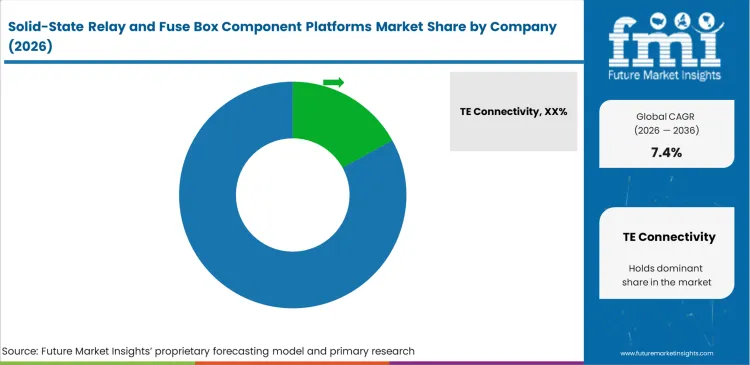
Access to semiconductor wafers now carries as much weight as product performance in supplier selection for this market. Procurement teams no longer assess vendors only on switch ratings or thermal limits. They review wafer access, sourcing stability, and the supplier’s ability to support output across the full vehicle program. TE Connectivity and Littelfuse hold an advantage because they have established sourcing ties and the scale to secure wafer capacity early. Smaller suppliers may offer capable products, yet buyers remain cautious when supply plans look uncertain. That caution reflects prior disruption. Automotive programs have already faced delays when smaller vendors could not secure semiconductor supply during constrained periods. Early qualification now depends on supply visibility alongside technical capability. In practical terms, procurement has shifted from a component review to a supply risk review. Fast switching speed and compact design still matter, though they carry less value when long-term supply remains unclear.
Established suppliers benefit from reliability records that newer entrants usually cannot match. Sensata Technologies, for instance, has built extensive internal data from thermal and environmental testing over long operating cycles. That record matters because automotive approval teams need evidence of part behavior under heat, vibration, humidity, and electrical load. Lower-cost alternatives may appear competitive in specification sheets, yet approval becomes harder without comparable life-cycle evidence. New entrants often need major spending on accelerated aging and validation before they can compete credibly. That reality gives incumbents room to protect pricing. Many engineering teams place proven durability ahead of modest upfront savings. In this segment, the advantage sits in both the hardware and the validation record behind it. Proprietary test history will remain a barrier while validation standards for solid-state relays stay fragmented.
Buyer power creates further pressure on suppliers in this segment. Automotive purchasing teams often require dual sourcing for major power distribution programs, which limits vendor control. Yazaki and Aptiv, among others, face requests for standardized module footprints that allow easier supplier switching during supply disruption. This creates a clear trade-off. Suppliers want differentiated features, while customers want hardware interchangeability. Many vendors respond by keeping housing formats and physical dimensions close to buyer requirements while shifting more value into firmware and diagnostic functions. That approach helps them meet procurement rules and retain some pricing control. Margin protection increasingly depends on where differentiation sits. Suppliers that depend only on hardware features face greater price pressure. Firms that build value into software, controls, and diagnostics are usually better placed to protect margins.
Key Players in Solid-State Relay and Fuse Box Component Platforms Market
- TE Connectivity
- Littelfuse
- Sensata Technologies
- Yazaki
- Aptiv
Scope of the Report
| Metric | Value |
|---|---|
| Quantitative Units | USD 920 million to USD 1,880 million, at a CAGR of 7.4% |
| Market Definition | Solid-State Relay and Fuse Box Component Platforms isolates faults and manages power distribution across complex high-voltage architectures using semiconductor switching combined with circuit protection nodes. |
| Segmentation | Component type, Platform type, Voltage class, End use, Mounting format |
| Regions Covered | North America, Europe, Asia Pacific, Latin America |
| Countries Covered | United States, Canada, Mexico, Brazil, Germany, United Kingdom, France, Italy, Spain, China, Japan, India, South Korea |
| Key Companies Profiled | TE Connectivity, Littelfuse, Sensata Technologies, Yazaki, Aptiv |
| Forecast Period | 2026 to 2036 |
| Approach | Base models anchor against verified automotive and industrial equipment production volumes. |
Source: Future Market Insights (FMI) analysis, based on proprietary forecasting model and primary research
Segments
Component Type:
- SSR modules
- Fuse modules
- Hybrid modules
- Control boards
- Busbars
Platform Type:
- Hardwired boxes
- Modular boxes
- Battery units
- Electrical centers
- Fuse panels
Voltage Class:
- Low voltage
- High voltage
- Mixed voltage
End Use:
- Passenger vehicles
- Commercial vehicles
- Industrial equipment
- Energy storage
- Charging systems
Mounting Format:
- Panel mount
- DIN rail
- PCB mount
- Sealed units
Regions:
- North America & Latin America
- United States
- Canada
- Mexico
- Brazil
- Argentina
- Chile
- Europe
- Germany
- United Kingdom
- France
- Italy
- Spain
- Asia-Pacific
- China
- Japan
- South Korea
- India
- ASEAN
- ANZ
- Middle East & Africa
- UAE
- Saudi Arabia
- South Africa
Bibliography
- International Energy Agency. (2025, May 14). Global EV outlook 2025. IEA.
- Gong, Z., Song, J., & Zhang, Y. (2025). Automotive fuse & relay box plug-in modules assembly correctness detection system based on machine vision. Engineering Applications of Artificial Intelligence, 159, 111691.
- Roslan, M. F., Reza, M. S., Rahman, M. S., Mansor, M., Arsad, A. Z., Jern, K. P., Ramachandaramurthy, V. K., & Hannan, M. A. (2024). State-of-the-art on advanced technologies of solid-state circuit breaker for reliable and sustainable power supply: A bibliometric analysis and future guidelines. Alexandria Engineering Journal, 104, 636–664.
- Driving the future: A comprehensive review of automotive battery management systems, technologies, and future trends. (2025). Journal of Power Sources.
This bibliography is provided for reader reference. The full FMI report contains the complete reference list with primary source documentation.
This Report Addresses
- Thermal management constraints impacting widespread semiconductor adoption across major automotive Tier-1 supplier platforms.
- Specific procurement dynamics separating passenger vehicle modular designs from extreme vibration industrial hardwired enclosures.
- Localization mandates pushing rapid joint venture formations across Asia Pacific electronic component foundries.
- Integration challenges preventing legacy combustion platform engineers from utilizing drop-in replacement logic boards.
- Warranty claim reductions achieved through predictive diagnostic firmware embedded within modern switching nodes.
- Safety homologation timelines dictating arc-free isolation adoption speeds across North American grid storage deployments.
- Tool-free installation failures forcing field technicians back toward bolted panel mount component architectures.
- Competitive moats created by proprietary accelerated aging databases guarded fiercely by established industry incumbents.
Frequently Asked Questions
What drives SSR modules segment expansion?
Semiconductor topologies eliminate physical contact wear entirely, forcing procurement directors to specify them for high-frequency switching tasks.
Why do hardwired boxes hold significant share?
Permanent soldered connections prevent microscopic arcing caused by terminal fretting, making them indispensable for harsh industrial environments.
Why are passenger vehicles adopting solid-state logic rapidly?
Exponentially increasing internal electronics density forces packaging engineers to shrink overall spatial footprints drastically.
What makes panel mount formats preferable?
External bolting mechanisms allow service technicians to replace modules without dismantling complex internal busbar architectures.
How does thermal management shape supplier selection?
Sourcing teams focus more on verified heat dissipation performance than on upfront component cost, since poor thermal control can lead to serious failure in use.
What is the structural constraint slowing modular adoption?
Quality assurance departments refuse to approve components lacking decades of verified field data in extreme vibration zones.
How do localized diagnostic algorithms change revenue models?
Firmware engineers embed predictive failure logic directly into hardware nodes, allowing software leads to capture recurring licensing fees.
Why is India expanding at 9.1% annually?
Massive government subsidies targeting two-wheeler electrification compel local startups to demand ultra-compact switching modules immediately.
What structural factor pushes Chinese manufacturers?
Export-focused commercial vehicle makers implement aerospace-grade relays to bypass extremely strict European safety regulations.
How does South Korea differ from neighboring territories?
Premium assembly lines integrate advanced predictive maintenance algorithms, prioritizing software-defined capabilities over sheer component volume.
Why does Japan adopt solid-state architectures slowly?
Conservative engineering cultures demand exhaustive parallel testing before approving any semiconductor replacement for proven mechanical systems.
What drives North American utility procurement?
Safety engineers mandate solid-state interruption speeds to isolate failing battery cells within microseconds to prevent cascading fires.
How do Mexican nearshoring initiatives impact sourcing?
Heavy commercial vehicle assembly operations moving south demand immediate access to localized high-voltage component validation labs.
Why do European buyers accept higher upfront pricing?
Strict recycling mandates compel hardware designers to eliminate toxic potting compounds and unrecyclable plastic resins completely.
What hidden advantage do legacy incumbents possess?
Established players own enormous libraries of proprietary thermal validation data that startups simply cannot replicate quickly.
How do automotive buyers prevent vendor lock-in?
Purchasing departments ruthlessly demand identical module physical footprints to allow instantaneous supplier swapping during wafer shortages.
Preview the report firsthand - request a free sample
Get SampleGet the brochure for pricing and purchase details.
Get PDFTable of Content
- Executive Summary
- Global Market Outlook
- Demand-side Trends
- Supply-side Trends
- Technology Roadmap Analysis
- Analysis and Recommendations
- Market Overview
- Market Coverage / Taxonomy
- Market Definition / Scope / Limitations
- Research Methodology
- Chapter Orientation
- Analytical Lens and Working Hypotheses
- Market Structure, Signals, and Trend Drivers
- Benchmarking and Cross-market Comparability
- Market Sizing, Forecasting, and Opportunity Mapping
- Research Design and Evidence Framework
- Desk Research Programme (Secondary Evidence)
- Company Annual and Sustainability Reports
- Peer-reviewed Journals and Academic Literature
- Corporate Websites, Product Literature, and Technical Notes
- Earnings Decks and Investor Briefings
- Statutory Filings and Regulatory Disclosures
- Technical White Papers and Standards Notes
- Trade Journals, Industry Magazines, and Analyst Briefs
- Conference Proceedings, Webinars, and Seminar Materials
- Government Statistics Portals and Public Data Releases
- Press Releases and Reputable Media Coverage
- Specialist Newsletters and Curated Briefings
- Sector Databases and Reference Repositories
- FMI Internal Proprietary Databases and Historical Market Datasets
- Subscription Datasets and Paid Sources
- Social Channels, Communities, and Digital Listening Inputs
- Additional Desk Sources
- Expert Input and Fieldwork (Primary Evidence)
- Primary Modes
- Qualitative Interviews and Expert Elicitation
- Quantitative Surveys and Structured Data Capture
- Blended Approach
- Why Primary Evidence is Used
- Field Techniques
- Interviews
- Surveys
- Focus Groups
- Observational and In-context Research
- Social and Community Interactions
- Stakeholder Universe Engaged
- C-suite Leaders
- Board Members
- Presidents and Vice Presidents
- R&D and Innovation Heads
- Technical Specialists
- Domain Subject-matter Experts
- Scientists
- Physicians and Other Healthcare Professionals
- Governance, Ethics, and Data Stewardship
- Research Ethics
- Data Integrity and Handling
- Primary Modes
- Tooling, Models, and Reference Databases
- Desk Research Programme (Secondary Evidence)
- Data Engineering and Model Build
- Data Acquisition and Ingestion
- Cleaning, Normalisation, and Verification
- Synthesis, Triangulation, and Analysis
- Quality Assurance and Audit Trail
- Market Background
- Market Dynamics
- Drivers
- Restraints
- Opportunity
- Trends
- Scenario Forecast
- Demand in Optimistic Scenario
- Demand in Likely Scenario
- Demand in Conservative Scenario
- Opportunity Map Analysis
- Product Life Cycle Analysis
- Supply Chain Analysis
- Investment Feasibility Matrix
- Value Chain Analysis
- PESTLE and Porter’s Analysis
- Regulatory Landscape
- Regional Parent Market Outlook
- Production and Consumption Statistics
- Import and Export Statistics
- Market Dynamics
- Global Market Analysis 2021 to 2025 and Forecast, 2026 to 2036
- Historical Market Size Value (USD Million) Analysis, 2021 to 2025
- Current and Future Market Size Value (USD Million) Projections, 2026 to 2036
- Y-o-Y Growth Trend Analysis
- Absolute $ Opportunity Analysis
- Global Market Pricing Analysis 2021 to 2025 and Forecast 2026 to 2036
- Global Market Analysis 2021 to 2025 and Forecast 2026 to 2036, By Component Type
- Introduction / Key Findings
- Historical Market Size Value (USD Million) Analysis By Component Type , 2021 to 2025
- Current and Future Market Size Value (USD Million) Analysis and Forecast By Component Type , 2026 to 2036
- SSR Modules
- Fuse Modules
- Others
- SSR Modules
- Y-o-Y Growth Trend Analysis By Component Type , 2021 to 2025
- Absolute $ Opportunity Analysis By Component Type , 2026 to 2036
- Global Market Analysis 2021 to 2025 and Forecast 2026 to 2036, By Platform Type
- Introduction / Key Findings
- Historical Market Size Value (USD Million) Analysis By Platform Type, 2021 to 2025
- Current and Future Market Size Value (USD Million) Analysis and Forecast By Platform Type, 2026 to 2036
- Hardwired Boxes
- Fuse Panels
- Others
- Hardwired Boxes
- Y-o-Y Growth Trend Analysis By Platform Type, 2021 to 2025
- Absolute $ Opportunity Analysis By Platform Type, 2026 to 2036
- Global Market Analysis 2021 to 2025 and Forecast 2026 to 2036, By Voltage Class
- Introduction / Key Findings
- Historical Market Size Value (USD Million) Analysis By Voltage Class, 2021 to 2025
- Current and Future Market Size Value (USD Million) Analysis and Forecast By Voltage Class, 2026 to 2036
- Low voltage
- High voltage
- Mixed voltage
- Low voltage
- Y-o-Y Growth Trend Analysis By Voltage Class, 2021 to 2025
- Absolute $ Opportunity Analysis By Voltage Class, 2026 to 2036
- Global Market Analysis 2021 to 2025 and Forecast 2026 to 2036, By End Use
- Introduction / Key Findings
- Historical Market Size Value (USD Million) Analysis By End Use, 2021 to 2025
- Current and Future Market Size Value (USD Million) Analysis and Forecast By End Use, 2026 to 2036
- Passenger Vehicles
- Commercial Vehicles
- Others
- Passenger Vehicles
- Y-o-Y Growth Trend Analysis By End Use, 2021 to 2025
- Absolute $ Opportunity Analysis By End Use, 2026 to 2036
- Global Market Analysis 2021 to 2025 and Forecast 2026 to 2036, By Mounting Format
- Introduction / Key Findings
- Historical Market Size Value (USD Million) Analysis By Mounting Format, 2021 to 2025
- Current and Future Market Size Value (USD Million) Analysis and Forecast By Mounting Format, 2026 to 2036
- Panel Mount
- DIN Rail
- Others
- Panel Mount
- Y-o-Y Growth Trend Analysis By Mounting Format, 2021 to 2025
- Absolute $ Opportunity Analysis By Mounting Format, 2026 to 2036
- Global Market Analysis 2021 to 2025 and Forecast 2026 to 2036, By Region
- Introduction
- Historical Market Size Value (USD Million) Analysis By Region, 2021 to 2025
- Current Market Size Value (USD Million) Analysis and Forecast By Region, 2026 to 2036
- North America
- Latin America
- Western Europe
- Eastern Europe
- East Asia
- South Asia and Pacific
- Middle East & Africa
- Market Attractiveness Analysis By Region
- North America Market Analysis 2021 to 2025 and Forecast 2026 to 2036, By Country
- Historical Market Size Value (USD Million) Trend Analysis By Market Taxonomy, 2021 to 2025
- Market Size Value (USD Million) Forecast By Market Taxonomy, 2026 to 2036
- By Country
- USA
- Canada
- Mexico
- By Component Type
- By Platform Type
- By Voltage Class
- By End Use
- By Mounting Format
- By Country
- Market Attractiveness Analysis
- By Country
- By Component Type
- By Platform Type
- By Voltage Class
- By End Use
- By Mounting Format
- Key Takeaways
- Latin America Market Analysis 2021 to 2025 and Forecast 2026 to 2036, By Country
- Historical Market Size Value (USD Million) Trend Analysis By Market Taxonomy, 2021 to 2025
- Market Size Value (USD Million) Forecast By Market Taxonomy, 2026 to 2036
- By Country
- Brazil
- Chile
- Rest of Latin America
- By Component Type
- By Platform Type
- By Voltage Class
- By End Use
- By Mounting Format
- By Country
- Market Attractiveness Analysis
- By Country
- By Component Type
- By Platform Type
- By Voltage Class
- By End Use
- By Mounting Format
- Key Takeaways
- Western Europe Market Analysis 2021 to 2025 and Forecast 2026 to 2036, By Country
- Historical Market Size Value (USD Million) Trend Analysis By Market Taxonomy, 2021 to 2025
- Market Size Value (USD Million) Forecast By Market Taxonomy, 2026 to 2036
- By Country
- Germany
- UK
- Italy
- Spain
- France
- Nordic
- BENELUX
- Rest of Western Europe
- By Component Type
- By Platform Type
- By Voltage Class
- By End Use
- By Mounting Format
- By Country
- Market Attractiveness Analysis
- By Country
- By Component Type
- By Platform Type
- By Voltage Class
- By End Use
- By Mounting Format
- Key Takeaways
- Eastern Europe Market Analysis 2021 to 2025 and Forecast 2026 to 2036, By Country
- Historical Market Size Value (USD Million) Trend Analysis By Market Taxonomy, 2021 to 2025
- Market Size Value (USD Million) Forecast By Market Taxonomy, 2026 to 2036
- By Country
- Russia
- Poland
- Hungary
- Balkan & Baltic
- Rest of Eastern Europe
- By Component Type
- By Platform Type
- By Voltage Class
- By End Use
- By Mounting Format
- By Country
- Market Attractiveness Analysis
- By Country
- By Component Type
- By Platform Type
- By Voltage Class
- By End Use
- By Mounting Format
- Key Takeaways
- East Asia Market Analysis 2021 to 2025 and Forecast 2026 to 2036, By Country
- Historical Market Size Value (USD Million) Trend Analysis By Market Taxonomy, 2021 to 2025
- Market Size Value (USD Million) Forecast By Market Taxonomy, 2026 to 2036
- By Country
- China
- Japan
- South Korea
- By Component Type
- By Platform Type
- By Voltage Class
- By End Use
- By Mounting Format
- By Country
- Market Attractiveness Analysis
- By Country
- By Component Type
- By Platform Type
- By Voltage Class
- By End Use
- By Mounting Format
- Key Takeaways
- South Asia and Pacific Market Analysis 2021 to 2025 and Forecast 2026 to 2036, By Country
- Historical Market Size Value (USD Million) Trend Analysis By Market Taxonomy, 2021 to 2025
- Market Size Value (USD Million) Forecast By Market Taxonomy, 2026 to 2036
- By Country
- India
- ASEAN
- Australia & New Zealand
- Rest of South Asia and Pacific
- By Component Type
- By Platform Type
- By Voltage Class
- By End Use
- By Mounting Format
- By Country
- Market Attractiveness Analysis
- By Country
- By Component Type
- By Platform Type
- By Voltage Class
- By End Use
- By Mounting Format
- Key Takeaways
- Middle East & Africa Market Analysis 2021 to 2025 and Forecast 2026 to 2036, By Country
- Historical Market Size Value (USD Million) Trend Analysis By Market Taxonomy, 2021 to 2025
- Market Size Value (USD Million) Forecast By Market Taxonomy, 2026 to 2036
- By Country
- Kingdom of Saudi Arabia
- Other GCC Countries
- Turkiye
- South Africa
- Other African Union
- Rest of Middle East & Africa
- By Component Type
- By Platform Type
- By Voltage Class
- By End Use
- By Mounting Format
- By Country
- Market Attractiveness Analysis
- By Country
- By Component Type
- By Platform Type
- By Voltage Class
- By End Use
- By Mounting Format
- Key Takeaways
- Key Countries Market Analysis
- USA
- Pricing Analysis
- Market Share Analysis, 2025
- By Component Type
- By Platform Type
- By Voltage Class
- By End Use
- By Mounting Format
- Canada
- Pricing Analysis
- Market Share Analysis, 2025
- By Component Type
- By Platform Type
- By Voltage Class
- By End Use
- By Mounting Format
- Mexico
- Pricing Analysis
- Market Share Analysis, 2025
- By Component Type
- By Platform Type
- By Voltage Class
- By End Use
- By Mounting Format
- Brazil
- Pricing Analysis
- Market Share Analysis, 2025
- By Component Type
- By Platform Type
- By Voltage Class
- By End Use
- By Mounting Format
- Chile
- Pricing Analysis
- Market Share Analysis, 2025
- By Component Type
- By Platform Type
- By Voltage Class
- By End Use
- By Mounting Format
- Germany
- Pricing Analysis
- Market Share Analysis, 2025
- By Component Type
- By Platform Type
- By Voltage Class
- By End Use
- By Mounting Format
- UK
- Pricing Analysis
- Market Share Analysis, 2025
- By Component Type
- By Platform Type
- By Voltage Class
- By End Use
- By Mounting Format
- Italy
- Pricing Analysis
- Market Share Analysis, 2025
- By Component Type
- By Platform Type
- By Voltage Class
- By End Use
- By Mounting Format
- Spain
- Pricing Analysis
- Market Share Analysis, 2025
- By Component Type
- By Platform Type
- By Voltage Class
- By End Use
- By Mounting Format
- France
- Pricing Analysis
- Market Share Analysis, 2025
- By Component Type
- By Platform Type
- By Voltage Class
- By End Use
- By Mounting Format
- India
- Pricing Analysis
- Market Share Analysis, 2025
- By Component Type
- By Platform Type
- By Voltage Class
- By End Use
- By Mounting Format
- ASEAN
- Pricing Analysis
- Market Share Analysis, 2025
- By Component Type
- By Platform Type
- By Voltage Class
- By End Use
- By Mounting Format
- Australia & New Zealand
- Pricing Analysis
- Market Share Analysis, 2025
- By Component Type
- By Platform Type
- By Voltage Class
- By End Use
- By Mounting Format
- China
- Pricing Analysis
- Market Share Analysis, 2025
- By Component Type
- By Platform Type
- By Voltage Class
- By End Use
- By Mounting Format
- Japan
- Pricing Analysis
- Market Share Analysis, 2025
- By Component Type
- By Platform Type
- By Voltage Class
- By End Use
- By Mounting Format
- South Korea
- Pricing Analysis
- Market Share Analysis, 2025
- By Component Type
- By Platform Type
- By Voltage Class
- By End Use
- By Mounting Format
- Russia
- Pricing Analysis
- Market Share Analysis, 2025
- By Component Type
- By Platform Type
- By Voltage Class
- By End Use
- By Mounting Format
- Poland
- Pricing Analysis
- Market Share Analysis, 2025
- By Component Type
- By Platform Type
- By Voltage Class
- By End Use
- By Mounting Format
- Hungary
- Pricing Analysis
- Market Share Analysis, 2025
- By Component Type
- By Platform Type
- By Voltage Class
- By End Use
- By Mounting Format
- Kingdom of Saudi Arabia
- Pricing Analysis
- Market Share Analysis, 2025
- By Component Type
- By Platform Type
- By Voltage Class
- By End Use
- By Mounting Format
- Turkiye
- Pricing Analysis
- Market Share Analysis, 2025
- By Component Type
- By Platform Type
- By Voltage Class
- By End Use
- By Mounting Format
- South Africa
- Pricing Analysis
- Market Share Analysis, 2025
- By Component Type
- By Platform Type
- By Voltage Class
- By End Use
- By Mounting Format
- USA
- Market Structure Analysis
- Competition Dashboard
- Competition Benchmarking
- Market Share Analysis of Top Players
- By Region
- By Component Type
- By Platform Type
- By Voltage Class
- By End Use
- By Mounting Format
- Competition Analysis
- Competition Deep Dive
- TE Connectivity
- Overview
- Product Portfolio
- Profitability by Market Segments (Product/Age /Sales Channel/Region)
- Sales Footprint
- Strategy Overview
- Marketing Strategy
- Product Strategy
- Channel Strategy
- Littelfuse
- Sensata Technologies
- Yazaki
- Aptiv
- TE Connectivity
- Competition Deep Dive
- Assumptions & Acronyms Used


