

- Industry Size (2026)
- USD 9037.6 Mn
- Forecast (2036)
- USD 11796.6 Mn
- CAGR (2026 to 2036)
- 2.7%
Automotive Relays and Fuses Market Forecast and Outlook 2026 to 2036
The automotive relays and fuses market is likely to be valued at USD 9,037.6 million in 2026 and is forecasted to reach USD 11,796.6 million by 2036 at a CAGR of 2.7%. Value formation reflects the non-discretionary role of relays and fuses in managing electrical load switching and circuit protection across vehicle architectures rather than feature-driven expansion. Every vehicle platform requires a baseline population of these components to control current flow, isolate faults, and prevent thermal damage within wiring systems. Unit demand scales with circuit count, redundancy requirements, and safety validation thresholds, anchoring revenue behavior to electrical architecture stability and regulatory compliance rather than vehicle volume volatility.
Cost structure and validation discipline govern progression over the forecast period. Relays and fuses operate under tight cost ceilings due to high installation volumes and limited functional differentiation, constraining pricing leverage. Thermal stress, vibration exposure, and contact wear impose durability requirements that increase material and testing costs without proportional unit price expansion. Platform-specific electrical layouts limit full standardization, sustaining parallel component variants across OEM programs. Replacement demand is tied to mileage accumulation, thermal cycling, and electrical fault incidence rather than discretionary upgrades. Procurement decisions prioritize certified performance consistency, long-term availability, and failure-rate predictability, reinforcing steady value accumulation rooted in system-critical necessity rather than innovation-led substitution.
Quick Stats for Automotive Relays and Fuses Market
- Automotive Relays and Fuses Market Value (2026): USD 9,037.6 million
- Automotive Relays and Fuses Market Forecast Value (2036): USD 11,796.6 million
- Automotive Relays and Fuses Market Forecast CAGR 2026 to 2036: 2.7%
- Leading Product Category by Demand Share: Automotive Relays
- Fastest-Growing Countries: China, Brazil, USA, Germany, South Korea
- Top Players in Global Demand: TE Connectivity, Littelfuse, Eaton, Omron, Panasonic, Denso, Bosch, Mitsubishi Electric, HELLA, Schneider Electric
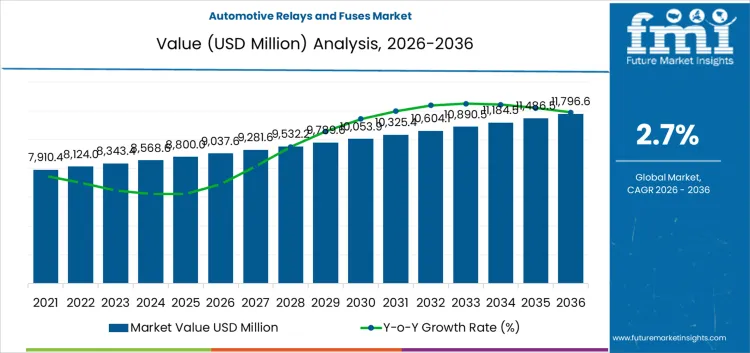
Automotive Relays and Fuses Market Key Takeaways
| Metric | Value |
|---|---|
| Market Value (2026) | USD 9,037.6 million |
| Market Forecast Value (2036) | USD 11,796.6 million |
| Forecast CAGR 2026 to 2036 | 2.7% |
Why is the Demand for Automotive Relays and Fuses Growing?
Demand for automotive relays and fuses is increasing as vehicle electrical architectures become more complex and power distribution requirements expand. Modern vehicles integrate numerous electronic systems for functions such as lighting, infotainment, advanced driver assistance, and climate control. Relays are specified to manage switching of high current circuits with minimal losses and precise actuation, while fuses protect circuits from overload and prevent electrical fires. Engineers evaluate component ratings for current carrying capacity, temperature tolerance, and contact reliability to ensure safety and performance under varied operating conditions. Procurement teams prioritize solutions with consistent manufacturing quality, certification compliance, and compatibility with diverse voltage systems across passenger cars, commercial vehicles, and specialty equipment platforms.
Regulatory standards for automotive electrical safety influence selection criteria and reinforce adoption of certified relays and fuses that support predictable performance over service life. Growth in electrified and hybrid vehicle programs further reinforces uptake of advanced relay and fuse designs that accommodate higher voltage systems and improved energy management. Vehicle manufacturers coordinate component selection with wiring harness suppliers and electronic control units to simplify integration and streamline assembly processes. Maintenance planners and service networks require ready availability of replacement relays and fuses that match engineering specifications to reduce repair turnaround. These technical and operational priorities support sustained demand growth for automotive relays and fuses.
How Are the Segments Classified in the Automotive Relays and Fuses Market?
Demand for automotive relays and fuses is shaped by electrical load management needs, circuit protection requirements, and rising electronic content in vehicles. Modern vehicles integrate multiple control units, safety systems, and comfort features requiring reliable switching and protection. Adoption aligns with platform electrification, wiring complexity growth, and regulatory safety standards. Component selection prioritizes current handling capacity, thermal stability, and service reliability. Segment classification reflects differentiation by product function, operating voltage range, and functional application area. Structure highlights how protection role, electrical architecture, and system location influence specification priorities and installation density.
Which Product Category Represents the Largest Share of Demand?
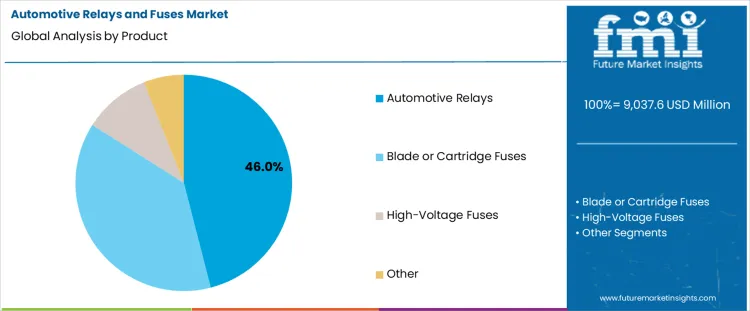
Automotive relays hold 46.0%, representing the largest share among product categories due to widespread switching requirements. Relays control power distribution to lighting, motors, and electronic modules across vehicle systems. Frequent switching cycles and load variation increase durability and contact reliability requirements. Integration supports centralized control logic and efficient wiring design. Blade and cartridge fuses protect circuits from overload with high unit penetration across harnesses. High-voltage fuses address electrified powertrains with lower volume intensity. Product segmentation reflects dominance of active switching components where control flexibility and reliability remain critical.
Key Points
- Relays manage power switching across multiple vehicle systems.
- High switching frequency increases reliability requirements.
- Other products focus on circuit protection and voltage isolation.
Which Voltage Class Accounts for the Highest Share of Demand?
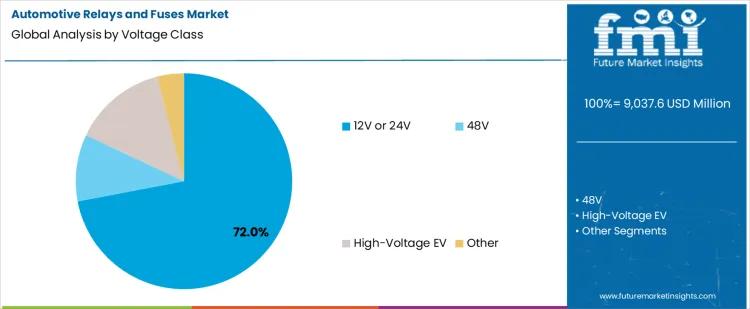
12V or 24V systems hold 72.0%, representing the largest share among voltage classes due to legacy vehicle architectures. Conventional electrical systems rely on these voltage levels for lighting, body electronics, and control units. Established component standards support broad compatibility and cost efficiency. Manufacturing scale reinforces continued adoption across passenger and commercial vehicles. High-voltage EV and 48V systems support electrification and mild hybrid functions with lower penetration. Voltage class segmentation reflects concentration of electrical protection and switching demand within conventional low-voltage architectures supporting the majority of installed vehicle systems.
Key Points
- Low-voltage systems remain dominant across vehicle platforms.
- Standardization supports compatibility and scale efficiency.
- Higher voltage classes serve electrification-specific functions.
Which Application Area Drives the Largest Share of Demand?
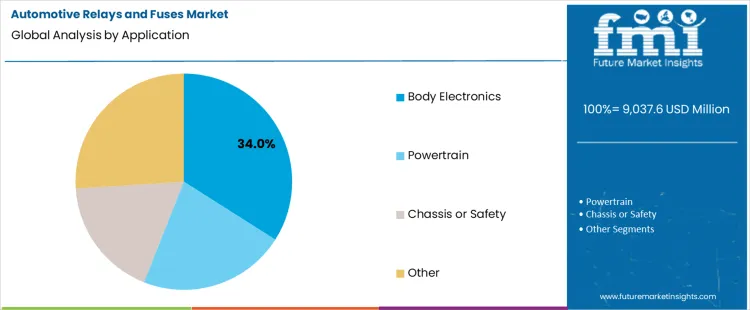
Body electronics hold 34.0%, representing the largest share among application areas due to extensive feature integration. Lighting, windows, seating, and infotainment systems require numerous relays and fuses for control and protection. High circuit density increases component count per vehicle. Continuous feature addition amplifies electrical load management complexity. Powertrain and chassis systems apply components under higher current conditions with fewer circuits. Other applications support auxiliary and comfort features. Application segmentation reflects concentration of relay and fuse usage within body systems where feature proliferation drives sustained component demand.
Key Points
- Body electronics require dense circuit protection and control.
- Feature growth increases component count per vehicle.
- Other systems apply components under different load profiles.
What are the Key Dynamics in the Automotive Relays and Fuses Market?
Demand for automotive relays and fuses reflects electrical protection and switching requirements across vehicle power distribution architectures. Adoption spans passenger vehicles, commercial vehicles, and electrified platforms incorporating increasing electronic content. Global scope aligns with rising circuit density, safety compliance expectations, and platform modularization. Usage centers on electromechanical relays, solid-state relays, blade fuses, cartridge fuses, and high-voltage protection devices integrated within vehicle electrical systems.
How do electrical load growth and system protection requirements shape adoption?
Modern vehicles incorporate numerous electronic control units, sensors, actuators, and infotainment systems requiring controlled power switching and fault isolation. Demand increases as advanced driver assistance systems, electrified powertrains, and comfort features raise current loads and circuit complexity. Relays manage high-current switching for motors, lighting, and heating functions without overloading control circuits. Fuses provide essential protection against short circuits and overload events to prevent wiring damage and fire risk. Electrified vehicles introduce demand for high-voltage fuses supporting battery packs, inverters, and charging systems. Adoption reflects non-discretionary need for reliable electrical protection supporting functional safety and system continuity.
How do cost pressure, thermal constraints, and standardization limits influence market scalability?
Relays and fuses face intense cost sensitivity due to high-volume usage and limited differentiation. Demand sensitivity rises where OEM pricing targets restrict adoption of advanced solid-state solutions. Thermal stress from higher current density affects component lifespan and packaging design. Miniaturization trends increase heat dissipation challenges within compact fuse and relay boxes. Validation requirements for durability, vibration, and temperature cycling extend qualification timelines. Platform-specific electrical architectures limit full standardization across vehicle lines. Supply chain dependence on copper, silver alloys, and semiconductor components introduces cost volatility, constraining scalable expansion across diverse automotive programs.
How Is Demand for Automotive Relays and Fuses Evolving Globally?
Demand for automotive relays and fuses is expanding globally due to rising electrical load density, safety protection requirements, and maintenance-led replacement across vehicle fleets. Adoption aligns with stabilization of power distribution, protection of electronic modules, and reliability under vibration and thermal cycling. Electrification and advanced driver assistance increase circuit count, elevating specification needs for current rating, sealing, and durability. Aftermarket replacement remains relevant where mileage accumulation is high. Growth rates in China at 4.1%, Brazil at 3.9%, USA at 2.4%, Germany at 2.2%, and South Korea at 2.0% indicate steady expansion driven by electrical architecture stability and lifecycle servicing.
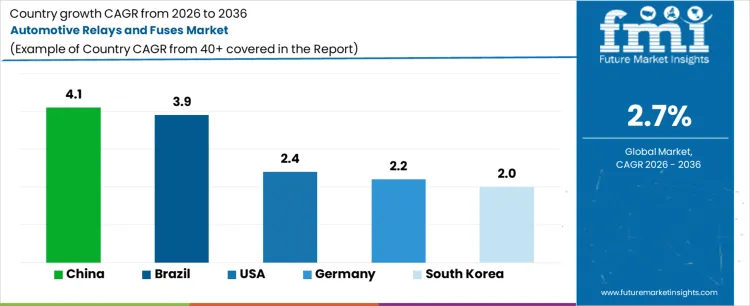
| Country | CAGR (%) |
|---|---|
| China | 4.1% |
| Brazil | 3.9% |
| USA | 2.4% |
| Germany | 2.2% |
| South Korea | 2.0% |
What Is Supporting Automotive Relay and Fuse Demand Growth in China?
Automotive relay and fuse demand in China is growing at a CAGR of 4.1%, supported by high vehicle utilization and increasing electrical feature content. Urban driving conditions elevate thermal and vibration stress on power distribution components. OEMs specify higher current capacity and sealed housings to maintain reliability. Electrified powertrains and feature-rich interiors add circuits, increasing relay and fuse counts per vehicle. Domestic vehicle production sustains OEM volumes across passenger and commercial segments. Inspection regimes and preventive maintenance practices encourage timely replacement. Demand growth remains maintenance-led, reflecting operating intensity and electrical system complexity rather than rapid vehicle population expansion.
- Rising electrical load from feature-rich vehicles
- Urban thermal and vibration exposure conditions
- Electrification increasing circuit protection points
- Stable OEM demand from domestic production
Why Is Brazil Experiencing Steady Expansion in Relay and Fuse Demand?
Operating environment conditions shape automotive relay and fuse demand in Brazil, expanding at a CAGR of 3.9%. Heat and humidity accelerate degradation of contacts and fuse elements. Long-distance freight and urban delivery increase electrical duty cycles. Road vibration influences mounting stability and terminal wear. Fleet aging contributes to aftermarket replacement as operators prioritize electrical reliability. Electrification progresses gradually, adding incremental circuit protection needs. Demand growth reflects environmental exposure and maintenance requirements rather than growth in new vehicle registrations.
- Heat and humidity affecting electrical contacts
- High duty cycles in logistics and delivery
- Vibration impacting mounting and terminals
- Aging fleets supporting aftermarket replacement
How Is the USA Sustaining Demand for Automotive Relays and Fuses?
Automotive relay and fuse demand in the USA is expanding at a CAGR of 2.4%, driven by high mileage accumulation and preventive maintenance practices. Vehicles operate across diverse climates, exposing components to moisture, salt, and thermal cycling. Regulatory standards emphasize electrical safety and circuit protection reliability. Advanced driver assistance and infotainment systems add protected circuits. Aftermarket replacement dominates due to long vehicle service life. Growth remains measured, aligned with maintenance cycles rather than increases in vehicle production.
- Climate diversity stressing electrical components
- Safety standards emphasizing circuit protection
- ADAS and infotainment increasing protected loads
- Strong aftermarket replacement orientation
What Factors Are Shaping Relay and Fuse Demand in Germany?
Engineering discipline influences automotive relay and fuse demand in Germany, growing at a CAGR of 2.2%. High manufacturing quality standards extend component service life, moderating replacement frequency. Regulated vibration, sealing, and thermal performance requirements shape specification choices. Preventive maintenance schedules create predictable replacement demand. Export-driven logistics sustain steady vehicle utilization. Electrification progresses with careful architecture validation. Growth reflects disciplined servicing within mature fleets rather than rapid evolution of electrical system layouts.
- High quality standards extending service intervals
- Strict sealing and thermal performance requirements
- Predictable preventive maintenance cycles
- Stable utilization from export logistics
Why Is South Korea Showing Controlled Growth in Automotive Relay and Fuse Demand?
Automotive relay and fuse demand in South Korea is growing at a CAGR of 2.0%, influenced by efficient fleet management and compact operating geography. Shorter driving distances reduce cumulative electrical stress. Strong maintenance discipline limits premature failures. Manufacturing and port logistics sustain steady vehicle usage. OEMs favor standardized electrical architectures with long service intervals. Electrification adds circuits incrementally without rapid redesign. Growth remains controlled, reflecting efficient operations and scheduled replacement rather than expansion of vehicle deployment.
- Shorter routes limiting cumulative electrical stress
- Strong preventive maintenance discipline
- Manufacturing and port logistics activity
- Standardized long-life electrical architectures
What is the competitive landscape of demand for the automotive relays and fuses market globally?
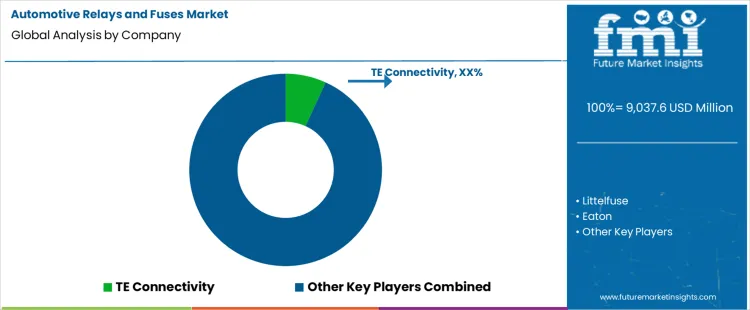
Demand for automotive relays and fuses is driven by increasing electrical complexity in vehicles, expansion of electrified and semi-autonomous systems, and stringent safety and reliability requirements. Relays and fuses provide essential circuit protection and switching functions for lighting, power distribution, HVAC, infotainment, and advanced driver assistance systems. Buyers evaluate electrical load ratings, switching durability, contact reliability, thermal performance, and packaging compatibility with automotive harness architectures. Procurement teams prioritize suppliers with validated OEM qualifications, global manufacturing and after-sales support, and ability to meet rigorous automotive quality standards such as IATF 16949. Trend in the global market reflects growth of high-power electronics in EVs, increased use of modular electrical distribution, and demand for smart protection solutions supporting diagnostics and connectivity.
TE Connectivity holds leading positioning through a broad portfolio of automotive relays and fuse products integrated into vehicle electrical and electronic systems with extensive global OEM adoption. Littelfuse supports demand with high-performance fuses and circuit protection devices designed for diverse automotive load profiles and safety standards. Eaton contributes automotive fuses and relay solutions with strong presence in power distribution and load management architectures. Omron participates with automotive-grade relay technologies optimized for reliability and compact packaging. Panasonic supplies relays and fuses with emphasis on thermal stability and electrical endurance for automotive applications. Competitive differentiation depends on electrical performance reliability, certification readiness, global supply continuity, and ability to support complex vehicle electrical network requirements.
Key Players in the Automotive Relays and Fuses Market
- TE Connectivity
- Littelfuse
- Eaton
- Omron
- Panasonic
- Denso
- Bosch
- Mitsubishi Electric
- HELLA
- Schneider Electric
Scope of the Report
| Items | Values |
|---|---|
| Quantitative Units | USD million |
| Product | Automotive Relays; Blade or Cartridge Fuses; High-Voltage Fuses; Other |
| Voltage Class | 12V or 24V; 48V; High-Voltage EV; Other |
| Application | Body Electronics; Powertrain; Chassis or Safety; Other |
| Sales Channel | OEM Line-Fit; Dealer or OES; Independent Aftermarket; Other |
| Regions Covered | Asia Pacific, Europe, North America, Latin America, Middle East & Africa |
| Countries Covered | China, Brazil, USA, Germany, South Korea, and 40+ countries |
| Key Companies Profiled | TE Connectivity; Littelfuse; Eaton; Omron; Panasonic; Denso; Bosch; Mitsubishi Electric; HELLA; Schneider Electric |
| Additional Attributes | Dollar sales by product, voltage class, and application; adoption trends for high-voltage fuses supporting battery electric and hybrid architectures; switching endurance, breaking capacity, and thermal derating performance metrics; coordination with zonal electrical architectures and power distribution units; miniaturization, heat dissipation, and arc suppression considerations; aftermarket replacement patterns tied to electrical load growth; compliance with OEM electrical safety standards, ISO and IEC norms, and regional automotive regulations influencing relay and fuse specification. |
Automotive Relays and Fuses Market by Segment
Product:
- Automotive Relays
- Blade or Cartridge Fuses
- High-Voltage Fuses
- Other
Voltage Class:
- 12V or 24V
- 48V
- High-Voltage EV
- Other
Application:
- Body Electronics
- Powertrain
- Chassis or Safety
- Other
Sales Channel:
- OEM Line-Fit
- Dealer or OES
- Independent Aftermarket
- Other
Region:
- Asia Pacific
- China
- Japan
- South Korea
- India
- Australia & New Zealand
- ASEAN
- Rest of Asia Pacific
- Europe
- Germany
- United Kingdom
- France
- Italy
- Spain
- Nordic
- BENELUX
- Rest of Europe
- North America
- United States
- Canada
- Mexico
- Latin America
- Brazil
- Chile
- Rest of Latin America
- Middle East & Africa
- Kingdom of Saudi Arabia
- Other GCC Countries
- Turkey
- South Africa
- Other African Union
- Rest of Middle East & Africa
Bibliography
European Parliament and Council of the European Union. (2019, November 27). Regulation (EU) 2019/2144 on type-approval requirements for motor vehicles and their trailers, and systems, components and separate technical units intended therefor, as regards general safety and the protection of vehicle occupants and vulnerable road users, amending Regulation (EU) 2018/858. Official Journal of the European Union. (Consolidated text available via EUR-Lex.)
United Nations Economic Commission for Europe. (2017). UN Regulation No. 10: Uniform provisions concerning the approval of vehicles with regard to electromagnetic compatibility. UNECE (WP.29).
United Nations Economic Commission for Europe. (2017). UN Regulation No. 100, Revision 3: Uniform provisions concerning the approval of vehicles with regard to specific requirements for the electric power train. UNECE (WP.29).
International Organization for Standardization. (2023). ISO 16750-1:2023—Road vehicles—Environmental conditions and testing for electrical and electronic equipment—Part 1: General. ISO.
Frequently Asked Questions
How big is the automotive relays and fuses market in 2026?
The global automotive relays and fuses market is estimated to be valued at USD 9,037.6 million in 2026.
What will be the size of automotive relays and fuses market in 2036?
The market size for the automotive relays and fuses market is projected to reach USD 11,796.6 million by 2036.
How much will be the automotive relays and fuses market growth between 2026 and 2036?
The automotive relays and fuses market is expected to grow at a 2.7% CAGR between 2026 and 2036.
What are the key product types in the automotive relays and fuses market?
The key product types in automotive relays and fuses market are automotive relays, blade or cartridge fuses, high-voltage fuses and other.
Which voltage class segment to contribute significant share in the automotive relays and fuses market in 2026?
In terms of voltage class, 12v or 24v segment to command 72.0% share in the automotive relays and fuses market in 2026.
Preview the report firsthand - request a free sample
Get SampleGet the brochure for pricing and purchase details.
Get PDFTable of Content
- Executive Summary
- Global Market Outlook
- Demand-side Trends
- Supply-side Trends
- Technology Roadmap Analysis
- Analysis and Recommendations
- Market Overview
- Market Coverage / Taxonomy
- Market Definition / Scope / Limitations
- Market Background
- Market Dynamics
- Drivers
- Restraints
- Opportunity
- Trends
- Scenario Forecast
- Demand in Optimistic Scenario
- Demand in Likely Scenario
- Demand in Conservative Scenario
- Opportunity Map Analysis
- Product Life Cycle Analysis
- Supply Chain Analysis
- Investment Feasibility Matrix
- Value Chain Analysis
- PESTLE and Porter’s Analysis
- Regulatory Landscape
- Regional Parent Market Outlook
- Production and Consumption Statistics
- Import and Export Statistics
- Market Dynamics
- Global Market Analysis 2021 to 2025 and Forecast, 2026 to 2036
- Historical Market Size Value (USD Million) Analysis, 2021 to 2025
- Current and Future Market Size Value (USD Million) Projections, 2026 to 2036
- Y-o-Y Growth Trend Analysis
- Absolute $ Opportunity Analysis
- Global Market Pricing Analysis 2021 to 2025 and Forecast 2026 to 2036
- Global Market Analysis 2021 to 2025 and Forecast 2026 to 2036, By Product
- Introduction / Key Findings
- Historical Market Size Value (USD Million) Analysis By Product , 2021 to 2025
- Current and Future Market Size Value (USD Million) Analysis and Forecast By Product , 2026 to 2036
- Automotive Relays
- Blade or Cartridge Fuses
- High-Voltage Fuses
- Other
- Automotive Relays
- Y-o-Y Growth Trend Analysis By Product , 2021 to 2025
- Absolute $ Opportunity Analysis By Product , 2026 to 2036
- Global Market Analysis 2021 to 2025 and Forecast 2026 to 2036, By Voltage Class
- Introduction / Key Findings
- Historical Market Size Value (USD Million) Analysis By Voltage Class, 2021 to 2025
- Current and Future Market Size Value (USD Million) Analysis and Forecast By Voltage Class, 2026 to 2036
- 12V or 24V
- 48V
- High-Voltage EV
- Other
- 12V or 24V
- Y-o-Y Growth Trend Analysis By Voltage Class, 2021 to 2025
- Absolute $ Opportunity Analysis By Voltage Class, 2026 to 2036
- Global Market Analysis 2021 to 2025 and Forecast 2026 to 2036, By Application
- Introduction / Key Findings
- Historical Market Size Value (USD Million) Analysis By Application, 2021 to 2025
- Current and Future Market Size Value (USD Million) Analysis and Forecast By Application, 2026 to 2036
- Body Electronics
- Powertrain
- Chassis or Safety
- Other
- Body Electronics
- Y-o-Y Growth Trend Analysis By Application, 2021 to 2025
- Absolute $ Opportunity Analysis By Application, 2026 to 2036
- Global Market Analysis 2021 to 2025 and Forecast 2026 to 2036, By Sales Channel
- Introduction / Key Findings
- Historical Market Size Value (USD Million) Analysis By Sales Channel, 2021 to 2025
- Current and Future Market Size Value (USD Million) Analysis and Forecast By Sales Channel, 2026 to 2036
- OEM Line-Fit
- Dealer or OES
- Independent Aftermarket
- Other
- OEM Line-Fit
- Y-o-Y Growth Trend Analysis By Sales Channel, 2021 to 2025
- Absolute $ Opportunity Analysis By Sales Channel, 2026 to 2036
- Global Market Analysis 2021 to 2025 and Forecast 2026 to 2036, By Region
- Introduction
- Historical Market Size Value (USD Million) Analysis By Region, 2021 to 2025
- Current Market Size Value (USD Million) Analysis and Forecast By Region, 2026 to 2036
- North America
- Latin America
- Western Europe
- Eastern Europe
- East Asia
- South Asia and Pacific
- Middle East & Africa
- Market Attractiveness Analysis By Region
- North America Market Analysis 2021 to 2025 and Forecast 2026 to 2036, By Country
- Historical Market Size Value (USD Million) Trend Analysis By Market Taxonomy, 2021 to 2025
- Market Size Value (USD Million) Forecast By Market Taxonomy, 2026 to 2036
- By Country
- USA
- Canada
- Mexico
- By Product
- By Voltage Class
- By Application
- By Sales Channel
- By Country
- Market Attractiveness Analysis
- By Country
- By Product
- By Voltage Class
- By Application
- By Sales Channel
- Key Takeaways
- Latin America Market Analysis 2021 to 2025 and Forecast 2026 to 2036, By Country
- Historical Market Size Value (USD Million) Trend Analysis By Market Taxonomy, 2021 to 2025
- Market Size Value (USD Million) Forecast By Market Taxonomy, 2026 to 2036
- By Country
- Brazil
- Chile
- Rest of Latin America
- By Product
- By Voltage Class
- By Application
- By Sales Channel
- By Country
- Market Attractiveness Analysis
- By Country
- By Product
- By Voltage Class
- By Application
- By Sales Channel
- Key Takeaways
- Western Europe Market Analysis 2021 to 2025 and Forecast 2026 to 2036, By Country
- Historical Market Size Value (USD Million) Trend Analysis By Market Taxonomy, 2021 to 2025
- Market Size Value (USD Million) Forecast By Market Taxonomy, 2026 to 2036
- By Country
- Germany
- UK
- Italy
- Spain
- France
- Nordic
- BENELUX
- Rest of Western Europe
- By Product
- By Voltage Class
- By Application
- By Sales Channel
- By Country
- Market Attractiveness Analysis
- By Country
- By Product
- By Voltage Class
- By Application
- By Sales Channel
- Key Takeaways
- Eastern Europe Market Analysis 2021 to 2025 and Forecast 2026 to 2036, By Country
- Historical Market Size Value (USD Million) Trend Analysis By Market Taxonomy, 2021 to 2025
- Market Size Value (USD Million) Forecast By Market Taxonomy, 2026 to 2036
- By Country
- Russia
- Poland
- Hungary
- Balkan & Baltic
- Rest of Eastern Europe
- By Product
- By Voltage Class
- By Application
- By Sales Channel
- By Country
- Market Attractiveness Analysis
- By Country
- By Product
- By Voltage Class
- By Application
- By Sales Channel
- Key Takeaways
- East Asia Market Analysis 2021 to 2025 and Forecast 2026 to 2036, By Country
- Historical Market Size Value (USD Million) Trend Analysis By Market Taxonomy, 2021 to 2025
- Market Size Value (USD Million) Forecast By Market Taxonomy, 2026 to 2036
- By Country
- China
- Japan
- South Korea
- By Product
- By Voltage Class
- By Application
- By Sales Channel
- By Country
- Market Attractiveness Analysis
- By Country
- By Product
- By Voltage Class
- By Application
- By Sales Channel
- Key Takeaways
- South Asia and Pacific Market Analysis 2021 to 2025 and Forecast 2026 to 2036, By Country
- Historical Market Size Value (USD Million) Trend Analysis By Market Taxonomy, 2021 to 2025
- Market Size Value (USD Million) Forecast By Market Taxonomy, 2026 to 2036
- By Country
- India
- ASEAN
- Australia & New Zealand
- Rest of South Asia and Pacific
- By Product
- By Voltage Class
- By Application
- By Sales Channel
- By Country
- Market Attractiveness Analysis
- By Country
- By Product
- By Voltage Class
- By Application
- By Sales Channel
- Key Takeaways
- Middle East & Africa Market Analysis 2021 to 2025 and Forecast 2026 to 2036, By Country
- Historical Market Size Value (USD Million) Trend Analysis By Market Taxonomy, 2021 to 2025
- Market Size Value (USD Million) Forecast By Market Taxonomy, 2026 to 2036
- By Country
- Kingdom of Saudi Arabia
- Other GCC Countries
- Turkiye
- South Africa
- Other African Union
- Rest of Middle East & Africa
- By Product
- By Voltage Class
- By Application
- By Sales Channel
- By Country
- Market Attractiveness Analysis
- By Country
- By Product
- By Voltage Class
- By Application
- By Sales Channel
- Key Takeaways
- Key Countries Market Analysis
- USA
- Pricing Analysis
- Market Share Analysis, 2025
- By Product
- By Voltage Class
- By Application
- By Sales Channel
- Canada
- Pricing Analysis
- Market Share Analysis, 2025
- By Product
- By Voltage Class
- By Application
- By Sales Channel
- Mexico
- Pricing Analysis
- Market Share Analysis, 2025
- By Product
- By Voltage Class
- By Application
- By Sales Channel
- Brazil
- Pricing Analysis
- Market Share Analysis, 2025
- By Product
- By Voltage Class
- By Application
- By Sales Channel
- Chile
- Pricing Analysis
- Market Share Analysis, 2025
- By Product
- By Voltage Class
- By Application
- By Sales Channel
- Germany
- Pricing Analysis
- Market Share Analysis, 2025
- By Product
- By Voltage Class
- By Application
- By Sales Channel
- UK
- Pricing Analysis
- Market Share Analysis, 2025
- By Product
- By Voltage Class
- By Application
- By Sales Channel
- Italy
- Pricing Analysis
- Market Share Analysis, 2025
- By Product
- By Voltage Class
- By Application
- By Sales Channel
- Spain
- Pricing Analysis
- Market Share Analysis, 2025
- By Product
- By Voltage Class
- By Application
- By Sales Channel
- France
- Pricing Analysis
- Market Share Analysis, 2025
- By Product
- By Voltage Class
- By Application
- By Sales Channel
- India
- Pricing Analysis
- Market Share Analysis, 2025
- By Product
- By Voltage Class
- By Application
- By Sales Channel
- ASEAN
- Pricing Analysis
- Market Share Analysis, 2025
- By Product
- By Voltage Class
- By Application
- By Sales Channel
- Australia & New Zealand
- Pricing Analysis
- Market Share Analysis, 2025
- By Product
- By Voltage Class
- By Application
- By Sales Channel
- China
- Pricing Analysis
- Market Share Analysis, 2025
- By Product
- By Voltage Class
- By Application
- By Sales Channel
- Japan
- Pricing Analysis
- Market Share Analysis, 2025
- By Product
- By Voltage Class
- By Application
- By Sales Channel
- South Korea
- Pricing Analysis
- Market Share Analysis, 2025
- By Product
- By Voltage Class
- By Application
- By Sales Channel
- Russia
- Pricing Analysis
- Market Share Analysis, 2025
- By Product
- By Voltage Class
- By Application
- By Sales Channel
- Poland
- Pricing Analysis
- Market Share Analysis, 2025
- By Product
- By Voltage Class
- By Application
- By Sales Channel
- Hungary
- Pricing Analysis
- Market Share Analysis, 2025
- By Product
- By Voltage Class
- By Application
- By Sales Channel
- Kingdom of Saudi Arabia
- Pricing Analysis
- Market Share Analysis, 2025
- By Product
- By Voltage Class
- By Application
- By Sales Channel
- Turkiye
- Pricing Analysis
- Market Share Analysis, 2025
- By Product
- By Voltage Class
- By Application
- By Sales Channel
- South Africa
- Pricing Analysis
- Market Share Analysis, 2025
- By Product
- By Voltage Class
- By Application
- By Sales Channel
- USA
- Market Structure Analysis
- Competition Dashboard
- Competition Benchmarking
- Market Share Analysis of Top Players
- By Regional
- By Product
- By Voltage Class
- By Application
- By Sales Channel
- Competition Analysis
- Competition Deep Dive
- TE Connectivity
- Overview
- Product Portfolio
- Profitability by Market Segments (Product/Age /Sales Channel/Region)
- Sales Footprint
- Strategy Overview
- Marketing Strategy
- Product Strategy
- Channel Strategy
- Littelfuse
- Eaton
- Omron
- Panasonic
- Denso
- Bosch
- Mitsubishi Electric
- HELLA
- Schneider Electric
- TE Connectivity
- Competition Deep Dive
- Assumptions & Acronyms Used
- Research Methodology


