

- Market Size (2026)
- USD 1.7 Bn
- Forecast (2036)
- USD 2.3 Bn
- CAGR (2026 to 2036)
- 3.4%
Automotive Propeller Shaft Couplings Market Size, Market Forecast and Outlook By FMI
Summary of the Automotive Propeller Shaft Couplings Market
- Demand and Growth Drivers
- Light trucks and sport utility vehicles keep coupling demand steady due to rear axle torque transfer needs.
- Aftermarket repair demand rises when propeller shaft vibration is traced to worn joints and yoke interfaces.
- Fleet operators are expected to favor durable couplings that reduce downtime on pickups and commercial vans.
- Product and Segment View
- Yoke flanges are projected to account for 38.0% of component demand in 2026 due to broad use in shaft-to-axle joints.
- Passenger vehicles are expected to represent 42.0% of vehicle type demand in 2026 as rear-wheel and all-wheel platforms need shaft couplings.
- Original equipment sales are projected to account for 61.0% of channel demand in 2026 as automakers buy fitted driveline parts.
- Geography and Competitive Outlook
- China is projected to expand at 4.5% CAGR through 2036 due to high vehicle output and large local supplier scale.
- India is expected to record 4.3% CAGR during the forecast period as utility vehicle output supports driveline demand.
- Companies with shaft assembly knowledge and joint testing depth are expected to hold stronger positions with automakers.
- Analyst Opinion
- Nikhil Kaitwade, Associate Vice President at FMI says, “The purchase decision for automotive propeller shaft couplings has shifted beyond basic hardware. Buyers now focus on fit integrity and service efficiency. Suppliers that link coupling design with comprehensive shaft assembly checks are better positioned to protect share amid ongoing platform transitions.”
- Automotive Propeller Shaft Couplings Market Value Analysis
- The automotive propeller shaft couplings market is moving from basic replacement buying into fit-based drivetrain planning.
- Pickup trucks and rear-wheel vehicles keep shaft coupling demand steady across original equipment and repair channels.
- All-wheel drive layouts raise coupling variety because each platform carries different torque paths and shaft angles.
- Aftermarket value is tied to vibration diagnosis, service kit availability, and quick replacement at repair shops.
Key Takeaways
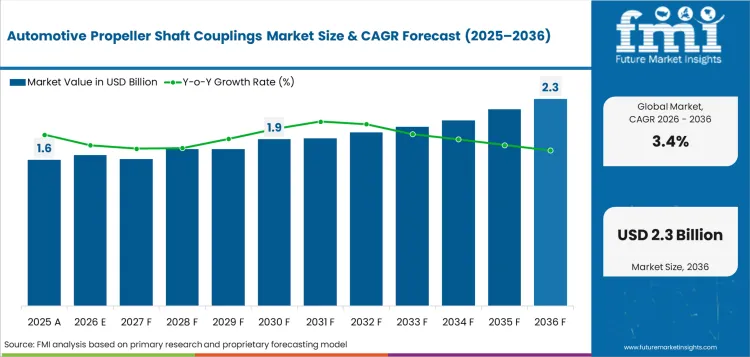
- The automotive propeller shaft couplings market was valued at USD 1.6 billion in 2025.
- By 2036, the automotive propeller shaft couplings market is expected to be worth USD 2.3 billion.
- From 2026 to 2036, the market is projected to expand at a CAGR of 3.4%.
- The market is projected to create an incremental opportunity of USD 677.3 million between 2026 and 2036.
- In 2026, yoke flanges are expected to account for 38.0% of component demand.
- China at 4.5% CAGR and India at 4.3% CAGR are projected to be the faster expanding country markets.
Automotive propeller shaft couplings are becoming more important because they manage torque and vibration at one driveline connection point. In May 2026, GKN Automotive stated that propshaft joints and couplings must handle severe service loads, high operating angles and path-length changes between axles and gearboxes. This makes coupling design important for ride comfort during acceleration, turning and rough-road driving. Vehicle platforms are also using different shaft layouts, so modular coupling systems are gaining relevance. In May 2026, Dana listed Spicer propshaft torque capacities from 700 Nm to 7,000 Nm. This makes coupling selection more specific to SUVs, pickups and commercial vehicles. Lightweight shaft designs also need more accurate mounting. In July 2025, EP4579096A1 described centering rings and adhesive injection holes for an automotive drive shaft mounting element. Balancing proof remains important because small errors create vibration across the full shaft.
Automotive Propeller Shaft Couplings Market Definition
The automotive propeller shaft couplings market includes parts used to connect the propeller shaft with adjoining drivetrain components. These parts include yoke flanges, universal joints, flexible couplings, center bearing interfaces, and constant velocity coupling points. The scope covers passenger vehicles, light commercial vehicles, heavy commercial vehicles, and off-highway vehicles. Commercial vehicle propeller shafts are included when couplings are sold with shaft systems or service kits.
Automotive Propeller Shaft Couplings Market Inclusions
Market scope covers commercially traded automotive propeller shaft coupling products by component, vehicle type, sales channel, material, and drive layout. Revenue scope covers original equipment parts, replacement couplings, fitted service kits, and shaft assembly interfaces. The key stakeholders include automakers, tier-one driveline suppliers, shaft assemblers, parts distributors, repair shops, fleet service buyers, and material suppliers. Adjacent industrial coupling designs are used as reference points only when they guide automotive torque transfer choices.
Automotive Propeller Shaft Couplings Market Exclusions
Scope does not include full axle assemblies, transmission shafts, wheel hub units, fifth wheel trailer couplers, or non-automotive industrial shaft couplings. It also excludes fluid quick couplers and steering column joints unless the part is sold for propeller shaft torque transfer.
Automotive Propeller Shaft Couplings Market Research Methodology
- Primary Research: FMI analysts spoke with driveline suppliers, component distributors, shaft assembly firms, repair buyers, and automotive service planners.
- Desk Research: The model used vehicle output data, electric vehicle mix data, company product portfolios, and trade association updates.
- Market sizing and forecasting: The forecast used vehicle production exposure, replacement cycles, coupling price bands, and driveline layout mix.
- Data validation: Results were checked against passenger vehicle output, truck output, aftermarket demand signals, and active supplier participation.
Why is the Automotive Propeller Shaft Couplings Market Growing?
- Light truck use raises demand for torque-rated propeller shaft coupling parts in rear-wheel and four-wheel layouts.
- Aftermarket service demand improves when vibration checks identify worn universal joints or loose yoke interfaces.
- Electric and hybrid drivelines create new coupling needs where shafts must handle quieter operating conditions.
Vehicle output gives the market a steady replacement and original equipment floor. The International Organization of Motor Vehicle Manufacturers reported 96.4 million vehicles produced in 2025 and 99.8 million vehicles sold in the same year. That scale gives coupling suppliers broad exposure to new shaft assemblies and service replacement needs. Automotive coupling systems remain useful where designers need controlled shaft movement and vibration reduction.
Electric vehicle growth changes the way couplings are judged by buyers. The International Energy Agency reported that electric car sales reached 21 million units in 2025 and grew by over 20% from the prior year. Quieter electric drive systems make vibration easier for drivers to notice during acceleration. Electric vehicle driveline vibration couplings are expected to gain attention where comfort and shaft balance are part of the buying decision.
Market Segmentation Analysis
- Yoke flanges are projected to account for 38.0% of component demand in 2026 as shaft-to-axle joints need fixed and serviceable connection points.
- Passenger vehicles are expected to represent 42.0% of vehicle type demand in 2026 due to large production scale and sport utility vehicle exposure.
- Original equipment sales are anticipated to hold 61.0% of channel demand in 2026 as automakers source fitted driveline parts by platform.
- Steel is projected to account for 56.0% of material demand in 2026 as buyers continue to value fatigue strength and cost control.
- Rear wheel layouts are estimated to account for 44.0% of drive layout demand in 2026 due to pickup and commercial vehicle use.
The market is divided into five primary segment groups based on component, vehicle type, sales channel, material, and drive layout. Component includes yoke flanges, universal joints, flexible couplings, center bearings, and constant velocity couplings. Vehicle type includes passenger vehicles, light commercial vehicles, heavy commercial vehicles, and off-highway vehicles. Sales channel includes original equipment, aftermarket, and service kits.
Insights into the Yoke Flanges Component Segment
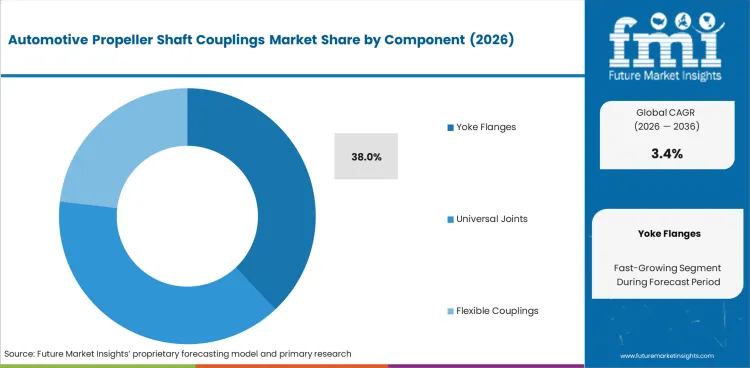
- Yoke flanges are projected to account for 38.0% of component demand in 2026. Their lead reflects wide use at shaft ends where torque transfer needs a firm joint.
- Universal joints and flexible couplings support different angle and vibration needs. High-angle constant velocity couplings widen design options for platforms with tight packaging.
Insights into the Passenger Vehicles Segment
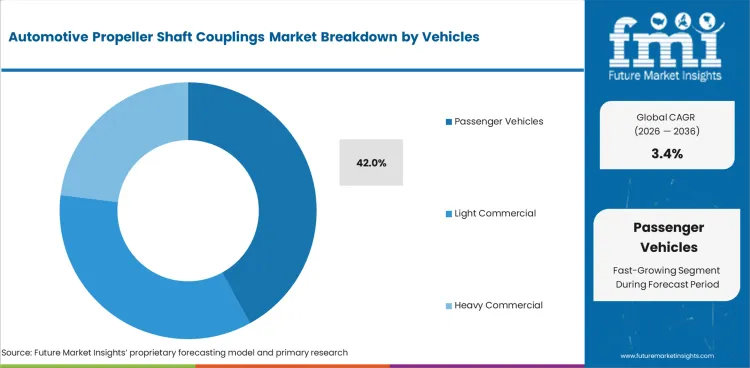
- Passenger vehicles are expected to represent 42.0% of vehicle type demand in 2026. Sport utility vehicles and rear-wheel cars keep propeller shaft content higher than small front-wheel cars.
- Light commercial vehicles support service replacement because delivery vans and pickups face heavier load cycles. Specialty commercial vehicles add low-volume shaft needs across worksite platforms.
Insights into the Original Equipment Sales Channel Segment
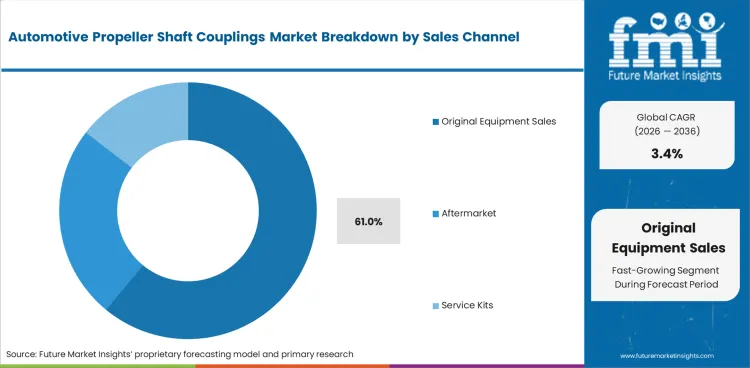
- Original equipment sales are anticipated to account for 61.0% of channel demand in 2026. Automakers buy couplings as platform-matched parts that must pass shaft balance checks.
- Aftermarket kits gain share when repair shops replace joints and seals together. Service kits reduce return visits when vibration is tied to worn driveline hardware.
Insights into the Steel Material Segment
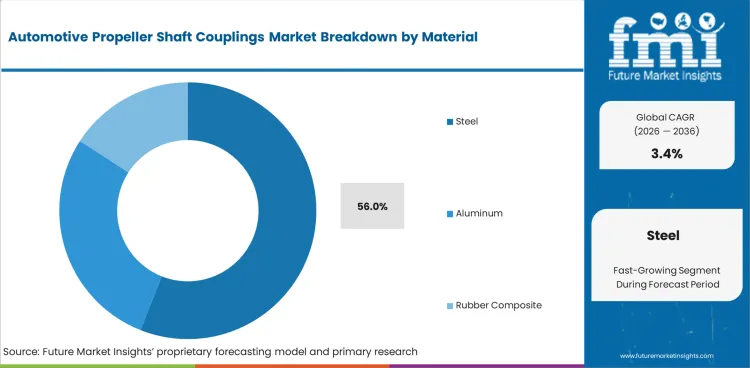
- Steel is projected to account for 56.0% of material demand in 2026. Its lead comes from torque strength and predictable fatigue life in daily-use vehicles.
- Aluminum and composite parts remain selective choices for weight-sensitive platforms. High-speed e-drive couplings may raise interest in lighter rotating parts over time.
Insights into the Rear Wheel Drive Layout Segment
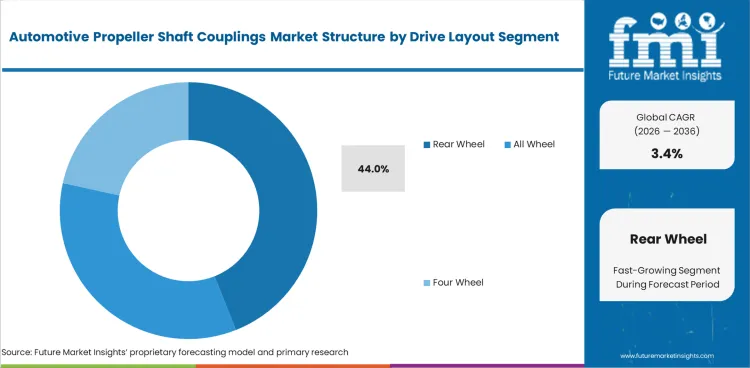
- Rear wheel layouts are estimated to represent 44.0% of drive layout demand in 2026. Pickup trucks and commercial vans rely on propeller shafts for rear axle power transfer.
- All-wheel systems use more coupling points due to front and rear torque paths. All-wheel-drive coupling systems show how drivetrain layout raises part count.
Automotive Propeller Shaft Couplings Market Drivers, Restraints, and Opportunities
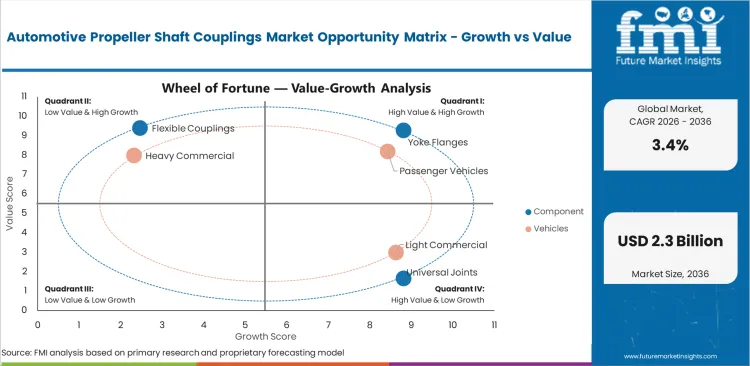
- Pickup and utility vehicle output supports coupling demand where rear axle torque transfer is common.
- Incorrect fit and poor service selection can raise vibration issues and shorten part life.
- Quieter electric vehicles create opportunity for couplings designed around noise and balance control.
Light Truck Driveline Load
Light truck and utility vehicle platforms create steady coupling demand because torque loads are higher than in many small cars. The United States and Brazil both carry large pickup and commercial vehicle fleets that use rear or four-wheel drive layouts. Coupling buyers often prefer proven steel yoke designs when load and service cost are more important than weight reduction. This keeps mature coupling types relevant even as vehicle electronics change.
Electric Noise Sensitivity
Electric drivetrains reduce engine noise and make shaft vibration easier to notice inside the cabin. This changes the buying test from strength alone toward balance and noise control. E-axle input and output couplings show the same shift in electric drive interfaces. Suppliers that prove lower runout and better rubber bonding can win higher-value orders.
Aftermarket Fit Risk
Replacement demand can be limited by poor part matching and uncertain service diagnosis. A repair shop may replace one joint even when the center bearing or flange interface caused the vibration. This creates a service kit opportunity for suppliers that bundle the correct hardware and explain the fit clearly. It also raises the value of catalog accuracy in the aftermarket channel.
Analysis of Automotive Propeller Shaft Couplings Market By Key Countries
.webp "Top Country Growth Comparison Automotive Propeller Shaft Couplings Market Cagr (2026 2036)")
| Country | CAGR |
|---|---|
| China | 4.5% |
| India | 4.3% |
| Brazil | 3.9% |
| United States | 3.6% |
| Germany | 3.2% |
| South Korea | 3.1% |
| Japan | 2.7% |
Source: Future Market Insights, 2026.
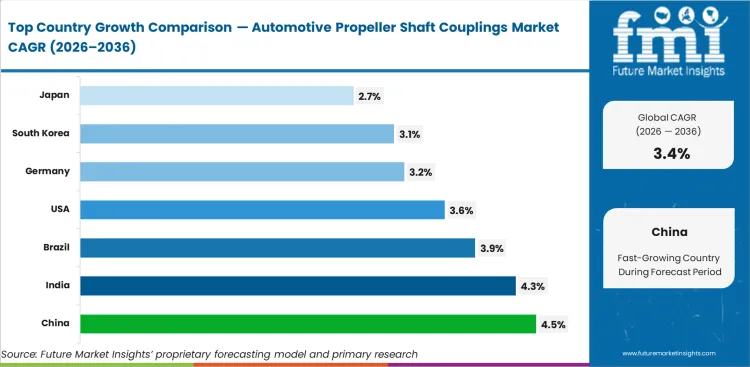
Automotive Propeller Shaft Couplings Market CAGR Analysis By Country
- China is projected to record a 4.5% CAGR through 2036 as vehicle output scale keeps local driveline buying high.
- India is expected to expand at 4.3% CAGR through 2036 as utility vehicles and local assembly raise shaft part needs.
- Brazil is forecast to grow at 3.9% CAGR through 2036 as truck and export activity support replacement demand.
- The United States is expected to advance at 3.6% CAGR through 2036 with pickup fleets and repair activity supporting couplings.
- Germany is projected to rise at 3.2% CAGR through 2036 as premium driveline programs offset slower domestic output.
- South Korea is forecast at 3.1% CAGR through 2036 due to export vehicle production and supplier precision.
- Japan is expected to post 2.7% CAGR through 2036 as mature production limits volume growth but supports high-spec parts.
Demand for automotive propeller shaft couplings is forecast to rise at 3.4% CAGR from 2026 to 2036. Countries above the global pace combine vehicle output scale with pickup, utility vehicle, or export exposure. Countries below the global pace keep technical value but face slower volume growth.
Demand Outlook for Automotive Propeller Shaft Couplings Market in China
China is projected to record a 4.5% CAGR through 2036 as local vehicle output keeps propeller shaft buying active. The State Council of the People’s Republic of China reported that auto output reached 34.531 million units in 2025. Large production runs give Chinese coupling suppliers repeat orders across passenger cars and light trucks. The local electric vehicle shift will reduce some conventional shaft demand but raise fit needs in hybrid and all-wheel platforms.
- Guangdong and Shanghai support demand through passenger vehicle and new energy vehicle assembly.
- Chongqing and Hubei keep driveline parts relevant through utility vehicle and commercial vehicle output.
- Local suppliers need balance testing and rubber bonding control to serve quieter electric platforms.
Future Outlook for Automotive Propeller Shaft Couplings Market in India
India is expected to expand at 4.3% CAGR through 2036 as vehicle production and sport utility vehicle demand lift driveline parts use. The Society of Indian Automobile Manufacturers reported 31.034 million vehicles produced in fiscal year 2024 to 2025. This gives local suppliers a large channel for original equipment couplings and repair kits. Pune and Chennai remain key sourcing locations for shaft and axle parts.
- Pune suppliers benefit from local passenger vehicle and utility vehicle assembly clusters.
- Chennai supports coupling demand through export vehicle output and nearby tier-one suppliers.
- Repair demand increases in tier-two cities as utility vehicle ownership expands outside large metro areas.
Sales Analysis of Automotive Propeller Shaft Couplings Market in Brazil
Brazil is forecast to grow at 3.9% CAGR through 2036 as domestic vehicle output and exports support shaft coupling demand. The Brazilian Association of Motor Vehicle Manufacturers reported 2.644 million vehicles produced in 2025. Export growth adds demand for validated driveline components that meet regional vehicle programs. Local suppliers can benefit when service buyers need affordable replacement kits for pickups and light trucks.
- São Paulo keeps the largest role through automaker plants and supplier concentration.
- Minas Gerais supports demand through commercial vehicle and parts supply activity.
- Paraná repair channels need service kits for pickups used in farm and logistics work.
Demand Outlook for Automotive Propeller Shaft Couplings Market in the United States
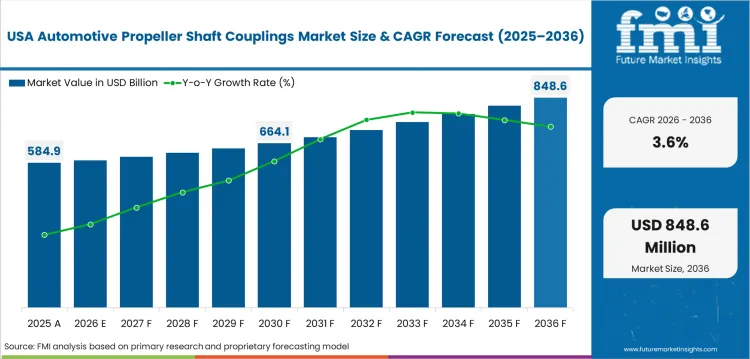
The United States is expected to advance at 3.6% CAGR through 2036 due to pickup trucks and high driving activity. The United States Department of Energy tracks annual vehicle miles traveled as a core transport use measure and updated the data in February 2026. High road use supports replacement of worn driveline parts across older pickups and sport utility vehicles. Suppliers with wide catalog coverage can serve both dealer and independent repair channels.
- Michigan and Ohio remain important for driveline engineering and supplier programs.
- Texas pickup fleets create service demand for universal joints and yoke hardware.
- Kentucky and Indiana assembly activity supports original equipment coupling orders.
Opportunity Analysis of Automotive Propeller Shaft Couplings Market in Germany
Germany is projected to rise at 3.2% CAGR through 2036 as premium driveline design supports higher-value coupling work. The German Association of the Automotive Industry stated that Germany produced 1.67 million electric passenger cars in 2025. That shift raises focus on noise control and lighter rotating parts in driveline design. Coupling suppliers can protect value by serving hybrid, all-wheel, and performance platforms.
- Bavaria keeps demand tied to premium sport utility and performance vehicle platforms.
- Baden-Württemberg supports precision driveline parts through powertrain engineering depth.
- Lower Saxony creates demand for quiet drivetrain parts tied to electric vehicle output.
Demand Outlook for Automotive Propeller Shaft Couplings Market in South Korea
South Korea is forecast at 3.1% CAGR through 2036 as export vehicle production keeps supplier standards high. Local assembly strength in Ulsan and Gwangju supports driveline part demand for passenger vehicles and sport utility vehicles. Coupling producers are expected to focus on lighter joints and lower vibration parts for export platforms. The market is steady but does not match China or India in volume expansion.
- Ulsan assembly supports original equipment demand for shaft-linked driveline parts.
- Gwangju commercial vehicle activity keeps service replacement relevant for utility models.
- Gyeonggi suppliers can gain from precision machining and rubber part supply depth.
Future Outlook for Automotive Propeller Shaft Couplings Market in Japan
Japan is expected to post 2.7% CAGR through 2036 as mature output limits volume growth but keeps quality needs high. Japanese suppliers remain important in constant velocity joints and precision rotating parts. Aichi and Kyushu assembly clusters support original equipment coupling demand across passenger and utility vehicle platforms. Growth stays moderate as more front-wheel and electric platforms use fewer propeller shaft parts.
- Aichi remains the main local anchor for automaker buying and tier-one driveline sourcing.
- Kyushu assembly supports passenger vehicle shaft and joint demand through export programs.
- Shizuoka parts makers can compete through precision machining and long service life.
Competitive Landscape and Strategic Positioning
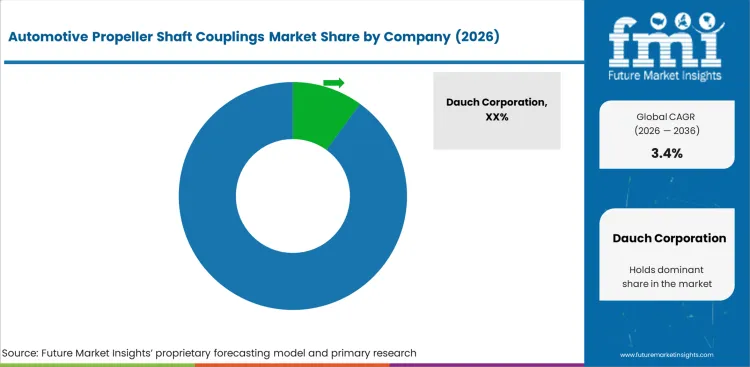
- Dauch Corporation combines American Axle & Manufacturing and GKN Automotive driveline depth after the announced combination with Dowlais.
- Dana, ZF Friedrichshafen, and Schaeffler hold positions through axle, driveline, and rotating component knowledge.
- Neapco, NTN Corporation, and JTEKT Corporation compete through joint, shaft, and precision component supply.
Competition in the automotive propeller shaft couplings market is shaped by automaker platform access, engineering depth, and driveline validation capability. Large suppliers secure early design wins by demonstrating proven torque capacity and noise‑and‑vibration control well before vehicle launch. Their advantage lies in integrating couplings into full driveline validation programs rather than supplying standalone components.
Smaller and mid‑sized players remain competitive in the aftermarket by offering precise fit data and consistent availability. In this segment, buyer risk extends beyond part price to include the cost of repeat repairs and vibration complaints following installation.
Electric and hybrid platforms raise the competitive bar further. Propeller shaft couplings and half‑shaft assemblies are increasingly evaluated as part of a broader rotating system that prioritizes balance and efficiency. Adjacent components, such as commercial vehicle hub bearings, highlight a wider industry shift toward longer service life and reduced friction. Suppliers that link coupling performance to full shaft behavior and system‑level outcomes are more likely to gain access to original equipment programs as driveline architectures evolve.
Key Companies in the Automotive Propeller Shaft Couplings Market
The competitive structure is split between global driveline suppliers and focused joint or coupling specialists.
- Global driveline suppliers include Dauch Corporation, Dana Incorporated, ZF Friedrichshafen, and Schaeffler. These companies compete with full driveline knowledge, platform engineering teams, and supply relationships with major automakers. Their strength is the ability to connect couplings with axles, shaft assemblies, and vibration testing before a platform reaches production.
- Joint and precision component suppliers include NTN Corporation and JTEKT Corporation. These companies hold ground where constant velocity joints, bearings, and machined rotating parts influence coupling selection. Their role is strongest when automakers need tight fit control and long part life across high-volume passenger platforms.
- Focused shaft suppliers include Neapco and selected regional aftermarket brands. These firms serve replacement channels with universal joints, yoke parts, and shaft service hardware. Their advantage is catalog depth and faster repair availability for pickups and older rear-wheel vehicles.
Competitive Benchmarking: Automotive Propeller Shaft Couplings Market
| Company | Shaft Interface Coverage | NVH Test Depth | Aftermarket Kit Reach | Geographic Footprint |
|---|---|---|---|---|
| Dauch Corporation | High | Strong | High | Global |
| Dana Incorporated | High | Strong | Medium | Global |
| ZF Friedrichshafen | Medium | Strong | Medium | Global |
| Schaeffler | Medium | Strong | Medium | Global |
| NTN Corporation | Medium | Medium | Medium | Global |
| JTEKT Corporation | Medium | Medium | Medium | Asia Pacific and global OEM channels |
| Neapco | High | Medium | High | North America and global aftermarket |
| SGF Automotive | Medium | Strong | Medium | Europe and global specialty channels |
Source: Future Market Insights competitive analysis, 2026. Ratings reflect relative positioning based on shaft interface coverage, vibration testing depth, and aftermarket kit reach.
Key Developments in Automotive Propeller Shaft Couplings Market
- In January 2025, American Axle & Manufacturing showcased electric, hybrid, and internal combustion driveline systems at CES 2025. This showed supplier focus on mixed powertrain programs.
- In January 2025, American Axle & Manufacturing announced a USD 1.44 billion combination with Dowlais. The deal strengthened driveline scale and brought GKN Automotive closer to AAM.
- In July 2025, GKN Automotive presented driveline and electrification solutions at Dritev 2025. The program included disconnect systems and driveshaft design for sustainability.
- In October 2024, Schaeffler completed its merger with Vitesco Technologies. The combined group gained broader electric drivetrain and rotating component capability.
Key Players in the Automotive Propeller Shaft Couplings Market
Major Global Players:
- Dauch Corporation
- Dana Incorporated
- ZF Friedrichshafen AG
- Schaeffler AG
- NTN Corporation
- JTEKT Corporation
- Neapco Holdings LLC
Specialist Players:
- SGF Automotive
- Nexteer Automotive
- BorgWarner Inc.
- GSP Automotive Group
- GMB Corporation
Report Scope and Coverage
| Parameter | Details |
|---|---|
| Quantitative Units | USD 1.7 billion to USD 2.3 billion, at a CAGR of 3.4% |
| Market Definition | Couplings and flange interface parts used to transfer torque through automotive propeller shafts |
| Component Coverage | Yoke flanges, universal joints, flexible couplings, center bearings, and constant velocity couplings |
| Vehicle Type Coverage | Passenger vehicles, light commercial vehicles, heavy commercial vehicles, and off-highway vehicles |
| Regions Covered | North America, Latin America, Europe, East Asia, South Asia and Pacific, Middle East and Africa |
| Countries Covered | United States, China, India, Germany, Japan, Brazil, South Korea, and 30 plus countries |
| Key Companies Profiled | Dauch Corporation, Dana Incorporated, ZF Friedrichshafen, Schaeffler, NTN Corporation, JTEKT, and Neapco |
| Forecast Period | 2026 to 2036 |
| Approach | Hybrid bottom-up and top-down method starting with vehicle output and coupling replacement demand |
Source: Future Market Insights, 2026.
Automotive Propeller Shaft Couplings Market Breakdown By Component, Vehicle Type, and Region
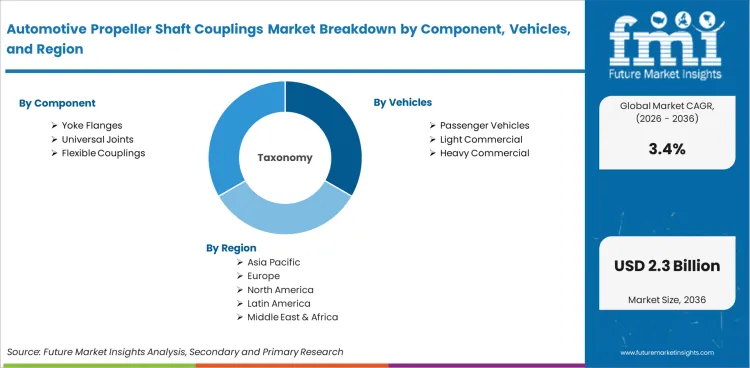
Automotive Propeller Shaft Couplings Market Segmented by Component:
- Yoke Flanges
- Universal Joints
- Flexible Couplings
- Center Bearings
- CV Couplings
Automotive Propeller Shaft Couplings Market Segmented by Vehicle Type:
- Passenger Vehicles
- Light Commercial
- Heavy Commercial
- Off Highway
Automotive Propeller Shaft Couplings Market Segmented by Sales Channel:
- Original Equipment
- Aftermarket
- Service Kits
Automotive Propeller Shaft Couplings Market Segmented by Material:
- Steel
- Aluminum
- Rubber Composite
- Carbon Composite
Automotive Propeller Shaft Couplings Market Segmented by Drive Layout:
- Rear Wheel
- All Wheel
- Four Wheel
- Hybrid Drive
Automotive Propeller Shaft Couplings Market Segmented by Region:
- North America
- United States
- Canada
- Latin America
- Brazil
- Mexico
- Argentina
- Europe
- Germany
- United Kingdom
- France
- Italy
- Spain
- East Asia
- China
- Japan
- South Korea
- South Asia and Pacific
- India
- Australia
- Thailand
- Indonesia
- Middle East and Africa
- Gulf Cooperation Council
- South Africa
Research Sources and Bibliography
- International Organization of Motor Vehicle Manufacturers. (2026, April 23). Auto industry growth shifted east in 2025 amid global repositioning.
- State Council of the People’s Republic of China. (2026, January 14). China’s auto output, sales reach new highs in 2025.
- Society of Indian Automobile Manufacturers. (2025, April 15). Monthly performance March 2025 and April 2024 to March 2025.
- German Association of the Automotive Industry. (2026, February 3). Production and market in January 2026.
- Brazilian Association of Motor Vehicle Manufacturers. (2026, January 15). Produção e venda de autoveículos crescem em 2025 e Anfavea projeta nova alta em 2026.
- United States Department of Energy. (2026, February). Maps and data: Annual vehicle miles traveled in the United States.
- International Energy Agency. (2026). Technology: Electric vehicles. Global Energy Review 2026.
- American Axle & Manufacturing. (2025, January 2). AAM returns to CES 2025 to showcase innovative automotive solutions.
- American Axle & Manufacturing. (2025, January 29). AAM announces combination with Dowlais for USD 1.44 billion in cash and stock.
- GKN Automotive. (2025, July 14). GKN Automotive at Dritev 2025.
- Schaeffler Group. (2024, October 1). Merger of Vitesco Technologies Group AG into Schaeffler AG successfully completed.
- NTN Americas. (2026). Precision bearings for OE and aftermarket needs.
This Report Answers
- What is the current and future size of the Automotive Propeller Shaft Couplings Market?
- How fast is the Automotive Propeller Shaft Couplings Market expected to expand between 2026 and 2036?
- Which component is expected to lead the market by 2026?
- Which vehicle type is expected to account for the highest demand by 2026?
- What factors are driving demand for automotive propeller shaft couplings globally?
- How is electric vehicle growth changing coupling design needs?
- Why do yoke flanges remain the main component segment?
- Which countries are projected to record faster expansion through 2036?
- What is driving market expansion in China and India?
- Who are the key companies active in the Automotive Propeller Shaft Couplings Market?
- How does FMI estimate and validate the market forecast?
Frequently Asked Questions
What is the global demand for Automotive Propeller Shaft Couplings Market in 2026?
In 2026, the global Automotive Propeller Shaft Couplings Market is expected to reach USD 1.7 billion, supported by original equipment and repair demand.
How big will the Automotive Propeller Shaft Couplings Market be in 2036?
By 2036, the Automotive Propeller Shaft Couplings Market is expected to reach USD 2.3 billion, with steady vehicle platform exposure supporting the forecast.
How much is Automotive Propeller Shaft Couplings Market expected to expand by 2036?
Between 2026 and 2036, demand for automotive propeller shaft couplings is projected to expand at a CAGR of 3.4%.
Which component is expected to lead the Automotive Propeller Shaft Couplings Market by 2026?
Yoke flanges are expected to account for 38.0% of component demand in 2026 due to wide use at shaft-to-axle connection points.
Why is China important in the Automotive Propeller Shaft Couplings Market?
China is projected to record 4.5% CAGR through 2036 as large vehicle output keeps local driveline and coupling demand active.
Why is India growing in the Automotive Propeller Shaft Couplings Market?
India is expected to expand at 4.3% CAGR through 2036 as vehicle production and utility vehicle use lift coupling demand.
What does Automotive Propeller Shaft Couplings Market definition include?
The market includes yoke flanges, universal joints, flexible couplings, center bearing interfaces, and constant velocity coupling points used on propeller shafts.
How does FMI make the Automotive Propeller Shaft Couplings Market forecast?
FMI uses vehicle output, drive layout mix, service replacement cycles, and supplier evidence to estimate value and check forecast reasonableness.
Which is better for buyers, yoke flanges or flexible couplings?
Yoke flanges suit firm torque transfer at shaft ends. Flexible couplings fit platforms where noise control and slight shaft movement need attention.
What affects the cost of automotive propeller shaft couplings?
Cost changes with material, machining tolerance, rubber bonding, torque rating, and whether the part is sold alone or inside a service kit.
How do automotive propeller shaft couplings work?
They connect the propeller shaft to nearby driveline parts and transfer turning force. The coupling must handle angle change without creating vibration.
How long do automotive propeller shaft couplings usually last?
Service life depends on load, road use, lubrication condition, and shaft balance. Heavy pickup and commercial use can shorten replacement cycles.
Preview the report firsthand - request a free sample
Get SampleGet the brochure for pricing and purchase details.
Get PDFTable of Content
- Executive Summary
- Global Market Outlook
- Demand-side Trends
- Supply-side Trends
- Technology Roadmap Analysis
- Analysis and Recommendations
- Market Overview
- Market Coverage / Taxonomy
- Market Definition / Scope / Limitations
- Research Methodology
- Chapter Orientation
- Analytical Lens and Working Hypotheses
- Market Structure, Signals, and Trend Drivers
- Benchmarking and Cross-market Comparability
- Market Sizing, Forecasting, and Opportunity Mapping
- Research Design and Evidence Framework
- Desk Research Programme (Secondary Evidence)
- Company Annual and Sustainability Reports
- Peer-reviewed Journals and Academic Literature
- Corporate Websites, Product Literature, and Technical Notes
- Earnings Decks and Investor Briefings
- Statutory Filings and Regulatory Disclosures
- Technical White Papers and Standards Notes
- Trade Journals, Industry Magazines, and Analyst Briefs
- Conference Proceedings, Webinars, and Seminar Materials
- Government Statistics Portals and Public Data Releases
- Press Releases and Reputable Media Coverage
- Specialist Newsletters and Curated Briefings
- Sector Databases and Reference Repositories
- FMI Internal Proprietary Databases and Historical Market Datasets
- Subscription Datasets and Paid Sources
- Social Channels, Communities, and Digital Listening Inputs
- Additional Desk Sources
- Expert Input and Fieldwork (Primary Evidence)
- Primary Modes
- Qualitative Interviews and Expert Elicitation
- Quantitative Surveys and Structured Data Capture
- Blended Approach
- Why Primary Evidence is Used
- Field Techniques
- Interviews
- Surveys
- Focus Groups
- Observational and In-context Research
- Social and Community Interactions
- Stakeholder Universe Engaged
- C-suite Leaders
- Board Members
- Presidents and Vice Presidents
- R&D and Innovation Heads
- Technical Specialists
- Domain Subject-matter Experts
- Scientists
- Physicians and Other Healthcare Professionals
- Governance, Ethics, and Data Stewardship
- Research Ethics
- Data Integrity and Handling
- Primary Modes
- Tooling, Models, and Reference Databases
- Desk Research Programme (Secondary Evidence)
- Data Engineering and Model Build
- Data Acquisition and Ingestion
- Cleaning, Normalisation, and Verification
- Synthesis, Triangulation, and Analysis
- Quality Assurance and Audit Trail
- Market Background
- Market Dynamics
- Drivers
- Restraints
- Opportunity
- Trends
- Scenario Forecast
- Demand in Optimistic Scenario
- Demand in Likely Scenario
- Demand in Conservative Scenario
- Opportunity Map Analysis
- Product Life Cycle Analysis
- Supply Chain Analysis
- Investment Feasibility Matrix
- Value Chain Analysis
- PESTLE and Porter’s Analysis
- Regulatory Landscape
- Regional Parent Market Outlook
- Production and Consumption Statistics
- Import and Export Statistics
- Market Dynamics
- Global Market Analysis 2021 to 2025 and Forecast, 2026 to 2036
- Historical Market Size Value (USD Million) Analysis, 2021 to 2025
- Current and Future Market Size Value (USD Million) Projections, 2026 to 2036
- Y-o-Y Growth Trend Analysis
- Absolute $ Opportunity Analysis
- Global Market Pricing Analysis 2021 to 2025 and Forecast 2026 to 2036
- Global Market Analysis 2021 to 2025 and Forecast 2026 to 2036, By Component
- Introduction / Key Findings
- Historical Market Size Value (USD Million) Analysis By Component , 2021 to 2025
- Current and Future Market Size Value (USD Million) Analysis and Forecast By Component , 2026 to 2036
- Yoke Flanges
- Universal Joints
- Flexible Couplings
- Yoke Flanges
- Y-o-Y Growth Trend Analysis By Component , 2021 to 2025
- Absolute $ Opportunity Analysis By Component , 2026 to 2036
- Global Market Analysis 2021 to 2025 and Forecast 2026 to 2036, By Vehicles
- Introduction / Key Findings
- Historical Market Size Value (USD Million) Analysis By Vehicles, 2021 to 2025
- Current and Future Market Size Value (USD Million) Analysis and Forecast By Vehicles, 2026 to 2036
- Passenger Vehicles
- Light Commercial
- Heavy Commercial
- Passenger Vehicles
- Y-o-Y Growth Trend Analysis By Vehicles, 2021 to 2025
- Absolute $ Opportunity Analysis By Vehicles, 2026 to 2036
- Global Market Analysis 2021 to 2025 and Forecast 2026 to 2036, By Sales Channel
- Introduction / Key Findings
- Historical Market Size Value (USD Million) Analysis By Sales Channel, 2021 to 2025
- Current and Future Market Size Value (USD Million) Analysis and Forecast By Sales Channel, 2026 to 2036
- Original Equipment Sales
- Aftermarket
- Service Kits
- Original Equipment Sales
- Y-o-Y Growth Trend Analysis By Sales Channel, 2021 to 2025
- Absolute $ Opportunity Analysis By Sales Channel, 2026 to 2036
- Global Market Analysis 2021 to 2025 and Forecast 2026 to 2036, By Material
- Introduction / Key Findings
- Historical Market Size Value (USD Million) Analysis By Material, 2021 to 2025
- Current and Future Market Size Value (USD Million) Analysis and Forecast By Material, 2026 to 2036
- Steel
- Aluminum
- Rubber Composite
- Steel
- Y-o-Y Growth Trend Analysis By Material, 2021 to 2025
- Absolute $ Opportunity Analysis By Material, 2026 to 2036
- Global Market Analysis 2021 to 2025 and Forecast 2026 to 2036, By Drive Layout
- Introduction / Key Findings
- Historical Market Size Value (USD Million) Analysis By Drive Layout, 2021 to 2025
- Current and Future Market Size Value (USD Million) Analysis and Forecast By Drive Layout, 2026 to 2036
- Rear Wheel
- All Wheel
- Four Wheel
- Rear Wheel
- Y-o-Y Growth Trend Analysis By Drive Layout, 2021 to 2025
- Absolute $ Opportunity Analysis By Drive Layout, 2026 to 2036
- Global Market Analysis 2021 to 2025 and Forecast 2026 to 2036, By Region
- Introduction
- Historical Market Size Value (USD Million) Analysis By Region, 2021 to 2025
- Current Market Size Value (USD Million) Analysis and Forecast By Region, 2026 to 2036
- North America
- Latin America
- Western Europe
- Eastern Europe
- East Asia
- South Asia and Pacific
- Middle East & Africa
- Market Attractiveness Analysis By Region
- North America Market Analysis 2021 to 2025 and Forecast 2026 to 2036, By Country
- Historical Market Size Value (USD Million) Trend Analysis By Market Taxonomy, 2021 to 2025
- Market Size Value (USD Million) Forecast By Market Taxonomy, 2026 to 2036
- By Country
- USA
- Canada
- Mexico
- By Component
- By Vehicles
- By Sales Channel
- By Material
- By Drive Layout
- By Country
- Market Attractiveness Analysis
- By Country
- By Component
- By Vehicles
- By Sales Channel
- By Material
- By Drive Layout
- Key Takeaways
- Latin America Market Analysis 2021 to 2025 and Forecast 2026 to 2036, By Country
- Historical Market Size Value (USD Million) Trend Analysis By Market Taxonomy, 2021 to 2025
- Market Size Value (USD Million) Forecast By Market Taxonomy, 2026 to 2036
- By Country
- Brazil
- Chile
- Rest of Latin America
- By Component
- By Vehicles
- By Sales Channel
- By Material
- By Drive Layout
- By Country
- Market Attractiveness Analysis
- By Country
- By Component
- By Vehicles
- By Sales Channel
- By Material
- By Drive Layout
- Key Takeaways
- Western Europe Market Analysis 2021 to 2025 and Forecast 2026 to 2036, By Country
- Historical Market Size Value (USD Million) Trend Analysis By Market Taxonomy, 2021 to 2025
- Market Size Value (USD Million) Forecast By Market Taxonomy, 2026 to 2036
- By Country
- Germany
- UK
- Italy
- Spain
- France
- Nordic
- BENELUX
- Rest of Western Europe
- By Component
- By Vehicles
- By Sales Channel
- By Material
- By Drive Layout
- By Country
- Market Attractiveness Analysis
- By Country
- By Component
- By Vehicles
- By Sales Channel
- By Material
- By Drive Layout
- Key Takeaways
- Eastern Europe Market Analysis 2021 to 2025 and Forecast 2026 to 2036, By Country
- Historical Market Size Value (USD Million) Trend Analysis By Market Taxonomy, 2021 to 2025
- Market Size Value (USD Million) Forecast By Market Taxonomy, 2026 to 2036
- By Country
- Russia
- Poland
- Hungary
- Balkan & Baltic
- Rest of Eastern Europe
- By Component
- By Vehicles
- By Sales Channel
- By Material
- By Drive Layout
- By Country
- Market Attractiveness Analysis
- By Country
- By Component
- By Vehicles
- By Sales Channel
- By Material
- By Drive Layout
- Key Takeaways
- East Asia Market Analysis 2021 to 2025 and Forecast 2026 to 2036, By Country
- Historical Market Size Value (USD Million) Trend Analysis By Market Taxonomy, 2021 to 2025
- Market Size Value (USD Million) Forecast By Market Taxonomy, 2026 to 2036
- By Country
- China
- Japan
- South Korea
- By Component
- By Vehicles
- By Sales Channel
- By Material
- By Drive Layout
- By Country
- Market Attractiveness Analysis
- By Country
- By Component
- By Vehicles
- By Sales Channel
- By Material
- By Drive Layout
- Key Takeaways
- South Asia and Pacific Market Analysis 2021 to 2025 and Forecast 2026 to 2036, By Country
- Historical Market Size Value (USD Million) Trend Analysis By Market Taxonomy, 2021 to 2025
- Market Size Value (USD Million) Forecast By Market Taxonomy, 2026 to 2036
- By Country
- India
- ASEAN
- Australia & New Zealand
- Rest of South Asia and Pacific
- By Component
- By Vehicles
- By Sales Channel
- By Material
- By Drive Layout
- By Country
- Market Attractiveness Analysis
- By Country
- By Component
- By Vehicles
- By Sales Channel
- By Material
- By Drive Layout
- Key Takeaways
- Middle East & Africa Market Analysis 2021 to 2025 and Forecast 2026 to 2036, By Country
- Historical Market Size Value (USD Million) Trend Analysis By Market Taxonomy, 2021 to 2025
- Market Size Value (USD Million) Forecast By Market Taxonomy, 2026 to 2036
- By Country
- Kingdom of Saudi Arabia
- Other GCC Countries
- Turkiye
- South Africa
- Other African Union
- Rest of Middle East & Africa
- By Component
- By Vehicles
- By Sales Channel
- By Material
- By Drive Layout
- By Country
- Market Attractiveness Analysis
- By Country
- By Component
- By Vehicles
- By Sales Channel
- By Material
- By Drive Layout
- Key Takeaways
- Key Countries Market Analysis
- USA
- Pricing Analysis
- Market Share Analysis, 2025
- By Component
- By Vehicles
- By Sales Channel
- By Material
- By Drive Layout
- Canada
- Pricing Analysis
- Market Share Analysis, 2025
- By Component
- By Vehicles
- By Sales Channel
- By Material
- By Drive Layout
- Mexico
- Pricing Analysis
- Market Share Analysis, 2025
- By Component
- By Vehicles
- By Sales Channel
- By Material
- By Drive Layout
- Brazil
- Pricing Analysis
- Market Share Analysis, 2025
- By Component
- By Vehicles
- By Sales Channel
- By Material
- By Drive Layout
- Chile
- Pricing Analysis
- Market Share Analysis, 2025
- By Component
- By Vehicles
- By Sales Channel
- By Material
- By Drive Layout
- Germany
- Pricing Analysis
- Market Share Analysis, 2025
- By Component
- By Vehicles
- By Sales Channel
- By Material
- By Drive Layout
- UK
- Pricing Analysis
- Market Share Analysis, 2025
- By Component
- By Vehicles
- By Sales Channel
- By Material
- By Drive Layout
- Italy
- Pricing Analysis
- Market Share Analysis, 2025
- By Component
- By Vehicles
- By Sales Channel
- By Material
- By Drive Layout
- Spain
- Pricing Analysis
- Market Share Analysis, 2025
- By Component
- By Vehicles
- By Sales Channel
- By Material
- By Drive Layout
- France
- Pricing Analysis
- Market Share Analysis, 2025
- By Component
- By Vehicles
- By Sales Channel
- By Material
- By Drive Layout
- India
- Pricing Analysis
- Market Share Analysis, 2025
- By Component
- By Vehicles
- By Sales Channel
- By Material
- By Drive Layout
- ASEAN
- Pricing Analysis
- Market Share Analysis, 2025
- By Component
- By Vehicles
- By Sales Channel
- By Material
- By Drive Layout
- Australia & New Zealand
- Pricing Analysis
- Market Share Analysis, 2025
- By Component
- By Vehicles
- By Sales Channel
- By Material
- By Drive Layout
- China
- Pricing Analysis
- Market Share Analysis, 2025
- By Component
- By Vehicles
- By Sales Channel
- By Material
- By Drive Layout
- Japan
- Pricing Analysis
- Market Share Analysis, 2025
- By Component
- By Vehicles
- By Sales Channel
- By Material
- By Drive Layout
- South Korea
- Pricing Analysis
- Market Share Analysis, 2025
- By Component
- By Vehicles
- By Sales Channel
- By Material
- By Drive Layout
- Russia
- Pricing Analysis
- Market Share Analysis, 2025
- By Component
- By Vehicles
- By Sales Channel
- By Material
- By Drive Layout
- Poland
- Pricing Analysis
- Market Share Analysis, 2025
- By Component
- By Vehicles
- By Sales Channel
- By Material
- By Drive Layout
- Hungary
- Pricing Analysis
- Market Share Analysis, 2025
- By Component
- By Vehicles
- By Sales Channel
- By Material
- By Drive Layout
- Kingdom of Saudi Arabia
- Pricing Analysis
- Market Share Analysis, 2025
- By Component
- By Vehicles
- By Sales Channel
- By Material
- By Drive Layout
- Turkiye
- Pricing Analysis
- Market Share Analysis, 2025
- By Component
- By Vehicles
- By Sales Channel
- By Material
- By Drive Layout
- South Africa
- Pricing Analysis
- Market Share Analysis, 2025
- By Component
- By Vehicles
- By Sales Channel
- By Material
- By Drive Layout
- USA
- Market Structure Analysis
- Competition Dashboard
- Competition Benchmarking
- Market Share Analysis of Top Players
- By Regional
- By Component
- By Vehicles
- By Sales Channel
- By Material
- By Drive Layout
- Competition Analysis
- Competition Deep Dive
- Dauch Corporation
- Overview
- Product Portfolio
- Profitability by Market Segments (Product/Age /Sales Channel/Region)
- Sales Footprint
- Strategy Overview
- Marketing Strategy
- Product Strategy
- Channel Strategy
- Dana Incorporated
- ZF Friedrichshafen AG
- Schaeffler AG
- NTN Corporation
- JTEKT Corporation
- Neapco Holdings LLC
- Dauch Corporation
- Competition Deep Dive
- Assumptions & Acronyms Used


