

- Industry Size (2026)
- USD 5.2 Bn
- Forecast (2036)
- USD 8.8 Bn
- CAGR (2026 to 2036)
- 6.4%
AWD Coupling System Market Size, Market Forecast and Outlook By FMI
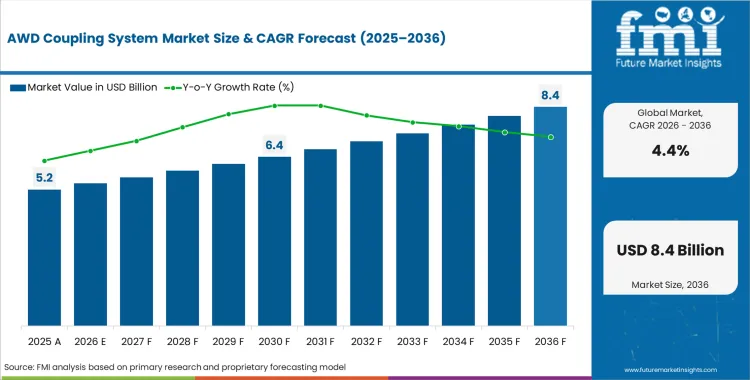
In 2025, the AWD coupling system market was held at USD 5.0 billion and with steady increase in sales, it is now expected to cross USD 5.2 billion in 2026 at a CAGR of 4.4% during the forecast period. Rising demand is expected to take total industry valuation to USD 8.0 billion by 2036, as automotive OEMs standardize torque-vectoring architectures across mid-tier vehicle platforms and expand the use of AWD coupling systems.
Car engineers are under pressure to reduce parasitic friction without weakening the traction performance drivers still expect, especially in heavier hybrid vehicles. That requirement is changing how AWD coupling system contracts are evaluated. Automakers now place more weight on disconnect speed, packaging efficiency, and control precision than on mechanical strength alone. A slow-reacting system keeps unnecessary driveline load in play, which raises fuel consumption and makes emissions compliance harder to manage. Suppliers are responding by integrating faster electronic controls directly into rear axle systems. In procurement terms, software quality and power-transfer logic now carry more weight than heavy metal content, which is steadily reshaping demand across disconnect system designs.
Summary of AWD Coupling System Market
- Market Snapshot
- Baseline valuation for the AWD coupling system market stands at USD 5.0 billion in 2025 and is projected to reach USD 8.0 billion by 2036.
- Global sales are forecast to advance at a 4.4% CAGR over the ten-year assessment period, creating an incremental opportunity of USD 2.8 billion.
- Supply awards in this technically demanding hardware market depend on traction control accuracy, torque transfer speed, and packaging efficiency far more than on unit price alone.
- Component manufacturers are moving beyond basic mechanical engagement systems and shifting toward electro-hydraulic and disconnecting architectures that fit modern fuel-efficiency and vehicle control requirements.
- Demand and Growth Drivers
- Strong consumer preference for high-riding utility vehicles continues to shape production volumes, keeping all-wheel capability embedded in mainstream model programs rather than confined to premium trims.
- Automakers depend on advanced disconnect systems to reduce parasitic drag during highway cruising without compromising immediate traction response when slip conditions appear.
- Hybrid and battery-electric vehicle programs are pushing driveline engineers to redesign torque-transfer systems around instant torque delivery and electric axle packaging requirements.
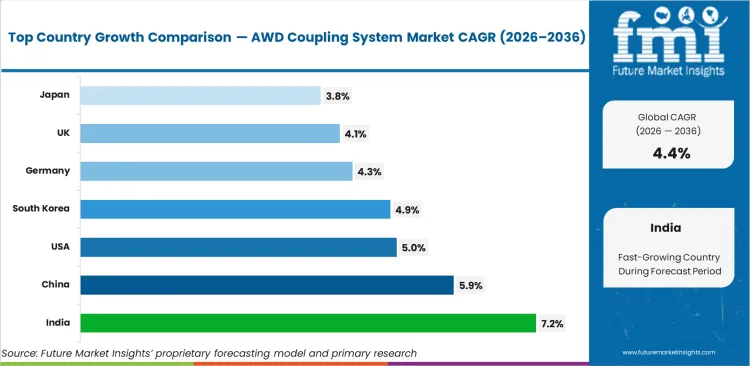
- India is expected to remain the fastest-growing country market, with AWD coupling system demand rising at a 7.2% CAGR through 2036. China follows at 5.9%, the U.S. at 5.0%, South Korea at 4.9%, Germany at 4.3%, the UK at 4.1%, and Japan at 3.8%, reflecting faster growth in emerging production centers and steadier replacement-led demand in mature automotive bases.
- Lengthy engineering validation and vehicle-level testing cycles continue to slow adoption, even as newer electrified platforms move into development pipelines.
- Product and Segment View
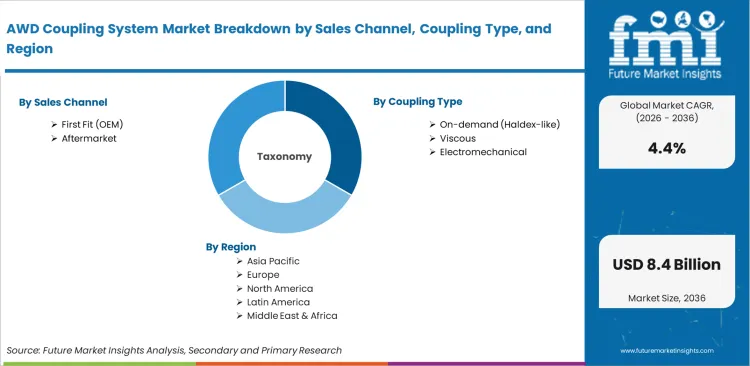
- This market covers hardware ranging from conventional viscous couplings to electronically controlled torque-transfer units used in modern traction management and axle-disconnect systems.
- First Fit (OEM) channels are expected to account for 88.0% share in 2026, as torque management systems must be calibrated and integrated during initial vehicle assembly.
- On-demand (Haldex-like) systems are anticipated to capture 54.0% of the market in 2026 because they engage power electronically only when traction conditions require it.
- SUV/CUV applications are estimated to represent 71.0% share in 2026, supported by automaker focus on safety, drivability, and higher-margin passenger vehicle formats.
- ICE/HEV powertrain applications are projected to hold 78.0% share in the near term, reflecting the continued dominance of legacy vehicle platforms in current production programs.
- Rear Coupling architectures are likely to account for 66.0% market share in 2026, supported by their suitability for transverse engine layouts that require rear axle support.
- The analysis covers discrete coupling assemblies and torque-transfer modules, while excluding complete transfer cases and heavy-duty e-axles to keep the component scope precise.
- Geography and Competitive Outlook
- India, China, and the USA generate a large share of new equipment demand, while Germany and Japan remain driven by stable factory schedules, engineering discipline, and predictable sourcing cycles.
- Long-term platform awards depend on a supplier’s ability to solve software integration, calibration, and packaging constraints well before vehicle production begins.
- BorgWarner, GKN, Magna, AISIN, JTEKT, and Dana compete through platform fit, control software capability, and OEM program depth, with BorgWarner benefiting from a broad product portfolio across coupling and drivetrain applications.
- The supplier base remains moderately consolidated because major assembly relationships are difficult to displace, even as ownership changes and new technical requirements begin to alter long-standing mechanical benchmarks.
The ability to fully disengage the secondary axle during highway cruising has become an important efficiency advantage. Once that axle is disconnected, mechanical drag falls, fuel use improves, and battery range benefits in electrified vehicles. As these units become more closely linked with electric drivetrain controls, response time has moved into the center of engineering decisions. Performance is now judged in milliseconds, because torque must be restored the moment road grip changes. That shift is pushing AWD coupling development toward faster calibration, tighter electronic integration, and more compact actuation systems.
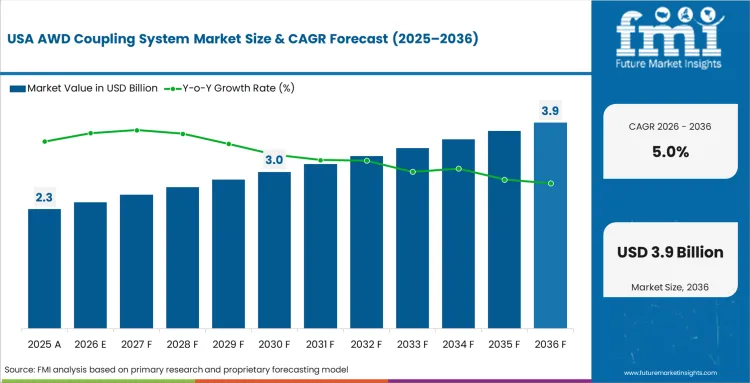
Demand for AWD coupling system market throughout the United States is expected to grow at 5.0% because heavy truck platforms require robust mechanical engagement. India is likely to lead the long-run by projecting an anticipated 7.2% of CAGR as domestic automakers expand utility vehicle offerings into lower price brackets. China is predicted to follow closely at 5.9% due to rapid electrification demanding new e-axle geometries, boosting AWD coupling in the country. South Korea is set to move ahead at 4.9% with focused hybrid driveline exports. Germany is forecasted to register a 4.3% CAGR, driven by premium brand shift toward on-demand rear architecture. UK operations are predicted to scale at 4.1% on replacement cycles, while Japan is anticipated to likely post a 3.8%, prioritizing lightweight configurations. Engineering focus diverges sharply between high-volume mechanical cost-reduction in emerging economies and software-driven torque precision in mature regions.
Segmental Analysis
AWD Coupling System Market Analysis by Sales Channel
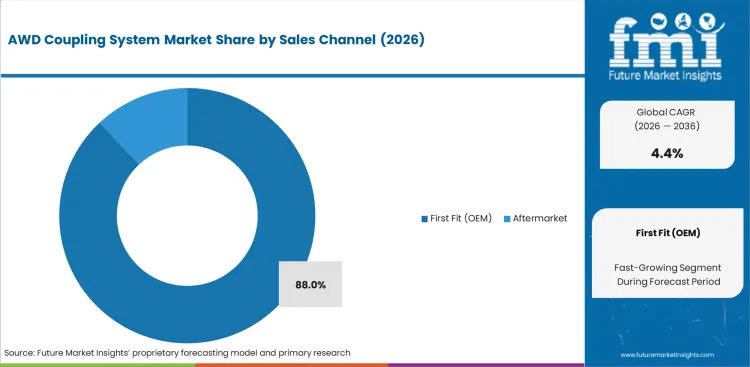
Automakers prefer installing all-wheel-drive hardware during vehicle assembly rather than leaving fitment to dealerships or local workshops. Factory integration remains the preferred route because these systems must be calibrated against the vehicle’s electronic architecture and validated under OEM safety standards, which is why the First Fit (OEM) segment is estimated to account for 88.0% share in 2026. Retrofitting raises warranty exposure and functional risk, especially when limited slip differential couplings must communicate accurately with the central control system to manage torque delivery and prevent instability. Most local repair shops do not have the software access or calibration capability required to handle that work to OEM expectations.
- Cost Economics In Procurement: Volume-based sourcing agreements reduce unit costs during vehicle platform negotiations. OEM procurement teams exchange long-term production commitments for tighter pricing on clutch packs and associated mechanical hardware.
- Hidden Operation Expenses: Weak software integration at the assembly stage can trigger costly warranty failures. Quality teams then carry the diagnostic burden when torque transfer does not perform properly under cold-weather or low-traction testing conditions.
- Lifecycle Margin Reality: Aftermarket limitations keep suppliers dependent on OEM production volumes. Profitability improves later in the vehicle lifecycle, once propeller shaft replacement demand starts building beyond the five-year ownership mark.
AWD Coupling System Market Analysis by Coupling Type
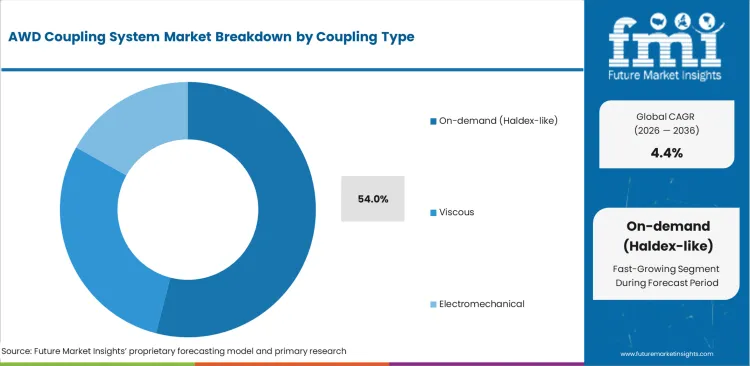
Modern vehicle programs place a clear premium on cutting mechanical drag to improve fuel efficiency. That requirement has increased demand for systems that disconnect the rear axle during steady highway driving and re-engage it quickly when traction conditions worsen. On-demand (Haldex-like) units are anticipated to capture 54.0% of the market in 2026 because they give automakers a workable balance between fuel savings and all-weather control. Buyers assessing traction systems continue to favor electronically controlled units, as traditional viscous couplings respond too slowly for the stability targets expected in current vehicle platforms.
- Performance Exceeding Expectations: Electro-hydraulic pressure builds within a fraction of a wheel rotation. Traction engineers rely on that response speed to intervene before wheel speed sensors show a material slip event.
- Edge Condition Gaps: Sustained low-speed articulation raises internal fluid temperature beyond normal operating thresholds. Fleet maintenance teams encounter thermal lockouts when operators run uncooled units outside their intended duty cycle.
- Acceptability Standards: Validation teams require precise coordination with anti-lock braking systems. Software validation managers routinely reject mechanical designs that cannot support predictive engagement based on steering angle and related vehicle inputs.
AWD Coupling System Market Analysis by Vehicle Type
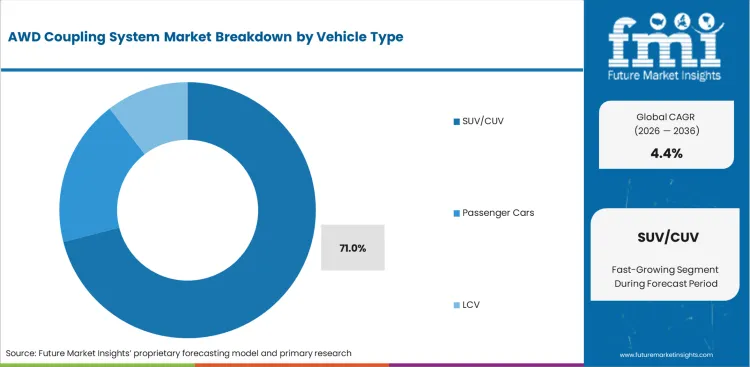
In 2026, the SUV/CUV segment is likely to account for 71.0% of market share. Global vehicle demand continues to shift toward crossovers and sport utility platforms, where buyers expect better road presence along with dependable performance in rain, snow, and mixed driving conditions. Automakers increasingly position all-wheel drive as a safety and premium-value feature on these vehicles, which keeps off-road driveline couplings central to platform design. That demand puts packaging teams under pressure to fit couplings and related driveline hardware into tight underfloor spaces without reducing cabin room or compromising passenger comfort.
- Decision Triggers: Premium trim strategies often require the early addition of secondary axle propulsion. Platform engineering teams must package compact torque modules into architectures that were initially designed around front-wheel-drive layouts.
- Qualification Hurdles: Cabin refinement targets remain strict in unibody vehicle platforms. Acoustics teams reject otherwise functional layouts when gear noise enters the passenger compartment during steady highway driving.
- Renewal Drivers: Continued consumer preference for elevated seating and crossover utility supports long-term production volumes. Supply chain teams secure cast housing availability through multi-year agreements to avoid future capacity constraints.
AWD Coupling System Market Analysis by Powertrain
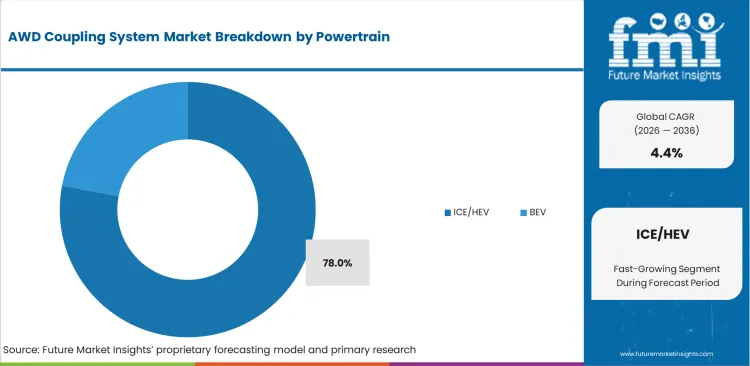
Car companies are planning for electric futures, but the reality on today's factory floors tells a different story. Standard gas engines and traditional hybrids still dominate production schedules, which is why the ICE/HEV category is expected to hold a share of 78.0% in 2026. When designing a hybrid, engineers often find that large battery packs block the space needed for a dedicated rear electric motor. To solve this packaging problem, they stick with physical metal driveshafts and high speed e-drive couplings to send power from the front engine backward.
- Displacement Targets: Combusting platforms face intense scrutiny regarding parasitic efficiency losses. Powertrain directors target constant-mesh components for elimination to satisfy tightening fleet emission standards.
- Residual RISK: Utilizing mechanical driveshafts alongside battery packs introduces severe packaging conflicts. Battery packaging engineers compromise cellular capacity specifically to route physical shafts toward rear differentials.
- Capture Strategies: Extending combustion platform lifecycles requires adopting disconnecting hardware. Program managers implement electro-hydraulic clutches merely to buy time before fully electrifying specific vehicle nameplates.
AWD Coupling System Market Analysis by Axle
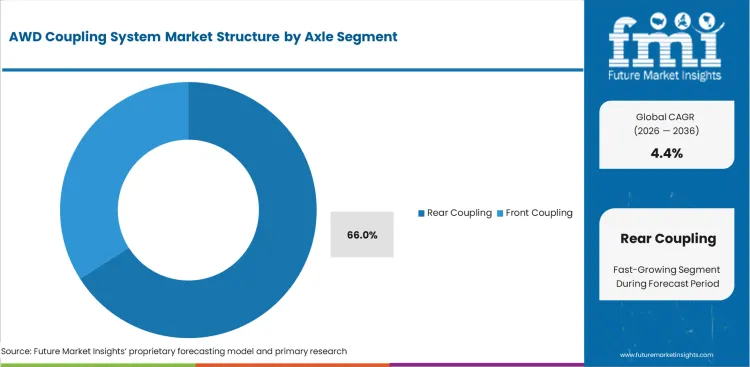
Most everyday cars are built with the engine sitting sideways, meaning all the basic power goes straight to the front wheels. To give these cars all-wheel-drive capability, designers mount a compact clutch pack right in front of the rear wheels that pulls power backward the exact split second the front tires lose grip, leading the market as likely to see the Rear Coupling segment account for 66.0% share in 2026. This layout allows automakers to build basic front-wheel-drive cars cheaply while offering all-weather traction as an easy factory upgrade using specific e-axle input and output couplings.
- Early Adoption Profiles: Front-heavy transverse platforms require trailing axle assistance for basic acceleration on slick surfaces. Vehicle dynamics engineers specify predictive rear engagement to prevent dangerous understeer during throttle application.
- Follower Changes: Longitudinal luxury architectures gradually adopt similar disconnecting logic. Premium chassis directors abandon permanent mechanical splits in favor of fully variable multi-plate systems to chase fractional efficiency gains.
- Final Conversion: Entry-level hatchbacks adopt lightweight magnetic couplings strictly for snow-belt regions. Cost engineering teams authorize bare-minimum traction hardware purely to satisfy regional dealership demands.
AWD Coupling System Market Drivers, Restraints, and Opportunities
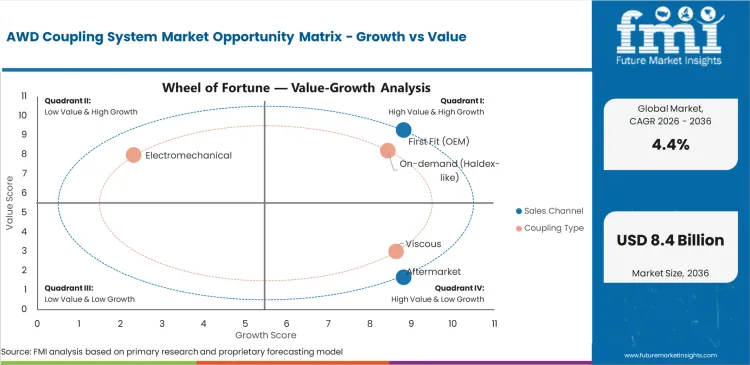
Tightening global efficiency mandates compel OEM driveline engineers to eliminate mechanical drag across heavy utility vehicle fleets. Parasitic losses generated by permanently engaged secondary axles destroy fuel economy ratings, forcing platform directors to specify fast-acting disconnect architectures. Delaying transition risks severe regulatory fines and limits automaker ability to sell profitable heavy crossovers in strict emission zones. Purchasing teams demand driveline control systems capable of severing mechanical connections in milliseconds. Rapid actuator response ensures safety systems retain full torque control during sudden maneuvers while allowing zero-drag highway cruising. Speed directly dictates compliance capability for AWD coupling vs transfer case evaluations.
Validation protocols inside automotive engineering departments block rapid technology deployment. Software integration testing requires extreme durability validation across diverse climate extremes before any vehicle transfer case or multi-plate module secures production approval. Rigorous testing cycles force Tier-1 suppliers to freeze physical designs years before actual vehicle launch. Mechanical refinements sit idle while electronics teams debug traction-control algorithms. Modular software architectures are emerging to bypass physical testing bottlenecks, yet legacy safety requirements keep actual production deployment painfully slow.
- Software Monetization: Selling pre-validated traction control algorithms alongside hardware. Software engineering directors capture premium margins by reducing OEM calibration workloads.
- Thermal Management Integration: Bundling active cooling circuits into high-performance clutch packs. Product development managers secure heavy-duty towing contracts by solving overheating constraints.
- Hybrid Architecture Adaptation: Designing compact disconnect modules specifically for electric vehicle e-axle layouts. Advanced engineering heads win immediate platform nominations by shrinking total package volume.
Regional Analysis
Based on regional analysis, AWD Coupling System is segmented into North America, Latin America, Western Europe, Eastern Europe, Asia-Pacific, and Middle East and Africa across 40 plus countries. Global demand for AWD coupling hardware shifts based on local driving habits, with emerging markets chasing affordable all-weather traction while mature economies focus on squeezing every bit of efficiency out of hybrid setups.
.webp "Top Country Growth Comparison Awd Coupling System Market Cagr (2026 2036)")
| Country | CAGR (2026 to 2036) |
|---|---|
| India | 7.2% |
| China | 5.9% |
| USA. | 5.0% |
| South Korea | 4.9% |
| Germany | 4.3% |
| UK | 4.1% |
| Japan | 3.8% |
Source: Future Market Insights (FMI) analysis, based on proprietary forecasting model and primary research
Asia-Pacific AWD Coupling System Market Analysis
Automakers across this massive region are completely reshaping how power gets to the wheels, balancing the need for affordable compact utility vehicles in developing areas against strict electric vehicle mandates in manufacturing hubs. As large battery packs leave no room for traditional driveshafts, engineering teams are rushing to design smaller electric axle disconnects that do not add unnecessary weight or noise. Local supply chains are also adapting quickly, moving away from expensive hydraulic systems toward tougher, simpler mechanical setups wherein price matters most.
- India: Buyers upgrading from simple two-wheel drive hatchbacks want rugged vehicles that can handle rough rural roads without the heavy price tag of an old-school transfer case. Recognizing this shift, India is likely to record a CAGR of 7.2% in demand during the assessment period as domestic car companies rapidly expand their sub-four-meter crossover lineups. Building these simplified torque units locally also opens up major opportunities for regional metal forging suppliers who can deliver at scale.
- China: With the rapid rollout of heavy hybrid platforms, sales of coupling hardware industry are expected to increase at a CAGR of 5.9% during the forecast period to handle the sudden spikes in electric torque. Car designers are demanding lightning-fast disconnect systems to squeeze out as much pure electric driving range as possible. This intense push has allowed domestic parts builders to catch up with legacy European firms when it comes to software integration speed.
- South Korea: Because so much of the local manufacturing is focused on global exports, purchasing directors insist on using flexible parts that fit seamlessly into both gas-powered and hybrid cars on the same assembly line. Building this kind of manufacturing flexibility means South Korea is projected to witness 4.9% CAGR in demand through 2036 while securing global supply chains against unexpected disruptions. Standardizing these actuator controls drastically cuts down on factory headaches across different vehicle models.
- Japan: Engineering teams are obsessively focused on stripping out any excess weight from the rear drive modules to improve overall vehicle efficiency. This relentless push for optimization means Japan is likely to post a CAGR of 3.8% by 2036 as chassis designers shift toward magnetic engagement systems that completely eliminate heavy hydraulic fluids. The clear engineering goal remains achieving purely electronic torque distribution without the mechanical bulk.
FM reports, the Asia-Pacific supply base is splitting into two distinct paths, creating ultra-affordable mechanical setups for local consumers and designing highly advanced, lightweight electronic disconnects for global electric vehicle exports.
North America AWD Coupling System Market Analysis
The sheer size and towing requirements of North American trucks and large SUVs dictate an extreme level of durability for all traction hardware. Consumers expect their vehicles to perform flawlessly in heavy snow or while pulling trailers, forcing engineers to install massive clutch packs that can safely absorb and shed intense heat. At the same time, premium brands are feeling the pressure to add smarter, predictive engagement networks that can manage all this power smoothly.
- USA.: As heavy passenger trucks remain incredibly popular, USA. demand is forecasted to expand at a CAGR of 5.0% through 2036 to support the baseline volume for mechanical multi-plate units. Fleet buyers and everyday drivers alike care far more about proven reliability than they do about minor improvements in fuel economy. Parts suppliers who fail to properly account for the intense heat buildup during heavy towing quickly face the harsh reality of expensive warranty claims wiping out their profits.
FMI estimates, the North American market prioritizes rugged, heat-resistant hardware over delicate efficiency gains, meaning suppliers must guarantee their coupling systems can survive years of towing abuse without failing.
Europe AWD Coupling System Market Analysis
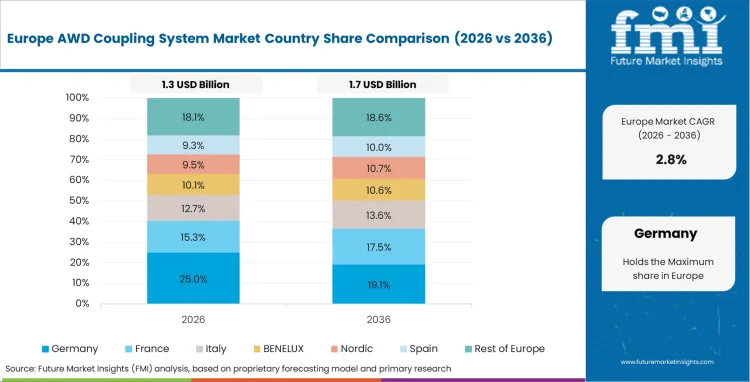
Luxury car brands are aggressively chasing strict fleet emission rules by completely removing mechanical drag from their larger, rear-wheel-biased sedans. Disconnecting the front wheels precisely when they are not needed requires incredibly sharp coordination between the vehicle's computer and the hydraulic systems. On top of that, European chassis directors set the global benchmark for a quiet ride, and they will quickly reject any hardware that makes a noticeable whining sound inside the cabin.
- Germany: The high-speed reality of highway driving requires stability control systems that work perfectly the instant power needs to shift between wheels. Engineering chiefs demand smart software that can predict and stop wheel slip before it happens, which is why demand in Germany is anticipated to rise at a CAGR of 4.3% through 2036 as luxury platforms upgrade their tech. Suppliers who master both silent operation and complex coding gain a massive advantage in winning these premium contracts.
- UK: Building high-end off-road vehicles requires specialized hardware that can handle the stress of crawling over rough terrain at very low speeds. To meet these tough design standards, UK operations are expected to register a CAGR of 4.1% through 2036 as product planners seek coupling units that will not overheat during extended outdoor use. Integrating electronic locking controls directly into these units helps local brands stay competitive against imported utility vehicles.
FMI assesses, success in Western Europe hinges entirely on delivering silent, software-driven precision that helps luxury automakers meet emission goals without sacrificing the premium driving experience. The report includes France, Italy, Spain, Brazil, and Mexico. Detailed automotive differential analysis reveals distinct regional friction regarding the transition from mechanical to electrified torque management.
Competitive Aligners for Market Players
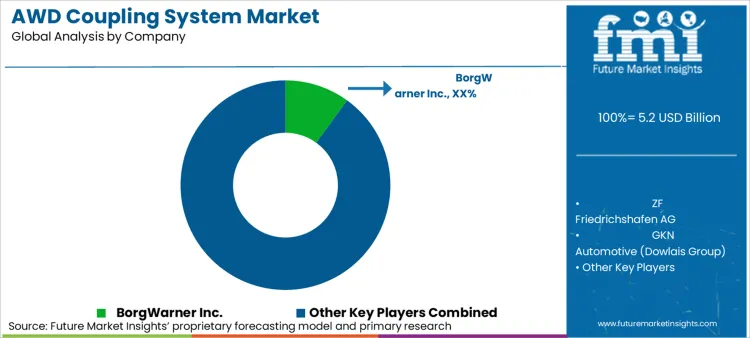
Making the basic metal parts for all-wheel drive systems no longer guarantees a supplier can charge premium prices on standard parts and accessories contracts. Today, a supplier's real value comes down to how well their software controls the hardware, rather than just how tough the physical clutch materials are. Large component builders use their size to deliver fully programmed modules, which saves car manufacturers from spending thousands of hours writing their own code. Purchasing managers will actually reject perfectly built physical parts if they do not include the smart algorithms needed to run them. To win major vehicle contracts, top AWD coupling system manufacturers must prove their systems can disconnect completely to save fuel while communicating instantly with the vehicle's safety computers.
Long-standing suppliers hold a massive advantage because they have decades of test data on noise, vibration, and heat limits. This deep history means established firms can promise their parts will survive heavy towing and rough use, a claim that new competitors simply cannot prove without running years of expensive real-world testing. FMI analysts note that successfully designing automotive axle disconnects requires solving complicated sound echoing problems inside the passenger cabin. Any new company trying to break into this space must build strong software teams that can write code to anticipate exactly when wheels will slip. Simply having a big factory to forge metal parts is useless to automakers if the computer brains controlling those parts fail under pressure.
Automakers are actively pushing back against being forced to use just one supplier's software for the life of a vehicle. Engineering leads now write their rules so that the physical coupling units must take orders directly from the car's main computer, instead of relying on a closed software system controlled entirely by the parts supplier. This shift puts negotiating power firmly back into the hands of the car brands. By splitting the physical metal parts from the software logic, purchasing teams can freely buy clutch packs from multiple competing factories to keep prices low. Suppliers who cannot make their physical hardware work smoothly with an automaker's overarching software system will simply be blocked from supplying parts for high-end vehicle lines.
Key Players in AWD Coupling System Market
- BorgWarner
- GKN (Dowlais Group)
- Magna
- AISIN
- JTEKT
- Dana
Scope of the Report
| Metric | Value |
|---|---|
| Quantitative Units | USD 5.2 billion to USD 8.0 billion, at a CAGR of 4.4% |
| Market Definition | Torque-transfer units manage power distribution between primary and secondary automotive axles to optimize traction and efficiency. These discrete electromechanical or hydraulic assemblies regulate clutch engagement dynamically, isolating auxiliary driveline components during steady-state driving to eliminate parasitic drag and improve vehicle fuel economy. |
| Segmentation | Sales Channel, Coupling Type, Vehicle Type, Powertrain, Axle |
| Regions Covered | North America, Latin America, Western Europe, Eastern Europe, East Asia, South Asia and Pacific, Middle East and Africa |
| Countries Covered | USA., China, India, Germany, Japan, South Korea, UK |
| Key Companies Profiled | BorgWarner, GKN (Dowlais Group), Magna, AISIN, JTEKT, Dana |
| Forecast Period | 2026 to 2036 |
| Approach | Light vehicle production volume multiplied by AWD penetration rates per vehicle class anchors baseline estimates. |
Source: Future Market Insights (FMI) analysis, based on proprietary forecasting model and primary research
AWD Coupling System Market by Segment
Sales Channel
- First Fit (OEM)
- Aftermarket
Coupling Type
- On-demand (Haldex-like)
- Viscous
- Electromechanical
Vehicle Type
- SUV/CUV
- Passenger Cars
- LCV
Powertrain
- ICE/HEV
- BEV
Axle
- Rear Coupling
- Front Coupling
Regions:
- Asia Pacific
- India
- China
- Japan
- South Korea
- Indonesia
- Australia & New Zealand
- ASEAN
- Rest of Asia Pacific
- Europe
- Germany
- Italy
- France
- United Kingdom
- Spain
- Benelux
- Nordics
- Central & Eastern Europe
- Rest of Europe
- North America
- United States
- Canada
- Mexico
- Latin America
- Brazil
- Argentina
- Chile
- Rest of Latin America
- Middle East & Africa
- Kingdom of Saudi Arabia
- United Arab Emirates
- South Africa
- Turkey
- Rest of Middle East & Africa
Bibliography
- Zhang, L., Wang, Z., Wang, L., & Ren, C. (2024). Optimization control of multi-mode coupling all-wheel drive system for hybrid vehicle. Chinese Journal of Mechanical Engineering, 37, 31.
- Park, J.-Y., Jeon, J.-H., & Kim, Y.-C. (2024). A study on power transmission control for applying MR fluid multi-plate clutch to automobile power distribution device. Applied Sciences, 14(9), 3871.
- Louback, E., Biswas, A., Machado, F., & Emadi, A. (2024). A review of the design process of energy management systems for dual-motor battery electric vehicles. Renewable and Sustainable Energy Reviews, 193, 114293.
- Grđan, I., Škugor, B., & Deur, J. (2024). Energy-efficient straight-line driving torque vectoring for electric vehicles with disconnect clutches and unequal front/rear motors. In 16th International Symposium on Advanced Vehicle Control (AVEC 2024) (pp. 364-370). Springer.
- U.S. Department of Transportation. (2024, June 7). USDOT finalizes new fuel economy standards for model years 2027-2031.
This bibliography is provided for reader reference. The full FMI report contains the complete reference list with primary source documentation.
This Report Addresses
- Component integration requirements dictating torque hardware choices across high-volume Japanese automotive manufacturing operations.
- Software validation friction slowing electro-hydraulic coupling deployment within legacy European combustion vehicle architectures.
- Thermal management limits preventing rapid mechanical clutch scaling inside North American heavy utility vehicle platforms.
- Acoustic engineering challenges forcing chassis directors to reject functional disconnect layouts in premium passenger cabins.
- Warranty cost realities compelling Tier-1 suppliers to prioritize internal software engineering capabilities over raw manufacturing volume.
- Dealership replacement timelines determining actual lifecycle profitability for original equipment driveline components.
- Battery packaging constraints forcing structural driveline compromises inside global plug-in hybrid electric platform designs.
- Actuator response speed dictating safety compliance capabilities across dynamic wheel slip scenarios.
Frequently Asked Questions
What does an AWD coupling system do?How do NVH targets restrict mechanical coupling design?
Torque-transfer units manage power distribution between primary and secondary automotive axles to optimize traction and eliminate parasitic drag during highway driving.
How big is the AWD coupling system sector in 2026?
Sales are projected to reach USD 5.2 billion in 2026 as automakers standardize disconnect architectures across mid-tier vehicle platforms.
What is the forecast for the AWD coupling system sector by 2036?
Sustained demand propels total valuation to USD 8.0 billion by 2036, driven by aggressive utility vehicle adoption and electrification mandates.
Why do on-demand AWD couplings lead adoption?
Electro-hydraulic actuation allows chassis engineers to program completely detached secondary drivelines during steady-state cruising, satisfying strict fleet emission requirements.
Which vehicle segment uses AWD coupling systems the most?
Premium compact SUVs require massive component volumes because consumer preference pushes automakers to mandate all-wheel capability on entry-level crossover architectures.
Why is India growing faster than Japan in AWD coupling demand?
Domestic Indian automakers expand compact utility offerings rapidly into lower price brackets, while mature Japanese manufacturing focuses entirely on marginal weight reduction.
How is electrification changing AWD coupling design?
Heavier battery-electric curb weights force suspension program managers to upgrade torque-transfer capacity while integrating clutches directly into compact rear e-axles.
Which companies are leading the AWD coupling system sector?
Top Tier-1 integrators controlling software-defined torque networks include BorgWarner, Magna, and Dana.
What is the difference between viscous and on-demand couplings?
Viscous fluid devices rely entirely on mechanical slip to generate engagement pressure, whereas on-demand systems utilize preemptive electronic controls to eliminate wheel spin instantly.
Are rear couplings more common than front couplings?
Trailing axle integration dominates global architectures because front-heavy transverse engine platforms require rear traction assistance for basic acceleration on slick surfaces.
What triggers replacements at the dealership level?
Catastrophic fluid degradation and localized thermal shutdowns primarily drive aftermarket replacement volume.
Why do first-fit installations dominate sales channel share?
Automakers require deep electronic stability control integration during primary assembly, locking aftermarket vendors out of chassis networks.
How does software complexity impact Tier-1 supplier profitability?
Developing predictive algorithms requires massive upfront engineering investment, narrowing margins unless suppliers secure high-volume platform nominations.
What specific operational risk accompanies fully mechanical viscous units?
Inability to intentionally sever driveline connection during steady-state highway driving guarantees permanent parasitic drag.
Why do premium automakers demand millisecond engagement response?
Predictive safety systems require instant torque transfer to neutralize wheel slip before drivers perceive traction loss.
How does battery packaging conflict with mechanical driveshafts?
Routing physical shafts to rear differentials cuts directly into available floorpan space, reducing total cellular capacity.
What drives demand for electro-hydraulic disconnects on hybrid frames?
Platform engineers implement fast-acting clutches specifically to eliminate highway drag and artificially extend electric-only range.
Why do crossover vehicles generate high warranty claims on torque transfer components?
Passenger car tire profiles transfer severe pothole shock loads directly into lightweight clutch housings originally engineered for front-wheel drive.
What structural barrier prevents rapid e-axle coupling adoption?
Legacy automakers maximize amortization on existing combustion transfer case tooling before authorizing completely new electric rear axle architectures.
How do NVH targets restrict mechanical coupling design?
Acoustic managers veto functional gear sets if audible whine penetrates unibody cabins during high-speed cruising.
What advantage do established suppliers hold over new driveline entrants?
Deep libraries of pre-validated thermal modeling data allow incumbents to guarantee extreme towing durability without lengthy physical testing.
Why do procurement directors demand open-architecture actuator controls?
Isolating hardware from proprietary supplier software allows automakers to dual-source physical clutch packs.
How does vehicle weight influence traction hardware specifications?
Heavy utility platforms require oversized multi-plate modules capable of absorbing massive heat loads during transient slip events.
Preview the report firsthand - request a free sample
Get SampleGet the brochure for pricing and purchase details.
Get PDFTable of Content
- Executive Summary
- Global Market Outlook
- Demand-side Trends
- Supply-side Trends
- Technology Roadmap Analysis
- Analysis and Recommendations
- Market Overview
- Market Coverage / Taxonomy
- Market Definition / Scope / Limitations
- Research Methodology
- Chapter Orientation
- Analytical Lens and Working Hypotheses
- Market Structure, Signals, and Trend Drivers
- Benchmarking and Cross-market Comparability
- Market Sizing, Forecasting, and Opportunity Mapping
- Research Design and Evidence Framework
- Desk Research Programme (Secondary Evidence)
- Company Annual and Sustainability Reports
- Peer-reviewed Journals and Academic Literature
- Corporate Websites, Product Literature, and Technical Notes
- Earnings Decks and Investor Briefings
- Statutory Filings and Regulatory Disclosures
- Technical White Papers and Standards Notes
- Trade Journals, Industry Magazines, and Analyst Briefs
- Conference Proceedings, Webinars, and Seminar Materials
- Government Statistics Portals and Public Data Releases
- Press Releases and Reputable Media Coverage
- Specialist Newsletters and Curated Briefings
- Sector Databases and Reference Repositories
- FMI Internal Proprietary Databases and Historical Market Datasets
- Subscription Datasets and Paid Sources
- Social Channels, Communities, and Digital Listening Inputs
- Additional Desk Sources
- Expert Input and Fieldwork (Primary Evidence)
- Primary Modes
- Qualitative Interviews and Expert Elicitation
- Quantitative Surveys and Structured Data Capture
- Blended Approach
- Why Primary Evidence is Used
- Field Techniques
- Interviews
- Surveys
- Focus Groups
- Observational and In-context Research
- Social and Community Interactions
- Stakeholder Universe Engaged
- C-suite Leaders
- Board Members
- Presidents and Vice Presidents
- R&D and Innovation Heads
- Technical Specialists
- Domain Subject-matter Experts
- Scientists
- Physicians and Other Healthcare Professionals
- Governance, Ethics, and Data Stewardship
- Research Ethics
- Data Integrity and Handling
- Primary Modes
- Tooling, Models, and Reference Databases
- Desk Research Programme (Secondary Evidence)
- Data Engineering and Model Build
- Data Acquisition and Ingestion
- Cleaning, Normalisation, and Verification
- Synthesis, Triangulation, and Analysis
- Quality Assurance and Audit Trail
- Market Background
- Market Dynamics
- Drivers
- Restraints
- Opportunity
- Trends
- Scenario Forecast
- Demand in Optimistic Scenario
- Demand in Likely Scenario
- Demand in Conservative Scenario
- Opportunity Map Analysis
- Product Life Cycle Analysis
- Supply Chain Analysis
- Investment Feasibility Matrix
- Value Chain Analysis
- PESTLE and Porter’s Analysis
- Regulatory Landscape
- Regional Parent Market Outlook
- Production and Consumption Statistics
- Import and Export Statistics
- Market Dynamics
- Global Market Analysis 2021 to 2025 and Forecast, 2026 to 2036
- Historical Market Size Value (USD Million) Analysis, 2021 to 2025
- Current and Future Market Size Value (USD Million) Projections, 2026 to 2036
- Y-o-Y Growth Trend Analysis
- Absolute $ Opportunity Analysis
- Global Market Pricing Analysis 2021 to 2025 and Forecast 2026 to 2036
- Global Market Analysis 2021 to 2025 and Forecast 2026 to 2036, By Sales Channel
- Introduction / Key Findings
- Historical Market Size Value (USD Million) Analysis By Sales Channel , 2021 to 2025
- Current and Future Market Size Value (USD Million) Analysis and Forecast By Sales Channel , 2026 to 2036
- First Fit (OEM)
- Aftermarket
- First Fit (OEM)
- Y-o-Y Growth Trend Analysis By Sales Channel , 2021 to 2025
- Absolute $ Opportunity Analysis By Sales Channel , 2026 to 2036
- Global Market Analysis 2021 to 2025 and Forecast 2026 to 2036, By Coupling Type
- Introduction / Key Findings
- Historical Market Size Value (USD Million) Analysis By Coupling Type, 2021 to 2025
- Current and Future Market Size Value (USD Million) Analysis and Forecast By Coupling Type, 2026 to 2036
- On-demand (Haldex-like)
- Viscous
- Electromechanical
- On-demand (Haldex-like)
- Y-o-Y Growth Trend Analysis By Coupling Type, 2021 to 2025
- Absolute $ Opportunity Analysis By Coupling Type, 2026 to 2036
- Global Market Analysis 2021 to 2025 and Forecast 2026 to 2036, By Vehicle Type
- Introduction / Key Findings
- Historical Market Size Value (USD Million) Analysis By Vehicle Type, 2021 to 2025
- Current and Future Market Size Value (USD Million) Analysis and Forecast By Vehicle Type, 2026 to 2036
- SUV/CUV
- Passenger Cars
- LCV
- SUV/CUV
- Y-o-Y Growth Trend Analysis By Vehicle Type, 2021 to 2025
- Absolute $ Opportunity Analysis By Vehicle Type, 2026 to 2036
- Global Market Analysis 2021 to 2025 and Forecast 2026 to 2036, By Powertrain
- Introduction / Key Findings
- Historical Market Size Value (USD Million) Analysis By Powertrain, 2021 to 2025
- Current and Future Market Size Value (USD Million) Analysis and Forecast By Powertrain, 2026 to 2036
- ICE/HEV
- BEV
- ICE/HEV
- Y-o-Y Growth Trend Analysis By Powertrain, 2021 to 2025
- Absolute $ Opportunity Analysis By Powertrain, 2026 to 2036
- Global Market Analysis 2021 to 2025 and Forecast 2026 to 2036, By Axle
- Introduction / Key Findings
- Historical Market Size Value (USD Million) Analysis By Axle, 2021 to 2025
- Current and Future Market Size Value (USD Million) Analysis and Forecast By Axle, 2026 to 2036
- Rear Coupling
- Front Coupling
- Rear Coupling
- Y-o-Y Growth Trend Analysis By Axle, 2021 to 2025
- Absolute $ Opportunity Analysis By Axle, 2026 to 2036
- Global Market Analysis 2021 to 2025 and Forecast 2026 to 2036, By Region
- Introduction
- Historical Market Size Value (USD Million) Analysis By Region, 2021 to 2025
- Current Market Size Value (USD Million) Analysis and Forecast By Region, 2026 to 2036
- North America
- Latin America
- Western Europe
- Eastern Europe
- East Asia
- South Asia and Pacific
- Middle East & Africa
- Market Attractiveness Analysis By Region
- North America Market Analysis 2021 to 2025 and Forecast 2026 to 2036, By Country
- Historical Market Size Value (USD Million) Trend Analysis By Market Taxonomy, 2021 to 2025
- Market Size Value (USD Million) Forecast By Market Taxonomy, 2026 to 2036
- By Country
- USA
- Canada
- Mexico
- By Sales Channel
- By Coupling Type
- By Vehicle Type
- By Powertrain
- By Axle
- By Country
- Market Attractiveness Analysis
- By Country
- By Sales Channel
- By Coupling Type
- By Vehicle Type
- By Powertrain
- By Axle
- Key Takeaways
- Latin America Market Analysis 2021 to 2025 and Forecast 2026 to 2036, By Country
- Historical Market Size Value (USD Million) Trend Analysis By Market Taxonomy, 2021 to 2025
- Market Size Value (USD Million) Forecast By Market Taxonomy, 2026 to 2036
- By Country
- Brazil
- Chile
- Rest of Latin America
- By Sales Channel
- By Coupling Type
- By Vehicle Type
- By Powertrain
- By Axle
- By Country
- Market Attractiveness Analysis
- By Country
- By Sales Channel
- By Coupling Type
- By Vehicle Type
- By Powertrain
- By Axle
- Key Takeaways
- Western Europe Market Analysis 2021 to 2025 and Forecast 2026 to 2036, By Country
- Historical Market Size Value (USD Million) Trend Analysis By Market Taxonomy, 2021 to 2025
- Market Size Value (USD Million) Forecast By Market Taxonomy, 2026 to 2036
- By Country
- Germany
- UK
- Italy
- Spain
- France
- Nordic
- BENELUX
- Rest of Western Europe
- By Sales Channel
- By Coupling Type
- By Vehicle Type
- By Powertrain
- By Axle
- By Country
- Market Attractiveness Analysis
- By Country
- By Sales Channel
- By Coupling Type
- By Vehicle Type
- By Powertrain
- By Axle
- Key Takeaways
- Eastern Europe Market Analysis 2021 to 2025 and Forecast 2026 to 2036, By Country
- Historical Market Size Value (USD Million) Trend Analysis By Market Taxonomy, 2021 to 2025
- Market Size Value (USD Million) Forecast By Market Taxonomy, 2026 to 2036
- By Country
- Russia
- Poland
- Hungary
- Balkan & Baltic
- Rest of Eastern Europe
- By Sales Channel
- By Coupling Type
- By Vehicle Type
- By Powertrain
- By Axle
- By Country
- Market Attractiveness Analysis
- By Country
- By Sales Channel
- By Coupling Type
- By Vehicle Type
- By Powertrain
- By Axle
- Key Takeaways
- East Asia Market Analysis 2021 to 2025 and Forecast 2026 to 2036, By Country
- Historical Market Size Value (USD Million) Trend Analysis By Market Taxonomy, 2021 to 2025
- Market Size Value (USD Million) Forecast By Market Taxonomy, 2026 to 2036
- By Country
- China
- Japan
- South Korea
- By Sales Channel
- By Coupling Type
- By Vehicle Type
- By Powertrain
- By Axle
- By Country
- Market Attractiveness Analysis
- By Country
- By Sales Channel
- By Coupling Type
- By Vehicle Type
- By Powertrain
- By Axle
- Key Takeaways
- South Asia and Pacific Market Analysis 2021 to 2025 and Forecast 2026 to 2036, By Country
- Historical Market Size Value (USD Million) Trend Analysis By Market Taxonomy, 2021 to 2025
- Market Size Value (USD Million) Forecast By Market Taxonomy, 2026 to 2036
- By Country
- India
- ASEAN
- Australia & New Zealand
- Rest of South Asia and Pacific
- By Sales Channel
- By Coupling Type
- By Vehicle Type
- By Powertrain
- By Axle
- By Country
- Market Attractiveness Analysis
- By Country
- By Sales Channel
- By Coupling Type
- By Vehicle Type
- By Powertrain
- By Axle
- Key Takeaways
- Middle East & Africa Market Analysis 2021 to 2025 and Forecast 2026 to 2036, By Country
- Historical Market Size Value (USD Million) Trend Analysis By Market Taxonomy, 2021 to 2025
- Market Size Value (USD Million) Forecast By Market Taxonomy, 2026 to 2036
- By Country
- Kingdom of Saudi Arabia
- Other GCC Countries
- Turkiye
- South Africa
- Other African Union
- Rest of Middle East & Africa
- By Sales Channel
- By Coupling Type
- By Vehicle Type
- By Powertrain
- By Axle
- By Country
- Market Attractiveness Analysis
- By Country
- By Sales Channel
- By Coupling Type
- By Vehicle Type
- By Powertrain
- By Axle
- Key Takeaways
- Key Countries Market Analysis
- USA
- Pricing Analysis
- Market Share Analysis, 2025
- By Sales Channel
- By Coupling Type
- By Vehicle Type
- By Powertrain
- By Axle
- Canada
- Pricing Analysis
- Market Share Analysis, 2025
- By Sales Channel
- By Coupling Type
- By Vehicle Type
- By Powertrain
- By Axle
- Mexico
- Pricing Analysis
- Market Share Analysis, 2025
- By Sales Channel
- By Coupling Type
- By Vehicle Type
- By Powertrain
- By Axle
- Brazil
- Pricing Analysis
- Market Share Analysis, 2025
- By Sales Channel
- By Coupling Type
- By Vehicle Type
- By Powertrain
- By Axle
- Chile
- Pricing Analysis
- Market Share Analysis, 2025
- By Sales Channel
- By Coupling Type
- By Vehicle Type
- By Powertrain
- By Axle
- Germany
- Pricing Analysis
- Market Share Analysis, 2025
- By Sales Channel
- By Coupling Type
- By Vehicle Type
- By Powertrain
- By Axle
- UK
- Pricing Analysis
- Market Share Analysis, 2025
- By Sales Channel
- By Coupling Type
- By Vehicle Type
- By Powertrain
- By Axle
- Italy
- Pricing Analysis
- Market Share Analysis, 2025
- By Sales Channel
- By Coupling Type
- By Vehicle Type
- By Powertrain
- By Axle
- Spain
- Pricing Analysis
- Market Share Analysis, 2025
- By Sales Channel
- By Coupling Type
- By Vehicle Type
- By Powertrain
- By Axle
- France
- Pricing Analysis
- Market Share Analysis, 2025
- By Sales Channel
- By Coupling Type
- By Vehicle Type
- By Powertrain
- By Axle
- India
- Pricing Analysis
- Market Share Analysis, 2025
- By Sales Channel
- By Coupling Type
- By Vehicle Type
- By Powertrain
- By Axle
- ASEAN
- Pricing Analysis
- Market Share Analysis, 2025
- By Sales Channel
- By Coupling Type
- By Vehicle Type
- By Powertrain
- By Axle
- Australia & New Zealand
- Pricing Analysis
- Market Share Analysis, 2025
- By Sales Channel
- By Coupling Type
- By Vehicle Type
- By Powertrain
- By Axle
- China
- Pricing Analysis
- Market Share Analysis, 2025
- By Sales Channel
- By Coupling Type
- By Vehicle Type
- By Powertrain
- By Axle
- Japan
- Pricing Analysis
- Market Share Analysis, 2025
- By Sales Channel
- By Coupling Type
- By Vehicle Type
- By Powertrain
- By Axle
- South Korea
- Pricing Analysis
- Market Share Analysis, 2025
- By Sales Channel
- By Coupling Type
- By Vehicle Type
- By Powertrain
- By Axle
- Russia
- Pricing Analysis
- Market Share Analysis, 2025
- By Sales Channel
- By Coupling Type
- By Vehicle Type
- By Powertrain
- By Axle
- Poland
- Pricing Analysis
- Market Share Analysis, 2025
- By Sales Channel
- By Coupling Type
- By Vehicle Type
- By Powertrain
- By Axle
- Hungary
- Pricing Analysis
- Market Share Analysis, 2025
- By Sales Channel
- By Coupling Type
- By Vehicle Type
- By Powertrain
- By Axle
- Kingdom of Saudi Arabia
- Pricing Analysis
- Market Share Analysis, 2025
- By Sales Channel
- By Coupling Type
- By Vehicle Type
- By Powertrain
- By Axle
- Turkiye
- Pricing Analysis
- Market Share Analysis, 2025
- By Sales Channel
- By Coupling Type
- By Vehicle Type
- By Powertrain
- By Axle
- South Africa
- Pricing Analysis
- Market Share Analysis, 2025
- By Sales Channel
- By Coupling Type
- By Vehicle Type
- By Powertrain
- By Axle
- USA
- Market Structure Analysis
- Competition Dashboard
- Competition Benchmarking
- Market Share Analysis of Top Players
- By Regional
- By Sales Channel
- By Coupling Type
- By Vehicle Type
- By Powertrain
- By Axle
- Competition Analysis
- Competition Deep Dive
- BorgWarner
- Overview
- Product Portfolio
- Profitability by Market Segments (Product/Age /Sales Channel/Region)
- Sales Footprint
- Strategy Overview
- Marketing Strategy
- Product Strategy
- Channel Strategy
- GKN (Dowlais Group)
- Magna
- AISIN
- JTEKT
- Dana
- BorgWarner
- Competition Deep Dive
- Assumptions & Acronyms Used


