

- Industry Size (2026)
- USD 1.4 Bn
- Forecast (2036)
- USD 2.0 Bn
- CAGR (2026 to 2036)
- 3.7%
Limited-Slip Differential Couplings Market Forecast and Outlook 2026 to 2036
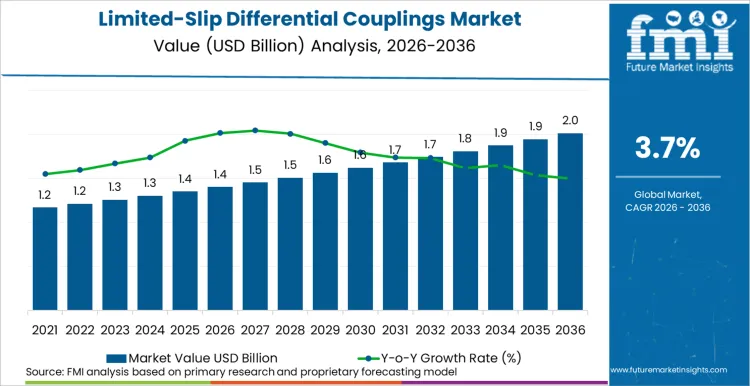
The global limited-slip differential couplings market is forecasted to reach USD 1.4 billion in 2026 and expand to USD 2.0 billion by 2036, advancing at a CAGR of 3.7%. This outlook reflects the automotive industry's transition toward sophisticated traction management systems, where traditional mechanical differential technologies evolve toward electronically controlled platforms that integrate real-time torque distribution capabilities.
Market expansion is driven by rising demand for improved vehicle handling characteristics, with automotive OEMs and tier-1 suppliers embracing advanced differential solutions across passenger car, SUV, and commercial vehicle segments globally. The shift toward all-wheel drive configurations in mainstream vehicle categories creates sustained demand for efficient torque management systems that maintain traction while optimizing fuel efficiency.
Technological advancement in electronic limited-slip differential systems enables manufacturers to develop solutions that offer precise torque vectoring capabilities through integrated sensor networks and control algorithms. These innovations allow for real-time adjustment of power distribution between wheels, effectively addressing varying road conditions while maintaining vehicle stability and driver control throughout diverse operating scenarios.
“I believe BorgWarner’s world-class product portfolio, innovative and customer-centric culture, and strong operating model position the company well to drive favorable business results for many years. As we look to capture growth opportunities ahead, we will stay focused on enhancing our strong product portfolio, efficiently managing our costs to stay competitive and supporting our dynamic teams around the globe to deliver value to our customers. We believe this focus will further strengthen our product leadership position. The future for BorgWarner is bright and I’m incredibly excited to get started in my new role.”- CEO (Joseph Fadool) BorgWarner Inc.
The industry value proposition extends beyond basic traction enhancement toward comprehensive vehicle dynamics management that incorporates stability control integration, performance optimization features, and adaptive response characteristics. Advanced manufacturers are developing modular differential systems that accommodate various vehicle platforms while reducing complexity and manufacturing costs through standardized component architectures.
Summary of Limited-Slip Differential Couplings Market
- The limited-slip differential couplings market comprises clutch-type, torque-sensing, electronic, and hybrid differential systems used for controlled torque distribution in passenger cars, SUVs, pickup trucks, and performance vehicles across automotive manufacturing and aftermarket applications.
- Market scope includes mechanical, electronic, and hybrid differential technologies categorized by coupling mechanism, vehicle application, and drive configuration, excluding basic open differentials, racing-specific units, and custom fabrication services.
- The limited-slip differential couplings market is projected to grow at a CAGR of 3.7% from 2026 to 2036, expanding from USD 1.4 billion in 2026 to USD 2.0 billion by 2036, based on automotive production forecasts, drivetrain technology adoption rates, and automotive OEM integration patterns.
- The sector experiences technological transition toward electronic control systems, modular design platforms, and integrated vehicle dynamics management, supported by automotive manufacturer partnerships and regulatory emphasis on vehicle stability requirements.
- Competition involves established suppliers including Schaeffler Group, ZF Friedrichshafen, BorgWarner Inc, and GKN Automotive, with strategic focus on electronic system development, platform standardization, and OEM partnership expansion across global automotive markets.
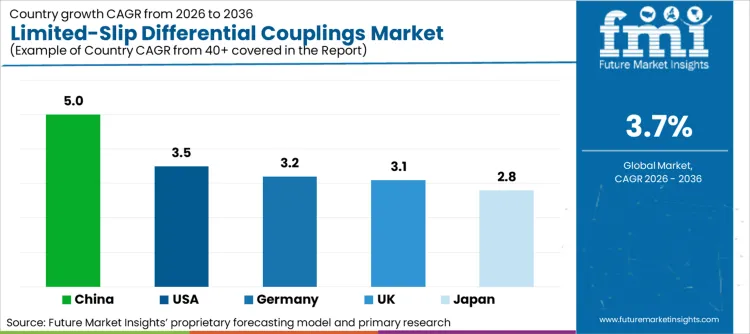
- China is projected to record the fastest growth at 5.0% CAGR through 2036, while the United States retains significant market share supported by pickup truck demand and performance vehicle applications requiring advanced traction management capabilities.
Limited-Slip Differential Couplings Market Key Takeaways
| Metric | Value |
|---|---|
| Market Value (2026) | USD 1.4 billion |
| Market Forecast Value (2036) | USD 2.0 billion |
| Forecast CAGR (2026 to 2036) | 3.7% |
What is Driving the Demand for Limited-Slip Differential Couplings?
Demand for limited-slip differential couplings is propelled by automotive industry expansion of all-wheel drive vehicle configurations and increasing consumer expectations for enhanced traction performance across diverse driving conditions. The growing prevalence of SUVs and crossover vehicles in global markets has amplified demand for differential systems that provide improved handling characteristics while maintaining fuel efficiency standards required by regulatory frameworks.
Technological advancement in electronic stability control systems creates integration opportunities for sophisticated differential technologies that complement existing vehicle safety features. Automotive manufacturers are incorporating limited-slip differentials as standard equipment in mid-tier and premium vehicle segments to differentiate product offerings and meet consumer preferences for enhanced driving dynamics and all-weather capability.
The expanding electric vehicle market presents opportunities for differential coupling applications in multi-motor configurations, where precise torque management becomes essential for optimizing battery efficiency and vehicle range. Advanced differential systems enable electric vehicle manufacturers to implement torque vectoring capabilities that enhance both performance characteristics and energy consumption profiles across varying operating conditions.
How is the Limited-Slip Differential Couplings Market Segmented?
The limited-slip differential couplings market segments by differential type, vehicle application, drive configuration, and sales channel. By differential type, the market includes clutch-type LSD, torque-sensing systems, electronic LSD, and hybrid configurations. Vehicle applications encompass performance cars, SUVs and crossovers, pickup trucks, and commercial vehicles. Drive configurations include rear-wheel drive, all-wheel drive, front-wheel drive, and specialty applications. Sales channels comprise OEM line-fit, aftermarket replacement, motorsport applications, and specialty performance markets. Regionally, the market is divided into North America, Europe, Asia Pacific, Latin America, and the Middle East & Africa.
Why Do Clutch-Type LSD Systems Lead the Market?
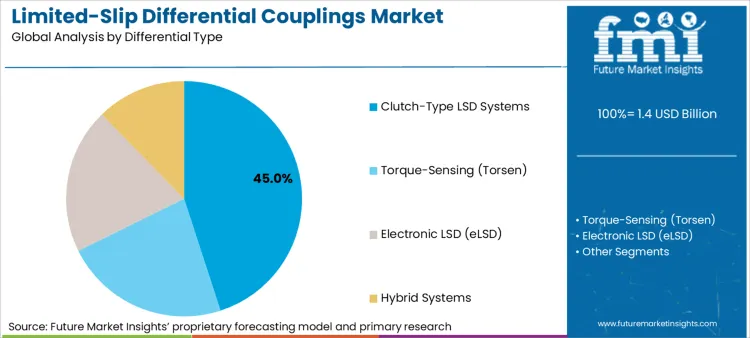
Clutch-type limited-slip differential systems maintain market leadership with 45.0% share, driven by their established performance characteristics, cost-effectiveness in mass production, and compatibility with existing drivetrain architectures across multiple vehicle platforms. These systems provide reliable torque management through mechanical coupling mechanisms that respond to wheel speed differentials without requiring electronic control integration, making them suitable for applications where simplicity and durability are primary considerations.
Electronic LSD systems capture expanding market share at 25.0%, reflecting automotive industry adoption of integrated vehicle dynamics management platforms that coordinate differential operation with stability control, traction management, and performance optimization systems. Torque-sensing differential technologies maintain specialized applications where progressive torque transfer characteristics provide advantages in performance and off-road vehicle segments.
How Do Vehicle Applications Influence Differential Selection?
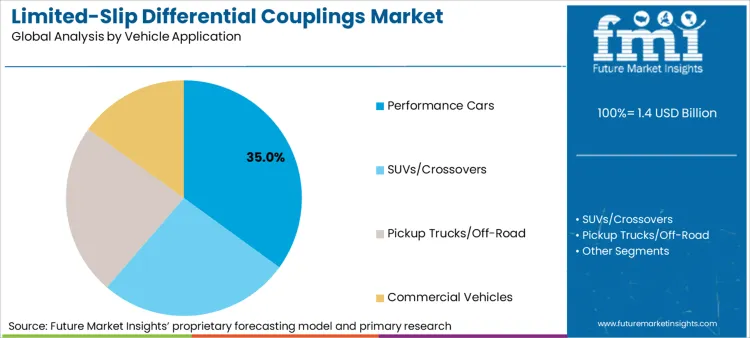
Performance cars represent the largest market segment at 35.0% share, where limited-slip differentials provide essential traction management capabilities for high-power applications and enthusiast driving scenarios. These vehicles require differential systems that maintain handling precision while managing significant torque loads across varying road surface conditions and driving dynamics.
SUV and crossover applications account for 31.0% of market demand, driven by consumer expectations for all-weather capability and enhanced traction performance in mainstream vehicle categories. Commercial and pickup truck segments require differential systems that provide reliable operation under heavy load conditions while maintaining durability throughout extended service intervals and diverse operating environments.
How Is Technological Evolution Reshaping Limited-Slip Differential Couplings?
The limited-slip differential sector transitions from traditional mechanical coupling systems toward integrated electronic platforms that coordinate torque distribution with broader vehicle dynamics management functions. Strategic partnerships between differential manufacturers and automotive OEMs accelerate development of modular systems that accommodate multiple vehicle platforms while reducing complexity and manufacturing costs through standardized component architectures.
Advanced control algorithms enable real-time torque vectoring capabilities that optimize power distribution based on driving conditions, vehicle load, and driver inputs. This technological evolution creates differential systems that provide both performance enhancement and efficiency optimization, allowing manufacturers to address consumer expectations for improved handling while meeting fuel economy and emissions requirements.
Integration capabilities with existing vehicle systems reduce installation complexity while expanding functional possibilities through coordination with anti-lock braking, stability control, and traction management platforms. The development of compact, lightweight differential assemblies supports automotive industry trends toward weight reduction and packaging efficiency in modern vehicle architectures.
How Is the Limited-Slip Differential Couplings Market Evolving Globally?
Global demand for limited-slip differential couplings increases as automotive manufacturers expand all-wheel drive availability across vehicle segments while addressing consumer preferences for enhanced traction capability and driving confidence. Growth reflects rising adoption of electronic differential technologies, performance-oriented vehicle development, and integration requirements for advanced drivetrain management systems across automotive manufacturing regions.
United States records 3.5% CAGR, Germany records 3.2% CAGR, China records 5.0% CAGR, Japan records 2.8% CAGR, and United Kingdom records 3.1% CAGR. Market expansion is driven by vehicle platform diversification and performance enhancement requirements rather than volume growth alone.
| Country | CAGR (2026-2036) |
|---|---|
| United States | 3.5% |
| Germany | 3.2% |
| China | 5.0% |
| Japan | 2.8% |
| United Kingdom | 3.1% |
United States: How is Performance Vehicle Demand Supporting Market Growth?
The United States market benefits from sustained demand for pickup trucks and performance vehicles that require advanced differential systems for enhanced traction capability and handling characteristics. American automotive manufacturers continue expanding all-wheel drive availability across mainstream vehicle segments, creating opportunities for differential suppliers to provide integrated solutions that meet both performance and efficiency requirements.
Driven by this vehicle platform expansion, the American limited-slip differential couplings market is set to grow at a 3.5% CAGR during the study period, supported by pickup truck production and performance vehicle development. The integration of electronic differential systems with existing vehicle platforms creates opportunities for suppliers to provide comprehensive traction management solutions that address diverse operating conditions and consumer preferences.
Germany: Will Engineering Excellence Drive Premium Differential Adoption?
Germany's limited-slip differential market focuses on precision engineering and integration capabilities that support premium vehicle applications and advanced drivetrain technologies. German automotive manufacturers emphasize differential systems that provide precise torque management while maintaining efficiency standards required for global market competitiveness. The German market is expected to grow at a 3.2% CAGR during the study period.
Opportunities exist in developing specialized differential systems for electric and hybrid vehicle applications where torque vectoring capabilities enhance both performance and efficiency characteristics. German engineering expertise in automotive systems creates demand for differential solutions that integrate seamlessly with advanced vehicle management platforms while providing superior functionality and reliability.
China: Is Manufacturing Scale Supporting Differential Technology Adoption?
In China, the market is driven by rapid automotive production expansion and increasing consumer preference for vehicles equipped with enhanced traction management capabilities. Chinese automotive manufacturers are adopting differential technologies to improve vehicle competitiveness in both domestic and export markets. The Chinese limited-slip differential market is projected to grow at a 5.0% CAGR during the study period.
The expansion of SUV and crossover production in China creates sustained demand for differential systems that provide all-weather capability at competitive cost levels. China's role as a global automotive manufacturing center generates opportunities for differential suppliers to establish production capabilities that serve both domestic and international markets while meeting quality and performance standards.
Japan: How is Hybrid Vehicle Integration Influencing Differential Development?
Japan's market emphasizes integration of differential technologies with hybrid and electric vehicle platforms, where precise torque management becomes essential for optimizing system efficiency and vehicle performance. Japanese manufacturers focus on compact, lightweight differential solutions that complement advanced drivetrain architectures while maintaining reliability standards. The Japanese market is set to grow at a 2.8% CAGR during the study period.
Development opportunities center on differential systems that coordinate effectively with hybrid powertrains and regenerative braking systems. Japanese expertise in automotive electronics creates demand for differential solutions that integrate seamlessly with vehicle control networks while providing enhanced functionality and operational efficiency.
United Kingdom: How is Performance Engineering Shaping Market Direction?
The United Kingdom market focuses on performance-oriented differential applications and advanced engineering solutions that support premium vehicle development and motorsport-derived technologies. British manufacturers emphasize differential systems that provide superior handling characteristics while meeting stringent efficiency and emissions requirements. The United Kingdom market is expected to grow at a 3.1% CAGR during the study period.
Opportunities exist in developing differential technologies for high-performance and specialty vehicle applications where advanced torque management capabilities provide competitive advantages. The emphasis on engineering excellence creates demand for differential solutions that combine innovative design with proven reliability across demanding operational scenarios.
Who are the Major Players Active in the Limited-Slip Differential Couplings Market?
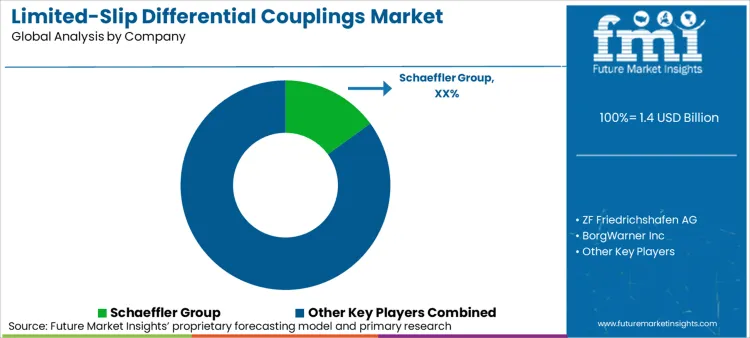
As automotive differential technologies become more sophisticated and integration requirements more complex, major players including Schaeffler Group, ZF Friedrichshafen, BorgWarner Inc, and GKN Automotive compete on their ability to provide comprehensive drivetrain solutions that integrate differential functionality with broader vehicle dynamics management systems. These industry leaders invest in electronic control technologies and modular design platforms that enable automotive manufacturers to implement advanced traction management capabilities across multiple vehicle platforms.
The market observes regional specialization in competitive approaches. North American suppliers like Eaton Corporation maintain leadership through established OEM relationships and expertise in pickup truck and commercial vehicle applications, while European companies such as ZF Friedrichshafen advance precision engineering and integration capabilities for premium vehicle segments. Asian manufacturers focus on cost-effective solutions that meet growing demand in expanding automotive markets while maintaining quality standards.
Key Industry Developments:
- In February 2026, ZF Friedrichshafen AG and the BMW Group signed a long-term supply agreement in the field of passenger car drive systems.
- In November 2025, Schaeffler and Neura Robotics inked a partnership to jointly develop and supply key components for humanoids.
Key Players in the Limited-Slip Differential Couplings Market
- Schaeffler Group
- ZF Friedrichshafen AG
- BorgWarner Inc
- GKN Automotive
- Eaton Corporation
- JTEKT Corporation
- Aisin Corporation
- Dana Incorporated
- Quaife Engineering
- OS Giken Co., Ltd.
Market Definition
The limited-slip differential couplings market encompasses specialized automotive drivetrain components designed to manage torque distribution between wheels through mechanical, electronic, or hybrid coupling systems that enhance vehicle traction, stability, and handling characteristics across passenger cars, commercial vehicles, and performance applications. Market measurement covers differential systems sold through OEM integration and aftermarket channels globally.
The limited-slip differential couplings market includes technologies categorized by coupling mechanism, vehicle application, and control system type, utilized in automotive manufacturing and replacement applications. Market expansion reflects increasing adoption of all-wheel drive configurations, growing demand for enhanced vehicle dynamics, and technological advancement in electronic traction management systems.
Market Inclusion
Included in the limited-slip differential couplings market scope are differential systems categorized by type (clutch-type, torque-sensing, electronic, hybrid), vehicle application (passenger cars, SUVs, pickup trucks, commercial vehicles), drive configuration (RWD, AWD, FWD), and sales channel (OEM, aftermarket, performance). The scope encompasses differential systems focused on traction enhancement, stability improvement, and performance optimization through automotive manufacturers, tier-1 suppliers, and aftermarket distributors.
Geographically, the market covers key regions including North America, Europe, Asia-Pacific, Latin America, and Middle East and Africa, with country-level analysis for significant markets including United States, Germany, China, Japan, United Kingdom, South Korea, and Brazil.
Market Exclusion
Excluded from the limited-slip differential couplings market scope are basic open differential systems, solid axle configurations, and components not designed for traction management applications. Custom racing differentials, prototype systems, and specialized military vehicle applications are outside the defined market scope.
The market excludes non-automotive differential applications, components not marketed as complete differential systems, and products that do not meet automotive quality and safety standards for commercial vehicle integration.
Scope of the Report
| Items | Values |
|---|---|
| Quantitative Units | USD 1.4 billion |
| Differential Type | Clutch-Type LSD; Torque-Sensing; Electronic LSD; Hybrid Systems |
| Vehicle Application | Performance Cars; SUVs/Crossovers; Pickup Trucks; Commercial Vehicles |
| Drive Configuration | RWD; AWD; FWD; Specialty Applications |
| Sales Channel | OEM Line-Fit; Aftermarket; Motorsport; Performance Markets |
| Regions Covered | North America, Europe, Asia-Pacific, Latin America, Middle East & Africa |
| Countries Covered | United States, Germany, China, Japan, United Kingdom, South Korea, Brazil, and 40+ countries |
| Key Companies Profiled | Schaeffler Group; ZF Friedrichshafen; BorgWarner Inc; GKN Automotive; Others |
| Additional Attributes | Revenue analysis by differential type and vehicle application; performance assessment across OEM and aftermarket channels; technology advancement tracking in electronic and hybrid systems; integration capabilities with vehicle dynamics management platforms; market dynamics influenced by automotive production trends, consumer preferences, and regulatory requirements for vehicle stability and traction management. |
Limited-Slip Differential Couplings Market by Segment
Differential Type:
- Clutch-Type LSD
- Torque-Sensing (Torsen)
- Electronic LSD (eLSD)
- Hybrid Systems
Vehicle Application:
- Performance Cars
- SUVs/Crossovers
- Pickup Trucks/Off-Road
- Commercial Vehicles
Drive Configuration:
- Rear-Wheel Drive (RWD)
- All-Wheel Drive (AWD)
- Front-Wheel Drive (FWD)
- Specialty Applications
Sales Channel:
- OEM Line-Fit
- Aftermarket
- Motorsport/Performance
- Specialty Markets
Region:
- Asia-Pacific
- China
- Japan
- South Korea
- India
- Australia
- Southeast Asia
- Rest of Asia-Pacific
- Europe
- Germany
- United Kingdom
- France
- Italy
- Spain
- Netherlands
- Nordic Countries
- Rest of Europe
- North America
- United States
- Canada
- Mexico
- Latin America
- Brazil
- Argentina
- Chile
- Rest of Latin America
- Middle East & Africa
- Saudi Arabia
- UAE
- South Africa
- Rest of Middle East & Africa
Bibliography
- Society of Automotive Engineers. (2024). Automotive differential technologies and traction management systems: Engineering guidelines and performance standards. SAE International.
- Thompson, R. (2023). Advanced drivetrain technologies in modern vehicles: Integration strategies and market applications. Automotive Engineering Review, 18(4), 287-301.
- Martinez, L., & Anderson, K. (2024). Electronic differential systems and vehicle dynamics: Technical advancement and market trends. International Journal of Automotive Technology, 12(2), 156-172.
Frequently Asked Questions
How big is the limited-slip differential couplings market in 2026?
The global limited-slip differential couplings market is estimated to be valued at USD 1.4 billion in 2026.
What will be the size of limited-slip differential couplings market in 2036?
The market size for the limited-slip differential couplings market is projected to reach USD 2.0 billion by 2036.
How much will be the limited-slip differential couplings market growth between 2026 and 2036?
The limited-slip differential couplings market is expected to grow at a 3.7% CAGR between 2026 and 2036.
What are the key product types in the limited-slip differential couplings market?
The key product types in limited-slip differential couplings market are clutch-type lsd systems , torque-sensing (torsen), electronic lsd (elsd) and hybrid systems.
Which vehicle application segment to contribute significant share in the limited-slip differential couplings market in 2026?
In terms of vehicle application, performance cars segment to command 35.0% share in the limited-slip differential couplings market in 2026.
Preview the report firsthand - request a free sample
Get SampleGet the brochure for pricing and purchase details.
Get PDFTable of Content
- Executive Summary
- Global Market Outlook
- Demand-side Trends
- Supply-side Trends
- Technology Roadmap Analysis
- Analysis and Recommendations
- Market Overview
- Market Coverage / Taxonomy
- Market Definition / Scope / Limitations
- Research Methodology
- Chapter Orientation
- Analytical Lens and Working Hypotheses
- Market Structure, Signals, and Trend Drivers
- Company Annual and Sustainability Reports
- Peer-reviewed Journals and Academic Literature
- Corporate Websites, Product Literature, and Technical Notes
- Earnings Decks and Investor Briefings
- Statutory Filings and Regulatory Disclosures
- Technical White Papers and Standards Notes
- Trade Journals, Industry Magazines, and Analyst Briefs
- Conference Proceedings, Webinars, and Seminar Materials
- Government Statistics Portals and Public Data Releases
- Press Releases and Reputable Media Coverage
- Specialist Newsletters and Curated Briefings
- Sector Databases and Reference Repositories
- FMI Internal Proprietary Databases and Historical Market Datasets
- Subscription Datasets and Paid Sources
- Social Channels, Communities, and Digital Listening Inputs
- Additional Desk Sources
- Expert Input and Fieldwork (Primary Evidence)
- Primary Modes
- Qualitative Interviews and Expert Elicitation
- Quantitative Surveys and Structured Data Capture
- Blended Approach
- Why Primary Evidence is Used
- Field Techniques
- Interviews
- Surveys
- Focus Groups
- Observational and In-context Research
- Social and Community Interactions
- Stakeholder Universe Engaged
- C-suite Leaders
- Board Members
- Presidents and Vice Presidents
- R&D and Innovation Heads
- Technical Specialists
- Domain Subject-matter Experts
- Scientists
- Physicians and Other Healthcare Professionals
- Governance, Ethics, and Data Stewardship
- Research Ethics
- Data Integrity and Handling
- Primary Modes
- Tooling, Models, and Reference Databases
- Data Engineering and Model Build
- Data Acquisition and Ingestion
- Cleaning, Normalisation, and Verification
- Synthesis, Triangulation, and Analysis
- Quality Assurance and Audit Trail
- Market Background
- Market Dynamics
- Drivers
- Restraints
- Opportunity
- Trends
- Scenario Forecast
- Demand in Optimistic Scenario
- Demand in Likely Scenario
- Demand in Conservative Scenario
- Opportunity Map Analysis
- Product Life Cycle Analysis
- Supply Chain Analysis
- Investment Feasibility Matrix
- Value Chain Analysis
- PESTLE and Porter’s Analysis
- Regulatory Landscape
- Regional Parent Market Outlook
- Production and Consumption Statistics
- Import and Export Statistics
- Market Dynamics
- Global Market Analysis 2021 to 2025 and Forecast, 2026 to 2036
- Historical Market Size Value (USD Million) Analysis, 2021 to 2025
- Current and Future Market Size Value (USD Million) Projections, 2026 to 2036
- Y-o-Y Growth Trend Analysis
- Absolute $ Opportunity Analysis
- Global Market Pricing Analysis 2021 to 2025 and Forecast 2026 to 2036
- Global Market Analysis 2021 to 2025 and Forecast 2026 to 2036, By Differential Type
- Introduction / Key Findings
- Historical Market Size Value (USD Million) Analysis By Differential Type , 2021 to 2025
- Current and Future Market Size Value (USD Million) Analysis and Forecast By Differential Type , 2026 to 2036
- Clutch-Type LSD Systems
- Torque-Sensing (Torsen)
- Electronic LSD (eLSD)
- Hybrid Systems
- Clutch-Type LSD Systems
- Y-o-Y Growth Trend Analysis By Differential Type , 2021 to 2025
- Absolute $ Opportunity Analysis By Differential Type , 2026 to 2036
- Global Market Analysis 2021 to 2025 and Forecast 2026 to 2036, By Vehicle Application
- Introduction / Key Findings
- Historical Market Size Value (USD Million) Analysis By Vehicle Application, 2021 to 2025
- Current and Future Market Size Value (USD Million) Analysis and Forecast By Vehicle Application, 2026 to 2036
- Performance Cars
- SUVs/Crossovers
- Pickup Trucks/Off-Road
- Commercial Vehicles
- Performance Cars
- Y-o-Y Growth Trend Analysis By Vehicle Application, 2021 to 2025
- Absolute $ Opportunity Analysis By Vehicle Application, 2026 to 2036
- Global Market Analysis 2021 to 2025 and Forecast 2026 to 2036, By Region
- Introduction
- Historical Market Size Value (USD Million) Analysis By Region, 2021 to 2025
- Current Market Size Value (USD Million) Analysis and Forecast By Region, 2026 to 2036
- North America
- Latin America
- Western Europe
- Eastern Europe
- East Asia
- South Asia and Pacific
- Middle East & Africa
- Market Attractiveness Analysis By Region
- North America Market Analysis 2021 to 2025 and Forecast 2026 to 2036, By Country
- Historical Market Size Value (USD Million) Trend Analysis By Market Taxonomy, 2021 to 2025
- Market Size Value (USD Million) Forecast By Market Taxonomy, 2026 to 2036
- By Country
- USA
- Canada
- Mexico
- By Differential Type
- By Vehicle Application
- By Country
- Market Attractiveness Analysis
- By Country
- By Differential Type
- By Vehicle Application
- Key Takeaways
- Latin America Market Analysis 2021 to 2025 and Forecast 2026 to 2036, By Country
- Historical Market Size Value (USD Million) Trend Analysis By Market Taxonomy, 2021 to 2025
- Market Size Value (USD Million) Forecast By Market Taxonomy, 2026 to 2036
- By Country
- Brazil
- Chile
- Rest of Latin America
- By Differential Type
- By Vehicle Application
- By Country
- Market Attractiveness Analysis
- By Country
- By Differential Type
- By Vehicle Application
- Key Takeaways
- Western Europe Market Analysis 2021 to 2025 and Forecast 2026 to 2036, By Country
- Historical Market Size Value (USD Million) Trend Analysis By Market Taxonomy, 2021 to 2025
- Market Size Value (USD Million) Forecast By Market Taxonomy, 2026 to 2036
- By Country
- Germany
- UK
- Italy
- Spain
- France
- Nordic
- BENELUX
- Rest of Western Europe
- By Differential Type
- By Vehicle Application
- By Country
- Market Attractiveness Analysis
- By Country
- By Differential Type
- By Vehicle Application
- Key Takeaways
- Eastern Europe Market Analysis 2021 to 2025 and Forecast 2026 to 2036, By Country
- Historical Market Size Value (USD Million) Trend Analysis By Market Taxonomy, 2021 to 2025
- Market Size Value (USD Million) Forecast By Market Taxonomy, 2026 to 2036
- By Country
- Russia
- Poland
- Hungary
- Balkan & Baltic
- Rest of Eastern Europe
- By Differential Type
- By Vehicle Application
- By Country
- Market Attractiveness Analysis
- By Country
- By Differential Type
- By Vehicle Application
- Key Takeaways
- East Asia Market Analysis 2021 to 2025 and Forecast 2026 to 2036, By Country
- Historical Market Size Value (USD Million) Trend Analysis By Market Taxonomy, 2021 to 2025
- Market Size Value (USD Million) Forecast By Market Taxonomy, 2026 to 2036
- By Country
- China
- Japan
- South Korea
- By Differential Type
- By Vehicle Application
- By Country
- Market Attractiveness Analysis
- By Country
- By Differential Type
- By Vehicle Application
- Key Takeaways
- South Asia and Pacific Market Analysis 2021 to 2025 and Forecast 2026 to 2036, By Country
- Historical Market Size Value (USD Million) Trend Analysis By Market Taxonomy, 2021 to 2025
- Market Size Value (USD Million) Forecast By Market Taxonomy, 2026 to 2036
- By Country
- India
- ASEAN
- Australia & New Zealand
- Rest of South Asia and Pacific
- By Differential Type
- By Vehicle Application
- By Country
- Market Attractiveness Analysis
- By Country
- By Differential Type
- By Vehicle Application
- Key Takeaways
- Middle East & Africa Market Analysis 2021 to 2025 and Forecast 2026 to 2036, By Country
- Historical Market Size Value (USD Million) Trend Analysis By Market Taxonomy, 2021 to 2025
- Market Size Value (USD Million) Forecast By Market Taxonomy, 2026 to 2036
- By Country
- Kingdom of Saudi Arabia
- Other GCC Countries
- Turkiye
- South Africa
- Other African Union
- Rest of Middle East & Africa
- By Differential Type
- By Vehicle Application
- By Country
- Market Attractiveness Analysis
- By Country
- By Differential Type
- By Vehicle Application
- Key Takeaways
- Key Countries Market Analysis
- USA
- Pricing Analysis
- Market Share Analysis, 2025
- By Differential Type
- By Vehicle Application
- Canada
- Pricing Analysis
- Market Share Analysis, 2025
- By Differential Type
- By Vehicle Application
- Mexico
- Pricing Analysis
- Market Share Analysis, 2025
- By Differential Type
- By Vehicle Application
- Brazil
- Pricing Analysis
- Market Share Analysis, 2025
- By Differential Type
- By Vehicle Application
- Chile
- Pricing Analysis
- Market Share Analysis, 2025
- By Differential Type
- By Vehicle Application
- Germany
- Pricing Analysis
- Market Share Analysis, 2025
- By Differential Type
- By Vehicle Application
- UK
- Pricing Analysis
- Market Share Analysis, 2025
- By Differential Type
- By Vehicle Application
- Italy
- Pricing Analysis
- Market Share Analysis, 2025
- By Differential Type
- By Vehicle Application
- Spain
- Pricing Analysis
- Market Share Analysis, 2025
- By Differential Type
- By Vehicle Application
- France
- Pricing Analysis
- Market Share Analysis, 2025
- By Differential Type
- By Vehicle Application
- India
- Pricing Analysis
- Market Share Analysis, 2025
- By Differential Type
- By Vehicle Application
- ASEAN
- Pricing Analysis
- Market Share Analysis, 2025
- By Differential Type
- By Vehicle Application
- Australia & New Zealand
- Pricing Analysis
- Market Share Analysis, 2025
- By Differential Type
- By Vehicle Application
- China
- Pricing Analysis
- Market Share Analysis, 2025
- By Differential Type
- By Vehicle Application
- Japan
- Pricing Analysis
- Market Share Analysis, 2025
- By Differential Type
- By Vehicle Application
- South Korea
- Pricing Analysis
- Market Share Analysis, 2025
- By Differential Type
- By Vehicle Application
- Russia
- Pricing Analysis
- Market Share Analysis, 2025
- By Differential Type
- By Vehicle Application
- Poland
- Pricing Analysis
- Market Share Analysis, 2025
- By Differential Type
- By Vehicle Application
- Hungary
- Pricing Analysis
- Market Share Analysis, 2025
- By Differential Type
- By Vehicle Application
- Kingdom of Saudi Arabia
- Pricing Analysis
- Market Share Analysis, 2025
- By Differential Type
- By Vehicle Application
- Turkiye
- Pricing Analysis
- Market Share Analysis, 2025
- By Differential Type
- By Vehicle Application
- South Africa
- Pricing Analysis
- Market Share Analysis, 2025
- By Differential Type
- By Vehicle Application
- USA
- Market Structure Analysis
- Competition Dashboard
- Competition Benchmarking
- Market Share Analysis of Top Players
- By Regional
- By Differential Type
- By Vehicle Application
- Competition Analysis
- Competition Deep Dive
- Schaeffler Group
- Overview
- Product Portfolio
- Profitability by Market Segments (Product/Age /Sales Channel/Region)
- Sales Footprint
- Strategy Overview
- Marketing Strategy
- Product Strategy
- Channel Strategy
- ZF Friedrichshafen AG
- BorgWarner Inc
- GKN Automotive
- Eaton Corporation
- JTEKT Corporation
- Aisin Corporation
- Dana Incorporated
- Schaeffler Group
- Competition Deep Dive
- Assumptions & Acronyms Used


