

- Market Size (2026)
- USD 13.4 Bn
- Forecast (2036)
- USD 20.9 Bn
- CAGR (2026 to 2036)
- 4.6%
Differential Housing and Carrier Components Market Size, Forecast, and Outlook By FMI
Summary of the Differential Housing and Carrier Components Market
- Demand and Growth Drivers
- Axle platform refreshes are expected to support housing demand as OEMs redesign driveline layouts for higher torque loads.
- Hybrid vehicle production is forecast to keep carrier demand active since mechanical final drives remain part of many electrified platforms.
- Commercial vehicle durability needs are likely to support demand for ductile iron housings and heavy-duty carrier cases.
- Product and Segment View
- Differential housings are projected to hold the leading position as they define gear alignment and axle durability.
- Ductile iron is expected to remain the preferred material because casting strength and machining control suit mass axle production.
- Light trucks and SUVs are forecast to lead vehicle type demand as higher axle loads require stronger housings and carriers.
- Geography and Competitive Outlook
- China is likely to remain a significant demand driver due to large vehicle output and fast NEV production growth.
- India is expected to gain share as commercial vehicle sales and passenger vehicle exports support local axle sourcing.
- Companies with casting depth, machining scale and axle validation support are likely to gain traction during the forecast period.
- Analyst Opinion
- Nikhil Kaitwade, Principal Analyst at FMI says, “Differential housings and carrier components look like old-line cast parts, but the purchasing decision is changing. OEMs now want parts that can carry higher torque loads without adding unnecessary mass. Electric axles have not removed the need for precision housings. They have changed the geometry and validation work around them.”
- Differential Housing and Carrier Components Market Value Analysis
- OEM axle sourcing keeps market value stable because housings and carriers are ordered at vehicle platform level.
- Higher torque in SUVs and pickup trucks raises demand for stronger carrier cases and reinforced bearing areas.
- Electric axle programs brings in new casing work as suppliers integrate motor, gear and carrier functions into compact units.
- Aftermarket replacement demand stays stable in heavy-duty vehicles because carrier wear can shorten axle service life.
- Casting and machining cost discipline will decide supplier margins as vehicle makers pressure drivetrain component prices.
Key Takeaways, Market Size, and Forecast
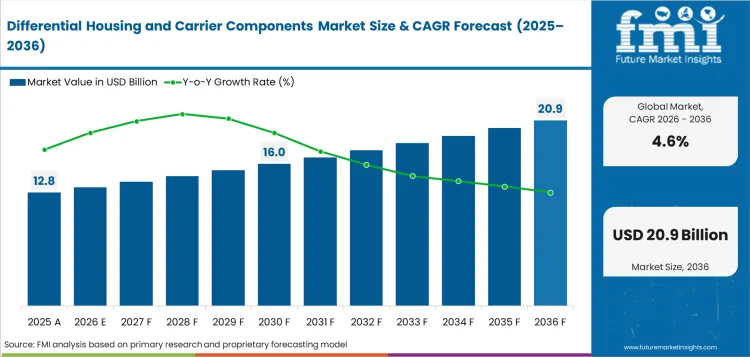
- The market was valued at USD 12.8 billion in 2025.
- By 2036, the market is projected to reach USD 20.9 billion as axle platforms keep shifting toward higher torque and lighter carrier designs.
- The market is forecast to expand at 4.6% CAGR between 2026 and 2036.
- Incremental opportunity is projected at USD 7.5 billion during the assessment period.
- Differential housings are projected to capture 35.0% in 2026 as axle assemblies need stable cast structures around gear sets.
- Ductile iron is expected to hold 46.0% in 2026 due to its balance of strength, machinability and cost.
- OEM supply is forecast to represent 72.0% in the first forecast year as vehicle makers source housings and carriers at platform level.
- China at 5.4% CAGR and India at 5.2% CAGR are forecast to expand faster due to high vehicle output and axle localization.
Commercial axles now face a narrow design tradeoff between lower engine speed and carrier durability. Dana’s December 2024 AdvanTEK 40 Pro release matters to axle specification because the system keeps a 40,000-pound 6x4 platform and adds 18 axle ratios with a 2.05 option. OEMs and fleet specifiers gain more ratio choice so housing and carrier suppliers need bearing capacity and lubrication detail built into quoted packages. EV final drives add a second design requirement. Sona Comstar reported BEV program revenue of INR 12,235 million and said BEV-related products contributed 36% of revenue in FY 2024-25. Component suppliers capture more value when they sell assembled final-drive content instead of single differential gears. Material qualification now acts as a buyer filter. ASTM A536-24 covers ductile iron castings and links 60-40-18 to full ferritizing anneal. Foundries that document grade and heat treatment lower validation risk for housings and carriers. Aftermarket distributors can use the same proof to separate service-grade parts from low-cost castings.
Differential Housing and Carrier Components Market Definition
The differential housing and carrier components market covers structural axle components that support the differential gear set and transfer torque to the wheels. Scope includes differential housings, carrier cases, bearing caps, cover assemblies and machined carrier parts used in vehicle axle systems.
Differential Housing and Carrier Components Market Inclusions
Market scope covers commercially traded differential housing and carrier components categorized by component type, material, vehicle type, drivetrain configuration and sales channel. Stakeholders include axle system suppliers, vehicle manufacturers, casting foundries, machining service providers, aftermarket distributors, remanufacturers and heavy-duty fleet service networks.
Differential Housing and Carrier Components Market Exclusions
Scope does not include complete axle modules, ring gears, pinions, driveshafts, wheel bearings, electronic torque-vectoring software or transmission housings sold outside differential carrier use.
Differential Housing and Carrier Components Market Research Methodology
- Primary Research: FMI analysts reviewed axle supplier portfolios, casting capacity signals and vehicle platform sourcing practices. Inputs covered OEM sourcing teams, foundry suppliers, drivetrain component manufacturers and aftermarket distributors.
- Desk Research: The study used vehicle production statistics, company product data, official supplier releases and national automotive output data. Public sources were used only for demand indicators and supplier activity checks.
- Market Sizing and Forecasting: The model combined axle fitment rates, vehicle production by powertrain and average component value by vehicle class. Material use and drivetrain configuration were applied to estimate component-level demand.
- Data Validation: Forecast checks compared vehicle output, commercial vehicle sales and supplier expansion in driveline systems. Country forecasts were adjusted using production scale, electrification pace and local axle manufacturing depth.
Why is the Differential Housing and Carrier Components Market Growing?
- Higher torque loads in SUVs and commercial vehicles raise the need for stronger carrier cases and machined bearing support.
- Electric axle design creates new housing formats as motor and gear functions move into compact drive units.
- Aftermarket demand persists because heavy-duty axle carriers face wear under high-load fleet use.
- OEM supply remains the main route because housings are validated with complete axle systems before vehicle launch.
Global vehicle production gives the market a steady manufacturing base. OICA stated that global vehicle output increased from 92.7 million units in 2024 to 96.4 million units in 2025. Production expansion keeps axle and carrier demand active across passenger and commercial platforms. Differential housing demand follows vehicle production because each axle layout needs a structural part around the gear set. Suppliers with foundry access and machining capacity can protect volume even when powertrain mix changes. The practical result is a market that grows through platform redesign rather than simple part count expansion.
Electrification changes component design rather than removing the need for housing expertise. ZF’s April 2025 AxTrax 2 order in India covers several thousand electric axles for commercial vehicles. The same system delivers 210 kW continuous power through a compact axle-based design. Electric axle housings still need strength, sealing and tight alignment around rotating components. Conventional differential suppliers can participate when they adapt casting and machining to integrated e-drive layouts.
Market Segmentation Analysis
- Differential housings are projected to capture 35.0% in 2026 as axle assemblies need stable structures for gear alignment.
- With 46.0% share in 2026, ductile iron is expected to lead material use due to its strength and machining balance.
- Light trucks and SUVs are forecast to represent 38.0% during the first forecast year as higher vehicle weight raises axle load needs.
- ICE axles are projected to hold 58.0% in 2026 since many commercial vehicles still use mechanical driveline layouts.
- OEM supply is anticipated to account for 72.0% by 2026 as carriers and housings are sourced during axle platform planning.
The market is divided into five primary segment groups based on component type, material, vehicle type, drivetrain configuration and sales channel. Component type separates differential housings, carrier cases, bearing caps and cover assemblies. Material choice reflects casting cost, load capacity and machining accuracy. Vehicle type explains torque load and durability needs across light trucks, passenger cars, heavy commercial vehicles and off-highway equipment. Drivetrain configuration tracks the shift from ICE axles toward hybrid and electric drive axles. Sales channel shows why OEM supply stays dominant while replacement demand supports service revenue.
Insights into Differential Housings Differential Housing and Carrier Components Market by Component Type
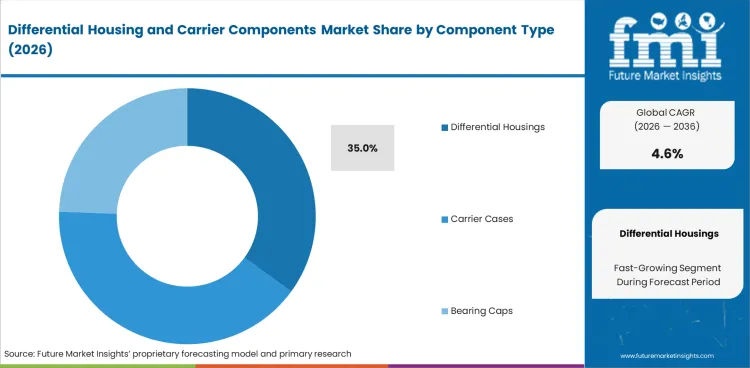
- During the first forecast year, differential housings are projected to capture 35.0% as axle assemblies need strong structures around gears, bearings and seals.
- Housing suppliers win when casting quality reduces machining scrap. Small porosity defects can raise rejection risk because bearing bores need tight dimensional control.
Insights into Ductile Iron Differential Housing and Carrier Components Market by Material
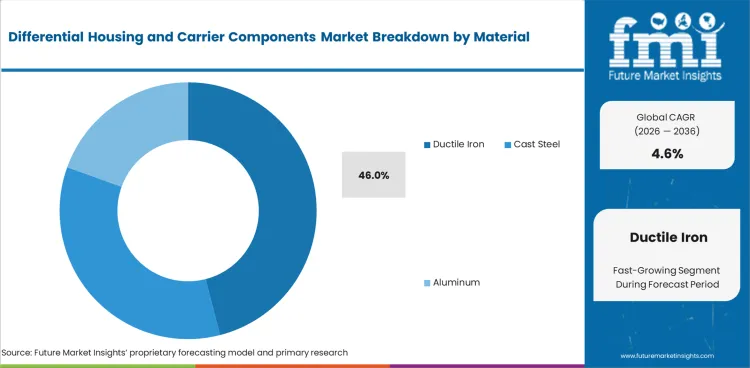
- Ductile iron is expected to hold 46.0% in 2026 since it gives axle suppliers strength, machinability and cost control in large-volume casting.
- Aluminum is gaining attention in electric axles. Ductile iron keeps an advantage in heavy-duty and pickup platforms that need impact resistance.
Insights into Light Trucks and SUVs Differential Housing and Carrier Components Market by Vehicle Type
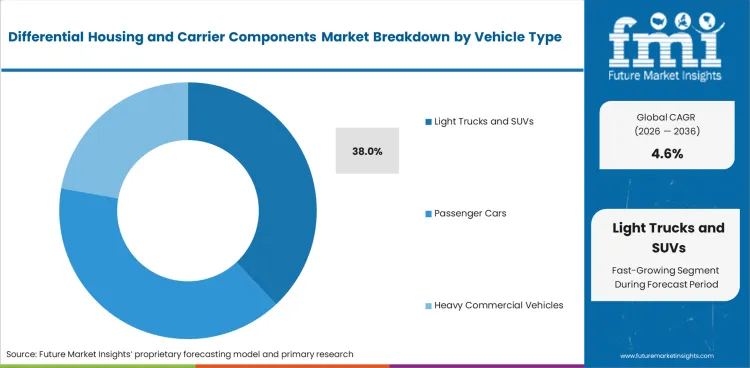
- Light trucks and SUVs are forecast to represent 38.0% during the assessment period as towing demand and vehicle weight increase axle housing stress.
- Pickup and SUV platforms often use higher-capacity rear axles, which drives the demand for thicker carrier walls and better bearing cap stability.
Insights into ICE Axles Differential Housing and Carrier Components Market by Drivetrain Configuration
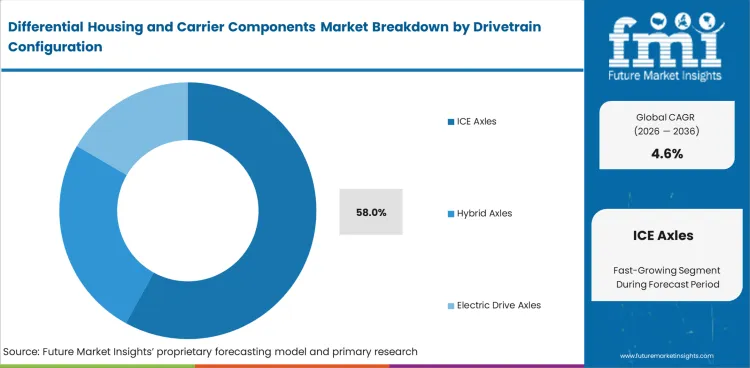
- ICE axles are projected at 58.0% by 2026 because commercial vehicles and many utility platforms continue to use mechanical final-drive systems.
- Hybrid systems keep a mechanical axle path in many vehicles. That protects carrier demand even as electric assistance changes the powertrain mix.
Insights into OEM Supply Differential Housing and Carrier Components Market by Sales Channel
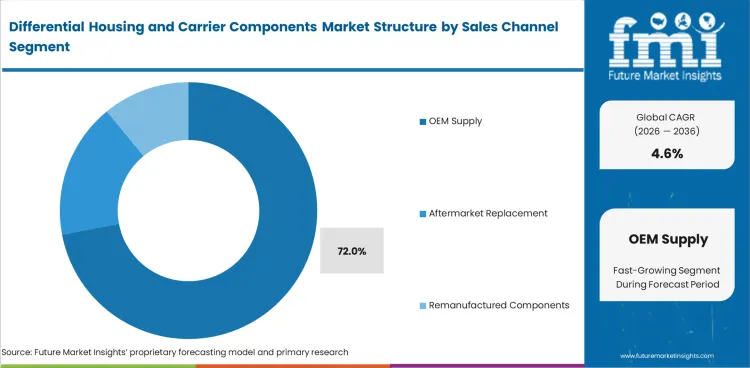
- From 2026 to 2036, OEM supply is anticipated to hold 72.0% as housings and carriers are validated with axle systems before vehicle launch.
- Aftermarket demand matters in heavy-duty service. Spicer lists medium-duty and heavy-duty axle carriers built with genuine parts and OE standards.
Differential Housing and Carrier Components Market Drivers, Restraints, and Opportunities
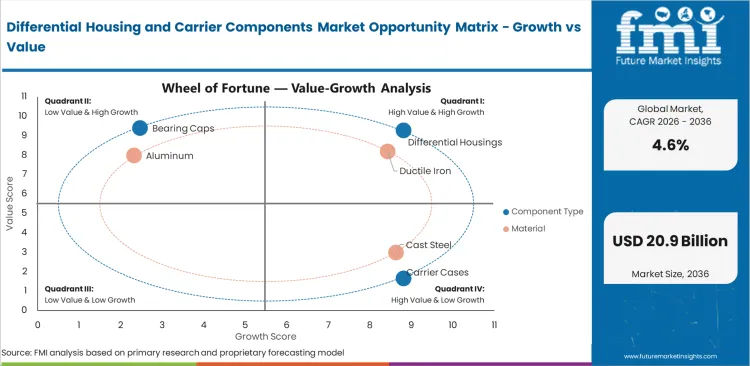
- Vehicle production growth supports axle component demand across passenger and commercial platforms.
- E-axle integration creates new housing designs for compact electric drive units.
- Casting quality remains a restraint because scrap and machining rework can weaken supplier margins.
- Remanufactured carrier programs create opportunity in heavy-duty and off-highway service channels.
- Material substitution opens selective demand for aluminum housings in electric vehicle platforms.
Vehicle output supports axle demand
Vehicle output remains the clearest demand base for differential housings and carrier parts. The Federal Reserve reported average USA motor vehicle assemblies at 10.16 million units in 2025 on a seasonally adjusted annual-rate basis. Trucks formed the larger part of that output at 8.88 million units. Truck-heavy production supports axle components because many truck platforms use stronger rear driveline systems. Housings and carriers benefit from that mix because higher loads require durable cast structures. Suppliers serving pickup and commercial vehicle programs can maintain better pricing discipline.
Electric axles create housing work
Electric driveline growth creates a new component route for housing suppliers. Magna announced a new Wuhu facility in November 2025 to manufacture eDrive systems and said the leased site covers more than 160,000 square feet. The facility is expected to create about 200 jobs at full production. E-drive systems still need precision casings that control gear mesh, motor mounting and sealing. Suppliers with axle housing experience can move into electric drive housings when they meet tighter packaging needs. The opportunity is in compact designs that combine strength with lower mass.
Analysis of Differential Housing and Carrier Components Market by Key Countries
.webp "Top Country Growth Comparison Differential Housing And Carrier Components Market Cagr (2026 2036)")
| Country | CAGR |
|---|---|
| China | 5.4% |
| India | 5.2% |
| Mexico | 4.9% |
| United States | 4.4% |
| Germany | 4.1% |
| South Korea | 3.9% |
| Japan | 3.5% |
Source: Future Market Insights, 2026.
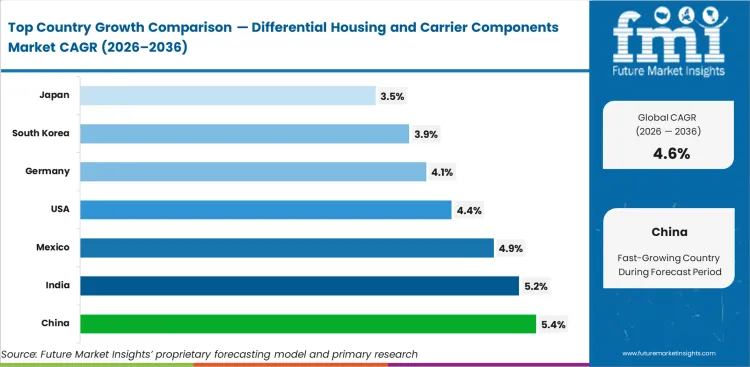
Differential Housing and Carrier Components Market CAGR Analysis by Country
- China is projected at 5.4% CAGR by 2036 due to record vehicle output.
- India is expected to grow at 5.2% CAGR as driveline localization improves through 2036.
- Mexico is forecast at 4.9% CAGR between 2026 and 2036 due to export-linked assembly.
- Light truck output keeps the United States at 4.4% CAGR during the forecast period.
- Germany is expected to record 4.1% CAGR through 2036 as EV production expands.
- South Korea is forecast at 3.9% CAGR by 2036 due to steady vehicle output.
- Japan is expected at 3.5% CAGR through 2036 as production softness limits growth.
- Globally, the market is projected at 4.6% CAGR during the forecast period.
Demand Outlook for Differential Housing and Carrier Components in China
China at 5.4% CAGR by 2036 is projected to lead country growth due to vehicle scale and axle localization. The State Council reported 34.531 million vehicles produced in 2025 and NEV output at 16.626 million units. Higher production keeps carrier demand active across ICE and electric axle platforms. Domestic casting and machining suppliers can gain as local OEMs raise platform volumes.
- Shanghai and Jiangsu axle suppliers need precision housings for passenger vehicle platforms with tight gear alignment needs.
- Chongqing and Hubei support commercial vehicle axle demand through truck production clusters and local component sourcing.
- Guangdong NEV producers create demand for compact electric drive housings that balance torque support and packaging space.
Demand Analysis of Differential Housing and Carrier Components in India
India is expanding its vehicle production and sales base across passenger and commercial segments. SIAM reported FY 2025-26 passenger vehicle sales of 46.43 lakh units and commercial vehicle sales of 10.80 lakh units. Local supplier expansion is expected to drive demand in India at 5.2% CAGR through 2036. Machined carrier suppliers can serve OEM platforms and replacement channels as axle localization deepens.
- Pune and Chennai support axle component demand through supplier clusters serving passenger and commercial vehicle output.
- Gujarat is witnessing demand from vehicle assembly and casting activity across local driveline supply networks.
- North India aftermarket channels need carrier replacements as commercial fleets face heavy-duty operating cycles.
Opportunity Analysis of Differential Housing and Carrier Components in Mexico
Mexico is an important North America-based manufacturing route for axle and driveline components. INEGI’s light vehicle automotive industry record shows monthly production reporting for 2025 and 2026, with March 2026 data published on April 9, 2026. Export-linked assembly is forecast to propel industry in Mexico at 4.9% CAGR between 2026 and 2036. Axle suppliers serving pickup and SUV programs benefit from proximity to USA vehicle platforms.
- Coahuila and Nuevo León support drivetrain manufacturing for North American vehicle programs and export supply chains.
- Guanajuato creates demand for machined components serving vehicle assembly plants and nearby supplier networks.
- Border-region suppliers can serve replacement channels linked to USA fleets and cross-border parts movement.
Demand Outlook for Differential Housing and Carrier Components in the United States
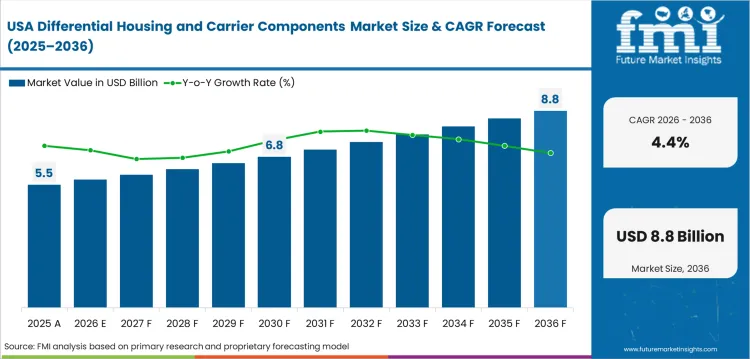
The United States remains a light truck-centered demand pool for axle components. Across the forecast decade, the market is forecast to grow at 4.4% CAGR as pickup and utility vehicle platforms need stronger housings. Suppliers with axle validation depth can protect pricing in OEM and aftermarket channels. Demand will follow rear axle strength and replacement needs across fleet use.
- Michigan supports OEM axle development and supplier engineering work for new driveline platforms.
- Ohio and Indiana create demand through drivetrain manufacturing depth and established component supply networks.
- Texas fleet use supports replacement demand for pickup and commercial axles under high-duty operating conditions.
Future Outlook for Differential Housing and Carrier Components in Germany
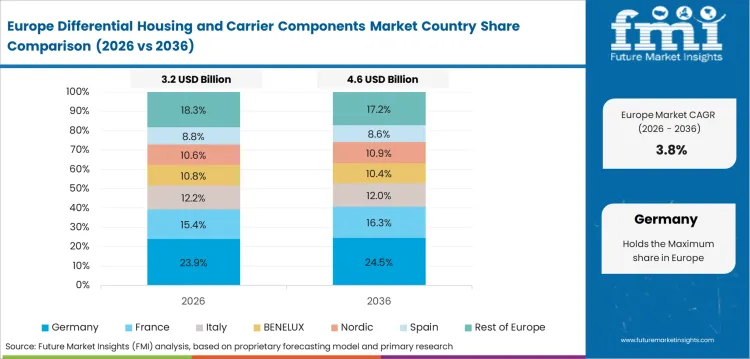
During the assessment period, Germany is expected to advance at 4.1% CAGR. The country is shifting the drivetrain mix toward electric production. VDA reported that German BEV passenger car production reached 1.22 million units in 2025 and rose 15.0% from the prior year. Electric vehicle growth changes casing needs since e-drive units need compact housings with accurate gear alignment.
- Bavaria supports premium vehicle programs that need higher drivetrain precision and validated axle components.
- Baden-Württemberg creates demand for electric axle and e-drive casing work for advanced vehicle platforms.
- Saxony supports EV component demand as electric vehicle production expands across regional assembly sites.
Sales Analysis of Differential Housing and Carrier Components in South Korea
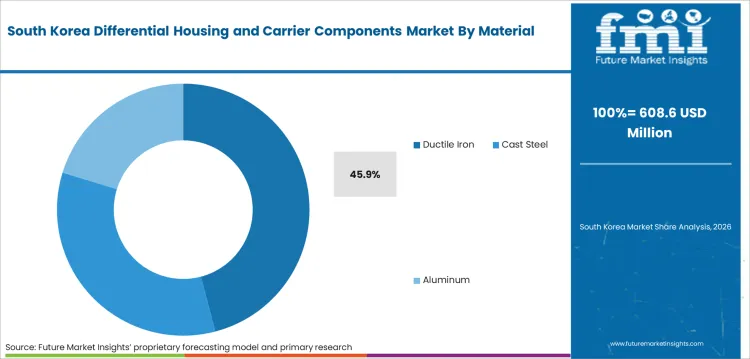
South Korea is forecast at 3.9% CAGR by 2036 due to steady output and export-oriented vehicle programs. The country has a stable vehicle production base and export-linked component demand. OICA’s 2025 production statistics list South Korea at 3,844,338 motor vehicles. Component suppliers need to monitor Hyundai and Kia platform changes as drivetrain localization affects sourcing.
- Ulsan supports axle demand through high vehicle output and established supplier access.
- Hwaseong and Gwangmyeong create demand for passenger vehicle drivetrain components across OEM programs.
- Local suppliers can serve EV casing work as powertrain platforms shift toward compact electric drive units.
In-depth Analysis of Differential Housing and Carrier Components in Japan
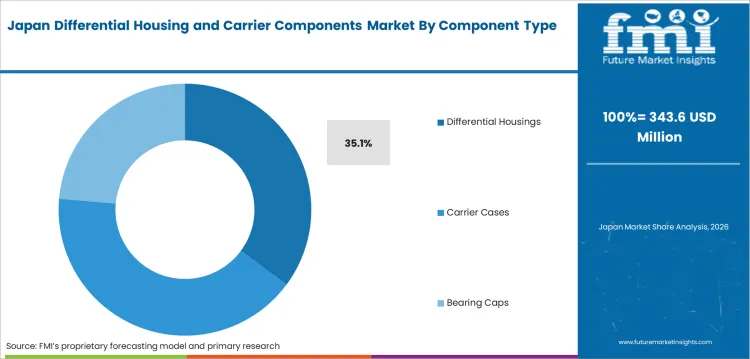
Japan remains a precision driveline market despite softer production. By 2036, Japan is expected to post 3.5% CAGR as high-quality axle demand offsets slower vehicle output. JAMA reported motor vehicle production in Japan at 8.23 million units in 2024, down 8.5% from the prior year. Precision casting and machining strength will keep suppliers relevant in OEM programs.
- Aichi supports passenger vehicle drivetrain sourcing through long-standing OEM supplier networks.
- Shizuoka supports axle and transmission component production for compact and hybrid vehicle platforms.
- Kyushu vehicle plants create demand for compact driveline components that need tight machining quality.
Competitive Landscape and Strategic Positioning
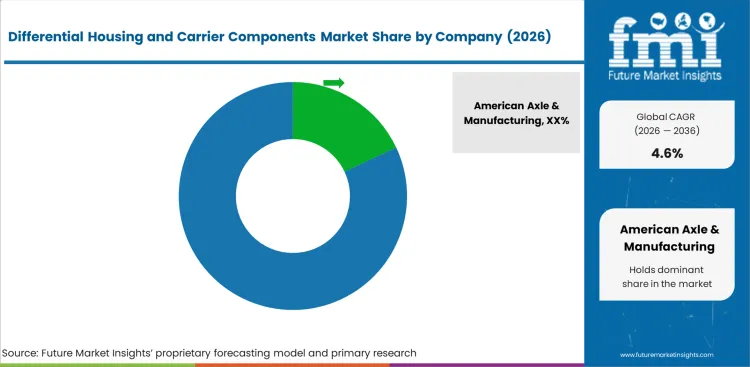
- Competitive strength depends on axle validation, casting precision and machining control.
- AAM, Dana and Cummins-Meritor hold established positions through axle platform access.
- ZF and Magna influence future housing design through electric axle programs.
- Entry barriers include casting repeatability, bearing-bore accuracy and OEM durability approval.
AAM’s January 2025 combination with Dowlais shows that operating scale matters in driveline component supply. The transaction was valued at about USD 1.44 billion in cash and stock. AAM also stated that the combined company would have about USD 12.0 billion in annual revenue on a 2023 non-adjusted basis. The deal strengthens AAM’s position across ICE, hybrid and electric driveline components.
Dana’s April 2025 Bauma presentation emphasized durability and service support in off-highway driveline systems. Dana presented Spicer drivetrain solutions for ICE, hybrid and battery-electric equipment. The company also described a certified remanufacturing program for Spicer axles, transmissions and gearboxes. The program supports aftermarket demand where carrier life and service access affect fleet operating cost.
Key Companies in the Differential Housing and Carrier Components Market
- Integrated Driveline Leaders: AAM, Dana and Cummins-Meritor hold positions through axle systems, carrier assemblies and OEM platform access.
- Electric Drive System Suppliers: ZF and Magna shape future casing demand through e-axle and eDrive system programs.
- Asian Drivetrain Specialists: Aisin, JTEKT and Hyundai WIA support OEM supply through drivetrain component manufacturing and local platform relationships.
Competitive Benchmarking: Differential Housing and Carrier Components Market
| Company | Casting and machining depth | Axle validation support | EV housing readiness | Geographic footprint |
|---|---|---|---|---|
| AAM | High | Strong | Strong | North America, Europe and Asia |
| Dana | High | Strong | Strong | Global |
| Cummins-Meritor | High | Strong | Medium | North America and global commercial vehicle channels |
| ZF Friedrichshafen | Medium | Strong | High | Global |
| Magna | Medium | Strong | High | North America, Europe and China |
| Aisin | Medium | Strong | Medium | Japan and global OEM channels |
| JTEKT | Medium | Medium | Medium | Japan and Asia centered |
| Hyundai WIA | Medium | Medium | Medium | South Korea and global Hyundai Motor Group channels |
Source: Future Market Insights competitive analysis, 2026.
Key Developments in Differential Housing and Carrier Components Market
- In August 2025, BluE Nexus Corporation, AISIN Corporation and DENSO Corporation announced that their jointly developed eAxle was installed in Isuzu D-MAX EV.
- In April 2026, Cummins Inc. announced the launch of the Meritor® RT-160 HE tandem drive axle family for heavy linehaul applications at Truck World in Mississauga, Canada.
Key Players in the Differential Housing and Carrier Components Market
Major Global Players:
- American Axle & Manufacturing
- Dana Incorporated
- Cummins-Meritor
- ZF Friedrichshafen
- Magna International
Specialist and Regional Players:
- Aisin Corporation
- JTEKT Corporation
- Hyundai WIA
Report Scope and Coverage
| Parameter | Details |
|---|---|
| Quantitative Units | USD 13.4 billion to USD 20.9 billion, at 4.6% CAGR |
| Market Definition | Differential housings, carrier cases and related machined structural axle components |
| Regions Covered | North America, Latin America, Western Europe, Eastern Europe, East Asia, South Asia and Pacific, Middle East and Africa |
| Countries Covered | United States, China, India, Germany, Japan, Mexico, South Korea and 30+ countries |
| Key Companies Profiled | AAM, Dana, Cummins-Meritor, ZF Friedrichshafen, Magna, Aisin, JTEKT, Hyundai WIA |
| Forecast Period | 2026 to 2036 |
| Approach | Hybrid bottom-up and top-down methodology using vehicle output, axle fitment, material mix and supplier activity |
Source: Future Market Insights, 2026.
Differential Housing and Carrier Components Market by Segments
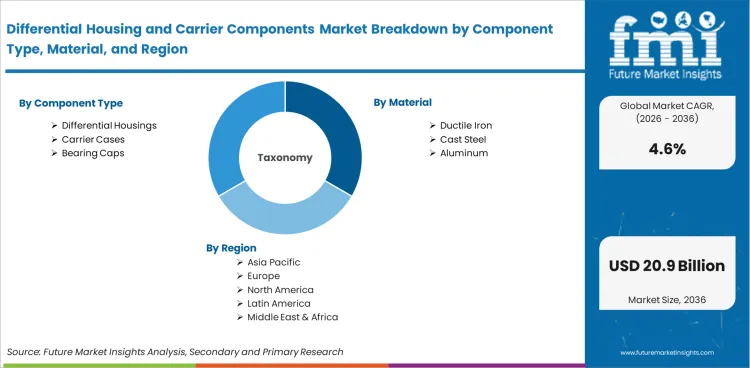
Differential Housing and Carrier Components Market Segmented by Component Type:
- Differential housings
- Carrier cases
- Bearing caps
- Cover assemblies
Differential Housing and Carrier Components Market Segmented by Material:
- Ductile iron
- Cast steel
- Aluminum
- Cast iron
Differential Housing and Carrier Components Market Segmented by Vehicle Type:
- Light trucks and SUVs
- Passenger cars
- Heavy commercial vehicles
- Off-highway vehicles
Differential Housing and Carrier Components Market Segmented by Drivetrain Configuration:
- ICE axles
- Hybrid axles
- Electric drive axles
Differential Housing and Carrier Components Market Segmented by Sales Channel:
- OEM supply
- Aftermarket replacement
- Remanufactured components
Differential Housing and Carrier Components Market by Region:
- North America
- United States
- Canada
- Mexico
- Latin America
- Brazil
- Chile
- Rest of Latin America
- Western Europe
- Germany
- United Kingdom
- Italy
- Spain
- France
- Nordic
- BENELUX
- Rest of Western Europe
- Eastern Europe
- Russia
- Poland
- Hungary
- Balkan and Baltic
- Rest of Eastern Europe
- East Asia
- China
- Japan
- South Korea
- South Asia and Pacific
- India
- ASEAN
- Australia and New Zealand
- Rest of South Asia and Pacific
- Middle East and Africa
- Kingdom of Saudi Arabia
- Other GCC Countries
- Turkiye
- South Africa
- Other African Union
- Rest of Middle East and Africa
Research Sources and Bibliography
- American Axle & Manufacturing. (2025, January 29). AAM announces combination with Dowlais. American Axle & Manufacturing.
- Dana Incorporated. (2025, April 7). Dana off-highway drive and motion systems powering OEM sustainability at Bauma 2025. Dana Incorporated.
- State Council of the People’s Republic of China. (2026, January 14). China’s auto output, sales reach new highs in 2025. State Council.
- Society of Indian Automobile Manufacturers. (2026, April 14). Auto industry performance of Q4 (Jan-March 2026) & FY 2025-26. SIAM.
- Instituto Nacional de Estadística y Geografía. (2026, April 9). Administrative record of the light vehicle automotive industry. INEGI.
- Verband der Automobilindustrie. (2026, February 3). 40 Prozent der Pkw-Produktion im Jahr 2025 elektrisch. VDA.
- International Organization of Motor Vehicle Manufacturers. (2026). Production statistics: World motor vehicle production by country and type, 2025. OICA.
- Japan Automobile Manufacturers Association. (2025, September). The motor industry of Japan 2025. JAMA.
- Board of Governors of the Federal Reserve System. (2026, April 16). Industrial production and capacity utilization: Table 3, motor vehicle assemblies. Federal Reserve.
- Magna International Inc. (2025, November 19). Magna deepens China footprint to meet growing EV demand. Magna International.
- Cummins Inc. (2026, April 15). Cummins launches new RT-160 HE high-efficiency tandem drive axle at Truck World 2026. Cummins Inc.
- BluE Nexus Corporation, AISIN Corporation, & DENSO Corporation. (2025, August 1). Isuzu’s first battery-electric pickup “D-MAX EV” adopts eAxle. AISIN Corporation.
This Report Answers
- What is the current size of the differential housing and carrier components market?
- What will the differential housing and carrier components market be worth by 2036?
- How fast is the market projected to expand during the forecast period?
- Which component type is projected to lead demand in 2026?
- Which material is expected to hold the leading share in 2026?
- How are electric axles changing housing and carrier component design?
- Which countries are forecast to grow faster during the assessment period?
- How do OEM supply and aftermarket channels differ in this market?
- Which companies are active in differential housing and carrier components?
- How does FMI estimate and validate the market forecast?
Frequently Asked Questions
What is the global demand for differential housing and carrier components in 2026?
In 2026, the global differential housing and carrier components market is projected to reach USD 13.4 billion.
How big will the differential housing and carrier components market be by 2036?
By 2036, the market is forecast to reach USD 20.9 billion as axle platforms keep evolving.
What CAGR is projected for this market?
The market is forecast to expand at 4.6% CAGR during the assessment period.
Which component type is projected to lead the market in 2026?
Differential housings are projected to lead with 35.0% share in 2026 due to structural axle demand.
Which material is expected to lead demand in 2026?
Ductile iron is expected to hold 46.0% share in 2026 due to strength and machining balance.
Which country is forecast to grow fastest in this market?
China is forecast to grow at 5.4% CAGR by 2036 due to large vehicle and NEV production.
What does the market include?
The market includes differential housings, carrier cases, bearing caps and cover assemblies used in axle systems.
What is excluded from the market scope?
Complete axle assemblies, gear sets, driveshafts and electronic traction-control software are outside the scope.
Why do electric axles matter for this market?
Electric axles need compact housings that support gears, motors and sealing within one drive unit.
How does FMI estimate this market?
FMI uses vehicle output, axle fitment, material mix, supplier activity and country production checks to validate the forecast.
Preview the report firsthand - request a free sample
Get SampleGet the brochure for pricing and purchase details.
Get PDFTable of Content
- Key Takeaways
- Market Size and CAGR
- Top Growth Driver
- Fastest Growing Segment
- Leading Region
- Key Companies
- Emerging Opportunities
- Executive Summary
- Global Market Outlook
- Demand-side Trends
- Supply-side Trends
- Technology Roadmap Analysis
- Analysis and Recommendations
- Analyst Perspective (What is happening? Why now? What should investors know?)
- Key Questions Answered
- How large is the market?
- What is the CAGR?
- What are key trends?
- Which region dominates?
- Who are the leaders?
- Market Overview
- Market Coverage / Taxonomy
- Market Definition / Scope / Limitations
- Research Methodology
- Chapter Orientation
- Analytical Lens and Working Hypotheses
- Market Structure, Signals, and Trend Drivers
- Benchmarking and Cross-market Comparability
- Market Sizing, Forecasting, and Opportunity Mapping
- Research Design and Evidence Framework
- Desk Research Programme (Secondary Evidence)
- Expert Input and Fieldwork (Primary Evidence)
- Tooling, Models, and Reference Databases
- Data Engineering and Model Build
- Quality Assurance and Audit Trail
- Market Background
- Market Dynamics (Drivers, Restraints, Opportunity, Trends)
- Scenario Forecast (Optimistic, Likely, Conservative)
- Impact Analysis
- AI Impact
- Sustainability Impact
- Regulatory Impact
- Technology Impact
- Consumer / Buyer Analysis
- Purchase Drivers
- Adoption Barriers
- Buyer Journey
- Opportunity Map Analysis
- Product Life Cycle Analysis
- Supply Chain Analysis
- Investment Feasibility Matrix
- Value Chain Analysis
- PESTLE and Porter's Analysis
- Regulatory Landscape
- Regional Parent Market Outlook
- Production and Consumption Statistics
- Import and Export Statistics
- Global Market Analysis and Forecast, 2021 to 2036
- Historical Market Size Value (USD Billion) & Volume (Unit) Analysis, 2021 to 2025
- Current and Future Market Size Value (USD Billion) & Volume (Unit) Projections, 2026 to 2036
- Y-o-Y Growth Trend Analysis
- Absolute $ Opportunity Analysis
- Global Market Pricing Analysis, 2021 to 2036
- Global Market Analysis and Forecast, By Component Type, 2021 to 2036
- Introduction / Key Findings
- Historical Market Size Value (USD Billion) & Volume (Unit) Analysis By Component Type, 2021 to 2025
- Current and Future Market Size Value (USD Billion) & Volume (Unit) Analysis and Forecast By Component Type, 2026 to 2036
- Differential housings
- Carrier cases
- Bearing caps
- Cover assemblies
- Differential housings
- Y-o-Y Growth Trend Analysis By Component Type, 2021 to 2025
- Absolute $ Opportunity Analysis By Component Type, 2026 to 2036
- Global Market Analysis and Forecast, By Material, 2021 to 2036
- Introduction / Key Findings
- Historical Market Size Value (USD Billion) & Volume (Unit) Analysis By Material, 2021 to 2025
- Current and Future Market Size Value (USD Billion) & Volume (Unit) Analysis and Forecast By Material, 2026 to 2036
- Ductile iron
- Cast steel
- Aluminum
- Cast iron
- Ductile iron
- Y-o-Y Growth Trend Analysis By Material, 2021 to 2025
- Absolute $ Opportunity Analysis By Material, 2026 to 2036
- Global Market Analysis and Forecast, By Vehicle Type, 2021 to 2036
- Introduction / Key Findings
- Historical Market Size Value (USD Billion) & Volume (Unit) Analysis By Vehicle Type, 2021 to 2025
- Current and Future Market Size Value (USD Billion) & Volume (Unit) Analysis and Forecast By Vehicle Type, 2026 to 2036
- Light trucks and SUVs
- Passenger cars
- Heavy commercial vehicles
- Off-highway vehicles
- Light trucks and SUVs
- Y-o-Y Growth Trend Analysis By Vehicle Type, 2021 to 2025
- Absolute $ Opportunity Analysis By Vehicle Type, 2026 to 2036
- Global Market Analysis and Forecast, By Drivetrain Configuration, 2021 to 2036
- Introduction / Key Findings
- Historical Market Size Value (USD Billion) & Volume (Unit) Analysis By Drivetrain Configuration, 2021 to 2025
- Current and Future Market Size Value (USD Billion) & Volume (Unit) Analysis and Forecast By Drivetrain Configuration, 2026 to 2036
- ICE axles
- Hybrid axles
- Electric drive axles
- ICE axles
- Y-o-Y Growth Trend Analysis By Drivetrain Configuration, 2021 to 2025
- Absolute $ Opportunity Analysis By Drivetrain Configuration, 2026 to 2036
- Global Market Analysis and Forecast, By Sales Channel, 2021 to 2036
- Introduction / Key Findings
- Historical Market Size Value (USD Billion) & Volume (Unit) Analysis By Sales Channel, 2021 to 2025
- Current and Future Market Size Value (USD Billion) & Volume (Unit) Analysis and Forecast By Sales Channel, 2026 to 2036
- OEM supply
- Aftermarket replacement
- Remanufactured components
- OEM supply
- Y-o-Y Growth Trend Analysis By Sales Channel, 2021 to 2025
- Absolute $ Opportunity Analysis By Sales Channel, 2026 to 2036
- Global Market Analysis and Forecast, By Region, 2021 to 2036
- Introduction
- Historical Market Size Value (USD Billion) & Volume (Unit) Analysis By Region, 2021 to 2025
- Current Market Size Value (USD Billion) & Volume (Unit) Analysis and Forecast By Region, 2026 to 2036
- North America
- Latin America
- Western Europe
- Eastern Europe
- East Asia
- South Asia and Pacific
- Middle East & Africa
- Market Attractiveness Analysis By Region
- North America Market Analysis and Forecast, By Country, 2021 to 2036
- Historical Market Size Value (USD Billion) & Volume (Unit) Trend Analysis By Market Taxonomy, 2021 to 2025
- Market Size Value (USD Billion) & Volume (Unit) Forecast By Market Taxonomy, 2026 to 2036
- By Country
- USA
- Canada
- Mexico
- By Component Type
- By Material
- By Vehicle Type
- By Drivetrain Configuration
- By Sales Channel
- By Country
- Market Attractiveness Analysis
- By Country
- By Component Type
- By Material
- By Vehicle Type
- By Drivetrain Configuration
- By Sales Channel
- Key Takeaways
- Latin America Market Analysis and Forecast, By Country
- Historical Market Size Value (USD Billion) & Volume (Unit) Trend Analysis By Market Taxonomy, 2021 to 2025
- Market Size Value (USD Billion) & Volume (Unit) Forecast By Market Taxonomy, 2026 to 2036
- By Country
- Brazil
- Chile
- Rest of Latin America
- By Component Type
- By Material
- By Vehicle Type
- By Drivetrain Configuration
- By Sales Channel
- By Country
- Market Attractiveness Analysis
- By Country
- By Component Type
- By Material
- By Vehicle Type
- By Drivetrain Configuration
- By Sales Channel
- Key Takeaways
- Western Europe Market Analysis and Forecast, By Country
- Historical Market Size Value (USD Billion) & Volume (Unit) Trend Analysis By Market Taxonomy, 2021 to 2025
- Market Size Value (USD Billion) & Volume (Unit) Forecast By Market Taxonomy, 2026 to 2036
- By Country
- Germany
- UK
- Italy
- Spain
- France
- Nordic
- BENELUX
- Rest of Western Europe
- By Component Type
- By Material
- By Vehicle Type
- By Drivetrain Configuration
- By Sales Channel
- By Country
- Market Attractiveness Analysis
- By Country
- By Component Type
- By Material
- By Vehicle Type
- By Drivetrain Configuration
- By Sales Channel
- Key Takeaways
- Eastern Europe Market Analysis and Forecast, By Country
- Historical Market Size Value (USD Billion) & Volume (Unit) Trend Analysis By Market Taxonomy, 2021 to 2025
- Market Size Value (USD Billion) & Volume (Unit) Forecast By Market Taxonomy, 2026 to 2036
- By Country
- Russia
- Poland
- Hungary
- Balkan & Baltic
- Rest of Eastern Europe
- By Component Type
- By Material
- By Vehicle Type
- By Drivetrain Configuration
- By Sales Channel
- By Country
- Market Attractiveness Analysis
- By Country
- By Component Type
- By Material
- By Vehicle Type
- By Drivetrain Configuration
- By Sales Channel
- Key Takeaways
- East Asia Market Analysis and Forecast, By Country
- Historical Market Size Value (USD Billion) & Volume (Unit) Trend Analysis By Market Taxonomy, 2021 to 2025
- Market Size Value (USD Billion) & Volume (Unit) Forecast By Market Taxonomy, 2026 to 2036
- By Country
- China
- Japan
- South Korea
- By Component Type
- By Material
- By Vehicle Type
- By Drivetrain Configuration
- By Sales Channel
- By Country
- Market Attractiveness Analysis
- By Country
- By Component Type
- By Material
- By Vehicle Type
- By Drivetrain Configuration
- By Sales Channel
- Key Takeaways
- South Asia and Pacific Market Analysis and Forecast, By Country
- Historical Market Size Value (USD Billion) & Volume (Unit) Trend Analysis By Market Taxonomy, 2021 to 2025
- Market Size Value (USD Billion) & Volume (Unit) Forecast By Market Taxonomy, 2026 to 2036
- By Country
- India
- ASEAN
- Australia & New Zealand
- Rest of South Asia and Pacific
- By Component Type
- By Material
- By Vehicle Type
- By Drivetrain Configuration
- By Sales Channel
- By Country
- Market Attractiveness Analysis
- By Country
- By Component Type
- By Material
- By Vehicle Type
- By Drivetrain Configuration
- By Sales Channel
- Key Takeaways
- Middle East & Africa Market Analysis and Forecast, By Country
- Historical Market Size Value (USD Billion) & Volume (Unit) Trend Analysis By Market Taxonomy, 2021 to 2025
- Market Size Value (USD Billion) & Volume (Unit) Forecast By Market Taxonomy, 2026 to 2036
- By Country
- Kingdom of Saudi Arabia
- Other GCC Countries
- Türkiye
- South Africa
- Other African Union
- Rest of Middle East & Africa
- By Component Type
- By Material
- By Vehicle Type
- By Drivetrain Configuration
- By Sales Channel
- By Country
- Market Attractiveness Analysis
- By Country
- By Component Type
- By Material
- By Vehicle Type
- By Drivetrain Configuration
- By Sales Channel
- Key Takeaways
- Key Countries Market Analysis
- USA
- Pricing Analysis
- Market Share Analysis, 2025
- By Component Type
- By Material
- By Vehicle Type
- By Drivetrain Configuration
- By Sales Channel
- Canada
- Pricing Analysis
- Market Share Analysis, 2025
- By Component Type
- By Material
- By Vehicle Type
- By Drivetrain Configuration
- By Sales Channel
- Mexico
- Pricing Analysis
- Market Share Analysis, 2025
- By Component Type
- By Material
- By Vehicle Type
- By Drivetrain Configuration
- By Sales Channel
- Brazil
- Pricing Analysis
- Market Share Analysis, 2025
- By Component Type
- By Material
- By Vehicle Type
- By Drivetrain Configuration
- By Sales Channel
- Chile
- Pricing Analysis
- Market Share Analysis, 2025
- By Component Type
- By Material
- By Vehicle Type
- By Drivetrain Configuration
- By Sales Channel
- Germany
- Pricing Analysis
- Market Share Analysis, 2025
- By Component Type
- By Material
- By Vehicle Type
- By Drivetrain Configuration
- By Sales Channel
- UK
- Pricing Analysis
- Market Share Analysis, 2025
- By Component Type
- By Material
- By Vehicle Type
- By Drivetrain Configuration
- By Sales Channel
- Italy
- Pricing Analysis
- Market Share Analysis, 2025
- By Component Type
- By Material
- By Vehicle Type
- By Drivetrain Configuration
- By Sales Channel
- Spain
- Pricing Analysis
- Market Share Analysis, 2025
- By Component Type
- By Material
- By Vehicle Type
- By Drivetrain Configuration
- By Sales Channel
- France
- Pricing Analysis
- Market Share Analysis, 2025
- By Component Type
- By Material
- By Vehicle Type
- By Drivetrain Configuration
- By Sales Channel
- India
- Pricing Analysis
- Market Share Analysis, 2025
- By Component Type
- By Material
- By Vehicle Type
- By Drivetrain Configuration
- By Sales Channel
- ASEAN
- Pricing Analysis
- Market Share Analysis, 2025
- By Component Type
- By Material
- By Vehicle Type
- By Drivetrain Configuration
- By Sales Channel
- Australia & New Zealand
- Pricing Analysis
- Market Share Analysis, 2025
- By Component Type
- By Material
- By Vehicle Type
- By Drivetrain Configuration
- By Sales Channel
- China
- Pricing Analysis
- Market Share Analysis, 2025
- By Component Type
- By Material
- By Vehicle Type
- By Drivetrain Configuration
- By Sales Channel
- Japan
- Pricing Analysis
- Market Share Analysis, 2025
- By Component Type
- By Material
- By Vehicle Type
- By Drivetrain Configuration
- By Sales Channel
- South Korea
- Pricing Analysis
- Market Share Analysis, 2025
- By Component Type
- By Material
- By Vehicle Type
- By Drivetrain Configuration
- By Sales Channel
- Russia
- Pricing Analysis
- Market Share Analysis, 2025
- By Component Type
- By Material
- By Vehicle Type
- By Drivetrain Configuration
- By Sales Channel
- Poland
- Pricing Analysis
- Market Share Analysis, 2025
- By Component Type
- By Material
- By Vehicle Type
- By Drivetrain Configuration
- By Sales Channel
- Hungary
- Pricing Analysis
- Market Share Analysis, 2025
- By Component Type
- By Material
- By Vehicle Type
- By Drivetrain Configuration
- By Sales Channel
- Kingdom of Saudi Arabia
- Pricing Analysis
- Market Share Analysis, 2025
- By Component Type
- By Material
- By Vehicle Type
- By Drivetrain Configuration
- By Sales Channel
- Türkiye
- Pricing Analysis
- Market Share Analysis, 2025
- By Component Type
- By Material
- By Vehicle Type
- By Drivetrain Configuration
- By Sales Channel
- South Africa
- Pricing Analysis
- Market Share Analysis, 2025
- By Component Type
- By Material
- By Vehicle Type
- By Drivetrain Configuration
- By Sales Channel
- USA
- Market Structure Analysis
- Competition Dashboard
- Competition Benchmarking
- Market Share Analysis of Top Players
- By Regional
- By Component Type
- By Material
- By Vehicle Type
- By Drivetrain Configuration
- By Sales Channel
- Emerging Startups
- Innovation Benchmarking
- Competition Analysis
- Competition Deep Dive
- AAM
- Overview
- Product Portfolio
- Profitability by Market Segments (Product/Region/Sales Channel)
- Sales Footprint
- Strategy Overview
- Marketing Strategy
- Product Strategy
- Channel Strategy
- Dana
- Cummins-Meritor
- ZF Friedrichshafen
- Magna
- Aisin
- JTEKT
- Hyundai WIA
- AAM
- Case Studies
- Success Stories
- Recent Developments
- Competition Deep Dive
- Assumptions & Acronyms Used


