

- Industry Size (2026)
- USD 1.4 Bn
- Forecast (2036)
- USD 4.6 Bn
- CAGR (2026 to 2036)
- 12.7%
Carrier-Agnostic Parcel and Freight Visibility Aggregation Market Size, Market Forecast and Outlook By FMI
The carrier-agnostic parcel and freight visibility aggregation market surpassed a valuation of USD 1.2 billion in 2025. The industry is expected to reach USD 1.4 billion in 2026 at a CAGR of 12.7% during the forecast period. Demand outlook carries the market valuation to USD 4.6 billion by 2036 as logistics networks centralize API normalization to eliminate data fragmentation across multi-carrier ecosystems.
Logistics procurement teams face catastrophic blind spots during handoffs between long-haul freight operators and local final-mile couriers. Unpredictable dwell times at regional cross-docks trigger massive retailer chargebacks, compelling routing managers to abandon siloed tracking portals in favor of a unified multi-carrier tracking dashboard for shippers. Delaying integration exposes supply chain planners to unavoidable inventory stockouts during peak seasons. While standalone supply chain visibility software provides milestone updates, true supply chain visibility aggregation software translates disparate telemetry into single normalized data streams, exposing hidden node bottlenecks.
Once tier-two regional carriers standardize webhook payloads, legacy electronic data interchange connections become immediate commercial liabilities. Platform adoption accelerates rapidly because standardized telemetry removes bespoke integration hurdles that previously blocked mid-market shippers from scaling carrier bases. Transitioning toward dynamic transport management system routing depends entirely on crossing this specific data normalization threshold.
Summary of Carrier-Agnostic Parcel and Freight Visibility Aggregation Market
- Carrier-Agnostic Parcel and Freight Visibility Aggregation Market Definition
- Carrier-Agnostic Parcel and Freight Visibility Aggregation translates incompatible carrier telemetry formats into a standardized, predictive tracking feed for enterprise supply chains.
- Demand Drivers in the Market
- Retailer chargeback penalties compel supply chain planners to implement predictive delay alerts before shipments miss delivery windows.
- Cross-border documentation bottlenecks require customs brokers to access real-time node arrival data to prevent container demurrage.
- Capacity constraints push freight procurement managers to onboard unvetted regional carriers, demanding immediate integration without multi-month EDI setups.
- Key Segments Analyzed in the FMI Report
- Component: Platform software is expected to hold 68.0% share in 2026, driven by operational necessities surrounding continuous data normalization.
- Shipment Mode Coverage: Multimodal visibility is projected to capture 46.0% share in 2026, as inventory transfers across ocean, rail, and road demand unified event correlation.
- Deployment Model: Cloud/SaaS is anticipated to record 81.0% share in 2026, supported by requirements for weekly API connector updates.
- End User: Large shippers and retailers are set to account for 37.0% share in 2026, fueled by strategic mandates to independently audit 3PL performance.
- Application: Real-time tracking and ETA management is poised to grab 34.0% share in 2026, rooted in transitions from reactive tracking to prescriptive yard scheduling.
- India: 15.1% compound growth, reflecting rapid digitization of highly fragmented owner-operator trucking fleets.
- Analyst Opinion at FMI
- Rahul Pandita, Principal Analyst, Consumer Product, at FMI, points out, "Logistics directors obsess over milestone tracking latency under the assumption that faster pings yield better outcomes. Real operational friction actually occurs inside cross-dock facilities, where standard GPS telemetry goes completely dark. Aggregation platforms failing to ingest warehouse management system updates alongside over-the-road telematics leave massive measurement gaps right where most SLA failures originate. Shippers measuring visibility success merely by carrier onboarding rates completely miss actual operational objectives. The true metric is preventing yard congestion when predictive ETAs collapse."
- Strategic Implications / Executive Takeaways
- Transportation managers eliminate multi-month onboarding delays by swapping legacy EDI mapping for pre-built REST APIs.
- Customer service directors reduce inbound call volumes by exposing normalized courier data directly to consumers.
- Procurement officers secure foundational negotiating leverage by matching claimed carrier transit times against aggregated historical performance data.
- Methodology
- Primary Research: Direct interviews with logistics directors and routing optimization engineers.
- Desk Research: Analysis of carrier API documentation logs and integration registries.
- Market-Sizing and Forecasting: Baseline anchored to API call volume across aggregation nodes.
- Data Validation and Update Cycle: Forecasts calibrated against platform revenue disclosures.
Carrier-Agnostic Parcel and Freight Visibility Aggregation Market Key Takeaways
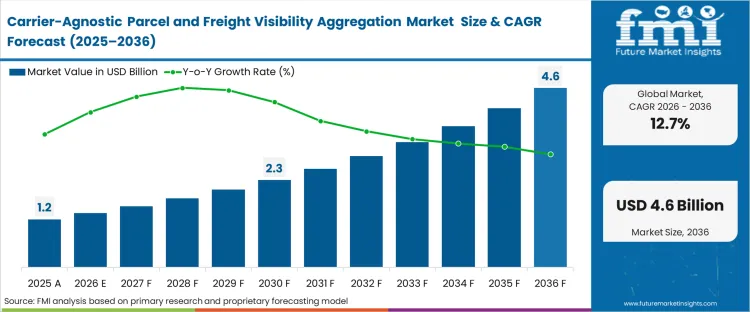
| Metric | Details |
|---|---|
| Industry Size (2026) | USD 1.4 Billion |
| Industry Value (2036) | USD 4.6 Billion |
| CAGR (2026–2036) | 12.7% |
Source: Future Market Insights (FMI) analysis, based on proprietary forecasting model and primary research
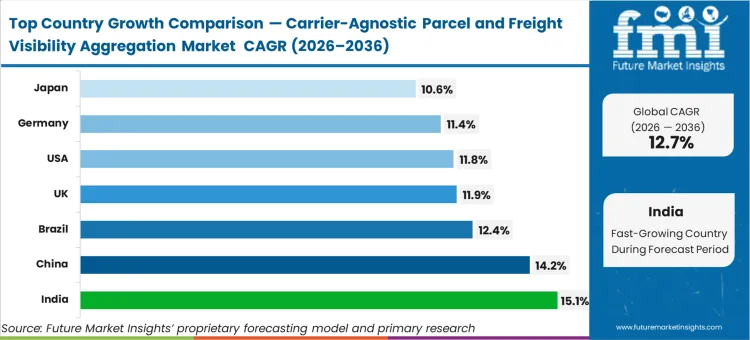
India leads at 15.1% as fragmented owner-operator networks demand radical transparency, while China tracks at 14.2% on aggressive export hub digitization. Brazil advances at 12.4%, with United Kingdom expanding by 11.9% and United States capturing 11.8% driven by complex multimodal demands. Germany posts 11.4% and Japan records 10.6% supported by strict port compliance. This divergence stems from varying legacy EDI dependencies versus cloud-native API adoption across global logistics corridors, dictating broader logistics visibility software penetration.
Carrier-Agnostic Parcel and Freight Visibility Aggregation Market Definition
A shipment visibility aggregation platform operates as an intelligence layer translating incompatible carrier telemetry formats into standardized predictive tracking feeds for enterprise supply chains. Architecture normalizes disparate electronic logging device pings and webhook updates from unconnected carriers into unified operational dashboards. Logistics directors rely on carrier-agnostic parcel and freight visibility aggregation to predict arrival times across multimodal journeys without requiring bespoke integrations for every logistics provider.
Carrier-Agnostic Parcel and Freight Visibility Aggregation Market Inclusions
FMI includes API gateway services, predictive analytics engines, and delivery tracking platform modules designed specifically for cross-carrier normalization. Systems providing predictive estimated time of arrival calculations via machine learning models fall strictly within scope. Bidirectional communication layers allowing shippers to update instructions based on aggregated alerts form core technical components evaluated inside every carrier-neutral shipment tracking platform analysis.
Carrier-Agnostic Parcel and Freight Visibility Aggregation Market Exclusions
Hardware telematics devices and electronic logging equipment fall outside analytical parameters because they generate raw data rather than aggregating tracking streams. Proprietary tracking tools developed by single carriers strictly for fleet management remain excluded. Standalone warehouse execution systems sit outside this boundary, as operational focus centers on intra-facility automation rather than over-the-road freight monitoring workflows.
Carrier-Agnostic Parcel and Freight Visibility Aggregation Market Research Methodology
- Primary Research: Logistics directors, transportation procurement managers, and routing optimization engineers.
- Desk Research: Carrier API documentation logs, transportation management system integration registries, and SLA penalty claim archives.
- Market-Sizing and Forecasting: API call volume across major global aggregation nodes establishes baseline trajectories.
- Data Validation and Update Cycle: Cross-referencing platform revenue disclosures with tier-two carrier onboarding announcements confirms adoption rates.
Segmental Analysis
Carrier-Agnostic Parcel and Freight Visibility Aggregation Market Analysis by Component
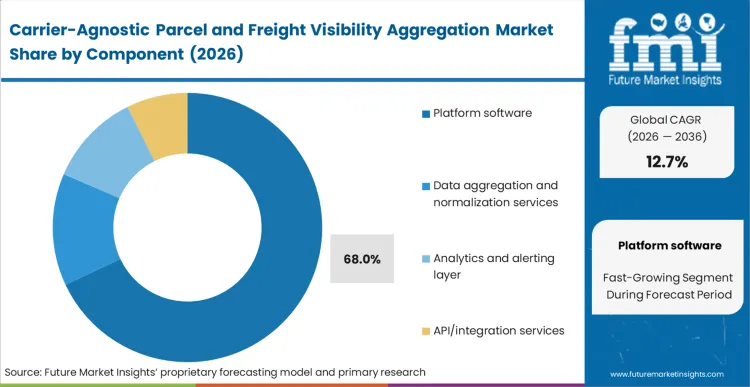
Continuous normalization of messy carrier data dictates commercial dominance ahead of dashboard aesthetics. Platform software commands 68.0% share, and FMI's assessment indicates logistics IT directors value robust ingestion pipelines over analytical overlays. Routing algorithms fail instantly when tier-two couriers change webhook structures without notice. Maintaining stable freight transport management feeds requires dedicated freight ETA aggregation software capable of instantly identifying schema drift. System integrators rarely confess that underlying data cleaning consumes exponentially more compute resources than interface rendering. Planners relying on brittle freight management software architectures face catastrophic blind spots during peak shipping weeks.
- Initial procurement savings: Consolidating disparate tracking tools reduces direct licensing fees. Transportation managers strip overlapping vendor contracts to unlock immediate budget flexibility.
- Hidden integration expenses: Mapping custom EDI fields into standardized schemas consumes massive internal engineering hours. IT directors routinely underestimate this mapping burden, severely delaying project ROI timelines.
- Total lifecycle calculations: True economic value emerges during carrier churn. Procurement teams replace underperforming logistics providers instantly without incurring fresh integration penalties, fundamentally altering negotiation leverage.
Carrier-Agnostic Parcel and Freight Visibility Aggregation Market Analysis by Shipment Mode Coverage
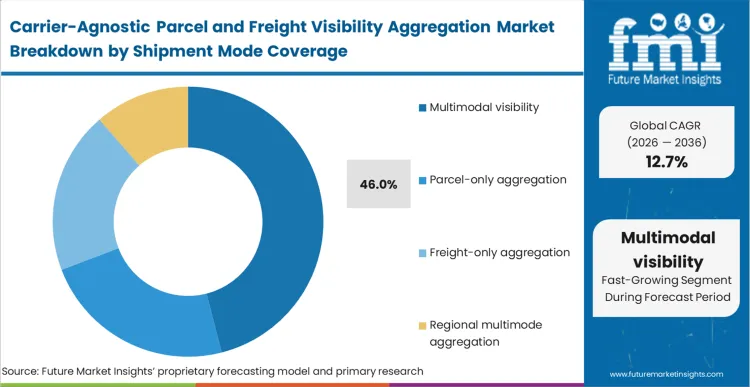
Contradictory tracking protocols between maritime shipping operators and final-mile couriers create operational nightmares for inventory controllers. Multimodal visibility secures 46.0% share, reflecting urgent mandates to correlate handoff events across entirely different technological ecosystems. Planners using siloed freight management systems lose line-of-sight exactly when ocean containers transfer to regional rail networks. Connecting discrete modes allows inventory analysts to dynamically adjust safety stock formulas based on real-world transit variability. FMI notes that true multimodal visibility aggregation translates marine port congestion directly into inland distribution center staffing requirements. Supply chain executives missing cross-mode correlation suffer cascading delays and pay premium airfreight rates to bypass preventable surface bottlenecks. Adding connected logistics nodes amplifies complexity without solving foundational translation problems.
- Handoff blind spots: Terminal operators fail to log container departures promptly. Customs brokers miss critical document submission windows, triggering immediate and expensive demurrage fees.
- Residual data latency: Premium tracking integrations suffer polling delays from legacy rail operators. Inventory analysts must inject buffer hours into ETA calculations to absorb fundamental latency effectively.
- Full corridor mapping: Securing uninterrupted visibility requires digitizing transition points alongside transport segments. Operations managers achieve seamless tracking only when cross-dock scanning integrates perfectly with over-the-road telematics.
Carrier-Agnostic Parcel and Freight Visibility Aggregation Market Analysis by Deployment Model
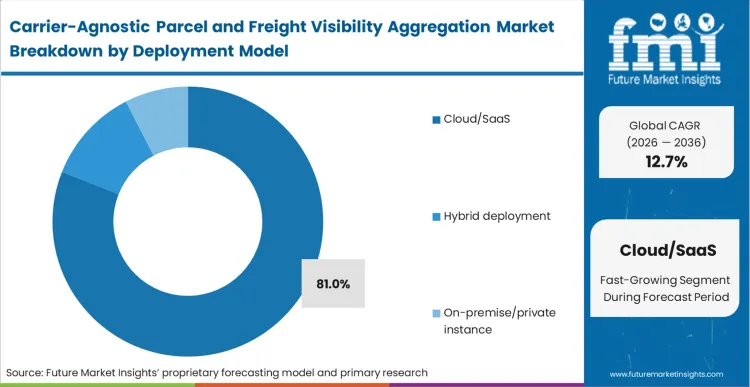
Instant synchronization with global carrier networks becomes impossible when running isolated software instances behind corporate firewalls. Cloud/SaaS grabs 81.0% share, driven entirely by necessities to receive continuous connector updates. API protocols evolve weekly, breaking static on-premise integrations and leaving IT administrators scrambling to patch broken data feeds. Centralized digital logistics frameworks allow vendors to deploy critical schema fixes simultaneously across thousands of client environments. Based on FMI's analysis, local deployments fail architecturally because they isolate enterprises from collective intelligence generated by millions of cross-network freight movements. Planners demanding private instances for perceived security reasons inadvertently construct expensive data silos degrading tracking accuracy within months. Connecting platforms to enterprise control towers amplifies cloud-native agility requirements.
- Agile carrier onboarding: Native SaaS platforms provide pre-certified connectors for thousands of regional couriers. Implementation managers activate new logistics partners in hours rather than mapping custom EDI protocols for months.
- Update maintenance constraints: Logistics providers alter webhook payloads frequently. Cloud providers absorb maintenance burdens, insulating enterprise IT directors from constant troubleshooting loops and broken feeds.
- Long-term architecture: Future consolidation among tier-two carriers requires rapid backend integration shifting. Procurement teams locked into rigid on-premise solutions lack flexibility to exploit emerging capacity networks.
Carrier-Agnostic Parcel and Freight Visibility Aggregation Market Analysis by End User
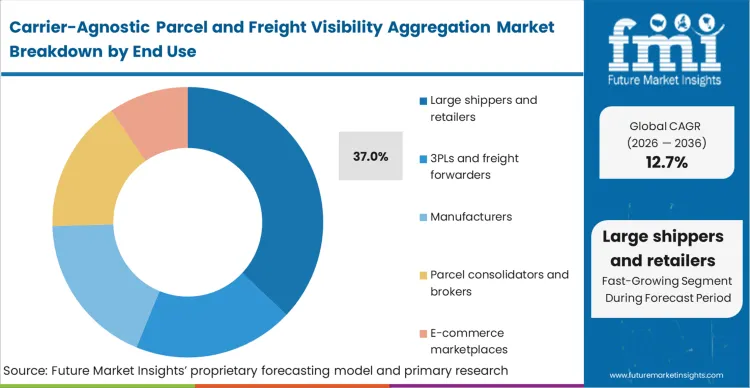
Retail giants face uncomfortable truths regarding outsourced logistics oversight. Large shippers and retailers hold 37.0% share, compelled to build independent delivery exception management platform capabilities rather than trusting 3PL-provided data. Fulfillment directors demand unfiltered telemetry to penalize logistics providers accurately for missed service level agreements. Relying on standard control tower services leaves brands vulnerable to sanitized reporting that obscures chronic terminal delays. FMI observes deep systematic irony: major retailers procure aggregation tools specifically to audit 3PL partners, forcing those same 3PLs to purchase identical software to defend against retailer chargebacks. Executives lacking an independent parcel visibility API platform forfeit negotiating leverage during annual freight contract renewals, absorbing unjustified rate increases. Integrating route optimization planning software becomes secondary to this auditing imperative.
- Tier-one enterprise adoption: Fortune 500 retailers deploy aggregation layers first. Chief supply chain officers weaponize visibility data to enforce strict vendor inbound compliance metrics globally.
- Mid-market compliance pressures: Regional manufacturers follow suit when major retailers threaten delisting for late deliveries. Operations managers grudgingly adopt tracking portals to defend shelf space allocations.
- Long-tail capitulation: Small parcel consolidators finally integrate tracking APIs to survive. Brokerage owners realize bidding on enterprise contracts requires proving real-time ETA capabilities before discussing rates.
Carrier-Agnostic Parcel and Freight Visibility Aggregation Market Analysis by Application
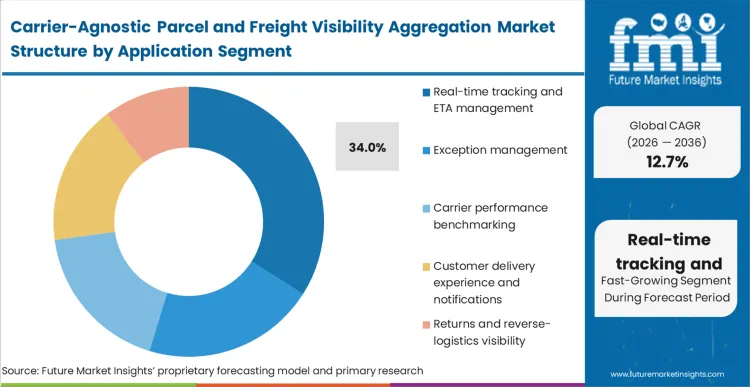
Milestone status updates no longer satisfy distribution center requirements. Real-time tracking and ETA management captures 34.0% share, driven by shifts toward prescriptive yard scheduling and real-time ETA management for ecommerce deliveries. Operations managers discard legacy last mile delivery software when it fails to adjust inbound receiving dock schedules dynamically. True predictive systems consume weather data, historical driver behavior, and port congestion telemetry to calculate arrivals continuously. According to FMI's estimates, raw coordinate data provides zero value; algorithms must translate coordinates into actionable labor-scheduling directives for warehouse supervisors. Supply chain planners clinging to static estimated delivery dates encounter massive overtime costs as dock workers sit idle awaiting delayed trailers. Effective first mile logistics coordination requires exact dynamic ETA capabilities.
- Triggering initial adoption: Mounting detention fees from waiting drivers force urgent software upgrades. Yard managers procure predictive ETA modules specifically to synchronize dock door availability with incoming freight.
- Validating vendor accuracy: Machine learning algorithms compare promised transit times against actual GPS progression. Procurement directors use discrepancy data to penalize carriers consistently missing established velocity targets.
- Driving enterprise expansion: Perfecting inbound tracking naturally leads to outbound customer notifications. Customer experience directors leverage identical predictive engines to reduce consumer anxiety regarding high-value deliveries.
Carrier-Agnostic Parcel and Freight Visibility Aggregation Market Drivers, Restraints, and Opportunities
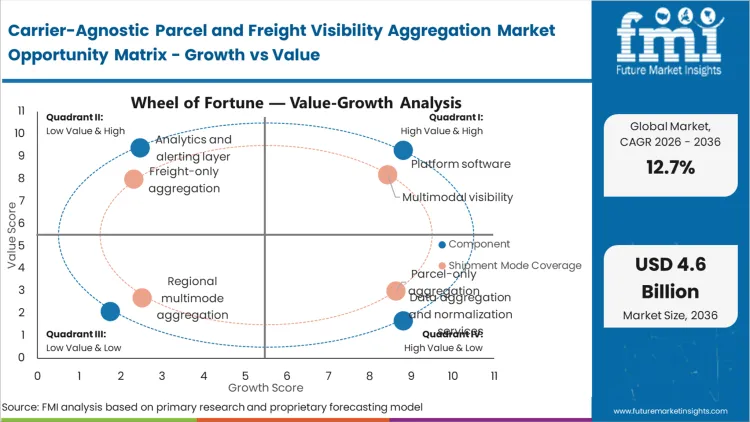
Retailer compliance penalties compel logistics procurement managers to upgrade tracking architecture immediately. Major e-commerce platforms now issue catastrophic chargebacks for delayed inbound freight, transforming parcel and freight exception management software from an operational luxury into a margin-defense mechanism. Operating blind during final-mile handoffs virtually guarantees missed delivery windows. Aggregating disparate express and small parcel telemetry into single dashboards provides routing supervisors with predictive alerts necessary to intercept failing shipments. Delaying integration guarantees margin erosion through compounding SLA fines.
Heterogeneous data quality across tier-two couriers sabotages advanced predictive algorithms. Enterprise carriers provide pristine API payloads, but regional operators transmit delayed or malformed status updates. Fragmentation forces IT directors to spend excessive engineering cycles scrubbing dirty data rather than optimizing routes across a normalized carrier events platform. Systems output unreliable ETA calculations when fed garbage telemetry, eroding warehouse manager trust in software outputs. Emerging machine learning scrubbers attempt to auto-correct missing pings, yet functional data gaps from unsophisticated operators remain persistent friction points.
Opportunities in the Carrier-Agnostic Parcel and Freight Visibility Aggregation Market
- Return-logistics monetization: Aggregating reverse-journey telemetry allows inventory planners to pre-sell returned items before physically reaching processing centers.
- Scope three emissions auditing: Capturing accurate transit data across outsourced carriers provides sustainability officers with auditable carbon footprint metrics necessary for compliance reporting.
- Demonstrating financial returns: Organizations capturing the true ROI of carrier-agnostic visibility software integrate real-time last mile delivery congestion data, enabling dispatchers to divert in-transit parcels automatically and prevent cascading network failures.
Regional Analysis
.webp "Top Country Growth Comparison Carrier Agnostic Parcel And Freight Visibility Aggregation Market Cagr (2026 2036)")
Based on regional analysis, carrier-agnostic parcel and freight visibility aggregation market is segmented into North America, Latin America, Europe, East Asia, South Asia & Pacific, and Middle East & Africa across 40 plus countries.
| Country | CAGR (2026 to 2036) |
|---|---|
| India | 15.1% |
| China | 14.2% |
| Brazil | 12.4% |
| United Kingdom | 11.9% |
| United States | 11.8% |
| Germany | 11.4% |
| Japan | 10.6% |
Source: Future Market Insights (FMI) analysis, based on proprietary forecasting model and primary research
Americas Carrier-Agnostic Parcel and Freight Visibility Aggregation Market Analysis
Massive continental distances and fragmented local delivery networks force supply chains across hemispheres to prioritize predictive tracking. Logistics executives abandon static EDI connections in favor of continuous API polling to monitor freight traversing vast logistics corridors. FMI's analysis indicates sprawling geography magnifies minor delay costs, pushing operations managers to demand second-by-second coordinate updates. Port congestion compels import directors to link maritime tracking directly with domestic rail and road telemetry, seeking seamless visibility across disparate networks.
- United States: Multimodal complexity drives adoption, forcing supply chain planners to correlate rail manifests with final-mile courier logs. Demand advances at 11.8%, reflecting intensive integration requirements across highly fragmented domestic carrier landscapes. Connecting disparate systems provides enterprise shippers leverage needed to penalize underperforming logistics partners effectively.
- Brazil: Rampant cargo theft dictates stringent tracking protocols. Expansion tracks at 12.4% as security directors deploy aggregated visibility tools specifically to monitor high-value freight traversing high-risk regional corridors. Mastering continuous telemetry alters how domestic insurers calculate transit risk premiums.
FMI's report includes detailed analysis of automated parcel delivery terminals integration, assessing visibility challenges across broader logistics corridors not featured above. Future tracking ecosystems depend entirely on standardizing peripheral nodes.
Europe Carrier-Agnostic Parcel and Freight Visibility Aggregation Market Analysis
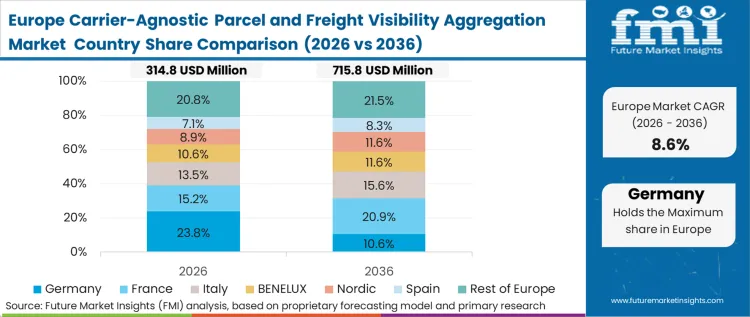
Cross-border customs friction mandates precise arrival predictions to prevent border bottlenecks. Transportation managers rely on aggregated telemetry to pre-file documentation based on highly accurate ETA calculations. As FMI analysts note, unpredictable border wait times destroy static schedules, making dynamic visibility strict regulatory and operational requirements.
- United Kingdom: Post-Brexit border friction forces customs brokers to demand real-time freight location data. Operations expand by 11.9% as importers scramble to digitize documentation workflows tied directly to physical vehicle coordinates. Mastering data flows allows forwarders to bypass standard border delays entirely.
- Germany: Deep industrial supply chains require flawless just-in-time component deliveries to sustain automotive manufacturing. Growth tracks at 11.4% driven by assembly plant directors refusing to accept inbound shipments lacking continuous API tracking. Aligning component arrivals perfectly with production schedules eliminates costly factory floor idle time.
FMI's report includes France, Italy, and Spain, examining unique customs integration layers across continental borders.
Asia Pacific Carrier-Agnostic Parcel and Freight Visibility Aggregation Market Analysis
Export velocity dictates operational survival for regional manufacturers. Factory directors deploy aggregation platforms specifically to synchronize outbound container movements with rigid marine vessel cutoff times. According to FMI's estimates, missing single sailing windows triggers massive inventory holding costs and damages international client relationships. Planners require pristine visibility from factory floors to departure terminals to guarantee compliance.
- India: Highly fragmented owner-operator fleets create massive tracking blind spots for national distributors. Revenue surges at 15.1% because logistics planners desperately need API normalizers to process inconsistent SMS and basic GPS pings from tier-three transport providers. Converting unstructured data into usable ETAs fundamentally stabilizes chaotic domestic supply chains.
- China: Aggressive digitization of sprawling export hubs forces deep integration among local drayage operators. Market grows at 14.2% as port authorities mandate real-time telematics feeds from all incoming freight. Aligning factory output with digitized port schedules grants manufacturers distinct competitive advantages over less integrated peers.
- Japan: Strict driver overtime regulations compel fleet managers to optimize every route dynamically. Expansion hits 10.6% precisely because dispatchers require absolute visibility to prevent drivers from exceeding legal operating hours. Securing tracking capabilities alters how regional 3PLs quote delivery guarantees.
FMI's report encompasses ASEAN and ANZ regions, detailing maritime gateway connectivity.
Competitive Aligners for Market Players
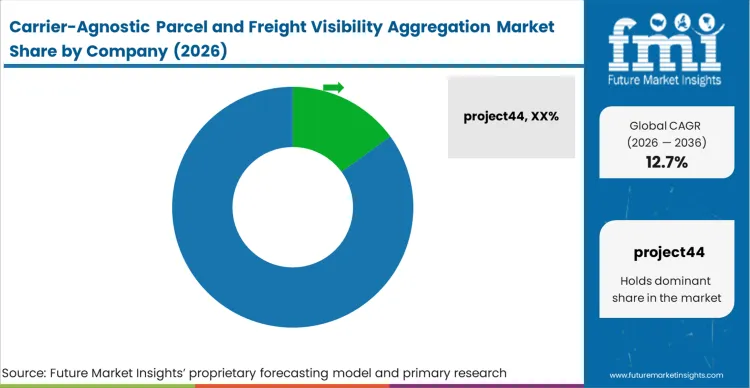
Competition in this market is shaped much more by carrier network depth than by dashboard design. That is why buyers spend so much time comparing project44 and FourKites on actual visibility reach rather than surface-level software presentation. Large shippers usually want platforms that can connect quickly with existing carrier networks and deliver value without a long onboarding cycle. When a provider already supports regional couriers through native webhook connections, it removes a major source of friction that often slows older fleet and logistics systems. Vendors with limited carrier libraries usually struggle to stay competitive, even if the software itself looks strong.
Established players also benefit from years of normalized transit data. Descartes Systems Group and SAP have built large historical telemetry bases, which gives their ETA and exception models a clear advantage. Newer competitors may offer capable analytics tools, but prediction quality is harder to trust when the platform has not yet seen enough real shipment history across lanes, carriers, and failure events. That data depth creates a practical barrier in the market. It is difficult for a new entrant to match incumbent accuracy quickly, no matter how refined the interface may be.
Even with those advantages, large shippers are careful about becoming too dependent on one visibility provider. During procurement, they increasingly ask for open APIs and direct data access so carrier information can move into their own internal systems. That is why platforms such as e2open and Transporeon are often evaluated not only on visibility coverage, but also on how easily their data can be exported and reused. Many enterprise buyers now want aggregators to handle translation and normalization, while core routing and decision-making remain inside their own environments.
Key Players in Carrier-Agnostic Parcel and Freight Visibility Aggregation Market
- project44
- FourKites
- Descartes Systems Group
- e2open
- Shippeo
- SAP
- Transporeon
Scope of the Report
| Metric | Value |
|---|---|
| Quantitative Units | USD 1.4 Billion to USD 4.6 Billion, at a CAGR of 12.7% |
| Market Definition | Carrier-Agnostic Parcel and Freight Visibility Aggregation functions as an intelligence layer, translating incompatible carrier telemetry formats into standardized, predictive tracking feeds for enterprise supply chains. The architecture normalizes disparate electronic logging device pings and webhook updates from unconnected carriers into unified operational dashboards. |
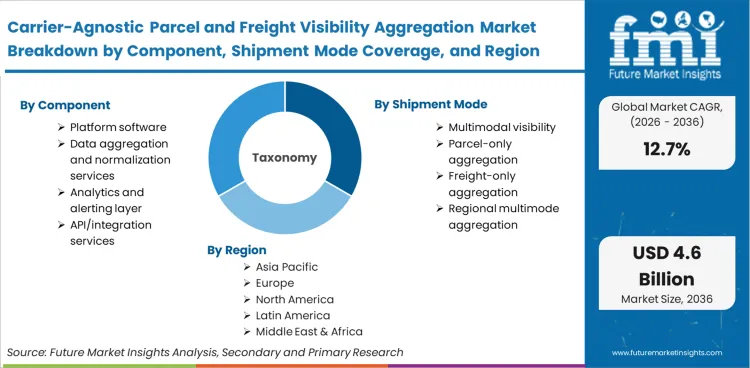
| Component Segmentation | Platform software, Data aggregation and normalization services, Analytics and alerting layer, API/integration services |
| Shipment mode coverage Segmentation | Multimodal visibility, Parcel-only aggregation, Freight-only aggregation, Regional multimode aggregation |
| Deployment model Segmentation | Cloud/SaaS, Hybrid deployment, On-premise/private instance |
| End user Segmentation | Large shippers and retailers, 3PLs and freight forwarders, Manufacturers, Parcel consolidators and brokers, E-commerce marketplaces |
| Application Segmentation | Real-time tracking and ETA management, Exception management, Carrier performance benchmarking, Customer delivery experience and notifications, Returns and reverse-logistics visibility |
| Regions Covered | North America, Latin America, Europe, East Asia, South Asia & Pacific, Middle East & Africa |
| Countries Covered | United States, China, Germany, United Kingdom, India, Japan, Brazil, and 40 plus countries |
| Key Companies Profiled | project44, FourKites, Descartes Systems Group, e2open, Shippeo, SAP, Transporeon |
| Forecast Period | 2026 to 2036 |
| Approach | API call volume across major global aggregation nodes establishes baseline trajectories, cross-referenced against platform revenue disclosures. |
Source: Future Market Insights (FMI) analysis, based on proprietary forecasting model and primary research
Carrier-Agnostic Parcel and Freight Visibility Aggregation Market Analysis by Segments
Component
- Platform software
- Data aggregation and normalization services
- Analytics and alerting layer
- API/integration services
Shipment mode coverage
- Multimodal visibility
- Parcel-only aggregation
- Freight-only aggregation
- Regional multimode aggregation
Deployment model
- Cloud/SaaS
- Hybrid deployment
- On-premise/private instance
End user
- Large shippers and retailers
- 3PLs and freight forwarders
- Manufacturers
- Parcel consolidators and brokers
- E-commerce marketplaces
Application
- Real-time tracking and ETA management
- Exception management
- Carrier performance benchmarking
- Customer delivery experience and notifications
- Returns and reverse-logistics visibility
Region
- North America
- United States
- Canada
- Latin America
- Brazil
- Mexico
- Europe
- Germany
- United Kingdom
- France
- Italy
- Spain
- East Asia
- China
- Japan
- South Korea
- South Asia & Pacific
- India
- ASEAN
- ANZ
- Middle East & Africa
- GCC Countries
- South Africa
Bibliography
- Bureau of Transportation Statistics. (2024, December 31). Transportation Statistical Annual Report 2024. USA Department of Transportation.
- International Air Transport Association. (2024). 2024 IATA Annual Security Report.
- International Maritime Organization. (2024, January 31). Maritime Single Window - advancing digitalization in shipping.
- World Customs Organization, & Universal Postal Union. (2025, June). WCO–UPU Guidelines on the Exchange of Electronic Advance Data (EAD) and Data Quality.
- European Commission. (2024, December 20). Commission Delegated Regulation (EU) 2024/2024 of 26 July 2024 supplementing Regulation (EU) 2020/1056 by establishing the eFTI common data set and eFTI data subsets. EUR-Lex.
This bibliography is provided for reader reference. The full FMI report contains the complete reference list with primary source documentation.
This Report Addresses
- Retailer chargeback penalties accelerating predictive ETA module adoption.
- Cost constraints surrounding legacy EDI mappings versus cloud-native API connectors.
- Handoff blind spots occurring between maritime terminals and inland rail networks.
- Strategic auditing capabilities deployed by large shippers to benchmark 3PL performance.
- Extreme fragmentation of owner-operator fleets driving demand across Indian logistics corridors.
- Petabyte-scale historical tracking data acting as competitive moats for incumbent vendors.
- Cross-dock tracking failures causing cascading SLA breaches during peak retail seasons.
- Border friction pushing European customs brokers to digitize documentation workflows via coordinate tracking.
Frequently Asked Questions
What is a carrier-agnostic visibility platform?
This software normalizes incompatible telemetry from diverse carriers into a single, standardized dashboard to predict accurate arrival times.
How does parcel visibility aggregation work?
The system ingests raw carrier data via APIs, normalizes the formatting, and applies machine learning to calculate precise ETAs.
What is the difference between TMS and visibility platform?
A TMS handles freight execution and financial settlement, while a visibility platform focuses purely on real-time tracking and predictive ETAs.
Visibility platform vs TMS: Which handles carrier onboarding?
A TMS manages contractual onboarding and rate negotiations. Visibility platforms focus on rapid API connections strictly for tracking data.
Can one platform track parcel and freight carriers together?
Yes. Leading systems simultaneously ingest data across maritime, rail, and final-mile couriers to correlate complex multimodal handoffs.
Explain carrier-agnostic freight visibility software for an enterprise shipper?
It replaces dozens of individual carrier portals with one master API feed, ensuring continuous, centralized freight monitoring within an ERP.
Which visibility platforms aggregate parcel and freight carriers on one dashboard?
Providers like project44, FourKites, Shippeo, and Descartes Systems Group use vast pre-integrated carrier libraries to offer unified multimodal dashboards.
How large is the parcel and freight visibility aggregation market?
Valued at USD 1.2 billion in 2025, the market is projected to reach USD 4.6 billion by 2036.
What is the projected value by 2036?
Cumulative investment reaches USD 4.6 Billion through 2036. Logistics directors continuously replace brittle legacy software with native cloud API tracking solutions to avoid expensive integration maintenance.
What is the expected growth rate?
Adoption expands at 12.7% CAGR. Shippers realize operating blind during final-mile transitions guarantees missed delivery windows and compounding retailer chargeback fines.
Which component leads software adoption?
Platform software holds 68.0% share. Routing algorithms require dedicated ingestion architectures capable of instantly identifying tier-two carrier schema drift to prevent sudden tracking failures.
Why does multimodal visibility dominate shipment modes?
Correlating events across maritime and road networks captures 46.0% share. Inventory controllers dynamically adjust safety stock formulas based on actual cross-modal transit variability rather than static schedules.
Why do large shippers prioritize this technology?
Retailers secure 37.0% share specifically to independently audit outsourced 3PL partners. Fulfillment directors require raw telemetry to penalize logistics providers accurately for missed SLAs without relying on sanitized reporting.
What accelerates real-time tracking applications?
Mounting detention fees force yard managers to procure predictive ETA modules holding 34.0% share. Algorithms synchronize dock door labor availability directly with incoming freight coordinate data.
Why does India lead regional growth rates?
Expansion hits 15.1% due to massive fragmentation across owner-operator fleets. Logistics planners urgently require API normalizers to process inconsistent SMS pings from tier-three transport providers.
What drives adoption across China?
Revenue advances at 14.2% as port authorities mandate real-time telematics feeds from incoming freight. Factory directors synchronize outbound container movements with rigid marine vessel cutoff times.
How does cross-border friction impact European tracking?
Unpredictable border wait times destroy static schedules. Transportation managers rely on aggregated telemetry to pre-file customs documentation based on highly accurate coordinate updates.
What blocks advanced predictive tracking capabilities?
Heterogeneous data quality from regional operators sabotages machine learning accuracy. IT directors spend excessive engineering cycles scrubbing dirty data rather than optimizing supply chain routes.
How does visibility impact return logistics?
Aggregating reverse-journey telemetry allows inventory planners to pre-sell returned merchandise. Organizations monetize returning assets long before they physically reach central processing centers.
Why do legacy EDI connections limit shipper growth?
Mapping custom data fields consumes massive internal engineering hours. Transport managers utilizing pre-built API connectors activate new logistics partners in days rather than months.
Preview the report firsthand - request a free sample
Get SampleGet the brochure for pricing and purchase details.
Get PDFTable of Content
- Executive Summary
- Global Market Outlook
- Demand-side Trends
- Supply-side Trends
- Technology Roadmap Analysis
- Analysis and Recommendations
- Market Overview
- Market Coverage / Taxonomy
- Market Definition / Scope / Limitations
- Research Methodology
- Chapter Orientation
- Analytical Lens and Working Hypotheses
- Market Structure, Signals, and Trend Drivers
- Benchmarking and Cross-market Comparability
- Market Sizing, Forecasting, and Opportunity Mapping
- Research Design and Evidence Framework
- Desk Research Programme (Secondary Evidence)
- Company Annual and Sustainability Reports
- Peer-reviewed Journals and Academic Literature
- Corporate Websites, Product Literature, and Technical Notes
- Earnings Decks and Investor Briefings
- Statutory Filings and Regulatory Disclosures
- Technical White Papers and Standards Notes
- Trade Journals, Industry Magazines, and Analyst Briefs
- Conference Proceedings, Webinars, and Seminar Materials
- Government Statistics Portals and Public Data Releases
- Press Releases and Reputable Media Coverage
- Specialist Newsletters and Curated Briefings
- Sector Databases and Reference Repositories
- FMI Internal Proprietary Databases and Historical Market Datasets
- Subscription Datasets and Paid Sources
- Social Channels, Communities, and Digital Listening Inputs
- Additional Desk Sources
- Expert Input and Fieldwork (Primary Evidence)
- Primary Modes
- Qualitative Interviews and Expert Elicitation
- Quantitative Surveys and Structured Data Capture
- Blended Approach
- Why Primary Evidence is Used
- Field Techniques
- Interviews
- Surveys
- Focus Groups
- Observational and In-context Research
- Social and Community Interactions
- Stakeholder Universe Engaged
- C-suite Leaders
- Board Members
- Presidents and Vice Presidents
- R&D and Innovation Heads
- Technical Specialists
- Domain Subject-matter Experts
- Scientists
- Physicians and Other Healthcare Professionals
- Governance, Ethics, and Data Stewardship
- Research Ethics
- Data Integrity and Handling
- Primary Modes
- Tooling, Models, and Reference Databases
- Desk Research Programme (Secondary Evidence)
- Data Engineering and Model Build
- Data Acquisition and Ingestion
- Cleaning, Normalisation, and Verification
- Synthesis, Triangulation, and Analysis
- Quality Assurance and Audit Trail
- Market Background
- Market Dynamics
- Drivers
- Restraints
- Opportunity
- Trends
- Scenario Forecast
- Demand in Optimistic Scenario
- Demand in Likely Scenario
- Demand in Conservative Scenario
- Opportunity Map Analysis
- Product Life Cycle Analysis
- Supply Chain Analysis
- Investment Feasibility Matrix
- Value Chain Analysis
- PESTLE and Porter’s Analysis
- Regulatory Landscape
- Regional Parent Market Outlook
- Production and Consumption Statistics
- Import and Export Statistics
- Market Dynamics
- Global Market Analysis 2021 to 2025 and Forecast, 2026 to 2036
- Historical Market Size Value (USD Million) Analysis, 2021 to 2025
- Current and Future Market Size Value (USD Million) Projections, 2026 to 2036
- Y-o-Y Growth Trend Analysis
- Absolute $ Opportunity Analysis
- Global Market Pricing Analysis 2021 to 2025 and Forecast 2026 to 2036
- Global Market Analysis 2021 to 2025 and Forecast 2026 to 2036, By Component
- Introduction / Key Findings
- Historical Market Size Value (USD Million) Analysis By Component , 2021 to 2025
- Current and Future Market Size Value (USD Million) Analysis and Forecast By Component , 2026 to 2036
- Platform software
- Data aggregation and normalization services
- Analytics and alerting layer
- API/integration services
- Platform software
- Y-o-Y Growth Trend Analysis By Component , 2021 to 2025
- Absolute $ Opportunity Analysis By Component , 2026 to 2036
- Global Market Analysis 2021 to 2025 and Forecast 2026 to 2036, By Shipment Mode Coverage
- Introduction / Key Findings
- Historical Market Size Value (USD Million) Analysis By Shipment Mode Coverage, 2021 to 2025
- Current and Future Market Size Value (USD Million) Analysis and Forecast By Shipment Mode Coverage, 2026 to 2036
- Multimodal visibility
- Parcel-only aggregation
- Freight-only aggregation
- Regional multimode aggregation
- Multimodal visibility
- Y-o-Y Growth Trend Analysis By Shipment Mode Coverage, 2021 to 2025
- Absolute $ Opportunity Analysis By Shipment Mode Coverage, 2026 to 2036
- Global Market Analysis 2021 to 2025 and Forecast 2026 to 2036, By Deployment Model
- Introduction / Key Findings
- Historical Market Size Value (USD Million) Analysis By Deployment Model, 2021 to 2025
- Current and Future Market Size Value (USD Million) Analysis and Forecast By Deployment Model, 2026 to 2036
- Cloud/SaaS
- Hybrid deployment
- On-premise/private instance
- Cloud/SaaS
- Y-o-Y Growth Trend Analysis By Deployment Model, 2021 to 2025
- Absolute $ Opportunity Analysis By Deployment Model, 2026 to 2036
- Global Market Analysis 2021 to 2025 and Forecast 2026 to 2036, By End Use
- Introduction / Key Findings
- Historical Market Size Value (USD Million) Analysis By End Use, 2021 to 2025
- Current and Future Market Size Value (USD Million) Analysis and Forecast By End Use, 2026 to 2036
- Large shippers and retailers
- 3PLs and freight forwarders
- Manufacturers
- Parcel consolidators and brokers
- E-commerce marketplaces
- Large shippers and retailers
- Y-o-Y Growth Trend Analysis By End Use, 2021 to 2025
- Absolute $ Opportunity Analysis By End Use, 2026 to 2036
- Global Market Analysis 2021 to 2025 and Forecast 2026 to 2036, By Application
- Introduction / Key Findings
- Historical Market Size Value (USD Million) Analysis By Application, 2021 to 2025
- Current and Future Market Size Value (USD Million) Analysis and Forecast By Application, 2026 to 2036
- Real-time tracking and ETA management
- Exception management
- Carrier performance benchmarking
- Customer delivery experience and notifications
- Returns and reverse-logistics visibility
- Real-time tracking and ETA management
- Y-o-Y Growth Trend Analysis By Application, 2021 to 2025
- Absolute $ Opportunity Analysis By Application, 2026 to 2036
- Global Market Analysis 2021 to 2025 and Forecast 2026 to 2036, By Region
- Introduction
- Historical Market Size Value (USD Million) Analysis By Region, 2021 to 2025
- Current Market Size Value (USD Million) Analysis and Forecast By Region, 2026 to 2036
- North America
- Latin America
- Western Europe
- Eastern Europe
- East Asia
- South Asia and Pacific
- Middle East & Africa
- Market Attractiveness Analysis By Region
- North America Market Analysis 2021 to 2025 and Forecast 2026 to 2036, By Country
- Historical Market Size Value (USD Million) Trend Analysis By Market Taxonomy, 2021 to 2025
- Market Size Value (USD Million) Forecast By Market Taxonomy, 2026 to 2036
- By Country
- USA
- Canada
- Mexico
- By Component
- By Shipment Mode Coverage
- By Deployment Model
- By End Use
- By Application
- By Country
- Market Attractiveness Analysis
- By Country
- By Component
- By Shipment Mode Coverage
- By Deployment Model
- By End Use
- By Application
- Key Takeaways
- Latin America Market Analysis 2021 to 2025 and Forecast 2026 to 2036, By Country
- Historical Market Size Value (USD Million) Trend Analysis By Market Taxonomy, 2021 to 2025
- Market Size Value (USD Million) Forecast By Market Taxonomy, 2026 to 2036
- By Country
- Brazil
- Chile
- Rest of Latin America
- By Component
- By Shipment Mode Coverage
- By Deployment Model
- By End Use
- By Application
- By Country
- Market Attractiveness Analysis
- By Country
- By Component
- By Shipment Mode Coverage
- By Deployment Model
- By End Use
- By Application
- Key Takeaways
- Western Europe Market Analysis 2021 to 2025 and Forecast 2026 to 2036, By Country
- Historical Market Size Value (USD Million) Trend Analysis By Market Taxonomy, 2021 to 2025
- Market Size Value (USD Million) Forecast By Market Taxonomy, 2026 to 2036
- By Country
- Germany
- UK
- Italy
- Spain
- France
- Nordic
- BENELUX
- Rest of Western Europe
- By Component
- By Shipment Mode Coverage
- By Deployment Model
- By End Use
- By Application
- By Country
- Market Attractiveness Analysis
- By Country
- By Component
- By Shipment Mode Coverage
- By Deployment Model
- By End Use
- By Application
- Key Takeaways
- Eastern Europe Market Analysis 2021 to 2025 and Forecast 2026 to 2036, By Country
- Historical Market Size Value (USD Million) Trend Analysis By Market Taxonomy, 2021 to 2025
- Market Size Value (USD Million) Forecast By Market Taxonomy, 2026 to 2036
- By Country
- Russia
- Poland
- Hungary
- Balkan & Baltic
- Rest of Eastern Europe
- By Component
- By Shipment Mode Coverage
- By Deployment Model
- By End Use
- By Application
- By Country
- Market Attractiveness Analysis
- By Country
- By Component
- By Shipment Mode Coverage
- By Deployment Model
- By End Use
- By Application
- Key Takeaways
- East Asia Market Analysis 2021 to 2025 and Forecast 2026 to 2036, By Country
- Historical Market Size Value (USD Million) Trend Analysis By Market Taxonomy, 2021 to 2025
- Market Size Value (USD Million) Forecast By Market Taxonomy, 2026 to 2036
- By Country
- China
- Japan
- South Korea
- By Component
- By Shipment Mode Coverage
- By Deployment Model
- By End Use
- By Application
- By Country
- Market Attractiveness Analysis
- By Country
- By Component
- By Shipment Mode Coverage
- By Deployment Model
- By End Use
- By Application
- Key Takeaways
- South Asia and Pacific Market Analysis 2021 to 2025 and Forecast 2026 to 2036, By Country
- Historical Market Size Value (USD Million) Trend Analysis By Market Taxonomy, 2021 to 2025
- Market Size Value (USD Million) Forecast By Market Taxonomy, 2026 to 2036
- By Country
- India
- ASEAN
- Australia & New Zealand
- Rest of South Asia and Pacific
- By Component
- By Shipment Mode Coverage
- By Deployment Model
- By End Use
- By Application
- By Country
- Market Attractiveness Analysis
- By Country
- By Component
- By Shipment Mode Coverage
- By Deployment Model
- By End Use
- By Application
- Key Takeaways
- Middle East & Africa Market Analysis 2021 to 2025 and Forecast 2026 to 2036, By Country
- Historical Market Size Value (USD Million) Trend Analysis By Market Taxonomy, 2021 to 2025
- Market Size Value (USD Million) Forecast By Market Taxonomy, 2026 to 2036
- By Country
- Kingdom of Saudi Arabia
- Other GCC Countries
- Turkiye
- South Africa
- Other African Union
- Rest of Middle East & Africa
- By Component
- By Shipment Mode Coverage
- By Deployment Model
- By End Use
- By Application
- By Country
- Market Attractiveness Analysis
- By Country
- By Component
- By Shipment Mode Coverage
- By Deployment Model
- By End Use
- By Application
- Key Takeaways
- Key Countries Market Analysis
- USA
- Pricing Analysis
- Market Share Analysis, 2025
- By Component
- By Shipment Mode Coverage
- By Deployment Model
- By End Use
- By Application
- Canada
- Pricing Analysis
- Market Share Analysis, 2025
- By Component
- By Shipment Mode Coverage
- By Deployment Model
- By End Use
- By Application
- Mexico
- Pricing Analysis
- Market Share Analysis, 2025
- By Component
- By Shipment Mode Coverage
- By Deployment Model
- By End Use
- By Application
- Brazil
- Pricing Analysis
- Market Share Analysis, 2025
- By Component
- By Shipment Mode Coverage
- By Deployment Model
- By End Use
- By Application
- Chile
- Pricing Analysis
- Market Share Analysis, 2025
- By Component
- By Shipment Mode Coverage
- By Deployment Model
- By End Use
- By Application
- Germany
- Pricing Analysis
- Market Share Analysis, 2025
- By Component
- By Shipment Mode Coverage
- By Deployment Model
- By End Use
- By Application
- UK
- Pricing Analysis
- Market Share Analysis, 2025
- By Component
- By Shipment Mode Coverage
- By Deployment Model
- By End Use
- By Application
- Italy
- Pricing Analysis
- Market Share Analysis, 2025
- By Component
- By Shipment Mode Coverage
- By Deployment Model
- By End Use
- By Application
- Spain
- Pricing Analysis
- Market Share Analysis, 2025
- By Component
- By Shipment Mode Coverage
- By Deployment Model
- By End Use
- By Application
- France
- Pricing Analysis
- Market Share Analysis, 2025
- By Component
- By Shipment Mode Coverage
- By Deployment Model
- By End Use
- By Application
- India
- Pricing Analysis
- Market Share Analysis, 2025
- By Component
- By Shipment Mode Coverage
- By Deployment Model
- By End Use
- By Application
- ASEAN
- Pricing Analysis
- Market Share Analysis, 2025
- By Component
- By Shipment Mode Coverage
- By Deployment Model
- By End Use
- By Application
- Australia & New Zealand
- Pricing Analysis
- Market Share Analysis, 2025
- By Component
- By Shipment Mode Coverage
- By Deployment Model
- By End Use
- By Application
- China
- Pricing Analysis
- Market Share Analysis, 2025
- By Component
- By Shipment Mode Coverage
- By Deployment Model
- By End Use
- By Application
- Japan
- Pricing Analysis
- Market Share Analysis, 2025
- By Component
- By Shipment Mode Coverage
- By Deployment Model
- By End Use
- By Application
- South Korea
- Pricing Analysis
- Market Share Analysis, 2025
- By Component
- By Shipment Mode Coverage
- By Deployment Model
- By End Use
- By Application
- Russia
- Pricing Analysis
- Market Share Analysis, 2025
- By Component
- By Shipment Mode Coverage
- By Deployment Model
- By End Use
- By Application
- Poland
- Pricing Analysis
- Market Share Analysis, 2025
- By Component
- By Shipment Mode Coverage
- By Deployment Model
- By End Use
- By Application
- Hungary
- Pricing Analysis
- Market Share Analysis, 2025
- By Component
- By Shipment Mode Coverage
- By Deployment Model
- By End Use
- By Application
- Kingdom of Saudi Arabia
- Pricing Analysis
- Market Share Analysis, 2025
- By Component
- By Shipment Mode Coverage
- By Deployment Model
- By End Use
- By Application
- Turkiye
- Pricing Analysis
- Market Share Analysis, 2025
- By Component
- By Shipment Mode Coverage
- By Deployment Model
- By End Use
- By Application
- South Africa
- Pricing Analysis
- Market Share Analysis, 2025
- By Component
- By Shipment Mode Coverage
- By Deployment Model
- By End Use
- By Application
- USA
- Market Structure Analysis
- Competition Dashboard
- Competition Benchmarking
- Market Share Analysis of Top Players
- By Regional
- By Component
- By Shipment Mode Coverage
- By Deployment Model
- By End Use
- By Application
- Competition Analysis
- Competition Deep Dive
- project44
- Overview
- Product Portfolio
- Profitability by Market Segments (Product/Age /Sales Channel/Region)
- Sales Footprint
- Strategy Overview
- Marketing Strategy
- Product Strategy
- Channel Strategy
- FourKites
- Descartes Systems Group
- e2open
- Shippeo
- SAP
- Transporeon
- project44
- Competition Deep Dive
- Assumptions & Acronyms Used


