

- Industry Size (2026)
- USD 0.8 Bn
- Forecast (2036)
- USD 1.6 Bn
- CAGR (2026 to 2036)
- 7.6%
Rail Freight Slot and Path Optimization Platforms Market Size, Market Forecast, and Outlook By FMI
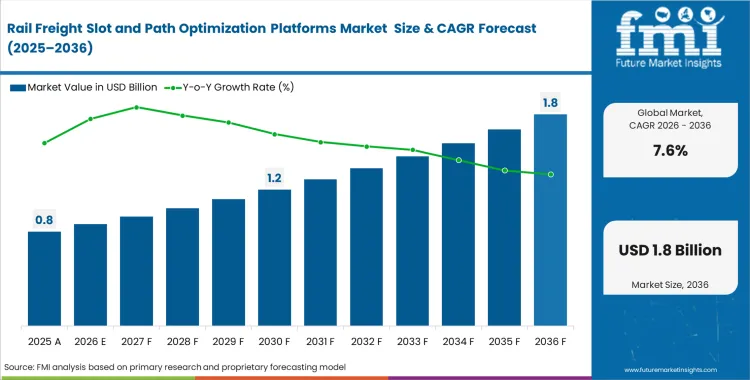
The rail freight slot and path optimization platforms market was valued at USD 0.7 billion in 2025. Demand analysis is poised to cross USD 0.8 Billion in 2026 at a CAGR of 7.6% during the forecast period. Strong funding supports market income growth to USD 1.6 billion through 2036 as infrastructure owners mandate algorithmic conflict resolution for high-density mixed traffic corridors.
Network dispatchers face immediate operational consequences when cross-border bulk trains fail to meet their assigned time windows. With passenger traffic increasing on shared rail networks, reliance on manual adjustments to train schedules is no longer practical. Delays in adopting algorithm-based scheduling systems result in capacity rejections and, in turn, lost cargo volumes. Sourcing directors prioritize freight rail infrastructure tools integrating natively with existing signaling workflows over standalone modules. Organizations seeking rail freight path optimization software demand precise physics-based modeling.
Summary of Rail Freight Slot and Path Optimization Platforms Market
- The market is estimated at USD 0.7 billion in 2025.
- The market is projected to reach USD 1.6 billion by 2036.
- The market is expected to grow at a CAGR of 7.6% from 2026 to 2036.
- The forecast period represents an incremental opportunity of USD 0.8 billion.
- Cloud deployment leads the segment with a 56.0% share.
- Path allocation dominates the function segment with a 31.0% share.
- Infrastructure managers are the leading buyers with a 38.0% share.
- Mainline freight leads the rail network type segment with a 44.0% share.
- License-based revenue models dominate with a 47.0% share.
- India (9.2%), Poland (8.8%), and UAE (8.5%) are among the fastest-growing markets.
- Key companies in the market include Tracsis, Wabtec, Hitachi Rail, Alstom, Siemens Mobility, Optym, and MERMEC.
The market is fragmented, which indicates that no single vendor leads globally across all freight pathing, slotting, and rail-capacity orchestration use cases.
The implementation of centralized traffic control centers is reshaping how capacity is allocated across the network. Once owners upgrade physical signaling to digital blocks, automated freight management systems become mandatory. Legacy dispatch boards fail instantly when block distances shrink, forcing operators into predictive rail freight conflict detection software.
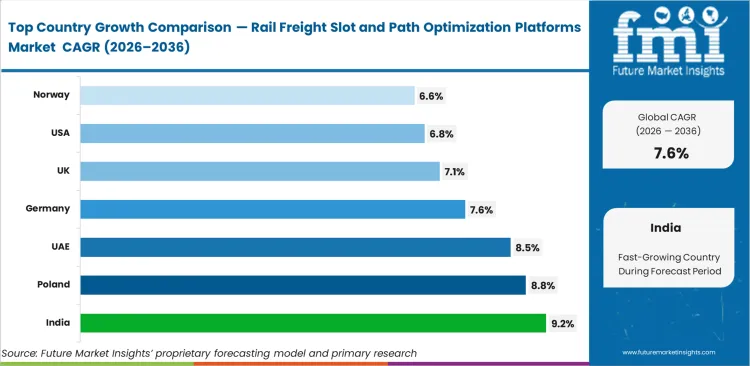
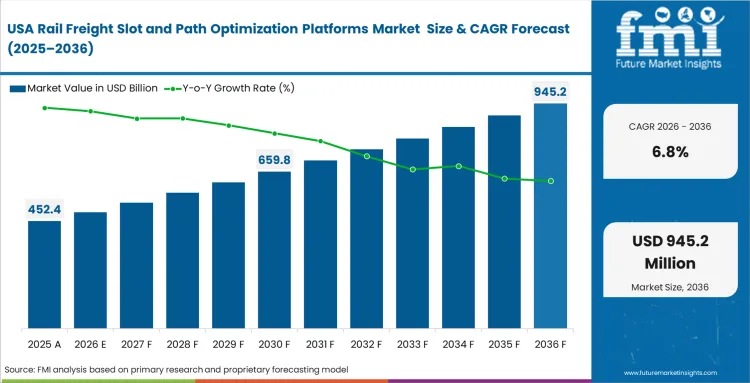
India is estimated to grow at a CAGR of 9.2% through 2036, supported by software adoption tied to dedicated freight corridor optimization and the separation of bulk freight from passenger traffic. Poland is projected to post 8.8% CAGR during the forecast period as rising European transit volumes continue to shift through bypass networks. Industry growth in the United Arab Emirates is likely to reach 8.5% CAGR, driven by greenfield rail launches that require automation from the outset. Germany is expected to record 7.6% CAGR through 2036 as rail operators integrate TTR-compatible capacity planning software. Margin discipline across privatized rail operations is keeping the United Kingdom on a 7.1% growth path, while precision scheduled railroading pressures support 6.8% CAGR in the United States. Norway is anticipated to expand at a CAGR of 6.6% by 2036, reflecting continued investment in software tools that help manage persistent single-track bottlenecks.
Segmental Analysis
Rail Freight Slot and Path Optimization Platforms Market Analysis by Deployment
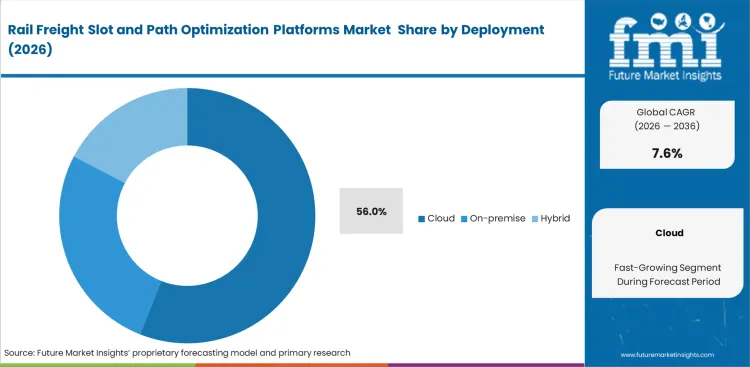
Cloud architecture is steadily replacing localized server infrastructure as cross-border rail operations demand real-time coordination and shared visibility across multiple agencies. By 2026, cloud-based models are anticipated to account for 56.0% share of deployments, largely driven by national rail authorities that require synchronized handover protocols at international junctions. IT procurement leaders within corridor management organizations increasingly mandate off-premise hosting to support broader digital transformation integration with neighboring rail networks.
- Multi-agency visibility: A shared architectural framework allows national operators to monitor inbound train movements simultaneously, enabling terminal managers to allocate shunting resources well in advance of arrival.
- Security protocol alignment: Centralized hosting enforces uniform cybersecurity standards across all participating freight entities, reducing the burden on compliance teams that would otherwise need to audit numerous independent on-premise systems.
- Scalability bottlenecks: As network complexity grows, so does the computational demand for advanced routing calculations. Cloud infrastructure allows IT teams to scale capacity instantly, avoiding the delays associated with procuring and deploying physical hardware.
Rail Freight Slot and Path Optimization Platforms Market Analysis by Function
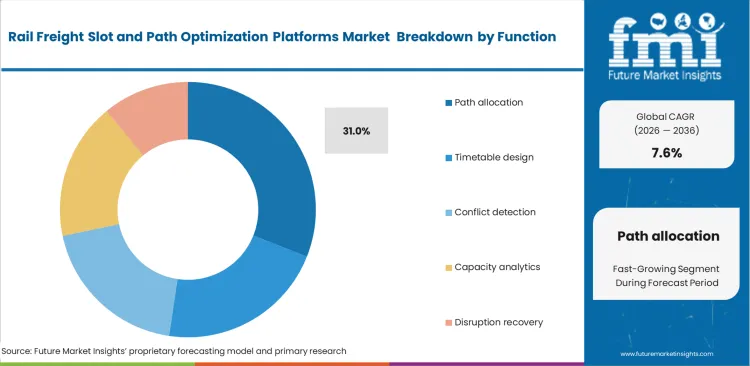
Daily dispatch decisions continue to revolve around the practical mechanics of track assignment. At the core, path allocation serves as the primary commercial lever for infrastructure owners, shaping how capacity is distributed and monetized across the network. Capacity directors rely on freight management software to allocate access rights in a structured manner among competing private operators. Path allocation is estimated to hold 31.0% share in 2026, reflecting its role as the central unit of value in rail network utilization. The act of assigning specific track space and time windows directly translates into toll-based revenue generation. A persistent limitation in conventional assignment systems: many fail to capture fine-grained variations in train performance, particularly the acceleration differences between heavy bulk freight and faster intermodal services.
- Commercial tolling: Accurate slot allocation enables granular, time-based billing for track usage, allowing financial teams to extract revenue even from short, previously unused intervals.
- Conflict prediction: Advanced algorithms evaluate millions of routing permutations to detect potential conflicts before dispatch, enabling operators to resolve overlaps ahead of execution and avoid congestion.
- Recovery sequencing: Modern disruption management systems can recalculate national timetables within seconds following infrastructure failures, helping operations teams restore service flow while minimizing cumulative delays.
Rail Freight Slot and Path Optimization Platforms Market Analysis by Buyer
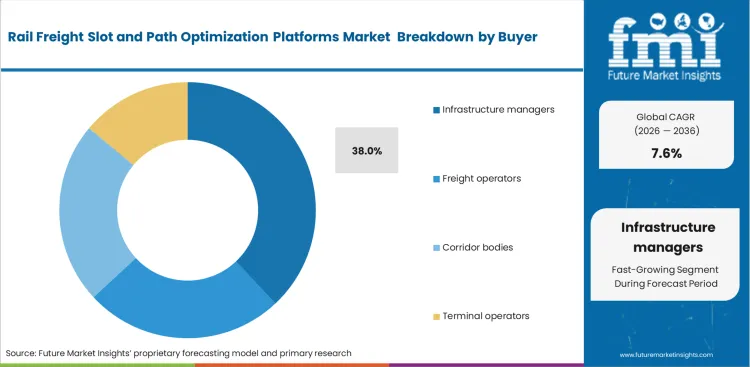
Control over physical track access ultimately determines the technical and operational framework for the wider rail ecosystem. Infrastructure managers hold a structurally dominant position, directly influencing freight transport management protocols and the rules governing capacity allocation. Infrastructure managers are anticipated to hold 38.0% share in 2026, underscoring their central role in technology adoption decisions. Buyers consistently favor solutions backed by proven safety validation and long-standing certification, often placing these ahead of algorithmic sophistication. Vendors offering technically superior routing capabilities can still be excluded if they lack an established safety pedigree. Private rail operators must therefore ensure their internal systems remain fully compatible with the standardized capacity allocation platforms mandated by infrastructure owners.
- Hardware deferral: Optimization tools draw additional capacity from existing signaling systems, allowing finance teams to defer major investments in track expansion and related infrastructure.
- Maintenance synchronization: Infrastructure managers can allocate defined maintenance windows, enabling engineering teams to complete repairs without interrupting revenue-generating train flows.
- Operator compliance: Private freight operators are required to submit capacity requests in standardized digital formats, with any interoperability gaps increasing the risk of rejection and operational disruption.
Rail Freight Slot and Path Optimization Platforms Market Analysis by Rail network type
High-volume freight corridors place the greatest operational strain on scheduling systems, making them a true test of algorithmic reliability. These mainline routes handle the bulk of long-distance cargo movement and require precise coordination across varying train speeds and load profiles. Mainline freight is expected to hold 44.0% share in 2026, reflecting its dominance in overall tonnage throughput. Network operations directors rely on route optimization software to manage sequencing over extended distances, ensuring that slower heavy-haul trains and faster services can coexist without disruption.
Maintaining continuous movement is critical, as frequent stops lead to significant kinetic energy losses, especially for fully loaded trains. A structural gap that often goes unaccounted for, inefficiencies originating within classification yards. Yardmasters operating outside centralized mainline systems may release trains ahead of or behind schedule, undermining carefully optimized dispatch plans. Aligning decision-making between yard-level operations and mainline controllers remains essential to achieving consistent corridor performance.
- Kinetic energy preservation: Continuous flow scheduling minimizes unnecessary braking and acceleration, allowing heavy trains to retain momentum on gradients and significantly reduce fuel consumption.
- Passenger segregation: Mixed-traffic management systems identify narrow operating windows between high-frequency passenger services, enabling freight trains to be inserted without affecting commuter schedules.
- Border handover: Cross-border operations depend on tightly synchronized arrival times to match locomotive and crew availability in adjoining countries, preventing congestion at interchange points.
Rail Freight Slot and Path Optimization Platforms Market Analysis by Revenue model
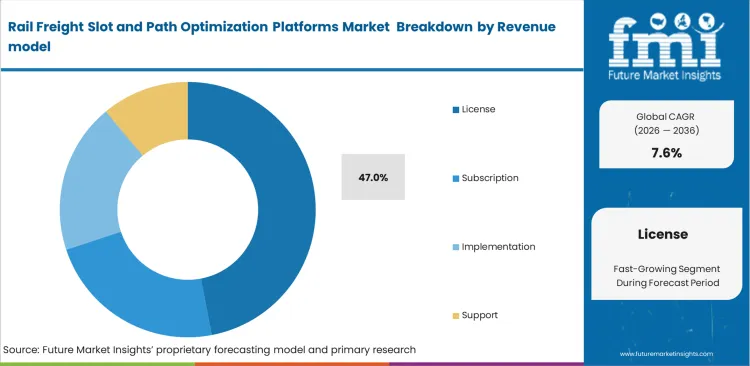
License models are estimated to hold 47.0% share in 2026, aligning closely with multi-year government funding cycles. A growing limitation in this model perpetual licenses often lock organizations into static optimization frameworks, while cloud-based alternatives continue to evolve. Chief technology officers find that these fixed systems become computationally outdated, as newer algorithms deliver faster and more efficient processing. The cost of upgrading or replacing legacy on-premise platforms can ultimately exceed the investment required for continuously updated subscription-based solutions. This approach ensures that critical supply chain visibility systems remain operational even during periods of budget constraint.
- Capital budget alignment: One-time licensing fits within structured national investment cycles, allowing financial planners to manage expenditures without exposure to fluctuating annual subscription costs.
- Sovereign control: Full ownership of software enables government and defense agencies to audit routing logic for security risks, ensuring there are no external vulnerabilities within critical infrastructure systems.
- Upgrade friction: Organizations operating on perpetual licenses often delay updates due to internal validation requirements, leaving systems running on outdated versions with reduced capability in areas such as conflict detection.
Rail Freight Slot and Path Optimization Platforms Market Drivers, Restraints, and Opportunities
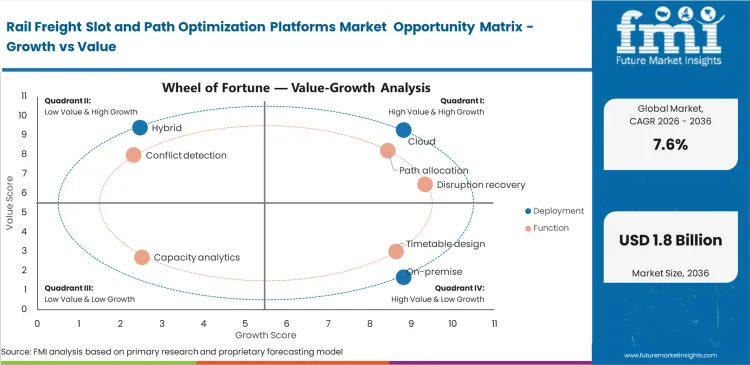
Track saturation forces capacity directors to extract hidden margins from existing block sections using computational simulations. Corridor bodies face immediate commercial penalties when cross-border bulk trains miss allocated windows. Operators cannot rely on manual graph adjustments while passenger traffic expands on shared networks. Delaying algorithmic scheduling adoption directly translates into rejected capacity requests and forfeited cargo volume. Procurement directors prioritize tools integrating natively with existing signaling workflows. Surging rail freight demand requires software to perform complex mathematical planning on aging infrastructure.
Inaccurate physical track geometry data prevents software from calculating realistic schedules. Network operators frequently upload legacy track databases containing dangerous inaccuracies regarding gradient metrics and precise block lengths. Upgrading mathematical solvers without digitizing underlying infrastructure geometry simply creates perfect schedules for fictional networks. Operations directors must fund expensive LIDAR mapping projects to verify track realities before freight rail scheduling software can accurately predict stopping distances. Aligning this technology requires integration far beyond standalone freight management software limits.
Opportunities in Rail Freight Slot and Path Optimization Platforms Market
- First-mile integration: Interfacing mainline scheduling with first mile logistics platforms prevents trains departing yards partially empty. Terminal operators maximize train length utilization using best rail timetable optimization platforms for freight rail.
- Maritime port synchronization: Linking train arrival algorithms directly to waterway transportation schedules reduces container dwell time on docks. Supply chain directors eliminate unnecessary storage fees.
- Predictive maintenance mapping: Overlaying track degradation models onto daily routing schedules allows repair crews early access. Connecting with a rail freight scheduling platform implementation partner secures track blocks proactively without causing unexpected freight delays.
Regional Analysis
Based on regional analysis, Rail Freight Slot and Path Optimization Platforms is segmented into North America, Latin America, Europe, Asia Pacific, and Middle East and Africa across 40 plus countries.
.webp "Top Country Growth Comparison Rail Freight Slot And Path Optimization Platforms Market Cagr (2026 2036)")
| Country | CAGR (2026 to 2036) |
|---|---|
| India | 9.2% |
| Poland | 8.8% |
| United Arab Emirates | 8.5% |
| Germany | 7.6% |
| United Kingdom | 7.1% |
| United States | 6.8% |
| Norway | 6.6% |
Source: Future Market Insights (FMI) analysis, based on proprietary forecasting model and primary research
Europe Rail Freight Slot and Path Optimization Platforms Market Analysis
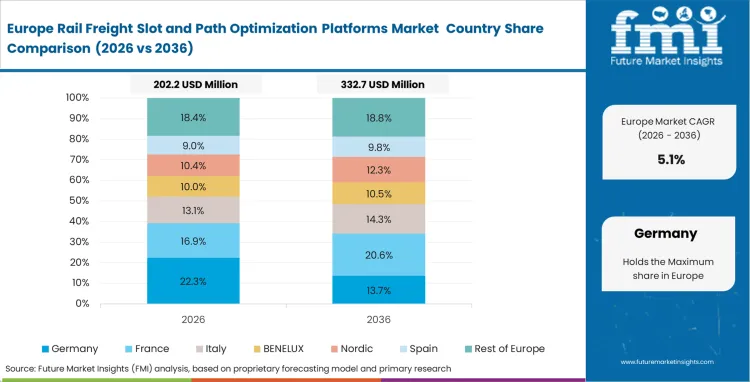
Standardized capacity request workflows are increasingly shaping software architecture across national rail systems. Interoperability requirements are pushing infrastructure managers to adopt consistent data formats, enabling real-time visibility across cross-border and multimodal shipment visibility. Sourcing teams place primary emphasis on compliance with European Train Control System specifications before even considering optimization speed or algorithmic performance. Modernization efforts are largely directed toward ensuring freight routing can operate efficiently within densely utilized passenger networks without breaching safety constraints. Vendors that fail to meet interoperability certification standards are effectively excluded from large-scale public tenders. Deploying cross-border freight path coordination platforms becomes essential to ensure smooth operational handovers between national systems.
- Poland: The rail capacity planning and timetabling software market in Poland is expected to hold a 8.8% CAGR, supported by operators who win high‑value transit contracts by consistently meeting cross‑border arrival commitments. Poland is seeing some of the clearest pressure points in rail freight planning as international transit volumes increasingly divert onto bypass corridors. Regional dispatch teams no longer rely on manual train graphing because the margin for error around industrial hubs has disappeared. Capacity directors now use predictive rail capacity planning and timetable optimization software to manage border‑to‑border flows and avoid gridlock.
- Germany: In Germany, TTR‑aligned capacity planning has moved beyond pilot programs and into everyday operations. Country’s rail capacity planning software sector is anticipated to capture a 7.6% CAGR, as network owners require timetable simulations that can accommodate maintenance windows, seasonal freight peaks, and commercial train paths without conflict. Signaling and planning teams use these systems to test schedule changes before they reach live traffic. The objective is straightforward: move more freight across existing corridors rather than wait years for new infrastructure to come online.
- United Kingdom: The United Kingdom’s privatized rail structure forces operators to justify every minute of network access they request. Network owners reject paths aggressively, pushing fleet and planning managers to rely on software models that validate submissions through hard calculations rather than negotiation. Industry outlook for rail timetabling and path allocation software in the UK is estimated to hold a 7.1% CAGR during the forecast, tied directly to cost‑control strategies that reduce locomotive idle time and improve asset utilization across constrained corridors. These tools give operators factual grounds to challenge refusals and resubmit paths with confidence.
- Norway: Norway’s rail network leaves little room for improvisation. Long single‑track stretches mean one poorly timed meet can ripple across the system for hours. Dispatchers depend on conflict detection and meet‑pass optimization modules to sequence heavy timber and mineral trains safely around passenger services. The Norwegian rail capacity planning software segment is anticipated to capture a 6.6% CAGR by 2036, largely because infrastructure managers use these systems to postpone expensive double‑tracking projects without compromising reliability.
FMI’s report includes France, Italy, Spain, and Sweden, where European regulations that penalize delayed cross‑border handovers are forcing state railways to fund scheduling modernization even when internal budgets are tight. In the Czech Republic, rising east‑west freight flows are pushing infrastructure managers to sharpen timetable precision around manufacturing clusters linked to Germany and Austria.
Asia Pacific Rail Freight Slot and Path Optimization Platforms Market Analysis
Rapid infrastructure expansion is beginning to exceed the practical limits of manual dispatching. Newly developed heavy-haul corridors are being designed with built-in requirements for freight forwarding software to manage extremely high tonnage volumes. Planners are introducing entirely new scheduling frameworks tailored to the operational realities of kilometer-long bulk trains. FMI’s analysis suggests that software providers must move beyond standard European operating logic and recalibrate their models to reflect the distinct braking behavior and handling characteristics of large regional train configurations.
- India: India’s dedicated freight corridors have changed the economics of train planning within a short timeframe. Freight density continues to rise, and interchange points now handle volumes that manual dispatch methods cannot manage. The rail capacity planning and scheduling software industry in India reflects a 9.2% CAGR, as chief dispatchers implement automated pathing to keep slow bulk trains segregated from faster intermodal services. Terminal and port operators rely on accurate arrival sequencing to clear yards and reduce downstream congestion.
FMI’s report includes China, Japan, Australia, and South Korea, where rapid electrification programs are changing locomotive performance characteristics and forcing capacity planners to recalculate traction and braking profiles within routing software on a continual basis. In Thailand, heavy investment in electrified freight corridors linked to port and industrial zone development is increasing reliance on advanced planning systems to manage mixed‑traffic operations.
Americas and Middle East Rail Freight Slot and Path Optimization Platforms Market Analysis
Precision scheduled railroading is driving the use of longer train consists operating on tightly controlled intervals. Operations directors rely on railway telematics data to feed continuous, real-time position updates into conflict resolution systems, allowing for more responsive decision-making. The emphasis has shifted from simply accommodating trains within fixed slots to maximizing overall asset velocity across the network. Scheduling platforms in these markets function less as public coordination tools and more as mechanisms to improve operating margins for private rail operators. The adoption of advanced train path allocation software for freight operators is therefore closely tied to efforts aimed at increasing network throughput and efficiency within privately managed systems.
- United Arab Emirates: The United Arab Emirates approaches rail planning from a different starting point. With greenfield networks coming online, operators are free of legacy timetables and entrenched operating habits. The UAE rail planning software sector is expected to capture a 8.5% CAGR, as logistics directors design schedules digitally from the outset, aligning port departure windows with inland terminal capacity using rule‑based planning tools. Early adoption of fully automated corridor design across freight‑only networks has shaped operating practices well before traffic reaches scale.
- United States: In the United States, private railroads focus less on adding track and more on extracting velocity from what they already own. Long single‑track sections and oversized train consists make meet‑pass precision a daily challenge. Dispatch commanders rely on predictive rail planning software to keep trains moving within crew hour limits and siding constraints. The USA rail capacity planning software market is estimated to hold a 6.8% CAGR by 2036, grounded in measurable savings from higher network fluidity rather than headline expansion projects.
FMI’s report includes Canada, Mexico, Brazil, and Saudi Arabia, where planning software must integrate directly with proprietary positive train control systems, raising technical barriers for new vendors. Turkey is seeing increased momentum as east-west freight corridors expand and operators attempt to align legacy signaling with newer control systems.
Competitive Aligners for Market Players
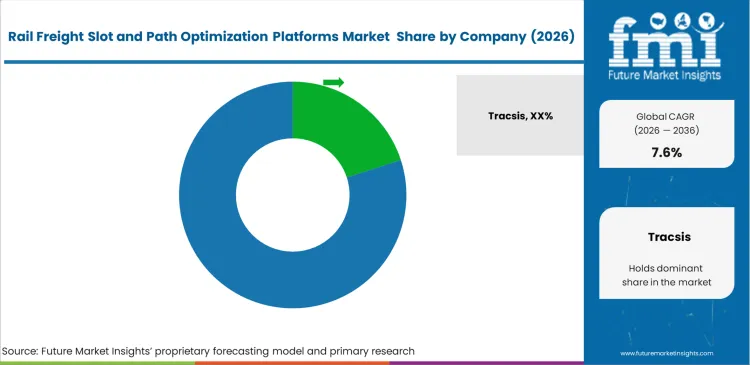
National track owners require absolute proof of safety before deploying any scheduling software. Procurement teams evaluate algorithmic reliability within smart railways architecture and ignore basic interface upgrades. Tracsis and Siemens Mobility secure contracts by utilizing decades of local signaling experience to satisfy complex national safety rules. Alstom bypasses standalone software tenders entirely by bundling optimization platforms into large hardware modernization deals. Evaluating the rail freight optimization software key players means measuring actual physical hardware integration capabilities. Track operators refuse to authorize routing platforms lacking proven safety logic on live rails.
Established signaling firms hold a structural advantage tied directly to legacy traffic management systems. Hitachi Rail and Wabtec own the proprietary communication protocols running trackside relays. Controlling these protocols prevents software startups from interacting with the rail network. Companies have to negotiate partnerships with these hardware incumbents to execute basic train control commands. A mathematically perfect schedule provides no operational value if the rail traffic management systems fail to transmit route commands to the physical track switches. Hardware access remains the primary barrier to entry.
Infrastructure managers recognize this hardware constraint and push back against vendor lock-in. Procurement directors mandate open communication standards and discard closed platforms during initial vendor reviews. Buyers force vendors to demonstrate automotive logistics integrations to prove their system architecture is flexible enough to communicate with outside platforms. True competitive separation happens during unexpected network outages. When rail freight path optimization software vendors instantly recalculate national timetables after a track failure, they secure long-term contract renewals. Dispatchers prioritize system resilience over fractional gains in daily routing efficiency.
Key Players in Rail Freight Slot and Path Optimization Platforms Market
- Tracsis
- Wabtec
- Hitachi Rail
- Alstom
- Siemens Mobility
- Optym
- MERMEC
Scope of the Report
| Metric | Value |
|---|---|
| Quantitative Units | USD 0.78 Billion to USD 1.62 Billion, at a CAGR of 7.60% |
| Market Definition | Enterprise software suites orchestrating train movement schedules calculate conflict-free routing paths using infrastructure constraints and mathematical models. |
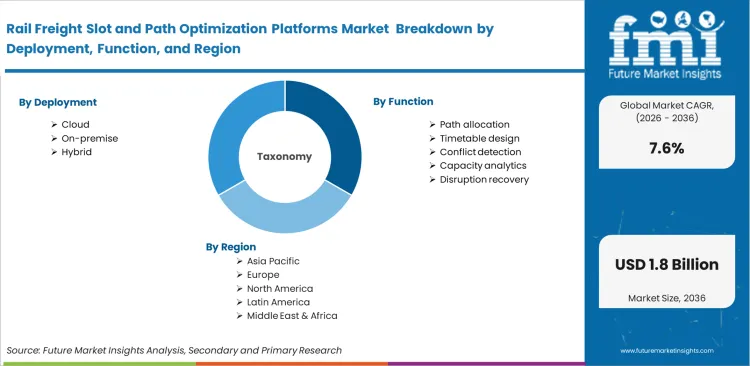
| Segmentation | Deployment, Function, Buyer, Rail network type, Revenue model |
| Regions Covered | North America, Latin America, Europe, Asia Pacific, Middle East and Africa |
| Countries Covered | India, Poland, United Arab Emirates, Germany, United Kingdom, United States, Norway |
| Key Companies Profiled | Tracsis, Wabtec, Hitachi Rail, Alstom, Siemens Mobility, Optym, MERMEC |
| Forecast Period | 2026 to 2036 |
| Approach | Track-kilometer density metrics and annual path request volumes established baseline software adoption rates. |
Source: Future Market Insights (FMI) analysis, based on proprietary forecasting model and primary research
Rail Freight Slot and Path Optimization Platforms Market Analysis by Segments
Deployment
- Cloud
- On-premise
- Hybrid
Function
- Path allocation
- Timetable design
- Conflict detection
- Capacity analytics
- Disruption recovery
Buyer
- Infrastructure managers
- Freight operators
- Corridor bodies
- Terminal operators
Rail network type
- Mainline freight
- Cross-border corridors
- Dedicated corridors
- Mixed traffic
Revenue model
- License
- Subscription
- Implementation
- Support
Region
- North America
- United States
- Canada
- Latin America
- Brazil
- Mexico
- Europe
- Germany
- United Kingdom
- France
- Italy
- Spain
- Poland
- Norway
- Sweden
- Asia Pacific
- China
- Japan
- India
- Australia
- South Korea
- Middle East and Africa
- United Arab Emirates
- Saudi Arabia
Bibliography
- Alstom. (2025, March 31). Alstom to modernise rail traffic control system for the Poznań freight bypass in Poland. Alstom.
- DB InfraGO. (2024). Capacity Strategy 2028. DB InfraGO.
- European Commission. (2025, July 30). Commission Staff Working Document accompanying the proposal for a regulation on the use of railway infrastructure capacity in the single European railway area. European Commission.
- Federal Railroad Administration. (2025, February 24). Freight Rail Overview. USA Department of Transportation.
- Li, S., Zhang, Y., & colleagues. (2024). Freight train line planning for large-scale high-speed rail network: An integer Benders decomposition-based branch-and-cut algorithm. Transportation Research Part E: Logistics and Transportation Review.
- Press Information Bureau. (2026, January 14). Railways sets new record in freight movement. Government of India.
This bibliography is provided for reader reference. The full FMI report contains the complete reference list with primary source documentation.
This Report Addresses
- Track saturation forces driving predictive software adoption among infrastructure managers.
- Algorithmic differences required for scheduling heavy bulk trains versus intermodal services.
- Software compliance barriers dictated by national rail signaling regulations.
- Cloud hosting vulnerabilities regarding mission-critical traffic management systems.
- Strategic consequences for private haulers relying on manual path requests.
- Kinetic energy modeling requirements for mainline corridor optimization.
- Hardware deferral strategies enacted by finance directors utilizing algorithmic efficiency.
- Disruption recovery sequence calculations following localized track failures.
Frequently Asked Questions
What is the baseline valuation for software tracking?
Values reached USD 0.72 Billion in 2025. Software tools transitioned from optional planning accessories to mandatory operational requirements as track density increased on shared networks.
Why does cloud deployment capture 56.0% share?
Multi-agency data sharing demands centralized architecture. Corridor managers require instant visibility into neighboring country operations, making localized on-premise servers commercially obsolete for international transit routes.
How does path allocation function commercially?
Algorithms assigning specific track usage windows generate direct tolling revenue for track owners. Minute-by-minute billing accuracy ensures finance controllers capture maximum value from previously hidden capacity gaps.
What structural differences exist between India and Poland?
India implements automated scheduling to coordinate massive dedicated heavy-haul corridors separating bulk from passenger trains. Poland deploys software to manage extreme transit volume shifting through specific international bypass arteries.
Why do infrastructure managers dictate platform technical standards?
Track owners hold ultimate authority over physical access rights. Private operators must adopt compliant software formats to interface successfully with national capacity portals or face immediate path request rejection.
What operational risk hides within perpetual license models?
Organizations owning static legacy software face rapid algorithmic obsolescence. Chief technology officers discover mathematical solving techniques evolve weekly, rendering expensive five-year-old perpetual licenses incapable of handling modern mixed-traffic density.
How does kinetic modeling alter timetable design?
Basic algorithms assume uniform locomotive performance across all train types. Integrating actual physics prevents perfectly calculated schedules from collapsing when heavy bulk trains struggle on steep physical gradients.
Why do passenger networks drive freight software adoption?
Mixed-traffic corridors require exact scheduling to slide slow bulk cargo between high-speed commuter intervals. Dispatchers utilize micro-second calculations to prevent freight trains from causing systemic passenger delays.
What prevents startups from disrupting legacy vendors?
Incumbents hold proprietary communication protocols governing trackside interlocking hardware. New software cannot execute physical track changes without partnering with established signaling giants possessing deep safety certification histories.
How do terminal operators benefit from mainline software?
Integrating yard management systems with inbound pathing algorithms reduces container dwell times. Shunting crews prepare specific tracks hours before mainline arrival, minimizing localized congestion.
What structural friction delays software implementation?
Legacy track databases contain inaccurate gradient and block length measurements. Applying advanced mathematical solvers to flawed physical data generates dangerous schedules requiring expensive infrastructure verification mapping.
Why is disruption recovery a separate software module?
Recalculating an entire national timetable following a track failure requires massive instant computational power. Recovery commanders rely on specialized algorithms to restore normal service rhythms while minimizing total delay minutes.
How do cross-border corridors impact scheduling?
International handovers require precise arrival timing to match foreign locomotive and crew availability. Coordinators utilize software to prevent massive heavy-haul trains from stacking up at national boundaries.
What role does safety certification play during procurement?
Buyers prioritize decade-long safety validation pedigrees over raw algorithmic speed. Superior mathematical routing models frequently lose national tenders if vendors lack established physical signaling experience.
Why do some regions prefer capital expenditure software funding?
State-backed monolithic rail entities operate on strict five-year budget cycles. Financial planners prefer purchasing perpetual software licenses to avoid unpredictable annual subscription fee increases during government funding freezes.
How does precision scheduled railroading affect tool usage?
Operators focus on maximizing asset velocity across vast transcontinental arteries. Software tracks extremely long consists to ensure precise meet-and-pass coordination at undersized rural sidings.
What commercial consequences face delayed path requesters?
Manual train graph adjustments fail when competing for limited peak-hour slots. Operations directors relying on outdated scheduling methods suffer immediate path rejections and forfeit lucrative transit contracts.
Why is hardware deferral a primary purchase motivation?
Algorithmic optimization squeezes extra capacity out of existing signaling block sections. Network owners avoid funding massive concrete and steel capacity upgrades by simply routing traffic more intelligently.
How does hybrid deployment mitigate operational risks?
Centralized cloud servers fail during localized internet outages. Buyers evaluating hybrid structures maintain critical dispatching continuity by switching to localized backup servers when external data links sever.
What specific metric validates software adoption rates?
Track-kilometer density metrics combined with annual path request volumes establish accurate baseline penetration. Analysts cross-reference vendor recurring revenue against national infrastructure capital expenditure budgets.
How do algorithms synchronize maintenance with commercial traffic?
Track owners reserve specific engineering windows without halting revenue generation. Software calculates exact safe intervals for repair crews to occupy track sections between scheduled heavy-haul passes.
Why must yard operations integrate with mainline logic?
Yardmasters releasing trains manually destroy carefully calculated mainline sequences. Connecting localized departure decisions directly into regional control models remains mandatory for true corridor efficiency.
Preview the report firsthand - request a free sample
Get SampleGet the brochure for pricing and purchase details.
Get PDFTable of Content
- Executive Summary
- Global Market Outlook
- Demand-side Trends
- Supply-side Trends
- Technology Roadmap Analysis
- Analysis and Recommendations
- Market Overview
- Market Coverage / Taxonomy
- Market Definition / Scope / Limitations
- Research Methodology
- Chapter Orientation
- Analytical Lens and Working Hypotheses
- Market Structure, Signals, and Trend Drivers
- Benchmarking and Cross-market Comparability
- Research Design and Evidence Framework
- Desk Research Programme (Secondary Evidence)
- Company Annual and Sustainability Reports
- Peer-reviewed Journals and Academic Literature
- Corporate Websites, Product Literature, and Technical Notes
- Earnings Decks and Investor Briefings
- Statutory Filings and Regulatory Disclosures
- Technical White Papers and Standards Notes
- Trade Journals, Industry Magazines, and Analyst Briefs
- Conference Proceedings, Webinars, and Seminar Materials
- Government Statistics Portals and Public Data Releases
- Press Releases and Reputable Media Coverage
- Specialist Newsletters and Curated Briefings
- Sector Databases and Reference Repositories
- FMI Internal Proprietary Databases and Historical Market Datasets
- Subscription Datasets and Paid Sources
- Social Channels, Communities, and Digital Listening Inputs
- Additional Desk Sources
- Expert Input and Fieldwork (Primary Evidence)
- Primary Modes
- Qualitative Interviews and Expert Elicitation
- Quantitative Surveys and Structured Data Capture
- Blended Approach
- Why Primary Evidence is Used
- Field Techniques
- Interviews
- Surveys
- Presidents and Vice Presidents
- R&D and Innovation Heads
- Technical Specialists
- Domain Subject-matter Experts
- Scientists
- Physicians and Other Healthcare Professionals
- Governance, Ethics, and Data Stewardship
- Research Ethics
- Data Integrity and Handling
- Primary Modes
- Tooling, Models, and Reference Databases
- Desk Research Programme (Secondary Evidence)
- Data Engineering and Model Build
- Data Acquisition and Ingestion
- Cleaning, Normalisation, and Verification
- Synthesis, Triangulation, and Analysis
- Quality Assurance and Audit Trail
- Market Background
- Market Dynamics
- Drivers
- Restraints
- Opportunity
- Trends
- Scenario Forecast
- Demand in Optimistic Scenario
- Demand in Likely Scenario
- Demand in Conservative Scenario
- Opportunity Map Analysis
- Product Life Cycle Analysis
- Supply Chain Analysis
- Investment Feasibility Matrix
- Value Chain Analysis
- PESTLE and Porter’s Analysis
- Regulatory Landscape
- Regional Parent Market Outlook
- Production and Consumption Statistics
- Import and Export Statistics
- Market Dynamics
- Global Market Analysis 2021 to 2025 and Forecast, 2026 to 2036
- Historical Market Size Value (USD Million) Analysis, 2021 to 2025
- Current and Future Market Size Value (USD Million) Projections, 2026 to 2036
- Y-o-Y Growth Trend Analysis
- Absolute $ Opportunity Analysis
- Global Market Pricing Analysis 2021 to 2025 and Forecast 2026 to 2036
- Global Market Analysis 2021 to 2025 and Forecast 2026 to 2036, By Deployment
- Introduction / Key Findings
- Historical Market Size Value (USD Million) Analysis By Deployment , 2021 to 2025
- Current and Future Market Size Value (USD Million) Analysis and Forecast By Deployment , 2026 to 2036
- Cloud
- On-premise
- Hybrid
- Cloud
- Y-o-Y Growth Trend Analysis By Deployment , 2021 to 2025
- Absolute $ Opportunity Analysis By Deployment , 2026 to 2036
- Global Market Analysis 2021 to 2025 and Forecast 2026 to 2036, By Function
- Introduction / Key Findings
- Historical Market Size Value (USD Million) Analysis By Function, 2021 to 2025
- Current and Future Market Size Value (USD Million) Analysis and Forecast By Function, 2026 to 2036
- Path allocation
- Timetable design
- Conflict detection
- Capacity analytics
- Disruption recovery
- Path allocation
- Y-o-Y Growth Trend Analysis By Function, 2021 to 2025
- Absolute $ Opportunity Analysis By Function, 2026 to 2036
- Global Market Analysis 2021 to 2025 and Forecast 2026 to 2036, By Buyer
- Introduction / Key Findings
- Historical Market Size Value (USD Million) Analysis By Buyer, 2021 to 2025
- Current and Future Market Size Value (USD Million) Analysis and Forecast By Buyer, 2026 to 2036
- Infrastructure managers
- Freight operators
- Corridor bodies
- Terminal operators
- Infrastructure managers
- Y-o-Y Growth Trend Analysis By Buyer, 2021 to 2025
- Absolute $ Opportunity Analysis By Buyer, 2026 to 2036
- Global Market Analysis 2021 to 2025 and Forecast 2026 to 2036, By Revenue model
- Introduction / Key Findings
- Historical Market Size Value (USD Million) Analysis By Revenue model, 2021 to 2025
- Current and Future Market Size Value (USD Million) Analysis and Forecast By Revenue model, 2026 to 2036
- License
- Subscription
- Implementation
- Support
- License
- Y-o-Y Growth Trend Analysis By Revenue model, 2021 to 2025
- Absolute $ Opportunity Analysis By Revenue model, 2026 to 2036
- Global Market Analysis 2021 to 2025 and Forecast 2026 to 2036, By Region
- Introduction
- Historical Market Size Value (USD Million) Analysis By Region, 2021 to 2025
- Current Market Size Value (USD Million) Analysis and Forecast By Region, 2026 to 2036
- North America
- Latin America
- Western Europe
- Eastern Europe
- East Asia
- South Asia and Pacific
- Middle East & Africa
- Market Attractiveness Analysis By Region
- North America Market Analysis 2021 to 2025 and Forecast 2026 to 2036, By Country
- Historical Market Size Value (USD Million) Trend Analysis By Market Taxonomy, 2021 to 2025
- Market Size Value (USD Million) Forecast By Market Taxonomy, 2026 to 2036
- By Country
- USA
- Canada
- Mexico
- By Deployment
- By Function
- By Buyer
- By Revenue model
- By Country
- Market Attractiveness Analysis
- By Country
- By Deployment
- By Function
- By Buyer
- By Revenue model
- Key Takeaways
- Latin America Market Analysis 2021 to 2025 and Forecast 2026 to 2036, By Country
- Historical Market Size Value (USD Million) Trend Analysis By Market Taxonomy, 2021 to 2025
- Market Size Value (USD Million) Forecast By Market Taxonomy, 2026 to 2036
- By Country
- Brazil
- Chile
- Rest of Latin America
- By Deployment
- By Function
- By Buyer
- By Revenue model
- By Country
- Market Attractiveness Analysis
- By Country
- By Deployment
- By Function
- By Buyer
- By Revenue model
- Key Takeaways
- Western Europe Market Analysis 2021 to 2025 and Forecast 2026 to 2036, By Country
- Historical Market Size Value (USD Million) Trend Analysis By Market Taxonomy, 2021 to 2025
- Market Size Value (USD Million) Forecast By Market Taxonomy, 2026 to 2036
- By Country
- Germany
- UK
- Italy
- Spain
- France
- Nordic
- BENELUX
- Rest of Western Europe
- By Deployment
- By Function
- By Buyer
- By Revenue model
- By Country
- Market Attractiveness Analysis
- By Country
- By Deployment
- By Function
- By Buyer
- By Revenue model
- Key Takeaways
- Eastern Europe Market Analysis 2021 to 2025 and Forecast 2026 to 2036, By Country
- Historical Market Size Value (USD Million) Trend Analysis By Market Taxonomy, 2021 to 2025
- Market Size Value (USD Million) Forecast By Market Taxonomy, 2026 to 2036
- By Country
- Russia
- Poland
- Hungary
- Balkan & Baltic
- Rest of Eastern Europe
- By Deployment
- By Function
- By Buyer
- By Revenue model
- By Country
- Market Attractiveness Analysis
- By Country
- By Deployment
- By Function
- By Buyer
- By Revenue model
- Key Takeaways
- East Asia Market Analysis 2021 to 2025 and Forecast 2026 to 2036, By Country
- Historical Market Size Value (USD Million) Trend Analysis By Market Taxonomy, 2021 to 2025
- Market Size Value (USD Million) Forecast By Market Taxonomy, 2026 to 2036
- By Country
- China
- Japan
- South Korea
- By Deployment
- By Function
- By Buyer
- By Revenue model
- By Country
- Market Attractiveness Analysis
- By Country
- By Deployment
- By Function
- By Buyer
- By Revenue model
- Key Takeaways
- South Asia and Pacific Market Analysis 2021 to 2025 and Forecast 2026 to 2036, By Country
- Historical Market Size Value (USD Million) Trend Analysis By Market Taxonomy, 2021 to 2025
- Market Size Value (USD Million) Forecast By Market Taxonomy, 2026 to 2036
- By Country
- India
- ASEAN
- Australia & New Zealand
- Rest of South Asia and Pacific
- By Deployment
- By Function
- By Buyer
- By Revenue model
- By Country
- Market Attractiveness Analysis
- By Country
- By Deployment
- By Function
- By Buyer
- By Revenue model
- Key Takeaways
- Middle East & Africa Market Analysis 2021 to 2025 and Forecast 2026 to 2036, By Country
- Historical Market Size Value (USD Million) Trend Analysis By Market Taxonomy, 2021 to 2025
- Market Size Value (USD Million) Forecast By Market Taxonomy, 2026 to 2036
- By Country
- Kingdom of Saudi Arabia
- Other GCC Countries
- Turkiye
- South Africa
- Other African Union
- Rest of Middle East & Africa
- By Deployment
- By Function
- By Buyer
- By Revenue model
- By Country
- Market Attractiveness Analysis
- By Country
- By Deployment
- By Function
- By Buyer
- By Revenue model
- Key Takeaways
- Key Countries Market Analysis
- USA
- Pricing Analysis
- Market Share Analysis, 2025
- By Deployment
- By Function
- By Buyer
- By Revenue model
- Canada
- Pricing Analysis
- Market Share Analysis, 2025
- By Deployment
- By Function
- By Buyer
- By Revenue model
- Mexico
- Pricing Analysis
- Market Share Analysis, 2025
- By Deployment
- By Function
- By Buyer
- By Revenue model
- Brazil
- Pricing Analysis
- Market Share Analysis, 2025
- By Deployment
- By Function
- By Buyer
- By Revenue model
- Chile
- Pricing Analysis
- Market Share Analysis, 2025
- By Deployment
- By Function
- By Buyer
- By Revenue model
- Germany
- Pricing Analysis
- Market Share Analysis, 2025
- By Deployment
- By Function
- By Buyer
- By Revenue model
- UK
- Pricing Analysis
- Market Share Analysis, 2025
- By Deployment
- By Function
- By Buyer
- By Revenue model
- Italy
- Pricing Analysis
- Market Share Analysis, 2025
- By Deployment
- By Function
- By Buyer
- By Revenue model
- Spain
- Pricing Analysis
- Market Share Analysis, 2025
- By Deployment
- By Function
- By Buyer
- By Revenue model
- France
- Pricing Analysis
- Market Share Analysis, 2025
- By Deployment
- By Function
- By Buyer
- By Revenue model
- India
- Pricing Analysis
- Market Share Analysis, 2025
- By Deployment
- By Function
- By Buyer
- By Revenue model
- ASEAN
- Pricing Analysis
- Market Share Analysis, 2025
- By Deployment
- By Function
- By Buyer
- By Revenue model
- Australia & New Zealand
- Pricing Analysis
- Market Share Analysis, 2025
- By Deployment
- By Function
- By Buyer
- By Revenue model
- China
- Pricing Analysis
- Market Share Analysis, 2025
- By Deployment
- By Function
- By Buyer
- By Revenue model
- Japan
- Pricing Analysis
- Market Share Analysis, 2025
- By Deployment
- By Function
- By Buyer
- By Revenue model
- South Korea
- Pricing Analysis
- Market Share Analysis, 2025
- By Deployment
- By Function
- By Buyer
- By Revenue model
- Russia
- Pricing Analysis
- Market Share Analysis, 2025
- By Deployment
- By Function
- By Buyer
- By Revenue model
- Poland
- Pricing Analysis
- Market Share Analysis, 2025
- By Deployment
- By Function
- By Buyer
- By Revenue model
- Hungary
- Pricing Analysis
- Market Share Analysis, 2025
- By Deployment
- By Function
- By Buyer
- By Revenue model
- Kingdom of Saudi Arabia
- Pricing Analysis
- Market Share Analysis, 2025
- By Deployment
- By Function
- By Buyer
- By Revenue model
- Turkiye
- Pricing Analysis
- Market Share Analysis, 2025
- By Deployment
- By Function
- By Buyer
- By Revenue model
- South Africa
- Pricing Analysis
- Market Share Analysis, 2025
- By Deployment
- By Function
- By Buyer
- By Revenue model
- USA
- Market Structure Analysis
- Competition Dashboard
- Competition Benchmarking
- Market Share Analysis of Top Players
- By Regional
- By Deployment
- By Function
- By Buyer
- By Revenue model
- Competition Analysis
- Competition Deep Dive
- Tracsis
- Overview
- Product Portfolio
- Profitability by Market Segments (Product/Age /Sales Channel/Region)
- Sales Footprint
- Strategy Overview
- Marketing Strategy
- Product Strategy
- Channel Strategy
- Wabtec
- Hitachi Rail
- Alstom
- Siemens Mobility
- Optym
- MERMEC
- Tracsis
- Competition Deep Dive
- Assumptions & Acronyms Used


