

- Industry Size (2026)
- USD 0.64 Bn
- Forecast (2036)
- USD 2.52 Bn
- CAGR (2026 to 2036)
- 14.7%
Human-Robot Collaborative Picking Optimization Platforms Market Size, Market Forecast and Outlook By FMI
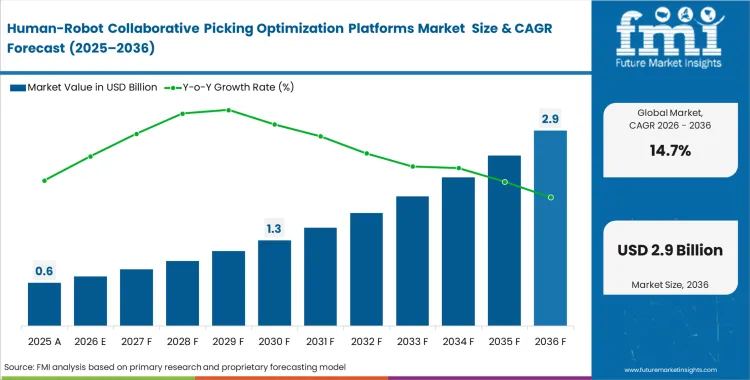
The human robot picking optimization market was valued at USD 0.56 billion in 2025. Revenue is poised to reach USD 0.64 billion in 2026 at a human robot picking market CAGR of 14.7% during the forecast period. Consistent investment carries cumulative valuation to USD 2.52 billion through 2036 as fulfilment centres transition from siloed hardware deployments to unified dynamic execution environments within the warehouse human robot collaboration software market.
Summary of Human-Robot Collaborative Picking Optimization Platforms Market
- Human-Robot Collaborative Picking Optimization Platforms Market Definition
- Algorithmic platforms designed specifically to coordinate, route, and balance tasks between human pickers and autonomous robotic fleets in real time.
- Demand Drivers in the Market
- Unpredictable order velocity forces fulfillment center directors to abandon static zoning protocols.
- Chronic labor shortages compel 3PL facility managers to extract maximum throughput from existing workforce pools.
- High fleet congestion rates push systems integrators to implement predictive spatial traffic management algorithms.
- Key Segments Analyzed in the FMI Report
- AMR orchestration is projected to capture 39.0% share in 2026, as a result of routing requirements across legacy distribution centers requiring robust AMR picking orchestration software market solutions.
- Cloud is expected to hold 58.0% share in 2026, as operators require continuous remote telemetry processing and algorithmic updating via warehouse picking optimization SaaS.
- E-commerce fulfillment is poised to hold 34.0% share in 2026, mandated by extreme peak-season volume fluctuations demanding collaborative picking optimization for e commerce fulfillment.
- Task orchestration is likely to command 31.0% share in 2026, representing the foundational logic layer for all hybrid operations and AMR task orchestration for piece picking.
- RaaS subscription is estimated to secure 46.0% share in 2026, lowering upfront capital barriers for mid-market logistics operators.
- India: 17.1% compound growth, anchored by massive greenfield e-commerce infrastructure investments.
- Analyst Opinion at FMI
- Rahul Pandita, Principal Analyst, Technology, at FMI, observes that, "Logistics executives evaluating collaborative picking platform trends assume deploying more robots linearly increases throughput. We expect that adding hardware without dynamic orchestration can exponentially increase spatial congestion, effectively trapping capital on the warehouse floor. A highly optimized fleet of fifty units coordinated seamlessly with human pickers consistently outperforms an uncoordinated fleet of two hundred. The true competitive advantage stems entirely from algorithms that predict human walking speeds and fatigue rates dynamically, allowing robots to intercept workers precisely when needed, rather than forcing humans to adapt to rigid machine pacing."
- Strategic Implications / Executive Takeaways
- Procurement heads must prioritize software integration capabilities over raw hardware specifications during vendor selection.
- Facility architects face immediate pressure to design aisle geometries supporting dynamic routing rather than static zone-picking.
- Supply chain vice presidents must move capital allocation toward continuous algorithmic tuning to protect initial robotic investments and ensure strong human robot picking platform ROI.
Key Takeaways
| Metric | Details |
|---|---|
| Industry Size (2026) | USD 0.64 billion |
| Industry Value (2036) | USD 2.52 billion |
| CAGR (2026 to 2036) | 14.7% |
Source: Future Market Insights (FMI) analysis, based on proprietary forecasting model and primary research
Operations directors currently face a distinct integration crisis where deploying more autonomous mobile units actively degrades human picker efficiency. This bottleneck forces warehouse managers to evaluate warehouse picking software for labour shortages to synchronise disparate fleet data with human labour profiles in real time, avoiding severe traffic congestion and stranded capital on the facility floor. FMI observes that pure routing algorithms fail without predictive models mapping individual picker fatigue rates across a shift. Linking warehouse robotics to wearable labour tracking metrics transforms raw throughput potential into actual shipped volume while fundamentally reducing picker walk time with AMRs.
Once algorithms accurately forecast picker walking paths dynamically rather than relying on static zonal averages, fleet throughput compounds automatically. This transition triggers immediate operational leverage because machines spend zero time waiting for human task completion. Pre-positioning logic shifts from simple batch grouping to localized spatial density management, a critical function of any warehouse picking orchestration platform market deployment.
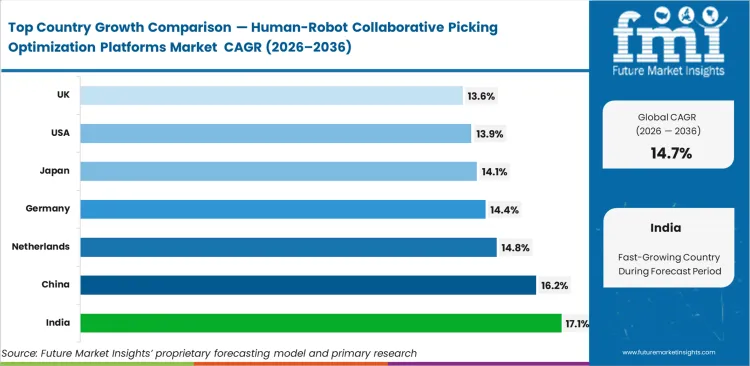
AMR picking software in India leads at 17.1%, as greenfield fulfilment expansion scales rapidly alongside massive e-commerce adoption. Collaborative warehouse picking in China tracks at 16.2% on the back of aggressive warehouse digitization and labour-intensive economics. Warehouse robotics software in the Netherlands and warehouse picking orchestration software in Germany advance at 14.8% and 14.4% respectively, supported by highly concentrated automation ecosystems. Japan progresses at 14.1% where workforce scarcity mandates deliberate brownfield deployment cycles. The United States and United Kingdom register 13.9% and 13.6% growth, respectively, as these regions focus heavily on software-led orchestration across established asset bases. Divergence across these hubs stems entirely from the ratio of algorithmic facility design versus legacy systems integration.
Definition
Software engines engineered to synchronize tasks between biological workers and autonomous fleets represent this core sector. These platforms ingest real-time telemetry, spatial data, and order profiles to dynamically assign actions, preventing congestion and maximizing throughput. They function as the connective intelligence layer sitting above base-level physical control systems within the broader collaborative picking optimization software market.
Inclusions
Pick path optimisation software for warehouses, real-time labour balancing software for warehouse picking, and hybrid fleet task allocation systems fall entirely within scope. APIs connecting these optimization engines to larger inventory management software frameworks require critical analysis. Exception management protocols that specifically govern interaction rules between human and robotic actors demand inclusion.
Exclusions
Physical hardware mechanisms like actual mobile chassis or mechanical gripping arms remain completely outside this boundary. Base-level facility management systems lacking real-time dynamic spatial orchestration capabilities are strictly omitted. Standalone labour tracking software without robotic integration features fails functional scope criteria.
Human-Robot Collaborative Picking Optimization Platforms Market Research Methodology
- Primary Research: Operations directors, robotics integration leads, and fulfillment center architects evaluating the best warehouse picking orchestration software.
- Desk Research: Technical API documentation, WMS integration whitepapers, and industrial automation patent registries detailing AI in collaborative warehouse picking.
- Market-Sizing and Forecasting: Paid software license volumes and enterprise-wide subscription run rates across tier-1 logistics providers.
- Data Validation and Update Cycle: Vendor financial filings cross-referenced against quarterly automation deployment metrics.
Segmental Analysis
Human-Robot Collaborative Picking Optimization Platforms Market Analysis by Platform Type
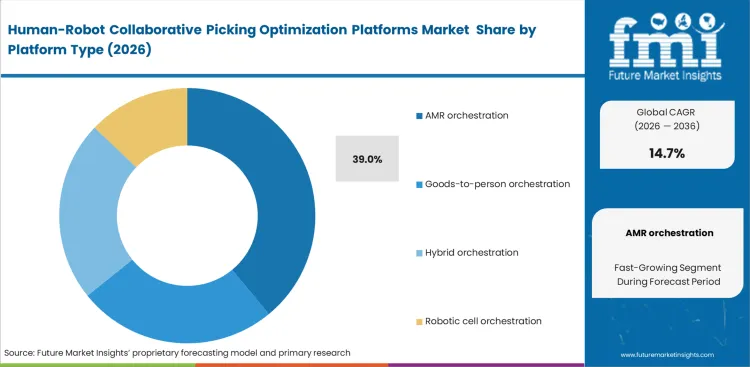
Legacy static allocation fails when autonomous units multiply across narrow warehouse aisles. AMR orchestration commands 39.0% share because it directly solves this resulting congestion crisis within the broader AMR picking orchestration software market. Fulfilment operations directors mandate this software layer to ensure expensive hardware assets generate promised returns. Purchasing these platforms allows managers to dynamically reroute machines away from highly trafficked human zones instantaneously. Facility leads delaying this integration face severe bottlenecks, where multi-million-dollar autonomous mobile robots sit idle waiting for path clearance. FMI's analysis indicates that vendor lock-in originates here. Once an algorithm learns a specific facility's unique traffic patterns, migrating to a competing platform resets months of machine learning optimization. Operators attempting to mix hardware fleets without a unified orchestration layer inevitably experience degraded overall facility throughput, driving some toward the distinct goods to person orchestration software market.
- Hardware-agnostic mapping: Base algorithms map physical topology independently of specific navigation protocols. Fleet managers avoid vendor silos by utilizing universal coordinate grids for spatial planning.
- Congestion heat-mapping: Software visualizes real-time traffic density across specific aisles during peak fulfillment hours. Shift supervisors utilize this dashboard to dynamically relocate personnel away from machine-heavy zones.
- Predictive path clearance: Platforms anticipate intersecting routes between biological workers and robotic units before physical encounters occur. Safety officers rely on these preventative calculations to address concerns around collaborative picking software safety and ergonomics.
Human-Robot Collaborative Picking Optimization Platforms Market Analysis by Deployment Model
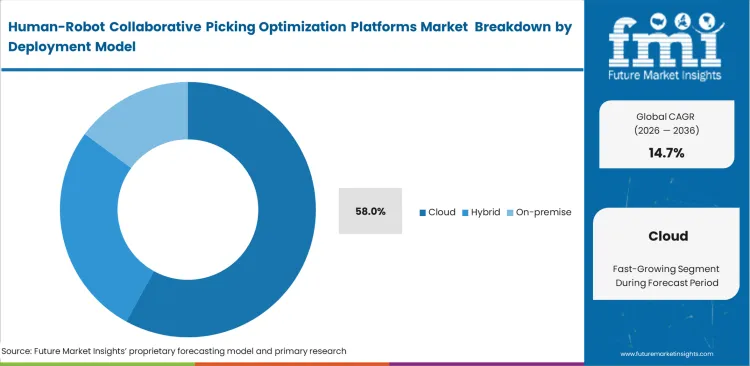
Enterprise architectures are moving rapidly toward decentralised computing to support massive telemetry streams. Cloud deployment captures 58.0% share as logistics providers abandon heavy on-premises server maintenance in favour of agile warehouse picking optimization SaaS. Chief Information Officers select these environments to facilitate continuous over-the-air algorithmic updates without interrupting active shift execution. Connecting local facility data to centralised mobile robotics software models accelerates machine learning accuracy across global supply networks. According to FMI's estimates, raw latency metrics matter less than the ability to instantly replicate successful routing logic from a Berlin facility to an Ohio distribution center. Technology buyers prioritizing physical servers eventually encounter severe processing limitations when coordinating fleets exceeding five hundred active units.
- Telemetry aggregation: Remote servers compile gigabytes of movement data generated hourly by active fleets. Data scientists leverage this centralized repository to train more efficient pathfinding models continuously.
- Over-the-air updates: Engineering teams push critical algorithm refinements directly to operational facilities simultaneously. IT directors eliminate costly weekend shutdown windows traditionally required for manual patching.
- Cross-facility learning: Routing optimizations discovered in one geographic location automatically propagate across an entire enterprise network. Supply chain vice presidents achieve standardized efficiency benchmarks regardless of localized constraints.
Human-Robot Collaborative Picking Optimization Platforms Market Analysis by Warehouse Type
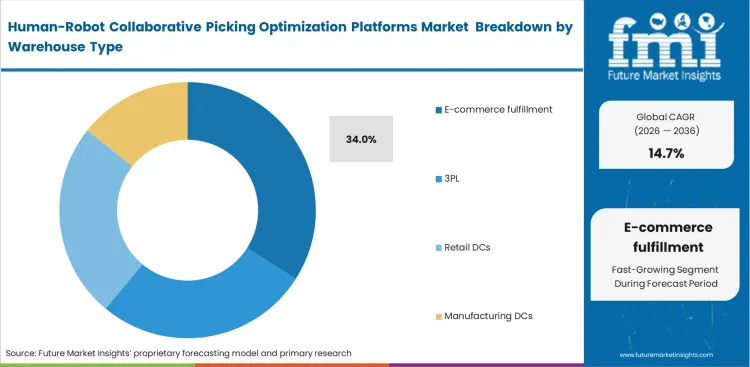
Extreme seasonal volume spikes constantly stress baseline labour capacity limits. E-commerce fulfilment accounts for 34.0% share directly due to these unpredictable consumers' purchasing cycles, cementing the need for collaborative picking optimization for e commerce fulfillment. Site directors deploy orchestration tools to seamlessly scale robotic assistance matching daily order velocity. This environment demands extreme flexibility because rigid wave-picking sequences collapse under modern next-day delivery guarantees. Facilities heavily reliant on temporary seasonal workers derive maximum value here, as algorithmic guidance completely eliminates new-hire training timelines. Competitors relying on static smart warehouse technologies without dynamic human-machine balancing cannot survive holiday volume surges profitably, a reality also driving investment in collaborative picking software for 3PL warehouses and specialized robotic picking orchestration for retail DCs.
- Volume spike adaptation: Algorithms instantly redistribute task ratios between machine fetchers and human pickers during promotional sales events. Operations managers avoid chaotic floor conditions by letting software govern velocity limits.
- Temporary worker integration: Intuitive interface prompts guide inexperienced seasonal hires through complex multi-order batches flawlessly. Training coordinators reduce onboarding duration from two weeks to three days using algorithmic pacing.
- Returns processing sync: Reverse logistics workflows require specialized manual inspection steps coordinated with autonomous transport. Quality control supervisors maintain processing speed by sequencing delivery precisely to inspection station availability.
Human-Robot Collaborative Picking Optimization Platforms Market Analysis by Core Function
Supply chain architects must fundamentally choose how work assignments are distributed across hybrid teams. Task orchestration holds 31.0% share because it acts as the primary neurological center for facility operations, particularly within AMR task orchestration for piece picking. Industrial engineers implement this specific function to break massive incoming orders into perfectly sequenced micro-assignments. Linking human cognitive flexibility with machine travel endurance creates the ultimate cost-per-pick advantage. As per FMI's projection, algorithms that only calculate shortest-distance paths fail. Superior platforms actively calculate individual worker fatigue indices when assigning subsequent picks using advanced labour balancing software for warehouse picking. Failing to adopt intelligent task splitting leaves operators highly vulnerable to systemic supply chain management delays.
- Micro-assignment splitting: Complex customer orders fracture into tiny independent actions optimized for either transport or selection. Process engineers eliminate unnecessary walking distances by delegating all heavy transit to machines.
- Fatigue-aware allocation: Software actively monitors worker pace via wearable scanners to prevent physical exhaustion during twelve-hour shifts. Human resources directors utilize this pacing data to reduce workplace injury claims.
- Real-time priority shifting: Urgent express shipping orders automatically preempt standard tasks across all operational queues. Floor managers guarantee delivery cut-off times without manually intervening in standard flows, effectively providing seamless warehouse exception management with robots.
Human-Robot Collaborative Picking Optimization Platforms Market Analysis by Commercial Model
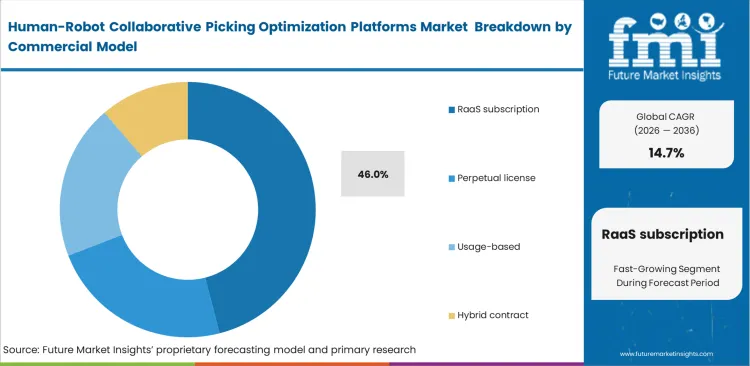
Securing board approval for multi-million-dollar capital expenditures frequently stalls modernization efforts. RaaS subscription leads with 46.0% share by successfully converting these daunting technological leaps into predictable operating expenses, heavily influencing collaborative picking software pricing models. Chief Financial Officers favor this structure because it perfectly aligns software costs with actual seasonal revenue generation, ensuring a measurable ROI model for human robot collaborative picking. This procurement strategy allows mid-tier regional distributors to access tier-one robotics as a service capabilities instantly. In FMI's view, perpetual licenses represent a massive hidden liability, as static codebases quickly become obsolete against rapidly evolving fleet hardware configurations. Companies delaying subscription transitions inevitably find their legacy architecture unable to interpret telemetry from next-generation mobile units.
- Opex conversion: Financial controllers eliminate massive upfront licensing fees from annual capital expenditure budgets. Finance departments closely align monthly platform costs directly against specific facility throughput metrics.
- Seasonal flex pricing: Billing parameters scale dynamically based on active unit counts during peak holiday periods. Procurement managers avoid paying for maximum system capacity during slower summer fulfillment months.
- Continuous feature access: Subscribers automatically receive advanced machine learning capabilities without negotiating separate upgrade contracts. IT procurement teams guarantee baseline technological parity with massive retail competitors.
Human-Robot Collaborative Picking Optimization Platforms Market Drivers, Restraints, and Opportunities
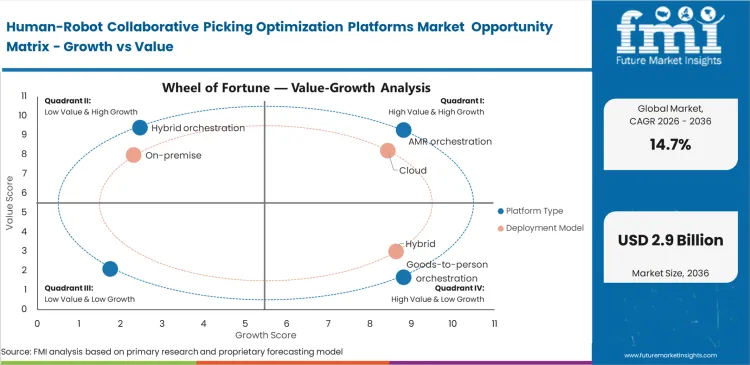
Chronic workforce scarcity forces logistics vice presidents to aggressively maximize productivity per square foot. Operations leads cannot physically hire enough personnel to meet modern next-day delivery volume requirements, elevating warehouse picking software for labour shortages to a critical boardroom priority. This reality demands warehouse design and layout configurations blending human dexterity with robotic endurance. Facilities failing to implement these coordination platforms face skyrocketing cost-per-pick metrics, effectively eroding tight fulfillment margins. Software orchestration provides the only viable mechanism to scale output without proportionally scaling headcount.
Legacy rigid architectural configurations create massive friction for immediate deployment. Integrating dynamic routing algorithms into deeply entrenched proprietary systems frustrates automation engineers endlessly, making warehouse orchestration software integration with WMS a primary operational hurdle. This technical debt slows adoption significantly because operators fear disrupting active revenue streams during complex software migrations. Current middleware solutions attempt to bridge this gap but often introduce unacceptable latency into real-time routing decisions, stretching the human robot picking deployment timeline beyond initial executive expectations.
Opportunities in the Human-Robot Collaborative Picking Optimization Platforms Market
- Micro-fulfillment integration: Urban facility managers deploy specialized micro fulfillment algorithms to coordinate hybrid picking within highly constrained retail footprints.
- Predictive maintenance linking: Maintenance directors synchronize fleet charging schedules with employee break periods to ensure maximum simultaneous operational uptime.
- Cold-storage adaptation: Engineering teams design extreme-environment task parameters to minimize biological exposure times while maximizing robotic transit inside frozen sectors.
Regional Analysis
Based on regional analysis, human-robot collaborative picking optimization platforms market is segmented into North America, Europe, Asia Pacific, Latin America, and Middle East & Africa across 40 plus countries.
.webp "Top Country Growth Comparison Human Robot Collaborative Picking Optimization Platforms Market Cagr (2026 2036)")
| Country | CAGR (2026 to 2036) |
|---|---|
| India | 17.1% |
| China | 16.2% |
| Netherlands | 14.8% |
| Germany | 14.4% |
| Japan | 14.1% |
| United States | 13.9% |
| United Kingdom | 13.6% |
Source: Future Market Insights (FMI) analysis, based on proprietary forecasting model and primary research
Asia Pacific Human-Robot Collaborative Picking Optimization Platforms Market Analysis
Prominent greenfield logistics infrastructure development fundamentally dictates operational strategies across this region. Supply chain directors possess the rare luxury of designing warehouse tug robots routing algorithms before pouring physical concrete. This blank-slate advantage accelerates software implementation because architects avoid navigating legacy technical debt. FMI analysts note that extreme labor intensity pushes operators to adopt hybrid orchestration models much earlier than western counterparts. Dense urban populations mandate extremely high-velocity fulfillment nodes, making pure manual operations mathematically impossible to scale profitably.
- India: India human-robot collaborative picking optimization platforms industry is projected to expand at a 17.1% CAGR from 2026 to 2036. Intensive e-commerce penetration drives tier-1 logistics providers to rapidly construct highly automated greenfield distribution nodes across major metropolitan perimeters. Third-party logistics operations managers rely on these algorithmic systems to manage highly variable workforce skill levels without sacrificing daily throughput. This rapid deployment velocity ultimately grants domestic operators significant localized cost advantages against international competitors attempting to enter the region with legacy manual fulfillment models.
- China: Unprecedented transaction volumes mandate algorithms mathematically capable of coordinating thousands of simultaneous human and mechanical actors within single facilities. Demand in the China human-robot collaborative picking optimization platforms industry is forecast to grow at a 16.2% CAGR over the ten-year assessment period. Shift directors actively rely on these integrated systems to maintain exact delivery windows during massive digital shopping festivals. Mastering these extreme peak-load capabilities establishes leading Chinese fulfillment operators as highly competitive global algorithm exporters across adjacent Asian supply networks.
- Japan: Severe demographic contractions force warehouse operators to extract maximum daily utility from an increasingly aging workforce without causing physical burnout. Operations planners deliberately deploy spatial orchestration infrastructure to explicitly minimize physical walking strain on senior employees during peak fulfillment cycles. This operational necessity positions the Japan human-robot collaborative picking optimization platforms segment toward an expected 14.1% CAGR through 2036, effectively accelerating completely autonomous picking transitions long-term while immediately preserving the active functional capacity of the current labor pool.
FMI's report includes detailed analysis of South Korea, Australia, and emerging Southeast Asian logistics hubs. Extreme variance in regional internet penetration directly correlates with advanced automation capital allocation.
Europe Human-Robot Collaborative Picking Optimization Platforms Market Analysis
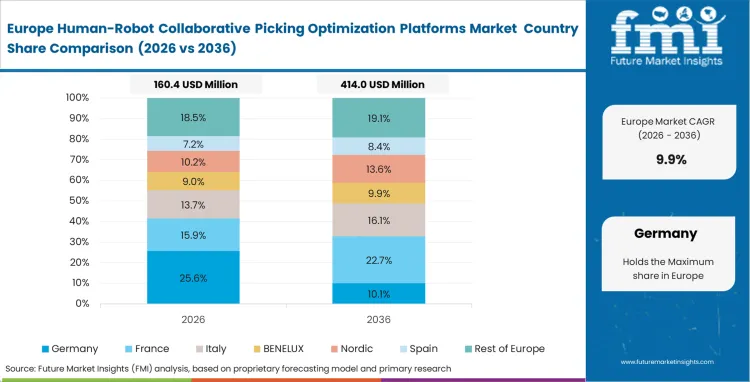
Stringent labor protection frameworks actively shape how automation interacts with biological workers here. Works council representatives explicitly require algorithms proving robotic integration reduces physical strain rather than just increasing output velocity. Compliance officers heavily scrutinize pathfinding protocols to ensure safe spatial buffers exist continuously. Based on FMI's assessment, operators treat these platforms primarily as ergonomic enhancement tools rather than pure displacement technologies. Dense cross-border shipping networks also demand highly standardized tracking systems across varying regulatory environments.
- Netherlands: Strategic port proximity creates incredibly dense, high-throughput commercial transit hubs that immediately overwhelm standard manual sorting capabilities. The Netherlands human-robot collaborative picking optimization platforms industry is anticipated to record a 14.8% CAGR during the forecast period. Facility managers heavily implement these orchestration engines to smoothly execute massive international freight breakdowns directly off incoming shipping channels. Successful port-adjacent algorithmic integration consistently yields highly lucrative long-term fulfillment contracts with global conglomerates demanding strict cross-border inventory visibility.
- Germany: Registering a projected 14.4% CAGR over the next decade, the Germany human-robot collaborative picking optimization platforms demand benefits heavily from an advanced industrial automation heritage. This background naturally creates a highly receptive operational environment for deploying sophisticated algorithmic controls across legacy supply chains. Systems engineers strategically integrate these routing engines directly into existing highly complex mechanical handling environments. This unparalleled engineering depth creates highly durable, battle-tested blueprints that multinational retail corporations eventually replicate across their broader European distribution networks.
- United Kingdom: Persistent cross-border shipping friction forces internal domestic supply networks to aggressively maximize localized operational efficiency within highly constrained real estate footprints. Retail fulfillment directors actively adopt these algorithmic routing layers to directly compensate for significantly reduced migrant labor pools traditionally utilized for peak season scaling. The United Kingdom human-robot collaborative picking optimization platforms industry is predicted to achieve a 13.6% CAGR through 2036. Mastering this domestic workforce constraint immediately opens permanent operational pathways for highly resilient localized distribution designs.
FMI's report includes France, Italy, Spain, and Nordic distribution networks. Sustainable energy mandates heavily influence how European operators schedule robotic charging cycles.
North America Human-Robot Collaborative Picking Optimization Platforms Market Analysis
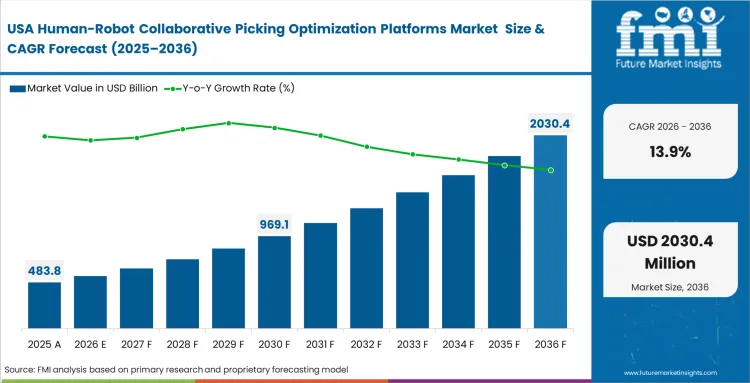
Massive established footprint modernization represents the primary challenge across vast continental networks. IT directors struggle to overlay cutting-edge predictive routing onto legacy monolithic management software. The sheer physical scale of these buildings requires highly robust logistics visibility software capable of tracking units across millions of square feet without signal degradation. FMI observes that venture capital backing heavily distorts localized software development cycles, producing rapid iteration speeds. Operators prioritize raw integration speed to combat fierce retail delivery monopolies.
- United States: Enormous consumer expectation for immediate next-day delivery places strain on aging national fulfillment architecture. Sector revenue within the United States human-robot collaborative picking optimization platforms segment is forecast to progress at a 13.9% CAGR between 2026 and 2036. Supply chain vice presidents implement these specific software engines to surgically eliminate persistent picking bottlenecks during volatile holiday volume surges. Connecting these dynamic routing layers directly to consumer-facing tracking applications radically improves terminal customer satisfaction scores while simultaneously capping expensive overtime labor expenditures across vast distribution networks.
FMI's report includes Canada and Mexico. Cross-border manufacturing integration requires software capable of handling bilingual interface requirements and shifting customs priorities.
Competitive Aligners for Market Players
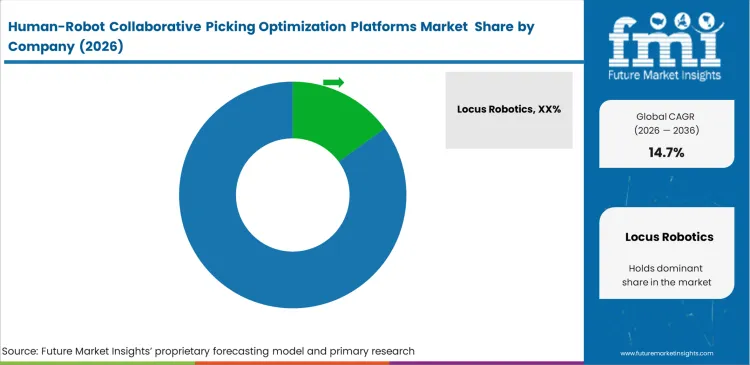
Intense software specialization defines the current operational battleground for leading developers. Locus Robotics and GreyOrange actively pivot away from pure hardware sales, focusing aggressively on proprietary orchestration logic as top human-robot picking optimization platform vendors. Supply chain executives evaluate these vendors based entirely on API flexibility and integration speed rather than mechanical chassis durability, directly seeking the best warehouse picking orchestration software. Real-world machine learning datasets provide massive competitive moats, as algorithms trained on millions of actual warehouse interactions vastly outperform theoretical models. New entrants struggle significantly to convince risk-averse facility directors to trust unproven routing engines during critical peak seasons.
Established incumbents possess deep, preexisting integrations with foundational enterprise resource planning software. Hai Robotics and Exotec leverage these established data pipelines to deploy supply chain analytics significantly faster than standalone startups. This API library constitutes a massive advantage because buyers demand plug-and-play functionality without requiring extensive custom coding. Challengers must build highly targeted, niche functionalities integrating AI in collaborative warehouse picking to bypass these entrenched vendor relationships. Buyers fundamentally resist replacing fully functioning core systems merely for marginal speed improvements.
Fulfillment conglomerates actively demand open-source architecture to prevent catastrophic vendor lock-in. Operations leaders continuously run pilot programs testing Geek+ and Swisslog platforms simultaneously within single facilities to ensure true interoperability, closely evaluating collaborative warehouse picking key players. This strategic multi-vendor approach forces developers to maintain universal communication standards or risk immediate enterprise rejection. Algorithms that seamlessly direct a Symbotic unit alongside a competitor's machine represent the ultimate strategic goal for major logistics buyers weighing their collaborative picking software implementation cost.
Key Players in Human-Robot Collaborative Picking Optimization Platforms Market
- Locus Robotics
- GreyOrange
- Hai Robotics
- Exotec
- Geek+
- Swisslog
- Symbotic
Scope of the Report
| Metric | Value |
|---|---|
| Quantitative Units | USD 0.64 billion to USD 2.52 billion, at a CAGR of 14.7% |
| Market Definition | Software engines engineered to synchronize tasks between biological workers and autonomous fleets, dynamically assigning actions to prevent congestion and maximize throughput. |
| Segmentation | Platform type, Deployment model, Warehouse type, Core function, Commercial model, and Region |
| Regions Covered | North America, Europe, Asia Pacific, Latin America, Middle East & Africa |
| Countries Covered | United States, Germany, United Kingdom, China, Japan, India, Netherlands |
| Key Companies Profiled | Locus Robotics, GreyOrange, Hai Robotics, Exotec, Geek+, Swisslog, Symbotic |
| Forecast Period | 2026 to 2036 |
| Approach | Paid software license volumes and enterprise-wide subscription run rates across tier-1 logistics providers |
Source: Future Market Insights (FMI) analysis, based on proprietary forecasting model and primary research
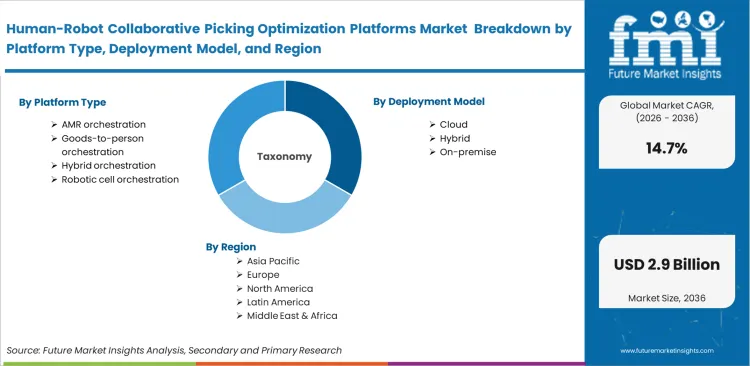
Human-Robot Collaborative Picking Optimization Platforms Market Analysis by Segments
Platform type:
- AMR orchestration
- Goods-to-person orchestration
- Hybrid orchestration
- Robotic cell orchestration
Deployment model:
- Cloud
- Hybrid
- On-premise
Warehouse type:
- E-commerce fulfillment
- 3PL
- Retail DCs
- Manufacturing DCs
Core function:
- Task orchestration
- Path optimization
- Labor balancing
- Exception management
- Slotting sync
Commercial model:
- RaaS subscription
- Perpetual license
- Usage-based
- Hybrid contract
Region:
- North America
- United States
- Canada
- Europe
- Germany
- United Kingdom
- France
- Italy
- Spain
- Russia
- Netherlands
- Asia Pacific
- China
- Japan
- India
- South Korea
- Australia
- Indonesia
- Malaysia
- Latin America
- Brazil
- Mexico
- Argentina
- Middle East & Africa
- GCC Countries
- South Africa
- Turkey
Bibliography
- Allard, M. D., & Keller, K. (2024, July). Keeping America moving: Employment in transportation and warehousing industries. USA Bureau of Labor Statistics.
- Fakhrai Rad, F., Oghazi, P., Onur, İ., & Kordestani, A. (2025). Adoption of AI-based order picking in warehouse: Benefits, challenges, and critical success factors. Review of Managerial Science, 19, 3495-3540.
- Hosseini, Z., Le Blanc, P. M., Demerouti, E., van Gool, P. J. R., van den Tooren, M., & Preenen, P. (2024). The impact of working with an automated guided vehicle on boredom and performance: An experimental study in a warehouse environment. International Journal of Production Research. Advance online publication.
- Keith, R., & La, H. M. (2024). Review of autonomous mobile robots for the warehouse environment. arXiv.
- National Institute of Standards and Technology. (2024). Internet of Things (IoT) Advisory Board (IoTAB) report. USA Department of Commerce.
- USA Census Bureau. (2026, March 10). Quarterly retail e-commerce sales: 4th quarter 2025. USA Department of Commerce.
This bibliography is provided for reader reference. The full FMI report contains the complete reference list with primary source documentation.
This Report Addresses
- Hardware-agnostic mapping impact on vendor lock-in avoidance
- Volume spike adaptation metrics across e-commerce fulfillment
- Congestion heat-mapping effectiveness during peak holiday seasons
- RaaS subscription capital expenditure conversion ratios
- Greenfield logistics algorithmic planning across tier-1 Indian cities
- Micro-assignment splitting efficiency against manual walking distances
- Over-the-air update implementation rates across global cloud deployments
- Predictive path clearance reductions regarding near-miss facility incidents
Frequently Asked Questions
What is a human robot collaborative picking optimization platform?
Software engines engineered to synchronize tasks between biological workers and autonomous fleets represent this core sector. These platforms ingest real-time telemetry, spatial data, and order profiles to dynamically assign actions, preventing congestion and maximizing throughput.
How do collaborative picking platforms work?
These platforms map physical facility topology and integrate with wearable employee trackers to create a dynamic digital twin. They process live incoming order data and assign transit tasks to autonomous units while directing humans to execute precise item selections.
Do human robot picking platforms replace workers?
These systems fundamentally augment existing labor pools rather than directly replacing staff. Algorithms calculate individual worker fatigue indices and dynamically match mechanical transit support to individual pacing, maximizing the output of the current workforce.
How much can collaborative picking software improve throughput?
Operations directors frequently record double or triple baseline metrics depending on prior manual inefficiency. The exact KPIs for warehouse picking orchestration software vary, but completely eliminating human travel time across massive facilities produces immediate margin improvements.
Explain the human robot collaborative picking optimization platform market in simple terms?
This sector provides the software brain that tells robots and humans how to work together in a warehouse without getting in each other's way. It calculates the fastest routes and assigns the heavy lifting to machines so humans only do the complex picking.
Which companies lead in collaborative picking optimization platforms?
Locus Robotics, GreyOrange, Hai Robotics, Exotec, Geek+, Swisslog, and Symbotic define the current competitive landscape. These vendors hold massive proprietary datasets tracking millions of actual human-machine interactions across global fulfillment centers.
What was the valuation of this sector in 2025?
Total revenue reached USD 0.56 billion in 2025. This baseline reflects initial enterprise adoption of routing software explicitly designed to prevent congestion between biological workers and growing mechanical fleets.
What is the projected value by 2036?
Cumulative revenue hits USD 2.52 billion by 2036. This expansion occurs as basic warehouse management systems prove fundamentally incapable of balancing real-time task loads without dedicated algorithmic orchestration layers.
Why does AMR orchestration lead the platform segment?
AMR orchestration captures 39.0% share because operators face immediate traffic gridlock when adding machines to narrow aisles. Orchestrating these specific units yields the fastest return on invested capital by eliminating hardware idle time.
Why is the cloud deployment model dominant?
Cloud environments secure 58.0% share due to massive telemetry processing requirements. Remote servers compile movement data across entire enterprise networks, allowing data scientists to push over-the-air machine learning refinements continuously.
How does task orchestration fundamentally shift warehouse logic?
Task orchestration commands 31.0% share by breaking orders into micro-assignments. The system delegates heavy transit strictly to machines while reserving human intervention exclusively for complex item selection.
Why are CFOs pushing for RaaS subscription models?
RaaS holds 46.0% share because it converts daunting technological software upgrades into predictable operating expenses. Finance teams match monthly subscription scaling directly against seasonal facility throughput metrics.
What causes India to outpace global growth rates?
India expands at 17.1% because intensive e-commerce penetration drives greenfield automated node construction. Facility architects design algorithms before pouring concrete, entirely avoiding legacy integration constraints.
How do Chinese operators utilize these platforms differently?
China tracks at 16.2% due to unprecedented holiday volume spikes requiring thousands of simultaneous actors. Chinese shift directors rely on algorithms to maintain exact delivery windows during extreme peak load conditions.
What constraint defines Japanese adoption?
Japan advances at 14.1% where severe demographic contractions force operators to minimize physical walking strain on senior employees. Algorithms deliberately prioritize ergonomic routing over pure velocity.
How do works councils influence European implementations?
European compliance officers heavily scrutinize pathfinding protocols to ensure safe spatial buffers exist. Operators deploy algorithms primarily as ergonomic enhancement tools proving robotic integration reduces human physical strain.
Why does the Netherlands outpace the broader European average?
The Netherlands grows at 14.8% because strategic port proximity creates high-throughput international transit hubs. Facility managers deploy software to smoothly orchestrate massive freight breakdowns directly off shipping channels.
What barrier restricts United States adoption speed?
The USA grows at 13.9% as IT directors struggle overlaying predictive routing onto legacy monolithic management software. The sheer physical scale of existing distribution centers complicates seamless telemetry transmission.
Preview the report firsthand - request a free sample
Get SampleGet the brochure for pricing and purchase details.
Get PDFTable of Content
- Executive Summary
- Global Market Outlook
- Demand-side Trends
- Supply-side Trends
- Technology Roadmap Analysis
- Analysis and Recommendations
- Market Overview
- Market Coverage / Taxonomy
- Market Definition / Scope / Limitations
- Research Methodology
- Chapter Orientation
- Analytical Lens and Working Hypotheses
- Market Structure, Signals, and Trend Drivers
- Benchmarking and Cross-market Comparability
- Market Sizing, Forecasting, and Opportunity Mapping
- Research Design and Evidence Framework
- Desk Research Programme (Secondary Evidence)
- Company Annual and Sustainability Reports
- Peer-reviewed Journals and Academic Literature
- Corporate Websites, Product Literature, and Technical Notes
- Earnings Decks and Investor Briefings
- Statutory Filings and Regulatory Disclosures
- Technical White Papers and Standards Notes
- Trade Journals, Industry Magazines, and Analyst Briefs
- Conference Proceedings, Webinars, and Seminar Materials
- Government Statistics Portals and Public Data Releases
- Press Releases and Reputable Media Coverage
- Specialist Newsletters and Curated Briefings
- Sector Databases and Reference Repositories
- FMI Internal Proprietary Databases and Historical Market Datasets
- Subscription Datasets and Paid Sources
- Social Channels, Communities, and Digital Listening Inputs
- Additional Desk Sources
- Expert Input and Fieldwork (Primary Evidence)
- Primary Modes
- Qualitative Interviews and Expert Elicitation
- Quantitative Surveys and Structured Data Capture
- Blended Approach
- Why Primary Evidence is Used
- Field Techniques
- Interviews
- Surveys
- Scientists
- Physicians and Other Healthcare Professionals
- Governance, Ethics, and Data Stewardship
- Research Ethics
- Data Integrity and Handling
- Primary Modes
- Tooling, Models, and Reference Databases
- Desk Research Programme (Secondary Evidence)
- Data Engineering and Model Build
- Data Acquisition and Ingestion
- Cleaning, Normalisation, and Verification
- Synthesis, Triangulation, and Analysis
- Quality Assurance and Audit Trail
- Market Background
- Market Dynamics
- Drivers
- Restraints
- Opportunity
- Trends
- Scenario Forecast
- Demand in Optimistic Scenario
- Demand in Likely Scenario
- Demand in Conservative Scenario
- Opportunity Map Analysis
- Product Life Cycle Analysis
- Supply Chain Analysis
- Investment Feasibility Matrix
- Value Chain Analysis
- PESTLE and Porter’s Analysis
- Regulatory Landscape
- Regional Parent Market Outlook
- Production and Consumption Statistics
- Import and Export Statistics
- Market Dynamics
- Global Market Analysis 2021 to 2025 and Forecast, 2026 to 2036
- Historical Market Size Value (USD Million) Analysis, 2021 to 2025
- Current and Future Market Size Value (USD Million) Projections, 2026 to 2036
- Y-o-Y Growth Trend Analysis
- Absolute $ Opportunity Analysis
- Global Market Pricing Analysis 2021 to 2025 and Forecast 2026 to 2036
- Global Market Analysis 2021 to 2025 and Forecast 2026 to 2036, By Platform Type
- Introduction / Key Findings
- Historical Market Size Value (USD Million) Analysis By Platform Type , 2021 to 2025
- Current and Future Market Size Value (USD Million) Analysis and Forecast By Platform Type , 2026 to 2036
- AMR orchestration
- Goods-to-person orchestration
- Hybrid orchestration
- Robotic cell orchestration
- AMR orchestration
- Y-o-Y Growth Trend Analysis By Platform Type , 2021 to 2025
- Absolute $ Opportunity Analysis By Platform Type , 2026 to 2036
- Global Market Analysis 2021 to 2025 and Forecast 2026 to 2036, By Deployment Model
- Introduction / Key Findings
- Historical Market Size Value (USD Million) Analysis By Deployment Model, 2021 to 2025
- Current and Future Market Size Value (USD Million) Analysis and Forecast By Deployment Model, 2026 to 2036
- Cloud
- Hybrid
- On-premise
- Cloud
- Y-o-Y Growth Trend Analysis By Deployment Model, 2021 to 2025
- Absolute $ Opportunity Analysis By Deployment Model, 2026 to 2036
- Global Market Analysis 2021 to 2025 and Forecast 2026 to 2036, By Warehouse Type
- Introduction / Key Findings
- Historical Market Size Value (USD Million) Analysis By Warehouse Type, 2021 to 2025
- Current and Future Market Size Value (USD Million) Analysis and Forecast By Warehouse Type, 2026 to 2036
- E-commerce fulfillment
- 3PL
- Retail DCs
- Manufacturing DCs
- E-commerce fulfillment
- Y-o-Y Growth Trend Analysis By Warehouse Type, 2021 to 2025
- Absolute $ Opportunity Analysis By Warehouse Type, 2026 to 2036
- Global Market Analysis 2021 to 2025 and Forecast 2026 to 2036, By Commercial Model
- Introduction / Key Findings
- Historical Market Size Value (USD Million) Analysis By Commercial Model, 2021 to 2025
- Current and Future Market Size Value (USD Million) Analysis and Forecast By Commercial Model, 2026 to 2036
- RaaS subscription
- Perpetual license
- Usage-based
- Hybrid contract
- RaaS subscription
- Y-o-Y Growth Trend Analysis By Commercial Model, 2021 to 2025
- Absolute $ Opportunity Analysis By Commercial Model, 2026 to 2036
- Global Market Analysis 2021 to 2025 and Forecast 2026 to 2036, By Region
- Introduction
- Historical Market Size Value (USD Million) Analysis By Region, 2021 to 2025
- Current Market Size Value (USD Million) Analysis and Forecast By Region, 2026 to 2036
- North America
- Latin America
- Western Europe
- Eastern Europe
- East Asia
- South Asia and Pacific
- Middle East & Africa
- Market Attractiveness Analysis By Region
- North America Market Analysis 2021 to 2025 and Forecast 2026 to 2036, By Country
- Historical Market Size Value (USD Million) Trend Analysis By Market Taxonomy, 2021 to 2025
- Market Size Value (USD Million) Forecast By Market Taxonomy, 2026 to 2036
- By Country
- USA
- Canada
- Mexico
- By Platform Type
- By Deployment Model
- By Warehouse Type
- By Commercial Model
- By Country
- Market Attractiveness Analysis
- By Country
- By Platform Type
- By Deployment Model
- By Warehouse Type
- By Commercial Model
- Key Takeaways
- Latin America Market Analysis 2021 to 2025 and Forecast 2026 to 2036, By Country
- Historical Market Size Value (USD Million) Trend Analysis By Market Taxonomy, 2021 to 2025
- Market Size Value (USD Million) Forecast By Market Taxonomy, 2026 to 2036
- By Country
- Brazil
- Chile
- Rest of Latin America
- By Platform Type
- By Deployment Model
- By Warehouse Type
- By Commercial Model
- By Country
- Market Attractiveness Analysis
- By Country
- By Platform Type
- By Deployment Model
- By Warehouse Type
- By Commercial Model
- Key Takeaways
- Western Europe Market Analysis 2021 to 2025 and Forecast 2026 to 2036, By Country
- Historical Market Size Value (USD Million) Trend Analysis By Market Taxonomy, 2021 to 2025
- Market Size Value (USD Million) Forecast By Market Taxonomy, 2026 to 2036
- By Country
- Germany
- UK
- Italy
- Spain
- France
- Nordic
- BENELUX
- Rest of Western Europe
- By Platform Type
- By Deployment Model
- By Warehouse Type
- By Commercial Model
- By Country
- Market Attractiveness Analysis
- By Country
- By Platform Type
- By Deployment Model
- By Warehouse Type
- By Commercial Model
- Key Takeaways
- Eastern Europe Market Analysis 2021 to 2025 and Forecast 2026 to 2036, By Country
- Historical Market Size Value (USD Million) Trend Analysis By Market Taxonomy, 2021 to 2025
- Market Size Value (USD Million) Forecast By Market Taxonomy, 2026 to 2036
- By Country
- Russia
- Poland
- Hungary
- Balkan & Baltic
- Rest of Eastern Europe
- By Platform Type
- By Deployment Model
- By Warehouse Type
- By Commercial Model
- By Country
- Market Attractiveness Analysis
- By Country
- By Platform Type
- By Deployment Model
- By Warehouse Type
- By Commercial Model
- Key Takeaways
- East Asia Market Analysis 2021 to 2025 and Forecast 2026 to 2036, By Country
- Historical Market Size Value (USD Million) Trend Analysis By Market Taxonomy, 2021 to 2025
- Market Size Value (USD Million) Forecast By Market Taxonomy, 2026 to 2036
- By Country
- China
- Japan
- South Korea
- By Platform Type
- By Deployment Model
- By Warehouse Type
- By Commercial Model
- By Country
- Market Attractiveness Analysis
- By Country
- By Platform Type
- By Deployment Model
- By Warehouse Type
- By Commercial Model
- Key Takeaways
- South Asia and Pacific Market Analysis 2021 to 2025 and Forecast 2026 to 2036, By Country
- Historical Market Size Value (USD Million) Trend Analysis By Market Taxonomy, 2021 to 2025
- Market Size Value (USD Million) Forecast By Market Taxonomy, 2026 to 2036
- By Country
- India
- ASEAN
- Australia & New Zealand
- Rest of South Asia and Pacific
- By Platform Type
- By Deployment Model
- By Warehouse Type
- By Commercial Model
- By Country
- Market Attractiveness Analysis
- By Country
- By Platform Type
- By Deployment Model
- By Warehouse Type
- By Commercial Model
- Key Takeaways
- Middle East & Africa Market Analysis 2021 to 2025 and Forecast 2026 to 2036, By Country
- Historical Market Size Value (USD Million) Trend Analysis By Market Taxonomy, 2021 to 2025
- Market Size Value (USD Million) Forecast By Market Taxonomy, 2026 to 2036
- By Country
- Kingdom of Saudi Arabia
- Other GCC Countries
- Turkiye
- South Africa
- Other African Union
- Rest of Middle East & Africa
- By Platform Type
- By Deployment Model
- By Warehouse Type
- By Commercial Model
- By Country
- Market Attractiveness Analysis
- By Country
- By Platform Type
- By Deployment Model
- By Warehouse Type
- By Commercial Model
- Key Takeaways
- Key Countries Market Analysis
- USA
- Pricing Analysis
- Market Share Analysis, 2025
- By Platform Type
- By Deployment Model
- By Warehouse Type
- By Commercial Model
- Canada
- Pricing Analysis
- Market Share Analysis, 2025
- By Platform Type
- By Deployment Model
- By Warehouse Type
- By Commercial Model
- Mexico
- Pricing Analysis
- Market Share Analysis, 2025
- By Platform Type
- By Deployment Model
- By Warehouse Type
- By Commercial Model
- Brazil
- Pricing Analysis
- Market Share Analysis, 2025
- By Platform Type
- By Deployment Model
- By Warehouse Type
- By Commercial Model
- Chile
- Pricing Analysis
- Market Share Analysis, 2025
- By Platform Type
- By Deployment Model
- By Warehouse Type
- By Commercial Model
- Germany
- Pricing Analysis
- Market Share Analysis, 2025
- By Platform Type
- By Deployment Model
- By Warehouse Type
- By Commercial Model
- UK
- Pricing Analysis
- Market Share Analysis, 2025
- By Platform Type
- By Deployment Model
- By Warehouse Type
- By Commercial Model
- Italy
- Pricing Analysis
- Market Share Analysis, 2025
- By Platform Type
- By Deployment Model
- By Warehouse Type
- By Commercial Model
- Spain
- Pricing Analysis
- Market Share Analysis, 2025
- By Platform Type
- By Deployment Model
- By Warehouse Type
- By Commercial Model
- France
- Pricing Analysis
- Market Share Analysis, 2025
- By Platform Type
- By Deployment Model
- By Warehouse Type
- By Commercial Model
- India
- Pricing Analysis
- Market Share Analysis, 2025
- By Platform Type
- By Deployment Model
- By Warehouse Type
- By Commercial Model
- ASEAN
- Pricing Analysis
- Market Share Analysis, 2025
- By Platform Type
- By Deployment Model
- By Warehouse Type
- By Commercial Model
- Australia & New Zealand
- Pricing Analysis
- Market Share Analysis, 2025
- By Platform Type
- By Deployment Model
- By Warehouse Type
- By Commercial Model
- China
- Pricing Analysis
- Market Share Analysis, 2025
- By Platform Type
- By Deployment Model
- By Warehouse Type
- By Commercial Model
- Japan
- Pricing Analysis
- Market Share Analysis, 2025
- By Platform Type
- By Deployment Model
- By Warehouse Type
- By Commercial Model
- South Korea
- Pricing Analysis
- Market Share Analysis, 2025
- By Platform Type
- By Deployment Model
- By Warehouse Type
- By Commercial Model
- Russia
- Pricing Analysis
- Market Share Analysis, 2025
- By Platform Type
- By Deployment Model
- By Warehouse Type
- By Commercial Model
- Poland
- Pricing Analysis
- Market Share Analysis, 2025
- By Platform Type
- By Deployment Model
- By Warehouse Type
- By Commercial Model
- Hungary
- Pricing Analysis
- Market Share Analysis, 2025
- By Platform Type
- By Deployment Model
- By Warehouse Type
- By Commercial Model
- Kingdom of Saudi Arabia
- Pricing Analysis
- Market Share Analysis, 2025
- By Platform Type
- By Deployment Model
- By Warehouse Type
- By Commercial Model
- Turkiye
- Pricing Analysis
- Market Share Analysis, 2025
- By Platform Type
- By Deployment Model
- By Warehouse Type
- By Commercial Model
- South Africa
- Pricing Analysis
- Market Share Analysis, 2025
- By Platform Type
- By Deployment Model
- By Warehouse Type
- By Commercial Model
- USA
- Market Structure Analysis
- Competition Dashboard
- Competition Benchmarking
- Market Share Analysis of Top Players
- By Regional
- By Platform Type
- By Deployment Model
- By Warehouse Type
- By Commercial Model
- Competition Analysis
- Competition Deep Dive
- Locus Robotics
- Overview
- Product Portfolio
- Profitability by Market Segments (Product/Age /Sales Channel/Region)
- Sales Footprint
- Strategy Overview
- Marketing Strategy
- Product Strategy
- Channel Strategy
- GreyOrange
- Hai Robotics
- Exotec
- Geek+
- Swisslog
- Symbotic
- Locus Robotics
- Competition Deep Dive
- Assumptions & Acronyms Used


